QUALITY CONTROL IN LUNG FUNCTION
TESTING
B.G. Cooper and A. K. Butterfield
Routine lung function tests (i.e. spirometry, lung volume and gas transfer) have been well established as sensitive indices of disease progression or response to
therapeutic interventions. However, the variability in some lung function measurements can be very high (>10%), unless high-quality measurements, excellent staff training and high-quality assurance processes are in place [1–8]. Clinical governance and clinical trial regulatory authorities are becoming increasingly aware of the need for safety studies using lung function measurements, hence the
importance of stringent quality control programmes is becoming more apparent.
There is often confusion over the difference between quality
assurance (QA) and quality control (QC). In lung function testing, QC covers the operational techniques and activities that are used to fulfil
requirements for quality. In other words, QC is used to verify that measured parameters using volume, flow or pressure measurements or gas analysis on equipment are of acceptable quality and that they are complete and correct.
QA refers to planned and systematic activities implemented to provide adequate confidence that the results will fulfil requirements for quality [9]. This comprises the implementation of a regular and frequent quality-control programme and specifically during lung function testing includes routine checks within patients’ tests that maximal efforts were made, that tests were repeatable and that technical or patient errors were identified or eliminated.
In real terms it is easier to consider QC as checking the quality of the equipment and the staff
Correspondence B. G. Cooper
Lung Investigation Unit 1st Floor Nuffield House Queen Elizabeth Site Metchley Park Road
University Hospital Birmingham NHS Foundation Trust
THE BUYERS’ GUIDE TO RESPIRATORY CARE PRODUCTS 25 performing the test, and QA as
checking that each set of tests performed adheres to international standards (e.g.,those of the European Respiratory Society (ERS)/American Thoracic Society (ATS)) [6-8].
A comprehensive QA programme will check staff, equipment and protocols. Errors introduced into the testing process by any of these elements can be minimised through vigilant application of training standards, equipment maintenance and by adhering to published protocols and international testing standards (e.g., ERS/ATS).
Head A: Laboratory quality assurance
Laboratory QA is designed to detect, reduce, and correct deficiencies in a laboratory’s internal analytical process prior to the release of patient results and to improve the quality of the results. QC is a measure of precision or how well the measurement system reproduces the same result over
time and under varying operating conditions.
A Levey–Jennings chart is a graph on which QC data is plotted to give a visual indication whether a laboratory test is working well [9]. The distance from the mean is measured in terms ofSD. Lines run across the graph at the mean, in addition to one, two and sometimes three SDeither side of the mean. This makes it easy to see how far a result deviates from the mean measured value.
QA covers all activities: design, development, production, installation, servicing,
documentation, verification and validation. This introduces the rules of “fit for purpose” and “do it right the first time”. It includes: the regulation of the quality of raw materials, assemblies, products and components; services related to production; and management, service routines and inspection processes.
QA processes should be applied as standard to any physiological measurement, no matter how
apparently simple the test (e.g. spirometry).
What quality control procedure should be followed?
Calibration
This is the checking of a measuring parameter (e.g.volume) with a traceable standard (e.g.3-L calibration syringe) and the adjustment of the measuring device to the exact value of the standard [10]. All calibration syringes should be checked with a certified syringe, which is itself re-checked annually, or every 2–3 yrs in less busy departments.
Verification
This is the checking of a measuring parameter (e.g.volume) with a traceable standard (e.g.3-L calibration syringe) without adjustment of the measuring device value. The object is to ensure that the measurement is within the tolerance of the device and does not vary beyond an acceptable level. This is often the case for
spirometers that have no calibration facility.
Simulation
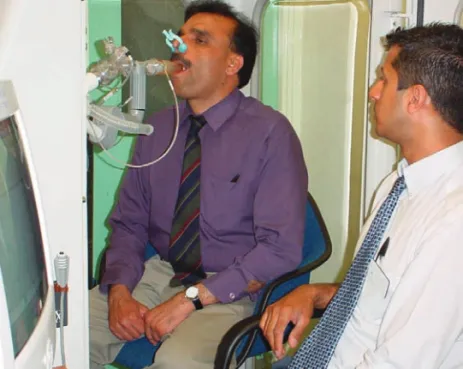
Simulation devices are becoming more common and are usually systems designed to mimic the actions of a patient. They can be referred to as “ghost patients” and can include a “ghost” volume (e.g. a calibration syringe “patient”) or Figure 1. Lung function testing (©ARTP).
gas transfer with samples of expired gases and controlled inspired and expired volumes. These simulators are now available commercially (e.g., from Hans Rudolph Inc., Kansas City, MO, USA) and can be sent around a number of labs every 2–3 months to check machine stability. They remove the “human error” part of the testing and monitor the technical performance of the equipment. Although, they can be criticised for not measuring exactly what a patient does because all gases are dry and cold from a cylinder rather warm and humidified from a subject, they have been shown to produce stable equipment readings over many months to years [11].
Biological control
The simplest way to monitor long-term QC is to perform regular tests on healthy subjects (or even stable patients) and check that inter-site within-subject variation is <5% over 1 yr.
Routinely, biological control (BioQC) can be measured every day, but it is usually every week. The greatest advantage is that if equipment is suspected of failing acutely, the BioQC subject can perform a quick test and see whether his or her measurements fall within the expected range of values. In this way it is often possible to detect patient error, volume or gas analysis faults or, more likely, some sort of leak on the system.
When to use quality control? QC should always be used by all clinical lung function services independent of location (primary care, secondary care, clinical trials, pharmacy testing, “high street screening”, etc.), the staff performing the test (clinical assistants, nurses, therapists, technologists, scientists or physicians, etc.) and the equipment (handheld spirometers, full lung function testing systems, research
equipment, etc.) being used. Quality standards should be no lower for physiological testing than they are for any biomedical diagnostic procedure. A hormone or metabolite sample not including a QC process would be deemed meaningless by a clinician or in a court of law! Lung function testing should have similar standards, otherwise cost-cutting will become quality-cutting – which is totally unacceptable.
Spirometry
Whenever a spirometry test is performed, it is essential that for each session (or even before each patient, if only one test is being completed) either a verification or calibration procedure is carried out.
Lung volumes
Lung volumes measured either by gas dilution (helium dilution technique or nitrogen washout technique) or body
plethysmography need careful consideration in terms of QC. BioQC should be performed on these systems and there is value in performing BioQC on both when present in the same department.
For gas dilution techniques, not only should volume measurements be verified/calibrated, but the gas analysers need to be assessed to ensure that they are accurate and have a linear response across their working range. Sometimes, when the equipment has an external inlet port, it is possible to perform a Figure 3. Gas transfer test simulator.
Figure 4. Biological control using lung function staff (©ARTP).
32 THE BUYERS’ GUIDE TO RESPIRATORY CARE PRODUCTS
simple gas dilution technique for two analysers (e.g.helium and carbon monoxide) simultaneously and show that as they are diluted they change in a linear manner to each other.
For body plethysmography, the box pressure (volume signal) and mouth pressure need to be calibrated before each patient or session. Usually a sinusoidal calibration pump is fitted to the equipment to ensure volume can be calibrated simply. Any volume measuring device (for the subdivisions of lung volume such as inspiratory capacity (IC), expiratory reserve volume, etc.) also needs to be calibrated/verified before each patient or session.
Gas transfer
Gas transfer test equipment is now usually integrated into “full testing” equipment so calibration, of the volume and gas analysers is usually sufficient for gas transfer.
One useful internal QA measure from the gas transfer test is the comparison of the effective alveolar volume (Va,eff) with the total lung capacity (TLC), either by helium dilution or nitrogen washout. In unobstructed subjects, these values should be close to one another and the ratio Va,eff/TLC is a useful estimate of the quality of the efforts performed by the subject. This ratio should normally be ~0.90, and should never be >1.00 or <0.80 in unobstructed subjects.
Mouth pressures
Mouth pressure meters need to be checked from time to time to ensure that the transducers are accurate and linear across the working range (usually 10–200 cmH2O). This can
either be done with a water manometer for the lower ranges or with a modified mercury
sphygmomanometer for the upper ranges. Depending on frequency of use, this may need to be done only 2–3 times per year.
Frequency
The recent ATS/ERS guidelines state that for spirometry, QC calibration or verification should take place every day in normal departments and at least twice a day in busy departments [6].
QC procedures are perhaps most important when new lung function equipment or software is procured by a department. No two
manufacturers produce equipment that measures lung function in an identical manner. Technological developments in flow, volume or gas analysis usually drive software changes that result in small but significant differences when the new device is introduced. Ideally, a period of cross-over QC should be
performed between the old and new devices using healthy controls and in patients to ensure that longitudinal measurements are not compromised. If large differences occur, it may be necessary to inform clinicians with a “step change” warning on future reports with the new equipment.
Everyone who operates lung function equipment – nurses, physiotherapists, physicians, technologists, physiologists and scientists – is responsible for QC.
Evidence base for quality control in lung function testing
Aside from being common sense and routine scientific practice, the evidence that QC is beneficial for clinical trials has been examined and is compelling, but not extensive.
Quality monitoring in lung function measurements has become a keystone of clinical trials involving respiratory measurements.
The Lung Health Study of 1991 [12] showed that even well-trained technologists’ performance fell over time. A QA programme was introduced that included regular
mentoring and prompt feedback from experts in the field, which showed an improvement in the test results. A more recent study has also demonstrated reproducible measurements using a quality feedback model [13].
Quality assurance in research More recent recommendations from the USA, including the American College of Occupational and Environmental Medicine [14], the National Lung Health
Education Program [15] and the National Committee for Clinical Laboratory Standards [16] have provided solutions and
recommendations for developing a QC system primarily for clinical trials; however, many of these standards should also be adopted for routine clinical service.
The seven key areas recommended are:
•Screening and accrediting departments
•Providing training to the lung function operators
•Limiting performance to a core group of testers
•Providing hard-copy printouts of traces
•Reviewing all tests in a central location, providing feedback on test quality, reproducibility and suggesting improvement
•Site visits for training and quality checks
•Running QA programmes
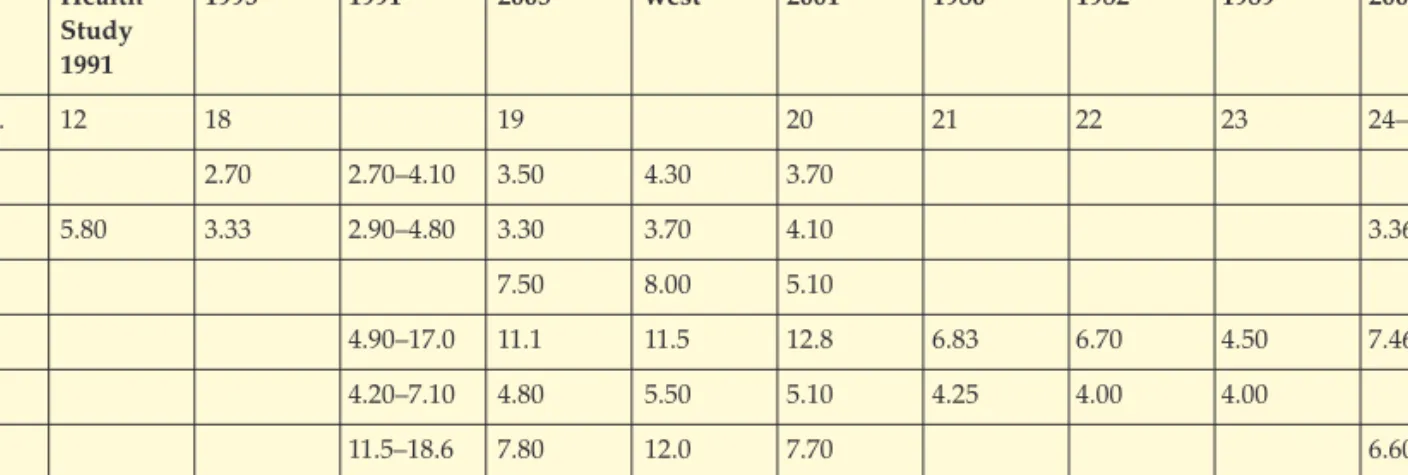
A further point that needs to be considered is that subjects who have poor reproducibility also show the greatest decline in annual lung function [17] suggesting that all data should have quality and reproducibility checked by the same experts. Table 1 shows the
published results of a number of studies of quality control in lung function.
What is acceptable variation in lung function quality control?
There are several published papers on the expected variation in lung function QC. The data can be split into intra-departmental and inter-departmental variation.
More recent data from the Association for Respiratory
Technology and Physiology regional quality control scheme in the UK shows a consistent pattern that has enabled recommended targets of
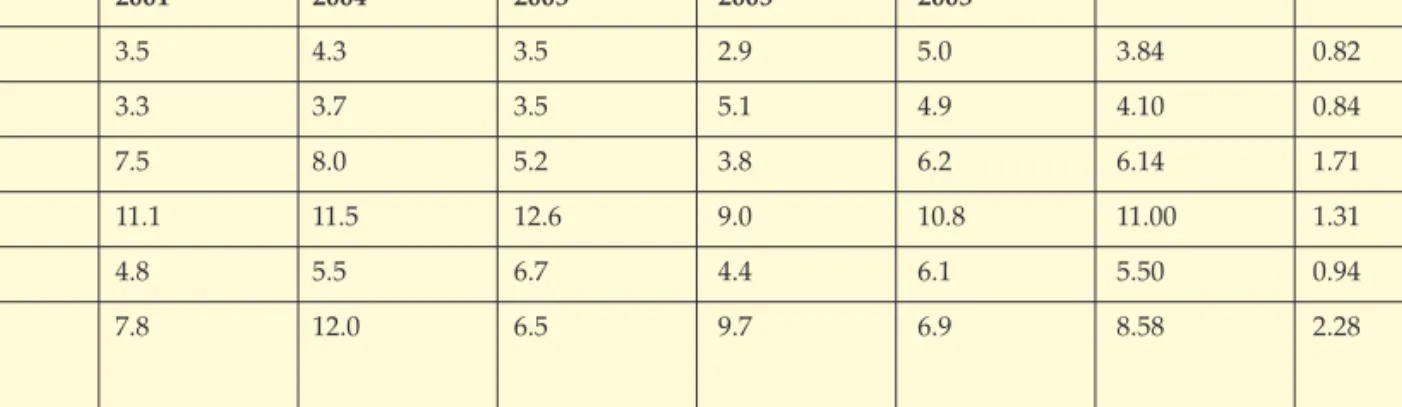
repeatability for spirometry (<5%) lung volumes (functional residual capacity (FRC) <12%, TLC <6%) and gas transfer (<9%). Table 2 shows the published results of quality control studies in lung function from ARTP labs in the UK.
Two recent longitudinal studies by JENSENet al.[11, 27] have shown a variation of 2.8–4.2% in forced expiratory volume in one second (FEV1) and 4.9–9.8% in the transfer factor of the lung for carbon monoxide between five different manufacturers’ equipment. It can therefore be assumed that, where laboratories are using different manufacturers’ equipment, inter-laboratory variance will be a little greater than would be expected within a single laboratory using only one manufacturer’s equipment.
Lung volumes
There is some controversy over the variability/repeatability of lung volumes measured by body plethysmography (table 3). The FRC has a variability of about 6–7%, but biologically FRC is dependent upon subject behaviour. TLC, which is estimated from FRC and IC, is less variable because it is biologically a more stable and standardised measurement. Table 1. Inter-departmental variation in lung function for a variety of published data sets.
Lung Sapaldiab Denver Watts South- ANZSRS Bohadana Viljanen Williams Blonshine Health 1995 1991 2005 west 2001 1980 1982 1989 2007 Study 1991 Ref. no. 12 18 19 20 21 22 23 24–26 FVC 2.70 2.70–4.10 3.50 4.30 3.70 FEV1 5.80 3.33 2.90–4.80 3.30 3.70 4.10 3.36 PEF 7.50 8.00 5.10 FRC 4.90–17.0 11.1 11.5 12.8 6.83 6.70 4.50 7.46 TLC 4.20–7.10 4.80 5.50 5.10 4.25 4.00 4.00 TL,co 11.5–18.6 7.80 12.0 7.70 6.60
Data are presented as coefficient of variation (SD/mean). ANZSRS: Australian and New Zealand Society of Respiratory Science; FVC: forced vital capacity; FEV1: forced expiratory volume in one second; PEF: peak expiratory flow; FRC: functional residual capacity; TLC: total lung capacity; TL,co: transfer factor of the lung for carbon monoxide.
THE BUYERS’ GUIDE TO RESPIRATORY CARE PRODUCTS 37 The residual volume, which is
derived from three measurements ((FRC + IC) – vital capacity) is the most variable measurement and because it is dimensionally a small number, it is more susceptible to variation.
Where different manufacturers’ equipment is used within the same laboratory, it is recommended that any patients being monitored over time are tested on the same
equipment on each visit, and ideally at the same time of day, in order to minimise this variance.
Exercise testing
QC in full respiratory exercise testing equipment is often
overlooked but ideally should form a routine part of a department operating such a service [28]. This will usually involve gas and volume/flow calibration with a biological control scheme.
Servicing and maintenance The specialised nature of QC equipment dictates that servicing should be carried out by the manufacturer, or an engineer certified by the manufacturer, and at the manufacturer’s
recommended intervals.
Documentation of manufacturers’ service visits should be kept, including any calibration
certificates, software upgrades and engineers’ reports. Maintaining a service history for each item of equipment is good practice as it may reveal recurrent problems or deteriorating function.
A QA programme that includes QC should have a response function that triggers either re-calibration or some repair to the equipment as soon a possible after a fault is detected. Therefore, constant vigilance needs to be operated as part of best practice. Planned preventive maintenance should be in place to anticipate failing equipment over time.
Recent evidence is emerging from clinical trials to show that consistent in-depth QA programmes can produce more stringent quality standards in lung function testing. A series of clinical trials on inhaled insulin has been the catalyst to use both mechanical and biological QC in worldwide lung function departments. Early indications show some interesting results. One study has shown that 44% of departments did not have a BioQC process [24]. Only 12% of labs performed BioQC weekly and a further 21% monthly. Clearly, despite healthcare staff being aware of the requirement for QC, many centres ignore this responsibility for a quality service.
In a programme of mechanical QC [25], which followed an in-depth training period using simulators and syringe flow–volume loops, spirometry was unacceptable in 9% of cases and simulated gas transfer tests showed a failure rate of only 5.32%. This is the first published evidence to show that mass QC programmes can establish and maintain high standards of lung function quality. In the same trials [26], a BioQC programme showed very little within-visit variation for spirometry (2.85%), lung volumes (3.35%) and gas transfer (3.67%) and between-visit variation of 3.36%, 7.46% and 6.60%, respectively. More data is being Table 2. Inter-departmental variation for selected UK regions. Association for Respiratory Technology and Physiology Quality Control data from lung function departments in the UK [19].
West-mids South-west London A London B North-west Mean SD
2001 2004 2005 2005 2005 FVC 3.5 4.3 3.5 2.9 5.0 3.84 0.82 FEV1 3.3 3.7 3.5 5.1 4.9 4.10 0.84 PEF 7.5 8.0 5.2 3.8 6.2 6.14 1.71 FRC 11.1 11.5 12.6 9.0 10.8 11.00 1.31 TLC 4.8 5.5 6.7 4.4 6.1 5.50 0.94 TL,co 7.8 12.0 6.5 9.7 6.9 8.58 2.28
Table 3. Variability of lung volumes
Ref. No. TLC FRC RV
Bohadana 1980 21 4.25 6.83 9.50
Vilianen 1982 22 4.00 6.70 11.80
Williams 1989 23 4.00 4.50 11.00
Data are presented as coefficient of variation (SD/mean). FVC: forced vital capacity; FEV1: forced expiratory volume in one second; PEF: peak expiratory flow; FRC: functional residual capacity; TLC: total lung capacity; TLco: transfer factor of the lung for carbon monoxide.
Data are presented as coefficient of variation (SD/mean). TLC: total lung capacity; FRC: functional residual capacity; RV: residual volume.
collected and presented, which shows that BioQC programmes can deliver high standards in lung function measurement.
Summary
It can not be doubted that high-quality lung function testing with appropriate mechanical and biological QC processes can deliver lung function testing to within 5% variation for spirometry and 7% and
9% for lung volumes and gas transfer, respectively. These standards can be achieved in both clinical trials and routine clinical practice, so it is a challenge to all lung function testing departments, as well as nurses and other healthcare staff performing spirometry to adopt QC programmes and take control of their services.
It will probably take the mandatory accreditation of lung function departments to ensure that QC
programmes become a normal part of everyday service. Nevertheless, quality control for spirometry could happen overnight, if services delivering spirometry were forced to have a QC programme in place before they received payment for their services. Well-trained and highly competent practitioners in spirometry should sell the fact that they have QC programmes so that in time they will “corner the market” in reliable and safe spirometry.■
1. Guidelines for the measurement of respiratory function.
Recommendations of the British Thoracic Society and the Association of Respiratory Technicians and Physiologists.Respir Med1994; 88: 165–194.
2. Crapo RO. Spirometry: Quality Control and Reproducibility Criteria.Am Rev Respir Dis1991; 143: 1212–1213. 3. Wanger J. Quality assurance. Respir
Care Clin N Am. 1997; 3: 273–289. 4. Gardner RM, Clausen JL, Crapo RO,
et al.Quality assurance in pulmonary function laboratories. Am Rev Respir Dis1986; 134: 626–627.
5. Brusasco V, Crapo R, Viegi G. Coming together: the ATS/ERS consensus on clinical pulmonary function testing.Eur Respir J2005; 26: 1–2.
6. Miller MR, Hankinson J, Brusasco V, et al.Standardisation of spirometry. Eur Respir J2005; 26: 319–338.
7. Wanger J, Clausen JL, Coates A,et al. Standardisation of the measurement of lung volumes.Eur Respir J2005; 26: 511–522.
8. MacIntyre N, Crapo RO, Viegi G, et al. Standardisation of the single-breath determination of carbon monoxide uptake in the lung. Eur Respir J2005; 26: 720–735.
9. Grant EL, Leavenworth RS. Statistical Quality Control, 6th Edn. New York, McGraw-Hill Book Company, 1988. 10. Ninaber MK, Schot R, Fregonese L,
Stolk J. A syringe simulation of biological controls for quality assessment of prospective lung volume measurements. Respiration. 2008; 76: 187–192
11. Jensen R L, Teeter JG, England RD, Pickering EH, Howell HM, Crapo RO Instrument performance in the longitudinal measurement of diffusing
capacity (DLco).Eur Respir J2004; 24; Supp 24, S182.
12. Enright PL, Johnson LR, Connett JE, Voelker H, Buist AS. Spirometry in the Lung Health Study: methods and quality control. Am Rev Resp Dis 1991; 143: 1215–1223.
13. Bellia V, Pistelli R, Catalano F, et al Quality control of spirometry in the elderly: the SARA Study. Am J Respir Crit Care Med2000; 161: 1094–1100. 14. American College of Occupational
and Environmental Medicine Position Paper. Spirometry in the
occupational setting. Occup Environ Med; 2000; 42: 228–245.
15. Ferguson GT, Enright PL, Buist AS, Higgins MW. Office spirometry for lung health assessment in adults: a concensus statement from National Lung Health Education Program. Chest2000; 117: 1146–1161. 16. National Committee for Clinical
Laboratory Standards HS-4, Quality System Model for respiratory care, Wayne, NCCLS, 2000.
17. Eisen EA, Wegman DH, Louis TA. Effects of selection in a prospective study of forced expiratory volume in Vermont granite workers. Am Rev Respir Dis1983;128: 587–591. 18. Kunzli N, Ackermann-Liebrich U,
Keller R, Perruchoud AP, Schindler C, SAPALDIA Team. Variability of FVC and FEV1due to technician, team, device and subject in an eight centre study: three quality control studies in SAPALDIA. Eur Respir1995, 8: 371–376.
19. Watts TP, Butterfield AK, Moore AJ, Marshall T. How accurate are your respiratory function results? – a quality assurance audit of respiratory function laboratories within the West Midlands. InspireDec 2005; 6: 12–16.
20. Swanney M, Guy P, Cardno L, et al. Interlaboratory variability in the measurement of lung function in Australia and New Zealand. Proc ANZSRS ASM 2001.
21. Bohadana AB, Teculescu D, Peslin R, Jansen Da Silva KM, Pino J. Comparison of four methods for calculating the total lung capacity measured by body plethysmograph. Bull Europ Physiopath Resp1980; 16: 769–776.
22. Viljanen AA, Vijanen BC, Halttunen PK, Kreus KE. Body plethysmograph studies in non-smoking, healthy adults. Scand J Clin Lab Invest1982; 42, Suppl. 35–50.
23. Williams JH, Bencowitz HZ. Differences in plethysmographic lung volumes. Effects of linked vsunlinked spirometry. Chest1989; 95: 117–123. 24. Blonshine S, Harris R, Snow M.
Evaluation of biological quality control variance in a multi-centred clinical trials of inhaled insulin. Eur Respir J 2007; 30: Supp. 51, S7.
25. Blonshine S, Harris R, Snow M. Evaluation of mechanical quality control methods used in a clinical trial for inhaled insulin. Eur Respir J 2007; 30: Supp. 51, S704. 26. Blonshine S, Harris R, Snow M
Evaluation of staff certifications and equipment quality control in pulmonary function laboratories in 14 countries. Eur Respir J2007; 30: Supp. 51, S704.
27. Jensen RL, Teeter JG, England RD, White HJ, Pickering EH, Crapo RO. Performance of 5 PTF Instruments in the longitudinal measurement of FEV1. Eur Respir J2004; 24: Supp. 24, S182.
28. Revill SM, Morgan MD Biological quality control for exercise testing. Thorax2000; 55: 63–6.