Application of Project Management in
Ministerial Security Development
Technical Paper
After the September 11, 2001 attack on the World Trade
Center and the Pentagon, the U.S. Defense focus turned to
fighting terrorism throughout the world. The U.S. entered
into a conflict with Afghanistan to remove the Taliban
govern-ment which supported Osama Bin Laden and insurgent training
camps. In 2003, the U.S. expanded the “Global War on Terror”
to include Iraq and the removal of Saddam Hussein and purge
the country of Al Qaeda insurgents. In both situations,
govern-ment functions were devastated and needed to be rebuilt. This
paper discusses applying a strategic to tactical,
multi-dimen-sional approach to project management to a Ministerial Security
Development mission laying a foundational framework with
developmental processes. Although this paper focuses on the
Ministry of Defense (MoD), the same approach applies to other
Security Ministries such as Ministry of Interior and National
Department of Security. This paper does not cover the “fight”
element of contingency operations. The project management
approach utilizes business models adopted by the Pentagon
to establish organization operations. The U.S’s ability to
estab-lish effective MoD organizations in these regions is essential to
a decreasing Department of Defense (DoD) budget particularly
with Sequestration. Self-sufficiency means less manpower by
the Coalition Security Assistance Force (CSAF). The lessons of
Iraq and Afghanistan have shown that establishing Ministerial
Security functional capability cannot be approached as a
cam-paign plan. A project management approach provides the tools
for business operations planning and allows for identifying and
managing risks in a very uncertain environment.
DOI 10.5592/otmcj.2014.3.4 Research paper
Carol Axten
Civil Engineering , Project Management, University of Maryland [email protected]International Ministerial
Security Development
(MSD), Program
Management Office
Structure, Integrated
Management Plan, MSD in
Iraq and Afghanistan
Keywords
Introduction
The legitimacy of the Security Ass-istance Mission and in particular the Ministerial Security Development mis-sion is addressed in the U.S. National Security Strategy (NSS) for 2010. As stated in the NSS,
“the United States and the inter-national community cannot shy away from the difficult task of pursuing sta-bilization in conflict and post-conflict environments. In countries like Iraq and Afghanistan, building the capac-ity necessary for securcapac-ity, economic growth, and good governance is the only path to long term peace and security. But we have also learned that the effectiveness of these efforts is profoundly affected by the capacity of governments and the political will of their leaders. We will take these constraints into account in designed appropriate assistance strategies and will facilitate the kind of collaboration that is essential-within our government
and with international organizations-in those instances when we engage in the difficult work of helping to bring con-flicts to an end.” (White House, 2010)
The NSS specifically addresses the need that development is a strate-gic, economic, and moral imperative requiring the focus on assisting the developing countries and their people to manage their security threats, intro-duce global economic expansion, and establish accountable and democratic institutions that support basic human needs (White House, 2010). This objec-tive is recognized in both CSAF efforts in Iraq and Afghanistan.
As cited in the Master Ministerial Development Plan (MMDP), “the Ministerial Advisory Group (MAG) will develop the capabilities and capacity of the Ministry of Defense and General Staff in order to establish enduring institutions which can direct and sus-tain Afghan-led security operations.” (Goodman, 2012).
CSAF Structure
The CSAF structure is broken into two elements: (1) equip, train, and advise and (2) Ministerial Leadership Development. This approach tends to separate (1) equipment, training and advising of the equipment from (2) the role of advising on standing up processes for the Defense Ministry to determine equipment and training needs and budget and execute for those needs. This approach establishes the Ministry foundation sooner but is higher risk for the Assisted Nation to effectively assume the responsibility having less of an understanding for why processes and practices are imple-mented. The effort done concurrently would provide better understanding by the Assisted Nation.
Planning needs to be accomplished in conjunction with the Assisted Nation (Nation X for this paper) to facilitate “buy-in” and processes and practices meet the long term needs of the nation
Specialized Competencies
Administration Inspector General Military Operations & Tactics
Budget/Finance Inteligence Personal & Education
Construction Leadership Development Procurement
Engineering Legal Stractegic Communication & Publcic Affairs Office
Facilities Managment Logistics Strategic Planning & Policy
Information Technology Medical Training
Operational Command
Force Employment Force Support(Equipment) Force Support(Equipment) Force Generation
Operational
Command Logistic
Infrastructure
Foreign Military Sales Contract Managment & Audit Oversight Budget/Funding Enterprise Systems Corps Oprerations Force Managment Force Development U.S. Command
Equip, Train & Advise (ETA) Command
Equip, Train & Advise - Army,
Air, Navy, SOF
MOD-MAG PMO MOD
CSAF
for sustaining their security and sta-bility. The approach for managing projects in a dynamic environment, Simultaneous Management, suits Ministerial Security Development over the traditional project management approach. The skill of negotiation and ability to influence is paramount to cre-ating “buy-in” with the nation.
The CSAF Organization Structure (Figure 1) needs to accommodate a critical alignment with the MoD lead-ership to jointly establish the foun-dation together. This alignment is accomplished through the Ministerial Advisory Group (MAG). A Program Management Office Structure, typi-cally used in the DoD for acquisition and development of weapon systems, encompasses three primary elements:
(1) Matrix of projects and competency support, (2) an Integrated Plan, and (3) Hierarchy Milestone Reviews. The MAG can assume the role of a Program Management Office with responsibility for the integration of all tasking across the CSAF. Figure 1.
A Project Management Office man-ages a single project; a Program Management Office (PMO) man-ages multiple projects. A Portfolio Management Office manages sev-eral programs and is typical of a DoD Program Executive Office (PEO). Management attention between the office types changes from a focus of execution within a project and tools of basic project management to manage-ment across multiple programs and the breadth and complexity of meeting the
organization’s mission and multiple stakeholders’ objectives. Ministerial Security Development fits the model of a PMO managing several projects which have defined interrelation-ships. With the incorporation of mul-tiple PMOs, the mission at the CSAF level becomes a PEO. The complexity of a PEO is driven by the increase in external focus on impacts, constraints, consequences, and results. In order to better manage these multi-faceted elements, knowledge areas such as Strategic Management, Governance Management, Per for mance Management, Communication Manage- ment, and Risk Management become crit-ical to effective Portfolio Management.
Force Functional Organizations Joint Command ETA-Army ETA-Air Force ETA-Navy ETA-SOF ETA-Logistics US Command CSAF Program Office Project 1-HRM Project 2-Budget/Finance Project 3-Procurement Project 4-Logistics Project 5-Institutional Training MOD-MAG PMO MOD Figure 2 Joint
Command ETA-Army ETA-Air Force ETA-Navy ETA-SOF LogisticsETA- US Command Project 1
Strategy & Policy x x x x x x x
Project 2 HRM x x x x x x x Project 3 Budget/Finance x x x x x x x Project 4 Procurement x x x x x x x Project 5 Logistic x x x x x x x Project 6 Institutional Training x x x x x x x PMO Figure 3
Matrix Structure
An Integrated Management Plan (IMP) details the tasking for each CSAF Force Functional Command (FFC) and the relationships or linkages that exist creating the integration piece. The PMO manages the integration of sev-eral projects for establishing the Core Capability of the MoD. As a minimum, these would be the foundational pro-cesses or systems for managing Nation X’s Military Force: Strategic Planning & Policy, Human Resource Management, Budget/Financial, Procurement, Logistics, and Institutional Training. Figure 2 depicts the complexity of mul-tiple FFCs supporting mulmul-tiple projects. Applying linear presentation to a matrix structure can appear chaotic and dif-ficult to follow alignment of project to FFC participants. Figure 2
Figure 3presents the same complex-ity but in a two-dimensional matrix chart creating order and alignment. This visual representation conveys the cross-functional element of a matrix structure through a table of projects aligned with FFCs. Figure 2 and 3 depict the difference in approach for visually depicting the same information.
By adding the competencies of the
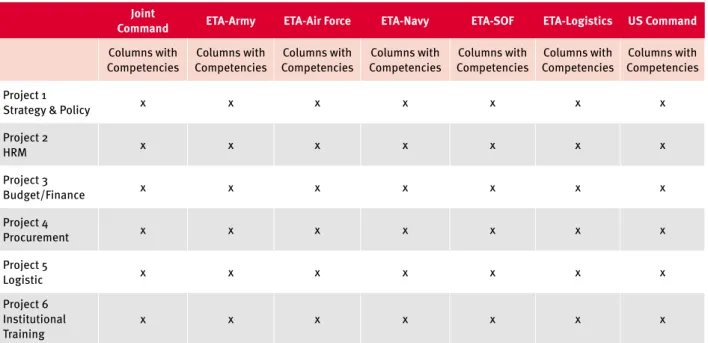
FFCs, the structure becomes a three-dimensional matrix represented in a two-dimensional form in Figure 4. The foundational systems (projects) may have a common thread for data collec-tion, analysis, and feedback loop to apply the information in the next itera-tion of operaitera-tions. The common thread element optimizes on common data collection for multiple applications. Competency participants that cross projects ensure this common thread to leverage commonality of systems to the greatest extent. Figure 4
To add further complexity, initiatives such as literacy, counter-corruption, gender integration, and civilianization require a comprehensive approach in planning and implementation. These cross-cutting initiatives cross projects, FFCs, and competencies creating a fourth dimension to the structure and execution Figure 5.
Integrated Management Plan
The PMO defines the guidance for the FFCs to develop their piece of the IMP (Figure 6) through the collaborated agreements with Nation X’s MoD. The PMO monitors the progress of the IMP activities and resolves cross-functionalissues. Each FFC manages their IMP activities and coordinates with PMO for the protocol for interaction with Nation X’s MoD. Figure 6
A Memorandum of Understanding (MOU) can be drafted by each FCC to address the conditions needed for interaction and rationale with Nation X; both PMO and FFC leadership sign the MOU. The MOU allows each FFC to oper-ate more autonomously yet still within defined guidelines. This is prudent in Ministerial Security Development to ensure a single message and direction is conveyed to Nation X’s Government leadership. When the message appears ambiguous, Nation X’s Government leadership tends to exploit the oppor-tunity to misinterpret the message to their advantage. The more players involved the greater the risk that the CSAF’s direction is misinterpreted by Nation X. This is a recognized risk in International Relations and is mitigated by a single message and direction of CSAF through PMO.
Utilizing a project management approach to Ministerial Security Development would ensure conti-nuity of execution through the IMP built with Summary Tasks. Detailed
Joint
Command ETA-Army ETA-Air Force ETA-Navy ETA-SOF ETA-Logistics US Command Columns with
Competencies CompetenciesColumns with CompetenciesColumns with CompetenciesColumns with CompetenciesColumns with CompetenciesColumns with CompetenciesColumns with Project 1
Strategy & Policy x x x x x x x
Project 2 HRM x x x x x x x Project 3 Budget/Finance x x x x x x x Project 4 Procurement x x x x x x x Project 5 Logistic x x x x x x x Project 6 Institutional Training x x x x x x x Figure 4
planning would occur in 6 month roll-ing wave increments. Project manage-ment elemanage-ments of risk managemanage-ment can be applied to manage the uncertainty inherent in building Nation X’s Defense Government Base while at war. Risks such as availability of electricity, internet
connectivity, culturally differing perspec-tives can be identified and mitigated using standard risk management tech-niques. This approach would allow for budgeting of Summary Tasks and the tracking of cost performance associated with those tasks in addition to schedule
performance. Re-allocation of resources can be effectively managed based on the ability to meet capability parameters in some areas and respond to challenges in others.
An IMP would provide continuity to reduce the inefficiency caused by the
Joint
Command ETA-Army ETA-Air Force ETA-Navy ETA-SOF ETA-Logistics US Command Columns with
Competencies CompetenciesColumns with CompetenciesColumns with CompetenciesColumns with CompetenciesColumns with CompetenciesColumns with CompetenciesColumns with Project 1 Strategy & Policy x x x x x x x Project 2 HRM x x x x x x x Project 3 Budget/ Finance x x x x x x x Project 4 Procurement x x x x x x x Project 5 Logistic x x x x x x x Project 6 Institutional Training x x x x x x x Figure 5
Force Function Commands
FMO
Literacy-Counter-Corruption - Gender Integration - Civilization
Figure 6
MOD MOD-MAG PMO
Advise Leadershio Development Force Managment & Force Development
Integrated Managment Plan
Force Employment Force Generation Force Support(Equipment) U.S. Support Functions Operational
Command Advise CommandEquip, Train & Infrastructure Logistic Command
turnover of personnel. Few compa-nies could stay in business with 100% turnover every year and possibly 50% turnover every 6 months. An IMP with Summary Tasks scoped with Nation X would lay the foundation for detailed planning occurring in the 6 month incre-ments. Especially with multi-national support, good planning can reduce the friction created from ambiguous objectives and the need to “reinvent the wheel” throughout the mission.
Capability Milestones
To evaluate the progress of Nation X, metrics would be developed using quantitative measures to the greatest extent. Qualitative measures should be applied based on understanding the limitations on interpretation. Significant movement in a rating capability would be presented to an Executive Ministerial Development Board (EMDB) (Figure 7) which is chaired by the Director for the PMO with leadership of all FFC. The EMDB would collectively determine if a Capability Milestone (CM) has been achieved. In the case when consensus cannot be reached, the Chairman has the final decision. At the beginning of the Ministerial Security Development effort, the EMDB would be Coalition-led participation. As Nation X’s lead-ership reached pre-planned levels of
capability, the participation would include Nation X and eventually shift to Co-Chairing the EMDB with joint participation in reviews and decisions.
Figure 7
In the early stages, quarterly reviews should be conducted by the Director of the PMO to the Ministerial Leadership: Minister of Defense, First Deputy Minister, Chief of General Staff, and Vice Chief of General Staff to convey the progress and areas of concern. As progress is made in Ministerial Development Leadership capability, the shift would occur to the Minister of Defense ultimately brief-ing the Director for the PMO. The IMP should include the roadmap in transi-tion of responsibility of the EMDB as part of the PMO’s Summary Tasks.
Each FFC would track the progress of the tasks, including how each of their areas are doing on literacy, counter-corruption, gender integration, and civilianization both CSAF and part-nering Nation X to meet the Capability Milestone. Building infrastructure is often part of building the capabil-ity in a Developing Government. For example, establishing institutional training includes the physical build-ing (construction), curriculum (train-ing), and administration management (administration). The IMP includes the tasks of the CSAF for infrastructure
projects, tasks associated with Nation X, and all linked to Nation X’s Capability Milestone. Nation X is required to pro-vide land for the building; this would be a Summary Task assigned to Nation X with linkages to CSAF’s design and con-struction of building. This link creates the bond between the CSAF and Nation X in truly creating a partnership, one side cannot achieve success without the other. An IMP can predict cost and schedule results for the entire project or program at any point in time.
Another example is logistics, warehouses (construction) for stor-age would need to be designed and constructed, land provided (Assisted Nation), and processes for receiving goods, storing, requisitioning, and distributing those goods (logistics) established. Once the logistical foun-dation is established and data is col-lected, forecasting is accomplished using the historic data and a feedback loop can trigger automatic ordering at pre-determined points (contracting). Identifying personnel from Nation X and training them links the effort to the HRM system (personnel & education). In both examples, multiple competen-cies play into achieving the End Result. These competencies will cross FFC as projects are executed from Strategic to Operational to Tactical levels to meet full security mission. The IMP tracks
Figure 7
Force Employment
CM Rating Change CM Rating Change
Executive Ministerial Development Board
Chair, Director MoD-MAG PMO Co-Chair Minister of Defense
Force Generation U.S. Support Functions Operational Command Capability Milestone (CM) Board Assassment Capability Milestone (CM) Board Assassment Capability Milestone (CM) Board Assassment
Equip, Train &
performance and predicts cost and schedule results for End State at any point in time.
The initiatives of literacy, counter-corruption, gender integration, and civilianization would be included in IMP tasks and Capability Milestone rating for all projects, FCCs, and competen-cies. This method creates a compre-hensive approach for initiatives to drive synergistic results to achieve security and stability of the nation; synergis-tic results equate to the whole being greater than the sum of the parts.
Conclusion
In the report Learning from Iraq: A Final Report from the Special Inspector General for Iraq Reconstruction, there were seven Final Lessons for Iraq summarized:
1. Create an integrated civilian-mili-tary office to plan, execute, and be accountable for contingency rebuild-ing activities durrebuild-ing stabilization and reconstruction operations.
2. Begin rebuilding only after establish-ing sufficient security, and focus on small programs and projects.
3. Ensure full host-country engagement in program and project selection, securing commitments to share costs (possibly through loans) and agree-ments to sustain completed projects after their transfer.
4. Establish uniform contracting, per-sonnel, and information manage-ment systems that all Self-Regulatory Organizations (SRO) participants use.
5. Require robust oversight of SRO activ-ities from the operation’s inception.
6. Preserve and retire programs devel-oped in Iraq, like the Commander’s Emergency Response Program and the Provincial Reconstruction Team program that produced successes when used judiciously.
7. Plan in advance, plan comprehen-sively and in an integrated fashion, and have the backup plans ready to go. (Bowen, 2013)
As cited in the above lessons learned, the need for a comprehensive approach, an integrated plan, and the participation in planning with the Assisted Nation are primary elements to success of the CSAF mission. This paper provides the concept of a Program Management Office Structure utilizing the Ministerial Advisory Group as the PMO due to their role as the advisory link to the Ministry of Defense. The PMO will collaterally compile and manage the IMP while executing Ministerial Development Leadership. The paper also portrays the complexity of structure, planning, and implementation through a multi-dimen-sional approach to achieve success in Ministerial Security Development. This approach provides both effectiveness and efficiency in implementation over establishing separate PMO and MoD-MAG organizations.
The results of years of military pres-ence in Iraq and Afghanistan reduced violence; however, this reduction is not truly tested until the external military presence is gone and the Nation must now sustain the stability and provide for their own security. The death toll in Iraq has exceeded 8000 for 2013 return-ing to the pre-U.S. military surge which significantly reduced and then leveled violence from 2009-2011 (Gamel, 2013). With neighboring Syria in a civil war and Libya still in turmoil from the civil war initiated during the Arab Spring 2011 and the removal of Colonel Muammar Gaddafi, the Middle East and Southwest Asia will remain on the International Security radar for some time. Although future security assistance initiatives are expected to be less extensive as Iraq and Afghanistan, the need to bolster the MoD of foreign countries to provide security and stability for the nation will be a mission for the DoD for many years. The lessons in the execution of Iraq and Afghanistan provide insight into the long-term approach for Ministerial Security Development in the application of smaller contingency operations.
References:
Bowen, S. (2013) Learning from Iraq: A Final Report from the Special Inspector General for Iraq Reconstruction, Washington, DC. Gamel, K and Yacoub, S., (2013), “UN in Iraq
Worried About Uptick in Bodies Found”, ABC News Baghdad available at http://abcnews. go.com/International.
Goodman, J. Col (revision 2012), and Heiden, C. Dr. and Dryden, G. (original, 2011), Master Ministerial Development Plan, NATO Training Mission-Afghanistan/Combined Security Transition Command-Afghanistan, Afghanistan.
White House, (2010), National Security Strategy, Washington, DC.