INTRODUCTION
Coastal marine aquaculture is growing steadily world wide as a means of food production, but has been criticized on environmental grounds (Pillay 2008). One of the most contentious issues is the possi-ble impact of aquaculture effluents accumulating on the seabed on community structure and ecosystem functioning of the benthic ecosystem (Kalantzi & Karakassis 2006, Dubois et al. 2007). Compared to
fin-fish farming, shellfin-fish aquaculture is considered to cause less damage to the environment as there is no addition of feed (Crawford et al. 2003). However, shellfish are recognized as keystone species that exert a bottom-up effect on marine ecosystems through biodeposition (i.e. the deposition of faeces and pseu-dofaeces), transferring materials and nutrients to the benthic environment (Newell 2004). This process can affect ecosystem functioning by serving as additional food sources to the benthos and can thus potentially © The authors 2018. Open Access under Creative Commons by Attribution Licence. Use, distribution and reproduction are un -restricted. Authors and original publication must be credited. Publisher: Inter-Research · www.int-res.com
*Corresponding author: [email protected]
Impact of farming non-indigenous scallop
Argopecten irradians
on benthic ecosystem
functioning: a case-study in Laizhou Bay, China
Qian Huang
1, 2,*, Sergej Olenin
1, Song Sun
3, 4, Marleen De Troch
21Klaipeda University, Marine Science and Technology Centre, H. Manto 84, 92294, Klaipeda, Lithuania 2Ghent University, Biology Department, Marine Biology, Krijgslaan 281 − S8, 9000 Ghent, Belgium
3Institute of Oceanology, Chinese Academy of Sciences, Key Laboratory of Marine Ecology and Environmental Sciences, 266071 Qingdao, PR China
4College of Marie Science, University of Chinese Academy of Sciences, 10004 Beijing, PR China
ABSTRACT: The farming of the non-indigenous bay scallop Argopecten irradiansin coastal waters generates large amounts of biodeposits that potentially change the trophic pathways and quality of the benthic food web at lower trophic levels such as meiobenthos. To understand the trophic link between faecal pellets of bay scallop and meiobenthos in the aquaculture area, we investigated the resource use of harpacticoid copepods and nematodes inside and outside of 3 bay scallop farms in Laizhou Bay (Bohai Sea, China) using natural abundance of stable carbon and nitrogen isotopes to-gether with fatty acid profiling. Faeces were found to be enriched in δ15N compared to all other food sources, which made faecal matter traceable. The enriched δ15N in several meiobenthos at the farms, together with the mixing model results, indicated that faeces could be a new food source for most of harpacticoid copepods and some nematodes. The quantities and the pathways of assimila-tion differed between the copepod families, depending on their feeding behaviors and the receiving environment. Furthermore, due to the presence of higher levels of polyunsaturated fatty acids, in particular docosahexaenoic acid, the dominant copepod family Canuellidae that abundantly con-sumed scallop faeces showed enhanced nutritional quality compared with those in the control sites. Thus, aquaculture of non-indigenous bay scallops provided a food source that was directly and in-directly consumed by meiobenthos underneath the scallop farms and improved the quality of lower level consumers as a food item in the benthic food web.
KEY WORDS: Mariculture · Non-indigenous species · Argopecten irradians · Harpacticoid copepods · Nematodes · Food source · Stable isotopes · Fatty acids
O
PEN
PEN
A
CCESS
CCESS
change the benthic energy flow (Peterson & Heck 1999, Callier et al. 2008). Although many studies have recorded the influence of bio deposition on benthic as-semblages (Hartstein & Rowden 2004, Callier et al. 2008), little is known about the fate of biodeposits and their functional effect on the benthic ecosystem, e.g. through the assimilation of these deposits by benthic organisms. While biodeposits have a good nutritional value (McKindsey et al. 2011), it is unclear whether the benthos can benefit from incorporating these deposits into their diet.
China is the biggest shellfish aquaculture producer worlwide and scallop farming using longlines in coastal marine waters is a major part of its aqua -culture industry (FAO 2016). Among the -cultured scallop species, the non-indigenous species (NIS) Argopecten irradians(a.k.a. bay scallop), introduced from North America, has dominated the Chinese scal-lop production over the past 30 yr (Guo & Luo 2016). In terms of economic output, A. irradianshas an ad-vantage over the native scallop Chlamys farreridue to the faster growth rate (Guo & Luo 2016). However, the high biodeposition rate of A. irradians (almost 10 times higher than C. farreri) also poses a threat to the benthic ecosystem (Zhou et al. 2006, Li et al. 2009, Wang 2015). However, little is known about whether and how the biodeposition of non-indigenous A. irra-dianscan potentially affect organisms in the sediment and the overall functioning of the benthic ecosystem. Ecosystem functioning integrates the energy flux within a system (Power 1992). The process of re -source utilization by benthic consumers, especially meiobenthos (the smaller fraction of metazoans pass-ing through a 1 mm sieve but bepass-ing retained on a 38 μm sieve), is crucial to understand the energy flux of an ecosystem, because: (1) meiobenthos are highly abundant and form a link between primary produc-ers and higher trophic levels (TLs) (Leduc et al. 2009); and (2) due to their small size, short generation times and close associations with sediments, they are sensitive to stressors and respond functionally to them (Kennedy & Jacoby 1999). However, there is lit-tle information on functional responses (in particular, resource utilization) of meiobenthos to aquaculture biodeposition. Since the effects of aquaculture waste are known to differ among trophic guilds and feeding behaviors of animals (Wai et al. 2011), it is important to incorporate the knowledge of functional responses of different taxonomic groups in order to understand the impact on ecosystem functioning. Furthermore, harpacticoid copepods are important food sources and providers of fatty acids (FAs), especially highly polyunsaturated fatty acids (PUFAs), to higher
mar-ine consumers (de Lima et al. 2013). Their FA profiles depend on their food sources and environmental con-ditions (Nanton & Castell 1999, De Troch et al. 2012, de Lima et al. 2013). Determining the presence of quality-indicator FAs, such as PUFA, 20:5ω3 (eicosa -pentaenoic acid; EPA) and 22:6ω3 (docosahexaenoic acid; DHA), in harpacticoid copepods will contribute to the assessment of the functional impacts of bio -deposition by bay scallop in aquaculture areas.
The analysis of the natural abundance of stable iso-topes together with FA profiles is an efficient tool to investigate the diet of meiobenthos (Leduc & Probert 2009, Cnudde et al. 2015). Stable carbon ratios reflect the food sources of consumers, and nitrogen ratios are used to determine their trophic positions (DeNiro & Epstein 1978, Minagawa & Wada 1984). Moreover, stable isotopes help to trace the fate of aquaculture waste in different communities (Gondwe et al. 2012, Vizzini & Mazzola 2012, Sanz-Lázaro & Sanchez-Jerez 2017). FA profiles provide information on food sources such as diatoms and bacteria (Kelly & Scheibling 2012).
The aim of this study was to evaluate the impact of aquaculture of the NIS bay scallop A. irradians on benthic ecosystem functioning. Specifically, we used stable isotopes and FAs to test the following hypo -theses: (1) the presence of a scallop farm affects the isotopic values of primary organic sources in the sed-iment; (2) scallop faeces are consumed by meioben-thos in the receiving sediment; (3) the quantity of fae-ces consumption differs among taxa/families of meiobenthos; and (4) the presence of a scallop farm changes the FA profile of the harpacticoid copepods occurring in the sediment.
MATERIALS AND METHODS Study area
Samples were collected in scallop farms located in the eastern part of the Laizhou Bay (37° 00’ to 38° 30’ N, 118° 45’ to 120° 30’ E). Laizhou Bay is lo -cated in the south Bohai Sea, Shandong Province, on the north coast of China. It has a mean depth of 9 m (maximum ~18 m), a coastline of 320 km and a total area of ~700 000 ha (Zhuang et al. 2014). The north-east –southnorth-east currents dominate with a mean veloc-ity of 20 cm s−1, indicating a poor exchange of water (Zhao & Chen 2001). The area is an important spawn-ing and breedspawn-ing ground for many fishes but is cur-rently under pressure due to human activities such as intensive mariculture (Jin et al. 2013).
The bay scallop Argopecten irradians is a major mariculture species, which has been cultivated using the suspended-longline method in this area for 30 yr. Bay scallop mariculture in Laizhou Bay is one of the most important sources of scallop production in China, with a total area of 500 ha and a density of 200 ind. m−2yielding a production of around 20 000 t yr−1 (Liu et al. 2004, Wang 2015). Bay scallops are cultured from May to November each year without adding any feed. The rest of the year, the area is devoid of any aquaculture activities.
Sampling design
We selected 3 of the largest farms and 3 correspon-ding control sites. To exclude any direct effect of aquaculture on the control sediment, each control site was located 2 km to one side of the farm, at the same depth as the farm, so that it was exposed later-ally to the predominant current that also flowed through the farm. Each pair of sites, ‘farm’ and ‘con-trol’, was considered as a single station, and the 3 sta-tions were characterized by sediment type as sandy-shallow (Stn SS) (2% clay, 24−28% silt, 69−73% sand; water depth 5 m), muddy-shallow (Stn MS) and muddy-deep (Stn MD) (4−6% clay, 53−55% silt, 39−42% sand; water depth 7.5 and 12 m respective -ly). Previous observations in Laizhou Bay revealed that biodeposition rates of bay scallops peaked in November, and rates of larger individuals were higher than those of smaller ones (Wang 2015). We thus conducted sampling for stable isotopes and FA analysis in October−November 2015 and 2016, be -fore the harvest of scallops, in order to cover the period of high biodeposition rates in this area. For FA samples, an additional sampling campaign was con-ducted in May 2016 before the scallop lantern nets were placed in this area.
Sampling procedure
We considered that meiobenthos from each farm and control site were exposed to the following com-mon primary organic sources: (1) phytoplankton from the water column, (2) microphytobenthos (MPB) in the sediment surface, and (3) fragments of seagrass Zostera marina leaves in the sediment (senescent fragments of Z. marinaverified by microscopical ob-servation). Bay scallop faeces were only considered as a potential food source at the farm sites. Phyto-plankton was considered to be the major component
in the pre-filtered particulate organic matter (POM) be cause the weight-to-weight ratio of parti culate orga nic carbon to chlorophylla (POC/chla) ranged from 19 to 37 in October-November in our sampling area (Wang 2015). This is within the known range of 2 to 200 for POC/chl ain algae (Cifuentes et al. 1988). POM samples were obtained at each control site in order to avoid the potential addition of aquaculture-derived organic matter. About 500 ml seawater was filtered through a 58 μm net to remove zooplankton and large detritus, and subsequently filtered on pre-combusted (450°C, 4 h) 0.7 μm Whatman GF/F glass fiber filters. MPB samples were collected at each farm and control sites in 2016. Due to the insufficient MPB biomass for reliable stable isotope analysis, we pooled farm and control together for each station, which is justified by the similar δ13C and δ15N values of the surface sediment at each farm and control site (see ‘Data analysis’ below). MPB were separated from the sediment surface using a modified method of Doi et al. (2003): the top 1 cm sediment collected by a Van Veen grab was covered by a 2 mm layer of quartz sands (25 to 65 μm diameter, pre-combusted at 500°C for 2 h), a nylon net (75 μm), and another layer of 2 mm pre-combusted quartz sands. The dishes were illuminated for 24 h, while moisture was main-tained with continuous spraying of filtered seawater on the sand. After illumination, the upper sand layer was scraped off and resuspended in filtered seawater. The supernatants were filtered on pre-combusted Whatman GF/F filters. We also collected sediment surface or ganic matter (SSOM) to evaluate the impact on the organic pool of surface sediments. SSOM was collected at each farm and control site by scraping the top layer (0 to 1 cm) of sediment from the Van Veen grab. To collect the bay scallop faeces, 20 individuals of scallop (average body length of 5.5 cm) were placed in the containers with filtered seawater over night and faeces were obtained by filtering the water from the containers on pre-combusted GF/F filters. Samples (n = 2 to 4) were taken for POM, MPB, SSOM and scallop faeces.
Meiobenthos for stable isotopes and FAs were col-lected qualitatively by scraping the top 1 cm layer of the sediment from 3 randomly selected patches (ap -prox. 1 × 1 m) that were at least 1 m apart at the farm and control sites.
Stable isotope analysis
The POM, MPB, and faeces samples were oven-dried at 60°C to a constant weight and divided into 2
subsamples. One set was treated with hydrochloric acid (HCl) fume to remove carbonates for 13C, and the other, without acid treatment, was used for 15N analysis. All samples were put into tin capsules (Ele-mental Microanalysis, 8 × 5 mm) and pinched closed. 30 to 60 mg of sediment was acidified in silver capsules (Elemental Microanalysis, 8 × 5 mm) with dilu -ted HCl to remove carbonates and washed with dis-tilled water. The capsules were dried and pinched closed afterwards.
Sediments were sieved with filtered seawater through a 500 μm and a 150 μm sieve. The fraction retained on the 150 μm sieve was frozen and trans-ported to the lab. The frozen samples were thawed and meiobenthos were handpicked with a needle under a stereomicroscope. Meiobenthos were sorted into nematodes (150 to 300 ind. per sample) and copepods. For the samples collected in 2015, cope-pods were pooled together (80 to 100 ind. per sam-ple) while copepod samples in 2016 were sorted to family level (80 to 120 ind. per sample). Meiobenthos were rinsed with MilliQ water twice before being transferred to tin capsules, oven-dried overnight at 60°C and pinched closed. All samples were stored in a desiccator prior to further analysis.
C and N stable isotopes were measured with an isotope ratio mass spectrometer (type Europa Inte-gra) at UC Davis Stable Isotope Facility (University of California). Isotope values are expressed as δ13C and
δ15N (‰) determined by the following equation: (1) where R = 13C/12C or 15N/14N. Reference standards were PDB for δ13C and atmospheric nitrogen for δ15N.
Fatty acid profiling
FA samples included only specimens of the har -pacticoid copepod family Canuellidae collected at Stn SS. The abundances of the rest of the meio -benthos at the other sites were too low to obtain enough biomass for a reliable analysis. Canuellidae were extracted alive from sediments following the method of Svensson et al. (2010) and stored at room temperature overnight to clear their gut content. The next day, 100 to 150 individuals were picked, washed with filtered seawater, and transferred to glass tubes for storage at −80°C prior to FA extraction.
Lipid extraction, methylation to fatty acid methyl esters (FAMEs), and FAME analysis followed the procedure of De Troch et al. (2012). FAME of 19:0
(Fluka 74208) was added as internal standard. The FAMEs were analyzed with a gas chromatograph (HP 6890N) coupled to a mass spectrometer (HP 5973). FAMEs were identified by comparing the re -tention time and mass spectra with authentic stan-dards and mass spectral libraries (WILEY, NITS05) and then analyzed with the software MSD Chem -Station (Agilent Technologies). Individual FAMEs were quantified by using a component FAME and BAME mix (Supelco #47885 and #47080 respectively, Sigma-Aldrich) and additional standards (Larodan). Shorthand FA notations were expressed as A:BωX, where A gives the number of carbon atoms, B repre-sents the number of double bonds and X is the posi-tion of the first double bond closest to the terminal methyl group.
Data analysis
Variations in δ13C and δ15N values of potential food sources, SSOM, and meiobenthos were tested using analysis of variance (ANOVA) followed by StudentNewmanKeuls pairwise comparisons. Prior to ANO -VA, the assumption of homogeneity of variances were diagnosed with Kolmogorov-Smirnov tests and Levene’s tests, respectively. Log transformations were used to meet this assumption if necessary. Non-parametric Kruskal-Wallis tests were conducted when homogeneity of variation could not be reached. Dif-ferences between farm and control at each station for
δ13C and δ15N values of SSOM, TL, and FA indicators were assessed using t-tests. ANOVA and t-tests were conducted with the software SPSS 20.0.
To identify the difference in isotopic values (δ13C and δ15N) of meiobenthos between farm and con-trol, the δ13C and δ15N ratios of taxon or family co-occurring in farm and control sites were plotted in the same biplot (i.e. δ13C control/δ13C farm and δ15N control/δ15N farm). Taxa or families were considered to have similar δ13C or δ15N values if the ratio fell within the 95% confidence interval (CI) encompass-ing the 1:1 correlation between farm and control isotopic values.
The TL of meiobenthos was estimated based on
δ15N values:
TLconsumer= 2 + (δ15Nconsumer − δ15Nbase)/Δ15N (2) where δ15N
base is the δ15N of primary consumer i.e. the family of harpacticoid copepods that has the lowest δ15N in each site. The Δ15N of 2.3 ‰ for mar-ine organisms was adopted (Zanden & Rasmussen 2001). C or N = –1 10 13 15 sample standard 3
(
)
δ ⎡ ⎣⎢ ⎤⎦⎥ × R RA mixing model MixSIR applied Bayesian method was used to calculate the potential food sources of meiobenthos (Moore & Semmens 2008). Trophic en -richment factors (TEF) of 0.3 ± 1.3 ‰ δ13C and 2.3 ± 1.8 ‰ δ15N were adopted for each trophic step (Zan-den & Rasmussen 2001). The isotopic values of the seagrass Z. marinawere adopted from Hoshika et al. (2006). We calculated isotopic data only for the year 2016 because MPB was not collected in 2015. MPB and POM were pooled as a logical group represent-ing the microalgae-derived organic matter (Phillips et al. 2005).
A 2-way permutational multivariate analysis of variance (PERMANOVA, main test and pairwise test) and analysis of similarity (ANOSIM) were run on the relative FA profiles of Canuellidae in Stn SS in 2016. Time (‘Before vs. During’, where ‘Before’ refers to the period prior to the start of seasonal aquaculture pro-duction) and site (‘Farm vs. Control’) were orthogo-nal and fixed factors. A distance-based test for homo-geneity of multivariate dispersions (PERMDISP) was used to test the homogeneity of multivariate disper-sion (Anderson 2006). To visualize the degree of dissimilarity of FA composition between groups, non-metric multi-dimensional scaling (nMDS) was con-ducted based on a Bray-Curtis resemblance matrix of untransformed relative FA profiles. The contribution of individual FA to these clusters was tested by
simi-larity percentages (SIMPER) analysis. All multivari-ate analyses were performed with Primer V6 (Clarke & Gorley 2006), using the PERMANOVA+ add-on package (Anderson et al. 2008).
RESULTS
Stable isotopes of food sources
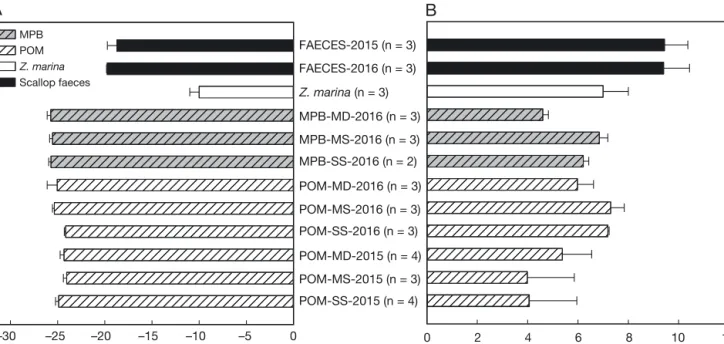
Scallop faeces showed enriched δ15N values (9.40 ± 1.03 ‰ in 2015 and 9.44 ± 0.93 ‰ in 2016, Fig. 1), which were higher than those of any other potential food source (ANOVA for 2016: F6,13 = 20.999, p < 0.001; 2015: F3,11= 8.666, p = 0.003). For the δ13C values, significant differences were found, with decrea -sing signatures from seagrass (Zostera marina) to scallop faeces to POM and MPB (Fig. 1A). Isotopic composition of POM and MPB varied among stations in terms of δ15N values in 2016 (ANOVA, POM in 2016: F2, 6 = 6.806, p = 0.029; MPB in 2016: F2, 5 = 13.900, p = 0.009) (Fig. 1B). Within each station, only Stn MD and Stn SS showed significant differences in isotopic signatures. At Stn MD the MPB had more depleted δ15N values compared with POM, while there were no differences at SS and MS (t-test, SS: t1.074= 6.157, p = 0.091; MS: t4= 1.622, p = 0.180; MD: t4= 3.715, p = 0.021). At Stn SS δ13C values of POM 13C (‰) 15N (‰) –30 –25 –20 –15 –10 –5 0 Z. marina (n = 3) MPB-MD-2016 (n = 3) MPB-MS-2016 (n = 3) MPB-SS-2016 (n = 2) POM-MD-2016 (n = 3) POM-MS-2016 (n = 3) POM-SS-2016 (n = 3) POM-MD-2015 (n = 4) POM-MS-2015 (n = 3) POM-SS-2015 (n = 4) FAECES-2016 (n = 3) FAECES-2015 (n = 3) MPB POM Z. marina Scallop faeces 0 2 4 6 8 10 12
A
B
Fig. 1. Average stable (A) carbon and (B) nitrogen isotope signatures (mean ± SD for n replicates) of primary organic food sources of meiobenthos taxa collected from ‘farm’ and ‘control’ sites at 3 stations at scallop farms in Laizhou Bay, China in 2015 and 2016. Food sources analysed were scallop faeces, seagrassZostera marina(isotopic values adopted from Hoshika et al. 2006), particulate organic matter (POM) and microphytobenthos (MPB). Stations were characterized by sediment type as
were more depleted than those of MPB, while there were no differences at MS and MD (t-test, SS: t3 =
9.203, p = 0.003; MS: t4 = 6.908, p = 0.415; MD: t4 =
1.050, p = 0.353). The δ15N values of POM at Stns SS and MS were lower in 2015 compared with those in 2016 (Fig. 1B), and Stns SS and MD in 2015 displayed more depleted δ15N than in 2016 (F
5,14 = 3.477, p =
0.030; post hoc test α= 0.014 for Stn SS and
α
= 0.023 for Stn MS).Stable isotopes of SSOM
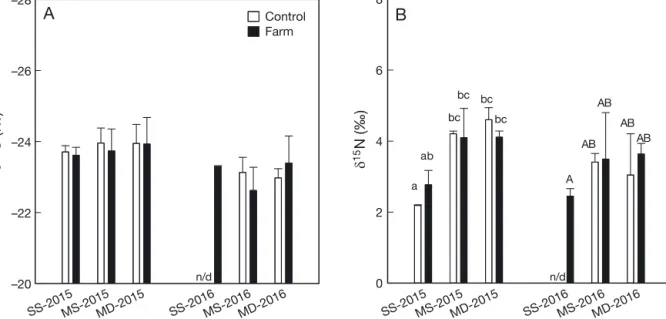
Results of t-tests showed there was no significant difference for either δ13C or δ15N of SSOM between
farm and control sites at each station (Fig. 2; see also Table S1 in the Supplement at www. int-res. com/ articles/ suppl/ q010 p227 _ supp. pdf; t-test: p > 0.05). The ANOVA test for the δ15N values of SSOM at 3
stations in 2015 showed a spatial variation (ANOVA:
F5,12= 33.338, p < 0.001) with Stn SS having slightly
lower δ15N values (Fig. 2).
Stable isotopes and trophic level of meiobenthos Copepods and nematodes were the major meioben-thos taxa in all stations, accounting from 8 to 15% and 45 to 92% for meiobenthos biomass respectively (au-thors’ unpubl. data). For copepods, in total 4 families
were identified: Canuellidae, Laophontidae, Ectino somatidae, and Miraciidae. At Stns SS and MS, Ca -nuellidae was the dominant copepod family at both control and farm sites. At Stn MD, copepods were more diverse at the farm site, where Laophontidae, Ectinosomatidae, Miraciidae, and Canuellidae were abundant; while at the control site only Lao phontidae and Ectinosomatidae were abundant. C and N iso -topic values varied spatially and were not always the same in the 2 sampling events, ranging from −23.02 ± 0.76 ‰ to −19.16 ± 0.20 ‰ for δ13C and 8.13 ± 0.13 ‰ to 14.37 ± 0.17 ‰ for δ15N (Table 1). Carbon and nitrogen
isotopic values varied among meiobenthos taxa (in 2015, δ13C: F 12, 31 = 31.126, p < 0.001; δ15N: F12, 31 = 9.832, p < 0.001; in 2016, δ13C: F 13, 31= 30.035, p < 0.001; δ15N: F 13, 31= 8.089, p < 0.001). In general, nematodes
had higher δ15N values compared with copepods from
the same site, except for the nematodes from 2015 Stn SS that showed a slightly lower value at the farm and a similar value at the control site (Table 1). For the common copepod family Canuellidae, isotopic values displayed high variation (mean values ranged from −21.27 to −19.16 ‰ and from 8.13 to 12.55 ‰ for
δ13C and δ15N respectively). Family Ectinosomatidae
showed the highest δ15N among copepods at the farm
at Stn MD in 2016.
With regard to TL, nematodes at Stns MD and MS showed higher values than any other meiobenthos, ranging from 2.9 to 3.7 (ANOVA: F19, 47= 6.024, p <
0.001). Compared with nematodes from the same
SS-2015MS-2015MD-2015 SS-2016MS-2016MD-2016 –28 –26 –24 –22 –20 Control Farm SS-2015MS-2015MD-2015 SS-2016 MS-2016MD-2016 0 2 4 6 8 n/d n/d a ab bc bc bc A AB AB AB AB bc
A
B
13 C (‰) 15 N (‰)Fig. 2. (A) δ13C and (B) δ15N values (mean ± SD, n = 3) of sediment surface organic matter collected from ‘farm’ and ‘control’
sites at 3 stations (SS, MS and MD) at scallop farms in Laizhou Bay, China in 2015 and 2016. See Fig. 1 legend for abbreviations of stations. Significant differences (p < 0.05) among groups identified by Student-Newman-Keuls pairwise comparisons are
site, the TL values of copepods were lower and var-ied among families and sites. Canuellidae always displayed the lowest TL value at each site, except for Stn SS in 2015 when nematodes had the lowest TL (Table 1). Laophontidae and Miraciidae showed intermediate TL corresponding to an omnivore signal (Post 2002, Maria et al. 2012). Only Ectinosomatidae
from the farm site at Stn MD in 2016 showed a car-nivorous signal (TL = 3.2); the was significantly higher than at the control site at the same station (TL control = 2.4; p = 0.004; Table 1).
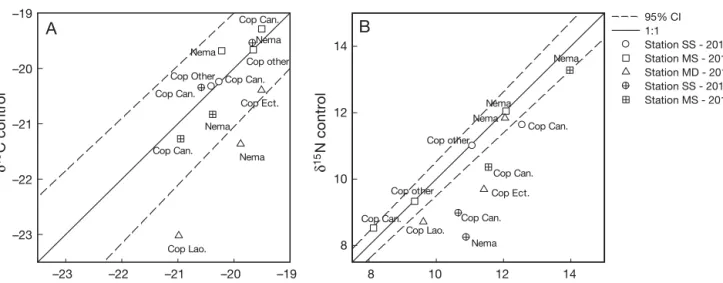
The δ13C and δ15N ratios of co-occurring species at control and farm sites from each station are presented in Fig. 3. For δ13C, most taxa showed similar values at
Station Taxon Control Farm t−test for TL
δ13C δ15N TL δ13C δ15N TL t(df) p-value 2016 SS Canuellidae −20.32 ± 0.08 (3) 11.63 ± 0.08 (3) 1.9 −20.40 ± 0.01 (4) 12.55 ± 0.03 (4) 2 0.818 (5) 0.451NS MS Canuellidae −19.28 ± 0.08 (3) 8.52 ± 0.05 (3) 2 −19.50 ± 0.07 (3) 8.13 ± 0.13 (3) 2 0.088 (4) 0.943NS Nematoda −19.68 ± 0.12 (3) 12.04 ± 0.29 (3) 3.5 −20.21 ± 0.16 (3) 12.07 ± 0.20 (3) 3.7 1.922 (4) 0.117NS MD Laophontidae −23.02 ± 0.76 (3) 8.71 ± 0.97 (3) 2 −20.98 ± 0.18 (3) 9.61 ± 0.19 (3) 2.4 1.705 (4) 0.163NS Ectinosomatidae −20.39 ± 0.11 (3) 9.68 ± 0.19 (3) 2.4 −19.51 ± 0.26 (3) 11.41 ± 0.48 (3) 3.2 6.014 (4) 0.004**
Miraciidae n/a n/a n/a −19.72 ± 0.31 (3) 9.67 ± 0.25 (3) 2.4 n/a n/a
Canuellidae n/a n/a n/a −19.16 ± 0.20 (3) 8.63 ± 0.28 (3) 2 n/a n/a
Nematoda −21.36 ± 0.21 (3) 11.83 ± 0.26 (3) 3.4 −19.88 ± 0.32 (4) 12.04 ± 0.42 (4) 3.5 0.987 (5) 0.369NS 2015 SS Canuellidaea −20.35 ± 0.42 (4) 8.98 ± 0.22 (4) 2 −20.58 ± 0.33 (4) 10.66 ± 0.11 (4) 2 1.731 (6) 0.134NS Nematoda −19.54 ± 0.65 (3) 8.25 ± 0.51 (3) 1.7 −19.67 ± 0.72 (4) 10.89 ± 0.31 (4) 2.1 3.820 (5) 0.012* MS Canuellidaea −21.27 ± 0.83 (4) 10.36 ± 0.38 (4) 2 −20.95 ± 0.07 (4) 11.55 ± 0.11 (4) 2 0.986 (6) 0.362NS Nematoda −20.83 ± 0.19 (3) 13.28 ± 0.21 (3) 3.3 −20.38 ± 0.12 (3) 13.97 ± 0.09 (3) 3 3.960 (4) 0.017* MD Bulk copepoda −21.08 (1) 11.66 (1) 2 −21.45 ± 0.04 (2) 12 ± 0.4 (2) 2 n/a n/a
Nematoda −20.88 ± 0.29 (2) 13.65 ± 0.01 (2) 2.9 −20.22 ± 0.07 (2) 14.37 ± 0.17 (2) 3 n/a n/a
aFamily Canuellidae represented > 70% of sampled organisms per replicate
Table 1. δ13C and δ15N values (mean ± SD, with number of replicates shown in parentheses) and trophic levels (TL, mean) of harpacticoid
copepods and nematodes from scallop farms in Laizhou Bay, China in 2015 and 2016. Samples were taken from ‘control’ and ‘farm’ sites at 3 stations, characterized by sediment type as sandy-shallow (SS), muddy-shallow (MS) and muddy-deep (MD). Results of t-tests of TL in taxa co-occurring in farm and control sites are shown. ***p < 0.001; **p < 0.01; *p < 0.05; NS = non-significant; n/a: not applicable
–23 –22 –21 –20 –19 –23 –22 –21 –20 –19 Cop Can. Nema Cop other Nema Nema Cop Ect. Nema Cop Can. Cop Can. Cop Lao.
A
Cop Other Cop Can.
8 10 12 14 8 10 12 14 95% CI 1:1 Station SS - 2016 Station MS - 2016 Station MD - 2016 Station SS - 2015 Nema Nema Station MS - 2015 Nema Cop Can. Cop Lao. Cop Can. Cop Ect. Cop other Nema Cop other Cop Can. Cop Can.
B
δ13C farm δ 13 C control δ15N farm δ 15 N controlFig. 3. Comparison of (A) δ13C and (B) δ15N values for harpacticoid copepod and nematode taxa between ‘farm’ and ‘control’
sites at 3 stations (SS, MS and MD) at scallop farms in Laizhou Bay, China in 2015 and 2016. See Fig. 1 legend for abbreviations of stations. In each panel, the solid line represents a 1:1 correlation between δ13C or δ15N values at farm and control sites, and
the 2 dashed lines show the 95% CI. Values outside the 95% CI are significantly different. Nema: nematodes; Cop Can.: cope-pod family Canuellidae; Cop Ect.: copecope-pod family Ectinosomatidae; Cop Lao.: copecope-pod family Laophontidae; Cop other: rest of the pooled copepods. In 2015, all copepods are pooled but still represented by the dominant family: Canuellidae, representing
farm and control sites since they fell within the 1:1 correlation 95% CI. For
δ15N, nematodes at Stns MS and MD had similar values be tween farm and control sites, but nematodes at the farm site at Stn SS showed a more en-riched δ15N compared to the control site. All copepods in 2015 and all the abundant families in 2016 (except family Canuellidae at Stn MS) showed more enriched δ15N at farm sites com-pared to control sites.
Mixing model estimation of utiliza-tion by meiobenthos
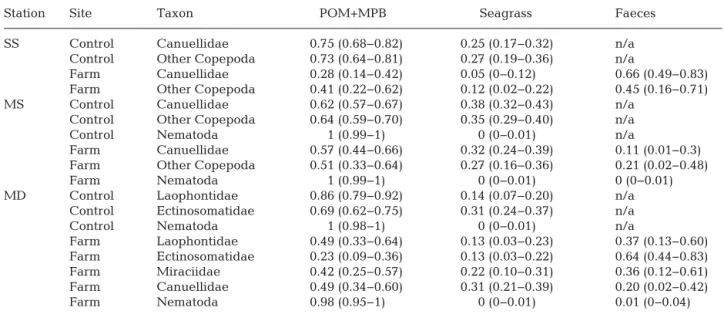
In general, faeces-derived materials were utilized by many copepods under the farms, contributing 12 to 61%, 13 to 60%, 44 to 83%, and 49 to 83% to the diets of Miraciidae, Lao phontidae, and Ectinosomatidae at Stn MD, and Canuellidae at Stn SS, respectively (Table 2). However, the quantities of faeces consumed by copepods differed among the stations. For Canuellidae, scallop faeces were predominantly con-sumed at the farm site at Stn SS (con-tributing at least almost half of their
di-Station Site Taxon POM+MPB Seagrass Faeces SS Control Canuellidae 0.75 (0.68−0.82) 0.25 (0.17−0.32) n/a
Control Other Copepoda 0.73 (0.64−0.81) 0.27 (0.19−0.36) n/a
Farm Canuellidae 0.28 (0.14−0.42) 0.05 (0−0.12) 0.66 (0.49−0.83) Farm Other Copepoda 0.41 (0.22−0.62) 0.12 (0.02−0.22) 0.45 (0.16−0.71) MS Control Canuellidae 0.62 (0.57−0.67) 0.38 (0.32−0.43) n/a
Control Other Copepoda 0.64 (0.59−0.70) 0.35 (0.29−0.40) n/a Control Nematoda 1 (0.99−1) 0 (0−0.01) n/a
Farm Canuellidae 0.57 (0.44−0.66) 0.32 (0.24−0.39) 0.11 (0.01−0.3) Farm Other Copepoda 0.51 (0.33−0.64) 0.27 (0.16−0.36) 0.21 (0.02−0.48) Farm Nematoda 1 (0.99−1) 0 (0−0.01) 0 (0−0.01) MD Control Laophontidae 0.86 (0.79−0.92) 0.14 (0.07−0.20) n/a
Control Ectinosomatidae 0.69 (0.62−0.75) 0.31 (0.24−0.37) n/a Control Nematoda 1 (0.98−1) 0 (0−0.01) n/a
Farm Laophontidae 0.49 (0.33−0.64) 0.13 (0.03−0.23) 0.37 (0.13−0.60) Farm Ectinosomatidae 0.23 (0.09−0.36) 0.13 (0.03−0.22) 0.64 (0.44−0.83) Farm Miraciidae 0.42 (0.25−0.57) 0.22 (0.10−0.31) 0.36 (0.12−0.61) Farm Canuellidae 0.49 (0.34−0.60) 0.31 (0.21−0.39) 0.20 (0.02−0.42) Farm Nematoda 0.98 (0.95−1) 0 (0−0.01) 0.01 (0−0.04) Table 2. Contribution (mean, with 95% CIs in parentheses) of particulate organic matter plus microphytobenthos (POM+MPB), seagrass and faeces in the diet of meiobenthos taxa collected from ‘farm’ and ‘control’ sites at 3 stations at scallop farms in Laizhou Bay, China in 2015 and 2016. See Table 1 legend for abbreviations of stations. The values were calculated using the
Bayesian stable isotope mixing model (MixSIR). n/a: not applicable
Ctrl SS Ctr MSCtrl MDCtrl MD Farm SSFarm MSFarm MDFarm MDFarm MDFarm MD
0 20 40 60 80 100 C o n tr ib u ti o n o f f o o d so u rces ( % )
Can. Can. Lao. Ect. Can. Can. Can. Lao. Mira. Ect.
POM+MPB Seagrass Faeces
Fig. 4. Proportion of mean contributions of food sources to different families of harpacticoid copepods collected from ‘farm’ and ‘control’ sites at 3 stations (SS, MS and MD) at scallop farms in Laizhou Bay, China in 2016. See Fig. 1 legend for abbreviations of stations. Food sources analysed were scallop fae-ces, seagrass Zostera marina,and particulate organic matter plus microphyto-benthos (POM+MPB). Can.: Canuellidae, Lao.: Laophontidae, Mira.:
ets), while faeces were less important at the farm sites at Stns MS and MD (Table 2, Fig. 4). By contrast, nema-todes at Stns MS and MD consumed very little faeces-derived material (<1%).
Fatty acid profiles of the copepod family Canuellidae
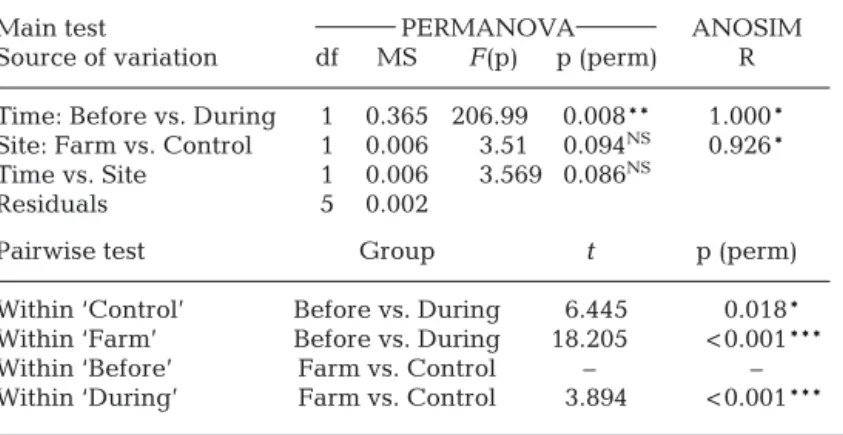
There was a significant difference in FA profiles over time (PERMA NOVA, p < 0.01; ANOSIM, R > 0.75; Table 3), indicating that the FA profile of Canuellidae changed in time. In line with this, the nMDS showed a grouping for samples before aquaculture activity (T0) and the ones collected during aquaculture activity (T1)
(Fig. 5). Based on the results of SIMPER, DHA contributed the most to this dissimi-larity (29.12%). Before aquaculture activ-ity, 16:0 was the major component of the total FA, contributing 46.1 and 47.0% of the total FA of family Canuellidae at farm and control sites respectively, while DHA was the most important FA during aqua-culture ac tivities, contributing 39.01and 29.38% at farm and control sites respec-tively (Table 4).
In addition, a seasonal effect contrib -uted to this pattern: significant differ-ences were found between before and during aquaculture (‘Before vs. During’) within control and farm sites (see pair-wise PER MANOVA tests in Table 3). More importantly, the difference ‘Before vs During’ was more significant within ‘Control’ than within ‘Farm’ (p < 0.05 and p < 0.001 respectively; Table 3), demonstrating that aqua culture made a crucial contribution to the FA profile of Canuellidae at Stn SS. Pairwise PERMANOVA also showed that farm and control sites strongly differed during the aquaculture stage (‘Farm vs. Control’ with ‘During’: p < 0.001; Table 3:), though more replicates were needed to confirm this pattern in a pairwise test between farm and control within ‘Before’.
When excluding the seasonal effect, SIMPER showed that DHA contributed 33.71% to the differ-ence between farm and control sites during aquacul-ture. During aquaculture at Stn SS, Canuellidae at the farm site had higher amounts of DHA and PUFAs than at the control site (Fig. 6, Table 4, Table S2 in the Supplement). 20:1ω9 and PUFA/ SFA, considered as the indicators of carnivorous diet (Stevens et al. 2004), showed higher values in Canuellidae at farm sites during aquaculture at Stn SS. The trophic marker of diatoms/dino flagel lates, i.e. EPA/DHA (Cripps & Atkinson 2000), was lower at farm sites, indicating the different diets of Canuellidae at farm sites compared to those at control sites. Other trophic FA biomarkers showed no difference between farm and control sites (Fig. 6; see also Table S2; p > 0.05).
DISCUSSION
Fate of bay scallop biodeposits in the aquaculture area
Stable isotopes analysis has been applied to trace the fate of aquaculture waste in several studies
Main test PERMANOVA ANOSIM
Source of variation df MS F(p) p (perm) R
Time: Before vs. During 1 0.365 206.99 0.008** 1.000* Site: Farm vs. Control 1 0.006 3.51 0.094NS 0.926*
Time vs. Site 1 0.006 3.569 0.086NS
Residuals 5 0.002
Pairwise test Group t p (perm)
Within ‘Control’ Before vs. During 6.445 0.018* Within ‘Farm’ Before vs. During 18.205 < 0.001*** Within ‘Before’ Farm vs. Control – – Within ‘During’ Farm vs. Control 3.894 < 0.001*** Table 3. Effect of time (‘Before vs. During’ seasonal aquaculture produc-tion) and site (‘Farm vs. Control’) on fatty acid profiles of Canuellidae at scallop farms in Laizhou Bay, China, sampled at Stn SS (see Table 1 legend for abbreviation) in 2016. ***p < 0.001; **p < 0.01; *p < 0.05; NS = not significant. –: no testing possible due to insufficient number of replicates
Fig. 5. Non-metric multi-dimensional scaling (nMDS; resem-blance: S17 Bray-Curtis similarity, 2D stress: <0.01) of the rela-tive fatty acid composition of the harpacticoid copepod family Canuellidae in ‘farm’ and ‘control’ sites at Stn SS (see Table 1 legend for abbreviation) at a scallop farm in Laizhou Bay, China
(Kon et al. 2009, Gondwe et al. 2012, Callier et al. 2013), since the aquaculture-derived waste has dis-tinctive isotopic values. In our study, the enriched
δ15N of bay scallop faeces compared to other organic sources was a prerequisite in order to be able to trace its fate. Contrary to some studies that demonstrate the accumulation of aquaculture waste in the sediment organic matter (OM) pool, SSOM in our study did not show the enrichment of 15N by scallop farming activity. This could be explained by 2 hypotheses. First, the aquaculture-derived OM was diluted in the water column and thus did not sink to the sea floor (Vizzini & Mazzola 2012). Sec-ond, the local consumers rapidly incorporated the aquaculture-derived matter (Kon et al. 2009). As we found more enriched δ15N values of most cope-pods and some nematodes in the sediment under the farms (see ‘Effects of bay scallop aquaculture on the quality of harpacticoid copepods for higher trophic levels’), the second explanation is more plausible. Callier et al. (2013) re ported a similar
outcome; i.e. isotopic values shifted in inverte-brates rather than in SSOM. Taken to gether with the results of our study, this suggests that analyzing the response of the benthos (i.e. a biotic response) to evaluate the effect of aqua-culture will provide a more comprehensive view than investigating only the response of the sediment (i.e. an abiotic response).
Biodeposits of bay scallop as food sources to meiobenthos
The resource utilization of meiobenthos ap -pears to be a promising tool to evaluate the effect of aqua culture effluents on ecosystem function-ing in terms of energy flow (Kennedy & Jacoby 1999, De Troch et al. 2013). The incorporation of scallop faeces into the diets of most harpacticoid copepods at all stations and nematodes in the sandy station under the farms demonstrates that bay scallop farming changed the energy flow in the basal part of the food web. This evidence agrees with findings of other studies that aquaculture effluents serve as alternative food sour -ces for the benthos (Dubois et al. 2007, Callier et al. 2013).
The flux of OM is usually enhanced in the shellfish aquaculture area (Newell 2004, Mc Kind -sey et al. 2011); consequently the food availabil-ity for benthic organisms increases. Moreover, in terms of food source profitability, bio deposits are considered to be of good nutritional value be cause of their high carbon and nitrogen contents, large pro-portions of labile OM, and the low C/N ratios (Kaut-sky & Evans 1987, Miller et al. 2002). Biodeposits are mucus-enriched and function as good substrates for bacteria (Hargrave 1976). Thus, abundant microor-ganisms colonize on the pellet particles during gut passage (Wer ry & Lee 2005, Cnudde et al. 2011) and after defecation (Fabiano et al. 1994), and efficiently rework the labile components within hours to days (Carlsson et al. 2010). They break down the refrac-tory OM from the faecal pellets and also produce micro bial nutrients (e.g. extracellular protein and exu dates) that make them available to other benthic organisms (Kautsky & Evans 1987, Wotton & Malm qvist 2001). Furthermore, increasing densities of micro -organisms (e.g. bacteria, ciliates and dino flagellates) themselves provide more foods for meiobenthos (Epstein 1997, Moens & Vincx 1997). Therefore, bio -deposit-derived materials can easily be con sumed by meiobenthos and enter the basal food web.
Fatty acid Before aquaculture During aquaculture
Farm Control Farm Control
14:0 6.61 (1) 7.52 (1) 1.03 ± 0.15 (4) 1.63 ± 0.59 (3) 15:0 5.95 (1) 6.67 (1) 0.88 ± 0.12 (4) 1.18 ± 0.19 (3) 16:0 46.1 (1) 47.0 (1) 14.67 ± 1.19 (4) 20.54 ± 3.80 (3) 16:1ω7 n/a n/a 3.34 ± 0.55 (4) 3.91 ± 0.73 (3) 17:0 7.09 (1) 7.4 (1) 3.41 ± 0.14 (4) 3.00 ± 0.13 (3)
17:1ω7 n/a n/a n/a 0.06 ± 0.11 (3)
18:0 27 (1) 25.6 (1) 12.47 ± 0.43 (4) 17.60 ± 1.09 (3) 18:1ω9t n/a n/a 2.62 ± 0.83 (4) 2.79 ± 0.92 (3) 18:1ω9c n/a n/a 4.90 ± 0.14 (4) 4.25 ± 0.75 (3) 18:2ω6c n/a n/a 1.03 ± 0.69 (4) 1.30 ± 0.13 (3) 20:0 1.53 (1) 1.01 (1) 0.50 ± 0.08 (4) 0.50 ± 0.04 (3) 18:3ω3 ALA n/a n/a 0.77 ± 0.08 (4) 0.74 ± 0.07 (3) 20:1ω9 n/a n/a 2.05 ± 0.19 (4) 1.30 ± 0.02 (3)
20:2ω6 n/a n/a 0.38 ± 0.02 (4) n/a
22:0 2.01 (1) 1.49 (1) 0.83 ± 0.01 (4) 0.56 ± 0.04 (3)
20:3ω6 n/a n/a n/a 0.16 ± 0.28 (3)
22:1ω9 n/a n/a 0.13 ± 0.26 (4) n/a
23:0 0.96 (1) 0.74 (1) 0.61 ± 0.02 (4) 0.25 ± 0.22 (3) 20:5ω3 EPA n/a 0.45 (1) 9.82 ± 0.64 (4) 9.77 ± 1.45 (3) 24:0 2.23 (1) 1.62 (1) 0.93 ± 0.03 (4) 0.60 ± 0.02 (3) 24:1ω6 n/a n/a 0.51 ± 0.03 (4) 0.38 ± 0.36 (3) 22:6ω3 DHA n/a n/a 39.01 ± 1.84 (4) 29.38 ± 3.59 (3) Table 4. Relative fatty acid composition of the harpacticoid copepod fam-ily Canuellidae from ‘farm’ and ‘control’ sites at Stn SS (see Table 1 leg-end for abbreviation) at a scallop farm in Laizhou Bay, China before and during seasonal aquaculture in 2016. Values for ‘during aquaculture’ are mean ± SD, with the number of replicates given in parentheses. ALA: alpha-linolenic acid; EPA: eicosapentaenoic acid; DHA:
Effect of bay scallop aquaculture on the diets of meiobenthos
While aquaculture-derived OM is a nutritional food source (McKindsey et al. 2011, Callier et al. 2013), the quantities and pathways of consumption by ben-thos vary among trophic groups and feeding modes (Dubois et al. 2007, Wai et al. 2011). In accordance with the large trophic diversity of meiobenthos in coastal areas (Hicks & Coull 1983, Jensen 1987), we found that the quantities and pathways of faeces con-sumption differed according to the feeding behaviors of the meiobenthos. This was clearly illustrated by the harpacticoid copepod families. Substrate brow -sers, like Laophontidae and Miraciidae, possibly took faecal OM through scraping or sweeping off the attached bacteria (Hicks & Coull 1983, Cnudde et al. 2013, Mascart et al. 2013). For Canuellidae, faecal OM were presumably assimilated by filtering-feed-ing the small particles suspended in the water col-umn (Cnudde et al. 2015). With the provision of bac-teria and protists on the biodeposits (Wotton & Malmqvist 2001, Bongiorni et al. 2005), Ectinosomati-dae showed an increased TL, suggesting that the
feeding type of this taxon changed from omnivorous to carnivorous. It is possible that the dominant spe-cies of Ectino somatidae has been modified by farm-ing, since this is a species-rich family with various resource utilization strategies including diatom-feeding, microvory, point- diatom-feeding, and predation (Coull & Dudley 1976, Sei fried & Dürbaum 2000). Further detailed screening of the trophic ecology of meio -benthos is required to prove this.
In addition, the copepod family Canuellidae de -mon strated that the effect of bay scallop biodeposi-tion depends on the receiving environment. With a broad range of niche breadth (De Troch et al. 2003), Canuellidae could switch their diets to more nutri-tious organic sources such as scallop biodeposits if other sources were insufficient, for instance in a sandy bottom with low chlorophyll levels and poor organic resources (Cartaxana et al. 2006). At muddy stations, the small contributions of biodeposits to Canuellidae may be explained by the greater avail-ability of autotrophic production.
As for nematodes, their TLs indicate that the com-munities were different according to the sediment type. Nematodes at muddy stations were carnivores
EPA DHA PUFA 16:1ω7
SUM15, ω17 20:1ω 9 18:2ω 6 16:1ω 7/16:0 EPA/DHAPUFA/SFA 0.0 0.1 0.2 0.3 0.4 0.5
Marker fatty acids (%)
0.6
Fatty acid ratios
0.0 0.2 0.4 0.6 0.8 1.0 1.2 1.4 1.6 1.8 Control Farm
*
*
** ** ** * **Fig. 6. Marker fatty acids (FA), with values shown for relative FA composition and FA ratios, in the harpacticoid copepod fam-ily Canuellidae at ‘farm’ and ‘control’ sites at Stn SS (see Table 1 legend for abbreviation), during seasonal aquaculture at a scallop farm in Laizhou Bay, China in 2016.Eicosapentaenoic acid (EPA), docosahexaenoic acid (DHA) and polyunsaturated fatty acids (PUFA) are indicative of food quality. Other biomarkers shown are: 16:1ω7 and 16:1ω7/16:0 (indicative of diatoms in the diet); EPA/DHA (diatoms/dinoflagellates); SUM 15,17 (i.e. the sum values of 15:0, 17:0, 17:1ω7 in this study; indicating bacterial FAs); 18:2ω6 (terrestrial detritus or green algae); 20:1ω9 and PUFA/SFA ratio (indicative of carnivory). Asterisks show
and did not incorporate faeces-derived materials into their diets. The data suggest that even when bio -deposits were present, they did not modify their feeding mode i.e. they were either consuming bacte-ria derived from MPB extracellular polymeric sub-strate (EPS) or predating on small nematodes that fed on EPS of MPB (Moens et al. 2005, Rzeznik-Orignac et al. 2008, Majdi et al. 2012). It is also possible that this group of nematodes resided in deeper sediment (Steyaert et al. 2003) and could not access the bio -deposits, which had either already been consumed by surface locating copepods or were not buried deep enough into the sediments. In this case, bay scallop farming has no impact on the resource utiliza-tion by nematodes that are trophic specialists. In con-trast, nematodes at the sandy station incorporated biodeposits under the scallop farm. Microvory of nematodes has been reported to be dominant below a mussel farm (Netto & Valgas 2010), where they pre-sumably benefit from higher microbial densities by organic loading (Mirto et al. 2000). In our study, the feeding group of nematodes was likely changed by bay scallop farming.
Effect of bay scallop aquaculture on the quality of harpacticoid copepods for higher trophic levels PUFA concentrations, and especially those of DHA increased in Canuellidae (the most abundant harp -acticoid copepods) as they consumed certain amounts of scallop faeces at farm sites during the high biodeposition stage. PUFAs are important com-positions of cell membranes and are needed in ani-mals at all taxonomic levels, including copepods (Ed-erington et al. 1995, Hartwich et al. 2013). Especially at low temperature, PUFAs promote membrane fluid-ity (Farkas 1979, Stillwell & Wassall 2003). Also, with higher levels of PUFA, copepods have higher repro-duction ability in terms of eggs prorepro-duction (Edering-ton et al. 1995). In our study, as the winter had just started during our sampling season, we hypothesize that the higher contents of PUFA provided Canuelli-dae with better opportunities to reproduce and deal with the low temperature and food-stress periods.
Furthermore, PUFAs, EPA and DHA have been recognized as good biomarkers to describe the qual-ity of food (Boon & Duineveld 1996, Goedkoop et al. 2000). As higher level consumers in marine ecosys-tems cannot synthesize highly unsaturated fatty acids (HUFAs) such as DHA, their HUFA levels are derived entirely from their food sources (Iverson 2009, Hartwich et al. 2013). As harpacticoid
cope-pods are important food items for epibenthic organ-isms such as shrimps and juvenile fishes (Coull et al. 1995), their quality in terms of PUFA or HUFA levels becomes an important factor influencing the quality of higher consumers as a food source and thus en -riching the entire food web. Thus, the fact that Canuellidae consuming biodeposits of bay scallops contained more PUFAs (especially DHA) implies that they constituted a more nutritious food item for higher level consumers.
However, the mechanisms behind the increasing levels of PUFA (especially DHA) are not clear yet because the pathways to accumulate DHA are com-plicated and depend on several factors (Bell & Tocher 2009, Werbrouck et al. 2016). Copepods may gain DHA directly from the food or synthesize DHA from shorter chain of PUFAs (Schlechtriem et al. 2006, De Troch et al. 2012). It has been suggested that organ-isms using ‘foreign foods’ (i.e. foods not originating from their habitat) were not accustomed to these, and this might have stimulated the compensatory bio-chemical pathways (Iverson 2009). It is possible that loading of bio deposits induces the pathway to accu-mulate PUFAs and DHA in Canuellidae. To further elucidate the role of faeces in the eco system func-tioning, there are many options for future investiga-tion; for example to determine whether, how, and to what extent aquaculture-derived PUFAs is transfer-able through the food chain.
Bay scallop as a non-indigenous species for the local environment: a positive perspective It is always a concern that culturing NIS, especially non-indigenous shellfish, in coastal marine ecosystem, includes ecological risks (Newell 2004, Shelton & Rothbard 2006, Minchin et al. 2009). Our study showed that, to some extent, farming the non-indige-nous bay scallop provides an extra food source for the benthos and consequently improves the quality of the local benthic environment. This suggests that the farming bay scallop has a positive effect on ecosystem functioning. To make a more complete assessment of NIS aquaculture, further re search is needed to com-pare the effects with those of culturing native species. Our observations may also apply to other shellfish farms, but additional factors should be considered, such as aquaculture characteristics (e.g. cultured spe cies, stocking densities, etc.), and the hydrodyna mics and sediment type of the receiving environment, be-cause these can also affect the activities of the benthos (Chamberlain et al. 2001, Giles et al. 2006).
CONCLUSIONS
Our study showed that stable isotopes, especially
δ15N, are a powerful tool to trace possible functional changes due to aquaculture activities. We also showed that the biodeposits were directly/indirectly consumed by meiobenthos, and accordingly, har -pacticoid copepods residing under the scallop farms improved their quality as food items for the next trophic level. Therefore, we demonstrate a positive effect of intensive farming of bay scallop Argopecten irradianson ecosystem functioning.
Acknowledgements. This work was funded by the Doctoral Programme on Marine Ecosystem Health and Conservation (MARES) in the form of a PhD grant to Q.H. FA analyses were supported by the Research Foundation − Flanders (FWO) in the form of Research Grant 31523814 ‘FAs as dietary tracers in benthic food webs’ awarded to M.D.T. The research was carried out with infrastructure funded by the European Marine Biological Research Centre (EMBRC) Bel-gium and FWO Project GOH3817N. We thank Prof. Hong-sheng Yang and his research group, Prof. Kuidong Xu and his research group, Dr. Tao Jiang, Dr. Lin Lu, and the staff of Blue Ocean for their supports during sample collection in China. We also express our gratitude to Annick Van Ken-hove, Bart Beuselinck, and Dirk Van Gansbeke for help in the lab, to Dr. Jianxiang Feng for useful suggestions, and to Elena Pagter for proofreading.
LITERATURE CITED
Anderson MJ (2006) Distance-based tests for homogeneity of multivariate dispersions. Biometrics 62: 245−253 Anderson MJ, Gorley R, Clarke K (2008) PERMANOVA+ for
PRIMER: guide to software and statistical methods. PRIMER-E, Plymouth
Bell MV, Tocher DR (2009) Biosynthesis of polyunsaturated fatty acids in aquatic ecosystems: general pathways and new directions. In: Arts MT, Brett MT, Kainz MJ (eds) Lipids in aquatic ecosystems. Springer, New York, NY, p 211−236
Bongiorni L, Mirto S, Pusceddu A, Danovaro R (2005) Response of benthic protozoa and thraustochytrid pro-tists to fish farm impact in seagrass (Posidonia oceanica) and soft-bottom sediments. Microb Ecol 50: 268−276 Boon A, Duineveld G (1996) Phytopigments and fatty acids
as molecular markers for the quality of near-bottom par-ticulate organic matter in the North Sea. J Sea Res 35: 279−291
Callier MD, McKindsey CW, Desrosiers G (2008) Evaluation of indicators used to detect mussel farm influence on the benthos: two case studies in the Magdalen Islands, East-ern Canada. Aquaculture 278: 77−88
Callier MD, Lefebvre S, Dunagan MK, Bataille MP, Cough-lan J, Crowe TP (2013) Shift in benthic assemblages and organisms’ diet at salmon farms: community structure and stable isotope analyses. Mar Ecol Prog Ser 483: 153−167
Carlsson MS, Glud RN, Petersen JK (2010) Degradation of mussel (Mytilus edulis) fecal pellets released from
hang-ing long-lines upon sinkhang-ing and after settlhang-ing at the sed-iment. Can J Fish Aquat Sci 67: 1376−1387
Cartaxana P, Mendes C, Van Leeuwe M, Brotas V (2006) Comparative study on microphytobenthic pigments of muddy and sandy intertidal sediments of the Tagus estu-ary. Estuar Coast Mar Sci 66: 225−230
Chamberlain J, Fernandes T, Read P, Nickell T, Davies I (2001) Impacts of biodeposits from suspended mussel (Mytilus edulis L.) culture on the surrounding surficial sediments. ICES J Mar Sci 58: 411−416
Cifuentes L, Sharp J, Fogel ML (1988) Stable carbon and nitrogen isotope biogeochemistry in the Delaware estu-ary. Limnol Oceanogr 33: 1102−1115
Clarke KR, Gorley RN (2006) PRIMER V6: user manual -tutorial. Plymouth Marine Laboratory, Plymouth Cnudde C, Willems A, Van Hoorde K, Vyverman W, Moens
T, De Troch M (2011) Effect of food preservation on the grazing behavior and on the gut flora of the harpacticoid copepod Paramphiascella fulvofasciata. J Exp Mar Biol Ecol 407: 63−69
Cnudde C, Moens T, Willems A, De Troch M (2013) Sub-strate-dependent bacterivory by intertidal benthic cope-pods. Mar Biol 160: 327−341
Cnudde C, Moens T, Werbrouck E, Lepoint G, Van Gans-beke D, De Troch M (2015) Trophodynamics of estuarine intertidal harpacticoid copepods based on stable isotope composition and fatty acid profiles. Mar Ecol Prog Ser 524: 225−239
Coull BC, Dudley BW (1976) Delayed naupliar development of meiobenthic copepods. Biol Bull 150: 38−46
Coull BC, Greenwood JG, Fielder DR, Coull BA (1995) Sub-tropical Australian juvenile fish eat meiofauna: experi-ments with winter whiting Sillago maculataand observa-tions on other species. Mar Ecol Prog Ser 125: 13−19 Crawford CM, Macleod CKA, Mitchell IM (2003) Effects of
shellfish farming on the benthic environment. Aquacul-ture 224: 117−140
Cripps G, Atkinson A (2000) Fatty acid composition as an indicator of carnivory in Antarctic krill, Euphausia superba.Can J Fish Aquat Sci 57: 31−37
de Lima LCM, Navarro DMAF, Souza-Santos LP (2013) Effect of diet on the fatty acid composition of the copepod Tisbe Biminiensis.J Crustac Biol 33: 372−381
De Troch M, Fiers F, Vincx M (2003) Niche segregation and habitat specialisation of harpacticoid copepods in a trop-ical seagrass bed. Mar Biol 142: 345−355
De Troch M, Boeckx P, Cnudde C, Van Gansbeke D, Van-reusel A, Vincx M, Caramujo MJ (2012) Bioconversion of fatty acids at the basis of marine food webs: insights from a compound-specific stable isotope analysis. Mar Ecol Prog Ser 465: 53−67
De Troch M, Roelofs M, Riedel B, Grego M (2013) Structural and functional responses of harpacticoid copepods to anoxia in the Northern Adriatic: an experimental ap -proach. Biogeosciences 10: 4259−4272
DeNiro MJ, Epstein S (1978) Influence of diet on the distribution of carbon isotopes in animals. Geochim Cosmo -chim Acta 42: 495−506
Doi H, Kikuchi E, Hino S, Itoh T, Takagi S, Shikano S (2003) Seasonal dynamics of carbon stable isotope ratios of par-ticulate organic matter and benthic diatoms in strongly acidic Lake Katanuma. Aquat Microb Ecol 33: 87−94 Dubois S, Marin-Léal JC, Ropert M, Lefebvre S (2007)
Effects of oyster farming on macrofaunal assemblages associated with Lanice conchilega tubeworm
popula-tions: a trophic analysis using natural stable isotopes. Aquaculture 271: 336−349
Ederington MC, McManus GB, Harvey HR (1995) Trophic transfer of fatty acids, sterols, and a triterpenoid alcohol between bacteria, a ciliate, and the copepod Acartia tonsa.Limnol Oceanogr 40: 860−867
Epstein SS (1997) Microbial food webs in marine sediments. II. Seasonal changes in trophic interactions in a sandy tidal flat community. Microb Ecol 34: 199−209
Fabiano M, DANOVAro R, Olivari E, Misic C (1994) Decom-position of faecal matter and somatic tissue of Mytilus galloprovincialis: changes in organic matter composition and microbial succession. Mar Biol 119: 375−384 FAO (Food and Agriculture Organization of the United
Nations) (2016) The state of world fisheries and aqua -culture 2016. FAO, Rome
Farkas T (1979) Adaptation of fatty acid compositions to temperature — a study on planktonic crustaceans. Comp Biochem Physiol B 64: 71−76
Giles H, Pilditch CA, Bell DG (2006) Sedimentation from mussel (Perna canaliculus) culture in the Firth of Thames, New Zealand: impacts on sediment oxygen and nutrient fluxes. Aquaculture 261: 125−140
Goedkoop W, Sonesten L, Ahlgren G, Boberg M (2000) Fatty acids in profundal benthic invertebrates and their major food resources in Lake Erken, Sweden: seasonal varia-tion and trophic indicavaria-tions. Can J Fish Aquat Sci 57: 2267−2279
Gondwe MJ, Guildford SJ, Hecky RE (2012) Tracing the flux of aquaculture-derived organic wastes in the southeast arm of Lake Malawi using carbon and nitrogen stable isotopes. Aquaculture 350−353: 8−18
Guo X, Luo Y (2016) Scallops and scallop aquaculture in China. In: Shumway SE, Parsons GJ (eds) Scallops, 3E. Elsevier Science, Oxford, p 937–952
Hargrave BT (1976) The central role of invertebrate faeces in sediment decomposition. In: Anderson JM, Macfadyen A (eds) The role of terrestrial and aquatic organisms in decomposition processes. Blackwell Scientific, Oxford, p 301−321
Hartstein ND, Rowden AA (2004) Effect of biodeposits from mussel culture on macroinvertebrate assemblages at sites of different hydrodynamic regime. Mar Environ Res 57: 339−357
Hartwich M, Martin-Creuzburg D, Wacker A (2013) Sea-sonal changes in the accumulation of polyunsaturated fatty acids in zooplankton. J Plankton Res 35: 121−134 Hicks GRF, Coull BC (1983) The ecology of marine
harpacti-coid copepods. Oceanogr Mar Biol Annu Rev 21: 67−175 Hoshika A, Sarker MJ, Ishida S, Mishima Y, Takai N (2006) Food web analysis of an eelgrass (Zostera marina L.) meadow and neighbouring sites in Mitsukuchi Bay (Seto Inland Sea, Japan) using carbon and nitrogen stable iso-tope ratios. Aquat Bot 85: 191−197
Iverson SJ (2009) Tracing aquatic food webs using fatty acids: from qualitative indicators to quantitative determi-nation. In: Arts MT, Brett MT, Kainz MJ (eds) Lipids in aquatic ecosystems. Springer, New York, NY, p 281−308 Jensen P (1987) Feeding ecology of free-living aquatic
nematodes. Mar Ecol Prog Ser 35: 187−196
Jin X, Shan X, Li X, Wang J, Cui Y, Zuo T (2013) Long-term changes in the fishery ecosystem structure of Laizhou Bay, China. Sci China Earth Sci 56: 366−374
Kalantzi I, Karakassis I (2006) Benthic impacts of fish farm-ing: meta-analysis of community and geochemical data.
Mar Pollut Bull 52: 484−493
Kautsky N, Evans S (1987) Role of biodeposition by Mytilus edulisin the circulation of matter and nutrients in a Baltic coastal ecosystem. Mar Ecol Prog Ser 38: 201−212 Kelly JR, Scheibling RE (2012) Fatty acids as dietary tracers
in benthic food webs. Mar Ecol Prog Ser 446: 1−22 Kennedy AD, Jacoby CA (1999) Biological indicators of
mar-ine environmental health: meiofauna — a neglected ben-thic component? Environ Monit Assess 54: 47−68 Kon K, Kawakubo N, Aoki JI, Tongnunui P, Hayashizaki KI,
Kurokura H (2009) Effect of shrimp farming organic waste on food availability for deposit feeder crabs in a mangrove estuary, based on stable isotope analysis. Fish Sci 75: 715−722
Leduc D, Probert PK (2009) The effect of bacterivorous nematodes on detritus incorporation by macrofaunal de -tritivores: a study using stable isotope and fatty acid analyses. J Exp Mar Biol Ecol 371: 130−139
Leduc D, Probert PK, Duncan A (2009) A multi-method approach for identifying meiofaunal trophic connections. Mar Ecol Prog Ser 383: 95−111
Li Y, Veilleux DJ, Wikfors GH (2009) Particle removal by Northern bay scallops Argopecten irradians irradiansin a semi-natural setting: application of a flow-cytometric technique. Aquaculture 296: 237−245
Liu H, Fang J, Zhu J, Dong S and others (2004) Study on lim-iting nutrients and phytoplankton at long-line-culture areas in Laizhou Bay and Sanggou Bay, northeastern China. Aquat Conserv 14: 551−574
Majdi N, Tackx M, Traunspurger W, Buffan-Dubau E (2012) Feeding of biofilm-dwelling nematodes examined using HPLC-analysis of gut pigment contents. Hydrobiologia 680: 219−232
Maria TF, Vanaverbeke J, Esteves AM, De Troch M, Van-reusel A (2012) The importance of biological interactions for the vertical distribution of nematodes in a temperate ultra-dissipative sandy beach. Estuar Coast Mar Sci 97: 114−126
Mascart T, Lepoint G, De Troch M (2013) Meiofauna and harpacticoid copepods in different habitats of a Medi -terra nean seagrass meadow. J Mar Biol Assoc UK 93: 1557−1566
McKindsey CW, Archambault P, Callier MD, Olivier F (2011) Influence of suspended and off-bottom mussel culture on the sea bottom and benthic habitats: a review. Can J Zool 89: 622−646
Miller DC, Norkko A, Pilditch CA (2002) Influence of diet on dispersal of horse mussel Atrina zelandicabiodeposits. Mar Ecol Prog Ser 242: 153−167
Minagawa M, Wada E (1984) Stepwise enrichment of 15N
along food chains: further evidence and the relation between δ15N and animal age. Geochim Cosmochim
Acta 48: 1135−1140
Minchin D, Gollasch S, Cohen AN, Hewitt CL, Olenin S (2009) Characterizing vectors of marine invasion. In: Rilov G, Crooks JA (eds) Biological invasions in marine ecosystems. Ecological Studies 204. Springer, Berlin, p 153−172
Mirto S, La rosa T, Danovaro R, Mazzola A (2000) Microbial and meiofaunal response to intensive musselfarm bio -deposition in coastal sediments of the western Medi -terra nean. Mar Pollut Bull 40: 244−252
Moens T, Vincx M (1997) Observations on the feeding ecol-ogy of estuarine nematodes. J Mar Biol Assoc UK 77: 211−227
Moens T, Bouillon S, Gallucci F (2005) Dual stable isotope abundances unravel trophic position of estuarine nema-todes. J Mar Biol Assoc UK 85: 1401−1407
Moore JW, Semmens BX (2008) Incorporating uncertainty and prior information into stable isotope mixing models. Ecol Lett 11: 470−480
Nanton DA, Castell JD (1999) The effects of temperature and dietary fatty acids on the fatty acid composition of harpacticoid copepods, for use as a live food for marine fish larvae. Aquaculture 175: 167−181
Netto SA, Valgas I (2010) The response of nematode assem-blages to intensive mussel farming in coastal sediments (Southern Brazil). Environ Monit Assess 162: 81−93 Newell RI (2004) Ecosystem influences of natural and
culti-vated populations of suspension-feeding bivalve mol-luscs: a review. J Shellfish Res 23: 51−62
Peterson BJ, Heck KL (1999) The potential for suspension feeding bivalves to increase seagrass productivity. J Exp Mar Biol Ecol 240: 37−52
Phillips DL, Newsome SD, Gregg JW (2005) Combining sources in stable isotope mixing models: alternative methods. Oecologia 144: 520−527
Pillay TVR (2008) Aquaculture and the environment, 2nd edn. Blackwell, London
Post DM (2002) Using stable isotopes to estimate trophic position: models, methods, and assumptions. Ecology 83: 703−718
Power ME (1992) Habitat heterogeneity and the functional significance of fish in river food webs. Ecology 73: 1675−1688
Rzeznik-Orignac J, Boucher G, Fichet D, Richard P (2008) Stable isotope analysis of food source and trophic posi-tion of intertidal nematodes and copepods. Mar Ecol Prog Ser 359: 145−150
Sanz-Lázaro C, Sanchez-Jerez P (2017) Mussels do not directly assimilate fish farm wastes: shifting the rationale of integrated multi-trophic aquaculture to a broader scale. J Environ Manage 201: 82−88
Schlechtriem C, Arts M, Zellmer I (2006) Effect of tempera-ture on the fatty acid composition and temporal trajecto-ries of fatty acids in fasting Daphnia pulex(Crustacea, Cladocera). Lipids 41: 397−400
Seifried S, Dürbaum J (2000) First clear case of carnivory in marine Copepoda Harpacticoida. J Nat Hist 34: 1595− 1618
Shelton WL, Rothbard S (2006) Exotic species in global aquaculture — a review. Isr J Aquacult Bamidgeh 58: 3−28
Stevens CJ, Deibel D, Parrish CC (2004) Incorporation of
bacterial fatty acids and changes in a wax ester-based omnivory index during a long-term incubation experi-ment with Calanus glacialis Jaschnov. J Exp Mar Biol Ecol 303: 135−156
Steyaert M, Vanaverbeke J, Vanreusel A, Barranguet C, Lucas C, Vincx M (2003) The importance of fine-scale, vertical profiles in characterising nematode community structure. Estuar Coast Mar Sci 58: 353−366
Stillwell W, Wassall SR (2003) Docosahexaenoic acid: mem-brane properties of a unique fatty acid. Chem Phys Lipids 126: 1−27
Svensson CJ, Hyndes GA, Lavery PS (2010) An efficient method for collecting large samples of live copepods free from detritus. Mar Freshw Res 61: 621−624
Vizzini S, Mazzola A (2012) Tracking multiple pathways of waste from a northern bluefin tuna farm in a marine-coastal area. Mar Environ Res 77: 103−111
Wai TC, Leung KM, Wu RS, Shin PK, Cheung SG, Li X, Lee JH (2011) Stable isotopes as a useful tool for revealing the environmental fate and trophic effect of open-sea-cage fish farm wastes on marine benthic organisms with different feeding guilds. Mar Pollut Bull 63: 77−85 Wang F (2015) Feeding ecology of two megagrazers in two
typical bays. MSc thesis, University of Chinese Academy of Sciences, Beijing
Werbrouck E, Van Gansbeke D, Vanreusel A, De Troch M (2016) Temperature affects the use of storage fatty acids as energy source in a benthic copepod (Platychelipus litto ralis, Harpacticoida). PLOS ONE 11: e0151779 Werry J, Lee SY (2005) Grapsid crabs mediate link between
mangrove litter production and estuarine planktonic food chains. Mar Ecol Prog Ser 293: 165−176
Wotton RS, Malmqvist B (2001) Feces in aquatic ecosystems. Bioscience 51: 537−544
Zanden M, Rasmussen JB (2001) Variation in δ15N and δ13C
trophic fractionation: implications for aquatic food web studies. Limnol Oceanogr 46: 2061−2066
Zhao J, Chen JF (2001) Research on aquacultural hydro-environment of Eastern Laizhou Bay. Mar Fish Res 22: 62−67 (in Chinese with English Abstract)
Zhou Y, Yang H, Zhang T, Liu S and others (2006) Influence of filtering and biodeposition by the cultured scallop Chlamys farreri on benthic-pelagic coupling in a eutrophic bay in China. Mar Ecol Prog Ser 317: 127−141 Zhuang W, Gao X, Zhang Y, Xing Q, Tosi L, Qin S (2014) Geochemical characteristics of phosphorus in surface sediments of two major Chinese mariculture areas: the Laizhou Bay and the coastal waters of the Zhangzi Island. Mar Pollut Bull 83: 343−351
Editorial responsibility: Pablo Sánchez Jerez, Alicante, Spain
Submitted: November 3, 2017; Accepted: February 22, 2018 Proofs received from author(s): May 13, 2018