SAS Clinical Programming
In 18 Easy Steps
FOR M.Pharm / M.Sc (Life Sciences) /M.sc (Stats)/
M.C.A/M.Tech / B.Pharm /Bio-Tech/B.Tech.
SAS Clinical Programming
In 18 Easy Steps
FOR M.Pharm / M.Sc (Life Sciences) /M.sc (Stats)/
M.C.A/M.Tech / B.Pharm /Bio-Tech/B.Tech.
Notion Press
5 Muthu Kalathy Street, Triplicane, Chennai - 600 005
First Published by Notion Press 2014 Copyright © Mr. Y. Lakshmi Prasad 2014 All Rights Reserved.
ISBN: 978-93-84381-63-9
This book has been published in good faith that the work of the author is original. All efforts have been taken to make the material error-free. However, the author and the publisher disclaim the responsibility. No part of this book may be used, reproduced in any manner whatsoever without written permission from the author, except in the case of brief quotations embodied in critical articles and reviews.
This book is dedicated to
P. V. Narasimha Rao
(Patriotic statesman who believed that
the nation is bigger than the political system)
Preface
Finally, An Indian author created an indispensable guide focuses on SAS Clinical Programming, in an instructive and conversational tone which helps them who want to make their career in SAS Clinical Programming and entry level programmers for their day to day tasks
with practical, real world examples, detailed description, work flows,
Issues, Resolutions, key techniques and many more.
This book is like your personal trainer, explains the art of SAS clinical Programming in 18 easy steps which covers from basics to ADS, TLF Creation, as well as CDISC SDTM, ADaM. Many statistical
Concepts are explained in an easy way so that you feel confident while
using Statistical Procedures. If you are already working as a SAS Clinical Programmer, still you need this book to sharpen your skills.
This book will be an asset to you and your career by making you a better SAS clinical Programmer.
Authors’ Note
One interesting thing in SAS Clinical Programming, it is the career Option for people with various study backgrounds. I have seen SAS
Programmers with different qualifications like Pharmacy, Statistics,
M.C.A, M. Tech, M.Sc Life sciences, Bio Tech, Mathematics and many more. It is wonderful to see people with different backgrounds working on the same project, but how can we expect Clinical Research
and Biostatistics knowledge from a person with technical qualification.
Every person might be strong in their own subject but SAS Clinical Programmer needs to know more than one subject (Programming (Tech), Clinical Research (Pharma) and Biostatistics (Stats)). This
might be the reason I thought it would be beneficial to have a resource
that brings together all these aspects in one volume so that it would help everybody who wants to make SAS Programming as their career Option.
This book was written to assist learners in getting started, while at the same time providing techniques that I have found to be useful to Entry level SAS Clinical programmers. This book is aimed more at the SAS Clinical programmer who is responsible for producing submission ready Reports.
This book assumes that the reader has no prior knowledge of clinical research and SAS programming. Each one of us has our own
style of approach to an issue; it is likely that others will find alternate
solutions for many of the issues discussed in this book.
The clinical trial data that appears in a number of examples throughout this book was just an imaginary phase 2 Diabetic study, any resemblance was simply accidental.
This book was organized in 18 easy steps from introduction to
creating final reports, which resembles the SAS Clinical programmer’s
viii Author’s Note
The solutions to some of the questions are not written fully but only some steps of hints are mentioned. It is just for the sake of recalling the memory involving important facts in common practice.
I shall ever be thankful, grateful and eager to accept the insightful suggestions from my colleagues make this work more worthy.
Acknoweldgements
A great deal of information was received from the numerous people who offered their time. I would like to thank each and every person who helped me in creating this book.
I heartily express my gratitude to all of my peers, colleagues, friends and students whose sincere response geared up to meet the exigent way of expressing the contents. I am very much grateful to our Press, editors and designers whose scrupulous assistance completed this work to reach your hands.
Finally, I am personally indebted to my wonderful partner
Prajwala, and my kid Prakhyath, for their support, enthusiasm, and tolerance, without which this book would have never been completed.
Contents
Preface vi
Authors’ Note vii
Acknoweldgements ix
Step 1: INTRODUCTION TO CLINCAL RESEARCH 1
Drug Development Process 1
Clinical Research 2
Clinical Trials 3
Clinical Research Process 3
Industry Regulations and Standards for Clinical Trials 6
Departments and Roles in a CRO 8
Process Flow in a Typical Clinical Trial 12
Step 2: INTRODUCTION TO SAS 15
Basic SAS Program Requirements 16
Rules for User-Supplied SAS Names 17
SAS WINDOWS 18
Reading Data into a SAS Data Set 19
Introduction to SAS/Library 20
Step 3: INTRODUCTION TO OUR STUDY 23
Diabetes Mellitus 23
Types of Diabetes Mellitus 23
Pathophysiology 24
Diagnosis 24
WHO Diabetes Diagnostic Criteria 25
Study Details 25
Study Design 26
Efficacy Measures 27
Analysis Populations 28
Contents xi
Baseline Definition 29 Efficacy Evaluation 30
Safety Evaluation 30
Step 4: STUDY DATASETS 32
List Input Method 33
Double Trailing AT Method (@@) 34
Reading Non Standard Data (Format Input Method) 36 Column Input, Column Pointer Method 40
Column Pointer At Method 45
Step 5: INTRODUCTION TO PROC STEP 56
Proc Print (PRINT Procedure) 57
Proc Contents (CONTENTS Procedure) 65
Proc Sort (SORT Procedure) 67
Proc Format (FORMAT Procedure) 72
Step 6: COMBINING DATASETS 81
Concatenating Datasets 82
Appending Datasets 83
Interleaving Datasets 87
Merging Datasets 88
Step 7: SAS FUNCTIONS 98
Arithmetic Functions 99
Character Functions 101
DATE/TIME Functions 122
Step 8: UNDERSTANDING DATA STEP
PROCESS AND PDV 128
Flow of Action in a Datastep 128
Processing a DATA Step, a Walkthrough 130
Types of Errors in SAS 131
Common Automatic Variables 132
Step 9: MODIFYING SAS DATASETS 133
Conditional Processing 133
xii Contents
Debugging 154 Creating User Generated Log Messages 154
RETAIN Statement 155
Array 158
Step 10: STATISTICAL CONCEPTS 165
Common Statistical Terms 165
Types of Variables 166
Types of Data 167
Types of Clinical Studies 172
Selection of an Appropriate Statistical Test 174
Proc Freq (FREQ Procedure) 175
CHI-Square Test 179
Fisher’s Exact Test 182
Mantel-Heanszel Chi-Square Test 183
Cochran-Mantel-Heanszel Chi-Square Test (CMH Test) 184
Proc Means (MEANS Procedure) 184
Proc Univariate (UNIVARIATE Procedure) 188
Proc Univariate in Data Cleaning 191
ODS (Output Delivery System) 192
Proc Ttest (TTEST Procedure) 199
Two Sample Ttest 201
Proc Npar1way (NPAR1WAY Procedure) 203
Wilcoxon Signed-rank Test 204
Wilcoxon Rank Sum Test 205
Proc ANOVA 206
Kruskal-Wallis Test 208
CORR Procedure 209
Regression Analysis 213
Multiple Linear Regressions 218
LOGISTIC Regression 219
Step 11: SAS MACROS 222
Macro Terminology 222
Macro Variables 223
%LET Statement 225
Contents xiii
Symget and Symgetn Functions 230
Building a Better Macro 233
Macro Parameters 235
Steps in Creating Macro 236
Macro Functions 237 Macro Debugging 242 Storing Macros 244 Step 12: PROC SQL 248 SQL Terminology 248 SELECT Clause 249 INTO Clause 256 Joining Tables 257
Performing Inner Join 259
Step 13: CDISC SDTM 264 CDISC Standards 264 SDTM Domains 266 DM Domain 274 CM Domain 281 AE Domain 287 LB Domain 294
Step 14: CDISC ADaM 301
Structure of Analysis Dataset Specifications 301 ADSL Specification 303 ADAE Specifications 315 ADCM Specifications 320 ADLB Specifications 326 Data Definition Tables (Define.pdf) 332
Step 15: CREATING ANALYSIS DATASETS 337
Study Populations / Analysis Populations 339
Study Day Variable 339
Change from Baseline 343
Visit Windowing 344
xiv Contents
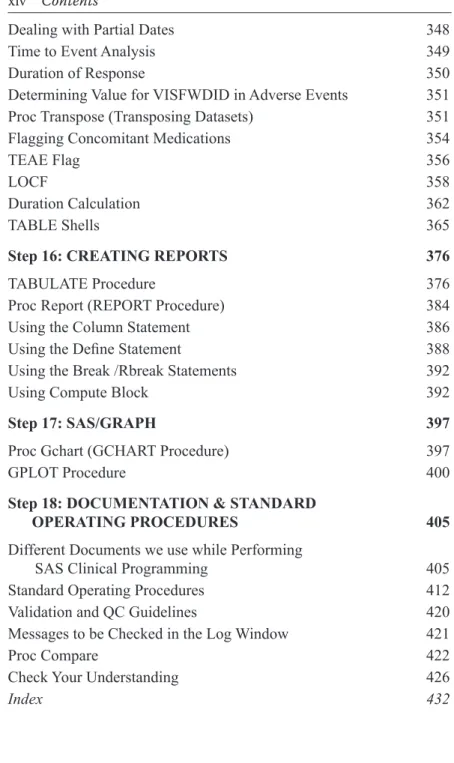
Dealing with Partial Dates 348
Time to Event Analysis 349
Duration of Response 350
Determining Value for VISFWDID in Adverse Events 351 Proc Transpose (Transposing Datasets) 351
Flagging Concomitant Medications 354
TEAE Flag 356
LOCF 358
Duration Calculation 362
TABLE Shells 365
Step 16: CREATING REPORTS 376
TABULATE Procedure 376
Proc Report (REPORT Procedure) 384
Using the Column Statement 386
Using the Define Statement 388
Using the Break /Rbreak Statements 392
Using Compute Block 392
Step 17: SAS/GRAPH 397
Proc Gchart (GCHART Procedure) 397
GPLOT Procedure 400
Step 18: DOCUMENTATION & STANDARD
OPERATING PROCEDURES 405
Different Documents we use while Performing
SAS Clinical Programming 405
Standard Operating Procedures 412
Validation and QC Guidelines 420
Messages to be Checked in the Log Window 421
Proc Compare 422
Check Your Understanding 426
We all have dreams. But in order to make dreams
come into reality, it takes an awful
lot of determination, dedication,
self-discipline, and effort.
Step 1
INTRODUCTION TO
CLINCAL RESEARCH
The Process from discovering a new drug to registering it for marketing is very complex and lengthy. There are several people involved in the Process of drug discovery and development includes Scientists, Clinicians, Statisticians as well as Data managers and SAS Programmers. It is estimated that, on average, a drug takes 10-12 years from initial research to reach the market. Drug discovery and development are mainly carried out by pharmaceutical companies and research agencies. The pharmaceutical market is very competitive. It is imperative that pharmaceutical companies discover and develop drugs
efficiently and within the shortest time span to remain competitive.
Drug Development Process
The Drug development Process has different stages:
Drug Discovery
Drug Development Clinical Trials
Manufacturing Marketing Approval
The Drug Discovery Process involves in finding out the target that
causes the disease, chemical or biological compounds are screened and
tested against these targets to find leading drug candidates for further
development.
The Drug Development Process involves Tests performed on the lead compounds in test tubes (laboratory, in vitro) and on animals (in vivo) to check how they affect the biological systems.
2 SAS Clinical Programming
The development Process includes pharmacological studies of the lead compound and its effects on toxicity, carcinogenicity, mutagenicity and reproductive development. These data are important for determining the safety and effectiveness of the lead compound as a potential drug.
Typically, tens of thousands of compounds are screened and tested, and only a handful makes it into the market as drug products. The statistics are such that, of 5000 compounds that show initial promise,
five will go into human clinical trials, and only one will become an
approved drug.
Clinical Research
Clinical research is a branch of healthcare science that determines the safety and effectiveness of medications, devices, diagnostic products and treatment regimens intended for human use.
Clinical research includes:
Medical and behavioral research involving volunteer participants Investigations that are carefully developed and conducted with
clinical outcomes recorded
Identification of better ways to prevent, diagnoses, treats, and
understands human disease
Trials that test new treatments, clinical management and clinical
outcomes, and long–term studies
Strict scientific guidelines
There are ethical and regulatory constraints for the design and conduct of a clinical trial that have to be considered. Ethical principles are to protect participants before a drug is put forward for a clinical trial.
The United States National Institutes of Health (NIH) has stipulated seven ethical requirements:
1. Social value 2. Scientific validity
3. Fair subject selection 4. Informed consent
Y Lakshmi Prasad 3
6. Independent review 7. Respect for human subjects
Clinical Trials:
Clinical trials are prospective studies on human subjects that are
designed to answer specific questions about drugs, treatments, devices
or new ways of using known interventions, generating safety and efficacy data.
Clinical Research is a study that tests how well an intervention works in a group of people, Tests for new methods of screening, prevention, diagnosis, or therapy. During a trial, additional information is learned about an intervention, its Risks, and its effectiveness.
Clinical Research Process
Pre-clinical testing
Investigational New Drug Application (IND) Phase I (assess safety)
Phase II (test for effectiveness) Phase III (large-scale testing) Licensing (approval to use)
Approval (available for prescription)
Post-marketing studies (special studies and long-term effectiveness/
use)
Pre-Clinical Testing
Pre-clinical testing is required before testing humans. Pre-clinical testing is often conducted on animals many pre-clinical studies use a review Committee to determine if the use of animals is warranted. The review Committee also checks to see if the research can be improved by reducing or replacing animals. Laboratory and animal studies
are conducted to find out if there is a potential benefit of the drug,
vaccine, or other product and to explore general safety concerns. If a
vaccine, Drug has a potential benefit, it is prepared for human testing.
4 SAS Clinical Programming
Investigational New Drug Application (IND):
For studies that involve a new vaccine, drug, after completing Pre-clinical testing, an investigational new drug application (IND) must
be filed describing the results of pre-clinical testing and how future
studies will be conducted. The U.S. Food and Drug Administration (FDA) have 30 days to review the IND. If the FDA approves the IND within 30 days, the test drug can precede to a phase I trial.
Phase I (Assess Drug Safety):
The Phase I clinical trial is the first experiment in which a drug is tested
on the human body. The primary aim of the trial is to assess the safety of the new drug. Phase I trials are usually conducted with open label, i.e. the subjects are aware of the drugs that they are being given. For
the first time, the Test drug is introduced to humans. Testing occurs in
a small number of healthy volunteers (20 to 100). This initial phase of testing usually lasts several months to 1 year.
The goals of phase I clinical trials are Assess safety for humans as well as select the dose to be used in future studies. During phase I, the study is designed to determine how the human body reacts and what side effects occur as dosage levels is increased.
Open-label Study: A trial in which subjects and investigators know which product each subject is receiving.
Phase II (Test for Safety and
Effectiveness):-A phase II study provides comparative information about relative safety
and effectiveness and efficacy.
Most phase II studies are randomized trials. This means One group receives the experimentalTest Drug other Control group receives the current standard treatment or Placebo.
Some phase II studies are blinded, This means participants and researchers do not know who receives the experimental test drug, this testing may last from several months to 2 years it may involve from 100-300 participants.
Phase III (Large-Scale
Testing):-The objective of Phase III is to confirm the efficacy of the drug in a
Y Lakshmi Prasad 5
in different demographic locations, to determine the influence of ethnic
responses, so this trial is also known as a multicentre trial. This large-scale testing (1,000-3,000 participants/volunteers) provides a better
understanding of efficacy.
Most phase III studies are randomized and blinded trials with
specific entry criteria. Phase III studies typically last several years.
After a phase III study is successfully completed, a company can request NDA from the FDA.
Randomization: The Process of assigning trial subjects to treatment or control groups using an element of chance to determine the assignments in order to reduce bias.
Blinded study: A study in which the subject, the investigator, or anyone assessing the outcome is unaware of the treatment assignment(s).
Control group: The group of subjects in a controlled study that receives no treatment, a standard treatment or a placebo.
Placebo: A pharmaceutical preparation that does not contain the investigational agent.
Multicenter trial: Clinical trial conducted according to a single protocol but at more than one site and therefore, carried out by more than one investigator.
Food and Drug Administration (FDA): The United States regulatory authority charged with, among other responsibilities, granting IND
and NDA approvals.
New Drug Application (NDA): An application to FDA for a license to market a new drug in the United States.
Licensing (Approval to Use):
After all three clinical trial phases are complete and, if the research demonstrates that the test drug is safe and effective, a New Drug
Application (NDA)/ Biologics License Application (BLA) is filed with the FDA. This NDA/BLA must contain all scientific information
compiled over the course of the trials. The FDA is allowed at least 6 months to review the NDA/BLA. However, this review Process
can sometimes take up to 2 years, depending on specific country
6 SAS Clinical Programming
Approval (Available for Prescription):
Health care providers are able to prescribe. Even after approval, reviews continue to ensure safety over time. For example, all cases of adverse events must be reported, and quality control standards must be met (Sometimes studies to evaluate long-term effects are also required). The accelerated approval Process for serious diseases is designed to
help development of treatments and to fill an unmet medical need to get
important new treatments to patients faster.
Post-Marketing Studies:
Post-marketing studies (special studies and long-term effectiveness/ use) are also called Phase IV studies. These studies are often performed in special populations not previously studied (for example, children or the elderly) the studies are designed to monitor Long-term
effectiveness and/or efficacy and the impact on a person’s quality of
life. Some studies help determine the cost -effectiveness of a therapy compared to other traditional and new therapies.
Industry Regulations and Standards for Clinical Trials
Every trial has to be approved and carried out under regulatory compliance to comply with GCP requirements. Different countries have different requirements for clinical trials. Two organizations that
carry significant regulatory weight are the combined forces of the US
Food and Drug Administration (FDA) and International Conference on Harmonization of Technical Requirements for Registration of Pharmaceuticals for Human Use (ICH).
It is the role of public regulatory authorities to ensure that pharmaceutical companies comply with regulations. There is legislation that requires drugs to be developed, tested, trialed and manufactured in
accordance to guidelines so that they are safe and patient’s well being
is protected.
Regulatory authorities perform the watchdog role to ensure that animal studies comply with Good Laboratory Practice (GLP), clinical trials are performed in accordance with Good Clinical Practice (GCP) and drugs are manufactured under current Good Manufacturing Practice (cGMP) conditions.
ICH stands for “International Conference on Harmonization of Technical Requirements for Registration of Pharmaceuticals for
Y Lakshmi Prasad 7
Human Use”. ICH is a joint initiative involving both regulators and research-based industry representatives of the EU, Japan and the US in
scientific and technical discussions of the testing Procedures required to assess and ensure the safety, quality and efficacy of medicines.
The objective of ICH is to increase international harmonization of technical requirements to ensure that safe, effective and high quality
medicines are developed and registered in the most efficient and cost
effective manner.
The ICH Topics are divided into four major categories:
Quality (Q): Those relating to chemical and pharmaceutical Quality
Assurance.
Safety (S): Those relating to in vitro and in vivo pre clinical studies. Efficacy (E): Those relating to clinical studies in human subject. Multidisciplinary topics (M): Topics which do not fit uniquely into
one of the above categories.
Efficacy Topics:
E3: Structure and Content of Clinical Study Reports E4: Dose-Response Information to Support Drug Registration E6: Good Clinical Practice: Consolidated Guideline
E8: General Considerations for Clinical Trials E9: Statistical Principles for Clinical Trials
E10: Choice of Control Group and Related Issues in Clinical Trials
ICH’s mission is to make recommendations towards achieving
greater harmonization in the interpretation and application of technical Guidelines and requirements for pharmaceutical product registration.
The ICH Steering Committee and its sub-committee are comprised of representatives from six parties that represent the regulatory bodies and research-based industry in the European Union, Japan and the USA.
8 SAS Clinical Programming
Region Regulatory Body Research Based Industry
Japan MHLW - Ministry of Health, Labour and Welfare
JPMA-Japan Pharmaceutical Manufacturers Association Europe EU - European
Union EFPIA - European Federation of Pharmaceutical Industries and Associations
USA FDA - Food and
Drug Administration PhRMA - Pharmaceutical Research and Manufacturers of America
U.S.FDA: Branch of the United States Department of Health and Human Services and regulates all aspects of pharmaceutical industry.
21 CFR Part 11 Compliance: In your research the computer systems used to collect and analyze data must be validated to meet the FDA requirements for electronic records and signatures.
Title 21 of the Code of Federal Regulations (CFR):
Parts applicable to clinical research:
Part 11 - Electronic Records and Signatures Part 50 - Protection of Human Subjects
Part 54 - Financial Disclosure by Clinical Investigators Part 56 - Institutional Review Boards
Part 312 - Investigational New Drug Application
Part 314 - Applications for FDA Approval to Market a New Drug
or an Antibiotic Drug
Part 600 - Biological Products Part 812 - Medical Devices
Departments and Roles in a CRO
Contract Research Organization: CRO is an organization that provides support to the Pharmaceutical, biotechnology, and medical device industries in the form of research services outsourced on a contract basis. A CRO may provide such services as Pre Clinical Research, Clinical Research, Clinical Trials Management, Clinical Data Management, Bio statistics and SAS Programming.
Y Lakshmi Prasad 9
A Typical Clinical Research Organization may contain the
following departments:
Clinical Operations Data Management Medical writing Pharmacovigilance
Biostatistics/ SAS Programming Regulatory affairs
Key Functions in Clinical Operations:
Managing and coordination of study conduct Monitoring and tracking of project milestones to ensure that the
project runs within timelines.
Participation as appropriate to expedite the feasibility and conduct
of global trials
Ensuring that the regulatory submission are of acceptable quality Support Investigator as and when required (e.g. Finalization of
Investigator agreements and contracts, Finalization of Protocol
and CRF)
Key Functions in Data Management:
Data Entry Database creation, Updating, Validation and Database lock Data Quality Check
Data Clarification Form generation
10 SAS Clinical Programming
Protocol: Clinical research is conducted according to a plan (a protocol) or action plan. The plan describes what will be done in the study, how it will be conducted, and why each part of the study is necessary. The protocol or plan is carefully designed to safeguard the
participant’s health and answer specific research questions.
Case Report Form (CRF).A printed, optical, or electronic document designed to record all of the protocol-required information to be reported to the sponsor for each trial subject.
Key Functions in Quality Assurance:
Facilitate audits which are conducted by clients locally within the
country
Ensure that all staff within the country has a complete and current
training record
Facilitate the auditing of suppliers and vendors used by company
within the country
Ensure that all GCP compliance issues with sites or elsewhere are
raised to the Director of Quality Assurance and the Director of Medical Affairs
Maintaining version control of SOPs to ensure that all staff are
following the correct and up to date SOPs
Key Functions in Pharmacovigilance:
Collect, follow-up, transmit all local adverse events, and pregnancy
cases, to Global Pharmacovigilance.
Process cases in accordance with Global and Local
Pharmacovigilance Procedures.
Answer ADR and ADR case processing questions from local
Regulatory Authorities and Health Care Professionals.
Submit the report able ADRs, to the local Regulatory Authorities
according to the national regulations and answer any subsequent questions in collaboration with the Global Pharmacovigilance.
Y Lakshmi Prasad 11
Key Functions in Medical Writing:
Clinical Study Protocol Writing Documentation for Regulatory Submission Technical Documentation for Clinical Trials Writing Medical Cases
Managing SAEs during clinical trials
Closely associated with regulatory department in preparing
narratives for submission
Standard Operating Procedure (SOP):Detailed, written instructions
to achieve uniformity of the performance of a specific function.
Adverse Drug Reaction (ADR): Any noxious and unintended
response associated with the use of a drug in humans.
Serious Adverse Event (SAE ): Any untoward medical occurrence that at any dose: results in death, is life threatening, requires inpatient hospitalization or prolongation of existing hospitalization, results
in persistent or significant disability/incapacity, or is a congenital
12 SAS Clinical Programming
Process Flow in a Typical Clinical Trial
Protocol Development CLINICAL Blank CRF OPERATIONS CRF designing Database Designing Filled CRF DCF Edit check ProgrammingData Entry Discrepancy
DATA MANA GEMENT Data Validation Database Lock Data Extract CDISC Conversion BIO ST ATISTICS ADS Creation
TLF Creation Study Submission
SITE
Process Flow in a Typical Clinical Trial:
Every clinical investigation begins with the development of a clinical protocol. The protocol is a document that describes how a clinical trial will be conducted and ensures the safety of the trial subjects and integrity of the data collected.
After preparing the protocol we go with CRF designing, The Case Report Form is a data-reporting document used in a clinical
study. CRF Collects relevant data in a specific format in accordance