Kayiwa, J; Clarke, K; Knight, L; Allen, E; Walakira, E; Namy, S; Merrill, KG; Naker, D; Devries, K; (2017) Effect of the good school toolkit on school staff mental health, sense of job satisfaction and perceptions of school climate: Secondary analysis of a cluster randomised trial. Preventive medicine. ISSN 0091-7435 DOI: https://doi.org/10.1016/j.ypmed.2017.05.022
Downloaded from: http://researchonline.lshtm.ac.uk/3928427/ DOI:https://doi.org/10.1016/j.ypmed.2017.05.022
Usage Guidlines:
Please refer to usage guidelines at http://researchonline.lshtm.ac.uk/policies.html or alternatively contact [email protected].
ACCEPTED MANUSCRIPT
Effect of the good school toolkit on school staff mental health, sense of job satisfaction and perceptions of school climate: Secondary analysis of a cluster randomised trial
Joshua Kayiwa1*, Kelly Clarke2, Louise Knight3, Elizabeth Allen3, Eddy Walakira4, Sophie Namy5, Katherine G. Merrill3, Dipak Naker5, Karen Devries3
1
Ministry of Health, Public Health Emergency Operations Centre, Kampala Uganda
2
Institute for Global Health, University College of London, UK
3
London School of Hygiene and Tropical Medicine, London, UK
4
Makerere University, Kampala, Uganda
5
Raising Voices, Kampala, Uganda
1*
Corresponding Author: Joshua Kayiwa. Ministry of Health, Emergency Operations Centre. P O Box 3675 Kampala Uganda. Email: [email protected]
Abstract (Word count = 225/250)
The Good School Toolkit, a complex behavioural intervention delivered in Ugandan primary schools, has been shown to reduce school staff-perpetrated physical violence against students. We aimed to assess the effect of this intervention on staff members’ mental health, sense of job satisfaction and perception of school climate. We analysed data from a cluster-randomised trial administered in 42 primary schools in Luwero district, Uganda. The trial was comprised of cross-sectional baseline (June/July 2012) and endline (June/July 2014) surveys among staff and students. Twenty-one schools were randomly selected to receive the Toolkit, whilst 21 schools constituted a wait-listed control group. We generated composite measures to assess staff members’ perceptions of the school climate and job satisfaction. The trial is registered at clinicaltrials.gov (NCT01678846). No schools dropped out of the study and all 591 staff members who completed the endline survey were included in the analysis. Staff in schools receiving the Toolkit had more positive perspectives of their school climate compared to staff in control schools (difference in mean scores 2.19, 95% Confidence
ACCEPTED MANUSCRIPT
Interval 0.92, 3.39). We did not find any significant differences for job satisfaction and mental health. In conclusion, interventions like the Good School Toolkit that reduce physical violence by school staff against students can improve staff perceptions of the school climate, and could help to build more positive working and learning environments in Ugandan schools.
Key Words: Staff-perpetrated violence; Physical Violence; Primary School staff; Students; Mental Health; Job Satisfaction; School Climate; Uganda
ACCEPTED MANUSCRIPT
(Word count = 2905/3500) BACKGROUND
Violence against children is common in certain parts of the world, with devastating health and social effects, including depression, suicide attempts, poor educational attainment and increased risk of experiencing or perpetrating violence in adulthood1–5. Available national data indicate that over 40% of children in East Africa experience some form of life-time physical violence during childhood6–8. Perpetration of physical violence by school staff - including teachers, caretakers and administrative staff - may account for a large proportion of the total burden of childhood physical violence exposures, especially in Sub-Saharan Africa9. A study conducted in Luwero District, central Uganda, indicates that more than 90% of primary school students have ever experienced physical violence (e.g. slapped, hit or caned) by a school staff member in their lifetime. More than 50% reported such exposures within the past week10.
Violence in schools has negative effects on students’ emotional well-being, affects school attendance, and is inversely associated with staff mental health and teaching quality11,12. This is a pertinent issue in sub-Saharan African contexts, where low levels of job satisfaction and poor motivation among teachers may hinder progress towards sustainable development goals for education and development11,12. A positive school environment has been demonstrated to reduce staff-perpetrated violence, influence academic achievements, and reduce absenteeism13–15
. Earlier work elsewhere linked school-based violence with staff’s mental health, sense of job satisfaction and perceptions of school climate16–18. Very few interventions have been tested for their efficacy in improving these three outcomes in the context of low and middle-income countries19.
A recent randomized controlled trial in Luwero District, Uganda, evaluated the impact of the Good School Toolkit, a complex behavioural intervention delivered in primary schools to reduce school-based staff-perpetrated physical violence against children. The Toolkit involves supporting staff and students to develop a collective vision for the school, create a nurturing learning environment and strengthen school governance. The Toolkit significantly reduced past-week physical violence against students among the
ACCEPTED MANUSCRIPT
intervention schools, compared to controls (odds ratio 0·40, 95% CI 0·26–0·64, p<0·0001)20. We hypothesized that, through reductions in violence and/or by improving the learning environment, the intervention would have benefits for school staff members’ mental health, job satisfaction and perceptions of school climate. In this study, we aim to test these hypotheses by conducting secondary analyses of data from the trial.
METHODS
Study setting and design
We use data from the Good School Study (GSS), a cluster randomized controlled trial conducted between September 2012 and May 2014 in Luwero District, Uganda. The study was a collaboration between Raising Voices, a Ugandan-based Non-Governmental Organisation (NGO), Makerere University, the UCL-Institute of Education and the London School of Hygiene and Tropical Medicine. Luwero District has a population of more than 450,000 and comprises both rural and urban areas. The study protocol and main trial results are reported in full elsewhere10,20–24.
The GSS included a two-arm cluster-randomised trial design, with primary schools as the unit of clustering. In Uganda, children attend primary school between the ages of 6 and 14 years25. From 268 primary schools in Luwero, we excluded 97 schools with fewer than 40 primary five students, and 20 schools with existing similar school-based interventions. A total of 42 schools were then randomly selected to participate in the trial. This sample size enabled the detection of a 13% difference in the prevalence of reported violence between the intervention and control arms with 5% statistical significance and 80% power. No post-hoc power computations were conducted since this was an exploratory secondary analysis of the original study. Random blocks with a proportionate to stratum size random allocation was used to consent and allocate 21 schools to a wait-listed control arm, and 21 schools to receive the intervention. Head teachers from all 42 schools agreed for their schools to participate.
ACCEPTED MANUSCRIPT
baseline survey was conducted in June-July of 2012 and the endline survey was conducted in June-July 2014. Both teaching and non-teaching staff members were invited to take part in the surveys and individual written consent was obtained.
Intervention
The Good School Toolkit is a manualised intervention designed to reduce physical violence against children perpetrated by school staff, and was developed by Raising Voices26. The Toolkit aims to improve the learning environment by developing mutual respect, improving staff and student understanding of power relationships and promoting use of non-violent discipline. It involves staff and students in activities such as: setting school-wide goals, developing action plans for the set goals (both academic and recreational) with specific dates for the set deliverables, encouraging empathy by facilitating reflections on experiences of violence, providing school staff with new knowledge on alternative non-violent discipline, and providing opportunities to practice new behavioural skills.
At each school receiving the intervention, two student and two staff protagonists were identified to implement the Toolkit, supported by Raising Voices staff. Staff and student protagonists conducted face-to-face activities with other staff and students in their schools, mainly in groups. The intervention ran for 18 months and is described in full elsewhere.26
Data collection tools and outcomes
All data were collected via interviewer-administered questionnaires programmed into tablet computers or mobile phones, with algorithms designed to minimize erroneous skips. From staff, we collected socio-demographic data as well as data on violence, mental health, job satisfaction and perceptions of school climate. We collected data on staff perpetration of physical, sexual and emotional violence against students and non-students using items adapted from the International Society for the Prevention of Child Abuse and Neglect Child Abuse Screening Tool - Child Institutional
ACCEPTED MANUSCRIPT
(ICAST-CI)27 and the World Health Organization (WHO) Multi-Country Study on Women’s Health and Domestic Violence against Women28
.
We used the 20-item Self-Report Questionnaire (SRQ-20) screening instrument29 to measure symptoms of common mental disorders (e.g. depression and anxiety) among staff members. Items on this instrument are scored 0 (symptom absent) or 1 (symptom present), and summed to give a range of total scores from 0-20. The reliability and validity of this tool have been established elsewhere, including several African settings30–32. In our study, Cronbach’s alpha was 0.71, indicating acceptable internal consistency of the instrument33. There is no established cut off score for the SRQ in the general population of Ugandan adults, so we used a score cut off of 6 and above to be indicative of a common mental disorder status in our descriptive analysis, following evidence from studies internationally and studies of other populations in Uganda34,35.
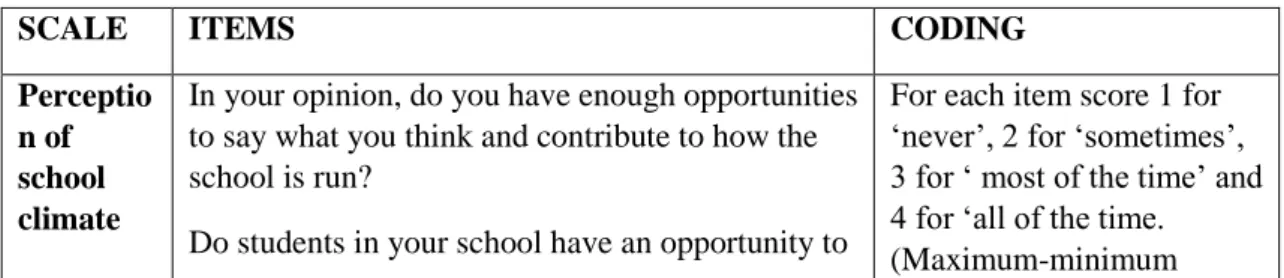
We generated a composite measure with 16 items to assess staff members’ perceptions of the school climate (Table 1). Answers were summed to generate a total score ranging from 16 to 64, with lower scores indicating more negative perceptions of school climate compared to higher scores. Cronbach’s alpha for this measure was 0.78. We further generated a composite measure with five items to assess job satisfaction (Table 1). Answers were summed to give a possible range of scores from 5 to 20, with lower scores representing less satisfaction. Internal consistency for the scale was acceptable (Cronbach’s alpha = 0.69). Staff responding to fewer than half of the items used to generate any of the three outcomes were recorded as missing.
Table 1: Perception of school climate and job satisfaction scales among staff participating in the Good School Toolkit intervention among Ugandan primary Schools
SCALE ITEMS CODING
Perceptio n of school climate
In your opinion, do you have enough opportunities to say what you think and contribute to how the school is run?
Do students in your school have an opportunity to
For each item score 1 for ‘never’, 2 for ‘sometimes’, 3 for ‘ most of the time’ and 4 for ‘all of the time. (Maximum-minimum
ACCEPTED MANUSCRIPT
SCALE ITEMS CODING
say what they think?
Do students in your school have an opportunity to contribute to how the school is run?
Do you feel that your views on how the school's policies could be improved are welcomed? How often do you take any actions to change how your school is run?
Do you feel that there is anybody at your school you can talk to if you feel unhappy about work? Thinking about your school as a whole, do you feel like you are part of a team?
Do you have regular staff meetings?
Would you say that students feel comfortable talking to you/want to confide in you if they are unhappy about something at home or at school? Do you feel that students respect their peers and adults?
Do you feel that school staff respect their students? Do you have a good relationship with the students? Do you have a good relationship with parents? Do you feel concerned about how other school staff members behave at school?
How often does this school experience problems with physical violence?
How often does this school experience problems with bullying (e.g. verbal abuse of staff or students)?
range: 16-64. Lower scores indicated more negative perceptions)
Job satisfacti on
How often would you say that you enjoy your job? Do you feel valued as an employee?
Do you take pride in your work?
Do you feel that your employers care about your well-being?
Do you feel adequately rewarded financially for what you do?
For each item score 1 for ‘never’, 2 for ‘sometimes’, 3 for ‘ most of the time’ and 4 for ‘all of the time. (Maximum-minimum range: 5-20). Lower scores indicated less satisfaction)
ACCEPTED MANUSCRIPT
Statistical analysis
To assess the impact of the intervention on staff mental health, perceptions of school climate and job satisfaction, we performed complete-cases analyses, using multilevel mixed-effects linear regression models with unstructured correlation structures (which allow for all variances and covariances to be distinctly estimated at school level) to account for clustering at the school level 36,37. All three variables were analysed as continuous outcomes. Since the three outcomes were not normally distributed, we used nonparametric bootstraping (2000 replications) to estimate bias-corrected 95% confidence intervals. The final models were adjusted for the baseline school mean scores of staff mental health, sense of job satisfaction and perceptions of school climate respectively. Additionally we carried out a further adjusted analysis to allow for the possible imbalance of some factors at baseline. This analysis further adjusted for baseline school mean age, number of children sharing a sleeping area (child crowdedness) and number of adults sharing a sleeping area (adult crowdedness). All analyses were conducted in Stata 14.0 IC software.
Ethical considerations
We obtained ethical approval for the trial from the London School of Hygiene and Tropical Medicine and the Uganda National Council of Science and Technology. Our consent and child protection procedures are described in full elsewhere20. Head teachers at each participating school informed staff, students and parents about the study. We obtained written informed consent from individual staff members who participated in the study.
RESULTS
Staff member characteristics at baseline
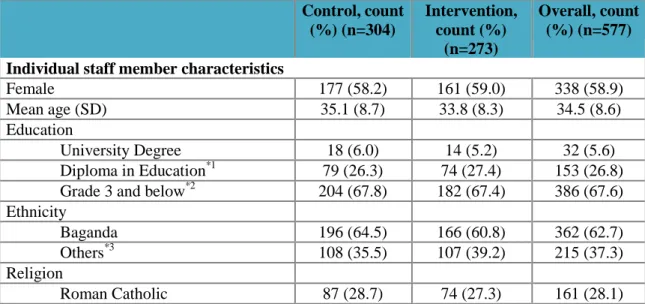
The study flow-chart is presented in Figure 1. At baseline, 577 staff participated completed the survey (control: 304, intervention: 273).
ACCEPTED MANUSCRIPT
At baseline, mean staff’s age was 34.5±8.6 years; 59% (338/577) were female; 63% (362/577) were married, yet 51% (294/577) had more than two children. Three-quarters (76%, 441/577) were teachers, 6% (34/577) were head teachers and 18% (76/591) had other school-based roles such as administrators, cleaners, cooks and accountants. Two-thirds (68%, 386/577) had received schooling up to grade three, which is the basic qualification for a primary teaching post in Uganda, acquired after a minimum of two years schooling at a Teacher Training College. Most (71%, 407/577) had worked at the same school for over five years. Mean SRQ-20 score was 4.5±3.2, and 32% (183/577) had an SRQ-20 score≥6. Experience of intimate partner violence, non-partner sexual violence and child sexual abuse was 43% (245/577); 10% (57/577) and 5% (30/577) respectively (Table 2).
Baseline socio-demographic characteristics of staff members in intervention and control schools were generally similar. Use of physical violence against non-students in the past week was slightly higher in the intervention arm (18.3%), compared to the control arm (8.9%). However, use of physical violence against students was similar across trial arms. Mean SRQ-20 scores, job satisfaction scores and perception of school climate scores were also comparable across intervention and control schools (Table 2).
Table 2: Baseline characteristics of staff members participating in the Good School Toolkit study among Ugandan primary schools
Control, count (%) (n=304) Intervention, count (%) (n=273) Overall, count (%) (n=577) Individual staff member characteristics
Female 177 (58.2) 161 (59.0) 338 (58.9)
Mean age (SD) 35.1 (8.7) 33.8 (8.3) 34.5 (8.6)
Education
University Degree 18 (6.0) 14 (5.2) 32 (5.6)
Diploma in Education*1 79 (26.3) 74 (27.4) 153 (26.8)
Grade 3 and below*2 204 (67.8) 182 (67.4) 386 (67.6)
Ethnicity
Baganda 196 (64.5) 166 (60.8) 362 (62.7)
Others*3 108 (35.5) 107 (39.2) 215 (37.3)
Religion
ACCEPTED MANUSCRIPT
Control, count (%) (n=304) Intervention, count (%) (n=273) Overall, count (%) (n=577) Anglican 94 (31.0) 103 (38.0) 197 (34.3) Other*4 122 (40.3) 94 (34.7) 216 (37.6) Marital status Single 64 (21.1) 73 (26.9) 137 (23.8) In Relationship 23 (7.6) 26 (9.6) 49 (8.5) Married/Staying together 204 (67.1) 159 (58.7) 363 (63.1)Divorced, Separated, Widow 13 (4.3) 13 (4.8) 26 (4.5)
Number of children None 46 (15.1) 57 (20.9) 103 (17.9) 1-2 91 (29.9) 89 (32.6) 180 (31.2) 3+ 167 (54.9) 127 (46.5) 294 (51.0) Housing Status Own 112 (36.8) 87 (32.0) 199 (34.6) Rents 91 (29.9) 73 (26.8) 164 (28.4) Other*5 101 (33.2) 112 (41.2) 213 (37.0)
Years worked at school
0-2 years 34 (11.2) 43 (15.8) 77 (13.4) 3-5 years 53 (17.4) 39 (14.3) 92 (16.0) 6+ years 217 (71.4) 190 (69.9) 407 (70.7) Role at School Teacher 234 (77.0) 207 (75.8) 441 (76.4) Head teacher 17 (5.6) 17 (6.2) 34 (5.9) Other*6 53 (17.4) 49 (18.0) 102 (17.7)
Number of children sharing the same sleeping area (child crowdedness)
None 102 (33.6) 123 (45.1) 225 (39.0)
1+ 202 (66.5) 150 (55.0) 352 (61.0)
Number of adults sharing the same sleeping area (adult crowdedness)
None 111 (36.5) 128 (46.9) 239 (41.4)
1 167 (54.9) 136 (49.8) 303 (52.1)
2+ 26 (8.6) 9 (3.3) 35 (6.1)
Violence exposure and perpetration
Ever experienced child sexual abuse 16 (5.3) 14 (5.1) 30 (5.2)
Ever experienced intimate partner violence 125 (41.1) 120 (44.0) 245 (42.5) Ever experienced non-partner sexual
violence
35 (11.5) 22 (8.1) 57 (10.0)
Use of physical violence against non-students in past one week
27 (8.9) 50 (18.3) 77 (13.3)
Use of physical violence against students in past one week
131 (43.1) 109 (39.9) 240 (41.6)
Outcomes
Mean Mental Health (SRQ-20) score (SD)*7
4.5 (3.2) 4.4 (3.1) 4.5 (3.2)
Common mental disorder Status, n (%)
Low (SRQ-20 score < 6) 203 (66.8) 191 (70.0) 394 (68.3)
ACCEPTED MANUSCRIPT
Control, count (%) (n=304) Intervention, count (%) (n=273) Overall, count (%) (n=577) Mean perception of school climate score(SD)*9
42.8 (6.2) 43.1 (6.9) 42.9 (6.6)
*1 Acquired after at least two years of training in any Teachers Training College *2
Acquired after at least three years of training in any Teachers Training College *3
Munyankole, Musoga, Mukiga, Muteso, Langi, Acholi, Mugisu, Lugbara, and Munyoro *4
Pentecostal, Seventh-day Adventist, Muslim *5
Employer pays, Lives somewhere else without paying *6
Administrator, secretary, accountant, cook, cleaner, handyman
*7 Overall scores for each participant range from 0-20, with lower scores indicating more favourable outcomes *8
Overall scores for each participant range from 5-20, with lower scores indicating less satisfaction *9
Overall scores for each participant range from 16-64, with lower scores indicating more negative perceptions
Intervention effect on staff mental health, sense of job satisfaction and perception of school climate
For the endline survey, we obtained data from 591 staff members (control: 308; intervention: 283). None of the 591 participants had consistently missing data for all the 20 items of the SRQ-20 score, the five items of the job satisfaction score, and the 16 items of the school climate perception score (Table 1). However, we observed 15, 20 and 65 participants with at least one missing item related to SRQ-20, job satisfaction and school climate perception measures respectively. Of these, we failed to compute the job satisfaction measure for only one participant, since they had 3/5 items of this measure missing. Although this participant was kept in the univariate analyses, they were automatically excluded from the models.
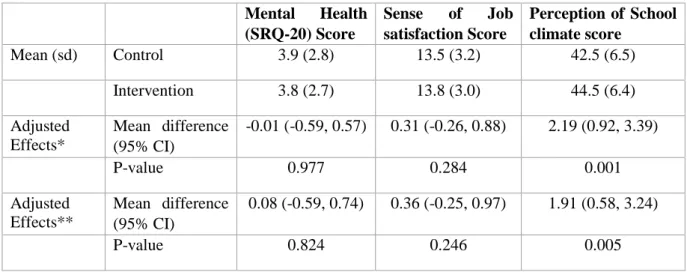
At endline, mean SRQ-20 scores in both intervention and control arms had reduced compared to baseline, however there was no significant difference between trial arms (-0.01, 95%CI: -0.59, 0.57) (Table 3). Similarly, mean scores on the job satisfaction scale were not significantly different in intervention and control schools at endline (0.31, 95%CI: -0.26, 0.88). Perception of school climate was significantly higher (i.e. staff had more positive perceptions of the school climate) in schools that received the intervention, compared to control schools (intervention mean 44.5±6.4; control mean 42.5±6.5; adjusted mean difference: 2.19, 95%CI: 0.92, 3.39). Similar results were obtained following further adjustments for baseline mean age, child crowdedness and adult crowdedness (Table 3).
ACCEPTED MANUSCRIPT
Table 3: Effect of the Good School Toolkit on staff mental health, job satisfaction and perception of school climate within primary schools in Uganda
Mental Health (SRQ-20) Score Sense of Job satisfaction Score Perception of School climate score Mean (sd) Control 3.9 (2.8) 13.5 (3.2) 42.5 (6.5) Intervention 3.8 (2.7) 13.8 (3.0) 44.5 (6.4) Adjusted Effects* Mean difference (95% CI) -0.01 (-0.59, 0.57) 0.31 (-0.26, 0.88) 2.19 (0.92, 3.39) P-value 0.977 0.284 0.001 Adjusted Effects** Mean difference (95% CI) 0.08 (-0.59, 0.74) 0.36 (-0.25, 0.97) 1.91 (0.58, 3.24) P-value 0.824 0.246 0.005
* Individual models were adjusted for school-level baseline mental score, baseline sense of job satisfaction and baseline perception of school climate scores respectively
** Each individual model was further adjusted for baseline school-level mean age, child crowdedness and adult crowdedness.
DISCUSSION
Summary of findings
The Good School Toolkit led to a significant improvement in school staff members’ perception of the school climate, including perceptions of support, respect and communication among staff and students. However, the Toolkit did not significantly improve staff mental health or sense of job satisfaction.
In previous analyses of the Good Schools Study data, we found that the intervention significantly improved students’ feelings of safety and well-being at school20
. Although improvements in both school staff and student perceptions of school climate may be entirely due to reductions in violence, it is also possible that the Toolkit improved staff-student relations and potentially mutual support, improved communication, respect and team-working. The nature of the relationship and direction of causality between physical violence and school climate is unclear. On the one hand, a reduction in physical violence against students may cause staff members to perceive their school as more supportive and conducive to learning. Alternatively, improving the school
ACCEPTED MANUSCRIPT
climate by increasing respect and improving relationships between staff and students may reduce the need for discipline in the classroom, as demonstrated in home-based settings.38 Violence in Ugandan schools remains common despite the national ban on corporal punishment for the past ten years. This suggests that deeper operational and social changes may be necessary to sustainably prevent violence. Further analyses of qualitative and quantitative process evaluation data could help to clarify pathways to reducing violence perpetration among school staff.
We observed a relatively high baseline prevalence of psychological distress among school staff working in Ugandan primary schools. However, the Toolkit did not significantly improve mental health scores. This is consistent with previous analyses of the Good Schools Study data, showing that the intervention did not impact on student mental health.20,24 There are several potential explanations for these findings. Mental health is associated with various socio-economic and structural factors, as well as exposure to other forms of violence outside school (e.g. intimate partner violence) that were not addressed by the Toolkit. These factors might have undermined the ability of an in-school intervention to achieve a measurable difference in mental health between the two study arms. Improvements in mental health may occur later than improvements in school climate and reductions in violence and therefore were not captured as a result of the relatively short time frame of the trial.
The Toolkit did not significantly improve sense of job satisfaction among staff members, despite previous literature suggesting an association between job satisfaction and perceptions of a positive school environment39,40. Schools in Uganda are largely under-resourced, with large class sizes, and low paid staff, especially public schools41. In the Good School Study, schools did not receive any financial remunerations or additional educational resources through the intervention, which may be necessary to improve staff job satisfaction and perceptions of school environment. Further qualitative research would be helpful to understand the needs of school staff in Uganda in order to improve staff morale, recruitment and retention.
ACCEPTED MANUSCRIPT
Implications
Our findings suggest that the Good School Toolkit had benefits for staff as well as students. It is plausible that staff members who perceive a more positive school climate are more likely to provide an optimal learning environment, build trusting relationships with students, and detect and mitigate student academic, health and social problems42. Previous studies suggest that a positive school environment reduces symptoms of post-traumatic stress among children exposed to community violence, mitigates negative effects of socioeconomic disadvantage on academic success, and facilitates learning and personal development43,44. By improving school climate, the Toolkit could therefore offer a potential avenue to build resilience among young people at an individual and community level, in relation to violence and potentially other forms of trauma and adversity45.
Generalisability of the findings
Given the high prevalence of staff-perpetrated physical violence against students across Uganda it is likely that our results are generalizable to other populations in this setting. The Good School Toolkit is currently being scaled up to over 600 schools in Uganda, and is being adapted for secondary schools. It is also being translated and adapted for use in Lesotho and Mongolia26. It will be interesting to evaluate the effects of the Toolkit in these settings on both student and staff outcomes.
Study limitations
Our analysis has four main limitations. First, the trial was designed to test the effect of the intervention on staff-perpetrated physical violence (the primary outcome). Our secondary analyses of this data may therefore have been under-powered to detect changes in the staff outcomes tested here. Second, due to the nature of the intervention, it was not possible to mask staff members or data collectors to allocation. This may have led to bias towards a larger effect sizes for staff outcomes. However, student reports of school climate show a similar improvement in intervention schools, and we would expect student reports to be biased in the opposite direction of the intervention effect (as they may have felt more able to disclose if climate was poor, following the
ACCEPTED MANUSCRIPT
intervention). Our results thus suggest that there was a real improvement in school climate. Third, although we present the number of staff who did not participate in follow-up and endline surveys, we did not collect data from these staff and are therefore unable to compare them with the complete sample. Lastly, we used composite measures to measure job satisfaction and perception of school climate. Although we assessed the internal consistency of these measures, factor analyses (both exploratory and confirmation) may be beneficial to further explore their suitability.
CONCLUSIONS
A school-based complex behavioural intervention that reduced perpetration of physical violence against students, also improved staff members’ perceptions of school climate. Although the intervention had no significant effect on staff mental health or sense of job satisfaction, it could have implications for improving staff motivation and retention, and for the development of supportive learning environments.
ACCEPTED MANUSCRIPT
Declaration of interests: The Good School Toolkit was developed by Dipak Naker at Raising Voices, Kampala Uganda. Dipak Naker approached Karen Devries with the idea to do a study, was involved in the conceptualisation and design of the study, commented on the interpretation of results for pre-specified the primary and secondary outcomes, but was not involved in data collection, management, or analysis. Joshua Kayiwa was contacted as an independent statistician and researcher during the publication of these specific results, but was not involved in the intervention implementation or data collection. Eddy Walakira was involved in supervision of data collection, but did not directly collect any data or do any data management and did not influence interpretation of these results. No other authors have any conflict of interest to declare.
Role of funding sources: This study was funded by the Medical Research Council (MRC), Department for International Development (DfID), and Wellcome Trust (Grant ID: MR/L004321/1) to Karen Devries. Additional funding was obtained from the Hewlett Foundation to Dipak Naker. None of the funding sources had any direct or indirect involvement in the design, conduct, implementation, monitoring, analysis or reporting of the study results.
Acknowledgments: We are so grateful to all Raising Voices staff and the Good School implementation team including Willington Ssekadde, Jane Frank Nalubega and the CHAI-U team. The contribution made by the interviewers and supervisors team: Anna Louise Barr, Heidi Grundlingh, Jennifer Horton, is equally recognized. Recognition is also extended to the trial steering committee: Russell Viner (chair), Maria Quigley (independent statistician), Lucy Cluver, and Jo Mulligan (observer). Lastly, we are so grateful to Medical Research Council (MRC), Department for International Development (DfID), Wellcome Trust and Hewlett Foundation for funding this work.
REFERENCES
ACCEPTED MANUSCRIPT
Abuse Negl.31, 1101–1114 (2007).
2. Norman, R. E. et al. The long-term health consequences of child physical abuse, emotional abuse, and neglect: a systematic review and meta-analysis. PLoS Med.
9, e1001349 (2012).
3. Fang, X. & Corso, P. S. Child maltreatment, youth violence, and intimate partner violence: developmental relationships. Am. J. Prev. Med.33, 281–290 (2007). 4. Ehrensaft, M. K. et al. Intergenerational transmission of partner violence: a
20-year prospective study. J. Consult. Clin. Psychol.71, 741–753 (2003). 5. Hillis, S., Mercy, J., Amobi, A. & Kress, H. Global Prevalence of Past-year
Violence Against Children: A Systematic Review and Minimum Estimates.
Pediatrics137, e20154079 (2016).
6. UNICEF-Uganda & Ministry of Gender Labour and Social Development.
Situation analysis of Children in Uganda. (2015).
7. UNICEF-Tanzania. Violence Against Children in Tanzania: Findings from a
National Survey 2009. (2011).
8. UNICEF-Kenya. Violence against Children in Kenya: Findings from a 2010 National Survey. Summary Report on the Prevalence of Sexual, Physical and Emotional Violence, Context of Sexual Violence, and Health and Behavioral
Consequences of Violence Experienced in Childhood. (2012).
9. Devries, K. M. Violence against children and education. Int. Health 8, 1–2 (2016).
10. Devries, K. M. et al. School violence, mental health, and educational performance in Uganda. Pediatrics133, e129-37 (2014).
11. Forero, R., McLellan, L., Rissel, C. & Bauman, A. Bullying behaviour and psychosocial health among school students in New South Wales, Australia: cross sectional survey. BMJ319, 344–348 (1999).
12. Wilson, C. M., Douglas, K. S. & Lyon, D. R. Violence against teachers: prevalence and consequences. J. Interpers. Violence26, 2353–2371 (2011). 13. Bradshaw, C. P., Waasdorp, T. E. & Leaf, P. J. Effects of school-wide positive
behavioral interventions and supports on child behavior problems. Pediatrics
130, e1136-45 (2012).
14. Espelage, D. L., Polanin, J. R. & Low, S. K. Teacher and staff perceptions of school environment as predictors of student aggression, victimization, and willingness to intervene in bullying situations. Sch. Psychol. Q. 29, 287–305 (2014).
15. Dominguez Alonso, J., Lopez-Castedo, A. & Pino Juste, M. School violence: evaluation and proposal of teaching staff. Percept. Mot. Skills 109, 401–406 (2009).
16. Astor, R. A., Benbenishty, R., Zeira, A. & Vinokur, A. School climate, observed risky behaviors, and victimization as predictors of high school students’ fear and judgments of school violence as a problem. Heal. Educ. Behav. Off. Publ. Soc.
ACCEPTED MANUSCRIPT
Public Heal. Educ.29, 716–736 (2002).
17. Evans, L. Understanding teacher morale and job satisfaction. Teach. Teach.
Educ.13, 831–845 (1997).
18. Grayson, J. L. & Alvarez, H. K. School climate factors relating to teacher burnout: A mediator model. Teach. Teach. Educ.24, 1349–1363 (2008).
19. Bonell, C. et al. Systematic review of the effects of schools and school environment interventions on health: evidence mapping and synthesis. NIHR
Journals Libr. (2013). doi:10.3310/phr01010
20. Devries, K. M. et al. The Good School Toolkit for reducing physical violence from school staff to primary school students: a cluster-randomised controlled trial in Uganda. Lancet. Glob. Heal.3, e378-86 (2015).
21. Devries, K. M. et al. The Good Schools Toolkit to prevent violence against children in Ugandan primary schools: study protocol for a cluster randomised controlled trial. Trials14, 232 (2013).
22. Child, J. C., Naker, D., Horton, J., Walakira, E. J. & Devries, K. M. Responding to abuse: Children’s experiences of child protection in a central district, Uganda.
Child Abuse Negl.38, 1647–1658 (2014).
23. Knight, L. et al. Are school-level factors associated with primary school students’ experience of physical violence from school staff in Uganda? Int.
Health8, 27–35 (2016).
24. Gannett, K. R. School staff perpetration of physical violence against students in Uganda: a multilevel analysis. [Under Rev. (2016).
25. Uganda National Planning Authority. Pre-primary and Primary Education in Uganda: Access, Cost, Quality and Relevance. Available at: http://npa.ug/wp-content/uploads/NDPF5-Paper-3172015.pdf.
26. Raising Voices. The Good School Toolkit. Available at: http://raisingvoices.org/good-school/. (Accessed: 23rd August 2016)
27. ISPCAN. ICAST-C: the ISPCAN Child Abuse Screening Tool—Child Version.
Manual and proposed guidelines for pilot administration. (International Society
for the Prevention of Child Abuse and Neglect, 2006).
28. García-Moreno, C., Jansen, H. A. F. M., Ellsberg, M., Heise, L. & Watts, C. WHO Multi-country Study on Women’s Health and Domestic Violence against
Women. (2005).
29. Beusenberg, M. & Orley, J. H. A User’s guide to the self reporting questionnaire
(SRQ). (1994).
30. Stewart, R. C., Umar, E., Tomenson, B. & Creed, F. Validation of screening tools for antenatal depression in Malawi--a comparison of the Edinburgh Postnatal Depression Scale and Self Reporting Questionnaire. J. Affect. Disord.
150, 1041–1047 (2013).
31. Stewart, R. C. et al. Validation of a Chichewa version of the self-reporting questionnaire (SRQ) as a brief screening measure for maternal depressive
ACCEPTED MANUSCRIPT
disorder in Malawi, Africa. J. Affect. Disord.112, 126–134 (2009).
32. Scholte, W. F., Verduin, F., van Lammeren, A., Rutayisire, T. & Kamperman, A. M. Psychometric properties and longitudinal validation of the self-reporting questionnaire (SRQ-20) in a Rwandan community setting: a validation study.
BMC Med. Res. Methodol.11, 116 (2011).
33. Tavakol, M. & Dennick, R. Making sense of Cronbach’s alpha. International
Journal of Medical Education2, 53–55 (2011).
34. Devries, K. et al. Violence against women is strongly associated with suicide attempts: evidence from the WHO multi-country study on women’s health and domestic violence against women. Soc. Sci. Med.73, 79–86 (2011).
35. Nakimuli-Mpungu, E. et al. Cross-cultural adaptation and validation of the self-reporting questionnaire among HIV+ individuals in a rural ART program in southern Uganda. HIV. AIDS. (Auckl).4, 51–60 (2012).
36. Littell, R. C., Pendergast, J. & Natarajan, R. Modelling covariance structure in the analysis of repeated measures data. Stat. Med. 19, 1793–1819 (2000). 37. Zeger, S. L. & Liang, K.-Y. Longitudinal Data Analysis for Discrete and
Continuous Outcomes. Biometrics42, 121–130 (1986).
38. Kyegombe, N. et al. ‘SASA! is the medicine that treats violence’. Qualitative findings on how a community mobilisation intervention to prevent violence against women created change in Kampala, Uganda. Glob. Health Action 7,
25082 (2014).
39. Taylor, D. L. & Tashakkori, A. Decision Participation and School Climate as Predictors of Job Satisfaction and Teachers’ Sense of Efficacy. J. Exp. Educ.63,
217–230 (1995).
40. Griffith, J. The School Leadership/School Climate Relation: Identification of School Configurations Associated with Change in Principals. Educ. Adm. Q.
35, 267–291 (1999).
41. Ablo, E. & Reinikka, R. Do Budgets Really Matter? Evidence from Public
Spending on Education and Health in Uganda. (1998).
42. Elovainio, M. et al. Organizational justice at school and its associations with pupils’ psychosocial school environment, health, and wellbeing. Soc. Sci. Med.
73, 1675–1682 (2011).
43. Thapa, A., Cohen, J., Guffey, S. & Higgins-D’Alessandro, A. A review of school climate research. Rev. Educ. Res.83, 357–385 (2013).
44. O’Donnell, D. A., Roberts, W. C. & Schwab-Stone, M. E. Community violence exposure and post-traumatic stress reactions among Gambian youth: the moderating role of positive school climate. Soc. Psychiatry Psychiatr. Epidemiol.
46, 59–67 (2011).
45. Theron, L., Liebenberg, L. & Malindi, M. When schooling experiences are respectful of children’s rights: A pathway to resilience. Sch. Psychol. Int. 142723713503254 (2013).
ACCEPTED MANUSCRIPT
EFFECT OF THE GOOD SCHOOL TOOLKIT ON SCHOOL STAFF MENTAL HEALTH, SENSE OF JOB SATISFACTION AND PERCEPTIONS OF SCHOOL CLIMATE: SECONDARY ANALYSIS OF A CLUSTER RANDOMISED TRIAL
Highlights of the manuscript
i. The intervention reduced staff-perpetrated physical violence in 42 Ugandan schools ii. It also led to positive perspectives of school climate by staff