Jurnal Iqra’ : Kajian Ilmu Pendidikan 4(2): 231–248
Blended Learning and Project Based Learning: The Method to Improve Students’ Higher Order Thinking Skill (HOTS)
Rifda Eliyasni1, Ary Kiswanto Kenedi2, Inaad Mutlib Sayer
1Universitas Negeri Padang, Indonesia 2Universitas Samudra, Indonesia
3University of Human Development, Iraq
Corresponding Author: Rifda Eliyasni, [email protected]
ARTICLE INFO Article history: Received 21 October 2019 Revised 11 November 2019 Accepted 27 December 2019 ABSTRACT
The background of this research was the demands of the industrial revolution 4.0 era. Hence, the students should have high-oder thinking skills and lecturers must be able to create learning that was able to achieve these demands. This study examined the effect of Blended Learning and Project Based Learning in improving the students’ Higher Order Thinking Skill (HOTS). This research was an experimental research with a quasi-experiment design type. The sample of this research was 90 students from Primary School Teacher Education Department at State University of Padang. This research proven that the obtained t count = 4.374 with df = 392.24 and sig (1 way) = 0.000 where sig (1 way) <0.05. It concluded that there was an improving of students’ HOTS ability that learned using Blended Learning and Project Based Learning rather than of using Blended Learning only. This research of using Blende-Learning and Project Based learning could improve on students' higher-order thinking skills. This research implied using Blended Learning and Project Based learning model was an alternative to improve Higher Order Thinking Skill (HOTS).
Keywords: Blended Learning, Higher Order Thinking Skill (HOTS), Project
Based Learning.
How to cite Eliyasni, R., Kenedi, A.K., & Sayer, I.M. (2019). Blended Learning and Project-Based Learning: The Method to Improve Students’ Higher Order Thinking Skill (HOTS). Jurnal Iqra’ : Kajian Ilmu Pendidikan, 4(2). 231-248.
https://doi.org/10.25217/ji.v4i2.549
Journal Homepage http://journal.iaimnumetrolampung.ac.id/index.php/ji/ This is an open access article under the CC BY SA license
https://creativecommons.org/licenses/by-sa/4.0/
INTRODUCTION
The industrial revolution 4.0 has entered the system of human life (Lasi
et al, 2014). The industrial revolution 4.0 is an era of analogous change to the
digital age (Maskuriy, Selamat, Ali, Maresova, & Krejcar, et al., 2014). The
change of paradigm has an impact on all elements of human life (Liao, Rocha,
Deschamps, & Brezinski, 2018; Mcphee, Hudson, & Allahar, 2017; Wagner,
Herrmann, & Thiede, 2017; Lase, 2019). It means that the industrial revolution
era demands the existence of changes mindset and behavior from traditional to modern. These changes ensue in overall system changes. The traditional system
232
of human life must be changed into a life full of technology. It also affects on the
education system that change continuously (Manufacturing, 2017). The
industrial revolution 4.0 in the educational process experienced changes either of impact, demands, or efforts to improve life quality. For instance the education system must conform to the educational process with the characteristics of the industrial revolution 4.0. Hence, the education system must change all the systems from the traditional to modern systems
(Hariharasudan & Kot, 2018; Xu, David, & Kim, 2018), Included learning
process in the class. While the demands of the industrial revolution 4.0 namely, the education must be able to produce the graduates who have a good skill, capability, and competitive globally to improve their quality (Dwiyanti, Ana, &
Widianingsih, 2018; Hariharasudan & Kot, 2018). The period of Industrial
revolution 4.0, related using technology, the people should be able to understand technology holistically (Lewin & Mcnicol, 2014; Mayes, Natividad,
& Spector, 2015). Now, a good skill in the 21st Century becomes one of the
solutions to answer the challenges of the industrial revolution 4.0 era. This is due to the alignment of objectives so that they have similarities in overcoming problems. Partnership for 21st Century Skills states that the existence skills of 21st century due to the opinion that individuals are born and developed from a technological environment that results in acceleration of access information, enables the acceleration of technological development and enables communication processes and collaboration with new patterns (Sardone &
Devlin -scherer, 2010;Faheem et al., 2018).
Skills of 21st Century equalize the ability to think and skills that will adapt people to dominate the fields, which is needed in life for 21st century
(Kivunja, 2015;Thieman, 2008). One of the main ability in 21st century skills is
creative, critical and problem solving (Laar, Deursen, Dijk, & Haan, 2017;
Rahman, 2019). This ability is called high level thinking ability or known as
Higher Order Thinking Skill (HOTS). Higher Order Thinking Skill (HOTS) is the ability to think critically and creatively which aims to solve problems. HOTS is the ability to think in the cognitive domain which involves thinking processes in analyzing, evaluating and creating (Pajar et al., 2018; Series, 2018). It means that HOTS is part of the ability to think that involves processes in the realm of cognitive critically in solving problems. Therefore it can be concluded that Higher Order Thinking Skill (HOTS) consists of the ability to think critically, creatively and solve problems.
Critical thinking really needs to be developed for students, because it is a cognitive thinking process that aims to set a goal (Sardone & Devlin-Scherer,
233
he/she has set the goals that aim to solve a problem, conclude a problem, collect hypothetical problem solutions, and make the right decision for the problem. In addition the capability of thinking creatively is also part of HOTS. The capability of thinking creatively is to produce products through new ideas
(Hasanah, 2017; Herman, 2017). The capability of creative thinking has many
benefits such as being able to produce ideas, changing thinking flexibly, and able to develop ideas to find problem solutions. Problem solving skills is also part of HOTS (Yuliati & Lestari, 2018). Problem-solving ability is a thought process that stimulates students to treat a problem and analyze it which aims to solve the problem. The capability of problem solving has several benefits, namely training individuals to collaborate procedurally and systematically, developing creativity, expanding thinking processes, increasing intellectual abilities, increasing individual motivation and increasing individual activity in the learning process. Therefore the problem-solving ability needs to be
developed for each individual (Achsin, 2016;Susanti, 2018) The development of
HOTS can be done in the learning process including mathematics learning. Mathematics learning is learning that must be taught at every level of education
(Kenedi, Helsa, Ariani, Zainil, & Hendri, 2019). Mathematics learning needs to
be taught because it has a real impact on everyday life. Mathematics learning has links with other scientific disciplines so that mathematics learning becomes learning that can be related to all sciences including technology (Helsa &
Kenedi 2019;Yuliati & Lestari, 2018). Therefore mathematics learning cannot be
separated in the process of producing graduates who can compete in the era of the industrial revolution 4.0. In order to achieve the goal of mathematics learning, the lecturers as subjects of learning must be able to innovate their learning which has the relevance for industrial revolution 4.0 and have improving of Higher Order Thinking Skill (HOTS). The learning process can be created from the learning model that used by the lecturer. One of the appropriate learning models in the era of the industrial revolution 4.0 is technology based learning.
Technology-based learning is learning that uses technology as a learning tool that is very suitable to be applied in the era of the industrial revolution 4.0. One of the technology-based learning models is learning e-learning (Osubor &
Chiemeke, 2015). E-learning is learning that uses the intranet or the internet in
the learning process (Agarwal & Pandey, 2013). E learninghas several types of strategies. One of them is blended learning. Blended learning is learning that
combines face-to-face learning with online learning (López-pérez, Pérez-lópez,
& Rodríguez-ariza, 2011). It means that in the blended learning process students
234
online learning process. Therefore blended learning is very suitable for use in the era of the industrial revolution 4.0.
In addition to blended learning, another learning model that can be used as a combination of innovations in the industrial revolution era 4.0 is Project Based Learning (PBL). Project Based Learning (PBL) is learning that provides opportunities for students to carry out learning activities through working on collaborative projects to produce a products (Helle, Tynjälä, & Olkinuora, 2006;
Choi, Lee, & Kim, 2019; Basilotta Gómez-Pablos, Martín del Pozo, & García-
Valcárcel Muñoz-Repiso, 2017). PBL is systematic learning by involving
students for finding information and knowledge based on real experience to produce products. PBL has the characteristics of demanding students to make decisions through a systematic framework, having problems whose solutions are not limited and demanding students to design the process of activities. Moreiver each member is responsible for finding information and finding solutions, the existence of ongoing evaluations, the resulting product is assessed and the emergence of a learning atmosphere that collaborates with each other to find mistakes and make changes (Fernandes, 2014; Chang & Lee, 2010; Koh,
Herring, & Hew, 2010). Therefore PBL the researchers believe that this models
are suitable for improving students' thinking abilities and skills. Hence, the innovation that can be done by the lecturer is to develop learning that can conform the challenges of the industrial revolution 4.0, HOTS thinking ability, the characteristics of students and the characteristics of learning mathematics.
Many previous studies have been conducted by other researchers related to blended learning. The first research reported that there was an influence of blended learning strategies on the acquisition of learning concepts and
procedures on students who have different self-regulated learning (Sudarman,
2015). This research was conducted on economics students who learn statistics.
Other research stated that the influence of blended learning on the mastery of concepts and physics reasoning in class X students (Kusairi, 2013). This research was conducted in class X on physics. Other research states that there is an influence of the application of the blended learning model to student learning outcomes in accounting subjects at Vocational High School 11 Bandung
(Kiranawati, 2014). From those previous studies it can be concluded that
blended learning gave impact and influence on the learning process. Those previous studies are really different from this current study. Because, it emphasize in using blended learning based on project based learning of students at Program Study of Primary School Teacher Education Department. Specifically, the researchers increase the students’ Higher Order Thinking Skill (HOTS) aspect of mathematics learning. Besides that blended learning model
235
which has developed, was the researchers’ innovation by using the Project Based Learning concept.
This research is essential to do because the student at Program Study of Primary School Teacher Education Department is a department that will produce a good educator. So that the first milestone in the formal education process was came from lecturers’ elementary school. This researcher essential to increase the students’ Higher Order Thinking Skill (HOTS), because the ability to think critically and creatively which aims to solve problems. HOTS is the ability to think in the cognitive domain which involves thinking processes in analyzing, evaluating and creating (Ahmad, 2018; Series, 2018). Hence, this research used Blended Learning and Project Based Learning Model that improves the quality of student learning. This innovation needs to be tested scientifically. Therefore the purpose of this study is to determine the effect of the Project Based Learning Model and Blended Learning Model to improve the students’ Higher Order Thinking Skill (HOTS) of student
RESEARCH METHODOLOGY
The researchers used quasi-experimental design with Non-equivalent
control model (Campbell & Stanley, 2015). The population was classified into three 3 groups, namely high level class (A), medium level class (B) and low level class (C). The division of class is based on the results of the initial the ability of students’ HOTS. Class level distribution based on the score of final test HOTS students’ ability. The classes that got score less than 0.65 of HOTS students can be categorized as low class. The classes that got score between 0.65 and 0,80 can be categorized as medium class. Then, The classes that got score more than 0.80 of HOTS students can be categorized as high class. The participants were selected with cluster random sampling technique from three classes’ division level. The sampling technique in this research is a random sample, namely the technique of determining the sample by mixing the subject. Thus all subjects are considered the same. The sample of this research was 90 students from Primary School Teacher Education Department at State University of Padang. The sample was 90 students who divided into three level classes: 30 students in high level class, 30 students in medium class, and 30 in low level class. In this study the experimental class used blended learning process and project based learning, while the control class used the blended learning model only.
The researchers used observation sheets and tests in collecting data. Observation sheet was used to analyze the implementation of learning. This observation sheet contains the learning process of lecturers and students. This
236
observation sheet was in the form of a checklist for the implementation of lecturers and students in the learning process. The observation sheet analysis technique used percentages in the following formula:
Source: Arikunto (2010)
Tests were used to measure students' HOTS. The questions used previously have been tested for validity by the expert. Moreover, a reliability test was carried out by using the Alpah cronbach formula, which obtained the result of 0.821, which meant that the question was very reliable.
Technique analysis data consist of a prerequisite test and a hypothesis test. The prerequisite test consists of normality test and homogeneity test. Normality test aimed to see the samples with normal distribution using the Kolmogorov Smirnov formula using the Asymp.Sig rule, which means that if α> from 0.05 then the data is normally distributed. Homogeneity test aimed to see data from the same variant. Homogeneity test uses test of variance. Data is homogeneous if α> of 0.05. Hypothesis testing uses t-test and N-Gain test. T test aims to determine the difference in average value. While the n gain test aims to determine the increase or decrease in scores and see effectiveness. The hypotheses in this study are:
1. Is there an influence on improving the students’ HOTS ability that learn by using blended learning, in applaying of project based learning model with students who learn by just blended learning?
2. Is there an effect of increasing students' HOT ability to their initial level of ability?
3. Is there an interaction of learning factors with the level of initial ability on the students’ ability of HOTS.
RESULT AND DISCUSSION
The increase of HOTS of students in this study was seen from the value of N gain. Based on the Figure 1, the capability of students’ HOTS, who learn blended learning and project-based learning was higher than students who
learn by only blended learning. The graph also shows that Simpangan Baku of
students who learn by using blended learning in the form the basis project was lower than by using only blended learning. It can be proven that the ability of students who learn by blended learning in using project-based learning is more homogeneous.
237
Figure 1. The Results Value of N-Gain
After analyzing N-Gain, the next step is to conduct T-Test. It is to find out the excellence of blended learning and project-based learning. But, it
previously was done testing was carried out using formula Kolmogorov-Smirnov.
The normality test states that the data is normally distributed with the Sig value of the experimental and control classes, 0.879 and 0.057. The next test is the similarity of variance using the Levene Test. Test get a value of F = 4.256 with sig = 0, 027. It proves that the N-gain variance of HOTS students' ability to learn with project-based blended learning is not the same as the N-gain variance of HOTS ability of students who learn by blended learning because sig values are obtained below 0.05. Widiarso states that there are two types of T-Tests, namely the T-Test for homogeneous data and the T-Test for inhomogeneous data (Kusumah, 2010). T-Test with homogenous data uses the equal-variance t-test while T-Test with non-homogeneous data uses the unequal-variance t-test. Therefore, it is in its calculation be obtained t hitung = 4.374 with df = 392.24 and
sig (2 lanes) = 0,000. Widiarso also stated that the value of sig (1 lane) is equal to half the value of sig (2 lanes), so in this study the value of sig (1 lane) is 0,000. Therefore it is concluded that the improvement of students’ HOTS who learn by blended learning and project based learning is higher than students who learn by using blended learning only.
Average Simpangan Baku A ve ra ge N -Ga in
Project-Based Learning & Blended-Learning Blended-Learning
238
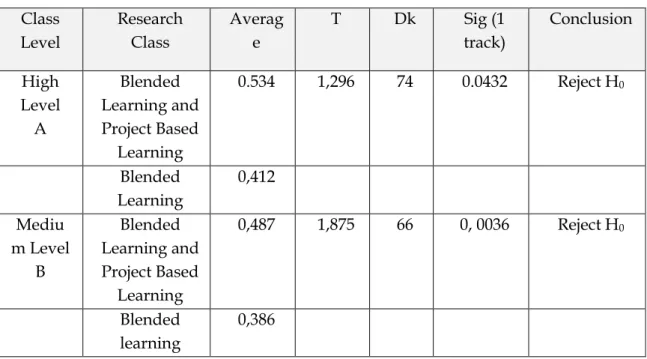
Because of this research was carried out at different class levels, namely high class, medium class and low class, it is necessary to investigate whether there is a difference of improving students’ HOTS with blended learning and project based learning at each different level. To find the answers, calculations were performed using independent sample T-Tests. The first, conducted a normality test at each level of class and based on calculations concluded that the data were normally distributed. After that an independent sample T-Test is performed with the following results:
Table 1. T-Test Results on N-Gain Students HOTS Based on Grade Level
Class Level Research Class Averag e T Dk Sig (1 track) Conclusion High Level A Blended Learning and Project Based Learning 0.534 1,296 74 0.0432 Reject H0 Blended Learning 0,412 Mediu m Level B Blended Learning and Project Based Learning 0,487 1,875 66 0, 0036 Reject H0 Blended learning 0,386
Based on data presented in Table 1, testing in class A, a comparison of the average value of N-Gain experiment class and control class that is t count =
1.296 with sig (1 lane) = 0.0432, due to Sig (1Pathway) <0.05, It was concluded that the improving of students’ HOTS class A who learns blended learning and project based learning is higher than students who learn by using only blended learning. It also applied to the class B and C, where the final conclusion H0 is
rejected. So that, the students’ HOTS who learn blended learning and project based learning is higher than only used blended learning.
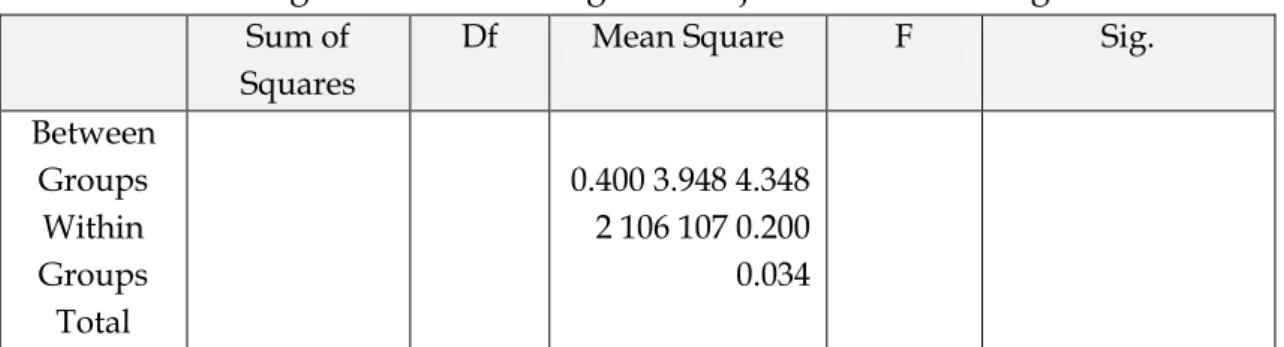
Furthermore, to determine the level of which one HOTS has increased the high capability in using blended learning model and blended learning, the researchers used One Way ANOVA. Previously the researcher conducted tests of normality and homogeneity and this asset has been fulfilled. Then one way ANOVA test was carried out with the following results:
239
Table 2. Results of One Way Anova N-Gain in Improving Students’ HOTS in
Using Blended-Learning and Project Based Learning.
Sum of Squares
Df Mean Square F Sig.
Between Groups Within Groups Total 0.400 3.948 4.348 2 106 107 0.200 0.034
Table 2 presented that the F count = 5.843 with sig = 0.003 which means
that H0 is rejected. Therefore it can be concluded that there is an influence of class level on N-gain students’ ability HOTS. Therefore, further tests (post-hoc test) using the Tukey Test. The test results can be seen in the table below:
Table 3. Tukey Test Results
Level Mean Difference Std. Error Sig Tukey
HSD
A B 0.1145 0.0483
A C 0.1384 0.0423
B C 0.0294 0.0432
*) The mean difference is significant at the 0.05 level.
Table 3 presented that the level of class A and level of class B obtains Sig = 0.027. So that it is concluded that there are significant differences between two class levels. Then between class A level and class C level got Sig = 0.008 so that it was concluded that there was a significant difference between two class levels, namely between class B level and class C level got Sig = 0.582 so that it was concluded that there were significant differences betweene two class levels. Table 3 presented that class A has higher N-Gain than classes B and C. As the result, it can be concluded that blended learning and project based learning
model was very suitable for use in classes that have high HOTS. Furthermore,
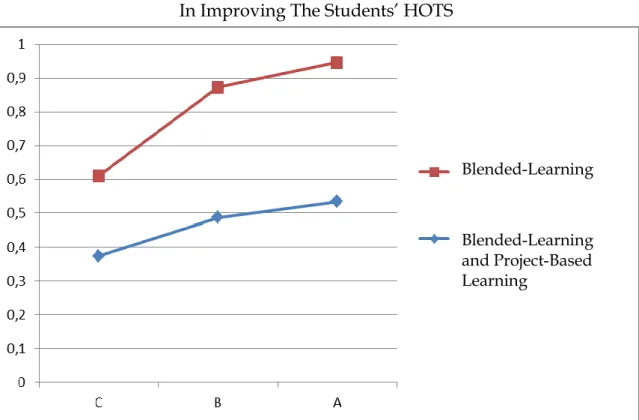
the researchers use two way Anova test to find out the learning interaction among level classes in increasing the students’ HOTS.
240
Figure 2. Interaction Between Learning and among Level Classes
In Improving The Students’ HOTS
Figure 2 presented that any difference classes of students’ HOTS who learn blended learning and project based learning, with student the students’ HOTS who learn only used blended learning. Interaction test produces f arithmetic = 0, 846 with Sig = 0, 475. Hence, It can be concluded that H0 is
accepted, then there is no interaction. It inflicts the main influence being meaningful. On the results of was found Fcount = 24.87 with Sig = 0,000. So it was
concluded that there were differences in the average N-Gain of students’ HOTS who studied with the blended learning model and project based learning and students who learned only using blended learning model. This research is also supported by analyzing data based on lecturer and student observation sheets. Based on the lecturer observation sheet, the lecturer gets a score of 98%. It proven from the lecturers’ implementation blended learning activities and Project based learning got excellent category. Step by step the data that has been prepared by lecturers were a good implementation. Hence, learning process is able to achieve the stated learning goals. Learning activities carried out by lecturers also have an impact on the learning process of students. Based on the calculation of the feasibility of learning by students was obtained a value 97.5%. It proved that learning process carried out by students was a good category.
Blended-Learning
Blended-Learning and Project-Based Learning
241
Using this model made students active in developing their thinking skills so they can improve HOTS.
The finding of this research was in using blended learning model and project based learning significantly affected in improving the students’ Higher Order Thinking Skill (HOTS). It can be proven from the result data: obtained t count = 4.374 with df = 392.24 and sig (1 way) = 0.000 where sig (1 way) <0.05. It means that there was an improving of Students’ Higher Order Thinking Skill (HOTS) ability by blended learning and project-based learning, rather than students who study learn blended learning only. It line with previous research that there was a significant influence of using blended learning to the
acquisition of learning concepts and student procedures (Sudarman, 2015). This
research stated that students who learn by using blended learning get higher scores on learning concepts and procedures than students who study only face to face. Other researcher was also supported by Kusairi (2013) stated that there was a positive participant in using students' blended learning towards the mastery of students' concepts and reasoning. This research stated that students who learn to use blended learning have higher mastery of concepts and physical reasoning compared to students who study face to face. Other studies suggest that there was a positive influence on the blended learning model on learning outcomes of elementary school students (Kiranawati, 2014). This research stated that students who learn to use blended learning have higher learning outcomes than students who learn directly. Other research reported that effective blended learning can increase student motivation and understanding (Bibi & Jati, 2015), there is a significant influence on the use of blended learning models using Edmodo on student learning outcomes
(Susilawati, 2018). These results can be concluded that blended learning can
improve the quality of learning for finding information and knowledge based on real experience to produce products. The students make decisions through a systematic framework, having problems whose solutions are not limited and demanding students to design the process of activities.
The finding previous studies above were different from this current research, which using blended learning and project based learning. It also emphasize on improving the students' Higher Order Thinking Skill (HOTS). Other previous studies only compare blended learning with face-to-face learning. HOTS was a higher level thinking ability that needs to be taught in
higher education (Kenedi, 2018; Ahmad, 2017). Therefore students' Higher
Order Thinking Skill (HOTS) needs to be trained in the learning process. One learning model that can be used is blended learning. In this research blended learning model was equally used in the experimental class and control class,
242
only in the experimental class were given additional project based learning. From the results of the study it was found that in these two classes improved students’ HOTS. Blended learning is a learning model that combines face-to-face learning and online learning (Kristanto & Mariono, 2017). Project based learning is learning that requires students to produce products collaboratively
(Bell, 2010). In this research blended learning and project based learning can
improve the students’ HOTS. In project based learning students were required to think, and to understand the problem to be solved. This thought process was asking questions, searching and managing information, making plans and making decisions (Insyasiska, Zubaidah, Susilo, Biology, & Malang, 2015). It required the students’ HOTS to be implemented. Blended learning can improve students' HOTS due to the blended learning has space available, so students can study independently. This study proven that the independence of students in the learning process train and stimulate students' minds to understand information. So that, the students found the information correctly. Learning independence is the ability possessed by individuals in problems solving. When students studied independently they would automatically associate their HOTS abilities in solving problems. Blended learning gave opportunities for students
and lectures to communicate and discuss in outside classroom (Ningsih, 2016;
Saifuddin, 2018). Besides that, blended learning also provided access to a
variety of learning resources (Usman, 2019; Bibi et al., 2015). It encourage the enthusiasm of students to use learning resources in accordance with the characteristics of their learning styles. This is because in the blended learning process the lecturer has provided varied learning resources to be used as a source of information in the learning process.
The implications of this research can be applied in the scientific and practical domains. In the scientific realm, it can be used as a reference in developing models blended learning and project based learning. Whereas, in
the practical realm the blended learning model and project-based learning can
be used as an effort to improve students' higher order thinking skills. This study also suggests that this learning model can be applied to have a good impact on the quality of learning in higher education and the need for further development of this research
CONCLUSION
Based on the research finding, it can be concluded that there was an influence of students learning with a blended learning and project based learning. Students who learned using blended learning and project based learning can improve student’s HOTS rather than learned blended learning
243
only. Students who have high initial HOTS ability have more impact on the improvement of HOTS with blended learning and Project-Based Learning. Then there was no interaction between the factors of learning factors with the initial level of ability on students’ HOTS ability.
.
ACKNOWLEDGMENTS
The researchers would like thank to Prof. Ganefri Ph.D as Rector of State University of Padang and Dr. Bachtiar Akob, M.Pd as Rector University of Samudra who has given motivation to the authors to complete this research. Thank for Lembaga Penelitian dan Pengabdian Masyarkat (LPPM) of State University of Padang and University of Samudra for giving permission to conduct this collaborative research. Thank you also expressed to the students of Primary School Teacher Education Department at State University of Padang, Andi and Eka for their contribution in helping to collect the data.
AUTHOR CONTRIBUTION STATEMENTS
This research is a collaborative research of two universities. In this research, RE and AKK jointly design research, collect data, conduct analysis and conduct dissemination together. Then, IMS is the third author as researcher who helps finishing this research
REFERENCES
Achsin, M. (2016). Kemampuan Pemecahan Masalah Pada PBL Pendekatan Kontekstual dalam Tinjauan Inventori Kesadaran Metakognitif.
In PRISMA, Prosiding Seminar Nasional Matematika (pp. 696-704). Google
Scholar
Agarwal, H., & Pandey, G. N. (2013). Impact of E-Learning in Education. 2(12),
146–148. Google Scholar
Ahmad, S., Kenedi, A. K., & Masniladevi, M. (2018). Instrumen Hots
Matematika Bagi Mahasiswa PGSD. Jurnal PAJAR (Pendidikan dan
Pengajaran), 2(6), 905-912. Google Scholar
Ahmad, S., Prahmana, R. C. I., Kenedi, A. K., Helsa, Y., Arianil, Y., & Zainil, M. (2017). The instruments of higher order thinking skills. In Journal of
Physics: Conference Series (Vol. 943, No. 1, p. 012053). IOP Publishing.
Google Sholar
Arikunto, S. (2010). Prosedur Penelitian Suatu Pendekatan Praktek. Jakarta: PT.
Rineka Cipta. Retrieved from Google Scholar
Baygin, M., Yetis, H., Karakose, M., & Akin, E. (2016, September). An effect analysis of industry 4.0 to higher education. In 2016 15th international
244
conference on information technology based higher education and training
(ITHET) (pp. 1-4). IEEE. Google Scholar
Basilotta Gómez-Pablos, V., Martín del Pozo, M., & García-Valcárcel Muñoz-Repiso, A. (2017). Project-based learning (PBL) through the incorporation of digital technologies: An evaluation based on the experience of serving
teachers. Computers in Human Behavior, 68, 501–512.
https://doi.org/10.1016/j.chb.2016.11.056
Bell, S. (2010). Project-Based Learning for the 21st Century: Skills for the Future.
The Clearing House: A Journal of Educational Strategies, Issues and Ideas, 83(2),
39–43. https://doi.org/10.1080/00098650903505415
Benešová, A., & Tupa, J. (2017). Requirements for education and qualification of
people in Industry 4.0. Procedia Manufacturing, 11, 2195-2202.
https://doi.org/10.1016/j.promfg.2017.07.366
Bibi, S., & Jati, H. (2015). Efektivitas model blended learning terhadap motivasi dan tingkat pemahaman mahasiswa mata kuliah algoritma dan pemrograman. Jurnal Pendidikan Vokasi, 5(1), 74-87.
http://dx.doi.org/10.21831/jpv.v5i1.6074
Butler, H. A. (2012). Halpern Critical Thinking Assessment predicts real‐world
outcomes of critical thinking. Applied Cognitive Psychology, 26(5), 721-729. https://doi.org/10.1002/acp.2851
Campbell, D. T., & Stanley, J. C. (2015). Experimental and Quasi-Experimental
Designs for Research. Ravenio Books. Google Scholar
Chang, L.-C., & Lee, G. C. (2010). A team-teaching model for practicing project-based learning in high school: Collaboration between computer and
subject teachers. Computers & Education, 55(3), 961–969.
https://doi.org/10.1016/j.compedu.2010.04.007
Choi, J., Lee, J.-H., & Kim, B. (2019). How does learner-centered education affect teacher self-efficacy? The case of project-based learning in Korea. Teaching
and Teacher Education, 85, 45–57. https://doi.org/10.1016/j.tate.2019.05.005
Dwiyanti , V., Ana, A., & Widianingsih, I. (2018). Industrial Education Impact on Vocational Student Social Skills. Innovation of Vocational Technology
Education, 14(2), 98–103. https://doi.org/10.17509/invotec.v14i2.14362
Faheem, M., Shah, S. B. H., Butt, R. A., Raza, B., Anwar, M., Ashraf, M. W., … Gungor, V. C. (2018). Smart grid communication and information technologies in the perspective of Industry 4.0: Opportunities and
challenges. Computer Science Review, 30, 1–30.
https://doi.org/10.1016/j.cosrev.2018.08.001
Fernandes, S. R. G. (2014). Preparing Graduates for Professional Practice: Findings from a Case Study of Project-based Learning (PBL). Procedia -
245
Social and Behavioral Sciences, 139, 219–226.
https://doi.org/10.1016/j.sbspro.2014.08.064
Hariharasudan, A., & Kot, S. (2018). A Scoping Review on Digital English and
Education 4.0 for Industry 4.0. Social Sciences, 7(11), 227.
https://doi.org/10.3390/socsci7110227
Hasanah, M. A., & Surya, E. (2017). Differences in the abilities of creative thinking and problem solving of students in mathematics by using cooperative learning and learning of problem solving. International Journal
of Sciences: Basic and Applied Research (IJSBAR), 34(01), 286-299. Google
Scholar
Helle, L., Tynjälä, P., & Olkinuora, E. (2006). Project-Based Learning in Post-Secondary Education – Theory, Practice and Rubber Sling Shots. Higher
Education, 51(2), 287–314. https://doi.org/10.1007/s10734-004-6386-5
Helsa, Y., & Kenedi, A. K. (2019). Edmodo-Based Blended Learning Media in
Learning Mathematics. JOURNAL OF TEACHING AND LEARNING IN
ELEMENTARY EDUCATION (JTLEE), 2(2), 107–117.
https://doi.org/10.33578/jtlee.v2i2.7416
Herman, T. (2017). The Enhancement of Students ’ Critical Thinking Skills in
Mathematics through The 5E Learning Cycle with Metacognitive Technique.
57(ICMSEd 2016), 4(7), 101–106. Google Scholar
Insyasiska, D., Zubaidah, S., & Susilo, H. (2017). Pengaruh project based learning terhadap motivasi belajar, kreativitas, kemampuan berpikir kritis,
dan kemampuan kognitif siswa pada pembelajaran biologi. Jurnal
Pendidikan Biologi, 7(1), 9-21. http://dx.doi.org/10.17977/jpb.v7i1.713
Kiranawati, I. (2014). Pengaruh Penerapan Model Blended Learning Terhadap Hasil Belajar Siswa Pada Mata Pelajaran Akuntansi Di SMK Negeri 11
Bandung. Jurnal Pendidikan Akuntansi & Keuangan, 4(1), 1-14.
https://doi.org/10.17509/jpak.v4i1.15381
Kivunja, C. (2015). Exploring the pedagogical meaning and implications of the 4Cs “super skills” for the 21st century through Bruner’s 5E lenses of knowledge construction to improve pedagogies of the new learning
paradigm. Creative Education, 6(02), 224..
https://doi.org/10.4236/ce.2015.62021
Koh, J. H. L., Herring, S. C., & Hew, K. F. (2010). Project-based learning and student knowledge construction during asynchronous online discussion.
The Internet and Higher Education, 13(4), 284–291.
246
Kristanto, A., & Mariono, A. (2017). The Development of Instructional Materials
E-Learning Based On Blended Learning. 10(7), 10–17.
https://doi.org/10.5539/ies.v10n7p10
Kusairi, S. (2013). Pengaruh Blended Learning terhadap Penguasaan Konsep dan
Penalaran Fisika Peserta Didik Kelas X. 9(1), 67–76.
https://doi.org/10.15294/jpfi.v9i1.2582
Kusumah, Y. S. (2010). Dampak Pendidikan Matematika Realistik Masalah Siswa Smp. 1(1), 41–51. Google Scholar
Laar, E. Van, Deursen, A. J. A. M. Van, Dijk, J. A. G. M. Van, & Haan, J. De. (2017). Computers in Human Behavior The relation between 21st-century skills and digital skills : A systematic literature review. Computers in
Human Behavior, 72, 577–588. https://doi.org/10.1016/j.chb.2017.03.010
Lasi, H., Fettke, P., Kemper, H. G., Feld, T., & Hoffmann, M. (2014). Industry 4.0. Business & information systems engineering, 6(4), 239-242. https://doi.org/10.1007/s12599-014-0334-4
Lase, D. (2019). Education and Industrial Revolution 4.0. Jurnal Handayani PGSD
FIP UNIMED, 10(1), 48–62. https://doi.org/10.24114/jh.v10i1.14138
Lewin, C., & Mcnicol, S. (2015). Supporting the development of 21st century skills through ICT. KEYCIT 2014: key competencies in informatics and ICT, 7,
181. Google Scholar
Liao, Y., Rocha, E., Deschamps, F., & Brezinski, G. (2018). The impact of the fourth
industrial revolution : a cross-country / region comparison. 28,
https://doi.org/10.1590/0103-6513.20180061
López-pérez, M. V., Pérez-lópez, M. C., & Rodríguez-ariza, L. (2011). Computers & Education Blended learning in higher education : Students ’ perceptions and their relation to outcomes. Computers & Education, 56(3),
818–826. https://doi.org/10.1016/j.compedu.2010.10.023
Manufacturing, I. (2017). Requirements for Education and Qualification of People in
Industry. 11(June), 2195–2202.
https://doi.org/10.1016/j.promfg.2017.07.366
Maskuriy, R., Selamat, A., Ali, K. N., Maresova, P., & Krejcar, O. (n.d.). applied sciences Industry 4 . 0 for the Construction Industry — How Ready Is the
Industry ?. Google Scholar
Mayes, R., Natividad, G., & Spector, J. M. (2015). Challenges for Educational Technologists in the 21st Century. Education Sciences, 5(3), 221–237. https://doi.org/10.3390/educsci5030221
Mcphee, C., Hudson, D., & Allahar, H. (2017). Technology Innovation Management
247
Ningsih, Y. L., & Jayanti, J. (2016). Hasil Belajar Mahasiswa Melalui Penerapan
Model Blended Learning Pada Mata Kuliah Persamaan Diferensial. Jurnal
Pendidikan Matematika RAFA, 2(1), 1–11. Google Scholar
Osubor, V. I., & Chiemeke, S. C. (2015). E-Learning Functional Model: A Technology-Based Teaching Method For Providing Access To Sustainable Quality Education. African Journal of Computing & ICT, 8(2). Google Scholar Rahman, M. (2019). 21st Century Skill “Problem Solving”: Defining the
Concept. Asian Journal of Interdisciplinary Research, 2(1), 64–74.
https://doi.org/10.34256/ajir1917
Sardone, N. B., & Devlin-Scherer, R. (2010). Teacher Candidate Responses to Digital Games. Journal of Research on Technology in Education, 42(4), 409–
425. https://doi.org/10.1080/15391523.2010.10782558
Selamat, A., Alias, R. A., Hikmi, S. N., Puteh, M., & Tapsi, S. M. (2017). Higher education 4.0: Current status and readiness in meeting the fourth
industrial revolution challenges. Redesigning Higher Education towards
Industry, 4, 23-24. Google Scholar
Sudarman, S. (2015). Pengaruh strategi pembelajaran blended learning terhadap perolehan belajar konsep dan prosedur pada mahasiswa yang memiliki
self-regulated learning berbeda. Jurnal Pendidikan dan Pembelajaran
(JPP), 21(1), 107-117. Google Scholar
Susanti, V. D. (2018). Analisis Kemampuan Kognitif dalam Pemecahan Masalah
Berdasarkan Kecerdasan Logis-Matematis. JMPM: Jurnal Matematika dan
Pendidikan Matematika, 3(1), 71–83.
https://doi.org/10.26594/jmpm.v3i1.998
Susilawati, E. (2017). The Using Of Blended Learning For Citizenship Education Course. International Journal of Scientific & Technology Research, 6(10),
278-281. Google Scholar
Thieman, G. Y. (2008). Using Technology as a Tool for Learning and Developing 21st
Century Citizenship Skills : An Examination of the NETS and Technology Use
by Preservice Teachers With Their K-12 Students. 8, 342–366.
Google Scholar
Wagner, T., Herrmann, C., & Thiede, S. (2017). Industry 4.0 Impacts on Lean
Production Systems. Procedia CIRP, 63, 125–131.
https://doi.org/10.1016/j.procir.2017.02.041
Usman, U. (2019). Komunikasi Pendidikan Berbasis Blended Learning Dalam Membentuk Kemandirian Belajar. Jurnal Jurnalisa, 4(1), 136-150.
248
Xu, M., David, J. M., & Kim, S. H. (2018). The Fourth Industrial Revolution :
Opportunities and Challenges. 9(2), 90–95.
https://doi.org/10.5430/ijfr.v9n2p90
Yuliati, S. R., & Lestari, I. (2018). Higher-Order Thinking Skills (HOTS) Analysis
Of Students In Solving Hots Question In Higher Education. Perspektif Ilmu
Pendidikan, 32(2), 181-188. Google Scholar
Copyright Holder :
© Eliyasni, R., Kenedi, A.K., & Sayer, I.M (2019). First Publication Right :
© Jurnal Iqra’ : Kajian Ilmu Pendidikan This article is under: