Strategic CRM for public enterprise
using various customer segmentation methods
SungMin Bae and Youn Sung Kim
Dept. of Industrial & Management Engineering, HANBAT National University SAN 16-1, Duckmyoung-Dong, Yusong-Gu, Daejeon 305-719, Korea
Graduate School of Logistics, College of Business Administration, INHA University 253 Yonghyun-Dong, Nam-Gu, Incheon 402-751, Korea
Strategic CRM for public enterprise
using various customer segmentation methods
Abstract
The dynamics of the customer-company relationship have changed dramatically over time. Customers have always been at the core of a company’s long-term growth strategies. In case of the public enterprise, the customers are also valuable. But, for their unique characteristics, most public enterprises do not know their real customer. They provide specialized services to the customer for the public benefit not their profit. It does not mean that customer relationship is an unimportant matter. In this manner, very recently, public enterprise tries to identify their customer and their characteristics for customer-company relationship. In this paper, we suggest the customer identification and segmentation framework for the public enterprise considering their unique characteristics.
1. INTRODUCTION
As the world market becomes more competitive, enterprise economy become financial fluctuation and saturation. A private enterprise has been set a goal of profitability growth by market and customer segmentation. In this manner, market becomes more active, and company should apply the concept of mass marketing, relation marketing, CRM (Customer Relationship Management).[1][2] In order words, CRM affects on rapidly changing world economy, many competitor, and well-informed customer, and a limitation of existing marketing and development of IT (Information Technology). CRM
understand customer’s latent needs and provide right product or service to the right customer. That is, CRM define strategy and a best service for customer. Also, it considers customer needs and behavior, and examines profitability and continuous automation process.
Recently, private enterprises recognize CRM as a customer-focused strategy but it does not plays an important role in public enterprises. CRM will be a great help public enterprise to renovate and develop like private enterprise. Accordingly, public enterprises increasingly adopt CRM system.[5] In addition, public enterprises have pursued public and economical efficiency of their organization.
In this paper, we examine Korea pubic enterprise, which classified a top-class enterprise for year 2005 KCSI (Korean Customer Satisfaction Index). First, we examine their existing CRM system and their customer segmentation scheme. After that, we suggest various customer segmentation methods based on RFM and CSI and reconstruct data structures for CRM system and provide a framework for enhanced CRM system.
2. LITERATE REVIEW
2.1. CRM in public enterprise
In Korea, most public enterprises are a kind of state-run organization. It is different from private enterprise, because it pursues public interests and profitability [6]. But, today, existing public enterprise compete with private enterprises so they should more effort for increasing their profitability. Public enterprises have various types of business and customers. And public enterprises have individual-customers as well as enterprise-customers. But CRM of public enterprise is more difficult than private enterprise. Moreover, many public enterprises are needed to be changed to self-regulate and
other-direct. For example, from 1999, the Korean Ministry of Planning and Budget enforce CSI survey to public enterprises. The CSI result of year 2003 is 76.2/100 point on the average, and it is a big growth compared with CSI result of year 1999 – 59.7/100 point on the average. That is, public enterprise has been changed rapidly. In other word, public enterprise should take up CRM system for their organization, because CRM is most important system for raising their CSI score, and CRM gives public enterprise to identity their current situation and customer-focused strategy. If public enterprises steadily make an effort, CRM give help for Customer Satisfaction.
Table 1 shows CRM case of public enterprises and private enterprises.
Table 1. CASES for CRM system in public and private enterrises Korea Trade-Investment Promotion
Agency (KOTRA)
- CS, Customer-oriented
- Internal and external united CRM - Automatic CRM system in website Public
enterprise
Korea Railroad
- Members and visitors united CRM system
- Reservation and sale SK Telecom
- Save customer information for DB - Database marketing
- Characteristic CRM KTF
- Good time party - All customer is owner - Combine service
Samsung life insurance - A partners for life - CRM with use Pilot process American International Group Inc.
(AIG)
- IT system reinforce for customer service
Bury St Edmunds Banks U.K. - DM for target customer Bank of Japan - DW use CRM
Jebsen & Jessen South East Asia
(JJSEA) - 7area united CRM Private
Enterprise
EPSON - Customer service center
2.2. CRM, Customer DB, and Segmentation
Basically, CRM makes customer segment from customer DB. Current status of public enterprise does not use customer DB. In this manner, public enterprise should consider customer DB and it helps accurate customer segmentation. Therefore, in this paper, we
will consider customer segmentation by RFM and CSI method.
- RFM analysis: how recently is customer purchase (Recency), how frequently is
purchase (Frequency), how much is total purchase per customer (Monetary). RFM analysis makes grade each item, and find customers target and improves profitability. - CSI analysis: CSI is an index of customer satisfaction to each product or service for
customer. In Korea, Korea Management Association consulting (KMAC) develop K-CSI. This survey has been performed to 103 enterprises in every year.
3. VARIOUS CUSTOMER SEGMENTATION SCHEME FOR
STRATEGIC CRM
In this section, we examine Korea public enterprise. Our target public enterprise provides specialized services related with imports and export to small and medium-sized enterprises (SME). It serves as a bridge between Korean and foreign businessperson who wish to forge trade or investment relations.
3.1 Basic customer segmentation methods
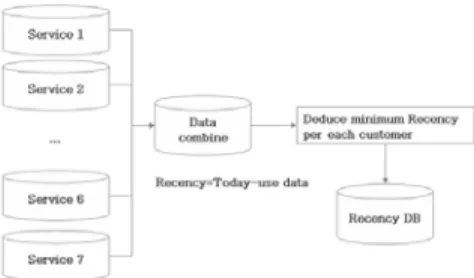
As we mentioned before, RFM data used to segment the customers of our target enterprise. Figure 1 shows processes of Frequency value based segmentation, and Figure 2 indicates processes of Recency value based segmentation. In this time, we could not perform Monetary value based segmentation, because the service fee, which is provided by our target enterprise, could not reflect their real expenses. That is, our target
enterprise is a “Public” enterprise and their main target customer is SME. Also, the definition of RFM differs from original definition.
· Recency: numerical difference between recently and now service use data (do not care
field of service)
· Frequency: the number of use each customer to main services
· Monetary: service amount, and value of current and future
Figure 1. Analysis process of Frequency Figure 2. Analysis process of Recency
Based on RFM data, we build a decision tree, as depicted Figure 3, for customer segmentation. As a result, we find two groups of customers based on Frequency value. The criteria between loyal and normal customers are 5. It means that loyal customers uses our target enterprise more than five times in specific periods. In this time, number of loyal customer group is 168, and number of normal customer is 65.
Figure 4 is an example of customer segmentation in view point of services which is provided by our target enterprise. For HB service case, if a frequency value has over 13, then we classify this customer group is a loyal customer group.
Figure 4. 2004 Customer segmentation results
As a result, we find that customer segmentation of our target enterprise is greatly influenced by frequency value. Also, in view point of service, frequency value is deeply related to the level of customer group.
3.2 Various customer segmentation schemes
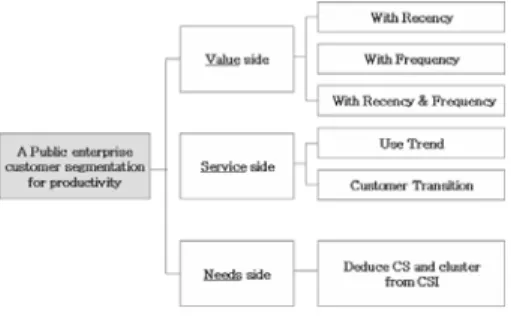
As we mentioned before, we can show our target enterprise’s customer segmentation is influenced by customers’ frequency value. If our target enterprise want to more precise customer segmentation, than they should consider each services’ frequency value. In this section, we suggest other methods to segment their customers in view point of customer value, their services, and customers’ needs as depicted Figure 5.
- Value-based customer segmentation
Value-based customer segmentation focuses on the current and future value of their customers. Table 2 and Table 3 show results of customer segmentation. In Table 2, cluster F1 and F2 is loyal customer groups and customers in cluster F1 uses our target enterprises 30 times per year and 2.5 times per month. Also, in Table 3, recency value of loyal customer is one month.
Table 2. Frequency customer segmentation Table 3. Recency customer segmentation
Group Frequency value Number of customer Rate (%) Cluster F1 31~854 127 1.38 Cluster F2 7~30 1833 19.88 Cluster F3 3~6 2387 25.89 Cluster F4 2 1486 16.12 Cluster F5 1 3387 36.74 Sum n/a 9220 100
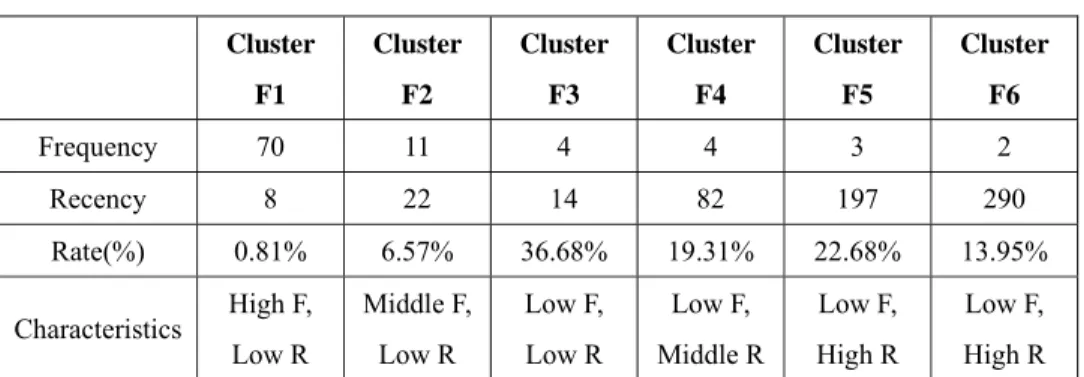
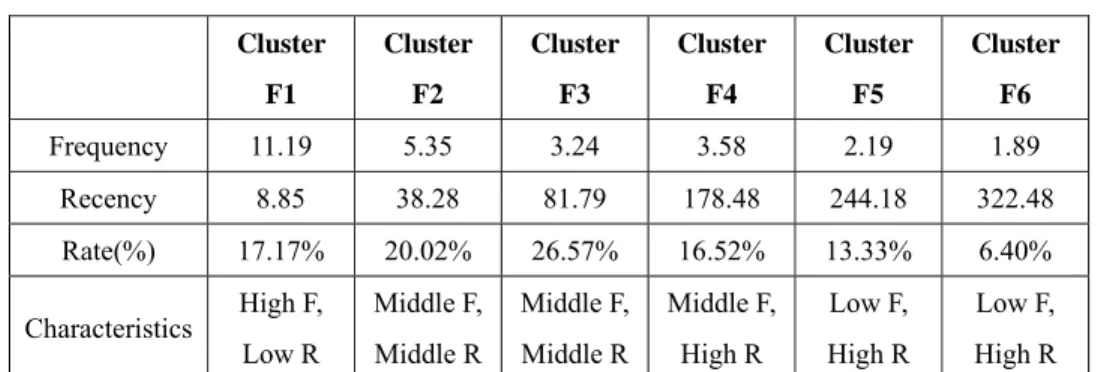
In Table 4 and Table 5, we use frequency and recency value simultaneously to segment customers. Each cluster has own character of Frequency and Recency value, and their characteristics are divided high and middle and low.
Table 4. RF customer segmentation (2004) Cluster F1 Cluster F2 Cluster F3 Cluster F4 Cluster F5 Cluster F6 Frequency 70 11 4 4 3 2 Recency 8 22 14 82 197 290 Rate(%) 0.81% 6.57% 36.68% 19.31% 22.68% 13.95% Characteristics High F, Low R Middle F, Low R Low F, Low R Low F, Middle R Low F, High R Low F, High R Group Recency value Number of customer Rate (%) Cluster F1 31 2021 21.92 Cluster F2 69 1861 19.64 Cluster F3 158 2239 24.83 Cluster F4 276 2450 26.57 Cluster F5 362 649 7.04 Sum n/a 9220 100
Table 5. RF customer segmentation (2005) Cluster F1 Cluster F2 Cluster F3 Cluster F4 Cluster F5 Cluster F6 Frequency 11.19 5.35 3.24 3.58 2.19 1.89 Recency 8.85 38.28 81.79 178.48 244.18 322.48 Rate(%) 17.17% 20.02% 26.57% 16.52% 13.33% 6.40% Characteristics High F, Low R Middle F, Middle R Middle F, Middle R Middle F, High R Low F, High R Low F, High R
And we can build a transition matrix between customer group based on customer segmentation results in 2004 and 2005. As a result, we can find almost year 2004 customer moved to higher level cluster in 2005.
Table 6. Customer transition matrix from 2004 to 2005 2005 2004 Group 1 (%) Group 2 (%) Group 3 (%) Group 4 (%) Group 5 (%) Group 6 (%) Total (%) Group 1 61.9 19.05 6.35 4.76 6.35 1.59 100.00 Group 2 46.86 22.31 15.21 8.92 5.27 1.42 100.00 Group 3 23.94 20.44 24.25 15.06 10.00 6.31 100.00 Group 4 16.60 24.90 21.42 17.94 13.39 5.76 100.00 Group 5 18.34 20.67 17.76 21.11 15.43 6.70 100.00 Group 6 8.45 14.29 18.95 14.29 27.70 16.33 100.00 Sum 23.70 21.00 20.70 15.66 12.48 6.46 100.00
- Service-based customer segmentation
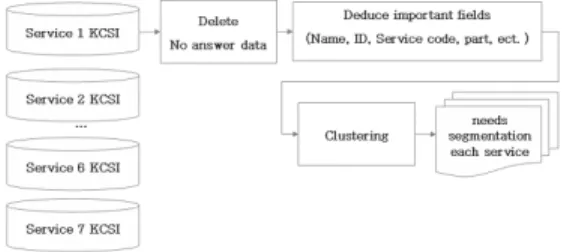
Service based customer segmentation is most important element for several services management. It helps to grasp each service character and identify trends of service. It could be coupled with behavioral segmentation. Figure 6 show processes of customer
trend analysis. Table 7 shows that each customer group uses their unique service. It means that we could extract the characteristics of customers which are linked with specific services.
Figure 6. Process of used customer trends
Table 7. Result of customer trends
% Service 1 Service 2 Service 3 Service 4 Service 5 Service 6 Service 7
Cluster F1 0.81 31.35 13.58 47.87 3.73 2.36 0.30
Cluster F2 0.22 15.94 1.91 46.06 6.98 0.0 28.28
Cluster F3 0.88 21.75 13.94 38.37 15.06 1.81 8.18
Cluster F4 0.54 15.00 13.01 29.96 38.95 1.96 0.58
Cluster F5 58.84 21.02 2.45 9.46 6.35 0.66 1.23
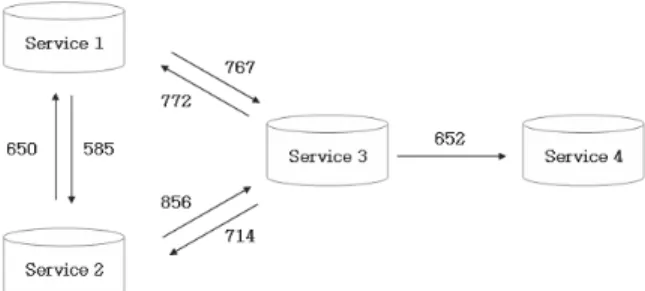
Figure 7 indicates service-usage sequences extracted from customer transaction data. Each service has their sequence like ‘service 1 → service 3 → service 4.’ It could be applied with marketing promotions.
Figure 7. service-usage sequences
- Needs-based customer segmentation
Needs based customer segmentation is coupled with customer satisfaction. Therefore, CSI data is used to needs-based customer segmentation but, in general, CSI survey data is commonly used to identify the level of customer satisfaction. Figure 8 shows segmentation process using CSI survey data.
Figure 8. Segmentation process using CSI survey data
In Table 8, we classify Cluster 3 has high-level of customer needs and Clsuter 2 has low-level of customer needs based on CSI survey data. Table 9 shows Frequency and Recency value of each cluster. It shows that needs-based segmentation is deeply related with Recency value of each customer group.
Table 8. Result of analysis Table 9. RF needs segmentation average High (Cluster 3) Middle (Cluster 1) Low (Cluster 2) Point 93.4 69.3 41.2
Cluster Frequency Recency cluster 1 4.54 57.84 cluster 2 3.64 52.36 cluster 3 6.67 55.42 Sum 5.24 56.17
4. FUTURE FRAMEWORK FOR PUBLIC ENTERPRISE CRM
4.1 Elements of CRM system: Architecture, Data Structure
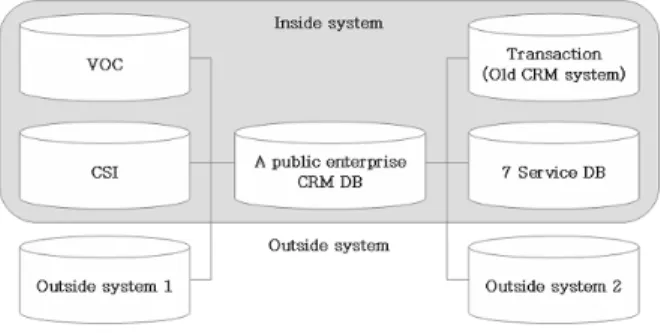
To build an effective CRM system for public enterprise, they should identify their current status of their CRM system and consider the integration of their legacy systems. For our target enterprise, their CRM system only focuses on the segmentation so it should be extended to the targeting and positioning of customers. Figure 9 indicates the architecture of future CRM system. VOC and CSI DB should be managed to conduct the customer segmentation, targeting, and positioning. And, main CRM DB should be connected to the other customer DB to enrich their customer data.
Figure 9. Future CRM system architecture
In addition, as listed in Table 10, several data should be collected and managed for transaction DB.
Table 10. Items in Transaction DB
items contents Common information - Customer ID, Name
Use Service - Kind of services, Service name, Use date, agency Service amount - Service amount, Credit
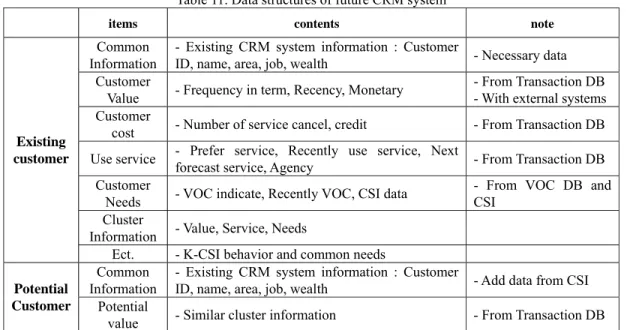
Table 11 shows data structures of future CRM system. For existing customer, it contains customer value related data, cost-related data, needs-related data, and so on. For potential customers, it contains the results of analysis, such as cluster information, their service-usage patterns, customer transaction matrix, and so on.
Table 11. Data structures of future CRM system
items contents note
Common Information
- Existing CRM system information : Customer
ID, name, area, job, wealth - Necessary data Customer
Value - Frequency in term, Recency, Monetary
- From Transaction DB - With external systems Customer
cost - Number of service cancel, credit - From Transaction DB Use service - Prefer service, Recently use service, Next forecast service, Agency - From Transaction DB
Customer
Needs - VOC indicate, Recently VOC, CSI data
- From VOC DB and CSI
Cluster
Information - Value, Service, Needs Existing
customer
Ect. - K-CSI behavior and common needs Common
Information - Existing CRM system information : Customer ID, name, area, job, wealth - Add data from CSI Potential
Customer Potential
value - Similar cluster information - From Transaction DB
4.2 VOC Control Tower (VCT)
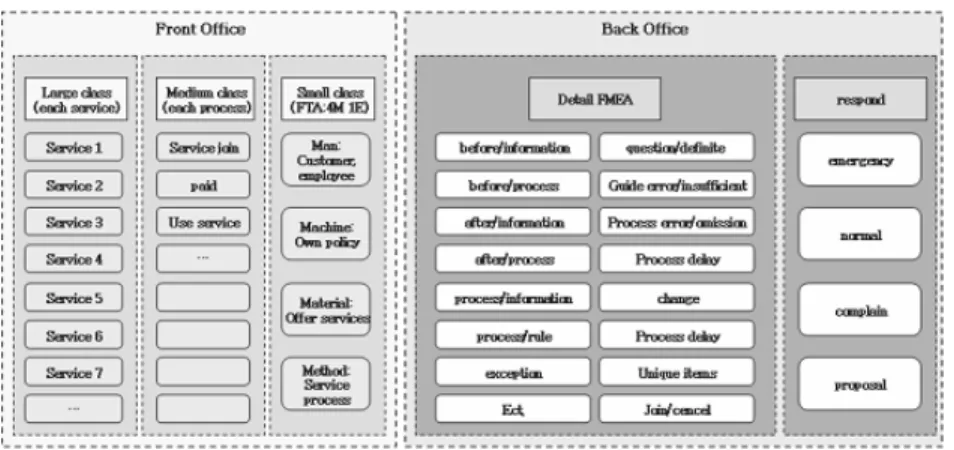
Voice of Customer (VOC) is participation of customer and VOC is a valuable source to share valuable customer information with sales, marketing, and operation management. In many enterprises, we found that the actions on the VOC occurrence and its fluctuation rely on the knowledge from experts’ experiences not on the systematic and scientific method. These approach may derive wrong results, and even if the results are correct, these are mere personal know-how not the knowledge stored in the knowledgebase that can be transmitted within the enterprise. In this manner, the structures of VOC are the most important job to collect and manage the VOC. Figure 10 shows the VOC data structures. To build effective and flexible VOC data structure, we
focus on the process of each service. Also, several metadata, such as FTA and FMEA related data, should be added to enrich their information.
Figure 10. VOC data structures example
5. CONCLUSIONS
Today’s competitive environment requires customer-driven excellence for enterprise competitiveness. To establish the basic framework for business excellence based on customer data, we conducted the in-depth examination on customer data and provide several customer segmentation methods. In addition, to derive significant improvement point from VOC, we proposed the VOC data structures with FTA (fault tree analysis) and FMEA (failure mode and effect analysis). CSI survey data as the major source of customer needs is newly applied to segment customer groups.
6. REFERENCES
Approach”, John wiley & Sons, Inc., 2005ChanUk Park, “Korean CRM practice
method”, The 21C Organizations Series 8, sigma insight, 2005
[2] Don Peppers, Martha Rogers, “Managing Customer Relationships :a Strategic Framework”, John wiley & Sons, Inc., 2004
[3] YoungOk Kang, “Public sector CRM case & report”, Seoul development institute, 2004,7
[4] Ministry of Commerce. Industry and Energy, “e-Business case Library”, The Federation of Korean Industries, 2004
[5] Dyche, Jill, “THE CRM HANDBOOK”, Addison-Wesley, 2003