1
IMPROVING CO-LEARNER INTERACTIONS THROUGH WEB
BASED ONLINE ASSESSMENTS WITHIN DISTANT
LEARNING SETTING
Teaching Learning Quality Improvement Scheme (TLQIS)
FINAL REPORT
NOVEMBER 2009
RESEARCH TEAM:
Dr. Bingunath Ingirige, Dr. Dilanthi Amaratunga, Mr. David Dowdle, Mr. Kaushal
Keraminiyage, Dr. Jack Goulding, Mr. David Baldry and Prof. Mel Lees
RESEARCH ASSISTANT:
Sharifah Mazlina Syed Khuzzan Alhabshi
School of Built Environment,
University of Salford,
4
thFloor, Maxwell Building,
Salford,
M5 4WT,
Greater Manchester
SCHOOL OF THE BUILT
ENVIRONMENT
2
Table of Contents
1. Introduction
3
2. Project Team
3
3. Rational and Background
4
4. Aims and Objectives
6
5. Final Progress and Achieved Outcomes
7
6. Research Methodology
13
7. Case Study Findings
….15
8. Research Dissemination
…..29
9. Conclusion
…..29
10. References
30
11. Appendices
Appendix A: Literature Review
33
Appendix B: Interim Report
48
Appendix C: Paper from BEAR Conference
71
Appendix D: Paper on T & L Workshop
84
Appendix E: Attachments from Assessment Week 91
Appendix F: Conference Paper from IPGRC……… 93
3
1.
Introduction
This document represents the final report for the research project titled: “Improving
Co-Learner Interactions through Web Based Online Assessments within Distant Learning
Setting”, carried out by the School of Built Environment at the University of Salford. The
project was funded by the Teaching and Learning Quality Improvement Scheme
(TLQIS) and this report has been produced in partial fulfilment of the set guidelines of
TLQIS. This document was designed to initially discuss the background to the project,
justifying the reasons undertaking the research project, together with brief details on
project aims and objectives; and the final progress and achieved outcome highlighted.
This was then followed by the literature review section, research methodology section,
the presentation of results section, discussion and findings, the conclusion section, and
culminating with the dissemination of the research section. The detailed literature
review section is attached as per Appendix A.
2.
PROJECT TEAM
This project comprises of the following team members:
Project Leader:
Dr. Bingunath Ingirige, Lecturer, School of the Built Environment (Programme Director,
MSc Project Management in Construction)
Other team members:
Dr. Dilanthi Amaratunga
Mr. David Dowdle
Mr. Kaushal Keraminiyage
Dr. Jack Goulding
Mr. David Baldry
Prof. Mel Lees
4
3.
RATIONALE AND BACKGROUND
Distance Learning (DL) education has improved significantly during the recent years
mainly due to the major developments that have taken place in application of
information and communication technologies (ICT) (Salmon, 2000; Zhang et al, 2004;
Ingirige
et al, 2005). With respect to the domain of higher education (HE) in the
construction industry, DL has become a major source by which many HE institutes
conduct their courses, particularly at the postgraduate level. The new developments in
technology have impacted the overall delivery process of the DL construction
programmes. A major influencing factor for achieving the intended learning outcomes
of these programmes within an overall ICT enabled delivery process is the assessment
strategy adopted. Tutors in DL programmes adopt various methods of assessments
and these could be broadly classified as formative and summative assessments.
Formative assessments attempt to provide feedback to learners, whereas the
summative assessments refer to the actual assessed component. Formative and
summative methods of assessment are included under the umbrella term ‘assessment
strategy’ and are interwoven with one another and often inseparable (Dunn et al, 2004).
In offering DL programmes, the School of the Built Environment (SOBE) recognises that
learners pursuing their qualifications in geographical isolation have a powerful need to
form a community of co-learners which would enhance and enrich their learning
experience and support their continuing participation. In addition, the learning outcomes
of the Masters programmes delivered by SOBE (in line with ‘M’ level descriptors within
QAA’s FHEQ framework and specific subject benchmark statements relevant to the
field), often specify “that students will be able to lead and work effectively with project
teams and communicate effectively in a variety of forms” and develop transferable skills
such as “Interactive and Group Skills and taking part in group discussions”. Therefore
the overall assessment strategies of Masters DL programmes identify the achievement
of these learning outcomes as key goals.
5
SOBE currently offers seventeen Masters DL programmes and it forms a major part of
the portfolio of investment within SOBE to improve the effectiveness and efficiency.
Several online assessments are being utilised in line with the learning outcomes. The
Masters programmes utilise blackboard virtual environments in the asynchronous mode.
Previously, the ‘Horizonwimba’ was used in the synchronous mode to deliver the
modules to the distance learners up until September 2009, where the ‘Horizonwimba’
was then replaced by the ‘Elleuminate Bridge’. Some of the programmes utilise the
Blackboard VLE at different levels for both formative and summative assessments.
‘Elluminate Bridge’ enables learners to easily and seamlessly integrate live,
synchronous distance learning and collaboration into their coursework. This means that
instructors would be able to schedule and deliver classes using the ‘Elluminate
Live’,
which is an application within the ‘Elluminate Bridge’ through the Internet-based,
real-time, multi-platform eLearning tool that includes superior voice over the Internet, video,
shared whiteboards, text messaging, breakout rooms, application sharing, PowerPoint
import, and many others. Furthermore, learners can launch a synchronous session or
recording using ‘Elluminate Live!’ directly from the Blackboard Learning System.
The MSc in Project Management at SOBE had been observed, and, it was found that
learners sometimes have online meetings outside formal contact hours (see Allen, 2005
for more details on online learning communities). Learners often express their need for
more empowerment within some of their modules to enhance their active engagement
within the programmes. With all types of learning, including web based learning; it is
useful for students to receive constructive, timely, and relevant
feedback on their
progress even within distance learning settings. Therefore a mix of computer marked
and tutor marked essays could be adopted for summative assessments. Online
assessment is sometimes constrained
by the medium in which it is operating. Computer
marked assessments
alone are not appropriate for marking or giving feedback on
assignments
such as essays or projects that require more than the mere reproduction
of
knowledge. With the increase of DL programmes being offered there has been a
corresponding increase in both synchronous and asynchronous mechanisms being
developed to facilitate these assessments (Dede, 1996; Wilson and Whitelock, 1997).
6
Despite addressing the needs of the programmes in developing a regime of assessment
strategies most learning communities express a feel of isolation. However, barriers in
the form of resource constraints, sometimes affect the provision of pedagogic
requirements such as maintaining appropriate co-learner interactions within the masters
DL programmes. With this respect, it was proposed that there was a need to raise
awareness in this area by identifying the importance of online assessments and
co-learner interactions among SOBE Masters Programme Leaders. This research involved
the Masters Programme leaders in order to assist in gaining insights on the various
strategies adopted in their respective programmes to address online assessments and
co-learner interactions. These results were compared to develop a guideline in order to
improve co-learner interactions by case studies with other schools and faculties at the
University of Salford and other universities within the UK that were identified to be
included as case studies.
4.
AIM AND OBJECTIVES
The overall aim of this research is to improve co-learner interactions through online
assessments within distance learning settings pertaining to existing distance learning
Masters Programmes at SOBE and to share results with other schools and faculties.
The objectives of this proposal are as follows:
i) Identify the currently available web based online assessment tools within DL;
ii) Identify barriers in improving co-learner interactions within DL;
iii) Formulate a methodology for linking online assessment tools with encouraging
co-learner interaction;
iv) Identify gaps within the available tools and their capabilities in improving co-learner
interactions;
v) Recommend appropriate guidelines for improvement both in terms of assessment
tools as well as possible facilitator and leaner interventions; and
7
5.
FINAL PROGRESS AND ACHIEVED OUTCOMES
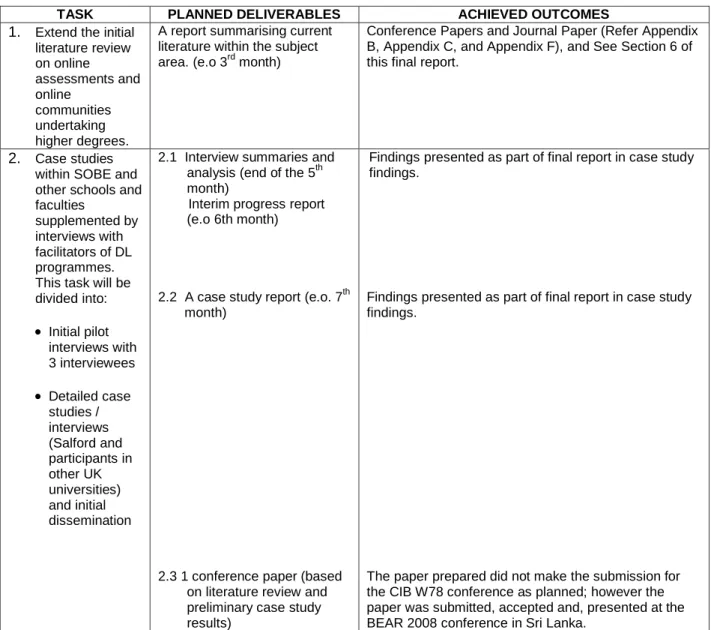
Table 1 shows the tasks that were determined at the beginning of the research, and the
achieved outcomes.
TASK PLANNED DELIVERABLES ACHIEVED OUTCOMES
1. Extend the initial literature review on online assessments and online communities undertaking higher degrees.
A report summarising current literature within the subject area. (e.o 3rd month)
Conference Papers and Journal Paper (Refer Appendix B, Appendix C, and Appendix F), and See Section 6 of this final report.
2. Case studies within SOBE and other schools and faculties
supplemented by interviews with facilitators of DL programmes. This task will be divided into: • Initial pilot interviews with 3 interviewees • Detailed case studies / interviews (Salford and participants in other UK universities) and initial dissemination
2.1 Interview summaries and analysis (end of the 5th month)
Interim progress report (e.o 6th month)
2.2 A case study report (e.o. 7th month)
2.3 1 conference paper (based on literature review and preliminary case study results)
Findings presented as part of final report in case study findings.
Findings presented as part of final report in case study findings.
The paper prepared did not make the submission for the CIB W78 conference as planned; however the paper was submitted, accepted and, presented at the BEAR 2008 conference in Sri Lanka.
* Note: e.o refers to: End Of
Table 1: Planned Deliverables and Achieved Outcomes
In addition to the above planned deliverables and their achieved outcomes, the
followings are identified as the additional achieved outcomes from this research
explained in further detail:
8
i. Literature Review
The literature review was designed to address the following issues on the overview
of DL, the definitions and characteristics of DL, the issue of interactivity and
feedback within DL settings, assessments and the types of web-based online
assessments available.
Précis of the Literature Review
Advances in information technology (IT) is continually evolving; opening up
additional channels for today’s higher education (Chen et al, 2001), e.g. distance
education technologies, hence triggering distance education technologies to become
more prominent during the last decade of the 20
thcentury (Ingirige et al, 2005).
Distance Learning (DL) education has also improved significantly during the recent
years mainly due to the major developments that have taken place in application of
information and communication technologies (ICT) (Salmon, 2000; Zhang et al,
2004; Ingirige et al, 2005); which now has become a major source by which many
Higher Education (HE) institutes conduct their courses, particularly at the
postgraduate level. A major influencing factor for achieving the intended learning
outcomes of these programmes within an overall ICT enabled delivery process is the
assessment strategy adopted. Tutors in DL programmes adopt various methods of
assessments and these could be broadly classified as formative and summative
assessments. Refer the literature review section for an in-depth understanding of
DL, assessments, and co-learner interactions.
Several definitions have been cited for the term DL; among others; Majdalany and
Guiney (1999) define DL as “instruction and learning practice utilising technology
and involving students and teachers who are separated by time and space”.
Jonassen (1992) defines DL as the volitional control of learning by the student rather
than the distant instructor, while Perraton (1988) and Verduin and Clark (1991)
define it as the separation of the teacher and the learner in space and / or time
9
during at least a majority of the instructional process (Refer Appendix A for further
definitions and characteristics of DL).
Another issue within DL is interactivity and feedback. Feedback is considered
essential to learners towards effective learning (Gagne, 1985). Hence, in a DL
setting, feedbacks are considered important as it is a mean of interaction and
communication; i.e. between learners with instructors and learners with co-learners.
DL conditions usually constrain when, where and how DL feedback occurs, because
feedback is a function of interactivity, and interactivity changes from traditional to DL
environments (Wolcott, 1996). According to Ley (1999), an instructor in a traditional
classroom can more easily interact with students by easily giving simple knowledge
of result feedback with more complex feedback as students require or demand. In
DL environments, most distance instructors lack the logistical support or the
technology to return papers and answer questions during the same session.
Learners’ abilities to interact with the instructor, the peers, and the content can affect
their performance in DL. Acker and McCain (1993) mentioned that "interaction is
central to the social expectations of education in the broadest sense and is in itself a
primary goal of the larger educational process and that feedback between learner
and teacher is necessary for education to develop and improve" (p. 11). (Refer
Appendix A and Appendix B for more detail on DL, interactivity and feedback).
In addition to interaction and feedback, assessment is also considered an
indispensable part of teaching and learning (Govindasamy, 2002). It can also be
considered as a way of interaction and providing feedback from the co-learner (e.g.
instructor) to the learner. Basically, assessment supports the learning approach a
student adopts. According to Marcus (2006), a varied combination of assessment
activities provides sufficient opportunity for the student to demonstrate learning,
while several assessment options allow learners to respond to different evaluation
strategies. The choice of assessment methods is an important decision in
instructional design (Stephen et al, 2007). This is especially more important in a DL
10
programme, in which students often focus heavily on formal assessment
requirements. In addition, assessment choices should support intended learning
outcomes and also consistent with the desired learning approaches (Stephen et al,
2007).
According to Govindasamy (2002), assessment is typically divided into two types,
namely the summative assessment and formative assessment. Many researchers
(Brown and Knight, 1994; Buchanan, 2000; Henly, 2003) have emphasised the
importance of formative assessment in student learning achievement. A learning
environment with formative assessment has numerous benefits for learners. Many
studies indicate that integrating the DL environment with web-based assessment
have positive results (Velan et al, 2002; Henly, 2003). Summative assessment is
what students tend to focus on. It is the assessment, usually on completion of a
course or module, which says whether or not you have "passed". It is usually
undertaken with reference to all the objectives or outcomes of the course, and is
usually fairly formal.
For the benefit of readers, please refer to Appendix A of this report for full detail of
literature review conducted.
ii. Interview Guidelines
A set of interview guidelines were prepared for the interviews that were conducted
within the month of September 2007 (Refer Appendix B - Interim Report)
iii. Pilot Interview
A pilot interview session was conducted in August 2007 with one of the DL tutors in
a Masters programme within SOBE to get a broad overview of the followings:
•
Identification of the delivery methods currently implemented within the DL settings;
•
Identification of the methods of assessment currently implemented within DL;
11
•
Identification of the available web-based online assessment tools used within DL;
•
Identification of the gaps within the available tools and their capabilities in
improving co-learner interactions;
•
Identification of the barriers in improving co-learner interactions within DL;
iv. Case Studies Interviews
Contacts persons (tutors) involved in DL programmes within SOBE and other
schools within the University of Salford were identified and interviewed as part of the
research case study that contributed towards the main findings. Subsequent to the
case studies from the University of Salford, four other universities within the UK were
chosen as case studies. Several tutors of DL programmes within these four
universities were contacted and interviewed, contributing towards the main findings
of this research.
v. Paper Submitted to BEAR Conference 2008
A paper was submitted and presented at the International Conference on Building
Educational Research (BEAR) 2008 under the theme Education (e-Learning) titled
"Improving co-learner interactions through web-based online assessments within
distance learning settings" which was held in February 2008 (Refer Appendix C –
BEAR Conference Paper).
vi.
Teaching and Learning Assessment Workshop – Scholarship Week
A Teaching and Learning Assessment Workshop was conducted during
Scholarship Week 2008 within the School of Built Environment, University of
Salford to (Refer Appendix D – Teaching and Learning Assessment Workshop
Report).
12
A paper was submitted and presented at the International Postgraduate Research
Conference in Prague, 2008 titled “Personalised Learning Environments: A
Diagnostic Questionnaire for Construction” (Refer Appendix E – IPGRC Conference
Paper).
viii. Presentation on Assessment during the Assessment Week 2008
A presentation on assessment was conducted by Dr. Bingu Ingirige during the
Assessment Week, 2008 at the University of Salford (Refer Appendix F –
Presentation Slides).
ix.
Journal Paper
A journal paper was written as part of the outcome from this research to be
submitted to the International Journal of Instructional Technology and Distant
Learning titled "Improving co-learner interactions through web-based online
assessments within distance learning settings: Findings from Case Studies" (Refer
Appendix G – Journal Paper).
6.
Research Methodology
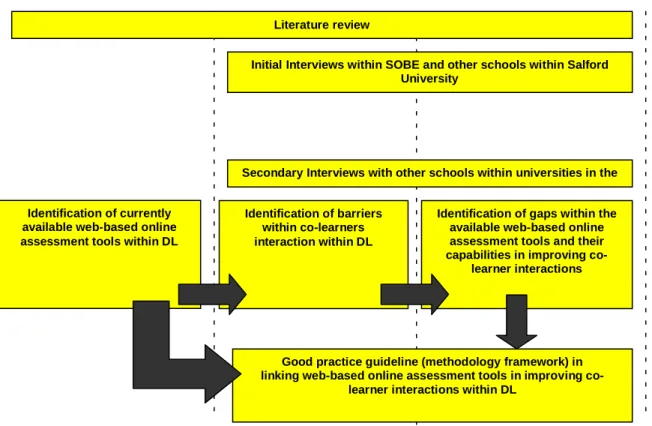
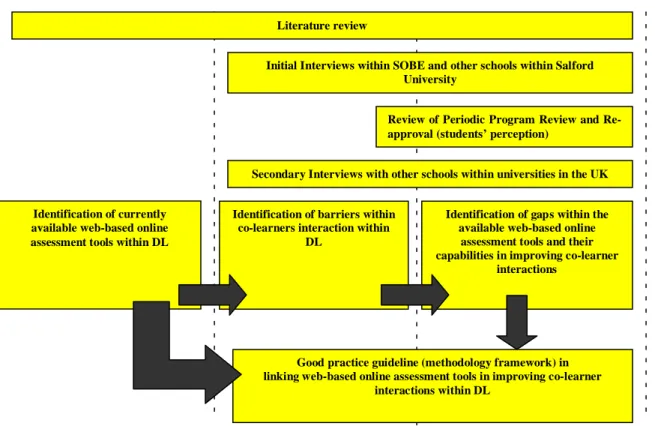
The following figure illustrates the methodology that was followed in conducting this
research.
13
Figure 1: Research Methodology Flow
With reference to Figure 1, the initial literature review was employed with the intention of
identifying the current available web-based online assessment tools within DL and their
functionalities as well as their functionalities and capabilities in improving co-learner
interactions. This is represented as stage 1 of the work. The literature review was
continued throughout the whole duration of the research in keeping up to-date with the
developments in the field. Initial interviews were then conducted within the second
stage in identifying the barriers within co-learner interactions within a DL setting as well
as identifying gaps within the available tools used and their capabilities in improving
co-learner interactions. Within the third stage, a secondary interview was conducted with
other schools within the four universities in the UK that were identified as part of this
Literature review
Initial Interviews within SOBE and other schools within Salford University
Secondary Interviews with other schools within universities in the Identification of currently
available web-based online assessment tools within DL
Identification of gaps within the available web-based online assessment tools and their capabilities in improving
co-learner interactions Identification of barriers
within co-learners interaction within DL
Good practice guideline (methodology framework) in linking web-based online assessment tools in improving
co-learner interactions within DL
14
research’s case studies. The gaps identified from the current DL tools obtained from
the initial interview were compared against DL scenarios within other universities in the
UK as per conducted in the secondary interviews. A good practice guideline was
developed in order to link web-based online assessment tools with improving co-learner
interactions. These findings were then disseminated through various channels (see
Section 8 of this report).
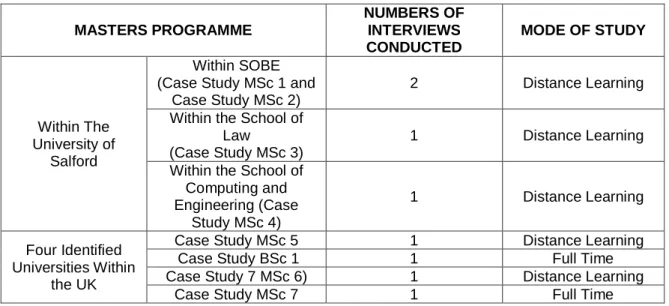
From the research methodology planned, seven Masters Programmes, and one
undergraduate taught course were looked into, and interviews were conducted with
each of the programme leaders. See Table 2 for summary of interviews conducted
throughout this research process.
MASTERS PROGRAMME NUMBERS OF INTERVIEWS CONDUCTED MODE OF STUDY Within The University of Salford Within SOBE (Case Study MSc 1 and
Case Study MSc 2)
2 Distance Learning
Within the School of Law (Case Study MSc 3)
1 Distance Learning
Within the School of Computing and Engineering (Case Study MSc 4) 1 Distance Learning Four Identified Universities Within the UK
Case Study MSc 5 1 Distance Learning
Case Study BSc 1 1 Full Time
Case Study 7 MSc 6) 1 Distance Learning
Case Study MSc 7 1 Full Time
Table 2: Summary of Interviews Conducted
7.
Case Study Findings
The previous section detailed the research methodology adopted for this research. This
section analyses and presents the qualitative feedback from the case studies that had
been conducted. Case study MSc 1 to Case study MSc 4 was conducted within
15
schools at the University of Salford, whilst Case Study MSc 5 to Case study MSc 7; and
Case study BSc 1 were conducted within four of the identified universities within the UK.
Case Study MSc 1
This Masters programme delivers lectures through “Horizonwimba” and corresponds
with the distance learners through emails generally. “Horizonwimba” is being used to
accommodate for the need of using audio and visual modes of communication between
the tutor and the learner. The visual and audio communication is accomplished through
a web conferencing based system capable of establishing video and audio based
communications between the tutor and the learner. It uses the voice transfer,
application transfer and chatting facilities to deliver synchronous lectures. One of the
problems both tutors and learners encounter in utilising web conferencing is the time
that it takes to learn the various functionalities of the tool (Keraminiyage et al, 2006).
As mentioned in the previous heading, electronic paper and project submissions are
seen to be one of the web-based assessment tools made available to provide feed-back
and improve co-learner interactions. This programme has adopted written coursework
comprising legal scenarios as a method of assessment which students will then submit
via Blackboard (Bb) once completed. Any questions or enquiries regarding the
coursework can be discussed with the DL tutor through email. There was no emphasis
on co-learners interactions when deciding on the method of assessment to be
implemented for this programme. Although this type of assessment is considered to be
one of the web-based assessment tool available; it does not really encourage
co-learners interactions unless if the DL tutors promotes the students to discuss and
interact with co-learners by starting up a discussion forum in conjunction with the
coursework in a discussion board or any other means of communication medium.
According to the DL tutor, no other web-based assessment tools have been used within
this programme. There have been reports from students regarding the late feedback
that they get back from the DL tutors. From the interview conducted, the DL tutor
16
suggested that co-learners interactions through web-based assessment tools could be
improved by conducting more group work assignments, support more interactions and
discussions through discussion boards, emails and chat rooms.
Case Study MSc 2
This Masters programme is taught via the internet with support that takes the form of an
induction and other events such as networks that are all optional, plus a summer school
that has a compulsory attendance requirement. Lecture materials are presented in
accessible format which comprise text, diagrams and drawings (for which descriptor
alternatives are available) and video presentations (for which audio and text captioning
are available). Tutor support is provided via online tutorials, group discussions and
individual communication (i.e. through email). Learners not only can engage with other
co-learners formally through tutorials and threaded group discussions but also
informally through the student common room. The discussions and tutorial support will
be both synchronous and asynchronous.
The method of assessment for this programme is designed to evaluate the student’s
abilities in achieving the intended learning outcomes for the module. During the start of
the module, students will be provided with details of learning activities and assessment
dates. Students then participate in learning activities and non-assessed formative
feedback will be provided to them during the module to assist with motivational
reinforcement. For each module, students will be required to complete a piece of end
assessment and the nature of this varies according to the module. In one of the
modules, students’ work will be authenticated by practical assessment through an
access appraisal and audit. The end assessment is considered as an electronic paper
and project submission as submissions
Based on the information given by the DL tutor, although it is found that no specific
web-based assessment tools have been used for this programme, interactions between
co-learners is basically encouraged through tutorials and threaded group discussions as
17
mentioned before, as well as interacting through the student common room. This is
inline with the web-based assessment tool made available to provide feed-back and
improve co-learner interactions as mentioned by Ley (1999).
Case Study MSc 3
Case Study 3 is a Distance Learning (DL) Masters programme. Learners undertaking
this programme are invited to a face-to-face teaching session, whereby lecture
materials are then distributed. The assessment methods implemented for this
programme are a balance of both summative, and formative. The summative
assessment is in the form of a written coursework for each of the modules offered,
whereby learners are required to submit an essay regarding a problem-based scenario.
These written coursework are to be submitted straight to the school office. In addition to
the coursework, learners are also required to submit a dissertation by the end of the
programme. The formative assessment implemented within this programme is a
self-assessed activity within the learners, through group discussions, etc.
Moreover, as part of the formative assessments being implemented, this programme
also conducts chat-rooms, and discussion forums to encourage interactions within their
learners. These types of assessments however, are not graded. Although this
mechanism is considered as a way to encourage learners to interact with other
co-learners, there are always issues such as time constraint within the learners; being
geographically apart does not help, and the attitude of some learners just not bothered
to participate as it is not graded, etc. Furthermore, some learners felt that it was best to
communicate to the module instructors direct if they had any uncertainties, etc
regarding the subject matter.
Some of the learners enrolled in this programme did not know what to expect in a DL
environment, i.e. expecting it to be the same as a traditional classroom setting. Based
on the interview conducted, the instructor within this programme thought that having a
tutorial session online via the discussion board would help encourage learners to
18
interact with other co-learners, although still with the opinion that humans are not easy
to be instructed. Encouragements can always be given to help them interact more with
other co-learners, especially through web-based online assessment tools, but at the end
of the day, it is the attitude of the learners themselves that would determine how they
interact with others. The DL instructor still thought that although the programme
conducted was a DL programme, a face-to-face lecture session should still be
conducted at least during the beginning of the module to encourage learners to interact,
especially during break-time. In addition, having ‘group-clusters’ within areas of interest
might also help to encourage learners interact more.
Case Study MSc 4
This Masters programme delivers lectures based on a traditional classroom setting,
which is conducted through summer school sessions. During the summer school
sessions, tutorials and practical works are also conducted. In addition to the lecture
sessions, learners are also distributed with learning materials at the beginning of the
session.
The assessments methods implemented within this programme are mostly on
summative type of assessment. Learners are required to submit written coursework,
undergo a practical session, and undertake a final examination within the end of each
semester. The submission of the course is also done the traditional way, through
submission to the school office. In addition to the assessments mentioned, learners are
also required to submit a dissertation as part of the partial fulfilment of the requirements
of the Masters degree. Currently, no web-based online assessment tools, or computer
aided assessment tools are being implemented within the programme.
The instructor of the DL programme thought that the barriers within DL settings were
communication, and interaction within co-learners. It was under the impression that
learners rely more on co-workers (as a majority of the learners ere working full time in
the industry), rather than interact with other co-learners within the programme.
19
Furthermore, the instructor within this programme thought that the web-based online
assessment tools were not suitable for this programme, as it emphasises more on
summative assessments rather than formative assessments, and the among the
summative assessment implemented and graded is the practical work. The instructor
feels that it would be difficult to programme a mechanism within the web-based online
assessment tools for practical works.
Among the recommendation that were made to help improve co-learners interaction
within the programme was to put into practice more group work rather than individual
work, but having a constraint of ‘free-riders’ within the group members.
Case Study MSc 5
Case Study 5 is a Distance Learning (DL) Masters programme. Similar with Case
Study 4, learners within this programme are also invited to a face-to-face teaching
session, whereby lecture materials are then distributed in addition to the learning
materials put online. Tutor support is also provided via online tutorials, group
discussions and individual communication (i.e. through email). Learners are
encouraged to use the online tutorials, group discussions and chat rooms provided as a
medium of interaction with other co-learners enrolling within the same programme. The
discussions and tutorial support will be both synchronous and asynchronous.
The assessment methods implemented for this programme are a balance of both
summative, and formative. The summative assessment is in the form of a written
coursework for each of the modules offered, whereby learners are required to submit an
essay regarding a problem-based scenario, or a current issue. These written
coursework are to be submitted through email to the course instructor. In addition to the
coursework, learners are also required to submit a dissertation by the end of the
programme. The formative assessment implemented within this programme is a
self-assessed activity within the learners, through group discussions, etc.
20
Moreover, as part of the formative assessments being implemented, this programme
also conducts chat-rooms, and discussion forums to encourage interactions within their
learners. These types of assessments however, are not graded. Although this
mechanism is considered as a way to encourage learners to interact with other
co-learners, similar to the findings from the previous case studies, there are always issues
such as time constraint within the learners; being geographically apart does not help,
and the attitude of some learners just not bothered to participate as it is not graded, etc.
Furthermore, some learners felt that it was best to communicate to the module
instructors direct if they had any uncertainties, etc regarding the subject matter.
Some of the learners enrolled in this programme did not know what to expect in a DL
environment, i.e. expecting it to be the same as a traditional classroom setting. Some
of the learners, according to the instructor, have complexities of working alone at
different times and in different locations; which then leads to certain stresses.
Furthermore, some were not even sure of the technological problems that they were
going to be exposed to until they had really enrolled on the DL programme, which lead
to frustration due to the absence of personnel to provide them with technical support.
Based on the interview conducted, the instructor within this programme thought that
having a tutorial session online via the discussion board would help encourage learners
to interact with other co-learners, although still with the opinion that humans are not
easy to be instructed. Encouragements can always be given to help them interact more
with other co-learners, especially through web-based online assessment tools, but at
the end of the day, it is the attitude of the learners themselves that would determine how
they interact with others. The DL instructor still thought that although the programme
conducted was a DL programme, a face-to-face lecture session should still be
conducted at least during the beginning of the module to encourage learners to interact,
especially during break-time. In addition, having ‘group-clusters’ within areas of interest
might also help to encourage learners interact more.
21
Case Study BSc 1
This full time undergraduate programme is taught via the internet with support, as well
as providing learners with lecture materials which are presented online in an accessible
format. The tutor support is provided via online tutorials, group discussions and
individual communication (i.e. through email) whereby learners not only can engage
with other co-learners formally through tutorials and threaded group discussions but
also informally through the student common room. The discussions and tutorial support
will be both synchronous and asynchronous.
Within this programme, learners are introduced with electronic portfolio (e-Portfolio),
whereby learners create an electronic portfolio using a template and HTML authoring
tools to be posted to the portfolio server. The in-house software then would allow a
tutor to select the learner’s name and review their work and complete a scoring rubric.
This assessment data is collected and stored in a database that can be used for
aggregation of data. The e-Portfolio approach is said to be more learner-centred as
compared to the normal summative and formative assessment approach.
Since this programme is a full time course, it does not have the common stated barriers
within a DL environment. However, the tutor was in line that online assessments play
an important part on co-learners communication and interactions. The instructor within
this programme was also in the same opinion as the instructor within CaS 4; whereby
group work would be able to help improve co-learners interaction within the DL
community. The use of technology with the programme was considered to be ideal for
this programme, as the programme mainly attracted fresh learners, and not many from
the industry; being a full time programme.
Case Study MSc 6
This Masters programme is taught via the internet with support, as well as providing
learners with lecture materials which are presented online in an accessible format. In
22
addition to the online learning materials provided, learners are also supplied with text
books, and software related to the programme of study. Tutor support is provided via
online tutorials, group discussions and individual communication (i.e. through email).
This programme implements a mix of both summative and formative assessments,
although more weight is towards the summative assessment. The types of summative
assessment implemented are written coursework, which is to be submitted via email,
and the dissertation. Formative assessments are not graded, only conducted as an
initiative to encourage learners to engage and interact with other co-learners through
tutorials and group discussions forums via ‘skype’. ‘Skype’ is a software application that
allows users to make telephone calls over the Internet. Skype allows users to
communicate by both voice, and more traditional textual instant messaging.
Among the barriers in a DL environment were identified; i.e. communication barriers
caused by the nature of the learners taking the programme, as a majority of the learners
are working in the industry, making their time schedule packed and tight. In addition to
that, a DL environment which implements a lot of technology might not be able to attract
‘older’ learners who are not comfortable with the use of technology as a medium of
interaction within co-learners. The instructor expressed his opinion that group work
would be able to help improve co-learners interaction within the DL community.
CASE STUDY MSc 7
This Masters programme is a full time Masters programme. The lectures are delivered
across 12 weeks within one semester during the evenings. The face-to-face lectures
combine part-time and full-time learners within the programme. Learners are also
involved in tutorial sessions within the time allocated to enhance their understanding
within the modules involved.
The assessments methods involve both an equally balanced of formative, and
summative. The formative assessments that are being implemented are working group
23
activities during lectures, presentations, and a session from the tutors to provide
feedback to the learners regarding their activities and presentation. The summative
assessments that are being practiced are the normal individual coursework and
examination during the end of each semester. The number of coursework given varies
depending on each module the students take. In addition to that, each learner is also
required to submit a dissertation by the end of their programme.
Although this is a full-time Masters programme, the programme leader that was
interviewed gave his views towards a DL Masters programme. He felt that learners
within the DL programme would often feel isolated due to being geographically apart
from other co-learners enrolling in the same programme. Learners need to meet often,
and interact with other co-learners and instructors to have a more ‘healthier’ learning
environment. Due to the nature of DL programme, instructors should be more
innovative in providing initiatives to help improve interactions within co-learners.
The programme leader of this programme is by the opinion that elderly staff tend to shy
away from the technology side, perhaps younger staff would be more enthusiastic with
the ‘new’ technology (online assessment tools) being offered within higher education
nowadays. He also feels that online assessment tools should be dealt more with
undergraduate levels-because MSc assessments should be more complex, detailed,
and critical essay coursework. Even if deciding on the implementation of online
assessment tools, it should be more towards formative assessment, but then there
would be the issue on participation of learners if the assessments are not graded. As a
conclusion, the programme leader interviewed was in the view that learners should
often meet, and interact with other co-learners, therefore not really supportive of the DL
settings.
8.
Discussion and Findings
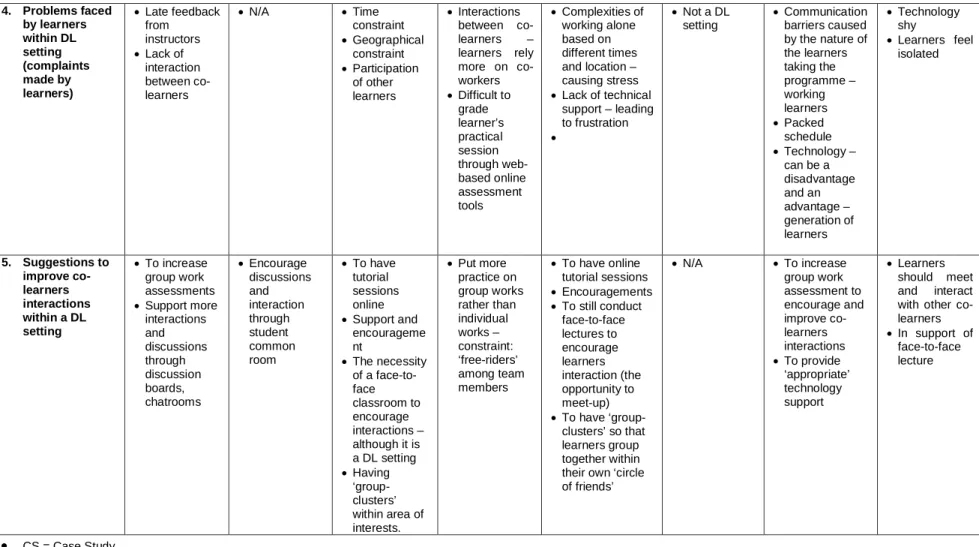
Table 3 shows the summary of findings for all the case studies conducted within this
research. The summary of findings was narrowed down into five main criteria, i.e.: (i)
24
method of delivery, (ii) method of interaction, (iii) method of assessment, (iv) problems
faced by learners within DL setting, and (v) suggestions to improve co-learners
interactions within a DL setting.
From table 3, it can be seen that there was a mix of method of delivery within the case
studies conducted, i.e. some lectures were delivered face-to-face (through summer
school sessions), and some were delivered and taught online with the support of the
Internet. The common method of interaction was through the use of emails and online
tutorial support, as well as discussion boards and chat rooms. The case studies
implemented both a mixture of summative and formative assessments methods. The
common summative assessments identified were written coursework, project paper and
dissertation. The written coursework and project paper were usually submitted via
email or straight through the school office. The formative assessment method practised
by most of the case studies is through learning activities with other co-learners.
However, it can be concluded that almost all of the case studies conducted did not
implement a specific web-based online assessment tools within the assessment method
to be used in the MSc and BSc programme. This might be due to the problems that
have been raised by some of the course instructors within the case studies, whereby
the course instructors felt that an MSc programme should implement a much more
critical, complex, and detailed written coursework. The web-based online assessment
tool is said to be more suitable for undergraduates’ level.
Some of the problems that were being faced by the learners within a DL setting are
identified as: the lack of interaction between co-learners within the programme, as well
as late feedback obtained from the instructor on any enquiries or assessments taken.
The learners also found it difficult to work in isolation based upon the geographical and
time constraint being faced by the learners enrolled in a DL setting. Almost all the case
studies were in the perception that in order to improve co-learners interaction within a
DL setting, a face-to-face lecture should also be conducted within the period of study.
This would give learners the opportunity to get-together and interact with other learners
within the programme. This conforms to the findings from the literature review that
25
many educators feel that the face-to-face iterative interaction with learners is an
important part of the learning process (Bergstrom et al., 2006). More group works
assessments were recommended as an initiative to encourage co-learners interactions,
although extra care should be addressed to minimise the threat of ‘free-riders’ among
group members. Programme instructors should also ensure that there is sufficient
technology support for learners, so that learners do not feel isolated and stressed due to
the nature of the DL setting. This further conforms the finding from literature as
highlighted by Naglieri et al., (2004) that learners have different technology abilities.
Learners who perceive themselves as being I.T. illiterate may find online assessments
within the DL setting as an advantage. In addition, one of the recommendations made
by the instructors within the case studies were to develop ‘group-clusters’ within
learners’ area of interest, to encourage learners of the same ‘circle’ would interact more
within the discussion boards and chat rooms provided.
26
Criteria CS MSc 1 CS MSc 2 CS MSc 3 CS MSc 4 CS MSc 5 CS BSc 1 CS MSc 6 CS MSc 7 1. Method of Delivery • Lectures through Horizonwi-mba • Lectures delivered via the Internet • Summer school – attendance compulsory • Face-to-case teaching session • Classroom setting – conducted through summer schools • Conduct tutorials and practical works • Face-to-face teaching session • Taught via the Internet• Taught via the Internet • Lecture materials presented online • Lectures delivered face-to-face • Tutorial sessions 2. Method of Interaction • Via email • Using audio and visual modes between tutor and learners • Discussion forums/board s for learners to interact • Online tutorials, group discussions and email • Threaded group discussion board • Student common room • Email • Chat rooms • Discussion forums • Face-to-face • Email • Tutor support through online tutorials, discussions and individual communication (via email) • Tutor support via online tutorials • Learners are introduced with e-portfolio – more learner-centred • Tutor support via online tutorials, email • Face-to-face 3. Method of Assessment • Written coursework submitted via email • dissertation • No use of web-based online assessment tool • Learning activities • Formative feedback • Electronic paper and project submission • dissertation • No use of specific web-based online assessment tool • Formative – self assessed learning activities • Summative – written coursework submitted to school office • Dissertation • No use of specific web-based online assessment tool • Mostly summative • Written coursework submitted through school office • Practical session • Final examination • Dissertation • No use of specific web-based online assessment tool • Balance of both summative and formative • Essay/ written coursework • Submitted via email • Formative assessment conducted through learning activities within learners through group discussions • No use of specific web-based online assessment tool • No use of specific web-based online assessment tool • Summative assessment submitted via email • Dissertation • Formative assessment was held to encourage learners to interact using ‘skype’ • No use of specific web-based online assessment tool • A balance of formative and summative • Formative – working group activities, presentations • Feedback from tutors to learners – a special session is conducted • Summative assessment – individual coursework • Dissertation • No use of specific web-based online assessment tool – not appropriate for MSc level
27
4. Problems faced by learners within DL setting (complaints made by learners) • Late feedback from instructors • Lack of interaction between co-learners • N/A • Time constraint • Geographical constraint • Participation of other learners • Interactions between co-learners – learners rely more on co-workers • Difficult to grade learner’s practical session through web-based online assessment tools • Complexities of working alone based on different times and location – causing stress • Lack of technical support – leading to frustration • • Not a DL setting • Communication barriers caused by the nature of the learners taking the programme – working learners • Packed schedule • Technology – can be a disadvantage and an advantage – generation of learners • Technology shy • Learners feel isolated 5. Suggestions to improve co-learners interactions within a DL setting • To increase group work assessments • Support more interactions and discussions through discussion boards, chatrooms • Encourage discussions and interaction through student common room • To have tutorial sessions online • Support and encourageme nt • The necessity of a face-to-face classroom to encourage interactions – although it is a DL setting • Having ‘group-clusters’ within area of interests. • Put more practice on group works rather than individual works – constraint: ‘free-riders’ among team members • To have online tutorial sessions • Encouragements • To still conduct face-to-face lectures to encourage learners interaction (the opportunity to meet-up) • To have ‘group-clusters’ so that learners group together within their own ‘circle of friends’ • N/A • To increase group work assessment to encourage and improve co-learners interactions • To provide ‘appropriate’ technology support • Learners should meet and interact with other co-learners• In support of face-to-face lecture
• CS = Case Study
28
9.
Research Dissemination
The following outcomes have been disseminated from this research, identified as
follows:
•
Conference Paper from the BEAR Conference, 2008;
•
Teaching and Learning Assessment Workshop held during the Scholarship Week
2008;
•
Presentation on Assessment during the Assessment Week 2008; and,
•
Conference Paper presented at the International Post Graduate Research
Conference (IPGRC), 2008.
The detailed outcomes from this research are attached as Appendix C, Appendix D,
Appendix E, and Appendix F respectively.
10. Conclusion
Findings from the case studies revealed that most of the DL programmes deliver lecture
materials in accessible format which comprise text, diagrams and drawings (for which
descriptor alternatives are available) and video presentations (for which audio and text
captioning are available) through online environments such as the “Horizonwimba” and
‘Elluminate Bridge’. The delivery methods currently used within the programmes are
both synchronous and asynchronous. The result from this research identifies that there
is a lacking in the implementation of specific web-based assessments tools within the
DL settings, since none of the case studies have actually implemented a specific
web-based online assessment tool as an assessment mechanism. However, the aid of
technology is used within the assessment method implemented, i.e. most of the
submission of coursework and project papers was done via email. However, the use of
web-based online assessment tools is not denied as a way forward towards a paradigm
shift in DL community as a means to encourage co-learners interactions (O’Reilly and
Morgan, 1999).
29
Based on the in depth literature, web-based assessments tools have been found to help
improve co-learners interactions within DL settings. Most DL programmes have just
gone for the traditional assessment method, which is the written coursework due to lack
of emphasis on co-learners interactions when deciding on the method of assessment to
be implemented. The findings from the case studies highlighted the following
recommendations in general to improve co-learners interactions within a DL setting with
the aid of online assessments methods:
•
More group works/ assessments are recommended to encourage co-learners
to interact more. However, being in a Masters level, the assessments should
be more complex, detailed, and critical; hence, close attention should be given
to learners in avoiding ‘free-riders’ within team members.
•
More support should be given to learners through discussion boards, emails,
and chat rooms in order to encourage learners’ interactions.
•
I.T. support should also be taken into ‘proper’ consideration to attract ‘matured’
learners, or learners who are not comfortable with the use of technology as a
medium of interaction within co-learners.
•
Having ‘group-clusters’ within areas of interest to encourage learners within the
same level of interest so that chat rooms and discussion boards can be catered
to address learners’ personalised interests.
The highlighted recommendations should be used as a way forward for all DL setting
programmes so that web-based online assessment tools could really be used in order to
improve co-learner interactions.
30
11. References
Acker, S. R., and McCain, T. A., (1993). The contribution of interactivity and two-way video to
successful distance learning applications: A literature review and strategic positioning. The
Center for Advanced Study in Telecommunications. The Ohio State University: Columbus,
Ohio.
Berge, Zane, L. and Scrum, L., (1998) “Linking Strategic Planning with Program
Implementation for Distance Learning." CAUSE/EFFECT 21 (3).
http://www.educause.edu/ir/library/html/cem9836.html
Brown, S. and Knight, P. (1994) Assessing Learners in Higher Education. Kogan Page, London.
[Accessed 12 June 2007]
Buchanan, T. (2000) The Efficacy of a World-Wide Web mediated formative assessment.
Journal of Computer Assisted Learning
, 16, 193-200.
Butler, D.L. and Winne, P.H. (1995) Feedback and Self-regulated learning: a theoretical synthesis. Review of Educational Research, 65(3), 245-281
Chou, C.C., (2000) Patterns of Learner-Learner Interaction in Distance Learning Networks,
EDMEDIA2000 Annual Conference, 26 June – 1 July 2000, Montreal, Canada.
Dede, C. (1996) "Emerging Technologies in Distance Education for Business."
Journal Of
Education For Business
, Vol. 71 (4), 197-204.
Du Mont, R.R. (2002) Distance Learning: A Systems View: An Assessment and Review of the
Literatur
2007]
Dunn, L, Morgan, C, O’Reilly, M. & Parry, S. (2004). The Student handbook: new directions in
traditional and online assessment. London: Routledge Falmer.
Gagne, R.M. (1985) Conditions of Learning, 3rd ed., CBS College Publishing, New York, NY.
Govindasamy, T. (2002), “Successful Implementation of e-Learning Pedagogical
Considerations”,
Internet and Higher Education,
4, 287-299.
Greenlaw, S.A. and DeLoach, S.B. (2003) Teaching critical thinking with electronic discussion,
Journal of Economic Education,
34, 36-52.
Gotschall, M.. (2000), E-learning strategies for executive education and corporate training.
Fortune
, 141 (10), S5 – S59.
Gunawardena, C. N., Lowe, C. A., & Anderson, T. (1998). Transcript analysis of
computer-mediated conferences as a tool for testing constructivist and social-constructivist learning
theories, Proceedings: Distance learning '98: The 14th Annual Conference on Distance
Teaching and Learning (pp. 139-145). Madison, WI: University of Wisconsin.
Henly, D. (2003), Use of Web-based formative assessment to support student learning in a
metabolism/ nutrition unit.
European Journal of Dental Education,
7, 116-122.
Ingirige, B., Amaratunga, R.D.G., Keraminiyage, K.P. and Baldry, D (2005) “Leveraging
distance learning tools for broadbasing education in construction industry disciplines: The
importance of a continuous social aspect”, proceedings of 3rd CIB / RICS – COBRA
international symposium, Brisbane.
Jonassen, D.H. (1992) Applications and limitations of hypertext technology for distance
learning. Paper presented at the Distance Learning Workshop, Armstrong Laboratory, San
Antonio, TX.
Karaliotas, Y. (1998) Interactivity in The Learning Environment: Distance Education. 1998
Project Report, Open University, UK
31
Keegan, D. (1986). The Foundations of Distance Education. London: Croom Helm.
Keraminiyage, K.P. Ingirige, B. and Amaratunga, D., (2006), Do the modern Distance Learning
tools sufficiently Address the Social Issues in Learning? 3rd Salford Conference in Education
in Changing Environment , 12-13 January, Salford, UK
Ley, K. (1999) Monitoring a CMC environment created for distance learning,
Journal of Computer Assisted Learning, Vol. 13(4), 253 – 260.Majdalany, Gibran and Susan Guiney (1999) "Implementing Distance Learning in Urban
Schools." ERIC Clearinghouse on Urban Education DIGEST, Number 150.
http://www.ed.gov/databases/ERIC_Digests/ed438338.html
Marcus, S. (2006) Measure by measure: how WBT can help create a social online presence.
Campus Wide Information Systems,
23(2), 56-67.
[Accessed 12 June 2007]
Moore, M.G., (1989) Three types of interaction,
The American Journal of Distance Education
,
3(2), 1-6
Nicol, D.J. (1997)
Research on Learning and Higher Education Teaching
, UCoSDA Briefing
Paper 45 (Sheffield, Universities and Colleges Staff Development Agency).
Perraton, H. (1988) A theory for distance education. In D. Sewart, D. Keegan, & B. Holmberg
(Ed.),
Distance education: International perspectives
(pp. 34-45). New York: Routledge.
Reiser, R.A. and Dick, W. (1996) Instructional Planning: A Guide for Teachers, Allyn and Bacon, Boston, MARohfeld, R. W., & Hiemstra, R. (1995). Moderating discussions in the electronic classroom. In
Z. Berge & M. Collins (Eds.), Computer-mediated communication and the online classroom,
volume three: distance learning (pp. 91-104). Creskill, NJ: Hampton Press.
Salmon, G.
(2000)
E-moderating: The key to teaching and learning online. London: Kogan Page, 2000.
Sherry, L. (1996) Issues in distance learning.
International Journal of Distance Education
, 1(4),
337-365.
Velan, G., Kumar, R., Dziegielewski, M. and Wakefield, D. (2002) Web-based assessments in
pathology with QuestionMark Perception.
Pathology
, 34, 282-284.
Verduin, John and Thomas A. Clark. (1991) Distance Education: the Foundations of Effective
Practice. San Francisco: Jossey Bass.
Wagner, E. D. (1998). Interaction strategies for online training designs. Proceedings of Distance
Learning 98: 14
thAnnual Conference on Distance Teaching & Learning
(pp. 417-421).
Madison, WI: University of Wisconsin
System.
Williams, G. (2000). Advantages of Computer-based Assessment. http://www.csu.edu.au/
Wilson, T. and Whitelock, D. (1997), “Monitoring a CMC environment created for distance
learning”,
Journal of Computer Assisted Learning, Vol. 13(4), 253 – 260.Wolcott, L.L. (1996) The distance teacher as reflective practitioner. Educational Technology, 35, 39-43