An Artistic Perspective on Distributed Computer
Networks. Creativity in Human-Machine Systems
Mindaugas Gapsevicius
Supervisor: Dr. Matthew Fuller, Dr. Mark Bishop August 2015
Centre for Cultural Studies Goldsmiths University of London Submitted for MPhil degree
Declaration
Acknowledgments
First and foremost, my gratitude goes to Dr. Matthew Fuller and Dr. Mark Bishop, my supervisors at Goldsmiths University of London for seeing this project through to the end with precious comments, support and challenging questions.
I am deeply indebted to Florian Cramer, who encouraged me to choose this programme; to my friends, colleagues and teachers Arūnas Spraunius, Wolfgang Knapp, Hubertus von Amelunxen, and Hannes Brunner with whom I regularly had conversations about art, sciences and technologies. A special thank you to Elizabeth McTernan, who made this thesis more readable; and to Dominik Eggermann, who helped with coding.
I am very grateful to my family: mom Stasė Gapševičienė, dad Adolfas Gapševičius, sister Vilma Suchockienė, and aunt Kazytė Lazdynaitė, who all encouraged me throughout this project.
The last but most important, thank you my love Dovilė Aleksaitė, who was pushing me forward. Ačiū!
Abstract
This thesis is written from an artistic perspective as a reflection on currently significant discussions in media theory, with a focus on the impact of technology on society. While mapping boundaries of contemporary art, post-digital art is considered the best for describing current discourses in media theory in the context of this research. Bringing into the discussion artworks by Martin Howse & Jonathan Kemp (2001-2008), Maurizio Bolognini (Bolognini 1988-present), and myself (mi_ga 2006), among many others, this research defines post-digital art, which in turn defines a complexity of interactions between elements of different natures, such as the living and non-living, human and machine, art and science. Within the analysis of P2P networks, I highlight Milgram's (1967) idea of six degrees of separation, which, at least from a speculative point of view, is interesting for the implementation of human-machine concepts in future technological developments. From this perspective, I argue that computer networks could, in the future, have more potential for merging with society if developed similarly to the computer routing scheme implemented in the Freenet distributed information storage and retrieval system. The thesis then describes my own artwork,
0.30402944246776265, including two newly developed plugins for the Freenet storage system; the first plugin is constructed to fulfill the idea of interacting elements of different natures (in this case, the WWW and Freenet), while the other plugin attempts to visualize data flow within the Freenet storage and retrieval system. All together, this paper proposes that a reconsideration of distributed and self-organized information systems, through an artistic and philosophical lens, can open up a space for the rethinking of the current integration of society and technology.
Table of Contents
Acknowledgments...3
Abstract...4
Introduction...8
Chapter I. Self-organization and the Post-digital...12
Aesthetics of the Post-digital...12
The Post-digital Domain...12
Aesthetics of the Post-digital...16
Mailia...21
Artificial Paradises (ap)...26
Programmed Machines...30
Interaction and Emergence in the Post-digital...33
Post-digital territory...34
Approaching Transdisciplinarity...34
Strata...36
Mapping...38
Rhizome...39
Concluding Notes on Post-digital Territory...41
Life Between Human and Machine...42
A Human-Machine Rhizome...42
James Grier Miller's Living Systems...44
Life-like Processes in Inorganic Systems...46
Ross Ashby's Reproduction...47
Self-reference and Autopoiesis...48
Aesthetics of Artificial Life and Artificial Intelligence...51
Artificial Life Territory...53
Discussion...56
Simple Rules and Computable Creativity...58
Automata are Everywhere...58
Computable Discrete Elements in the Turing Machine...59
Emergence of Creative Forms in Cellular Automata...61
Computation Within Larger Interactive Systems...63
Conclusion...66
Chapter II. The Territory of P2P Networks...68
Networks and Their Specifics...68
Computer Networks and Routing Systems...68
The Vulnerability of Prevailing Networks and the Need for a Self-organized Network...71
Self-organization Within P2P Networks...74
Related P2P Computer Networks...75
BitTorrent File-sharing Network...75
The Distributed Search Engine YaCy...75
Freenet Storage System...76
Tor Communication Network...78
An I2P Network for Communication...78
Evolving Information Systems in DREAM...79
Search and Storage Methods of Distributed P2P Systems...81
Architecture of Decentralized and Distributed Networks...81
BitTorrent Architecture...82
YaCy Architecture...83
Freenet Architecture...85
Freenet Routing Algorithm...86
Freenet Web Server...88
Tor Architecture...90
I2P Architecture...92
Discussion...94
Scalability in P2P Networks...94
Notes on Routing Algorithms in P2P Systems...95
Storage in P2P Networks...96
Notes on Encryption Use in Computer Networks...98
Notes on Visualizing P2P Networks...99
Potential for Creativity in P2P Networks...100
Annex I. Project: 0.30402944246776265...101
Development...103
Conceptual and Technical Mappings...103
Defining the Visual Framework...107
Concept...111
Installations...112
Installation instructions...115
Instructions for the Physical Space...115
Technical Requirements for the Computers...115
Software Installation and Configuration...116
Technical Description...117
Visualization Plugin Classes and Functions...118
Automaton Plugin Classes and Functions...120
Conclusion...124 References...126 Glossary...138 List of Abbreviations...140 Figures...142 Media...164
Introduction
One of the most significant current discussions in media theory focuses on the impact of technology on society and the physical change in humans parallel to technology (Hayles 1999, 2012, Malabou 2004). In the arts, such discourse appears in A-Life (Whitelaw 2004), BioArt (Myers 2012, Ginsberg et al. 2014), speculative or fictional design (Dunne & Raby 2013), and new media art (Frieling & Daniels 2004, Tribe et al. 2007) contexts. These discourses are often accompanied with self-organization concepts (Hayles 1999, Bedau 2003) and digitally processed information in post-digital arts (Cramer 2014, Bolognini 2008).
In this thesis, with the aforementioned theory in mind, I propose that the reconsideration of distributed, self-organized information systems through an artistic and philosophical lens will not only add yet another mechanistic or speculative approach to present-future societies, but will also open up a space for the rethinking of the current integration of society and technology. While proposing such a framework, I will use trans-disciplinary research and artistic methods to open up a discourse on self-organized information systems as a potential model to be integrated into future societies. Although my work does not necessarily provide solutions or concrete answers, the power of artistic method lies in its invaluable competency to question objects and situations that are often tacitly accepted as the only existing possibilities.
The proposed hypothesis has come from the comparison of social and computer networks within the above-mentioned discourse in media theory, technological
developments within computer networks, and my artistic position. Whether framing the discussion of political, economical, or cultural issues, my artworks question the
creativity of machines and do not presume humans to be the only creative force at work. This position unleashes further questions, ranging from abstract, philosophical
examinations of creativity to global concerns about what forces dictate the organization of humanity and determine our future as a society. From this perspective, I will argue that computer networks could, in the future, have more potential in merging society if developed similarly to the social networks. The argument is built from three different
perspectives: a) theoretical, comprised of related problematics in media and cultural theory, b) technical, including analysis of routing protocols in distributed computer networks, and c) practical, unfolding as aesthetic forms and methods used in my practical project. While trying to generalize various mechanisms and prevailing theories, I suggest that a self-organized approach to human-machine rhizomes and interaction within non-uniform networks demands more attention. In addition, my contributed artwork, an installation titled 0.30402944246776265, should offer a framework designed for studying information flow in the proposed non-uniform network.
This work therefore develops as follows: The first chapter lays out the basis for my argument and traces the territory of post-digital art, which is defined as using hybrid methods comprised of physical and virtual forms. In this chapter, I discuss the idea of creativity allocated to the calculating machine and how creative calculation might emerge. The examples analyzed include Mailia, my own artwork (mi_ga 2006),
Artificial Paradises by Martin Howse and Jonathan Kemp (2001-2008), and
Programmed Machines by Maurizio Bolognini (Bolognini 1988-present). Furthermore, post-digital territory is considered within a broader theoretical framework, including ideas of the rhizome, strata, and mapping. Emerging from the works of Deleuze and Guattari, these ideas demonstrate a similarity to post-digital aesthetics by highlighting interaction between heterogenous elements within the defined context. In addition, an extensive analysis is made using the idea of the interaction between elements and their self-organization within a system. Given that interaction might be defined through the simple rules used to describe automata, further analysis dives into the territory of computation, which could also unfold from the lens of creativity. The chapter then introduces Wolfram's (2002) and von Neumann's (1966) experiments with cellular automata generating patterns resembling those found in nature and ends with the introduction of computer networks as an interactive Turing machine or cellular
automata (CA). Applying the CA concept to the computer networks, the chapter wraps up the speculative artistic idea that self-organized information systems have the potential to become indivisible from living systems and in so doing assist future societies.
where decisions are made for an artistic framework to emerge. The discussion in this chapter proposes that the Freenet distributed storage system has the potential to become a basis for a non-uniform network model. Highlighted is that, first of all, the Freenet uses a routing algorithm built upon the idea of six degrees of separation as introduced by Stanley Milgram (1967). Secondly, it is simultaneously a distributed storage system and a search engine, which is required of any complete information system. In addition, this chapter proposes that the Freenet might have more potential if bridged with systems of a different nature, like the prevailing World Wide Web or other networks such as Tor or I2P. The possibility of interacting with other kinds of systems would open Freenet for indirect external influence and would bring it closer to the idea of the human-machine rhizome introduced in the first chapter.
The last part of the theses introduces my installation 0.30402944246776265 (2013-2014), which uses a number of interconnected nodes representing the non-uniform network of humans and computers. The Freenet distributed system is used as a basis for interaction between the computers. The additionally developed software piece bridges the Freenet system with the World Wide Web as an information trigger for a
non-uniform network. Yet another plugin visualizes interaction between the computers so the spectator can follow information routing within the network. The installation refers to the hypothesis introduced above as follows: it is assumed that, a) through interaction, the viewer will be able to get an idea of distributed computer networks that have the potential to share information similarly to social systems and b) being able to share information and to demonstrate a certain level of intelligence, computer networks have the potential to become an integral part of future societies.
The overall contribution of this research is twofold: aesthetic and technical. The art piece, made for a wider audience, highlights discourse on the impact of technology on society and questions the ethical values of future societies: Which entity ultimately should be granted the power to make the final decisions, human or machine? And if machine, then what is left at stake for the human race? The technical result emerges through open source plugins, wherein one of them is designed to track the Freenet network over time and the second operates as a bridge between the World Wide Web and the Freenet making the system sustainable. If self-organized processes in the Freenet network are tracked over time, the visualization could provide interesting
results, e.g. they could demonstrate the swarm intelligence behavior of information flow within the network. The artwork, however, does not provide any answers to the
hypothesis of clustering information proposed by Freenet developers and leaves it open.
In addition, development of the plugins for the purposes of the artwork could furthermore be fed back into the Freenet developers' community as raw material for other future technological and scientific endeavors.
Chapter I. Self-organization and the Post-digital
Aesthetics of the Post-digital
The Post-digital Domain
The questions outlined within the following thesis are viewed from the perspective of a posthuman, present-future state where the human merges with technology. In Katherine Hayles' terms, it is a state where the human seamlessly articulate with intelligent
machines and approaches his or her body as a prosthesis (Hayles 1999). This
perspective is also close to Rosi Braidotti's critical posthumanism and her awareness of being part of the Anthropocene (Braidotti 2013). Sometimes, especially when I describe my artistic work, this perspective merges an imagining of a cybernetic organism, that is, a hybrid of machine and organism defined by social and bodily reality (Haraway 1990).
Now, what contemporary arts are described as being hybrid, merging in themselves organic and non-organic matter? First of all, this includes interdisciplinary,
multidisciplinary, and transdisciplinary arts. While these terms will be further discussed within the subsection “Approaching Transdisciplinarity” in the next section, it is worth listing more specific niches of contemporary arts. BioArt could be listed as hybrid, using various techniques and methods including organisms and biotechnologies (GFP Bunny by Eduardo Kac, The Physarum Experiments by Heather Barnett). Also hybrid is new media art, using computational techniques for aesthetic purposes (Artificial
Paradises by Martin Howse, Programmed Machines by Maurizio Bolognini). Hybridity is also one of the main adjectives describing post-digital arts.
The positions describing the term post-digital differ, fluctuating between a
hybridization of forms (Alexenberg), the introduction of failure to digital aesthetics (Cascone), and the importance of process in regard to the packaged product (Cramer). Nevertheless, digital arts and particularly software arts play a huge role in the post-digital age and are reflected while defining its domain. For artist and art educator Mel
Alexenberg, the post-digital (an adjective) is
of or pertaining to art forms that address the humanization of digital technologies through interplay between digital, biological, cultural, and spiritual systems, between cyberspace and real space, between embodied media and mixed reality in social and physical communication, between high tech and high touch experiences, between visual, haptic, auditory, and kinesthetic media experiences, between virtual and augmented reality, between roots and globalization, between autoethnography and community narrative, and between web-enabled peer-produced wikiart and artworks created with alternative media through participation, interaction, and collaboration in which the role of the artist is redefined
(Alexenberg 2011:10).
In other words, the “post-digital” is a hybrid of forms with a redefined role of the artist. “Digital” technologies for Alexenberg act as an extension of humanity (Alexenberg 1987), similar to what Marshal McLuhan calls extensions of a man helping one to reach his goals (McLuhan 1964). Moreover, the post-digital is rather the condition of
everything, a Deleuzian consistency (for more details on Deleuzian consistency and other important terms for post-digital aesthetics, see the next section, “Post-digital Territory”). Although Alexenberg's definition suggests that the post-digital has a feature of hybridity, a balance of physical and virtual, form and action, the meaning he puts behind the post-digital is rather philosophical, imaginative, and spiritual. In other words, the post-digital for Alexenberg is an imaginative state where the digital becomes part of the analogue, and vice versa.
A different emphasis is put on the post-digital by researcher and media theorist Florian Cramer, who presented his ideas on post-digital research during a discussion that was part of the transmediale festival in Berlin in 2014. This position unfolds from two perspectives: on one hand, as a merging of digital and analogue and, on the other, through the everyday use of computers and digital information. In the reader of the discussion on the post-digital, Cramer writes that neither “old” nor “new” media are meaningful, as they merge in the post-digital (Cramer 2014). Different from
Alexenberg, who defines the post-digital as an in-betweenness of forms and meanings, post-digital aesthetics for Cramer focus rather on “processual” DIY cultures and the application of “new media” practices onto “old media.” If, in the case of DIY cultures,
the process itself has become aestheticized with the rebirth of “old media,” the conditional change made by digital technologies is already de facto and is no longer considered revolutionary.
Within such a domain, it is also worth bringing up the musician Kim Cascone, who introduced the term “post-digital” itself (Cascone 2000). While stating that the
revolution of digital information is over, Cascone offers two features of the post-digital that distinguish the post-digital from the digital. First of all, he brings into the aesthetics of music a failure of the digital, the glitch. Secondly, he introduces the “tool” as the message instead of the medium being the message, an idea introduced much earlier by Marshal McLuhan (1964). If the “glitch” for Cascone speaks of the illusion of
technological perfection and is the result of experimentation, the “message” is what one sees (or hears, in the case of sound) rather than reads. With the post-digital, Cascone defines a slight change in culture: on one hand, “failure” is introduced as a natural process for creativity, and, on the other hand, sound can be perceived by seeing how it is made. This position introduces the importance of the “background” or unseen medium in post-digital aesthetics.
To illustrate the post-digital as having a different approach to aesthetics, Cramer points to the generation born in the 1990s, who do not remember times without computers; the “digital” is a given for them, per se. Consequently, the youngest generation often uses different ways of interacting and have social lives influenced strongly by
communication (see “Glossary” for the use of the term “communication” in this thesis) within virtual space. Even if the post-digital, according to Cramer, is a yet another “post” term, it is a term that is useful when talking about contemporary art. If new media artists use technologies explicitly to emphasize technologies themselves, post-digital artists focus on the message communicated through the use of technologies (compare, for example, Biotricity1 by RIXC collective, The Sequence Dress2 by Anna
1 http://www.renewable.rixc.lv/biotricity-dtw/ , (Accessed 27 August 2015).
2 http://annadumitriu.tumblr.com/post/123672195554/the-sequence-dress-was-exhibited-as-part-of-eva, (Accessed 27 August 2015).
Dumitriu, Bodymetries3 by Theresa Schubert and Ear on Arm by Stelarc4 or artworks
having less or no focus on biotechnologies, such as Google Will Eat Itself5 by
Uebermorgen and Persecuting.US6 by Paolo Cirio).
Cramer's idea suggests that we are living during a time of significant cultural change similar to that marked by the appearance of the digital computer in the 1950s. On one hand, this change marks the end of the digital revolution, and, on the other hand, the digital world has become as natural as, to paraphrase, the air we breathe. This is, first of all, visible in the arts and mass culture, which have shifted to a stage wherein the tool(s) and the medium(s) used to produce an artwork are not necessarily central. While recent decades have often encountered the terms “performance art,” “video art,” “digital art,” “software art,” and the like, in the post-digital, the tool and the medium have changed their meaning, no longer generating content solely through their novel “nowness” as measurement, as genre.
Secondly, there is a transdisciplinary moment (for broader elaboration, see the second section “Approaching Transdisciplinarity”) emerging through all practices, including scientific research, arts, and creativity at professional and non-professional levels. This position is already implicit in the definition proposed by Alexenberg. Moreover, it is clearly stated by Bolognini in his book Postdigitale, where he distinguishes three of the features of the approach of this new domain: the spread of digital technologies
throughout artistic production, the spread of digital technologies at the non-professional level, and experimental research across disciplines (Bolognini 2008). The
aforementioned features of the post-digital presuppose the wider collapse of subjects, a larger blur happening across not only media but also professional fields. Despite that, those fields might still be distinguished from each other if approaching the domain from different perspectives – for instance, the technical and artistic points of view (for
example, see the description of my artwork “Annex I. Project: 0.30402944246776265”).
3 http://www.theresaschubert.com/bodymetries.html, (Accessed 27 August 2015). 4 http://stelarc.org/?catID=20242, (Accessed 27 August 2015).
5 http://www.gwei.org/, (Accessed: 19 March 2014). 6 http://persecuting.us/, (Accessed 27 August 2015).
As such, the post-digital domain becomes a layered whole, where people, tools, and media are used all together to express a thought, rather than to define a discrete product, as would be a case when approaching an object of discussion according to specific artistic genres or mediums. The post-digital domain brings to the forefront aesthetics extended into scientific, technical, political, social, or economic contexts, discourses, and processes which, in the end, make up a fundamental contemporary condition that we cannot step outside of.
Aesthetics of the Post-digital
When introducing post-digital aesthetics, it is worth mentioning the reason for the choice of this term and not, for example, “transdisciplinary,” “postinternet,” or “post-media” aesthetics. If transdisciplinarity is used for defining a layered and integrative approach (for broader discourse, refer to the second section and its subsection
“Approaching Transdisciplinarity”), postinternet is used to define arts influenced by the Internet,7 and post-media defines an installation which is not specific to any one
medium,8 post-digital, as introduced within the above subsection, unfolds as a layered
whole through, first of all, technological lenses, which form specific aesthetics in comparison with post-media contexts.
The historical dimension of the post-digital is defined by Cramer as a merging of “old” and “new” media. Illustrating this merging, Cramer provides a meme depicting a “hipster” sitting on a bench with an old typewriter.9 Ignoring the image as a “funny”
7 For example, see the interview with Marisa Olson. Available at
http://we-make-money-not-art.com/archives/2008/03/how-does-one-become-marisa.php Accessed 2015-04-25. Article “What's Postinternet Got to Do with Net Art?” by Michael Connor. Available at
http://rhizome.org/editorial/2013/nov/1/postinternet/ Accessed 2015-04-25.
8 See Krauss, R. (2000). A Voyage on the North Sea: Art in the Age of the Post-Medium Condition.
London: Thames & Hudson. Available at
http://isites.harvard.edu/fs/docs/icb.topic837293.files/Krauss_Voyage%20on%20the%20North %20Sea.pdf Accessed 2015-04-25.
meme or as a picture featuring a “strange” hipster, Cramer suggests analyzing it through the visible symbols. First of all, it is a play on opposite meanings: the “digital” image-board meme and “analogue” hipster with typewriter. Secondly, the “analogue”
typewriter in the proposed environment expresses disenchantment with digital information systems, which can be seen as far too precise, too clean, and too discrete compared to generating “analogue” text, image, or sound. A deeper analysis of the image produces a story that leaves “new” media in the past and in so doing, defines what the aesthetics of post-digital could be within popular mass culture.
For the development of artistic expressions, the last decades have been important because of the new possibilities offered by the computer. The “digital” format of computer arts is represented using discrete computable values, unfolding in the end as zeros and ones. This is not the case in the use of traditional media like painting or sculpture, where everything is still physical matter. If “new media” applied to “old media” invokes the idea of the post-digital, then the term presupposes the use of computers or computation permeating the final result, at least as an outcome of
research, a critical position, or a conceptual reference. As David Berry concludes, “In a post-digital age, whether something is digital or not will no longer be seen as the essential question … as all forms of media become themselves mediated, produced, accessed, distributed or consumed through digital devices and technologies” (Berry 2014). Therefore, within post-digital aesthetics, a mediation of social, political, economic, scientific, spiritual or environmental factors through and on top of new media becomes important.
What is so exciting about new media and the change defined by the post-digital? First of all, while focusing on new technological tools, new media art was soon explored. Secondly, the focus on computers and computer networks did not prove to be stable in the markets, including artistic contexts. Therefore, new media art soon lost its power of being novel and unique with the first technological crisis and the dotcom crash around 2000. This crisis, however, brought novel Web 2.0 tools, which offered the Internet user easier access to publishing content.10 And finally, social activism, hacktivism, media
10 For example, see Olia Lialina's entry in 2013 on “Net Art Generations”. Available at:
activism, and other net-isms opened up a discourse on “old” and “new” media; since then, new media art has extended into social space within the networks.
Within the post-digital art contexts, it is worth mentioning new media artists working in the domains of BioArt and net.art. In BioArt, ideas of evolution and emergence have their own niches, which were mainly explored in the context of A-life in the 1990s. Karl Sims' Genetic Images (Sims 1993), Christa Sommerer & Laurent Mignonneau's
Interactive Plant Growing (Sommerer & Mignonneau 1992) and A-Volve (Sommerer & Mignonneau 1994-1995), Troy Innocent's Iconica (Troy Innocent 1998), and similar works focus on the simulation of biological organisms or the interaction among them. An extensive study of early A-life artworks has been done by Mitchell Whitelaw, who points out that emergence is central to A-life and A-life art (Whitelaw 2004). If
examined more closely, the central task for the artists listed above has been to depict life-like situations and evolving processes using emerging aesthetic forms and
technologies. For example, Sommerer & Mignognou simulated the growth of plants, or showed "breeding" forms by embedding them into a virtual context. Thus, the
emergence of artificial life is only meant to be understood literally and not to be enmeshed in the hybrid context of post-digital art.
Net.art discourse and its focus on networks emerged in the late 1990s. Although its specificity is best described over analysis of technology and new tools such as HTML, Java Script, chat and mailing lists (see for example artworks by Alexey Schulgin, Olia Lialina, JODI), its importance for post-digital aesthetics is laid, first of all, on the reevaluation of social ties along technological achievements and the art market
(RTMARK, The Yes Men, Uebermorgen). Being able to express him or herself over the Internet, the net.artist had less interest in traditional exhibitions (compare, for example, biographies of the late 1990s of d2b.org, JODI, Olia Lialina) and more interest in communication through various mailing lists (7-11, Nettime, Rhizome). This phenomenon brought about a series of artworks and discourses on the production of unsolicited digital information (or SPAM).
mentioning are Frederic Madre and his mailing list “Palais Tokyo,”11 JODI's
communication over email,12 d2b's and my collaborative work asco-o13 and the
Nato.0+55+3d campaign from Antiorp, who is also known as Netochka Nezvanova.14
Receiving tens and sometimes hundreds of hardly readable emails from Antiorp or useless communication over the Palais Tokyo mailing list, the reader was supposed to critically evaluate standards of communication over computer networks, as well as consider the annoyance (or power) of communication with machine-like systems. Bringing a critical position to a top-down-oriented society, capitalist economics, and neoliberal politics, net.art is very close to the aesthetics and discourses of the post-digital.
Nevertheless, it lacks a hybridity of forms, disciplines, discourses, and contexts. If the tools used in net.art were usually a combination of custom and modified or hacked software, and if the tendency of such art was in most cases limited to browser
aesthetics,15 post-digital aesthetics open art up to physical space and can refer to social
networks and political or economic issues.
A classic example of post-digital artwork is GWEI (Google Will Eat Itself), a critical reflection on a Google advertising campaign by Uebermorgen (Uebermorgen, 2005), or a more recent work, Persecuting.US by Paolo Cirio, who used publicly available
messages on Twitter pages for the analysis of users' political views (Cirio, 2012). Among the net.artists considered working within the post-digital domain are also net.artists who moved out of web space into physical space: Uebermorgen,16 Jodi,17 The
11 For further discourse, see interview between Josephine Bosma and Frederic Madre at
http://www.josephinebosma.com/web/node/84 (Accessed: 25 April 2015). 12 For idea, see for example interview between Mark Allen and Jodi at
http://www.theawl.com/2012/06/jodi-dot-org-net-artists (Accessed: 25 April 2015). 13 http://www.asco-o.com, (Accessed: 27 August 2015).
14 For example, see one of the Antiorp's emails to the Nettime mailing list at
http://amsterdam.nettime.org/Lists-Archives/nettime-l-9902/msg00096.html (Accessed: 25 April 2015).
15 For example, consider Form Art by Alexei Shulgin, 1997 (available at
http://www.c3.hu/collection/form/) or OSS by JODI from 2000 (available at http://oss.jodi.org). 16 http://www.ubermorgen.com/ , (Accessed: 25 April 2015).
Yes Men,18 Cory Arcangel,19 Evan Roth,20 and Aram Barthol,21 among others. In
addition, there are a large number of artists who came up from the BioArt contexts, including Theresa Schubert,22 Anna Dimitriu,23 Heather Dewey-Hagborg,24 and Martin
Howse,25 among others. Interesting to mention are a series of projects by the
Brooklyn-based artists who make up the collective Future Archeology and who bring digital artefacts like microchips into analogue space (Future Archeology 2014). Likewise, another example is Anna Flagg's Cuddlebot, a furry animal-like machine that
intelligently recognizes “emotional touch gestures using machine learning methods”26
(Flagg 2013). All these examples demonstrate the move of the “digital” into the “analogue” or the mix of “digital” and “analogue.”
Therefore, it is clear that post-digital aesthetics do not conform to any defined forms, media, or genres, but are, in fact, ubiquitous; their relegation to genre is a superficial categorization that is not consistent with the contemporary (in)distinction of disciplines and media. Based on this assertion, I submit a discussion of three selected artworks:
Mailia, the project I have developed (mi_ga 2006), Artificial Paradises, by Martin Howse and Jonathan Kemp (Howse & Kemp 2001-2008), and Programmed Machines,
by Maurizio Bolognini (Bolognini 1988-present). Being not necessarily classic
examples of post-digital art, these artworks define interaction, creativity, and emergence in a posthuman state (e.g. Programmed Machines) and are open for post-digital
discourse, including critique of top-down social, political, and economic strategies (e.g.
Mailia) and praise of bottom-up approaches to environmental issues (e.g. Artificial Paradises).
18 http://theyesmen.org/ (Accessed: 25 April 2015).
19 http://www.coryarcangel.com/ (Accessed: 25 April 2015). 20 http://www.evan-roth.com/ (Accessed: 25 April 2015). 21 http://www.datenform.de/ (Accessed: 25 April 2015).
22 http://www.theresaschubert.com, (Accessed: 26 August 2015). 23 http://www.normalflora.co.uk/, (Accessed: 26 August 2015). 24 http://deweyhagborg.com/ , (Accessed: 25 April 2015). 25 http://www.1010.co.uk, (Accessed: 25 August 2015).
Mailia
I developed the software piece Mailia in 2006, which carries aesthetics of the pure “digital,” as the work is indistinguishable from the computer networks and screens displaying the result of computational activity. Nevertheless, this work could be considered within the post-digital domain or a broader posthuman discourse because it could evoke thoughts of artificial intelligence, or express disenchantment with digital information systems if considered from the perspective of digital waste. This artwork also served as the first inspiration for the extensive research that has followed on research in a posthuman state defined by Donna Haraway (1990), Katherine Hayles (1999), Catherine Malabou (2004), Rosi Braidotti (2013), and Nicholas G. Carr (2010).
Mailia could be considered a simple piece of software designed to answer emails. The encounter with Mailia is neither visual nor aural. It is rather a process, a life situation that only exists for the primary “audience” (i.e. the participants/actors). A
sender/receiver of a given email and a machine are involved in the process. After sending an email to someone, the sender would expect some answer. If there is a Mailia
machine involved, the answer would be generated by a machine. This answer is a sort of "out of office" reply.
Over the course of its existence, Mailia generated27 replies from Google search results
and, along with those results, included the original message in a standard reply form.
The machine was designed in such a way that keywords taken from the incoming email would be processed through the Google API in order to find related information on the World Wide Web and to generate a reply message from content available on the net. In an imagined framework where two Mailia machines are involved, the process would only be executed in a virtual environment. In the description of the software, I wrote that "if answers are publicly saved, search engines will index the answers again and utilize these as output for other similar replies" (mi_ga 2006). Consequently, databases 27 The Mailia machine used Google API to search for related information on Google servers. Since
would grow over time with newly generated content and, henceforth, would evolve in terms of content-oriented or qualitative change (for more precise definition of the use of the term “evolution” within this thesis, see “Glossary”).
For testing purposes, Mailia was installed in my personal server with configured email services. The answers generated by the machine provoked people to continue interaction with the machine in different ways, including writing emails to various mailing lists to which my personal email address was subscribed. In such a way, every time people would write an email to a certain mailing list, the machine would immediately generate an answer in response to the email sent. A random "tester" sent an email to my mailbox with the Rhizome mailing list28 address registered as being the sender's address. This
resulted in an endless loop between the mailing list and the Mailia machine, which, in turn, generated some 5,000 reply emails back to the Rhizome mailing list, ending with a couple of million further emails in total sent to the subscribers.29 If, say, there were a
number of machines running the same software, those machines could have started exchanging messages among themselves, producing even more content while replying to each other's emails. It is easy to imagine that such stimuli-response behavior or communication (see “Glossary” for the use of this term in this thesis) between computers would rapidly flood and break networks with unsolicited data traffic, as happened with the Rhizome mailing list.30 However, if the system were self-aware and
self-reparable, the continuing discussion would probably lead us to yet another
dimension – the possibility of a living machine or the possibility of a machine becoming as creative and as intelligent as a human being. This dimension is further explored in my other project, 0.30402944246776265, which is part of this research and is introduced in the Annex of the thesis (for more details, see “Annex I. Project:
0.30402944246776265”).
Having introduced the Mailia framework, the message behind the artwork leads to at
28 For the Rhizome mailing list, see http://www.rhizome.org
29 According to Mark Tribe, one of the moderators of Rhizome Raw, the list in 2000 had about 400 subscribers, and it is assumed that, by 2006, the number had not changed dramatically. The reference is available at http://www.afsnitp.dk/onoff/Texts/tribearchivingne.html (Accessed: 24 March 2014). 30 Reported by Patrick May, Director of Technology at Rhizome.org. The report is available at
least three threads which will be developed further: 1) shared work between machines and humans, 2) (un)controlled information exchange in artificial networks, and 3) the production of unsolicited digital information (or SPAM).
The first thread – a shared work between machines and humans – opens up a framework where tasks normally fulfilled by humans are outsourced to machines. Even if the proposed set-up has an ironic connotation and could be seen from the perspective of speculative design, in theory, a number of emails could be answered by a machine. For example, a machine analyses incoming email and determines that the request is for sharing personal moments in life; the machine then performs a search of the personal calendar, analyses recently produced content, and sends back a corresponding answer. Finally, the task is fulfilled by a machine. Let us take a more concrete example, a Mailman system designed to distribute emails to a list of email addresses. If the sender of the email is not supposed to send email directly to the list of emails configured in the Mailman system, the Mailman system would define it and would send a generated answer to the sender, indicating that he or she had to wait until the administrator of the list approved the email. Another option would be that the sender rejects the sent email by clicking on a link provided. In so doing, the email answering machine has a direct connotation of the post-human discourse introduced earlier in this subsection. It is also a reference to the scientific discipline of Artificial Intelligence, inquiring into the
computer science that develops machines and software with human-like intelligence.
A straightforward analogy can also be made here with the ELIZA software built by Joseph Weizenbaum between 1964 and 1966 (Weizenbaum 1966). This software, which simulates a psychotherapist, illustrated the concept of the Turing Test (Turing 1950), demonstrating that, if a human communicating with a machine does not realize that he is communicating with a non-human, then that machine must be intelligent. The Turing Test is meant to be an intellectual or psychological test, showing that an artificial machine could be as intelligent as a human. In the proposed Mailia machine, the workload was intended to be shared between the machine and human, where the machine would take over some workload by replying to emails, thereby becoming relevant to artificial intelligence discourse.
A more poetic analogy to Mailia is one of the earliest software pieces, LoveLetters, a program written by software engineer Christopher Stranchey in the early 1950s
(Stranchey 1952). The software generated letters from a collection of words allocated to different word pools, like databases of textual material. Parallel to its digital nature,
LoveLetters was manifested in a relatively traditional format, in the form of letters that were scattered around Manchester University, where the software was developed. Such a manifestation was supposed to question the reader who was behind those letters. As is possible to imagine, the answer to that question was not evident, because neither were computers ubiquitous nor were the signed initials on the letters identifiable. Although the piece was not intended to be an artwork, discussing it from a post-digital art perspective reveals it as a potentially ideal example, in that it bears a performative nature, merging in itself virtual and physical forms, old and new media (as discussed within the post-digital frame by media theorist Florian Cramer), and is that it comes from an engineering approach within an artificial intelligence context. Although Mailia
did not have any material output, the “collaboration” between machines and humans was expressed in such a way that Mailia replaced humans while answering emails, and humans contributed with initial databases of textual material – either writing an email or, as in this case, storing information on the Internet so that Mailia could perform searches and find relevant content for replies.
The second thread – (un)controlled information exchange in artificial networks – utilizes the idea of interaction between digital machines. For example, a random email is sent to a mailbox with the Mailia system installed in it; Mailia would analyse its content, search for related information on the Google search engine, and, in reply to the email, would include an additional couple of new lines found through the Google search engine. Providing replies for further searches, say through the Mailman archiving system, the newly generated reply would include information that might have been sent at the beginning of the thread.31 To simplify, if an initial email message delivered to
Mailia consists of a, b, and c, in reply, Mailia might generate ad, be, and cf, and the next answer could be dg, eh, and fi, and in a later reply could happen to be ga, hf, or ic. In such a setting, several Mailia machines could enter into continuous stimuli-response
31 For concrete examples, refer to http://triple-double-u.com/mailia/?s=feedback (Accessed: 25 April 2015).
behaviour, which, in turn, could be considered as communication between artificial machines, or, even further, as a setting for an artificially intelligent social system.
On the other hand, considering the Mailia setting from the quality of the replies delivered, the viewer should come up with the third thread introduced in the
introduction – the production of unsolicited digital information (or SPAM). This thread refers to the critique of top-down social and political systems over questions such as etiquette within networked society, rapidly growing digital content, and, in a broader sense, technological development.
Considering Mailia in SPAM context, thousands of Mailia emails sent over the Rhizome mailing list, it was not intended that the reader be annoyed by spam-like emails; instead he or she was meant to consider the imperfection of the machine and worthless digital information. What happens with, for example, rapidly increasing digital content? Should it be stored, systematized, or maybe deleted? Being a strong example of SPAM art, Mailia does not answer such questions. Instead, it invites the viewer to consider the development of technology in parallel to humanity. Thus, Mailia
becomes tightly linked to today's significant discourse on post-humanism.
Considering Mailia from the perspectives introduced above, an environment where a machine interacts with another machine and produces stimulus-response situations could be used in further simulating life-like behaviour and situations. If the first thread of Mailia leads to the acknowledgment of Artificial Intelligence discourse as referring to a top-down brain model, the second thread suggests operation within an artificial life territory, focussing on biological bottom-up processes that suggest self-organized frameworks. For instance, if I were to consider several Mailia machines communicating among themselves, the content of the reply messages would evolve over time into something new, considering the content of the reply messages. Mailia machines generating dg, eh, and fi or ga, hf, and ic messages tend to compile content reflecting previously given content and, in turn, generate a contextual discourse. Such a
framework would be more explicit if additional methods were used to either systematize or visualize content. For example, the visualized routes of digital information sent within the computer networks would be more appealing if shown on monitors, as with
the project 0.30402944246776265,the description of which is provided in the Annex I. In other words, alongside interaction between machines, there would be a reference to the simulation of life-like and evolving processes. A life-like situation would bring an additional layer to the Mailia machine, which could be introduced within an A-Life context.
Now, even if it has been stated that one of the three threads of this section (listed above) describes the Mailia system as linked to SPAM, the emergence through interaction between machines might also generate valuable content. The following projects are examples of similar work: the net.art generator by Cornelia Solfrank (Solfrank 1999), a collaborative work of mine titled asco-o (mi_ga & d2b 1999), another work of mine called carpet/?s (mi_ga 2006), and Alan Sondheim's Internet Text series (Sondheim 1994-present). In the first example, the net.art generator,Solfrank offered software that generated personalized websites according to the names entered into the website form. In the case of asco-o, the content was often manually copied from existing websites, then triggered with the automated programmes and then sent back to the mailing list as a new ASCII image. The carpet/?s is a fully automated system producing ASCII patterns from the content found at the very moment the website is visited. In addition, the Internet Text series by Alan Sondheim is, in most cases, a triggered variation of computer terminal output.
All in all, the works are comprised of slightly changed or rearranged content that is reintroduced as new content created by an artist who shares creative work with or allocates some creative tasks to a machine. Having said this, the Mailia machine is in the position to create, or otherwise, to be a collaborator with the artist, or maybe even an artist itself.
Artificial Paradises
(
ap
)
Initially entering the gallery space set for Artificial Paradises (Howse & Kemp 2001-2008), there is a feeling that the hardware stacked in the middle of the space is not a
simple installation. Some time-based action must be absent: sound, visuals, people operating the devices. The hardware modules – computers, monitors, synthesizers, record decks, video projectors, printers, scanners, cables, connectors, a sound system, and custom devices – are attached to each other in a literal pile, so they form a
sculptural installation worth attention from any contemporary artist, critic, computer freak, or dead media collector (Fig. 1).
The performance or, according to the authors, “software and situations,” starts with the appearance of hipster-like32 performers and the turning on of the machines. While the
machines boot, it is clear that the machine-noise is part of the aesthetics of the
performance. A variety of input signals, altered and controlled in real time by software and artists, unfold as a composition of part physical installation, part DJ-mix, part real-time audio input, and part generated sound and visuals. Although there is a feeling that not necessarily all the equipment within the installation is being used during the
performance, a complex set of hardware devices, people, processes, sounds, and visuals shape an indivisible baroque-style ensemble, unfolding through variety of expressive forms, contrasting colors and computer-generated dynamics. Having a set up with mixed “old” and “new” media, “analogue” and “digital” sound and visuals, the performance opens up the space for a timeless feeling, becoming a good example of post-digital aesthetics.
An analogy to ap (Artificial Paradises), just under different circumstances and at a different scale, was the event titled “Art Hack Day” during the Transmediale 2014 festival in Berlin. The event united artists, audiences, workshops, performances, and presentations that unfolded DIY techniques, sophisticated mechanisms, and hipster performances. Post-digital aesthetics and self-organized activities recalled a sci-fi belief in technology and offered an anti-capitalist discourse. Kristoffer Gansing, one of the curators of the exhibition, described the event in one of the follow-up emails to the Rohrpost mailing list33 as “a living entity … rather than a predefined collection of the
32 “Hipster,” who in the context of this work is introduced as wearing new and vintage cloths and likes combining new and dead media, is seen as a post-digital archetype. Compare also the reference to a hipster with a typewriter described by Florian Cramer and introduced in the subsection “Aesthetics of the Post-digital.”
curators' best picks” (Gansing 2014). With performers keeping busy the whole time, ap, similarly to the “Art Hack Day”event,is less a collection of objects and more a living entity.
In such a context, ap (versions 01 and 02) was presented with a sophisticated description of the project:
ap02 presents a promiscuous model of data generation and self-display, making use of a virtual machine architecture to develop and execute self-modifying instruction sets across networked nodes.
Reconfigurable code is interwoven with and determined by network and environmental data. Nodes expand virally through diverse machine environments as they actively seek for data across any network. The body of the work is code (material) and in work this code is made evident, visible. The only functionality of ap02 is in self-display; showing its own changing, performative code as it runs. ap02 is expressed within three interwoven projects; as physical self display devices, as a freely available, distributed networked application and implemented within a performance structure; development of current ap01 clustering and performance technology towards non-hierarchical models of client/server design and improved scalability. ap02 performance technology will load custom-OS from floppy and communicate with range of devices + Internet. ap02 performance technology implements promiscuous de-centralized data generation and self-display of operations resulting from cross-node-developing instruction sets (Howse & Kemp 2001-2008).
Altogether, the Artificial Paradises installation could be approached through at least four features relevant to posthuman as well as post-digital strata interpreted here as defined by Deleuze and Guattari (1980): a) interconnection and scalability, where nodes expand virally through diverse machine environments, b) self-modifying instruction sets across networked nodes, c) a distributed networked application implemented within a performative environment, and d) a self-display, showing its own changing,
performative code as it runs.
The description proposes that the artwork's technical set-up plays an important role, mapping a non-hierarchical distribution of interconnected devices. Therefore, the number of devices attached to each other in the set-up is variable, and the final installation is kept open, depending on the equipment available at the time of the
performance. This openness is conveyed to the viewer through ethernet switches, computers, and video projectors. Such a set-up provides a bottom-up perspective towards emergence, which, as will be shown in the next sections, is crucial for self-organized environments (for further details, see the section “Life Between Human and Machine”).
Self-modifying instruction sets across networked nodes are managed through the ap
virtual machine, which is able to track data flows and metrics from peripheral hardware modules like scanners, printers, custom synthesizers, or record decks and output it to video projectors and a sound system. It also listens for the commands entered through the terminal and, depending on the available input data – whether it is tracked in real time, accessed from the memory of the computer, or elsewhere on the Internet – outputs processed data to the peripheral devices, resulting in sonic and visual forms.
The ability of ap to have interconnected devices along with the implemented virtual machine also enables “digital” network activity within an “analogue” performative environment, or, in other words, enables interaction between machines and performers. In so doing, the virtual machine becomes the “mediator” between the devices and performers, forming a connection between elements of different natures. Such a connection might be described as a rhizomatic, where, through the interaction, one element would mimic features of the other element (for a more detailed discourse on the rhizome, see the subsection “Rhizome” in the next section).
Finally, the ap technical set-up opens up a space for display and, upon that, self-reflectivity and reproduction. If, say, the video projector outputs some data traffic from the Internet, a webcam capturing the output may send the signal back into the virtual machine for further processing. The processed data might then be displayed on the screen again in a new form. This visuality further involves the viewer in the feedback cycle, able to intake and process the work him or herself.
where all elements interact with each other. The elements of the performance – industrial noise, “dead-media” devices, computers, the projected plain green ASCII characters and images – refer back to the “old” or an early “new” media aesthetics and with that, to the post-digital discourse. Here, while turning on and booting up all the devices that are supposed to interact with each other, the software and the executable code is given a God-like role, responsible for the creation of a universe. Meanwhile, the performance unfolds as a rhizome exposing code as environment and environment as code and attempts to bring the virtual out of the machine and the environment back into the machine. Putting together an “analogue” environment with “digital” technology, the installation even strengthens the impression of being in a post-digital state.
As developed in this subsection, the interconnectedness of all the devices, the
performing people, and the evolving content refers to the Deleuze and Guattari terms
rhizome, strata, and mapping. These terms receive more attention in the next section “Post-digital Territory,” where I introduce the post-digital as bearing holistic features.
Programmed Machines
Hundreds of computers programmed by Maurizio Bolognini are left to run ad infinitum
in his life-long project Programmed Machines (Bolognini 1988-present). If the computers are installed in an exhibition space, the viewer encounters them first as a classic installation, which – as opposed to the baroque style of Artificial Paradises – is very minimal, often featuring only machines and cables (Fig. 2). The standard-looking desktop computers as objects do not tell the viewer more without an additional story. This is especially true in Bolognini's Sealed Computers series,34 where the monitor
busses are “sealed” and are not supposed to be connected to monitors at any time. Other arrangements where computers are hooked up to monitors or video projections would re-direct the viewer towards moving-image aesthetics, and the installation of desktop computers would, in part, lose the author's initial idea of understanding the image without seeing it, as a non-visual abstraction. Moreover, the withholding of visuals in
digital arts does not necessarily fit into the usual context of time-based arts, which, in a conventional sense, arguably rely on the aesthetics of screen imagery. These are images that never stay the same; these are invisible images that self-shape ad infinitum.
Behind Programmed Machines, there are at least two messages important to the proposed research: a) the computer is introduced as a machine generating moving images, and b) the viewer having no visual to grab onto, is forced to think from the computer's perspective.
In the first case, the moving images are introduced through the endless generation of random imagery which, counter-intuitively, is not necessarily witnessed by the human eye. When imagining imagery, as in the unsealed Programmed Machines, the first question to ask is at what level are these images random, and would it be interesting if they were not random. In the case of random imagery, the image forms would not evolve and would stay as they were programmed by the artist. On the other hand, if random functions were used at the minimal level, the machine could be given a chance to perform some creativity, like, for example, in fractal or cellular automata patterns.
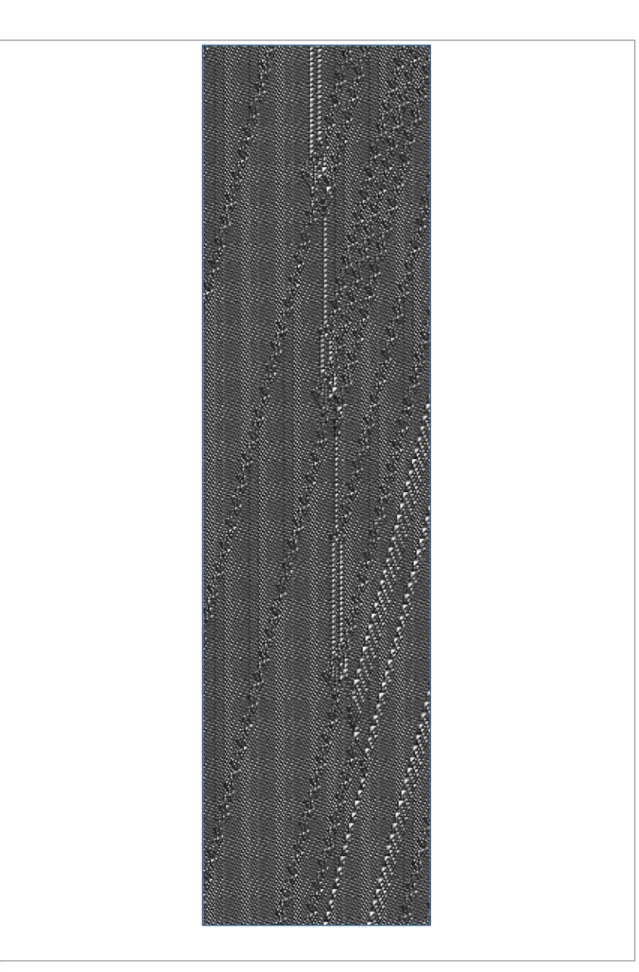
Less randomization, for example, is given in the case of the Atlas 2 series (Fig. 3). Here, the image develops a certain level of complexity over time. Consequently, Programmed Machines could be programmed in such a way that endlessly moving images would produce a result similar to those generated by two-dimensional cellular automata or three dimensional fractals. Therefore, Programmed Machines could gain more attention from the viewer, as they could provoke him or her to analyze the work through
evolutionary processes. Moreover, this would lead to even further discourse about who – the machine or the author of the algorithm – is more “creative.”
In the second case, the viewer is put into confrontation with a machine. Depending on the machine or the installation approached, it could be direct (as in interactive
installations such as the Collective Intelligence Machines series) or indirect (as in, for example, the Sealed Computers series). The indirect confrontation would, however,
require more imagination from the viewer. Reflecting on the Sealed Computers
installation, which could also apply to any other installation of Bolognini's, Andreas Broeckmann “points us to an 'aesthetics of the machinic' whose aesthetic experiences are effected by such machinic structures in which neither artistic intention, nor formal or controllable generative structures, but an amalgamation of material conditions, human interaction, processual restrictions, and technical instabilities play the decisive role” (Broeckamann 2006). While separating machinic and human perspectives, Broeckmann suggests trying to understand the machine from its position. Here, the viewer again has to deal with the “digital” and “analogue” dichotomy, just under different circumstances, as described by Florian Crammer while introducing post-digital aesthetics (for further discourse, refer to the earlier subsection “Aesthetics of the Post-digital”).
Direct confrontation with machines is perceived in the later installation series from Bolognini titled Collective Intelligence Machines. In this piece, the viewer may modify the exhibited image by sending SMS containing numbers, say, from 0 to 100, to the computer, which then change the parameters that define some of the characteristics of the images, such as the thickness of the lines, radius, density, etc. This gives the viewer a chance to “think machinically” or to expect some reflection while starting interaction, or a “conversation” with it. While proposing structured communication techniques between user and machine (in this case, analogous to the delphi method,35 where the
user would expect certain moves from the machine), Bolognini refers to holistic ideas and collective intelligence scenarios where the individual is given a participatory task in a digitally analogue context.
To sum up, for Bolognini, Programmed Machines make up a sci-fi fantasy proposing that machines – similarly to humans – are living organisms. The only difference is that a machine is not able to reproduce itself and sooner or later will stop operating either because of technical failure or shortage of electricity. Metaphorically, Programmed Machines for Bolognini might appear as his own children, who, as soon as they are born (meaning programmed), are set free into the universe (meaning connected to electricity
35 Forecasting the method used in collective intelligence frameworks may involve communication techniques based on iteration, feedback, and statistical response in order to come up with common answers or results.
and left to run on their own).
Interaction and Emergence in the Post-digital
Describing the artworks above, I have contended that, in post-digital art, an important role is given to the interaction between different disciplines and elements, which provokes the emergence of new forms. This was demonstrated by bringing into the discussion Artificial Paradises by Martin Howse and Jonathan Kemp, Programmed Machines by Maurizio Bolognini, and my own project, Mailia. New forms have
manifested through a) subjective method, in the case of Artificial Paradises, b) random method, in the case of Programmed Machines, and c) computed method, in the case of
Mailia.
All the works introduced include a certain level of interaction and emergence. If, in
Programmed Machines, the interaction between the machine and viewer was expressed indirectly as an act of introspection with a feel for machinic aesthetics, the interaction in
Artificial Paradises was expressed as human-machine collaboration or, to be more precise, as stimulus-response behaviour within a hybrid digital and analogue environment. Since Programmed Machines and Artificial Paradises influence the viewer's decision-making indirectly, by comparison, one might say that there is no direct interaction in Mailia with the viewer, whose influence is determined exclusively by his or her history of interaction within the machinic environment.
While illustrating post-digital aesthetics with the Artificial Paradises performance, it was suggested that different elements – software, hardware, performers, and audience – while interacting with each other, function as a system wherein each of its elements is delegated a certain task. This idea is further analyzed with the support of Deleuze and Guattari's terms which should help in defining the discourse and the framework of the post-digital, in Deleuze and Guattari's terms, the territory.
Post-digital territory
Approaching Transdisciplinarity
As introduced in the first section, post-digital aesthetics defy borders between contexts, media, and formats old and new, digital and analogue. The aesthetics of the post-digital can have features of the natural and social sciences, engineering and the arts, theory and practice. The post-digital utilizes a variety of methods in the convergence of philosophy, science, and technology and tends to unfold in non-traditional aesthetic forms and concepts, including those developed with the help of computable machines (for example, see Paolo Cirio) or while experimenting with biological forms (for example, see Heather Dewey-Hagborg). Taking this into account, how do we approach post-digital aesthetics, and what methodology is applicable for artistic practices and analysis? If there is a variety of disciplines involved in the process, the answer must then fluctuate between multidisciplinary, interdisciplinary, and transdisciplinary perspectives.
If multidisciplinary research is “is approached from different angles, using different disciplinary perspectives” where “neither the theoretical perspectives nor the findings of the various disciplines are integrated in the end” (Besselaar & Gaston 2001),
interdisciplinary research combines more than one discipline. In order to reach the goal of the subject, interdisciplinarity could be defined as a bridge between two or more disciplines or as an integration of two or more disciplines, an idea introduced by Julie Thompson Klein (Klein 1990). If, in the first case, while bridging disciplines, the disciplines remain discrete, the second case defines a new discipline that, according to Klein, overarches all disciplines to transcend towards the notion of transdiciplinarity (Klein 1990:66). In so doing, interdisciplinarity remains somewhere between
multidisciplinarity and transdisciplinarity.
Within this notion, transdisciplinarity, as defined by Jean Piaget in 1970, tries to locate links between disciplines instead of separating them,36 becoming in such a way a
36 This definition is borrowed from the article “Methodology of Transdisciplinarity–Levels of Reality, Logic of the Included Middle and Complexity” by Basarab Nicolescu, who introduces
transdisciplinarity while quoting Jean Piaget's “L’épistémologie des relations interdisciplinaires”, in Léo Apostel et al. (1972).
layered structure, a strata, similar to what has been shown through the introduction of post-digital aesthetics. A different approach towards transdisciplinarity, which is meant to cover all disciplines, was proposed by Erich Jantsch while introducing the term for university reform (Jantsch 1970). For him, interdisciplinarity within universities is a methodology still awaited for coordinating activities, whereas “the entire
education/innovation system may become coordinated as a multilevel, multi-goal hierarchical system through a transdisciplinary approach” (Jantsch 1970). If Piaget's definition has a non-hierarchical approach, the position introduced by Jantsch is closer to a holistic understanding of transdisciplinarity.
Understanding transdisciplinary is valid for cognitive sciences, complexity science, artificial intelligence, and artificial life, to name a few. New theories using
transdisciplinary methodology to inquire into a research field – system theory,
complexity theory, chaos theory – have become indivisible from any further scientific or philosophical inquiry. If the approach introduced by Ross Ashby to define cybernetics still has more of an interdisciplinary meaning (Ashby 1957), the General Systems Theory proposed by Ludvig von Bertalanffy (Bertalanffy 1950) and the definition of Living Systems offered by James Grier Miller (Miller 1978) both have features of transdisciplinarity as defined by Erich Jantsch. Systems discussed by Gille Deleuze and Felix Guattari (Deleuze & Guattari 1980) or those approached by Stephen Wolfram (Wolfram 2002) have features of transdisciplinarity as defined by Piaget. The same use of the term appeared at the Planetary Collegium led by artist Roy Ascott at Plymouth University, where he described the Collegium as “concerned with the advancement of emergent forms of art and architecture, in the context of telematic, interactive, and technoetic media, and their integration with science, technology, and consciousness research.”37 This meaning appears to be closest to a layered post-digital
transdisciplinarity as defined by Piaget, where no one discipline or genre appears to be more important than any other and transdisciplinarity itself is not positioned over all other disciplines.
Considering that transdisciplinarity and the inherent collision of views, forms, and formats in post-digital aesthetics seem to make up a natural methodology for the linkage 37 See http://www6.plymouth.ac.uk/researchcover/rcp.asp?pagetype=G&page=273 (Accessed: 29 April