2015-2016
THE INFLUENCE OF NEW
TECHNOLOGIES IN FOREIGN
LANGUAGE LEARNING
Autora del TFG: YASMINA TRIGUEROS RUEDA
Grado: ESTUDIOS INGLESES - ENGLISH STUDIES
Tutora: Aintzane Doiz
OUTLINE
ABSTRACT ... 1
1. INTRODUCTION ... 2
2. THE NEW TECHNOLOGIES IN EDUCATION ... 3
2.1. Computers ... 4
2.2. The Web 2.0 ... 5
Blogs ... 6
Wikis ... 7
Social Networks ... 8
YouTube and videos ... 10
2.3. The Interactive White Board (IWB) ... 11
2.4. Electronic dictionaries ... 12
3. THE USE OF NEW TECHNOLOGIES AT A SCHOOL: A CASE STUDY ... 13
3.1. Background information ... 13
3.2. The participants ... 14
3.3. The procedure ... 14
3.4. The research questions ... 14
3.5. Results ... 15
3.6. Discussion ... 21
4. GENERAL CONCLUSIONS ... 22
5. REFERENCES ... 24
1
ABSTRACT
The new technologies have become part of our societies especially in the so-called developed countries and it is hard to conceive our daily routines without them. This paper explores the use of new technologies in foreign language teaching and learning, in this case, English. In particular, the aim of this paper is to show the effects of new technologies in the process of English teaching and learning by using different tools, such as, students’ own computers, wikis, blogs, social networks and videos. In order to do so, I have organized this paper into two parts. First, I provide a characterization of new technologies and provide a selection of the main tools used in the classroom. The educational benefits and drawbacks of four main groups of tools are discussed: computers, the Web 2.0 (blogs, wikis, social networks, YouTube and videos), the interactive white board and electronic dictionaries. The second part of the paper presents a practical case study in which the use of the new technologies at a small school in Bergara (in the Basque Autonomous Community) is researched and reported on. The study includes an interview with the English teacher, a questionnaire on the use of these technologies which was filled out by 51 students and a report on 4 weeks of class observations I conducted. Two are the main research questions that will be addressed: (i) are the new technologies useful for foreign language teachers and foreign language learning?, (ii) do children find the use of technologies in their foreign language classroom useful? The main conclusion is that most of the students and the teacher like working with the new technologies and that they are helpful to learn a foreign language, despite a few disadvantages. Finally, in the last part of the paper I relate the theoretical part and the practical part of the paper in the conclusions.
2
1.
INTRODUCTION
Castells (2000: 60) defines the new information technologies as follows: “Las nuevas tecnologías de la información y la comunicación son el conjunto convergente de tecnologías de la microelectrónica, la informática (máquinas y software), las telecomunicaciones y la optoelectrónica.” These technologies are so prevalent in our daily lives that it is impossible to understand current society without them.
Technological advancements are also used in education including second language learning. But, why do we use new technologies in second language learning education? New technologies do not seem to be something natural for teachers, as they require the development of new competences especially in the case of teachers and students who may not be so familiar with them (Romero 2005: 89). However, Johns and Tórrez (2001: 11) argue that “the new technologies offer many possibilities to the second language learner.” In fact, there are several points in favour of the new technologies:
They improve access to education for those students that live in remote areas or are isolated.
They have the ability of transporting students to places they cannot go to in the real world.
They can be used to explain difficult concepts and ideas that are not easy to understand and they do it in different ways.
They are also used by students in their daily life. They stimulate and motivate the students’ imagination.
In addition, the new technologies allow teachers to adapt to the different studying pace of schoolchildren thereby addressing students’ individual, psychological and intellectual needs (Lee, 2000). For example, the use of computer programs allows students to work on their own and at their own pace. Finally, the new technologies allow the instructor to prepare and do activities that would not be possible in a regular class. Sveikauskaite, Reza-Hernandez and Clifford (2003) mention some more reasons in support of the use of the new technologies:
3
Technology has evolved from its support function to play a role in initiating learning processes. It can provide a flexible learning environment where students can really explore and be engaged. Hypermedia, for example, individually addresses levels of fluency, content knowledge, student motivation, and interest allowing inclusion of LEP (limited English proficient) students, who can thus monitor their comprehension, language production, and behavior (cited in Langer de Ramirez, 2010: 4)
In short, the use of the new technologies in education means a new and an easier way to study for the new generations who use them all the time and have been using them since they were little. However, it is essential for students and teachers to know how to use them and how to make the best of them for their studies and learning process.
Against this backdrop, the aim of this paper is twofold. Firstly, it characterizes the new technologies in foreign language teaching/learning, a relatively new phenomenon in foreign language teaching, and analyses some of their advantages and disadvantages. Secondly, the paper seeks to gather the students’ and the teacher’s opinions about the use of the new technologies in an English course in a primary high school in the Basque Autonomous Community. In order to fulfill this task, the participants (51 primary-school children) were asked to fill out a questionnaire, an interview with the teacher was conducted to gain her insights and some class observations took place. Finally, my findings at the school will be related to the ideas that are put forward in the first part of this paper in the last section of this paper.
2.
THE NEW TECHNOLOGIES IN EDUCATION
The incorporation of new technologies has changed modified or even unsettled society as well as education. In this section, I will discuss several new technological resources used for language learning that have been introduced in the last two decades more or less, such as the Web 2.0 (e.g. blogs, wikis, social networks, YouTube), the whiteboard and electronic dictionaries. But first, I will summarize some of the benefits and downsides of the use of computers in education since computers are the basis for the new technologies.
4 2.1. Computers
According to Jonassen (1996), Salaberry (1999) and Rost (2002) the use of computers in foreign language teaching has several advantages. Firstly, computers allow students to work on their notes wherever and whenever they want. Secondly, computers require the use of simultaneous senses, such as hearing and seeing. Thirdly, computers promote learners’ motivation (Lee, 2000). That is to say, computers can be excellent stimuli for second language learning since they give children the chance to take on games and communicative activities which reduce stress and anxiety and make students more motivated (Taylor, 1980). Fourthly, participants who use language learning programs tend to have higher self-esteem ratings than regular students (Robertson et al., 1987). In addition, since students’ interact with computers and not with the other students, the use of computers is a great tool for students that are too shy to talk in the L2 in front of their schoolmates (Warschauer, 1996). Finally, computers are a great tool to overcome students’ limited span of attention. They do not allow students to switch off after some time and cease to pay attention because, when students use computers, they have to be active at all times. They are the ones who are supposed to solve the problems which are shown on the screens and “switching off” is not possible.
While the use of computers in the classroom has a lot of advantages, there are some disadvantages too. Gips et al. (2004) noted that one disadvantage associated with the use of computers in schools is the increase of educational costs. Another disadvantage is that teachers and students are required to have at least some basic knowledge of the use of computers. Since there are a lot of teachers who do not have sufficient technological training to guide their students on the use of computers, training courses for teachers are a must, with the subsequent cost for the schools. A third drawback is the fact that the software for computer assisted language learning programs is still imperfect. Warschauer (1996) pointed out that a program should ideally be able to recognize a user’s “spoken” input and measure it not just for correctness but also for “appropriateness”. That is, the program should be able to recognize which problems students are having with pronunciation, sentence structure, and language use, and then intelligently decide among a range of alternatives. However, computer technologies are not intelligent enough to be truly interactive nowadays. They cannot handle unexpected situations because of their limited artificial intelligence (Blin, 1999; Dent, 2001). In the fourth place, computers can be too appealing and may be addictive for children and
5 adults in some situations. They seem to “captivate” kids. Finally, perhaps the most persistent drawback is related to health issues, such as visual strain, harmful effects of radiation and back problems. However, it should be borne in mind that, under normal conditions, research has shown that computer screens are safe, they do not compromise the health of our eyes, and emit little or no harmful radiation.
All in all, computers help children to be in control of their learning experience and to choose the level of challenge they feel comfortable with. Furthermore, they encourage children to use all of their senses to extract information. What is more, computers have a fascination over children and can catch their full attention although they can be unsafe if they are not used properly because children can become hooked on them and suffer physical problems. As children master the use of computers, they build positive attitudes towards technology that will pay dividends for the rest of their lives. So, despite the presence of some disadvantages associated with the use of computers, research has shown that computers are a wonderful educational tool for young children provided their use is supervised by adults.
In the remainder of the section, I will discuss the use of the Web 2.0, the interactive white board and electronic dictionaries.
2.2. The Web 2.0
The term Web 2.0 was coined by O´Reilly (2005):
Web 2.0 is the network as platform, spanning all connected devices; Web 2.0 applications are those that make the most of the intrinsic advantages of that platform: delivering software as a continually-updated service that gets better the more people use it, consuming and remixing data from multiple sources, including individual users, while providing their own data and services in a form that allows remixing by others, creating network effects through an “architecture of participation,” and going beyond the page metaphor of Web 1.0 to deliver rich user experiences.
Recent research on the use of Web 2.0 tools in the language classroom has shown that the use of this technology is very much appreciated by students (Stanley,
6 2006) and it is associated with greater levels of student motivation (Goodwin-Jones, 2005).
But what is the Web 2.0 exactly? While some experts have said that it is not easy to define what the Web 2.0 is (Adell (2010) and Sanchez (2008)), this term refers to the second generation of the World Wide Web (it used to be the Web 1.0 before). It includes a series of devices, such as blogs, wikis, social networking and YouTube, that allow collaboration amongst its users and the act of sharing information online.
However, there are some discrepancies regarding the devices that should be included within the Web 2.0. For example, Sánchez (2008), and Langer de Ramirez (2010) believe that YouTube should be included within the Web 2.0, whereas Castaño, et al. (2008) do not. I will follow the former view. In contrast, I believe that it is best not to include the white board as part of the Web 2.0 although Miller and Glover (2009: 506) state that “the relationship between IWB use and Web 2.0 arises from the potential of both to add impetus for teachers to structure lesson development and enhance activity.”
In the following paragraphs I will provide a characterization of blogs, wikis, social networks and videos/YouTube as part of the Web 2.0., but I will talk about the interactive white boardand electronic dictionaries in two different sections.
Blogs
Blogs, also known as weblogs (Web + log(s)), are publications accessible through the Internet. They provide the user a website to communicate and share information through the network. It could be an image, a video, multimedia content or any other kind of content that the user wants to post. One of the main characteristics of blogs is that they are used to display the entries authored by the blog owner and, even though the entries are visible for other web users, the person who has created it is the only person who can post their thoughts in the blog, although anyone can receive comments and make them public in that or in any other blog.
From the educational point of view, blogs are very easy to use. Moreover, students can have a lot of fun while they learn/use English because anyone can participate in the blog: they can write, read and communicate in English. Although there are very few studies that have examined the benefits of blogs for foreign language skills, we know that they encourage collaborative learning and support personal
7 journalism or blogging and, as I have mentioned before, they foster feedback in the form of comments on blog posts, that is, they are relevant for the improvement of writing. In this vein, Armstrong and Retterer (2008) found out that the use of blogs improved the accuracy of verbal morphology and they promoted more extensive written production. From the students´ perspective, blogging is preferred to reading traditional journals or writing essays. Students find publishing their writing online more motivating, and they believe that blogging improves their writing (Armstrong and Retterer, 2008; Thorne and Payne, 2005). Furthermore, blogs serve to motivate children in their foreign language learning because they provide a sense of competence, relatedness to others and autonomy, all of which are crucial aspects for language learning as argued in Deci and Ryan’s self-determination theory (1985).
Finally, it is important to mention that blogs are also very useful when a new student joins a class of students who have been together for a while: at the beginning a new student may feel embarrassed or may be too shy to express their opinions freely because of the called “silent period” suffered in SLL. This period can last for a few months until the learner gets used to the environment, the language and the culture. Writing in a blog can be a solution for the “silent period” and the acclimatization period: the new student may be connected with their classmates without being forced to actively participate in the blog.
Wikis
Wikis are websites that allow multiple users to add, delete and edit the information posted in the website. The most famous wiki is the “Wikipedia” and it clearly illustrates what wiki technology is. The Wikipedia is an online encyclopedia. It is a collection of a huge amount of articles on any kind of topics written and rewritten by many people, some of whom are experts on the topic at hand. Anyone with a computer and access to the Internet can change or edit the information in this wiki. The contents are revised by laypeople who do not like to see errors and by experts who make sure that the information in the wiki is accurate. However, the Wikipedia is not normally used at schools or at universities as a source of information because “in schools, Wikipedia has gotten a bad rap” (Langer de Ramirez, 2010: 30). The reason for the mistrust could be placed on the fact that we do not know who is responsible for the content. “Teachers are wary of the information on the sites, since much of it is written
8 by laypeople rather than experts” (Langer de Ramirez, 2010: 30). But I think that even though the Wikipedia may not be a reliable source of information for some people, it is a very easy and useful webpage for many others.
But are wikis useful for teachers in foreign language learning? Do they have a place in the EFL classroom? The short answer is “yes”. A wiki can become the place where students collaborate in group projects. Like blogs, wikis allow learners to carry out group work without having to be in the same place. In addition, they are very useful for shy people or for the students who cannot meet after class or on weekends. However, in order for the use of wikis to pay off in the EFL classroom and to ensure that the collaboration among students is successful, teachers must take a dynamic role and be actively involved in the students’ contributions to the wikis (Ioannou and Artino, 2008; Lund and Smørdal, 2006).
Social Networks
Social networks allow users to build their own profiles and communicate with their friends and share information. Facebook, for example, is one of the most popular social networks among students and “Twitter seems to be the most popular micro blogging system” (Langer de Ramirez, 2010:106). In fact, “Facebook and MySpace are both already used in schools as a means of teaching everything from history to health” (Langer de Ramirez, 2010:107).
Langer de Ramirez (2010) discusses some of the benefits of using Facebook in the classroom. For instance, teachers can ask their students to create an account on this site to talk about the theme they are working on, such as, scientists, authors, etc. In addition, they can share information by posting videos, images, or comments. They can also obtain information from other people on Facebook or their classmates (it can be a private account, an account for one’s friends or for all the members of Facebook). In short, Facebook can be a wonderful and different way of working on one’s English and learning how to write in English instead of writing essays or papers.
The benefits of Twitter discussed by Grosseck and Holotescu (2008) (in Langer de Ramirez, 2010: 106) are the following:
Twittering about learning in class or outside fosters the sense of classroom community.
9 It promotes writing as a fun activity. It fosters editing skills and develops literacy
skills.
Students can use tweets to send out questions and observations to the group while being engaged in classroom activities.
It encourages the collaboration across schools and also around the world since students can follow tweets from classes in other schools which are studying the same subject or reading the same book.
It enhances project management: if you set up a group to work on a project, the tweets can be picked up on cell phones (like e-mail).
It is a tool for assessing opinions, examining consensus and looking for outlying ideas. Twitter can also be used as an academic setting to foster interaction and debate on a given topic.
It is a viable platform for meta-cognition (e.g. to practice thinking about learning) which has been shown to benefit comprehension and retention of information. It connects people that one would not have met otherwise.
It keeps track of students’ conversations on about a particular topic. It is a good way of making a quick announcement.
Being limited to just 140 characters, Twitter really focuses one’s attention. Twitter has developed its own sort of discursive grammar, requiring a great deal of summarizing, which is an important skill to master for EFLs.
It promotes students’ connection to the real world.
It gives the students a sense of what a person is like outside the classroom (so, they end up being a lot more comfortable with the classroom discourse).
It is helpful for quieter students, who might not speak up in class but can be heard via tweets.
It provides age-appropriate environments.
But the use of Twitter in education also has three main drawbacks (Grosseck and Holotescu (2008) cited in Langer de Ramirez, 2010: 107). First, the language used in Twitter can be rude due to the brevity of each text and subsequent occasional lack of courtesy words and phrases. Secondly, teachers using Twitter are “on call” virtually round the clock and students can intrude into their private time. Finally, Twitter facilitates the spread of rumors in schools.
10 Even though the social network Twitter has some benefits, I do not agree with the experts’ characterization of social networks as studying tools because I do not see a clear connection between Twitter, for instance, and education. I see Twitter as atool for entertainment, with its benefits for reading in your free time, or for learning about the world. This may be due to the fact that I have always used the social networks for entertainment. Hence, I would not use this kind of tools in my lessons to teach a foreign language.
YouTube and videos
YouTube is one of the most widely used programs to listen to music and to view, create and share videos. It also allows its users to have an account, watch videos and provide comments about the videos. It is important to mention that users need to be 18 years old to open an account and upload videos in YouTube.
YouTube is a very useful tool to teach English as a foreign language. It provides access to new contexts to students since it overcomes the boundaries of time and space. The learner can be transported virtually to a country where the foreign language is the native language and listen to it being used in a natural way (Taylor and Gitsaki, 2003).
YouTube provides the cultural context for the language which is being studied. The videos from the target language country give students an idea of life in the foreign country and provide students with a good linguistic source. Tschirner (2001: 318) argues that videos enable learners to “plunge into and participate in the world of native speakers” and expose them to “phonological, grammatical, lexical, pragmatic and socio-cultural features within a situational framework” (2001: 307). YouTube is also a very useful tool because one can find videos on grammar, vocabulary and pronunciation. In addition, Stempleski (2002: 364) argues that the activities which involve the use of videos motivate students in their process of learning, “language use and heightening students’ awareness of particular language points and other aspect of communication.”
Dirr (2005) and Prendes Espinosa (2005)points out that educational videos are the most effective tool in language learning as they encourage students’ thinking process, they spark students’ imagination and promote discussions in the classroom. They also help to illustrate difficult concepts and make “visiting” places possible, as I have mentioned before.
11 In short, the advances in educational technology, such as the use of computers and of the Web 2.0 (e.g. blogs, wikis, social networks and YouTube) that we have discussed make passive children take an active role in their learning process because the Web 2.0 is a user-based social web. Without users, it would not be possible for people to share information using the various formats. The Web 2.0 is also beneficial because it encourages students to become the creators of their own projects. Moreover, it is essential during the so-called “silent period” in which children do not want to collaborate and participate because of their shyness. Most importantly, however, is Langer de Ramirez’s eye-opening statement for teachers and researchers, “there are many reasons why Web 2.0 tools are beneficial for ELLs, perhaps the most convincing reason is the one that we teachers often underestimate: The World Wide Web is fun!” (2010: 4).
2.3. The Interactive White Board (IWB)
I decided not to include the Interactive White Board (IWB) in the Web 2.0 because the IWB is mainly used as a projector in the classrooms, as we will see in the class observations that I will report in section 3.
The existing research on the topic has shown that the teacher and the students benefit from this new tool and that both groups have a positive attitude towards it. According to most research on the use of the IWB in education based on self-reported data (e.g. interviews, questionnaires), the use of the IWB has an impact on the learning process and on the learner. In particular, it helps to improve memorizing materials, it also promotes learner autonomy during the learning process and it encourages more practice and reuse of the material which has already been learnt. The IWB has also been shown to increase students’ enthusiasm, interest and engagement in the learning process (Tozcu, 2008). Some teachers have also reported that the IWB has a positive and dramatic effect on their teaching (Gray, et al. 2005).
However, teachers need to be trained; they must be taught to use the IWB. Glover and Miller (2004) have demonstrated that teachers need to be helped through a three-stage development process in order to change from the traditional to the increasingly more interactive use of the IWB. The first stage or the Supported didactic stage iswhen the teacher uses the IWB as a visual support for the lesson, that is to say, when the IWB is not an integral part of the educational tools leading to conceptual
12 development. The second stage, the interactive stage, takes place when the teacher uses some of the potential of the IWB to stimulate student responses during the lesson and to illustrate some concepts. The last stage, the Enhanced interactivity stage, is when the teacher develops the materials so that the students focus upon the IWB as a means of prompting, explaining, developing and testing the concepts during most of the lesson time.
2.4. Electronic dictionaries
Electronic dictionaries are also a resource associated with the new technologies. As their name state, electronic dictionaries take an electronic format and they can be either handheld or involve a search online. Clearly one of the main advantages of electronic dictionaries is that they provide a quick way to find the meaning of unknown words without interrupting the reading process.
Research on the use of electronic dictionaries in foreign language learning has explored the effectiveness of this tool for reading comprehension, the retention of the meaning of unknown words and the learners’ attitudes toward reading in a foreign language. Aust, et al. (1993), Koyama and Takeuchi (2007) and Laufer and Levitsky-Aviad (2006) found out that students who used paper dictionaries and students who employed electronic dictionaries had similar reading comprehension scores. However, Leffa (1993) showed that learners using electronic dictionaries had a significantly higher understanding of the text than the users of paper dictionaries (86.10% vs. 62.70%). He also discovered that language learner beginners who used electronic dictionaries closed the gap between stronger and weaker learners quicker.
In a different line of research, Aust, et al.(1993), Koyama and Takeuchi, (2007) and Leffa (1993) discovered that most of the learners who used electronic dictionaries were faster than those who used paper dictionaries at completing reading texts tasks. Nonetheless, in an earlier study by Koyama and Takeuchi (2004), no significant difference was found in the time needed to complete the work when comparing users of the two types of dictionaries. The reason was the fact that the users of electronic dictionaries looked more words up than the users of paper dictionaries.
I agree with the fact that using electronic dictionaries is quicker than using a paper dictionary. However, since the meaning of the words may frequently be derived from context, it may be not necessary to look all the words up. Moreover, I believe that
13 students will look up more unknown words with the electronic dictionary as it is faster and easier. So both electronic dictionaries and paper dictionaries have advantages and disadvantages.
In section 3 I will provide empirical evidence of the use of some of the tools that have been discussed here in a school in Bergara (the Basque Autonomous Community, Spain).
3.
THE USE OF NEW TECHNOLOGIES AT A SCHOOL: A
CASE STUDY
3.1. Background information
The research I will be reporting here on was conducted at a public school in Bergara (the Basque Autonomous Community, Spain). The school has participated in the program of 2.0 schools since 2006 as a result of which, the teachers are familiar with the new technologies discussed in section 2. In addition, the school has also been working in a trilingual program since 2011 whereby students carry out project work. Until the first semester of the academic year 2014/15, the themes of the projects were chosen by the teachers, but currently the students themselves choose the topics for their projects and the teachers adapt their curricula to the idea proposed by the students. For example, if the students want to learn about robots, the children will work with volumes and geometrical figures in mathematics and they will learn about the lives of some scientists who had something to do with robots, machines or industry in science. In the Basque, Spanish and English language classes they will learn about the lives of the inventors; they will also be taught how to write a text of instructions (e.g. making a robot), how to describe a robot, for example, or how to write a comic in which the robot is the main character. Finally, learners are asked to make a mockup of a robot and to paint it, or to make a collage in their favorite subject, handicrafts. That is to say, the students work on a topic that is interesting for them in all the school subjects.
14 3.2. The participants
In this study there were 51 participants, 26 of whom are female and 25 male. They are all Spanish-Basque bilinguals and were distributed in two different classrooms of the 6th year in primary school (11-12 years old). The students have four hours and a half of English per week (two 90-minute classes and two 45-minute classes).
3.3. The procedure
I used three instruments to obtain information from the students and the teacher. First, I asked the students to fill in the questionnaire I had made up myself (See appendix 1). The questionnaire contains 17 questions distributed into three sections: the first group of questions are related to the background information on students’ knowledge about new technologies and their use (questions 1 to 3), the next group of questions (questions 4 to 10) enquire about the student’s perception of the use and usefulness of the new technologies in the EFL classroom and its advantages and disadvantages, and the third group deals with the use of new technologies in their private life (questions 11 to 17).
Secondly, I observed the children in their English classes for four weeks to see the students’ interaction with some of the new technologies which were discussed in section 2. I also observed the English teacher, a young woman, who helped me with this part of my study. Observing children in class was a new experience for me and it proved to be extremely valuable since I saw things that I would not have expected to see among young children.
Thirdly, I interviewed the English teacher about her experience with the new technologies (See appendix 2). The interview lasted 50 minutes.
3.4. The research questions
The two research questions that I wanted to address in my study regarding the use of new technologies in foreign language learning are:
15 (i) Are the new technologies useful for foreign language teachers and foreign language learning?
(ii) Do children find the use of the new technologies useful in the foreign language classroom?
3.5. Results
Students’ questionnaires
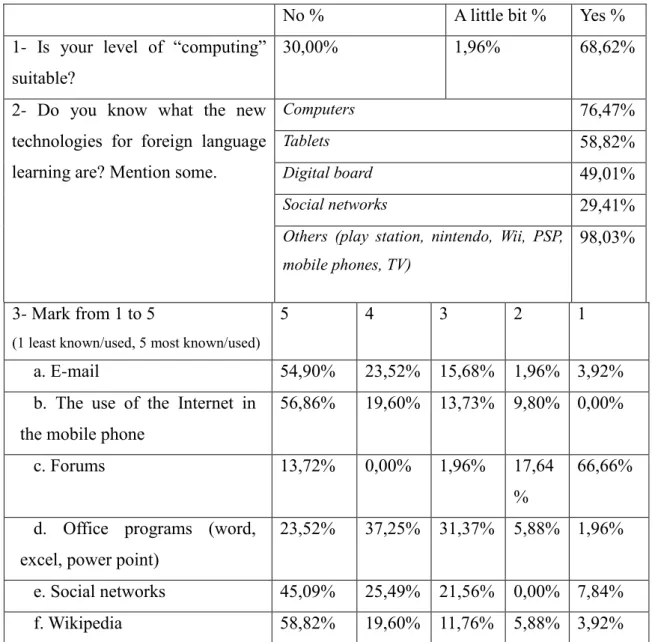
Table 1 summarizes the students’ responses for section 1 of the questionnaire, namely, the participants’ familiarity with the new technologies and their use.
No % A little bit % Yes %
1- Is your level of “computing” suitable?
30,00% 1,96% 68,62%
2- Do you know what the new technologies for foreign language learning are? Mention some.
Computers 76,47%
Tablets 58,82%
Digital board 49,01%
Social networks 29,41%
Others (play station, nintendo, Wii, PSP, mobile phones, TV)
98,03%
Table 1: Knowledge of and ability to use the new technologies (questions 1-3, section 1) 3- Mark from 1 to 5
(1 least known/used, 5 most known/used)
5 4 3 2 1
a. E-mail 54,90% 23,52% 15,68% 1,96% 3,92%
b. The use of the Internet in the mobile phone
56,86% 19,60% 13,73% 9,80% 0,00%
c. Forums 13,72% 0,00% 1,96% 17,64
%
66,66% d. Office programs (word,
excel, power point)
23,52% 37,25% 31,37% 5,88% 1,96% e. Social networks 45,09% 25,49% 21,56% 0,00% 7,84%
16 Almost 70% of the participants (68.62%) believed to have suitable knowledge of “computing”. All the students think that they know what the new technologies for foreign language learning are and mention the following: computers (76.47% of the participants), tablets (58%), the digital board (49%) and social networks (29.41%). However, some confusion regarding the meaning of the new technologies is found amongst the students since 98% of them mentioned the Play station, Nintendo, Wii, PSP, the TV and mobile phones (it is also possible that they may have misunderstood the question). The confusion may result from the fact that the devices that the participants mentioned are present in their daily life. Roughly speaking over 75% of the students are very familiar with (5 in the scale) or familiar with (4 in the scale) the mail, the Internet, social networks and the Wikipedia. However, it is interesting to note that 66% of the participants never use or are not familiar with forums.
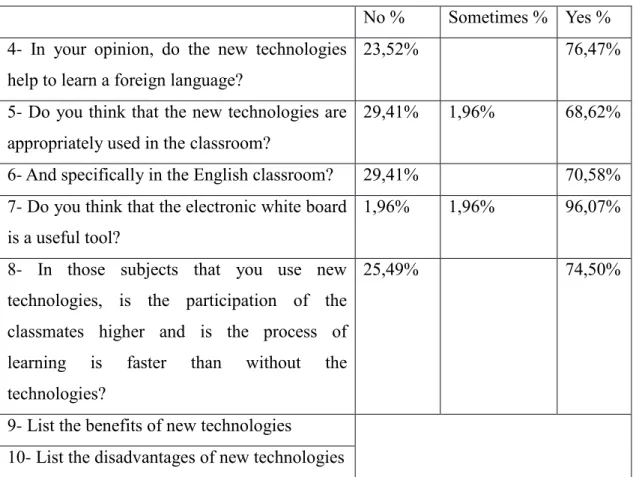
Table 2 summarizes the students’ opinion on the usefulness of the new technologies for the EFL (section 2 of the questionnaire).
No % Sometimes % Yes % 4- In your opinion, do the new technologies
help to learn a foreign language?
23,52% 76,47%
5- Do you think that the new technologies are appropriately used in the classroom?
29,41% 1,96% 68,62%
6- And specifically in the English classroom? 29,41% 70,58% 7- Do you think that the electronic white board
is a useful tool?
1,96% 1,96% 96,07%
8- In those subjects that you use new technologies, is the participation of the classmates higher and is the process of learning is faster than without the technologies?
25,49% 74,50%
9- List the benefits of new technologies
10- List the disadvantages of new technologies
17 Roughly speaking, 75% of the students agree that the use of new technologies helps to learn a foreign language. 68% and 70% believe that the tools associated to the new technologies are used correctly in the classroom in general, and in the English classroom, respectively. When they were asked about the usefulness of the white board, 96% replied that they believed it is useful, although it has to be borne in mind that it was merely used as a tool to project the contents from the teacher’s computer. A high percentage of the students (74.5%) believed that the use of the new technologies promoted class participation and fostered learning. In short, the students have a good opinion of the new technologies for foreign language learning.
As far as the advantages of the use of new technologies are concerned (question 9), most of the participants mentioned that they make their lives easier: it is easier and much quicker to find information on the Internet than in encyclopedias, books and (paper) dictionaries. In addition, they also pointed out that the new technologies make learning a language more fun since they can play games and do different kinds of activities. As for the disadvantages (question 10), all of the children mentioned that the new technologies harm the environment even more than books. Most of them stated that the new technologies are addictive and that they can cause some health problems (e. g. headaches, back pain) and are responsible for needing reading glasses. Finally some of the students mentioned that the new technologies are expensive to buy and to run (energy costs).
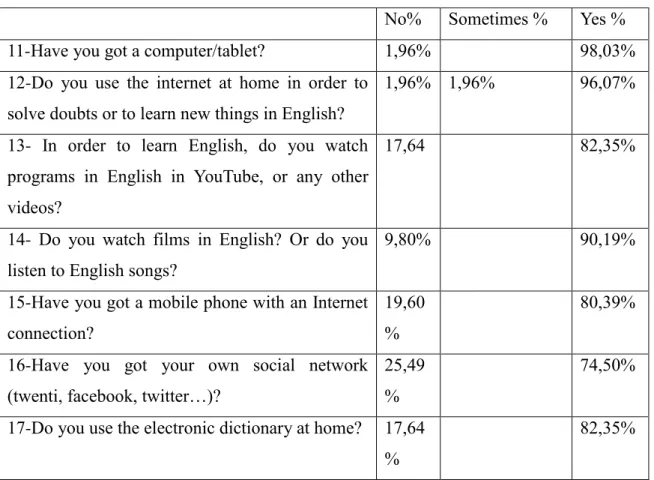
18 Table 3 summarizes the students’ responses on their personal use of the new technologies at home (section 3 of the questionnaire).
No% Sometimes % Yes %
11-Have you got a computer/tablet? 1,96% 98,03%
12-Do you use the internet at home in order to solve doubts or to learn new things in English?
1,96% 1,96% 96,07%
13- In order to learn English, do you watch programs in English in YouTube, or any other videos?
17,64 82,35%
14- Do you watch films in English? Or do you listen to English songs?
9,80% 90,19%
15-Have you got a mobile phone with an Internet connection?
19,60 %
80,39% 16-Have you got your own social network
(twenti, facebook, twitter…)?
25,49 %
74,50% 17-Do you use the electronic dictionary at home? 17,64
%
82,35% Table 3: The use of the new technologies in the students’ private life.
All the students, except one, had computers at home. The majority uses the Internet to solve doubts or learn new things in English (96%) and a very high percentage of the students use electronic dictionaries at home (82%). In addition, the majority of the students listen to English songs (90%) and watch movies or videos in English in YouTube (82%). 80% of the students have a smart mobile phone and 74% of them participate in social networks. There is no doubt that the new technologies are part of the students’ lives.
The interview with the teacher
The teacher’s opinion about the new technologies is crucial since it affects her teaching and the lessons she teaches. The teacher believes that new technologies are a dynamic way of learning and that they help to keep children’s attention. In her opinion,
19 new technologies are particularly useful with shy students, and programs such as “drive” foster communication outside the classroom and facilitate student-teacher communication. However, it is important to clarify that the teacher does not use all the tools that were referred to in section 2 of the paper because some of them are too complicated to use for young children or they may distract the children’s attention from the point that the teacher wants to make. For example, some years ago, the teacher had tried to use blogs in her classroom but she stopped doing it because children “got lost.” As a result, nowadays she uses YouTube and the electronic dictionary mainly. YouTube is a great help to her because she can find hundreds of videos on many different topics. Videos are useful because students are motivated and do not get distracted while they watch them. The electronic dictionary is mainly used by the students while they are doing their reading assignments. In fact, the students use it a lot when they are reading texts in their computers: they look the words up in the dictionary themselves, they do not waste time and can do their activities much faster.
For the teacher it is very clear that the new technologies motivate students very much, but as the course goes on, “if we use the same resources (YouTube, drive and the email) all the time, the children get bored after a while because the novelty effect wears off.” That is why it is important to use books (i.e. the traditional way of teaching English) in combination with the new technologies. Children need variation in their classes. Furthermore, in her experience, “books are always available” while the new technologies may have some technical problems and fail sometimes. For example, there are frequent problems with the network (there are connection breakdowns), sometimes there are not enough computers for everybody, the batteries go dead, suitable programs are not available or have not been installed in the computers, and documents cannot be downloaded. One never has these problems with books.
According to the teacher, the main difference between teaching English the traditional way (i.e. using the course book) and using the new technologies is that the latter caters for the students’ different levels: “when there are different levels, it is easier to find or to prepare different materials for each level with the same content.” For example, “if you want to play a video from YouTube you can play it with or without the subtitles depending on the students’ level.” In contrast, books cannot be adapted to the students’ different levels that one sees in the same classroom. “There is the book and that’s it.”
20 Finally, the teacher mentioned that she did not have any trouble adjusting to the new way of teaching. However, she admitted that not everybody adjusts easily. For example, she mentioned some teachers that had to take crash courses or take self-tutorials at home to learn how to use these tools in their classrooms because knowing how to use basic computer programs, such as, the email, word, excel or power point is not enough. Specific training is required.
Class observations
As I mentioned before, I sat in the English classroom for four weeks. This observation period served to confirm that children are familiar with the new technologies. In general the pupils know how to use the new technologies and they are familiar with them. They always used the same devices and tools (drive, Google translator and few things more), so after a while they did not have any trouble using them. In addition, one could tell that their lives revolve around computers, the Internet, YouTube and the electronic dictionaries. However, I noticed that the participants do not know how to use office programs (e. g. excel, word, power point). The teacher tried to address this issue and taught the children how to use these programs during class every day. As for the children’s opinions, it seemed to me that most of them prefer the classes in which the new technologies were used to the regular classes in which the book is used. Moreover, they think that the new technologies help them learn more efficiently.
From the teacher’s point of view, the new technologies offered her different resources to make the lessons more dynamic. In addition, I saw that using YouTube was a great help for the teacher since the same content could be made accessible to all the students regardless of their level of English: she prepared a video with subtitles for the students who had more trouble and without subtitles for the students who could follow the video without them.
All in all, the main conclusion I derived from my four-week observation is that students work harder, are more concentrated on the task they are doing and are more motivated when they use their computers. More learning seems to take place.
21 3.6. Discussion
Once the three sources of data have been discussed (student questionnaire, class observation and the interview with the teacher), we are ready to answer the two research questions of my study.
Research question 1: Are the new technologies useful for foreign language teachers and foreign language learning?
The main conclusion is that the new technologies are very helpful for foreign language learning. For example the video is used frequently to explain difficult terms, concepts, etc. The teacher can also use the new technologies to prepare the lessons at varying degrees of difficulty to accommodate the students’ level. Moreover, the new technologies make the lessons more dynamic because the teacher has different resources to explain the theory. Finally since the students are more motivated to learn and are more receptive, the teacher is also more motivated to prepare her classes and to teach. However, the teacher should decide when it is appropriate to use these tools since the “novelty effect” may wear off after a while.
Research question 2: Do children find the use of technologies in their foreign language classroom useful?
It is clear from the students’ replies of the questionnaire that they like to use the new technologies in class more than the conventional tools. During my class observations I saw that they were more concentrated when they were working with the computer, when they were watching videos, or when they were using the Internet to look in the wikis or the electronic dictionary. The children also use the new technologies at home for educational purposes: they watch videos in English, they listen to English songs or use electronic dictionaries. They are constantly exposed to these devices in their daily life. However, they did mention some drawbacks such as health issues and economic reasons. Hence, the use of the new technologies should be supervised by an adult.
22
4.
GENERAL CONCLUSIONS
It is a fact that most students have computers nowadays. Just a few years ago having a computer was not as common as it is nowadays, and the use of computers and the new technologies in the classroom would have been unthinkable. The goals of this paper were twofold: (i) to characterize the new technologies and discuss their use in the foreign language classroom, (ii) to research whether the students and the teacher at a school in the Basque Autonomous Community liked to use the new technologies and thought that more learning was achieved.
The results of my study have confirmed the benefits that have been noted in section 2 on the characterization of the new technologies. Firstly, it is clear from the children’s responses to the questionnaire and the class observations that children know how to use the new technologies and tools nowadays. They have the right skills to do so and they are self-sufficient. This is an advantage for the teacher and the dynamics of the class because she can concentrate on the task itself and does not need to spend time on technical issues.
Secondly, the advantages associated with the use of the new technologies discussed in section 2 were attested during my class observations, and there are more advantages than disadvantages. Firstly, computers allow students to work on their own wherever and whenever they want (Jonassen, 1966; Salaberry, 1999 and Rost, 2002). My class observations confirmed that students work autonomously and that the use of programs such as “drive” allows the teacher and the students to exchange opinions and notes. They can also work at home. Secondly, the new technologies promote learners’ motivation (Lee, 2000). This was clearly the case in the class I observed, and the children’s opinions also stated the same thing. Thirdly, new technologies were a help for shy students (Warschauer, 1996). In my case study I noted that there were some shy people and that the new technologies helped them to interact and to do the work. The main disadvantage is the occurrence of technical problems, such as dead batteries and the problems with the Internet connection.
Thirdly, the teacher used some of the devices associated with the new technology discussed in section 2. In particular she used wikis, the videos in YouTube and the electronic dictionary. In my study I saw that the Wikipedia was used as a fast and easy way to find information. The children, however, did not make any written
23 contributions in it. Similarly, the electronic dictionary was used by the students to look up the meaning of words when they were working on their own. It was used every day because it is a very convenient tool. But the most widely used tool were the videos from YouTube. The videos are a great help for the teacher since they serve to work on different skills such as listening and reading practice and they can be adapted to the different levels of students’ English competence. They also motivated the students very much and the students tried to follow the videos very hard. However, the use of social networks and blogs was discarded in this particular school because they are not ease to use for young children. In addition, the children can easily get distracted by the social networks and will not pay attention to the teacher.
Summing up, most of the students and the teacher in the study feel comfortable working and learning with the new technologies and their advantages outweigh their disadvantages.
24
5.
REFERENCES
Adell, J. (2010). Educación 2.0. In C. Barba & S. Capella (Eds.), Ordenadores en las aulas. La clave es la metodología (pp. 19-33). Editorial Grao: Barcelona.
Armstrong, K., & Retterer, O. (2008). Blogging as L2 writing: A case study. AACE Journal, 16 (3), 233-251.
Aust, R., Kelley, M. J., & Roby, W. B. (1993). The use of hyper-reference and conven-tional dictionaries. Educational Technology Research & Development, 41, 63-73. Blin, F. (1999). CALL and the Development of Learner autonomy. In Debski, R. & Levy, m. (Eds.), WorldCALL: Global Perspectives on Computer-Assisted Lan-guage Learning (pp. 133-147). Lisse: Swets and Zeitlinger.
Castaño, C., Maíz, I., Palacio, G., & Villarroel, J.D. (2008). Prácticas educativas en entornos web 2.0. Madrid: Editorial Síntesis.
Castells, M. (2000). La era de la información (Volumen I) La sociedad red. Madrid: Alianza.
Cheng-Chieh, L. & Allan, W. (2006). The Advantages and Disadvantages of Computer Technology in Second Language Acquisition. Doctoral Forum National Journal for Publishing and Mentoring Doctoral Student Research, Volume 3 Number 1, 16.(http://faculty.ksu.edu.sa/saad/Documents/CALL%20Advantages%20and%2 0disadvantages.pdf)
Deci, E.L., & Ryan R.M. (1985). Intrinsic motivation and self-determination in human behavior. New York: Plenum
Dent, C. (2001). Studer: classification v. categorization. Available from http://www.burningchrome.com:8000/~cdent/fiaarts/docs/1005018884:23962.ht m. Accessed 19 April, 2014.
Dirr, P. (2005). Desarrollo social y educativo ante las nuevas tecnologías y problemas psicológicos de la interacción persona-computador. In Martínez, F., & Prendes, M.P. (Eds.), Nuevas tecnologías y educación (pp. 69-84). Madrid: Pearson Pren-tice Hall.
Gips, A., DiMattia, P., & Gips, J. (2004). The effect of assistive technology on educa-tional costs: Two case studies. In K. Miesenberger, J. Klaus, W. Zagler, D. Burger (Eds.). Computers Helping People with Special Needs (pp. 206-213). Austria: Springer.
25 Glover, D. & Miller, D.J. (2004). Players in the Management of Change: introducing
interactive whiteboards into schools. Management in Education, Vol.17.
Golonka, E., Bowles, A., Frank, V., Richardson, & Freynik, S. (2013). Technologies for foreign language learning: a review of technology type and their effectiveness.
Computer Assisted Learning, Vol. 27, No. 1, 70-105.
Goodwin-Jones, R. (2005). Emerging technologies: Skype and podcasting: Disruptive technologies for language learning. Language Learning and Technology, 9 (3), 9–12.
Grosseck, G., & Holotescu, C. (2008). 4th International Scientific Conference,
eLearn-ing and Software for Education. Available from
https://adlunap.ro/else../papers/015.-697.1.Grosseck%20Gabriela-Can%20we%20use.pdf. Accessed 20 February, 2014.
Gray, C., Hagger-Vaughan, L., Pilkington, R. & Tomkins, S.A. (2005). The Pros and Cons of Interactive Whiteboards in Relation to the Key Stage 3 Strategy and Framework. Language Learning Journal, 32 (1), 38-44.
Ioannou, A., & Artino, A. (2008). Incorporating Wikis in an educational technology course:Ideas, reflections and lessons learned. Paper presented at the Society for Information Technology and Teacher Education (SITE) International Confer-ence, Las Vegas.N.Y.
Johns, K.M., & Tórrez, N.M. (2001). Helping ESL learners succeed. Phi Delta Kappa,
484, 7–49.
Jonassen, D.H. (1996). Computers in the classroom. Englewood cliffs. NJ: Merrill. Koyama, T., & Takeuchi, O. (2004). Comparing electronic and printed dictionaries:
How the difference affected EFL learning. JACET Bulletin, 38,33-46.
Koyama, T., & Takeuchi, O. (2007). Does Look-up Frequency Help Reading Compre-hension of EFL Learners? Two Empirical Studies of Electronic Dictionaries.
CALICO Journal, 25 (1), 110–125.
Langer de Ramirez, L. (2010). Empower English Language Learners with Tools from the Web. United States: Corwin.
Laufer, B., & Levitsky-Aviad, T. (2006). Examining the effectiveness of ‘‘Bilingual Dictionary Plus’’ – A dictionary for production in a foreign language. Interna-tional Journal of Lexicography, 19,135-155.
26 Lee, K.W. (2000). English teachers’ barriers to the use of computer assisted language learning. The Internet TESL Journal. Available from http://iteslj.org/Articles/Lee-CALLbarriers.html. Accessed 26 February, 2014. Leffa, V. (1993). Using an electronic dictionary to understand foreign language text.
Trabalhos em linguistica aplicada, 21,19-29.
Lund, A., & Smørdal, O. (2006). Is there a space for the teacher in a wiki? Paper pre-sented at the WikiSym 2006, Odense, Denmark.
Miller, D., & Glover, D. (2009). Interactive Whiteboards in the Web 2.0 Classroom. In M. Thomas (Ed.), Handbook of Research on Web 2.0 and Second Language Learning (pp. 506-525). Hershey.
O’Reilly, T. (2005). What Is Web 2.0. Design Patterns and Business Models for the Next Generation Of Software. Available from http://radar.oreilly.com/2005/10/web-20-compact-definition.html. Accessed 26 February, 2014.
Robertson, E.F., Dannelly, K., Malloy, P.J. & Reeves, H.C. (1987). Rapid isoelectric focusing in a vertical polyacrylamide minigel system. Anal: Biochem.
Romero, A. (2005). Desarrollo social y educativo con las nuevas tecnologías. In Martí-nez, F., & Prendes, M.P.(Eds.), Nuevas tecnologías y educación (pp.89-92). Ma-drid: Pearson Prentice Hall.
Rost, M. (2002). New technologies in language education: Opportunities for profes-sional growth. Available from http://www.longman.com/ae/multimedia/pdf/MikeRost_PDF.pdf. Accessed 2 March, 2014.
Salaberry, R. (1999). CALL in the year 2000: Still developing the research agenda.
Language Learning and Technology, 3 (1), 104-107.
Sánchez, J. (2008). La Web 2.0. In Ruiz, J., Sánchez, J. & Palomo, R. (Eds.), Enseñanza con TIC en el siglo XXI. La escuela 2.0 (pp.13-25). Sevilla: Ediciones MAD-Eduforma.
Stanley, G. (2006). Podcasting: Audio on the Internet comes of age. TESL-EJ, 9 (4).
Available from http://www.tesl-ej.org/wordpress/issues/volume9/ej36/ej36int/. Accessed 19 February, 2014.
Stempleski, S. (2002). Video in the ELT classroom: The role of the teacher. In J.C. Richards & W.A. Renandya (Eds.), Methodology in language teaching (pp.364-367).Cambridge: Cambridge University Press.
27 Sveikauskaite, A., Reza-Hernandez, L., & Clifford, M. (2003). Critical issue:Using technology to support limited-English-proficient (LEP)students´learning experi-ences.North Central Regional Education Laboratory. Available from:
http://ncreL.org/sdrs/areas/issues/methods/technlgy/te900.htlm. Accessed 20 February, 2014.
Taylor, R. & Gitsaki, C. (2003). Teaching WELL in a Computerless Classroom.
C.A.L.L. Journal, 16 (4), 275-294.
Taylor, R. (1980). The computer in the school: Tutor, tool, tutee. New York: Teachers College Press.
Thorne, S. L., & Payne, J. S. (2005). Evolutionary trajectories, Internet mediated ex-pression, and language education. CALICO, 22 (3), 371-397.
Tozcu. A. (2008). The use of interactive whiteboards on teaching non-roman scripts.
Computer Assisted Language Learning, 21, 217-228.
Tschirner, E. (2001). Language Acquisition in the Classroom. The role of Digital Video. Computer assisted Language learning, 14(3), 305-319.
Warschauer, M. (1996). Motivational aspects of using computers for writing and com-munication. In Warschauer, M. (Eds.), Telecolaboration in foreign language learning Proceedings of the Hawaii Symposium. Technical Reeport 2 (pp. 29-46).Honululu: University of Hawaii Press.
28
6.
APPENDICES
Appendix 1: The students’ questionnaire. Which is your mother tongue? Which is your second language
And your third language? If there is any.
Do you learn English only at school, or in another place too?
Section 1: Background information on the participants’ familiarity with the new technologies and their use.
*Answer the next questions: (yes, no, sometimes/a little bit)
1. Is your level of computing suitable?
2. Do you know what new technologies are? Mention some of them. 3. Mark from 1 to 5 (1 least known/used and 5most known/used)
a. E-mail
b. The use of the Internet in the mobile phone. c. Forums
d. Office programs (word, excel, power point) e. Social networks
f. Wikipedia
Section 2: The use and usefulness of the new technologies in the EFL classroom
4. In your opinion, do the new technologies help to learn a second/third (English) language?
5. Do you think that the new technologies are used correctly in the classroom?
6. And specifically in the English classroom?
7. Do you think that the electronic white board is a useful tool?
8. In those subjects that you use new technologies, is the participation of the classmates higher and is the process of learning is faster than without the technologies?
9. List the benefits of the new technologies
29 Section 3: The use of the new technologies at home and/or in their private life.
11. Have you got a computer/tablet?
12. Do you use the internet at home in order to solve class doubts or to learn new things?
13. In order to learn English, do you watch programs in English in YouTube, or any other videos?
14. Do you watch films in English? Or do you listen to English songs? 15. Have you got a mobile phone with the Internet connection?
16. Have you got your own social network (tuenti, facebook, twitter…)? 17. Do you use the electronic dictionary at home?
Appendix 2: Questions for the interview with the English teacher.
1- Which differences can you see between learning with new technologies or with books?
2-Which differences can you see between teaching with new technologies or with books?
3- Are the students more motivated when studying/learning with new technology? 4- Do they participate more with these new technologies?
5- What about the social networks, wikis, blogs and videos (YouTube)?
6- Teachers, or you in particular, did you have any problem to adapt to the new technologies introduced in education?
7- Tell me something positive (an advantage) of the new technologies: 8-Tell me something negative (a disadvantage) of the new technologies: