Reacting to Risks with Real Options:
Reacting to Risks with Real Options:
Valuation of Managerial Flexibility in IT Projects
Reageren op Risico’s met Reële Opties:
Waardering van Managerial Flexibiliteit in IT Projecten
Proefschrift
ter verkrijging van de graad van doctor aan de Universiteit van Tilburg,
op gezag van de rector magnificus, prof.dr. Ph. Eijlander, in het openbaar te verdedigen ten overstaan van een door het college voor promoties aangewezen commissie
in de aula van de Universiteit op vrijdag 6 maart 2009 om 14.15 uur
door
Cornelia Alijda Richarda Hilhorst geboren op 7 september 1971 te Soest.
Promotores: Prof.dr. P.M.A. Ribbers Prof.dr.ir. H.W.G.M. van Heck
Copromotor: Dr. M.T. Smits
Overige leden: Prof.dr. J.A. Bartoli Prof.dr. W.E. Berghout Prof.dr. H. Krmar
Tilburg University/Faculty of Economics and Business Administration © 2008, Cokky Hilhorst
All rights reserved. No part of this publication may be reproduced or transmitted in any form or by any means electronic or mechanical, including photocopying, recording, or by any information storage and retrieval system, without permission in writing from the author.
Preface
This dissertation is the result of intellectual curiosity, creativity but most of all perseverance. It is the product of a large personal investment in which I tried to be flexible by staging the project in order not to run the risk of abandonment of the project altogether. As such, I am grateful to many people who have helped me during the last five years.
My Ph.D. would not have started if Prof. Dirk van Dalen, my former master thesis supervisor, had not underlined that ‘doctoranda’ means ‘she who has to become doctor’. I want to thank him for stimulating me to pursue an academic career in the first place.
Of course, the by far most important contributors to this thesis I want to thank are Prof. Pieter Ribbers, Prof. Eric van Heck and Martin Smits who have made it possible for me to write this dissertation and who have given me the freedom to find my own research path, step by step. Over the years we have had many discussions about the papers I worked on and those discussions have very much improved the overall quality of the research presented in this dissertation.
At PricewaterhouseCoopers I received important support from many colleagues. It has been a huge pleasure to realise that we work for a firm with people possessing so much knowledge as well as enthusiasm to help out. Most importantly, without the full support from Adri de Bruijn it would not have been possible to combine a full-time job with scientific research and to be able to write up in France. Furthermore, it was a pleasure to see how my colleagues at PricewaterhouseCoopers spent time and made knowledgeable efforts to help me sharpen the field experiment instrument and questions and in conducting the ‘guinea pig’ experiments. I am especially indebted to Hans Luijendijk who provided me with data from senior IS/IT executives, and Jacques de Swart and Jan Wille to help me interpret the experimental data. Additionally I would like to
thank Sabine Kos and Neal Muusze for proofreading and adding improvements to my English.
I am also highly indebted to Marianne Kennes from TiasNimbas Business School who provided me with data from ‘MIM’ alumni.
I want to thank students and faculty of the ECIS 2006 Doctoral Consortium for their feedback andforproviding me with the confidence regarding the direction of my research. Throughout the course of my research I have benefited from the help of many academics whom I asked for advice.I especially would like to thank Bert Bettonvil for helping me on several occasions.
During the final year of my PhD, I spent two-and-a-half months at l’Institut d’Administration d’Entreprises in Aix-en-Provence. My advice for anyone who ever needs to write a thesis or a book: go there! Even with the rainy karma of Piet surrounding me in the South of France, it was a wonderful experience and I want to thank Jacques-Andre Bartoli for having me over to work on my dissertation. And of course, my close friends and special women in my life deserve special mentioning: Erica, Elfi (my ‘thesis-victim-in-crime’), Ieke, Rebecca, Simone, Esther, Nikki and my sister Claire. Each of you supported me in her own way in difficult times as well as in less difficult times. I enjoy your company very much and hope that our relationships will continue to strengthen in the future.
My mother, Ida, and father, Kees, have given me all the attention I needed and they have tried their best to keep up with the academic customs and my progress. I will not forget the adorable question my father posed me one day: ’Will your whole class be defending their theses at the same day?’ They are definitely the proof that flexibility comes with age.
Contents
Preface... 5
Chapter 1 Introduction... 11
1.1 Why Should We Study this Topic?... 12
1.2 Overall Research Questions and Theoretical Issues Addressed ... 14
1.3 Research Contribution of the Dissertation ... 16
1.4 Implications for Practice ... 18
1.5 Research Design: a Multimethod Multilevel Approach ... 20
1.6 Structure of the Dissertation... 23
Chapter 2 Literature Review... 25
2.1 Flexibility as a Priority in Gaining Competitive Advantage... 26
2.3 IT Risks and Theoretical Perspectives on Risk... 36
2.4 The Valuation of Managerial Flexibility in IT Projects using Real Options Theory ... 40
2.5 Real Options Reasoning and IT Risk Management...49
2.6 Detailed Research Questions... 52
Chapter 3 A Resource Based and Real Options Perspective on Strategic Flexibility and IT Infrastructure Capabilities: an Exploratory Case Study Analysis ... 55
3.1 Strategic Flexibility and IT Infrastructure Investments... 56
3.2 Theoretical Framework ... 57
3.3 Field Study... 62
3.4 Analysis of Empirical Findings...75
Chapter 4 Using Dempster-Shafer Theory and Real Options Theory to Assess
Competing Strategies for Implementing IT Infrastructures: A Case Study... 83
4.1 Introduction...84
4.2 Theoretical Background ... 86
4.3 Attributes for IT Infrastructure Strategies... 94
4.4 The Case: Implementation of a Human Resource Management System .97 4.5 Assessment of the Different Implementation Strategies ... 102
4.6 Discussion and Conclusion ... 115
Chapter 5 IT Project Risks and the Managerial Valuation of Real Options... 121
5.1 Introduction...122
5.2 Real Options Based Risk Management in IT Projects ... 125
5.3 Research Model and Hypotheses ... 132
5.4 Research Method ... 146
5.5 Analysis and Results ... 149
5.6 Discussion ...153
5.7 Implications and Directions for Further Research ...157
5.8 Conclusion ...161
Chapter 6 Conclusions and recommendations... 163
6.1 Summary of Main Findings... 163
6.2 Limitations of the research ... 169
6.3 Theoretical Contributions... 172
6.4 Managerial Relevance ... 173
6.5 Directions for Future Research...177
References ... 181
Appendix C: Pretest Experiment... 199
Appendix D: Pretest IT Project Scenario... 211
Appendix E: Field Experiment IT Project Scenario... 213
Samenvatting... 215
Chapter 1
Introduction
Risk is at the heart of most large information technology (IT) capital investments (Keen 1991). From large software applications (e.g., ERP, tailor-made applications) to infrastructure technologies (e.g., networks, security systems), a common element is uncertainty about whether the project will achieve its goals, and if so, what payoffs can be expected (Fichman et al. 2005). Due to the risk involved, IT projects are notoriously difficult to manage and too many of them end in failure. Research shows that project failures are occurring with alarming frequency. Data shows that a 30 percent failure chance is not unusual (The Standish Group 2001) and as many as 80 percent of all IT projects run over their budgets (Walkerden and Jefferey 1997). Hence it is no surprise that avoidance of failure is a dominant theme in the information systems (IS) literature.
One explanation for the high failure rate is that managers are not taking prudent measures to assess and manage the risks involved in these projects. Since a large proportion of the causes for late, over-budget delivery of software are management-related (Van Genuchten 1991), the search for appropriate managerial action to solve this problem has been intense. As managers have considerable flexibility in how they approach and structure their IT projects (Fichman 2004), using this flexibility to manage risk is among recently advocated methods for improving IT project value (Kumar 2002, Benaroch 2006).
This research aims at increasing our understanding of the role and impact of risk and managerial flexibility on IT project valuation.
1.1
Why Should We Study this Topic?
Since risk is a central fact of life, it is important that decision-makers know how they should respond to risk and which countermeasures are effective in managing risk. In practice, given the potential for major losses on IT projects, organisations exhibit a defensive posture towards IT projects (Fichman et al. 2005). One manifestation of this posture is downplaying the level of risk. When managing IT projects, risk is often overlooked, underplayed, and dismissed, especially organisational risk (Fichman et al. 2005). Another manifestation is applying an appearance of predictability to IT projects by demanding rigidity in project planning and execution. A final manifestation is that managers do not acknowledge that abandoning IT projects can be inherent in the process of undertaking risky ventures. By hiding instead of highlighting risk, these approaches can increase an organisation’s exposure to unnecessary risk (Fichman et al. 2005).
In research, considerable hopes in improving the performance in software development have been placed in techniques and guidelines that identify, analyze and tackle IT risks (Leavit 1964, Boehm 1989, 1991, Davis 1982, McFarlan 1982, Schmidt et al. 2001, Wallace et al. 2004). Research on dealing with IT risk has primarily focused on crafting guidelines for specific tasks (Lyytinen et al. 1998). This has led to a number of problems. Firstly, we have little empirical evidence of the practical usefulness of managing risk. Secondly, approaches for management of risk shape the attention and guide the actions of managers in quite different and ad hoc ways (Lyytinen et al. 1998). Thirdly, risk management approaches have, until more recently in work developed by Wallace et al. (2004) and Du et al. (2007), largely ignored the organisational environment in which they are used and their impact on management performance and IT project value (Benaroch 2002). Overall, the area seems to lack theories that help to explain risk management
When there is high risk, flexibility has value. An important aspect in dealing with risk in IT project management decision-making is the presence of flexibility in IT projects. This flexibility can take two basic forms (Fichman 2004). The first dimension is flexibility in theresult, i.e., what the system offers for future uses and enhancements. Organisations can – although at a certain cost and effort - enhance flexibility by making systems more generic, modular, interoperable, and scalable, and so to apply them to a variety of business processes or products (Fichman et al. 2005). The second dimension of flexibility on IT projects concerns the processby which IT systems are delivered. IT can be suited to a variety of opportunities for incremental project commitment, such as developing simulations, prototypes, pilots, and various forms of staged implementation (Benaroch 2002, Fichman 2004). This type of flexibility is promoted by managerial decisions to for example decompose, scale down, or stage projects. Allowing managers to wait prior to committing to a risky outcome is the key difference in decisions with flexibility (Miller and Shapira 2004). This managerial flexibility, which is the focus of our research, gives managerial decision makers the possibility to adjust project resources in ways that avoids potential losses while preserving potential gains. Managerial flexibility provides managers the ability to alter the operating strategy, or the course of a single project, by acting in response to the resolution of uncertainty over time. A flexible project may allow for downside protection against unfavourable conditions, e.g. by abandoning a project or by shrinking its scale; but as it may also endow the manager with the possibility of profiting from growth opportunities in case of favourable conditions, e.g. by expanding the scale or scope of a project. Therefore, when facing risk, a project with embedded managerial flexibility to respond to contingencies can be more valuable than one without.
In recent years, a large body of research has been dedicated to the application of real options theory in IS management. In our research, we will use real options theory to research the valuation of managerial flexibility in IT projects in practice.
A project embeds real options when managers have the opportunity but not the obligation to adjust the future direction of the project in response to external or internal risks. Examples of these different types of real options include deferring the project, switching the project to serve a different purpose, changing the scale of the project, implementing a project in incremental stages, abandoning the project, or using the project as a platform for future growth opportunities.
As real options theory proposes, managerial flexibility can have value in risky projects. Real options theory allows an organisation to assess uncertain IT investments and more importantly, it offers a framework that assumes that decision makers take a proactive stance to manage risk on IT projects by actively creating and extracting value. As real options theory proposes, promoting flexibility in the IT project process or result creates a quantifiable value, and this value exists whether or not an organisation actually attempts to quantify it (Fichman et al. 2005). Therefore, effective options reasoning requires that managers do three things well (Fichman et al. 2005):
recognizeand enhance opportunities to create options with IT, valuethese options, and,
manageprojects to fully extract this value.
We will use these three aspects of recognizing, valuing and managing flexibility to answer our overall research question.
1.2
Overall Research Questions and Theoretical Issues
Addressed
This dissertation raises the following overall research question: Overall Research Question:
The dissertation will attempt to answer this question by conducting three separate studies. Although each study has its own specific research question, they all will be (partly or fully) investigated using the particular real options lens.
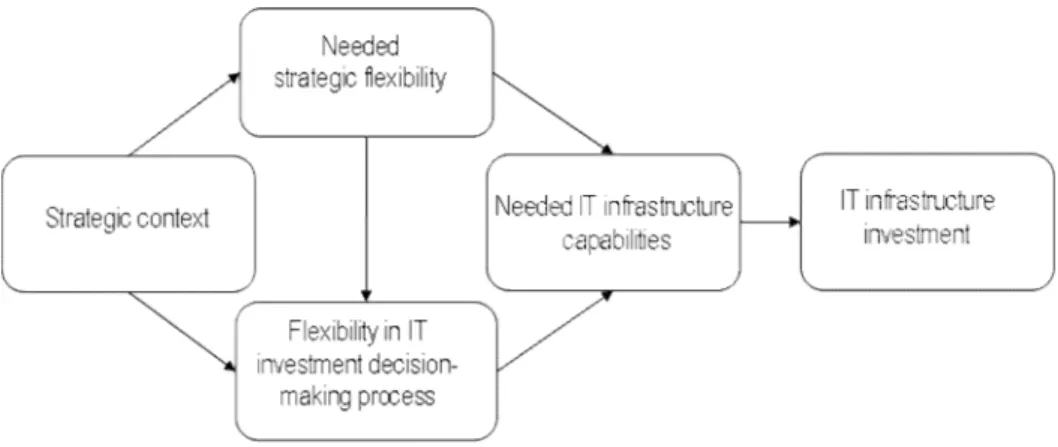
The first issue we will explore is whether managerial flexibility in IT investment decisions is recognized in practice. As we will explain, flexibility is a crucial factor to gain competitive advantage as a firm. Nowadays, managers of most companies seem to be aware of the benefits of being flexible. Since flexibility is a critical success factor in relation to the management and design of IT investments (Kim and Saunders 2003), and understanding flexibility is a difficult issue, it is important to explore how firms build flexibility into their IT investment decisions. Therefore, this will be the purpose of the first study. This initial study looks at decision-making at a strategic firm level and explores the linkages between strategic flexibility, IT infrastructure capabilities, and managerial flexibility in IT project decision-making.
In the second part of our research we investigate how managerial flexibility in IT projects can be valued. Real options theory values managerial flexibility by finding an optimal balance between risk and returns from a financial perspective. However, the value of managerial flexibility in IT projects will not rely on real options value alone. IT projects can typically result in non-financial benefits such as intangible performance improvements (Remenyi et al. 1993). Unlike cost, such benefits primarily impact processes inside an organisation and are seldom easily translatable into cash flow. Therefore, their value is predominantly dependent on (individual) judgement and not on market prices. When finding a balance between risk and IT project benefits to determine the value of managerial flexibility, ignoring this value may negatively impact the insight in the total value of managerial flexibility of the IT project. We develop a theoretical decision-making model which deals with both financial and non-financial criteria. We make a literature investigation and propose decision criteria that should be taken into account to optimally configure an IT project both from a financial and from a
non-financial perspective. The model captures risk regarding the variability of the project’s financial value as well as risk regarding non-financial judgments. We show that the developed decision-making model can generate valuable information for decision-makers required to select from competing IT project configurations using sensitivity analysis. We also will go into the fundamental requirements that need to be met when combining real options analysis with decision analysis.
The third part of our dissertation takes a qualitative perspective on the management of managerial flexibility in relation to IT project risk. Since real options are not inherent in IT projects, they usually must be planned and intentionally embedded in an IT project in order to control specific risk factors (Benaroch 2002). Several researchers have proposed effective combinations of risk and real options to embed in IT projects in order to optimally control risk and maximize IT project value (Benaroch 2002, Kumar 2002). Recognizing which managerial flexibilities to embed in an IT project as a response to risk is one of the main steps that has to be taken by management for deciding whether or not the flexibility as offered by real options is relevant for a specific IT project. In this research, we empirically test the effects of specific risks on the valuation of real options in IT project decisions. The aim is to investigate whether the proposed link between risk management and real options is in line with the intuition managers have. Our approach is to use a field experiment, including a pre-test, to examine how different risk factors and real options embedded in an IT project affect managers’ perceptions of project value. We will test the proposed risk-options relations and investigate possible biases that may exist in the valuation of risk-real options relations.
understand that the flexibility offered by real options has value (Benarch et al. 2006, Tiwana et al. 2006), our research tries to give insight in the fact that this valuation is actually driven by the presence of different types of risk. We intend to investigate whether the proposed option based risk management reasoning as proposed in earlier research generally corresponds with the intuition of managers. This would suggest that managers understand that the value of managerial flexibility offered by different types of options in IT projects can serve as an effective risk countermeasure. Also, we intend to investigate possible biases that may exist in the managerial valuation of real options in the presence of different types of risk. Our study hopes to extend the theoretical literature in which mappings are suggested between different types of risk and the managerial flexibility as offered by different types of options (Micallizi and Trigeorgis 1999, Benaroch 2002, Kumar 2002, Bräutigem et al. 2003). This insight is particularly important since it would suggest that real options theory can be used to study risk management from an economic perspective by linking risk, flexibility, and economic value. Therefore, real options theory may be used as a complementary theory to study risk management behaviour.
The second contribution of this research is to support the insight that - when changing the operating strategy of a project - the number of choices an organisation possesses, the likelihood of the change as well as the ease of change depend on both financial and non-financial criteria which cannot be provided for by real options analysis alone. Many IT project benefits are seldom associated to goods or services sold on an outside market. When decision-makers ignore these benefits in the valuation of managerial flexibility in IT projects, they will ignore vital information in the selection of the most viable type of flexibility to embed in an IT project. This may negatively impact the total value of the IT project. Whilst previous research studies have valued multi-stage investments using real options analysis, they have ignored the multi-dimensional nature of IT project decisions. We develop a decision model to value managerial flexibility in a way that takes
account of the multi-dimensional nature of IT projects by combing real options analysis and decision analysis. We intend to offer a contribution to real options theory and decision theory, by giving an insight in the main theoretical hurdles that have to be taken into account when combining real options theory and decision theory.
Of course, additional research is necessary to give insight in how managers perceive IT project value and which biases they demonstrate in valuing IT projects. This insight is particularly important, since it may give insight in their decision-making rationale when making IT project selection and management decisions at a tactical and strategic level.
1.4
Implications for Practice
Our research has several implications in practice. The major practical implication of our study will be based on our finding whether the managerial valuation of the different types of real options follows real options based risk management reasoning. However, the experimental results will only indicate whether the valuation of different types of real options is taken into account implicitly. The intuitive managerial valuation of real options in the face of risk will be of little practical consequence unless managers become explicitly aware of the value of managerial flexibility. There is no free lunch in managing flexibility; managing and valuing flexibility can be costly when resources are limited, and flexibility may have a negative effect on project commitment. Therefore, mechanisms have to be put in place to maximize real options reasoning in practice. These mechanisms include several aspects.
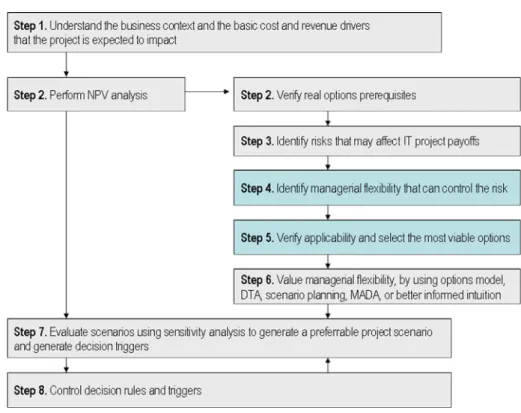
Firstly, management may actively and explicitly identify and select operational options to manage risk at the offset of IT projects. This can be achieved by identifying the most important risks that affect the project’s success. By using a
only in projects with competing scenarios or in projects in which the uncertainty is high or the time-frame is long. The most obvious candidates for the valuation of managerial flexibility are projects that are managed in fast moving environments or projects that are large and complex. The flexibility can be valued using for example real options analysis or decision tree analysis. As is implied by our research, financial analysis tools may be complemented by non-financial decision analysis tools to take into account the full benefits of the embedded flexibility. In projects where valuation of flexibility is not necessary, for example due to reasons of insufficient skills or resources, rules of thumb or experience may be used to ‘value’ flexibility.
Secondly, management may be committed to actually exercising options when appropriate. Project management practices to continuously track the evolving value of options could be employed. Of course, the degree to which these project investment and planning capabilities can be successfully developed and implemented depends on the maturity and culture of the organisation, the maturity of the IT department and the skills of its staff, but most importantly, on the adequacy of the organisation’s and project’s governance structure. This includes the mandate to actively embed and manage flexibility to fully extract its value, but also the mandate to terminate or abandon projects if they do not deliver their expected value. To overcome personal and organisational biases, managers may take steps to change the elements of organisational culture and procedures, for example by defining and implementing ‘exit strategies’ when making the IT project investment. In any case, management may need to explicitly define and communicate decision rules and triggers to be able to manage and control the embedded flexibility during the course of a project, including conditions under which a project can be abandoned.
Another practical implication of our research is that practitioners may invest in different types of IT infrastructure capabilities (Weill et al. 1998) when aiming for different types of strategic flexibility needed at the business side. They may
identify the necessary IT infrastructure capabilities and the accompanying IT infrastructure investments, by actively and explicitly searching for strategic growth options, since these may represent a large part of the IT infrastructure investments value. Since the strategic growth options are mainly business driven, both IT and business can be involved when searching for growth options.
A practical contribution of this research is to provide for a model that relates risk, managerial flexibility and IT project value at different decision-making levels. To our knowledge, this is the first decision-making model that links risk, managerial flexibility and IT project value at a strategic, tactical and managerial decision-making level.
1.5
Research Design: a Multimethod Multilevel Approach
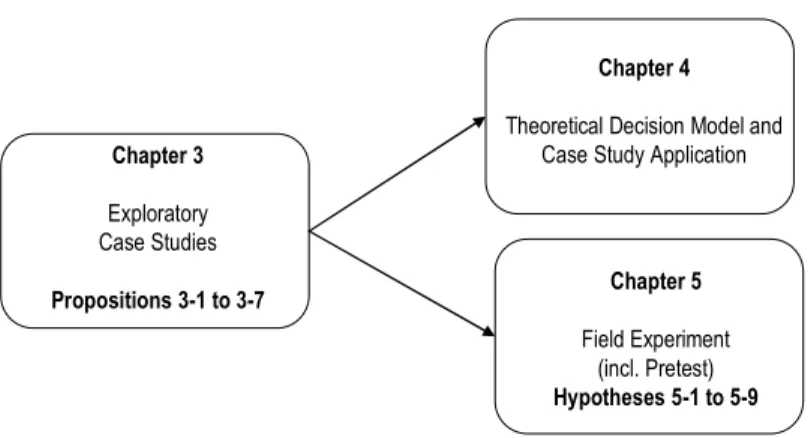
In this dissertation, a multimethod research approach is selected to address the overall research question. Multimethod research aims to strengthen the validity of the research by using multiple methods, whereby the methods are chosen to complement each other’s strengths and weaknesses. Multiple methods can be used in a simultaneous or sequential form (Brewer et al. 1989). In a simultaneous form, the researcher uses multiple methods in the same study to measure the same phenomenon (Mingers 2001). In sequentially using multiple methods, the results of one method are the basis for a new study of the same concept using a different method. The sequential multimethod approach is taken in our overall research (see Figure 1-1). As Figure 1-1 shows, the different research methods we use are (exploratory) case study research and field experiments.
Figure 1-1.Sequential multimethod approach in our research
A multimethod approach is advocated (Mingers 2001) for different reasons. Firstly, a multimethod approach can be an effective way of dealing with the full richness of the phenomena studied. It encourages creativity of the researcher by ‘discovering fresh or paradoxical factors that stimulate further work’ (Mingers 2001). Since a study is rarely a single event but often a longer process, different methods may yield different insights during the study of the whole process. Secondly, the use of different research methods increases the internal and external validity1 of the research, thereby possibly increasing the generalizability of the
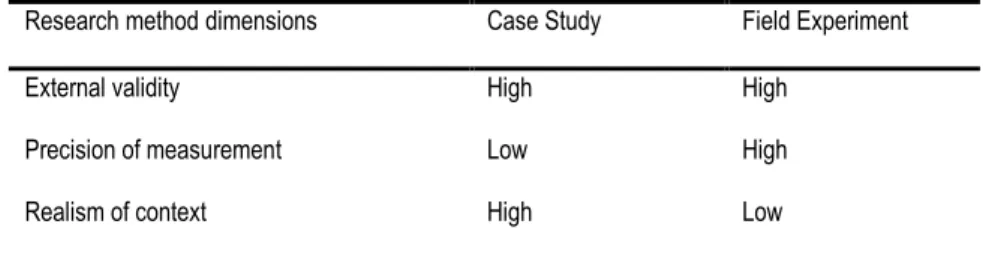
research. Scandura & Williams (2000) identify three dimensions to rate a research method. These are generalizability of the results, precision of measurement, and realism of context. Table 1-1 shows how our two methods score on each of these three dimensions.
1Internal validity refers to the extent to which cause-and-effect conclusions can validly be made in a study and requires that alternative explanations of the results can be eliminated (Yin 1994). External validity refers to the extent to which a study’s findings can be generalized to people beyond those in the specific study. It requires good construct validity, establishing correct operational measures for the concepts being studied, and content validity, to the extent to which a measure represents all facets of a given social concept (Yin 1994).
Chapter 4
Theoretical Decision Model and Case Study Application
Chapter 5 Field Experiment (incl. Pretest) Hypotheses 5-1 to 5-9 Chapter 3 Exploratory Case Studies Propositions 3-1 to 3-7
Research method dimensions Case Study Field Experiment External validity High High
Precision of measurement Low High Realism of context High Low
Table 1-1Dimensions of our research methods (Scandura and Williams 2000) Our sequential multimethod research approach enables us to score high on each of the three dimensions of a research design. The advantage of field experiments is that they create a tightly controlled environment that allows a researcher to establish causality and increase the internal validity (Shadish et al. 2002). Field data have the strength of high external validity. Case study research scores high on external validity and realism of context. Combining the above methods should lead to robust conclusions compared with a single method study. Replicating studies using a different research method challenges the researcher to assess whether the operationalisation made in one study can be replicated or refined to accommodate this new setting while staying consistent with the previous study. By combining analysis from different research methods, we aim at giving a fuller and richer understanding of how risk and managerial flexibility impacts IT project value.
To study IT decision-making, different levels of analyses can be taken. A multilevel approach aims at explaining macro level outcomes using micro level inputs, or vice versa. This research is concerned with organisational decision-making. Organisational decisions are inherently multilevel, since they are taken at various organisational levels (Keuning and Eppink 1979), and either by individuals or by groups. In our research we look at IT decision-making at a firm level (strategic and tactical decisions, that concern the organisation and its external
(tactical level, that concerns the internal structure of the organisation), and at the level of an individual decision-maker (tactical level, that concerns the internal structure of the organisation). In chapter six we conclude by presenting a conceptual model which relates the researched constructs at the different decision-making levels.
1.6
Structure of the Dissertation
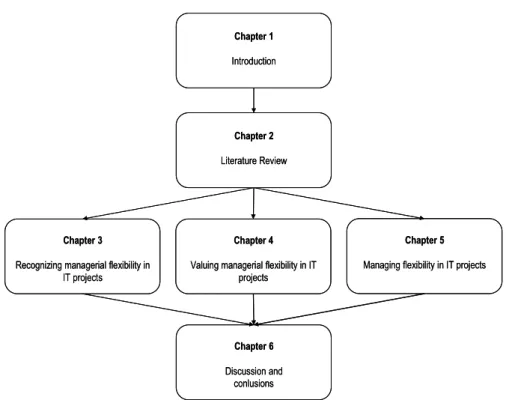
After this introduction, chapter two provides a literature overview. The chapter introduces the detailed research questions that will be the focus of the empirical research chapters. In the following three chapters, we address the research questions by presenting our empirical research. The chapters are relatively independent of each other: each chapter addresses a specific research question. However, the three chapters jointly cover the topic of how the valuation of managerial flexibility impacts IT decision-making. Chapter three focuses on the recognition of managerial flexibility from a firm-perspective. Chapter four addresses the theoretical and practical valuation of managerial flexibility in a specific IT project when dealing with risk. In chapter five we present empirical findings on the managerial valuation of real options in risky IT projects. Finally, in chapter six we discuss our results and conclusions. We discuss the generalizability of our findings, highlight the managerial relevance and discuss implications for future research. Figure 1-2 illustrates the structure of the dissertation.
Figure 1-2.Structure of the dissertation Chapter 1 Introduction Chapter 2 Literature Review Chapter 4
Valuing managerial flexibility in IT projects
Chapter 5
Managing flexibility in IT projects
Chapter 3
Recognizing managerial flexibility in IT projects Chapter 6 Discussion and conlusions Chapter 1 Introduction Chapter 2 Literature Review Chapter 4
Valuing managerial flexibility in IT projects
Chapter 5
Managing flexibility in IT projects
Chapter 3
Recognizing managerial flexibility in IT projects
Chapter 6
Discussion and conlusions
Chapter 2
Literature Review
In this chapter we will review current knowledge on IT project decision-making, risk and flexibility. The literature reviewed in this chapter mainly follows the course of our empirical research as presented in chapters three to six. This research has evolved from doing exploratory research on flexibility by taking a broad perspective on the management of IT infrastructures when facing environmental uncertainty, to a detailed study of dealing with different types of IT risk and managerial flexibility when evaluating IT projects. Therefore, the literature review in this chapter will deal with these topics in a more general overview. In this chapter, we define the main concepts that are used in the subsequent empirical chapters. This provides part of the theoretical background for the studies in the subsequent chapters.
This chapter is structured as follows. In section one, we explain why flexibility is important in gaining competitive advantage when investing in risky IT projects. In section two, we explore the concept of flexibility. In section three, we present different theoretical perspectives on risk management and explain how managerial flexibility can play an important role when dealing with risk. In section four we introduce the valuation of managerial flexibility using real options theory. In the last section we explain the use of real options reasoning in IT risk management.
2.1
Flexibility as a Priority in Gaining Competitive Advantage
In this section, we shortly discuss the concept of competitive advantage and we discuss its link to IT investments. We investigate how the concept of flexibility has become a key priority in gaining competitive advantage.
2.1.1 Competitive Advantage and IT
Practitioners of strategic management in organisations are constantly on the lookout for resources that can bring their firms competitive advantage. The concept was popularized by Porter (1985), who states that competitive advantage grows from the value a firm is able to create that exceeds the firms cost of creating the product or service. Sustained competitive advantage flows from organisational capabilities and resources that are rare, valuable, non-substitutable, and imperfectly imitable (Barney 1991).
Over the past decades, information technology (IT) has been promoted as one of the resources that organisations could use to gain a competitive advantage (Byrd et al. 2001, Charette 1989, Clemons 1986, Kemerer et al. 1991). As IT operates at the core of modern organisations, the efficiency and flexibility with which IT capabilities – hardware, software, skills and expertise – are developed and embedded in the organisation, is business critical (Byrd et al. 2001, Rockart et al. 1996). Although during the 1980s and 1990s, the competitive value of IT was thought to come from the so-called strategic information systems (Reich et al. 1990, Clemons 1991), researchers rationalised that complementary assets or organisational characteristics are needed to keep these systems proprietary to the firm and keep these systems gain competitive advantage (King et al. 1989, Rockart et al. 1996). Nowadays, the search for competitive advantage from IT has shifted much more from strategic information systems to the strategic value of IT infrastructure. Research has shown that the success of companies really is derived
which are components of the organisations’ IT infrastructure (Weill 1993, Davenport et al. 1994).
In this research we use a general definition of IT as given in Boynton et al. (1994):
“The organized combination of hardware, software, data resources and communication networks as well as the knowledge, skills and methods, used for enabling electronically-based information collection, transformation and dissemination.”
In our research we make a distinction between IT projects and IT investments. Although the two terms are often used interchangeably, we refer to IT investments as any use of resources intended to increase future production output or income with the use of IT (derived from Buckley et al 1998). With an IT project we refer to a sequence of activities undertaken to accomplish a temporary endeavour (with a defined completion date) to create a unique product or service over time using IT (derived from Loch et al. 2006). We make a further distinction between different aspects of the general concept of IT (Weill 1993, Weill et al. 1998):
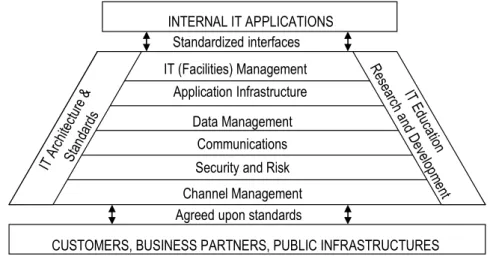
The physical IT infrastructure consisting of hardware, communication networks and basic software such as operating systems and database management systems, including applications that are standard across the firm, such as email applications.
The information systems as applications of IT, to solve specific business problems.
The management-oriented capabilities for an effective provision and use of information resources. These include for example the management of the infrastructure and its relationships with the business, the core policies that govern the use of the infrastructure and determine the future development, and research and development of the IT infrastructure.
One reason for making the above distinction is that decisions planned for each of the mentioned aspects of IT are different in nature, thus requiring the application of different decision logics, different competencies of the decision-maker and the involvement of different people in the decision-making process (Mocker et al. 2006). The concept of IT infrastructure emphasizes the standardization of systems and data throughout the corporation, on the one hand, and the distribution of systems and applications on the other (Benjamin et al. 1984). Many IT infrastructure investments are not business problem specific and thus should not only be seen as serving specific information systems. Weill and Broadbent (1998) confirm this view by stating that IT infrastructure is “shared by multiple business areas and […] used by several different applications”. Thus, IT infrastructure investment decisions are concerned with building a “strategic IT platform […] that not only responds to immediate needs but also provides escalating benefits over the long term” (Rockart et al. 1996). Parker, Benson and Trainor (1998) recognize the specifics of IT infrastructure decisions in that they state that “traditional cost-benefit approaches don’t work well in areas of investment unrelated to specific development projects”. In contrast, each information system addresses a specific business problem or need. The corresponding strategic decisions are made on the basis of so called “business cases” that justify how well these specific business needs are fulfilled.
In a more recent debate on IT, Carr (2003) takes the view that as computer technology becomes more standardized, businesses will have a harder time gaining a competitive edge over their rivals through IT investments. However, in the fierce debate following the article, the main reactions contend that competitive advantage is not the result of standardized desktops, but the result of effective management and use of IT by skilled and highly motivated people (Carr 2003). Firms using identical technologies and spending comparable amounts on IT display an enormous variability in profitability (Strassman 1997).
2.1.2
Flexibility in IT Projects as a Critical Success Factor in Gaining
Competitive Advantage
There is widespread recognition that IT investments are surrounded by uncertainty. Uncertainty facing IT investments arises from many sources—for example, the increasing integration of technologies within and across organisations or the increasing emphasis on using IT to support innovative products and customer-facing processes with hard-to-predict market appeal. There are two fundamental types of uncertainty that play a role when making IT investments: exogenous and endogenous uncertainty (Pindyck 1988). Exogenous uncertainty refers to market and environmental uncertainty, whereas endogenous uncertainty refers to uncertainty that is IT project related and caused within the organisation. Due to sources of endogenous and exogenous uncertainties, IT projects are widely regarded as notoriously risky2(Keen 1981).
Since the existing business environment is characterized by augmented uncertainty and risk, flexibility is regarded as an essential competence for organisations in a rapidly changing and unpredictable world. An organisation should be flexible enough to handle both the unexpected threats and the opportunities posed by an uncertain future and unstable environment. Given the increase in uncertainty and risk, companies that recognize the value of flexibility and that build a degree of flexibility into their IT investments are likely to be at a significant advantage in the future, relative to companies that fail to take account of flexibility in the design and evaluation of IT projects (Baldwin 1987).
2In decision theory and practice it is common to make a distinction between risk and uncertainty. If each of the
possible actions leads to a set of outcomes with known probability the decision is made in an environment of risk. If decision-making is concerned with a number of possible scenarios that can actualize with unknown probability, decisions are made in an environment of uncertainty. The term uncertainty refers to the degree to which future states cannot be anticipated and accurately predicted (Pfeffer and Salancik 1978). Since the terms risk and uncertainty differ only by the degree with which probabilities of outcomes can be defined, it is not surprising that they are mostly used interchangeably in literature and practice (Hertz and Thomas 1983). In this thesis, we will mainly refer to the concept of risk, although probabilities may not always be explicitly assigned to a set of outcomes.
Although flexibility is a core concept in theory and practice, understanding and defining flexibility is a difficult issue as the term is manifold and used in heterogeneous contexts. A growing number of terms is used to refer to flexibility such as agility, adaptability, or resilience. Also, flexibility is used in relation to different concepts such as organisations, IT (infrastructure or information systems), and decision-making. Evans (1991) shaped the expression “polymorphy of the concept flexibility”. For this reason it is important to clarify what types of flexibility are discussed in this work and to define the term flexibility for the purpose of this thesis.
2.2
The Concept and Value of Managerial Flexibility
In this section, we investigate the different perspectives on flexibility and explain why and when flexibility has value in IT projects.
2.2.1 What Does Flexibility Mean?
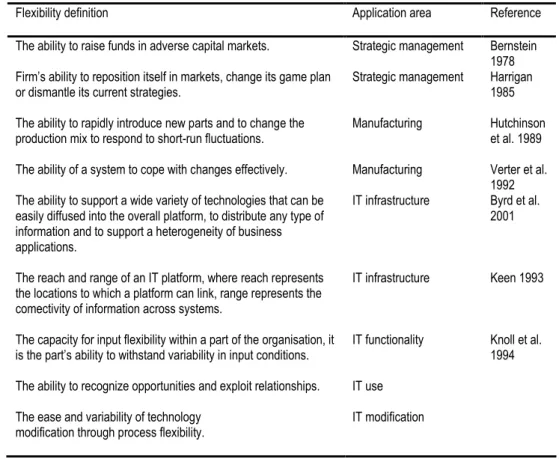
Different dimensions and definitions of flexibility within companies can be found in today’s literature. In psychological terms, a flexible person is open-minded and adaptable, whereas an inflexible person is unable to deal with ambiguity and uncertainty (Anastasi 1990). This is a good starting point for defining flexibility in an economic or a business environment. Flexibility is generally understood as the ability or characteristic of a system to activate or enable a change potential when the demand for change arises either from the environment or from within the system (Gronau 2003). It refers to smooth alterations in practices and policies in the event of unexpected or changing conditions. In Table 2-1 several definitions and references are given of flexibility.
Flexibility definition Application area Reference The ability to raise funds in adverse capital markets. Strategic management Bernstein
1978 Firm’s ability to reposition itself in markets, change its game plan
or dismantle its current strategies. Strategic management Harrigan1985 The ability to rapidly introduce new parts and to change the
production mix to respond to short-run fluctuations.
Manufacturing Hutchinson et al. 1989 The ability of a system to cope with changes effectively. Manufacturing Verter et al.
1992 The ability to support a wide variety of technologies that can be
easily diffused into the overall platform, to distribute any type of information and to support a heterogeneity of business applications.
IT infrastructure Byrd et al. 2001 The reach and range of an IT platform, where reach represents
the locations to which a platform can link, range represents the comectivity of information across systems.
IT infrastructure Keen 1993 The capacity for input flexibility within a part of the organisation, it
is the part’s ability to withstand variability in input conditions. The ability to recognize opportunities and exploit relationships. The ease and variability of technology
modification through process flexibility.
IT functionality IT use IT modification
Knoll et al. 1994
Table 2-1Definitions of flexibility and their application domain
A shortcoming of these definitions is that flexibility in particular functions may be emphasized, while the overall influence of flexibility is overlooked. Chapter three provides a good example of this, where a firm in one of the cases implements an IT platform to enable a multi-channel strategy. This gives the firm the flexibility to quickly respond to changes in aggregate customer demand and customize a product or service to suit an individual customer. However, as one business manager explicitly states, it makes the firm more inflexible from a business unit perspective, since working in multidisciplinary teams makes projects more complex and defining products in one channel takes more time.
Because of such problems, and because the research on flexibility is fragmented across many disciplines, creating confusion and misunderstanding regarding the term’s meaning, some authors tried to find a common way to unify the various interpretations of flexibility.
Volberda (1998) divided flexibility in two types, namely internal flexibility, which is viewed as the capacity of organisations to adapt to the demands of the environment, and external strategic flexibility, which describes the capacity of organisations to influence their environment and thereby reduce their vulnerability. This definition involves the strategy of adaptation to the environment as well as the one of influencing the environment itself. We will use part of this definition in our research in chapter three.
Several authors (Koornhof 1998, Ku 1995) stated that the meaning of flexibility is too multi-faceted to give a single formal definition of it. Koornhof (1998) contends that a definition of flexibility should delineate the space in which a more detailed analysis can take place and exclude other spaces, but without creating a completely unique space for itself. Therefore, it is essential to define flexibility for a special purpose, without violating the broader meaning of flexibility. In line with this, in our research we use the definition as given by Trigeorgis (1993), who defines flexibility as:
“the ability of management to alter its operating strategy, or the course of a single project, by acting in response to the resolution of uncertainty over time in order to capitalize on favourable future opportunities or to mitigate loss.”
We refer to this type of flexibility as managerial flexibility. This definition emphasizes the option character of an IT investment or project, as flexibility in this context implies for a manager the right but not the obligation to change the project settings according to uncertain conditions.
2.2.2 The Importance to Value Managerial Flexibility in IT Projects
Since the flexibility in IT investment opportunities represents value, it is evident that valuing flexibility in a management environment is an important topic to master, not only for a single decision maker, but for the firm as a whole. Failure to give the right value to an IT project could lead a firm to reject investment opportunities that would be worthwhile. In this manner, a firm could easily lose revenues. The value of managerial flexibility can be motivated from the risky choice problems commonly found in microeconomics (Neumann et al. 1944), as shown in Figure 2-1, derived from Miller and Shapira (2004). If the built-in managerial flexibility in this example is ignored, a decision maker would miss important investment value.
We assume a software development project with a risk of being unsuccessful due to inadequate network capacity to run the software system. Due to the risk, the project offers a payoffx1with probability p1(0
< p1< 1) and payoff x2with probability p2, where p1+ p2= 1. The project has an expected value of p1x1+ p2x2.
This standard decision problem assumes commitment to the project must be made beforethe outcome is known. No allowance is made for the possibility that the decision-maker may choose to wait and view the outcome before deciding whether to pursue the project.
Allowing for waiting prior to committing to an uncertain outcome is the key difference in decisions with flexibility. In our example, the project manager has the possibility to wait to invest in the project, allowing her to wait for information on the network problems that could arrive over time. If x1is a gain and x2is a loss, holding this put option favourably truncates the
distribution of the project’s payoff to max (p1x1, 0).
Figure 2-1A risky decision problem without flexibility vs. with flexibility Although organisations know they must innovate (at least occasionally) to thrive, it can still be difficult to decide which IT projects to adopt, when to adopt them, and how to manage the implementation process to realize business value. Nowadays, managers of most companies seem to be aware of the benefits of being flexible (Busby et al. 1997). For this reason, it is surprising that the methods that
are adopted to value flexibility are mostly ad hoc, rather than trying to use a comprehensive, systematic and structured approach.
2.2.3 Different Types of Managerial Flexibility in IT projects
Managers have considerable flexibility in how they approach IT investments. This flexibility can take two basic forms: flexibility in theprocessorcourseof delivering the new system, and flexibility in theresult, i.e., what the system offers for future uses and enhancements (Fichman 2004). Flexibility in the former is promoted by managerial discretion in how projects are decomposed and staged, while flexibility in the latter is promoted by proactive steps to make systems more generic, modular, multipurpose, interoperable, and scalable. This type of flexibility of the functions in the delivered system can also create (or frustrate) variations of process flexibility. For example, if a firm implements a web site using HTML scripts instead of Java, this might limit its ability to expand the web site to handle more traffic and functions if future circumstances justify expansion of the scope or scale of the project.
Many authors provide a clear understanding of the different types of managerial flexibility that management possesses to structure the course of an IT project. To make a first introduction to managerial flexibility in relation to the theory of real options, in Table 2-2 different types of managerial flexibility (real options) as categorized by Trigeorgis (1993) are presented.
Option type Description
Switch use Management can decide to switch the use of a project, when a project is put to a different purpose from that for which it was originally intended (Trigeorgis 1993). Over time, the relative value of alternative uses becomes more apparent and only uses with positive payoffs are pursued.
Change Scale Management can decide to change the scale of a project, allowing the resources allocated to a project to becontractedorexpandedin order to change the scope or the scale of the application (Kumar 2002, Pindyck 1988). The organisation can increase the
Option type Description unfavorable.
Stage Management can stage a project by structuring a project as a series of incremental outlays that allows the project to be terminated if business conditions become unfavorable. As each stage is completed the ambiguities about the net payoffs from subsequent stages are resolved; value is created by only pursuing stages with positive payoffs.
Abandon Management can abandon a project by discontinuing the project prior to completion and redeploy remaining project resources (Hubbard 1993). As a project unfolds actual costs and benefits become more clear, and losses can be curtailed by terminating the project.
Strategic
Growth A growth option is embedded in a project when an initial baseline investment opens thedoor to pursue a variety of potential follow-up investments, not all of which can necessarily be foreseen (Trigeorgis 1993). Over time, the relative value of follow-up investments becomes more apparent and only investments with positive pay offs are pursued.
Defer The initiation of a project can be delayed without risking foregoing a valuable opportunity (Benaroch et al. 1999, Hubbard 1994). The firm avoids investing in what is destined to be a losing proposition, while chances are increased of making the right choice on a crucial project decision.
Table 2-2Classification of different types of managerial flexibility (real options)
2.2.4 Risk as a Key Value Driver of Managerial Flexibility
If there is no purpose to play out flexibility, there is no reason for having or creating it, and thus flexibility will be of no value (Ku 1995). To remain transparent and give a clear message about the value arising from flexibility, a decision maker must decide which type of flexibility is more relevant for an actual project. Besides the augmented clarity in communication of flexibility’s value, there are other reasons which enforce limiting the amount of flexibility to be examined. Barnett (2005) for example, states that looking for strike signals for exercising the managerial flexibility is costly and resources are limited. Busby and Pitts (1997) notice that having flexibility can also have negative effects, in as far the commitment of the organisation to a proposed plan can be undermined. Also, Ku (1995) points out that too much flexibility, i.e. too many options, may be harmful
in as far as they can complicate the analysis and confuse the decision maker. Bräutigem et al. (2003) observe that since flexibility represents the ability to react to a state of resolved risk, this risk is the key presence of flexibility. Mapping flexibilities to risks should be one of the core concepts for decision-maker to decide whether or not managerial flexibility is relevant for a specific IT project.
2.3
IT Risks and Theoretical Perspectives on Risk
As we have described above, managerial flexibility has value in the presence of risk. Therefore, we describe the different types of risk in IT projects and we explain the different definitions of risk and the attitudes towards risk as defined in decision theory and behavioral theory. We will describe the real options perspective on risk, a theory that is used to study the phenomenon of managerial flexibility.
2.3.1
Risk in IT projects
Work on IT project risk management has focused on the identification and categorisation of critical risk factors in IT projects, developing checklists, propose frameworks and risk dimensions (Barki et al. 2001, Boehm 1989, McFarlan 1997, Wallace et al. 2004). The major stream in research on IT risk includes work concerned with firm-specific risk arising in software development projects (Barki et al. 2001, Copeland et al. 2000, Benaroch et al. 2000). Research initially identified technical execution risk factors such as IT personnel skills, project size, technical complexity, and a continuous stream of requirement changes (Boehm 1989), and additionally identified such risk factors as user involvement, top management commitment, and conflicts between user departments (Barki et al. 1993, Keil et al. 1998, Wallace et al. 2004). The second stream of research focuses more on IT risks arising outside the scope of software development and implementation (Clemons 1986, Clemons 1991, Kemerer et al. 1991). This work identifies additional forms of
are especially relevant in the context of strategic information systems. The forms of IT risk can be placed into three categories (Benaroch 2002):
Firm-specific risksare due to uncertain endogenous factors. These factors affect the ability of the firm to successfully realize an IT project. Firm-specific risks can be subdivided in financial risk, project execution risk, scope and requirements risk and organisational risk (see also chapter five).
Competition risksare the result of uncertainty about whether a competitor will make a pre-emptive move, or simply copy the project and improve on it. These risks give rise to the possibility that the investing firm might lose part or all of the project opportunity.
Market risks are due to uncertain exogenous factors that affect every firm considering the same project. These factors can affect the ability of the investing firm to obtain the payoffs expected from a realized project opportunity (see chapter five).
2.3.2
Risk and Attitudes towards Risk in Decision Theory and
Behavioral Theory
In classical decision theory, risk is most commonly defined as reflecting variation in the distribution of possible outcomes, their likelihoods, and their subjective values (Arrow 1965). The idea of risk is embedded in the larger idea of choice as affected by the expected return of an alternative. Risk is measured by the variance of the probability distribution of possible gains and losses associated with a particular alternative (Arrow 1965). In this formulation, a risky alternative is one for which the variance is large.
According to the behavioural view of risk, the managerial perspective on risk differs from classical decision theory. Firstly, although managers regard possibilities for gain as being of primary significance in assessing the attractiveness of alternatives (MacCrimmon et al. 1986), they see ‘risk’ as associated with the negative outcomes. Secondly, managers see risk not primarily
as a probability concept, but rather define it in terms of the magnitude of possible bad outcomes. Thirdly, though quantities may be involved in assessing the level of risk, most managers show little desire to reduce risk to a quantifiable construct. According to Lyytinen et al. (1998), IT project risk management approaches focus on ambiguous losses (Boehm 1989). In the literature dealing with IT project risk, risks are both defined following the decision theoretic view (Boehm 1989, Charette 1989), and following the managerial view in which risk is associated with a negative outcome (Keil et al. 1998, Wallace et al. 2004). Yet, most risk management approaches deal solely with negative outcomes and how to avoid them. In this way, the central insight of the decision theoretic view (the importance of considering the whole distribution of possible outcomes) becomes obscured.
Regarding attitudes towards risk, virtually all theories of choice assume that decision makers prefer larger expected returns to smaller ones, provided all other factors (e.g., risk) are constant (Lindley 1971). In general, they also assume that decision makers are risk averse. When faced with one alternative having a given outcome with certainty, and a second alternative which is a gamble but has the same expected value as the first, an individual will choose the certain outcome rather than the gamble (Pratt 1964, Arrow 1965, Ross 1981). Thus, expected value is assumed to be positively associated, and risk is assumed to be negatively associated with the attractiveness of an alternative. Risk averse decision makers prefer relatively low risks and are willing to sacrifice some expected return in order to reduce the variation in possible outcomes (March and Shapira 1987). Risk seeking decision makers prefer relatively high risks and are willing to sacrifice some expected return in order to increase variation (March and Shapira 1987). The decision theoretic view implicitly considers that decision makers normally have to be compensated for variability in possible outcomes. It also assumes that decision makers are passive in managing risk. It assumes that all alternatives are given, their features cannot be changed to affect risk and decision makers deal with risk
by first calculating and then choosing among the available alternative risk-return combinations (Yates 1992).
The behavioural view of risk has several implications for this classical decision theoretic view of risk management. Firstly, when risk involves great losses, managers act in a loss-aversive manner instead of a rational manner as predicted by the traditional theory (Kahneman and Tversky 1982). They make fast decisions to avoid risks, negotiate uncertainty absorbing contracts, or just delay decisions if possible (MacCrimmon and Wehrung 1986). Secondly, managing risks is not seen as gambling, but as mastering the environments so as to bring the risks under control. Management seeks to modify risks, rather than simply accept them, and they assume that risk is controllable and manageable (MacCrimmon and Wehrung 1986). Bringing risk under control is seen as entailing the active mastering of the environment. Thirdly, managers neither understand, nor care to use precise probability estimates: crude characterizations are used to exclude certain possibilities from the decision (Fischoff et al. 1981) and thus make the managerial process a sequential pruning exercise instead of a one-shot decision.
According to Lyytinen et al. (1998) the behavioural perspective on risk (March and Shapira 1987) seems more appropriate in explaining current practices of managing IT project risks than the classical decision theoretic view on risk management.
2.3.2 Real Options Theory and IT Risk Management
An important aspect that forms a foundation for the research in our empirical chapters is the use of real options reasoning. Real options reasoning can represent a valuable theoretical foundation for studying IT risk management for several reasons. Firstly, real options theory views risk as a trait of a project or of its contextual environment that affects the degree of variation in both negative and positive expected outcomes (Benaroch 2006). The IT risk management focus on
avoiding the negative outcomes of risk may neglect the opening up to future expansion opportunities as a response to positive risk, which are regarded as specifically valuable (Benaroch 2002, McGrath 1997). Secondly, although the behavioural view shows us that managers neither understand, nor care to use probability estimates, the attitude towards risk in the options perspective is more in line with the behavioural than with the decision theoretic perspective. Real options based risk management suggests that management should proactively manage strategic investments, by creating opportunities for mid-course corrections to investment strategies (Teece 2006). The real options approach assumes that strategy is a path of related options and there is no well thought-through overall strategy. By using managerial flexibility to deal with risk, managers can avoid risk or bring it down to acceptable proportions, for example by delaying decisions, transferring risk to a third party or by redirecting the course of the project. So the real options perspective may represent a promising complementary theory to existing theories by offering an economic perspective on risk management logic as observed in practice.
2.4
The Valuation of Managerial Flexibility in IT Projects using
Real Options Theory
As real options theory represents a promising candidate for studying risk management in IT projects, in this section we will introduce the core concepts of real options theory. We will introduce the two main real options research streams in the IS field and briefly review real options critique.
2.4.1 Real Options Theory and Managerial Flexibility
Using real options theory, decision-makers are able to evaluate managerial flexibility using the value of an investment and its risk profile (Kulatilaka et al. 1996). A real option, by definition, gives the holder the right, but not the
options theory considers the risk firms face due to technical, organisational and environmental factors (Tallon et al. 2002). If future events remove or otherwise reduce the key sources of risk to some satisfactory level, the firm may exercise its option to invest (Tallon et al. 2002). Using real options, a project may allow for downside protection against adverse risk, e.g., by deferring the project or by reducing its scale. But it also endows a manager with the possibility of profiting from growth opportunities in case of favourable conditions, for example by expanding the scale or the scope of the project.
Three conditions are prerequisite to using real options concepts to structure the evaluation and management of technology investments, and all three conditions hold strongly for IT projects.
Uncertainty regarding net payoffs: as we have described earlier, net payoffs in IT projects are typically uncertain.
Irreversibility in project costs. Irreversibility is defined as the impossibility to reverse or correct a decision with no cost. Regarding the condition of irreversibility, the adoption of an IT project is essentially an investment in a new organisational capability, and such investments are largely irreversible due to the tight coupling of technology and organisation (Kogut et al. 2001). While a portion of expenditures for hardware and software can be reversed in some cases, other direct costs associated with organisational learning and adaptation cannot be reversed. These costs include expenditures for training, hiring experienced workers and consultants, engaging in learning by doing, developing new policies and procedures, and absorbing losses in productivity during the transition from old to new (Fichman 2004).
Managerial flexibility regarding how projects are structured (Dixit et al. 1994). As described earlier, managers have considerable flexibility in how they approach IT projects. This flexibility can take the form of flexibility in the configuration of a project, for example through staging or incremental development.
Different types of real options may be present in IT projects, as described in Table 2-1 (Trigeorgis 1993). A distinction can be made between operating real options and strategic real options. Operating real options relate to the operational aspects of the project (timing, scale, scope, etc.) and allow to flexibly change investment configuration features. These options are the option to defer, the option to change scale, the option to switch use, the option to abandon and the option to stage. Strategic growth optionsspawn new investment opportunities and refer to the opportunity to grow the project's scope beyond what was initially anticipated through follow-up investments (Benaroch 2002). Strategic flexibility options are especially interesting in case of IT infrastructure investments, as we shall see in chapter three, since their value is derived from follow-up investments.
In the information systems research field, there are two main streams of research with regard to real options theory. One stream focuses on real options analysis (Benaroch and Kauffman 1999, Benaroch 2000), and is high on rigor and the technical aspects of valuing investments using real option analysis. However, it often overlooks the complexities of applying real options to the kind of projects IT managers actually face. The other stream focuses onreal options reasoningorreal options thinking(Fichman 2004, Fichman et al. 2005, Tiwana et al. 2006, Tiwana et al. 2007), a strategy focus concerned with the articulation of managerial heuristics and reasoning processes based on the real options logic. This stream recognizes the complexities of applying real options in practice. It typically offers no rigorous approach to configuring the various real options that could be embedded in real projects.
The focus of our research is mainly directed to the options reasoning research, as we show in chapter three and five. In chapter four we will use a real options analysis to compare the real options value with other valuation techniques. We will first discuss real options analysis, as its core concepts represent the basis for options reasoning. In the next section we present real options reasoning and its
2.4.2 Real Options Analysis
In capital budgeting theory, the value of an asset (or an entire company) equals the discounted present value of its expected future cash flows. Cash flows are the cash inflow and cash outflow of the organisation. Normally, the legal boundary of the company is taken as the ‘border’. This net present value (NPV) is exactly the same as the increase in shareholders’ wealth (Buckley et al. 1998). Hence, companies contemplating investments in capital projects should use the NPV rule. That is, take the project if the NPV is positive but reject it if the NPV is negative or zero. The attractiveness of an IT investment project is then calculated by the summation of the associated cash flows. In formula (Copeland et al. 2001):
NPV =∑ (CFt/ (1 +k))^t- I0, fort= 1,…,n
CFtstands for the sum of cash flows in yeart. The cost of capital isk. I0stands for
the initial investment (cash flows) at the beginning of the project. NPV stands for net present value, the sum of the discounted cash flows of the investment. The NPV rule assumes that no decision or action will be taken in the future once the project starts to take place; that is, it assumes that all expected cash flows are precommitted. As we have argued earlier, this is typically not the case with IT projects. Therefore, the NPV rule is argued to represent the lower bound of an ongoing project’s actual value to the firm (Taudes et al. 2000). The difference in the valuation of an investment without flexibility as opposed to an investment with flexibility is shown in Figure 2-2.
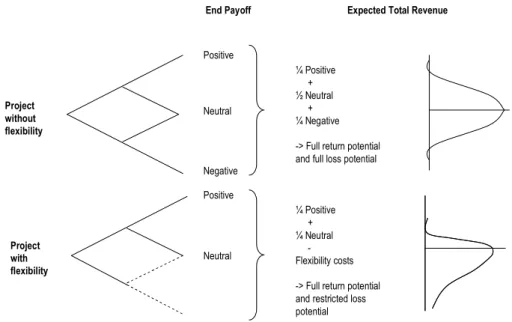
Figure 2-2: IT project value with and without managerial flexibility (Scialdone 2007)
Let us assume that a project’s outcome can either go up or down in both time periods. The upper decision tree in the figure represents the project without flexibility. The outcome at the end of period two can be either positive (i.e. two times up), neutral (one time up and one time down) or negative (two times down). The middle outcome is twice as likely as the other two outcomes because it can be reached in two different ways. This will result in a normal distribution of the project’s expected cash flow. The lower project investment incorporates managerial flexibility, considering the possibility to skip the negative outcomes (depicted in dotted lines). This results in an asymmetrical distribution of the project’s payoff. Therefore, Fischer (2002) concluded that the NPV on its own is unsuitable for valuing projects as it represents the lower bound of project value under high uncertainty.
Positive Neutral Negative Positive Neutral ¼ Positive + ½ Neutral + ¼ Negative -> Full return potential and full loss potential
¼ Positive + ¼ Neutral
-Flexibility costs -> Full return potential and restricted loss potential
End Payoff Expected Total Revenue
Project without flexibility Project with flexibility