Database foundations for scalable RDF
processing
Katja Hose1, Ralf Schenkel1,2, Martin Theobald1, and Gerhard Weikum1 1 Max-Planck-Institut f¨ur Informatik, Saarbr¨ucken, Germany
2
Saarland University, Saarbr¨ucken, Germany
Abstract. As more and more data is provided in RDF format, storing huge amounts of RDF data and efficiently processing queries on such data is becoming increasingly important. The first part of the lecture will introduce state-of-the-art techniques for scalably storing and query-ing RDF with relational systems, includquery-ing alternatives for storquery-ing RDF, efficient index structures, and query optimization techniques. As central-ized RDF repositories have limitations in scalability and failure tolerance, decentralized architectures have been proposed. The second part of the lecture will highlight system architectures and strategies for distributed RDF processing. We cover search engines as well as federated query pro-cessing, highlight differences to classic federated database systems, and discuss efficient techniques for distributed query processing in general and for RDF data in particular. Moreover, for the last part of this chap-ter, we argue that extracting knowledge from the Web is an excellent showcase – and potentially one of the biggest challenges – for the scal-able management of uncertain data we have seen so far. The third part of the lecture is thus intended to provide a close-up on current approaches and platforms to make reasoning (e.g., in the form of probabilistic infer-ence) with uncertain RDF data scalable to billions of triples.
1
RDF in centralized relational databases
The increasing availability and use of RDF-based information in the last decade has led to an increasing need for systems that can store RDF and, more impor-tantly, efficiencly evaluate complex queries over large bodies of RDF data. The database community has developed a large number of systems to satisfy this need, partly reusing and adapting well-established techniques from relational databases [122]. The majority of these systems can be grouped into one of the following three classes:
1. Triple storesthat store RDF triples in a single relational table, usually with additional indexes and statistics,
2. vertically partitioned tablesthat maintain one table for each property, and 3. Schema-specific solutions that store RDF in a number of property tables
In the following sections, we will describe each of these classes in detail, fo-cusing on two important aspects of these systems:storage and indexing, i.e., how are RDF triples mapped to relational tables and which additional support struc-tures are created; and query processing, i.e., how SPARQL queries are mapped to SQL, which additional operators are introduced, and how efficient execution plans for queries are determined. In addition to these purely relational solutions, a number of specialized RDF systems has been proposed that built on non-relational technologies, we will briefly discuss some of these systems. Note that we will focus on SPARQL3processing, which is not aware of underlying RDF/S or OWL schema and cannot exploit any information about subclasses; this is usually done in an additional layer on top.
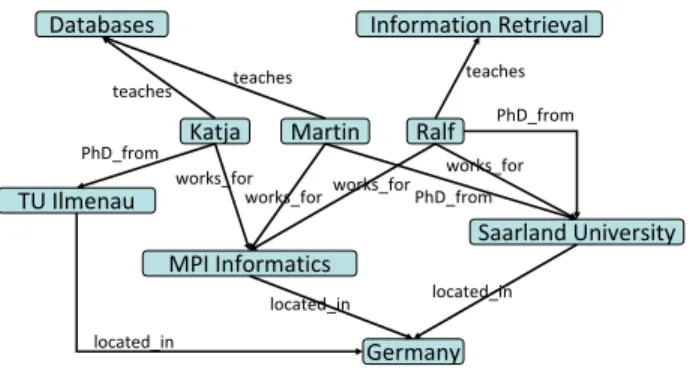
We will explain especially the different storage variants with the running example from Figure 1, some simple RDFfactsfrom a university scenario. Here, each line corresponds to a fact (triple, statement), with a subject (usually a resource), aproperty (orpredicate), and anobject (which can be a resource or a constant). Even though resources are represented by URIs in RDF, we use string constants here for simplicity. A collection of RDF facts can also be represented as a graph. Here, resources (and constants) are nodes, and for each fact<s,p,o>, an edge fromstoois added with labelp. Figure 2 shows the graph representation for the RDF example from Figure 1.
<Katja,teaches,Databases> <Katja,works_for,MPI Informatics> <Katja,PhD_from,TU Ilmenau> <Martin,teaches,Databases> <Martin,works_for,MPI Informatics> <Martin,PhD_from,Saarland University> <Ralf,teaches,Information Retrieval> <Ralf,PhD_from,Saarland University> <Ralf,works_for,Saarland University> <Saarland University,located_in,Germany> <MPI Informatics,located_in,Germany>
Fig. 1.Running example for RDF data
1.1 Triple Stores
Triple stores keep RDF triples in a simple relational table with three or four attributes. This very generic solution with low implementation overhead has been very popular, and a large number of systems based on this principle are available. Prominent examples include 3store [56] and Virtuoso [41] from the Semantic Web community, and RDF-3X [101] and HexaStore [155] that were developed by database groups.
3
Martin Ralf Katja
Saarland University MPI Informatics
Databases Information Retrieval
Germany TU Ilmenau teaches teaches teaches PhD_from PhD_from PhD_from works_for works_for works_for located_in located_in located_in works_for
Fig. 2.Graph representation for the RDF example from Figure 1
Storage. RDF facts are mapped to a generic three-attribute table of the form
(subject,property,object), also know as triple table; for simplicity, we will abbreviate the attributes by S, P, and O. To save space (and to make access structures more efficient), most systems convert resource identifiers, properties and constants to numeric ids before storing them in the relation, for example by hashing. The resulting map is usually stored in an additional table, sometimes separately for resource ids and constants. If a system stores data from more than one source (or more than one RDF graph), the relation is often extended by a fourth numeric attribute, the graph id(abbreviated asG), that uniquely identifies the source of a triple. In this case, the relation is also called aquadruple table.
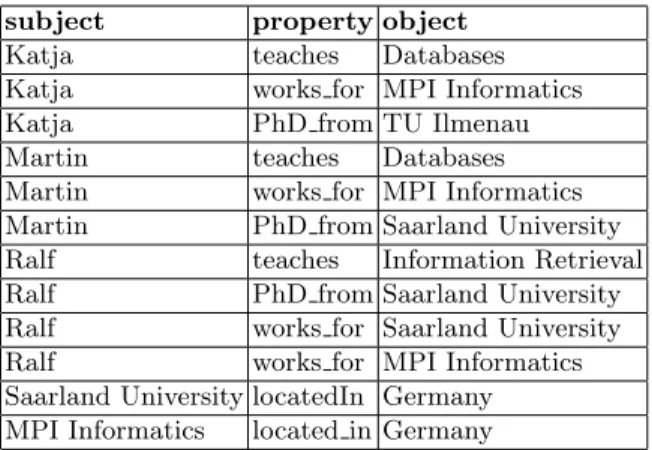
Figure 3 shows the resulting three-attribute relation for the example from Figure 1.
For efficient query processing, indexes on (a subset of) all combinations of
S, P, and OS are maintained. This allows to efficiently retrieve all matches for a triple pattern of a SPARQL query. We will often refer to indexes with the sequence of the abbreviations of the indexed attributes (such asSPO). Since each index has approximately the size of the relation, the number of combinations for which indexes are kept is usually limited, or indexes are stored in a compressed way.
Virtuoso[40] comes with a space-optimized way of mapping resources, predi-cates and constants to numeric ids (IRI ID). These strings are mapped to numeric ids only if they are long (which means at least 9 bytes long), otherwise, they are stored as text in the quadruple relation (this saves for short objects over a
solu-subject property object
Katja teaches Databases
Katja works for MPI Informatics
Katja PhD from TU Ilmenau
Martin teaches Databases
Martin works for MPI Informatics Martin PhD from Saarland University Ralf teaches Information Retrieval Ralf PhD from Saarland University Ralf works for Saarland University Ralf works for MPI Informatics Saarland University locatedIn Germany MPI Informatics located in Germany
Fig. 3.Triple store representation for the running example from Figure 1
tion that maps everything to ids). It uses a standard quadruple table(G,S,P,O)
with a primary key index on all four attributes together. In addition, it uses a bitmap index on (O,G,P,S): This index maintains, for each combination of
(O,G,P) in the data, a bit vector. Each subject is assigned a bit position, and for a quadruple (g,s,p,o) in the data, the bit position for s is set to 1 in the bit vector for (o,g,p). Virtuoso stores distinct values within a page only once and eliminates common prefixes of strings. An additional compression of each page with gzip yields a compression from 8K to 3K for most pages.
RDF-3X uses a standard triple table and does not explicitly support multi-ple graphs. However, RDF-3X never actually materializes this table, but instead keeps clustered B+ tree indexes on all six combinations of (S,P,O). Additionally, RDF-3X includes aggregated indexes for each possible pair of (S,P,O) and each order, resulting in six additional indexes. The index on (S,O), for example, stores for each pair of subject and object that occurs in the data the number of triples with this subject and this object, we’ll refer to this index asSO*. Such an index allows to efficiently answer queries like select ?s ?o where {?s ?p ?o}. We could process this by scanning theSOPindex, but we don’t need the exact bind-ings for?pto generate the result, so we read many index entries that don’t add new results. All we need is, for each binding of ?sand?o, the number of triples with this subject and this object, so that we can generate the right number of results for this binding (including duplicates). TheSO*index can help a lot here. Finally, RDF-3X maintains aggregated indexes for each single attribute, again plus triple counts.
To reduce space requirements of these indexes, RDF-3X stores the leaves of the indexes in pages and compresses them. Since these leaves contain triples that often share some attribute values and all attributes are numeric, it uses delta encoding for compression. This, together with encoding strings into comparably short numbers, helps to keep the overall size of the database comparable or even slightly smaller than the size of the uncompressed RDF triples in textual representation. The original RDF-3X paper [101] includes a discussion of
space-time tradeoffs for compression and shows that, for example, compression with LZ77 generates more compact indexes, but requires significantly more time to decompress.
Query Processing and Optimization. Query execution on a quadruple store is done in two steps,convertingthe SPARQL query into an equivalent SQL query, and creating and executing aquery plan for this SQL query.
Step 1.The conversion of a SPARQL query to an equivalent SQL query on the triple/quadruple table is a rather straight-forward process; we’ll explain it now for triple tables. For each triple pattern in the SPARQL query, a copy of the triple relation is added to the query. Whenever a common variable is used in two patterns, a join between the corresponding relation instances is created on the attributes where the variable occurs. Any constants are directly mapped to conditions on the corresponding relation’s attribute.
As an example, consider the SPARQL query
SELECT ?a ?b WHERE {?a works_for ?u.
?b works_for ?u. ?a phd_from ?u. }
which selects people who work at the same place where they got their phd, together with their coworkers. This is mapped to the SQL query
SELECT t1.s, t2.s FROM triple t1, triple t2, triple t3 WHERE t1.p=’works_for’ AND t2.p=’works_for’ AND t3.p=’phd_from’ AND t1.o=t2.o AND t1.o=t3.o AND t1.s=t3.s
Note that in a real system, the string constants would usually be mapped to the numeric id space first. Further note that we can optimize away one join here (t2.o=t3.o) since it is redundant.
Step 2. Now that we have a standard SQL query, it is tempting to simply rely on the existing relational backends for optimizing and processing this query. This is actually done in many systems, and even those systems which implement their own backend system use the same operators used in relational databases. Converting the SQL query into an equivalent abstract operator tree, for example an expression in relational algebra, is again straight-foward.
Once this is done, the next step is creating an efficient physical execution plan, i.e., decide how the abstract operators (joins, projection, selection) are mapped to physical implementations in a way that the resulting execution is as cheap (in terms of I/O and CPU usage) and as fast (in terms of processing times) as possible. The choice of implementations is rather huge, for example a join operator can be implemented with merge joins, hash joins, or nested loop
joins. Additionally, a number of specialized joins exist (such as outer joins and semi joins) that can further improve efficiency. An important physical operator in many systems are index lookups and scans which exploit the numerous indexes that systems keep. Often, each triple pattern in the original SPARQL query corresponds to an index scan in the corresponding index if that index is available, for example, the triple pattern?a works for ?bcould be mapped on a scan of the PSOindex, if that exists. If the optimal index does not exist, scans of less specific indexes can be used, but some information from that index must be skipped. For example, if the system provides only an O index, a pattern ?a works for MPI Informaticscan be mapped to a scan of theOindex, starting at MPI Informatics and skipping all entries that do not match the predicate constraint.
Finding the most efficient plan now includes considering possible variants of physical plans (such as different join implementations, different join orders, etc.) and selecting the most efficient plan. This, in turn, requires that the execution cost for each plan is estimated. It turns out that off-the-shelf techniques imple-mented in current relational databases, for example attribute-level histograms to represent the distribution. These techniques were not built for dealing with a sin-gle, large table. The main problem is that they ignore correllation of attributes, since statistics are available only separately for each attribute. Estimates (for example how many results a join will have, or how many results a selection will have) are therefore often way off, which can lead to arbitrarily bad execu-tion plans. Multi-dimensional histograms, on the other hand, could capture this correllation, but can easily get too large for large-scale RDF data.
RDF-3X [100, 101] comes with specializes data structures for maintaining statistics. It uses histograms that can handle any triple pattern and any join, but assume independence of different patterns, and it comes with optimizations for frequent join paths. To further speed up processing, it applies sideway infor-mation passing between operators [100]. It also includes techniques to deal with unselective queries which return a large fraction of the database.
Virtuoso [40] exploits the bit vectors in its indexes for simple joins, which can be expressed as a conjunction of thse sparse bit vectors. As an example, consider the SPARQL query
select ?a
where {?a works_for Saarland University. ?a works\for MPI Informatics.}
To execute this, it is sufficient to load the bit vectors for both triple patterns and intersect them. For cost estimation, Virtuoso does not rely on per-attribute histogram, but uses query-time sampling: If a triple pattern has constants for
pand oand the graph is fixed, it loads the first page of the bit vector for that pattern from the index, and extrapolates selectivity from the selectivity of this small sample.
Further solutions on the problem of selectivity estimation for graph queries were proposed by [90, 91] outside the context of an RDF system; Stocker et al. [135] consider the problem of query optimization with graph patterns.
1.2 Vertically Partitioned Tables
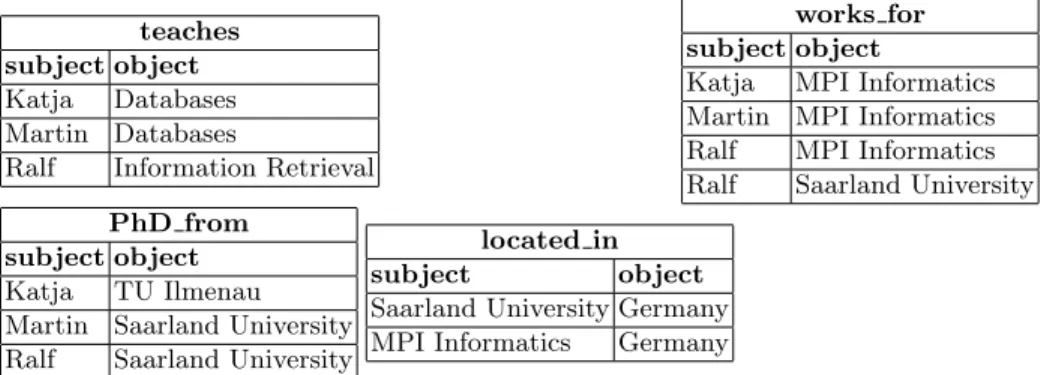
The vast majority of triple patterns in queries from real applications has fixed properties. To exploit this fact for storing RDF, one table with two attributes, one for storing subjects and one for storing objects, is created for each property in the data; if quadruples are stored, a third attribute for the graphid is added. An RDF triple is now stored in the table for its property. Like in the Triple table solution, string literals are usually encoded as numeric ids. Figure 4 shows how our example data from Figure 1 is represented with vertically partitioned tables.
teaches subject object Katja Databases Martin Databases
Ralf Information Retrieval
works for subject object
Katja MPI Informatics Martin MPI Informatics Ralf MPI Informatics Ralf Saarland University PhD from
subject object Katja TU Ilmenau Martin Saarland University Ralf Saarland University
located in subject object Saarland University Germany MPI Informatics Germany
Fig. 4.Representation of the running example from Figure 1 with vertically partitioned tables
Sinces tables have only two columns, this idea can be further pushed by not storing them in a traditional relational system (a row store), but in a column store. A column store does not store tables as collections of rows, but as collection of columns, where each entry of a column comes with a unique ID that allows to reconstruct the rows at query time. This has the great advantage that all entries within a column have the same type and can therefore be compressed very efficiently. The idea of using column stores for RDF was initially proposed by Abadi et al. [2], Sidirourgos et al. [130] pointed out advantages and disadvantages of this technique.
Regarding query processing, it is evident that triple patterns with a fixed property can be evaluated very efficiently, by simply scanning the table for this property (or, in a column store, accessing the columns of this table). Query optimization can also be easier as per-table statistics can be maintained. On the other hand, triple patterns with a property wildcard are very expensive since they need to access all two-column tables and form the union of the results.
1.3 Property Tables
In many RDF data collections, a large number of subjects have the same or at least are largely overlapping set of properties, and many of these properties will
be accessed together in queries (like in our example above that asked for people that did their PhD at the same place where they are working now). Combin-ing all properties of a subject in the same table makes processCombin-ing such queries much faster since there is no need for a join to combine the different properties. Property tables do exactly this: Groups of subjects with similar properties are represented by a single table where each attribute corresponds to a property. A set of facts for one of these subjects is then stored as one row in that table, where one column represents the subjects, and the other columns store objects for the properties that correspond to that column, or NULL if no such property exists. The most prominent example for this storage structure is Jena [23, 158]. Chong et al. [27] proposed property tables as external view (which can be material-ized) to simplify access to triple stores. Levandoski et al [80] demonstrate that property tables can outperform triple stores and vertically partitioned tables for RDF data collections with regular structure, such as DBLP or DBPedia.
This table layout comes with two problems to solve: First, there should not be too many NULL values since they increase storage space, so storing the whole set of facts in a single table is not a viable solution. Instead, the set of subjects to store in one table can be determined by clustering subjects by the set of their properties, or subjects of the same type can be stored in the same table if schema information is available. Second, multi-valued properties, i.e., properties that can have more than one object for the same subject, cannot be stored in this way without breaking the relational paradigm. In our example, people can work for more than one institution at the same time. To solve this, one can either create multiple attributes for the same property, but this works only if the maximal number of different objects for the same property and the same subject is rather small. Alternatively, one can store facts with these properties in a standard triple table.
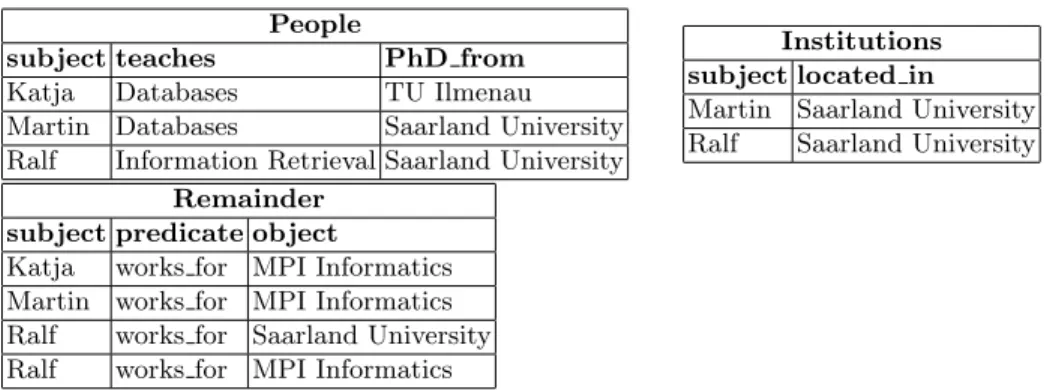
Figure 5 shows the representation of the example from Figure 1 with property tables. We grouped information about people in thePeopletable and informa-tion about Instituinforma-tions in the Institutions table. As theworks for property can have multiple objects per subject, we store facts with this property in the
Remaindertriple table.
1.4 Specialized Systems
Beyond the three classes of systems we presented so far, there are a number of systems that don’t fit into these categories. We will shortly sketch these systems here without giving much detail, and refer the reader to the referenced original papers for more information.
Atre et al. [9] recently proposed to store RDF data in matrix form. Com-pressed bit vectors help to make query processing efficient. Zhou and Wu [160] propose to split RDF data into XML trees, rewrite SPARQL as XPath and XQuery expressions, and implement an RDF system on top of an XML database. Fletcher and Beck [42] propose to index not triples, but atoms, and introduce the Three-Way Triple Tree, a disk-based index.
People
subject teaches PhD from Katja Databases TU Ilmenau Martin Databases Saarland University Ralf Information Retrieval Saarland University
Institutions subject located in
Martin Saarland University Ralf Saarland University Remainder
subject predicate object
Katja works for MPI Informatics Martin works for MPI Informatics Ralf works for Saarland University Ralf works for MPI Informatics
Fig. 5.Representation of the running example from Figure 1 with property tables
A number of proposals aims at representing and indexing RDF as graphs. Baolin and Bo [85] combine in their HPRD system a triple index with a path index and a content index. Liu and Hu [84] propose to use a dedicated path index to improve efficiency of RDF query processing. Grin [149] explicitly uses a graph index for RDF processing. Matono et al. [92] propose to use a path index based on suffix arrays. Br¨ocheler et al propose to use DOGMA, a disk-based graph index, for RDF processing.
2
RDF in distributed setups
Managing and querying RDF data efficiently in a centralized setup is an impor-tant issue. However, with the ever-growing amount of RDF data published on the Web, we also have to pay attention to relationships between web-accessible knowledge bases. Such relationships arise when knowledge bases store seman-tically similar data that overlaps. For example, a source storing extracted in-formation from Wikipedia (DBpedia [10]) and a source providing geographical information about places (GeoNames4) might both provide information about the same city, e.g., Berlin.
Such relationships are often expressed explicitly in the form of RDF links, i.e., subject and object URIs refer to different namespaces and there-fore establish a semantic connection between entities contained in differ-ent knowledge bases. Consider again the above mdiffer-entioned sources (DB-pedia and GeoNames) [15], both provide information about the same en-tity (e.g. Berlin) but use different identifiers. Thus, the following RDF triple links the respective URIs and expresses that both sources refer to the same entity: (<http://dbpedia.org/resource/Berlin>, <owl:sameAs>,
http://sws.geonames.org/2950159/)
The exploitation of these relationships and links offers users the possibility to obtain a wide variety of query answers that could not be computed considering
4
a single knowledge base but require the combination of knowledge provided by multiple sources. Computing such query answers requires sophisticated reasoning and query optimization techniques that also take the distribution into account. An important issue in this context that needs to be considered is the interface that is available to access a knowledge base [63]; some sources provide SPARQL endpoints that can answer SPARQL queries, whereas other sources offer RDF dumps – an RDF dump corresponds to a large RDF document containing the RDF graph representing a source’s complete dataset.
TheLinking Open Data initiative5 is trying to enforce the process of estab-lishing links between web-accessible RDF data sources – resulting inLinked Open Data[15], a detailed introduction to Linked Data is provided in [11]. The Linked Open Data cloud resembles the structure of the World Wide Web (web pages connected via hyperlinks) and relies on the so-called Linked Data principles [14]:
– Use URIs as names for things.
– Use HTTP URIs so that people can look up those names.
– When someone looks up a URI, provide useful information, using the stan-dards (RDF, SPARQL).
– Include links to other URIs, so that they can discover more things.
For a user there are several ways to access knowledge bases and exploit links between them. A basic solution isbrowsing[38,57,148]: the user begins with one data source and progressively traverses the Web by following RDF links to other sources. Browsers allow users to navigate through the sources and are therefore well-suited for non-experts. However, for complex information needs, formulating queries in a structured query language and executing them on the RDF sources is much more efficient. Thus, in the remainder of this section we will discuss the main approaches for distributed query processing on RDF data sources – a topic, which has also been considered in recent surveys [51,63]. We begin with an overview of search engines in Section 2.1 and proceed with approaches adhering to the principles of data warehouses (Section 2.2) and federated systems (Sec-tion 2.3). We proceed with approaches that discover new sources during query processing (Section 2.4) and end with approaches applying the P2P principle (Section 2.5).
2.1 Search engines
Before discussing how traditional approaches known from distributed database systems can be applied in the RDF and Linked Data context, let us discuss an alternative to find linked data on the Web: search engines.
The main idea is to crawl RDF data from the Web and create a centralized index based on the crawled data. The original data is not stored permanently but dropped once the index is created. Since the data provided by the original sources changes, indexes need to be recreated from time to time. In order to
5
answer a user query, all that needs to be done is to perform a lookup operation on the index and to determine the set of relevant sources. In most cases user queries consist of keywords that the search engine tries to find matching data for. The so found results and relevant sources are output to the user with some additional information about the results.
The literature proposes several central index search engines, some of them are discussed in the following. We can distinguish local-copy approaches [26, 34, 58] that collect local copies of the crawled data and index-only approaches [37, 108] that only hold local indexes for the data found on the Web. Another distinguish-ing characteristic is what search engines find: RDF documents [37, 108] or RDF objects/entities [26, 34, 58].
Swoogle. One of the most popular search engines for the Semantic Web was Swoogle [37]. It was designed as a system to automatically discover Semantic Web documents, index their metadata, and answer queries about them. Using this engine, users can find ontologies, documents, terms, and other data published on the Web.
Swoogle uses an SQL database to store metadata about the documents, i.e., information about encoding, language, statistics, ontology annotations, re-lationships among documents (e.g., one ontology imports another one), etc. A crawler-based approach is used to discover RDF documents, metadata is ex-tracted, and relationships between documents are computed. Swoogle uses two kinds of crawlers: a Google crawler using the Google web service to find relevant Semantic Web documents and a crawler based on Jena2 [157], which identifies Semantic Web content in a document, analyzes the content, and discovers new documents through semantic relations.
Discovered documents are indexed by an information retrieval system, which can use either character N-Gram or URIrefs as keywords to find relevant docu-ments and to compute the similarity among a set of docudocu-ments. Swoogle com-putes ranks for documents in a similar way as the PageRank [109] algorithm used by Google.
Thus, a user can formulate a query using keywords and Swoogle will report back a list of documents matching those keywords in a ranked order. Optionally, a user might also define content-based constraints to a general SQL query on the underlying database, e.g., the type of the document, the number of defined classes, language, encoding, etc.
Semantic Web Search Engine (SWSE). In contrast to other search engines (document-centric), which given a keyword look for relevant sources and doc-uments, SWSE [58] is entity-centric, i.e., given a keyword it looks for relevant entities.
SWSE uses a hybrid approach towards data integration: first, it uses YARS2 [60] as an internal RDF store to manage the crawled data (data ware-housing) and second, it applies virtual integration using wrappers for external sources. In order to increase linkage between data from different sources, SWSE
applies entity consolidation. The goal is to identify URIs that actually refer to the same real-world entity by finding matches analyzing values of inverse func-tional properties. In addition, existing RDF entities are linked to Web documents (e.g., HTML) using an inverted index over the text of documents and specific properties such as foaf:nameto identify entities.
YARS2 uses three different index types to index the data: (i) a keyword index using Apache Lucene6 as an inverted index – this index maps terms occurring in an RDF object of a triple to the subject, (ii) quad7 indexes in six different orderings of triple components – distributed over a set of machines according to a hash function, and (iii) join indexes to speed up queries containing combinations of values or paths in the graph.
In the first step of searching, the user defines a keyword query. The result of the search is a list of all entities matching the keyword together with a summary description for the entities. The results are ranked by an algorithm similar to PageRank combining ranks from the RDF graph with ranks from the data source graph [65]. To refine the search and filter results, the user can specify a specific type/class, e.g., person, document, etc. By choosing a specific result entity, the user can obtain additional information. These additional pieces of information might originate from different sources. Users can then continue their exploration by following semantic links that might also lead to documents related to the queried entity.
WATSON. WATSON [34] is a tool and an infrastructure that automatically collects, analyzes, and indexes ontologies and semantic data available online in order to provide efficient access to this knowledge for Semantic Web users and applications.
The first step, of course, is crawling. WATSON tries to discover locations of semantic documents and collects them when found. The crawling process ex-ploits well-known search engines and libraries, such as Swoogle and Google. The retrieved ontologies are inspected for links to other ontologies, e.g., exploiting
owl:import,rdfs:seeAlso, dereferenceable URIs, etc.
Afterwards, the semantic content is validated, indexed, and metadata is gen-erated. WATSON collects metadata such as the language, information about contained entities (classes, properties, literals), etc. By exploiting semantic re-lations (e.g.owl:import), implicit links between ontologies can be computed in order to detect and remove duplicate information and so that storing redundant information and presenting duplicated results to the user can be avoided.
WATSON supports queries based on keywords similar to Swoogle to retrieve and access semantic content including a particular search phrase (multiple key-words are supported). Keykey-words are matched against the local names, labels, comments and/or literals occurring in ontologies. WATSON returns URIs of matching entities, which can serve as an entry point for iterative search and exploration.
6
http://lucene.apache.org/java/docs/fileformats.html 7
Sindice. Sindice [108] crawls RDF documents (files and SPARQL endpoints) from the Semantic Web and uses three indexes for resource URIs, Inverse Func-tional Properties (IFPs)8, and keywords. Consequently, the user interface allows users to search for documents based on keywords, URIs, or IFPs. To process the query, the query only needs to be passed to the relevant index, results need to be gathered, and the output (HTML page) needs to be created.
The indexes correspond to inverted indexes of occurrences in documents. Thus, the URI index has one entry for each URI. The entry contains a list of document URLs that mention the corresponding URI. The structure of the keyword index is the same, the only difference is that it does not consider URIs but tokens (extracted from literals in the documents), the IFP index uses the uniquely identifying pair (property, value).
When looking for the URI of a specific entity (e.g. Berlin), Sindice provides the user with several documents that mention the searched URI. For each result some further information is given (human description, date of last update) to enable users to choose the best suitable source. The results are ranked in order of relevance, which is determined based on the TF/IDF relevance metric [43] in information retrieval, i.e., sources that share rare terms (URIs, IFPs, keywords) are preferred. In addition, the ranking prefers sources whose URLs a similar to queried URIs, i.e., containing the same hostnames.
Falcons. In contrast to other search engines, Falcons [26] is a keyword-based search engine that focuses on finding linked objects instead of RDF documents or ontologies. In this sense, it is similar to SWSE.
Just like other systems, Falcons crawls RDF documents, parses them using Jena9, and follows URIs discovered in the documents for further crawling. To store the RDF triples, Falcons creates quadruples and uses a quadruple store (MySQL).
To provide detailed information about objects, the system constructs a virtual document containing literals associated with the object, e.g., human-readable names and descriptions (rdfs:label, rdfs:comment).
Falcons creates an inverted index based on the terms in the virtual documents and uses this index later on for keyword-based search. A second inverted index is built based on the objects’ classes – it is used to perform filtering based on the objects’ classes/types. For a query containing both, keywords and class restrictions, Falcons computes the intersection between the result sets returned by both indexes.
Thus, given a keyword query, Falcons uses the index to find virtual documents (and therefore objects) containing the keywords. Falcons supports class-based (typing) query refinement by employing class-inclusion reasoning, which is the main difference to SWSE, which does not allow such refinements and reasoning.
8
http://www.w3.org/TR/owl-ref/#InverseFunctionalProperty-def:If a property is declared to be inverse-functional, then the object of a property statement uniquely determines the subject (some individual).
9
The so-found result objects are ranked by considering both their relevance to the query (similarity between the virtual documents and the keyword query) and their popularity (a measure based on the number of documents referring to the object).
Each presented result object is accompanied with a snippet that shows asso-ciated literals and linked objects matched with the query. – also shows detailed RDF descriptions loaded from the quadruple store.
More systems. There are many more search engines such as OntoSearch2 [111], which stores a copy of an ontology in a tractable description logic and supports SPARQL as a query language to find, for instance, all the instances of a given class or the relations occurring between two instances. Several other systems aim at providing efficient access to ontologies and semantic data available online. For example, OntoKhoj [112] is an ontology portal that crawls, classifies, ranks, and searches ontologies. For ranking they use an algorithm similar to PageRank. Oyster [110] is different in the sense that it focuses on ontology sharing: users register ontologies and their metadata, which can afterwards accessed over a peer-to-peer network of local registries. Finally let us mention OntoSelect [19] is an ontology library that focuses on providing natural language based access to ontologies.
2.2 Data warehousing
So far, we have discussed several techniques to search for documents and entities using search engines. However, the problem of answering queries based on data provided by multiple sources has been known in the database community since the 80s. Thus, from a database point of view the scenario we face with distributed RDF processing is similar todata integration.
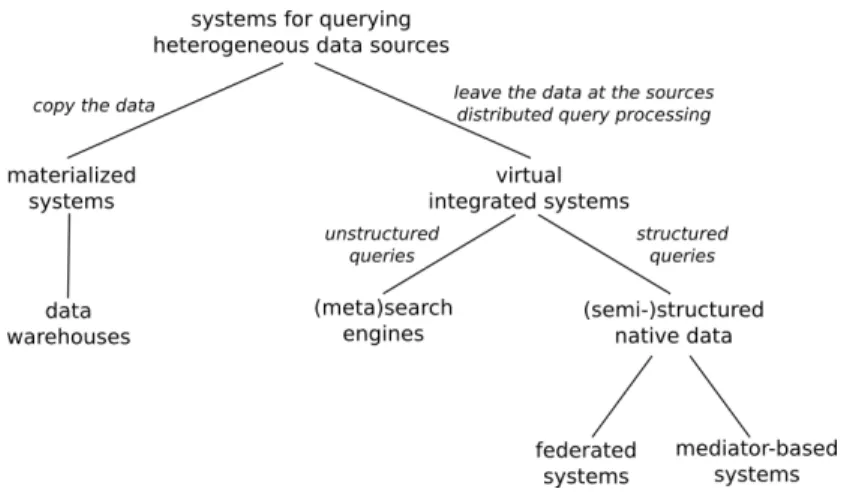
Figure 6 shows a categorization of data integration systems from a classical database point of view. The same categorization can be applied to the problem of processing Linked Data because, despite some differences, similar problems have to be solved and similar techniques have already been applied by different systems for Linked Data processing.
The first and most important characteristic that distinguishes data integra-tion systems is whether they copy the data into a central database, or storage system respectively, or leave the data at the sources and only work with sta-tistical information about the sources, e.g., indexes. Approaches falling into the former category are generally referred to asmaterialized data integration systems withdata warehousesas a typical implementation. Approaches of the second cat-egory are referred to as virtual data integration systems as they only virtually integrate the data without making copies.
The process of integrating data into a data warehouse is referred to as the ETL process (Extract-Transform-Load). First, the data is extracted from the sources, then it is transformed, and finally loaded into the data warehouse. This workflow can also be applied in the Semantic Web context.
Extract. As many knowledge bases are available as dumps for download, it is possible to download a collection of interesting linked datasets and import them into a data warehouse. This warehouse resembles a centralized RDF storage system that can be queried and optimized using the techniques discussed in Section 1. If a data source is not available for download, the data can be crawled by looking up URIs or accessing a SPARQL endpoint. As the data originates from different sources, the system should keep track of provenance, e.g., by using named graphs [22] or quads.
Transform. Data warehouses in the database world usually provide the data in an aggregated format, e.g., in a data warehouse storing information about sales we do not keep detailed information about all transactions (as provided by the sources) but, for instance, the volume of sales per day (computing aggregated values based on the data provided by the sources). For linked data, this roughly corresponds to running additional analyses on the crawled data for duplicate detection/removal or entity consolidation as applied, for instance, by WATSON and SWSE.
Load. Finally, the transformed data is loaded into the data warehouse. In depen-dence on aspects such as the update frequency of the sources and the size of the imported datasets, it might be difficult to keep the data warehouse up-to-date. In any case the data needs to be reloaded or recrawled so that the data ware-house can be updated accordingly. It is up to the user, or the user application respectively, to decide if and to what extent out-of-date data is acceptable or not.
Reconsidering the search engines we have already discussed above, we see that some of these approaches actually fall into this category: the search engines using a central repository to store a local copy of the RDF data they crawled from the web, e.g., SWSE [58], WATSON [34], and Falcons [26].
In summary, the data warehouse approach has some advantages and dis-advantes. The biggest advantage, of course, is that all information is available locally, which allows for efficient query processing, optimization, and therefore low query response times. On the other hand, there is no guarantee that the data loaded into the data warehouse is up-to-date and we have to update it from time to time. From the perspective of a single user or application, the data warehouse contains a lot of data that is not queried and unnecessarily increases storage space consumption. So, the data warehouse solution is only suitable if we have a sufficiently high number of queries and diverse applications.
2.3 Federated systems
As mentioned above, database literature proposes two main classes of data in-tegration approaches (Figure 6): materialized and virtual data inin-tegration. In contrast to materialized data integration approaches, virtual data integration systemsdo not work with copies of the original data but only virtually integrate
Fig. 6.Classification of data integration approaches
the data. If we are only interested in answering unstructured queries based on keywords, the search engine approach, as a variant of virtual integration sys-tems, is an appropriate solution. We have already discussed several examples of Semantic Web search engines in Section 2.1. Some of them are pure search engines that only work with indexes and output pointers to relevant data at the sources, whereas other Semantic Web search engines rather correspond to data warehouses.
When we are interested in answering structured queries on the most recent version of the data, we need to consider approaches that integrate sources in a way that preserves the sources’ autonomy but at the same time allow for evaluating queries based on the data of multiple sources: we distinguish between mediator-based systems andfederated systems.
Mediator-based systems. Classic mediator-based systems provide a service that integrates data from a selection of independent sources. In such a scenario, sources are often unaware that they are participating in an integration system. A mediator provides a common interface to the user that is used to formulate queries. Based on the global catalog (statistics about the data available at the sources), the mediator takes care of rewriting and optimizing the query, i.e., the mediator determines which sources are relevant with respect to the given query and creates subqueries for the relevant sources. In case the sources manage their local data using data models or query languages different from what the medi-ator uses, so-called wrappers rewrite the subqueries in a way that makes them “understandable” for the sources, e.g., SQL to XQuery. Wrappers also take care of transforming the data that the sources produce as answers to the query into the mediator’s model. In practice, the task of the mediator/wrapper architecture is to overcome heterogeneity on several levels: data model, query language, etc.
Federated systems. The second variant of virtual integration systems from a database point of view is federated systems. A federation is a consolidation of multiple sources providing a common interface and therefore very similar to the mediator-based approach. The main difference to mediator-based systems is that sources are aware that they are part of the federation because they actively have to support the data model and the query language that the federation agreed upon. In addition, sources might of course support other query languages.
However, from a user’s point-of-view there is no difference between both archi-tectures as both provide transparent access to the data. Likewise, in general the Semantic Web community does not distinguish between these two architectures either so that both approaches are referred to as federated systems, virtual in-tegration, and/or federated query processing [51, 54, 63]. Thus, in the following we adopt the notion of a federation from the Semantic Web community and do not distinguish between federated and mediated architectures nor between federators and mediators.
There are some peculiarities unique to the web of linked data that we need to deal with in a distributed setup. Some sources, for instance, do not provide a query interface that a federated architecture could be built upon, i.e., some sources only provide information to dereferenceable HTTP URIs, some sources are only available as dumps, and some sources provide access via SPARQL end-points.
For the first two cases, we can crawl the data and load it into a central repository (data warehouse) or multiple repositories that can be combined in a federation – comparable to using wrappers for different data sources. If the data is already available via SPARQL endpoints, we only need to register them in the federation and their data can be accessed by the federation to answer future queries. In addition, if we adopt SPARQL as the common protocol and global query language, then no wrappers are necessary for SPARQL endpoints because they already support the global query language and data format.
Another interesting difference between classic federated database systems and federated RDF systems is that for systems using the relational data model, answering a query involves only a few joins between different datasets defined on attributes of the relations. For RDF data, this is more complicated because the triple format requires much more (self) joins. Moreover, some aspects of RDF, e.g., explicit links (owl:sameAs), are also aspects that need to be considered during query optimization and execution.
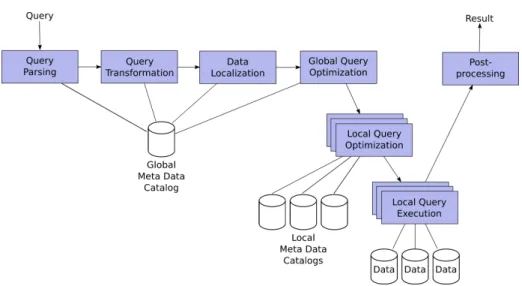
Query processing in distributed database systems roughly adheres to the steps highlighted in Figure 7: query parsing, query transformation, data localization, global query optimization, local query optimization, local query execution, and post-processing. In the following we discuss each of these steps in detail; we first describe each step with respect to classic distributed databases and then compare it to distributed RDF systems.
Fig. 7.Steps of distributed query processing
Query parsing. After the query has been formulated by the user, it has to be parsed, i.e., the query formulated in a declarative query language is represented using an internal format that facilitates optimization. For example, a query for-mulated in SQL is transformed into an algebra operator tree.
Likewise, SPARQL queries can be parsed into directed query graphs: SQGM (SPARQL Query Graph Model) [62]. In any case, after parsing we have a graph consisting of operators that need to be evaluated in order to answer the query – a connection between operators indicates the data flow, i.e., the exchange of intermediate results, between them.
Query transformation. In this step, simple and straightforward optimizations are applied to the initial query that do not require any sophisticated consider-ations but mostly rely on heuristics and straightforward checks. One aspect is to perform a semantic analysis, e.g., to check whether relations and attributes referred to in the query do actually exist in the schema. The schema informa-tion necessary for this step are stored in the global catalog. In addiinforma-tion, query predicates are transformed into a canonical format (normalization) to facilitate further optimization, e.g., to identify contradicting query predicates that would result in empty result sets. Moreover, simple algebraic rewriting is applied using heuristics to eliminate bad query plans, e.g., replacing crossproducts followed by selections with join operators, redundant predicates are removed, expressions are simplified, unnesting of subqueries and views, etc.
Similar transformations can be done for SPARQL queries. For example, we can check for contradictions of conditions in the query that would lead to an empty result set. We can also apply some basic optimizations such as remov-ing redundant predicates and simplifyremov-ing expressions. In addition, we can also check if the predicates referenced in the query do actually exist, i.e., if there
is any source providing corresponding triples. However, this is only useful for distributed RDF systems that do not traverse links to discover new sources dur-ing query processdur-ing. As discussed below, the information necessary to perform these checks are part of the global catalog.
Data localization. In the classic data localization step, the optimizer replaces references to global relations with references to the sources’ fragment relations that contribute to the global relation. The optimizer simply needs to access the global catalog and make use of reconstruction expressions: algebraic expressions that, when executed, reconstruct the global relations by combining the sources’ fragments in an appropriate manner. In consideration of predicates and joins contained in the query, a subset of fragments and therefore sources can be elim-inated from the query because the data they provide cannot contribute to the query result.
In case of Linked Data and systems for distributed RDF processing, this step entails the identification of sources relevant to a given query. Whereas we have reconstruction expressions for relational databases, it is more complicated for RDF data because there are no strict rules and or restrictions on which source uses which vocabulary. Thus, what an appropriate optimizer for distributed RDF systems needs to do in this step is to go through the list of basic graph patterns contained in the query and identify relevant sources. The information necessary to perform this task are contained in the global catalg, which we will discuss in detail below.
Global query optimization. In principle, the goal of this step is to find an efficient query execution plan. In classic distributed systems, the optimizer can optimize for total query execution time or for response time. The former is a measure for the total research consumption in the network, i.e., it sums up the duration of all operations necessary to answer the query over all nodes altogether. Response time takes parallel execution into account and measures the time until the results are presented to the user. Optimizing response time can exploit all different flavors of parallelization only when the mediator has some “control” over the sources, i.e., considering direct interaction, communication, and data exchange between any two nodes for optimization.
In federated RDF systems, however, sources are still more autonomous so that some of the options available to classic optimizers cannot be considered, e.g., we cannot decide on a query plan that requires one source to send an intermediate result directly to another source that uses the received data to compute a local join. Thus, techniques commonly referred to as data, query, or hybrid shipping [76] are not applicable in the RDF context. Likewise, the option of pipelining10results between operators executed at different sources is hardly applicable.
10
Result items (tuples) are propagated through a hierarchy of operators (e.g., joins) so that when a tuple is output by an operator on a lower level, itimmediatelyserves as input to the upper operator – before all input tuples have been processed by the lower operator.
In general, however, it is efficient in terms of load at the mediator and com-munication costs when joins can directly be executed at the sources. The problem is that with the restrictions mentioned above joins in distributed RDF systems can only be executed in a completely decentralized fashion at a sources1if there is no additional data at any other source s2 that could produce additional re-sults when joined with part of the data provided by s1. Thus, even though s2 can process the join locally it has to return, in addition to the join result, all data that could be joined with other sources’ data. Hence, in most cases joins have to be computed in a centralized fashion by the mediator [51, 139]. In that case, the optimizer applies techniques for local query optimization as discussed in Section 1.
Another option to process joins efficiently is to use a semijoin [76] algorithm to compute a join between an intermediate result at the mediator and a data source [51]. The mediator needs to compute a projection on the join variables and extract all variable bindings present in the intermediate result. For all these variable bindings, the mediator needs to query the remote data source with re-spect to the join definition and retrieve the result, which consists of all triples matching the join condition. So, the mediator retrieves all relevant data to per-form the join locally. Unfortunately, SPARQL does not support the inclusion of variable bindings in a query so that the only alternative is to include variable bindings as filter expressions in a query, which for a large number of bindings might blow up the size of the query message. The alternative of sending sepa-rate messages for each binding [115] results in a high number of messages and therefore increases network load and query execution costs.
A heuristic to minimize query execution costs is to minimize the size of in-termediate results. Hence, optimizers for federated RDF systems also try to find a plan that minimizes the size of intermediate results. Theresfore, the optimizer considers additional statistics about selectivities and cardinalities provided by the global catalog (see below).
Another standard technique for every optimizers is to apply heuristics to re-order query operators in a way that intermediate results are small, i.e., pushing highly selective operators downwards in the query graph so that they are exe-cuted first. Considering RDF data, this means to push down value constraints – ideally into subqueries executed at the sources to reduce the amount of ex-changed data.
Another important and related issue for standard optimizers is join order op-timization. The goal is to find the order of joins that minimizes execution costs. This process heavily relies on statistics (global catalog) to estimate the size of intermediate results. Obviously, it is beneficial to execute joins first that pro-duce small outputs so that all other joins can be computed more efficiently. For optimization in distributed RDF systems, join order optimization corresponds to determining the order of evaluating basic graph patterns. To estimate the size of intermediate results, the optimizer needs detailed statistics that allow for cardinality estimation. Histograms are very common for relational distributed systems and can also be useful in the context of federated RDF systems. A
simple heuristic that can be applied without detailed statistics is variable count-ing [136], which estimates the selectivity of basic graph patterns in dependence on the type and number of unbound components.
In consideration of all these different possibilities for query optimization, the optimizer has to explore and evaluate a potentially high number of alternative query plans that all compute the same result. For exploration, a common tech-nique is the application of dynamic programming for plan enumeration, which enables an exhaustive search of all query plans. In order to decide on the ben-efit of each plan, the optimizer has to determine its costs using an appropriate cost model [51, 105, 139]. For this purpose, the optimizer again needs statistics about the data, selectivity, cardinality estimations about intermediate results. In addition, it is worthwhile to consider network latencies as well.
The current standard for distributed RDF optimizers is to optimize a query and to determine a query plan for each query individually at runtime. This can be improved by adopting more techniques from classic distributed database systems that pre-optimize (partial) execution plans for frequently issued queries or subqueries contained in many queries, e.g., two-step-plans [76].
As a high number of sources provide potentially relevant data for a given query, approximation by reducing the number of queried sources is an appro-priate technique to reduce the overall execution costs. This can be achieved by ranking sources based on triple and join pattern cardinality estimations and prune all but the top-ranked sources from consideration [59].
Global catalog and indexes. As we have seen above, the global catalog plays an important role for query optimization. It might contain information about specific sources such as vocabulary, supported predicates, network latencies, etc. In addition, for the distributed setup and especially for cardinality estimation, the catalog has to contain statistics about the data, e.g., in the form of indexes. In constrast to indexes that are applied in the context of centralized systems (complete indexes), these indexes cannot provide the same level of details because of the amount of data from all sources altogether. Therefore indexes and statistics about the data suitable for distributed optimization have to abstract the data in a way that allows for index size compression. The goal is to find a suitable trade-off between the level of detail and memory space consumption – the general rule is the more detailed an index is, the more accurate are cardinality estimations but the higher is the memory consumption.
A widely used approach for indexing isschema-level indexing, i.e., predicate URIs and the types of instances. Whereas types and predicates that occur only rarely represent good discriminators to detect relevant sources for a given query, frequently used types and predicates that almost every source provides are only of little use for optimization, e.g., rdfs:label. The disadvantage is that this index cannot be used for basic graph patterns with variables in the predicate position. An alternative to indexing predicates and types detached from the structure of the overall RDF graph is indexing paths of predicates [139]. More-over, when considering the RDF data of a source as a graph, it might also be useful to index frequent subgraphs [51, 89, 146].
Another kind of indexes areinverted URI indexes. They index the data on instance level by indexing all URIs occuring in a data source. This kind of index allows the query processor to identify all sources which contain a given URI and thus potentially contribute bindings for a triple pattern containing that URI.
There are also indexes indexing data on both instance-level and schema-level [59]. They make use of data structures known from classic relational database: histograms. As these data structures have originally been developed to summarize informtion about numerical data, hash functions are applied to all elements of a triple so that triples are transformed into numerical space. One-dimensional histograms index each component (subject, predicate, object) in separate. But when considering each of these three dimensions in separate, the optimizer looses a great potential for optimization because the combination of instances is much more selective and therefore more useful for query opti-mization. Thus, multidimensional histograms are applied, i.e., three-dimensional histograms. An alternative to histograms, other structures that efficiently sum-marize multidimensional data can be applied, e.g., QTrees [59].
Local query optimization and execution. When the global optimizer has decided for a specific query execution plan, subqueries are extracted and sent to the sources for local execution. They apply the same optimization techniques as for local queries, so that the received query is treated like a query issued directly at the source. Consequently, it is optimized and executed using the techniques discussed in Section 1.
Post-processing In this last step the partial results received from the sources are combined into the final result. For simple distributed queries, the post-processing might simply consist of a union operation. For more complex queries, however, post-processing is much more complex and costly because all operations that could not be executed at the sources have to be processed by the mediator after retrieving the data from the sources. As discussed above, this is particularly true for joins for which multiple sources provide relevant data. In addition, it might be necessary to remove duplicates in the result set, which represents the very last operation for post-processing.
To conclude the section about federated systems and federated RDF processing, we discuss some systems that have been proposed in this context.
SemWIQ. The Semantic Web Integrator and Query Engine [79], SemWIQ in short, uses an architecture based on the mediator/wrapper approach, i.e., wrappers are used to enable the participation of sources using other data models, e.g. relational databases. All registered data sources must either be connected by a SPARQL-capable wrapper or support the SPARQL protocol directly.
Queries are formulated in SPARQL, the parser computes a canonical query plan, which is optimized by the federator/mediator. The optimization process only considers very basic statistics, such as a list of classes and the number of
instances a data source provides for each class as well as a list of predicates and their occurrences. For query optimization, the federator analyzes the query and scans the catalog for relevant registered data sources. The resulting plan is executed by sending subqueries to the sources (via wrappers or SPARQL endpoints).
The system requires that every data item has an asserted type, i.e., for a query it requires type information for each subject variable in order to be able to retrieve instances. As a consequence, there are some restrictions with respect to query formulation, e.g., all subjects must be variables and for each subject variable its type must be explicitly or implicitly defined. The optimizer then uses this information to look for registered data sources providing instances of the queried types. More sophisticated optimization techniques, such as the push-down of joins, have been proposed as future work.
DARQ. DARQ [115] (Distributed ARQ) is a federated system of SPARQL end-points that allows distributed query processing on the set of registered endend-points. It also adopts a mediator-based approach and assumes that sources that do not support SPARQL themselves are connected to the federation using wrappers.
Data sources are described using service descriptions (represented in RDF). These descriptions contain capabilities, i.e., constraints expressed with regular SPARQL filter expressions. These constraints can express, for instance, that a data source only stores data about specific types of resources. For sources with limitations of access patterns, e.g., allowing lookups on personal data only when the user can specify the name of the person of interest. DARQ supports this by defining patterns in the service descriptions that must be included in the query. To provide the query optimizer with statistics, service descriptions contain the total number provided by a data source and optionally information for each capability, e.g., the number of triples with a specific predicate and the selectivities (bound subject/object) of a triple pattern with a specific predicate. Queries are formulated in SPARQL, parsed, and handed to the query plan-ning and optimization components. DARQ uses a cost-based query optimization technique relying on the statistical information provided as service descriptions and capabilities.
A SPARQL query contains one or more filtered basic graph patterns (triple patterns). DARQ performs query planning for each basic graph pattern in sep-arate. By comparing the triple patterns of the query against the capabilities of the service descriptions, the system can detect a set of relevant sources for each pattern. As this matching procedure is based on predicates, DARQ only supports queries with bound predicates.
After having determined the relevant sources, subqueries are created, one for each basic graph pattern and data source matching. Thus, the system might create multiple subqueries that are to be sent to the same data source. In that case, the subqueries can be combined into one message.
Based on these subqueries the query optimizer considers limitations on access patterns and tries to find a feasible and efficient query execution plan. For logical
query optimization, heuristics are used that try to simplify the query and reduce intermediate result sizes, e.g., push value constraints into subqueries, which cor-responds to pushing down selections in classic query optimization. In order to decide for a specific implementation to process joins (nested loop join or bind join), the optimizer estimates the result size of joins based on the statistics given in the service descriptions. The optimizer chooses the implementation with the least estimated transfer costs (computed based on the result estimates).
In the end, subqueries are executed at the sources and remaining operations are executed by the federator.
Hermes. Hermes [147] is a system based on a federated architecture that has a slightly different focus than other systems discussed so far. Queries are not formulated using SPARQL. Instead, the user enters a keyword query and Hermes tries to translate the keyword query into a structured query (SPARQL). The query is decomposed into subqueries, which are executed at the sources.
In order to achieve this, a number of indexes are created: a keyword index (indexing terms extracted from the labels of data graph elements), a structure index (information about schema graphs, i.e., relations between classes derived from the connections given in the data graph), and a mapping index (infor-mation about mappings on data- and schema-level, pairwise mappings between elements).
After having received the input keywords, relevant sources are determined using the keyword index. The retrieved keyword elements are combined with schema graphs received from the structure index to find substructures that con-nect all keyword elements. A ranking function is used to rank the computed query graphs so that the user can choose some of them for execution.
The selected query is decomposed into subqueries, each of which is answered by a different data source. Optimization uses the same techniques as DARQ [115]. Before sending the subqueries to the sources, they are mapped to the query for-mat supported by the receiving data source. After execution, the results received from the sources are combined.
Other systems. Virtuoso [41], a native quad store, provides the option to consider remote sources for query execution. The system dereferences URIs and holds the retrieved data in a cache for future queries.
Dartgrid [25] is a system for SPARQL queries over multiple relational databases. One of the main components is the semantic registration service which maintains mappings from the schemas of registered data sources to the internal ontology. An query interface based on forms and ontologies helps users to con-struct semantic queries formulated in SPARQL. Queries are translated using the mapping information into SQL queries that can be executed on the sources.
The networked graphs approach [126] allows users to reuse and integrate RDF content from other sources. It allows users to define RDF graphs by extensionally listing content and by using views on other graphs. These views can be used to include parts of other graphs. Networked graphs are designed for distributed
settings and are exchangeable between sources. However, the paper focuses more on semantics and reasoning than on aspects of query execution.
[139] presents an approach for querying distributed RDF data sources and in-troduces index structures, a cost model, and an algorithm for query answering. The approach supports distributed SeRQL path queries over multiple Sesame RDF repositories using a special index structure to determine the relevant sources for a query.
2.4 Discovering new sources during query processing
In contrast to the classic understanding of federated databases, processing Linked Data arises additional challenges that we have not discussed in detail above, e.g., by dereferencing URIs and considering the returned document as a new virtual “data source” not all sources are known in advance and available for indexing. Furthermore, approaches that index a static set of sources, i.e., all approaches we have discussed so far, have to recreate their indexes from time to time in order to reflect recent updates to the sources, which means that some of the information provided by the index might be out-of-date.
Pure. Some strategies for query processing over Linked Data rely on the prin-ciple of following links between sources [61]. An advantage in comparison to federated architectures is that sources that are not accessible via SPARQL end-points can be considered. Another advantage is that users can retain complete control over the data they provide.
The query is executed without a previous query planning or optimization step. First, the system retrieves data from the sources mentioned in the query. The data is partially evaluated on the retrieved data so that relevant source URIs and links can be identified. The system uses these URIs to retrieve more data. It iteratively evaluates and discovers further data until all sources found to be relevant have been processed.
The peculiarity of this approach is the intertwining of the two phases: query evaluation and link traversal. Previous work [17,94] kept these two phases in sep-arate by first retrieving the data and then evaluating the query on the retrieved data.
Hybrid. It is also possible to combine federated query processing with active discovery of unknown but potentially relevant sources [78]. The main assump-tion is that knowledge about some sources is available for query planning and optimization. During query execution, sources are retrieved, new sources are it-eratively discovered, the query plan is reoptimized and partially executed until all relevant sources have been processed.
2.5 Systems based on the P2P paradigm
As we have seen, distributed processing of RDF data can be realized by adopting the federated database system architecture and developing efficient solutions for
problems that come along with the characteristics of Linked Data. But there is another important class of distributed systems that Linked Data processing can also benefit from: peer-to-peer (P2P) systems.
P2P systems are networks of autonomous peers that are connected through logical links, which express that a pair of peers “know” each other, i.e., they can exchange messages and data and are referred to as neighbors. A pair of peers without a link do not know each other and can therefore only contact each other if they find a path of links via intermediate peers that connects them.
In general, sources/peers in a P2P network have a higher degree of autonomy in comparison to sources in distributed database systems. In pure P2P networks there is no central component, i.e., no federator or mediator, that could be used for query planning and optimization. Instead, the behavior of the whole system is the consequence of local interactions between peers.
Whereas sources in the context of distributed databases are considered to be rather stable and available, P2P systems assume a higher degree of dynamic behavior, i.e., they assume that peers might join and leave the network at any time. Even though a peer leaves the network, the system should still be able to answer queries – even though the data provided by the peer that left the network is (momentarily) unavailable. Moreover, each peer in the network might issue queries and participate in answering queries. There are different classes of P2P systems:centralized P2P,pure P2P,hybrid P2P,structured P2P.
Centralized P2P systems. For centralized P2P systems, like Napster11, there is a central component providing a centralized index that is used to locate relevant data to a given query. So, a user query issued at a peer is sent to the central component, which uses the index to find peers providing the queried data. This information is sent back to the querying peer, which then directly communicates with other peers to access the queried data.
Pure/unstructured P2P systems. As the centralized server represents a bottle-neck and a single point of failure, pure P2P system strictly avoid peers with special roles. Instead, all peers are considered equal and query processing is re-alized byflooding, i.e., a peer with a local user query forwards the query to all its neighbors, they proceed the same so that the query finally reaches all the peers in the network. The answers to the query are routed back to the query initiator, which can then directly communicate with peers providing relevant data. In analogy to structured P2P systems, which we will discuss below, pure P2P systems are often referred to asunstructured P2P systems.
Hybrid P2P systems. The problem with flooding is that query processing con-sumes much bandwidth and weak/slow peers represent the bottleneck. So, hybrid P2P systems use super-peers to counteract this problem. Super-peers are strong peers that form an unstructured P2P network. Weaker peers are connected to a super-peer as leaf nodes and form a centralized P2P system.
11