Influence of Tutor Behaviours
on the Process of
Problem-Based Learning
Copyright © 2013 E. Chng
All rights reserved. No part of this thesis may be reproduced or transmitted in any form, by any means, electronic or mechanical, without the prior written permission of the author, or where appropriate, of the publisher of the articles.
Cover illustration by Isaac Liang
Influence of Tutor Behaviours on the Process of
Problem-Based Learning
Invloed van tutorgedrag op het proces van probleemgestuurd
onderwijs
Thesis
to obtain the degree of Doctor from the Erasmus University Rotterdam
by command of the rector magnificus Prof. dr. H.A.P. Pols
and in accordance with the decision of the Doctorate Board
The public defence shall be held on Thursday December 19th, 2013 at 11.30 hours
by
Chng Xue Li, Esther Born in Singapore
Doctoral Committee
Promotor: Prof. dr. H.G. Schmidt Co-Promotor: Dr. E. H. J. Yew
Other members: Prof. dr. H.T. van der Molen Prof. dr. D.H.J.M. Dolmans Prof. dr. T.A.J.M. van Gog
Acknowledgements
9
Chapter 1:
Introduction
11
Chapter 2:
Is learning in Problem-based learning
cumulative?
27
Chapter 3:
Effects of tutor-related behaviours on the
process of problem-based learning
55
Chapter 4:
To what extent do tutor-related behaviours
influence student learning in PBL?
77
Chapter 5:
Does social congruent behaviour contribute
to the effectiveness of a PBL tutor?
101
Chapter 6:
Summary and conclusions
123
References
149
Appendices
159
Propositions
165
Acknowledgements
This thesis would not have materialized without the guidance and encouragement of many individuals to whom I am truly grateful.
To Professor Henk Schmidt, it has been an honour and a privilege to work under your supervision. Thank you very much for your invaluable advice, constructive feedback and precious time spent on discussing the findings from the research. I am also very grateful for your patience, support and for believing that I could complete this journey.
To Dr. Elaine Yew, I am truly blessed to have been mentored by you through this fulfilling journey. You have been inspirational and I greatly appreciate the guidance, encouragement and all the helpful suggestions. Thank you for always checking on my progress and motivating me towards the finishing line.
To Republic Polytechnic and the senior management team, especially Mr. Yeo Li Pheow and Dr. Michael Koh, thank you for this opportunity and for the continual support. I am also grateful to Dr. Terence Chong, Dr. Girija, Dr. Tan Lay Pheng and Mr. Ashley Chua for their understanding and words of encouragement.
To Ms. Serene Choo and Ms. Tan Chin Pei who took the same journey, thank you for lending a helping hand when it was needed and for never failing to cheer one another on during this journey. To my colleagues from the School of Applied Sciences who helped in one way or another with the data collection, I am very thankful for your assistance and willingness to help.
To my parents, siblings, brother-in-law and niece, I am truly grateful for your love, constant support and encouragement throughout this journey. Last but not least, I am very thankful to God who made all things possible.
Chapter 1: Introduction
The theme of this thesis revolves around the behaviours of the tutor in problem-based learning (PBL) and its effects on the learning in this approach. Although a substantial amount of research on PBL has been conducted over the years, it is still relatively unclear how learning takes place during the PBL process. In addition, factors that influence the learning process such as the quality of problems, the tutor and the use of scaffolds are areas that require greater investigation (Schmidt, Rotgans and Yew, 2011). With these considerations in mind, the research conducted in this thesis aims to deepen the understanding of what occurs during the actual learning process of PBL and in particular, the impact PBL tutors have on student learning.
Unlike the typical view of a teacher in the conventional classroom, students under the tutelage of a PBL tutor are taught not to be passive recipients of knowledge but are individuals who make their own decisions about the nature and structure of their learning (Barell, 2010). PBL tutors are expected to facilitate the learning process and to promote collaborative learning by encouraging students to actively participate in the classroom activities. Using a problem to trigger learning, students would tap on their prior knowledge to guide them in their investigations before applying the newly constructed knowledge to solve the problem. In addition, PBL tutors would aid in the scaffolding of learning, monitor the quality of learning and intervene when necessary (Schmidt et al., 2011).
In view of the interactive nature between students and the PBL tutor, it can be hypothesized that what tutors do in the classrooms may have an effect on the learning process. There are
three key behaviours of the PBL tutor that are often reviewed in the literature, namely, social congruence, subject-matter expertise, and cognitive congruence. These tutor-related behaviours and their influence on student learning would be studied in greater depth in this thesis.
In this chapter, a review of the current literature on PBL and the role of the PBL tutor will be examined before formulating a list of research questions that aid in guiding the investigation of this thesis. Towards the end of this chapter, an outline of what will be covered in the subsequent chapters will be presented.
Why is there an interest in PBL?
As society continues to develop rapidly, organizations are forced to adapt to the environmental changes so as to remain competitive. For instance, globalization has created new opportunities for organizations to operate at an international level and advanced information technologies have improved the rate of information exchange. Ignoring such environmental changes would be destructive as they can affect the sustainability of an organization in the 21st century. Due to these developments, employers are constantly seeking to hire knowledge-based workers who are able to tackle these changes.
So what skills are necessary to handle these challenges in the 21st century? Living in the digital-age, it is unsurprising that there is greater demand for workers to possess technological literacy. However, besides being able to use multiple technologies, there is growing evidence that employers prefer workers who are proficient in critical thinking, problem solving, effective communication and
team work (Paige, 2009). Creativity, leadership, adaptability and global awareness have also been cited as skills that are more crucial now than ever before as the challenges in the world today are increasing in complexity (Walser, 2008). This in turn has placed greater demand on educational institutions to develop individuals who are able to meet these expectations of a fast-changing global economy.
From a traditionalist viewpoint, educational institutions are designed for teaching students under the direction of teachers who imparted knowledge based on the agreed curriculum. However, over the years, educational research has indicated that possessing knowledge alone is insufficient as students may be unable to make appropriate use of what they have been taught (Schmidt, 1983). Together with the expectations to equip students with the 21st century skills, education policymakers are considering education reforms to address these issues. Although there is greater emphasis on these skills then before, it has been argued that these skills such as critical thinking and global awareness are not new skills, at least amongst the elites in the previous centuries. However, what is new is that success in the current day and age depends upon having such skills and therefore should not be confined to a group of individuals but they must become universal. In other words, these skills should be taught more intentionally and effectively in educational institutions (Rotherham and Willingham, 2010).
Student-centric methods have been favoured by advocators of the 21st century skills and PBL is a pedagogy that has become increasingly popular in developing workers for the 21st century. This is because PBL claims to provide a rigorous learning environment that not only allows learners to construct new knowledge but to train
students how to apply the knowledge through the process of solving problems similar to those experienced at the workplace (Hmelo-Silver, 2004). In addition, the potential to develop social skills such as teamwork and communication through PBL supports its use and implementation in the classrooms as students have to work collaboratively to solve the problems. As the characteristics of PBL suggest that a rich learning environment that mirrors the workplace is provided for students, it is possible to conclude that PBL does help students develop skills that would prepare them to meet the demands of a changing workplace and society (Grabinger, Dunlap and Duffield, 1997).
How do students learn in PBL?
Students in a PBL curriculum learn through the process of problem-solving as learning is driven by exposing students to real-life problems. This form of learning was developed in the late 1960’s and has its roots in the medical field whereby students were tasked to solve real cases, conduct research and propose solutions for a wide variety of medical conditions. Despite remaining predominantly used in the medical and health science curriculum, PBL has since been adopted in other disciplines such as Business, Engineering and Law (Massa, 2008).
In a PBL classroom, students work in small collaborative groups to solve problems that are relevant to their domain of study. Through this problem-solving process, students would engage in discussions with their peers and build upon their prior knowledge to construct new knowledge. While working on these authentic problems, students will ask questions, conduct investigations, consider possible solutions, draw conclusions and reflect on their
decisions (Barell, 2010). As these problems are often complex and without a single correct answer, it is believed that students would be able to learn both content and thinking strategies (Hmelo-Silver, 2004). Simultaneously, students learn to work in teams to achieve the common goal of solving the problem. Such a learning environment encourages learners to be active participants and an increased level of student engagement is believed to create a positive influence on learning. This can be supported by findings from a recent study where two groups of an undergraduate physics course were examined (Deslauriers, Schelew & Wieman, 2011). Students in the first group attended lectures conducted by a Noble Prize winning physicist while students in the second section were led by teaching assistants to solve real physics problems that they might encounter as a practicing physicist. The results indicated that students in the second section were more engaged and more likely to attend classes. In addition, their scores on a test averaged 74% as compared to an average score of 41% from students who attended the lectures, which suggests that learning is enhanced if students are engaged in the learning process (Deslauriers et al., 2011).
Besides working in small collaborative groups, a significant amount of self-directed learning is usually involved with PBL (Prince, 2004). This is important because developing students as self-directed learners is essential so that they would be able to continue learning on their own for the rest of their lives (Das, Mpofu, Hasan & Stewart, 2002). These various components of PBL are weaved into the learning process comprising of three learning phases: problem analysis, self-directed learning and a reporting phase (Schmidt, 1983; Barrows, 1988; Hmelo-Silver, 2004). As students work in their small collaborative groups to examine the problem in the problem analysis phase, they utilize prior knowledge to identify learning issues and
generate questions to help in the problem-solving process. In the self-directed learning phase, students refer to a variety of resources to search for relevant information that can be used to answer the questions raised. While students try to make sense of the gathered information, they share their views amongst their team and it forms the basis of brainstorming for possible solutions. By the reporting phase, the collaborative groups would have had sufficient time to synthesize and evaluate information, resulting in a proposed solution to the problem. As the groups share their findings, their peers are encouraged to raise questions and this helps the students to refine their original idea and hypotheses.
Through PBL, it can be expected that graduating students would have the domain knowledge and be more skilled in interpersonal communication, problem-solving and self-directed learning as compared to those from a conventional lecture-based environment (Schmidt, Vermeulen & Van Der Molen, 2006). Research has also shown that PBL is effective in equipping students with skills such as having the ability to work independently, possess good planning skills and ability to work under pressure, which are skills needed to prepare students for the workforce (Schmidt et al., 2006; Vaatstra & De Vries, 2007). For these aforementioned reasons and more, it can be expected that interest in adopting the PBL pedagogy in educational institutions will continue to rise as it develops learners holistically.
Based on the description of the PBL process, it is evident that learning in a PBL curriculum is mainly student-centric. However, it is essential to note that a tutor is also present during the PBL process and their existence may have an influence on the learning process.
What is the role of the tutor in PBL?
The role of the PBL tutor is qualitatively different from a teacher in a conventional classroom. As compared to teachers in a traditional curriculum, PBL tutors are often less content-driven and they view the process of learning as equally important to gaining knowledge. In view of this, PBL tutors must control their desire to impart knowledge and focus on the learning process instead in order to be effective (Wetzel, 1996). Rather than simply passing on information and providing direct instructions to students, the role of the PBL tutor is to model good strategies for learning and thinking so that learners can apply these strategies when they encounter similar situations in future (Hmelo-Silver, 2004).
During the learning process, the PBL tutor is present at the problem analysis and reporting phase. They are expected to play active roles in the scaffolding of student learning by assisting them in developing a framework that can be used to construct knowledge on their own. This allows students to foster the skills of critical thinking and habits of life-long learning (Das et al., 2002). For students who are new to PBL, the tutor takes on more responsibility to aid students in developing learning scaffolds until they are able to create their own scaffolds. After which, the guidance provided by the tutor would begin to fade but the tutor continues to monitor the progress of the students (Hmelo-Silver, 2004).
To assist students in constructing learning scaffolds, the PBL tutor would ask questions to stimulate elaboration of concepts and encourage knowledge integration as well as interactions between students (De Grave, Dolmans & Van Der Vleuten, 1999). In addition, the tutor would probe students to think of possible solutions to the
problem and model for them the kinds of questions that they should be asking themselves during problem-solving. As such, the relationship between the tutor and students can be viewed as a type of cognitive apprenticeship (Hmelo-Silver & Barrows, 2006; Schmidt & Moust, 2000; Collins et al., 1989). Therefore, in order to be effective in managing this cognitive learning process, it can be argued that the tutor should not only possess the relevant content knowledge, but also be skilled in facilitation, active listening, motivating learning, and critical reflection (Maudsley, 1999). In order to assess if a PBL tutor is able to perform their role effectively, it is necessary to examine their behaviours demonstrated in the classroom and how they influence students’ learning.
What kind of behaviours should tutors exhibit?
As mentioned previously, social congruence, subject-matter expertise and cognitive congruence are three key tutor-related behaviours that are often reviewed in the literature. In terms of social congruence, it is believed that this behaviour plays a key role in building a non-threatening learning environment as social congruence refers to the tutor’s ability to interact informally with students. This in turn allows students to feel comfortable in voicing their views, which may ultimately enhance the learning process and result in better academic achievement (Schmidt & Moust, 1995).
The need for PBL tutors to be socially congruent can be supported by a study that explored students’ perceptions on what makes a PBL tutor effective. The findings indicated that tutors, who respected the opinions of students, were able to establish good communications, understand students’ feelings and advised them on how to learn, were deemed as effective tutors (Kassab, Al-Shboul,
Abu-Hijleh & Hamdy, 2006). This indicates that possessing subject-matter knowledge alone is insufficient. Without a genuine interest in the lives and learning process of the students, the tutor would lack sensitivity to the difficulties faced by students, thus hindering their ability to guide students’ learning. Furthermore, a study by Schmidt & Moust (1995) indicated that social congruence directly influenced group functioning during the problem-solving process and this may result in better student performance.
Besides social congruence, Schmidt and Moust (1995) also found that subject-matter expertise of tutors had a slightly direct positive impact on student achievement. Based on the common perception of the role of a teacher, it is natural to assume that effective PBL tutors should possess the relevant domain knowledge so that they are able to provide students with the necessary content knowledge and correct the misconceptions that are constructed. As a result of the guidance provided by a subject-matter expert, students are expected to have a better grasp of the concepts and in turn perform better academically. However, past studies focusing on the behaviours of tutors with subject-matter expertise and its effects on student performance remain debatable (Silver & Wilkerson, 1991; Schmidt, Van Der Arend, Moust, Kokx & Boon, 1993; Davis, Nairn, Paine, Anderson & Oh, 1992; Dolmans, Wolfhagen & Schmidt, 1996). For instance, Davis et al. (1992) found differences in the performance of students in favour of subject-matter experts, Dolmans et al. (1996) found that tutor expertise did not influence student achievement.
As a result of the conflicting findings on subject-matter expertise, other studies have shifted their focus to observe the behaviours of subject-matter experts in attempts to better understand the influence of a PBL tutor with relevant content
knowledge. However, reports from various studies were also contradictory. A study conducted by Silver and Wilkerson (1991) suggested that tutors with subject-matter expertise took a more directive role in the PBL process, provided more direct answers to questions and contributed more during the discussions. In addition, a study by Schmidt et al. (1993) indicated that students guided by tutors with subject-matter expertise spent significantly more time on self-directed learning as compared to those guided by non-subject-matter experts, which indirectly may lead to better academic performance. However, Davis et al. (1992) could not identify behavioural differences in tutors with subject-matter expertise and those with lesser subject-matter knowledge.
Other than social congruence and subject-matter expertise, the study by Schmidt and Moust (1995) examined a third tutor-related behaviour termed as cognitive congruence. This behaviour can be defined as ‘the ability to express oneself in the language of the students, using the concepts they use, and explaining things in ways easily grasped by students’ (Schmidt & Moust, 1995, p.709). As such, cognitive congruence can also be viewed as a combination of subject-matter expertise and social congruence. Schmidt and Moust (1995) found that cognitive congruence was able to influence tutorial group functioning and this indirectly affected the level of student achievement through an increase in time spent on self-study. As a result, the authors concluded that a higher level of achievement can be attained through effective tutoring that requires not only the tutors’ content knowledge but an ability to interact with students on a personal level as well as to utilize language that is easily understood by students (Schmidt & Moust, 1995). In another study that compared between faculty tutors and student tutors, the results indicated that faculty tutors used their subject-matter knowledge
more extensively while student tutors were better able to identify with the difficulties students experience while dealing with the problem at hand (Schmidt, Van Der Arend, Kokx & Boon, 1994). This suggests that the student tutors were more cognitively congruent as compared to the faculty tutors, which allows them to better understand the nature of the problems faced by students and to respond more appropriately by using prompts that are more easily understood (Dolmans, Gijselaers, Moust, De Grave, Wolfhagen & Van Der Vleuten, 2002).
Using the structural equations modelling approach, Schmidt and Moust (1995) proposed that tutors who are more cognitively congruent would utilize subject-matter knowledge in a better way and be more socially congruent, which ultimately translates into higher student performance. This is because the problem-solving process would function better resulting in students being more interested in the subject matter and spending more time on self-directed learning (Schmidt & Moust, 2000). However, if the content expert is also able to guide students back onto the right track by discovering and learning from their own mistakes as well as reasoning their way to the desirable conclusions, then the PBL tutor would be more effective in developing students as self-directed learners. This is because a lack of the domain knowledge can make it difficult for the tutor to follow student discussions as well as to actively contribute to it and without an interest in the students the tutor would not be stimulated to encourage students to complete the problem-solving process (Schmidt & Moust, 2000).
The findings on the effect of the tutor’s social congruence, subject-matter expertise and cognitive congruence on student achievement remain ambiguous. However, there is a general
consensus that these behaviours do have an effect on students achieving the curricular outcomes. Yet, their influence on the PBL process remains unclear.
What are my research questions?
A review of the current literature has indicated that tutor-related behaviours appear to have an effect on student achievement. However, little is known about how learning takes place as a student progresses through the different PBL phases and how the behaviours of the PBL tutor affects their effectiveness in facilitating the learning process. Hence, the following research questions were designed and used to guide the development of the investigation in this thesis.
As student progress through the different learning phases of the PBL process, is learning dependent on what was learnt in the previous phase?
How can learning at each PBL phase be measured?
What behaviours make a PBL tutor effective in facilitating the learning process?
Do the behaviours of the tutor influence learning at each PBL phase? If so, to what extent do the tutor-related behaviours influence learning during the PBL process?
Amongst subject-matter expertise, social congruence and cognitive congruence, is there a particular tutor-related behaviour that has a greater influence on the learning process?
Outline of thesis
The subsequent chapters in this thesis aim to address the research questions listed above and a concluding chapter would
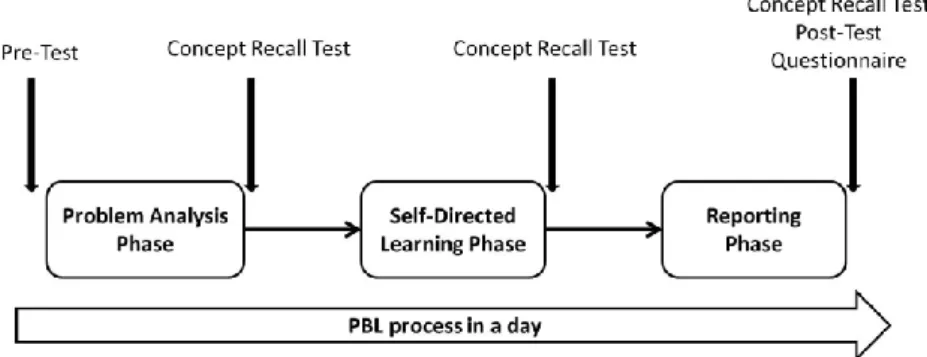
consolidate the findings from the studies that were conducted. All of the studies were conducted at the same tertiary educational institution in Singapore where PBL is used as the baseline pedagogy for all of its diploma courses. However, unlike other institutions, the implementation of PBL at this polytechnic is somewhat different whereby the entire PBL process is completed within a day (Yew and O’Grady, 2012). Students are introduced to a problem at the start of the day and are expected to report their proposed solution to the problem by the end of the day. Within the day and under the guidance of a tutor, students would engage in peer learning and self-study to grapple the concepts related to the problem.
In Chapter 2, the main focus was to examine how students learn during the PBL process. Learning is believed to be a cumulative process where new learning builds upon what was learnt previously. As such, this study investigated each learning phase and sought to understand if learning was dependent on the previous phase or if there was a particular learning phase that was more important than another. In order to do so, a method to measure student learning at each of the PBL phases was developed and the measurement tool was termed as the concept recall test. These tests required students to recall keywords that were related to the topic for the day. Besides measuring student learning at each PBL phase, an essay test was conducted at the end of the reporting phase to measure student achievement. As students were asked to elaborate on their understanding of the topic, it was possible to assess if students had understood the concepts they had learnt. Using the structural equations modelling approach, the data was analysed and the findings indicated that learning in PBL was cumulative whereby learning in one phase is influenced by what was learnt in the previous phase. In addition, the results proved that the methodology used to
measure students’ learning process and achievement was efficient and valid.
Following the successful development of the methodology described in Chapter 2, the remaining studies in Chapters 3, 4 and 5 utilized this method to explore the effect of the tutor’s subject-matter expertise, cognitive congruence and social congruence on student learning during the PBL process. In Chapter 3, the aim of the study was to explore the effects of the tutor-related behaviours on student learning and to identify if there was a particular behaviour that had a greater influence on learning as compared to another. Tutors were randomly selected to be part of the study and the effects of their behaviours on the PBL process were examined. Although all three tutor-related behaviours were found to have a significant effect on student achievement, the findings indicated that the social congruent behaviour of the tutor had a significant influence on learning during the PBL process.
Based on the findings from the study in Chapter 3, further investigation on the effects of the tutor’s social congruent behaviour were examined in Chapters 4 and 5. In attempts to ensure that a more distinct difference between the tutor-related behaviours was studied, tutors were handpicked to participate in the study instead of being randomly selected. In Chapter 4, tutors were chosen based on their student ratings from a questionnaire that measured tutor behaviours. The ratings either indicated that the tutors exhibit high levels of subject-matter expertise, cognitive congruence and social congruence or they exhibit low levels of these behaviours based on the students’ perceptions. Therefore, the study involved exploring if the tutors exhibiting high levels of these behaviours, particularly social congruence, were more effective in tutoring the learning
process. However, a change in the behaviours of the tutors was observed when they tutored a different group of students, resulting in a smaller difference between the tutor-related behaviours from both group of tutors. Hence, this led to findings that were not as straightforward as those obtained in Chapter 3.
The study in Chapter 5 was a continuation of Chapter 4 to further examine the effects of tutors exhibiting high or low levels of social congruence. However, instead of selecting different tutors to form the high and low groups, tutors who are known to display high levels of social congruence were asked to mimic the behaviours displayed by tutors in the low social congruence group by controlling their behaviours. This minimized the amount of natural variations that may occur when different tutors are used and it was an attempt to conduct a controlled experiment in a natural educational setting.
The final chapter provides an overview of the findings from the research conducted for this thesis. It highlights how each of the studies has attempted to answer the research questions raised and also suggests possible areas for future research. Through these studies, more insights will be gained about the PBL process and to what extent the PBL tutor influences the learning process. This would ultimately provide a better understanding on the PBL process so as to seek ways to enhance learning and develop learners in a PBL curriculum more effectively.
Chapter 2: Is Learning in Problem-based learning
Cumulative?
1Abstract
Problem-based learning (PBL) is generally organized in three phases, involving collaborative and self-directed learning processes. The hypothesis tested here is whether learning in the different phases of PBL is cumulative, with learning in each phase depending on that of the previous phase. The scientific concepts recalled by 218 students at the end of each PBL phase were used to estimate the extent of students’ learning. The data were then analyzed using structural equation modeling. Results show that our hypothesized model fits the data well. Alternative hypotheses according to which achievement is predicted either by collaborative learning alone or by self-directed learning alone did not fit the data. We conclude that the learning in each PBL phase is cumulative, and strongly influenced by the earlier phase, thus providing support for the PBL cycle of problem analysis, self-directed learning, and a subsequent reporting phase. We also demonstrate an efficient method to capture and quantify students’ learning during the PBL process.
Introduction
Educators have long been advocating ‘active’ learning whereby students are engaged in meaningful activities as part of their learning process. Active learning has been generally defined as any instructional strategy that involves “students in doing things and
1
Published in: Yew, E.H.J., Chng, E., & Schmidt, H.G. (2011). Is learning in problem-based learning cumulative? Advances in Health Sciences Education, 16, pp. 449-464.
thinking about what they are doing” (Bonwell & Eison, 1991, p. 2). Given such a broad definition, active learning can be viewed as encompassing a wide variety of instructional methods. Although various studies have demonstrated the effectiveness of promoting student engagement using interactive-engagement methods compared to those in traditional courses (reviewed by Michael, 2006; Prince, 2004), questions about how students learn while being actively engaged, both individually and when in collaborative small groups, remain to be further investigated.
Generally learning is thought to be a cumulative process where new learning builds upon knowledge acquired in a previous phase. In the case of active learning, it is assumed that both collaborative learning episodes and individual self-directed study phases play important roles in students’ learning. Although the idea that new learning is dependent on what has been learned previously is almost universally accepted, demonstrations of its truth have been largely confined to the psychological laboratory, particularly in the field of text processing (e.g., Bransford & Johnson, 1972; Kintsch & Van Dijk, 1978). To our knowledge, no natural classroom demonstration of the cumulative nature of learning exists to date. Moreover, since social constructivism suggests that knowledge is mainly constructed by means of collaborative interactions (e.g., Cobb, 1994; Driver, Asoko, Leach, Mortimer, & Scott, 1994), it is possible that the effects of active learning on achievement are really only due to the group interactions and co-construction of knowledge. Alternatively, since research on self-regulated learning has shown that the use of self-regulated learning strategies strongly influences academic achievement (Zimmerman, 1990), it can be argued that it is the individual self-directed learning phase that is most important to students’ learning.
active learning is cumulative and whether it involves both collaborative and self-directed learning, in the context of problem-based learning (PBL). PBL is an example of an active-learning approach in which students are given the opportunity to learn independently as well as collaboratively, while understanding an ill-structured problem. It was originally developed in medical schools to help students integrate basic science and clinical knowledge, as well as to develop clinical reasoning and lifelong learning skills (Barrows, 1986). However it is now of increasing interest to educators of various levels and disciplines (Gallagher, Stepien, & Rosenthal, 1992; Kolodner et al., 2003) as it provides a structured framework of active and collaborative learning, in line with current understanding of learning as a constructive and co-constructive activity involving social interactions (Glaser & Bassok, 1989; Palincsar, 1998). As will be described in greater detail later on, PBL involves a sequential series of learning phases that emphasizes collaborative and individual self-directed learning at different points in time. The assumption underlying PBL is that learning in the PBL process is cumulative − learning in one phase is dependent on the previous, and also that both co-construction with peers and individual construction of concepts during self-directed study contribute to student learning (Schmidt, 1983). We therefore seek to test the assumptions regarding the nature of learning in PBL, by tracing the learning process of students throughout all the phases of PBL. The central thesis to be tested is whether learning in the different phases of PBL is cumulative − does the learning in each phase depend on the previous phase? Or are some phases of the PBL process more (or less) important than others? Secondly, we also seek to understand how students learn in the different phases of PBL in terms of concept acquisition and elaboration. A third objective is to devise an efficient and valid method to track students’ learning as it unfolds in the course of the PBL process.
The PBL Process
PBL always starts with a problem, for which students do not prepare beforehand. After the description of the problem is given to small groups of students, they first analyse the problem, generate possible explanatory hypotheses, build on one another’s ideas, as well as identify key issues to be studied further. These activities allow students to construct a shared initial explanatory theory or model explaining the problem-at-hand based on their prior knowledge (Schmidt, 1983). After this period of teamwork, they disperse for a period of individual study to work on learning issues they have identified as a group. When they next meet as a team during what is called the “reporting phase”, they are expected to share and discuss their findings, as well as refine their initial explanations based on what they have learned. Students would then move on to analyse a new problem, or if new learning issues requiring further study are identified during this phase, the process described above would be repeated. Thus, PBL can be seen as a cyclical process consisting of three phases: initial problem analysis, self-directed individual learning, and a subsequent reporting phase (Barrows, 1988; Hmelo-Silver, 2004; Schmidt, Van der Molen, Te Winkel, & Wijnen, 2009). A tutor is present to guide students’ learning in the problem analysis and reporting phases. The tutor’s role is to facilitate the processes involved when students co-construct knowledge through discussions and sharing of ideas (Hmelo-Silver & Barrows, 2006). In PBL, both group and individual learning processes are recognized to play important supplementary roles in students’ learning (Schmidt & Moust, 2000; Van den Hurk, Dolmans, Wolfhagen, & Van der Vleuten, 2001).
How Students Learn in the Process of PBL
different phases of the PBL cycle. The initial problem analysis activates students’ prior knowledge and allows them to relate new information in the problem to their existing knowledge. Hearing what other students elaborate upon could also serve to activate or uncover the less accessible prior knowledge in the listeners. Studies by De Grave, Schmidt, & Boshuizen (2001) and Schmidt, De Volder, De Grave, Moust and Patel (1989) have demonstrated that elaboration during problem analysis in a small group prior to studying problem-relevant new information resulted in increased knowledge acquisition and recall.As argued by De Grave, Boshuizen and Schmidt (1996), such elaboration and activation of existing knowledge are instrumental in restructuring and transferring concepts resulting in the construction of new knowledge and ideas. The process of discussion during the problem analysis phase would also result in students realizing the gaps between their existing knowledge and what they are required to know in order to respond to the problem. Thus students would identify these gaps as learning issues to be studied further during the self-directed learning phase. This individual study phase is a key feature in PBL, in line with its underlying “student-centered” philosophy of enabling students to take responsibility for their own learning by deciding what to study and to what extent. Through the self-directed learning phase, students learn important skills such as goal setting, planning and self-control in terms of time and task-management (Zimmerman, 2002). As students implement their course of actions to achieve their goals, they would also have to monitor and reflect on their own progress, thus exhibiting a kind of feedback loop in the process (Hmelo-Silver, 2004; Zimmerman, 1990).
When the tutorial group reconvenes to report their findings and the results of their individual study, opportunities are given to students to present, explain and defend their ideas, and in the process,
to restructure or refine their own knowledge networks (Schmidt & Moust, 2000). The discussions during the reporting phase are centered on students’ response to the problem statement given in the problem analysis phase. Studies have shown that group interactions such as elaborations and co-constructions take place during this phase, allowing for collaborative knowledge construction (Hmelo-Silver & Barrows, 2008; Visschers-Pleijers, Dolmans, Wolfhagen, & Van der Vleuten, 2004; Yew & Schmidt, 2008).
Factors Influencing Students’ Learning in PBL
A few studies have examined and tested how the variables thought to be active in PBL influence and relate with one another and students’ learning outcomes. Gijselaers and Schmidt (1990) tested a path model relating input variables such as the quality of problems, tutor performance and students’ existing knowledge, process variables such as group functioning and time spent on self-directed study, and the outcomes of learning. They demonstrated that problem quality influences tutorial group functioning, which in turn had an influence on the amount of time spent in individual study. More time put into individual study led to increased academic achievement. This model was further refined by Van der Hurk, Dolmans, Wolfhagen, & Van der Vleuten (2001). They investigated in more detail what actually happens to learners during problem analysis, individual study and reporting. They found that the quality of learning issues generated during the problem analysis phase had an impact on the extent to which the learning issues were used during individual study. Increased usage of learning issues during self-directed study also influenced students’ research to be more explanation-oriented, which in turn led to a “deeper discussion” during the reporting phase. Finally the depth of reporting led to a higher score on an achievement test.
Both of these tests of a causal model provide insight into the relationships between the variables important in the PBL process and hence into how students learn in PBL. In particular, the study by Van der Hurk et al. suggests that learning in PBL is indeed cumulative. Their study demonstrates that learning in the problem analysis phase influences individual study, which in turn influences the reporting phase, and finally achievement. However, as recognized by the authors, a limitation to both studies was that data were obtained based on students’ perceptions and retrospective self-report rather than on their actual behaviors. As argued by Dolmans & Schmidt (2006), and Hak & Maguire (2000), the research required to uncover the relationships between aspects of the tutorial process and students’ learning should be focused on the actual activities occurring in the various phases of PBL.
Some studies have used direct observational methods to examine how and what students learn during PBL. One observational study focusing on the content of the learning-oriented interactions of students was conducted by Yew and Schmidt (2008). Here the verbal interactions taking place in an entire PBL process were audio recorded and analyzed qualitatively. While the results demonstrated that PBL stimulates constructive, self-directed and collaborative learning processes, no relationships between the content of their interactions with subsequent learning were reported. In addition, due to the data- and time-intensive nature of the methodology involved, the sample size used in the study was limited, thus making statistical analysis difficult. A recent study by Hmelo-Silver and Barrows (2008) analyzed in detail the knowledge building process in a PBL tutorial by examining the discourse of students and facilitator throughout both the problem analysis and reporting phase of a PBL tutorial. This was carried out by videotaping five students as they worked on a problem for more than
5 hours in two separate sessions. The study demonstrated how an expert facilitator guided the group discourse with the use of open-ended metacognitive questions, and how students actively worked on enhancing and refining their collective knowledge throughout the group interaction portions of a PBL cycle. However this study again did not relate the quality of students’ verbal contributions to outcomes of their learning.
There have been several other attempts to trace the learning process in PBL. Visschers-Pleijers, Dolmans, de Leng, Wolfhagen, & Van der Vleuten (2006) made use of video recording while other researchers have made use of stimulated recall (De Grave et al., 1996), and thought sampling (Geerligs, 1995) to provide qualitative descriptions of the actual behaviors and activities in a PBL tutorial. The difficulty of such approaches is that they do not easily allow for the quantification of learning. In addition, they are so data-intensive that studying larger numbers of students becomes almost impossible. A case in point is our own previous attempt to study and identify the relationships between learning activities of students in PBL with their learning outcomes (Yew & Schmidt, 2008). We recorded all verbal interactions of two groups of students for an entire PBL cycle. In addition, we logged all their individual study activities, which were conducted through the use of computers. The resulting protocols, consisting of around 72 hours of material were segmented into ‘idea units’ consisting of the scientific ideas that were exchanged and studied (Meyer, 1985). The units of analysis selected were the relevant scientific concepts found in the protocols as expressed by the individual students during discussion and encountered during individual study on the internet (more about the relevance of scientific concepts for studying learning online in Method section). We identified and counted the relevant scientific concepts articulated by
each student during the different PBL phases and those they studied individually while working on the problem-at-hand. By analyzing the number of concepts acquired over the different learning phases for the nine students two distinct phases in the PBL process were identified − an initial concept articulation phase, in which students are exposed to and articulate new ideas, and a later concept repetition phase, in which ideas acquired seem to be repeated and elaborated upon. Given the small number of students involved, however, further statistical analysis of the data proved impossible. A second study using the same methodology included a larger sample size of 35 students and thus enabled us to analyze the quantitative relationships between students’ verbal interactions during different phases of the problem-based learning cycle, self-directed study, and achievement, using a structural equation modeling approach. Our results showed that students’ verbal contributions through collaborative discussion during the initial problem analysis phase strongly influenced the extent of their verbal contributions in the reporting phase. Greater contribution of relevant concepts verbalized during the reporting phase also led to higher achievement at the end of the PBL cycle.
The methodology as used in these studies assumes that exposure to (from computer screen recordings of internet study resources) or the articulation of a concept during discussion can be considered a proxy of the learning taking place. However it is possible that students may not really understand the concepts they were verbalizing, or could be simply scanning the computer screens without seriously studying the material before them. In addition, the recording and transcription of all the learning activities throughout a PBL cycle turned out to be extremely time-consuming, thus limiting the sample size that could be utilized for each study.
To our knowledge, no natural classroom demonstration of the cumulative nature of learning exists to date. Moreover, since social constructivism suggests that knowledge is mainly constructed by means of collaborative interactions (e.g. Cobb, 1994; Driver et al., 1994), it is possible that the effects of active learning on achievement are really only due to the group interactions and co-construction of knowledge. Alternatively, since research on self-regulated learning has shown that the use of self-regulated learning strategies strongly influences academic achievement (Zimmerman, 1990), it can be argued that it is the individual self-directed learning phase that is most important to students’ learning.
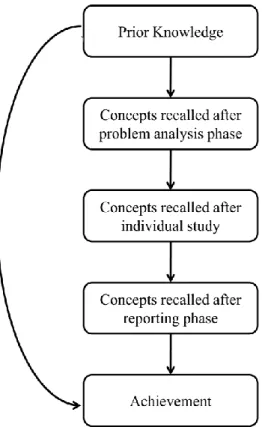
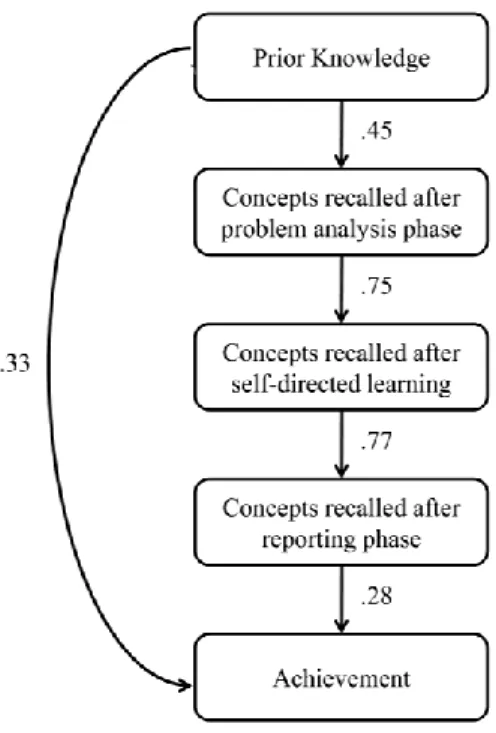
The purpose of this paper therefore is find the extent to which active learning is cumulative and whether it involves both collaborative and self-directed learning, in the context of problem-based learning (PBL). Figure 1 summarizes our hypothesized relations in terms of a causal model. We hypothesized that learning in PBL is a cumulative process where the learning in each new phase builds upon knowledge acquired in a previous phase. The process is initially driven by the prior knowledge that students bring with them to the classroom and the learning in each of the PBL phases influences student achievement.
Figure 1. Hypothesized model on the relationships between the different learning phases of PBL
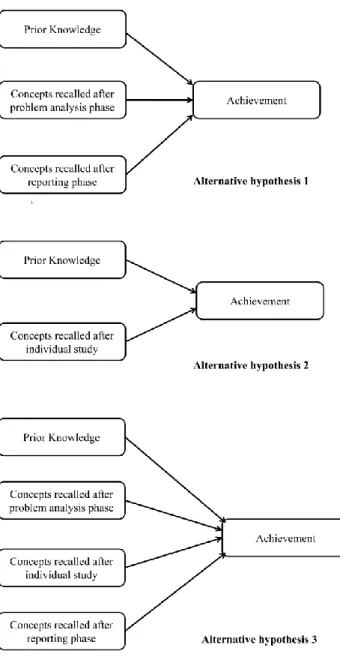
As mentioned earlier, it could be argued that the effects of active learning on achievement are mainly due to the group interactions and co-construction of knowledge or alternatively, that it is the individual self-directed learning phase that is most important to students’ learning. We therefore test our hypothesis against these alternative hypotheses: (1) Learning in PBL is only influenced by phases involving collaborative learning and co-construction; (2) Learning in PBL is only influenced by self-directed study; and (3) Learning in PBL is influenced by both collaborative learning as well as self-directed study, but not in a sequential cumulative manner. These alternative models are summarized in Figure 2.
Secondly, we hypothesize that the different PBL phases would involve the acquisition of new ideas (concepts) and the elaboration of previously acquired concepts to different extents. In an earlier preliminary study involving only nine students, we have shown that two different phases of the PBL process could be observed: an initial
terminology articulation phase − consisting mainly of the problem
analysis phase and initial SDL period, and characterized by the emergence of new concepts articulated and studied online, and secondly, a terminology repetition phase (mainly the later part of the SDL phase) where relevant concepts are repeated (Yew & Schmidt, 2008). Here we aim to test this “acquisition-elaboration theory” of learning in PBL again, this time using a larger sample size. Finally, an important auxiliary issue is: How can students’ learning be recorded as it unfolds? Through this study, we also aimed to develop and evaluate an efficient method to capture and quantify students’ learning during the PBL process so that causal relationships in the PBL process can be identified through path analysis.
Figure 2. Alternative models on the relationships between the different learning phases of PBL
Method
Participants
Participants were 218 students from 11 randomly selected classes. The students were in their second year in the School of Applied Science at a polytechnic in Singapore. Data were collected from these students during the third week of their Molecular Cell Biology class. As they had already completed one year of study in the polytechnic, students were not new to the PBL approach described below. Students and facilitators gave informed consent.
Educational context
The PBL process adopted at this polytechnic is somewhat unique in its “One-day-one-problem” approach. Here students work on one problem per day. Each class has a maximum of 25 students working together in teams of five. A brief description of the day’s process is described below:
Problem analysis phase (approximately 1 hour): The facilitator presents the problem for the day. Students work in teams of five to identify their prior knowledge and learning issues.
Self-directed learning (SDL) period (approximately 4 hours): Students do individual study or work with their teams on worksheets and other resources provided. They are also able to access other resources from the internet or textbooks. Time is spent helping one another within the team when necessary. Students meet with their facilitator for about 20 minutes in between this period to share their learning progress and strategy of understanding the problem.
Reporting phase (approximately 2 hours): Each team presents their consolidated findings and response to the problem, defending and elaborating based on questions raised by peers and the facilitator. The team presentation is usually in the form of powerpoint slides and the facilitator would also clarify key ideas if necessary.
Although the PBL process in this institution was adapted to suit the learning needs of the students and is completed within one day, it remains classified as PBL based on the “six core characteristics of PBL” described by Barrows (1996). The characteristics include student-centred learning whereby students work in small groups under the guidance of a tutor who facilitates the learning process. Problems are used as the stimulus for students’ learning with no opportunities to prepare beforehand. Furthermore, facilitators do not provide direct instruction. Instead, students construct their own understanding through self-directed learning (Hmelo-Silver, 2004). An additional feature of the PBL approach in this context is that instead of only individual study during the self-directed learning phase, peer consultation and collaboration also takes place during this time.
Procedure
A concept recall exercise was designed to estimate the number of relevant concepts that students were able to recall at the end of each PBL phase: problem analysis, self-directed learning and reporting. Our assumption is that as students engage in problem analysis, self-directed learning, group discussions, and/or peer teaching, they would be building networks of concepts related to the different learning issues as well as making relations between their prior knowledge and new ideas (Glaser & Bassok, 1989). A beginner’s initial network would consist of a few isolated concepts or ideas that
are poorly connected. Therefore, if asked to retrieve relevant concepts from these cognitive structures, his or her memory will be limited. The more students have learned about a topic, the richer, more coherent, and more detailed this particular network would be (Glaser & Bassok, 1989). As learning progresses, more linkages and integration between new and existing ideas are constructed. Therefore, students who have learned more effectively would be able to recall more concepts and would do that more easily (Collins & Quillian, 1969; Rumelhart & Norman, 1978). Hence, measuring the number of relevant concepts students were able to recall in regards to the problem-at-hand at the end of each learning phase gives an indication of the quality of students’ learning, as well as the concepts they were exposed to either from what they had read or discussed during that phase.
The concept recall exercise was given to the students three times in the day − at the end of the problem analysis phase, self-directed learning and reporting phase. It consisted of the following instruction: “List all the keywords or terminologies that are related to DNA and/or RNA.” (Understanding the structure of DNA and RNA was the focus of the particular day’s learning.) Students were instructed to only list concepts or keywords they thought were relevant, and not write in paragraphs or sentences. They were not allowed to discuss their answers or to refer to any resources when completing the exercise.
Materials
The problem statement for the day was entitled “Made for the Job” and it introduced students to concepts related to the structures and functions of DNA and RNA. A week prior to the problem, students were given an essay pre-test consisting of the following instruction:
“Describe and explain as much as you know about the structure of DNA and RNA.” This was to measure students’ prior knowledge in regards to the topic. The same essay question was administered as a post-test immediately after the day’s problem to measure students’ learning achievement. No time limit was set but students were instructed to complete the test on their own without referring to any resources. The problem statement is presented in Appendix A.
The “idea unit” was used as the entity for scoring the free recall essay tests for accuracy (Meyer, 1985; Schiefele & Krapp, 1996). Answers were segmented into idea units, which was defined as a statement ending with a comma, period, or “and”. A score of 2, 1 or 0 was awarded to each idea unit. A score of 2 was given for a completely correct idea unit, 1 for a partially correct idea unit and 0 when the idea unit was completely incorrect. The first and second authors independently scored about 20% of the tests with inter-rater correlation of r = .91. The remaining tests were scored by the first author.
Analysis
Students’ answers to the concept recall procedure were analyzed by awarding 1 point to each relevant concept given by the student. These concepts (keywords and terminologies related to DNA and RNA) were agreed upon by the first and second authors before rating. Both authors have expertise in the field of molecular and cell biology. All the concepts were then rated by both authors and checked for differences. As the keywords and terminologies related to DNA and RNA were not ambiguous, they were scored with only one discussion between the two raters to establish consistency. Total scores of each student for each PBL phase were then further analysed.
The relevant concepts listed were counted for each student for each learning phase (i.e. problem analysis, self-directed learning and reporting). The total number of concepts refers to the total number of relevant concepts recalled, including those that were repeated in one session. Newly emerged concepts were those that were not previously mentioned by the individual in any prior learning phase of the day. Repeated concepts were those that were previously recalled in an earlier learning phase. For the problem analysis phase, newly emerged and repeated concepts were deduced by comparing concepts listed at the end of the phase during the concept recall exercise with the concepts written in the pre-test answers.
T-tests were used to compare differences in pre- and post-test results. One-way ANOVA was used to find out if there were significant differences in the mean number of relevant concepts recalled at the end of each learning phase. The data were also analysed using structural equation modelling (SEM), a method that is able to test causal hypotheses among multivariate data. The pre- and post-test results as well as the total number of relevant concepts recalled by the students at the end of each PBL phase were analysed for this structural equation modelling analysis. The method generates several statistics that enable the investigators to assess how well the empirical data fit the theoretical model and to estimate the strengths of the causal relations hypothesized. Four indicators suggested in the literature were used to evaluate the goodness-of-fit of the models to the sample data, namely, the Chi-square/df index of fit, Chi-square, the Comparative Fit Index (CFI), and the Root Mean Square Error of Approximation (RMSEA) (Arbuckle, 2006; Browne & Cudeck, 1993; Hu & Bentler, 1999). The level of significance (p) computed from square and degrees of freedom should be higher than 0.05. The Chi-square/df index of fit yielded by dividing the minimum discrepancy (C)
by its degrees of freedom should be lower than 3 and preferably close to 1 (Arbuckle, 2006). CFI values larger than 0.95 and RMSEA scores below 0.06 can be considered as indicators of good fit (Browne & Cudeck, 1993).
Results
Results of mean student performance for the free recall essay pre- and post-tests showed improved scores for the post-test. The average difference between the post-test and pre-test scores for the free recall essay questions was 4.88 (SD = 3.88), indicating a significant increase in achievement at the end of the learning process, t (217) = 21.31, p < .01. The pre- and post-tests were significantly correlated at r
= .44, p < .01.
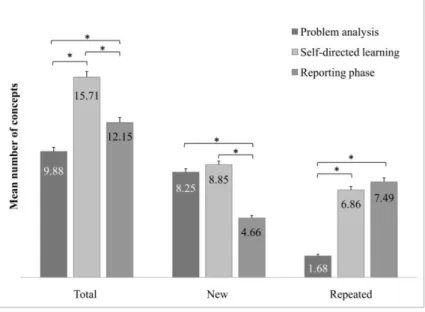
The relevant concepts recalled by students at the end of each learning phase during the concept recall exercise were counted in three different ways − the total number of relevant concepts including those which were repeated, newly emerged concepts as well as repeated concepts. The distribution of the average number of these relevant concepts is shown in Figure 3.
The one-way ANOVA revealed that the concepts verbalized differed significantly as a function of the different learning phases. The assumption of homogeneity of variance was violated so the Brown-Forsythe F-ratio is reported. There was a significant effect of the learning phase on the total number of concepts, F(2, 618.13) = 55.59, p < .01; number of newly emerged concepts, F(2, 609.93) = 79.32, p < .01 and repeated concepts, F(2, 497.73) = 156.06, p < .01.
Figure 3. Distribution of the mean number (+ SE) of total, new and repeated relevant concepts recalled at the end of the different learning phases of the PBL process (N = 218)
Post-hoc analyses using the Games-Howell test showed that the total number of relevant concepts recalled was significantly higher after the self-directed learning phase (M = 9.88, SD = 4.86) as compared to after the problem analysis phase (M = 15.71, SD = 6.52) (p < .05) and the reporting phase (M = 12.15, SD = 5.94). The total number of relevant concepts recalled after the reporting phase was also significantly higher compared to after the problem analysis phase. For the number of newly emerging concepts, these were significantly higher in the problem analysis phase (M = 8.25, SD = 4.10) and self-directed learning phase (M = 8.85, SD = 4.06) compared to the reporting phase (M = 4.66, SD = 2.99), while for the repeated concepts, these were significantly higher in the self-directed learning phase (M = 6.86, SD = 4.19) and reporting phase (M = 7.49, SD = 4.71) compared
with the problem analysis phase (M = 1.68, SD = 1.85). These significant differences are indicated in Figure 3.
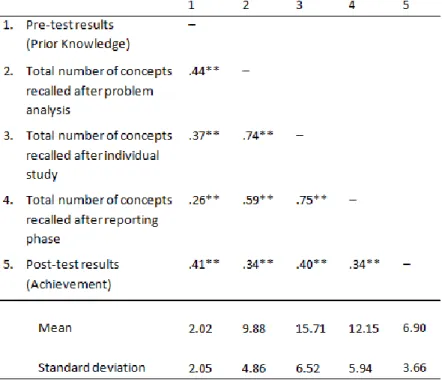
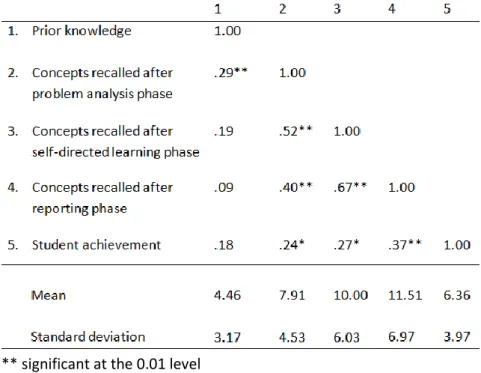
Table 1 shows the intercorrelations, means and standard deviations of the variables used in the structural equation model. Prior knowledge as measured by the essay pre-test is significantly correlated to students’ learning achievement and the total number of concepts recalled after each of the PBL phases. Students’ achievement is also significantly correlated to the concepts recalled at the end of each PBL phase. It can also be seen that the concepts recalled at the end of the different PBL phases are highly correlated with one another.
Table 1. Intercorrelations, Means and Standard Errors of the Variables
(N = 218)
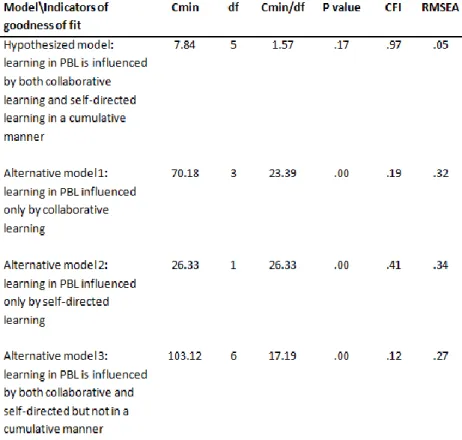
The hypothesized model displayed in Figure 1 was tested against the data, yielding the following results: Chi-square = 7.84, df = 5, p = .17; the minimum discrepancy, C, divided by the degrees of freedom, Chi-square/df = 1.57; the square root of the population discrepancy corrected by the complexity of the model RMSEA = .05; and the Comparative Fit Index (CFI) = .97. Figure 4 displays the path diagram of the model, showing the significant paths. The parameter estimates for the model were all statistically significant. These findings show that the model fits the data adequately.
Figure 4. Path model of the hypothesized model on relationships
The following alternative hypotheses proposed in the introduction were also tested against the data: (1) Learning in PBL is only influenced by phases involving collaborative learning and co-construction; (2) Learning in PBL is only influenced by self-directed study; and (3) Learning in PBL is influenced by both collaborative learning as well as self-directed study, but not in a cumulative manner. Table 2 shows a comparison of the results of the indicators of goodness of fit for the different models tested.
Table 2. Comparison of Results for Different Models Tested Using
Discussion
Our goals in this study were to understand how students learn in the different phases of PBL in terms of concept acquisition and elaboration as well as to investigate the extent to which active learning is cumulative and whether it involves both collaborative and self-directed learning, in the context of PBL. In addition, we sought to devise an efficient and valid method to track students’ learning in the PBL process.
The results in Figure 3 indicate that the self-directed learning phase is rich both in the acquisition of new concepts as well as the reiteration and repetition of concepts previously exposed to. That there was a high number of new concepts at the end of the problem analysis phase (as compared to students’ pre-test answers) suggests that the discussion during this phase helped to activate students’ prior knowledge, as previous studies have suggested (De Grave et al., 2001; Schmidt et al., 1989). We also observe that the reporting phase is characterized more by repetition of concepts rather than being exposed to new ones. This result is similar to the findings by Yew and Schmidt (2008) who identified two distinct phases of initial terminology articulation and a later terminology repetition in the PBL process from a group of students’ online research data and verbal interactions. Our results strengthen their findings, which were limited due to small sample size.
One surprising observation from the distribution of concepts in Figure 3 is that the total number of concept recalled during the reporting phase is less than that in the self-directed learning phase. One would expect that by the end of the whole PBL cycle, students would be able to recall more relevant concepts. Possible reasons for