U n i v e r s i t y o f H u d d e r s f i e l d R e p o s i t o r y
S n a p e , Kir s t y
An Ex plo r a tio n of S t u d e n t s’ Ex p e ri e n c e s of Pl a c e m e n t i n C o m p u ti n g a n d
E n g i n e e r i n g : a S o cio c ul t u r al An aly sis of L e a r n i n g
Or i g i n a l C i t a t i o n
S n a p e , Kir s t y ( 2 0 1 9 ) An Ex pl o r a tio n of S t u d e n t s’ Ex p e r i e n c e s of Pl a c e m e n t in
C o m p u ti n g a n d E n g i n e e r i n g : a S o cio c ul t u r a l An aly si s of L e a r n i n g . Do c t o r a l
t h e si s, U n iv e r si ty of H u d d e r s fi el d .
T hi s v e r si o n is a v ail a bl e a t h t t p :// e p r i n t s . h u d . a c . u k/i d/ e p r i n t/ 3 5 1 5 3 /
T h e U n iv e r si ty R e p o si t o r y is a d i gi t al c oll e c tio n of t h e r e s e a r c h o u t p u t of t h e
U niv e r si ty, a v ail a bl e o n O p e n Acc e s s . C o p y ri g h t a n d M o r al Ri g h t s fo r t h e
it e m s
o n t hi s si t e a r e r e t ai n e d b y t h e i n divi d u a l a u t h o r a n d / o r o t h e r c o p y ri g h t
o w n e r s .
U s e r s m a y a c c e s s full it e m s fr e e of c h a r g e ; c o pi e s of f ull t e x t it e m s g e n e r a lly
c a n b e r e p r o d u c e d , d i s pl ay e d o r p e rf o r m e d a n d g iv e n t o t hi r d p a r ti e s i n a n y
fo r m a t o r m e d i u m fo r p e r s o n al r e s e a r c h o r s t u dy, e d u c a ti o n al o r n o t-fo r-p r ofi t
p u r p o s e s wi t h o u t p r i o r p e r m i s sio n o r c h a r g e , p r o vi d e d :
•
T h e a u t h o r s , ti tl e a n d f ull b i blio g r a p h i c d e t ail s is c r e d i t e d in a n y c o p y;
•
A h y p e r li n k a n d / o r U RL is in cl u d e d fo r t h e o ri gi n al m e t a d a t a p a g e ; a n d
•
T h e c o n t e n t is n o t c h a n g e d i n a n y w ay.
F o r m o r e i nfo r m a t io n , in cl u di n g o u r p olicy a n d s u b m i s sio n p r o c e d u r e , p l e a s e
c o n t a c t t h e R e p o si t o r y Te a m a t : E. m a il b ox@ h u d . a c. u k .
1
An Exploration of Students’ Experiences of Placement
in Computing and Engineering: a Sociocultural Analysis
of Learning.
Kirsty Snape
A thesis submitted to the University of Huddersfield in partial fulfilment
of the requirements for the degree of Doctor of Philosophy
The University of Huddersfield
November 2019
2
Acknowledgements
I would like to take this opportunity to extend my sincerest gratitude to my participants
without whom this research would not have been possible.
I would also like to thank my supervisors who throughout the entirety of my higher
education journey have been a constant source of inspiration, reassurance and guidance.
To my fiancé Ryan who has supported me throughout all the ups and downs of academic
research (of which there have been many), thank you for believing in me.
Thank you also to the University of Huddersfield for offering me the Vice-Chancellor’s
scholarship, which enabled me to continue my academic progression where I would have
otherwise been unable.
3 Copyright statement
i. The author of this thesis (including any appendices and/ or schedules to this thesis)
owns any copyright in it (the “Copyright”) and s/he has given The University of
Huddersfield the right to use such Copyright for any administrative, promotional, educational and/or teaching purposes.
ii. Copies of this thesis, either in full or in extracts, may be made only in accordance with the regulations of the University Library. Details of these regulations may be obtained from the Librarian. This page must form part of any such copies made.
iii. The ownership of any patents, designs, trademarks and any and all other intellectual
property rights except for the Copyright (the “Intellectual Property Rights”) and any
reproductions of copyright works, for example graphs and tables (“Reproductions”),
which may be described in this thesis, may not be owned by the author and may be owned by third parties. Such Intellectual Property Rights and Reproductions cannot and must not be made available for use without permission of the owner(s) of the relevant Intellectual Property Rights and/or Reproductions.
4
Contents volume 1
•
Acknowledgements……….
.
2
•
Copyright S
tatements………
..
………..
3
•
Contents………
4
•
Abstract……….
6
•
1. Research J
ourney………
..
………
...
7
Research Journey………...7
Thesis Overview……….…….9
•
2. Chapter One
–
Literature R
eview……….
11
Defining Work Placements………..……12
Models of Placement………..……12
Work Placements and the Employability Agenda……….….14
Participation Motivations……….………..17
Non-Participation Motivations……….………..17
Outcome Focused Research……….……….21
Placement Design and Implementation……….………..26
Sociocultural Placement Research………29
Chapter Summary……….……….…..……32
•
3. Chapter Two
–
T
heory………
.
……….
35
Communities of Practice Theory……….…………35
Communities of Practice – a Definition ……….………36
Legitimate Peripheral Participation……….……….40
The Negotiation of Meaning………..42
Identity……….…….47
The Zone of Proximal Development……….……….54
Synthesising the Theories……….……61
Study Aims……….….62
•
4. Chapter Three - Method
……….………65
A Qualitative Approach………..…..……….65
Interpretivism………..……….65
Methodological Pluralism………..………..66
Facebook Group Rationale………..67
Interviews Rationale……….……71
The Context………..……..74
Recruitment……….75
Sample………..…….……….77
Data Collection Method………..…………78
Ethics………..……….83
Analysis………..…….87
Chapter Summary………..…….94
•
5. Chapter Four
–
Narratives
……….….96
Phil………..………..96
5
Kevin……….100
Antoni………..104
Tom………107
Regina……….…….109
•
6. Chapter Five
–
Thematic Analysis
………..113
•
Theme One – Integrating Learning………113
•
Theme One Summary……….…………134
•
Theme Two – Incorporation and Identity……….…………135
•
Theme Two Summary……….………155
•
Theme Three – Negotiating Relationships; the Dynamics of Power…………..157
•
Theme Three Summary……….…170
•
7. Chapter Six
–
Conclusions and R
ecommendations………
171
Limitations and Future Research……….172
Contribution to the Literature………..173
Conclusions and Recommendations……….173
•
8. References
……….……..179
•
Contents volume
2………1
91
•
Appendices
………..…….….192
Appendix 1 – Sample of Facebook Group Topics……….……….…..192
Appendix 2 – Interview Schedule………193
Appendix 3 – Ethics Submission………..196
Appendix 4 – Interview Information Sheet………..202
Appendix 5 – Facebook Group Information Sheet………..205
Appendix 6 – Interview Consent Form……….207
Appendix 7 – Facebook Group Consent Form………..…………..209
Appendix 8 – Duty of Care Document………..211
Appendix 9 – Phil Transcript………212
Appendix 10 – Sam Transcript………224
Appendix 11 – Kevin Transcript……….237
Appendix 12 – Antoni Transcript………..251
Appendix 13 – Tom Transcript………262
Appendix 14 – Regina Transcript………..270
6
Abstract
Past research dedicated to the study of the undergraduate work placement experience has demonstrated placement participation to be of great benefit to students, contributing to academic improvements, improved generic skills and increased employability. There is however a lack of research which examines the mechanisms underpinning the process of learning that results in these improvements. The academic literature in relation to work placements is under-theorised which, whilst providing valuable data, does not allow for a deep understanding of the phenomenon and makes the wider application of the research more challenging. This research project uses sociocultural notions of learning to explore students’ learning experiences during the work placement year drawing upon the work of Lave and Wenger (1991) and Vygotsky (1978). To explore students’ experiences of
placement, data was collected through use of semi-structured interviews and an interactive Facebook group. To analyse the data, narrative constructions were produced, and a thematic analysis was conducted. The analysis explored issues of identity, the meanings students formed in relation to their placement experience, and the practices perceived to be influential to placement learning. The study findings indicate where learning on placement and in academia enable one another which is a process mediated through the mechanism of a shifting identity. The findings also highlight where the notion of independent learning in higher education contrasts with the inherently collaborative nature of placement participation, and where the ability to navigate complex social dynamics is thus a fundamental skill for enabling placement learning.
7
Research Journey
During the second year of my undergraduate psychology degree I put myself forward for a research project that in hindsight I believe, transformed my undergraduate experience. The project involved exploring the experiences of law students as they set out to become legal advice practitioners in a university affiliated free legal advice clinic. My role in this project had been to act as a reflective peer mentor to one of the law students, for which I received training in relation to theories of learning and reflective practice. Throughout the project I met with my peer and attempted to help her to reflect upon and grow from her experiences of working in the clinic. Though I had studied developmental psychology in the year prior, participating in the legal advice clinic project had been my first real experience of exploring the psychology of learning in relation to higher education. I became fascinated by the concept of learning through practice and found myself relating to my degree in a much more interested and engaged way than before.
During the course of my participation in the project I had conducted three interviews with my law student counterpart. Using this data, I dedicated my final year dissertation to an exploration of what it meant to learn in the process of becoming an undergraduate legal advice practitioner. In doing so, I was able to further immerse myself in sociocultural theory. As I began to relate these theories to my
peer’s experience, my ontological position shifted from a passive acceptance of cognitivism to being firmly in favour of socioculturalism. When the time came to decide my PhD research interest, I hoped to explore further the nature of situated learning in relation to higher education. In discussion with my PhD supervisors the idea of exploring placement learning was formed. At that time, I was particularly interested in situated cognition and the importance that Lave and Wenger placed on learning in context. I had expected given the fundamentally situated nature of work-placement participation that this would be an area of the academic literature that was already saturated with theoretical explorations. I was surprised therefore to see how few studies explored the process of learning on placement, and how fewer still had done so based upon sociocultural notions of learning. After reviewing the research in the area, I sought to understand the mechanisms that contributed to the positive learning outcomes associated with placement participation and I knew there was space in the literature for a study that did so. Enacting this aim however has not always been a straight-forward endeavour.
My original aims were a work in progress:
8
2. To investigate how students perceive placements to aid in their development of key competences.
3. To investigate students’ subjective notions of their identity shift post placement.
4. To investigate how work placements are understood to contribute to the university from the perspective of members of the engineering teaching staff.
5. To use sociocultural theory to understand placement participation.
When I look back at my first research aims, I barely recognise them, such has been the extent of my learning journey as I have engaged in the world of academic research. Aim one I recall stemmed from my initial intention to take an ethnographic approach to exploring placement learning. I believed at that time (as I still do) that from my ontological position, where learning is thought to involve a process of meaning making in response to situated experiences of participating in practice, that it makes sense that research exploring learning would explore said meanings and observe said practice. At this early stage, I had conducted research but never really had to design it. I had read research methods text books that modelled ideal methods of research, but it was not until my supervisor drew attention to the impracticalities of my initial choice of method that I realised that though suitable, it was not necessarily feasible. I could not realistically as a student studying for a limited time, with limited funds, arrange to visit multiple students at workplaces scattered around the country. But for a long time I felt unable to move past this notion that a sociocultural study must observe the phenomena of study in context. Only as I continued to engage with theory, and with reading the placement literature to explore the methods by which other researchers had approached the study of placement did I come to truly see the value in a project that only focuses on students’ experiences and the meanings they form from them.
I recall, looking at my second aim, hoping to form a competence framework based upon industry
benchmarks, from which I could gauge students’ perceptions of what they had learned in the course
of placement. I knew that this was a research area saturated with a focus on outcomes and yet I still sought to contribute research, which even if only partially, added to them. My logic at the time was that to understand the process of learning, one must first understand what has been learned. Again, with the passage of time and plenty of reading I came to realise the rigidity of my thinking. The research area needed research that focused on the placement journey and not its end results. I could of course explore what students felt they learned along the way, but to explicitly focus (even only partially) on learning outcomes as so many had done before, would be to detract focus from the
student’s experiences of learning, which were after all what I had truly sought to capture with my
9
I also sought, when I set out to study placement learning, to study staff perceptions, simply because I noticed their absence in the existing literature. I worried with my research that I was contributing to an existing imbalance between a focus on the students and the voices of the other stakeholders. I see now, quite clearly, that staff perceptions of how placements contribute to the university tells us little about the student learning journey and even less about the placement experience. Though it seems obvious to me now as my research has progressed to a cohesive whole that this aim had no place within my study, in the course of conducting my research it took me a long time to come to this realisation. Despite all that I had read, it was only as I began engaging with my participants, hearing the richness of their experiences and the complex ways in which they were able to learn and grow from these experiences that I came to understand that this and solely this needed to by my focus. Anything else would detract from the student voice, which despite a mass of placement research that focused on students, still needed to be heard. My aims shifted accordingly:
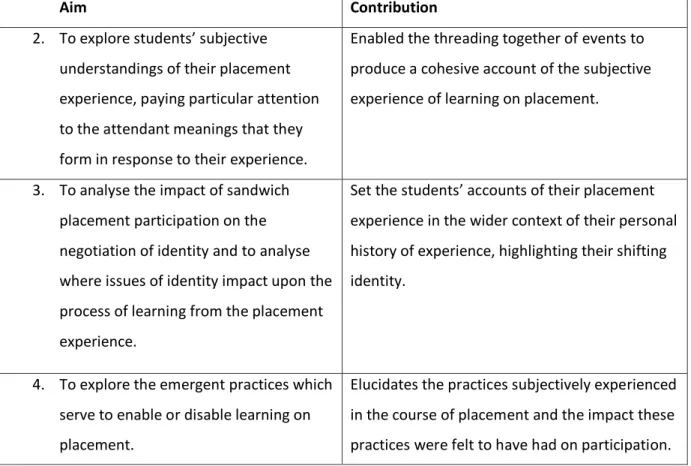
1. To apply a sociocultural theoretical framework to the understanding of placement learning, whilst contributing new theory driven knowledge to the work placement literature.
2. To explore students’ subjective understandings of their placement experience, paying particular attention to the attendant meanings that they form in response to their experience. 3. To analyse the impact of sandwich placement participation on the negotiation of identity and
to analyse where issues of identity impact upon the process of learning from the placement experience.
4. To explore the emergent practices which serve to enable or disable learning on placement. In the course of enacting these aims I have come to understand the complexity of the social research process, where circumstances shift and change in ways that cannot be anticipated requiring of the social researcher adaptability and resilience. I talk in my analysis of the transformative potential of participation in practice, this is something through participating in the act of academic research that I have come understand at a personal level. In the course of my research pursuit, I have found my method shifting in response to ongoing learning and unanticipated events. I have had to adapt to issues with timing and funding and faced barriers in relation to recruitment and access. But in the process of adapting to each of these challenges I have come to learn and appreciate the flexibility and resilience required in the process of becoming a social researcher.
Thesis Overview
The remainder of the thesis is divided into six chapters. Chapter One provides a review of the literature in relation to work placement participation. Included in the review are placement studies which have
10
been conducted in a range of countries across a variety of subjects. Much of the literature in relation to placement participation is quantitative in nature and the review reflects that. The chapter culminates in a critical argument in relation to the largely atheoretical nature of existing placement research. In Chapter Two I outline Lave and Wenger’s (1991) Situation Learning Theory and their subsequent work on Communities of Practice Theory and I outline Vygotsky’s (1978) concept of the
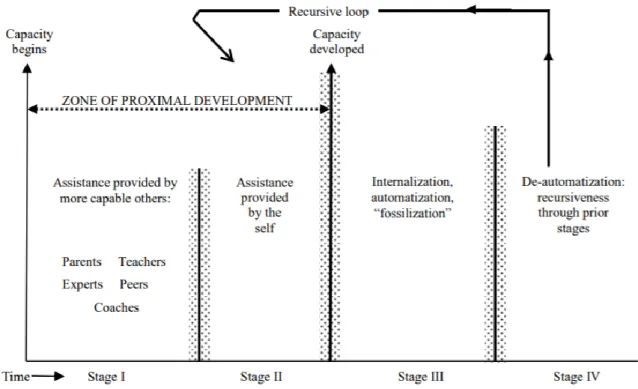
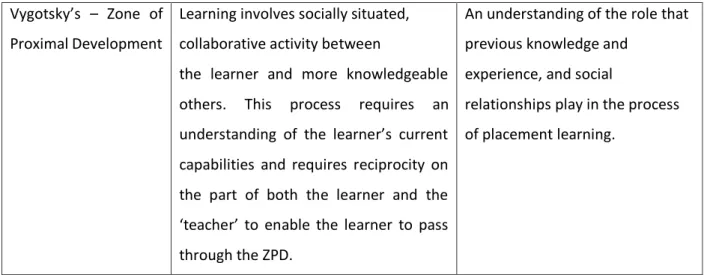
Zone of Proximal Development. Based upon the two theoretical positions an argument is presented in favour of the application of sociocultural learning theory for understanding placement learning. Chapter Three outlines in depth the method of data collection and analysis that was carried out in the process of exploring learning on placement and included in this discussion is a rationale for each of the methodological decisions made. In Chapter Four narratives of the placement experiences are presented. Six narratives were constructed based upon six separate interviews and each narrative offers an insight into the diversity of the work placement experience. Though the construction of the narratives was implicitly interpretive, no explicit attempts at interpretation are made in this chapter. In Chapter Five the data set as a whole is then analysed using a theoretical thematic analysis underpinned by the theoretical concepts outlined in chapter two. In Chapter Six the limitations of the study are considered, conclusions are made regarding the findings and recommendations are made for further research and practice.
11
Chapter One
–
Literature Review
Within this chapter I seek to demonstrate the predominant trends across the research area of work placement learning and to discuss the key findings of existing placement research. This I do with the intention of outlining recent understandings and to provide a rationale for the current research project. Whilst this thesis explores UK sandwich year placements for students in the subjects of computing and engineering, the following review of the literature is inclusive. It overviews studies which have been conducted in a variety of countries and which focus on an array of subjects and placement models, so as to contribute to building a more holistic understanding of the differing ways in which work placements have been conceptualised and approached. But with that said, certain exceptions were made whilst selecting literature for review. These exceptions were based on a
subjective judgement of a study’s relevance, and were determined on an independent basis, research
paper by research paper. Typically, those excluded from review related to clinical, teaching and social work placements, as a significant proportion of these papers were highly specific to experience within those particular subjects and so their relevance for understanding work placements more generally was deemed limited, this was not however always the case, some had more general applications allowing for their inclusion.
This chapter begins with an introduction to the concept of work placements in which I briefly overview some of the more predominant work placement models and demonstrate where these approaches to providing industry experience share similarities and where they diverge. Included in this introduction is an explanation as to how and why work placements were incorporated into the UK undergraduate curriculum and how once incorporated they have increasingly grown in prevalence, but not always in popularity. Whilst explaining the rationale behind the expansion of work placement programmes I draw upon rhetoric centred around student needs and expectations, government policy, industry requirements and global competitiveness. Upon demonstrating why stakeholders elect to invest in placement programmes, I review research which examines whether they can live up to expectations and produce the outcomes they are designed to engender. Much of the existing research I will argue lacks any basis in theory and focuses largely on quantitative measures of the academic and employment outcomes of placement participation. Whilst this is an essential avenue of exploration, research such as this is unable to provide an insight into the mechanisms of learning that contribute to these outcomes. This critique is one which has been echoed in placement research in recent years. In response to increasing calls for theoretically underpinned work-placement research, a limited number of studies exploring the process of learning on placement using sociocultural theories can
12
now be found in the work placement literature and these studies are discussed at the end of the chapter.
Defining Work Placements
This research project involves students’ experiences of their year in industry in what is commonly
known as a ‘sandwich year placement’. This term is used in reference to where a student spends a year gaining work experience relevant to their degree subject, sandwiched between the second and fourth year of study.
In alignment with my sociocultural allegiances I believe that the provision of a definition and description of the placement model under exploration in placement research is a necessity. As the nature of placements, their structure and design, will impact the way in which students experience and learn from them. A description of the nature of the placement explored is essential for providing context for the reader from which to situate their understandings of the study findings. Yet much of the existing placement research falls short of this expectation. Descriptions of the nature of the placements under scrutiny often lack depth (or are in some cases non-existent). What’s more, the use
of terminology with reference to placement models in general lacks consistency, further exacerbating these inadequacies.
The terminology applied in reference to the phenomena of work placements is extensive, it includes (but is not limited to): internships, practicums, field/clinical placements, field observations, shadowing (Purdie, Ward, Mcadie & King, 2013), work-based learning (Reeders, 2000), work-integrated learning and cooperative learning/education (Coll et al, 2009). A lack of clarity as to what exactly each of these labels refers has resulted in a general confusion, contradiction and overlap which is problematic for ensuring that the placement under study is appropriately characterised. As placement terminology is not the focus of this research project little space is dedicated to its exploration at present. For those seeking a more comprehensive overview of the placement nomenclature Gardner and Bartkus (2014) provide a useful reference guide. What follows instead is a brief overview of the labels that appear most frequently across the literature and a description of the model to which they most often refer.
Models of Placement
A key term, which appears particularly often in the Australian placement literature, is “ work-integrated learning” or “WIL” for short. Purdie et al (2013) state WIL takes many forms including internships, field observations and work placements which would suggest it to be an umbrella term which encompasses a variety of approaches to the provision of placement learning. Likewise,
13
Abeysekera (2006) suggests the term work integrated learning was coined as a means to encompass the increasingly diverse modes of vocational learning.
“Internship” is another term which frequently appears in the studies conducted in a range of countries, including UK based studies. Internships are structured, supervised, credit-based forms of work experience that provide students with opportunities to apply classroom knowledge in real world practice, they are flexible in relation to what they entail and how long they last often meaning students can participate in multiple internships throughout their higher education experience (Gardner and Bartkus, 2014). Higher education institutions (HEI’s) can either incorporate internships into their programmes or alternatively they can add an internship scheme at the end of the programme (Helyer and Lee, 2014). Gardner and Bartkus (2014) highlight how variances in their nature can mean that their quality can differ dramatically, with some students gaining significant learning opportunities whilst others are set menial tasks. Corrigan (2015) when studying the media industry for example, argued that students’ need for internship experience in a competitive job market combined with the
ambiguous nature of what internships should entail made them fertile ground for exploitation. Many internships Corrigan (2015) argues are unpaid, based on menial work and are prone to employees who
are indifferent to their intern’s learning experiences. Though caution should be applied in likening internships to sandwich placements, given their differing structures, evidence of power imbalances between incoming students and members of their workplace signals the importance of considering the impact of power as a potentially influential mechanism in the process of learning during placement participation. Chapter two therefore includes a critical discussion examining how Communities of Practice Theory can account for issues of power in explicating the placement learning process. Finally, “cooperative education” is another commonly occurring label and is particularly prominent in American research. This term most often refers to programmes which involve the formal integration of academic studies with work experiences, and generally entails periods in which work experience and academic studies occur in alternating rotations which often span the three years of undergraduate study (Cedercreutz and Cates, 2010). Within cooperative education programmes, a partnership is formed between the student, employer and educational institution, with the successful completion of both formal classroom work and placement participation being essential for gaining a qualification (Eames and Bell, 2005).
Whilst the above represents but a few of the wide-ranging placement labels it should provide sufficient context for understanding the placement models and terminology discussed throughout the remainder of the thesis. Throughout, where a placement study is under discussion, I will endeavour to use the label the researcher used. Doing so, in addition to providing a brief overview of the model
14
of placement to which each label most often refers should provide some insight as to the form of placement under investigation (but as the above critique would suggest the reader should always be mindful that inconsistencies and overlaps in terminology persist). Where discussing my own research or placement participation more generally, the terms ‘placement’ or ‘work placement’ will be utilised.
Work Placements and the Employability Agenda
Work placements in all their variations over time have become more prevalent in the undergraduate curriculum. Their increased presence is evidence of the fact that higher education institutions are under significant pressure to incorporate more employability strategies into their curriculum. What follows is an account of the nature of these pressures including from whom they emanate and for what reason, which serves to illustrate the way in which work placements have become an important tool for meeting the agendas of various stakeholders.
In the late 1950’s, the UK government Minister of Education established the National Council of Technological Awards in a bid to resolve issues of national wealth and economic competitiveness, through the promotion of industrial placements in engineering and technology degrees (Little and Harvey, 2007). Since this time there have been consistent efforts to form strong relationships between higher education and industry across a wider range of subjects (Bullock, Gould, Hejmadi and Lock, 2009). In the late 1990s interest in work placements once again surged culminating in the establishment of National Centre of Work Experience (Little and Harvey, 2007). This renewed interest is attributed to the highly influential government commissioned report - The National Committee of Inquiry into Higher Education (1997) Dearing Report. Within which it was recommended that universities with immediate effect should form links with employers to foster a greater number of work experience opportunities for students in a range of settings, regardless of whether these experiences be structured or informal, paid or unpaid. Undergraduate programmes, they suggested should allow students to become familiar with work and should provide opportunities for students to reflect upon these experiences and to build an understanding of how they might relate to future development. This is a message which has been reiterated numerous times in subsequent reports including: The Department for Education and Skills White Paper (2003), The DBIS (2009) Higher Ambitions Report and DBIS Wilson Review (2012). Each to varying degrees highlight the value of
placements for strengthening the position of Britain’s workforce in the global economy, enhancing student employability and improving students’ knowledge and transferable skills to produce an
appropriately skilled workforce. Driven by the pervasiveness of policy advocating work experience opportunities within the UK and in many other developed countries, work placements are increasingly
15
viewed as an integral aspect of the undergraduate learning experience (Bullock, Hemadji and Lock, 2012).
Pressure to contribute to student employability however emanates from numerous other sources, including graduate employers, many of whom for a long time have been dissatisfied with the work-readiness of prospective recruits (Wilton, 2012). Traditionally across the more vocational disciplines, where universities have tended to focus on teaching theoretical content, the majority of the teaching of professional practical skills has been allocated to the graduate employers who were in large part expected to train graduates on the job. Over time however, questions have been raised regarding whether graduates should enter the workplace ready to work (Sheldon & Thornwaite, 2005) and universities have thus begun to face criticism for merely providing students with a credential, the influence of which is in decline as the number of graduates continues to rise (Alpert, Heany and Kuhn, 2009). This decline in the status of academic credentials, has caused employers to place an increased importance on personal attributes in addition to a wider range of performative and organisation abilities (Brown and Hesketh, 2004). Thus, in addition to meeting government demands, HEI’s must also cooperate with employers who expect highly skilled, knowledgeable graduates who are ready to work (Medhat, 2003).
Students are an additional source of pressure, with their own expectations of what should come of their higher education experience. For undergraduates, education in general is increasingly being viewed as an investment (Abseykera, 2006). A combination of declining graduate vacancies (Banga & Lancaster, 2013), a rapidly expanding student number and a challenging labour market post-2007 recession, means that graduates face stiff competition when seeking employment (Brookes and Youngson, 2014). Many new graduates have difficulty obtaining graduate-level work and are finding it impossible to break into their desired sector (Helyer and Lee, 2014). Issues of graduate employability are therefore of great importance to students, particularly given the level of debt many accrue whilst financing their studies (Gomez, Lush and Clements, 2004). Sandwich placements and alternative forms of undergraduate work experience are increasingly thought of as an important means to develop graduate employability potential (Clarke and Zukas, 2016). Whilst a high percentage of recruiting employers enquire about students’ educational experiences, many believe vital skills such as
leadership and teamwork are not attainable solely from classroom learning, and thus rely upon demonstrations of work experience to identify the presence of these skills (Bar and McNeilly, 2002). The provision of work placement experiences should then, in theory, allow students the opportunity to build upon their employability by enabling them as graduates to distinguish themselves from their competition by using what they have learned through work placement experiences to stand out to graduate employers (Heyler & Lee, 2014).
16
Though it is evident that HEI’s must meet the expectations of numerous stakeholders, placements also have the potential to be important and beneficial for the HEI’s themselves. Attempts to improve
graduate employability are in part a reflection of each university’s concerns with their own future
enrolments which can greatly impact upon their own funding, productivity and competitiveness (Jackson, 2014). HEI’s frequently monitor factors such as academic achievement and graduate employment rates as part of their quality assurance procedures and the results of these measures have a significant impact on the reputation of the institution (Bullock et al, 2009) which is vital for increasing student numbers (Lawrence and Sharma, 2002).
Universities in their ongoing commitment to the employability agenda have adopted a range of employability strategies through the introduction of new courses, the modification of existing courses and the expansion of work experience opportunities (Cranmer, 2006). Given the value and investment each stakeholder places in the provision of work placements, it might be assumed that students in a position to accept a work-placement opportunity would do so without a great deal of hesitation. The reality however is much more complex. Numerous factors influence students’ decisions as to whether to embark upon a sandwich placement year. The factors impacting these decisions, in addition to those determining whether the students attempting to gain a placement are successful in their pursuit, are outlined below following a brief overview of current trends in relation to placement uptake.
As will be later evidenced, a significant amount of outcome focused placement research has demonstrated that placement programmes can be effective in generating positive changes. Yet for a number of students there is a level of resistance when it comes to committing to a year of work. For a significant time, the relative number of students selecting a sandwich option nationally was in a steady year-on-year decline (E4E, 2011). However, in recent years sandwich placements have increased in popularity. In the academic year 2014-2015 a total of 153,535 undergraduate students were enrolled on a sandwich course, a notable increase from the 113,795 enrolled on a sandwich course in 2009-2010 despite a decrease over that same period in the total number of undergraduates (Wickware, 2016). As to whether trends such as these are echoed internationally is hard to ascertain, the differences in the definition and nature of placements makes it difficult to contextualise placements in an international setting (Green, 2011). Past research has however indicated that whilst 55% of all European graduates participated in some form of placement period, with countries such as Finland, Germany and the Netherlands reporting figures as high as 80%, the number for the UK was comparatively low at 29% (Arthur and Little, 2010). A more recent comparison would however be preferable.
17
Thus, whilst placement programmes have become more frequent and varied, the level of student uptake does not appear to have followed such a consistent trend, their popularity amongst students it would appear waxes and wanes. Given the level of investment afforded to placement programmes and the high expectations of the outcomes of these investments, a more consistent positive trend would be desirable. To ensure this goal is met with future cohorts requires the identification of factors which either contribute to or dissuade students from choosing to embark upon a placement. Interestingly it would appear that little research thus far has been dedicated to this endeavour, despite the clear potential its findings have for designing interventions in the marketing and implementation of future placement programmes. The following is an overview of the findings from the limited number of studies available. These are typically based upon student self-report or HEI staff perceptions and examine the motivations and reasons behind students’ participation or non -participation in work placement opportunities.
Participation Motivations
ExperienceA significant number of students choose a placement course as a means of gaining industry experience which will enable them to apply theoretical knowledge in a practical environment in tandem with developing core competences (Little and Harvey, 2006; Balta, Coughlan and Hobson, 2012). Placements are viewed as a means to supplement learning in areas where universities’ practical
learning provision is considered unsatisfactory (Hejmadi, Bullock, Gould and Lock, 2012). Career Direction
Placement years are persuasive due to their perceived value for informing post-graduation career decisions and enhancing employment prospects (Hejmadi et al, 2012). For some students the placement year acts as a kind of test which allows them to determine if they are happy in a role or even in their chosen industry without a long-term commitment (Little & Harvey, 2006).
Additional incentives for participating in a placement year include salary (Morgan, 2006), convenience
– if the placement does not require relocation (Balta, Coughlan and Hobson, 2012) and the chance to have a break from academia (Little and Harvey, 2006).
Non-Participation Motivations
Lack of Information18
Bullock et al (2009) suggest based on interviews with non-placement students that placement opportunities tend to be rejected based either upon well-informed reasons or on uncertainty and a lack of information. For those who do not receive adequate information there is a level of uncertainty regarding the nature of the demands that are expected during their placement, with too little
information offered regarding companies, available roles and past students’ experiences. Students
can in addition have unrealistic expectations of industry with many expecting to be placed in large multi-national firms despite high competition for positions and a limited number of opportunities (Balta, Coughlan and Hobson, 2012). Work placement options thus do not always match the ambitions of students, leading them to feel there is a lack of choice (Bullock et al, 2009; Banga and Lancaster, 2013).
Transitional and Confidence Issues
Students can feel as though the work placement year has come too soon after their original transition to university and with it comes essential decisions regarding housing and relationships which have to be made well in advance of any placement confirmation (Hejmadi et al, 2012; Balta, Coughlan and Hobson, 2012). In some cases, the promotion of the work placement year does not occur until the second year leaving some students suddenly overwhelmed (Morgan, 2006). With students already having to cope with the demands of their degree, the addition of planning a transition to placement and all that it entails is a source of anxiety (Lock, Bullock, Gould and Hejmadi, 2009). Many students find their applications are rejected due to poor academic performance, a lack of work experience or a lack of core competencies (Balta, Coughlan and Hobson, 2012) and for some the prospect of facing rejection in these areas is enough to prevent them from even attempting to apply (Banga and Lancaster, 2013).
Completion of Studies
Mixed method data has demonstrated that for a large percentage of non-placement students, the opportunity to partake in a placement is rejected in favour of completing studies without a break. Bullock et al (2009) surveyed 136 non-placement students about why they chose not to embark on a placement, finding 80% chose not to go in favour uninterrupted study. Follow up focus groups suggested a clear career path underpinned this decision as students were eager to pursue their career sooner. Balta, Coughlan and Hobson (2012) found survey respondents felt the taxing workload of the second year to be a further deterrent prompting many to choose not to spend the time and effort on applications in favour of achieving an upper-class degree. Follow up focus group data suggested this was influenced by concerns around the time required to prepare CVs, apply for placements and attend interviews.
19 Career Focus
Some students feel confident that they already know their career direction without gaining placement experience, for others, placements are not felt to be worthwhile for impacting career prospects (Hejmadi et al, 2012). Crebert, Bates, Bell, Patrick and Cragnollini (2004) found of 664 placement students they surveyed, 74% believed the skills developed on placement contributed to their career advancement. However, often students believe they already have sufficient and relevant work experience without a placement (Morgan, 2006; Bullock et al, 2009; Hejmadi et al, 2012). Additionally, the lack of credit awarded for a placement year can hinder enthusiasm leading some to feel a shorter summer placement will be of more benefit (Bullock et al, 2009).
Location
The location of placement employers can act as a barrier for students wanting to participate on a placement for numerous reasons. Typically, less populated areas tend to have fewer employers with available placement positions (Banga & Lancaster, 2013). In highly competitive areas students have a harder time obtaining a placement (Balta, Coughlan and Hobson, 2012) and placements which are geographically dispersed can cause travel inconveniences which can be discouraging (Morgan, 2006; Balta, Coughlan and Hobson, 2012).
Financial Considerations
For some, part-time work is necessary to fund studies which can deter placement applications (Morgan, 2006). For others tuition fees tied to the work-placement year can be problematic – Bullock et al (2009) found for instance that almost all respondents in a survey of 145 students (regardless of whether they had completed a placement or not) strongly expressed their indignation about tuition fees tied to the placement year.
The Influence of Others
The perceived opinions of personal tutors and individual lecturers can be highly influential to a
student’s decision as to whether to embark on placement. Encouragement or a lack-thereof can impact whether students believe a placement will be worthwhile (Bullock et al, 2009; Hejmadi et al, 2012).
Inability to Obtain a Placement
For some a lack of strategy during the job search can limit opportunities to obtain a placement. Placement students tend to begin the recruitment process sooner than non-placement students and in a more focused, strategic and selective manner based upon a clearer understanding of the industry
20
in which they wish to work (Brookes and Youngson. 2014). Non-placement students in comparison reportedly lack confidence in their ability to gain employment resulting in a larger volume of less selective applications and an increasingly reduced resilience in the face of rejections (Brookes and Youngson, 2014). Non-placement students in addition are less likely to make use of University support services which are geared towards enabling students to maximise their employment potential (Brookes and Youngson, 2014).
Whilst the volume of research examining placement uptake is slight, its review sheds light on some of the factors (at both individual and more distal levels) that contribute to determining participation or non-participation. Whilst students have strong incentives for electing to undertake a year in industry including hands on experience, a clarified career direction and remuneration, so too are there compelling reasons for students not to participate, such as the ability to complete studies without delay and to focus upon studies without added pressure or distraction. Non-placement students have notably stated that they had few regrets in relation to their decision in part due to mixed reviews from their placement peers (Bullock et al, 2009). Thus, to some extent the justification of whether to participate comes down to individual preference based on perceptions of whether it would be more personally beneficial to embark on a placement or to bypass it.
However, for some, the ability to choose to undertake a placement year is dictated by influences outside of their own control. The identification of issues in relation to location, relationships and finances indicates a lack of equality of opportunity for some students, with certain personal circumstances dictating little choice but to decline the opportunity to work in industry. It has in addition been noted that international students are much less likely to participate in a placement (Mandiliras, 2004). Reasons for this are unknown but suggestions include language barriers or the hesitance of employers to employ international students due to difficulties in rehiring them post-graduation. In addition, as demonstrated by Bullock et al (2009), for some students many of the reasons for choosing to reject a placement opportunity are unfounded and potentially avoidable. For some, a lack of confidence in relation to numerous aspects of placement participation was a significant deterrent, while for others a lack of information meant that they felt unable to make an informed decision. More must therefore be done to ensure that those who are willing are given every opportunity to benefit from a placement experience. Bullock et al (2009) recommended that non-participation be combated via strategies including enabling students to reflect on risks versus benefits of participation, in addition to the provision of advice for coping mechanisms during placement preparation and participation. The nature of companies and job roles, they suggest, should also be made clear to students wherever possible. In addition, they state that an increased understanding of non-formal learning on the part of the lecturers may increase their own commitment which would in
21
turn implicitly transmit to students that work placements are worthwhile. Indeed, it would appear that whilst many students enter university with pre-planned intentions to complete a sandwich placement, for some the decision comes later following workshops in which they are convinced of their benefits (Brookes and Youngson, 2014). For those facing barriers due to personal circumstances, strategies such as the provision of short placement opportunities have in the past been demonstrated to be of value for students with part-time jobs and dependent families (Curtis, et al, 2009) which may enable some students to regain a little control over their capacity to improve their employability and participate in an industry experience where they might otherwise be unable.
The literature findings reviewed thus far have demonstrated the expectations of various stakeholders in relation to work-placement programmes, and how certain expectations can contribute to students’
decisions as to whether to participate in a placement. What is essential now however is to determine whether these expectations are being met.
Outcome Focused Research
The body of research dedicated to examining the impact of placement participation on outcomes is vast, but the majority focuses on the impact for the students specifically. In line with the literature in the area, the following discussion concentrates on the benefits and drawbacks of placement participation for students. Typically, research findings in this area can be divided into three categories; generic skills and attributes, academic development, and employment outcomes. The development of generic skills alongside academic development have been described as proximal impacts of the placement experience which in turn could contribute to the more distal benefit of improved employment outcomes and ultimately a sustained, successful career (Hu, Abdeer and Yusman, 2009). Generic Skills and Attributes
Undergraduate placement experiences are intended to contribute to the personal and professional development of students and to enhance their employment prospects by preparing them for the workplace (Bullock et al, 2012). It has therefore been argued that a key purpose of these programmes is to provide graduates with the comprehensive skill set that employers desire, which higher education institutions struggle to deliver (Coll et al, 2009). It has been suggested that employers have for a long time been dissatisfied with the quality of recent graduates, yet Mason, Williams, Cranmer and Guile (2003) have reported that there is little consensus between employers as to the extent of work-readiness that they expect graduates to possess. This has led some to contest whether employer dissatisfaction truly represents a skills gap (Wilton, 2012). Crebert, Bates, Bell, Patrick and Cragnolini (2004) suggest that where employer expectations are explored, skills which are consistently reported
22
as desirable include the abilities of students to: communicate, think critically, problem-solve and to be a confident team player. In general, they desire students who are adaptable and transformative and able to both initiate and respond to change. In their aim to hire graduates who can display these skills and attributes, employers are increasingly employing recruitment methods which test for both technical knowledge and an array of generic skills (Hall, Higson and Bullivant, 2009).
There is evidence to suggest that these generic skills can be fostered through work placement participation. Evidence of improved communication has been indicated across numerous studies (Reddy and Moores, 2006; Little and Harvey, 2007; Bullock et al, 2009; Hall, Higson and Bullivant,
2009). A finding which is of particular importance as employers’ dissatisfaction with graduate skills has been suggested to be strongest with respect to students lack of oral and written communication abilities (Blackwell, Bowes, Harvey, Hesketh and Knight, 2001). Crebert et al (2004) state that communication skills lend themselves to development at university, but students must be made aware of their importance and be offered opportunities to practice them throughout their degree including in authentic workplace settings.
Improved confidence has been suggested to stem from performing placement based tasks (Little and Harvey, 2007) and the process of reflecting on placement experiences which can enable students to combat feelings of powerlessness by allowing them to acknowledge their mistakes, strengths and
weaknesses which they can then ‘make their own’ (Paliadelis and Wood, 2016). In Jackson’s (2016)
qualitative exploration of how work placements develop students’ pre-professional identity, confidence was reported to have been boosted as a result of: gaining an insight into industry and the workplace which enabled students to relate to their chosen profession, having the opportunity to establish professional networks from which to draw support and gain knowledge, experiences of gaining the respect of colleagues and opportunities to participate in practice to build upon technical knowledge.
From semi-structured interviews with post-placement students, Little and Harvey (2007) found students felt their critical thinking had improved following placement participation. They reportedly believed themselves to be better able to question and challenge the information they were given in lectures. Further, the students also suggested they were better equipped to receive criticism. It is difficult to ascertain the nature by which placement contributed to this progression however without the application of a theoretical model from which to examine the experience.
Students often elect to participate on a placement as they perceive it to be an opportunity to develop core competences such as teamwork (Balta, Coughlan and Hobson, 2012). Improvements in
23
experiences of teamwork frequently differed. Little and Harvey (2007) found that whilst almost all students felt that they benefitted from experiences of team working, some were concerned about their own input and the way it was perceived by their colleagues. For others there was a sense of comradery and with it a perceived need to put in extra hours for the good of the team. For some students, teamwork on placement was a pleasant contrast to university teamwork experiences. Coll et al (2009) suggest that the ability to work in a team is a necessary skill both on and off campus. Crebert, Bates, Bell, Patrick and Cragnolini (2004) found from graduates’ survey responses that
interactive group work at university was considered of great importance in enabling the development of a range of other generic skills and abilities. Yet not all graduates were confident in their abilities to work in a team at the beginning of their placement, many were critical of how aspects of teamwork were not given enough attention in the academic context. This led to the suggestion that the prevailing culture of learning at university, from which personal achievement, ambition, goals and rewards are valued, is somewhat at odds with workplace learning where team achievement, goals and results are vital to the success of the organisation as a whole. Much of the generic skills development reported in this study was dependent on the collaborative learning students were able to experience on placement, thus the researchers suggest that students must be offered a higher level of group work and teamwork opportunities whilst at university in preparation for the transition to the workplace. Though this is an interesting finding, it is not possible to ascertain from survey data such as this, the process that underpins why collaboration is so influential for learning on placement.
Based upon survey data with placement students Crebert et al (2004) also found support to suggest work placements contribute to adaptability, suggesting there is a relationship between a graduates’
participation on placement and the ease with which they transition from university to employment. One student they noted, felt that their placement had provided them with a framework to develop the skills required for adapting to different environments. The study findings further suggested placement experiences offer students valuable preparation for addressing the difficult situations that a new graduate can face in employment.
Academic Outcomes
Post-placement academic improvements have been indicated from quantitative data across a range of subjects (Blair & Milea 2004; Brooks, 2012; Brooks and Youngson, 2014; Hejmadi et al, 2012), for both males and females (Gomez, Lush and Clements, 2004; Foster et al, 2011). Using a university’s
electronic record system Reddy and Moores (2012) were able to gather anonymous data for over 6000 students, which included their degree programme and classification, their second and final year mark,
24
gender, age, ethnicity, award year and placement status. Using a range of quantitative measures, they found students of different ethnicities, genders, and socioeconomic backgrounds all received similar academic benefits from their placement year. Crawford and Wang (2016) also found a significant association between placement participation and final year marks for both UK and international students but found the academic increase between the second and final year to be significantly greater for UK students. For this reason, the researchers recommended that universities must find ways of enabling international students to improve knowledge transfer from the workplace to university.
A limited number of studies have however also found no academic benefits to placements. Bullock et al (2009) found that for bioscience students the post-placement differential increased, whereas for engineering students it narrowed, value added could not therefore be claimed for engineers. Duignan (2002) also found no statistically significant difference in the final grades of placement and non-placement students. Duignan argued however that this finding did not mean that students did not learn from the experience, but more likely that they failed to exploit the full learning potential of the placement in relation to the attributes valued and evaluated in higher education.
Based on semi-structured interviews with placement students Little and Harvey (2007) argue placement participation results in improvements to personal organisation. Participants believed this to be a consequence of gaining the opportunity to take on responsibility and lead specific tasks as part of a wider team. When comparing survey data from degree-integrated placement students and non-placement students Bullock et al (2012) in addition, found a significant improvement in reported time-management for placement students. Cook, Parker and Pettijohn (2004) also using survey data, suggested students felt they were better able to relate to their classroom learning post-placement and Curtis et al (2009) found when surveying students who had returned from a short politics placement that more than three-quarters felt their subject knowledge had improved. Placements have also been suggested to positively impact students’ approaches to learning by enabling them to become more actively engaged in their learning (Little and Harvey, 2007) and by improving their motivation to study (Hejmadi et al, 2012). Improvements in these skills and attitudes should arguably enable more competent engagement with the valued practices of the academic community, ultimately leading to the academic improvements reported in the comparative quantitative studies outlined earlier.
25
In a survey of the heads of recruitment at 900 British firms, Bennet, Eagle, Mousley and Ali-Choudhury (2008) found the majority of respondents felt evidence of work placement experience was substantially more important for employability than degree class and type of university attended. Blair and Milea (2004) in addition demonstrated the potential monetary value of placement experience with cooperative education students reportedly being offered a higher salary, worth on average $6,302 more than that offered to those without cooperative education experience. Brooks and Youngson (2012) likewise found placement students to be more likely to gain a higher starting salary
and attributed this to placement students’ increased likelihood of gaining an appropriate graduate level role. Based on HESA first destination returns data Bowes and Harvey (2000) found there to be a correlation between graduates who have work experience and early employability. Sandwich students in the early part of their careers were advantaged in the labour market, however the extent to which they were advantaged varied as a feature of their subject area with placement students in some subjects (science and languages) receiving a less significant advantage than others. In all areas except engineering, thick sandwich placement graduates had greater labour market success than thin sandwich placement graduates. Sandwich students were also marginally less likely to be unemployed than their non-sandwich placement counterparts. HESA return data could not however be used to explain why students in some subjects were more likely to receive an advantage from placement participation than in others. Brooks (2012) similarly used The Destinations of Leavers in Higher Education survey to assess the employability benefit of placement but also used qualitative data to offer further insights. Brookes (2012) demonstrated placement students to be more likely in employment than non-placement students and showed 25% of graduates returned to their placement workplace, Brooks thus suggested that employers may feel that by rehiring past placement students they are lowering their risk as the graduates will have already proved themselves capable. Using data from an open-ended online questionnaire Brooks found final year students who had taken a placement felt more confident in their ability to gain employment and were proactively looking for experience. Non-placement final years were in contrast more pessimistic about their employment opportunities and appeared to be less strategic in their job search. Placement students felt that they had developed the skills necessary for success in the workplace including an awareness of how to work within a corporate setting, work ethic, teamwork and confidence. Based upon their practical experience they felt better able to demonstrate their achievements to employers and could better explain why they would make a valuable contribution to the team.
The significant body of placement literature focusing on student outcomes has identified a range of benefits to be accrued by those who elect to participate on placement. As evidenced however, study findings have in some instances been inconsistent, suggesting that at least for some students,
26
placements do not always lead to positive learning and development outcomes. The incorporation of placement into the curriculum is not in itself enough to guarantee positive effects, the potential impact of the internship is in part influenced by how well the programme is designed and implemented (Kettis, Ring, Gustavsson and Wallman, 2013). Consequently, a number of researchers have sought to look beyond simply measuring the impact of placement, to explore the aspects of placement design and implementation which contribute to these outcomes. In doing so, suggestions for best practice and a scholarly approach to placement have been developed.
Placement Design and Implementation
Abeysekera (2006) suggested with regard to WIL programme design that the content of the curriculum
should more explicitly embrace employability skills, reflecting students’ earlier suggestions that a
greater emphasis on generic skills use in academia would be helpful in the transition to placement. Employers Abeysekera argued, should offer opportunities for inductions, supervisions and mentoring as well as providing students with opportunities to learn and apply their skills. Further, it was argued that employers should strategically rotate students in order to offer different opportunities for group work with different members of staff and to challenge students to re-examine that which they may otherwise take for granted.
Cleak, Roulston and Vredugdenhil (2016) provide support for Abeysekera’s assertion that
opportunities for supervision and mentoring are necessary elements of the placement experience. Surveying students studying social work, Cleak et al found overall satisfaction with the practice learning placement experience to be positively associated with opportunities for engagement in supervised learning activities with on-site supervisors; designated members of staff who are largely responsible for placement management, ongoing supervision and formative feedback. Similarly, Juznic and Pymm (2010) found Slovenian students to report disappointment with their placement, resulting in part from poor supervision. Dissatisfied students suggested that their tutor had been either too busy or ill-prepared.
Discrepancies have however been identified between students and their workplace supervisors in relation to underlying expectations surrounding the nature of the supervisory relationship. Daugherty (2011) using open-ended questionnaires sent to placement students and on-site supervisors explored the characteristics felt to be important for a positive placement experience. The supervisory relationship emerged as being an important influence on overall placement perceptions, but expectations of this relationship were found to differ among the two stakeholders. Students for example were found to desire training whereas supervisors felt more comfortable simply offering workplace exposure. Based upon her study findings, Daugherty made a series of recommendations. It
27
was recommended that students be told of the importance of initiative and interpersonal skills, to encourage them to be assertive enough to seek good quality assignments themselves. It was also recommended that site supervisors be told in writing their role and responsibility as a mentor which could then be reinforced through phone conversations and site visits. Finally, Daugherty recommended, site supervisors be made aware of the role of the internship within the curriculum to enhance their awareness of the educational component of the experience.
Though the above study findings highlight the importance of the supervisory relationship and have resulted in recommendations for its improvement, it is not possible to discern from this, the reasons underpinning why these relationships are important to students, nor how the dynamics of the relationship are influential to the placement learning process. Spouse (2001) was able to offer a greater insight into the placement student-supervisor relationship by applying sociocultural theories
of learning to its exploration, these theories included Lave and Wenger’s situated cognition and Vygotsky’s (1978) concept of the zone of proximal development. Based on ethnographic data collected with nursing students, Spouse argued that as novice professionals, students arrive at their placement with relevant theoretical knowledge but a lack of understanding as to how it applies in practice. Students thus require the help of an experienced practitioner to learn how their knowledge should be used. Where the nursing students received support from their placement supervisor and were able to form strong relationships built on trust, they were to settle into their placement quicker. The confidence boost they experienced from their positive supervisory relationships meant they were more likely to interact with other team members and participate in activities. Where there was an absence of this relationship however, students struggled to participate in practice, gain access to their
colleagues’ professional knowledge, and engage with their environment from an educational
perspective. These students would cling to relationships with singular members of staff, and constantly seek the permission of others. They would often repeat the same overly simple tasks and would hide away, thus alienating themselves. As such the students found their professional development was stunted.
Coll et al (2009) looked beyond the supervisory relationship to explore design issues in relation to placement pedagogy. In a cooperative education programme in New Zealand, Coll et al found no consistent mechanism by which placement coordinators or off-campus supervisors employed pedagogies designed to foster learning and knowledge integration. Learning through WIL, they found, occurred by means of legitimate peripheral participation whereby students worked alongside professionals in an apprentice model of learning. Though knowledge integration was not facilitated explicitly, it was indirectly fostered, principally by means of reflection and review such as through use of reflective journals and post-placement assignments. In order to more explicitly foster the process