Education and Science
Vol 40 (2015) No 178 255-283The Effect of the Project-Based Learning Approach on the Academic
Achievements of the Students in Science Classes in Turkey: A
Meta-Analysis Study
*Mehmet Fatih Ayaz
1, Mikail Söylemez
2Abstract
Keywords
In this research, the study of the meta-analysisis conducted to identify that the project-based learning approach affects the academic achievements of the students in science classes. Therefore, related literature of studies done in Turkey is reviewed. Master, doctoral dissertations and articles (between 2002 and 2013), related to the research problem and having statistical data about the study of the meta-analysis, are analysed by scanning from national and international database in Turkish and English. There are 41 studies including the sample about the effects of the project-based learning on the academic achievements of the students in science classes. 42 effect size values were obtained from these studies. The result of the meta-analysis shows that the project-based learning approach is more effective than traditional teaching methods about the academic achievements of the students in science classes. The effect size of the Project-based learning approach, between 0,777-1,218 confidence interval, has been found 0,997 (%95 CI, SE=0,112) about the academic achievements of the students in science classes by using random effect model. This value is moderate level to Cohen, Manion and Morrison’s the classification of the effect size (2007). Among the studies that are included in this study, 39 of 42 studies have positive, 3 of 42 studies have negative effect size value. Intermediate variables (moderator) analyses have been done at meta analysis studies, natural sciences, education levels, sample size, application time, used methods and types of publications. In these studies that have positive effect value; three of them are at poor, five of them are at modest, eleven of them are at moderate and twenty of them are at strong effect size level. As a result of analysis done by the intermediate variables the highest effect sizes have been observed at high school degree (ES=1,536), in physics (ES=1,046) and between 1-20 lesson hours (ES=1,203). The highest effect size in all variables has been observed at high school degree (ES=1,536). At the end of the study; according to the results of the research, there are some recommendations for the researchers and instructors.
Academic Achievement Science Education Meta-analysis Project-based Learning Effect Size Article Info Received: 10.02.2014 Accepted: 04.15.2015 Online Published: 05.04.2015 DOI: 10.15390/EB.2015.4000
Introduction
In the modern information age, there is big information burst in science and they are all the consequences of technology. Although easier to get information, even scientists have difficulties in keeping track of developments and changes in current information age (Tan & Temiz, 2003). The necessities of 21st century for humanity are to develop and change in accordance with science and technology which prospers everyday. To address these needs, there is a need for individuals who have more information and skills which will quide them to access to information. Especially, there is an urgent need for the individuals who know how to get this information. Direct transfer of information, beliefs, and feelings of the individuals are not sufficent and effective to turn the societies into the modern one.
Developments in science and technology are the driving force behind the fast changes in the social, political, economical, and cultural systems (Ünal, 2005). Therefore, individuals who are the basic source of social development need to be trained in order to meet changable needs and expectations. The first absolute necessity emerged due to the science and technology which is improving fastly is to take our scientific manpower to the universal level and make ensure to advance as an information society. The only way of making use of science and technology, the main source of comfortable and free-living, is to be an individual who can effectively use them. The one of the most effective ways of achieving this is education (Soylu, 2004).
Forming a modern structure in education can be accomplished through the training of the researchers (Gökmen, 2003). Today, the individual competencies expected today are to access to information, evaluate the information, to use the information in an effective way, and to transform these acquired information into skills (Erdem and Akkoyunlu, 2002). Starting from primary school to university, in the solution of problems, scientific method should be followed, and through education individuals need be supported to form it as a habit. Creating new information entailed by the change, educational institutions should contribute to this change and the training of individuals who can think critically (Gürol, 1995). Until today many education models have been exploited with various methods and techniques. The oldest and the most used one among these methods is traditional method which is a plain lecturing. Besides, question-answer, discussion methods can be also seen as traditional teaching methods, since alone they can no longer be accepted as contemporary methods. Today, lecture, question-answer, and discussion techniques alone do not seem very easy to gain the aimed skills to the individuals. In today's modern educational approaches, it is aimed to nurture individuals who have high logical thinking competence, can interrogate and search the information, cope with the problems, and learn to learn (Demirel, 2012).
For this reason, ‘constuctivism’ word has been started to used noteworthily in educational research and discussions (Cunningham & Duffy, 1996; Kinnucan-Welsch & Jenlink, 1998). Discussion, activities for the interests and needs of learners, a certain state of uncertainty to provide creative thinking and colloborative works take place at constructivist learning environment (Taylor, Fraser & Fisher, 1997). Students are activated and guidanced for solving problem by cooperative studies in such environment. It is benefited from experiences of students during this studies (Rice & Wilson, 1999). Individual solve problems based on his past experiences and configureted informations benefiting from multiple sources (Maypole & Davies, 2001). Although this approach learner-focused, it gives teachers important tasks since information isn’t transferred directly to students and teachers
attempts to gain these skills with the use of traditional methods such as lecture may not provide effective results. Project-based learning is one the teaching method in parallel with constructivist learning approach to realize this goal.
The project based learning has a long history. John Dewey’s Reconstructivism and Active Learning Model, Kilpatrik’s Project Method, Bruner’s Discovery Learning can be said as foundation stones of PBL (Korkmaz ve Kaptan, 2001). PBL was discussed for the first time in Kilpatrick’s article named “Project Method”. At first the method was developed to solve the problems faced in real life by using several educational techniques (Korkmaz, 2002). However, the real founder of the method is John Dewey (Dewey, 1997). The Project method is based on Dewey’s active learning theory. On the basis of The Project method, considered as one of the applications of American public education system, lays Dewey’s new school life and students’ learning how to solve the problems by themselves (Dewey, 2013). The most important names who synthesized Dewey’s studies and took it a step further were his students “Kilpatrick and Collins” (Çubukçu, 2011).
In general, project based learning is defined as students’ individual and group works in long period to reach a concrete product. The main goals of project studies are to help students to take responsibility for their education, to develop their positive risk taking behaviour, to motivate them to cooperate with others (Bilen, 2002; Korkmaz & Kaptan, 2002; Saban, 2000). With project based learning approach, we aim to gain students scientific skills and parallel to that to increase students’ academic achievement.
Problem
So far the number of scientific studies has increased rapidly. Different results may be drawn in different studies which were independently done on one particular subject. It may be reached different results in made in a particular subject, independent studies. Even studies are planed to have overall generalizations; they can not give overall explanations due to their limitations related to sample size, time, transportation, the number of practitioners etc. Researches are generally done without being related to other studies and concluded with the fact that further studies should be done (Özcan, 2008).
Because of the nature of social sciences, incidences and phenomenon are examined in their environment. Researcher tries to explain and intrepret these in their environment (Yıldırım & Şimşek, 2011). Based on the researches in social sciences, it can be seen that further study attempts are not kept on till more concrete solutions to the problems are taken (Karasar, 2005). There is need for more comprehensive and reliable studies to interpret the accumulated information in social sciences and to conduct new studies (Akgöz, Ercan & Kan, 2004). If we describe the science as collecting and commenting on this information, it is very important for the investigation, the review and synthesis of the study which deals with the same research problem to be valid and reliable. The system applied in meta-analysis includes quantitative analysis and synthesis of the studies in research literature (Chambers, 2004; Wolf, 1986). It combines the results of the study in a coherent and consistent manner (Cohen and Manion, 2001).
Although meta-analysis starts to be a very popular method in recent years, in 1904 it was Pearson who was the first doing quantitative analysis of the findings obtained from the studies on five different samples that set out the relationship between the vaccinated and the death. Since the year 1930, it has been a seriously studied method. In 1932, Fisher developed a method that combined the results of different experiments. In 1954, Cochran used a method of analysis that enabled the comparison of different studies carried out at different times and in different places (Sarıer, 2013). In the 1970s, Glass was the first scientist to use the name of meta-analysis in behavioral and social
new statistical methods (Cooper, 2010). Glass (1981) and Hunter published Schmidt and Jackson’s (1982) book containing meta-analysis methods (Akçil & Karaağaoğlu, 2001). In the 1980s, thanks to the commitment of Peto and colleagues at Oxford, meta-analysis developed very much. Hedges and Olkin (1985), and Petitti (1994) in detail describe the meta-analysis statistical methods; Greenland (1987), on the other hand, identifies the statistical methods for the meta-analysis of non-experimental studies (Çağatay, 1994).
Big studies fed from the literature reviews benefit from lots of studies to make general descriptions (Cooper, 2010). This thought is the main goal of literature reviews and meta-analysis. Big studies provide the politicians of education and researchers with the opportunity of which is formed by the synthesis of the individual studies and which shows the “big picture” and supplies scientific generalization. To be applied practically, social and treatment science need for data which is practical, brief, proved quantively in terms of its effect, and can be core for the new studies (Özcan, 2008).
The educational programs in Turkey were reformed in 2005 by taking the constructivist learning approach to the centre. In addition to this, the importance of Project Based Learning (PBL) approach has increased and this importance has been put fprward in many researches. In Turkey and in the world, there are many studies on the subject of “Project Based Learning Approach” (Altun, 2008; Baran, 2011; Barak & Dori, 2005; Benzer, 2010; Chang, Wu, Kuo & You, 2012; Demir, 2008; Doppelt, 2003; Frank & Barzilai, 2004; Girgin, 2009; Hun, Hwang & Huang, 2012; Kaldi, Filippatou & Govaris, 2011; Korkmaz, 2002; Mioduser & Betzer, 2007). Generally these studies explored the effect of PBL approach to the academic achivement (Baran, 2011; Güven, 2011; İmer, 2008; Keser, 2008; Köse, 2010; Tuncer, 2007), attitude (Baran, 2007; Benzer, 2010; Deniş Çeliker, 2012; Keser, 2008; Koçak, 2008; Serttürk, 2008), science process skills (Acar, 2011; Gültekin, 2009; Özahioğlu, 2012; Yurdatapan et al., 2013; Zeren Özer, 2011), motivation (Aslan, 2009; Keskin, 2011), critical thinking (Korkmaz, 2002) etc. In some of the studies there are significant differences between the effects of PBL approach and traditional teaching methods (Doğay, 2010; Girgin, 2009; Güven, 2011; Özcan, 2007; Serttürk, 2008); however, there is no significant difference in others (Avcı, 2006; Değirmenci, 2011; Gültekin, 2009; Tuncer, 2007). Researches which are done based on the different perspectives about PBL approach need to be combined, synthesed, and evaluated.
Nowadays there are few subjects which are not related to science. Many issues like environment, societal health, the production of tools to make life easy and protect society are all concerned with science. Therefore, to gain all individuals the skills needed to some extent to understand the basic subjects which the society is faced and to apply them can be accepted as the main goal of science (Howe, 2002).
Especially in spite of a great number of studies about the effects of PBL approach on the academic achievement in science classes, there is not any meta-analysis study during the search. Demiray (2013) and Kaşarcı (2013), have beendone meta analysis study by the effectiveness of PBL approach. However Demiray (2013), has made studies on the overall impact of the PBL approach. However Kaşarcı (2013) have examine the effectiveness of PBL approach to science lessons since primary studies are less than this meta-analysis study and he didn’t analyse intermediate variables, so these studies are different from purpose of this meta-analysis study. In this respect, there is an importance to find answer to the question of “What is the possible effect of project-based learning approach to the students' academic achievement in science classes?”
Purpose
The purpose of this research is to identify the students’ academic achievements in science classes (Science and Technology, Physics, Chemistry, Biology) through the use of meta-analysis methods comparing the methods of PBL approach with traditional education. For that reason, the meta-analysis of the studies found in the literature has been carried out. In addition to this, various characteristics which are thought to change the effects of PBL approach have been determined. These are the fields of science, the education level of students, sample size, time, methods, and the types of publication used in the studies. Otherwise, intermediate variables related with the personprepared the achievement test and operator was desired to included to study but wasn’t included due to the fact that informations weren’t given or precence of much difference between number of studies in sub groups. Under general purpose, it has been tried to identify the differences between the studies with meta-analysis characteristics and the PBL approach’s effect size. Thus, the following questions are tried to be answered:
1) What is the effect of PBL approach on the students’ academic achievements in science classes?
2) Does differ impact on the academic achievement of students of PBL approach by academic achievement of students in fields of science (Physics, Chemistry, Biology, Field of General Science)?’’
3) Does differ impact on the academic achievement of students of PBL approach by education levels (Primary, secondary, high school, bachelor)?
4) Does differ impact on the academic achievement of students of PBL approach by sampe size in studies (1-50 students, more than 50 students)?
5) Does differ impact on the academic achievement of students of PBL approach by practice time (1-20 hours, more than 20 hours)?
6) Does differ impact on the academic achievement of students of PBL approach by methods used in studies (only PBL method, another extra method with PBL method)?
7) Does differ impact on the academic achievement of students of PBL approach by types of publication (master thesis, PhD dissertation, article)?
Method
T
his part includes research model used in study, data collection, inclusion criteria, coding of datas, analyzing and commenting of datas.Research Model
In this research meta-analysis method used to designate of PBL approach’s effect. Meta-analysis is a literature search method in scientific research. Meta-Meta-analysis is a statistical procedure application used for the synthesis and comment of individuals studies. Meta-analysis provide comparison and combination of experimental studies findings in a similar area by statistical methods consistent and coherent way and calculation the effect size (Cohen, Manion & Morrison, 2007; Ergene, 1999; Glass, 1976; Hunter & Schmidt, 1990).
Data Collection
The studies included to research, is formed from master and doctoral theses, articles published or not published in refereed scientific journals between 2002-2013 in Turkey as “PBL Approach” and own research problems and needed statistical datas.
reached 108 theses names as a result of listing. As a result of investigations, theses suitable for research problem were included study. Investigations were made by examining of the full text. 46 theses prepared outside of field of science have been found. 17 restricted theses and 12 theses could not find in centre were requested from writer or the university libraries. It has been reached to seven thesis by this way but could not be reached 2 thesis in any way. In this process, it has been reached 38 theses about our subject affecting of academic achievement of students’ in science classes by PBL approach. These theses have been inserted to meta-analysis study.
Scanning literature to reach articles that published in Turkey has been done between June 2013 and February 2014 at ULAKBIM that the overall scientific journals in Turkey indexed, ASOS and refereed scientific journals to reach articles which published in Turkey. Theses wee searched oppositely since theses in Turkey is also published as an article. At the end of the search 2 articles were included to study which are done as PBL approach’s about academic achievement of students’ in science classes.
In one of the theses about academic achievement is included 2 different studies. So 2 effect size values have calculated in this study and inserted to meta-analysis study in this way.
Inclusion Criteria
The inclusion criteria of inserted studies are:
1) Done between years of 2002-2013 of study in Turkey.
2) Published as master, doctoral theses or article in scientific journals which written in languages of Turkish or English of study.
3) Being experimental of study.
4) Application of PBL approach to experimental group, traditional method is to control group.
5) Being arithmetic average and standart deviation values has been about academic achievement of students’ in science classes at experimental and control groups.
6) Giving sample values at studied groups.
Codification of Datas
Reliability of coding is an important point in the meta-analysis. Therefore, all studies should be evaluated by at least two experts (Açıkel, 2009; Akçil & Karaağaoğlu, 2001). Codification form (appendix-1) was prepared by researchers for determination of whether or not suitable for include in meta-analysis and comparement between meta-analysis for the purpose of study. Informations in codification form has chosen general characteristics of study. Some of the features in codification forms are; name of the study, writer of the study, type of the study, publishment year of study, the scale used in the study by whom, practice time, city of the study applied, education level of students, statistical datas in the study, effect size of the study.
For reliability of the study, codifications must be done at least two other researchers. Codifications were done by two researchers. Number of codes which are equal to each other clearized by comparing of two researchers who have completed their master's degree in educational sciences and doctoral studies are continuing. The reliability of the study found %97 by using reliability level
Analyzing and Commenting of Datas
In this study transaction effect meta-analysis is used in analyzing of datas. This technique developed by Glass, take an important place in education practices, social sciences and psychology researches. The relation of this type meta-analysis summarizes as transaction effect, the relation of the effects, nature of the object, quantity of the transaction and effect factors.
At transaction effect meta-analysis, it can be used starndardized effect size which shows Cohen d. It is determined by division of difference between experimental group and control group to combined standard deviation (
2
)
1
(
)
1
(
2 2
e c e e c c Nn
n
S
n
S
n
S
) (Cohen d N c eS
X
X
) (Huffcutt, 2002; Lipsey ve Wilson, 2001; Schulze, 2004). This statistical method provides a comparison of the resulting effect size by used in multiple studies to work independently of the data to be converted into a common measurement system. At the same time, power analysis should be performed that indicates the possibility of identifying obtained effect size correctly (Borenstein, Hedges, Higgins & Rothstein, 2009; Ellis, 2010; Üstün & Eryılmaz, 2014). Power analysis is done by using in NORMSDIST formula function in Excel.The scales can not be same in studies and can have inconsistent values which included into research. For that difference between groups which PBL approach used or did not use by standard for suitable in meta-analysis statistics studies with sample method, used standardized arithmetic average differences effect size (Cohen, 1988; Huffcutt, 2002; Hunter & Schmidt, 1990; Lipsey & Wilson, 2001; Rosenthal, 1991; Schulze, 2004; Wolf, 1986). Different researches are seen on the content of the studies included in this meta-analysis study. Obtained effect sizes using different tests on different samples in studies were calculated separately. Weights of studies were calculated as relative weights.
Classifications are used when commenting importance of effect size obtained from meta-analysis. Effect size classification by Cohen and others are as follows (2007, p. 521):
0 ≤ Effect size value ≤ 0,20 “poor”, 0,21 ≤ Effect size value ≤ 0,50 “modest”, 0,51 ≤ Effect size value ≤ 1,00 “moderate”, 1,01 ≤ Effect size value has “strong” effect level.
Studies is determined to be included in meta-analysis by analysing of research subject being scanned quantitatively and qualitatively, it was aimed to reduce the quality problem by including only theses and articles in the study. Related to opinions of experts that primary studies should not be evaluated based on the single quality scale score and therefore studies should not be taken out of the meta-analysis (Üstün & Eryılmaz, 2014; Wells & Littel, 2009). After this stage, the statistical combination of results is required. Before calculation of effect sizes calculated which statistical model will be used is decided that Hedges and Olkin (1985)'s described by Q statistics (tests used in measure of homogenity of effect size and population sample) in meta-analysis. There two models; fixed effect and random effect model.
It is assumed that only one real effect size for each run in fixed effect model (Borenstein et al., 2009). If effect size varies between studies for some reason it is called as sampling error (Borenstein, Hedges, Higgins & Rothstein, 2013). Random effect model is the model that estimates the average effect size of studies (Borenstein et al., 2013). In each study factors affecting operation probably will vary. If the existence of these differences is important to use a random effects model would be more appropriate.
Other statistics related to the heterogeneity of the studies together with Q statistic are also available. I2 developed as a complement of the Q statistics for heterogeneity of results may give a
clearer result (Petticrew & Roberts, 2006). I2 shows heterogeneity due to 25% low heterogeneity, 50%
intermediate and 75% of high heterogeneity (Cooper et al., 2009, p. 263).
Study number required for changing significance of results about studies’ effect size, which included to meta-analysis, analysed with Orwin method. Number of studies that average effect size value is zero is can be calculated by Orwin method (Hunter & Schmidt, 1990; Lipsey & Wilson, 2001). Orwin is calculated depending to the practical significance and also gives the chance of finding to researchers working only with missing studies and studies included in the meta-analysis of the overall effect size will decrease the value of the specific effect size (Üstün & Eryılmaz, 2014). This finding gives idea about effect size reliability which resultant as meta-analysis. In addition, funnel plot was used as to whether publication bias. Possible loss of the number of studies in meta-analysis and estimated effect of these studies on general effect was calculated by using trimm and fill method at funnel plot.
In this meta-analysis study PBL approach effects and traditional education methods effects were compared. In the study, PBL approach and traditional education methods were taken as independent variable, academic achievement of students in science classes is dependent variable. Analog ANOVA was used in analysis of intermediate variables.
Comprehensive Meta-Analysis 2.0 (CMA), MetaWin and Excel programmes were used in analyzing of datas. CMA was used for the overall effect size, sub-group analysis, publication bias, drawing of the forest plot and funnel plot graphs. MetaWin was used for normal quantile plot. Excel was used for power analysis.
Results
In this part, results about meta-analysis are given. Meta-analysis of the problems of research results are mentioned obtained by the method of combining the analysis results and their interpretation.
General Effect Size Results
Meta-analysis results given in there which are about PBL approach and traditional education methods effects in academic achievement of students in science classes.
Firstly, we have to determine the meta-analysis model to calculate effect size of studies. First we have to test homogenity of the studies by using fixed effect model.
Results about homogenity of the studies and general effect size by using the model of fixed effect model given in Table 1:
Table 1. The Results of Studies’ Effect Size Based on Fixed Effect Model
Average Effect Size Value (ES) Degrees of Freedom (df) Homogenity Value (Q) Chi-Square Table Value (Chi-Square) Standard Error (SE) I 2 %95 Confidence Interval for Effect Size
(ES (%95 CI)) Minimum Value (Min.) Maximum Value (Max.) 0,895 41 271,800 56,942 0,043 84,92 0,811 0,979
When we calculate homogenity value of studies based on fixed effect model, we found it Q=271,800. In
table significance level of %95 for forty-one degree of freedom value found as 56,942. Statistical value of Q=271,800 passed over forty-one degree of freedom value (for df=41,
56,942). Likewise, nearly %85 with I2 was highly heterogeneous. With this result studies’ effectsize is heterogeneous by fixed effect model. So that there is not only one real effect under effect size value.
For fixed effect model studies seems heterogeneous, misleadings can removed by using random effect model. Results about homogenity of the studies and general effect size by using the model of random effect model given in Table 2:
Table 1. The Results of Studies’ Effect Size Based on Random Effect Model
Average Effect
Size Value (ES) n
Standart
Error (SE) Z p
%95 Confidence Interval for Effect Size (ES (%95 CI)) Minimum Value (Min.) Maximum Value (Max.) 0,997 42 0,112 8,880 0,000 0,777 1,218
For analysis result of random effect model, average effect value is 0,997 with standard error of 0,112. In %95 confidence interval, minimum value of effect size is 0,777 and maximum value of effect size is 1,218. When we look statistical significance, it is found as Z=8,880 ve p=0,000. So the result is significance as statistical. Value was found 0,986 as a result of power analysis. This is a high value and can be said that determined the real effect of the study correctly.
Average effect size value is positive (+0,997), so transaction effect is in favor of experimental group. So that PBL approach has positive effect on students’ academic achievement on science classes. This effect is nearly strong effect for Cohen and his friends classifications (2007).
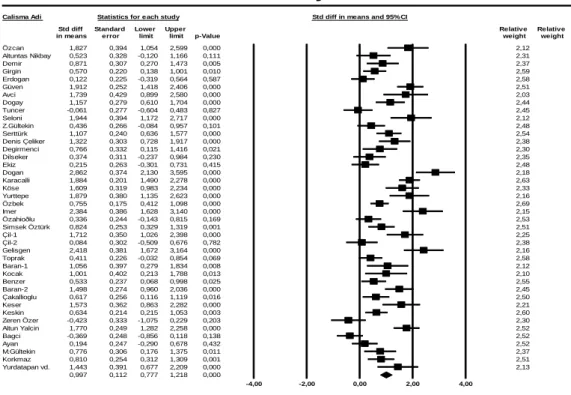
Forest plot that shows distribution of effect size values of primary studies formed by random effect model is given in Figure 1.
Figure 1. Forest plot showing distribution effect size values of studies
Squares in the plot shows study’s effect size, square lines on either side of squares indicate 95% confidence interval of the effect size minimum and maximum limits. They belong to the square of the field study indicates the weight of the overall effect size. The die having a rhombic shape located below shows overall effect size of studies.
When we examine effects size of studies, it determined minimum effect size value is -0,423, maximum effect size is 2,862. When we look effect size of studies, 39 studies are pozitive, 3 studies are negative from 42 studies. 39 studies which have pozitive effect in favor of experimental group using PBL approach, 3 studies have negative effect in favor of control group using traditional education method.
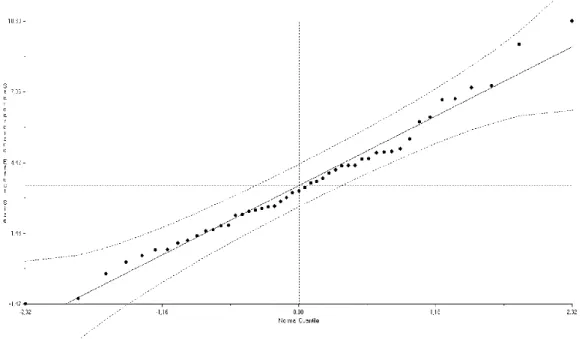
General distribution of studies’ effect size are normal distribution because they are on confidence interval which around x=y lines and show in cutted points. Effect size of studies’, which included this research, normal distribution graph given in Figure 2.
Calisma Adi Statistics for each study Std diff in means and 95% CI
Std diff Standard Lower Upper Relative Relative
in means error limit limit p-Value weight weight
Özcan 1,827 0,394 1,054 2,599 0,000 2,12 Altuntas Nikbay 0,523 0,328 -0,120 1,166 0,111 2,31 Demir 0,871 0,307 0,270 1,473 0,005 2,37 Girgin 0,570 0,220 0,138 1,001 0,010 2,59 Erdogan 0,122 0,225 -0,319 0,564 0,587 2,58 Güven 1,912 0,252 1,418 2,406 0,000 2,51 Avci 1,739 0,429 0,899 2,580 0,000 2,03 Dogay 1,157 0,279 0,610 1,704 0,000 2,44 Tuncer -0,061 0,277 -0,604 0,483 0,827 2,45 Seloni 1,944 0,394 1,172 2,717 0,000 2,12 Z.Gültekin 0,436 0,266 -0,084 0,957 0,101 2,48 Serttürk 1,107 0,240 0,636 1,577 0,000 2,54 Denis Çeliker 1,322 0,303 0,728 1,917 0,000 2,38 Degirmenci 0,766 0,332 0,115 1,416 0,021 2,30 Dilseker 0,374 0,311 -0,237 0,984 0,230 2,35 Ekiz 0,215 0,263 -0,301 0,731 0,415 2,48 Dogan 2,862 0,374 2,130 3,595 0,000 2,18 Karacalli 1,884 0,201 1,490 2,278 0,000 2,63 Köse 1,609 0,319 0,983 2,234 0,000 2,33 Yurttepe 1,879 0,380 1,135 2,623 0,000 2,16 Özbek 0,755 0,175 0,412 1,098 0,000 2,69 Imer 2,384 0,386 1,628 3,140 0,000 2,15 Özahioðlu 0,336 0,244 -0,143 0,815 0,169 2,53 Simsek Öztürk 0,824 0,253 0,329 1,319 0,001 2,51 Çil-1 1,712 0,350 1,026 2,398 0,000 2,25 Çil-2 0,084 0,302 -0,509 0,676 0,782 2,38 Gelisgen 2,418 0,381 1,672 3,164 0,000 2,16 Toprak 0,411 0,226 -0,032 0,854 0,069 2,58 Baran-1 1,056 0,397 0,279 1,834 0,008 2,12 Kocak 1,001 0,402 0,213 1,788 0,013 2,10 Benzer 0,533 0,237 0,068 0,998 0,025 2,55 Baran-2 1,498 0,274 0,960 2,036 0,000 2,45 Çakallioglu 0,617 0,256 0,116 1,119 0,016 2,50 Keser 1,573 0,362 0,863 2,282 0,000 2,21 Keskin 0,634 0,214 0,215 1,053 0,003 2,60 Zeren Özer -0,423 0,333 -1,075 0,229 0,203 2,30 Altun Yalcin 1,770 0,249 1,282 2,258 0,000 2,52 Bagci -0,369 0,248 -0,856 0,118 0,138 2,52 Ayan 0,194 0,247 -0,290 0,678 0,432 2,52 M.Gültekin 0,776 0,306 0,176 1,375 0,011 2,37 Korkmaz 0,810 0,254 0,312 1,309 0,001 2,51 Yurdatapan vd. 1,443 0,391 0,677 2,209 0,000 2,13 0,997 0,112 0,777 1,218 0,000 -4,00 -2,00 0,00 2,00 4,00 Favours A Favours B
Meta Analysis
Meta AnalysisFigure 2. Effect Size’s Normal Quantile Plot
When we look normal quantile plot of studies’ effect size, they are close to normal distribution line and don’t pass over the defined borders. Therefore studies which included to study show normal distribution.
General effect size value of impact of project-based learning approach to students' academic achievement in science classes is 0,997 at moderate level. To drop this level to modest level, needed number of studies found 41 which’s effect size values are zero. To drop this level to poor level, needed number of studies found 167 which’s effect size values are zero. To drop this level to zero (0,01), needed number of studies found 4146 which’s effect size values are zero. Referring to the excess of the number of studies that can be said obtained the results of analyze is reliable and publication bias is low. Moreover, whether publication bias can be interpreted with the aid of Funnel Plot given in Figure 3.
Figure 3. Effect Size’s Funnel Plot
-3 -2 -1 0 1 2 3 0,0 0,1 0,2 0,3 0,4 0,5 S ta n d a rd E rr o r Std diff in means
In the case of publication bias, effect sizes are take place in an distribution way in the funnel plot. In the case of the absence of publication bias, effect sizes are take place in a symmetrical distribution. However, exact symmetry is seen in case of the addition of four studies to the left side of funnel plot formed by Duval and Tweedie’s trimm and fill method. This is one of the evidence that the publication bias is low. Adjusted mean effect size value was found to be 0.819.
Results About Problem of Studies’ Fields of Science
The result of whether the effect sizes differs or not according to the fields of science is given in terms of academic achievement in Table 3.
Table 3.Effect Size Differences According to Fields of Science
Variable Inter-Group Homogeneity Value (QB) p n ES ES (%95 CI) Standard Error (SE) Min. Max. Field of Science 0,594 0,898 Physics 20 1,046 0,718 1,374 0,167 Chemistry 5 0,873 0,213 1,534 0,337 Biology 16 0,954 0,589 1,319 0,186 General 1 1,443 -0,103 2,989 0,789
Established groups, according to the fields of science, this research has been done with three fields of science in, called as general. Critic value with three degree of freedom found 7,815 on
table with %95 significance level. The homogeneity value between the groups, which was built in according to fields of science, has been found as (QB) 0,594. Because of the homogenity value between the groupsis smaller than the critical value, has not been found statistically significant differences between the groups which formed for the fields of science.
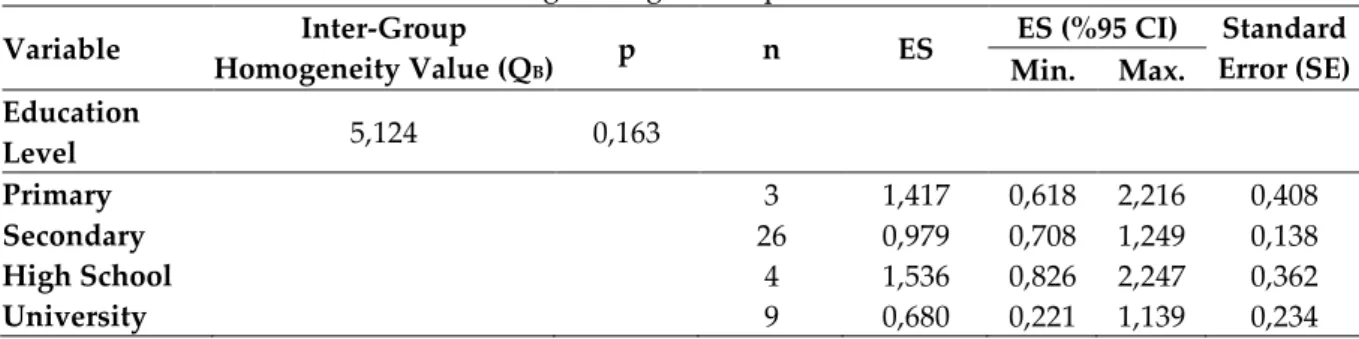
Results About Problem of Target Group’s Education Level in Studies
The result of whether the effect sizes differs or not according to the education level is given in terms of academic achievement in Table 4.
Table 4. Effect Size Differences According to Target Group’s Education Level
Variable Inter-Group Homogeneity Value (QB) p n ES ES (%95 CI) Standard Error (SE) Min. Max. Education Level 5,124 0,163 Primary 3 1,417 0,618 2,216 0,408 Secondary 26 0,979 0,708 1,249 0,138 High School 4 1,536 0,826 2,247 0,362 University 9 0,680 0,221 1,139 0,234
Critic value with one degree of freedom found 3,841 on
table with %95 significance level. The homogeneity value between the groups, which was built in according to education level, has been found as (QB) 5,124. Because of the homogenity value between the groups is smaller than the criticalResults About Problem of Sample Sizes of Studies
The result of whether the effect sizes differs or not according to the sample size is given in terms of academic achievement in Table 5.
Table 5. Effect Size Differences According to Sample Sizes Variable (Number of Students) Inter-Group Homogeneity Value (QB) p n ES ES (%95 CI) Standard Error (SE) Min. Max. Sample Size 0,340 0,560 1≤N≤50 18 1,078 0,728 1,428 0,179 51≤N 24 0,944 0,656 1,231 0,147
Critic value with one degree of freedom found 3,841 on
table with %95 significance level. The homogeneity value between the groups, which was built in according to sample sizes, has been found as (QB) 0,340. Because of the homogenity value between the groups is smaller than the criticalvalue, has not been found statistically significant differences between the groups which formed for sample size.
Results About Problem of Practicing Time of Studies
The result of whether the effect sizes differs or not according to the practicing time is given in terms of academic achievement in Table 6.
Table 6. Effect Size Differences According to Practicing Time Variable (Lesson Hour) Inter-Group Homogeneity Value (QB) p n ES ES (%95 CI) Standard Error (SE) Min. Max. Practicing Time 3,492 0,174 1≤h≤20 17 1,203 0,851 1,556 0,180 21≤h 15 1,004 0,632 1,376 0,190 Unspecified 10 0,662 0,218 1,107 0,227
Critic value with two degree of freedom found 5,991 on
table with %95 significance level. The homogeneity value between the groups, which was built in according to practicing time, has been found as (QB) 3,492. Because of the homogenity value between the groups is smaller than the criticalvalue, has not been found statistically significant differences between the groups which formed for practicing time.
Results About Problem of Methods Used in Studies
The result of whether the effect sizes differs or not according to the methods used in studies is given in terms of academic achievement in Table 7.
Table 7. Effect Size Differences According to Methods Used
Variable Inter-Group Homogeneity Value (QB) p n ES ES (%95 CI) Standard Error (SE) Min. Max. Method 0,002 0,961 PBL 36 0,996 0,755 1,236 0,123 PBL and others 6 1,012 0,423 1,601 0,301
critical value, has not been found statistically significant differences between the groups which formed for the methods used in studies.
Results About Problem of Types of Publication
The result of whether the effect sizes differs or not according to the types of publication is given in terms of academic achievement in Table 8.
Table 8. Effect Size Differences According to Types of Publication
Variable Inter-Group Homogeneity Value (QB) p n ES ES (%95 CI) Standard Error (SE) Alt Üst Type of Publication 0,475 0,789 Master Thesis 30 1,043 0,777 1,310 0,136 PhD Thesis 9 0,926 0,448 1,405 0,244 Article 3 0,771 -0,076 1,617 0,432
Critic value with two degree of freedom found 5,991 on table with %95 significance level. The homogeneity value between the groups, which was built in according to the types of publication, has been found as (QB) 0,475. Because of the homogenity value between the groups is smaller than the
critical value, has not been found statistically significant differences between the groups which formed for the types of publication.
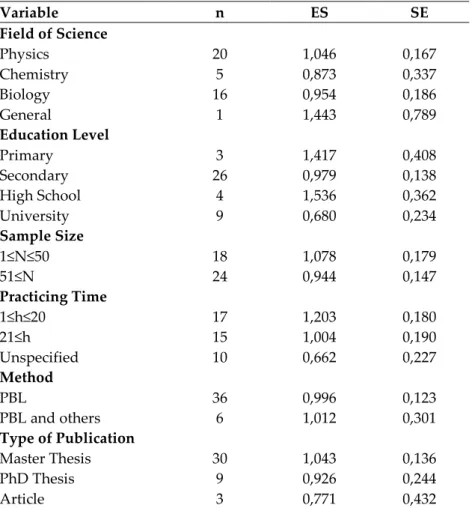
Number of studies and mean effect sizes of all study characteristics based on subgroup analyzes are given in Table 9.
Tablo 9. Number of studies and Effect Sizes Related to Characteristics
Variable n ES SE Field of Science Physics 20 1,046 0,167 Chemistry 5 0,873 0,337 Biology 16 0,954 0,186 General 1 1,443 0,789 Education Level Primary 3 1,417 0,408 Secondary 26 0,979 0,138 High School 4 1,536 0,362 University 9 0,680 0,234 Sample Size 1≤N≤50 18 1,078 0,179 51≤N 24 0,944 0,147 Practicing Time 1≤h≤20 17 1,203 0,180 21≤h 15 1,004 0,190 Unspecified 10 0,662 0,227 Method PBL 36 0,996 0,123
Discussion, Conclusion and Recommendations
As happens in any study, in this meta-analysis has some limitations. First of these is the limitations meta-analysis method has itself. Control grouped empirical studies which contains pre test and final test has been included into the study. An analysis could have been done about quality by using high validity and reliability quality scales. This study is consisted of researches have been done in Turkey. With the study it has been aimed to contribute to the national education policy. The results can ony be generalized for Turkey. The other limitation is at subgroup analysis, ANOVA, which can be effected from different factors, was used. And also the study has limitation of intermediate variables analysis which are coded. Also, rarity of primary numbers in some subgroups could be affected results.
First question of study is “What is the effect of PBL approach on the students’ academic achievements in science classes?” Totally 42 studies stated about effect of PBL approach to students' academic achievement in science lessons. Total sample size in studies is (total sample size in experimental and control groups) 2558. When we calculate homogenity value of studies based on fixed effect model, we found it Q=271,800. In
table significant level of %95 for forty-one degree of freedom value found as 56,942. Statistical value of Q=271,800 passed over forty-one degree of freedom value (for df=41,
56,942). So we used random effect model to calculate effect size of studies. It is determined that PBL approach have a positive effect to students 'academic achievement in science classes in order to determine its effect on the results of the meta-analysis of the PBL approach based on traditional learning methods to students' academic achievement in science classes. The effect sizeof the PBL approach, between 0,777-1,218 confidence interval, has been found 0,997 (%95 CI, SE=0,112) about the academic achievements of the students in science classes by using random effect model. This value is moderate level to Cohen, Manion and Morrison’s the classification of the effect size (2007). In the Kaşarcı’s meta-analysis study (2013), which was practised to prove the effect of PBL approach in academic achievement in field of science, the effect size value is between 0,763-1,273 confidence interval has been found ES=1,018 and seen compatible with this study. This effect is very close to strong level. According to studies about studies of PBL approach that applied 2558 people, PBL approach is more effective in increasing the academic achievement of students in science classes, compared to traditional teaching methods. In comparison with the traditional teaching approaches, PBL approach is more effective in developing academic achievement of the students in science classes. 39 studies are pozitive and 3 studies are negative in 42 studies. It could not determine why 3 negative studies are in favor for traditional education methods, but it considered, iti is about operator error. There are 4146 studies needed which’s effect size values are zero that decrease the effect size value to 0,01 which united 42 studies with meta-analysis method. It can be said results of analyses are reliable when we look number os studies are more.Second question of study is “Does differ impact on the academic achievement of PBL approach by academic achievement of students in fields of science (Physics, Chemistry, Biology, Field of General Science)?’’ There are 20 studies in physics, 16 studies in biology, 5 studies in chemistry and 1 study in general science. When average effect size of fields of science are compared, it has been observed that the highest effect size value is in field of general science (ES=1,443), the lowest effect size value is in chemistry (ES=0,873). When we look homogenity value between groups (QB=0,594) it seems
of the main areas of science is seen as close to each other at the same time, strong (ES=1,046) in the physics field, moderate in the biological (ES=0,954) and chemical fields (ES=0,873).
Third question of study is “Does differ impact on the academic achievement of students of PBL approach by education levels (Primary, secondary, high school, bachelor)?’’ There are 26 studies in secondary school level, 9 studies in university level, 4 studies in high school level and 3 studies in primary school level. When average effect size of students’ education level are compared, it has been observed that the highest effect size value is in high school level (ES=1,536), the lowest effect size value is in university level (ES=0,680). When we look homogenity value between groups (QB=5,124) it seems
it is little from critic value at %95 significance level as three degrees of freedom (df=1 için 3,841). Therefore, there could not find a statistically significant difference between groups which formed for students’ education level. According to that students’ education level could not change PBL approach’s effect size as a significant difference. However it has been observed that the difference between the effect sizes of the groups is not small. Considering the results of the analysis according to the educational level of the working group, the highest effect size values are observed in high school (ES=1,536) and primary school (ES=1,417) at strong level. Doing less number of primary studies at this level may have impact on these results. It can be said that effect size is also high at secondary school level (ES=0,979) and the results are reliable in view of much number of primaryb studies. The lowest effect size values was specified in universities (ES=0,680) at medium level.
Fourth question of study is “Does differ impact on the academic achievement of students of PBL approach by sampe size in studies (1-50 students, more than 50 students)?” There are 24 studies in “more than 50 students”, 18 studies in “1-50 students”. When average effect size of sample size are compared, it has been observed that the highest effect size value is in “1-50 students” (ES=1,078), the lowest effect size value is in “more than 50 students” (ES=0,944). When we look homogenity value between groups (QB=0,340) it seems it is little from critic value at %95 significance level as one degree
of freedom (df=1 için 3,841). Therefore, there could not find a statistically significant difference between groups which formed for sample size. According to that sample size could not change PBL approach’s effect size as a significant difference. However the effect size of the groups close to each other. Considering the results of the analysis based on the sample size of the study group, it is observed that effect size values of either sub variants are border of strong level.
Fifth question of study is “Does differ impact on the academic achievement of students of PBL approach by practice time (1-20 hours, more than 20 hours)?” There are 17 studies in “1-20 hours”, 15 studies in “more than 20 hours” and 10 studies that application time was unspecified. When average effect size of practice time are compared, it has been observed that the highest effect size value is in “1-20 hours” (ES=1,203), the lowest effect size value is in studies that application time was unspecified (ES=0,662). “more than 20 hours” (ES=1,004). When we look homogenity value between groups (QB=0,002) it seems it is little from critic value at %95 significance level as two degree
of freedom (df=2 için 5,991). Therefore, there could not find a statistically significant difference between groups which formed for practice time. According to that practice time could not change PBL approach’s effect size as a significant difference. However the effect size of the groups is close to each other. Considering the results of the analysis carried out according to application times, it was
method”. When the average effect sizes of used methods are compared, it has been observed that the highest effect size value is in “another extra method used with PBL method” (ES=1,012), the lowest effect size value is in “used only PBL method” (ES=0,996). When we look homogenity value between groups (QB=0,002) it seems it is little from critic value at %95 significance level as one degree of
freedom (df=1 için 3,841). Therefore, there could not find a statistically significant difference between groups which formed for used methods. According to that used methods could not change PBL approach’s effect size as a significant difference. However the effect size of the groups is close to each other. When considering the result of the analysis with respect to the methods used, there are 6 study of PBL approach together with another methods and 36 study of only PBL approach applied. It can be thought that differences between primary studies may affect the reliability of the results. Besides, it can be shown that effect size of two sub groups are high and using another methods with PBL approach doesn’t have a significant contributor.
The seventh question of the research is “Does differ impact on the academic achievement of students of PBL approach by types of publication (master thesis, PhD dissertation, article)?” For this, 30 master theses, 9 PhD theses and 3 scientific articles are included to the meta-analysis. When the average effect sizes of the types of publications are compared, it has been observed that master theses have the highest effect value (ES=1,043), scientific articles have the lowest effect value (ES=0,771). As the homogeneity value (QB=0,475) between groups is taken into consideration, this value has %95
percent significance level in Chi-square test table and with two unrestraint degree it is smaller than the critical level (df=2 için 5,991). For this reason, a statistically significant difference has not been found between the groups which formed for the types of publication. However it has been observed that the difference between the effect sizes of the groups is excessive. Considering the results of analysis according to types of publications, effect sizes of master theses (ES=1,043) and PhD dissertations (ES=0,926) were observed as close to each other. Size effect values of articles (0,771) were determined as low or medium levels in terms of theses.
Although there is no statistically significant difference according to the results; to increase students’ academic achievement in science classes by using PBL approach would be more effective physics as field of science, high school as education level and 1-20 hours as practice time.
Although there is no statistically significant difference according to the results; to increase students’ academic achievement in science classes by using PBL approach would be less effective chemistry as field of science, university as education level and more than 20 hours as practice time.
When the results examined, cause of PBL approach more effective in physics, it is more connected in life from the other fields of science and people are more interactive with physics subjects at daily life. PBL approach is more effective in high school level, because students can establish sincere relations with their peers, due to their development period feature they can work effectively in project studies groups. Especially students moves more independently at university level, project methods are less effective for the students are this education level. Cause of PBL approach is more effective between 1-20 hours as practice time, long-term study which is from limits of project methods cause becoming less achievement in lessons. It has been seen that effect sizes of postgrad thesis were higher than the article. These results can be considered normal because theses usually work with larger sample sizes and rigorously.
With the results and the experiment in study process in research, these recommendations to be given to practitioners, program developers and researchers:
Recommendations to Practitioners
1) To determine PBL approach’s effect to students’ academic achievement in science classes motivated meta-analysis study result; PBL approach is nearly at strong pozitive effect in students’ academic achievement in science classes than traditional education methods. Science teachers can use PBL approach for effective learning.
2) It identified that PBL approach has higher effect on students’ academic achievement in physics. Therefore PBL approach specially can use in field of physics.
3) When we look PBL approach effect size on students education level, the highest effect size is at high school level. According to that; PBL approach specially can use at high school level to increase students’ academic achievement in science classes.
4) For sample size classification; there could not find significant difference in effect size of PBL approach in students’ academic achievement in science classes. Therefore PBL approach can be used classes which has different student present.
5) For practice time of studies; there could not find significant difference in effect size of PBL approach in students’ academic achievement in science classes. Therefore PBL approach can be used in different practice time. But due to it found it is more effective between 1-20 hours practice time, so project time don’t be extended unnecessarily.
6) It was determined that using another methods with PBL approach has no positive effect. Therefore in lessons it is useful for learning to use another methods with PBL approach. So, using another methods with PBL in lessons may not be created an important change.
Recommendations to Program Developers
1) There can be given more place to PBL approach because of pozitive effect of PBL approach to students’ academic achievement in science classes. Specially cause of effect size found high in physics and biology, there can be given more place in their curriculums. Effect size value found less in chemistry than other fields of science. There can be given less place PBL approach in chemistry curriculum.
2) It was determined that PBL approach increase students’ academic achievement in science classes specially at high school level. Therefore there can be given more place to PBL approach at high school level curriculums.
Recommendations to Researchers
1) Studies with different effect size levels can be examined one by one and it can be determined these differences effect from what sort of factors.
2) It has been found that effect sizes of postgrad theses were higher than the article. The reasonf of that can be explored.
3) According to meta-analysis results, examining studies that have negative effect size value, it can be researched negative effect what factors caused as.
4) There can be more studies about PBL approach in primary and high schools, then their effect size can be analyzed again so it will be benefit for giving correct results.
5) There can be made more studies that used PBL approach in field of chemistry.
6) It is determined that to use another methods with PBL approach doesn’t increase effect size value. Reason of this can be searched by detailed.
7) Studies about PBL approach included to meta-analysis generally made as level of secondary school and university. There can be made researches with 4+4+4 education system type.
References
Acar, E. N. (2011). Proje tabanlı öğrenmenin fen bilgisi öğretmen adaylarının bilimsel süreç becerilerine ve biyolojiye yönelik tutumlarına etkisi. Yüksek Lisans Tezi. Çanakkale: Çanakkale Onsekiz Mart Üniversitesi Fen Bilimleri Enstitüsü.
Açıkel, C. (2009). Meta analiz ve kanıta dayalı tıptaki yeri. Klinik Psikofarmoloji Bülteni, 19(2), 164-172. Akçil, M., & Karaağaoğlu, E. (2001). Tıpta meta-analizi. Hacettepe Tıp Dergisi, 32(2), 184-190.
Akgöz, S., Ercan, İ., & Kan, İ. (2004). Meta-analizi. Uludağ Üniversitesi Tıp Fakültesi Dergisi, 30(2), 107-112.
Altun, S. (2008). Proje tabanlı öğretim yönteminin öğrencilerin elektrik konusu akademik başarılarına, fiziğe karşı tutumlarına ve bilimsel işlem becerilerine etkisinin incelenmesi. Doktora Tezi. Erzurum: Atatürk Üniversitesi Fen Bilimleri Enstitüsü.
Aslan, Ö. (2009). Proje tabanlı öğrenme yaklaşımının ilköğretim öğrencilerinin fen ve teknoloji dersine yönelik motivasyonlarına ve bilimin doğasını anlama düzeylerine etkisi. Yüksek Lisans Tezi. Ankara: Hacettepe Üniversitesi Sosyal Bilimler Enstitüsü.
Avcı, A. (2006). Elektronik eğitim seti tasarımında entegre programlama yazılımı ile desteklenen proje tabanlı öğrenmenin öğrencilerin elektronik devre tasarımı yapma ve geliştirme performanslarına ve kalıcılığa etkisi.Yüksek Lisans Tezi. Adana: Çukurova Üniversitesi Sosyal Bilimler Enstitüsü.
Baran, M. (2007). Proje tabanlı öğrenme modelinin fizik öğretmenliği ikinci sınıf öğrencilerinin elektrostatik konusu başarısına ve fiziğe yönelik tutumlarına etkisi üzerine bir araştırma. Yüksek Lisans Tezi. Diyarbakır: Dicle Üniversitesi Fen Bilimleri Enstitüsü.
Baran, M. (2011). Teknoloji ve proje tabanlı öğrenme yaklaşımı destekli düşünme yolculuğu tekniğinin lise 11. sınıf öğrencilerinin fizik başarılarına ve akademik benlik tasarımlarına etkisi. Doktora Tezi. Diyarbakır: Dicle Üniversitesi Fen Bilimleri Enstitüsü.
Benzer, E. (2010). Proje tabanlı öğrenme yaklaşımıyla hazırlanan çevre eğitimi dersinin fen bilgisi öğretmen adaylarının çevre okuryazarlığına etkisi. Doktora Tezi. İstanbul: Marmara Üniversitesi Eğitim Bilimleri Enstitüsü.
Bilen, M. (2002). Plandan uygulamaya öğretim. Ankara: Anı yayıncılık.
Borenstein, M., Hedges, L. V., Higgins, J. P. T., & Rothstein, H. R. (2009). Introduction to meta-analysis. United Kingdom: John Wiley and Sons, Ltd. Publication.
Borenstein, B., Hedges, L. V., Higgins, J. P. T., & Rothstein, H. R. (2013). Meta-analize giriş. (Translator: S. Dinçer) Ankara: Anı Yayıncılık.
Bryant, F. B., Kastrup, H., Udo, M., Hislop, N., Shefner, R., & Mallow, J. (2013). Science anxiety, science attitudes, and constructivism: A binational study. Journal of Science Education and Technology, 22(4), 432-448.
Chambers, E. (2004). An introduction to meta-analysis with articles from the journal of educational research (1992-2002). The Journal of Educational Research, 98(1), 35-44.
Chang, S. H., Wu, T. C., Kuo, Y. K., & You, L. C. (2012). Project-based learning with an online peer assessment system in a photonics instruction for enhancing led design skills. The Turkish Online Journal of Educational Technology, 11(4), 236-246.
Cunningham, D., & Duffy, T. (1996). Constructivism: Implications for the design and delivery of instruction. Handbook of research for educational communications and technology, 170-198.
Çağatay, P. (1994). Meta-analiz ve sağlık bilimlerine uygulaması. Yüksek Lisans Tezi. İstanbul: İstanbul Üniversitesi Sağlık Bilimleri Enstitüsü.
Çubukçu, Z. (2011). Proje tabanlı öğrenme. B. Oral içinde, Öğrenme öğretme kuram ve yaklaşımları (s. 527-539). Ankara: Pegem Akademi.
Değirmenci, Ş. (2011). Fen ve teknoloji dersinde “canlılar ve enerji ilişkileri” ünitesinin öğretilmesinde proje tabanlı öğrenmenin öğrenci başarısına etkisi. Yüksek Lisans Tezi. Konya: Selçuk Üniversitesi Eğitim Bilimleri Enstitüsü.
Demir, K. (2008). Bütünleştirilmiş öğretim programının işbirliğine dayalı ve proje tabanlı öğrenme yaklaşımıyla uygulanmasının etkililiği. Doktora Tezi. Ankara: Hacettepe Üniversitesi Sosyal Bilimler Enstitüsü.
Demirel, Ö. (2012). Öğretim ilke ve yöntemleri öğretme sanatı. Ankara: Pegem Akademi.
Deniş Çeliker, H. (2011). Fen ve teknoloji dersi güneş sistemi ve ötesi: uzay bilmecesi ünitesinde proje tabanlı öğrenme uygulamalarının öğrenci başarılarına ve fen ve teknolojiye yönelik tutumlarına etkisi. Doktora Tezi. İzmir: Dokuz Eylül Üniversitesi Eğitim Bilimleri Enstitüsü.
Dewey, J. (1997). Experience and education. New York: Kappa Delta Pi. Dewey, J. (2013). Deneyim ve eğitim. Ankara: ODTÜ Yayıncılık.
Doğay, G. (2010). Ekoloji ünitesinin öğrenilmesinde proje tabanlı öğrenme yönteminin öğrenci başarısına etkisi.Yüksek Lisans Tezi. Ankara: Gazi Üniversitesi Eğitim Bilimleri Enstitüsü.
Doppelt, Y. (2003). Implementation and assessment of project-based learning in a flexible environment. International Journal of Technology and Design Education, 13, 255-272.
Ekiz, S. O. (2008). Fen ve teknoloji laboratuvarının proje tabanlı öğrenme yaklaşımı ile desteklenerek öğretiminin öğrenci başarısına, hatırda tutma seviyesine ve duyuşsal özelliklerine etkisinin araştırılması. Yüksek Lisans Tezi. Muğla: Muğla Üniversitesi Fen Bilimleri Enstitüsü.
Ellis, P. D. (2010). The essential guide to effect sizes: Statistical power, meta-analysis, and the interpretation of research results. Cambridge: Cambridge University Press.
Erdem, M., & Akkoyunlu, B. (2002). İlkögretim sosyal bilgiler dersi kapsamında beşinci sınıf öğrencileriyle yürütülen ekiple proje tabanlı öğrenme üzerine bir çalışma. İlköğretim Online, 1(1), 2-11.
Ergene, T. (1999). Effectiveness of test anxiety reduction programs: A meta-analysis review. Doktora tezi. Ohio: Ohio Üniversitesi.
Frank, M., & Barzilai, A. (2004). Integrating alternative assessment in a project based learning course for preservice science and technology teachers. Assessment and Evaluation in Higher Education, 1(29), 41-61.
Girgin, D. (2009). Canlılar ve hayat ünitesinde proje tabanlı öğrenme yaklaşımının ilköğretim 5. sınıf öğrencilerinin akademik başarı ve tutumları üzerine etkisi. Yüksek Lisans Tezi. İzmir: Dokuz Eylül Üniversitesi Eğitim Bilimleri Enstitüsü.
Gültekin, Z. (2009). Fen eğitiminde proje tabanlı öğrenme uygulamalarının öğrencilerin bilimin doğasıyla ilgili görüşlerine, bilimsel süreç becerilerine ve tutumlarına etkisi. Yüksek Lisans Tezi. İstanbul: Marmara Üniversitesi Eğitim Bilimleri Enstitüsü.
Gürol, M. (1995). Bilgi toplumunun eğitim sistemi ve bu sisteme eğiticilerin yetiştirilmesi. 1. Sistem Mühendisliği ve Savunma Uygulamaları Sempozyumu. Ankara: Kara Harp Okulu.
Huffcutt, A. (2002). Research perspectives on meta analysis. S. G. Rogelberg içinde, Handbook of research methods in industrial and organizational psychology (pp. 198-215). Oxford: Blackwell Publishers Ltd.
Hung, C. M., Hwang, G. J., & Huang, I. (2012). A project-based digital storytelling approach for improving students’ learning motivation, problem-solving competence and learning achievement. Educational Technology and Society, 15(4), 368-379.
Hunter, J. E., & Schmidt, F. L. (1990). Methods of meta-analysis: Correcting error and bias in research findings. London: Sage Publications.
İmer, N. (2008). İlköğretim fen ve teknoloji öğretiminde proje tabanlı öğrenme yaklaşımının öğrencilerin akademik başarı ve tutumlarına etkisinin araştırılması. Yüksek Lisans Tezi. Ankara: Gazi Üniversitesi Eğitim Bilimleri Enstitüsü.
Kaldi, S., Filippatou D., & Govaris C. (2011). Project-based learning in primary schools: Effects on pupils' learning and attitudes. Education 3-13: International Journal of Primary, Elementary and Early Years Education, 39(1), 35-47.
Karaçallı, S. (2011). İlköğretim 4. sınıf fen ve teknoloji dersinde proje tabanlı öğrenme yönteminin akademik başarıya, tutuma ve kalıcılığa etkisi. Yüksek Lisans Tezi. Burdur: Mehmet Akif Ersoy Üniversitesi Sosyal Bilimler Enstitüsü.
Karasar, N. (2005). Bilimsel araştırma yöntemi. Ankara: Nobel Yayın Dağıtım.
Kaşarcı, İ. (2013). Proje tabanlı öğrenme yaklaşımının öğrencilerin akademik başarıları ve tutumlarına etkisi: Bir meta-analiz çalışması. Yüksek Lisans Tezi. Eskişehir: Eskişehir Osmangazi Üniversitesi Eğitim Bilimleri Enstitüsü.
Keser, K. Ş. (2008). Proje tabanlı öğrenme yaklaşımının fen bilgisi dersinde başarı, tutum ve kalıcı öğrenmeye etkisi. Yüksek Lisans Tezi. Eskişehir: Eskişehir Osmangazi Üniversitesi Fen Bilimleri Enstitüsü. Keskin, E. (2011). Proje tabanlı öğrenme yönteminin ilköğretim ikinci kademe öğrencilerinin başarı ve fen
motivasyonlarına etkisinin incelenmesi. Yüksek Lisans Tezi. Bursa: Uludağ Üniversitesi Eğitim Bilimleri Enstitüsü.
Kinnucan-Welsch, K., & Jenlink, P. M. (1998). Challenging assumptions about teaching and learning: Three case studies in constructivist pedagogy. Teaching and Teacher Education, 14(4), 413-427. Koçak, İ. (2008). Proje tabanlı öğrenme modelinin kimya eğitimi öğrencilerinin alkanlar konusunu anlamaları
ile kimya ve çevreye karşı tutumlarına olan etkisinin değerlendirilmesi. Yüksek Lisans Tezi. Ankara: Gazi Üniversitesi Eğitim Bilimleri Enstitüsü.
Korkmaz, H. (2002). Fen eğitiminde proje tabanlı öğrenmenin yaratıcı düşünme, problem çözme ve akademik risk alma düzeylerine etkisi. Doktora tezi. Ankara: Hacettepe Üniversitesi Sosyal Bilimler Enstitüsü. Korkmaz, H., & Kaptan, F. (2001). Fen eğitiminde proje tabanlı öğrenme yaklaşımı. Hacettepe
Üniversitesi Eğitim Fakültesi Dergisi, 20, 193-200.
Korkmaz, H., & Kaptan, F. (2002). Fen eğitiminde proje tabanlı öğrenme yaklaşımının ilköğretim öğrencilerinin akademik başarı, akademik benlik kavramı ve çalışma sürelerine etkisi. Hacettepe Üniversitesi Eğitim Fakültesi Dergisi, 22, 91-97.
Köse, M. (2010). İlköğretim 7. sınıf fen ve teknoloji dersi “kuvvet ve hareket” ünitesinin öğretiminde proje tabanlı öğrenme yaklaşımının öğrencilerin başarı ve tutumlarına etkisi. Yüksek Lisans Tezi. Konya: Selçuk Üniversitesi Eğitim Bilimleri Enstitüsü.