1
Learning Motivation and Achievement of Students of Dual System Program Mukminin Achmad [email protected] Kisman Salija [email protected] Baso Jabu [email protected]
Universitas Negeri Makassar, Indonesia
ABSTRACT
Achmad, Mukminin, 2019. The Correlation between learning motivation of students and their achievement in English at Vocational High School of Dual System Program. Thesis. English Education Department Graduate Program. State University of Makassar (Supervised by Kisman Salija and Baso Jabu)
The purpose of this research was to know whether or not there was a correlation between students’ learning motivation and their achievement in English at Vocational High School of Dual System Program. The sample of this research was 30 students of dual system program. After analyzing both X variable (students’ motivation) and Y variable (students’ achievement) by Pearson Product Moment formula, it was found that the correlation calculation rxy was 0.363 (it is between 0.20 - 0.40). It showed that there was a low or weak correlation between motivation (X variable) and achievement (Y variable). The researcher also concluded that the null hypothesis was rejected and the alternative hypothesis was accepted. It could be seen from the result of rxy was 0.363 with the degree freedom was 28. The result of Tt on the degree of significance 5 % = 0.361. Therefore rxy was greater than Tt or rxy > Tt = 0.363 > 0.361. It meant that there was a significant correlation between students’ learning motivation of dual system program and their learning achievement in English. The finding showed that the increase or decrease in X variable is significantly related to increase or decrease in Y variable. The students with high scores on motivation accordingly tend to get high scores on achievement in English.
Keyword: students’ motivation, instrumental dan integrative, achievement.
INTRODUCTION
The goal of English teaching at general senior secondary school is to equip students with the ability to develop: (1) oral and written communicative competence to
2
the informational literacy level; (2) the awareness of the nature and the importance of English roles played in global competition among nations; and (3) understanding about the interrelationships of language and culture (Attachment of the Regulation of the Ministry of National Education Number 22 Year 2006). Based on the second goal of English teaching above, One of the reasons why we must learn English in our daily life is because it is important to get a job. In this era, many people are jobless even though they have a degree. It is because they do not have a soft skill. Even though we get the best result in examination but we cannot speak in English, it is hard for us to find a job. Example is, if we want to work with a giant company such as Exxon mobil, Apple, Petronas, Sime Darby, Schlumberger and etc, we need to face many processes. One of the processess is interview. Interview is one of the important process for us to face if we want to work with a giant company. Many giant company have a franchise at the other country. So, they use international language that is English as a medium to communicate among the others. Therefore, they must do an interview in English to find an employee. If we have a soft skill like can speak fluently in English, the company will not hesitate to take us as one of their employee. Similarly, In doing the activity in a laboratory, they must practice their English by reading the Standard Operating Procedure (SOP) as well. Nowadays, Mastering a soft skill, like English language, is one requirement to fullfill to be skilled worker.
One of the formal institutions that has a responsibility to create a skilled worker is school especially vocational high school. Vocational education has a very important role in the effort of creating skilled workers and with specific skill. Jandhyala BG Tilak (2002) states that "Vocational education has a relevant job skills, that can make the worker more readily suitable for a given job and would make him / her more productive". Thus, Vocational education has some advantages because it can produce skilled and relevant, employable and productive human resources. If the process of vocational education, especially vocational curriculum of 2013 goes well and in accordance with plan and objectives set, the unemployment rate is expected decreasing and the Indonesian economy globally increase. To understand and explore vocational education, either good development, curriculum implementation and strategic efforts that might be an important input to improve the quality of the Indonesian economy through vocational education.
Vocational school is one of the educational models which combines education in schools and education outside the school in cooperation with the industrial world and the corporate world is called the dual education system and education with this model there is only and imposed in vocational secondary schools. The dual system of education is an educational program provided to students in high school vocational education programs combining school with the industrialized world or the business world by providing direct skill mastery in accordance with the competency of the expertise of each of the students, for example, a student with the competence of Chemical Analyst then these students will be given a dual system of education for 3 months in accordance with its expertise in the field of chemistry placed in a laboratory or company that has some instrument.
The students who take dual system program have not only advantage in developing capabilities that adapt to the changing demands of the times but also have a
3
disadvantage in doing their daily actitivities. The problems arise when they go back to school to do their activities in classroom. They have a limited time to study compare with other students who don’t take a dual system program. The students who take a dual system program in one semester (6 months) only have about 2-3 months to study in a school because they will be in the company for the next 3 months. On the other hand, they will learn the same material but with a short time compared to other students who study with the same material but with a normal time. The other problems of the implementation of dual system program conducted is disrupting student concentration in preparation for the national examination.
To anticipate the problems mentioned above, the student of dual system program should have a good motivation to get a good achievement. Motivation is one of the factors to improve students’ achievement in teaching and learning process. Based on Woolfolk (1998:27), motivation is considered as an integral part in the achievement of any goal. It is an important factor that has a positive influence in any educational learning process especially in learning second language. In addition, according to Wigfield and Guthrie (1995:47), motivation is one of the main determining factors of success in developing a second or foreign language. Furthermore, motivation is not only an intensive desire for learning and acquiring knowledge of English, but also an inner cause that push students forward in English learning with enthusiasm and willingness.
From the statements above, it can be said that motivation is an important factor in teaching and learning process. Motivation is energy of students which comes from inside or outside encouraging them to do something. It will give strength to student in order to get a better score. In fact, students will do everything to get good achievement. They will do the best way to get the best result. Therefore based on the explanation above, it can be considered that motivation has an important role in teaching learning. It can affect students’ achievement in learning. It also gives contribution in students’ success or failure in learning. Motivated students will get a highest achievement than the ones who are not motivated. Students with high motivation also will learn and do activities in the school with strong desire and eagerness.
Based on that reason, this should also happen to the student of SMK SMAK Makassar. Thus, this research is to find out whether or not there is a relationship between students’ motivation and their achievement through research under the title: “The Correlation between learning motivation of students and their achievement in English at Vocational High School of Dual System Program”.
Regarding the explanation aboveThe researcher intends to do research on the correlation between achievement and motivation in learning English among students of SMK SMAK Makassar. It is specifically addressed to seek the answers to the following questions:
1. What is the learning motivation of students in English at Vocational High School of Dual System Program?
2. What is the learning achievement of students in English at Vocational High School of Dual System Program?
3. Is there any correlation between learning motivation of students and their achievement in English at Vocational High School of Dual System Program?
4
In line with the presented research questions, the research objectives are to find out :
1. The learning motivation of students in English at Vocational High School of Dual System Program
2. The learning achievement of students in English at Vocational High School of Dual System Program
3. Correlation between learning motivation of students and their achievement in English at Vocational High School of Dual System Program
REVIEW OF RELATED LITERATURE
The difference among those previous studies and this research is lies on the population. In this research, the population is the student of dual system program. This study also analysed the instrumental and integrative motivation whereas the previous study took intrinsic and extrinsic motivation. However, in this research, the researcher chose a similar topic about students’ motivation and their academic achievement in learning English. The researcher might come up with different result with the previous research since it will be conducted at SMK-SMAK makassar.
The research conducted by Chan Chie Yuet (2008) “The Relationship between Motivation and Achievement in Foreign Language Learning in a Sixth Form College in Hong Kong” showed relationship between motivation and achievement in learning English in a sixth form college in Hong Kong. The methodological dimensions of the investigation were two fold. The findings indicated that there was a positive relationship between motivation and achievement among this sample of Hong Kong Advanced-level students in this sixth form college. The results also indicated that all the high, average and low achievers had strong extrinsic motivation, but this did not have any significant correlation with students’ English attainment. Instead, it was intrinsic motivation that had a positive correlation with students’ English grades. In this sample, intrinsic and extrinsic motives did not inhibit each other as they had no significant correlation.
Another research conducted by Feng Xia Wang (2008) entitled “Motivation and English Achievement: An Exploratory and Confirmatory Factor Analysis of New Measure for Chinese Students of English Learning” also helps the writer to know deep about the study of motivation and achievement. This research conducted in order to (1) construct a scale of English learning motivation in a particular Chinese context, the intrinsic/extrinsic motivation scale of English learning (I/EMSEL) and (2) explore the relationship between intrinsic motivation, extrinsic motivation and English achievement. Results indicated that autonomous extrinsic motivation correlated positively with intrinsic motivation and achievement, while controlled extrinsic motivation correlated negatively with them. In this study, there were two samples in the survey. The size of Sample 1 was 140 and participants were freshmen from several non- English majors at a comprehensive university in China. Males constituted about 45.6% of the sample with a total mean age of about 20. The participants in Sample 2 were 329 freshmen from the same university and they were randomly selected from several non-English-majors, such
5
as mathematics, physics, education, computer science, Chinese literature, and art. The participants were about equal numbers of men and women between the ages of 18 and 20 years. The researcher used questionnaire. Most items of the scale were written based on the constructs proposed in SDT and SLA motivation. The questionnaire, consisting of 24 five-point Likert scale items, was developed and group administered to two samples, Sample 1 for exploratory factor analysis and sample 2 for confirmatory factor analysis. The mark on the final English examination of the semester was used as an indication of English achievement.
RESEARCH METHOD
This research aims to identify the relationship between students’ motivation and their achievement by using questionnaire, test and observation. In this research, the researcher uses closed-form questionnaire, it can be called structure questionnaire. In this form, the statements or questions have the options of answer. The scoring of the items is done by Likert scale. The students/respondents just give the (√) sign in option of answer agree and disagree.
In this research, researcher uses a questionnaire to identify the students who have integrative motivation and the students who have instrumental motivation. This questionnaire is conducted to know the students’ instrumental and integrative motivation in learning English. A motivation questionnaire which is used in this study consists of twenty questions to elicit quantitative data from the respondents. The researcher adapted these questions from Benson (1991), Sarijit Kaur (1993) and Qashoa (2006) based on two scales of Gardner’s (1985) Attitude/Motivation Test Battery (AMTB) (The instrumental and integrative orientation scales) construct consisted 20 questions.
The cognitive achievement assessment is used to assess the students’ knowledge by using written test, oral test, assignment, and the other techniques to assess the students’ knowledge. Written test includes true-false, mutiple choice, matching and essay. In this research, the researcher applied an objective test item especially multiple choice items that there is only a single correct answer. In this test, the students must select one option from some alternatives. To assess the student cognitive achievement the researcher composed some questions covering 3 chapter consisted 30 questions based on the teaching and learning indicators.
In order to get students’ psychomotor achievement, this research also used observation. Observation was conducted to know the activities in the classroom which describing the participant of students in learning English. Arikunto states that the most effective way in using observation technique in collecting data is to use form of rubric (2010:272). In this research, the researcher observed the psychomotor achievement especially performance area in speaking. The students presented the task in group presentation covering 2 chapters. To assess the psychomotor achievement, the researcher adapted the rubric from Asmus (1999). The research applied the rubric of Analytic Rubrics for Testing Speaking Skill consists of Quantity of information communicated, fluency, pronounciation, vocabulary and grammar.
6 FINDINGS AND DISCUSSION
Table 1 Overall Mean of Instrumental and Integrative Motivation Statistics Instrumental Motivation Integrative Motivation N Valid 10 10 Missing 0 0 Mean 4.3500 4.3770 Std. Error of Mean .06277 .14037 Median 4.3150 4.4350 Mode 4.20 4.70 Std. Deviation .19849 .44390 Variance .039 .197 Range .63 1.50 Minimum 4.00 3.40 Maximum 4.63 4.90 Sum 43.50 43.77
Based on table 1 above, the data statistics showed that there was no significant difference between the two kinds of motivation for the research participants. The mean of the instrumental motivation (M=4.35) and the mean of the integrative motivation (M=4.38) appear to be close to each other. Since the Likert scale used on the questionnaire was of 5 points, both of the motivation means are considered to be high. This indicated that the students of Dual System Program at SMK SMAK Makassar participating in the research were highly instrumentally as well as highly integratively motivated to learn English, with a slightly defference for integrative motivation.
7
Therefore the students of Dual System Program at SMK SMAK Makassar are more integratively than instrumentally motivated.
Table 2 Overall Mean of Cognitive and psychomotor achievement
Statistics Cognitive Achievement Psychomotor Achievement N Valid 30 30 Missing 0 0 Mean 82.7667 75.8667 Std. Error of Mean 1.42287 1.12621 Median 87.0000 80.0000 Mode 87.00 80.00 Std. Deviation 7.79338 6.16851 Variance 60.737 38.051 Range 26.00 28.00 Minimum 67.00 56.00 Maximum 93.00 84.00 Sum 2483.00 2276.00
Regarding to table 2 above, the descriptive statistics showed that there was significant difference between the two kinds of achievement. The mean of the cognitive achievement (M=82.77) and the mean of the pychomotor achievement (M=75.87) appeared to be significantly different to each other. This indicates that the students of Dual System Program at SMK SMAK Makassar participating in the research are cognitively dominant than their psychomotor achievement.
Table 3 Overall mean of integrative motivation and cognitive achievement
Statistics Integrative Motivation Cognitive Achievement N Valid 30 30 Missing 1 1 Mean 4.3767 82.77 Std. Error of Mean .06002 1.423 Median 4.4000 87.00 Mode 4.30a 87 Std. Deviation .32872 7.793 Variance .108 60.737 Range 1.20 26 Minimum 3.80 67 Maximum 5.00 93
8
Sum 131.30 2483
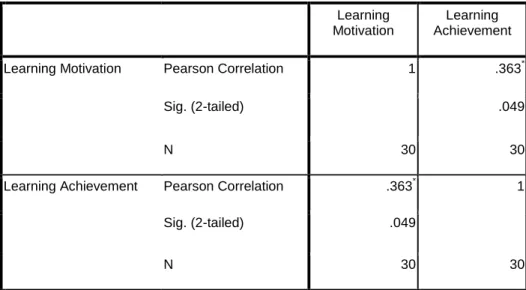
The overall mean of integrative motivation and cognitive achievement were taken from the mean score of integrative motivation (for each student) to represent the learning motivation whereas the students’ learning achievement (Y variable) was taken from the mean score of cognitive achievement (for each student). The calculation showed that the correlation coefficient (r) was 0.363. In order to interpret the data of X and Y variable, the researcher referred to the previous table of Simple Interpretation of Correlation proposed by Sugiyono (2007). From the table of Simple Interpretation of Correlation, the interpretation of calculation result was between 0.20 - 0.40 (0.363). It implied that the correlation between X variable and Y variable is weak or low.
Table 4 the correlation between students’ motivation and achievement
Correlations
Learning Motivation
Learning Achievement
Learning Motivation Pearson Correlation 1 .363*
Sig. (2-tailed) .049
N 30 30
Learning Achievement Pearson Correlation .363* 1
Sig. (2-tailed) .049
N 30 30
*. Correlation is significant at the 0.05 level (2-tailed).
The correlation between X variable (students’ learning motivation) and Y variable (students’ learning avhievement) is weak or low would also be supported by testing the hypothesis formulated in the previuos chapter. After calculating rxy, the result
of rxy was 0.363. The researcher determines degree of freedom (df) to get Tt (T table) by
using the formula of df = N-nr = 30–2 = 28. Based on the table, df (28) has significance 5% was 0.361. The researcher concludes that rxy is greater than Tt or rxy >
Tt = 0.363 > 0.361, so that Ha is accepted (Ho is rejected). Ha is accepted means that there is a significant correlation between X variable (motivation) and Y variable (achievement).
Based on the correlation between students’ motivation and achievement above, the significant correlations between two variables (Sig. 2-Tailed) value is less than .05
9
(.049). It can be concluded that there is a statistically significant correlation between two variables. That means that the increases or decreases in X variable is significantly relate to increases or decreases in Y variable. The students with high scores on motivation accordingly tend to get high scores on achievement in English.
This finding is also in line with the the research conducted by Chan Chie Yuet (2008) “The Relationship between Motivation and Achievement in Foreign Language Learning in a Sixth Form College in Hong Kong”. In this study she examined about motivation and achievement. And showed relationship between motivation and achievement in learning English in a sixth form college in Hong Kong. First,by means of questionnaires distributed to 33 Advanced-level students, their motivation intensity and orientations in learning English were explored. To analyse data, she applied Pearson Product Moment Correlation to examine the students’ motivation components and their English grades both in the Hong Kong Certificate of Education Examination and the Hong Kong Advanced Level Examination. Second, four high, four average and four low achievers of learning English, altogether 12 students aged 17 to 20, were invited to attend semi-structured interviews. Through the account of their English learning experience, the relationship between motivational factors and academic achievement in foreign language learning was investigated. The findings indicated that there was a positive relationship between motivation and achievement among this sample of Hong Kong Advanced-level students in this sixth form college.
The result of coefficient determinant (R) value was 13.2%. It indicated that the effect of X variable students’ motivation) toward the Y variable (students’ achievement) was 13.2%. Meanwhile, another 86.8% might be influenced by the other factors. The factors are may be the internal factor such as intelligences, talent, interest, attitude, willingness, memory, attention, ages, maturity, exhaustion, gender, learning strategy, skills, forgetfulness or the external factor such as teachers, administration staff, and the students’ classmates school building, class, equipment, laboratory, and learning tools.
Based on some factors mentioned above, the researcher assumes that the low or weak correlation of students at vocational high school of dual system program is affected by the learning strategy. As mentioned in the background that dual system program is educational program which combines eduacation in a school and education outside the school especially in the company which has coorperation with the school. In this case, the students of dual system program only attend the classroom for 3 months and for the next 3 months they will be in the company to practice their knowledge they obtain in the school. When they are in company, they still learn the material sent by their teacher via email or WA without attending the classroom. They become self-learners. When they become a self-learners, they should apply an appropriate learning strategy.
In short, it can be stated that learning strategies have an important position in determining specifically the learning achievement and generally the success of foreign language learning. They are said to have the potential to influence learning achievement in a positive manner. Therefore, it can assumed that the better the learning strategies are, the higher or better the learning achievement, including English learning achievement. Usually, students who use strategies more frequently and use a greater variety of strategies are the effective learners who in fact are successful in learning.
10
The explaination above also is in line with the research condusted by Wen (1997). Wen (1997) looked at the factors affecting the motivation of Asian and Asian-American students studying Chinese as a foreign language at the University of Houston, Texas. To determine the structures of motivation, the questionnaire data was first run through a factor analysis which yielded four factors, which the researcher identified as an instrumental motivation, integrative motivation, learning strategies and effort, and passiveness towards class requirements. Then in order to explain the relationship between these factors and language achievement, the questionnaire data and the average score of the midterm and final exam in all classes for each student were run through a multiple regression test. There was a relationship between integrative motivation of the first year students and their achievement in the Chinese language. The results also revealed that learning strategies were the most influential factor in the second year students’ achievement in Chinese.
CONCLUSION AND SUGGESTION
The researcher analyzed and correlated the score of students’ learning motivation (X variable) and students’ learning achievement (Y variable). The researcher correlated the data between questionnaire result and students’ achievement using Pearson Product Moment formula. The correlation showed that the correlation coefficient (r) was 0.363. It was between 0.20 - 0.40 (0.363). It was interpreted that the correlation between X variable (students’ learning motivation) and Y variable (students’ learning achievement) is weak or low. The researcher also concluded that the alternative hypothesis was accepted and the null hypothesis was rejected. It meant that there was significant correlation between students’ motivation and achievement in English.
The research outcome shows that there is a weak or low correlation between students’ learning motivation and achievement in English. Fi rst, English teacher is expected to improve their students’ motivation in learning English because motivated students will concentrate on teaching and learning process more than those who are not and they will enjoy studying given by the teacher. In addition, the teacher should always encourage the students to master English because the English language is a tool to achieve their success in the future. Second, Students are expected to increase their motivation in learning English. They are also expected to be more aware that English is very important in their life. Third, for the researchers who are interested in conducting similar research, they can use this finding as references for their research. In this case, the researcher highlights that the findings of this research might be a reflection of the motivation of just these participants, and the researcher could not generalize the outcomes to include all the students of SMK SMAK Makassar. Finally, for SMK SMAK Makassar, it is also suggested that it is necessary to provide both the teacher and student with a better school facilities to support the teaching-learning process and to increase school’s academic.
REFERENCES
Adedeji Tella. (2007). The Impact of Motivation on Student Academic Achievement and Learning Outcomes in Matematics Among Secondary School Student In Nigeria.
11
Eurasia Journal of Mathematics, Science and Technology Education, 3(2), 101– 110. https://doi.org/10.12973/ejmste/75381
Admin, . (2018). Pedoman Penulisan Jtp. Jurnal Teknologi Pendidikan (JTP), 11(1). https://doi.org/10.24114/jtp.v11i1.11203
Affum-osei, E., Adom, E. A., Barnie, J., & Forkuoh, S. K. (2014). Achievement motivation, academic self-concept and academic achievement among high school students. European Journal of Research and Reflection in Educational Sciences, 2(2), 24–37.
Alqurashi, F. (2019). The Effects of Motivation on EFL College Students’ Achievement. Studies in English Language Teaching, 7(1), 83. https://doi.org/10.22158 /selt.v7n1p83
Amiruddin, Kustono, D., Hadi, S., & Djuanda. (2016). The effectiveness dual system education program at 3 and 4 year vocational high school on improving mechanical engineering student achievement. AIP Conference Proceedings, 1778. https://doi.org/10.1063/1.4965771
Astuti, puji fitri. (2015). Based on the 2013 Curriculum in Elt Class. (103411012). Chee, J. D. (2016). Pearson’s product-moment correlation : Sample analysis. Research
Gate, May 2015),1–15. https://doi.org/10.13140/RG.2.1.1856.2726
Cunningham, K. R. (2013). The Effect of Motivation on Student Success in a First-Year Experience Course. 92. Retrieved from http://digitalcommons.wku.edu /cgi/ viewcontent.cgi?article=1040&context=diss
Darma, S., & Gajah, E. S. (2018). Development of Evaluation of Indonesian Curriculum 2013 Language Learning Results Based On Excel Program In Class V Students Muhammadiyah Basic School 28. 8(6), 56–60. https://doi.org/10.9790/7388-0806015660
Douglas, B. (2017). Relationship between teacher effectiveness and student achievement: An investigation of teacher quality. Thesis Paper, (May), 1–161. Fürstenau, B., Pilz, M., & Gonon, P. (2014). International Handbook of Research in
Professional and Practice-based Learning. https://doi.org/10.1007/978-94-017-8902-8
Gessler, M., & Peters, S. (2017). Implementation of Dual Training Programmes through the Development of Boundary Objects: A Case Study. Educar, 53(2), 309–331. https://doi.org/10.5565/rev/educar.862
Kardina, D., Natalia, M., & Widianti, A. S. (2013). Assessment Techniques Used in the English Classes Based on Curriculum 2013 : A Suggestion. (20), 1–56.
Khasanah, I. N. (2015). The Implementation of 2013 Curriculum by EnglishTeacher and Its Barriers (A Case Study at the 10th Grade of SMA N 1 Rembang in 2014/2015 Academic Year). Educational Research, 69.
Khidzir, N. Z., Daud, K. A. M., & Ibrahim, M. A. H. (2015). The Relationship among Student’s Domain of Learning Development Implementing Virtual Learning in Higher Learning Institutions. International Journal of Information and Education Technology, 6(6), 418–422. https://doi.org/10.7763/ijiet.2016.v6.725
Kuboja, J. M., & Ngussa, B. M. (2015). Affective Learning and Cognitive Skills Improvement: Experience of Selected Schools in Arusha, Tanzania. International
12
Journal of Academic Research in Progressive Education and Development, 4(2), 38–53. https://doi.org/10.6007/ijarped/v4-i2/1727
Laksmi, K. K., & Budiani, M. S. (2015). Psychological Well Being dan Motivasi Kerja Pada Pegawai Dinas Pendidikan. Jurnal Psikologi Teori Dan Terapan, 6(1), 50. https://doi.org/10.26740/jptt.v6n1.p50-53
Lashari, T. A., Alias, M., Akasah, Z. A., & Kesot, J. (2012). An Affective-Cognitive Teaching and Learning Framework in Engineering Education. ASEAN Journal of Engineering Education, 1(11), 11–24.
Mahadi, T. S. T., & Jafari, S. M. (2012). Motivation, Its Types, and Its Impacts in Language Learning. International Journal of Business and Social Science, 3(24), 230–235.
Marsela, S. (2017). The Correlation between Reading Motivation and Reading Comprehension Achievement of the Eleventh Grade Students of MAN 2 Palembang. Maskan, M., Suparlan, H. B., Utaminingsih, A., & Djajanto, L. (2014). Paired Industrial Role in the Implementation of Dual System Education to Shape the Work Adaptability of Vocational High School Students in Greater Malang. (Icpm), 422– 427. https://doi.org/10.2991/icpm-14.2014.75
Nasional, K. P., Dosen, C., & Jazidie, A. (2013). Kementerian pendidikan dan kebudayaan direktorat jenderal pendidikan tinggi. (021), 57946062–57946063. Ph, S. (2018). Sthrengtening Link and Match between Vocational Education and the
World of Work in Indonesia (a National Research Report). (11), 63–68.
Poompanom, T., Independent, A. N., Paper, S., In, S., Of, F., Requirements, T. H. E., … Foreign, A. S. A. (2016). A Survey Study of Students' motivation towards English Language Learning.
Riduwan, A. (n.d.). ( TUGAS AKHIR , SKRIPSI , TESIS , DISERTASI , DAN ARTIKEL JURNAL ) Harvard - American Psychological Association Style. Riduwan, Akhmad, 1–7.
Ronaldo, O. (2016). Teaching Material for English Subject in Vocational School. International Seminar on English Language and Teaching (ISELT), 4, 170–179. Skripsi, A. ’. (2010). The Correlation between Students' Learning Motivation and their
Achievement in English (A Correlational Study in the Eight Class of " MTs Al-Hamidiyah " ).
This, T., Degree, S., & Education, E. L. (2016). an Analysis of Authentic Assessment in 2013 Curriculum Used By the English Teacher At Sma Faculty of Teacher Training and Education.
Tresnawati, A. (2015). Vocational Schooling and Occupational Matching : Gender Differences in Indonesia. (December).
Wu Suen, L. J., Huang, H. M., & Lee, H. H. (2014). A comparison of convenience sampling and purposive sampling. Journal of Nursing, 61(3), 105–111. https://doi.org/10.6224/JN.61.3.105