arXiv:quant-ph/0310096v2 12 Feb 2004
A Bohmian view on quantum decoherence
A. S. Sanz (∗) and F. Borondo (∗∗)Departamento de Qu´ımica, C–IX, Universidad Aut´onoma de Madrid Cantoblanco – 28049 Madrid (Spain)
PACS.03.65.Ta – Foundations of quantum mechanics; measurement theory. PACS.03.65.Yz – Decoherence; open systems; quantum statistical methods. PACS.03.75.Dg – Atom and neutron interferometry.
Abstract. – The implications of quantum decoherence are analyzed from the perspective of Bohmian mechanics. Within the context of the double–slit experiment, we show that deco-herence is not enough to make a particle passing through one slit to lose the information on whether the other is open or close. Quantum mechanically, decoherence destroys interference, giving rise to an intensity pattern identical to that produced by two independent slits. However, Bohmian mechanics shows that, even in the case of total decoherence, the status of both slits is revealed by the motion of the particles.
Although different alternatives have been proposed to account for the problem of how a quantum system becomes classical [1], the theory of decoherence [2, 3] is the most widely ac-cepted. Decoherence is the irreversible emergence of classical properties (i.e., the suppression of quantum interferences) through the interaction of the system with the environment [4]. This interaction may occur via collisions [5], so that, when these scattering processes take place in a large number, an exponential damping is undergone by the off–diagonal elements of the density matrix (responsible for the interferences). This kind of issues has an important practical interest in many fields, such as, for example, quantum information theory [6]. Quan-tum computation relies on chains of atoms in a coherent superposition, and to achieve high efficiency long chains must be kept in such states during a certain time interval. Unfortunately, decoherence effects also increase rapidly with the chain length [7].
In spite of its relevance, Omn`es [1] doubts that decoherence can be the final answer to the problem of the loss of coherence in quantum mechanics. Although the reduced density operator becomes diagonal, the full one still represents a pure state with a permanent superposition as long as the system remains isolated. Therefore, this author wonders whether it is possible to perform a very refined measurement upon the environment that reveals the existence of quantum interferences. On the contrary, Zurek [8] suggests a pragmatic negative answer to this question, since such measurements are not possible in practice.
(∗) Present address: Chemical Physics Theory Group, Department of Chemistry, University of Toronto, Toronto, CanadaM5S 3H6.
E–mail: [email protected] (∗∗) E–mail:[email protected]
c
In this Letter we address this issue from a more fundamental viewpoint, considering whether it is possible to perform a very refined measurement beyond the standard quan-tum mechanics revealing the existence of quanquan-tum effects even in the case of full decohence. The ideal (and natural) framework to perform this task is Bohmian mechanics (BM) [9,10,11] that, being based on well–defined trajectories, provides a causal picture of the underlying physical phenomena, the effects of decoherence in our case. As a working model, we choose the double–slit experiment of Zeilingeret al.[12] with cold neutrons. The reason is clear. Par-ticle diffraction experiments constitute the most striking proof of the wave nature of matter. Moreover, similar experiments realized with two indistinguishable photons, each one sent to a different slit [13], have been recently used to check different predictions made by BM and the standard quantum mechanics (SQM) [14]. This can be also related to a still unsettled con-troversy on the possible “surrealistic” behaviour of Bohmian trajectories [15]. In our opinion the aspects on decoherence discussed here should be added to that discussion, at least when real experiments [12, 16] are considered.
Instead of using the density matrix language [17], in our description of decoherence we consider how the system wave function and the corresponding measured intensity are affected. Taking as the origin of time the instant when the neutron beam has just passed through the double–slit, and assuming that the system is out of any environmental interaction at that time, the initial wave function can be written as
|Ψ(0)i=c1|ψ1i+c2|ψ2i, (1)
and its time–evolved as
|Ψ(0)it=c1|ψ1it+c2|ψ2it. (2)
The measured intensity attis then given by
|Ψ(0)|2t =|c1|2|ψ1|2t+|c2|2|ψ2|2t + 2|c1||c2||ψ1|t|ψ2|tcosδt, (3) whereδtis the time–dependent phase difference between the waves|ψ1itand|ψ2it.
However, when the environment is taken into account, the initial state (1) becomes
|Ψi= (c1|ψ1i+c2|ψ2i)⊗ |E0i, (4)
and its time evolved gives rise to an entangled state,
|Ψit=c1|ψ1it⊗ |E1i+c2|ψ2it⊗ |E2i, (5)
which is different from (2) because of the system–environment interaction. The high sensitivity of these environment vectors [17] makes them to become orthogonal as time increases, since they are assumed to be too complex for keeping mutual coherence. Thus, even if they were coherent at the beginning (as it is the case here, where|E1i=|E2i=|E0iinitially), we have
that
|hE2|E1i| ≃e−t/τ, (6)
where τ is the coherence time, a measurement of how fast the system becomes classical (the smaller τ, the faster the system loses its coherence). Consequently, the measured intensity takes the form
|Ψ|2t =|c1|2|ψ1|2t+|c2|2|ψ2|2t+ 2|c1||c2|Λt|ψ1|t|ψ2|tcosδt′, (7) with Λt=|hE2|E1i|. For the sake of simplicity, we have assumed that the phase difference
On the other hand, within BM [11] the system evolution (in configuration space) is given by an equation of motion for the corresponding (quantum) trajectories,
˙rt=∇St
m , (8)
and another for the quantum flow, ˙
ρt+∇jt= 0, (9)
governing the “collective” motion of an ensemble of trajectories. In these equations,ρt=|Ψt|2 is the quantum probability density,jt=ρt∇St/mis the quantum density current, andStis the phase of|Ψit. The time evolution ofStis given by a quantum Hamilton–Jacobi equation [9], which includes the so–called quantum potential. This potential is directly connected with the wave behavior of standard quantum mechanics, thus making quantum motions very different from the classical ones [18], determined solely by the classical interaction.
To understand the effects produced by the loss of coherence in the double–slit experi-ment, one must consider the equivalent to Eq. (7) in terms of quantum trajectories. Thus, introducing|Ψit[19] into Eq. (8), rewritten in the form
˙rt= ~ 2im " thΨ|−→∇|Ψit−thΨ|←∇|−Ψit ρt # , (10) one gets ˙rt = ~ 2imρt |c1|2 h thψ1|−→∇|ψ1it−thψ1|←∇|−ψ1it i +|c2|2 h thψ2|−→∇|ψ2it−thψ2|←∇|−ψ2it i + ~ 2imρt c∗ 1c2hE1|E2i h thψ1|−→∇|ψ2it−thψ1|←∇|−ψ2it i −c.c. , (11)
withρt given by (7). In particular, for Λt= 0, Eq. (11) can be written as
˙rt=
|c1|2ρ(1)t ˙r1+|c2|2ρ(2)t ˙r2
˜
ρt , (12)
where ˙ri and ρ(ti) are the equation of motion and the probability density, respectively, as-sociated to the partial wave |ψii, and ˜ρt = |c1|2ρ(1)t +|c2|2ρ(2)t is the probability density corresponding to the reduced density operator. Notice that even in this limiting case, where the interference has disappeared, there is a strong correlation between trajectories coming from both slits.
The working model used here reproduces the diffraction experiment with cold neutrons performed by Zeilingeret al.[12], which has been analyzed by us [16] from both the optical and the standard quantum viewpoints. For the sake of simplicity, we consider the neutron beam only after it has passed through the double–slit, and until it reaches the detector. The dimensions of the double–slit arrangement, separated 5 m from the detector, area1–d′–a2 =
21.9–104.1–22.5µm (left slit–gap–right slit). The wavelength of the incident neutron beam is λdB= 18.45 ˚A, corresponds to a subsonic velocity ofv= 214.42 m/s.
To model the diffraction process, we consider two Gaussian slits [20] on thexy–plane, with neutrons propagating along thez–direction. To further simplify, it is assumed thatℓy ≫ℓx, beingℓxandℓythe slit dimensions. Then, the system can be considered 2–dimensional due to the translational symmetry along they–direction, and the motion takes place on thexz–plane.
-500 -250 0 250 500 -5000 -250 0 250 500 1 2 3 4 5 a) In te n si ty X (µm) b) Z ( m ) X (µm)
Fig. 1 – a) Comparison between experimental data (◦), and theoretical predictions derived from BM (•) and SQM (—) for a double–slit experiment with cold neutrons [12]. b) Sample of quantum trajectories corresponding to the Bohmian results of part (a).
Taking this into account, the initial wave function that simulates the two diffracted (just after passing through the slits) neutron beams is
|Ψ(0)i=G1(x, z) +G2(x, z), (13)
whereGi(x, z) are given by,
Gi(x, z)∝exp[−(x−xi)2/4σ2xi−(z−zi) 2/4σ2
zi+ i(pxix+pziz)]. (14)
On the other hand, the initial environment state is chosen of the form|E0i=|Ii, so that the
initial state is|Ψi=|Ψ(0)i ⊗ |Ii=|Ψ(0)i.
The time evolution of (13) is numerically obtained by Heller’s method [18], which is exact in our case. In the calculations, the Gaussian packets have been centered atx1,2= (a1,2∓d)/2
and z1,2 = 0, and incoherence [16] has been introduced by considering different propagation
velocities for each packet, given by px1,2 =∓~/a1,2 and pz1,2 = [(2π~/λdB) 2−p2
x1,2] 1/2. In
order to minimize the spreading effect with time along the z–direction, given by
σzt =σ s 1 + ~t mσ2 2 , (15)
it is enough to choose σ = 2a[ a= (a1+a2)/2 ] for both Gaussian packets. This ensures
the condition σz
t ≃σduring the whole propagation interval. On the other hand, we choose σxi =ai/4, since, for (x−xi) =σxi/2, the intensity at the border of the corresponding slit
amounts to |ψi(±σxi/2)| 2/|ψ
i(xi)|2 = e−2 (approximately 13.5% of the total intensity), and thus only a very small part of the wave is out of the boundaries defined by the borders of the slits. This assumption is in good agreement with the error on the slit widths experimentally reported by Zeilinger et al.[12], according to which neutrons penetrating through the boron wire along a chord 0.2µm away from the surface are attenuated by more than a factor e−1.
In Fig. 1(a) we show a comparison between the experimental data and our Bohmian calculation. The latter results have been calculated by binning quantum trajectories at the
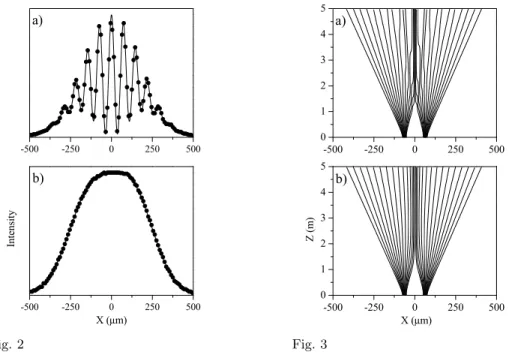
-500 -250 0 250 500 -500 -250 0 250 500 a) b) In te n si ty X (µm) Fig. 2 -500 -250 0 250 500 0 1 2 3 4 5 -500 -250 0 250 500 0 1 2 3 4 5 a) Z ( m ) X (µm) b) Fig. 3
Fig. 2 – Results obtained by means of a statistics of Bohmian trajectories (•) and SQM (—) for: a)
τ=∞(total coherence), and b)τ = 0 (null coherence).
Fig. 3 – Sample of quantum trajectories corresponding to the Bohmian results of Fig. 2.
detector in space intervals of 20 µm, as corresponds to the experimental situation [12]. The magnitude of Λt was empirically determined [16] from the experimental results, obtaining a value of 0.63. This implies a coherence time ofτ = 5.08×10⁻²s, approximately twice larger
than the total propagation time or time–of–flight (tflight = 2.33×10⁻² s). As can be seen,
the agreement is excellent. In the same figure, we also include for comparison the results obtained by the SQM [16] applied to the same model. As expected, they agree with the Bohmian results, since they have been computed taking into account the statistics implied by the initial probability density. In Fig. 1(b) we present the corresponding quantum trajectories obtained in our calculations. Some trajectories display the typical sudden change of direction, which has been shown to be characteristics of interference [18]. However, in this case, due to the loss of coherence, the extent of this behaviour is reduced, taking only place for the trajectories located close to the centreline between the two slits. Moreover, this effect is smoother than in the case of having total coherence [see Fig. 2(a) below]. Let us remark that this fact lets neutrons to get the asymptotic free quantum motion [18,21,22] before they reach the Fraunhofer region, contrary to what happens under normal circumstances. This is the first important conclusion of our work.
In order to appreciate how the loss of coherence would affect the measured intensity, we present in Fig. 2 such a magnitude calculated with BM and SQM for two different values of the coherence time. From top to bottom the results corresponding to τ =∞ (total co-herence) and 0 (null coco-herence) are shown. In Fig. 3 we present the ensembles of quantum trajectories corresponding to the different cases shown in Fig. 2. Notice that in all cases, and despite the loss of coherence, the trajectories coming from one slit do not cross to the region occupied by those coming from the other. What it is remarkable is that this behaviour takes
-500 -250 0 250 500 0 1 2 3 4 5 a) Z ( m ) X (µm) -500 -250 0 250 500 b) X (µm)
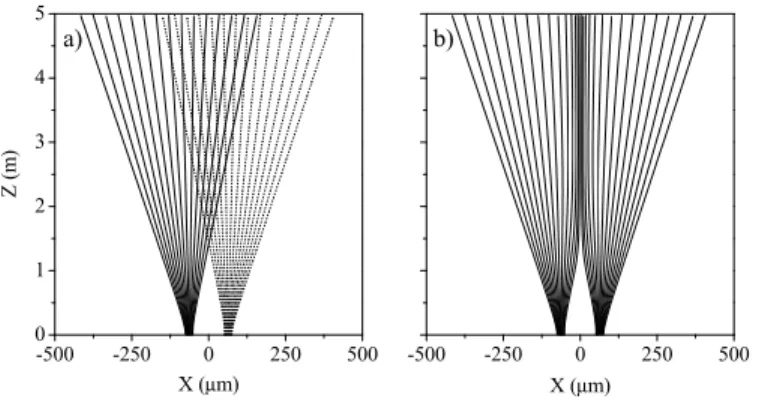
Fig. 4 – Comparison between quantum trajectories coming from both slits independently (a), and those obtained when the two slits are simultaneously opened andτ=0 (null coherence) (b).
place even when coherence is completely lost (τ=0). This result is totally unexpected, and is due to the fact that the contextual character of quantum mechanics is preserved even in this case. Moreover, it supports our suggestion in the introduction that something else, apart from decoherence, is necessary in order to make quantum mechanics exhibit a true classical behavior. Actually, we have shown elsewhere [23] the mechanism by which classical–like pat-terns emerge in situations (as happens here) in which contextuallity does not disappear. In a Bohmian sense, even when interference effects are lost, it is still possible to distinguish be-tween the situation corresponding to having the two slits simultaneously open, and the results obtained from the sum of the trajectories coming from each slit independently. Obviously, this distinction disappears when the Bohmian statistics, in the form of binning of quantum trajectories, is carried out, thus coinciding the results of BM and SQM.
Finally, in Fig. 4 we illustrate the previous statements by presenting a comparison of the results obtained from trajectories coming from each slit independently, and those obtained when the two slits are simultaneously opened and we have a value of τ=0 (null coherence). As can be seen, although trajectories at the borders are identical, as we approach the cen-tral region trajectories behave quite differently. In the first case they cross [part (a) of the figure], while for the true double–slit some “repulsion”is observed, making the corresponding topologies be totally different.
In summary, by applying BM to the paradigmatic two–slits experiment we have addressed the question raised in the introduction about the possibility of decoherence theory to fully explain the appearance of classical behavior in a quantum system. Our results show that, although statistics erases information about interference effects, there is still a strong con-textual quantum correlation in the behaviour of the system for the case of null coherence. This contextuallity makes the probability density to be sensitive to the information about the whole system. As a consequence, such information is “transmitted” to each particle, so that they “know” whether the other slit is open or not.
Authors gratefully acknowledge Prof. G. Gr¨ubl for useful discussions. This work has been supported in part by MCyT (Spain) under contracts BFM2000–347 and BFM2003–8212. ASS gratefully acknowledges a doctoral grant from the Consejer´ıa de Educaci´on y Cultura of the Comunidad Aut´onoma de Madrid (Spain).
REFERENCES
[1] Omn`es R.,Rev. Mod. Phys.,64(1992) 339.
[2] Zurek W. H.,Physics Today,44(10) (1991) 36.
[3] Giulini D., Joos E., Kiefer C., Kupsch J., Stamatescu I.-O.andZeh H. D.,Decoherence
and the Appearance of a Classical World in Quantum Theory(Springer, Berlin) 1996.
[4] Kiefer C.andJoos E.,Decoherence: Concepts and Examples,in Quantum Future, edited by P. Blanchard and A. Jadczyk(Springer, Berlin) 1998.
[5] Joos E.andZeh H. D.,Z. Phys. B,59(1985) 223.
[6] Nielsen M. A. and Chuang I. L.,Quantum Computation and Quantum Information (Cam-bridge University Press, Cam(Cam-bridge) 2000.
[7] Unruh W. G.,Phys. Rev. A, 51(1995) 992; Landauer R.,Phys. Lett. A,217 (1996) 188;
Mancini S.andBonifacio R.,Phys. Rev. A,63(2001) 032310. [8] Zurek W. H.,Phys. Rev. D,26(1982) 1862.
[9] Bohm D.,Phys. Rev.,85(1952) 166, 180.
[10] D¨urr D., Goldstein S.andZangh`ı N.,J. Stat. Phys.,67(1992) 843.
[11] Holland P. R., The Quantum Theory of Motion (Cambridge University Press, Cambridge) 1993.
[12] Zeilinger A., G¨ahler R., Shull C. G., Treimer W.andMampe W.,Rev. Mod. Phys.,60
(1988) 1067.
[13] Brida G., Cagliero E., Falzetta G., Genovese M., Gramegna M. and Predazzi E.,
Phys. Rev. A,68(2003) 033803, and references therein.
[14] Golshani M. and Akhavan O., J. Phys. A, 34 (2001) 5259; Ghose P., Majumdar A.S., Guha S.andSau J.,preprintquant–ph/0103126.
[15] Englert B.G., Scully M.O., S¨ussman G.and Walther H., Z. Naturf.,47a(1992) 1175; D¨urr D., Fusseder W., Goldstein S.andZangh`i N.,Z. Naturf.,48a(1993) 1261. [16] Sanz A. S., Borondo F. and Bastiaans M., (submitted to Phys. Rev. A); preprint
quant–ph/0310096.
[17] For a general treatment of the decoherence effect see: Omn`es R.,Phys. Rev. A,56(1997) 3383. [18] Sanz A. S., Borondo F.andMiret–Art´es S.,J. Phys. C,14(2002) 6109.
[19] In our analysis environment is simplified, and introduced only by the time–dependent param-eter Λt. Thus, its evolution is not characterized by an equation of motion, as in the case for the system. Nevertheless, we are aware that a more rigorous treatment of the problem should describe the process by means of a Hamiltonian of the typeH=Hs+He+Hint, coupling the coordinates of system and environment byHint. In this case, an equation of motion would also define the time–evolution of the environment.
[20] Feynman R. P.andHibbs A. R.,Quantum Mechanics and Path Integrals(McGraw–Hill, New York) 1965.
[21] Sanz A. S., Borondo F.andMiret–Art´es S.,Phys. Rev. B,61(2000) 7743.
[22] Allori A., D¨urr D., Goldstein S.andZangh`ı N.,J. Opt. B,4(2002) 482. [23] Sanz A. S., Borondo F.andMiret–Art´es S.,Europhys. Lett.,55(2002) 303.
![Fig. 1 – a) Comparison between experimental data (◦), and theoretical predictions derived from BM (•) and SQM (—) for a double–slit experiment with cold neutrons [12]](https://thumb-us.123doks.com/thumbv2/123dok_us/10285073.2935795/4.918.170.550.158.361/comparison-experimental-theoretical-predictions-derived-double-experiment-neutrons.webp)