Software Process Engineering Activities in Québec
Claude Y. Laporte, Oerlikon Aerospace, Saint-Jean-sur-Richelieu, Québec, Canada.
Abstract
This paper is divided in two parts. The first part will present the Applied Software Engineering Centre, its history, mission, services and links with other software engineering centres. The second part will present the experience of some Québec's organizations mainly with the Capability Maturity Model developed by the U.S. Software Engineering Institute.
1 The Applied Software Engineering Centre (ASEC)
The Applied Software Engineering Centre was created as a result of an agreement between six Canadian corporations active in the development of software for critical applications: CAE Electronics, Canadair, Keops Informatique, Oerlikon Aerospace, Paramax Systems Canada, Spar Aerospace and the Computer Research Institute of Montréal (CRIM).
The association between these corporations and CRIM is the culmination of a process begun in 1988 as two initiatives: the creation of a defense software engineering centre proposed by the Collège militaire Royal de Saint-Jean, and the creation of a software production centre proposed by a software consulting firm.
In 1990, a feasibility study sponsored by 13 companies and the Québec and federal governments, with the participation of the Collège militaire de Saint Jean, confirmed the role and importance of software engineering in improving the productivity and competitiveness of Canada's defence and aerospace industries.
The study, which included numerous consultations, served to gauge the level of competence of the software requirements of Canadian corporations. It also clearly revealed that a strategic alliance was needed to improve the software engineering process. Encouraged by these results, the study's sponsors decided to draw up a business plan in December 1990 to create a software engineering centre. Its mission would be to assume a leadership role at the technological level to assist and to improve their competencies in software engineering.
Given the urgency and scope of the challenge, it became essential to form an association with an existing centre if the objectives were to be reached in a timely fashion. The Centre de recherche informatique de Montréal CRIM was quickly identified as the partner most likely to make the greatest contribution to the new software engineering centre.
Following an agreement concluded on October 3, 1991, the Applied Software Engineering Centre (ASEC) became a new division of CRIM, in accordance with the conditions of acceptance and operation that ensured its autonomy.
ASEC was created to respond to an urgent need expressed by the industry in Canada, which is facing a challenge the outcome of which will be decisive. Information technology has become an overriding factor of productivity and innovation in all sectors of activity and demand for more and more complex software has increased spectacularly.
However, the lags in terms of software development, lack of qualified personnel, not to mention cost overruns, schedule slips, inadequate software productivity and quality, and system failure due to software bugs, are all seriously hampering growth. Worse still, in certain critical applications, these problems can have serious repercussions on public security or result in significant financial or social losses.
These are the problems facing ASEC. Its mission is to provide access to and training in the best software engineering managerial and technical solutions to help the Canadian software community raise its competence in software engineering. Its target clients will comprise companies and agencies that rely on information technology to improve their productivity and the quality of their services and products, and that use complex software for critical applications.
ASEC offers its members four main categories of services: software engineering process assessment, training, awareness of new technologies and interest groups, as well as all relevant support. The Applied Software Engineering Centre conducts its activities as part of CRIM. A Steering Committee comprised of industry, university, government and CRIM representatives, is responsible for controlling its activities and its budget. ASEC is well aware of the asset it represents in the network of centres with similar vocations elsewhere in Canada and abroad, and has established contact with a large number of them. ASEC has signed an agreement with the U.S. Software Engineering Institute (SEI) of Carnegie Mellon University.
This agreement will facilitate the transfer of software engineering technology for both countries. Additionally, ASEC has signed an agreement with the Software Productivity Consortium located in the province of British-Columbia and with the Software Technology Centre located in the province of Saskatchewan. This five-year agreement will foster collaboration and interchange of technologies.
The Centre has been in operations since fall of 1992. Revenue from the sale of services is estimated at $2.4 million over five years. Operating expenses and the cost of projects and services will exceed $1 million the first year and total almost $6.7 million over five years. ASEC and CRIM have received funding of $1 million and $2.8 million from the Québec and federal governments respectively. Both levels of government will thus contribute to creating and offering services that are essential if the Canadian industry is to develop and maintain its competitiveness.
2 Experience with the Maturity Model
A first exposure to the software process assessment methodology developed by the Software Engineering Institute (SEI) was done in Montréal in the summer of 1989. Two members of the technical staff of the SEI conducted a one-day workshop at the Ecole Polytechnique de Montréal. The workshop was attended by 50 persons. The participants came mainly from defense, aerospace and finance organizations from private and public sectors. During the workshop, the participants answered the SEI questionnaire, that was used to conduct formal assessments [1]. The questionnaires were compiled and, the results were that 93% of the participants to this workshop worked for organizations at the initial maturity level (level 1) and the remaining 7% were at the repeatable level (level 2) of the maturity scale.
As a comparison, the United States conducted similar workshops and gathered data from 113 projects [2]. The assessment workshop results as of January 15, 1989, indicate that the majority (86%) of the participants reported projects at the initial level (level 1). Fourteen percent (14%) of the participants reported projects at the repeatable level (level 2) and 1% reported projects at the defined level (level 3).
Following the tutorial, some organizations decided to conduct software process assessments. The following section will present the organizations that performed assessments and their views about both the assessment and improvement activities that were conducted mainly using the Capability Maturity Model [3]. The SEI has also presented results of 150 U.S. sites that performed formal assessments [4]. The participating organizations were not randomly selected. Therefore they do not necessarily constitute a valid sampling of U.S. organizations. None of the participating sites were performing at level 4 and 5. Seven percent (7%) of the sites were at level 3, nineteen percent (19%) were at level 2 and seventy four percent (74%) were at level 1.
3 Process Experiences in Québec
In 1990, the defense systems division of Canadair decided to go ahead in performing an SEI Software Process Assessment (SPA). This division of Canadair is responsible for the
maintenance of the Canadian armed force CF-18 aircrafts. For this assessment it was decided that the assessment team would be composed of representatives from the customer's organisation as well as representatives from the assessed organization. The on-site assessment was performed in February of 1991 and the action plan was published the following September. The cost of process assessment and improvement activities are summarized in Table 1. This division has also performed, in collaboration with ASEC staff, in the summer of 1994, an assessment using the new method developed by the SEI. This method is called CBA/IPI (Capability Maturity Model - Based Appraisal: lnternal Process lmprovement).
Table 1: Assessment and Improvement Costs at Canadair
In 1991, Paramax Systems Canada decided to perform an SEI assessment. Paramax is an organization mainly responsible for the development of the Canadian patrol frigate's computer system. The 2 million source lines of code software was developed by a large team of over 100 engineers and geographically dispersed in Canada and in the United States. Since 1991 Paramax has been improving its processes using the SEl's CMM, TQM (Total Quality Management) and ISO 9000 principles.
In 1993, four organizations performed SEI assessments. The first organization is the province of Québec's electricity supplier: Hydro-Québec. It's automatization department conducted an in-house assessment using the SEI questionnaire [1]. This department, staffed with 17 people, is mainly responsible for the development and maintenance of real-time embedded software that controls the Québec electrical network.
The second organization that conducted an assessment in 1993 is Oerlikon Aerospace. This organization is responsible for the production of an air-defense anti-tank system. The software
Assessment training and consulting cost: $40,000 Labour:
Training
On-site assessment Action plan elaboration Action plan implementation
160 hours 240 hours 500 hours 2500 hours
engineering department, staffed with 20 people, is responsible for the maintenance of the weapon software command control, and communication software, simulation software and instrumentation software. These four software domains add up to 530,000 source lines of code. The on-site assessment was done, in collaboration with the customer, in the spring of 1993. The action plan was completed in December and the process improvement activities were initiated in January of 1994. The organization is planning a re-assessment by fall of 1996. The third organization that performed an assessment is the Montréal Trust. This organization offers a range of financial and trust services. It administers assets of $64 billion and has gross revenues of 1.49 billion. The on-site assessment was done in spring of 1993 and the recommendations were presented to management in fall of 1993. Montréal Trust was assessed as a strong level 2 and is expecting to achieve level 3 by the end of 1994.
CAE Electronics is the fourth organization that performed an assessment in 1993. CAE Electronics mainly develops and manufactures a wide range of military and civilian simulators. In September, the Energy Control System Department, staffed with 90 software engineers, performed an assessment of its processes in collaboration with a customer (Hydro-Québec).
4 Process Related Activities
Montréal is the host of a SPIN (Software Process Improvement Network). Essentially, a SPIN is an interest group composed of software professionals from industry, government, academia, professional organizations, and consulting agencies. The SPIN provides a forum for the free and open exchange of information on software process improvement. The SEI provides some support to the SPIN organizations [5]. The 1995 directory listed 42 U.S. and 28 international SPIN organizations. The Montréal SPIN was founded in 1993. Its mission is to facilitate the understanding, the adoption and the deployment of proven or innovation solutions for software process improvement. The SPIN organizes six to eight events (e.g. tutorials, workshops, round tables) per year. The SPIN is affiliated to the ASEC, and the meetings are generally held at ASEC facilities. In addition, the SPIN benefits from the administrative services offered by ASEC (e.g. mailing, reservation, accounting).
ASEC also hosts an interest group that focuses on software engineering standards. More specifically, this group is very active in the ISO-SPICE project (lnternational Standards
Organization Software Process lmprovement and Capability dEtermination [6]. In collaboration with the interest group, ASEC will participate to the field trials, of this forth-coming ISO standard, in 1995. Hydro-Québec, will participate to the field trials.
A committee on Software Process was spawned from the IEEE Computer Society Technical Committee on Software Engineering (TCSE). The mandate of this committee is to help structure and improve communication within the process community. The committee is chaired by professor Nazim Madhavji of McGill University and CRIM. This committee publishes a Newsletter as part of the TCSE Newsletter [7].
Since most of Québec's software is developed in small or medium business. It was felt that these organizations could not afford the resources of performing an SEI SPA or CBA/IPI and set aside resources needed to address the findings of the assessment. ASEC, in collaboration with industrial partners developed a risk evaluation method based essentially on the CMM key process areas. The method, called S:PRIME (Software: Process Risk ldentification Mapping and Evaluation), identifies areas of priorities and facilitates the development of a focused action plan [8]. ASEC has conducted five S:PRIME assessments in 1994. Seven assessments are planned for in 1995. The method typically takes 100 staff-hours to perform the assessment of an organization, compared to the 1500 staff-hours required for an SEI assessment (i.e. training, on-site assessment, report preparation and presentations). Once an organization has been trained, it can perform, by itself follow-up S:PRIME assessments in order to track action plan implementation progress or identify other areas of priority.
The Personal Software Process (PSP) is a framework for doing disciplined software engineering. The PSP has been developed by the Software Engineering Institute under the direction of Watts Humphrey [9]. The PSP is taught at McGill University by Nazim Madhavji. Essentially, PSP shows professionals how to use measurements and statistical methods to plan and control their work, and it helps them to make accurate plans, to estimate the accuracy of these plans, and to track their performance. Students learn to define, evaluate, and improve a software process that is tailored to their own evolving personal needs. This helps them to evaluate and progressively improve their own performance. The PSP has a maturity framework similar to the Capability Maturity Model for software [3].
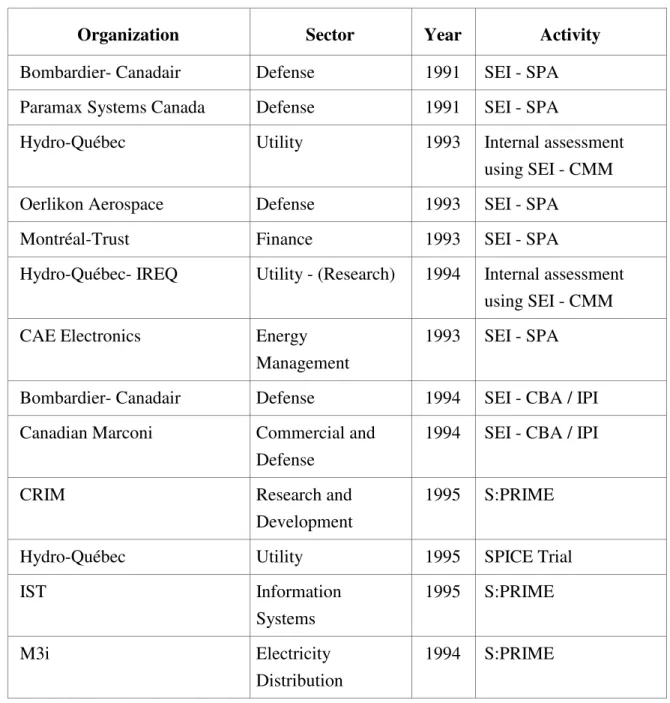
Table 2 lists organizations that are actively involved in software process engineering activities. So far, most assessments were performed, by large organizations, using the SEl's approach.
ASEC will perform at least 3 CBA/IPI assessments in 1995. Since in Québec the number of small and medium organizations outnumbers the number of large organizations, we expect a growing use of S:PRIME method. Finally, it is expected that 2 to 3 years of usage with SPICE will be required before large organizations make a decision to adopt SPICE assessment or stay with the SEl's approach. Unless, the SEI decides to map its CMM to the SPICE framework. It is worth mentioning that the SEI is collaborating to the development of a System Engineering Capability Maturity Model. This CMM is using the SPICE framework for the mapping of process areas and maturity levels.
Organization Sector Year Activity
Bombardier- Canadair Defense 1991 SEI - SPA Paramax Systems Canada Defense 1991 SEI - SPA
Hydro-Québec Utility 1993 Internal assessment
using SEI - CMM
Oerlikon Aerospace Defense 1993 SEI - SPA
Montréal-Trust Finance 1993 SEI - SPA
Hydro-Québec- IREQ Utility - (Research) 1994 Internal assessment using SEI - CMM
CAE Electronics Energy
Management
1993 SEI - SPA
Bombardier- Canadair Defense 1994 SEI - CBA / IPI Canadian Marconi Commercial and
Defense
1994 SEI - CBA / IPI
CRIM Research and
Development
1995 S:PRIME
Hydro-Québec Utility 1995 SPICE Trial
IST Information Systems 1995 S:PRIME M3i Electricity Distribution 1994 S:PRIME
Table 2: Software Process Activities in Québec
Note: 1. SEI - SPA: Software Engineering Institute Software Process Assessment with third party.
2. Internal assessment using SEI - CMM conducted without participation of third party.
3. SEI - CBA/IPI: Software Engineering Institute - CMM Based - Assessment: Internal Process Improvement with third party.
5 Lessons Learned
As a result of these assessments, we can describe some lessons that could be used by other organisations in the future.
Appropriate expectations must be set prior to embarking on a process improvement journey. First, process improvement is a long term and expensive activity. Management must be briefed that, for any sizable organization, process improvement activities span over years. Secondly, for organizations that are at level 1 of the maturity scale, findings of the assessment will point fingers to management issues. This is one of the reasons why senior management must be briefed about this situation in order to show full commitment when these findings are publicized within the organization. Beside senior management buy-in, it is essential that middle management and even some first line managers become champions of the process improvement program. The Capability Maturity Model [3] suggests the formation of a Software Engineering Process Group (SEPG) for an organization that is heading toward level 3 [10]. It is rather suggested that a small number of persons becomes active in process activities a couple of months before the on-site assessment. The SEPG should take this time to familiarize itself with the Capability Maturity Model and associated process improvement tools and activities. Ideally, there should be one full-time person on the SEPG while the other members could be assigned on a part-time basis. Beside their technical competencies, the members of the SEPG should be selected based on their enthusiasm for improvement and the respect they have within the organization.
The assessment team should be composed of members of the organizations as well as one or two persons that do not belong to the organization. Some organizations are requesting the participation of one assessor of ASEC to play the role of either assessment team member or assessment leader. Organizations can also obtain the services of an SEI assessment vendor to play these roles.
With regards to the development of the action plan, the organization should capitalize on the momentum gained during the assessment period. The organization does not have to wait for a completed action plan to start process improvement activities. Some improvement activities can begin soon after the completion of the on-site assessment
6 Conclusion
The Software Engineering Institute's Capability Maturity Model has been used successfully by organizations in Québec within the defense sector as well as outside the defense sector to conduct assessment and to put in place process improvement programs. As more organizations perform similar activities we should be in position to verify if these activities will have an impact on software productivity and quality and on the bottom line of the organizations.
References
[1] Humphrey, W.S. Sweet W.L. A Method for Increasing the Software Engineering Capability of Contractors. Software Engineering Institute Technical Report CMU/SEI-87-TR-23, September 1987.
[2] Humphrey, W.S., Kasse, T. and Kitson, D. State of Software Engineering Practice. Software Engineering Institute, Technical Report CMU/SEI-89-TR-1, 1989.
[3] Paulk, M., Weber, C.V., Garcia, S.M., Chrissis, M.B. and Bush, M. Key Practices of the Capability Maturity Model. Version 1.1, Software Engineering Institute Technical Report CMU/SEI-93-TR-25, February 1993.
[4] Zubrow, Kitson and Masters. An Analysis of SEI Software Process Assessment Results, Software Engineering Symposium, SEI, Carnegie Mellon University, Pittsburgh, 1993. [5] Marchok, J. Tapping into the Software Process Improvement Network. Bridge. Software
Engineering Institute, Carnegie Mellon University, Issue Three, 1993, p.10-12.
[6] Paulk, M.C. and Konrad M.D. ISO Seeks to Harmonize Numerous Global Efforts in Software Process Management, IEEE Computer, April 1994, p.68-70.
[7] IEEE Computer Society / Technical Committee on Software Engineering (TCSE). Software Engineering Technical Council Newsletter. September 1994, volume 13, No. 1, p.4.
[8] S:PRIME. Applied Software Engineering Centre (ASEC). Internal Report, 1994. [9] Humphrey, W. A Discipline of Software Engineering. Addison Wesley, 1994.
[10] Fowler, P. and Rifkin S. Software Engineering Process Group Guide Software Engineering Institute, Technical report CMU/SEI-90-TR-24, September 1990.