Jurnal Taman Vokasi Vol.7, Issue (2) 2019 (pp. 176-180) p-ISSN: 2338-1825; e-ISSN: 2579-4159 http://jurnal.ustjogja.ac.id/index.php/tamanvokasi
176
Improvement of Learning Motivation and Learning Outcomes
by Applying The Problem Based-Learning Method
Nurcholish Arifin Handoyono
1, Rabiman
2, Panggih Pribadi
3, Sigit Purnomo
4 12Universitas Sarjanawiyata Tamansiswa Yogyakarta; 3SMK Muhammadiya Prambanan SlemanEmail: 1[email protected], 2[email protected], 3[email protected], 4[email protected]
Abstracts.The objective of this research is to find: (1) increased learning motivation by applying the PBL method, and (2) increased learning outcomes by applying the PBL method. This research uses classroom action research with three cycles, each cycle consists of four phases: (1) planning; (2) action; (3) observe; and (4) reflecting. The research subjects were students of class XI TKR A totaling 26 students. Data collection techniques in research are: (2) self-assessment to measure student motivation; and (2) Tests to measure the learning outcomes. The data obtained is quantitative and processed into descriptive statistics. Data were analyzed descriptively. The research results are as follows: (1) learning motivation in the first cycle of 12.46 categorized as low, the second cycle of 14.72 categorized as high, and the third cycle of 16.76 categorized as very high, has increased by 2.26 from the first cycle to the second cycle and by 2.04 from the second cycle to the third cycle; and (2) learning outcomes in the first cycle of 75,38, the second cycle of 81,79), and the third cycle of 83.33, has increased by 6. 41 from the first cycle to the second cycle and by 1.54 of the second cycle to the third cycle.
Keywords: problem-based learning method; learning motivation; learning outcomes
Introduction
SMK Muhammdiyah Prambanan Sleman is one of the vocational schools that implemented the 2013 curriculum. Ideally, during the learning process in the classroom, the teacher uses student-centered learning methods [1]. However, in practice in the classroom there are still many teachers who apply the teacher-centered learning method. This learning method has many weaknesses, namely: (1) Objectives are not formulated specifically in the form of behavior that can be observed and measured, (2) Lesson material presented to the group without regard to individual students, (3) Most learning materials use lectures, written assignments, and other media according to the teacher's consideration, (4) oriented to teacher activities by prioritizing the teaching process, (5) most students are passive, especially must listen to the teacher's description, (6) Students must learn according to the speed determined by the speed of the teaching teacher, (7) Strengthening is usually only given after a test or examination is held, (8) Learning success is mostly assessed by the
teacher subjectively, and (9) The teacher functions as a disseminator or distributor knowledge [2].
Besides thinking about some weaknesses by applying teacher-centered learning methods, the impact felt by students during the learning process at SMK Muhammadiyah Prambanan Sleman is low learning motivation. When learning the majority of teachers only apply the lecture method wherein this method only occurs in one-way interaction. With the lecture method, only the teacher is active while students passively observe and listen to the explanation of the material from the teacher. The tendency of student learning activities like this really allows students to get bored quickly and are not interested as listeners. This is evident when the learning process takes place there are still many students who often chat with friends, play cellphones, sleepy, etc.
In PCPT learning can also be found teachers apply the lecture method. In addition to having an impact on low learning motivation, the lecture method also has an impact on low
learning outcomes. This is evidenced by the results of the final PCPT subjects on average 25.71 and none exceeded the minimum completeness criteria. With this problem, a solution is needed to overcome the problem of low motivation and learning outcomes. The solution that can be done is to improve the learning process by applying appropriate learning methods. The solution that can be done is to improve the learning process by applying appropriate learning methods. Learning can work well, so teachers need to prepare learning scenarios carefully and clearly [3]. The learning method in question is a student-centered learning method.
Problem-based learning (PBL) is one of the student-centered learning methods that can be applied in class. This method was chosen because the most effective learning is a strategy that can provide opportunities for students to use their knowledge to solve problems, engage in simulations or apply their knowledge to new contexts [4]. One learning strategy that can accommodate this is PBL.
PBL is not about problem-solving per se, but rather it uses appropriate problems to increase knowledge and understanding [5]. PBL is not just problem solving but uses related problems to increase knowledge and understanding. In the PBL method the teacher guides students to solve problems related to the material. The problems determined are still related or often found in daily activities.
With the problems determined by the teacher, students look for solutions in groups. The search for solutions can be done from various studies (internet, books, field, etc.). At the end of the lesson, students present the results of their respective group discussions. The presentation activities allow exchange of ideas between students. Learning activities with the PBL method can increase student participation so it is expected to be able to increase student motivation as an alternative to solving problems encountered in class. In addition to increased learning motivation, it is hoped that PCPT learning outcomes will also increase.
Learning Motivation
Some definitions from experts mean that learning motivation generally contains almost the same meaning. Learning motivation is the
encouragement that occurs in students that will have an impact on behavior change in a positive direction in the learning process [6] [7] [8]. These changes can be seen from several indicators. Indicators of learning motivation that will be used are ARSC motivation theory because this theory can be applied in the learning process which consists of: (1) Attention; (2) Relevance; (3) Confidence; and (4) Satisfaction [9].
Learning Outcomes of Power Transfer
Chassis Maintenance (PCPT)
The success of the learning process in the classroom will be determined by the learning outcomes as one of the indicators. Learning outcomes are depictions of students' success in achieving the competencies or learning objectives of the specified subjects. Students will have the ability/skills after following the learning process. Learning outcomes are abilities possessed by students after following the learning process [10] [11]. The learning process in question is learning of Power Transfer Chassis Maintenance (PCPT) consisting of 3 competencies, namely: (1) Maintaining the clutch system; (2) Maintaining the brake system; and (3) maintaining the transmission system.
Problem-Based Learning (PBL) Method
The most effective learning strategies are strategies that can provide opportunities for students to use their knowledge to solve problems, engage in simulations or apply their knowledge to new contexts [4]. One learning strategy that can accommodate this is PBL.PBL is an approach to learning by making confrontations with students with practical problems, which are open and unstructured through stimuli in learning. PBL can be devoted as simply as a model that organizes learning around problems [12]. PBL makes the problem as the main guide in the teaching and learning process.
PBL is not just problem solving but uses related problems to increase knowledge and understanding [5]. PBL focuses on maximizing student understanding So the main focus in PBL is to increase students' knowledge and understanding of a subject matter
According to experts, there are 5 stages (syntax) to implement PBL which is an aspect
Improvement of Learning Motivation and Learning Outcomes by Applying The Problem ….- 178
Jurnal Taman Vokasi Vol. 7 Issue (2) 2019
of realizing learning methods. The five stages are: (1) Student orientation to the problem; (2) Organizing students for learning; (3) Guiding individual and group investigations; (4) Develop and present results; (5) Analyzing and evaluating the problem-solving process [13] [14].
METHOD
The action research design chosen was the Kemmis and McTaggart model. This model consists of four stages in each cycle, namely: (1) planning, (2) acting, (3) observing, and (4) reflecting [15].
The place of research is at SMK Muhammdiyah Prambanan Sleman, located in Gatak, Bukoharjo, Prambanan, Sleman, Yogyakarta. The time of the research was conducted in the odd semester of the 2016/2017 school year, from July to September 2016.
Subjects were 26 students in class XI TKR A. The object of research is learning motivation and PCPT learning outcomes.
The research data is quantitative analyzed descriptively. Self-assessment sheets are used to measure learning motivation scores. Multiple-choice tests are used to measure learning outcome scores.
The criteria for the success of this research action are determined by the following indicators:
The first indicator is learning motivation, the data obtained will be processed referring to table 1 to determine its category. Research is
said to be successful if the learning motivation score is high.
Table 1. Determination of Categories for Learning Motivation Scores Categories X≥μ + 1.SBx Very high μ + 1.SBx > X ≥ μ High μ > X ≥ μ - 1.SBx Low X < μ - 1.SBx Very low Information: μ : Ideal Mean
: ½ (the highest ideal score + the lowest ideal score)
X : Respondent's score SB : Ideal standard deviation
: 1/6 (the highest ideal score - the lowest ideal score)
The second indicator is the PCPT learning outcomes. The study was said to be successful if the PCPT learning outcomes of students at least 75% exceeded the minimum completeness criteria of 75.
RESULTS DAN DISCUSSION
Motivation Learning
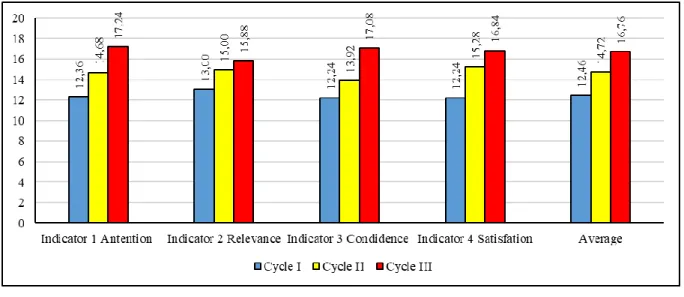
From the results of the study, it was found that the average score of students' motivation in the first cycle was 12.46 which was categorized as low, cycle II was 14.72 as high, and cycle III was 16.76 as very high. Each cycle has increased by 2.26 from cycle I to cycle II and by 2.04 from cycle II to cycle III. Comparison of student motivation between cycles can be seen in Figure 1 below:
Learning will be successful if the teacher and students are active. This active condition can be found in learning using PBL methods. By using PBL methods will also have an impact on increasing learning motivation. This is indicated by the measurement results found that student learning motivation is increasing from each cycle. The use of problem-based learning methods has a positive effect on learning motivation
[16]. The results of this research were conducted at the vocational level of vocational education the same as what was done in this research. The results of this research give the meaning that the PBL method is very suitable for use in vocational schools.
Student learning motivation in the first cycle is categorized as low, this is caused by students not yet accustomed to learning that applies PBL. At the beginning of learning students need adjustment with problem-oriented learning. This is one of the weaknesses of the problem-based learning method is the problem of a long time in terms of preparation [17] [18].
As a reflection to increase student motivation in cycle II and cycle III, teachers prepare more mature learning tools, namely preparing reference sources in the form of books and internet website links. The result of reflection obtained is an increase in student motivation in cycle II and cycle III. Improving the quality of learning is influenced by the teacher so that students can participate motivated [19].
Increased student motivation to increase in each cycle is reflected in learning activities. Students become more enthusiastic about learning from cycle I to cycle III. Students who have difficulty finding solutions to problems become easy because the teacher provides several references in the form of books and internet website links. Providing references will make it easier for students to access material relevant to the problems given by the teacher.
PCPT Learning Outcomes
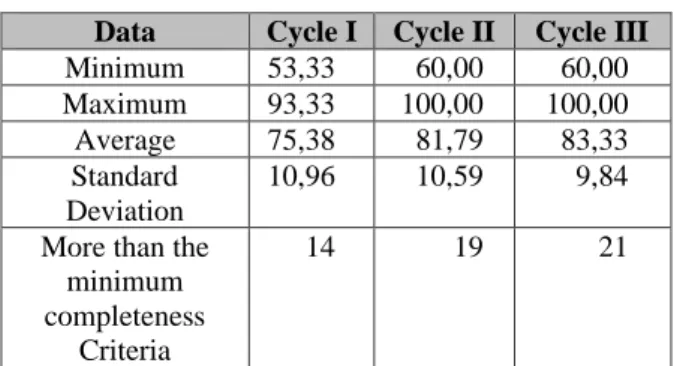
From the results of the research, it was found that the average score of PCPT learning outcomes in the first cycle was 75.38, the second cycle was 81.79, and the third cycle was 83.33. Each cycle has increased by 6.41 from cycle I to cycle II and by 1.54 from cycle II to
cycle III. Comparison of PCPT learning outcomes between cycles can be seen in Figure 2 below:
Table 1. Comparison of PCPT Learning Outcomes in Cycle I, Cycle II, and Cycle III
Data Cycle I Cycle II Cycle III
Minimum 53,33 60,00 60,00 Maximum 93,33 100,00 100,00 Average 75,38 81,79 83,33 Standard Deviation 10,96 10,59 9,84
More than the minimum completeness
Criteria
14 19 21
Indicators of successful actions from PCPT learning outcomes are students at least 75% exceeding the KKM that is equal to 75. In the first cycle, only 53.85% of students had exceeded the minimum completeness criteria, this was caused by the application of PBL method that was not optimal. At first students are not familiar with learning using PBL method and students are still confused about finding the right reference from the internet. So that the learning process can take place well, teachers need to prepare learning scenarios carefully and clearly [20]. As a reflection that cycle II has increased PCPT learning outcomes, the teacher needs to plan to learn systematically. The solution that can be done by the teacher is to prepare references in the form of books and internet website links. It is intended that students are not trapped at the wrong source when conducting investigations.
Actions taken based on the results of reflection have been proven to be effective in increasing PCPT learning outcomes. In the first cycle, only 53.85% of students had reached the minimum completeness criteria, in the second cycle, it increased to 73.08%. Even though in cycle II there has been an increase, but indicators of the success of the actions from the PCPT learning outcomes have not been achieved. Therefore, continued the next learning process in cycle III
In cycle III the teacher is more intensive in motivating and guiding students in the process of investigating problems according to the material. The teacher has an important role in learning for students in order to achieve good learning outcomes. Teachers play a critical role in enabling students to achieve good learning
179 –Improvement of Learning Motivation and Learning Outcomes by Applying The Problem ….
outcomes within effective education systems [21]. With the effectiveness of the learning process, in cycle III an increase in PCPT learning outcomes of 1.54 to 80.77% of students has exceeded the minimum completeness criteria. With this result, it can be concluded that the PBL method can improve student learning outcomes.
CONCLUSION
Learning motivation in the first cycle of 12.46 categorized as low, the second cycle of 14.72 categorized as high, and the third cycle of 16.76 categorized as very high, has increased by 2.26 from the first cycle to the second cycle and by 2.04 from the second cycle to the third cycle
Learning outcomes in the first cycle of 75,38, the second cycle of 81,79), and the third cycle of 83.33, has increased by 6. 41 from the first cycle to the second cycle and by 1.54 of the second cycle to the third cycle.
ACKNOWLEDGMENTS
Thank you to the SMK Muhammadiyah Prambanan for providing research facilities.
REFERENCES
[1] L. A. Scott, “21st century skills early learning framework. Partnership for 21st Century Skill (P21),” 2017. [Online]. Available:
http://www.p21.org/storage/documents/Ear lyLearning_Framework/
P21_ELF_%0AFramework_Final.pdf. [2] M. Ichsan, “Psikologi Pendidikan Dan
Ilmu Mengajar,” Edukasi, vol. 2, no. 2, pp. 60–76, 2016.
[3] S. Krishnan, R. Gabb, and C. Vale, “Learning Cultures of Problem-Based Learning Teams,” Australas. J. Eng. Educ., vol. 17, no. 2, pp. 67–78, 2017.
[4] J. W. Guthrie and P. J. Schuermann, Leading schools to success: Constructing and sustaining high-performing learning cultures. New York: SAGE Publications, Inc, 2011.
[5] D. F. Wood, “ABC of learning and teaching in medicine Problem based learning,” BMJ, vol. 328, no. 7384, pp. 328–330, 2003.
[6] L. L. Hardy, L. King, L. Farrell, R. Macniven, and S. Howlett, “Fundamental movement skills among Australian preschool children,” J. Sci. Med. Sport, vol. 13, no. 5, pp. 503–508, 2010.
[7] C. S. Dweck, “Motivation,” in Foundations for A Psychology of Education, New York: Routledge, 2012.
[8] S. Stoyanov, A theory of human motivation. London: Macat Library, 2017. [9] Keller and J. M, Motivational design for
learning and performance: The ARCS model approach. New York: Springer, 2010.
[10] A. Y. Kolb and D. A. Kolb, “Learning styles and learning spaces: Enhancing experiential learning in higher education,” Acad. Manag. Learn. Educ., vol. 4, no. 2, pp. 193–212, 2005.
[11] N. Sudjana, Dasar-dasar proses belajar mengajar. Bandung: PT Sinar Baru Algesindo, 2009.
[12] E. H. J. Yew and K. Goh, “Problem-Based Learning: An Overview of its Process and Impact on Learning,” Heal. Prof. Educ., vol. 2, no. 2, pp. 75–79, 2016.
[13] J. R. Savery, “Overview of Problem-based Learning: Definitions and Distinctions,” Interdiscip. J. Probl. Learn., vol. 1, no. 1, pp. 9–20, 2006.
[14] C. E. Hmelo-Silver and H. S. Barrows, “Goals and Strategies of a Problem-based Learning Facilitator,” Interdiscip. J. Probl. Learn., vol. 1, no. 1, pp. 21–39, 2006. [15] S. Kemmis, R. McTaggart, and R. Nixon,
The action research planner: Doing critical participatory action research. New York: Springer, 2014.
[16] N. A. Handoyono and Z. Arifin, “Pengaruh Inquiry Learning dan Problem-Based Learning terhadap Hasil Belajar PKKR Ditinjau dari Motivasi Belajar,” J. Pendidik. Vokasi, vol. 6, no. 1, pp. 31–42, 2016.
[17] P. A. Kirschner, J. Sweller, and R. E. Clark, “Why Minimal Guidance During Instruction Does Not Work: An Analysis of the Failure of Constructivist, Discovery, Problem-Based, Experiential, and Inquiry-Based Teaching,” Educ. Psychol., vol. 41,
no. 2, pp. 75–86, 2006.
[18] J. Strobel and A. van Barneveld, “When is PBL More Effective? A Meta-synthesis of Meta-analyses Comparing PBL to Conventional Classrooms,” Interdiscip. J. Probl. Learn., vol. 3, no. 1, pp. 44–58, 2009.
[19] Z. Dörnyei and E. Ushioda, Teaching and researching motivation, 2nd ed. London: Routledge, 2013.
[20] A. Suprijono, Cooperative Learning Teori dan Aplikasi Paikem. Yogyakarta: Pustaka Pelajar, 2010.
[21] T. Sharif, C. G. Hossan, and M. McMinn, “Motivation and Determination of Intention to Become Teacher: A Case of B.Ed. Students in UAE,” Int. J. Bus. Manag., vol. 9, no. 5, pp. 60–73, 2014.