Bloom of Trichodesmium erythraeum (Ehr.) and its impact on water quality and
plankton community structure in the coastal waters of southeast coast of India
A K Mohanty1, K K Satpathy1, G Sahu1, K J Hussain1, M V R Prasad1 & S K Sarkar2 1
Indira Gandhi Centre for Atomic Research, Kalpakkam, Tamil Nadu- 603 102 India 2
Department of Marine Science, University of Calcutta, Kolkata- 700 019 India [Email: [email protected]]
Received 14 September 2009; revised 11 January 2010
An intense bloom of Trichodesmium erythraeum was observed in the coastal waters (about 600 m away from the shore) of southeast coast of India during the post-northeast monsoon period. The bloom appeared during a relatively high temperature condition with coastal water salinity > 31 psu. A significant reduction in nitrate concentration was noticed during the bloom period, whereas, relatively high concentration of phosphate and total phosphorous was observed. An abrupt increase in ammonia concentration to the tune of 284.36 µmol l-1 was observed which coincided with the highest Trichodesmium density (2.88 × 10⁷ cells l-1). Contribution of Trichodesmium to the total phytoplankton density ranged from 7.79% to 97.01%. A distinct variation in phytoplankton species number and phytoplankton diversity indices was noticed. The lowest diversity indices coincided with the observed highest Trichodesmium density. Concentrations of chlorophyll-a (maximum 42.15 mg m-3) and phaeophytin (maximum 46.23 mg m-3) increased abnormally during the bloom.
[Key words: bloom, phytoplankton, tropical, Trichodesmium, oligotrophic, cyanobacteria] Introduction
Trichodesmium erythraeum, a marine
cyanobacterium, is an important nitrogen-fixer in the sea. It is one of the common bloom-forming species found in tropical and sub-tropical waters, particularly in the eastern tropical Pacific and Arabian Sea, contributing > 30% of algal blooms of the world1. Estimated global nitrogen fixation by Trichodesmium bloom (~ 42 Tg N yr-1) and during non-bloom conditions (~ 20 Tg N yr-1) suggests that it is likely to be the dominant organism in the global ocean nitrogen budget1, 2.Trichodesmium normally occurs in macroscopic bundles or colonies and blooms formed by it are often extremely patchy. The patchy spatial distribution of plankton blooms is usually connected to the physical variability of the water body3.
Reports in literature showed frequent occurrence of
Trichodesmium blooms in Indian waters, however, it
has been reported more frequently in the west coast4, 5, 6-11 as compared to east coast12, 13-15. Equipped with buoyancy regulating gas vesicles and nitrogen fixation enzymes, Trichodesmium is regarded as an organism well adapted to stratified, oligotrophic
conditions2. All the available reports on
Trichodesmium bloom from east and west coast of
India have been observed far away from the coast
(> 30 km). This appears to be the second report of
Trichodesmium bloom which was sighted near the
coast similar to the last year report from the same locality15.
During a regular coastal water monitoring program, a prominent discoloration of the surface water was noticed in the coastal waters of Kalpakkam (12o 33' N Lat. and 80o 11' E Long) (Figure 1) on 19th February 2008. The bloom was very dense and created yellowish-green coloured streaks (Figure 2a) of about 4 to 5m width and 10-20m long patches. The entire bloom extended to several kilometers along the coast. The phytoplankton responsible for discolouration was identified as Trichodesmium erythraeum (Figure 2b). Though, bloom of Noctiluca scintillans16, Asterionella
glacialis17 and Trichodesmium erythraeum15 in the
coastal waters of the Kalpakkam have been reported, the present one has many interesting features. Although, the data collected during our regular work were not concerned directly with an investigation into the causes of the bloom, the interest stimulated from the studies of various physicochemical and biological characteristics of the coastal water justifies the purpose of this paper. The acumen in investigating
Trichodesmium bloom appearance and distribution
sometimes causing damages to coastal fish and shellfish fauna18. Thus, studying the causes that favour the appearance of this bloom has social and economical
connotations. The impact of bloom on coastal water quality and phytoplankton community is reported in this paper along with the characteristic feature of the bloom.
Fig. 2a & b Discolouration of coastal water of Kalpakkam by Trichodesmium erythraeum bloom patches (a); magnified view of bundles formed by trichome (b)
Materials and Methods
Surface water samples were collected twice daily (between 9 to 10 AM and 4 to 5 PM during the bloom period (19th to 23rd February), whereas, during pre- and post-bloom periods samples were collected weekly only in the morning hours. Samples were drawn by lowering a clean plastic bucket from the Jetty of Madras Atomic Power Station (MAPS) and analyzed for various physicochemical parameters.
Temperature was measured by a mercury
thermometer with an accuracy of ±0.1oC. Winkler’s method19 was followed for the estimation of DO. Salinity was estimated by Knudsen’s method19. pH was measured by a pH meter (CyberScan PCD 5500) with an accuracy of ±0.1. Dissolved nutrients such as, nitrite, nitrate, ammonia, silicate and phosphate along with total nitrogen (TN) and total phosphorous (TP) were estimated following the methods of Grasshoff
et al.19 and Parsons et al.20. Chlorophyll-a and
phaeophytin were measured spectrophotometrically (Parsons et al., 1984. The phytoplankton density was estimated using Utermohl’s sedimentation technique21 and counted using Sedgwick Rafter counting chamber with the aid of binocular research microscope (Nikon Eclipse-50i). The identification of phytoplankton was done by following standard taxonomic monographs such as Desikachary22 for diatoms; Subramanian23,24 for dinoflagellates andFristch25 for green and blue-green algae (Cyanobacteria). Three diversity indices such as species richness (R), species diversity (D) and evenness (J) were computed to evaluate the variation between phytoplankton community structure and diversity, using standard formulae of Gleason (1922), Shannon-Weaver (1963) and Pielou (1966)respectively.
Results and discussions
A. Hydrography
The values of pH did not show significant variations and ranged from 8.0-8.2 during the study period (Figure-3a). It did not show any correlation with bloom appearance as it remained almost stable during pre-bloom, bloom and post-bloom periods. The surface water temperature during the study period ranged from 27.2-32.6°C (Figure 3b). Comparatively high temperatures were noticed during the afternoon collections. A general increase in water temperate was noticed from January to March, which is a general phenomenon associated with air temperature in this locality during this period of the year. Most of the marine cyanobacteria exhibit substantial growth in the temperature ranges 25-35°C11. The present bloom was noticed during relatively high temperature conditions (28.4-28.7°C in the morning and 31.2-32.6°C in the afternoon). Temperature has long been recognized as an important factor that controls Trichodesmium abundance26-27. Generally bloom of this filamentous alga occurred during hot weather season13, as cyanobacteria require relatively high temperature for
its optimum growth compared to other
phytoplankton28-29. The present study agreed well with earlier reports4, 13-15, 30, which showed similar temperature conditions with the appearance of
Trichodesmium bloom during early summer and
spring31 in the coastal waters of India. As observed, the bloom was more predominant during afternoon period when the temperature was relatively high as compared to morning period.
The observed salinity ranged from 31.58-33.18 psu. A gradual increase in salinity was noticed during the study period (Figure 3b). Stable salinity condition close to typical value of 32 psu and above is known to
support the growth and abundance of Trichodesmium. It is well known that the cyanobacterium is a stenohaline form with optimum growth at > 33 psu and can’t survive in low salinities11-14. DO
concentration ranged from 6.2-8.1 mg l-1
(Figure 3a). The lowest and the highest DO concentration was observed during the post-bloom and bloom period respectively. Marginally high DO was noticed during the bloom compared to the pre- and post-bloom period. However, concentrations of DO during pre-bloom period were relatively high as compared to post-bloom period. This could be due to photosynthetic release of oxygen by the dense algal biomass. Similar increase of DO content during
Trichodesmium bloom has also been reported
earlier2,15. As expected relatively low DO contents were observed during the post-peak bloom period, indicating that some of the cells are in decayed stage. This phenomenon of observation of low DO values
near bloom area is common to post-bloom era and indicative of decayed phase of the bloom.
B. Nutrients
Nitrate concentrations ranged from 0.17–6.79
µmol l-1, the highest value being observed during the pre-bloom period and the lowest during the bloom (Figure 3c). Relatively low nitrate levels, continuous patches with yellowish green colour and increased primary production (as reflected in chlorophyll-a
values) coinciding with peak bloom period
sufficiently indicated that the bloom was in growth phase. A significant reduction in nitrate concentration was noticed during the bloom as compared to pre- and post-bloom periods. Similar reduction of nitrate concentration during Trichodesmium bloom has also been reported by others12,14-15. Insignificant variation in concentration of nitrite was noticed during the period of study. On the contrary, ammonia values
Fig. 3b
were significantly high during the bloom, especially on the day of the highest cell density, compared to the pre- and post-bloom observations (Figure 3d), which ranged from 0.22-284.36 µmol l-1. This could be ascribed to the diazotrophic nature of Trichodesmium, which has the ability to produce ammonium through the process of nitrogen fixation32. As a result of the above process, the observed TN concentration was also relatively high (392.80 µmol l-1) on the peak bloom day (Figure 3d). Surprisingly, perusal of a plethora of literature available from Indian coasts
revealed that ammonia concentration during
Trichodesmium bloom has rarely been estimated or
reported4, 8, 33. A comparison of the present ammonia concentration with that of earlier reported value (126.72 µmol l-1) during Trichodesmium bloom from the same locality15 showed a two fold increase. Many reports have indicated discolouration of water,
production of offensive smell, increase in ammonia content and fish mortality in coastal waters due to
Trichodesmium bloom11. During the present
observation, in spite of prevalence of very high ammonia content, there was however, no fish mortality and thus social and economical implications were minimal. Considering the fact that, ammonia concentration >0.1 mg l-1 is toxic for the fish community18, the bloom could have a significant adverse effect on the biota of the coastal waters had it continued for a longer period. No report of fish mortality or any such nuisance incidence during the present study could be attributed to factors like shorter period of bloom persistence and its drifting away along with the pole-ward water current.
Phosphate levels ranged from 0.09 µmol l-1 during the pre-bloom to 1.51 µmol l-1 during the bloom (Figure 3e). The peak coincided with the day of the
Fig. 3d
Fig. 3a-e Variations in physico-chemical properties of the coastal waters of Kalpakkam during appearance of Trichodesmium erythraeum bloom.
highest Trichodesmium cell density. It did not show a clear trend during the study. Phosphate constitutes the most important inorganic nutrient that can limit the phytoplankton production in tropical coastal marine ecosystems34 and thereby the overall ecological processes. Usually seawater serves as the main source of phosphate in estuarine and coastal waters except those receives fresh water contaminated with phosphate. Apart from the physical and chemical processes, phosphate concentration in coastal waters mainly depends upon phytoplankton uptake and replenishment by microbial decomposition of organic matter. In the present study, an abrupt increase in phosphate content was encountered on the day of highest cell density compared to other observations. This increase in phosphate could be due to the extracellular release35 and decomposition of plankton. Moreover, bacterial liberation of phosphate from dead organisms has also been reported to be responsible for enhanced levels of phosphate during blooms36. Many other authors have also reported similar increase of phosphate content during the occurrence of bloom of
Trichodesmium14-15,35, Noctiluca37-39 and
Asterionella17. The irregular trend observed in
phosphate concentration during the study could be due to its rapid uptake as well as replenishment processes taking place in the coastal waters. Total phosphorous concentration showed a trend similar to that of phosphate and ranged from 0.14-2.83 µmol l-1 (Figure 3e).
Silicate values ranged from 7.58-16.28 µmol l-1 with lowest and highest values being observed during bloom and post-bloom periods respectively (Figure 3c). Pre-bloom concentrations of silicate were marginally high as compared to that of bloom and post-bloom periods. Silicate, utilized for the formation of the siliceous frustules of diatoms, constitutes one of the most important nutrients regulating the phytoplankton growth and proliferation and ultimately to its blooming. Relatively high values of silicate observed during the pre-bloom period could be ascribed to the silicate rich freshwater input into the coastal water during the monsoon period. Also, during post-monsoon period, the environmental conditions were unfavorable for phytoplankton growth, and thus silicate uptake was negligible leading to enhanced level of silicate in the coastal waters. Gradually, with onset of favourable conditions for phytoplankton growth, silicate uptake increased leading to decrease in its concentration in the coastal waters as observed
during the present study. Except for the enhanced concentration levels of silicate during pre-bloom period, its concentration remained almost stable
during the bloom and post-bloom period.
Observations similar to this have also been reported by several authors during the appearance of non-diatom blooms16,37-38, where silicate remains unutilized.
C. Phytoplankton community structure
Trichodesmium is considered as an organism well
used to stratified, oligotrophic environment. Thus, its abundance should be high in the boundary currents and decrease towards the coast wherein the availability of nitrogenous nutrients is more. There has not been any report of T. erythraeum bloom in the coastal zone right near the coast (within 600 m from the shore). Results showed that the bloom constituted both individual trichomes and colonial forms although the later dominated to the extent of 80-90%. Generally the trichome length varied from 300-1200 µm. Unlike the west coast of India wherein phytoplankton bloom is generally observed during the beginning of SW monsoon period (May-September), the present bloom was observed during the end of NE monsoon period. The present observation coincided with the transition period during which the coastal water current was about to change from southerly to northerly direction. This is the lull period during which the lowest magnitude of current is observed at this location. Blooms have been reported to be conspicuous in calm conditions. These calm conditions assist the trichomes to form dense rafts on the surface of the sea as has been observed during this study.
Phytoplankton community showed a distinct variation in its qualitative as well as quantitative aspects during the study. In total 69 species of phytoplankton were identified which comprised of 62 diatoms, 5 dinoflagellates, one silicoflagellatte and the cyanobacterium Trichodesmium erythraeum. The population density of phytoplankters ranged from 1.23 × 10⁵ and 2.94 × 10⁷ cells l-1 (Figure 4) showing more than two order increase during the peak bloom period. The lowest cell density was observed during post-bloom period. Surprisingly, Trichodesmium was found only during the bloom period from 19.02.08-23.02.08 and was totally absent during the pre- and post-bloom observations. Contribution of
Tricho-desmium to the total cell count ranged from 7.79 %
It is well known that Trichodesmium is more abundant in subsurface layers (20-30 m) as compared to surface water36. Though, the present bloom was observed in
coastal waters with much lower depth
(~ 8 m), in order to examine the presence of
Trichodesmium in the subsurface layers, bottom
samples were collected, and found to be absent. The observed density of Trichodesmium was found to be significantly higher than the earlier reported value of 3.38 × 10⁶ cells l-1 by Ramamurthy et al.13 and 4.80 × 10⁶ cells l-1 by Krishnan et al.11. Scrutiny of published literature showed that, the present observed density of Trichodesmium is the highest, reported to date from Indian waters, and surpassed by a factor of 1.75 times from that of earlier reported highest value (1.75 × 10⁷ cells l-1) by Santhanam et al.14 from Tuticorin Bay.
Community structure of phytoplankton showed that the number of species on a single observation varied between 7 species (on the day of highest cell count) and 24 during the post-bloom period. As expected relatively less number of species were found during the bloom as compared to pre- and post-bloom periods. Similar results have also been reported40 during Asterionella bloom. Interestingly, number of species were relatively less during the afternoon
collections on all the occasions as compared to the morning collections. This again emphasized that
certain phytoplankton such as Trichodesmium
erythraeum, which can tolerate relatively high amount
of irradiance in the surface water during afternoon as compared to morning period1-3,32. However, species not tolerant to irradiance, evading the surface water leading to low species diversity. Based on the numerical abundance, 30 species were considered as
important contributing 74.19-99.70% of the
population density (Table 1). Out of these
Asterionella glacialis, Nitzschia longissima,
Thalassionema nitzschioides, Thalassiosira decipiens
and Thalassiothrix longissima were present almost
throughout the study period. Species such as
Biddulphia heteroceros, Cocconeis distans and
Leptocylindrus minimum were found only during the
pre-bloom period and totally absent during bloom and post-bloom periods. On the contrary, two species of
Biddulphia (B. aurita and B. rhombous) were found
only during the post-bloom period. This clearly indicated that presence of Trichodesmium erythraeum favours growth of a selected group of diatoms during the post-bloom period.
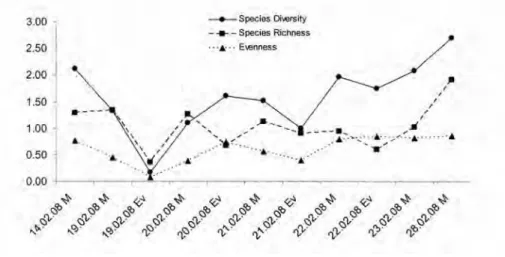
Distinct variations in all the three diversity indices were noticed during the study period (Figure-5).
Table 1 Percentage contribution of dominant phytoplankton species, total cell density and number of species encountered during the Trichodesmium erythraeum bloom in the coastal waters of Kalpakkam
14.02.08 19.02.08 M 19.02.08 E 20.02.08 M 20.02.08 E 21.02.08 M 21.02.08 E 22.02.08 M 22.02.08 E 23.02.08 M 28.02.0 8 M Asterionella glacialis 21.98 16.48 1.14 3.75 14.40 20.66 5.59 21.52 30.43 24.68 12.90 Biddulphia aurita 4.84 Biddulphia heteroceros 1.10 Biddulphia longicuris 0.06 2.42 Biddulphia mobiliensis 2.42 Biddulphia rhombus 1.30 4.03 Chaetoceros lorenzianus 0.42 2.25 2.42 Chaetoceros sp 0.19 1.13 1.38 1.61 Cocconeis distans 1.10 Coscinidiscus sp 1.10 0.19 2.42 Cyclotella sp 1.30 Dictyocha sp 2.60 Guinardia flaccida 1.61 Leptocylindrus minimum 0.90 Licmophora gracilis 2.20 Melosira sulcata 2.20 0.33 6.49 Melosira sp 16.81 Nitzschia longissima 3.30 1.48 0.98 3.19 16.00 5.36 1.97 6.33 14.49 2.60 1.61 Nitzschia sigma 2.20 0.60 1.43 2.53 Nitzschia stagnorum 1.10 1.27 Pinnularia interrupta 1.32 Pleurosigma sp 1.27 Pseudonitzschia delicatissima 0.59 5.07 Pseudonitzschia pungens 1.13 Thalasiossira decipiens 12.09 0.26 0.09 0.80 0.25 8.86 8.70 6.49 8.87 Thalasiossira sp 12.09 0.53 0.04 0.19 2.40 1.74 0.66 1.27 4.35 7.79 10.48 Thalassionema nitzschioides 24.18 4.69 0.34 2.06 16.00 15.05 8.88 17.72 21.74 24.68 13.71 Thalassiothrix frauenfeldii 4.40 0.45 0.09 1.13 1.06 0.99 1.27 5.19 2.42 Thalassiothrix longissima 0.41 0.94 2.40 2.04 2.53 1.30 2.42 Trichodesmium erythraeum 0.00 44.04 97.01 75.80 33.60 43.43 74.67 17.72 13.04 7.79 0.00 % contribution of above sp. 89.01 88.19 99.70 96.81 85.60 92.47 94.08 82.28 92.75 92.21 74.19 Total cell density
(X 105)
1.29 13.91 294.05 6.89 1.46 8.28 5.63 1.29 1.23 1.37 2.02 Total No. species in
the sample
16 19 7 18 9 16 13 12 8 13 24
Relatively high values of all the indices during the pre- and post-bloom periods showed that the phytoplankton community was floristically rich during these periods. A significant decrease in diversity indices was noticed on the day of the highest
Trichodesmium density. This could be attributed to
the dominance of Trichodesmium and the presence of very less number of other phytoplankton species.
E. Photosynthetic pigments
Photosynthetic pigments such as chlorophyll-a and phaeophytin showed wide variations which ranged from 1.21-42.15 mg m-3 and 0.78-46.23 mg m-3 respectively (Figure 6). The highest concentration was encountered during the bloom which coincided with highest cell density. In general, concentration of chlorophyll-a and phaeopigments remained high during bloom as compared to pre- and post-bloom
periods and the peak values of these two pigments were about 20 times higher than the normal values. Interestingly, concentrations of these pigments were relatively high during the post-bloom period as compared to the pre-bloom period. This affirmed the fact that phytoplankton growth gradually increased from post-monsoon to summer in this part of Bay of Bengal10-11. Similar observations of unusually high pigment concentrations have been reported by Ramamurthy et al.13, Pant & Devassy35 and Satpathy
et al.15 during Trichodesmium bloom and Mishra
et al.40 and Mishra & Panigrahy41 during Asterionella bloom.
Conclusion
Relatively high temperature, low current
magnitude, stable salinity (~ 33 psu) and low nitrate concentration were observed during the bloom of
Fig. 5 Variations in phytoplankton diversity indices during the bloom period
cyanobacterium T. erythraeum in the coastal waters of Kalpakkam. Abnormally high concentration of ammonia observed during the bloom period was a concern. The cell density was found to surpass all the earlier reported densities from east and west coast of India. Appearance of T. erythraeum in coastal waters of east coast of India during two successive years necessitates the need for continuous monitoring of physico-chemical parameters on a long-term basis, which would help in comprehending its cause and its ecological significance.
Acknowledgement
Authors are grateful to Director, Indira Gandhi Centre for Atomic Research and Director, Safety Group for their encouragement and support. Help rendered by Shri. S. Bhaskar of Environmental and Industrial Safety Section is also duly acknowledged.
References
1 Westberry, T.K. and Siegel, D.A., Spatial and temporal distribution of Trichodesmium in the world’s oceans, Global Biogeochemical Cycles, 20 (2006) GB4016
2 Capone, D.G., Zehr, J.P., Paerl, H.W., Bergman, B. and Carpenter, E.J., Trichodesmium, a globally significant marine bacteria, Science, 276 (1997)1221-1229
3 Kononen K & Leppänen J M, Patchiness, scales and controlling mechanisms of cyanobacterial blooms in the Baltic Sea: application of a multi-scale research strategy, in: Monitoring Algal Blooms: New Techniques for Detecting Large-Scale Environmental Change, edited by M. Kahru and Ch.W. Brown, (Landes Biosience, Austin, TX, USA,) 1997, pp. 63–84
4 Qasim S., Z., Some characteristic of a Trichodesmium bloom in the Laccadives, Deep Sea. Res., 17 (1970) 655-660 5 Sarangi, R.K., Prakash, C. and Nayak, S.R., Detection and
monitoring of Trichodesmium bloom in the coastal waters of Sourashtra coast, India using IRS P4 OCM data, Curr. Sci., 86 (2004) 1636-1841
6 Prabhu M.S., Ramamurthy, S., Kuthalingam, M.D.K. and Dhulkheid. M.H., On an unusual swarming of the planktonic blue green algae Trichodesmium Spp. off Mangalore. Curr. Sci., 34 (1965) 95
7 Devassy, V.P., Bhatrarhiri, P.M.A. and Qasim, S.Z., Trichodesmium Phenomenon. Indian J. Mar. Sci., 73 (1978) 168-186
8 Devassy V P, Trichodesmium red tides in the Arabian Sea, in: Contributions in Marine Sciences: A Special Volume to Felicitate Dr. S. Z. Qasim Sastyabdapurtl on His Sixtieth Birthday, edited by T.S.S. Rao, (National Institute of Oceanography, Dona Paula, India) 1987, pp. 61–66
9 Shetty H P C, Gupta T R C and Kattai R J, Green water phenomena in the Arabian Sea off Mangalore, in: Proceedings of the first India fisheries forum, 1988, pp 339-346
10 Koya, K.P.S. and Kaladharan, P., Trichodesmium bloom and mortality of Canthigaster margaritatus in the Lakshadweep Sea, Mar. Fish. Inf. Serv. Tech. Ext. Ser., 147 (1997) 14
11 Krishnan, A.A., Krishnakumar, P.K. and Rajagopalan, M., Trichodesmium erythraeum (EHR) bloom along the sothwest coast of India (Arabian Sea) and its impact on trace metal concentrations in seawater, Estuar. Coast. Shelf. Sci., 71 (2007) 641-646
12 Jyothibabu, R., Madhu, N.V., Murukesh, N., Haridas, P.C., Nair, K.K.C. and Venugopal, P., Intense blooms of Trichodesmium erythraeum (Cyanophyta) in the open waters along east coat of India, Indian J. Mar. Sci., 32 (2003)165-167 13 Ramamurthy, V. D., R. Selva Kumar, A. and Bhargava, R.
M. S., Studies on the blooms of Trichodesmium erythraeum (EHR) in the waters of the Central west coast of India, Curr. Sci., 41 (1972) 803-805
14 Santhanam, R., Srinivasan, A., Ramadhas, V. and Devaraj, M., Impact of Trichodesmium bloom on the plankton and productivity in the Tuticorin Bay, Southeast coast of India, Indian J. Mar. Sci., 23 (1994) 27-30
15 Satpathy, K.K., Mohanty, A.K.,Gouri Sahu, Usha Natesan, Venkatesan, R. and Prasad, M.V.R., On the occurrence of Trichodesminum erythraeum (Ehr.) bloom in the coastal waters of Kalpakkam, east coast of India, Indian J. Sci. Tech., 1 (2007) 1-11
16 Sargunam, C.A., Rao, V.N.R. and Nair, K.V.K., Occurrence of Noctiluca bloom in Kalpakkam coastal waters, east coast of India, Indian J. Mar. Sci., 18 (1989) 289-290
17 Satpathy, K.K. and Nair, K.V.K., Occurrence of phytoplankton bloom and its effect on coastal water quality. Indian J. Mar. Sci., 25 (1996) 145-147
18 Bhat, S.R. and Verlencar, X.N., Some enigmatic aspects of marine cyanobacterial genus, Trichodesmium. Curr. Sci., 91 (2006) 18-19
19 Grasshoff K, Ehrhardt M & Kremling K, Methods of seawater analysis, (Wiley- VCH, New York) 1983, pp. 786 20 Parsons T R, Maita Y & Lalli C M, A manual of chemical
and biological methods for Seawater analysis, (Pergamon Press, New York) 1984, pp. 173
21 A manual on methods for measuring primary production in aquatic environments, IBP hand book no 12, Blackwell scientific publication, London, 1974, pp. 225
22 Desikachary T V, Atlas of diatoms III & IV, (Madras Science Foundation, Madras) 1987, pp.239
23 Subramanian R, The Dinophycaes of Indian Seas Part-I. Genus Ceratium, (Marine Biological Association of India) 1968, pp. 129
24 Subramanian R, The Dinophycaes of Indian Seas Part-II. Peridiniaceae, (Marine Biological Association of India) 1971, pp. 134
25 Fristch F E, The Structure and Reproduction of Algae, Vol. II, (Cambridge Univ. Press, London) 1935, pp. 263
26 Marumo, R. and Nagasawa, S., Seasonal variation of the standing crop of a pelagic blue-green alga, Trichodesmium in the Kuroshio water, Bull. Plankton Soc. Japan, 23 (1976) 19-25 27 Carpenter, E.J., Physiology and ecology of the marine
plankton Oscillatoria (Trichodesmium), Mar. Biol. Lett., 4 (1983) 69-85
28 Suvapepant S, Trichodesmium blooms in gulf of Thailand, in: Marine pelagic cyanobacteria: Trichodesmium and other diazotrophs, edited by E.J. Carpenter, (Kluwer Academic Press) 1992, pp. 343-348
29 Sellner, K.G., Physiology, ecology and toxic properties of marine cyanobacteria blooms, Limnol. Oceanogr., 42 (1997) 1089-1104
30 Desa, E., Suresh, T., Matondakar, S.G.P., Desa, E., Goes, J., Mascarenhas, A., Parab, S.G., Shaikh, N. and Fernandes, C.E.G., Detection of Trichodesmium bloom patches along the eastern Arabian Sea by IRS-P4/OCM ocean colour sensor and by in-situ measurements, Indian J. Mar. Sci., 34 (2005) 374-386
31 Madhu, N.V., Jyothibabu, R., Maheswaran, P.A., Gerson, V.J., Gopalakrishnan, T.C. and Nair, K.K.C. Lack of seasonality in phytoplankton standing stock (chlorophyll-a) and production in western Bay of Bengal, Continent. Shelf Res., 26 (2006) 1868-1883
32 Chang, J., Chiang, K.P. and Gong, G.C., Seasonal variation and cross-shelf distribution of the nitrogen-fixing cyanobacterium, Trichodesmium, in the southern East China Sea. Continent. Shelf Res., 20 (2000) 479-492
33 Nair V E, Devassy V P & Madhupratap M, Blooms of phytoplankton along the coast of India associated with nutrient enrichment and the response of zooplankton, in: Marine coastal eutrophication. Science of the Total Environment, edited by R.A. Vollenweiden, (Elsevier) 1992, pp. 819-828
34 Cole C V & Sanford R L, Biological aspects of the Phosphorus cycle, paper presented at Symposium on Phosphorous Requirements for Sustainable Agriculture in Asia and Oceania, SCOPE/UNEP, 1989, 6-10.
35 Pant. A. and Devassy, V. P., Release of extracellular matter during photosynthesis by a Trichodesmium bloom, Curr. Sci., 45 (1976) 487-489
36 Subba Rao, S.D.V., Asterionella japonica bloom and discolouration off Waltair, Bay of Bengal, Limnol. Oceanogr., 14 (1969) 632-634
37 Raghuprasad, R. and Jayaraman, R., Preliminary studies on certain changes in the plankton and hydrological conditions associated with the swarming of Noctiluca, Proc. Ind. Acad. Sci., 40 (1954) 49-57
38 Dharani, G., Abdul Nazar, A.K., Kanagu, L., Venkateshwaran, P., Kumar, T.S., Ratnam,K., Venkatesan, R. and Ravindran, M., On the reoccurrence of Noctiluca scintillans bloom in Minnie Bay, Port Blair: Impact on water quality and bioactivity of extracts, Curr. Sci., 87 (2004) 990-994
39 Sahayak, S., Jyothibabu,R., Jayalakshmi, K.J., Habeebrehman, H., Sabu, P., Prabhakaran, M.P., Jasmine, P., Shaiju, P., Rejomon, G., Thresiamma, J. and Nair, K.K.C., Red tide of Noctiluca miliaris off south of Thiruvananthapuram subsequent to be “Stench event” at the south Kerala coast, Curr. Sci., 89 (2005) 1472-1473
40 Mishra, S., Sahu, G., Mohanty, A. K., Singh, S.K. and Panigrahy, R.C., Impact of the diatom Asterionella glacialis (Castracane) bloom on the water quality and phytoplankton community structure in coastal waters of Gopalpur sea, Bay of Bengal, Asian J. Water, Env. Poll., 3 (2006) 71-77
41 Misra, S. and Panigraphy, R.C., Occurrence of diatom blooms in Bahuda estuary, East Coast of India, Indian J. Mar. Sci., 24 (1995) 99-101