FEDERAL AVIATION ADMINISTRATION
February 24, 2011
Prepared by the:
Asset Management and NAS Supply Support Team
Technical Operations Service, ATO-W
Air Traffic Organization
FAA Asset Identification
Process and Procedure Guide
6/15/2011 ii
Table of Contents
FAA Asset Identification ... i
Process and Procedure Guide ... i
General ... 1
1. What is the purpose of this guide? ... 1
2. To whom does this guide apply? ... 1
3. What is the governing authority for this guide?... 1
4. What does this guide cover? ... 1
5. To whom do ―we‖, ―you‖, and their variants refer? ... 1
6. What information does this guide contain? ... 1
7. How do we request a deviation from these requirements and who can approve it? ... 2
8. What are my responsibilities? ... 2
Asset Identification Specification ... i
1 Introduction ... 1 1.1 Purpose ... 1 1.2 References ... 1 2 Specification ... 3 2.1 Barcode Standard ... 3 2.1.1 Unique identification ... 3 2.1.2 Asset labeling ... 4 2.1.3 Environmental considerations ... 4
2.1.4 FAA Order applicability... 4
2.2 Symbology and Printing Requirements for 1-D (Linear) Barcodes ... 4
2.2.1 Barcode symbology ... 4
2.2.2 Barcode printing ... 6
2.2.3 Print contrast ... 7
2.2.4 Field overlap ... 7
2.3 Data Requirements for 1-D (Linear) Barcodes ... 7
2.3.1 Mandatory Data ... 7
2.3.2 Symbol Syntax ... 7
2.3.3 Human Readable Text ... 8
2.4 Asset Label Specifications for 1-D (Linear) Barcodes ... 9
2.5 Symbology and Printing Requirements for 2-D (Data Matrix) Barcodes ... 10
2.5.1 Data matrix symbology ... 10
2.5.2 Data matrix size ... 10
2.5.3 Data matrix symbol quality ... 10
2.5.4 Calibration of verification equipment ... 11
2.5.5 Alternative quality measuring methodologies... 11
2.5.6 Field overlap ... 11
2.6 Data Requirements for 2-D (Data Matrix) Barcodes ... 11
2.6.1 Symbol Syntax ... 11
2.6.2 Human readable text... 13
2.6.3 Legibility of human readable text ... 13
6/15/2011 iii
2.8 Material Specifications ... 15
2.8.1 Resistance ... 15
2.8.2 Specular reflection (substrate, laminate & imaging media) ... 15
2.8.3 Composition ... 15 2.8.4 Application temperature ... 16 2.8.5 Service environment ... 16 2.9 Label Placement ... 16 2.9.1 Label accessibility ... 16 2.9.2 Number of labels ... 16 2.9.3 Application surfaces ... 16 2.9.4 Rough surfaces ... 17 2.9.5 Curved surfaces ... 17 2.9.6 Irregular surfaces ... 17 2.9.7 Administrative assets... 17 2.10 Replacement of Labels ... 17 2.11 Unreadable Labels ... 17
3 Government and Contractor responsibilities ... 19
3.1 Government asset identification ... 19
3.2 Contractor asset identification ... 19
3.3 Contractor label specifications ... 19
3.4 Contractor GS1 Company Prefix ... 19
Appendix 1. Definitions ... 20
Asset Idenification Contract Data ... i
Requirements List and Data Item ... i
Description (CDRL/DID) ... i
1 Introduction ... 1
1.1 Purpose ... 1
1.2 Background ... 1
1.2.1 Barcode Specification ... 1
1.2.2 Electronic Asset Data ... 1
1.2.3 Fixed File Format ... 2
2 Instructions ... 3
2.1 Statement of Work ... 3
2.1.1 Asset Identification Report... 3
2.2 CDRL Items: A0xx Asset Identification Report ... 5
2.3 Data Item Description (DID) ... Error! Bookmark not defined. 2.3.1 Example DID... Error! Bookmark not defined. 2.3.2 DID Fields - Contractors ... 5
2.3.3 DID Fields – FAA ... 6
2.4 Asset Identification Label ... 8
6/15/2011 1
General
1. What is the purpose of this guide?
This guide was written to provide an easy to use "how to" tool to assist you in asset identification including barcoding, tagging, or identifying FAA personal property assets using FAA asset identification standards. It ensures FAA assets are properly identified and managed from the time the asset is initially acquired until it reaches the end of its life cycle and is disposed of.
2. To whom does this guide apply?
It covers FAA headquarters, regions, centers (also referred to as "regions"), and field organizations, and applies to all FAA employees who manage FAA asset acquisitions.
3. What is the governing authority for this guide?
The Federal Property and Administrative Services Act of 1949, as amended (Act of 30 June 1949, 63 Stat. 372), the Chief Financial Officers (CFO) Act of 1990, and FAA Order 4600.27A, dated 11/16/07.
4. What does this guide cover?
This guide covers all FAA accountable personal property and operating inventory used in the National Airspace System (NAS) and other FAA personal property assets used in the
performance of its mission that is owned or controlled by the FAA. These assets are located within all FAA facilities as well as contractor facilities. In addition:
a) Future acquisitions of NAS systems require vendors to identify and tag all assets to the lowest replaceable/repairable units (LRU), during assembly or at the time deemed most appropriate in order to maintain the warranty or integrity of the assets.
b) Future acquisitions of non-NAS assets or systems, consisting of FAA accountable
property, as defined in FAA Order 4600.27A are tagged prior to delivery to or acceptance by the FAA. Non-accountable assets may be tagged and recorded in AITS at the
discretion of the property custodian.
5. To whom do “we”, “you”, and their variants refer?
Use of pronouns ―we‖, ―you‖, and their variants refer to the agency.
6. What information does this guide contain?
The following two documents are included in this guide:
a) Asset Identification Specification. This document describes the attributes of the FAA asset identification specification as developed by the Asset Management and NAS
6/15/2011 2
Supply Support Team, ATO-W, AML and GS1 US (formerly Uniform Code Council, Inc.).
b) Asset Identification Contract Data Requirements List (CDRL) and Data Item Description (DID). This document provides instructions for incorporating CDRLs and DIDs into all FAA asset acquisitions.
7. How do we request a deviation from these requirements and who can approve it?
Deviations must be submitted in writing to the FAA Service Management Group, Asset Management and NAS Supply Support Team, ATO-W, at 800 Independence Avenue, SW, Washington, DC 20591.
8. What are my responsibilities?
Effective asset management depends on your involvement as well as that of organizations that acquire, develop, own, operate, or replace the agency‘s personal property assets.
a) The Vice President of Technical Operations. ATO-W is the focal point and has overall responsibility for the FAA personal property management program. As such the ATO-W sponsors FAA asset identification initiatives.
b) The Vice President of Acquisition and Business Services (ATO-A) has overall
responsibility to make sure all applicable contracts and procurements contain applicable clauses from the Acquisition Management System (AMS), requiring newly acquired assets to be properly identified and tagged in accordance with the Asset Identification Specification.
c) All LOBs and SOs are responsible to make sure proper FAA assets are properly identified as they move through their life cycle.
FEDERAL AVIATION ADMINISTRATION
Version 3.0
February 24, 2011
Prepared by the:
Asset Management and NAS Supply Support Team
Technical Operations Service, ATO-W
Air Traffic Organization
6/15/2011 AIS-ii
Revision History
Author Date Version
AFZ-500 11/21/2002 v1.0 UCC® 4/15/2003 v1.1 UCC® 5/29/2003 v2.0 AFZ-500 6/10/2003 v2.1 AFZ-500 6/24/2003 v2.2 UCC® 7/25/2003 v2.3 AFZ-500 11/18/2003 v2.4 AMNSS 12/13/04 v2.5 AMNSS 5/27/06 v2.5.1 AMNSST 6/16/06 V2.5.2 AMNSST 9/21/2009 V2.5.5 AMNSST 7/10/2009 V2.5.4 AMNSST 9/21/2009 V2.5.5 AMNSST 11/18/2009 V2.5.6 AMNSST 2/24/2011 V3.0
6/15/2011 AIS-iii
Table of Contents
1 Introduction ... AIS-1 1.1 Purpose ... AIS-1 1.2 References ... AIS-1 2 Specification... AIS-32.1 Barcode Standard ... AIS-3 2.1.1 Unique identification ... AIS-3 2.1.2 Asset labeling ... AIS-4 2.1.3 Environmental considerations ... AIS-4 2.1.4 FAA Order applicability ... AIS-4 2.2 Symbology and Printing Requirements for 1-D (Linear) Barcodes ... AIS-4 2.2.1 Barcode symbology ... AIS-4 2.2.2 Barcode printing... AIS-6 2.2.3 Print contrast ... AIS-7 2.2.4 Field overlap ... AIS-7 2.3 Data Requirements for 1-D (Linear) Barcodes ... AIS-7 2.3.1 Mandatory Data ... AIS-7 2.3.2 Symbol Syntax ... AIS-7 2.3.3 Human Readable Text... AIS-8 2.4 Asset Label Specifications for 1-D (Linear) Barcodes ... AIS-9 2.5 Symbology and Printing Requirements for 2-D (Data Matrix) Barcodes ... AIS-10 2.5.1 Data matrix symbology ... AIS-10 2.5.2 Data matrix size ... AIS-10 2.5.3 Data matrix symbol quality ... AIS-10 2.5.4 Calibration of verification equipment ... AIS-11 2.5.5 Alternative quality measuring methodologies ... AIS-11 2.5.6 Field overlap ... AIS-11 2.6 Data Requirements for 2-D (Data Matrix) Barcodes ... AIS-11 2.6.1 Symbol Syntax ... AIS-11 2.6.2 Human readable text ... AIS-13 2.6.3 Legibility of human readable text ... AIS-13 2.7 Asset Label Specifications for 2-D (Data Matrix) Barcodes ... AIS-14 2.8 Material Specifications ... AIS-15 2.8.1 Resistance ... AIS-15 2.8.2 Specular reflection (substrate, laminate & imaging media)... AIS-15 2.8.3 Composition ... AIS-15 2.8.4 Application temperature... AIS-16 2.8.5 Service environment ... AIS-16 2.9 Label Placement ... AIS-16 2.9.1 Label accessibility ... AIS-16 2.9.2 Number of labels ... AIS-16 2.9.3 Application surfaces... AIS-16 2.9.4 Rough surfaces ... AIS-17 2.9.5 Curved surfaces ... AIS-17 2.9.6 Irregular surfaces ... AIS-17
6/15/2011 AIS-iv
2.9.7 Administrative assets ... AIS-17 2.10 Replacement of Labels ... AIS-17 2.11 Unreadable Labels ... AIS-17
3 Government and Contractor responsibilities ... AIS-19
3.1 Government asset identification ... AIS-19 3.2 Contractor asset identification ... AIS-19 3.3 Contractor label specifications ... AIS-19 3.4 Contractor GS1 Company Prefix ... AIS-19
6/15/2011 AIS-1
1
Introduction
1.1 Purpose
This document describes the attributes of the Federal Aviation Administration (FAA) Asset Identification Specification as developed by the Asset Management and NAS Supply Support Team (AM&NSST) and GS1 US (formerly Uniform Code Council, Inc.). This specification is in conformance with the GS1 Global Individual Asset Identifier (GIAI) standard. This specification shall be used FAA-wide for personal property asset identification.
This document also establishes two barcode specifications that define the format, standard, location and definition of the barcode label for identifying FAA accountable personal property and operating inventory used in the National Airspace System (NAS) in the performance of its mission that is owned or controlled by the FAA. The first specification is for a linear, or 1-D, barcode label, which encodes the asset‘s GIAI; the second specification is for a data matrix, or 2-D, barcode label, which encodes the GIAI as well as the CAGE code, part number, and serial number of the asset. The data matrix specification was finalized in July, 2009 after being accepted by both GS1 US and the Department of Defense (DoD).
1.2 References
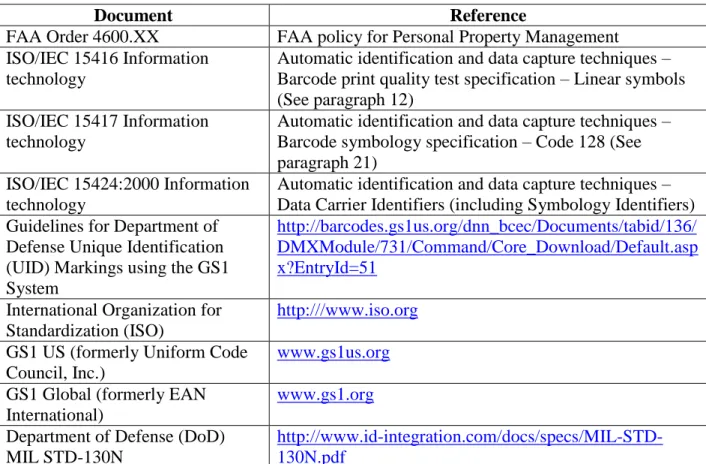
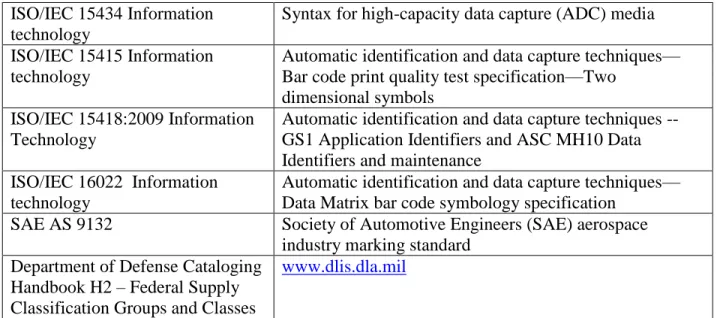
Table 1 below provides a complete list of all documents and publications referenced in this specification.
Document Reference
FAA Order 4600.XX FAA policy for Personal Property Management ISO/IEC 15416 Information
technology
Automatic identification and data capture techniques – Barcode print quality test specification – Linear symbols (See paragraph 12)
ISO/IEC 15417 Information technology
Automatic identification and data capture techniques – Barcode symbology specification – Code 128 (See paragraph 21)
ISO/IEC 15424:2000 Information technology
Automatic identification and data capture techniques – Data Carrier Identifiers (including Symbology Identifiers) Guidelines for Department of
Defense Unique Identification (UID) Markings using the GS1 System
http://barcodes.gs1us.org/dnn_bcec/Documents/tabid/136/ DMXModule/731/Command/Core_Download/Default.asp x?EntryId=51
International Organization for Standardization (ISO)
http:///www.iso.org
GS1 US (formerly Uniform Code Council, Inc.)
www.gs1us.org
GS1 Global (formerly EAN International)
www.gs1.org
Department of Defense (DoD) MIL STD-130N
http://www.id-integration.com/docs/specs/MIL-STD-130N.pdf
6/15/2011 AIS-2
ISO/IEC 15434 Information technology
Syntax for high-capacity data capture (ADC) media ISO/IEC 15415 Information
technology
Automatic identification and data capture techniques— Bar code print quality test specification—Two
dimensional symbols ISO/IEC 15418:2009 Information
Technology
Automatic identification and data capture techniques -- GS1 Application Identifiers and ASC MH10 Data Identifiers and maintenance
ISO/IEC 16022 Information technology
Automatic identification and data capture techniques— Data Matrix bar code symbology specification
SAE AS 9132 Society of Automotive Engineers (SAE) aerospace industry marking standard
Department of Defense Cataloging Handbook H2 – Federal Supply Classification Groups and Classes
www.dlis.dla.mil
6/15/2011 AIS-3
2
Specification
This section details the specifications for FAA asset barcode labels, including symbology, printing requirements, data requirements, materials, placement and replacement of labels, and appearance.
2.1 Barcode Standard
Section 2.1 applies to both linear (1-D) and Data Matrix (2-D) barcode labels.
2.1.1 Unique identification
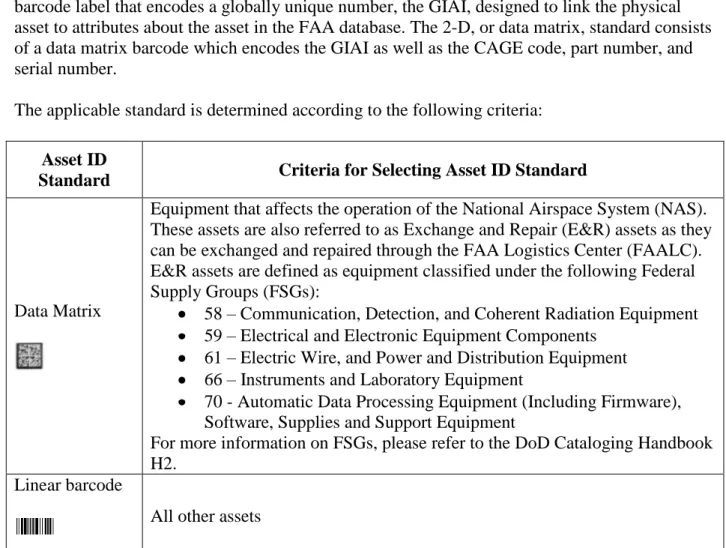
FAA assets are identified using one of two standards. The 1-D, or linear, standard consists of a barcode label that encodes a globally unique number, the GIAI, designed to link the physical asset to attributes about the asset in the FAA database. The 2-D, or data matrix, standard consists of a data matrix barcode which encodes the GIAI as well as the CAGE code, part number, and serial number.
The applicable standard is determined according to the following criteria:
Asset ID
Standard Criteria for Selecting Asset ID Standard
Data Matrix
Equipment that affects the operation of the National Airspace System (NAS). These assets are also referred to as Exchange and Repair (E&R) assets as they can be exchanged and repaired through the FAA Logistics Center (FAALC). E&R assets are defined as equipment classified under the following Federal Supply Groups (FSGs):
58 – Communication, Detection, and Coherent Radiation Equipment 59 – Electrical and Electronic Equipment Components
61 – Electric Wire, and Power and Distribution Equipment 66 – Instruments and Laboratory Equipment
70 - Automatic Data Processing Equipment (Including Firmware), Software, Supplies and Support Equipment
For more information on FSGs, please refer to the DoD Cataloging Handbook H2.
Linear barcode
All other assets
Table 2: Criteria for determining asset ID standard
It is intended that the asset label and the information in the asset management systems provide all required identification of the asset over its entire serviceable life cycle.
6/15/2011 AIS-4
2.1.2 Asset labeling
The FAA barcode label will be affixed to the asset. It will provide both a machine-readable barcode information and, when space permits, in human readable individual asset reference number in text format. In certain circumstances the barcode label may be directly marked, etched or embedded on the item. The FAA barcode label becomes the ―license plate‖ against which all the attributes of the asset may be recorded and with which the same information may be quickly and easily referenced and/or retrieved.
2.1.3 Environmental considerations
Asset labels must be able to withstand many environments (indoors, outdoors and the extreme heat and cold therein, exposure to solvents, oils, alcohol, etc.). Outdoor environments include locations in the U.S. as well as international locations where FAA assets exist. Labels must also be able to withstand periodic cleaning with water and detergent, and other chemicals used during maintenance, repair, and overhaul. Note: This will apply if the Lowest Replaceable Unit (LRU) is going through this process.
2.1.4 FAA Order applicability
This specification applicable to asset identification as defined in Order 4600.27A.
2.2 Symbology and Printing Requirements for 1-D (Linear) Barcodes
Section 2.2 applies only to linear (1-D) barcode labels.
2.2.1 Barcode symbology
The barcode symbology is GS1-128 which is based on the ISO Standard for barcode symbology specification – Code 128 (ISO/IEC 15417). An example of information available in above-referenced ISO document includes:
Symbology characteristics Symbol structure
Character assignments
o Symbol character structure o Data character encodation o Code Sets
o Special characters o Symbol check character Dimensional requirements
o Minimum width of a module (X) o Quiet zone
Reference decode algorithm Symbol quality
o General o Decodability o Quiet zones
6/15/2011 AIS-5
User-defined application parameters o Symbology and data characteristics o Test specification
6/15/2011 AIS-6
2.2.2 Barcode printing
For printing, the bars in the barcode and the human readable portion of the asset identification labels should be printed black on a white background. The printed symbol shall be ISO/IEC Grade 3.0 or better at time of printing. All labels should be printed with a protective surface laminate that results in an ISO/IEC symbol grade of 2.0 or better at the time of lamination. These two parameters are designed to ensure an ISO/IEC symbol grade of 1.5 in the label‘s final form. Labels shall conform to the ISO Standard for barcode print quality test specification
(ISO/IEC15416). Listed below are examples of information available in the above-referenced ISO document:
Symbols and abbreviated terms o Abbreviations
o Symbols
Measurement methodology o General requirements
o Reference reflectivity measurements
Measurement wavelength(s)
Measuring aperture
Optical geometry
Inspection band
Number of scans o Scan reflectance profile
o Scan reflectance profile assessment parameters
Element determination
Edge determination
Decode
Symbol contrast (SC)
Minimum reflectance (Rmin)
Edge contrast (EC)
Modulation (MOD)
Defects
Decodability
Quiet zone check o Symbol grading
Scan reflectance profile grading Decode
Reflectance parameter grading Decodability
Expression of symbol grade o Substrate characteristics
6/15/2011 AIS-7
2.2.3 Print contrast
The print contrast is to be measured per ISO/IEC 15416. Follow the GS1 standard, which is 1.5/10/670 – symbol grade/measuring aperture/wave length; this references the ISO/IEC 15416. 2.2.4 Field overlap
The barcode and the human readable data are separate fields. Each field should not protrude on any other, thereby maintaining the ability to distinguish between them.
2.3 Data Requirements for 1-D (Linear) Barcodes
Section 2.3 applies only to linear (1-D) barcode labels.
This section provides details on the data elements that make up the linear barcode identification standard.
2.3.1 Mandatory Data
The following data elements must be included in the asset label: 1. Application Identifier
2. GS1 Company Prefix 3. Individual Asset Reference 2.3.2 Symbol Syntax
The grammar, structure, and order of the barcode symbol elements are as follows:
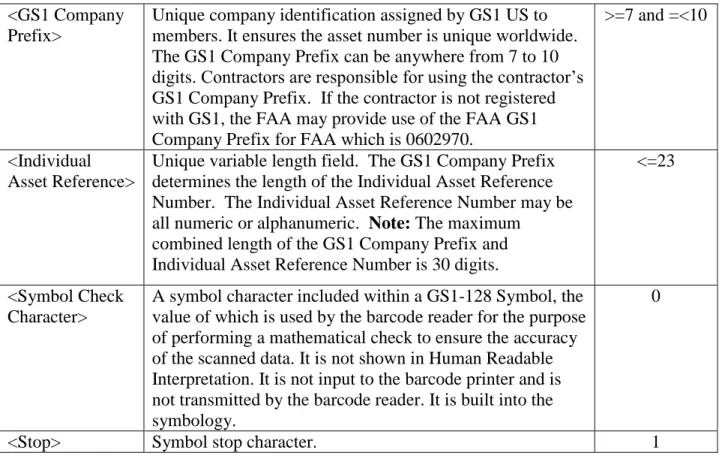
<ST><FNC1><AI><GS1 Company Prefix>< Individual Asset Reference><Symbol Check Character><Stop>
The symbol elements are defined in Table 5 below:
Element Data Content Length
<ST> Symbol start character 1
<FNC1> An element built into the barcode providing unique data integrity. It tells the scanning application that the data that follows will be in the GS1 format and that Application Identifiers will be used to identify the data. It is called: ‗function code one‘.
2
<AI>: Application Identifier. The Application Identifier (AI) for assets is 8004. It tells the scanning application that the data that follows is an asset number. This prevents common errors, like a serial number being mistaken for an asset number.
6/15/2011 AIS-8
<GS1 Company Prefix>
Unique company identification assigned by GS1 US to members. It ensures the asset number is unique worldwide. The GS1 Company Prefix can be anywhere from 7 to 10 digits. Contractors are responsible for using the contractor‘s GS1 Company Prefix. If the contractor is not registered with GS1, the FAA may provide use of the FAA GS1 Company Prefix for FAA which is 0602970.
>=7 and =<10
<Individual Asset Reference>
Unique variable length field. The GS1 Company Prefix determines the length of the Individual Asset Reference Number. The Individual Asset Reference Number may be all numeric or alphanumeric. Note: The maximum
combined length of the GS1 Company Prefix and Individual Asset Reference Number is 30 digits.
<=23
<Symbol Check Character>
A symbol character included within a GS1-128 Symbol, the value of which is used by the barcode reader for the purpose of performing a mathematical check to ensure the accuracy of the scanned data. It is not shown in Human Readable Interpretation. It is not input to the barcode printer and is not transmitted by the barcode reader. It is built into the symbology.
0
<Stop> Symbol stop character. 1
Table 3: Barcode symbol elements
2.3.3 Human Readable Text
Human readable text is to appear above the symbol with the exception of the small barcode identified in Table 5, Example C. The human readable text is not encoded; it is represented as follows:
Property of DOT/FAA
Human readable text is to appear below the symbol. The human readable text is represented as follows:
For FAA assets:
(8004) 0602970 XXXXXXXXX
where XXXXXXXXX is the unique Individual Asset Reference Number assigned by FAA.
For Contractor Barcoded assets:
(8004) NNNNNNN XXXXXXXXX
where NNNNNNN is the Contractor‘s GS1 Company Prefix, and XXXXXXXXX is the unique Individual Asset Reference Number assigned by the Contractor (refer to section 3.4).
6/15/2011 AIS-9
NOTE: Parentheses and Spaces are not encoded in the label, and are for human readability only.
2.4 Asset Label Specifications for 1-D (Linear) Barcodes
Section 2.4 applies only to linear (1-D) barcode labels.
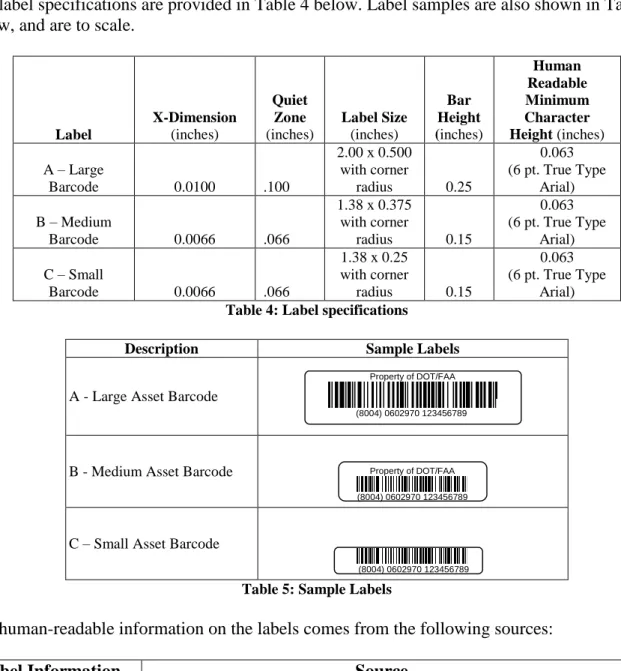
The label specifications are provided in Table 4 below. Label samples are also shown in Table 5 below, and are to scale.
Label X-Dimension (inches) Quiet Zone (inches) Label Size (inches) Bar Height (inches) Human Readable Minimum Character Height (inches) A – Large Barcode 0.0100 .100 2.00 x 0.500 with corner radius 0.25 0.063 (6 pt. True Type Arial) B – Medium Barcode 0.0066 .066 1.38 x 0.375 with corner radius 0.15 0.063 (6 pt. True Type Arial) C – Small Barcode 0.0066 .066 1.38 x 0.25 with corner radius 0.15 0.063 (6 pt. True Type Arial)
Table 4: Label specifications
Description Sample Labels
A - Large Asset Barcode
Property of DOT/FAA
(8004) 0602970 123456789
B - Medium Asset Barcode Property of DOT/FAA (8004) 0602970 123456789
C – Small Asset Barcode
(8004) 0602970 123456789 Table 5: Sample Labels
The human-readable information on the labels comes from the following sources:
Label Information Source
(8004) GS1 Global Individual Application Identifier – this signifies that the barcode is used for the identification of an asset. 0602970 GS1 Company Prefix assigned to the FAA
123456789 Individual Asset reference assigned by FAA to asset (sample value)
6/15/2011 AIS-10
NOTE: DOT/FAA text, Parentheses and Spaces are not encoded in the label, and are for human readability only.
2.5 Symbology and Printing Requirements for 2-D (Data Matrix) Barcodes
Section 2.5 applies only to Data Matrix (2-D) barcode labels.
2.5.1 Data matrix symbology
The Data Matrix standard is based on ISO/IEC 15424:2000. For AMS mandated Item Unique Identification (IUID) marking, the minimum mark is a Data Matrix ECC 200 symbol using ISO/IEC 15434 syntax and the semantics of ISO/IEC 15418. The two-dimensional symbol shall be the Data Matrix ECC 200 in accordance with ISO/IEC 16022.
2.5.2 Data matrix size
Unless otherwise specified, the module size shall be no smaller than 0.0075 inch (0.19 mm) and no larger than 0.025 inch (0.635 mm). Square symbol sizes shall not exceed one inch (25.4 mm). The larger dimension of rectangular Data Matrix symbols, as permitted by ISO/IEC 16022, shall not exceed one inch. Deviations from the stated module sizes and maximum overall symbol size shall be specified by contract if required. The data elements shall be encoded in the Data Matrix symbol using the syntax of ISO/IEC 15434. For examples, please see section 2.7 below.
2.5.3 Data matrix symbol quality
The following provide acceptance criteria for all marking procedures that can be used at the Supplier‘s choice:
2.5.3.1 ISO/IEC 15415
The symbol shall have a minimum quality grade of 3.0/05/650 measured with an aperture size of 0.005 inch (0.127 mm) with a light source wavelength of 650 nm ± 20 nm. As an exception, the ISO/IEC 15415 parameters Modulation (MOD), Symbol Contrast (SC), or both, may measure as low as 2.0, providing the overall ISO/IEC 15415 grade would be 3.0 if the MOD and SC grades are 3.0 or higher. (This allows for lower contrast substrates, high density images, printing, over-laminates and other such limiting factors to the parameters MOD, SC, or both on otherwise well produced images.) Quality (symbol validation and verification) reports shall clearly show that the MOD, SC, or both, are the only parameters measured as low as 2.0, and clearly show that the overall grade would be at least 3.0 if MOD and SC were at least 3.0. Quality reports shall also document the synthetic aperture size used. The methodology for measuring the print quality shall be as specified in ISO/IEC 15415, where the overall grade is based on a single scan (not five scans).
2.5.3.2 AIM DPM-1-2006
The symbol shall have a minimum quality grade of DPM2.0/7.5-25/650/(45Q|30Q|90|30T|30S|D) where:
6/15/2011 AIS-11
2. X dimension range of the application = 7.5-25 mils
3. Inspection wavelength = 650 nanometers ± 20 nanometers.
4. Lighting conditions = Medium Angle Four Direction (45Q) or Low Angle Four Direction (30Q) or Diffuse Perpendicular (90) or Low Angle Two Direction (30T) or Low Angle One Direction (30S) or Diffuse Off-axis (D).
2.5.3.3 SAE AS9132
The symbol shall fulfill the visual inspection criteria of ―Pass‖ as defined in AS9132. 2.5.4 Calibration of verification equipment
Due to the absence of a nationally traceable standard to calibrate verification equipment,
calibration processes and materials for reflectance criteria provided by the verifier manufacturer are acceptable.
2.5.5 Alternative quality measuring methodologies
If the preceding quality measuring methodologies specified are non-responsive, quality acceptance levels shall be identified within the individual contract or order.
2.5.6 Field overlap
The barcode and the human readable data are separate fields. Each field should not protrude on any other, thereby maintaining the ability to distinguish between them.
2.6 Data Requirements for 2-D (Data Matrix) Barcodes
Section 2.6 applies only to Data Matrix (2-D) barcode labels.
This section provides details on the data elements that make up the 2-D barcode identification standard.
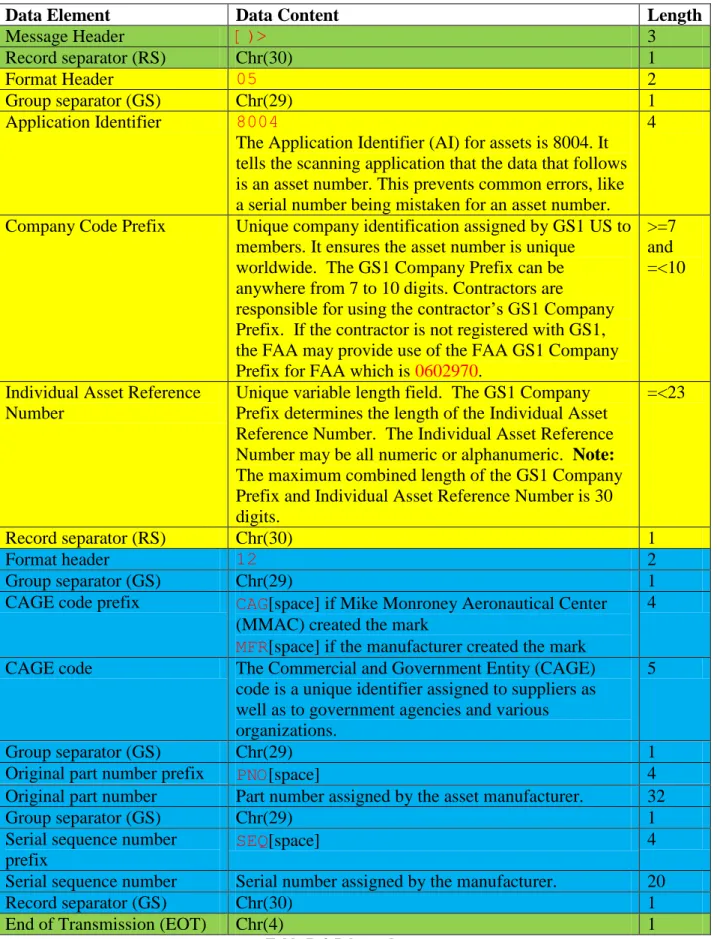
2.6.1 Symbol Syntax
6/15/2011 AIS-12
Data Element Data Content Length
Message Header [)> 3
Record separator (RS) Chr(30) 1
Format Header 05 2
Group separator (GS) Chr(29) 1
Application Identifier 8004
The Application Identifier (AI) for assets is 8004. It tells the scanning application that the data that follows is an asset number. This prevents common errors, like a serial number being mistaken for an asset number.
4
Company Code Prefix Unique company identification assigned by GS1 US to members. It ensures the asset number is unique
worldwide. The GS1 Company Prefix can be anywhere from 7 to 10 digits. Contractors are
responsible for using the contractor‘s GS1 Company Prefix. If the contractor is not registered with GS1, the FAA may provide use of the FAA GS1 Company Prefix for FAA which is 0602970.
>=7 and =<10
Individual Asset Reference Number
Unique variable length field. The GS1 Company Prefix determines the length of the Individual Asset Reference Number. The Individual Asset Reference Number may be all numeric or alphanumeric. Note:
The maximum combined length of the GS1 Company Prefix and Individual Asset Reference Number is 30 digits.
=<23
Record separator (RS) Chr(30) 1
Format header 12 2
Group separator (GS) Chr(29) 1
CAGE code prefix CAG[space] if Mike Monroney Aeronautical Center (MMAC) created the mark
MFR[space] if the manufacturer created the mark
4
CAGE code The Commercial and Government Entity (CAGE) code is a unique identifier assigned to suppliers as well as to government agencies and various organizations.
5
Group separator (GS) Chr(29) 1
Original part number prefix PNO[space] 4
Original part number Part number assigned by the asset manufacturer. 32
Group separator (GS) Chr(29) 1
Serial sequence number prefix
SEQ[space] 4
Serial sequence number Serial number assigned by the manufacturer. 20
Record separator (GS) Chr(30) 1
End of Transmission (EOT) Chr(4) 1
6/15/2011 AIS-13
Legend:
Green rows Message header/trailer
Yellow rows GS1 Asset Identification (AI) syntax.
Blue rows ATA Text Element Identifier syntax. TEIs are specified as 4 character identifiers consisting of 3 alphabetic characters followed by a space.
RED TEXT Literal data
Example:
[)>RS05GS80040602970xxxxx RS12GS CAG 12345GSPNO ABC123GSSEQ 7890RSEOT
where RS
= record separator, Chr(30) GS
= group separator, Chr(29)
xxxxx = individual asset reference number, not to exceed 23 bytes EOT
= end of transmission, Chr(4) 2.6.2 Human readable text
Human readable text is to appear above the symbol with the exception of the small barcode identified in 2.7 below. The human readable text is not encoded; it is represented as follows:
Property of DOT/FAA
Human readable text is to appear to the left of the symbol. The human readable text is represented as follows:
CAG (or MFR) CCCCC SEQ SSSSSSS
PNO PPPPPPPPPPPPPPP
Where CCCCC is the CAGE code, SSSSSSS is the serial number, and
PPPPPPPPPPPPPPP is the part number.
Note: The CAGE code will be preceded by CAG if the mark was created by the FAALC, or MFR if the mark was created by the manufacturer.
2.6.3 Legibility of human readable text
Legibility shall be as required for human readability. For human-readable information, the recommended minimum character height for human readable text is the equivalent of :
Character Height (Centimeters) Character Height (Inches) Character Height (Points)
6/15/2011 AIS-14
0.2 cm 0.08 in 5.76 pts
Table 8: Recommended human-readable text heights
Letters shall be capitals without serifs (sans-serif) such as Arial, Futura, Gothic, Trebuchet
MS, or other sans-serif font. Numerals shall be Arabic except when Roman numerals are used for type designation per applicable Government or industry specifications and standards. Generating characters by automated processes (e.g., dot peen, laser, interactive graphics systems, or stencils) shall be the preferred method.
2.7 Asset Label Specifications for 2-D (Data Matrix) Barcodes
Section 2.7 applies only to Data Matrix (2-D) barcode labels.
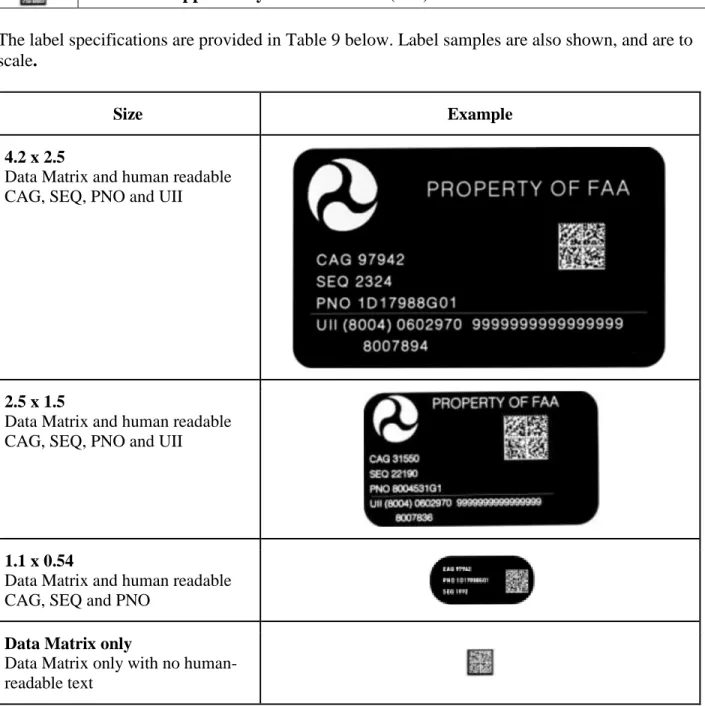
The label specifications are provided in Table 9 below. Label samples are also shown, and are to scale.
Size Example
4.2 x 2.5
Data Matrix and human readable CAG, SEQ, PNO and UII
2.5 x 1.5
Data Matrix and human readable CAG, SEQ, PNO and UII
1.1 x 0.54
Data Matrix and human readable CAG, SEQ and PNO
Data Matrix only
Data Matrix only with no human-readable text
6/15/2011 AIS-15
Table 9: Sample 2-D Barcode Labels
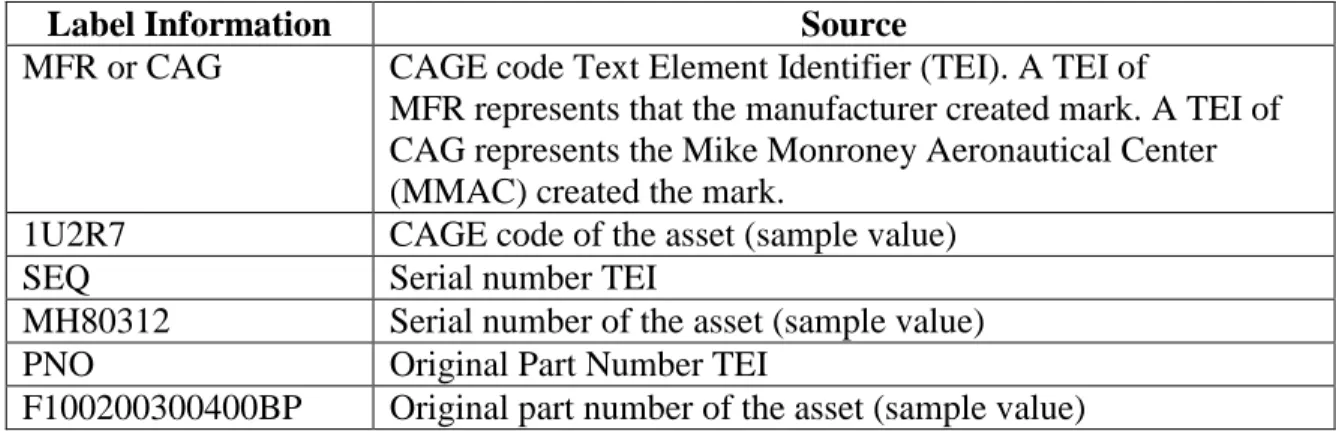
The human-readable information on the labels comes from the following sources:
Label Information Source
MFR or CAG CAGE code Text Element Identifier (TEI). A TEI of
MFR represents that the manufacturer created mark. A TEI of CAG represents the Mike Monroney Aeronautical Center (MMAC) created the mark.
1U2R7 CAGE code of the asset (sample value)
SEQ Serial number TEI
MH80312 Serial number of the asset (sample value)
PNO Original Part Number TEI
F100200300400BP Original part number of the asset (sample value) Table 10: Sources of human readable information on 2-D labels
Items shall be individually marked as follows:
1. Data Matrix labels shall be printed with white mark and lettering on a black background. 2. Preferred marking includes Data Matrix with human-readable information.
3. Where space is limited, the linear human-readable information may be abbreviated. 4. To accommodate severe space limitations, human-readable information may be omitted
from the item.
2.8 Material Specifications
Section 2.8 applies to both linear (1-D) and Data Matrix (2-D) barcode labels.
2.8.1 Resistance
The printed barcode image must be resistant to oils and solvents commonly used in the repair of printed circuit boards, such as water, alcohol, trichlorethane and hydrocarbon based solvents. Labels may be exposed to mechanical scrubbing using these solvents.
2.8.2 Specular reflection (substrate, laminate & imaging media)
Specific attention must be paid to the combination of label substrate (e.g., paper, metal, plastic, glass, ceramic, etc.) laminate (such as lacquer, clear tape, plastic over-wrap, etc.) and imaging media (e.g., ink, thermal transfer resin, photographic emulsion, etching, etc.) such that specular reflection is minimized.
2.8.3 Composition
The substrate for the asset label may be comprised of a variety of materials such as, but not limited to, bare and painted metals (i.e., steel and aluminum), various plastics, printed circuit boards, glass and wood. Note: This will apply if the Lowest Replaceable Unit (LRU) is going through this process.
6/15/2011 AIS-16
2.8.4 Application temperature
Labels will be applied at temperatures between 50 and 100 degrees Fahrenheit. Once applied the label must retain adhesive properties over an exposure range of –40F to +200F.
2.8.5 Service environment
During its service life the label may be exposed to direct sunlight, rain, snow, ice, and to various solvents, degreasers, varnishes, oils, detergents, paints, mineral oil, solder flux and
environmental temperatures ranging from –40F to 200F. Asset labels must remain affixed to the asset for the entire duration of the asset‘s lifetime. Asset labels should be produced so that, when scanned, they will reflect a minimum symbol grade of ANSI 2.0.
2.9 Label Placement
Section 2.9 applies to both linear (1-D) and Data Matrix (2-D) barcode labels.
2.9.1 Label accessibility
Asset identification labels should be located on the asset in a position that is easily accessible and can be read by a barcode scanner while the asset is in normal use. For example, if the rear of an asset is not normally easily accessible while in use, the asset label needs to be located on a side that is easily accessible (e.g., the front of the asset). It is desirable that labels are located close to or adjacent to the manufacturer‘s identification markings (serial, model, etc) if that location is also easily accessible for scanning.
When items cannot be physically marked (in the case that there is no space for a Data Matrix alone) or tagged due to a lack of marking space or because marking or tagging would have a harmful effect, the detailed marking requirements specified in this section shall be:
1. applied to a supplemental container that may or may not provide item protection,
becomes a part of the individual item, and is provisioned and managed as a component of that item, or
2. applied to the unit pack in addition to, or in combination with, the identification marking information specified.
2.9.2 Number of labels
Only one FAA asset barcode label is to be affixed to an asset. In the case of replaceable or configurable modules, an asset label should be affixed to each of the lowest replaceable units within the assembly.
2.9.3 Application surfaces
Labels are intended to be applied to flat and curved rigid surfaces, which have been degreased and cleaned with solvent. Labels are not intended to be applied to Teflon, delrin, and their related chemical family. Labels should not be placed over manufacturer labels or any silk-screened text designation on the item. Labels should not be placed over any indicators such as diodes (LED‘s)
6/15/2011 AIS-17
nor placed in a fashion that would detract from the utility of usability for which the item was designed or intended to function.
2.9.4 Rough surfaces
It is recommended that labels be located on clean, smooth, flat surfaces where possible, and on surfaces that provide direct visual access for a scanner and its operator. Labels should not be applied to rough surfaces, since these surfaces reduce adhesive performance.
2.9.5 Curved surfaces
It is recommended that labels applied to curved or cylindrical surfaces are applied along the axis of the cylinder to make the barcode visible and able to be scanned. If it is necessary to apply along the radial axis, the curve radius must not be less than 1.5 inches. This practice will ensure readability.
For Data Matrix symbols applied to a curved surface, the overall symbol size shall not exceed more than 32% of the radius (16% of the diameter or 5% of the circumference) associated with the curvature of the surface.
2.9.6 Irregular surfaces
Labels are not intended for irregular or bumpy surfaces, nor should they be applied to spherical surfaces or surfaces composed of compound curves.
2.9.7 Administrative assets
On administrative assets such as furniture and equipment, labels should not be located on decorative surfaces or to any surface subject to routine wear and abrasion.
2.10Replacement of Labels
Section 2.10 applies to both linear (1-D) and Data Matrix (2-D) barcode labels.
It is recognized that some asset labels may be exposed to environments so harsh as to render them unreadable after a period of time. For that reason, those personnel tasked with the inventorying assets, per FAA Order 4600.27A, are to ensure that asset labels are successfully scanned, and in the event of an unsuccessful scan the label must be physically replaced and the FAA‘S Asset Tracking and Management System should be updated with the new barcode information for the asset.
2.11Unreadable Labels
Section 2.11 applies to both linear (1-D) and Data Matrix (2-D) barcode labels.
When a linear or Data Matrix symbol mark is unacceptable (unreadable, in error, etc.) and cannot be removed or otherwise repaired, replaced or re-worked without deleterious effect to the marked item, it shall be crossed out. Linear barcodes are to be crossed out as shown in Figure 1 below
6/15/2011 AIS-18
using two diagonal lines crossing each other through the center of the barcode symbol, and also crossing all of the bars making up the symbol:
Figure 1: Crossing out a linear barcode
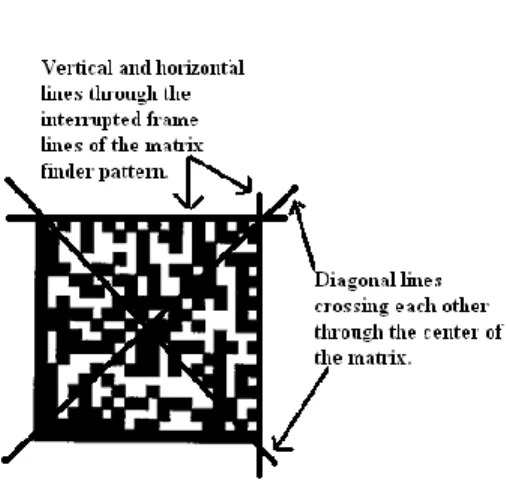
Data Matrix barcodes are to be crossed out as shown in Figure 2 below using two diagonal lines crossing each other through the center of the Data Matrix symbol and two other lines (one vertical the other horizontal) through the two interrupted frame lines (finder pattern) of the Data Matrix symbol.
Figure 2: Crossing out a Data Matrix barcode
Placement of a new label shall follow the FAA-approved procedure as specified in the FAA Personal Property Management Process & Procedure Guide, or the applicable FAALC documentation.
6/15/2011 AIS-19
3
Government and Contractor responsibilities
Section 3 applies to both linear (1-D) and Data Matrix (2-D) barcode labels.
This section outlines the responsibilities of the Government (FAA) and contractors in the application of this specification to FAA assets.
3.1 Government asset identification
The Government (FAA) is responsible for providing asset identification for all FAA assets as defined in FAA Order 4600.27A. The FAA is required to provide asset identification for all assets (i.e., assets in the field). Labels produced by the FAA for its assets (or produced by a third party specifically for the FAA‘s assets) are to conform to the specifications detailed in Section 2 above.
3.2 Contractor asset identification
Contractors are required to provide asset identification for all assets that are delivered. The contractor will also provide an electronic Asset Identification Report per Contract Data
Requirements List and Data Item Description (CDRL/DID), which includes the number on the label applied to the asset against which all the attributes of the asset may be recorded in, or extracted from, the FAA‘s Asset Tracking and Management System.
3.3 Contractor label specifications
Labels applied by contractors will follow the specifications detailed in Section 2 above.
3.4 Contractor GS1 Company Prefix
Contractors are also responsible for using the contractor‘s GS1 Company Prefix (plus the unique individual asset reference number maintained by the contractor), to meet the labeling
performance requirements as specified in this document. If the contractor is not registered with GS1, the FAA may provide use of the FAA Company Prefix and a sequence of Global Individual Asset Identifiers.
6/15/2011 AIS-20
Appendix 1. Definitions
The following definitions apply to the terms used in this appendix.
Term Definition
ANSI The American National Standards Institute designates standards submitted by their accredited Standards Development Organizations. The American National Standards Institute designation is awarded after the opportunity for public review and comment, and a
certification by the Standards Development Organizations that due process was followed in the development of the standard. GS1 US is an accredited standards development organization.
Application Identifier The field of two or more characters, at the beginning of a string of data, which uniquely defines its format and meaning. For example, the Application Identifier for assets is 8004; it tells the scanning application that the data that follows is an asset number. This prevents common errors, like a serial number being scanned and mistaken for an asset number.
Asset In general terms, an asset refers to a useful and valuable item that is owned or leased and is being used or is available for use in performance of FAA‘s mission.
Individual Asset reference number
A number assigned by the enterprise to an item providing for the differentiation of that item from any other item. The entity
responsible for labeling assets is responsible and accountable for not duplicating the individual asset reference number.
HRI Human Readable Interpretation.
ISO Worldwide federation of national standards bodies promoting the development of standardization and whose work results in the publication of international standards.
Life Cycle There are two categories of life cycle:
a. Data. The stages through which data pass, typically characterized as creation or collection, processing, dissemination, use, storage, and disposition.
b. Information System. The phases through which information systems pass, typically characterized as initiation, development, operation, termination, and decommissioning.
Ongoing reference For the purpose of this application guideline the terms and definitions given in Section 8, Glossary of Terms, of the General GS1
Specifications shall apply. The General GS1 Specifications is available at the GS1 US website at www.gs1us.org.
Quiet Zone A clear space on a label, having no machine-readable marks, which precedes the Start Character of a barcode symbol and follows the Stop Character. Formerly referred to as "Clear Area" or "Light Margin."
6/15/2011 AIS-21
organization of GS1 Member Organizations that co-manages the GS1 System and Global Standards Management Process.
GS1 Company Prefix The number assigned to a company by GS1 US. The inclusion of the GS1 Company Prefix ensures uniqueness throughout the world. GS1US GS1 US (formerly Uniform Code Council, Inc.) is a not-for-profit
organization dedicated to the development and implementation of standards-based, global supply chain solutions.
X- Dimension The specified width of the narrow element in a barcode symbol; the narrowest nominal width unit of measure in a barcode symbol.
FEDERAL AVIATION ADMINISTRATION
Version 2.0
February 24, 2011
Prepared by the:
Asset Management and NAS Supply Support Team
Technical Operations Service, ATO-W
Air Traffic Organization
Asset Idenification Contract Data
Requirements List and Data Item
6/15/2011 CDRL-ii
Revision History
Author Date Version
AFZ-500 12/1/2002 v1.0 AFZ-500 10/1/03 v1.1 AFZ-500 11/18/03 v1.2 AFZ-500 3/16/04 v1.2.1 AMNSS 12/13/04 v1.2.2 AMNSS 1/28/05 v1.2.3 AHW 5/9/06 v1.2.4 AMNSST 5/27/06 V 1.2.5 AMNSST 6/16/06 V 1.2.6 AMNSST 5/1/09 V 1.2.7 AMNSST 7/10/09 V1.2.8 AMNSST 9/21/09 V1.2.9 AMNSST 11/18/09 V1.2.10 AMNSST 2/24/11 V2.0
6/15/2011 CDRL-iii
Table of Contents
1 Introduction ... 1 1.1 Purpose ... 1 1.2 Background ... 1 1.2.1 Barcode Specification ... 11.2.2 Electronic Asset Data ... 1
1.2.3 Fixed File Format ... 2
2 Instructions ... 3
2.1 Statement of Work ... 3
2.1.1 Asset Identification Report ... 3
2.2 CDRL Items: A0xx Asset Identification Report ... 5
2.3 Data Item Description (DID)... Error! Bookmark not defined. 2.3.1 Example DID ... Error! Bookmark not defined. 2.3.2 DID Fields - Contractors ... 5
2.3.3 DID Fields – FAA ... 6
2.4 Asset Identification Label ... 8
2/24/11 CDRL-1
1
Introduction
1.1 Purpose
This document contains instructions for incorporating the Asset Identification Contract Data Requirements List and Data Item Description (CDRL/DID) for Linear and Data Matrix Barcodes into all Federal Aviation Administration (FAA) personal property asset acquisition contracts.
1.2 Background
1.2.1 Barcode Specification
The FAA has adopted a barcode label specification, called FAA Asset Identification
Specification, based on GS1 US (formerly Uniform Code Council, Inc.) standards. GS1 US is an international standards based organization that establishes asset identification standards for retail products such as the Uniform Product Code (U.P.C.) as well as other identification standards. The FAA has adopted the GS1standard for Global Individual Asset Identifier (GIAI). The GS1 Global Individual Asset Identifier (GIAI) is the unique identifier and the pointer to the business critical information necessary to identify and track individual assets. The GIAI has become a pointer to an ever-expanding library of information stored in electronic databases. This GS1 system solution was designed to enable companies and agencies to eliminate duplication of asset numbers, provide tracing and tracking capabilities, facilitate maintenance, and provide asset configuration management and control.
The barcode specification provides for two types of asset identification labels:
1-D (or linear) barcode labels, which encode the GIAI, and
2-D (or Data Matrix) barcode labels, which encode the GIAI as well as manufacturer‘s CAGE code, part number and serial number.
The requirements in this CDRL-DID apply regardless of which barcode type is used. For an overview of the criteria to determine when each type of label is used, please refer to the Asset Identification Specification, section 2.1.1.
1.2.2 Electronic Asset Data
The FAA identifies delivery of a system to its installation point and initial testing, as the system inception. It is the goal of the FAA to capture all personal property asset movement and service activity from the system inception until system retirement. This CDRL/DID represents the initial characterization, serialization, and capture of asset and system detail. All accountable personal property assets (and, optionally, non-accountable assets), facility equipment, and project materiel assets are recorded in the Automated Inventory Tracking System (AITS) which is the FAA personal property management system of record. The information generated by the contractor is to be delivered to the FAA in electronic format to populate the AITS data fields for a delivered system.
6/15/2011 CDRL-2
1.2.3 Fixed File Format
The seed data may be delivered to the FAA via electronic media in the fixed file format, as described in Section 10 of the DID (see section Error! Reference source not found.).
6/15/2011 CDRL-3
2
Instructions
This section provides instructions for contract officers and acquisitions staff to communicate FAA‘s asset identification requirements to potential contractors.
2.1 Statement of Work
2.1.1 Asset Identification Report 2.1.1.1 Barcode Symbology Standard
The Contractor shall use the appropriate barcode symbology standard, as described in the Asset Identification Specification document, to identify contract assets at the Lowest Replaceable Unit (LRU) level. For each LRU barcoded asset, the contractor shall provide the following types of information:
Barcode / Pin number Item Description
Manufacturer's part number Manufacturers' serial number Manufacturer‘s CAGE Code Year Manufactured
Cost
2.1.1.2 System-Level Data
The Contractor shall also provide system-level data such as: Major system components or enclosures
Component / enclosure descriptive data System configuration
Any other associated data 2.1.1.3 Examples of Equipment Types
LRU‘s may consist of circuit boards, modules, cable assemblies, motors, power supplies, etc. Ancillary equipment may consist of personal computer data terminals, displays, test rigs, etc. System components or enclosures may consist of cabinets, mounting assemblies, waveguides, etc.
2.1.1.4 Asset Management Systems
The Contractor is to use an FAA asset management systems or equivalent COTS package to manage the contract asset detail data for each category of asset from point of acquisition to production and delivery.
2.1.1.5 Barcoded Asset Listing
The Contractor will provide a report that contains a listing of all assets that have been identified with a barcode label. The report shall include all of the data elements considered for barcoding as specified in Block 10 of the DID (see Section Error! Reference source not found.).
6/15/2011 CDRL-4
2.1.1.6 Asset Identification Report
The Contractor will also provide an Asset Identification Report in accordance with the DID (DI-ATO-W-2003-005), Asset Identification Specification documentation, and the CDRL.
6/15/2011 CDRL-5
2.2 Contract Data Requirements List and Data Item Description (CDRL/DID)
2.2.1 CDRL/DID Fields - Contractors
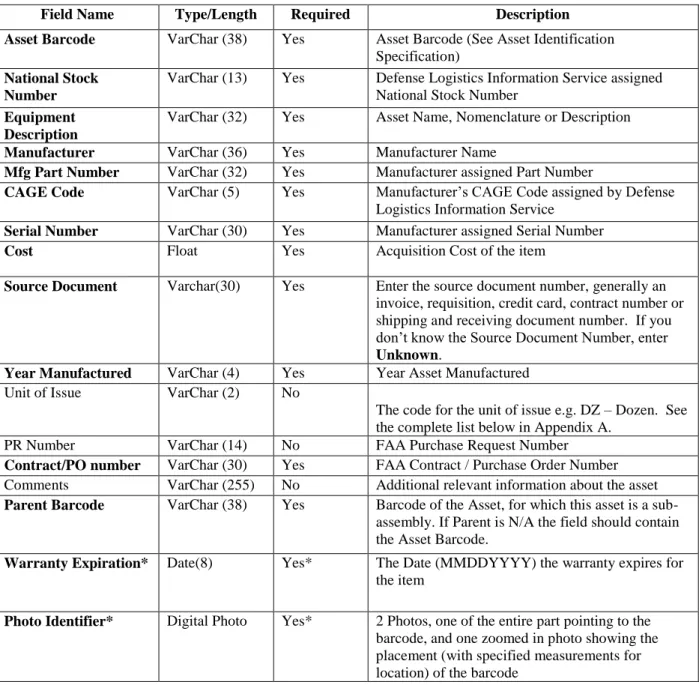
Contractors are required to include the following fields (as defined in 10.2.3 of the CDRL/DID preparation instructions) as described below:
Field Name Type/Length Required Description Asset Barcode VarChar (38) Yes Asset Barcode (See Asset Identification
Specification)
National Stock Number
VarChar (13) Yes Defense Logistics Information Service assigned National Stock Number
Equipment Description
VarChar (32) Yes Asset Name, Nomenclature or Description
Manufacturer VarChar (36) Yes Manufacturer Name
Mfg Part Number VarChar (32) Yes Manufacturer assigned Part Number
CAGE Code VarChar (5) Yes Manufacturer‘s CAGE Code assigned by Defense Logistics Information Service
Serial Number VarChar (30) Yes Manufacturer assigned Serial Number
Cost Float Yes Acquisition Cost of the item
Source Document Varchar(30) Yes Enter the source document number, generally an invoice, requisition, credit card, contract number or shipping and receiving document number. If you don‘t know the Source Document Number, enter
Unknown.
Year Manufactured VarChar (4) Yes Year Asset Manufactured Unit of Issue VarChar (2) No
The code for the unit of issue e.g. DZ – Dozen. See the complete list below in Appendix A.
PR Number VarChar (14) No FAA Purchase Request Number
Contract/PO number VarChar (30) Yes FAA Contract / Purchase Order Number Comments VarChar (255) No Additional relevant information about the asset
Parent Barcode VarChar (38) Yes Barcode of the Asset, for which this asset is a sub-assembly. If Parent is N/A the field should contain the Asset Barcode.
Warranty Expiration* Date(8) Yes* The Date (MMDDYYYY) the warranty expires for the item
Photo Identifier* Digital Photo Yes* 2 Photos, one of the entire part pointing to the barcode, and one zoomed in photo showing the placement (with specified measurements for location) of the barcode
Table 1: DID fields for contractors
*Note: Warranty Expiration and Photo Identifier information is required for assets acquired by the FAA Logistics Center (FAALC)
6/15/2011 CDRL-6
2.2.2 CDRL/DID Fields – FAA
For proper tracking in AITS, the FAA acquiring entity must add the following fields to the information provided by the contractor:
Field Name Type/Length Required Description
Region VarChar(2) Yes FAA Region Code for regional identification as listed below: 1 EA Eastern Region 2 SW Southwest Region 3 CE Central Region 4 WP Western-Pacific Region 5 AL Alaskan Region 7 SO Southern Region
8 EU Europe, Africa, and Middle East
A AC Mike Monroney Aeronautical Center
C GL Great Lakes Region E NE New England Region F VN Aviation Systems Standards N CT William J. Hughes Technical Center
O UN Unknown
S NM Northwest Mountain Region W WA Washington Headquarters Z GU Guest Account
Cost Center VarChar (8) Yes FAA Cost Center Code depicts the organization assigned maintenance responsibility. Cost Center is a primary collection point. It identifies the benefiting or administering organizational element. The Cost Center codes may represent an
organization, a function, geographical section or a combination of these elements. The codes are structured to facilitate the collection and summarization of obligations and costs within the FAA for various management purposes. When used in combination with the region code, the element is unique within the agency.
Asset Type Varchar(1) Yes Asset Type code identification as listed below:
1 – Line Item Accountable 2 – Barcoded Facility Equipment 3 – Facility Value
Location ID VarChar (4) Yes Location Identifier is a three or four character field that represents the city and state assigned to that identifier where the equipment is physically located
6/15/2011 CDRL-7
Facility Type VarChar (5) Yes Facility Service Equipment Profile assigned Location Identifier is a 5-digit alpha
abbreviation representing a NAS facility, e.g., "ATCT" representing an Air Traffic Control Tower, or "ILS" representing an Instrument Landing System.
FIC Varchar(5) No The System/Facility Identification Code is made up of a one-character numeric field representing the system code and a four-character alphanumeric field representing the capacity, type and model code.
Location 1 VarChar(30) Yes Location of the item within the facility, e.g. Address
Location 2 VarChar(30) Yes More specific location of the item within the facility, e.g. Room #/floor
Location 3 VarChar(30) Yes Exact location of the item within the facility, e.g. John Doe Cube/office number/desk
Test Equipment Boolean Yes Indicates whether the item is test equipment
Delphi Asset Number Varchar(30) No Asset Identifier used by the Delphi system
Accountability Bit Yes Select either Accountable or Non-Accountable from the drop-down box based on whether the item meets or doesn‘t meet the criteria for an accountable item.
0 – Non-Accountable 1 – Accountable
Justification Varchar(100) No If Unknown is checked, you must enter a reason why you don‘t have a Source Document Number.
Job Order Number VarChar (5) No Corporate Work Plan (formerly known as Resource Tracking Program) assigned Job Order Number
Fund Source VarChar(1) No The source of the funding, as listed below: 1 - National
2- Regional 3 - Other
Fund Source Comment VarChar(30) No Explanation if the Fund Source is Other, e.g., picked up from excess
F & E Boolean Yes Indicates whether the item is facility Equipment
Ownership Varchar(1) Yes These codes indicate who owns the property and are identified as listed below:
1 FAA owned (FAA maintained) 2 FAA owned (Loaned to military) 3 FAA owned (Loaned to civil agency) 4 FAA owned (Loaned to contractor) 5 Military owned (FAA maintained & supported)
6 Military owned (FAA supply support only)
7 Contractor owned (FAA operated) 8 Owned by others (FAA operated -
6/15/2011 CDRL-8 leased)
9 FAA borrowed and reloaned A Federal Aviation Administration (FAA)
B Department of Defense (DoD) C Other Federal Agency D State Government E Local Government F Foreign Government
G Domestic Private Organization I Federal Aviation Administration (FAA)
J Federal Aviation Administration (FAA)
K Department of Defense (DoD) L Other Federal Agency M State Government N Local Government O Foreign Government
P Domestic Private Organization Q Foreign Private Organization R Department of Defense (DoD) S Federal Aviation Administration (FAA)
T Department of Defense (DoD) U Other Federal Agency
V State Government W Local Government
Y Domestic Private Organization
Condition Code VarChar(1) No The code that best describes the condition of the item, as listed below:
1 - New or Unused
4 - Usable - property that shows some wear 7 - Unusable, but economically repairable R - Repairable
S - Scrap V - Serviceable
X - Salvage - repair uneconomical System Name VarChar(25) No The name of the system that the item is
associated with.
Date Received Date (8) Yes The date the item was received
Remarks Varchar(450) No Additional information regarding the item
Field Spare Boolean Yes Indicates whether the item is part of the field spare inventory
Table 2: DID fields for FAA acquiring entities
2.3 Asset Identification Label
See the Asset Identification Specification (in the previous section of this document) for complete label and identification specifications. Documents are available from the AM&NSST website at
6/15/2011 CDRL-9
https://intranet.faa.gov/FAAEmployees/org/linebusiness/ato/operations/technical_operations/am nsst/ .
6/15/2011 CDRL-10
Appendix A - Unit of Issue
The following is the list of Unit of Issue codes and descriptions: Unit of Issue Code Description
1D UNKNOWN AT ASSORTMENT AY ASSEMBLY BA BALL BC BLOCK BD BUNDLE BE BALE BG BAG BK BOOK BO BOLT BR BAR BT BOTTLE BX BOX CA CARTRIDGE CE CONE CK CAKE CL COIL CN CAN CO CONTAINER CS CASE CT CARTON CY CYLINDE DR DRUM DZ DOZEN EA EACH FT FOOT FV UNKNOWN FY UNKNOWN GL GALLON GR GROSS HD HUNDRED HK HANK IN INCH JR JAR KT KIT LB POUND LG LENGTH LI LITER LT LOT
6/15/2011 CDRL-11
Unit of Issue Code Description
MX THOUSAND OT OUTFIT OZ OUNCE PA PAPER PC PIECE PD PAD PE PECK PG PACKAGE PK PACK PL PAIL PR PAIR PT PINT PZ PACKET QT QUART RA UNKNOWN RL REEL RM REAM RO ROLL RX UNKNOWN SA SACK SE SET SF SQUARE FOOT SH SHEET SK SKEIN SL SPOOL SP UNKNOWN SX STICK SY SYSTEM TD UNKNOWN TE UNKNOWN TF UNKNOWN TN TON TO TROY OUNCE TU TUBE VC 500 XX TEN YD YARD