Florida International University
Florida International University
FIU Digital Commons
FIU Digital Commons
School of Computing and Information Sciences
College of Engineering and Computing
8-2019
Applications of Nature-Inspired Algorithms for Dimension
Applications of Nature-Inspired Algorithms for Dimension
Reduction: Enabling Efficient Data Analytics
Reduction: Enabling Efficient Data Analytics
Farid Ghareh Mohammadi
M. Hadi Amini
Hamid R. Arabnia
Follow this and additional works at: https://digitalcommons.fiu.edu/cs_fac
Applications of Nature-Inspired Algorithms for Dimension
Reduction: Enabling Efficient Data Analytics
Farid Ghareh Mohammadi
1, M. Hadi Amini
2, and Hamid R. Arabnia
11:Department of Computer Science, Franklin College of Arts and Sciences,
University of Georgia, Athens, Georgia, 30601
2: School of Computing and Information Sciences,
College of Engineering and Computing,
Florida International University, Miami, FL 33199
Emails: [email protected], [email protected], [email protected]
Abstract
In [1], we have explored the theoretical aspects of feature selection and evolutionary algorithms. In this chapter, we focus on optimization algorithms for enhancing data analytic process, i.e., we propose to explore applications of nature-inspired algorithms in data science. Feature selection optimization is a hybrid approach leveraging feature selection techniques and evolutionary algorithms process to optimize the selected features. Prior works solve this problem iteratively to converge to an optimal feature subset. Feature selection optimization is a non-specific domain approach.
Data scientists mainly attempt to find an advanced way to analyze data n with high computational efficiency and low time complexity, leading to efficient data analytics. Thus, by increasing generated/measured/sensed data from various sources, analysis, manipulation and illustration of data grow exponentially. Due to the large scale data sets, Curse of dimensionality (CoD) is one of the NP-hard problems in data science. Hence, several efforts have been focused on leveraging evolutionary algorithms (EAs) to address the complex issues in large scale data analytics problems. Dimension reduction, together with EAs, lends itself to solve CoD and solve complex problems, in terms of time complexity, efficiently. In this chapter, we first provide a brief overview of previous studies that focused on solving CoD using feature extraction optimization process. We then discuss practical examples of research studies are successfully tackled some application domains, such as image processing, sentiment analysis, network traffics / anomalies analysis, credit score analysis and other benchmark functions/data sets analysis.
Keywords: Dimension Reduction, Data Science, Hybrid Optimization, Curse of Dimensionality (CoD), Supervised Learning, Unsupervised Learning, Wrapper Feature Selection, Classification, Evolutionary Compu-tation, Swarm Intelligence, Filter Feature Selection.
1
Introduction
1.1
Overview
Feature selection and evolutionary algorithms have been explored in [1]. In this chapter, we aim to focus on an optimization approach for enhancing data analytic process. Feature selection optimization is hybrid approach leveraging pure feature selection techniques and evolutionary algorithms process to optimize the selected features. Researchers try to iterate this process until to converge to an optimal feature subsets. Feature selection optimization is non-specific domain approach which enable scientists to apply this to their data technically.
Data scientists always attempt to find an advanced way to work with data that are successfully conducted in a short time with high computational efficiency and low time complexity, leading to efficient data analyt-ics. Thus, by increasing generated/measured/sensed data from various sources, analysis, manipulation and illustration of data grow exponentially. Due to the large scale data sets, Curse of dimensionality (CoD) is one of NP-hard problems in data science. Hence, several efforts have been focused on leveraging evolutionary algorithms (EAs) to address the complexity issues in large scale data analytics problems. Dimension reduction, together with EAs, lend itself to solve CoD and solve complex problems, in terms of time complexity, efficiently. In this chapter, we first provide a brief overview of previous studies that focused on solving CoD using feature extraction optimization process. We then discuss practical examples of research studies are successfully tackled some application domains, such as: image processing, sentiment analysis, network traffics / anomalies analysis, credit score analysis and other benchmark functions / data sets analysis .
In [1], we have comprehensively explored various evolutionary algorithms for data science, including ar-tificial bee colony (ABC), ant colony optimization (ACO), Coyote Optimization Algorithm (COA), genetic algorithm (GA), grey wolf optimizer (GWO) and particle swarm optimization. These algorithms have real-world applications in the context of dimension reduction [2, 3, 4, 5, 6, 7, 8, 9, 10], interdependent smart city infrastructures [11, 12], optimization [13, 14, 15]. This chapter focuses on application of aforementioned evo-lutionary algorithms in dimension reductions [16, 17, 18, 19, 20, 21, 22, 23, 24, 25]. As mentioned in [1], some studies deployed GA, PSO, or their combination as effective tools for solving large-scale optimization problems, including optimal allocation of electric vehicle charging station and distributed renewable resource in power distribution networks [26, 27], resource optimization in construction projects [15], and allocation of electric vehicle parking lots in smart grids [28]. Moreover, we discuss some decent optimization using evolutionary algorithms including butterfly optimization algorithm (BOA), chicken swarm optimization (CSO), coral reefs optimization (CRO) and whale optimization algorithm (WOA).
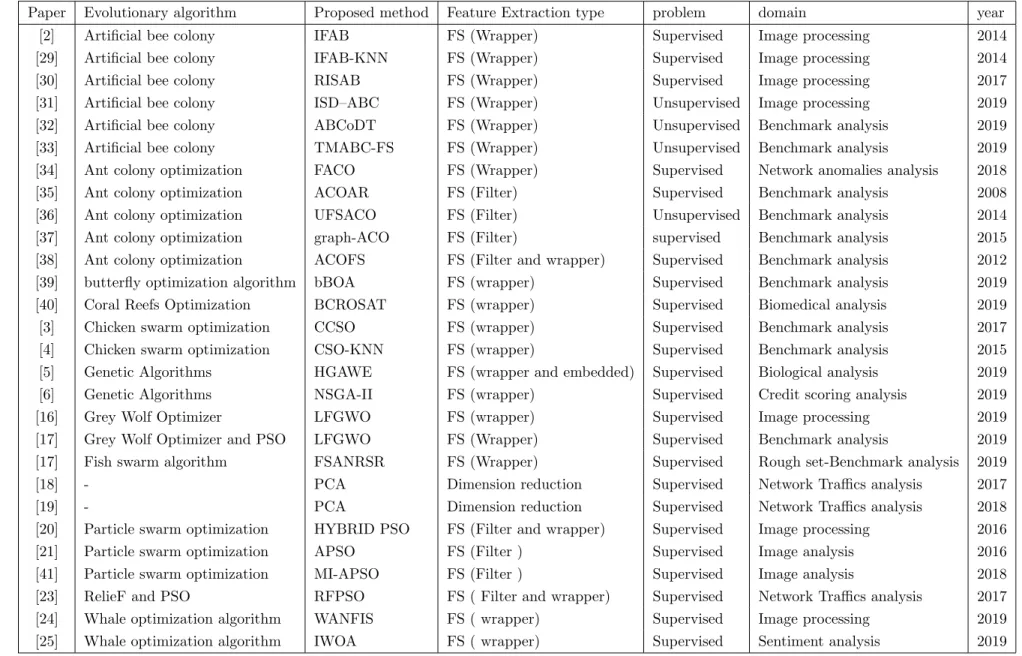
Table 1 presents a representative information about the feature selection techniques using evolutionary algorithms.
Paper Evolutionary algorithm Proposed method Feature Extraction type problem domain year [2] Artificial bee colony IFAB FS (Wrapper) Supervised Image processing 2014 [29] Artificial bee colony IFAB-KNN FS (Wrapper) Supervised Image processing 2014 [30] Artificial bee colony RISAB FS (Wrapper) Supervised Image processing 2017 [31] Artificial bee colony ISD–ABC FS (Wrapper) Unsupervised Image processing 2019 [32] Artificial bee colony ABCoDT FS (Wrapper) Unsupervised Benchmark analysis 2019 [33] Artificial bee colony TMABC-FS FS (Wrapper) Unsupervised Benchmark analysis 2019 [34] Ant colony optimization FACO FS (Wrapper) Supervised Network anomalies analysis 2018 [35] Ant colony optimization ACOAR FS (Filter) Supervised Benchmark analysis 2008 [36] Ant colony optimization UFSACO FS (Filter) Unsupervised Benchmark analysis 2014 [37] Ant colony optimization graph-ACO FS (Filter) supervised Benchmark analysis 2015 [38] Ant colony optimization ACOFS FS (Filter and wrapper) Supervised Benchmark analysis 2012 [39] butterfly optimization algorithm bBOA FS (wrapper) Supervised Benchmark analysis 2019 [40] Coral Reefs Optimization BCROSAT FS (wrapper) Supervised Biomedical analysis 2019 [3] Chicken swarm optimization CCSO FS (wrapper) Supervised Benchmark analysis 2017 [4] Chicken swarm optimization CSO-KNN FS (wrapper) Supervised Benchmark analysis 2015 [5] Genetic Algorithms HGAWE FS (wrapper and embedded) Supervised Biological analysis 2019 [6] Genetic Algorithms NSGA-II FS (wrapper) Supervised Credit scoring analysis 2019 [16] Grey Wolf Optimizer LFGWO FS (wrapper) Supervised Image processing 2019 [17] Grey Wolf Optimizer and PSO LFGWO FS (Wrapper) Supervised Benchmark analysis 2019 [17] Fish swarm algorithm FSANRSR FS (Wrapper) Supervised Rough set-Benchmark analysis 2019 [18] - PCA Dimension reduction Supervised Network Traffics analysis 2017 [19] - PCA Dimension reduction Supervised Network Traffics analysis 2018 [20] Particle swarm optimization HYBRID PSO FS (Filter and wrapper) Supervised Image processing 2016 [21] Particle swarm optimization APSO FS (Filter ) Supervised Image analysis 2016 [41] Particle swarm optimization MI-APSO FS (Filter ) Supervised Image analysis 2018 [23] RelieF and PSO RFPSO FS ( Filter and wrapper) Supervised Network Traffics analysis 2017 [24] Whale optimization algorithm WANFIS FS ( wrapper) Supervised Image processing 2019 [25] Whale optimization algorithm IWOA FS ( wrapper) Supervised Sentiment analysis 2019
Table 1: An overview of previous studies on supervised/unsupervised data sets applying hybrid (combined) feature selection.
1.2
Organization
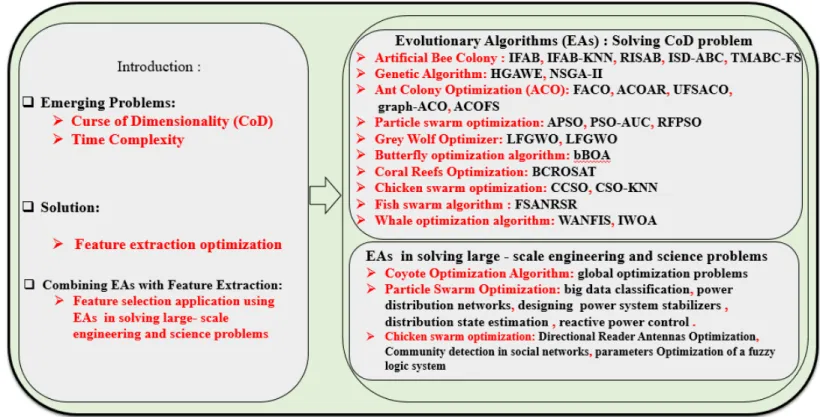
The rest of this study is organized as follows. In section 2, we have discussed the applied evolutionary algorithms and their application. Then, we introduce hybrid feature selection methods using evolutionary algorithms and their application in solving engineering and science problems. In general, Figure 1 represents the overall structure of this study.
Figure 1: Overall structure of this study
2
Application of evolutionary algorithms
Engineering, industries, scientists consider EA at the very final plan. They try to solve their problems easily in low time complexity run time. They used plenty of algorithms to find an optimal solution for their problems, but all of them failed. Some problems they are struggling with are NP-hard problems which are required to ponder the problems deeply. Therefore, final plan for researchers which is left is adopting evolutionary algorithms. Therefore, research scientist do not use EAs for solving simple problems and only consider them for challenging issues and NP-hard problems. It means that EAs have wide variety of applications and are not limited to a specific problems. In this section we will review some applications of them in Image processing [2, 42, 31], optimization problems [9]. Thus, Evolutionary algorithms are an impactful methods to address different NP-hard problems [43].Table 1 presents a representative information about the hybrid (combined)
feature selection techniques using evolutionary algorithms on supervised / unsupervised data sets. Based on [5, 22], hybrid (combined) methods are newly introduced, which mixes evolutionary algorithms together with filter based or wrapper based algorithms. So, All proposed methods you see in the table are hybrid methods. Table 2 provides complete definitions for abbreviation which are used in this chapter.
2.1
Feature extraction optimization
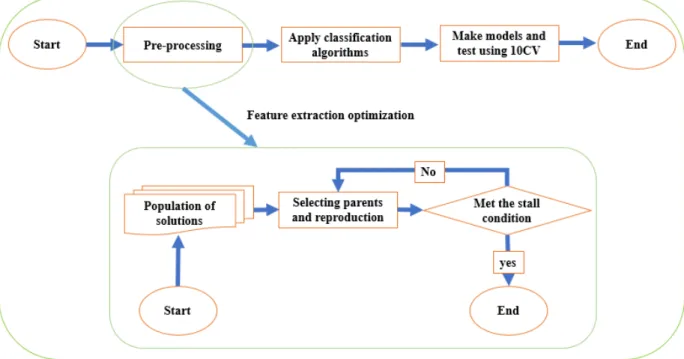
Finding a proper subset of features or generating a new sets of features while decreasing the dimension of data sets and improving the performance is still a NP-hard [44, 45] problem and scientists try to solve this problem. FE has been successfully done in several domains [19, 46, 47] and it is not domain specific. Here, we dig into some specific important feature selection algorithms like IFAB [2]. IFAB is a feature selection method has applied on digital images. Figure2 depicts a procedure of FE approach using EAs in an abstract way. It shows that EAs are adopted in pre-processing section to help scientists to reduce the number of feature properly. In general, we try to use a classification method to learn from train data and make a model. Then, leverage the generated model to predict un-labeled test data and calculate the performance of the classifier. As we discussed, classifiers fail to learn a large amount of data due to the CoD problem, So we discuss feature extraction optimization, how it helps classifier to learn the train data without struggling with over-fitting or under-fitting problems.
Figure 2: Evolutionary algorithms process for feature extraction
2.1.1 Feature selection for image classification
Due to growth of generating images in different areas and networks, transferring, distributing images, image labeling and classification raised the majority of researchers’ attention. To do that, scientists have implemented plenty of tools and packages and libraries, such as deep learning [48], generative adversarial networks (GANs) [49], convolutional neural network (CNN) [50], recurrent neural network (RNN) [51]. These provided algo-rithms have been successfully applied and determined very low loss in their accuracy. However, they still suffer from handling dig data, CoD problem and time complexity. Thus, researchers attempted to take advantage of leveraging evolutionary algorithms to address these problems properly. Image classification is one of Image stegnalysis has been quite an emerging challenges in large-scale engineering and science, particularly in ad-vanced image processing. The importance of issue has proliferated significantly last 20 years after the tragedy happened in 2001.
Abb Definition
ABC Artificial bee colony
ACOAR Ant colony optimization attribute reduction BSO Bat swarm algorithm
BCO Bee colony optimization
BOA Butterfly optimization algorithm COA Coyote Optimization Algorithm
CoD Curse of dimensionality CSO Chicken swarm optimization CCSO chaotic chicken swarm optimization
CRO Coral reefs optimization DA Dragonfly algorithm EAs Evolutionary algorithms
FS Feature selection FSA Fish swarm algorithm
GA Genetic algorithm GWO Grey Wolf Optimizer
IFAB Image steganalysis using FS based on ABC IoT Internet of things
ILS Iterated local search
IWOA Improved whale optimization algorithm PCA Principal component analysis
PEAs Parallel evolutionary algorithms RFPSO RelieF and PSO algorithms
RL Representation learning
RISAB Region based Image Steganalysis using Artificial Bee colony SLS Stochastic local search
SSGA Steady state genetic algorithm SVD Singular value dimension SVM Support vector machine
TMABC-FS Two-archive multi-objective artificial bee colony algorithm for FS WOA Whale Optimization Algorithm
WANFIS Whale adaptive neuro-fuzzy inference system Table 2: Abbreviation of words
• Application of artificial bee colony in feature selection:
Image steganalysis using feature selection based on artificial bee colony (IFAB) is presented by Ghareh
Mohammadi and Saniee Abadeh in [2]. IFAB has an optimized feature extraction process and is categorized into wrapper-based feature selection methods. This method works properly for examining input digital images and distinguishing cover images from stego images. A stego image is a cover image with an embedded message. The goal of IFAB is to decrease time complexity of training model while improving the classifier’s performance. Figure 3 presents IFAB’s process in detail stating that how IFAB technically combine three types of bees to optimize the feature extraction process. First of all, employed bees are applied to generate food sources and a goodness of each food source is generated using support vector machine(SVM). Fitness function leverage SVM to compute the goodness of each food source. According to the 1 fitness function is calculated. f[i] goes for each food source andPi stands for the accuracy of SVM per each food source. Each food source stands for a solution to the problem. A solution would present the number of features have selected to reduce the dimension of given data set. This step is done for each employed bee population. The employed bees and onlooker bees have the same population and equal to the dimension of input data. For instance, SPAM data set has 686 features which is equal to the population of them.
Fitness(fi)= 1 1+Pi ifPi >0 1+abs(Pi) ifPi <0 (1)
Second step is choosing a food source based on (using equation 2 the goodness of the food source to exploit it by onlooker bees. Once offspring (new solution) is generated, it is time for checking the condition, limit.
Vi =fi+v∗ (fi −fj).,v =[−1,1] (2)
Where j is a random number between 1 and N. i, j stands for features index in a input data set. N is the upper bound of number of features. If the solution’s performance stopped improving within the pre-defined iteration equal to the limit, then, in third step, Scout bee is selected to explore using equation 3 the area of the food source, and tries to update the solution by a pre-adjusted rate. Xmax,Xmin shows the upper bound and lover bound of population, respectively.
Xi =Xmax+v0∗ (Xmax−Xmin),v0=[0,1] (3)
Each iteration the best food source with respect to the goodness value is reserved and ABC updates food sources by replacing the minimum food source(minimum value of goodness) with new food source if it’s goodness outperforms minimum food source. ABC terminates by full-filling the condition or iteration is completed. Finally, ABC returns the best food source during whole iterations. This food source involves a number of relevant and important features and yields a better result.
Figure 3: An overview of Image steganalysis using Feature selection based on Artificial Bee colony (IFAB) [29]
IFAB-KNN is an advanced ABC for image steganalysis to enhance IFAB performance proposed by Ghareh Mohammadi and Saniee Abadeh in [29]. IFAB-KNN stands for one of the wrapper-based feature selection algorithm. Fitness function takes advantage of a lazy algorithm, k-Nearest Neighbor(KNN), within ABC and enables ABC to examine each subset of features deeply. Keeping the same number of selected features, IFAB-KNN outperforms IFAB with the tuned hyper-parameters. Xie et al [31] produced another unsupervised feature selection algorithm using ABC to classify hyperspectral images, ISD–ABC.
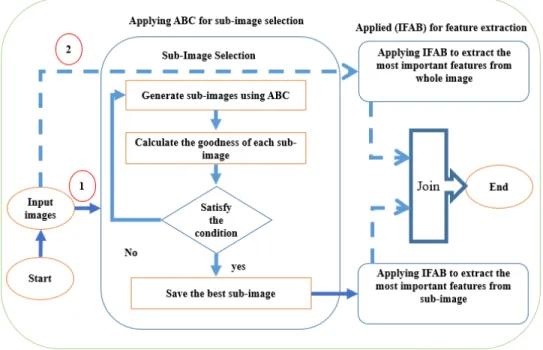
Ghareh mohammadi and Saniee Abadeh [30] presented another hybrid approach to feature selection, combination of data and images. They proposed RISAB, Region based Image Steganalysis using artificial bee colony by leveraging the IFAB characteristics. The goal of RISAB is to find the location of image that does not follow the harmony of the whole images. by finding special pixel or sets of pixels, RISAB could distinguish stego images from cover images. In RISAB, the researchers first applied ABC to find the most probable sub-image that carries the embedded data, which would be messages, images, etc. ABC was tailored to focus on image spatial domain which was one of the important challenging issues. After that, there are one given input data and one sub-image of input data. Then, researchers tried to apply IFAB on both of them. They were able to improve the performance of feature extractors like SPAM and CC-PEV, even IFAB. Figure 4 presents overall stepts of RISAB, for more information you may read this paper [30].
Figure 4: The process of feature selection using RISAB
• Application of particle swarm optimization in feature selection:
Chhikara et. al [20] proposed HYBRID, a new approach using PSO for solving CoD problem in image steganalysis. They proposed a combined filter and wrapper based feature selection approach to deal with high domensionality problem in image steganalysis. Authors tested HYBRID on data which had extracted using feature extraction methods, using images which were attacked by steganography algorithms. The HY-BRID enhanced the classification accuracy image steganalysis. Chikara and Kumari in [52] presented a new wrapper-based feature selection for image steganalysis, named Global Local PSO (GLBPSO) which leverages backpropagation neural networks to evaluate the selected feature subsets.
Adeli and Broumandnia in [21] introduced another filter-based feature selection algorithm for steganalysis named, an Adaptive inertia weight-based PSO (APSO) where the inertia weight of PSO is adaptively adjusted leverage of three components, such as: average distance of particles, the swarm diameter, and average velocity of particles. Rostami and Khiavi [22] take advantage of a novel fitness function which uses Area Under Curve (AUC) to evaluate feature subset. The Final accuracy of APSO yields a better result in comparison with IFAB, however, their time complexity problem still remains for a CoD problems.
• Application of grey wolf optimizer in feature selection:
Pathaket al [16] proposed a new feature selection algorithm, LFGWO which has been used to classify stego images from cover images. GWO has been widely used to solve large scale optimization, engineering, science problems, such as global optimization tasks [13], [17] optimized feature selection algorithm using combining
GWO and PSO called PSOGWO.
2.2
Feature selection for network traffic classification
Internet traffics growth has increased unexpectedly due to expanding new technologies and data comes from every where using internet of things (IoT). However, as lack of traditional traffic classification approaches, researchers have been applying traffic classification using ML techniques. Current and simple ML techniques may not turn into a optimum solution because of very high dimensionality.
Having multi-class data sets which are imbalance become another emerging challenge for scientist. ML algorithms struggles with the data and does not yield high recall for the minority classes. Researchers in their studies have proposed different hybrid approaches to address these problems. Scientists worked on data in pre-processing phase by using re-sampling approaches, cost-sensitive approaches and feature extraction approaches which has very high impact on the classification process. Donget al [23] proposed a new hybrid method using PSO address the aforementioned problems. Researchers in this paper presented a new hybrid feature selection algorithm combining RelieF and PSO algorithms called RFPSO. According to the figure , RFPSO has two main steps to follow. First step goes for initialization of RFPSO, and second step is fitness function selection
Relief is an feature selection algorithm proposed by Kira and Rendell in 1992 [53] . It is one of the filter-based feature selection that works deeply on relationship among features. It was firstly presented to address binary classification problems including discrete or numerical features. RFPSO calls the fitness function which stands for the inconsistency rate defined in equation 4 [53] . T stands for the total number of instances and the number of inconsistencies goes for N. They considered three popular criteria to evaluate their work. one Recall, one Precision and oneFmeasur e.
f itness=NT. (4)
Shi et al [18, 19] aimed to classify traffic data by proposing a robust feature extraction and feature
selection algorithms which leverage customized PCA. Hamamotoet al [54] used GA to detect network anomaly detection. GA is applied to create a digital signature of network segment by leveraging flow analysis. The information are provided and extracted from network flows which have been used to predict networks traffic action with in short time period. .They combined Ga with fuzzy logic to improve their result. Actually, fuzzy logic Fuzzy enables the Ml algorithm decides whether a sample represents an anomaly or not.
Figure 5: The process of feature selection using RelieF and PSO algorithms (RFPSO)
2.3
Feature selection benchmarks
Ahmedet al [3] presented an advanced feature selection algorithm using chaotic chicken swarm optimization (CCSO). They used CCSO to cover the problem of stalling in local minimum which is one of the important and common problems of traditional evolutionary and swarm algorithm. Unlike other evolutionary algorithms, it remembers both minimum and maximum value of each solution to optimize the search step. They used five different data sets, such as spambase, wbdc, ionosphere, lung and sonar. They compared their result with other evolutionary algorithms like PSO, binary CSO, bat swarm algorithm (BSO) and dragonfly algorithm (DA).
Ant colony optimization attribute reduction (ACOAR) is another feature selection algorithm which reduce the number features using filtering based algorithm. ACOAR is introduced in [35] and leverages the ACO process to improve the performance of algorithm in rough set theory. Moreover, Tabakhi et al [36] proposed another yet novel approach for feature selection algorithm for unsupervised data, called UFSACO . UFSACO looks for the optimal and the most relevant feature subset, however, it does not take advantage of learning algorithms to that end.Furthermore, it goodness of features relation is computed with respect to the similarity among features. UFSACO aims to the minimize the redundancy of features. Moreover, ACOFS, a hybrid ant colony optimization algorithm presented in. [38], graph-based feature selection using ACO [37].
• Recent advances in feature selection optimization:
We have included and classified the most popular and important research studies with respect to the evolution-ary algorithms. In this section, we would like to add last, but not the least, yet cutting-edge studies attempted solve to the NP-hard problems, Rao et al [32] presented another hybrid feature selection method using bee
colony and leveraging gradient boosting decision tree to address the NP-hard problems like curse of dimension-ality. Buiet al [24] proposed a hybrid feature selection for land pattern classification, using Whale Optimization Algorithm (WOA) and adaptive neuro-fuzzy inference concepts. Another improved WOA is presented in [25] to Arabic sentiment analysis by feature selection. Kozodoi et al [6] levergaed profit measures to propose a wrapper feature selection algorithm using NSGA-II genetic algorithm. Yan et al [40] improved yet another evolutionary algorithm, Coral Reefs Optimization (CRO), to select the best matched feature subsets, called BCROSAT to apply on biomedical data. Arora and Anand [39] introduced a binary variants of a new evolu-tionary algorithm, the butterfly optimization algorithm (BOA), to select the most important features. Zhang
et al [33] proposed new cost-sensitive multi-objective ABC-based feature selection, TMABC-FS. Pierezan and
Coelho [55] proposed new optimization algorithm based on COA, for solving global optimization problems.
3
Discussion
NP-hard problems always become the most challenging issues, most frequently seen in engineering and science. In this chapter, we address one of the emerging NP-hard problems in data science, the curse of dimensionality (CoD). A large number of research studies have attempted to solve this problematic issue. Researchers continue to publish new papers on this problem since they have not found an algorithm that performs in an accurate and robust way. Researchers did not obtain a better result by only using basic machine learning algorithms, such as support vector machine (SVM) or K-nearest neighbour (KNN). During the last two decades, scientists started to apply evolutionary algorithms to this issue and will continue publishing unlimited papers on this topic. Furthermore, Data scientists have significantly increased the number of domains to which they could apply evolutionary algorithms. So, lately, the number of data has proliferated and lead scientist to find a new type of data called Big data. Thus, working with data, including manipulating data and finding the pattern governing whole data becomes harder. Not only do we have different kinds of supervised data set with ground truth, but also this new type of data introduced a new concept, the unsupervised data set. Scientists proposed a technical way to deal with different groups of data, meanwhile their approaches have to be able to learn unsupervised data sets, too. The future work would be trying to propose a solution to apply evolutionary algorithms to help representation learning which enables scientists to find patterns and important features independent of the ground truth and enables classifiers to learn supervised and unsupervised data properly to avoid over-fitting.
4
Conclusion
Data science has some defects because of some data problems due to unexpected growing amount of it. The main problem of data is the curse of dimensionality (CoD), which causes yet another important problem, high time complexity. To solve CoD problem, researchers have been proposed different feature selection optimiza-tion techniques by selecting the most relevant and optimal features, tries to evaluate supervised/ unsupervised data sets. In this chapter, we provided the practical examples of applied evolutionary algorithm for feature
selection optimization and reviewed emerging optimization application. Furthermore, scientists have adopted evolutionary algorithms like IFAB and tailored them towards their goals. Moreover, having applied evolution-ary algorithms to select the most important features, researchers improved the performance of classification algorithms. For instance, IFAB decreased the dimension of a given data set intensely, while also enhancing the performance of the support vector machine (SVM) significantly. In addition, IFAB decreased the time to learn model, and improved time complexity. In this chapter, we categorized optimization method according to the evolutionary algorithms and their applications. It is noteworthy that evolutionary algorithms have been applied successfully on most of engineering, science and even biology and medical domains which make them powerful and robust enough. This study provides the required information for the researchers who plan to pursue research on dimension reduction and large-scale optimization problems.
References
[1] F Ghareh Mohammadi, M Hadi Amini, and Hamid R. Arabnia. Evolutionary computation, optimization and learning algorithms for data science. arXiv preprint arXiv: 1908.08006, 2019.
[2] F Ghareh Mohammadi and M Saniee Abadeh. Image steganalysis using a bee colony based feature selection algorithm. Engineering Applications of Artificial Intelligence, 31:35–43, 2014.
[3] Khaled Ahmed, Aboul Ella Hassanien, and Siddhartha Bhattacharyya. A novel chaotic chicken swarm optimization algorithm for feature selection. In 2017 Third International Conference on Research in
Computational Intelligence and Communication Networks (ICRCICN), pages 259–264. IEEE, 2017.
[4] Ahmed Ibrahem Hafez, Hossam M Zawbaa, Eid Emary, Hamdi A Mahmoud, and Aboul Ella Hassanien. An innovative approach for feature selection based on chicken swarm optimization. In2015 7th International
Conference of Soft Computing and Pattern Recognition (SoCPaR), pages 19–24. IEEE, 2015.
[5] Xiao-Ying Liu, Yong Liang, Sai Wang, Zi-Yi Yang, and Han-Shuo Ye. A hybrid genetic algorithm with wrapper-embedded approaches for feature selection. IEEE Access, 6:22863–22874, 2018.
[6] Nikita Kozodoi, Stefan Lessmann, Konstantinos Papakonstantinou, Yiannis Gatsoulis, and Bart Baesens. A multi-objective approach for profit-driven feature selection in credit scoring. Decision Support Systems, 120:106–117, 2019.
[7] Yu Xue, Jiongming Jiang, Binping Zhao, and Tinghuai Ma. A self-adaptive artificial bee colony algorithm based on global best for global optimization. Soft Computing, pages 1–18, 2018.
[8] Fatima Harfouchi, Hacene Habbi, Celal Ozturk, and Dervis Karaboga. Modified multiple search coop-erative foraging strategy for improved artificial bee colony optimization with robustness analysis. Soft
Computing, 22(19):6371–6394, 2018.
[9] Heqi Wang and Jiao-Hong Yi. An improved optimization method based on krill herd and artificial bee colony with information exchange. Memetic Computing, 10(2):177–198, 2018.
[10] Yongcun Cao, Yong Lu, Xiuqin Pan, and Na Sun. An improved global best guided artificial bee colony algorithm for continuous optimization problems. Cluster computing, pages 1–9, 2018.
[11] M Hadi Amini, Kianoosh G Boroojeni, SS Iyengar, Frede Blaabjerg, Panos M Pardalos, and Asad M Madni. A panorama of future interdependent networks: From intelligent infrastructures to smart cities.
InSustainable interdependent networks, pages 1–10. Springer, 2018.
[12] M Hadi Amini, Hamidreza Arasteh, and Pierluigi Siano. Sustainable smart cities through the lens of complex interdependent infrastructures: Panorama and state-of-the-art. In Sustainable Interdependent
Networks II, pages 45–68. Springer, 2019.
[13] Shubham Gupta and Kusum Deep. An opposition-based chaotic grey wolf optimizer for global optimisation tasks. Journal of Experimental & Theoretical Artificial Intelligence, pages 1–29, 2018.
[14] Xiao-lei Li. An optimizing method based on autonomous animats: fish-swarm algorithm. Systems
Engineering-Theory & Practice, 22(11):32–38, 2002.
[15] LY Zhang, Gang Luo, and LN Lu. Genetic algorithms in resource optimization of construction project.
Journal of Tianjin University (Science and Technology), 34(2):188–192, 2001.
[16] Yadunath Pathak, KV Arya, and Shailendra Tiwari. Feature selection for image steganalysis using levy flight-based grey wolf optimization. Multimedia Tools and Applications, 78(2):1473–1494, 2019.
[17] Qasem Al-Tashi, Said Jadid Abdul Kadir, Helmi Md Rais, Seyedali Mirjalili, and Hitham Alhussian. Binary optimization using hybrid grey wolf optimization for feature selection.IEEE Access, 7:39496–39508, 2019.
[18] Hongtao Shi, Hongping Li, Dan Zhang, Chaqiu Cheng, and Wei Wu. Efficient and robust feature extraction and selection for traffic classification. Computer Networks, 119:1–16, 2017.
[19] Hongtao Shi, Hongping Li, Dan Zhang, Chaqiu Cheng, and Xuanxuan Cao. An efficient feature generation approach based on deep learning and feature selection techniques for traffic classification. Computer
Networks, 132:81–98, 2018.
[20] Rita Rana Chhikara, Prabha Sharma, and Latika Singh. A hybrid feature selection approach based on improved pso and filter approaches for image steganalysis.International Journal of Machine Learning and
Cybernetics, 7(6):1195–1206, 2016.
[21] Ali Adeli and Ali Broumandnia. Image steganalysis using improved particle swarm optimization based feature selection. Applied Intelligence, pages 1–14, 2018.
[22] Vahid Rostami and Azar Shahmoradi Khiavi. Particle swarm optimization based feature selection with novel fitness function for image steganalysis. In2016 Artificial Intelligence and Robotics (IRANOPEN), pages 109–114. IEEE, 2016.
[23] Yuning Dong, Quantao Yue, and Mao Feng. An efficient feature selection method for network video traffic classification. In2017 IEEE 17th International Conference on Communication Technology (ICCT), pages 1608–1612. IEEE, 2017.
[24] Quang-Thanh Bui, Manh Van Pham, Quoc-Huy Nguyen, Linh Xuan Nguyen, and Hai Minh Pham. Whale optimization algorithm and adaptive neuro-fuzzy inference system: a hybrid method for feature selection and land pattern classification. International Journal of Remote Sensing, 40(13):5078–5093, 2019. [25] Mohammad Tubishat, Mohammad AM Abushariah, Norisma Idris, and Ibrahim Aljarah. Improved whale
optimization algorithm for feature selection in arabic sentiment analysis.Applied Intelligence, 49(5):1688– 1707, 2019.
[26] M Hadi Amini, Mohsen Parsa Moghaddam, and Orkun Karabasoglu. Simultaneous allocation of electric vehicles’ parking lots and distributed renewable resources in smart power distribution networks.Sustainable
Cities and Society, 28:332–342, 2017.
[27] Mostafa Rezaei Mozafar, Mohammad H Moradi, and M Hadi Amini. A simultaneous approach for optimal allocation of renewable energy sources and electric vehicle charging stations in smart grids based on improved ga-pso algorithm. Sustainable cities and society, 32:627–637, 2017.
[28] M Hadi Amini and Arif Islam. Allocation of electric vehicles’ parking lots in distribution network. In
ISGT 2014, pages 1–5. IEEE, 2014.
[29] F Ghareh Mohammadi and M Saniee Abadeh. A new metaheuristic feature subset selection approach for image steganalysis. Journal of Intelligent & Fuzzy Systems, 27(3):1445–1455, 2014.
[30] F Ghareh Mohammadi and Hedieh Sajedi. Region based image steganalysis using artificial bee colony.
Journal of Visual Communication and Image Representation, 44:214–226, 2017.
[31] Fuding Xie, Fangfei Li, Cunkuan Lei, Jun Yang, and Yong Zhang. Unsupervised band selection based on artificial bee colony algorithm for hyperspectral image classification.Applied Soft Computing, 75:428–440, 2019.
[32] Haidi Rao, Xianzhang Shi, Ahoussou Kouassi Rodrigue, Juanjuan Feng, Yingchun Xia, Mohamed Elho-seny, Xiaohui Yuan, and Lichuan Gu. Feature selection based on artificial bee colony and gradient boosting decision tree. Applied Soft Computing, 74:634–642, 2019.
[33] Yong Zhang, Shi Cheng, Yuhui Shi, Dun-wei Gong, and Xinchao Zhao. Cost-sensitive feature selection using two-archive multi-objective artificial bee colony algorithm. Expert Systems with Applications, 2019. [34] Huijun Peng, Chun Ying, Shuhua Tan, Bing Hu, and Zhixin Sun. An improved feature selection algorithm
based on ant colony optimization. IEEE Access, 6:69203–69209, 2018.
[35] Liangjun Ke, Zuren Feng, and Zhigang Ren. An efficient ant colony optimization approach to attribute reduction in rough set theory. Pattern Recognition Letters, 29(9):1351–1357, 2008.
[36] Sina Tabakhi, Parham Moradi, and Fardin Akhlaghian. An unsupervised feature selection algorithm based on ant colony optimization. Engineering Applications of Artificial Intelligence, 32:112–123, 2014.
[37] Parham Moradi and Mehrdad Rostami. Integration of graph clustering with ant colony optimization for feature selection. Knowledge-Based Systems, 84:144–161, 2015.
[38] Md Monirul Kabir, Md Shahjahan, and Kazuyuki Murase. A new hybrid ant colony optimization algorithm for feature selection. Expert Systems with Applications, 39(3):3747–3763, 2012.
[39] Sankalap Arora and Priyanka Anand. Binary butterfly optimization approaches for feature selection.
Expert Systems with Applications, 116:147–160, 2019.
[40] Chaokun Yan, Jingjing Ma, Huimin Luo, and Ashutosh Patel. Hybrid binary coral reefs optimization algorithm with simulated annealing for feature selection in high-dimensional biomedical datasets.
Chemo-metrics and Intelligent Laboratory Systems, 184:102–111, 2019.
[41] Jasmanpreet Kaur and Singara Singh. Feature selection using mutual information and adaptive particle swarm optimization for image steganalysis. In2018 7th International Conference on Reliability, Infocom
Technologies and Optimization (Trends and Future Directions)(ICRITO), pages 538–544. IEEE, 2018.
[42] Mohamed Abd Elaziz, Khalid M Hosny, and IM Selim. Galaxies image classification using artificial bee colony based on orthogonal gegenbauer moments. Soft Computing, pages 1–11, 2018.
[43] Maoguo Gong, Yue Wu, Qing Cai, Wenping Ma, A Kai Qin, Zhenkun Wang, and Licheng Jiao. Discrete particle swarm optimization for high-order graph matching. Information Sciences, 328:158–171, 2016.
[44] Stefano Ermon, Carla Gomes, Ashish Sabharwal, and Bart Selman. Taming the curse of dimensionality: Discrete integration by hashing and optimization. InInternational Conference on Machine Learning, pages 334–342, 2013.
[45] Nikolaos Kouiroukidis and Georgios Evangelidis. The effects of dimensionality curse in high dimensional knn search. In2011 15th Panhellenic Conference on Informatics, pages 41–45. IEEE, 2011.
[46] R Vanaja and Saswati Mukherjee. Novel wrapper-based feature selection for efficient clinical decision support system. In International Conference on Intelligent Information Technologies, pages 113–129. Springer, 2018.
[47] Emrah Hancer, Bing Xue, Mengjie Zhang, Dervis Karaboga, and Bahriye Akay. Pareto front feature selection based on artificial bee colony optimization. Information Sciences, 422:462–479, 2018.
[48] SanaUllah Khan, Naveed Islam, Zahoor Jan, Ikram Ud Din, and Joel JP C Rodrigues. A novel deep learning based framework for the detection and classification of breast cancer using transfer learning.
Pattern Recognition Letters, 2019.
[49] Subhankar Roy, Enver Sangineto, Nicu Sebe, and Beg¨um Demir. Semantic-fusion gans for semi-supervised satellite image classification. In2018 25th IEEE International Conference on Image Processing (ICIP), pages 684–688. IEEE, 2018.
[50] Anjun Zhang, Xuezhi Yang, Lu Jia, Jiaqiu Ai, and Zhangyu Dong. Sar image classification using adaptive neighborhood-based convolutional neural network. European Journal of Remote Sensing, 52(1):178–193, 2019.
[51] Renlong Hang, Qingshan Liu, Danfeng Hong, and Pedram Ghamisi. Cascaded recurrent neural networks for hyperspectral image classification. IEEE Transactions on Geoscience and Remote Sensing, 2019.
[52] Meena Kumari and Rita Chhikara. Blind image steganalysis using neural networks and wrapper feature selection. In 2017 International Conference on Computing, Communication and Automation (ICCCA), pages 1065–1069. IEEE, 2017.
[53] Kenji Kira and Larry A Rendell. A practical approach to feature selection. InMachine Learning Proceedings 1992, pages 249–256. Elsevier, 1992.
[54] Anderson Hiroshi Hamamoto, Luiz Fernando Carvalho, Lucas Dias Hiera Sampaio, Taufik Abr˜ao, and Mario Lemes Proen¸ca Jr. Network anomaly detection system using genetic algorithm and fuzzy logic.
Expert Systems with Applications, 92:390–402, 2018.
[55] Juliano Pierezan and Leandro Dos Santos Coelho. Coyote optimization algorithm: a new metaheuristic for global optimization problems. In 2018 IEEE Congress on Evolutionary Computation (CEC), pages 1–8. IEEE, 2018.
![Figure 3: An overview of Image steganalysis using Feature selection based on Artificial Bee colony (IFAB) [29]](https://thumb-us.123doks.com/thumbv2/123dok_us/9225201.2806897/10.1026.159.880.154.501/figure-overview-image-steganalysis-feature-selection-artificial-colony.webp)