Quantized Posterior Hashing: Efficient Posterior Exemplar Search Exploiting
Class-Specific Sparsity Structures
Afsaneh Asaei
1, Gil Luyet
1,3, Milos Cernak
1, Herv´e Bourlard
1,2 1Idiap Research Institute, Martigny, Switzerland
2
Ecole Polytechnique F´ed´erale de Lausanne (EPFL), Switzerland
3University of Fribourg, Switzerland
{aasaei,gluyet,mcernak,bourlard}@idiap.ch
Abstract
This paper shows that exemplar-based speech processing us-ing class-conditional posterior probabilities admits a highly effective search strategy relying on posteriors’ intrinsic spar-sity structures. The posterior probabilities are estimated for phonetic and phonological classes using deep neural network (DNN) computational framework. Exploiting the class-specific sparsity leads to a simple quantized posterior hashing procedure to reduce the search space of posterior exemplars. To that end, small subset of quantized posteriors are regarded as representa-tives of the posterior space and used as hash keys to index
buck-ets of similar exemplars. Theknearest neighbor (kNN) method
is applied for posterior based classification problems. The pho-netic posterior probabilities are used as exemplars for phoneme classification whereas the phonological posteriors are used as exemplars for higher level linguistic parsing. Experimental re-sults demonstrate that posterior hashing improves the efficiency ofkNN classification drastically. This work encourages the use of posteriors as discriminative exemplars appropriate for large scale speech classification tasks.
Index Terms: FastkNN, Structured sparsity, Quantized poste-rior hashing, Posteposte-rior representatives, Phoneme classification, Linguistic parsing.
1. Introduction
Exemplar-based speech processing provides a powerful big data solution for potentially a wide range of speech technologies. In particular, speech classification relying on exemplar matching possess higher flexibility than the statistical methods due to lack of prejudices on data and expected answers. The fundamental question that yet remains is the application-specific appropriate choice of exemplars. The present manuscript reinforces the po-sition of deep neural network (DNN) based class-conditional
posterior probabilities (briefly referred to as posteriors) as a
great choice of exemplars for speech classification tasks. In theory, if infinite number of exemplars of continuous probability density functions are provided, a simple nearest-neighbor rule leads to optimal classification [1]. In the con-text of speech recognition, the nearest-neighbor based tech-niques have been used as non-parametric methods to perform class-conditional probability estimation for acoustic model-ing [2, 3]. Typical choice of exemplars are variants of spectral features [4, 5], and approximate neighborhood search strategies are tailored to provide tractable frameworks [2].
Application of hashing in nearest neighbor search enables splitting the search space into buckets each identified with a unique hash key. The exhaustive search space is thus downsized to the corresponding bucket sizes [6]. In this context, the hash
function ensures locality preserving of similar/neighboring data while the whole space is spanned in disjoint splits [7]. In pos-terior space, all above essential features are obtained through a
simplelinear posterior quantizationto generate the hash keys
as posterior representatives, and populate the corresponding buckets of similar posterior vectors.
DNN posteriors live in union of low-dimensional/structured
sparse subspaces [8, 9]. Exploiting this property enables a
hierarchical speech classification and recognition framework based on sparse modeling of phonetic posterior exemplars [10]. In addition, the low-dimensional subspaces can be modeled through dictionary learning for sparse representation where pro-jection of the posteriors into the space characterized over the training data reduces the mismatch of the testing posteriors, and leads to enhanced acoustic modeling for speech recogni-tion [8, 9]. Another applicarecogni-tion of DNN phonetic posterior exemplars have been established in query-by-example spoken term detection [11], and sparse subspace modeling have been found promising to address this problem [12, 13].
In addition to the phonetic posteriors, our previous studies on phonological posteriors show that they conform to a small number of unique binary structures which are a tiny fraction of the number of permissible codes. Exploiting this property en-ables construction of a small-size codebook for very low-bit rate speech coding [14]. More recently, we also considered struc-tured sparsity of phonological posteriors for higher level clas-sification of linguistic properties, also referred to as linguistic parsing [15].
In this paper, we propose a novel application of structured sparsity of posterior probabilities in devising an effective hash-ing technique to reduce the search space of posterior exem-plars. Motivated by the idea of locality sensitive hashing for fast neighborhood search [7], the geometric locality in the space of posteriors can be defined by thresholding the high probability components at multiple quantized levels. As the variability in the space of posteriors is largely confined to the underlying class probabilities, grouping the posteriors according to their similar quantized codes ensures the actual neighbors in disjoint buck-ets covering the whole space. The posteriors are investigated at two levels corresponding to phonetic and phonological classes. We consider phonetic classification and phonological
linguis-tic parsing based onknearest neighbor (kNN) search using the
quantized posterior hashing technique.
In the rest of the paper, the posterior hashing theory is de-scribed in Section 2. Experimental studies are carried out in Section 3, and the conclusions are drawn in Section 4 with an outlook to development of large scale, fast and flexible speech technologies relying on DNN posterior exemplars.
2. Quantized Posterior Hashing
Inspired from the idea of locality sensitive hashing [7], a deter-ministic procedure for posterior space hashing is proposed. This procedure relies on structured sparsity of posterior subspaces to characterize the geometric localities, and enables search space reduction for neighborhood analysis of posterior exemplars. 2.1. Structured Sparsity
Phonetic and phonological posterior estimation requires speech
analysis that turns a sequence ofN acoustic feature
observa-tionsX={x1, . . . ,xn, . . . ,xN}into a sequence ofN
poste-rior probability vectorsZ={z1, . . . ,zn, . . . ,zN}where
zn= [p(C1|xn), . . . , p(Cq|xn), . . . , p(CQ|xn)]>
consists ofQclass-conditional posterior probabilities, and.>
denotes the transpose operator. DNN is the state-of-the-art
computational method to estimate the posterior probabilities. A DNN learns the categorical distribution mapping an input
acoustic feature xn to a specific class probability. A single
DNN is employed to estimate the phonetic posteriors, whereas multiple parallel DNNs are used for detection of different phonological classes; the DNN outputs are then concatenated to form the phonological posterior vector (details in 3.2).
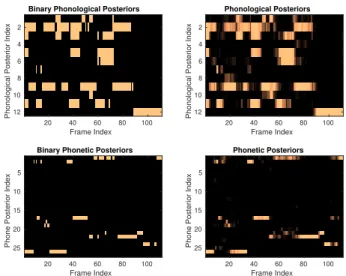
Figure 1 depicts a sample of phonological and phonetic pos-teriors estimated for an utterance of speech signal. The left plots illustrate the binary quantized posteriors of the continuous prob-abilities depicted in the right plots. An exclusive class-specific sparsity is evident for phonetic posteriors which is pertained to the DNN exclusive mapping to the hard output phonetic labels. As a result, the class-specific subspaces are highly structured or the matrices of class-specific phonetic posteriors have a very rank [8], and the posterior space is a union of these low-dimensional subspaces.
On the other hand, the restricted multi-class probabilities
are visible at phonological posteriors. As the phonological
classes correspond to sub-phonetic attributes, multiple classes are activated for generation of linguistic units at any instance of time, however, their combination is confined to a small per-missible activation of articulatory mechanisms as determined in a phonological system [16]. These permissible combinations define the sparsity structures underlying phonological posteri-ors. In both phonetic and phonological illustrations, the sparse vectors exhibit a sequencing structure inherited from the in-put acoustic feature observations. More details about the DNN setup for estimation of posteriors, their dimension and databases will be described in Section 3.
2.2. Quantized Posterior Representatives are Hash Keys Taking advantage of the underlying structured sparsity of pos-teriors, it is possible to design a hashing technique to divide the space into smaller size buckets of locally neighbor posteriors.
As already discussed in Section 2.1, posterior exemplars are sparse vectors residing in union of low-dimensional subspaces. Hence, for any posterior vector, the probabilities are confined to a very small number of components where the indices of high probabilities identify the unique structure of the underlying sub-space. Accordingly, the number of unique quantized posteriors is relatively small with respect to the sample size, and the quan-tized posteriors can be regarded as representatives of the poste-rior space. The quantized posteposte-rior representatives can be used as hash keys for splitting the space into geometric neighbors.
Binary Phonological Posteriors
Frame Index
20 40 60 80 100
Phonological Posterior Index
2 4 6 8 10 12 Phonological Posteriors Frame Index 20 40 60 80 100
Phonological Posterior Index
2 4 6 8 10 12
Binary Phonetic Posteriors
Frame Index
20 40 60 80 100
Phone Posterior Index
5 10 15 20 25 Phonetic Posteriors Frame Index 20 40 60 80 100
Phone Posterior Index
5 10 15 20 25
Figure 1: Posteriograms of phonological and phonetic posteriors.
Quantized posteriors are representatives of the posterior space that can be used as the hash keys for effective nearest neighbor search.
The following hashing formula express this method through dif-ferent levels of quantization.
H(z) =
2bz
2b (1)
wherezis a posterior probability vector, andbis the number of
bits for quantization.
The main idea is that the quantized posterior vectors can be used directly as the hash keys to form buckets of similar pos-terior exemplars. The quantized pospos-terior hashing divides the search space into disjoint buckets where the number of buckets is proportional to the number of disjoint classes.
In theory, the number of disjoint classes is equal to the di-mension of DNN outputs for phonetic posteriors, or equal to the number of permissible combinations of the phonological classes as defined in a phonological system [17, 18]. Our experimen-tal studies conducted in Section 3 confirm this proportionality. As the number of permissible combinations is relatively large in a phonological system, we will see that even the binary pos-terior hashing leads to effectively small-size buckets encapsu-lating similar posterior exemplars. Generally, as the number of quantization bits is increased, the buckets will become more specific. By fixing a minimum bucket size, a hierarchical hash-ing can be devised for search space indexhash-ing, and the neighbor search is accomplished for the finest matched quantization key (details in 3.3).
This hashing technique can be combined withkNN to
en-able efficient posterior classification. We will see in Section 3 that this simple hashing idea can reduce the search space of
pos-teriors tremendously with no degradation ofkNN performance.
2.3. Analysis and Cost
In theory, quantization of every component of posteriors inb
bits leads to splitting the space in maximumK= 2bQdisjoint
regions. Accordingly, the size of training data in each bucket
can be reduced to an averageN/2K. The minimum similarity
occurs for the vectors at the boundaries, thus maximum distance of the two vectors with equal hash keys is
max
H(z1)=H(z2)d(z1,z2)'d(z,z+ 1
where1K is an all-ones vector of dimensionK. Hence, the
probability of negative examples in a bucket is equal to the
probability of having an`1-distance smaller than 21b in every
dimension. Since the maximum`1distance is 1 (posterior
def-inition), this probability isp= 1
2b. The negative examples
oc-cur when theK-dimensional keys of the two posteriors of
dif-ferent classes are equivalent, therefore, negative examples have
the probability of1−pK. Since the typical number ofQis
often more than 40, this hashing function leads to a very small probability of encapsulating negative examples or wrong posi-tive examples in the same bucket.
In practice, the number of non-empty buckets is very small, and by considering a large minimum number of exemplars per bucket, the number of effective hash keys for each class is
proportional tokb2bE(z|Cq)ck0), whereE(.)is the expected
value of the posteriors obtained by averaging the probability
vectors belonging to the classCq, andk.k0denotes the
num-ber of non-zero components. The overall numnum-ber of hash keys
is thusPQq=1kb2bE(z|C
q)ck0. The experimental results are
presented in Section 3.
3. Experimental Results
In this section, we evaluate the effectiveness of hashing for
neighborhood search of posterior exemplars. TwokNN tasks
are investigated, namely, phoneme classification using phonetic posteriors, and linguistic parsing using phonological posteriors. 3.1. DNN Setup for Phonetic Posteriors
The phoneme classification is conducted on AMI corpus [19]. A DNN is used to estimate the phonetic posterior probabilities, and it is implemented using Kaldi toolkit [20]. Its architec-ture consists of three hidden layers with 1024 nodes. The in-put features of the DNN are MFCC features plus the first and second order dynamic features using a context of 9 frames at frequency 100. The DNN outputs are hard labels corresponding to 43 dimensional English phoneme classes. The training labels are obtained from hidden Markov model (HMM) force align-ment using speech transcription. We use the standard splitting of training, development and test data as performed in [21]. 3.2. DNN Setup for Phonological Posteriors
The Wall Street Journal WSJ0 and WSJ1 continuous speech recognition corpora [22] are used for training the phonological class detectors. Phonological detectors are trained on the
train-ing setsi tr s 284including 37,514 utterances using the Sound
Pattern of English phonological features [16]. For each phono-logical class, a 3x1024 DNN is initialized by deep belief net-work pre-training of [23], and trained using Kaldi toolkit [20]. The DNN output is trained as either 1 or 0 if the phonological class is present or not. Hence, each DNN estimates the prob-ability of occurrence of one phonological class. The outputs of all DNNs are concatenated to form a phonological posterior vector.
To perform linguistic parsing experiments, the Government Phonology (GP) posteriors [17, 18] are estimated on a labeled sub-set taken from the SIWIS database [24]. The dimension of phonological posteriors is 12 according to the GP phonologi-cal system that consists of the three basic resonance phonolog-ical primes commonly labeled as A, U, I, denoting the periph-eral vowel qualities [a], [u] and [i] respectively. Other vowels are defined by a composition of the basic ones, such as [e] re-sults in fusing the I and A primes. In addition to these
‘vo-calic’ primes, GP proposes also the ‘consonantal’ primes. The evaluation data consists of recordings of 10 training and 3 test-ing English speakers. Each speaker reads about 25 sentences, among which 5 questions, with focus (emphasis) on one pre-defined word. The corresponding transcription for each sen-tence was given, with a tag on the words that the speakers were asked to emphasize. Hence, the goal of linguistic parsing is ba-sically detection of emphasized segments in an utterance where the boundary of the segments are known beforehand, i.e. a top-down detection scenario.
3.3. FastkNN for Phoneme Classification
The cosine similarity is used inkNN search for phoneme
clas-sification [25]. The value ofk for exhaustive searchkNN is
chosen as 150; for hashing-basedkNN at binary level, it is
cho-sen as20, and for higher levels, it is11using the 10-fold cross
validation. Since AMI [19] is a very large corpus, we perform classification of a random selection of 50’000 test posteriors us-ing the labeled development posteriors.
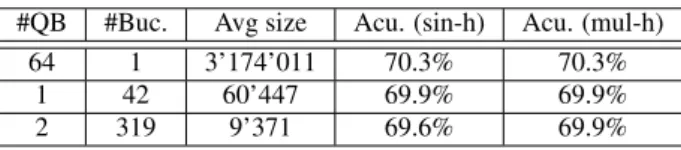
The posterior representatives or hash keys are obtained at different quantization levels. The minimum bucket size is fixed to 500, so if a hash key results in less than 500 neighborhood posteriors, it is discarded. For any test posterior, hashing can be implemented in a hierarchical procedure. The test hash keys at multiple quantization levels are obtained and compared with the available hash keys of labeled data using Jaccard distance, then the finest matched key with Jaccard distance = 0 is used to determine the bucket of neighboring posteriors. This procedure leads to multi-level hashing (mul-h). Alternatively, the single level quantization codes can be used to obtain the hash keys where the bucket with the closest key (even if the Jaccard dis-tance is greater than 0) is used for neighborhood search. This procedure leads to single level hashing (sin-h). The results of kNN phoneme classification performance are listed in Table 1.
Table 1: kNN Phoneme classification using single level
(sin-h) and multi-level (mul-(sin-h) quantized posterior hashing on AMI database.
#QB #Buc. Avg size Acu. (sin-h) Acu. (mul-h)
64 1 3’174’011 70.3% 70.3%
1 42 60’447 69.9% 69.9%
2 319 9’371 69.6% 69.9%
We observe that the number of unique hash keys is very small, and the search space can be reduced drastically with
al-most no degradation inkNN classification accuracy. In
addi-tion, the hash keys can be stored as binary vectors to enable fast binary matching to find the appropriate bucket, and paral-lel matching of the hash keys at multiple levels minimizes the computational overhead. The testing posteriors with different hash keys can be processed interdependently in parallel streams that can lead to higher speed up in exemplar based frameworks. 3.4. FastkNN for Phonological Linguistic Parsing
The information of linguistic events at supra segmental level is encoded in phonological attributes, thus classification of high-level linguistic events (such as stress or syllables) is feasible exploiting the structure of high probability phonological pos-teriors [15]. This task is also referred to as linguistic parsing. In this section, we study emphasis detection based on nearest neighbor search using phonological posteriors along with Jac-card similarity measure.
Un-emphasized "R"
Frame Index 10 20 30 40 50
Phonological Posterior Index
5 10 15 20 Emphasized "R" Frame Index 10 20 30 40 50
Phonological Posterior Index
5
10
15
20
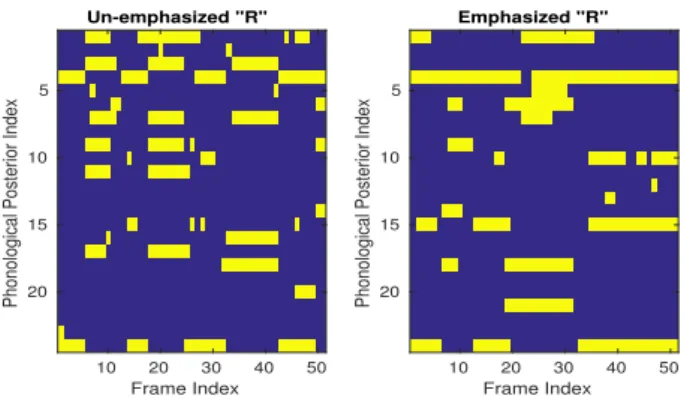
Figure 2: Structured sparsity of phonological posteriors depicted for
two pronunciation of the phoneme “R” in un-emphasized and empha-sized words.
This method relies on the hypothesis that phonological posteriors encode information about the emphasized or un-emphasized speech utterances in the support of their high prob-ability components. The support can be identified using quanti-zation at different levels. Figure 2 illustrates an example of bi-nary structures underlying un-emphasized and emphasized real-izations of phoneme “R”. The difference in the binary patterns is evident. To visualize this property in a larger scale, we plot the t-distributed stochastic neighbor embedding (tSNE) [26] of ar-bitrary selection of 900 frames of phonological representations corresponding to phoneme “R” with and without emphasis in Figure 3.
This empirical observation suggests that the binary struc-tures of phonological posteriors are indicative of their emphatic nature, thus they can be regarded as representatives of emphatic and non-emphatic variability of phonological posteriors. Ac-cordingly, the binary structures are used as the hash keys to split the space into buckets of neighboring exemplars. The nearest neighbor rule is then used for emphasis detection (c.f. [15] for details of the implementation). The results are listed in Table 2.
Table 2:Emphasis detection using phonological posterior
hash-ing on SIWIS database.
#QB #Buckets Avg bucket-size Accuracy
64 1 100’284 87.1%
1 405 222 93.5%
We can see that the search space of posterior exemplars is reduced by extracting the binary codes, however, the number of buckets (unique hash keys) is more than the binary codes of phonetic posteriors. This can be explained due to the definition and training of phonological posteriors which results in high probability components corresponding to multiple phonological classes (as opposed to phonetic posteriors which often have a single high probability component).
Furthermore, unlike phonetic posterior hashing, we do not enforce any constraint on the bucket size since the best value
ofkis found to be 1 for this task. During the nearest neighbor
search, if a binary code does not perfectly match the training hash keys, the most similar code quantified in terms of Jaccard
similarity is used. We can see thatbinaryhashing of
phonologi-cal posteriors enables restriction of the search space to the more “correct” exemplars as the classification improves through this confined search. The results of emphasis detection are better than a state-of-the-art emphasis detection accuracy on similar data [27].
2D tSNE of "R" binary structures - dim1
-40 -20 0 20 40
2D tSNE of "R" binary structures - dim2
-40 -20 0 20 40
Blue: unemphasized and Red: emphasized patterns
Figure 3:tSNE visualization of different realizations of phoneme “R”
with and without emphasis.
4. Conclusions and Future Directions
Posterior exemplars are sparse and live in union of low-dimensional subspaces. In this paper, a novel application of this property was proposed by introducing the quantized pos-terior hashing technique to enable an effective search strategy confined to the local neighborhood of posterior exemplars. The quantized posteriors are regarded as the representatives of the posterior space. It was shown that the number of unique hash keys or equivalently the number of buckets is very small that leads to tremendous reduction of the search space with
negligi-ble overhead. This method enanegligi-bles very fast and accuratekNN
search for phonetic classification and linguistic parsing. The number of unique hash keys or different buckets is re-lated to the sparsity level or the number of permissible classes. Since the “optimal” phonetic posteriors indicate a single highly probable class, the number of buckets is proportional to the
number of phones. In contrast, the phonological posteriors
are indicative of sub-phonetic attributes presented at multiple phonological class probabilities, hence, the number of unique hash keys is proportional to the size of permissible combina-tions as roughly quantified at binary quantization. In fact, bi-nary level hashing is very efficient for neighborhood search of phonological posterior exemplars.
Future work will focus on development of fast and flexible large scale ASR in a hierarchical exemplar based framework relying on the generic low-dimensional properties of DNN pos-terior exemplars. Furthermore, we will investigate alternative linguistic parsing tasks using structured sparsity of phonologi-cal posteriors. Higher semantic information can be integrated with the bottom-up approach towards development of exemplar based ASR framework that can exploit broad contextual infor-mation. Moreover, the neural network posterior estimation can be seen as a hash function of any type of speech acoustic fea-tures such as spectral feafea-tures. Hence, exemplar-based speech classification can potentially benefit from the proposed quan-tized posterior hashing at any speech representation level. We will study this idea in future developments.
5. Acknowledgments
The research leading to these results has received funding from by SNSF project on “Parsimonious Hierarchical Auto-matic Speech Recognition (PHASER)” grant agreement num-ber 200021-153507.In addition, this work has been conducted with the support of the Swiss NSF under grant SP2: the SCOPES Project on Speech Prosody.
6. References
[1] P. A. Devijver and J. Kittler,Pattern recognition: A
statis-tical approach. Prentice-Hall London, 1982, vol. 761. [2] Y. Xu, O. Siohan, D. Simcha, S. Kumar, and H. Liao,
“Exemplar-based large vocabulary speech recognition
us-ing k-nearest neighbors,” in IEEE International
Con-ference on Acoustics, Speech and Signal Processing, ICASSP, 2015, pp. 5167–5171.
[3] N. Singh-Miller, Neighborhood Analysis Methods in
Acoustic Modeling for Automatic Speech Recognition.
MIT PhD Thesis, 2010.
[4] J. F. Gemmeke, T. Virtanen, and A. Hurmalainen, “Exemplar-based sparse representations for noise robust
automatic speech recognition,”Audio, Speech, and
Lan-guage Processing, IEEE Transactions on, vol. 19, no. 7, pp. 2067–2080, 2011.
[5] T. N. Sainath, A. Carmi, D. Kanevsky, and B. Ramab-hadran, “Bayesian compressive sensing for phonetic
clas-sification,” in Acoustics Speech and Signal Processing
(ICASSP), 2010 IEEE International Conference on, 2010, pp. 4370–4373.
[6] J. Wang, H. T. Shen, J. Song, and J. Ji, “Hashing for
similarity search: A survey,”CoRR, vol. abs/1408.2927,
2014. [Online]. Available: http://arxiv.org/abs/1408.2927 [7] M. Slaney and M. Casey, “Locality-sensitive hashing for
finding nearest neighbors [lecture notes],” IEEE Signal
Processing Magazine, vol. 25, no. 2, pp. 128–131, 2008. [8] P. Dighe, G. Luyet, A. Asaei, and H. Bourlard,
“Ex-ploiting low-dimensional structures to enhance dnn based
acoustic modeling in speech recognition,” inIEEE
Inter-national Conference on Acoustics, Speech and Signal Pro-cessing (ICASSP), 2016.
[9] G. Luyet, Low-Rank Representation for Enhnaced
En-hanced Deep Neural Network Acoustic Modeles. Idiap
Research Intitute Master Thesis, 2016.
[10] P. Dighe, A. Asaei, and H. Bourlard, “Sparse modeling of neural network posterior probabilities for exemplar-based
speech recognition,”Speech Communication, 2015.
[11] T. J. Hazen, W. Shen, and C. White, “Query-by-example spoken term detection using phonetic posteriorgram
tem-plates,” inAutomatic Speech Recognition &
Understand-ing, 2009. ASRU 2009. IEEE Workshop on. IEEE, 2009,
pp. 421–426.
[12] D. Ram, A. Asaei, P. Dighe, and H. Bourlard, “Sparse modeling of posterior exemplars for keyword detection,”
inProceedings of Interspeech, no. EPFL-CONF-209088,
2015.
[13] D. Ram, A. Asaei, and H. Bourlard, “Sparse subspace modeling for query by example spoken term detection,” Idiap, Idiap-RR Idiap-RR-01-2016, 1 2016.
[14] A. Asaei, M. Cernak, and H. Bourlard, “On Compress-ibility of Neural Network Phonological Features for Low
Bit Rate Speech Coding,” inProceedings of Interspeech,
2015, pp. 418–422.
[15] ——, “On structured sparsity of phonological posteriors
for linguistic parsing,”arXiv preprint arXiv:1601.05647,
2016.
[16] N. Chomsky and M. Halle,The Sound Pattern of English.
New York, NY: Harper & Row, 1968.
[17] J. Harris, English Sound Structure, 1st ed.
Wiley-Blackwell, Dec. 1994. [Online].
Avail-able: http://www.amazon.com/exec/obidos/redirect?tag=
citeulike07-20\&path=ASIN/0631187413
[18] J. Harris and G. Lindsey,The elements of phonological
representation. Harlow, Essex: Longman, 1995, pp. 34– 79.
[19] J. Carletta, S. Ashby, S. Bourban, M. Flynn, M. Guille-mot, T. Hain, J. Kadlec, V. Karaiskos, W. Kraaij, M. Kro-nenthal, G. Lathoud, M. Lincoln, A. Lisowska, I. Mc-Cowan, W. Post, D. Reidsma, and P. Wellner, “The AMI
meeting corpus: A pre-announcement,” inProceedings of
the Second International Conference on Machine Learn-ing for Multimodal Interaction (MLMI), 2006, pp. 28–39. [20] D. Povey, A. Ghoshal, G. Boulianne, L. Burget, O. Glem-bek, N. Goel, M. Hannemann, P. Motlicek, Y. Qian, P. Schwarz, J. Silovsky, G. Stemmer, and K. Vesely, “The
kaldi speech recognition toolkit,” inProc. of ASRU, Dec.
2011.
[21] I. Himawan, P. Motlicek, M. Ferras, and S. Madikeri, “Towards utterance-based neural network adaptation in
acoustic modeling,” in IEEE Automatic Speech
Recog-nition and Understanding Workshop (ASRU), no.
EPFL-CONF-213067, 2015.
[22] D. B. Paul and J. M. Baker, “The design for the wall
street journal-based CSR corpus,” inProceedings of the
workshop on Speech and Natural Language, ser. HLT
’91. Stroudsburg, PA, USA: Association for
Computa-tional Linguistics, pp. 357–362.
[23] G. E. Hinton, S. Osindero, and Y. W. Teh, “A Fast
Learn-ing Algorithm for Deep Belief Nets,” Neural Comput.,
vol. 18, no. 7, pp. 1527–1554, 2006.
[24] “Spoken interaction with interpretation in switzerland (SIWIS),” 2015. [Online]. Available: https://www.idiap. ch/project/siwis/downloads/siwis-database
[25] A. Asaei, H. Bourlard, and B. Picart, “Investigation of knn classifier on posterior features towards application in au-tomatic speech recognition,” Idiap-RR Idiap-RR-11-2010, 6 2010.
[26] L. Van der Maaten and G. Hinton, “Visualizing data using
t-sne,”Journal of Machine Learning Research, vol. 9, no.
2579-2605, p. 85, 2008.
[27] M. Cernak and P. Honnet, “An empirical model of
em-phatic word detection,” in16th Annual Conference of the
International Speech Communication Association