Volume 16 | Issue 2 Article 14
December 2017
Parameter Estimation In Weighted Rayleigh
Distribution
M. Ajami
Vali-e-Asr University of Rafsanjan, Rafsanjan, Iran, [email protected]
S. M. A. Jahanshahi
University of Sistan and Baluchestan, Zahedan, Iran, [email protected]
Follow this and additional works at:http://digitalcommons.wayne.edu/jmasm
Part of theApplied Statistics Commons,Social and Behavioral Sciences Commons, and the
Statistical Theory Commons
This Regular Article is brought to you for free and open access by the Open Access Journals at DigitalCommons@WayneState. It has been accepted for Recommended Citation
Ajami, M., & Jahanshahi, S. M. A. (2017). Parameter Estimation In Weighted Rayleigh Distribution. Journal of Modern Applied Statistical Methods, 16(2), 256-276. doi: 10.22237/jmasm/1509495240
M. Ajami is an Assistant Professor in the Department of Statistics. Email him at
[email protected]. S. M. A. Jahanshahi is a Professor in the Department of Statistics. Email him at [email protected].
Parameter Estimation In Weighted
Rayleigh Distribution
M. Ajami
Vali-e-Asr University of Rafsanjan Rafsanjan, Iran
S. M. A. Jahanshahi
University of Sistan and Baluchestan Zahedan, Iran
A weighted model based on the Rayleigh distribution is proposed and the statistical and reliability properties of this model are presented. Some non-Bayesian and Bayesian methods are used to estimate the β parameter of proposed model. The Bayes estimators are obtained under the symmetric (squared error) and the asymmetric (linear exponential) loss functions using non-informative and reciprocal gamma priors. The performance of the estimators is assessed on the basis of their biases and relative risks under the two above-mentioned loss functions. A simulation study is constructed to evaluate the ability of considered estimation methods. The suitability of the proposed model for a real data is shown by using the Kolmogorov-Smirnov goodness-of-fit test.
Keywords: Bayesian estimators, estimation methods, goodness-of-fit, loss function, reliability, weighted model
Introduction
The Rayleigh distribution has been used in many areas of research, such as reliability, life-testing and survival analysis. Modeling the lifetime of random phenomena has been another area of study for which the Rayleigh distribution has
been significantly used. Being first introduced by Rayleigh (1880), this statistical
model was originally derived in connection with a problem in acoustics. More details on the Rayleigh distribution can be found in Johnson et al. (1994) and references therein.
The Rayleigh distribution has the following probability density function (pdf) and the cumulative distribution function (cdf), respectively,
2 2 exp , 0, 0, 2 1 exp , 0, 0. 2 x x f x x x F x x Weighted distributions are employed mainly in research associated with reliability, bio-medicine, meta-analysis, econometrics, survival analysis, renewal processes, physics, ecology and branching processes which are found in Patil and Rao (1978), Gupta and Kirmani (1990), Gupta and Keating (1985), Oluyede
(1999), Patil and Ord (1976) and Zelen and Feinleib (1969). A weighted form of
Rayleigh distribution has been published by Reshi et al. (2014). They introduced a
new class of Size-biased Generalized Rayleigh distribution and also investigated the various structural and characterizing properties of that model. In addition, they studied the Bayes estimator of the parameter of the Rayleigh distribution under the Jeffrey’s and the extended Jeffrey’s priors assuming two different loss functions. They compared four estimation methods by using mean square error through simulation study with varying sample sizes. In fact, weighted distributions arise in practice when observations from a sample are recorded with unequal probabilities
Suppose X is a non-negative random variable with its unbiased pdf f(x,β), β is a parameter, then g distribution is weighted version of f and is defined as
,
,
, , , , w x f x g x E w X
where the weight function w(x,α) is a non-negative function and 0 < E(w(X,α)) is a normalizing constant which is E(w(X,α)) = ∫w(x,α)f(x,β)dx. Furthermore, α is a parameter which may or may not depend on β and E(w(X,α)) = 1/Eg(1/w(X,α)) is
the harmonic mean of w(x,α) with the pdf g(.).
When w(x,α) = xα, α = 0, the distribution is referred to as weighted distributions of order α.
, ,
x f x
,
. g x E X
(1)For α = 1 or 2, the pdf (1) are referred to as length-biased (size-biased) and area-biased distributions, respectively.
A weighted Rayleigh (WR) distribution is proposed based on (1) and all calculations are done based upon this model, but in the sections of numerical simulations and application to real data a length-biased Rayleigh (LBR)
distribution is used without loss of generality. Because determinig the value of α
depends on the sampling method so it is not necessary to estimate α in practice,
therefore the focus on estimating the β parameter.
Weighted Rayleigh distribution
In the following, the WR(α,β) distribution is introduced and then, some properties including the rth moment, the corresponding CDF and hazard rate function are
calculated.
Definition 1. A nonnegative random variable X is said to have the WR(α,β) distribution provided that the variable’s density function is given by
1 2/2 /2 /2 1 1 , , , 0, , 0. 2 / 2 1 x g x x e x (2)Remark 1. Suppose that X follows WR(α,β) and let U = X2/2β,
then U follows Γ(α/2+1,1) distribution.
Remark 2. The WR(α,β) distribution belongs to the exponential family. Therefore, T = Σni=1X2i is a sufficient complete statistic.
The rth moments are useful for inference and model fitting. A result that
allows us to compute the moments of the WR(α,β) distribution is given in the following lemma.
Lemma 1. If X be a random variable with density function (2), then the rth moment is given by
/ 2 / 2 1 2 2 , 1 2 r r r r E X where r is a positive integer.
Proof. According to (2)
1
2/ 2 /2 /2 1 0 2 / 2 1 , r r x x E X e dx
let x2/2β = u2, then we have
1 2 / 2 / 2 / 2 / 2 1 0 1 2 2 2 2 . 2 / 2 1 1 2 r r r u r r r E X u e du
∎ Lemma 1 concludes
1/ 2 1/ 2 1 1 2 2 , 1 2 E X
2 2 1 1 1 2 2 2 , 1 1 2 2 V X
2 2 1 1 1 1 2 2 2 . 1 1 2 CV X The corresponding CDF of the WR(α,β) distribution is as follows:
2/ 2
/2 1 2 0 1 1 / 2 1, / 2 , / 2 1 / 2 1 x G x t e dt
x
where
1 1 0 , z a a z t e dt
denotes the lower incomplete gamma function.
In addition, the survival and the hazard rate functions of the WR(α,β) distribution are
2
/2 2 1 / 2 1 1 / 2 1, / 2 , / 2 1 / 2 1 t x G x t e dt x
and
/ 2 / 2 1
1 2/ 2 2
1 , 2 / 2 1, / 2 x x e h x x
respectively, where 1
, 1 1 a z a z t e dt
denotes upper incomplete gammafunction.
In special cases, if α = 1, corresponding length-biased distribution is
2 2/2 3/2 2 , 0, 0, x x g x e x
and if α = 2 corresponding area-biased distribution is
3 2/ 2 2 , 0, 0. 2 x x g x e x
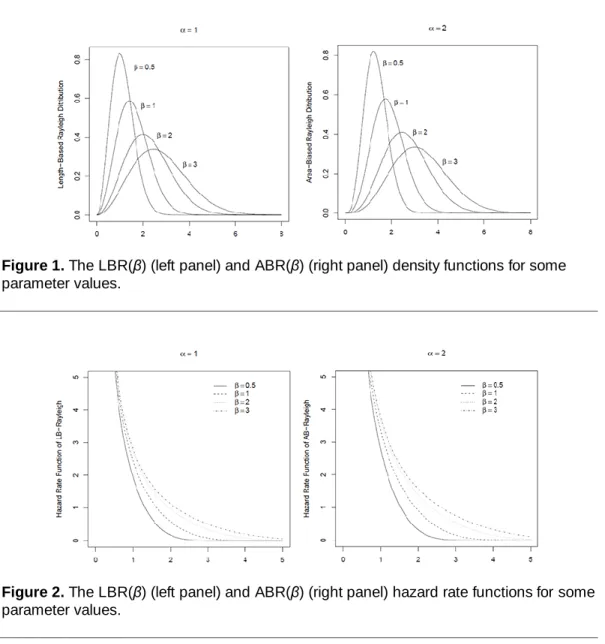
Plots of length-biased and area-biased (ABR) distributions for some
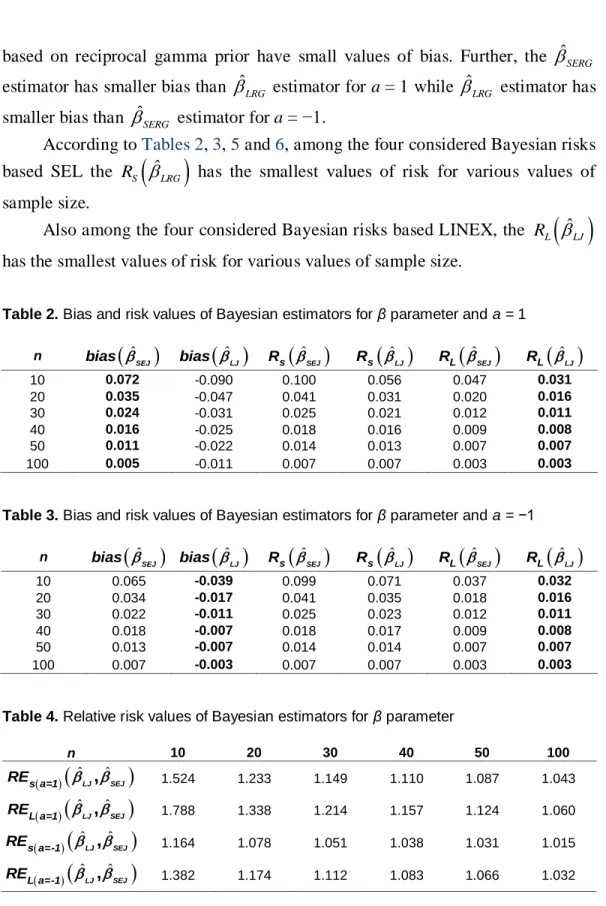
parameter values are displayed in Figure 1. Some possible shapes of the LBR and
Figure 1. The LBR(β) (left panel) and ABR(β) (right panel) density functions for some parameter values.
Figure 2. The LBR(β) (left panel) and ABR(β) (right panel) hazard rate functions for some parameter values.
Parameter estimation
In this section, the method of moments, the maximum likelihood method, uniformly minimum variance unbiased method, maximum goodness-of-fit method
Method of moments estimator
Hereafter, let X1, …, Xn be a random sample from the WR(α,β) distribution. The
method of moments estimator (MME) is
2 2 1 2 ˆ . 1 2 1 2 MME X
Maximum likelihood estimator The likelihood function can be written as
2 1 1 2 1 / 2 / 2 1 1 1 ; , , , 0, , 0. 2 / 2 1 n i i X n n n i i L
x x X e x
One can easily calculate maximum likelihood estimator (MLE) of β by
taking natural logarithm and derivative relative to β as
ˆ , 2 MLE T n where T = Σni=1X2i.To study asymptotic normality of
ˆMLE , calculate the Fisher informationI(β) as
2 2 2 2 1 , 2 1 2 n I
(3)So according to theorem 18 of Ferguson (1996)
ˆ
D
0,1MLE
Therefore, an 100(1 – α)% approximate confidence interval of β can be obtained as
1 /2 ˆ , MLE Z I where Zα/2 is the α/2th percentile point of the standard normal distribution.
Uniformly minimum variance unbiased estimator
Based upon Lemma 1,
2 2 1 2 2 . 1 2 E X Therefore,
2 1 2 2 , 1 2 E T n and 1 2 , 2 2 1 2 T E n
which is a function of the sufficient and complete statistic T that is unbiased for β. Thus based on Lehman-Scheffe theorem we have
1 2 ˆ . 2 2 1 2 UMVUE T n
Maximum goodness-of-fit estimators
Maximum goodness-of-fit estimators (otherwise known as minimum distance estimators) of the parameters of the CDF can be calculated by minimizing any distance of the empirical distribution function (EDF) statistics regarding to the unknown parameters. As other research has shown there is no unique EDF statistic which can be considered the most efficient for all situations (Alizadeh and Arghami, 2011). Kolmogorov-Smirnov, Cramer-von Mises and Anderson-Darling statistics seem to be momentous in situations are
1 2 2 1 2 2 1 sup , , , 1 n n i i i n n n n i i i i n n i i n i i i i D n G x G x W n G x G x p x G x G x A n p x G x G x
where p(x(i)) = G(x(i)) – G(x(i) – 1) is the probability under H0 and considering that
Gn(.)is EDF for G(.).
Bayes estimators of β
Considering β as a random variable, two different priors, namely Jeffreys and reciprocal gamma are considered for β. Taking into account the priors, two different loss functions are used for the WR(α,β) model, the first one is the squared error loss (SEL) function and the second one is linear exponential (LINEX) loss function.
Bayes estimator based on Jeffreys’ prior
I
1/ , 0,
and then, the posterior density will be
2 1 /2 /2 1 1 1 | in Xi , n x e (4)which follows reciprocal gamma distribution as
2 1 | : 1 , . 2 2 n i i X x rgamma n
The Bayesian estimator of β under the SEL function is
ˆ , 2 2 SEL T n where the SEL function is
2ˆ ˆ
, ,
L
and T = Σni=1X2i.
In the following, Bayesian estimator is calculated under the LINEX loss function. This loss function was proposed by Varian (1975) and Zellner (1986).
The LINEX loss function for scale parameter β is given by
a 1, 0, L e a a (5) where ˆ 1
and ˆ is an estimator of β. The sign and magnitude of “a”
represent the direction and degree of asymmetry respectively (see Soliman, 2000,
and Sanku, 2012). Under LINEX loss function (5) and using the posterior (4), the posterior mean of loss function, L(Δ), is
ˆ
ˆ 1 1, a a E L e E e aE one can easily obtain ˆ which minimizes the posterior expectation of the loss function (5), denoted by
ˆLJ as
ˆ 1 exp . 2 / 2 1) 1 LJ T a a n
Bayes estimator based on reciprocal gamma prior
Suppose β follows reciprocal gamma distribution as prior distribution which is
/1 , , 0. b b e
Then, the posterior density satisfies
2
1 /2 / /2 1 1 1 | , n i i b X n x e so the Bayesian estimator of β under the SEL function is
2 ˆ , SERG T b c
where c = n(α + 2) + 2σ − 2.In special case, if we suppose σ = 1, b = 0 then Bayesian estimator of β is
ˆ , 2 SERG T n which is equal to MLE.
ˆ 2 , LRG d T b where
1 exp / 2 1 1 2 a n d a
.The risk efficiency of
ˆ
SEJ regarding to
ˆ
LJ under LINEX and squared errors loss function based on Jeffreys’ priorIf random variable X follows the distribution function (2), so X2 obeys
Γ((α/2+1),2β) then T : Γ(n(α/2+1),2β) as
1 / 2 1 1 2 / 2 1 1 , 0. 2 / 2 1 n T n h t t e n
Because the risk functions of estimators
ˆSEJ and
ˆLJ are important, calculate these risk functions which are denoted by RL
ˆLJ , RL
ˆSEJ ,
ˆS LJ
R , and RS
ˆSEJ where the subject L denotes risk relative LINEX loss function and the subject S denotes risk relative to SEL.Lemma 2. Let X : WR(α,β), then risk function of
ˆSEJ under LINEX loss function with respect to the Jeffreys’ prior is
ˆ
/ 2 1
/ 2 1
1 1. / 2 1 1 / 2 1 1 n a L SEJ an a R e a n n Proof. By definition,
ˆ 1 0 ˆ 1 0 0 ˆ ˆ 1 1 ˆ 1. SEJ SEJ a SEJ L SEJ a SEJ R E L e a h t dt e h t dt a h t dt a
(6) It is easy to verify
ˆ / 2 1 1 0 0 (I). 1 , / 2 1 1 ˆ / 2 1 (II). . / 2 1 1 SEJ n a a SEJ a e h t dt e n n h t dt n
Substituting (I)-(II) into (6), the result desired follows.
∎
Corollary 1. Based on Lemma 2, one can conclude that
ˆ / 2 1 1
/ 2 1 1 / 2 1 1 1. a a n n L LJ R
e n
e a Lemma 3. Let X : WR(α,β), then the risk function of
ˆLJ under SEL function with respect to the Jeffreys’ prior is
1 2 1 2 2 1 1 2 1 1 1 1 2 2 1 ˆ . 2 1 a a n n S LJ a n n n e e a R a n a e Proof. By definition,
2
2 2 0 ˆ ˆ ˆ 2 ˆ . S LJ LJ LJ LJ R
h t dtE
E
(7) However,
2 / 2 1 2 2 2 / 2 1 2 / 2 1 / 2 1 1 1 ˆ (I). 2 1 ˆ (II). 2 . a n LJ a n LJ n n e E a n e E a Substituting (I)-(II) into (7), the proof is completed.
∎
Corollary 2. In the same procedure of Lemma 3 the RS
ˆSEJunder the SEL is
2
2 / 2 1 / 2 1 1 2 / 2 1 ˆ 1 . / 2 1 1 / 2 1 1 S SEJ n n n R n n
Definition 2. The risk efficiency of
ˆ2 regarding to
ˆ1 under Lloss function is defined as
2 1 2 1 ˆ ˆ ˆ, . ˆ L L L R RE R
The risk efficiency of
ˆ
SERG regarding to
ˆ
LRG under LINEX and SEL functions based on reciprocal gamma’s priorIn the following, the risk functions of estimators
ˆSERG and
ˆLRG are calculated. Therefore, they are denoted by RL
ˆLRG , RL
ˆSERG
, RS
ˆLRG , and RS
ˆSERG
.Corollary 3. Let X : WR(α,β), then the risk function of
ˆSERG under the LINEX and the SEL functions and reciprocal gamma prior are
2 1 / 2 1 ˆ 2 2 1, 1 2 b a c L SERG n e a R b n a c c
2 2 2 2 2 2 2 2 2 2 4 4 2 ˆ 2 2 2 . L SERG n n b nb R c b n c Corollary 4. Similar to Corollary 3 under the LINEX and the SEL functions and reciprocal gamma prior we have
1 / 2 1 ˆ , 2 1 b k a L LRG n e R k
and
2 2 2 2 2 2 2 2 ˆ 2 2 2 4 4 2 2 2 4 , S LRG R d n n b nb dn bd
where
exp . / 2 1 1 a k n
Numerical simulations
In the following, some experimental results are presented to investigate the effectiveness of the different estimation methods which have been so far performed. Bias and MSE for non-Bayesian estimators are mostly compared for different estimation methods. In this study, different sample sizes of n = 10, 20 (small), 30, 40 (moderate), 50 (large) and 100 (very large) are considered. In
Table 1, the average estimates of β based on 10,000 replications are presented for different estimation methods in which the MSEs are noted in the parentheses.
As can be seen in Table 1, among simple estimators the MLE and UMVUE
have the smallest values of bias and MSE for various values of sample size so MLE and UMVUE are the best estimation methods in terms of bias and MSE. In addition, the other two good methods of estimation in priority of order are MME and CVM.
Table 1. Bias and MSE values of simple estimators for β parameter
n MLE MME UMVUE KS CVM AD
10 -0.002550 0.014100 -0.002550 0.024430 0.023930 0.030840 (0.000007) (0.000995) (0.000007) (0.000601) (0.000572) (0.000952) 20 -0.002770 0.006340 -0.002770 0.012050 0.011170 0.014600 (0.000006) (0.000040) (0.000006) (0.000145) (0.000125) (0.000213) 30 -0.000260 0.005690 -0.000260 0.009430 0.009170 0.011480 (0.000003) (0.000032) (0.000003) (0.000088) (0.000084) (0.000131) 40 -0.001070 0.003430 -0.001070 0.006660 0.005620 0.007670 (0.000002) (0.000012) (0.000002) (0.000044) (0.000031) (0.000058) 50 -0.003730 -0.000380 -0.003730 0.001920 0.001050 0.002810 (0.000001) (0.000000) (0.000001) (0.000000) (0.000000) (0.000000) 100 0.000550 0.002840 0.000550 0.003610 0.003110 0.004190 (0.000000) (0.000000) (0.000000) (0.000001) (0.000001) (0.000001)
Bias values and risk functions are computed to compare considered Bayesian estimators. A comparison of this type is needed to check whether an estimator is inadmissible under some loss function. Therefore, if it is so, the estimator would not be used for the losses specified by that loss function. For this purpose, the risks of the estimators and the efficiency of them are computed. In each case, a = 1, a = −1, b = 2 and σ = 2 are taken without loss of generality.
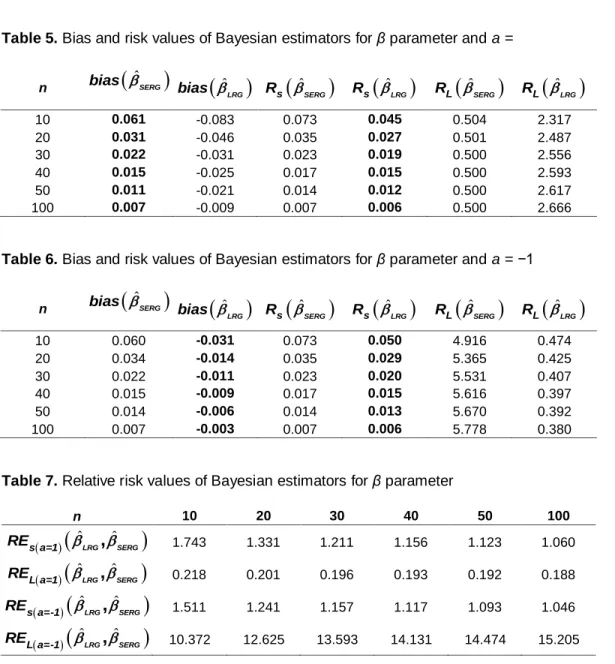
Because comparing different loss functions is not reasonable, compare the results in similar loss function, but in different priors. According to results compiled in Tables 2, 3, 5 and 6, all the four considered Bayesian estimators
based on reciprocal gamma prior have small values of bias. Further, the
ˆSERG estimator has smaller bias than
ˆLRG estimator for a = 1 while
ˆLRG estimator has smaller bias than
ˆSERG estimator for a = −1.According to Tables 2, 3, 5 and 6, among the four considered Bayesian risks based SEL the RS
ˆLRG has the smallest values of risk for various values of sample size.Also among the four considered Bayesian risks based LINEX, the RL
ˆLJhas the smallest values of risk for various values of sample size.
Table 2. Bias and risk values of Bayesian estimators for β parameter and a = 1 n
ˆ
SEJ
bias
ˆLJ
bias Rs
ˆSEJ
Rs
ˆLJ RL
ˆSEJ
RL
ˆLJ10 0.072 -0.090 0.100 0.056 0.047 0.031 20 0.035 -0.047 0.041 0.031 0.020 0.016 30 0.024 -0.031 0.025 0.021 0.012 0.011 40 0.016 -0.025 0.018 0.016 0.009 0.008 50 0.011 -0.022 0.014 0.013 0.007 0.007 100 0.005 -0.011 0.007 0.007 0.003 0.003
Table 3. Bias and risk values of Bayesian estimators for β parameter and a = −1 n bias
ˆSEJ
bias
ˆLJ
ˆ SEJ s R Rs
ˆLJ RL
ˆSEJ
RL
ˆLJ 10 0.065 -0.039 0.099 0.071 0.037 0.032 20 0.034 -0.017 0.041 0.035 0.018 0.016 30 0.022 -0.011 0.025 0.023 0.012 0.011 40 0.018 -0.007 0.018 0.017 0.009 0.008 50 0.013 -0.007 0.014 0.014 0.007 0.007 100 0.007 -0.003 0.007 0.007 0.003 0.003Table 4. Relative risk values of Bayesian estimators for β parameter
n 10 20 30 40 50 100
ˆLJ ˆSEJ
s a=1 RE , 1.524 1.233 1.149 1.110 1.087 1.043
ˆLJ ˆSEJ
L a=1 RE , 1.788 1.338 1.214 1.157 1.124 1.060
ˆLJ ˆSEJ
s a=-1 RE , 1.164 1.078 1.051 1.038 1.031 1.015
ˆLJ ˆSEJ
L a=-1 RE , 1.382 1.174 1.112 1.083 1.066 1.032Table 5. Bias and risk values of Bayesian estimators for β parameter and a =
n bias
ˆSERG
ˆ
LRGbias Rs
ˆSERG
Rs
ˆLRG
RL
ˆSERG
RL
ˆLRG
10 0.061 -0.083 0.073 0.045 0.504 2.317 20 0.031 -0.046 0.035 0.027 0.501 2.487 30 0.022 -0.031 0.023 0.019 0.500 2.556 40 0.015 -0.025 0.017 0.015 0.500 2.593 50 0.011 -0.021 0.014 0.012 0.500 2.617 100 0.007 -0.009 0.007 0.006 0.500 2.666
Table 6. Bias and risk values of Bayesian estimators for β parameter and a = −1
n bias
ˆSERG
ˆ
LRGbias Rs
ˆSERG
Rs
ˆLRG
RL
ˆSERG
RL
ˆLRG
10 0.060 -0.031 0.073 0.050 4.916 0.474 20 0.034 -0.014 0.035 0.029 5.365 0.425 30 0.022 -0.011 0.023 0.020 5.531 0.407 40 0.015 -0.009 0.017 0.015 5.616 0.397 50 0.014 -0.006 0.014 0.013 5.670 0.392 100 0.007 -0.003 0.007 0.006 5.778 0.380
Table 7. Relative risk values of Bayesian estimators for β parameter
n 10 20 30 40 50 100
ˆLRG ˆSERG
s a=1 RE , 1.743 1.331 1.211 1.156 1.123 1.060
ˆLRG ˆSERG
L a=1 RE , 0.218 0.201 0.196 0.193 0.192 0.188
ˆLRG ˆSERG
s a=-1 RE , 1.511 1.241 1.157 1.117 1.093 1.046
ˆLRG ˆSERG
L a=-1 RE , 10.372 12.625 13.593 14.131 14.474 15.205Application to real data
Here, in order to display the usage of proposed model in real data, it is needed to analyze two sets of the seven from the afore presented data in paper by Bennett
and Filliben (2000). Reportedly, they have notified minority electron mobility for
p-type Ga1-xAlxAs with seven different values of mole fraction. To do so, two
data sets are employed relating to the mole fractions of 0.25 and 0.30. The data values are as followed:
Data Set 1 (belongs to mole fraction 0.25): 3.051, 2.779, 2.604, 2.371, 2.214, 2.045, 1.715, 1.525, 1.296, 1.154, 1.016, 0.7948, 0.7007, 0.6292, 0.6175, 0.6449, 0.8881, 1.115, 1.397, 1.506, 1.528.
Data Set 2 (belongs to mole fraction 0.30): 2.658, 2.434, 2.288, 2.092, 1.959, 1.814, 1.530, 1.366, 1.165, 1.041, 0.9198, 0.7241, 0.6403, 0.576, 0.5647, 0.5873, 0.8013, 1.002, 1.250, 1.347, 1.368.
To evaluate the fitting quality of the Rayleigh and LBR distributions, the Kolmogorov-Smirnov (K-S) tests and AIC and BIC’s criterions are used. The
information about comparing both models are given in Table 8. Since probability
values of the LBR model are greater than corresponding values of the Rayleigh model and the AIC and BIC criterions of the LBR model are less than corresponding values of the Rayleigh model. Although the values of considered statistics are not significantly different but we it can be infered that the LBR distribution fits better than the Rayleigh distribution in both considered data.
The MLEs of β are 0.9322 and 0.7309 and the 95 percent confidence
intervals of β based on MLEs as suggested above under heading Parameter
Estimation, can be obtained as (0.6067,1.2577) and (0.4757,0.9861) respectively.
Table 8. Comparing related statistics for Rayleigh and LBR
Data Model D p.value AIC BIC
1 Rayleigh 0.1411 0.7458 46.0090 47.0540
1 LBR 0.1275 0.8427 45.9160 46.9610
2 Rayleigh 0.1354 0.7883 40.3870 41.4320
2 LBR 0.1311 0.8180 39.7820 40.8260
Conclusion
Different estimation procedures were studied for estimating the unknown scale parameter of the WR(α,β) distribution being the maximum likelihood estimator, the method of moment estimator, uniformly minimum variance unbiased estimator, maximum goodness-of-fit estimators and the Bayes estimators. Since it is not possible to compare different methods theoretically, some simulations were used for comparison of different estimators with respect to biases, mean squared errors and risks.
All the four considered Bayesian estimators based on reciprocal gamma prior have small values of bias. In addition, the
ˆSERG estimator has smaller biasthan
ˆLRG estimator for a = 1 but
ˆLRG estimator has smaller bias than
ˆSERG estimator for a = −1.Among the four considered Bayesian risks based SEL the RS
ˆLRG has thesmallest values of risk and based LINEX, the RL
ˆLJ has the smallest values of risk for various values of sample size. Thus from a Bayesian perspective we suggest using
ˆLRG estimator based on SEL and using
ˆLJ based on LINEX loss function.The performance of the MLE and UMVUE is also quite satisfactory and in overall non-Bayesian estimators are better than Bayesian estimators, thereby employing of the MLE and UMVUE estimators can be recommend for all practical purposes.
Acknowledgements
Portions of this paper are developed from the authors’ earlier conference presentation (Ajami & Jahanshahi, 2016).
References
Ajami, M. & Jahanshahi, S. M. A. (2016, August 24-26). Comparison of various estimation methods for size-biased Rayleigh distribution. Paper presented
at the 13th Iranian Statistical Conference, Shahid Bahonar University of Kerman,
Iran.
Alizadeh, N. H. & Arghami, N. R. (2011). Monte Carlo comparison of five exponentiality tests using different entropy estimates. Journal of Statistical
Computation and Simulation, 81(11), 1579–1592. doi:
10.1080/00949655.2010.496368
Bennett, H. S. & Filliben, J. J. A. (2000).A systematic approach for
multidimensional, closed form analytic modeling: minority electron mobilities in
Ga1-xAlxAs heterostructures, Journal of Research of the National Institute of
Standards and Technology, 105(3), 441–452. doi: 10.6028/jres.105.037
Ferguson, T. S. (1996). A Course In Large Sample Theory. New York:
Chapman and Hall.
Gupta, R. C. & Keating, J. P. (1985). Relations for reliability measures
Gupta, R. C. & Kirmani, S. N. U. A. (1990).The role of weighted
distributions in stochastic modeling, Communications in Statistics - Theory and
Methods, 19(9), 3147–3162. doi: 10.1080/03610929008830371
Johnson N. L., Kotz, S., & Balakrishnan, N. (1994). Continuous univariate
distributions, Vol 1 (2nd Ed.). New York: Wiley.
Oluyede, B. O. (1999).On inequalities and selection of experiments for
length-Biased Distributions. Probability in the Engineering and Informational
Sciences, 13(2), 169–185. doi: 10.1017/s0269964899132030
Patil, G. P. & Rao, C. R. (1978).Weighted distributions and size-biased sampling with applications to wildlife populations and human families.
Biometrics,34(2), 179–184. doi: 10.2307/2530008
Patil, G. P. & Ord, J. K. (1976).On size-biased sampling and related
form-invariant weighted distribution. Sankhya: The Indian Journal Of Statistics B, 38,
48–61.
Rayleigh, J. W. S. (1880). On the resultant of a large number of vibrations
of the some pitch and of arbitrary phase, Philosophical Magazine, 5th Series,
10(60), 73–78. doi: 10.1080/14786448008626893
Reshi, J. A., Ahmed, A. & Mir, K. A. (2014). Characterizations and
estimation in the length-biased generalized Rayleigh distribution. Mathematical
Theory and Modeling, 4(6),87-98.
Sanku, D. (2012).Bayesian estimation of the parameter and reliability
function of an inverse Rayleigh distribution, Malaysian Journal of Mathematical
Sciences, 6(1), 113–124.
Soliman, A. A. (2000). Comparison of LINEX and quadratic Bayes
estimators for the Rayleighdistribution. Communications in Statistics - Theory
and Methods, 29(1), 95–107. doi: 10.1080/03610920008832471
Varian, M. M. (1975). A Bayesian approach to real estate assessment. In S.
E. Fienberg and A. Zellner, Ed. Studies in Bayesian Econometrics and Statistics
(In Honor of Leonard J. Savage), pp. 195–208. Amsterdam: North
Holland/Elsevier.
Zelen, M. & Feinleib, M. (1969).On the theory of chronic diseases,
Biometrika, 56(3), 601–614. doi: 10.2307/2334668
Zellner, A. (1986). Bayesian estimation and prediction using loss functions,
Journal of the American Statistical Association. 81(394), 446–451. doi: