A prioritization analysis of disease association by data-mining of
functional annotation of human genes
Takayuki Taniya
a,b, Susumu Tanaka
c, Yumi Yamaguchi-Kabata
b,1, Hideki Hanaoka
d, Chisato Yamasaki
a,b,
Harutoshi Maekawa
a,e, Roberto A. Barrero
f, Boris Lenhard
g, Milton W. Datta
h, Mary Shimoyama
i,
Roger Bumgarner
j, Ranajit Chakraborty
k,l, Ian Hopkinson
m, Libin Jia
n, Winston Hide
o,
Charles Auffray
p, Shinsei Minoshima
q, Tadashi Imanishi
b,⁎
, Takashi Gojobori
b,r,⁎⁎
aJapan Biological Information Research Center, Japan Biological Informatics Consortium, AIST Bio-IT Research Building 7F, 2-4-7 Aomi, Koto-ku, Tokyo 135-0064, Japan
b
Biological Information Research Center, National Institute of Advanced Industrial Science and Technology, 2-4-7 Aomi, Koto-ku, Tokyo 135-0064, Japan
c
Tokyo Metropolitan Institute of Medical Science, 2-1-6 Kamikitazawa, Setagaya-ku, Tokyo 156-8506, Japan
dUniversity of Tokyo, Laboratory of Plant Biotechnology, Biotechnology Research Center, 1-1-1 Yayoi, Bunkyo-ku, Tokyo 113-8657, Japan eC's Lab Co., Ltd., Yamate Bldg. 2F, 7-5-1 Hamamatsu-cho, Minato-ku, Tokyo 101-0041, Japan
f
Centre for Comparative Genomics, Murdoch University, South Street, WA 6150, Australia
g
Center for Genomics and Bioinformatics, Karolinska Institute, Berzelius väg 35, SE-171 77 Stockholm, Sweden
h
Department of Laboratory Medicine and Pathology, University of Minnesota Medical School, United Hospital, 333 N. Smith Ave, Minneapolis, MN, USA
i
Rat Genome Database and Human and Molecular Genetics Center, Medical College of Wisconsin, 8701 Watertown Plank Road, Milwaukee, WI 53226, USA
j
Center for Expression Arrays, Department of Microbiology, University of Washington, 262B Rosen, Seattle, WA 98195, USA
kCenter for Computational Genomics, Institute of Investigative Genetics, University of North Texas Health Science Center, 3500 Camp Bowie Blvd., Fort Worth, TX 76107, USA l
Department of Forensic and Investigative Genetics, University of North Texas Health Science Center, 3500 Camp Bowie Blvd., Fort Worth, TX 76107, USA
m
Cardiovascular Genetics, British Heart Foundation Laboratories, Royal Free and University College Medical School, Rayne Building, University Street, London WC1E 6JJ, UK
n
National Cancer Institute, National Institutes of Health, Bethesda, MD 20892, USA
o
South African National Bioinformatics Institute, University Western Cape, Bellville 7535, South Africa
p
Array s/IMAGE, Genexpress, Functional Genomics and Systems Biology for Health, LGN, UMR 7091-CNRS and Pierre and Marie Curie University, Paris VI, Villejuif, France
qDepartment of Medical Photobiology, Medical Photonics Research Center, Hamamatsu University School of Medicine, 1-20-1 Handayama, Higashi-ku, Hamamatsu, Shizuoka 431-3192, Japan rNational Institute of Genetics, Center of Information Biology and DNA Data Bank of Japan, 1111 Yata, Mishima, Shizuoka 411-8540, Japan
a b s t r a c t
a r t i c l e i n f o
Article history: Received 1 March 2011 Accepted 6 October 2011 Available online 14 October 2011 Keywords: Disease Rheumatoid arthritis Prostate cancer Data-mining Gene function Discriminant analysis
Complex diseases result from contributions of multiple genes that act in concert through pathways. Here we present a method to prioritize novel candidates of disease-susceptibility genes depending on the biological similarities to the known disease-related genes. The extent of disease-susceptibility of a gene is prioritized by analyzing seven features of human genes captured in H-InvDB. Taking rheumatoid arthritis (RA) and pros-tate cancer (PC) as two examples, we evaluated the efficiency of our method. Highly scored genes obtained includedTNFSF12andOSMas candidate disease genes for RA and PC, respectively. Subsequent characteriza-tion of these genes based upon an extensive literature survey reinforced the validity of these highly scored genes as possible disease-susceptibility genes. Our approach, Prioritization ANalysis of Disease Association (PANDA), is an efficient and cost-effective method to narrow down a large set of genes into smaller subsets that are most likely to be involved in the disease pathogenesis.
© 2011 Elsevier Inc. All rights reserved.
1. Introduction
Finding disease-causing genes is one of the major issues in the human genome studies. The use of linkage analysis and positional
cloning techniques has led to the identification of genes involved in nu-merous Mendelian genetic disorders [1–4]. However,finding causative genes for complex disorders is more challenging. Multiple genes con-tribute to the pathogenesis of common disorders and each gene may contribute to a different degree. Therefore, association studies to detect genes contributing to complex diseases are designed by recruiting large numbers of subjects and genotyping many polymorphic markers. The possible susceptible loci identified by association studies usually contain dozens of candidate disease genes. Further studies identifying causative variants and characterizing biological processes of disease-onset mechanism require additional substantial resources, and can be impractical when examining dozens of genes. Even if genome-wide ⁎Corresponding author.
⁎⁎Correspondence to: T. Gojobori, Biological Information Research Center, National Institute of Advanced Industrial Science and Technology, 2-4-7 Aomi, Koto-ku, Tokyo 135-0064, Japan.
E-mail addresses:[email protected](T. Imanishi),[email protected]
(T. Gojobori).
1
Present address: Center for Genomic Medicine, RIKEN, 1-7-22 Suehirocho, Tsurumi, Yokohama 230-0045, Japan.
0888-7543/$–see front matter © 2011 Elsevier Inc. All rights reserved. doi:10.1016/j.ygeno.2011.10.002
Contents lists available atSciVerse ScienceDirect
Genomics
association studies (GWAS) are conducted with an enough number of polymorphic markers, a fraction of markers showing statistically signif-icant associations may be false positive. Infinding genes involved in the disease pathogenesis, it is not easy to distinguish biological relevance from the false positives in studies with a large number of markers. Thus, a method to prioritize candidate disease genes based on a priori biological knowledge is useful to narrow down candidate genes to identify causative genes of common diseases.
Cataloguing human genes [5–7] and annotations enabled us to an-alyze biological information of human genes in various ways. One im-portant application has been to prioritize possible candidate genes of disease implication by evaluating similarity or interactions between genes that have not only sequence homology but also share functional information including biological pathways. Recent studies showed that related phenotypes share common genetic basis and susceptibil-ity genes [8–10] because the proteins involved in the pathogenesis are likely to interact together[11,12]in a few biological pathways. Al-though there are previous studies on prioritizing disease-related genes by use of biological information [13–20], using various kinds of biological information of human genes would be useful. Therefore, we developed a method to prioritize candidate genes for common dis-eases by utilizing biological information of human genes. Our method depends on two assumptions: (1) genes related to a particular disease often have common inherent structural and functional properties, and (2) known causative genes of a particular disease and novel candidate genes for the disease may share specific biological pathways or sub-cellular locations of gene products. The analysis starts with collection and curation of known related genes for the target disease. We ana-lyze enrichment of biological functions in known related genes for the target disease, by using biological terms of functional domains from InterPro (www.ebi.ac.uk/interpro/), Enzyme Commission (EC) numbers (www.chem.qmul.ac.uk/iubmb/enzyme/), biological path-ways from the Kyoto Encyclopedia of Genes and Genomes (KEGG) (www.genome.ad.jp/kegg/) [21], and Gene Ontology (GO) (www. geneontology.org/) [22]. Then we examine all the other genes one by one whether a gene is biologically closer to the known related genes for the target disease than to the other genes by a subsequent discriminant analysis. Finally, we obtain a prioritized list of candidate genes for the disease.
We applied our approach to rheumatoid arthritis (RA) and prostate cancer (PC) in order to evaluate its efficiency. RA is the most common disabling autoimmune disease, affecting approximately 0.3–1% of the population[23]. While the etiology and pathogenesis of RA are not completely understood, a previous report has identified candidate genes and loci that may be related to RA[24]. Another common disease, PC, is the most commonly diagnosed male malignancy, and is the sec-ond leading cause of male cancer mortality in the world[25]. PC has long been known to cluster in families[26], and both segregation and linkage analyses have identified specific prostate cancer susceptibility loci and candidate genes[27,28]. Thus, both RA and PC represent com-plex genetic diseases for which the identification of causative disease genes would have a dramatic impact on public health.
This method, which we implemented by a system, Prioritization ANalysis for Disease Association (PANDA), provides prioritized candi-dates of disease-related genes that are useful for further studies to identify of new causative genes. The resulting output of our approach is a prioritized list of candidate genes for the diseases that represent potential disease biomarkers and perhaps even potential targets for therapies.
2. Results
2.1. Prioritization analysis of candidate genes for RA and PC
Known disease-related genes for RA and PC were retrieved from OMIM database (www.ncbi.nlm.nih.gov/Omim)[29]and subsequently
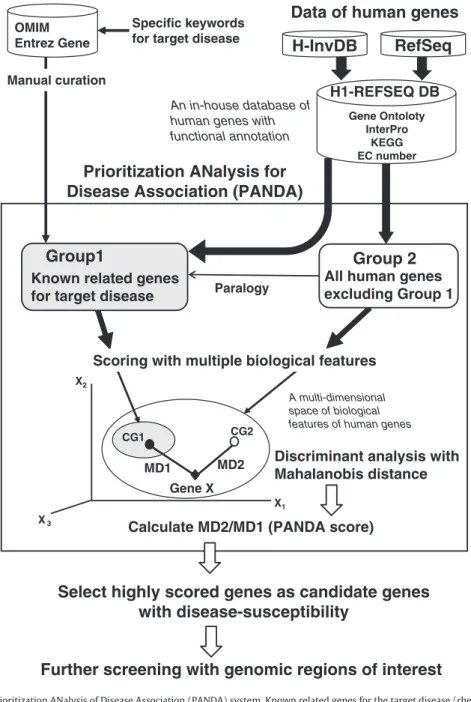
checked in Entrez Gene (www.ncbi.nlm.nih.gov/gene) by using MeSH terms (www.nlm.nih.gov/mesh/) for the two diseases (seeMethods andFig. 1). After manual curation, we selected 139 genes as known RA-related genes and 296 genes as known PC-related genes (Supple-mental Tables 1–2). These genes were used as‘training sets’to analyze all other genes in the H1-REFSEQ DB (an in-house database of all human genes containing 14,959 human genes, seeMethods) for likeliness of disease susceptibility. Biological information of all human genes was re-trieved from H-InvDB, and seven biological features (paralogy, InterPro, EC number, biological pathways from KEGG, and three categories of Gene Ontology, seeMethods) of human genes were used to examine bi-ological similarity of a gene to a group of known related genes for the target disease (group 1) or another group of all the other genes (group 2). Then we examined whether a gene tested is closer to the group 1 than to the group 2 by comparing the Mahalanobis distance be-tween a gene and the group 1 (MD1) with another distance bebe-tween the gene and the group 2 (MD2). We calculated the ratio of MD2 to MD1 (PANDA score) for each gene tested. To narrow down more prom-ising candidate genes for the target diseases, we used a higher thresh-old; the average values of the PANDA score for the known related genes (21.2 for RA and 14.1 for PC). As a result, 526 genes were detected as candidate genes for RA and 609 genes for PC (Table 1).
2.2. Candidate genes on genomic regions of interest
Although putative susceptible loci for RA and PC have been identi-fied by linkage analysis, association study, comparative genomic hy-bridization and chromosomal transfer, the actual genes involved in the disease have not been identified yet for many of these genomic re-gions. Therefore, a localization of a candidate gene on one of these geno-mic regions of interest (GROI) provides additional support for its potential role in the disease. To select candidate disease genes in GROIs, we searched the GROIs in OMIM for RA and PC, and found nine GROIs for RA and 18 GROIs for PC (listed in Supplemental Tables 3–4). Then we selected the candidate genes that were localized within these GROIs, and obtained 56 candidate genes for RA and 63 for PC.
2.3. Highly scored genes for rheumatoid arthritis
To further narrow down the most plausible candidate genes for RA, we ranked the 56 candidates on the GROIs according to the discrimi-nant analysis with the Mahalanobis distances (Supplemental Table 3). We inspected the highly scored genes, surveyed literature and found that these genes included biologically reasonable candidate genes. For example, tumor necrosis factor ligand superfamily member 12
(TNFSF12) showed the third highest score in 17p13 (Table 2A) which
is one of the GROIs with RA[24]. TheTNFSF12gene shares three GO an-notations (tumor necrosis factor receptor, immune response and mem-brane) with other known RA-related genes, including TNF (tumor necrosis factor), HLA-DRB1 (major histocompatibility complex, class II, DR beta 1) and toll-like receptor 2 (TLR2) (Table 2B). The
TNFSF12gene is expressed in macrophages, which infiltrates the
syno-vial membrane to form the inflammatory pannus that is characteristic of RA invading joint cartilage and destroying the underlying bone. TNFSF12 induces activation of matrix metallopeptidase 9 through nu-clear factor of kappa light polypeptide gene enhancer in B-cells 1 (NFKB1) pathway[30]that controls the incidence of collagen-based ar-thritis in mice through modulation of inhibitor of kappa light polypep-tide gene enhancer in B-cells, kinase beta (IKBKB)[31,32]. In addition, a molecule in the NFKB1 pathway, encoded by nuclear factor of kappa light polypeptide gene enhancer in B-cells inhibitor-like 1(NFKBIL1), was reported as a candidate RA-susceptibility gene, from an evidence of a di-allelic polymorphism in the promoter region of the gene[33]. Biological annotation of TNFSF12 shows functional similarities with some of the known RA-related genes. Thus, our result suggests that
2.4. Highly scored genes for prostate cancer
Similarly, we ranked the 63 candidate genes for PC (Supplemental Table 4) that were located in the 18 GROIs. One GROI for PC, 22q12, has been reported to be associated with PC by a combined genome-wide linkage scan[34]. The highly scored genes in 22q12 included Oncostatin M (OSM) with the highest PANDA score (30.4,Table 3A). OSM, an interleukin 6 (IL6)-type cytokine, induces activation of the androgen receptor (AR) in the absence of androgen[35].OSMshares four GO annotations (cytokine activity, immune response, regulation of cell growth, extracellular) with known PC-related genes, including
IL6,IL8,IGFBP3andINS(Table 3B). Interestingly, AR and IL6 have been
implicated as relevant molecules for PC, and were present in the known PC-related genes as the training set. Thus, OSM is a candidate
OMIM Entrez Gene
Select highly scored genes as candidate genes
with disease-susceptibility
MD2 MD1 X2 3 X1 X CG1 CG2H1-REFSEQ DB
H-InvDB
Group1
Group 2
All human genes
excluding Group 1
ParalogyGene X
Known related genes
for target disease
Data of human genes
RefSeq
Prioritization ANalysis for
Disease Association (PANDA)
Calculate MD2/MD1 (PANDA score)
Further screening with genomic regions of interest
Discriminant analysis with
Mahalanobis distance
Scoring with multiple biological features
Specific keywords for target disease
Manual curation Gene Ontoloty InterPro KEGG EC number A multi-dimensional space of biological features of human genes An in-house database of
human genes with functional annotation
Fig. 1.Analysis pipeline with the Prioritization ANalysis of Disease Association (PANDA) system. Known related genes for the target disease (rheumatoid arthritis and prostate can-cer in this study) were retrieved from OMIM and Entrez Gene, manually annotated and used as training set (group 1). We examined the proportion of biological terms in the train-ing set and that in all human genes (H1-REFSEQ DB, seeMethods). Based on different proportions of biological functions between the training set and all human genes, scores for multiple parameters were given to the all human genes. Candidate disease-related genes were prioritized by the discriminant analysis with multiple parameters. We calculated the Mahalanobis distances (MD1) between the position of a gene tested (open diamond) and the center of gravity of the group 1 (CG1, open circle) with multiple parameters. Similarly the Mahalanobis distances (MD2) between each gene and the center of gravity of the group 2 (CG2,filled circle) were calculated. Then we calculated the ratio of MD2 to MD1 (PANDA score) for each gene. Using the average value of the PANDA score for the known disease genes as a threshold, we considered any gene to be a candidate gene of disease-susceptibility if the ratio was greater than the threshold.
Table 1
Summary of prioritization analysis of disease-susceptibility genes for RA and PC. Disease relation Predicted similarity to known disease genes RA PC
Known – 139 296
Unknown Yesa
526 609
No 14,294 14,054
Candidate genes with disease-susceptibility for rheumatoid arthritis (RA) and prostate cancer (PC) were prioritized by analyzing biological information of human genes. We analyzed total 14959 human genes in H1-REFSEQ DB (an in-house database of human genes) including known related genes for the target diseases as the training sets. Each gene was tested one by one whether the gene is more similar to the known disease genes than the others by data-mining and discriminant analysis (see
Methods). The numbers of genes for each category are shown.
a
Genes whose PANDA scores (MD2/MD1) were higher than the threshold (the me-dian in the training set).
molecule that is involved in the disease onset of prostate cancer, pos-sibly through its modulation of IL6 related pathways.
2.5. Sensitivity of predicting disease-related genes
In order to evaluate the sensitivity of our approach for predicting disease genes, we examined whether the method correctly detects one of the known related genes for the target disease, which was replaced in a group of genes tested. This is an application of the leave-one-out cross-validation (LOOCV)[36], and we sequentially re-moved one of the known related genes for the target disease from the training set and placed it in the group of genes to be tested. Then, we calculated a new MD2/MD1 score (PANDA score), and checked whether the PANDA score of the removed gene was greater than 1. As a result, 126 of 139 (90.6%) known RA-related genes had scores greater than 1 (Supplemental Table 5). In the same way, 264 of 296 (89.2%) known PC-related genes showed higher scores than 1 (Supplemental Table 6).
2.6. Contribution of the data type to prioritize candidates of disease gene
We used the seven biological features of human genes to calculate Mahalanobis distance between a gene and a set of genes. However, it is not clear whether larger numbers of parameters increase the power of prediction and what data type is more effective than the other data. To see how the number of parameters affects the predic-tion power, we examined the sensitivity to identify the known dis-ease genes by the LOOCV with different numbers of parameters in different combinations. First, we examined the sensitivity tofind a known disease gene with seven parameters and compared the results with only GO annotations (molecular function, biological process and cellular component). The sensitivities by LOOCV were 74.8% (104 of 139) for the known RA genes and 72.6% (215 of 296) for the known PC genes when only GO annotation was used (Supplemental Tables 5–6). These sensitivities were slightly lower than that with the seven parameters.
We also examined the sensitivities tofind known disease genes for RA in all the 120 combinations of using 2–7 parameters (Supplemental Table 5). In identifying the known RA genes, the sensitivity was the highest when all the seven parameters were used. Three combinations of 5–6 parameters had high sensitivities as the seven parameters for the RA genes (Supplemental Table 5) when at leastfive parameters (InterPro, EC number and three GO concepts) were used.
The sensitivity of identifying the known PC-related genes was ex-amined in all 120 combinations of the parameters in the same way (Supplemental Table 6). The use of all the seven parameters showed the second highest sensitivity for identifying the known PC-related genes. Three combinations of 5–6 parameters were a little more sen-sitive than the use of the seven parameters, and two combinations of 4 or 6 parameters had the same sensitivity as the seven parameters (Supplemental Table 6). Thesefive combinations had at least four pa-rameters including InterPro, GO molecular function and GO biological process in common. These results suggest that using several features including GO would be effective for prioritization of disease-susceptibility genes.
3. Discussion
In the past several years, several attempts have been made to devel-op methods for prioritizing potential disease-susceptibility candidates [13–15], and these are based on sequence similarities between genes and functional annotations from Gene Ontology. Perez-Iratxeta et al. developed a method based on the co-appearance of GO terms and MeSH disease terms[16,17]. In contrast, Freudenberg et al. used the clustering method to identify new disease genes[18], while Turner et al. presented prioritization of candidate genes using statistics (POCUS) based on the over-representation of the annotated function for the target disease[15]. Although these methods have been relative-ly successful, there are two problems in identifying disease-related genes: (1) these methods strongly depend on kind of functional infor-mation (i.e., inforinfor-mation from GO), and (2) some frequently appearing biological terms in human genes can be“background noise”because
Table 2A
Highly scored genes within 17p13 in relation to RA.
Gene symbol Gene name Transcript PANDA score (MD2/MD1)
No. of GO featuresa
No. of other featuresb
CHRNE Cholinergic receptor, nicotinic, epsilon polypeptide NM_000080 85.3 3 0 CHRNB1 Cholinergic receptor, nicotinic, beta polypeptide 1 (muscle) BC011371 85.3 3 0 TNFSF12 Tumor necrosis factor (ligand) superfamily, member 12 NM_172089 62.1 3 0
NLGN2 Neuroligin 2 AB037787 16.2 2 2
MYH10 Myosin, heavy polypeptide 10, non-muscle AK026977 14.7 1 2
AURKB Aurora kinase B BC000442 13.6 2 3
ALOX12P2 Arachidonate 12-lipoxygenase pseudogene 2 AL832768 11.2 0 2
ALOX15 Arachidonate 15-lipoxygenase BC029032 11.2 2 3
KIF1C Kinesin family member 1C AB014606 10.5 2 2
Highly scored genes were ranked by the PANDA score (MD2/MD1).
a
Number of GO features of the gene (molecular function, biological process, and cellular component).
b
Number of non-GO features of the gene for four features (amino acid sequence similarity, InterPro, EC number, and KEGG pathways).
Table 2B
Scores forTNFSF12in relation to RA.
Parameter Functional annotation ID Base relevance score
Proportion in gene set Score to TNFSF12a
Training set All human genes GO molecular function Tumor necrosis factor receptor binding GO:0005164 (6)b
2.5 0.0102 0.0011 134.85 GO biological process Immune response GO:0006955 (7) 1.77 0.2342 0.0168 173.16 GO cellular component Membrane GO:0016020 (4) 2.03 0.2714 0.2704 8.14 Among the seven parameters, details for the three concepts of GO terms are shown. The score of paralogy was 0 becauseTNFSF12did not have a sequence similarity to any known RA-related gene. The scores of InterPro, EC number and KEGG pathway were also 0.
a
Scores were calculated by Eqs.(2) and (3).
they may be common terms frequently found in disease-related genes. For instance, if the training sets include genes encoding proteins that belong to large superfamilies such as immunoglobulin-like domain containing proteins, too many members of the same superfamily may be prioritized as candidate genes for the disease. In order to overcome such possible biases of these methods, we developed a robust method in which we use multiple sources of gene annotation and leverage training sets consisting of known disease genes. Aerts et al. constructed Endeavour which prioritizes disease susceptibility candidate genes [19]. However, the problem of“background noise”in the functional terms was not resolved in their study. Using seven methods for compu-tational prioritization of disease genes, Tiffin et al. (2006) generated a list of nine candidate genes for type 2 diabetes (T2D) common to six of the seven methods[20]. We have also identified three of the nine T2D candidate genes using PANDA system (data not shown), suggest-ing that our method can pick up reasonable candidate genes for multi-factorial diseases.
Here, we have highlighted two examples (TNFSF12andOSM) that were selected with three GO annotation categories. These two genes,
TNFSF12andOSM, had no positive scores for the other parameters
(Tables 2B and 3B). The prioritized genes included another candidate gene for PC, kringle containing transmembrane protein 1 (KREMEN1) with the second highest PANDA score in 22q12 (Table 3A).KREMEN1
has only two InterPro annotations that are shared with known PC-related genes including plasminogen activator urokinase (PLAU), plasminogen (PLG), hepatocyte growth factor (HGF), suppression of tumorigenicity 14 (ST14), and neuropilin 1 (NRP1) (data not shown). This suggests that a simultaneous usage of various features of human genes with GO annotation is effective for prioritization of disease-related genes.
To ensure that the prioritized genes are likely to be associated with the targeted disease, we surveyed subsequent reports in which a causative link to disease is shown. Interestingly, Godoy-Tundidor et al. reported that IL6 and OSM stimulate proliferation of prostate
cancer cells, at least in part, through activation of the phosphatidyli-nositol 3-kinase signaling pathway[37]. Therefore,OSM, one of the predicted candidate genes for PC, may be a reasonable candidate gene. We checked if there is any newly reported gene with suscepti-bility to RA or PC by searching for the later releases of the public da-tabases (OMIM, Entrez GENE, and PubMed). Then we prepared lists of known related genes for RA and PC again with new data. Between August 2004 and January 2008, 40 genes were newly described as RA-related genes in the OMIM database (Supplemental Table 7). When we conducted PANDA analysis by using this enhanced training set, eight genes of the 40 genes were selected in the training set via Entrez Gene. Three genes (FLT1,IL1RNandEBI3) of the remaining 32 genes were identified as candidate RA-susceptibility genes by our PANDA analysis (PANDA score > 21.2, Supplemental Table 7). Howev-er, theLGALS3 gene encoding galectin-3 was not highly scored al-though some galectin superfamily members are involved in pathogenesis of RA. This may be because that the gene data for galec-tin proteins had little functional annotation. One of limitations of our approach is that genes with little annotation are less likely to be pri-oritized as candidate disease genes. The highly scored genes included
FLT1(PANDA score = 115.5) whose gene product, FLT1, inhibits vas-cular endothelial growth factor (VEGF) response. The VEGF response may be involved in the pathogenesis of RA, because De Bandt et al. found that VEGFA, FLT1, and KDR are expressed in synovial cells from arthritic joints, using a transgenic mouse model of RA and anti-bodies to these three proteins [38]. Another gene prioritized was
IL1RN (PANDA score = 33.8) whose gene product, IL1RN, inhibits
IL1R binding by IL1-alpha and IL1-beta. Because these two cytokines (IL1-alpha and IL1-beta) are involved in both immune response and inflammatory response [39],IL1RN may be associated in the patho-genesis for RA. Recently, new susceptible loci for RA have been detected by GWAS [40–43], and many of them are genes involved in immune and inflammatory responses. Thus our analysis may have worked to predict biologically reasonable candidate genes.
Table 3A
Highly scored genes within 22q12 in relation to PC.
Gene symbol Gene name Transcript PANDA score (MD2/MD1) No. of GO featuresa No. of other featuresb OSM Oncostatin M NM_020530 30.4 3 0
KREMEN1 Kringle containing transmembrane protein 1 NM_032045 22.4 0 1
GAS2L1 Growth arrest-specific 2 like 1 NM_006478 20.6 1 1
TIMP3 Tissue inhibitor of metalloproteinase 3 NM_000362 17.5 0 2
LIMK2 LIM domain kinase 2 NM_005569 17.3 2 2
PIK3IP1 HGFL gene BC011049 16.6 0 1
ADRBK2 Adrenergic, beta, receptor kinase 2 NM_005160 16.4 2 2 CHEK2c
CHK2 checkpoint homolog (S. pombe) NM_007194 15.5 2 2
PLA2G3 Phospholipase A2, group III NM_015715 14.5 2 2
NF2 Neurofibromin 2 BC020257 11 1 2
The prioritized genes were ranked by the PANDA score (MD2/MD1).
a
Number of GO features (0–3) of the gene (molecular function, biological process, and cellular component).
b
Number of non-GO features (0–4) of the gene (amino acid sequence similarity, InterPro, EC number, and KEGG pathways).
c
This gene was included in the training set in the subsequent analysis with new data.
Table 3B
Scores forOSMin relation to PC.
Parameter Functional annotation ID Base relevance score
Proportion in gene set Score to OSMa
Training set All human genes GO molecular function Cytokine activity GO:0005125 (5)b
2 0.0043 0.0018 23.12
GO biological process Immune response GO:0006955 (7) 2 0.0158 0.0168 107.05 Regulation of cell growth GO:0001558 (6) 2 0.0158 0.0020
GO cellular component Extracellular GO:0005576 (3) 1.63 0.1348 0.0510 12.95 Among the seven parameters, details for the three concepts of GO terms are shown. The score of paralogy was 0 becauseOSMdid not have a sequence similarity to any known PC-related gene. The scores of InterPro, EC number and KEGG pathway were also 0.
a
Scores were calculated by Eqs.(2) and (3).
b
We also searched for newly added PC-related genes in the OMIM database between August 2004 and January 2008, and found 57 addi-tional PC-related genes that had not been reported in 2004. Then we conducted PANDA analysis again with the enhanced training set (Supplemental Table 8). Among these 57 genes, 17 genes were select-ed in the training set via Entrez Gene, and two genes, HNF1 homeo-box B (HNF1B) and Eph receptor B2 (EPHB2), of the remaining 40 genes were identified as candidate genes by our analysis (in which PANDA score was larger than 14.1, a threshold value in this analysis). In particular, EPHB2 showed the second highest score (PANDA score = 40.4) among the genes that are located at 1p36.1. This gene is of great interest because Huusko et al. identified mutations affect-ing translation inEPHB2in human prostate cancer cells[44]. Although reports of new susceptible loci for PC are increasing by GWAS, analy-sis of gene expression, and cancer genome sequencing [45–48], re-sults of these studies include false positives. Our approach would be useful tofind biologically relevant candidate genes from results by such large-scale analyses.
Although we showed that our approach can predict reasonable candidate disease genes, the approach can be extended in the follow-ing ways. First, by includfollow-ing text-minfollow-ing techniques, we will be able to make enhanced training sets for other complex diseases through automated processes. This will allow researchers to select training sets for PANDA analysis without detailed disease-specific knowledge or manual annotation of literature. Second, an expansion of parame-ters (e.g. including protein–protein interaction, gene-gene interaction and gene expression) and a customized selection of parameters would increase theflexibility of the analysis and improve the sensi-tivity in prioritizing disease-related genes that do not have functional similarities with known disease genes or do not have detailed func-tional annotations. Such developments should further allow re-searchers to leverage their knowledge base and experience to efficiently prioritize disease-related candidate genes.
This approach, implemented in the PANDA system, is an efficient and cost-effective method to narrow down a large set of genes that are typically identified in microarray or mapping studies, into a smal-ler subset most likely to be associated with the disease. In addition, the PANDA system would be a useful tool to prioritize biologically rel-evant candidate genes with result of GWAS, large-scale gene expres-sion data and genome sequencing tofind causative variants[49,50].
4. Methods
4.1. Data of human genes
We retrieved data of human genes from the two databases, H-InvDB [6]and RefSeq[5]. H-InvDB (version 1.0, on 15th July 2002) contained 41,118 H-Inv cDNAs, and RefSeq contained a set of 37,488 human mRNA sequences that were available on September 1st, 2003. After merging the two datasets of human genes and removing the genes hav-ing no functional information, we created the H1-REFSEQ DB containhav-ing a total of 14,959 human genes. We used representative transcripts (one transcript for one gene) instead of all genes in H1-REFSEQ DB to remove the redundancy of cDNAs due to multiple forms of alternative splicing variants. Information of gene structure and functional annotation for the 14,959 human genes was retrieved from the H-InvDB[6].
4.2. Selection and curation of known related genes for the target diseases
Known related genes for the target diseases (RA and PC in this study) were searched from the OMIM database (www.ncbi.nlm.nih. gov/Omim)[29]and Entrez Gene (www.ncbi.nlm.nih.gov/gene),fi l-tered and curated (see below), so that we can use them as the train-ing sets of our prioritization analysis. We used MeSH terms (www. ncbi.nlm.nih.gov/mesh) associated with the two diseases (‘arthritis, rheumatoid’, and ‘rheumatoid, juvenile arthritis’ for RA; ‘prostatic
neoplasms’and ‘prostatic intraepithelial neoplasia’for PC) to scan all abstracts of papers cited in OMIM and Entrez Gene. We obtained 231 genes as possible RA-related genes and 728 genes for possible PC-related genes in August 2004.
Next, the two gene sets werefiltered to select genes that have a series of curated references linked by PubMed IDs. We gave scores to these known disease genes based on the associated disease MeSH terms in their PubMed abstracts. The scores (1, 2, or 3) were assigned automatically according to the number of major MeSH topics that an abstract contained; no asterisk (1), asterisk for subheading (2), or as-terisk for specific disease term (3). Then we manually annotated each reference whether the relationship between the gene and the target disease was mentioned by checking phenotype-specific terms. Each abstract of the article was reviewed by two or more persons to avoid possible problems by different interpretations and annotations between persons. We did not weight the articles according to ap-proaches, sample numbers or ethnicity when we annotated the dis-ease susceptibilities of genes. The information we collected included some genes whose role in the pathogenesis was examined in mouse models. We did not give scores to the studies without functional val-idation. Functionally-related genes for RA included those involved in inflammation of synovial membrane, degeneration of synovial joints or immune response. Functionally-related genes for PC included those involved in the proliferation of cells, signal transduction and transcription factors. After discarding genes that were not clearly re-lated to the disease from a list of disease-rere-lated genes, we obtained 139 relevant genes for RA and 296 genes for PC (Supplemental Tables 1–2).
The selected known disease-related genes were used as the train-ing set of the prioritization analysis with the relevance scores, which were automatically given and manually checked (mentioned above). Because one known disease gene may have multiple reference arti-cles about susceptibility to the disease, we calculatedwi, the arith-metic mean of all baseline relevance scores for a particular genei. This wi was used as a parameter of disease susceptibility for a known related gene for the target disease.
4.3. Analysis of biological information of known related genes for target disease and all human genes
We selected genes that are relevant to the target disease from OMIM and Entrez Gene by querying disease-specific MeSH terms (downloaded on September 5, 2003). We then used these genes as a training set to analyze biological information for prioritization of candidates of disease-related genes. To utilize biological information for the analysis, annotated biological information on human genes from H-InvDB was analyzed with respect to the enrichment of specific biological terms in the known related genes for the target disease. The levels of enrichment of biological terms were converted into scores using several formulae (see below). The paralogy with the known re-lated genes for the target disease was also examined based on similar-ity of amino acid sequence by using the BLAST program[51]. We gave a higher score for a gene that had sequence similarity to the known related gene for the target disease (see below). In total, we used seven kinds of biological feature of human genes (sequence similarity, InterPro annotation, EC number, three kinds of GO terms, and KEGG pathways).
4.4. Sequence similarity to known related genes for the target disease: the paralogy score
Paralogous genes that result from gene duplications have a simi-larity in their sequence and may share some related biological fea-tures[52]. Therefore, a paralogous gene with known disease gene may be more likely to be involved in the disease than other genes. Based on this concept, we calculated‘paralogy score’so that we give
a higher priority to a gene when the gene has a similarity to any known related gene for the target disease. For this purpose, we searched for genes that have sequence similarity to each known relat-ed gene for the target disease. We comparrelat-ed amino acid sequences by using BLAST[51], and‘paralogous’gene pairs were identified with significance cutoff values ofe-100,80,60and40. When a genei(no previous evidence of linkage to the disease) has a similarity to known disease genei′, the paralogy scoreSp,iof a genei(no previous evidence of linkage to the disease) has a positive value given by the equation:
Sp;i¼−wi’ð1–log10½e−valueÞR; ð1Þ
wherewi′is the baseline relevance score for the known disease genei′ with which the geneiis similar to. We set the weightR(R100= 1 for the gene pairs whose similarity significance was detected withe-100) for the cases that sequence similarity was detected by the lower sig-nificance levels (Rvalues fore-80,60and40are given in Supplemen-tal Table 9). When geneidoes not have a similarity to any known related gene for the disease, this score was set to be 0.
4.5. Enrichment of functional terms: disease gene functional score
Genes associated with a disease may be prioritized through their functional similarities to known related genes for the disease or shared physiological pathway with known related genes with the dis-ease. Here, we have made the assumption that certain groups of genes having related functions may be over or under-represented in a group of genes related to a specific disease. To test this assumption, we compared the frequencies of biological terms between the known related genes to the target disease and all the genes in H1-REFSEQ DB. The biological terms from the following resources were analyzed; InterPro identifiers (www.ebi.ac.uk/interpro/), EC numbers (www. chem.qmul.ac.uk/iubmb/enzyme/), KEGG pathways (www.genome. ad.jp/kegg/) [21], and gene ontology (GO) (www.geneontology.org/ ). For the known PC-related genes, “regulation of transcription, DNA-dependent”was the most frequent among the terms in“ biolog-ical processes”of GO. However, this term was also frequent in all the cDNAs in H1-REFSEQ DB. From the disease-specific perspective for PC, “synaptic vesicle endocytosis” and “anti-apoptosis”, were over-represented in the PC-related genes. As the prostate is an endocrine organ and secretesfluids, vesicle transport is an important compo-nent of its function. Apoptosis has also been extensively studied in cancer cells as a survival mechanism. Based on these observations we have extended the analysis to individual genes by quantifying and ranking the potential disease genes based on their levels of asso-ciation to known disease-related genes through functional similarity or linkage to common physiological pathways. To carry out these comparisons we have utilized functional terms associated with genes, including InterPro identifiers, EC numbers, and KEGG pathway IDs, and expressed the proportion of each term for genes in the dis-ease group compared with the frequencies among all genes in H1-REFSEQ DB. For a given functional termjin gene annotation, a score of relevance to the target disease was calculated by using the ratio of the proportion of genes with the term in known disease genes to the proportion of genes with the term in all human genes. This ratio was multiplied by the base score of disease relevance of the term (wj) based on curation of the known disease genes (see above). Therefore, the score,Sf,j, was calculate by the equation
Sf;j¼wjPd;j=Pa;j; ð2Þ
wherePd,jis the proportion of genes with the term in known disease genes, andPa,jis the proportion of genes with the term in all human genes. This score was used as an indicator of the specificity of a func-tional term in known disease genes for the target disease. For a gene
whose disease relevance is unknown, the score was calculated by summingSf,jfor all the functional terms with the gene.
4.6. Use of biological terms in gene ontology data: GO score
The gene ontology[22]is composed as“a nested hierarchical vo-cabulary” of biological terms in which ‘general’ parent terms have nested child terms that are more specific. We have taken advantage of the nested hierarchy present within the GO terminology to pro-vide a scoring system for functional specificity based on the position of GO terms within the hierarchy. For example, cell (GO:0005623), is afirst-level GO term under the‘cellular component’category, nucle-us (GO:0005634), is a third-level term under the same category of “cellular component”. Therefore, we gave a higher weight (Pf,j) for a GO termjin a lower hierarchy. The score of GO term j,Sgo,j, was calculated as a product ofPh,jandSf,j:
Sgo;j¼Ph;jSf;j: ð3Þ
The score of GO term for a gene was calculated as the sum ofSgo,j for all the GO terms for the three concepts (molecular function, bio-logical processes, and cellular components) with the gene.
4.7. Prioritization of candidates of disease-related genes by discriminant analysis
Integration of biological information from human genes allowed us to evaluate similarities between a given gene and multiple sets of genes. Here, there are two groups of genes; thefirst group is known related genes to the target disease and the second group is all other genes. For a given gene tested, a distance between the gene and the known related genes for the target disease (group 1) was compared with another distance between the gene and all the other genes (group 2). To express the distance between a gene and the center of gravity of a group of genes, the Mahalanobis distance[34]was calcu-lated. For each gene from the group 2, we examined whether the gene is closer to the group 1 than to the group 2 by using Mahalanobis dis-tances and discriminant analysis. The Mahalanobis distance for a given geneiand the group 1 (MD1) was calculated as:
MD1¼ ffiffiffiffiffiffiffiffiffiffiffiffiffiffiffiffiffiffiffiffiffiffiffiffiffiffiffiffiffiffiffiffiffiffiffiffiffiffiffiffiffiffiffiffiffiffiffiffiffiffiffiðXi−μ1Þ0Cov−11ðXi−μ1Þ
q
; ð4Þ
whereXiis a vector for geneiconsisting of scores of multiple param-eters (seven paramparam-eters in this analysis),μ1is a vector of mean values in the group 1, andCov1−1is an inverse of the covariance matrix of the observed values of the seven parameters for the group 1. The Mahala-nobis distance between a query gene and the group 2 (MD2) was cal-culated in a same way. Then we judged whether a gene is closer to the group 1 (known related genes for the target disease) than the group 2 (all the other genes). Because we consider a gene showing smaller MD1 than MD2 to be a disease-susceptibility candidate, we calculated the ratio of MD2 to MD1 (PANDA score). We also calculated the PANDA score for each of known related genes to the target diseases (the training set) in the same way, and the average score in the train-ing set was calculated. Ustrain-ing the average score for the traintrain-ing set as a threshold, we considered any gene to be a candidate gene of disease-susceptibility if the score was greater than the threshold. Our results obtained by the prioritization analysis of disease association (PANDA) are available athttp://www.h-invitational.jp/panda/app.
Supplementary materials related to this article can be found on-line at doi:10.1016/j.ygeno.2011.10.002.
Acknowledgments
We thank Drs. Peter Tonellato, Arek Kasprzyk, Teruyoshi Hishiki, Craig Gough, Makoto Shimada, and Naoki Nagata for their helpful dis-cussion and comments on this study. We also thank all the members of the H-Invitational consortium and all the staff of JBIRC for construc-tion of H-InvDB and the PANDA system. This work isfinancially sup-ported by the Ministry of Economy, Trade and Industry of Japan (METI), the Ministry of Education, Culture, Sports, Science and Tech-nology of Japan (MEXT), the Japan Biological Informatics Consortium (JBiC), and National Institute of Advanced Industrial Science and Technology (AIST).
References
[1] A.L. Beaudet, 1998 ASHG presidential address. Making genomic medicine a reali-ty, Am. J. Hum. Genet. 64 (1999) 1–13.
[2] J. Bell, The new genetics in clinical practice, BMJ 316 (1998) 618–620. [3] J.P. Evans, C. Skrzynia, W. Burke, The complexities of predictive genetic testing,
BMJ 322 (2001) 1052–1056.
[4] K. Finkler, C. Skrzynia, J.P. Evans, The new genetics and its consequences for fam-ily, kinship, medicine and medical genetics, Soc. Sci. Med. 57 (2003) 403–412. [5] D.R. Maglott, K.S. Katz, H. Sicotte, K.D. Pruitt, NCBI's LocusLink and RefSeq, Nucleic
Acids Res. 28 (2000) 126–128.
[6] T. Imanishi, T. Itoh, Y. Suzuki, C. O'Donovan, S. Fukuchi, K.O. Koyanagi, R.A. Barrero, T. Tamura, Y. Yamaguchi-Kabata, M. Tanino, K. Yura, S. Miyazaki, K. Ikeo, K. Homma, A. Kasprzyk, T. Nishikawa, M. Hirakawa, J. Thierry-Mieg, D. Thierry-Mieg, J. Ashurst, L. Jia, M. Nakao, M.A. Thomas, N. Mulder, Y. Karavidopoulou, L. Jin, S. Kim, T. Yasuda, B. Lenhard, E. Eveno, Y. Suzuki, C. Yamasaki, J. Takeda, C. Gough, P. Hilton, Y. Fujii, H. Sakai, S. Tanaka, C. Amid, M. Bellgard, F. Bonaldo Mde, H. Bono, S.K. Bromberg, A.J. Brookes, E. Bruford, P. Carninci, C. Chelala, C. Couillault, S.J. de Souza, M.A. Debily, M.D. Devignes, I. Dubchak, T. Endo, A. Estreicher, E. Eyras, K. Fukami-Kobayashi, G.R. Gopinath, E. Graudens, Y. Hahn, M. Han, Z.G. Han, K. Hanada, H. Hanaoka, E. Harada, K. Hashimoto, U. Hinz, M. Hirai, T. Hishiki, I. Hopkinson, S. Imbeaud, H. Inoko, A. Kanapin, Y. Kaneko, T. Kasukawa, J. Kelso, P. Kersey, R. Kikuno, K. Kimura, B. Korn, V. Kuryshev, I. Makalowska, T. Makino, S. Mano, R. Mariage-Samson, J. Mashima, H. Matsuda, H.W. Mewes, S. Minoshima, K. Nagai, H. Nagasaki, N. Nagata, R. Nigam, O. Ogasawara, O. Ohara, M. Ohtsubo, N. Okada, T. Okido, S. Oota, M. Ota, T. Ota, T. Otsuki, D. Piatier-Tonneau, A. Poustka, S.X. Ren, N. Saitou, K. Sakai, S. Sakamoto, R. Sakate, I. Schupp, F. Servant, S. Sherry, R. Shiba, N. Shimizu, M. Shimoyama, A.J. Simpson, B. Soares, C. Steward, M. Suwa, M. Suzuki, A. Takahashi, G. Tamiya, H. Tanaka, T. Taylor, J.D. Terwilliger, P. Unneberg, V. Veeramachaneni, S. Watanabe, L. Wilming, N. Yasuda, H.S. Yoo, M. Stodolsky, W. Makalowski, M. Go, K. Nakai, T. Takagi, M. Kanehisa, Y. Sakaki, J. Quackenbush, Y. Okazaki, Y. Hayashizaki, W. Hide, R. Chakraborty, K. Nishikawa, H. Sugawara, Y. Tateno, Z. Chen, M. Oishi, P. Tonellato, R. Apweiler, K. Okubo, L. Wagner, S. Wiemann, R.L. Strausberg, T. Isogai, C. Auffray, N. Nomura, T. Gojobori, S. Sugano, Integrative annotation of 21,037 human genes validated by full-length cDNA clones, PLoS Biol. 2 (2004) e162.
[7] C. Yamasaki, K. Murakami, J. Takeda, Y. Sato, A. Noda, R. Sakate, T. Habara, H. Nakaoka, F. Todokoro, A. Matsuya, T. Imanishi, T. Gojobori, H-InvDB in 2009: ex-tended database and data mining resources for human genes and transcripts, Nucleic Acids Res. 38 (2010) D626–D632.
[8] A. Rzhetsky, D. Wajngurt, N. Park, T. Zheng, Probing genetic overlap among com-plex human phenotypes, Proc. Natl. Acad. Sci. U. S. A. 104 (2007) 11694–11699. [9] K.I. Goh, M.E. Cusick, D. Valle, B. Childs, M. Vidal, A.L. Barabasi, The human disease
network, Proc. Natl. Acad. Sci. U. S. A. 104 (2007) 8685–8690.
[10] R. Karns, G. Zhang, N. Jeran, D. Havas-Augustin, S. Missoni, W. Niu, S.R. Indugula, G. Sun, Z. Durakovic, N.S. Narancic, P. Rudan, R. Chakraborty, R. Deka, Replication of genetic variants from genome-wide association studies with metabolic traits in an island population of the Adriatic coast of Croatia. Eur J. Hum. Genet. 19 341–346.
[11] M. Oti, M.A. Huynen, H.G. Brunner, Phenome connections, Trends Genet. 24 (2008) 103–106.
[12] M. Oti, B. Snel, M.A. Huynen, H.G. Brunner, Predicting disease genes using pro-tein–protein interactions, J. Med. Genet. 43 (2006) 691–698.
[13] L. Franke, H. van Bakel, L. Fokkens, E.D. de Jong, M. Egmont-Petersen, C. Wijmenga, Reconstruction of a functional human gene network, with an application for priori-tizing positional candidate genes, Am. J. Hum. Genet. 78 (2006) 1011–1025. [14] E.A. Adie, R.R. Adams, K.L. Evans, D.J. Porteous, B.S. Pickard, SUSPECTS: enabling
fast and effective prioritization of positional candidates, Bioinformatics 22 (2006) 773–774.
[15] F.S. Turner, D.R. Clutterbuck, C.A. Semple, POCUS: mining genomic sequence an-notation to predict disease genes, Genome Biol. 4 (2003) R75.
[16] C. Perez-Iratxeta, P. Bork, M.A. Andrade, Association of genes to genetically inher-ited diseases using data mining, Nat. Genet. 31 (2002) 316–319.
[17] C. Perez-Iratxeta, M. Wjst, P. Bork, M.A. Andrade, G2D: a tool for mining genes as-sociated with disease, BMC Genet. 6 (2005) 45.
[18] J. Freudenberg, P. Propping, A similarity-based method for genome-wide predic-tion of disease-relevant human genes, Bioinformatics (Oxford, England) 18 (Suppl. 2) (2002) S110–S115.
[19] S. Aerts, D. Lambrechts, S. Maity, P. Van Loo, B. Coessens, F. De Smet, L.C. Tranchevent, B. De Moor, P. Marynen, B. Hassan, P. Carmeliet, Y. Moreau, Gene prioritization through genomic data fusion, Nat. Biotechnol. 24 (2006) 537–544.
[20] N. Tiffin, E. Adie, F. Turner, H.G. Brunner, M.A. van Driel, M. Oti, N. Lopez-Bigas, C. Ouzounis, C. Perez-Iratxeta, M.A. Andrade-Navarro, A. Adeyemo, M.E. Patti, C.A. Semple, W. Hide, Computational disease gene identification: a concert of methods prioritizes type 2 diabetes and obesity candidate genes, Nucleic Acids Res. 34 (2006) 3067–3081.
[21] M. Kanehisa, S. Goto, KEGG: kyoto encyclopedia of genes and genomes, Nucleic Acids Res. 28 (2000) 27–30.
[22] M. Ashburner, C.A. Ball, J.A. Blake, D. Botstein, H. Butler, J.M. Cherry, A.P. Davis, K. Dolinski, S.S. Dwight, J.T. Eppig, M.A. Harris, D.P. Hill, L. Issel-Tarver, A. Kasarskis, S. Lewis, J.C. Matese, J.E. Richardson, M. Ringwald, G.M. Rubin, G. Sherlock, Gene ontology: tool for the unification of biology. The Gene Ontology Consortium, Nat. Genet. 25 (2000) 25–29.
[23] D.T. Felson, Arthritis and Allied Conditions: A Textbook of Rheumatology, Williams & Wilkins, 1996.
[24] D. Jawaheer, M.F. Seldin, C.I. Amos, W.V. Chen, R. Shigeta, C. Etzel, A. Damle, X. Xiao, D. Chen, R.F. Lum, J. Monteiro, M. Kern, L.A. Criswell, S. Albani, J.L. Nelson, D.O. Clegg, R. Pope, H.W. Schroeder Jr., S.L. Bridges Jr., D.S. Pisetsky, R. Ward, D.L. Kastner, R.L. Wilder, T. Pincus, L.F. Callahan, D. Flemming, M.H. Wener, P.K. Gregersen, Screening the genome for rheumatoid arthritis susceptibility genes: a replication study and combined analysis of 512 multicase families, Arthritis Rheum. 48 (2003) 906–916.
[25] A. Jemal, R. Siegel, E. Ward, T. Murray, J. Xu, M.J. Thun, Cancer statistics, 2007, CA Cancer J. Clin. 57 (2007) 43–66.
[26] G. Morganti, L. Gianferrari, A. Cresseri, G. Arrigoni, G. Lovati, Clinico-statistical and genetic research on neoplasms of the prostate, Acta Genet. Stat. Med. 6 (1956) 304–305.
[27] B.S. Carter, T.H. Beaty, G.D. Steinberg, B. Childs, P.C. Walsh, Mendelian inheritance of familial prostate cancer, Proc. Natl. Acad. Sci. U. S. A. 89 (1992) 3367–3371. [28] J.R. Smith, D. Freije, J.D. Carpten, H. Gronberg, J. Xu, S.D. Isaacs, M.J. Brownstein, G.S.
Bova, H. Guo, P. Bujnovszky, D.R. Nusskern, J.E. Damber, A. Bergh, M. Emanuelsson, O.P. Kallioniemi, J. Walker-Daniels, J.E. Bailey-Wilson, T.H. Beaty, D.A. Meyers, P.C. Walsh, F.S. Collins, J.M. Trent, W.B. Isaacs, Major susceptibility locus for prostate can-cer on chromosome 1 suggested by a genome-wide search, Science 274 (1996) 1371–1374.
[29] A. Hamosh, A.F. Scott, J. Amberger, C. Bocchini, D. Valle, V.A. McKusick, Online Mendelian Inheritance in Man (OMIM), a knowledgebase of human genes and genetic disorders, Nucleic Acids Res. 30 (2002) 52–55.
[30] A. De Ketelaere, L. Vermeulen, J. Vialard, I. Van De Weyer, J. Van Wauwe, G. Haegeman, I. Moelans, Involvement of GSK-3beta in TWEAK-mediated NF-kappaB activation, FEBS Lett. 566 (2004) 60–64.
[31] Y. Okazaki, T. Sawada, K. Nagatani, Y. Komagata, T. Inoue, S. Muto, A. Itai, K. Yamamoto, Effect of nuclear factor-kappaB inhibition on rheumatoidfibroblast-like synoviocytes and collagen induced arthritis, J. Rheumatol. 32 (2005) 1440–1447.
[32] H. Okamoto, T. Iwamoto, S. Kotake, S. Momohara, H. Yamanaka, N. Kamatani, In-hibition of NF-kappaB signaling by fenofibrate, a peroxisome proliferator-activated receptor-alpha ligand, presents a therapeutic strategy for rheumatoid arthritis, Clin. Exp. Rheumatol. 23 (2005) 323–330.
[33] K. Okamoto, S. Makino, Y. Yoshikawa, A. Takaki, Y. Nagatsuka, M. Ota, G. Tamiya, A. Kimura, S. Bahram, H. Inoko, Identification of I kappa BL as the second major histocompatibility complex-linked susceptibility locus for rheumatoid arthritis, Am. J. Hum. Genet. 72 (2003) 303–312.
[34] J. Xu, L. Dimitrov, B.L. Chang, T.S. Adams, A.R. Turner, D.A. Meyers, R.A. Eeles, D.F. Easton, W.D. Foulkes, J. Simard, G.G. Giles, J.L. Hopper, L. Mahle, P. Moller, T. Bishop, C. Evans, S. Edwards, J. Meitz, S. Bullock, Q. Hope, C.L. Hsieh, J. Halpern, R.N. Balise, I. Oakley-Girvan, A.S. Whittemore, C.M. Ewing, M. Gielzak, S.D. Isaacs, P.C. Walsh, K.E. Wiley, W.B. Isaacs, S.N. Thibodeau, S.K. McDonnell, J.M. Cunningham, K.E. Zarfas, S. Hebbring, D.J. Schaid, D.M. Friedrichsen, K. Deutsch, S. Kolb, M. Badzioch, G.P. Jarvik, M. Janer, L. Hood, E.A. Ostrander, J.L. Stanford, E.M. Lange, J.L. Beebe-Dimmer, C.E. Mohai, K.A. Cooney, T. Ikonen, A. Baffoe-Bonnie, H. Fredriksson, M.P. Matikainen, T. Tammela, J. Bailey-Wilson, J. Schleutker, C. Maier, K. Herkommer, J.J. Hoegel, W. Vogel, T. Paiss, F. Wiklund, M. Emanuelsson, E. Stenman, B.A. Jonsson, H. Gronberg, N.J. Camp, J. Farnham, L.A. Cannon-Albright, D. Seminara, A combined genomewide linkage scan of 1,233 families for prostate cancer-susceptibility genes conducted by the international consortium for prostate cancer genetics, Am. J. Hum. Genet. 77 (2005) 219–229.
[35] Z. Culig, H. Steiner, G. Bartsch, A. Hobisch, Interleukin-6 regulation of prostate cancer cell growth, J. Cell. Biochem. 95 (2005) 497–505.
[36] K.V. Mardia, J.T. Kent, J.M. Bibby, Multivariate Analysis, Academic Press, New York, 1979.
[37] S. Godoy-Tundidor, I.T. Cavarretta, D. Fuchs, M. Fiechtl, H. Steiner, K. Friedbichler, G. Bartsch, A. Hobisch, Z. Culig, Interleukin-6 and oncostatin M stimulation of pro-liferation of prostate cancer 22Rv1 cells through the signaling pathways of p38 mitogen-activated protein kinase and phosphatidylinositol 3-kinase, Prostate 64 (2005) 209–216.
[38] M. De Bandt, M.H. Ben Mahdi, V. Ollivier, M. Grossin, M. Dupuis, M. Gaudry, P. Bohlen, K.E. Lipson, A. Rice, Y. Wu, M.A. Gougerot-Pocidalo, C. Pasquier, Blockade of vascular endothelial growth factor receptor I (VEGF-RI), but not VEGF-RII, sup-presses joint destruction in the K/BxN model of rheumatoid arthritis, J. Immunol. 171 (2003) 4853–4859.
[39] R. Horai, A. Nakajima, K. Habiro, M. Kotani, S. Nakae, T. Matsuki, A. Nambu, S. Saijo, H. Kotaki, K. Sudo, A. Okahara, H. Tanioka, T. Ikuse, N. Ishii, P.L. Schwartzberg, R. Abe, Y. Iwakura, TNF-alpha is crucial for the development of autoimmune arthritis in IL-1 receptor antagonist-deficient mice, J. Clin. Invest. 114 (2004) 1603–1611.
[40] A. Suzuki, R. Yamada, X. Chang, S. Tokuhiro, T. Sawada, M. Suzuki, M. Nagasaki, M. Nakayama-Hamada, R. Kawaida, M. Ono, M. Ohtsuki, H. Furukawa, S. Yoshino, M. Yukioka, S. Tohma, T. Matsubara, S. Wakitani, R. Teshima, Y. Nishioka, A. Sekine, A. Iida, A. Takahashi, T. Tsunoda, Y. Nakamura, K. Yamamoto, Functional haplotypes of PADI4, encoding citrullinating enzyme peptidylarginine deiminase 4, are asso-ciated with rheumatoid arthritis, Nat. Genet. 34 (2003) 395–402.
[41] The Wellcome Trust Case Control Consortium, Genome-wide association study of 14,000 cases of seven common diseases and 3,000 shared controls, Nature 447 (2007) 661–678.
[42] E.A. Stahl, S. Raychaudhuri, E.F. Remmers, G. Xie, S. Eyre, B.P. Thomson, Y. Li, F.A. Kurreeman, A. Zhernakova, A. Hinks, C. Guiducci, R. Chen, L. Alfredsson, C.I. Amos, K.G. Ardlie, A. Barton, J. Bowes, E. Brouwer, N.P. Burtt, J.J. Catanese, J. Coblyn, M.J. Coenen, K.H. Costenbader, L.A. Criswell, J.B. Crusius, J. Cui, P.I. de Bakker, P.L. De Jager, B. Ding, P. Emery, E. Flynn, P. Harrison, L.J. Hocking, T.W. Huizinga, D.L. Kastner, X. Ke, A.T. Lee, X. Liu, P. Martin, A.W. Morgan, L. Padyukov, M.D. Posthumus, T.R. Radstake, D.M. Reid, M. Seielstad, M.F. Seldin, N.A. Shadick, S. Steer, P.P. Tak, W. Thomson, A.H. van der Helm-van Mil, I.E. van der Horst-Bruinsma, C.E. van der Schoot, P.L. van Riel, M.E. Weinblatt, A.G. Wilson, G.J. Wolbink, B.P. Wordsworth, C. Wijmenga, E.W. Karlson, R.E. Toes, N. de Vries, A.B. Begovich, J. Worthington, K.A. Siminovitch, P.K. Gregersen, L. Klareskog, R.M. Plenge, Genome-wide association study meta-analysis identifies seven new rheumatoid arthritis risk loci, Nat. Genet. 42 (2010) 508–514.
[43] Y. Kochi, Y. Okada, A. Suzuki, K. Ikari, C. Terao, A. Takahashi, K. Yamazaki, N. Hosono, K. Myouzen, T. Tsunoda, N. Kamatani, T. Furuichi, S. Ikegawa, K. Ohmura, T. Mimori, F. Matsuda, T. Iwamoto, S. Momohara, H. Yamanaka, R. Yamada, M. Kubo, Y. Nakamura, K. Yamamoto, A regulatory variant in CCR6 is associated with rheumatoid arthritis susceptibility, Nat. Genet. 42 (2010) 515–519.
[44] P. Huusko, D. Ponciano-Jackson, M. Wolf, J.A. Kiefer, D.O. Azorsa, S. Tuzmen, D. Weaver, C. Robbins, T. Moses, M. Allinen, S. Hautaniemi, Y. Chen, A. Elkahloun, M. Basik, G.S. Bova, L. Bubendorf, A. Lugli, G. Sauter, J. Schleutker, H. Ozcelik, S. Elowe, T. Pawson, J.M. Trent, J.D. Carpten, O.P. Kallioniemi, S. Mousses, Nonsense-mediated decay microarray analysis identifies mutations of EPHB2 in human pros-tate cancer, Nat. Genet. 36 (2004) 979–983.
[45] M. Yeager, N. Orr, R.B. Hayes, K.B. Jacobs, P. Kraft, S. Wacholder, M.J. Minichiello, P. Fearnhead, K. Yu, N. Chatterjee, Z. Wang, R. Welch, B.J. Staats, E.E. Calle, H.S. Feigelson, M.J. Thun, C. Rodriguez, D. Albanes, J. Virtamo, S. Weinstein, F.R. Schumacher, E. Giovannucci, W.C. Willett, G. Cancel-Tassin, O. Cussenot, A. Valeri, G.L. Andriole, E.P. Gelmann, M. Tucker, D.S. Gerhard, J.F. Fraumeni Jr., R. Hoover, D.J. Hunter, S.J. Chanock, G. Thomas, Genome-wide association study of prostate cancer iden-tifies a second risk locus at 8q24, Nat. Genet. 39 (2007) 645–649.
[46] J.S. Witte, Prostate cancer genomics: towards a new understanding, Nat. Rev. 10 (2009) 77–82.
[47] R. Takata, S. Akamatsu, M. Kubo, A. Takahashi, N. Hosono, T. Kawaguchi, T. Tsunoda, J. Inazawa, N. Kamatani, O. Ogawa, T. Fujioka, Y. Nakamura, H. Nakagawa, Genome-wide association study identifiesfive new susceptibility loci for prostate cancer in the Japanese population, Nat. Genet. 42 (2010) 751–754.
[48] M.F. Berger, M.S. Lawrence, F. Demichelis, Y. Drier, K. Cibulskis, A.Y. Sivachenko, A. Sboner, R. Esgueva, D. Pflueger, C. Sougnez, R. Onofrio, S.L. Carter, K. Park, L. Habegger, L. Ambrogio, T. Fennell, M. Parkin, G. Saksena, D. Voet, A.H. Ramos, T.J. Pugh, J. Wilkinson, S. Fisher, W. Winckler, S. Mahan, K. Ardlie, J. Baldwin, J.W. Simons, N. Kitabayashi, T.Y. MacDonald, P.W. Kantoff, L. Chin, S.B. Gabriel, M.B. Gerstein, T.R. Golub, M. Meyerson, A. Tewari, E.S. Lander, G. Getz, M.A. Rubin, L.A. Garraway, The genomic complexity of primary human prostate cancer, Nature 470 (2011) 214–220.
[49] J. Chen, E.E. Bardes, B.J. Aronow, A.G. Jegga, ToppGene Suite for gene list enrich-ment analysis and candidate gene prioritization, Nucleic Acids Res. 37 (2009) W305–W311.
[50] A.R. Pico, I.V. Smirnov, J.S. Chang, R.F. Yeh, J.L. Wiemels, J.K. Wiencke, T. Tihan, B.R. Conklin, M. Wrensch, SNPLogic: an interactive single nucleotide polymorphism selection, annotation, and prioritization system, Nucleic Acids Res. 37 (2009) D803–D809.
[51] S.F. Altschul, W. Gish, W. Miller, E.W. Myers, D.J. Lipman, Basic local alignment search tool, J. Mol. Biol. 215 (1990) 403–410.
[52] A. Baudot, B. Jacq, C. Brun, A scale of functional divergence for yeast duplicated genes revealed from analysis of the protein–protein interaction network, Ge-nome Biol. 5 (2004) R76.