Vol. 7 No. 1, January 2020, pages: 45-52 ISSN: 2395-7492
https://doi.org/10.21744/irjmis.v7n1.812
The Effect of Organizational Commitments in Auditor Performance
with Dysfunctional Audit Behavior as Mediation Variables
Made Doni Permana Putra a
Anak Agung Gede Putu Widanaputra b
I Wayan Ramantha c
Gayatri d
Article history: Abstract
Received: 27 November 2019 Accepted: 18 December 2019 Published: 09 January 2020
Auditor performance is an act or the implementation of audit tasks that have been completed by the auditor within a predetermined period of time. One of the factors that influence auditor performance is organizational commitment and dysfunctional audit behavior. This study aims to empirically prove the effect of organizational commitment on auditor performance mediated by dysfunctional audit behavior. The population in this study were all auditors in KAP in all provinces of Bali. The sample was selected using the purposive sampling method with the criteria of auditors working on KAP for a minimum of one year. Data was collected through a survey method using a questionnaire. Hypotheses are tested by path analysis. Based on the results of the analysis it was found that organizational commitment has a positive effect on auditor performance and audit dysfunctional behavior is not able to significantly mediate organizational commitment to auditor performance. This is because an auditor who already has a commitment will do the best in carrying out his duties which causes his performance will increase, so that audit dysfunctional behavior is no longer significant in mediating the relationship of organizational commitment to auditor performance.
Keywords:
auditor performance; dysfunctional audit behavior; mediation;
organizational commitment; promotion;
International research journal of management, IT and social sciences © 2020. This is an open access article under the CC BY-NC-ND license (https://creativecommons.org/licenses/by-nc-nd/4.0/). Corresponding author:
Made Doni Permana Putra,
Faculty of Economics and Business, Udayana University, Denpasar, Indonesia.
Email address: [email protected]
a Udayana University, Denpasar, Indonesia
b Udayana University, Denpasar, Indonesia
c Udayana University, Denpasar, Indonesia
1 Introduction
There are many factors that affect auditor performance, one of which is organizational commitment and audit dysfunctional behavior. Highly committed auditors will have a hard business and will have better performance than those who are not committed (Nelaz et al., 2014). High commitment causes a lack of inclination for them to engage in deviant behavior in audits, on the contrary, the level of commitment to the organization has decreased so that an auditor no longer pays attention to his promotion and career progression so there is a possibility that the auditor will perform work that is not optimal. This is supported by research conducted by Wijana & Ramantha (2015), which states that organizational commitment has a significant positive effect on auditor performance. The same results were also obtained by research conducted by Wulandari (2015), Amandani & Wirakusuma (2017) where increasing organizational commitment within an organization can improve the auditor's performance. In conducting audit procedures it is not uncommon for auditors to conduct deviant behavior for certain reasons or what is commonly referred to as dysfunctional audit behavior.
Dysfunctional Audit Behavior is the auditor's behavior during the audit process because there is a mismatch between the audit programs that have been set with the audit program that was carried out (Anita et al., 2018). In other words, dysfunctional audit behavior is an action that deviates from the established standards. These behaviors constitute a serious threat to audit quality because audit evidence collected during the implementation of audit procedures is incompetent and sufficient as an adequate basis for the auditor to express an opinion on the reasonableness of the audited financial statements. The implication is that auditors tend to produce audits that are of less quality and can mislead the users of the report. It cannot be denied that there have been various cases of accounting scandals regarding audits that reflect the auditor's poor performance. Cases involving the public accountant profession have decreased the trust of users of audit services and the public in the accounting profession and began to doubt the performance of auditors.
Research on evaluating performance quality also found that auditors have a tendency to perform audit dysfunctional behavior or avoid audit dysfunctional behavior. If the evaluation of the quality of performance decreases, the dysfunctional audit behavior increases, and vice versa if the performance evaluation increases, it causes a decrease in audit dysfunctional behavior (Johansen & Christoffersen, 2016; Septian & Astika, 2019). Dysfunctional behavior in the workplace negatively affects overall organizational performance such as leading to decreased productivity, increased job dissatisfaction, higher turnover, and higher levels of work-related stress, which in turn can damage overall organizational performance (Ramzy et al., 2018). Lautania (2011), research results show that audit dysfunctional behavior significantly influences auditor performance, which means the higher dysfunctional audit behavior causes the auditor's performance to get worse.
Previous studies related to audit dysfunctional behavior emphasized dysfunctional behavior as the object of research. However, in this study researchers used audit dysfunctional behavior as a mediator of the effect of organizational commitment on auditor performance. So based on this presentation, it can be said whether audit dysfunctional behavior is able to mediate the effect of organizational commitment on auditor performance is a statement that will later be revealed in this study.
Literature review & hypotheses development
Effect of organizational commitment on auditor performance
Organizational commitment is expressed as a condition or the degree to which an employee supports a particular organization and its objectives and intends to maintain its membership in the organization (Srimindarti et al., 2015; Dewi & Ramantha, 2019). Organizational commitment can be built on the basis of work confidence in organizational values, the willingness of organizational members to help realize organizational goals and high loyalty to remain a member of the organization. Organizational commitment is seen as a value orientation towards the organization which shows that the individual really thinks about and prioritizes work and organization (Rantesalu et al., 2017).
The organizational commitment held by the auditor will have an impact on the auditor's performance. The results of Wulandari (2015); Wijana & Ramantha (2015); and Amandani & Wirakusuma (2017), stated that organizational commitment has a positive effect on auditor performance. The research of Ghorbanpour et al., (2014), Setianingrum et al., (2016); Sanjaya & Dwirandra (2019); and Pura (2017), also produced the same thing, namely the organizational commitment variable had a significant positive effect on auditor performance. This shows that the higher the
Putra, M. D. P., Widanaputra, A. A. G. P., Ramantha, I. W., & Gayatri, G. (2020). The effect of organizational commitments in auditor performance with dysfunctional audit behavior as mediation variables. International organizational commitment, it is possible that there is an increase in the performance of the auditor. Based on the description, the H1 hypothesis formulation is as follows:
H1: The higher the organizational commitment, the higher the auditor's performance.
Effect of organizational commitment on auditor performance through dysfunctional audit behavior
In achieving its objectives, an organization definitely needs the support of all available resources, one of which is human resources. Human resources needed are not only competent and highly motivated individuals. Individuals who have a strong commitment to the organization are also very needed because with a strong commitment, it is expected that individuals are able to maximize their performance. Some previous studies show the inconsistency of research results. The results of research conducted by Ghorbanpour et al. (2014); Wulandari (2015), Wijana & Ramantha (2015), Setianingrum et al. (2016), Amandani & Wirakusuma (2017) and Pura (2017), state that organizational commitment has a positive effect on auditor performance, which means increasing organizational commitment within an organization can improve the performance of the auditor.
But different results obtained by research conducted by Hanna & Firnanti (2013); Widhi & Setyawati (2015); Zubaidi & Surjanti (2018); Candradewi & Dewi (2019), which states that the variable organizational commitment has no effect on auditor performance. These results indicate that the auditor only maintains a professional attitude at work and has motivation in carrying out certain tasks in achieving a goal. For them, the organization is not fully and part of them. The results of research conducted by Lautania (2011), show that audit dysfunctional behavior negatively affects auditor performance. Baldacchino et al. (2016), assert that dysfunctional behavior will reduce organizational commitment and employee loyalty to the organization which in turn will affect overall organizational performance. Based on the description, the H2 hypothesis formulation is as follows:
H2: The Higher Organizational Commitment Causes Audit Dysfunctional Behavior to Decrease so that Auditor Performance Increases.
2 Materials and Methods
This research was conducted in the Public Accountant Office of the Province of Bali. The technique used by researchers in sample selection is nonprobability sampling, namely purposive sampling. This study uses quantitative data in the form of primary data obtained from questionnaires that are measured using a Likert scale. All research hypotheses were tested using path analysis techniques with the calculation process assisted with the Statistical Package for Social Sciences (SPSS) program.
3 Results and Discussions Path analysis test results
The model or first pathway in this study consists of the effect of organizational commitment on audit dysfunctional behavior. The results of the analysis are presented in table 1. The second model or path in this study consists of organizational commitment and audit dysfunctional behavior on auditor performance. The analysis results are presented in Table 2. Table 1 Coefficient Model 1 Model Unstandardized Coefficients Standardized Coefficients t Sig. B Std. Error Beta 1 (Constant) 58,691 9,604 6,111 0,000 Commitmens Organizational -0,835 0,255 -0,389 -3,269 0,002
Based on the calculation results, a comparison of a sig value of 0.002 is smaller than the sig value used that is 0.05 (0.002 <0.05), this shows that organizational commitment has a significant effect on dysfunctional audit behavior. The standardized coefficients beta value of the organizational commitment variable is negative at -0.389. These results indicate that organizational commitment negatively affects audit dysfunctional behavior.
Table 2 Coefficient Model 2 Model Unstandardized Coefficients Standardized Coefficients t Sig. B Std. Error Beta 1 (Constant) 24,321 4,295 5,662 0,000 Commitmens Organizational 0,682 0,097 0,608 7,010 0,000 Dysfunctional Audit Behavior -0,167 0,045 -0,319 -3,680 0,001
a. Dependent Variable: Auditor Performance
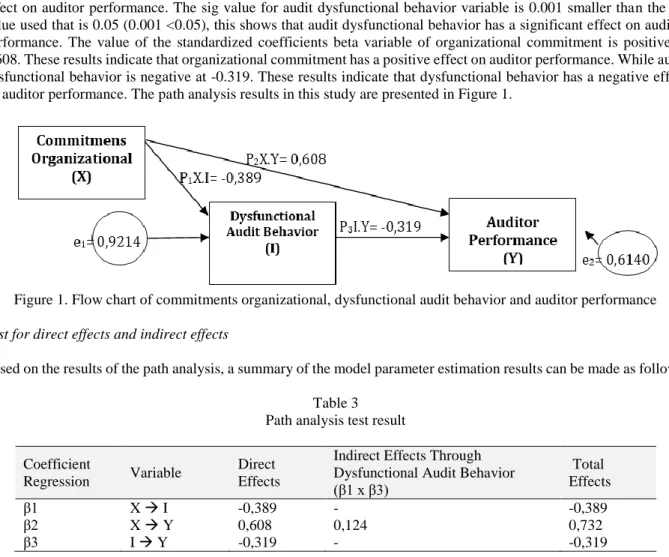
Based on the calculation results, the comparison of the sig value for the organizational commitment variable is 0,000 smaller than the sig value used that is 0.05 (0,000 <0.05), this shows that organizational commitment has a significant effect on auditor performance. The sig value for audit dysfunctional behavior variable is 0.001 smaller than the sig value used that is 0.05 (0.001 <0.05), this shows that audit dysfunctional behavior has a significant effect on auditor performance. The value of the standardized coefficients beta variable of organizational commitment is positive at 0.608. These results indicate that organizational commitment has a positive effect on auditor performance. While audit dysfunctional behavior is negative at -0.319. These results indicate that dysfunctional behavior has a negative effect on auditor performance. The path analysis results in this study are presented in Figure 1.
Figure 1. Flow chart of commitments organizational, dysfunctional audit behavior and auditor performance Test for direct effects and indirect effects
Based on the results of the path analysis, a summary of the model parameter estimation results can be made as follows. Table 3
Path analysis test result
Coefficient
Regression Variable
Direct Effects
Indirect Effects Through Dysfunctional Audit Behavior (β1 x β3) Total Effects β1 X I -0,389 - -0,389 β2 X Y 0,608 0,124 0,732 β3 I Y -0,319 - -0,319
Putra, M. D. P., Widanaputra, A. A. G. P., Ramantha, I. W., & Gayatri, G. (2020). The effect of organizational commitments in auditor performance with dysfunctional audit behavior as mediation variables. International Based on the results above shows that the direct effect of organizational commitment variables on auditor performance has a beta coefficient value of 0.608, while the indirect effect mediated by audit dysfunctional behavior is obtained by multiplication of β1 and β3 which shows a beta coefficient value of 0.124.
Effect of organizational commitment on auditor performance
The results showed that organizational commitment has a calculated value of 7.010 with a significance level of 0.000 and a positive regression coefficient of 0.608. This result means that the higher the organizational commitment, the higher the auditor's performance. The results of this study are in line with the results of research conducted by Wulandari (2015); Wijana & Ramantha (2015); and Amandani & Wirakusuma (2017), who found that organizational commitment has a positive effect on auditor performance. The research of Ghorbanpour et al. (2014); Setianingrum et al. (2016); and Pura (2017), also produced the same thing, namely the organizational commitment variable had a significant positive effect on auditor performance. The conclusion is that an auditor who has a commitment in carrying out his work will improve the performance of the auditor because an auditor who has a high commitment will try to do the best for his organization so that his performance increases.
Effect of organizational commitment on auditor performance through dysfunctional audit behavior
The results of the study found the value of beta unstandardized coefficients influence the influence of organizational commitment to dysfunctional behavior of -0.389 and the value of unstandardized coefficients of beta the influence of audit dysfunctional behavior on auditor performance was -0.319. This result means that organizational commitment has a negative influence on audit dysfunctional behavior. This means that the higher the organizational commitment, the lower the dysfunctional audit behavior. The results of this study are in line with the results of research conducted by Fakhar & Hoseinzadeh (2016) and Jaya et al. (2018), which results in an organizational commitment having a negative effect on dysfunctional audit behavior. Likewise, the effect of audit dysfunctional behavior on auditor performance, the higher the audit dysfunctional behavior, the lower the auditor's performance. The results of this study are in line with the results of research conducted by Lautania (2011), which states that audit dysfunctional behavior has a significant negative effect on auditor performance.
In this study, the results of the indirect effect of organizational commitment on auditor performance through audit dysfunctional behavior obtained results of 0.124, which means the indirect effect of organizational commitment on auditor performance through dysfunctional audit behavior <(smaller) than the direct effect of the influence of organizational commitment on auditor performance by .608. So from these results, dysfunctional behavior does not mediate the effect of organizational commitment on auditor performance. The results of this study show the truth of the theory used, where the theory of goal setting or goal-setting theory assumes that there is a direct relationship between specific and measurable goals and performance. This theory states that employees who have high goal commitment will affect their performance. Where in this study dysfunctional behavior is not able to mediate the effect of organizational commitment on auditor performance because an auditor who has high commitment will do their best in carrying out their duties so that the auditor will not perform audit dysfunctional behavior, then dysfunctional behavior here is no longer significant in mediating the commitment relationship the organization is in its performance. It can also be seen from the results of the questionnaire that has been distributed to the auditor that shows that the auditor as a respondent chose statement number 2 on the organizational commitment of "I feel proud to be part of this organization" with the greatest value where the statement after adding up has the highest value Compared to other statements, this shows that auditors in Bali are proud to be part of the organization where they work so that auditors will not do things that make the name of the organization worse, such as performing dysfunctional behavior.
An auditor who has a high commitment to the organization where he works will arise a sense of ownership of the organization, it will encourage the auditor to work seriously in order to produce quality audit examinations. Employees who have a high commitment to the organization will show positive attitudes and behaviors towards the institution, employees will have the soul to defend their organization, try to improve performance, and have a certain confidence to help realize the goals of the organization. Indirectly, employees who are highly committed to their organizations will have good performance standards so that employees will not engage in deviant behavior that is not in accordance with established standards.
So, in conclusion, the audit dysfunctional behavior does not mediate the effect of organizational commitment on the auditor's performance in Bali because of the results of this study the auditor in Bali has a high commitment to the organization where he works so that by itself the auditor will not accept audit dysfunctional behavior that leads to a
decrease in performance. High commitment results in no room for audit dysfunctional behavior and closes the possibility that auditors accept audit dysfunctional behavior which certainly can harm the organization and reduce the auditor's performance.
4 Conclusion
Organizational commitment has a positive and significant effect on auditor performance. This means that the higher the organizational commitment, the higher the auditor's performance. Organizational commitment has a negative and significant effect on audit dysfunctional behavior. This means that the higher organizational commitment causes dysfunctional behavior to decrease. Likewise, audit dysfunctional behavior has a negative and significant effect on auditor performance, which means the lower audit dysfunctional behavior causes auditor performance to increase. However, audit dysfunctional behavior is not significant as a mediating variable the effect of organizational commitment on auditor performance.
Future studies are expected to overcome the weaknesses of data collection in this study by adding interview methods so that researchers are more involved in the research process. Future studies should add independent variables and other mediating variables to see their effects on auditor performance. So it can be seen how to create a better auditor performance.
Conflict of interest statement
The authors declared that they have no competing interests. Statement of authorship
The authors have a responsibility for the conception and design of the study. The authors have approved the final article.
Acknowledgments
The authors would like to thank the reviewer for their consideration of the further process of the present paper. Thanks to the editor of IRJMIS for the valuable support, time as well as advice.
Putra, M. D. P., Widanaputra, A. A. G. P., Ramantha, I. W., & Gayatri, G. (2020). The effect of organizational commitments in auditor performance with dysfunctional audit behavior as mediation variables. International References
Amandani, N. M. R., & Wirakusuma, M. G. (2017). Pengaruh komitmen organisasi, gaya kepemimpinan dan pelatihan
profesi pada kinerja auditor. E-Jurnal Akuntansi, 916-942.
Anita, R., Nanda, S. T., Zenita, R., & Abdillah, M. R. (2018). Locus of Control, Penerimaan Auditor atas Dysfunctional
Audit Behavior dan Intention to Quit. Jurnal Dinamika Akuntansi dan Bisnis, 5(1), 43-54.
http://dx.doi.org/10.24815/jdab.v5i1.8623
Baldacchino, P. J., Tabone, N., Agius, J., & Bezzina, F. (2016). Organizational culture, personnel characteristics and
dysfunctional audit behavior. IUP Journal of Accounting Research & Audit Practices, 15(3), 34.
Candradewi, I., & Dewi, I. G. A. M. (2019). Effect of compensation on employee performance towards motivation as mediation variable. International Research Journal of Management, IT and Social Sciences, 6(5), 134-143. https://doi.org/10.21744/irjmis.v6n5.711
Dewi, N. P. R. A., & Ramantha, I. W. (2019). Effect of conflict and unclear role on auditor performance with emotional quotient as moderating variable. International Journal of Social Sciences and Humanities, 3(3), 50-59. https://doi.org/10.29332/ijssh.v3n3.350
Fakhar, P. T., & Hoseinzadeh, A. (2016). Investigate The Effect Of Organizational Commitment And Professional
Commitment On Dysfunctional Behaviors Of Auditors. International Academic Institute for Science and
Technology, 3(1), 1-12.
Ghorbanpour, Z., Dehnavi, H. D., & Heyrani, F. (2014). Investigating the effect of organization commitment on
performance of auditors in the community of certified accountants. Interdisciplinary Journal of Contemporary
Research in Business, 5(10), 199-209.
Hanna, E., & Firnanti, F. (2013). Faktor-faktor yang Mempengaruhi Kinerja Auditor. Jurnal Bisnis dan
Akuntansi, 15(1), 13-28. https://doi.org/10.34208/jba.v15i1.205
Jaya, S. M., Sudarma, M., & Roekhudin, R. (2018). Role of auditor performance mediation in acceptance of auditor
dysfunctional behavior: attribution theory perspective and role theory. Jurnal Aplikasi Manajemen, 16(4).
http://dx.doi.org/10.21776/ub.jam.2018.016.04.14
Johansen, T. R., & Christoffersen, J. (2017). Performance evaluations in audit firms: Evaluation foci and dysfunctional
behaviour. International Journal of Auditing, 21(1), 24-37. https://doi.org/10.1111/ijau.12079
Lautania, M. F. (2011). Pengaruh Time Budget Pressure, Locus Of Control dan Perilaku Disfungsional Audit Terhadap
Kinerja Auditor (Studi Pada Kantor Akuntan Publik Indonesia). Jurnal Telaah dan Riset Akuntansi, 4(1), 92-113.
Nelaz, Y. S., & Al-azhar, A. (2014). Pengaruh locus of control, keahlian auditor, komitmen organisasi terhadap
perilaku underreporting of audit time (studi empiris pada kap pekanbaru& padang). Jurnal Online Mahasiswa
(JOM) Bidang Ilmu Ekonomi, 1(2), 1-16.
Pura, R. (2017). Effects of auditor competence, information technology, accounting information systems and organizational commitment on auditors’performances at the state audit agency, in south sulawesi.
Ramzy, O., El Bedawy, R., & Maher, A. (2018). Dysfunctional Behavior at the Workplace and Its Impact on
Employees¡ Job Performance. International Journal of Business Administration, 9(4), 224-233.
https://doi.org/10.5430/ijba.v9n4p224
Rantesalu, A., Mus, A. R., & Arifin, Z. (2017). The effect of competence, motivation and organizational culture on
employee performance: the mediating role of organizational commitment. https://doi.org/10.31227/osf.io/m7wqs
Sanjaya Adi Putra, G., & Dwirandra, A. A. N. B. (2019). The effect of auditor experience, type of personality and fraud auditing training on auditors ability in fraud detecting with professional skepticism as a mediation variable. International Research Journal of Management, IT and Social Sciences, 6(2), 31-43. https://doi.org/10.21744/irjmis.v6n2.604
Septian, I., & Astika, I. B. P. (2019). Halo effect moderating: impact of professional skepticism on auditor performance. International Research Journal of Management, IT and Social Sciences, 6(4), 189-196. https://doi.org/10.21744/irjmis.v6n4.680
Setianingrum, R. M., Hastuti, S., & Hasibuan, T. T. (2016). Auditor Performance Based on Leadership Style and
Organization Commitment in Gender Perspective. Research Journal of Finance and Accounting, 18(7), 122-127.
Srimindarti, C. Sunarto, & Widati, LW (2015). The Effect of Locus of Control and Organizational Commitment to
Acceptance of Dysfunctional Audit Behavior Based On The Theory of Planned Behavior. International Journal of
Business, Economics and Law, 7(1), 27-35.
Widhi, S. N., & Setyawati, E. (2015). Pengaruh Independensi, Gaya Kepemimpinan, Komitmen Organisasi Dan Pemahaman Good Governance Terhadap Kinerja Auditor Pemerintah. Jurnal Manajemen Dan Bisnis, 19(1), 64– 79.
Wijana, D. G. A., & Ramantha, I. W. (2015). Interitas sebagai pemoderasi pengaruh komitmen organisasi pada kinerja
auditor. E-Jurnal Akuntansi, 841-851.
Wulandari. (2015). Pengaruh Komitmen Organisasi dan Ambiguitas Peran terhadap Kinerja Auditor Dengan Motivasi Sebagai Variabel Moderasi. Jom Fekon, 2(1), 1–14. https://doi.org/10.1192/bjp.112.483.211-a
Zubaidi, M., & Surjanti, J. (2018). Pengaruh komitmen organisasi, motivasi dan disiplin kerja terhadap kinerja