How climate compatible are livelihood adaptation strategies
and development programs in rural Indonesia?
R.M. Wise
a,⇑, J.R.A. Butler
b, W. Suadnya
c, K. Puspadi
d, I. Suharto
e, T.D. Skewes
f aCSIRO Land and Water Flagship, Black Mountain, Canberra, ACT 2601, Australia b
CSIRO Land and Water Flagship, GPO Box 2583, Brisbane, QLD 4001, Australia c
Faculty of Agriculture, University of Mataram, Jl. Majapahit 62, Mataram 83127, Nusa Tenggara Barat Province, Indonesia d
Assessment Institute for Agricultural Technology, Lombok, NTB, Indonesia e
VECO Indonesia, Denpasar, Indonesia
fCSIRO Oceans and Atmosphere Flagship, GPO Box 2583, Brisbane, QLD 4001, Australia
a r t i c l e i n f o
Article history:Received 16 September 2015 Revised 29 October 2015 Accepted 4 November 2015 Available online 14 November 2015 Keywords:
Adaptation pathways Deliberative decision-making Multiple criteria analysis Mal-adaptation Rural development
a b s t r a c t
Achieving climate compatible development (CCD) is a necessity in developing countries, but there are few examples of requisite planning processes, or manifestations of CCD. This paper presents a multi-stakeholder, participatory planning process designed to screen and prioritise rural livelihood adaptation strategies against nine CCD criteria. The process also integrated three principles of adaptation pathways: interventions should be (1) ‘no regrets’ and maintain reversibility to avoid mal-adaptation; (2) address both proximate and underlying systemic drivers of community vulnerability; and (3) linked across spatial scales and jurisdictional levels to promote coordination. Using examples of two rural sub-districts in Indonesia, we demonstrate the process and resulting CCD strategies. Priority strategies varied between the sub-districts but all reflected standard development inter-ventions: water management, intensification or diversification of agriculture and aquacul-ture, education, health, food security and skills-building for communities. Strategies delivered co-benefits for human development and ecosystem services and hence adaptive capacity, but greenhouse mitigation co-benefits were less significant. Actions to deliver the strategies’ objectives were screened for reversibility, and a minority were potentially mal-adaptive (i.e. path dependent, disproportionately burdening the most vulnerable, reducing incentives to adapt, or increasing greenhouse gas emissions) yet highly feasible. These related to infrastructure, which paradoxically is necessary to deliver ‘soft’ adaptation ben-efits (i.e. road access to health services). Only a small minority of transformative strategies addressed the systemic (i.e. institutional and political) drivers of vulnerability. Strategies were well-matched by development programs, suggesting that current interventions mir-ror CCD. However, development programs tackled fewer systemic drivers, were poorly coordinated and had a higher risk of mal-adaptation. We conclude that the approach is effective for screening and prioritising no regrets CCD, but more extensive learning pro-cesses are necessary to build decision-makers’ capacity to tackle systemic drivers, and to scrutinise potentially mal-adaptive infrastructural investments.
Ó2015 The Authors. Published by Elsevier B.V. This is an open access article under the CC BY-NC-ND license (http://creativecommons.org/licenses/by-nc-nd/4.0/).
http://dx.doi.org/10.1016/j.crm.2015.11.001
2212-0963/Ó2015 The Authors. Published by Elsevier B.V.
This is an open access article under the CC BY-NC-ND license (http://creativecommons.org/licenses/by-nc-nd/4.0/). ⇑ Corresponding author. Tel.: +61 2 6246 4374; fax: +61 2 6246 4202.
E-mail addresses:[email protected](R.M. Wise),[email protected](W. Suadnya),[email protected](K. Puspadi),[email protected] (I. Suharto),[email protected](T.D. Skewes).
Contents lists available atScienceDirect
Climate Risk Management
j o u r n a l h o m e p a g e : w w w . e l s e v i e r . c o m / l o c a t e / c r mIntroduction
Integrating climate change into development decision-making to achieve ‘climate compatible development’ (CCD) is a pressing challenge (Mitchell and Maxwell, 2010). Decision-makers must identify interventions which simultaneously achieve the co-benefits of reducing poverty, enhancing communities’ capacity to cope with current and future climate and other shocks, and mitigating greenhouse gas emissions (Ellis et al., 2013; Butler et al., 2014a; Suckall et al., 2015). However, the increasing frequency, magnitude and extent of natural hazards caused by global environmental change, the growing exposure of marginalised communities with limited power and agency, and the mismatches between top-down adaptation interventions and local cultural practices and institutions limit effective responses (Hardee and Mutunga, 2009; Artur and Hilhorst, 2012). These making difficulties are becoming recognised by researchers and decision-makers alike, and new assessment and planning approaches that better account for them must be developed (Ranger and Garbett-Shiels, 2011; Conway and Mustelin, 2014).
In this regard, ‘adaptation pathways’ is gaining prominence as a powerful concept, metaphor, analytical framework and planning tool for helping individuals or agencies in diverse contexts to reframe and diagnose the nature of their adaptation challenges, and reveal the adaptation interventions and their possible sequencing along multiple pathways based on understanding of the types of decisions needing to be made, the lifetimes and flexibility of decisions, and the need for transformation (Werners et al., 2013; Wise et al., 2014). In so doing, an adaptation pathways perspective and approach can provide the necessary guidance and clarity to decision-makers in their planning and implementation of adaptive learning and management for dealing with uncertainty, inter-temporal complexity, ambiguous goals or cross-jurisdictional impacts (Reeder and Ranger, 2011; Haasnoot et al., 2013; Wise et al., 2014). In developing countries, how-ever, there is a need to integrate climate change considerations into rapid and often poorly-coordinated decision-making, and to engage multiple stakeholders, including marginalised communities, into the process (Butler et al., 2014a, 2016a). This requires transitioning the governance of existing planning processes at the relevant scale, and the priming of stake-holders to implement change with improved information, skills and decision-making tools and processes (Butler et al., 2016b).
Three adaptation pathways principles are relevant for the planning of CCD. First, development programs must maintain flexibility and reversibility to avoid foreclosure of future decision options, and should be ‘no regrets’ to avoid locking com-munities into undesirable or mal-adaptive development trajectories which are path dependent, disproportionately burden the most vulnerable, reduce incentives to adapt or increase greenhouse gas emissions (Barnett and O’Neill, 2010; Fankhauser et al., 1999; Hallegatte, 2009). Second, development programs should aim to address both proximate and sys-temic drivers of community vulnerability, which necessitates combinations of responses that simultaneously or sequentially help fulfil immediate basic needs, build resilience, and facilitate transformation of the aspects of the societal context that impede the capacity of decision makers to make well-adapted decisions (Pelling, 2011; Wise et al., 2014). Third, interven-tions should be linked across spatial scales and jurisdictional levels to promote coordination and further reduce risks of mal-adaptation (i.e. actions that impact adversely on or increase the vulnerability of other systems, sectors or social groups; Barnett and O’Neill, 2010).
There is limited guidance and experience to date, however, on how to design and implement adaptation pathways to support CCD in the context of rural communities’ livelihoods in developing countries. In these situations develop-ment is an urgent priority, capacity at all levels is limited, social-ecological systems are highly vulnerable to global environmental change, and systemic factors are preeminent amongst the causes of vulnerability. Consequently there is an urgent need to ‘leap frog’ the Sustainable Development Goals before potentially extreme climate change impacts emerge in the mid- to late century (Butler et al., 2016c). To this end, a 4-year project was carried out in Nusa Teng-gara Barat (NTB) Province, Indonesia, to introduce a governance transition for rural development planning. The project mimicked the government’s annual integrated top-down and bottom-up village development planning process with relevant decision makers and stakeholders, and introduced them to adaptation pathways principles and the methods and tools required for CCD decision-making. In doing this, the project exposed stakeholders in case study sub-districts to a modified approach to their standard planning process and built their capacity for CCD planning (Butler et al., 2016b).
This project, its methods and results are the focus of this special issue (Butler et al., 2016a). Other papers present the par-ticipatory processes and associated tools developed and tested, including the analytical framework used in planning work-shops (Butler et al., 2016c), mapping of stakeholders’ knowledge cultures (Bohensky et al., 2016), modelling tools (Rochester et al., 2016; Skewes et al., 2016), climate projections (Kirono et al., 2016; McGregor et al., 2016), and qualitative and quan-titative evaluations (Butler et al., 2016b; Liu et al., 2016). This paper examines the final stage of the participatory planning process, which integrated the perspectives of multi-level stakeholders to determine prioritised adaptation strategies for case study sub-districts. The objectives of this paper are to (1) present the process and tools developed to formulate CCD, and (2) analyse the resulting strategies relative to the three principles of adaptation pathways discussed above, and thus reflect on the method’s strengths and weaknesses.
Study area and project design
Indonesia and NTB
Indonesia is highly sensitive to climate change because of its many small islands, and the reliance of large numbers of people on climate-sensitive agriculture and fisheries. Government-planned climate adaptation is nascent, however, and community-level adaptation has not been adequately addressed (Djalante and Thomalla, 2012).
NTB (Fig. 1) is one of the poorest regions in Indonesia. Poverty is most prevalent in rural areas, where 58% of the popu-lation live. Combined with variable soil types, culture, economic opportunities and human development, livelihoods vary markedly over short distances. Poor coordination between government, donor and non-government organisation (NGO) investments in development, exacerbated by stakeholders’ lack of awareness of potential future impacts of climate change and other drivers, maintains a high risk of mal-adaptive decision-making (Butler et al. 2014a).
In 2004, as part of the national decentralisation process, the Indonesian Government introduced an annual cycle of inte-grated top-down and bottom-up development planning (‘musrenbang’). Through multi-stakeholder consultations at the village, sub-district and district levels, the process formulates Village Development Plans and related expenditure. However,
musrenbangis often dysfunctional and is captured by political elites and government officials, resulting in communities’ needs largely not being met. Women and poorer households are often marginalised by the lack of procedural justice, and information on which to base decisions is frequently not made available to communities (Purba, 2011; Aswad et al., 2012).
Project design
The institutional flux caused by decentralisation provided an opportunity to establish an adaptation pathways approach to development in NTB. This project’s goal was to integrate adaptation pathways into development planning to reduce the vulnerability of communities to adverse future change. This would be achieved by mimicking themusrenbangprocess to identify and implement no regrets adaptation strategies within rural sub-district case studies. Primed by the project, stake-holders would modify the case studies’musrenbangto integrate adaptation pathways principles (Butler et al., 2016b).
An integrated top-down and bottom-up planning approach was designed in three stages of workshops (seeButler et al., 2015, 2016b). Following a stakeholder analysis, the Stage 1 provincial scale workshop engaged key decision-makers, scien-tists and NGOs from the national and provincial levels with responsibility for and knowledge of community development and natural resource management. Thirty-four government and NGO stakeholders attended, and were selected to ensure equal representation by women and men. Eighteen scientists from Indonesian institutions also attended, including members of the joint Indonesian and Australian research team who represented a diversity of disciplines encompassing the agricul-tural, ecological, economic, social, anthropological, meteorological, and climate sciences.
By applying downscaled climate change and population growth projections, the potential impacts on communities for a range of future development scenarios were analysed for all NTB sub-districts aggregated into types (seeRochester et al., 2016; Skewes et al., 2016). No regrets adaptation strategies were identified to address impacts specific to each sub-district type. Based on these findings, five case study sub-sub-districts were selected for Stage 2 of the process. Planning work-shops were carried out in each case study and engaged 30–40 key district, sub-district and community-level stakeholders from each case study sub-district. The participants represented the interests of women and men, plus local grass-roots NGOs and religious groups. Outputs were vulnerability assessments for villages and no regrets strategies tailored to their current adaptive capacity and the potential future impacts of drivers. In the Jerowaru and Terara case studies, half-day focus group discussions (FGDs) were also held separately with men, women and youth in selected villages to discuss their perceptions of livelihood challenges and necessary adaptation strategies.
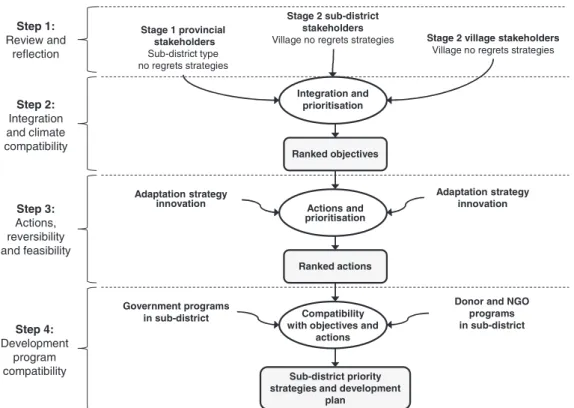
Stage 3 of the process (Fig. 2) involved integration workshops for each case study sub-district. These compared and then combined strategies for the relevant sub-district type from Stage 1 with those for the sub-district from Stage 2 and the vil-lage FGDs. Approximately 30 participants from the Stage 1 and Stage 2 workshops and FGDs attended. To ensure strong local and community level representation, 10 of these were from the Stage 1 workshop and 20 were from the Stage 2 workshops and FGDs. Again, participants were invited to ensure representation of the interests of youth, men, women, the aged, and religious groups. Outputs included prioritised CCD strategies for each sub-district, actions to achieve these strategies, and a comparison between their objectives and current or planned development programs. These were incorporated into a sub-district development plan for each case study, which included steps to address barriers to implementation.
The following section details the Stage 3 workshop process for two case studies, Jerowaru and Terara (Fig. 1). Jerowaru is a coastal sub-district in south-eastern Lombok. In 2010 it had a population of 53,932 in four villages. Livelihoods are diverse, and based on maize, tobacco, livestock, coastal fisheries, aquaculture (including seaweed) and tourism. Terara is located in central Lombok and in 2010 had a population of 9531 in six villages. Livelihoods are primarily based on rice production, with some tobacco, maize and livestock.
Integration and compatibility analysis – methods and process
Workshop participants were convened for 2 days in a neutral venue in the provincial capital, Mataram. The workshops were led by an independent Indonesian facilitator, supported by the project research team comprising Indonesian and Aus-tralian researchers. The same facilitator was then used in these workshops as that used in Stages 1 and 2.
The process consisted of four steps which integrated no regrets adaptation strategies previously identified during Stages 1 and 2, and applied the three adaptation pathways principles described in the Introduction to determine a single set of
pri-Step 1: Review and reflection Stage 1 provincial stakeholders Sub-district type no regrets strategies Stage 2 sub-district stakeholders
Village no regrets strategies Stage 2 village stakeholders Village no regrets strategies
Adaptation strategy innovation Actions and prioritisation Adaptation strategy innovation Integration and prioritisation Government programs in sub-district
Donor and NGO programs in sub-district Compatibility
with objectives and actions
Sub-district priority strategies and development
plan Step 2: Integration and climate compatibility Step 3: Actions, reversibility and feasibility Step 4: Development program compatibility Ranked objectives Ranked actions
oritised CCD interventions for each case study (Fig. 2). The first step involved stakeholders from the Stage 1 and 2 workshops and the FGDs presenting and reviewing the rationale for the adaptation strategies developed by their prior processes. The second step integrated the strategies presented and determined objectives for each, and prioritised them using criteria for CCD (see below). The third step involved identifying actions required to achieve the objectives, prioritised using reversibility and feasibility criteria. The fourth step analysed the compatibility of development programs with the prioritised objectives from the workshop, and aimed to enhance coordination amongst investments. After each workshop the extent to which the actions and development programs tackled proximate or systemic drivers of community vulnerability was also assessed. Each of these activities is described in detail below.
By enabling participants to reflect on their prior planning workshops, and to re-assess the outputs, the process was designed to provide a second loop of social learning and reflection (Butler et al., 2015, 2016c). In addition, the process aimed to empower community participants – particularly those from the village level FGDs – and to encourage the evolution of cross-scale social networks and new collaborations, which are key features of building adaptive capacity and initiating gov-ernance transitions (Pelling, 2011; Butler et al., 2016b).
Step 1. Review and reflection:This step involved representatives from each of the prior planning events and FGDs present-ing the process and outputs from their respective workshops to inform other participants, and to trigger review and reflec-tion. To promote a community perspective, the presenters representing the Stage 2 workshop and the FGDs were village leaders or residents. Prior to the workshop the results of the men, women and youth focus groups were synthesised for each village. All presenters volunteered and were prepared prior to the workshop by the research team. Presentations sum-marised the workshop process and outputs, including prioritised drivers of change for livelihoods, an aspirational vision for communities, future development scenarios, potential impacts on human well-being from climate change and population growth, adaptive capacity assessments, and the resulting context-specific adaptation strategies.
Step 2. Integration and climate compatibility:This step involved integrating the strategies presented in Step 1 into a single set of objectives for the case study. This was necessary because the initial sets of strategies comprised generalised recom-mendations for the sub-district type from the Stage 1 workshop, and more specific strategies for villages from the Stage 2 sub-district workshop and FGDs. The ‘tapestry’ of strategies spanned a diversity of sectors (e.g. water, agriculture, transport, tourism, health, energy) and hard and soft technological, infrastructural, social and institutional interventions (Butler et al., 2016c).
The integration method appliedRogers and Biggs’ (1999)‘objectives hierarchy’, which was developed as a structured pro-cess of incorporating societal values and scientific endpoints into the description of a ‘desired state’ (i.e. objectives) for ecosystem management (i.e. adaptation). Strengths of this approach were that it allowed participants to re-visit outputs from the previous workshops, and it facilitated the sharing of knowledge types and societal values from participants of dif-ferent gender, agency, and culture into the final set of negotiated objectives and actions. Representatives of the three levels worked in focus groups to identify over-arching themes of the strategies based on similarities in their intentions and out-comes, and then defining a specific objective for each theme. Results from the groups were collated in plenary using a pre-prepared Microsoft Excel spreadsheet made visible via a projector, which allowed the final definition of each objective to be further deliberated amongst all stakeholders.
Then, the objectives were prioritised against the co-benefits required to achieve CCD using deliberative Multi-Criteria Analysis (MCA:Munda, 2008; Steele et al., 2008). Nine criteria were used drawing on the principles of CCD presented by Eriksen et al. (2011)andButler et al. (2014a): income, food security, social cohesion, health, ecosystem service benefits, dis-aster risk reduction, biodiversity benefits, gender equality and greenhouse gas (GHG) mitigation. Scoring was carried out by focus groups comprised of stakeholders from different levels. Criteria were explained and discussed in detail by the facilita-tor prior to the exercise, and then groups scored each objective against the criteria on a scale of 5 to +5. Groups’ data were entered into a pre-prepared Excel spreadsheet which summed the scores based on an equal weighting for each criterion. Results were immediately presented via the projector, and the weighting of each criterion was discussed in plenary. If altered, the sensitivity of the results was demonstrated. Once the criteria weightings were agreed, the final scores were summed, and each objective ranked. This approach ensured transparency of the choice process by allowing debate about divergent preferences and opinions, and the implications of alternative weightings (Munda, 2008; Steele et al., 2008; Wegner and Pascual, 2011).
Step 3. Actions, reversibility and feasibility:This step began with presentations of the findings of research or other projects investigating innovative livelihood adaptation options relevant to the sub-district. In Jerowaru and Terara the focus was on trials of agricultural or aquaculture strategies undertaken by the research team (see Liu et al., 2016). The purpose was to ensure that the latest understanding and knowledge was available to participants to inform their choices of actions to achieve the prioritised objectives. However, due to time limits only the actions for the top four ranked objectives were explored. Participants were divided into four focus groups comprising stakeholders from the three levels and identified the actions for one objective each.
Following this, the reversibility and feasibility (the latter comprising cost effectiveness, opportunity cost, and existing capacity to implement the action) of each action was scored from 0 (low) to 5 (high) using the same deliberative MCA pro-cess as for Step 2. The combined assessment of the reversibility and feasibility of options gave an indication of the risk of irreversible, mal-adaptive interventions being introduced.
Step 4. Development program compatibility:Prior to the workshop a review of all current and planned development pro-grams relevant to each sub-district was undertaken by the research team, including their stated objectives. Summaries were
presented by representatives of the relevant government departments, NGOs or private sector companies, who were usually workshop participants, but if not were invited for this specific role. Following this session, the top four-ranked objectives from Step 2 were compared to the list of programs.
A different approach to the compatibility assessment was used for Terara based on learning gained from the first appli-cation of the process in Jerowaru. For Jerowaru, a ‘heat map’ was created in Excel by comparing development programs with the top four objectives identified from Step 2. Cells were colour-coded to reflect compatibility, and the coding of each cell involved plenary discussion and deliberation. However, this was found to be slow and limited the time available for discus-sion of each program’s effectiveness, and how gaps should be addressed. Therefore, in Terara the analysis was modified to be undertaken in focus groups instead of plenary. Each group was given a printed list of development programs and asked to assess their compatibility with the top four objectives. The following questions were posed to guide their analysis: (1) are programs currently being conducted that address this objective, (2) are new or additional activities needed to address this objective and who is responsible for this, and (3) what are the barriers to the programs’ implementation, and who is respon-sible for addressing them?
Following the workshops, we undertook a subjective analysis of whether each objective’s actions and the development programs’ objectives addressed proximate or systemic drivers of community vulnerability. AfterPelling (2011), proximate drivers were considered to be current symptoms of community vulnerability and risk (e.g. low levels of education, health and income, lack of infrastructure), and systemic drivers were the root causes of these symptoms. The latter included insti-tutional and political factors (e.g. land rights, access to markets, regulations, corruption), which in developing countries often determine individuals’ and households’ rights and participation in decision-making (Lemos et al., 2007; Rodima-Taylor et al., 2012), plus issues such as population growth and ecosystem degradation (Butler et al., 2014a,b). Incremental strategies tackle proximate drivers within the incumbent system or processes in the short term, while transformative strategies tackle systemic drivers, promoting fundamentally alternative forms of development, and creating a new system or process (Pelling, 2011; Park et al., 2012).
Table 1
Jerowaru sub-district objectives, ranked according to criteria for climate compatible development. Objectives are compared with the adaptation strategies identified by the prior Stage 1 provincial and Stage 2 sub-district planning workshops and the village focus group discussions (FGDs). Shaded cells indicate where strategies had been identified in previous workshops.
Table 2
Terara sub-district objectives, ranked according to criteria for climate compatible development. Objectives are compared with the adaptation strategies identified by the prior Stage 1 provincial and Stage 2 sub-district planning workshops and the village focus group discussions (FGDs). Shaded cells indicate where strategies had been identified in previous workshops.
0.0 0.5 1.0 1.5 2.0 2.5 3.0 3.5 4.0 4.5 5.0 Income Food security Social cohesion Health Ecosystem services benefits Disaster risk reducon Biodiversity benefits Gender equality GHG migaon 0.0 0.5 1.0 1.5 2.0 2.5 3.0 3.5 4.0 4.5 5.0
(a) Jerowaru
(b) Terara
Improve water availability and use (Obj 1) Improve income from seaweed (Obj 2) Build human capital (educaon & health) (Obj 3) Diversify into new, mixed cropping systems (Obj 4)
Improve public health (Obj 1)
Increase availability & consumpon of quality food (Obj 2) Achieve a civil society economy with business skills (Obj 3) Increase land-use efficienc y & sustainably manage water (Obj 4)
Fig. 3.Multi-Criteria Analysis scores of the top four objectives for (a) Jerowaru and (b) Terara against the nine criteria of climate compatible development. The average score of all the objectives for each criterion is shown by the black line.
Results
Integration and climate compatibility (Step 2)
For Jerowaru, the integration process produced 12 objectives (Table 1). There was a mix of strategies proposed in the prior planning processes. However, those proposed by the sub-district stakeholders were best represented, contributing to 10 of the 12 objectives, while provincial and village level strategies contributed to five each. The first and second-ranked
objec-1.1 1.2 1.3 1.4 1.5 1.6 1.7 2.1 2.2 2.3 2.4 2.5 2.6 3.1 3.2 3.3 3.4 3.5 3.6 3.7 3.8 3.9 3.10 4.1 4.2 4.3 4.4 4.5 0.0 0.5 1.0 1.5 2.0 2.5 3.0 3.5 4.0 4.5 5.0 1.1 1.3 1.2 1.4 1.5 2.1 2.2 2.3 2.4 3.2 3.1 2.5 3.3 3.4 3.5 4.1 4.2 4.3 4.4 4.5 0.0 0.5 1.0 1.5 2.0 2.5 3.0 3.5 4.0 4.5 5.0 0.0 0.5 1.0 1.5 2.0 2.5 3.0 3.5 4.0 4.5 5.0
low
Rev
e
rs
ib
il
it
y
hi
gh
low
Feasibility
high
low
Feasibility
high
(b) Terara
(a) Jerowaru
Fig. 4.Actions plotted by their reversibility and feasibility scores for (a) Jerowaru and (b) Terara. Numbers in the graphs correspond to actions inTables 3 and 4. Red boxes highlight those that are more risky because they are highly feasible but have the least reversibility.
Table 3
Actions identified for the top four-ranked objectives for Jerowaru sub-district, prioritised within each objective by the criteria of reversibility and feasibility. Shaded actions are those with low reversibility but high feasibility and hence have a high risk of mal-adaptation (seeFig. 4a).
tives, ‘improve water availability and use’ and ‘improve income from seaweed’ had not been originally proposed by village level stakeholders. Two of the provincial level strategies were not represented: ‘mangrove planting to protect coastlines and create fish habitat’ and ‘more water recycling’. Five of the sub-district level strategies were not represented: ‘desalination for drinking water’, ‘solar energy’, ‘intensification of salt pond production’, ‘intensification of paddy agriculture and infrastruc-ture’, and ‘coastal habitat restoration’. Three of the village level strategies were not represented: ‘loans’, ‘waged labour’ and ‘saving money or borrowing from family’. The final set of objectives also included two proposals which had not been iden-tified by any of the previous processes: ‘implementawiq awiq’ (traditional law) and ‘improve public order’.
For Terara, the integration process produced eight objectives (Table 2). The two highest-ranked objectives, ‘improve pub-lic health’ and ‘increase availability, access and consumption of quality food’ differed from those for Jerowaru. As for Jero-waru, sub-district strategies were best-represented, contributing to seven out of eight objectives, while village level strategies contributed to five and provincial level strategies contributed to four. The highest-ranked objective had been pro-posed by sub-district and both village level processes, but not by provincial level stakeholders. The second highest-ranked objective had not been proposed by any village level FGDs. While all of the strategies from the provincial and sub-district workshop were represented, six strategies identified by village level FGDs were not: ‘improving gender equality’, ‘managing expenses’, ‘getting loans’, ‘migrant labour’, ‘seeking jobs outside the village’ and ‘creating new jobs’.
The top four objectives for Jerowaru and Terara had positive or neutral scores for all nine of the climate compatible cri-teria (Fig. 3). In general, the top four objectives in both sub-districts scored highest against income, food security, social cohe-sion and health; in all cases scoring above 3.0 except Terara’s Objective 4 which scored 2.3 and 2.5 for social cohecohe-sion and health, respectively. The most noticeable differences between the two sub-districts were the high importance of gender equality in Terara relative to Jerowaru (average objective score of 3.5 versus 1.4), and disaster risk reduction in Jerowaru rel-ative to Terara (average objective score of 2.5 versus 1.8). Greenhouse gas (GHG) mitigation had the lowest score on average in both sub-districts.
Table 4
Actions identified for the top four-ranked objectives for Terara sub-district, prioritised within each objective by the criteria of reversibility and feasibility. Shaded actions are those with low reversibility but high feasibility and hence have a high risk of mal-adaptation (seeFig. 4b).
Objecves Ranked acons
1. Improve public health
1.1. Improve awareness of clean and healthy living 1.2. Develop Muslim sociees and groups
1.3. Raise awareness of mother and child health (e.g. breaseeding) 1.4. Provide public services and health facilies
1.5. Increase the ulizaon of back yards for medicinal plants 1.6. Provide health informaon access
1.7. Diversify non-rice consumpon
2. Increase availability, access and consumpon of quality food
2.1. Develop livestock commodies 2.2. Increase agricultural business
2.3. Post-harvest management and markeng of agriculture/livestock 2.4. Improve road access
2.5. Achieve family nutrion health standards 2.6. Improve electricity infrastructure
3. Achieve a civil society economy with growing business skills
3.1. Improve agriculture producon 3.2. Access to financial services from banks 3.3. Improve science and technology 3.4. Develop markets and markeng 3.5. Develop religious values
3.6. Improve community security and public order 3.7. Provide park areas and tourist sites 3.8. Improve transport facilies 3.9. Provide potable water
3.10. Provide health facilies and improve family planning
4. Increase efficiency of land use while sustainably managing water
4.1. Community forest development and greening with crop diversificaon 4.2. Ulise organic ferlizer and biogas
4.3. Build permanent rice fields 4.4. Improve water use efficiency
Actions, reversibility and feasibility (Step 3)
For the 20 actions prioritised for Jerowaru’s top four objectives (Table 3), the majority (14 or 60%) scored P2.5 for reversibility and feasibility (Fig. 4a). Four (20%) scoredP2.5 for feasibility, but <2.5 for reversibility, and therefore presented some risk of mal-adaptation. These all concerned the building of physical infrastructure, and one (‘build irrigation infrastruc-ture’) was associated with the highest-ranked objective, ‘improve water availability and use’ (Table 3).
For the 28 actions identified for Terara’s top four objectives (Table 4), the majority (15 or 54%) scoredP2.5 for reversibil-ity and feasibilreversibil-ity (Fig. 4b). Ten (36%) scoredP2.5 for feasibility and <2.5 for reversibility. These involved a mix of ‘soft’ engi-neering (e.g. markets, community security) and ‘hard’ physical infrastructure (e.g. ponds and irrigation, health facilities) or land use change (permanent rice fields;Table 4). All of these riskier actions were related to the third (‘achieve a civil society economy with growing business skills’) and fourth highest-ranked objectives (‘increase efficiency of land use while sustain-ably managing water’).
Development program compatibility (Step 4)
The review identified seven development programs in Jerowaru, with 21 objectives (Table 5). Of the programs, four were provincial government, two were district government, and one was an international NGO (United Nations World Food Pro-gram). The heat map summarising the compatibility analysis showed that three of the top four objectives are currently being well-targeted by existing programs: 14 (67%) of the program objectives aligned with Objective 1 ‘improve water availability and use’, and 16 (76%) aligned with Objectives 3 ‘build human capital’ and 4 ‘diversify cropping systems’. However, Objective 2 ‘improve income from seaweed’ was poorly covered, with only 7 (33%) of existing program objectives targeting this. How-ever, it was often expressed during plenary discussions that many community level participants were not aware of the pro-grams’ existence. It was also acknowledged that there was a lack of coordination and communication across the various agencies and communities about the programs, and that they were often not being effectively implemented due to limited government resources and capacity.
The results of the more detailed compatibility analysis for Terara are summarised inTable 6, but due to space limitations only those relating to the highest-ranked objective ‘improve public health’ is shown. As for Jerowaru, this objective was well-covered by seven programs run by national, provincial and district government departments and Islamic religious leaders. Table 5
Heat map showing development programs in Jerowaru and their objectives’ compatibility with the top four-ranked objectives. Colour codes are: red = no match; green = match; yellow = match but the program has finished; purple = matched programs that are planned.
Development programs and objecves
Objecves
1 2 3 4
Improve water availability and use
Improve income from seaweed Build human capital Diversify cropping systems NTB Forestry Department
Rehabilitaon of crical land in forest areas Improve the economy of forest communies NTB Marine and
Fisheries Department
Sustainable forest management and benefits Idenfy infrastructure needs in GiliBeleq Improve seaweed producon
NTB Food Security Agency
Fulfil food needs of community
Improve food availability of the community Realise food self-sufficiency
NTB Agriculture Department
Improve agricultural infrastructure and access Improve water availability for agriculture Expand the area planted
East Lombok District Public
Works Department
Improve road infrastructure Availability of water for agriculture
Availability of fresh water for community East Lombok
District Environment and Research
Board
Increased capacity of watersheds and springs Improve flood control
Manage the use of natural resources
Increase availability of ground water infrastructure United Naons
World Food Program
Disaster risk management Secure nutrion
However, participants noted that many of these were ineffective and required other activities to be introduced. In addition, numerous barriers to implementation were recorded. For example, while a program to provide health services and facilities was in effect, there were no doctors, midwives or health workers to staff the posts. Lack of funding and other resources were regularly cited as barriers to implementation.
Proximate and systemic drivers
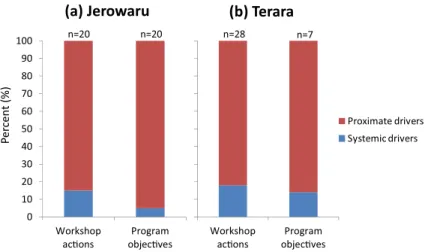
In Jerowaru, three (15%) of the actions identified for the four highest-ranked objectives addressed systemic drivers of vul-nerability, and were therefore transformative: ‘strengthen institutions (e.g. cooperatives)’, ‘coastal zoning and regulations for seaweed cultivation’ and ‘clarify status of public lands’ (Table 3). Only one (5%) of the development programs’ objectives was transformative: ‘sustainable forest management’ (Table 5). The remaining actions and development program objectives focused on addressing proximate drivers, and were therefore incremental (Fig. 5a).
The results for Terara were similar (Fig. 5b). Five (18%) of the actions for the four highest-ranked objectives addressed systemic drivers: ‘develop Muslim societies and groups’, ‘post-harvest management and marketing of agriculture/livestock’, ‘develop markets and marketing’, ‘develop religious values’ and ‘improve family planning’ (Table 4). For the development programs, the analysis was constrained by the consideration of only the highest-ranked objective, ‘improve public health’. Table 6
Development programs in Terara and their objectives and actions that contributed to the highest-ranked objective, ‘improve public health’. Program and objective (responsible
agency)
Activities conducted Activities still needed Barriers to implementation 1. Increased public awareness and
practice of clean and healthy behaviours (PNPM)
Slum housing built (BPMD) Building deep wells and bathing, washing and toilet facilities
Integrated Services Posts Village maternity house
built
Eradication of dengue fever (DIKES)
Regional management of settlement environments
Environmental sanitation program Education and extension on dengue
fever
Wash Hands With Soap Program Program to provide bathing, washing
and toilet facilities (NTB Department of Religion)
Lack of funding Lack of labour
Slum housing
infrastructure Need for renewed
tradi-tional knowledge and institutions
Poor public participa-tion and self-help
2. Raising child and maternal health awareness (DIKES)
Program to provide Inte-grated Services Posts Breastfeeding classes Free family planning
program
Nutritional assistance for children (1– 5 years old)
Lack of funding Lack of volunteers and
training of health workers
No meeting places 3. Improved use of dry land (Toga) Seed provision (DIKES)
Assistance for extension officers (BP4K)
Seed provision for commu-nity plantation (Hut Bun)
Seed provision
Development of horticultural crops Land and water management
Lack of funding No required seed No plant nurseries
4. Non-rice food diversification (BKP) Diversification and strengthening of food secu-rity program
Develop food self-sufficiency
Development of non-rice and non-wheat food
Diversification and strengthening food of security program
Developing food self-sufficient villages
No support for process-ing local food No diversification of
food consumption No food packaging
programs 5. Support informal gatherings (NTB
Department of Religion)
Provision of Friday lecture books and Al Quran Weekly program for
spiri-tual need (Toga)
Funding for religious infrastructure Provision of places for religious
education
No funding or locations Need Toga cooperation No sound systems 6. Provision of health services and
facilities (DIKES)
Building of village health centres
Assigning midwives and health workers to village health centres
Volunteer training and incentives
Assignment of village doctors and ambulances
Build hospital and Integrated Services Posts No ambulances No available doctors, midwives or health workers No locations or funding 7. Access to health information (DIKES) Provide mobile health
centre
Health awareness program
Regular health education No village extension officers
Lack of a library Acronyms in the table: PNPM (National Program for Community Empowerment); BPMD (Village Empowerment Board); DIKES (District Health Office); Toga (Islamic religious leaders); BP4K (District Extension Agency); Hut Bun (District Agency for Forestry and Estate Crops); BP4K (District Extension Agency); BKP (District Food Security Agency).
One (14%) of the development programs related to this addressed a systemic issue: ‘support informal gatherings’ to bolster Islamic values and institutions (Table 6).
Discussion
The participatory process and tools presented in this paper aimed to integrate no regrets adaptation strategies previously identified separately for sub-districts by national, provincial, district, sub-district and community level stakeholders, thus encouraging the coordination of development investment in future cycles of the localmusrenbang(planning) process. While the merits and effectiveness of both the design and facilitation of the planning process on a diverse set of outcomes are eval-uated elsewhere in this special issue (Butler et al., 2016b), this paper analyses the results through four lenses of more generic relevance for implementing adaptation pathways principles in developing countries. First, the ‘climate readiness’ of the final adaptation objectives was characterised in terms of their contribution to human development, disaster risk reduction, GHG emission reductions and ecosystem co-benefits, thus exemplifying CCD. Second, the actions to deliver the objectives were analysed in terms of potential mal-adaptation (i.e. irreversibility), and their feasibility, demonstrating the kinds of develop-ment that risk foreclosing future decision options, and which may not therefore be ‘no regrets’. Third, the actions were anal-ysed to consider whether they addressed proximate or systemic drivers of community vulnerability, and hence incremental or transformative adaptation. Finally, the comparison between the identified actions and the current development programs enabled an assessment of the extent to which standard government and NGO investments qualify as CCD, and the necessity for alterations in their priorities.
For the case studies of Jerowaru and Terara, the highest-ranked four objectives varied according to the local context and adaptation needs, influenced by the typical heterogeneity of agro-ecosystems and livelihoods of NTB’s island geography (Butler et al., 2016c). With the exception of two new objectives in Jerowaru, the majority of the objectives were closely related to the no regrets strategies identified in at least one of the prior planning workshops or focal group discussions (FGDs). All objectives tackled typical development challenges: water management, intensification or diversification of agri-culture and aquaagri-culture, education, health, food security and enhanced skills of community members. The top four objec-tives in each sub-district were focused on generating strong benefits for income, food security, social cohesion and health, but there was some variation between case studies in the relative benefits for gender equality and disaster risk reduc-tion. Notably, on average the scores for GHG mitigation were the lowest for any criterion in both case studies, suggesting that while most objectives promoted adaptation, mitigation was not equally feasible. Hence the priority objectives for Jerowaru and Terara provide empirical examples of CCD in the context of rural livelihoods and poverty alleviation.
The majority of the actions required to achieve the objectives were reversible. However, 20% of actions in Jerowaru and 36% in Terara demonstrated a risk of mal-adaptation, and therefore did not qualify as no regrets. These actions were also highly feasible, and hence the likelihood of their being implemented was substantial. The actions carrying the most signif-icant risks involved investments in hard infrastructure to provide essential services such as water, transport and electricity, which in turn underpin ‘soft’ adaptation options (e.g. provision and access to education, health, food, markets and economic opportunities). The greatest concern was for Jerowaru, where ‘build irrigation infrastructure’ was necessary to achieve the priority objective ‘improve water availability and use’. As noted in other NTB sub-districts (Butler et al., 2016c), irrigation and port infrastructure are most exposed to potential changes in rainfall and sea level rise, respectively, requiring careful consideration of ‘decision consequence times’ (Stafford Smith et al., 2011) and decision sequencing (Wise et al., 2014) prior to these investments. However, the pressing need for improved rural and maritime infrastructure in eastern Indonesian
Proximate drivers Systemic drivers
(b) Terara
(a) Jerowaru
0 10 20 30 40 50 60 70 80 90 100 Workshop acons Program objecves Workshop acons Program objecves 8 2 = n 0 2 = n n=20 n=7 Pe rc e n t ( % )Fig. 5.The proportions of Stage 3 workshop actions and development program objectives that addressed proximate and systemic drivers of community vulnerability in (a) Jerowaru and (b) Terara.
islands (Meharg et al., 2015), combined with a lack of decision-makers’ capacity to account for future change (Butler et al., 2014a,b), suggest that potentially mal-adaptive investments are likely to occur.
Few actions were transformative and addressed the systemic drivers of community vulnerability. Stage 1 workshop par-ticipants had listed population growth, corruption, and community empowerment as systemic issues in rural NTB. For the Stage 2 workshops in Jerowaru and Terara, population growth, poor social cohesion, declining ecosystem condition and soil fertility, limited land ownership, work ethic, divorce rates and women’s empowerment were also identified (Butler et al., 2016c). In spite of this, the Stage 3 workshops’ actions only addressed land ownership (‘clarify status of public lands’) and population growth (‘improve family planning’), and the remainder tackled unrelated issues of new markets, religious societies and coastal zoning and regulations. Overall, most objectives and actions focused on addressing immediate human needs and therefore contributed incrementally to the enhancement of communities’ adaptive capacity (e.g. provision of health and education services, improved agriculture and aquaculture productivity and diversification for food and income security). These results mirror the outputs from the preceding Stage 1 and Stage 2 workshops, where 67% and 84% of strate-gies were incremental, respectively (Butler et al., 2016c).
This raises two issues about the design and execution of the multi-level participatory approach developed by the project. First, it is possible that the structured social learning process failed to expose and address the systemic causes of vulnera-bility. Second, the stakeholders may have recognised these systemic issues but were unwilling to challenge them due to lack of confidence or capacity, or they chose to give precedence to meeting immediate livelihood needs before considering insti-tutional challenges. The fact that numerous systemic drivers had been identified by the same participants in the Stage 1 and 2 workshops suggests that stakeholders were aware of current and future root causes of vulnerability. Instead, meeting immediate needs through incremental strategies took precedence, as is often the case in developing countries (Conway and Mustelin, 2014) because future trends in climate change and other drivers are of lesser concern than current symptoms of under-development and modernisation (e.g.Fazey et al., 2011; Boissière et al., 2013; Butler et al., 2014b; McCubbin et al., 2015).
In our case this may have been because the Stage 1, 2 and 3 workshop processes did not provide sufficient time for par-ticipants to reflect deeply on the objectives and actions developed or did not sufficiently generate the necessary recognition of the transformative nature of change or ‘open up’ thinking to co-generate novel alternatives to meeting basic needs in cli-mate compatible ways. Any single participant would have spent a maximum of 4 days in the workshops and/or FGDs, and although these were designed to lead each person through two iterations ofBrown’s (2008)decision-into-practice learning spiral (Butler et al., 2015), this was possibly too brief, particularly for stakeholders with limited educational and organisa-tional capacity. Similar challenges have been faced by other action research exercises in developing country contexts (e.g. Fazey et al., 2010; Tschakert et al., 2014; Vervoort et al., 2014), and a common conclusion is that such processes require con-sistent engagement and iterative evolution of learning tools with stakeholders. In our case, the Stage 1, 2 and 3 workshops were intended to prime a continuation of the process through the annualmusrenbangplanning cycles in the case studies. If continued and supported, these provide the best opportunity to catalyse learning and develop windows of opportunity where systemic issues can be recognised and tackled through transformative action (Butler et al., 2016b).
A major systemic driver of vulnerability in Indonesia is the marginalisation of community members duringmusrenbang, and a lack of appropriate information which could enable their participation in decision-making (Purba, 2011; Aswad et al., 2012). We aimed to rectify this by emphasising sub-district and village level stakeholders’ participation in the Stage 3 work-shops, and creating focus groups with a mix of stakeholders, plus facilitation and methods designed to equally weight each participant’s views (Butler et al., 2015). The pre-eminence of strategies from the Stage 2 sub-district workshops in the final objectives for Jerowaru and Terara suggests that sub-district and community level participants’ views held sway in the dis-cussions. There were examples, however, of new strategies being introduced and others being omitted. One possible expla-nation is that the review and reflection process undertaken in Step 1 effectively created deliberation and negotiation, resulting in reconsideration of the initial strategies. A more cynical explanation is that in spite of both the purposeful design of the process and the facilitator’s efforts throughout to level the playing field, power dynamics and political objectives may not have been sufficiently neutralised, leading to the favouring of some options over others. Ex-post evaluations of the plan-ning process, however, indicated that community participants did feel empowered (Butler et al., 2015), and more vulnerable groups such as women benefitted from representation and participation (Butler et al., 2016b). A weakness of the evaluation method was the difficulty of tracking the influence of power dynamics in discussions and subsequent outputs (Butler et al., 2016c) limiting our ability to confidently explain the results.
There was a generally good match between the priority objectives and development programs in Jerowaru and Ter-ara. The only exception was in Jerowaru, where ‘improve income from seaweed’ was poorly covered, suggesting that this was a new and innovative strategy that had not yet been targeted by mainstream development investment. Con-sidering that the assessed objectives largely qualified as no regrets strategies and CCD, this indicates that the develop-ment programs were similarly contributing to CCD, including climate change adaptation and mitigation. This reflects the conclusions of Bours et al. (2014), who when reviewing coastal development projects in the Asia-Pacific region con-cluded that many investments are not conceived or evaluated as climate adaptation, but by delivering co-benefits they qualify as such.
There are three caveats to this result, however. First, the workshop-derived actions were consistently more likely to tackle systemic drivers of community vulnerability, with 15% and 18% being transformative in Jerowaru and Terara, respectively, versus 5% and 14% for the development program objectives. Although the small sample sizes constrain confident
conclusions, these differences could be due to the fact that the objectives and actions were the product of a participatory process involving stakeholder deliberation and social learning. By contrast, development programs in Indonesia are often developed independently by government agencies (Purba, 2011; Aswad et al., 2012), and are therefore vulnerable to the influences of power and politics where the framing and development is underpinned by the need to control system dynamics (Leach et al., 2010), and ‘‘actors aim to incorporate responses into the continuation of their normal behaviour, and elites are better positioned to take advantage of adaptation programmes than the vulnerable people that were targeted” (Artur and Hilhorst, 2012: 529). Second, the actions were evaluated to prioritise reversibility, resulting in potentially mal-adaptive infrastructural investment being ranked lower. This was not the case for the development programs, and in the case of Jer-owaru, port, agriculture, road and water infrastructure were planned (seeTable 5) without prior screening. Third, it was evi-dent that most existing government programs were ineffectively implemented or coordinated, and suffering from barriers including lack of funding and capacity, limiting progress towards CCD.
Conclusion
The integration methodology presented in this paper is specific to the three-stage structured planning process we devel-oped formusrenbangin NTB. However, the results present valuable insights to the characteristics of CCD for rural livelihoods in island geographies, and the role of adaptation pathways principles in developing CCD. Four conclusions can be reached. First, although there is variation between inland and coastal sites in their characteristics, no regrets CCD largely mirrors stan-dard human development interventions, including health, education, income generation and food security. Paradoxically, however, the need to build infrastructure to deliver these essential ‘soft’ services and hence adaptation presents risks of mal-adaptation. While this may be unavoidable, building capacity for incorporating flexibility into government and donor investment planning through decision sequencing along pathways can contribute to reducing this.
Second, the majority of actions required to deliver CCD were incremental, and tackled proximate drivers of community vulnerability. While participants were aware of deeper systemic issues, few transformative strategies were identified to address them, suggesting that an extended learning process, comprising innovative approaches to visioning, re-framing, sce-nario development, option identification, engagement and facilitation, is required, plus a greater understanding of the polit-ical barriers that constrain responses. Thus, if a step-change in adaptive capacity is to occur, enabling a ‘leap-frogging’ of the Sustainable Development Goals (Butler et al., 2016c), mechanisms to transform institutions that constrain community engagement in decision-making are necessary. The participatory planning process presented here provides a useful foundation.
Third, the final set of prioritised actions were predominantly made up of those identified at the sub-district level. This suggests that local stakeholders have more holistic and experiential perspectives of problems, and that the application of this type of process at the community scale is likely to be most appropriate for revealing and building understanding of local issues and stimulating the generation of locally-relevant and credible transformative actions.
Finally, many government and NGO development programs may be delivering CCD, but are not designed with this objec-tive in mind. The introduction of adaptation pathways principles through processes such asmusrenbangwould highlight gaps and risks, and re-prioritise expenditure, coordination and available capacity to no regrets strategies that deliver the greatest CCD co-benefits.
Acknowledgements
We acknowledge the support of the communities of Jerowaru and Terara for this research and are greatly appreciative of the time and enthusiasm given by workshop participants. We thank our University of Mataram colleagues for facilitating and assisting us to conduct the research. This research was funded by the DFAT-CSIRO Research for Development Alliance. References
Artur, L., Hilhorst, D., 2012. Everyday realities of climate change adaptation in Mozambique. Global Environ. Change 22 (2), 529–536.
Aswad, S., Heywood, P., Susilawati, C., 2012. The roles of procedural justice and social learning in improving self-organizing capabilities of local communities for sustainable development in decentralized Indonesia. OIDA Int. J. Sustainable Dev. 03 (10), 73–90.
Barnett, J., O’Neill, S., 2010. Maladaptation. Global Environ. Change 20, 211–213.
Bohensky, E.L., Kirono, D., Butler, J.R.A., Rochester, W., Habibi, P., Handayani, T., Yanuartati, Y., 2016. Climate knowledge cultures: stakeholder perspectives on change and adaptation in Nusa Tenggara Barat. Indonesia. Clim. Risk Manage. 12, 17–31.
Boissière, M., Locatelli, B., Sheil, D., Padmanaba, M., Sadjudin, E., 2013. Local perceptions of climate variability and change in tropical forests of Papua, Indonesia. Ecol. Soc. 18 (4), 13.http://dx.doi.org/10.5751/ES-05822-180413.
Bours, D., McGinn, C., Pringle, P., 2014. Evaluating Programmes through a Climate Adaptation Lens: Reflections from Coastal Areas in Asia and the Pacific. SEA Change CoP, Phnom Penh and UKCIP, Oxford.
Brown, V.A., 2008. Leonardo’s Vision: a Guide to Collective Thinking and Action. Sense Publishers, Rotterdam.
Butler, J.R.A., Suadnya, W., Puspadi, K., Sutaryono, Y., Wise, R.M., Skewes, T.D., Kirono, D., Bohensky, E.L., Handayani, T., Habibi, P., Kisman, M., Suharto, I., Hanartani, , Supartarningsih, S., Ripaldi, A., Fachry, A., Yanuartati, Y., Abbas, G., Duggan, K., Ash, A., 2014a. Framing the application of adaptation pathways for rural livelihoods and global change in eastern Indonesian islands. Global Environ. Change 28, 368–382.
Butler, J.R.A., Skewes, T., Mitchell, D., Pontio, M., Hills, T., 2014b. Declining ecosystem service trajectories in Milne Bay, Papua New Guinea: is human population pressure a more critical driver than climate change? Mar. Policy 46, 1–13.
Butler, J.R.A., Wise, R.M., Skewes, T.D., Bohensky, E.L., Peterson, N., Suadnya, W., Yanuartati, Y., Handayani, T., Habibi, P., Puspadi, K., Bou, N., Vaghelo, D., Rochester, W., 2015. Integrating top-down and bottom-up adaptation planning: a structured learning approach. Coastal Manage. 43, 346–364.
Butler, J.R.A., Bohensky, E.L., Darbas, T., Kirono, D., Wise, R.M., Sutaryono, Y., 2016a. Building capacity for adaptation pathways in eastern Indonesian islands: synthesis and lessons learned. Clim. Risk Manage. 12, A1–A10.
Butler, J.R.A., Suadnya, W., Yanuartati, Y., Meharg, S., Wise, R.M., Sutaryono, Y., Duggan, K., 2016b. Priming adaptation pathways through adaptive co-management: design and evaluation for developing countries. Clim. Risk Manage. 12, 1–16.
Butler, J.R.A., Bohensky, E.L., Suadnya, W., Yanuartati, Y., Handayani, T., Habibi, P., Puspadi, K., Skewes, T.D., Wise, R.M., Suharto, I., Park, S.E., Sutaryono, Y., 2016c. Scenario planning to leap-frog the Sustainable Development Goals: an adaptation pathways approach. Clim. Risk Manage. 12, 83–99. Conway, D., Mustelin, J., 2014. Strategies for improving adaptation practice in developing countries. Nat. Climate Change 4 (5), 339–342.
Djalante, R., Thomalla, F., 2012. Disaster risk reduction and climate change adaptation in Indonesia: institutional challenges and opportunities for integration. Int. J. Disaster Resilience Built Environ. 3 (2), 166–180.
Ellis, K., Cambray, A., Lemma, A., 2013. Drivers and challenges for climate compatible development, climate and development knowledge network ODI Policy Brief November 2010. Available at:http://sa.indiaenvironmentportal.org.in/files/file/Climate_Compatible_Development.pdf.
Eriksen, S., Aldunce, P., Bahinipati, C.S., Martins, R.D., Molefe, J.I., Nhemachena, C., O’Brien, K., Olorunfemi, F., Park, J., Sugna, L., Ulsrud, K., 2011. When not every response to climate change is a good one: identifying principles for sustainable adaptation. Climate Dev. 3, 7–20.
Fankhauser, S., Smith, J.B., Tol, R.S.J., 1999. Weathering climate change: some simple rules to guide adaptation decisions. Ecol. Econ. 30, 67–78. Fazey, I., Kesby, M., Evely, A., Latham, I., Wagatora, D., Hagasua, J.-E., Reed, M.S., Christie, M., 2010. A three-tiered approach to participatory vulnerability
assessment in the Solomon Islands. Global Environ. Change 20 (4), 713–728.
Fazey, I., Pettorelli, N., Kenter, J., Wagatora, D., Schuett, D., 2011. Maladaptive trajectories of change in Makira, Solomon Islands. Global Environ. Change 21, 1275–1289.
Haasnoot, M., Kwakkel, J.H., Walker, W.E., ter Maat, J., 2013. Dynamic adaptive policy pathways: a method for crafting robust decisions for a deeply uncertain world. Global Environ. Change 23 (2), 485–498.
Hallegatte, S., 2009. Strategies to adapt to an uncertain climate change. Global Environ. Change 19, 240–247.
Hardee, K., Mutunga, C., 2009. Strengthening the link between climate change adaptation and national development plans: lessons from the case of population in National Adaptation Programmes of Action (NAPAs). Mitig. Adapt. Strat. Glob. Change 15 (2), 113–126.
Kirono, D., Butler, J.R.A., McGregor, J., Ripaldi, A., Katzfey, J., Nguyen, K., 2016. Historical and future seasonal rainfall variability in Nusa Tenggara Barat Province, Indonesia: implications for the agriculture and water sectors. Clim. Risk Manage. 12, 45–58.
Leach, M., Scoones, I., Stirling, A., 2010. Dynamic Sustainabilities. Technology, Environment, Social Justice, London, Earthscan.
Lemos, M.C., Boyd, E., Tompkins, E.L., Osbahr, H., Liverman, D., 2007. Developing adaptation and adapting development. Ecol. Soc. 12 (2), 26.
McCubbin, S., Smit, B., Pearce, T., 2015. Where does climate fit? Vulnerability to climate change in the context of multiple stressors in Funafuti, Tuvalu. Global Environ. Change 30, 43–55.
McGregor, J.L., Nguyen, K.C., Kirono, D., Katzfey, J.J., 2016. High-resolution climate projections for the islands of Lombok and Sumbawa, Nusa Tenggara Barat Province, Indonesia: challenges and applications. Clim. Risk Manage. 12, 32–44.
Meharg, S., Kirono, D.G.C., Butler, J.R.A., McEachern, S., Hajkowicz, S., 2015. Australia-Indonesia Centre Megatrends: Infrastructure. Report Prepared for the Australia-Indonesia Centre, Monash University. CSIRO, Australia.
Mitchell, T., Maxwell, S., 2010. Defining climate compatible development, Climate and Development Knowledge Network ODI Policy Brief November 2010. Available at:http://r4d.dfid.gov.uk/pdf/outputs/cdkn/cdkn-ccd-digi-master-19nov.pdfaccessed (September, 2015).
Munda, G., 2008. Social Multi-criteria Evaluation for a Sustainable Economy. Springer, Berlin.
Park, S.E., Marshall, N.A., Jakku, E., Dowd, A.M., Howden, S.M., Mendham, E., Fleming, A., 2012. Informing adaptation responses to climate change through theories of transformation. Global Environ. Change 22, 115–126.
Pelling, M., 2011. Adaptation to Climate Change: From Resilience to Transformation. Routledge, London.
Purba, R.E., 2011. Public participation in development planning: a case study of Indonesian Musrenbang. Int. J. Interdiscip. Soc. Sci. 5 (12), 265–277. Ranger, N., Garbett-Shiels, S.-L., 2011. How can decision-makers in developing countries incorporate uncertainty about future climate risks into existing
planning and policymaking processes? Policy paper, Centre for Climate Change Economics and Policy, Grantham Research Institute on Climate Change and the Environment.
Reeder, T., Ranger, N., 2011. How do you adapt in an uncertain world? Lessons from the Thames Estuary 2100 project. World Resources Report, Washington DC. Available online athttp://www.worldresourcesreport.org.
Rochester, W.A., Skewes, T.D., Suadnya, W., Butler, J.R.A., Lyne, V.D., Handayani, T., Habibi, P., Karnan, Cokrowati, N., 2016. A typology of natural resource use for livelihood impact assessments in Nusa Tenggara Barat Province, Indonesia. Clim. Risk Manage. 12, 59–68.
Rodima-Taylor, D., Olwig, M.F., Chhetri, N., 2012. Adaptation as innovation, innovation as adaptation: an institutional approach to climate change. Appl. Geogr. 33, 107–111.
Rogers, K., Biggs, H., 1999. Integrating indicators, endpoints and value systems in strategic management of the rivers of the Kruger National Park. Freshw. Biol. 41 (2), 439–451.
Skewes, T.D., Hunter, C.M., Butler, J.R.A., Lyne, V.D., Suadnya, W., Wise, R.M., 2016. The Asset Drivers Well-being Interaction Matrix (ADWIM): a participatory tool for estimating future impacts on ecosystem services and livelihoods. Clim. Risk Manage. 12, 69–82.
Stafford Smith, M., Horrocks, L., Harvey, A., Hamilton, C., 2011. Rethinking adaptation for a 4°C World. Philos. Trans. R. Soc. A 369, 196–216.
Steele, K., Carmel, Y., Cross, J., Wilcox, C., 2008. Uses and Misuses of Multi-Criteria Decision Analysis (MCDA) in environmental decision-making. Report No. 0610. Australian Centre of Excellence for Risk Analysis.
Suckall, N., Stringer, L., Tompkins, E., 2015. Presenting Triple-Wins? Assessing projects that deliver adaptation, mitigation and development co-benefits in rural Sub-Saharan Africa. AMBIO 44 (1), 34–41.
Tschakert, P., Dietrich, K.A., Tamminga, K., Prins, E., Shaffer, J., Liwenga, E., Asiedu, A., 2014. Learning and envisioning under climatic uncertainty. Environ. Plan. A 46, 1049–1068.
Vervoort, J.M., Thornton, P.K., Kristjanson, P., Förch, W., Ericksen, P.J., Kok, K., Ingram, J.S.I., Herrero, M., Palazzo, A., Helfgott, A.E.S., Wilkinson, A., Havlík, P., Mason-D’Croz, D., Jost, C., 2014. Challenges to scenario-guided adaptive action on food security under climate change. Global Environ. Change 28, 383– 394.
Wegner, G., Pascual, U., 2011. Cost-benefit analysis in the context of ecosystem services for human well-being: a multidisciplinary critique. Global Environ. Change 21 (2), 492–504.
Werners, S.E., Pfenninger, S., van Slobbe, E., Haasnoot, M., Kwakkel, J.H., Swart, R.J., 2013. Thresholds, tipping and turning points for sustainability under climate change. Curr. Opin. Environ. Sustainability 5 (3–4), 334–340.
Wise, R.M., Fazey, I., Stafford Smith, M., Park, S.E., Eakin, H.C., Archer Van Garderen, E.R.M., Campbell, B., 2014. Reconceptualising adaptation to climate change as part of pathways of change and response. Global Environ. Change 28, 325–336.