50
Unsupervised Stance Detection for Arguments from Consequences
Jonathan Kobbe, Ioana Hulpus¸, Heiner Stuckenschmidt
University of Mannheim
{jonathan,ioana,heiner}@informatik.uni-mannheim.de
Abstract
Social media platforms have become an essen-tial venue for online deliberation where users discuss arguments, debate, and form opin-ions. In this paper, we propose an unsuper-vised method to detect the stance of argumen-tative claims with respect to a topic. Most related work focuses on topic-specific super-vised models that need to be trained for every emergent debate topic. To address this limita-tion, we propose a topic independent approach that focuses on a frequently encountered class of arguments, specifically, on arguments from consequences. We do this by extracting the effects that claims refer to, and proposing a means for inferring if the effect is agood or bad consequence. Our experiments provide promising results that are comparable to, and in particular regards even outperform BERT. Furthermore, we publish a novel dataset of ar-guments relating to consequences, annotated with Amazon Mechanical Turk.
1 Introduction
In the context of decision making it is crucial to compare positive and negative effects that result from a potential decision. Indeed, arguing for or against something because of its possible conse-quences is a frequent form of argumentation ( Reis-ert et al.,2018;Al-Khatib et al.,2020). In this pa-per, we address the classical stance detection prob-lem paying special attention to such arguments.
Stance detection, also called stance classifica-tion, is the task to decide whether a text is in favor of, against, or unrelated to a given topic. This prob-lem is related to opinion mining, but while opinion mining focuses on the sentiment polarity explicitly expressed by a text, stance detection aims to deter-mine the position that the text holds with respect to a topic that is generally more abstract and might not be mentioned in the text. As such, in stance
detection, texts can transmit a negative sentiment or opinion, but be in favor of the targeted topic. For example, the textHolocaust denial psychologically harms Holocaust survivorsexpresses a negative opinion, but its stance towardsCriminalization of Holocaust denialis positive.1
Recently, the problem of stance detection has received growing attention from the scientific com-munity, as shown by the recent survey ofK¨uc¸¨uk and Can(2020). Most approaches tackle this prob-lem by learning stance classification models for each topic. While this can achieve good results, new models need to be trained for each new topic of interest, generally entailing large annotation stud-ies.
While we admit that a one-size-fits-all approach to stance detection is currently unfeasible, we take a different perspective. Rather than targeting topic-dependent models, we target a subclass of argu-ments. Specifically, we focus on arguments that have been classified byWalton et al.(2008) under the argument from consequencesscheme. They contain a premise of the formIf A is brought about, then good (bad) consequences will (may plausibly) occur, and a conclusionA should (not) be brought about. In most real-life arguments of this type, the consequences are expressed, but the interpretation that they aregoodorbad, as well as the conclusion, are most often implicit. The task of stance detec-tion is then to determine if the argument is against or in favor of A. Our solution to find the stance of such arguments revolves around extracting and analyzing cause-effect relations in order to infer if the consequences aregoodorbad.
We conducted an Amazon Mechanical Turk (AMT) study, in which we crowdsourced anno-tations for 1894 arguments extracted from Debate-pedia. We compared our system’s performance
1All arguments presented in this paper are fromhttp:
to a sentiment analysis baseline and a fine-tuned BERT model. The results show that our results are comparable and, in some settings, even bet-ter than BERT’s.2 Aside from not needing anno-tated training data, we stress the advantage of our approach for providing human-understandable ex-planations to the results, and to provide, as a by-product, cause-effect relations between concepts brought up in arguments.
The paper is structured as follows. Section2 po-sitions our contributions with respect to related literature. Section 3 presents our proposed ap-proach. Section 4 describes our crowdsourced dataset, which we use in Section5to evaluate our approach. Lastly, Section6concludes the paper.
2 Related Work
Stance detection has been studied on various types of formal texts such as congressional debates (Thomas et al.,2006) and company-internal discus-sions (Murakami and Raymond,2010). However, like most recent related work on the topic, we are particularly interested in informal texts from online social media.
The vast majority of previous approaches pro-poses supervised methods, using traditional ma-chine learning algorithms (Somasundaran and Wiebe,2010;Anand et al.,2011;Hasan and Ng, 2013;Faulkner,2014;Sobhani et al.,2016; Adda-wood et al.,2017) and more recently, various deep neural networks architectures (Sun et al.,2018;Du et al.,2017;Dey et al.,2018;Ghosh et al.,2019). These approaches, most of which have been trig-gered by a recent SemEval shared task3( Moham-mad et al.,2016), learn topic-specific models. Thus, new topics require new models whose training en-tails large user annotation studies. In contrast, we propose a fully unsupervised, topic-independent method, and rather target a particular but frequent class of claims, those that refer to consequences.
Among the unsupervised approaches, the most prominent one is this ofSomasundaran and Wiebe (2009), which got extended byKonjengbam et al. (2018) and Ghosh et al. (2018). However, they focus on non-ideological topics (usually products, e.g., iPhone vs. Galaxy). In contrast, we target ideological topics (e.g.,Gay Marriage, Abortion) whose stance is harder to detect due to less
fre-2
Our data and source code are publicly available at https://github.com/dwslab/StArCon.
3http://alt.qcri.org/semeval2016/task6
quent use of sentiment words and a wider variety of brought up issues and arguments (Rajendran et al., 2016;Wang et al.,2019). On the one hand, these works extract topic aspects (e.g.,screen resolution, battery) and polarities towards these aspects, a step that is unfeasible for ideological topics. On the other hand, like these works, we also use syntactic rules, but not for pairing aspects to opinions, but for extracting triples that correspond to statements about effects over opinion words.
Another class of stance detection approaches uses the context of the post, such as its relations to other posts in the debate, the network of authors, or the author’s identity (Hasan and Ng,2013;Sridhar et al.,2014;Addawood et al.,2017;Bar-Haim et al., 2017b). By contrast, we target claim-topic pairs in isolation.
Another aspect that sets our work apart from most related work is that, except for the approaches that target tweets, most focus on longer texts while we consider short, one-sentence claims. In this re-gard, but not only, the stance detection work that is closest to ours is the partly supervised system of Bar-Haim et al.(2017a). They also propose a topic-independent solution to stance detection for short claims without considering context, but they do not specifically address arguments from consequences. While they follow a similar sequence of steps as we do, they propose different approaches for each step. For instance, they propose a supervised approach to detect the target of a claim’s opinion, while we do it in an unsupervised manner. They focus pri-marily on detecting contrastive relations between phrases, while our focus is on detecting effects. In this last regard, the works can be considered complementary.
Regarding the analysis of arguments from con-sequences, Reisert et al.(2018) provide and use scheme dependent templates to analyze the struc-ture of arguments. Their work is rather concep-tual and focuses on annotations. Very recently, Al-Khatib et al.(2020) built, on similar intuitions as ours, an approach for creating argumentation knowledge graphs based on cause-effect relations. Their work comes to reinforce the usefulness of addressing arguments from consequences.
To sum up, our contribution is three-fold: (i) we propose a fully unsupervised approach for stance detection, focusing on arguments that refer to con-sequences; (ii) we define rules over grammatical dependencies that exploit sentiment as well as
ef-fect words in order to determinegoodandbad con-sequences; (iii) we publish a new stance detection dataset that labels claims that refer to consequences, and which was crowdsourced on AMT.
3 Our Approach
Given an argumentative claim and a topic, our task is to detect the stance that the claim has with respect to the topic. Statements such as the claim or topic usually express a positive (favorable) or negative (unfavorable) position to a concept that we call the target. As such, the target is a phrase that belongs to the statement. In the example shown
Topic: Medical marijuana dispensaries Claim: Legalizing medical marijuana does not
increase use and abuse
Table 1: Example of topic-claim pair
in Table 1, the target of both topic and claim is medical marijuana. Our solution starts by first determining the stance of the claim and of the topic towards their respective targetsTcandTt. We then use these stances and the semantic relation between the targets to determine the claim’s stance towards the topic.
The overarching intuition behind our approach is that when the stance of a statement towards its target is favorable, the text either highlights the desirable consequences of the target being brought about (e.g.,Electing an EU president directly will increase accountability), or it highlights the nega-tive consequences if the target is not brought about (e.g.,Sinking organic blooms can render the deep sea anoxic).
At the core of our approach resides what we call theeffect triple. The effect triple is a triple of the form<(T,dir),(P,eff),(O,sent)>. The (T,dir) pair represents the targetT of the
state-ment and if the statestate-ment refers to a magnification (dir = 1) (e.g.legalizing medical marijuana), or a reduction (dir =−1) of the target (e.g. banning medical marijuana). The(P,eff)pair represents the predicateP that hasT as the subject, together with the effect eff that it has over the object O. The effect can be positive (eff = +1) or negative (eff =−1). Lastly, the(O, sent)pair represents the object over whichT has the effectP. We ex-pect thesentimentof an object to reflect whether it is generally regarded asa good thing(sent = +1) ora bad thing(sent =−1).
Our approach’s core idea is to distill such an effect triple from the claim and use it to infer the claim’s stance towardsTc. We further determine (Tt, dir)to infer the topic’s stance towardsTt.
Us-ing these stances, together with the relation be-tween the claim’s and the topic’s target, we finally decide the claim’s stance with respect to the topic. We now describe the lexicons we use as well as each of these steps in more detail.
3.1 Lexicons
For determiningdir,eff, andsent, we use an ef-fect verb lexicon and a sentiment lexicon that we describe in the following.
The ECF Effect Lexicon To identify verbs and nominalized verbs that indicate effects on their direct objects, we extend the connotation frames (Rashkin et al., 2016). The connotation frames lexicon consists of a list of 947 verbs, manually an-notated with values in the[−1,1]range, indicating if the verb implies a positive or negative effect over its object. We consider the entries with scores in the range[−0.1,0.1]as a neutral effect (e.g.,use, say, seem), and we filter them out. We call the 845 remaining words in the lexiconeffect words. We extend the list of effect words by adding all words in the same WordNet (Fellbaum,2010) synset as the effect words, as long as there is no contradic-tion. A contradiction occurs when a new candidate effect word shares a synset with both a negative and a positive effect word. This way, we obtain 2508 effect words. We call this lexicon the extended connotation frames lexicon (ECF). As ECF only contains verbs, we use it via the stems of the words, mainly to also get the effects of nominalized verbs. In our experiments, we compare the performance of this lexicon with +/-EffectWordNet (Choi and Wiebe,2014)(EWN).
The Sentiment Lexicon In order to determine if the object of the effect is something good or bad, we combine several commonly used senti-ment lexicons: (i) the MPQA lexicon4 (Wilson et al.,2005), (ii) the opinion lexicon ofHu and Liu (2004), and (iii) the sentiment lexicon of Toledo-Ronen et al. (2018) (uni- and bigrams, using a threshold of±0.2). The composed lexicon con-tains sentiment values in the range[−1,1].
4We used an American English dictionary to correct
ortho-graphic mistakes resp. to add American English versions of British English words.
For many words, the polarities of their sentiment and of their effect are the same (e.g., kill, love). Still, there are important exceptions, such asreduce, which has neutral sentiment but indicates a negative effect, orconquer, which has a slightly positive sentiment but indicates a negative effect.
3.2 Effect Triple Extraction
Target Identification To detect the targets of the claim (Tc) and topic (Tt), we assume thatTcis se-mantically related to the topic, or more specifically, toTt. Thus, we identifyTcandTtsimultaneously by following three strategies. The use of the second and third strategies is conditioned on the previous strategies to have failed to identify a pair of targets. First, we look for a pair of nouns that are identical or have the same lemma. We use Stanford Core NLP (Manning et al.,2014) for POS tagging and lemmatizing. Second, we look for a pair consisting of an acronym (e.g., ICC) and a word sequence whose first letters form the acronym (e.g., Interna-tional Criminal Court). Third, we look for pairs of nouns that are synonyms or antonyms according to Thesaurus.plus5.
Besides returning Tc and Tt, we also return a valuer = +1if the two targets have been found to be synonyms andr=−1if they are antonyms. Thus, first and second strategies only returnr = 1 while the third strategy returns1or−1.
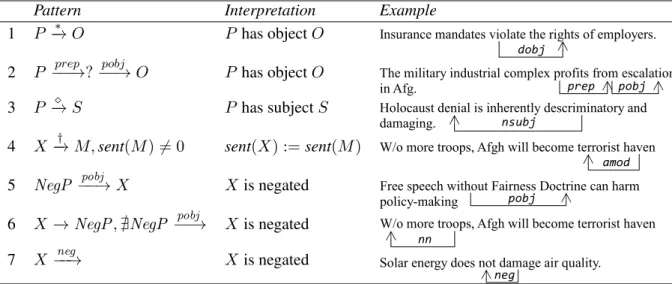
Target Direction Determination As described earlier, each target is accompanied by adirvalue which indicates if the statement refers to a phe-nomenon of amplification or reduction of the target. We detect this by searching for a word whose ob-ject is the target by using Patterns 1 and 2 shown in Table2. The word is then looked-up in the ef-fect lexicon. If a negative efef-fect is found, then dir = −1, otherwise dir = 1. We call the word thetarget effector, or justeffector. In the claim in Table1, the effector islegalizingand expresses an amplification of the target (dir = 1).
Detecting Predicates and Their Effects Effect words are commonly used in arguments from con-sequences to express a (potential) effect that the target has or might have over another object. For example, in the claim in Table1, the effect word increaseexpresses a positive effect that the (ampli-fied) target has over the objectsuse, abuse.
5We use only the synonyms and antonyms shown at
https://thesaurus.plus/thesaurus/xxxwhere xxxis a placeholder for concrete words
We detect this effect of the target by using Pat-tern 3 to find a predicate whose subject is either the target or its effector, and by looking up this predicate in the effect lexicon. We thereby seteff to1or−1, depending on if the effect is positive or negative. In our running example, the(P,eff)pair becomes (increase,−1)because of the negation, as we explain below.
Tellinggoodfrombad The last effect triple com-ponent we detect is (O,sent). To this end, we search the dependency graph for instantiations of Patterns 1 or 2, whereP is the predicate that has been detected to express the target’s effect. If such an object is found, we use the sentiment lexicon by first searching for the exact word and, if not available, for the word’s lemma. We setsent to−1 if the word bears a negative sentiment or to1 other-wise. In our example, the(O, sent)pair becomes (abuse,−1)because the worduseis neutral per se.
The sentiment of a word is overwritten by the sentiment of its modifiers, as shown in Pattern 4 in Table2. In the provided example in the table, one can see that the modifierterroristdominates the sentiment of the positive wordhaven. Conse-quently, bothterrorist havenandterrorist attack are considered generally bad.
Negation We deal with negations for each effect triple component. We identify negations by look-ing for Patterns 5, 6, and 7, as shown in Table2. Patterns 5 and 6 make use of a manually created list of all negative English prepositions6. The existence of a negation affecting the target, predicate, or object toggles the sign of the corresponding value
-dir,eff orsent, respectively.
3.3 Inferring the Stance Towards the Target To infer the stance that a statement expresses towards its target, we use the intuition that the stance is unfavorable when the text expresses negative consequences of the target, and posi-tive otherwise. Thus, we define that the stance towards the target is positive in exactly the fol-lowing four cases: (i) the target’s amplification implies a positive effect over something good (dir = eff = sent = +1); (ii) the target’s ampli-fication implies a negative effect over something bad (dir =+1,eff =sent=−1); (iii) the target’s reduction implies a negative effect over something
6Those are
except, less, minus, opposite, sans, unlike, ver-sus, without, w/o, vice, instead (of), lack.
Pattern Interpretation Example 1 P −→∗ O P has objectO
dobj
Insurance mandates violate the rights of employers. 2 P −prep−−→?−−→pobj O P has objectO
prep pobj The military industrial complex profits from escalation in Afg.
3 P −→ S P has subjectS
nsubj
Holocaust denial is inherently descriminatory and damaging.
4 X−→† M,sent(M)6= 0 sent(X) :=sent(M)
amod W/o more troops, Afgh will become terrorist haven 5 NegP −−→pobj X Xis negated
pobj
Free speech without Fairness Doctrine can harm policy-making
6 X−→NegP,@NegP −−→pobj Xis negated
nn
W/o more troops, Afgh will become terrorist haven 7 X−−→neg Xis negated
neg
Solar energy does not damage air quality.
Table 2: Dependency graph patterns.∗ ∈ {dobj, nsubjpass, cobj, csubjpass, nmod, xcomp}; ∈ {nsubj, csubj};† ∈ {amod, nn, advmod};NegP stands fornegative preposition
good (dir =eff =−1,sent =+1); (iv) the target’s reduction implies a positive effect over something bad (dir =+1,eff =−1,sent =+1). Hence, the stance is favorable towards the target if the mul-tiplication of the three components’ values is+1. Consequently, we define the stance of a statement towards the target ass=dir·eff·valand interpret
s= 1asIn favorands=−1asAgainst.
3.4 Inferring the Stance of the Claim Towards the Topic
The steps above can be executed analogously for the claim and the topic. However, due to the na-ture of the text expressing the topic, we only aim to extract an effect triple from the claim. For the topic, we detect its target and set the stance to its correspondingdirvalue. We denote the stances of the claim and topic towards their respective targets assc andst. To infer the claim’s stance towards the topic, we need to consider the relation between
TcandTt, i.e., the value ofr as described in Sec-tion 3.2. We then define the final result of the analysis asΠ =sc·st·r.
Table3presents further examples of how our ap-proach detects the stance of the claim towards the topic. As illustrated in the examples, the straightfor-ward interpretability of the stance detection process can be easily used for producing human-readable explanations for the returned results. This is partic-ularly relevant for helping users get more control over the process, particularly in light of subsequent applications on top of stance detection.
Porn watching may ac-tually reduce rape rates
Pornography
T, dir Porn,+1 Pornography,+1
P,eff reduce,−1
O,sent rape rates,−1
s 1 1
r 1
Π 1(In favor)
Holocaust denial psy-chologically harms Ho-locaust survivors
Criminalization
of Holocaust
denial
T, dir Holocaust denial,1 Hol. denial,−1
P,eff harms,−1
O,sent survivors,+1
s −1 −1
r 1
Π 1(In favor)
Table 3: Worked out Examples
3.5 Alternative Strategies
We denote the process in which all the previous steps are fulfilled and an effect triple is extracted asTPO. However, due to a variety of reasons that we analyze in Section5.4, we might fail to extract a complete effect triple. One such case is when an adjective expresses an effect, for instance, Holo-caust denial is discriminatory. For that reason, if we identifyT andP, but notO, we seteff to the sentiment polarity ofP, andsentto+1by default. We refer to this strategy asTP.
Another potential situation is that the system detects(P,eff)and(O,sent), but it can not relate them toT. One cause can be that we fail to identify
T. If so, dir = +1by default. Another cause can be that T is found, but we can not infer its relation toP. In this case, we consider that the
identified target is the subject ofP and set(T,dir) accordingly. We refer to this strategy asPO.
Lastly, if all above strategies fail to create an effect triple, we use a heuristic: ifTwas found,dir
is set accordingly. Otherwisedir = 1by default. For the remaining words in the statement, we check their sentiment score, still using Pattern 4, toggling the sign if it is negated. The sum of the sentiment scores is then multiplied withdir. The stance is considered favorable or not depending on the sign of the result. We refer to this strategy asHeuristic.
4 Dataset Generation
To evaluate our approach, we need stance annotated claim pairs, as well as annotations if the topic-claim pair refers to a consequence or not.
4.1 Data Collection
To create such a corpus, we run an AMT crowd-sourcing study, where we annotate claims and top-ics extracted from Debatepedia7. We only use the 236 Featured Debate Digest articlesas they are of higher quality. They contain more than 10,000 arguments labeled by their author as either pro or con the debate’s topic. Usually, the arguments start with a bolded, one-sentence summary, which serves as the argument’s claim. We exclusively use these claims and pair them to the debate’s topic. We ex-clude 16 debates whose topics containvsoror(e.g. Democrats vs. Republicans), and 30 debates with-out a title question. To create a balanced dataset that covers a large variety of topics, we randomly selected 5 pro and 5 con arguments of each debate. If a debate contains less than 5 pro and 5 con ar-guments, we select the maximum equal number of pro and con arguments. We obtain 190 different topics and 1894 arguments.
4.2 Crowdsourcing Study
The annotation task consisted of the debate’s topic, one of its claims, and two questions. The first ques-tion was to select the stance of the claim towards the topic, out of the following choices: in favor, against, neither andI don’t know. Although we have the original arguments’ stances, this question helps us check how clear the claim is when taken out of the debate’s context. The second question was whether the claim refers to a consequence re-lated to the topic, with possible answersyes, noand I don’t know. Each topic-claim pair was annotated
7http://www.debatepedia.org
Valid Stance Consequence
Annotations rate κ κ0 rate κ κ0
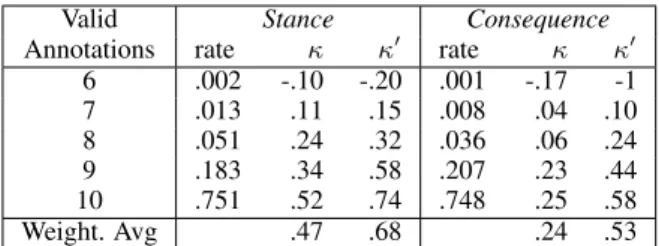
6 .002 -.10 -.20 .001 -.17 -1 7 .013 .11 .15 .008 .04 .10 8 .051 .24 .32 .036 .06 .24 9 .183 .34 .58 .207 .23 .44 10 .751 .52 .74 .748 .25 .58 Weight. Avg .47 .68 .24 .53
Table 4: Fleiss’ Kappa dependent on the number of valid annotations 0 0.2 0.4 0.6 0.8 1 0 0.2 0.4 0.6 0.8 1 Stance C o n s e q u e n ce
Figure 1: Reliability of annotators according to MACE: The higher the score, the more reliable the annotator is.
by 10 annotators living in the US with a HIT ap-proval rate greater than 98% and more than 10,000 approved HITs in total. Overall, 277 annotators worked on the task.
4.3 Agreement and Reliability
Table4 shows the inter-annotator agreement per number of valid annotations, i.e., annotations that are notI don’t know. Since we have many anno-tators, Fleissκis particularly low on consequence annotation, but still indicates higher agreement than random. To give an agreement estimate less sen-sitive to individual outliers, we also compute κ0
as the Fleiss kappa between two “experts”, where each expert brings together half of the number of annotators and its annotation is decided with MACE (Hovy et al.,2013).
Figure1shows the reliability of individual anno-tators. Although there is a weak correlation among the reliability of the two tasks (Pearson .41), some annotators are quite reliable in annotating stances, but highly unreliable in annotating consequences. This indicates that the latter task was unclear to some of the annotators. To understand why the annotators usually disagree, we investigated such
instances and identified several possible reasons: Complexity In the topic-claim pair Criminal-ization of Holocaust denial – Danger of public accepting holocaust denial should be fought by logic, both topic and claim have a negative stance towardsholocaust denial, which suggests the label in favor. Still, by proposing a different solution thancriminalization, the claim isagainstthe topic. Missing Background Knowledge Many argu-ments involve non-trivial background knowledge: Israeli military assault in Gaza – Hamas was first to escalate conflict following end of ceasefire.
AmbiguityAccording to the pair2009 US eco-nomic stimulus – Stimulus risks being too small not too large, a small stimulus is bad while an appro-priate stimulus is good.
Ethical Judgement Different judgments on what is good and bad can lead to different stance labels: Ban on human reproductive cloning – Cloning will involve the creation of children for predetermined roles.
Lack of Conceptual ClarityEspecially decid-ing whether the claim refers to a consequence re-lated to the topic can be a matter of judgment. For example, in Health insurance mandates – Insur-ance mandates violate the rights of employers, the violation of rights can be seen as a consequence or as a property of insurance mandates.
4.4 Final Dataset
To account for unreliable annotators, we compute the annotation result with MACE. As such, we find that for 81.36% of the annotated arguments, the stance label obtained via MACE is the same as the original stance label. By comparison, the majority vote matches79.30%of the original stance labels. Since disagreements between the MACE annota-tion and the original stance might indicate that the claim’s stance is unclear outside the debate’s con-text, we exclude from the dataset all such pairs. For example, the original label of the pairIs Wikipedia valuable? – Wikipedia is online and interactive, unlike other encyclopediasiscon, because, in its context, it was discussed whether Wikipedia is an encyclopedia or not. In contrast, the result of our annotation ispro. Since the original labels are only proorcon, all pairs that our study determined as neitherare removed. This filter resulted in a total of 1502pairs, out of which822have been annotated to relate to consequences.
conseq other debate wiki
pro con pro con pro con pro con
376 446 370 310 746 756 1195 1199
Table 5: Class distributions
5 Evaluation 5.1 Data
We report results both on the822pairs that relate to consequences, denoted by conseq, and on the rest of the pairs, denoted byother, as well as on their union, denoted bydebate.
For checking the performance of the systems on an independent dataset, we also use the claim stance dataset8 published by Bar-Haim et al. (2017a). This dataset contains 55 topics of ide-bate9 and 2394 manually collected claims from Wikipedia. We denote this dataset bywiki. As Bar-Haim et al.(2017a,b) do, when working with this dataset, we use only the topic’s target and not the entire topic to ensure comparability.
Table 5 shows the class distribution of the datasets.
5.2 Compared systems
We evaluate our system with the effect lexicon lexi-con that we describe in Section3.1(ECF), as well as with the +/-EffectWordNet (EWN). For compar-ison, we implement two other approaches:
sentAs a baseline, we use a system that simply sums up all the sentiment scores in the claim. For thewikidataset, the sign is switched if the topic sentiment is negative.
BERTAs state of the art, we use BERT (Devlin et al.,2019), which was recently shown to outper-form a series of alternative stance detection sys-tems (Ghosh et al.,2019). We fine-tune BERT us-ing the large, uncased pre-trained weights.10 Just as Schiller et al.(2020), we set the number of epochs to5and the batch size to16. The input are topic-claim pairs. We perform 10-fold cross-validation with a train-dev-test ratio of(70/20/10), ensuring that each topic exclusively occurs in one set. 5.3 Results and Discussion
The results that compare our system to BERT and the sentiment detection baseline are presented in
8
Available athttps://www.research.ibm.com/ haifa/dept/vst/debating_data.shtml
9
https://idebate.org/
10We worked with the original release: https://
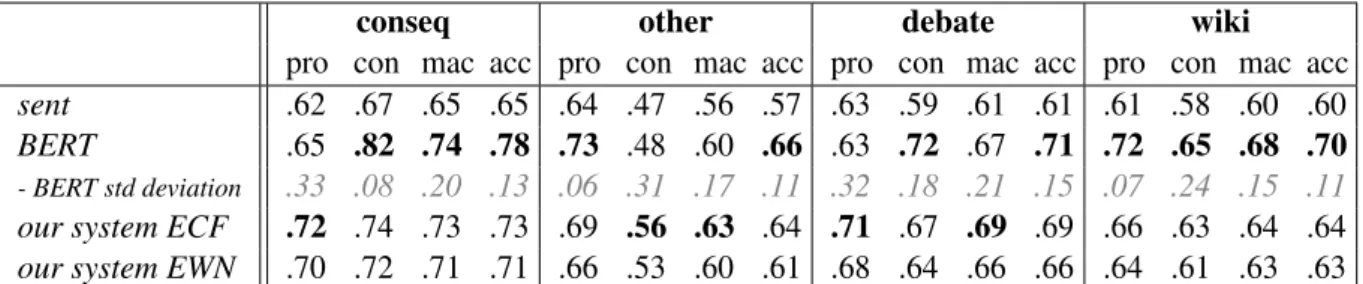
conseq other debate wiki pro con mac acc pro con mac acc pro con mac acc pro con mac acc sent .62 .67 .65 .65 .64 .47 .56 .57 .63 .59 .61 .61 .61 .58 .60 .60 BERT .65 .82 .74 .78 .73 .48 .60 .66 .63 .72 .67 .71 .72 .65 .68 .70 - BERT std deviation .33 .08 .20 .13 .06 .31 .17 .11 .32 .18 .21 .15 .07 .24 .15 .11
our system ECF .72 .74 .73 .73 .69 .56 .63 .64 .71 .67 .69 .69 .66 .63 .64 .64 our system EWN .70 .72 .71 .71 .66 .53 .60 .61 .68 .64 .66 .66 .64 .61 .63 .63
Table 6: Experimental results. F1 scores per stance class (proandcon), macro-F1 (mac), and Accuracy (acc). For BERT, we show the mean of the respective cross-validation results and their standard deviation.
Table6. First, as expected, our system performs better on arguments related to consequences than on other arguments, with a macro-F1 difference of 10pp betweenconseqandother. Further, our sys-tem with both lexicon settings consistently outper-forms thesentbaseline, but its macro-F1 score is outperformed by BERT onconseqandwiki, and its accuracy is outperformed by BERT on all datasets. This is not surprising, given that we use BERT pre-trained and then fine-tuned to our data. In-terestingly, our system with ECF achieves better results than BERT in terms of macro F1 score on the arguments that arenotrelated to consequences (other), and on the completedebatedataset. This indicates that our method can deal reasonably well with arguments that are not from consequences.
Concerning the two stance classes, with both lexicon settings, our system is better than BERT at predicting theproclass in arguments from con-sequences, but is outperformed on thecon class. Another interesting result is that on conseq, our system has a quite similar performance on thepro andconclasses with both lexicon settings . In con-trast, BERT’s performance varies drastically, with a difference of approximately 17pp in favor of the conclass. BERT’s high variability is also indicated by the high standard deviation on the 10 folds. For comparison, we also computed the F1 macro stan-dard deviation of our system with ECF when run on the same 10 folds, and the values lie between
.03ondebateand .07 onconseq. This indicates that our unsupervised approach is more robust with more predictable performance.
Concerning the two effect lexicons, our system performs consistently better when using ECF than when using EWN. Our analysis indicates that the high coverage of the EWN lexicon comes at the expense of accuracy. Therefore, in the following, we will only refer to our system using ECF.
Regarding the two datasets debate and wiki,
conseq other debate wiki
r F1 r F1 r F1 r F1 Total 1 .73 1 .63 1 .69 1 .64 Target found .82 .74 .76 .64 .80 .70 .53 .67 -Word/Lemma .75 .74 .72 .64 .74 .70 .42 .67 -Acronym .02 .80 .01 .89 .02 .83 .00 – -Syn/Ant .05 .69 .03 .50 .04 .64 .11 .66 TPO/TP/PO .60 .76 .39 .64 .51 .72 .54 .67 -TPO .23 .74 .05 .65 .15 .73 .07 .81 -TP .21 .84 .18 .74 .20 .80 .10 .77 -PO .16 .69 .16 .53 .16 .62 .36 .62 Heuristic .40 .68 .61 .61 .49 .65 .46 .61 Table 7: Evaluation of the target identification and stance detection strategies; r denotes the rate of data instances.
BERT outperforms our system, with quite a high margin particularly on the wiki data. The accu-racy thatBar-Haim et al.(2017a,b) report on the wikidata, when no context features are used, is
.68 which is lower than BERT’s (.70) but higher than ours (.65for evaluating on the dedicated test set). This is not surprising given that the data con-tains general arguments. Nevertheless, as our ap-proach only targets a subclass of these arguments, the results are quite promising. Unfortunately, Bar-Haim et al.(2017a,b)’s system is proprietary and we could not evaluate it on ourconseqdata.
Table7provides further insights into our solu-tion. First, on all Debatepedia based datasets, we find a target in more than.75of the data instances, and overall, the results are slightly better when a target is found. Most of the targets are found by word similarity and the fewest by the acronym. The results obtained on the instances where the target was found by synonym/antonym relations are sig-nificantly lower than those obtained when the target was found with the other two strategies. This in-dicates that the approach is sensitive to semantic drift in target identification.
Overall, we identify a potential consequence (TPO/TP/PO) for .6of the arguments in conseq.
While the results are quite good on all datasets when we detect a complete effect triple (TPO), they are overtaken by results of theTPcases. Together, the instances solved withTPOandTP strategies amount to.44of theconseq dataset but to much lower on the other datasets (e.g., only.17on the wiki). The performance on thePO cases is com-parable to the performance on theHeuristiccases, and significantly lower than whenTPOorTPcould be applied. Depending on the dataset, the system needed to apply the Heuristic strategy on.4to.61 of the instances. Our efforts for future work are directed towards helping the system make sense of more of the claims so that the number of times it needs to fallback toPOandHeuristicare reduced. 5.4 Error Analysis
To better understand the limitations of our ap-proach, we analyzed the errors on theconseqdata and found several reasons for wrong predictions:
Incomplete list of patterns Some arguments cannot be meaningfully analyzed with our current list of patterns. We plan to extend this list with more complex patterns, while we are also working on automatically learning such patterns from data. Conceptual errorsWe assume that positive ef-fects on something negative result in something negative (e.g.,War in Iraq has helped terrorist re-cruitment.). However, this is not always the case (e.g.,Privatizing social security helps the poor.).
Finding the targets As shown in Table7, we often fail to detect targets. For example, our tar-get detection strategies fail on the claim-topic pair Standardized tests ensure students learn essential information. – No Child Left Behind Act. In this specific case, there is a hypernym relation between the topic andStandardized tests. Further, we found that our straightforward approach to identifying targets and the relations between them is one of the core reasons for our approach’s poorer perfor-mance on thewikidata compared to thedebatedata. Improving the target finding strategy by leveraging additional semantic knowledge is one of the core directions for our future work.
Missing / wrong lexicon entries For many words, we are missing an entry in our lexicons, or the entry exists but is questionable. For instance, in the sentiment lexicon,Palestinianis annotated with a negative sentiment. Also, sometimes the effect on the object seems to be mixed up with the word’s overall effect. For example,solvehas a
pos-itive effect on the object in both ECF and EWN lexicons, but arguably when a problem issolved, it undergoes a reduction (e.g.Reforestation,[...] can help solve global warming).
AmbiguitySome words have a positive or nega-tive effect depending on the sense with which they are used (e.g.,pushvs. push for). In the effect lexi-con, we have only one entry per word. In the EWN, there are multiple senses, but we always use the most probable effect. Word sense disambiguation is required for these cases, which is known to be very challenging for verbs. However, a potential solution could be to annotate VerbNet frames with effects, but this is outside the scope of this work.
Text parsing errors As our method relies on the output of the dependency parser, the Lemma-tizer, the POS tagger, and the Stemmer, their errors naturally propagate.
6 Conclusion and Future Work
We propose a fully unsupervised method to detect the stance of arguments from consequences in on-line debates. The method exploits grammatical dependencies and lexicons to identify effect words and their impact. For our evaluation, we annotated arguments fromDebatepediaregarding their stance and whether they involve consequences or not. The results we obtained are motivating. Our method is comparable to BERT while being more robust.
Besides the future extensions of this approach that we mentioned in our results discussion and error analysis, this work opens several interesting research paths. Mainly, its good performance on the claims that refer to consequences reinforces our intuition that designing systems tailored for partic-ular argumentation schemes might be a good alter-native to topic-specific models. Therefore, we plan to complement this work with approaches for other frequently applied schemes such asarguments by expert opinion andarguments by example.
Acknowledgments
This work has been funded by the Deutsche Forschungsgemeinschaft (DFG) within the project ExpLAIN, Grant Number STU 266/14-1, as part of the Priority Program ”Robust Argumentation Machines (RATIO)” (SPP-1999).
References
Aseel Addawood, Jodi Schneider, and Masooda Bashir. 2017. Stance classification of twitter debates: The encryption debate as a use case. InProceedings of the 8th International Conference on Social Media & Society, #SMSociety17, New York, NY, USA. Asso-ciation for Computing Machinery.
Khalid Al-Khatib, Yufang Hou, Henning Wachsmuth, Charles Jochim, Francesca Bonin, and Benno Stein. 2020. End-to-end argumentation knowledge graph construction. In Proceedings of the Thirty-Fourth AAAI Conference on Artificial Intelligence (AAAI 2020).
Pranav Anand, Marilyn Walker, Rob Abbott, Jean E. Fox Tree, Robeson Bowmani, and Michael Minor. 2011. Cats rule and dogs drool!: Classifying stance in online debate. In Proceedings of the 2nd Work-shop on Computational Approaches to Subjectivity and Sentiment Analysis (WASSA 2.011), pages 1– 9, Portland, Oregon. Association for Computational Linguistics.
Roy Bar-Haim, Indrajit Bhattacharya, Francesco Din-uzzo, Amrita Saha, and Noam Slonim. 2017a.
Stance classification of context-dependent claims. In Proceedings of the 15th Conference of the Euro-pean Chapter of the Association for Computational Linguistics: Volume 1, Long Papers, pages 251–261, Valencia, Spain. Association for Computational Lin-guistics.
Roy Bar-Haim, Lilach Edelstein, Charles Jochim, and Noam Slonim. 2017b. Improving claim stance clas-sification with lexical knowledge expansion and con-text utilization. In Proceedings of the 4th Work-shop on Argument Mining. Association for Compu-tational Linguistics.
Yoonjung Choi and Janyce Wiebe. 2014. +/-EffectWordNet: Sense-level lexicon acquisition for opinion inference. InProceedings of the 2014 Con-ference on Empirical Methods in Natural Language Processing (EMNLP), pages 1181–1191, Doha, Qatar. Association for Computational Linguistics. Jacob Devlin, Ming-Wei Chang, Kenton Lee, and
Kristina Toutanova. 2019. Bert: Pre-training of deep bidirectional transformers for language understand-ing.
Kuntal Dey, Ritvik Shrivastava, and Saroj Kaushik. 2018. Topical stance detection for twitter: A two-phase lstm model using attention. In Advances in Information Retrieval, pages 529–536, Cham. Springer International Publishing.
Jiachen Du, Ruifeng Xu, Yulan He, and Lin Gui. 2017.
Stance classification with target-specific neural at-tention. In Proceedings of the Twenty-Sixth Inter-national Joint Conference on Artificial Intelligence, IJCAI-17, pages 3988–3994.
Adam Faulkner. 2014. Automated classification of stance in student essays: An approach using stance target information and the wikipedia link-based mea-sure. Proceedings of the 27th International Florida Artificial Intelligence Research Society Conference, FLAIRS 2014, pages 174–179.
Christiane Fellbaum. 2010. Princeton university: About wordnet.
Shalmoli Ghosh, Prajwal Singhania, Siddharth Singh, Koustav Rudra, and Saptarshi Ghosh. 2019. Stance detection in web and social media: A comparative study. In Experimental IR Meets Multilinguality, Multimodality, and Interaction, pages 75–87, Cham. Springer International Publishing.
Subrata Ghosh, Konjengbam Anand, Sailaja Rajanala, A Bharath Reddy, and Manish Singh. 2018. Unsu-pervised Stance Classification in Online Debates. In Proceedings of the ACM India Joint International Conference on Data Science and Management of Data, CoDS-COMAD ’18, pages 30–36, New York, NY, USA. ACM. Event-place: Goa, India.
Kazi Saidul Hasan and Vincent Ng. 2013. Extra-linguistic constraints on stance recognition in ideo-logical debates. InProceedings of the 51st Annual Meeting of the Association for Computational Lin-guistics (Volume 2: Short Papers), pages 816–821, Sofia, Bulgaria. Association for Computational Lin-guistics.
Dirk Hovy, Taylor Berg-Kirkpatrick, Ashish Vaswani, and Eduard Hovy. 2013. Learning whom to trust with MACE. InProceedings of the 2013 Conference of the North American Chapter of the Association for Computational Linguistics: Human Language Technologies, pages 1120–1130, Atlanta, Georgia. Association for Computational Linguistics.
Minqing Hu and Bing Liu. 2004. Mining and sum-marizing customer reviews. InProceedings of the Tenth ACM SIGKDD International Conference on Knowledge Discovery and Data Mining, KDD ’04, page 168–177, New York, NY, USA. Association for Computing Machinery.
Anand Konjengbam, Subrata Ghosh, Nagendra Kumar, and Manish Singh. 2018. Debate stance classifica-tion using word embeddings. InBig Data Analytics and Knowledge Discovery, pages 382–395, Cham. Springer International Publishing.
Dilek K¨uc¸¨uk and Fazli Can. 2020. Stance detection: A survey.ACM Comput. Surv., 53(1).
Christopher Manning, Mihai Surdeanu, John Bauer, Jenny Finkel, Steven Bethard, and David McClosky. 2014. The Stanford CoreNLP Natural Language Processing Toolkit. InProceedings of 52nd Annual Meeting of the Association for Computational Lin-guistics: System Demonstrations, pages 55–60, Bal-timore, Maryland. Association for Computational Linguistics.
Saif Mohammad, Svetlana Kiritchenko, Parinaz Sob-hani, Xiaodan Zhu, and Colin Cherry. 2016.
SemEval-2016 task 6: Detecting stance in tweets. In Proceedings of the 10th International Workshop on Semantic Evaluation (SemEval-2016), pages 31– 41, San Diego, California. Association for Computa-tional Linguistics.
Akiko Murakami and Rudy Raymond. 2010. Sup-port or oppose? classifying positions in online de-bates from reply activities and opinion expressions. In Coling 2010: Posters, pages 869–875, Beijing, China. Coling 2010 Organizing Committee.
Pavithra Rajendran, Danushka Bollegala, and Simon Parsons. 2016. Contextual stance classification of opinions: A step towards enthymeme reconstruction in online reviews. InProceedings of the Third Work-shop on Argument Mining (ArgMining2016), pages 31–39, Berlin, Germany. Association for Computa-tional Linguistics.
Hannah Rashkin, Sameer Singh, and Yejin Choi. 2016.
Connotation Frames: A Data-Driven Investigation. InProceedings of the 54th Annual Meeting of the As-sociation for Computational Linguistics (Volume 1: Long Papers), pages 311–321. Association for Com-putational Linguistics. Event-place: Berlin, Ger-many.
Paul Reisert, Naoya Inoue, Tatsuki Kuribayashi, and Kentaro Inui. 2018. Feasible Annotation Scheme for Capturing Policy Argument Reasoning using Ar-gument Templates. InProceedings of the 5th Work-shop on Argument Mining, pages 79–89, Brussels, Belgium. Association for Computational Linguis-tics.
Benjamin Schiller, Johannes Daxenberger, and Iryna Gurevych. 2020. Stance detection benchmark: How robust is your stance detection?
Parinaz Sobhani, Saif Mohammad, and Svetlana Kir-itchenko. 2016. Detecting stance in tweets and ana-lyzing its interaction with sentiment. InProceedings of the Fifth Joint Conference on Lexical and Com-putational Semantics, pages 159–169, Berlin, Ger-many. Association for Computational Linguistics. Swapna Somasundaran and Janyce Wiebe. 2009.
Rec-ognizing Stances in Online Debates. In Proceed-ings of the Joint Conference of the 47th Annual Meeting of the ACL and the 4th International Joint Conference on Natural Language Processing of the AFNLP: Volume 1 - Volume 1, ACL ’09, pages 226– 234, Stroudsburg, PA, USA. Association for Com-putational Linguistics. Event-place: Suntec, Singa-pore.
Swapna Somasundaran and Janyce Wiebe. 2010. Rec-ognizing stances in ideological on-line debates. In Proceedings of the NAACL HLT 2010 Workshop on Computational Approaches to Analysis and Genera-tion of EmoGenera-tion in Text, pages 116–124, Los Ange-les, CA. Association for Computational Linguistics.
Dhanya Sridhar, Lise Getoor, and Marilyn Walker. 2014. Collective stance classification of posts in online debate forums. InProceedings of the Joint Workshop on Social Dynamics and Personal At-tributes in Social Media, pages 109–117, Baltimore, Maryland. Association for Computational Linguis-tics.
Qingying Sun, Zhongqing Wang, Qiaoming Zhu, and Guodong Zhou. 2018. Stance detection with hierar-chical attention network. InProceedings of the 27th International Conference on Computational Linguis-tics, pages 2399–2409, Santa Fe, New Mexico, USA. Association for Computational Linguistics.
Matt Thomas, Bo Pang, and Lillian Lee. 2006.Get out the vote: Determining support or opposition from congressional floor-debate transcripts. In Proceed-ings of the 2006 Conference on Empirical Methods in Natural Language Processing, pages 327–335, Sydney, Australia. Association for Computational Linguistics.
Orith Toledo-Ronen, Roy Bar-Haim, Alon Halfon, Charles Jochim, Amir Menczel, Ranit Aharonov, and Noam Slonim. 2018. Learning sentiment com-position from sentiment lexicons. In Proceedings of the 27th International Conference on Computa-tional Linguistics, pages 2230–2241, Santa Fe, New Mexico, USA. Association for Computational Lin-guistics.
Douglas Walton, Christopher Reed, and Fabrizio Macagno. 2008. Argumentation Schemes. Cam-bridge University Press.
Rui Wang, Deyu Zhou, Mingmin Jiang, Si Jiasheng, and Yang Yang. 2019. A survey on opinion mining: from stance to product aspect. IEEE Access, PP:1– 1.
Theresa Wilson, Janyce Wiebe, and Paul Hoffmann. 2005. Recognizing Contextual Polarity in Phrase-level Sentiment Analysis. In Proceedings of the Conference on Human Language Technology and Empirical Methods in Natural Language Processing, HLT ’05, pages 347–354, Stroudsburg, PA, USA. Association for Computational Linguistics. Event-place: Vancouver, British Columbia, Canada.