DOI:10.1051/0004-6361/201629534 c ESO 2016
Astronomy
&
Astrophysics
Gaia Data Release 1
Special issue
Gaia
Data Release 1
Reference frame and optical properties of ICRF sources
F. Mignard
1,?, S. Klioner
2, L. Lindegren
3, U. Bastian
4, A. Bombrun
5, J. Hernández
6, D. Hobbs
3, U. Lammers
6,
D. Michalik
3, M. Ramos-Lerate
7, M. Biermann
4, A. Butkevich
2, G. Comoretto
8, E. Joliet
9,5, B. Holl
10, A. Hutton
11,
P. Parsons
12, H. Steidelmüller
2, A. Andrei
13, G. Bourda
14, and P. Charlot
141 Université Côte d’Azur, Observatoire de la Côte d’Azur, CNRS, CS 34229, 06304 Nice Cedex, France 2 Lohrmann-Observatorium, Technische Universität Dresden, 01062 Dresden, Germany
3 Lund Observatory, Department of Astronomy and Theoretical Physics, Lund University, PO Box 43, 22100, Lund, Sweden 4 Astronomisches Rechen-Institut, Zentrum für Astronomie der Universität Heidelberg, Mönchhofstraße 14, 69120 Heidelberg,
Germany
5 HE Space Operations BV for ESA/ESAC, Camino Bajo del Castillo s/n, 28691 Villanueva de la Cañada, Spain 6 ESA, European Space Astronomy Centre, Camino Bajo del Castillo s/n, 28691 Villanueva de la Cañada, Spain 7 Vitrociset Belgium for ESA/ESAC, Camino Bajo del Castillo s/n, 28691 Villanueva de la Cañada, Spain 8 Telespazio Vega UK Ltd for ESA/ESAC, Camino Bajo del Castillo s/n, 28691 Villanueva de la Cañada, Spain
9 NASA/IPAC Infrared Science Archive, California Institute of Technology, Mail Code 100-22, 770 South Wilson Avenue,
Pasadena, CA 91125, USA
10 Observatoire Astronomique de l’Université de Genève, Sauverny, Chemin des Maillettes 51, 1290 Versoix, Switzerland 11 Aurora Technology for ESA/ESAC, Camino Bajo del Castillo s/n, 28691 Villanueva de la Cañada, Spain
12 The Server Labs S.L. for ESA/ESAC, Camino Bajo del Castillo s/n, 28691 Villanueva de la Cañada, Spain 13 GEA-Observatorio National/MCT, Rua Gal. Jose Cristino 77, CEP 20921-400, Rio de Janeiro, Brazil
14 Laboratoire d’Astrophysique de Bordeaux, Université de Bordeaux, CNRS, B18N, Allée Geoffroy Saint-Hilaire, 33615 Pessac,
France
Received 16 August 2016/Accepted 20 September 2016
ABSTRACT
Context.As part of the data processing forGaiaData Release 1 (GaiaDR1) a special astrometric solution was computed, the so-called auxiliary quasar solution. This gives positions for selected extragalactic objects, including radio sources in the second realisation of the International Celestial Reference Frame (ICRF2) that have optical counterparts bright enough to be observed withGaia. A subset of these positions was used to align the positional reference frame ofGaiaDR1 with the ICRF2. Although the auxiliary quasar solution was important for internal validation and calibration purposes, the resulting positions are in general not published inGaia DR1.
Aims.We describe the properties of theGaiaauxiliary quasar solution for a subset of sources matched to ICRF2, and compare their optical and radio positions at the sub-mas level.
Methods.Descriptive statistics are used to characterise the optical data for the ICRF sources and the optical-radio differences. The most discrepant cases are examined using online resources to find possible alternative explanations than a physical optical-radio offset of the quasars.
Results.In the auxiliary quasar solution 2191 sources have good optical positions matched to ICRF2 sources with high probability. Their formal standard errors are better than 0.76 milliarcsec (mas) for 50% of the sources and better than 3.35 mas for 90%. Optical magnitudes are obtained inGaia’s unfiltered photometricGband. TheGaiaresults for these sources are given as a separate table in GaiaDR1. The comparison with the radio positions of the defining sources shows no systematic differences larger than a few tenths of a mas. The fraction of questionable solutions, not readily accounted for by the statistics, is less than 6%. Normalised differences have extended tails requiring case-by-case investigations for around 100 sources, but we have not seen any difference indisputably linked to an optical-radio offset in the sources.
Conclusions.With less than a quarter of the data expected from the nominal mission it has been possible to obtain positions at the sub-mas level for most of the ICRF sources having an optical counterpart brighter than 20.5 mag.
Key words. astrometry – reference systems – quasars: general
1. Introduction
This paper presents and discusses the first Gaia astromet-ric solution for the optical counterparts of radio sources in
? Corresponding author: F. Mignard,
e-mail:[email protected]
the second realisation of the International Celestial Reference Frame (ICRF2). This is a complementary paper to the general presentation inLindegren et al. (2016) of the astrometric solu-tions for GaiaData Release 1 (GaiaDR1). The main goal of the present paper is to provide the detection statistics for the ICRF2 subset, including photometric data inGaia’s unfiltered
Gmagnitude band. We also discuss and validate the astrometric accuracy through a straight comparison first with the defining sources of the ICRF2, and then including the less accurate non-defining sources. We examine a few individual problem sources for possible systematic optical-radio offsets. When statistically significant differences are found between the optical and radio positions we attempt to trace the root cause in the observations or data processing, such as the presence of an extended host galaxy or the match to a nearby star brighter than the optical counter-part, rather than in the sources themselves.
The paper starts with a presentation of the data used in this investigation and how the ICRF2 sources are matched toGaia
sources. We then discuss the overall properties of theGaia so-lution for 2191 sources considered as optical counterparts of ICRF2 quasars. In the following two sections we discuss the comparison of theGaiapositions and the radio positions for the sources with good agreement (94%) and for the more trouble-some cases (137 sources) where the distance between the two solutions exceeds 10 milliarcsec (mas).
2. Data
2.1. Radio positions of ICRF sources
The second realisation of the ICRF contains radio loud quasars observed with very long baseline interferometry (VLBI) over a period of up to 30 years (Ma et al. 2009;Fey et al. 2015). ICRF2 contains the precise position of 3414 compact radio sources and comes with an accuracy floor of 40 microarcsec (µas) in each co-ordinate for the whole set. ICRF2 superseded the initial ICRF1 solution (Ma et al. 1998) with more sources and better over-all accuracy. The two solutions are aligned to the same axes thanks to the 138 stable sources common to ICRF2 and ICRF1 (97 defining sources in ICRF1 and 41 other ICRF1 sources se-lected for their stability).
Not all the ICRF2 sources have the same astrometric qual-ity. The catalogue comprises three clearly delimited groups with different observation histories and statistical properties. This is very relevant for the comparison to the optical solution, since the three groups are expected to have similar formal accuracies in theGaiasolution, whereas they have very different accuracies in the radio positions. The division of the non-defining sources depends on whether the source was only observed as part of the Very Long Baseline Array (VLBA) Calibrator Survey (VCS, Beasley et al. 2002;Kovalev et al. 2007; Petrov et al. 2008) or not. The three groups of sources in ICRF2 are as follows:
– 295 defining sources with a positional accuracy usually bet-ter than 0.1 mas in both coordinates, but sometimes extend-ing to 0.3 mas. This is generally better than the accuracy in
GaiaDR1.
– 922 non-VCS sources observed in several sessions with a typical accuracy of 0.2 to 0.3 mas, but sometimes extending to several mas. About 75% of the sources in this category have formal uncertainties smaller than inGaiaDR1.
– 2197 VCS-only sources usually observed in a single VCS session. These sources have a wide range of quoted accura-cies from 0.2 mas to several tens of mas, and a median value around 1 mas. Within this group we may find goodGaia so-lutions deviating from the radio positions by∼50 mas with-out calling for exotic physical effects in the sources. Given the marked differences between these groups it is impor-tant to make comparisons per group when the accuracy of the
radio positions is relevant. Particular attention should be given to the group of defining sources.
2.2. Gaia observations of ICRF sources
The optical data discussed in this paper are based onGaia obser-vations made between 25 July 2014 (the start of the science mis-sion) and 16 September 2015. During this period about 30 billion detections of point sources were recorded by Gaiaand trans-mitted to the ground stations. During the initial processing of the data the crude celestial direction of each detection is com-puted using the first approximation of the spacecraft attitude (see Fabricius et al. 2016). This step supplies the celestial position of the detection with a precision of about 70 mas, independent of the magnitude (it is dominated by instrumental and attitude er-rors and not by the photon noise). This is normally sufficient to match every detection to an already known source or to cre-ate a new entry in the source list. The observation of an ICRF source proceeds in exactly the same way as for any other point-like source. As long as it is brighter than the detection threshold atG'20.7 (Gaia Collaboration 2016) it is likely to be detected and observed every time it crosses the astrometric field ofGaia. During the 14 months of observation used forGaiaDR1 a given source was typically detected from 10 to 20 times and at each of these crossings usually accurately located on the nine astromet-ric CCDs.
Every detection is thus matched to a unique entry in theGaia
source list using the best positional match within a window of about 1.5 arcsec as explained inFabricius et al. (2016). At the present stage of the project this matching is far from perfect ow-ing to errors in the initial source list, the approximate state of the instrument calibrations and spacecraft attitude, and the con-fusion of sources in high-density areas. Nevertheless, the match-ing is usually good enough that the astrometric parameters of the source can be computed from the ensemble of detections matched to it.
The observations of ICRF sources are normally matched to their radio positions listed in the Initial Gaia Source List (IGSL;Smart & Nicastro 2013). This list incorporates the data of theGaiaInitial Quasar Catalogue (GIQC;Andrei et al. 2014), which in turn includes the ICRF2 sources with their radio coor-dinates. When the match is successful the observation is linked to theGaiasource identifier assigned to the ICRF source in the source list. It is important to stress that this matching is done during the cyclic processing after all the observations have been collected. The limitations of this cross-match are discussed in Sect. 6 ofFabricius et al.(2016).
In this early phase of the mission the automatic photometric recognition of quasars (Bailer-Jones et al. 2013) is not yet acti-vated and ICRF sources are identified only from the positional match to their VLBI coordinates. This is not a foolproof method since the 1.5 arcsec window used in the process may yield spu-rious identifications when the optical counterpart of the radio source is too faint and a field star visible toGaiahappens to be nearby and falls into the match window. ICRF sources at low galactic latitudes have a higher probability of being erroneously linked toGaiaobservations of faint galactic stars.
Out of the 3414 ICRF2 sources, a tentative optical match was obtained at least once for ∼2750 sources. Near the Gaia
detection limit aroundG=20.7, a source is not necessarily de-tected in every field crossing depending on the noise, the loca-tion in the field of view, etc. If we consider the sources with re-peated matches at different periods of time, the number of ICRF2 sources for which we can reasonably state that Gaia sees an
optical counterpart is around 2500 (73% of the ICRF2 sources), among which 270 defining sources. The proportion of detections decreases from the defining sources to the VCS-only because, on average, the optical counterparts are slightly fainter. These num-bers based on the first fully processed data set should not change drastically when more data come in the next data release since the sky has already been scanned three times over the 14 months and most detectable sources are already in the database. The sources close to the detection threshold will continue to be un-derobserved and the astrometric solution difficult to obtain in subsequent releases. The final selection of ICRF sources for the present study is described in Sect.2.4.
2.3. Auxiliary quasar solution of Gaia data
The present optical positions of ICRF sources all come, with one exception, from the so-called auxiliary quasar solution de-scribed in Sect. 4.2 of Lindegren et al. (2016)1. The auxiliary quasar solution allowed the positions and parallaxes to be esti-mated for approximately 135 000 known quasars; their proper motions can be assumed to be negligible in the current context. The results of this solution were used for calibration and valida-tion purposes in the processing towardsGaiaDR1, and for align-ing the reference frame ofGaiaDR1 to the ICRF as described in Sect. 4.3 ofLindegren et al. (2016). Constraining the paral-laxes to zero is, in principle, better for the quasars, as discussed inMichalik & Lindegren(2016), but would have deprived us of the possibility of using this solution to check − or even cali-brate−the parallax zero-point and we considered this objective to be more important than the marginal improvement obtained by forcing the quasar parallax to be zero. Taking only the zero parallax and solving for positions and proper motions would not work as well given the short time base of theGaiaDR1.
However, apart from the 2191 positions discussed here, the astrometric results of the auxiliary quasar solution are not pub-lished as part of Gaia DR1. The positions of quasars inGaia
DR1 are instead derived by means of the so-called secondary solution (Sect. 4.4 of Lindegren et al. 2016), which does not require the prior knowledge of the source being a quasar and is therefore applicable to both quasars and galactic stars. Most sources inGaiaDR1 fainter thanV '11.5 have positions from the secondary solution.
For the ICRF sources there are thus two sets of positions in
Gaia DR1: those from the secondary solution available in the main catalogue of GaiaDR1 (see AppendixA), and those ob-tained in the auxiliary quasar solution, which are available as a separate table inGaiaDR1 and are discussed in this paper. The differences between the two sets of positions is usually less than 1 mas, but exceeds 100 mas for eight sources.
In the auxiliary quasar solution where the proper motions are constrained to small values, there are effectively fewer pa-rameters per source to fit than in the secondary solution. The auxiliary solution is therefore expected to be more accurate for sources with small proper motions like the quasars. In the case of the ICRF sources the superiority of the auxiliary quasar solu-tion is easily shown by a direct comparison of the two solusolu-tions with the VLBI positions (AppendixA). None of the optical posi-tions presented here is therefore based on the secondary solution.
1 The exception is the H
ipparcos
quasar HIP 60936 =3C 273 = ICRF J122906.6+020308, where the position comes from the primary (Tycho−Gaia) astrometric solution ofGaiaDR1. For simplicity we ig-nore this exception in the following, and refer to the data as coming from the auxiliary quasar solution.Constraining the proper motion is a compromise at this stage of the processing; in the subsequent releases with more available data and full astrometric solutions, no such assumption will be necessary.
2.4. Identification of ICRF sources in the Gaia auxiliary quasar solution
This section deals with the identification and selection of the ICRF sources in the Gaia auxiliary quasar solution. The dif-ference between this selection and the content of the Gaia
DR1 secondary solution for ICRF sources is discussed in AppendixA.
Given the auxiliary astrometric solution described in Sect. 2.3it is possible to make a much more reliable identifi-cation of ICRF sources among the tentative matches discussed in Sect.2.1. With an astrometric accuracy better than 10 mas in both catalogues, the probability of a chance alignment with a star remains below 10−3 for each target even in the galactic plane whereGaiadetects about 106sources per square degree. The worst case happens when there is no visible optical counter-part and a faint star is seen in the match window: that object will very likely be selected and only much later in the processing will it be realised that the match is dubious.
The final set of ICRF sources used in the subsequent analysis consists of the sources from the auxiliary quasar solution that satisfy all of the following criteria:
– number of matched detectionsN≥4;
– excess source noise2
i<20 mas;
– positional uncertainty (semi-major axis of the formal error ellipse)σpos,max<100 mas;
– angular separation from the ICRF2 positionρ <150 mas. The first three criteria roughly correspond to the quality crite-ria applied to the secondary solution inGaiaDR1 (Eq. (12) in Lindegren et al. 2016), while the fourth filters out some sources with adequate astrometric solutions but where the matching to ICRF2 is doubtful. The 150 mas limit corresponds to a clear transition in the distribution ofρand is beyond the largest un-certainty in the ICRF2. These criteria result in a list of optical positions for 2191 sources, of which 262 are defining sources in ICRF2, 640 are non-VCS, and 1289 are VCS-only.
Positions and other data for these 2191 sources are published as a separate table3inGaiaDR1. This “auxiliary quasar table”
is distinct from all other data in the release, in particular the po-sitions differ slightly from the secondary solutions for the same sources given in the main table ofGaiaDR1. As shown in Ap-pendixA, the present data are more accurate and more reliable than the secondary data. The fields included in the auxiliary quasar table are
– Gaiasource identifier (64-bit integer);
– reference epoch in Julian years;
– right ascensionα(degrees);
– standard uncertainty in right ascensionσα∗=σαcosδ(mas);
– declinationδ(degrees);
– standard uncertainty in declinationσδ(mas);
2 This measures the amount of noise, including calibration errors, that
must be assumed to exist in the elementary observations in addition to the photon noise in order to account for the dispersion of residuals in the astrometric solution(Lindegren et al. 2012).
3 The auxiliary quasar table is available in machine-readable form
– correlation coefficientC between the errors inαandδ for each source4;
– Gmagnitude computed from the mean flux;
– kind of prior used in the astrometric solution (3=
Tycho-Gaiaastrometric solution, 6=auxiliary quasar solution);
– ICRF designation of the source matched to thisGaiasource (16-character string);
– flag indicating how this source was used to fix the orientation of the reference frame ofGaiaDR1 (0=not used, 1=only
αused, 2=onlyδused, 3=bothαandδused).
The table contains 2191 entries. The reference epoch is al-ways J2015.0 and no modelling of the Galactic acceleration has been introduced in this solution. See the discussion in Sect.4.4. The magnitude field is empty for 39 sources without calibrated photometry in Gaia DR1. Only one entry has prior 3 (see footnote1).
3. Properties of ICRF sources inGaiaDR1
In this section we present the overall properties of theGaiaDR1 results for the ICRF sources as they stand, without any reference to their radio positions. The detailed comparison with the radio positions is deferred to Sect.4.
3.1. G magnitudes
An important first result derived from the data concerns the pho-tometric properties of ICRF sources in theGaia Gband. For the first time, magnitudes are obtained for practically all the opti-cal counterparts of the ICRF2 sources brighter thanG ' 20.7. In the present list of 2191 sources there are 39 for which no
Gmagnitudes were derived forGaiaDR1, although they all have good astrometric solutions5. The magnitude distribution of the
remaining 2152 sources is shown in the left panel of Fig.1and in the right panel for the subset of 260 defining sources. The shape of the fall-offforG &20 is at least partly an instrumen-tal effect due to the decreasing detection probability for fainter sources.
3.2. Formal uncertainties of the positions
The distributions of the formal uncertaintiesσα∗andσδin the auxiliary quasar solution are shown in Figs. 2,3, respectively. The median value is 0.62 mas in right ascension and 0.56 mas in declination when all 2191 sources are considered, and 0.51 mas and 0.46 mas for the subset of 262 defining sources. These sys-tematic differences in precision can be explained byGaia’s scan-ning law and the fact that the defiscan-ning sources are on average 0.3 mag brighter than the non-defining sources.
Because of Gaia’s scanning law and the relatively small number of observations used in the present solutions, there is a high degree of correlation betweenαandδ for many of the sources. A better measure of the positional uncertainty could then be the semi-major axis of the error ellipse,σpos, max, which can be computed fromσα∗,σδ, and the correlation coefficient
4 Inter-source correlations are expected to be negligible, given the
large angular separation of ICRF sources (several degrees) and the scan-ning geometry ofGaia. Empirically, we found that the positional diff er-ences betweenGaiaDR1 and ICRF2 have insignificant correlations, except on scales.10◦
where they may reach 0.04.
5 Straight inspection of the (uncalibrated) fluxes in the pre-processing
for these 39 sources indicates that their magnitudes range from 17.5 to 20.5.
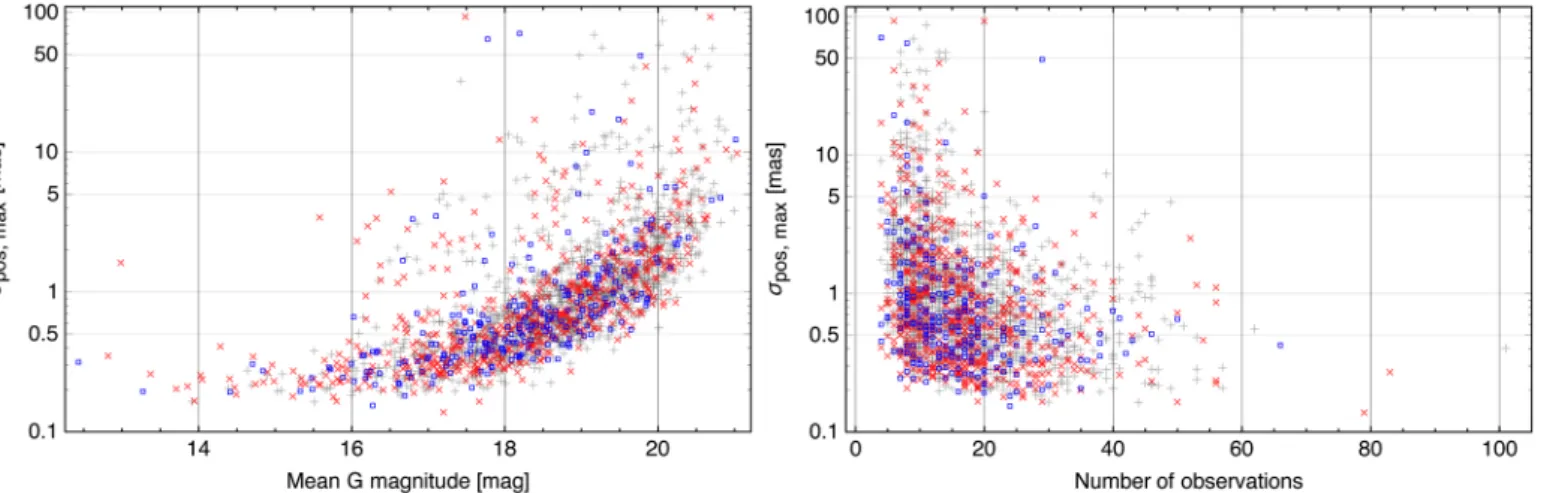
betweenαandδ(see Eq. (9) inLindegren et al. 2016). Figure4 shows scatter plots of σpos, max versus the G magnitude (left) and the number observations (right). The three groups of ICRF sources are shown with different symbols.
The expected increasing trend from the photon noise is very clear for the fainter sources in the left panel of Fig. 4. For
G<17 there is an accuracy floor around 0.25 mas due mainly to the limited performance of the instrument calibration in this re-lease. There are, however, approximately 200 sources for which
σpos, max is much higher than typical for their magnitudes. This
could have several different causes, for example a small number of observations or a poor time sampling inadequate for the astro-metric solution; this also could be due to source confusion in the initial matching of the detections or to a reduced detection prob-ability for faint sources. Source structure, including an extended distribution of light from the host galaxy, is another possible ex-planation in some cases. Most of the outliers in the left panel of Fig.4 can be explained by a small number of observations; as shown in the right panel, large positional uncertainties are much more common for sources with less than 10−15 matched detections.
4. Comparison of the optical and radio positions
In this section we compare the optical positions of the ICRF sources, as obtained in theGaiaauxiliary quasar solution, with their reference values in the radio domain taken from ICRF2 (Fey et al. 2015). Coordinate differences in right ascension and declination are computed as
∆α∗=(αDR1−αICRF2) cosδ, ∆δ=δDR1−δICRF2, (1)
from which the angular separation between the two positions is obtained as
ρ= √∆α∗2+ ∆δ2. (2)
The small-angle approximation implicit in these formulae is per-fectly adequate for our purpose, where position differences are
<150 mas and consequently second-order effects<0.1µas.
4.1. Position differences as angles
We consider first the position differences expressed as angles (in mas), that is without any scaling by their uncertainties or selec-tion based on the uncertainties. The results are given in a series of diagrams showing the distributions of the coordinate differences and positional separations both for the whole set of 2191 sources and for the subset of defining sources. This separate considera-tion is mandatory given the different range of uncertainties in the ICRF2 positions for the defining or non-defining sources (Sect.2.1).
The comparison is made under the assumption that theGaia
identification actually points to the matched ICRF source and therefore that when a difference is found between the two posi-tions (radio and optical), it refers to the same source. It is clear, however, that for the largest separations, above a few tens of mas, a misidentification is possible and is not necessarily due to a flaw in theGaiacross-matching, but more likely to the lack of a true optical counterpart within the detection range ofGaia. This will be investigated in later releases when more observations have been collected. Some sources have a relatively large uncertainty in ICRF2 (more than 5−10 mas), which could also be an expla-nation, in particular when the optical position is more accurate.
% in bin 0 2 4 6 8 G [mag] 12 13 14 15 16 17 18 19 20 21 22 % in bin 0 5 10 15 G [mag] 11 12 13 14 15 16 17 18 19 20 21 22
Fig. 1.Distribution of theGmagnitudes of ICRF2 sources with calibrated photometric data in the auxiliary quasar table.Left: all 2152 sources. Right: the 260 defining sources.
% in bin 0 5 10 15 20 25 30 σα* [mas] 0 0.5 1.0 1.5 2.0 2.5 3.0 3.5 4.0 4.5 5.0 % in bin 0 5 10 15 20 25 30 35 40 σα* [mas] 0 0.5 1.0 1.5 2.0 2.5 3.0 3.5 4.0 4.5 5.0
Fig. 2.Frequency distribution of the formal uncertainties in right ascension (σα∗) of the optical positions of ICRF2 sources. The distributions are cut at 5 mas for clarity.Left: all 2191 sources (2090 withσα∗<5 mas).Right: the 262 defining sources (254 withσα∗<5 mas).
% in bin 0 5 10 15 20 25 30 σδ [mas] 0 0.5 1.0 1.5 2.0 2.5 3.0 3.5 4.0 4.5 5.0 % in bin 0 5 10 15 20 25 30 35 40 σδ [mas] 0 0.5 1.0 1.5 2.0 2.5 3.0 3.5 4.0 4.5 5.0
Fig. 3.Frequency distribution of the formal uncertainties in declination (σδ) of the optical positions of ICRF2 sources. The distributions are cut at
5 mas for clarity.Left: all 2191 sources (2100 withσδ<5 mas).Right: the 262 defining sources (254 withσδ<5 mas).
The uncertainties are taken into account in the normalised com-parisons (Sect.4.2).
4.1.1. Coordinate differences
Histograms of the differences in right ascension and declina-tion are shown, respectively, in Figs.5and6. In each figure the left panel shows the distribution for all sources, the right panel shows the subset of defining sources. For better visibility only the central parts (within±10 mas) of the distributions are shown; the number of sources beyond this limit is given in the figure legends.
The median ∆α∗ for the whole sample is +0.038 ±
0.022 mas. The standard width of the distribution estimated by the robust scatter estimate6 (RSE) is 1.50 mas, while the non-robust sample standard deviation including the wings goes to 6.35 mas. The corresponding values for the defining subset are
+0.015±0.038 mas for the median, 0.74 mas for the RSE, and 3.23 mas for the sample standard deviation. The agreement with
6 The RSE is defined as2√2 erf−14/5−1≈0.390152 times the dis-tance between the 10th and 90th percentiles. For a normal distribution it equals the standard deviation.
Fig. 4.Formal uncertainties of the optical positions of ICRF sources versus magnitude and number of observations per source.σpos, maxrefers to
the semi-major axis of the error ellipse in position.Left: position uncertainty versus theGmagnitude for 2152 sources with calibrated photometry. Right: position uncertainty of the 2191 sources versus the number of detections (field-of-view transits) used in the astrometric solution. Symbols show defining sources as blue squares, non-VCS sources as red crosses, and VCS-only sources as pale grey plus signs.
% in bin 0 2 4 6 8 10 12 Δα* [mas] −10 −8 −6 −4 −2 0 2 4 6 8 10 % in bin 0 2 4 6 8 10 12 14 16 18 Δα* [mas] −10 −8 −6 −4 −2 0 2 4 6 8 10
Fig. 5.Distribution of the differences in right ascension between theGaiasolution and the ICRF2 positions.Left:the 2054 solutions closer than 10 mas to their radio position.Right:same for the 258 defining sources.
the defining sources is obviously better owing to the better qual-ity of this subset in the ICRF2. It is important to note that the
Gaiaframe has been aligned with the ICRF2 and that any bias in right ascension would therefore be absorbed by the orien-tation about the z-axis. However, the (robust) standard widths are good indicators of the quality of agreement between the two catalogues.
In declination the median ∆δ for the whole sample is
−0.069±0.021 mas, the RSE 1.85 mas, and the sample stan-dard deviation 7.99 mas. For the defining subset the median is
−0.136±0.032 mas, the RSE is 0.70 mas, and the sample stan-dard deviation 3.21 mas. The bias of'−0.1 mas in declination is statistically significant and may be related to the (ecliptic) north-south asymmetry of systematics noted inGaiaDR1 parallax data (e.g. Appendix C inLindegren et al. 2016). The reference frame alignment using a solid rotation (orientation) cannot remove a possible bias in declination7.
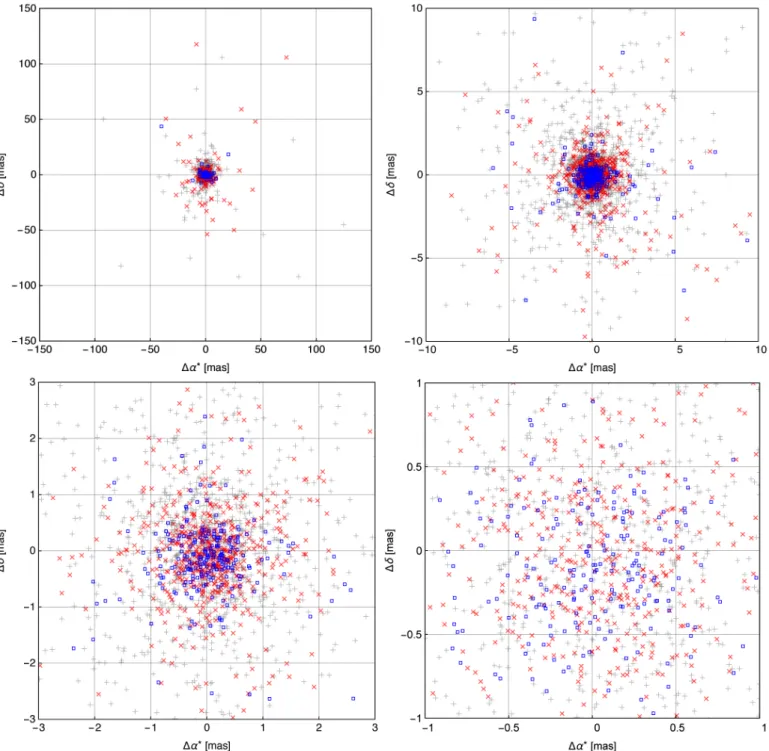
The plots in Fig.7show scatter plots of (∆α∗,∆δ), colour-coded for the different categories of ICRF sources. The upper
7 After the submission of the paper the authors learnt independently
from P. Charlot and Ch. Jacobs (priv. comm.) that a similar bias is seen between the ICRF2 and the preliminary solution of ICRF3.
left plot goes up to±150 mas in each coordinate and therefore contains all 2191 sources. It shows primarily the few sources well outside the saturated centre where most of the sources are concentrated with overlapping markers. There are two ob-vious outliers among the defining sources (blue squares); they are discussed in Sect.4.3. The upper right plot gives the distri-bution for the 2069 sources with coordinate differences within
±10 mas. Here it is clearly seen that the defining sources, as ex-pected, are more strongly concentrated around the centre than the non-VCS sources (red crosses), while the VCS-only sources (grey plus signs) have the largest spread. However, there are some 10−15 defining sources outside the central distribution that should be examined individually for possible contamination by the host galaxy or other anomalies. The lower left plot in Fig.7 extending to±3 mas shows more detail near the centre, but the distribution remains remarkably symmetric even at the highest resolution. The lower right plot in Fig.7is a close-up view of the very central region within±1 mas in each coordinate and shows again the predominance of defining sources and the significant fraction of sources in the very inner zone at a few 0.1 mas from the centre. The very small bias in declination is now visible with more sources in the negative values of ∆δ. The proportion of defining sources (blue squares) increases with resolution, but in
% in bin 0 1 2 3 4 5 6 7 8 9 10 Δδ [mas] −10 −8 −6 −4 −2 0 2 4 6 8 10 % in bin 0 2 4 6 8 10 12 14 16 18 Δδ [mas] −10 −8 −6 −4 −2 0 2 4 6 8 10
Fig. 6. Distribution of the differences in declination between theGaiasolution and the ICRF2 positions.Left:the 2054 solutions closer than 10 mas to their radio position.Right:same for the 258 defining sources.
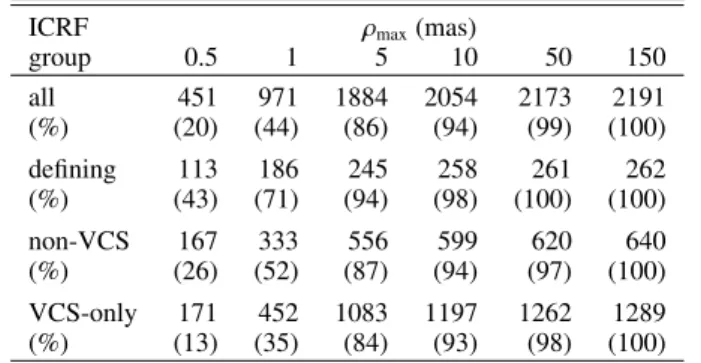
Table 1.Number of ICRF sources with angular separationsρ < ρmax
between the optical and radio positions.
ICRF ρmax(mas)
group 0.5 1 5 10 50 150 all 451 971 1884 2054 2173 2191 (%) (20) (44) (86) (94) (99) (100) defining 113 186 245 258 261 262 (%) (43) (71) (94) (98) (100) (100) non-VCS 167 333 556 599 620 640 (%) (26) (52) (87) (94) (97) (100) VCS-only 171 452 1083 1197 1262 1289 (%) (13) (35) (84) (93) (98) (100)
Notes.In brackets are the percentages of sources in the group below the given limits.
all three plots the optical and radio positions are statistically in very good agreement for all three categories of sources despite the larger uncertainties in the radio data for the non-defining and especially the VCS-only sources.
4.1.2. Angular separations
Table1gives the overall statistics of the angular separation (ρ) between the optical and radio positions, subdivided according to the type of ICRF source. The table shows that 94% of the optical positions are within 10 mas of the radio position of the associ-ated ICRF2 source. This is quite remarkable given the limited time coverage and the numerous limitations of the astrometric solutions forGaiaDR1 as explained inLindegren et al. (2016). For the defining sources the percentage is even higher (98%). There is in fact a very consistent pattern in that the fraction of separations within a given limit (ρmax) is always higher for the defining sources than for the non-VCS sources, which in turn have a higher fraction than the VCS-only sources. Since the dis-tinction between the three categories is irrelevant forGaia(cf. Fig.4), this confirms the difference in the quality of the radio positions expressed by the quoted uncertainties in ICRF2.
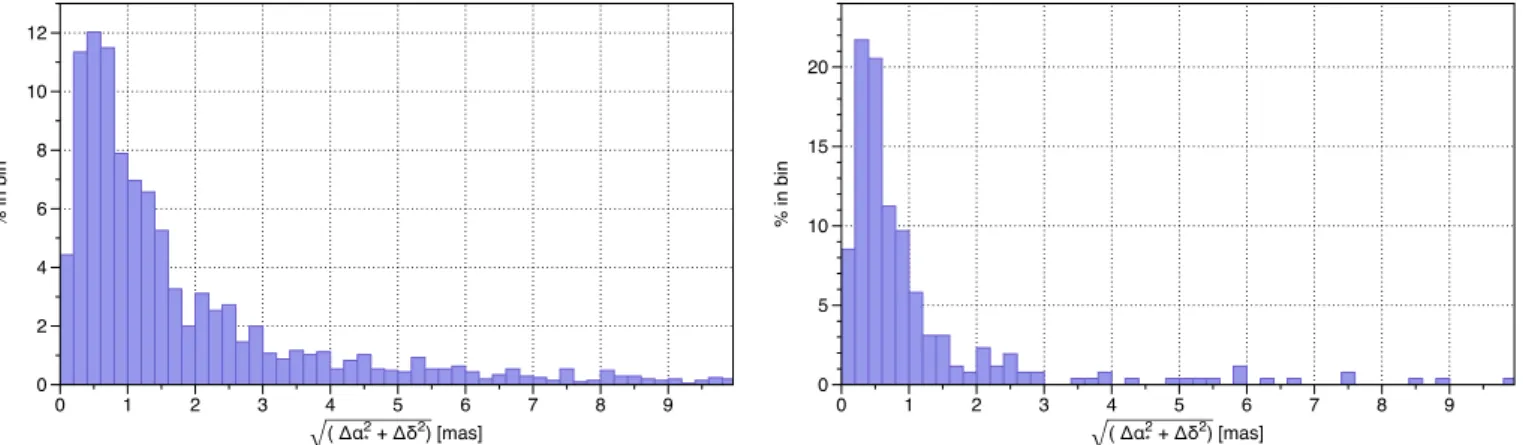
Figure 8 shows the distribution of separations in graphi-cal form. The difference between the whole set and the set of defining sources is even more conspicuous than for the coordi-nate differences. The median is 1.16 mas in one case and only
0.61 mas in the other. As mentioned earlier this is primarily due to the very different quality in the ICRF2 between the defining sources and the rest of the catalogue and confirms a well-known feature of the ICRF2 with fully independent observations.
4.2. Normalised differences
In this section we discuss the positional differences scaled by their standard uncertainties. We define the normalised coordinate differences as Xα = ∆α ∗ q σ2 α∗,Gaia+σ 2 α∗,ICRF , Xδ= q ∆δ σ2 δ,Gaia+σ 2 δ,ICRF , (3)
where the ICRF values are taken from the ICRF2 catalogue. The scaled analogue ofρwill be defined later (Sect.4.2.2).
4.2.1. Normalised coordinate differences
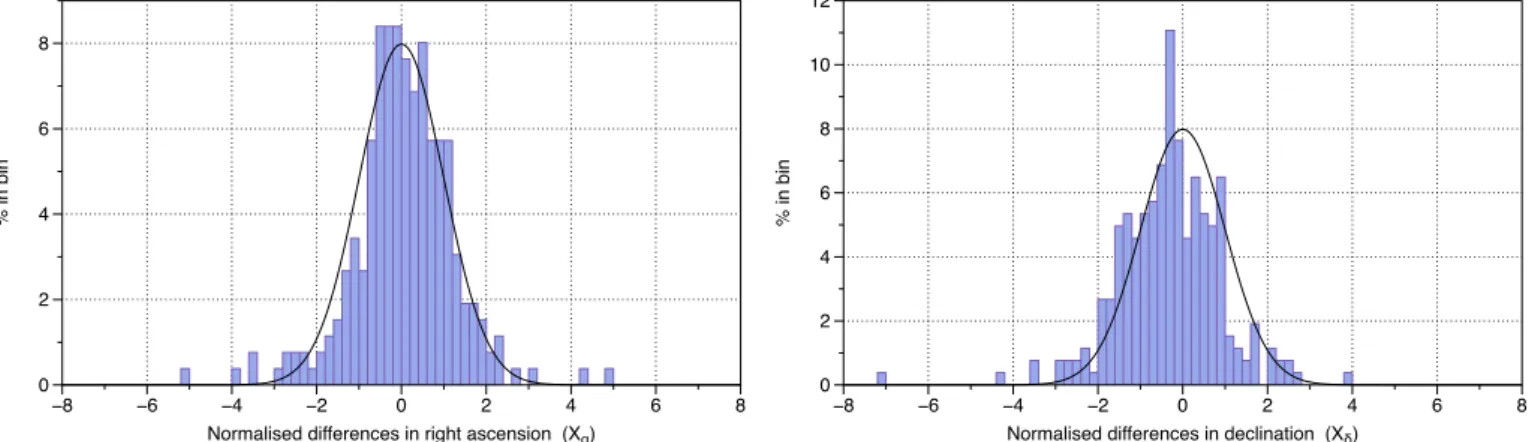
Figure9shows the cores of the distributions ofXαandXδ, leav-ing out only a few dozen points beyond the histogram bound-aries. The histograms roughly follow the expected normal dis-tribution of unit width, although there are clearly several tens of outliers in both histograms, and the negative bias in declination is clearly visible in the right histogram. The overall agreement is confirmed by the RSE, which is 1.01 in right ascension and 1.02 in declination. The outliers increase the sample standard devia-tions to 2.4 and 2.6, respectively.
The normalisation factors in Eq. (3) include the contributions from the uncertainties in both data sets (Gaia and ICRF). For comparison we show in Fig. 10the corresponding plots when only the uncertainties in theGaia data are included (obtained by settingσα∗,ICRF = σδ,ICRF = 0 in Eq. (3)). As expected, the resulting distributions are significantly wider (the RSE is 1.70 inαand 2.50 in δ), but the main difference is the much larger number of sources in the wings than when the combined un-certainties are used to scale the differences. These are primar-ily due to the non-defining sources for which the radio posi-tions are often much more uncertain than the optical posiposi-tions. The good overall agreement when the combined uncertainties are used suggests that the uncertainties quoted in ICRF2 for the non-defining sources are fairly reliable. Actually the true posi-tional uncertainty of the VCS-only sources is probably difficult
Fig. 7.Scatter plot of position differences in right ascension and declination (Gaiaminus ICRF2).Top left: all 2191 sources.Top right:the 2069 sources within±10 mas in both coordinates.Bottom left:the 1742 sources within±3 mas in both coordinates.Bottom right:the 1069 sources within±1 mas in both coordinates. Symbols show defining sources as blue squares, non-VCS sources as red crosses, and VCS-only sources as grey plus signs.
to ascertain with VLBI observations performed in a single ses-sion. The ongoing work to prepare ICRF3 with repeated obser-vations of VLBA calibrators will be very useful in this respect (Gordon et al. 2016).
Focusing now on the defining sources, we show in Fig.11 the distributions Xα and Xδ for the subset of 262 defining sources in the auxiliary quasar solution. For these sources the uncertainty coming from the ICRF2 is negligible, with a median around 0.06 mas, in comparison to the Gaia uncer-tainty, which has a median around 0.5 mas. The combined uncertainties in Eq. (3) are therefore dominated by the un-certainties from Gaia, and the distribution of the normalised
differences is primarily a test of the realism of the Gaia un-certainties and of possible physical optical-radio offsets. The RSE of the normalised differences is 1.03 in right ascension and 1.05 in declination. The deviations of these values from 1.00 are not statistically significant: the uncertainties in RSE estimated by bootstrap are about 0.08. Considering the much smaller sample, the overall agreement with a normal distribu-tion is about as good for the defining sources in Fig.11as for the whole sample in Fig.9. The proportion of outliers is also similar, with about 5% defining sources beyond three standard deviations in either coordinate; the corresponding number for the whole sample is about 7%. The bias in declination is more
% in bin 0 2 4 6 8 10 12 ( Δα2 * + Δδ2) [mas] 0 1 2 3 4 5 6 7 8 9 % in bin 0 5 10 15 20 ( Δα2 * + Δδ2) [mas] 0 1 2 3 4 5 6 7 8 9
Fig. 8.Distribution of the angular distances between theGaiasolution and the ICRF2 positions.Left:the 2054 solutions closer than 10 mas to their radio position.Right:same for the 258 defining sources.
% in bin 0 2 4 6 8 10
Normalised differences in right ascension (Xα)
−8 −6 −4 −2 0 2 4 6 8 % in bin 0 2 4 6 8 10
Normalised differences in declination (Xδ)
−8 −6 −4 −2 0 2 4 6 8
Fig. 9.Distribution of the normalised differences in right ascension (left) and declination (right) between theGaiaDR1 positions of 2191 ICRF sources and their radio positions. The histograms are cut at±8 in the normalised differences, leaving out 28 sources with|Xα|>8 and 28 sources with|Xδ|>8. The black curves are the expected centred normal distribution of unit standard deviation.
% in bin 0 2 4 6 8
Normalised differences in right ascension (Δα*/σα*, Gaia)
−8 −6 −4 −2 0 2 4 6 8 % in bin 0 2 4 6 8
Normalised differences in declination (Δδ/σδ, Gaia)
−8 −6 −4 −2 0 2 4 6 8
Fig. 10.Distribution of the differences in right ascension (left) and declination (right) between theGaiaDR1 positions of 2191 ICRF sources, normalised by the uncertainties of theGaiadata. The histograms leave out 97 sources with|∆α∗/σα∗|>8 and 154 sources with|∆δ/σδ|>8. The black curves are the expected centred normal distribution of unit standard deviation.
apparent for the defining subset because of the smaller combined uncertainties.
If we disregard the bias in declination and a certain percent-age of outliers, the distributions of the normalised differences for both defining and non-defining sources are in reasonable agreement with a normal distribution with zero mean and unit variance. The normalising factor only takes into account the sta-tistical errors and does not include the possible additional noise
coming from an actual optical-radio offset. If such an offset is present in most of the sources, it will be random in direction and will contribute to the observed dispersion of coordinate diff er-ences, thus increasing the RSE values. This increase would be more noticeable for the sources with small combined uncertain-ties. From the plots, despite the small number of sources usable for this purpose, it is already possible to state that if such off -sets exist in the majority of the defining sources, they must be
% in bin 0 2 4 6 8
Normalised differences in right ascension (Xα)
−8 −6 −4 −2 0 2 4 6 8 % in bin 0 2 4 6 8 10 12
Normalised differences in declination (Xδ)
−8 −6 −4 −2 0 2 4 6 8
Fig. 11.Distribution of the normalised differences in right ascension (left) and declination (right) between theGaiaDR1 positions of 262 defining ICRF sources and their radio positions. The histograms are cut at±8 in the normalised differences, leaving out two sources with|Xα|>8 and three
sources with|Xδ|>8. The black curves are the expected centred normal distribution of unit standard deviation.
much less than 1 mas. The RSE values of 1.03−1.05 for the nor-malised differences of the defining sources, although insignifi-cantly larger than one, set an upper limit of about 0.4 mas for the optical-radio offsets because otherwise the RSE values would be significantly larger than one. This is a statistical result, and does not preclude that the offsets are usually small and large only for a small fraction of the sources. By a similar reasoning it is possi-ble to conclude that the stated uncertainties of theGaiapositions in general cannot be underestimated, in the quadratic sense, by more than about 0.4 mas.
4.2.2. Normalised separations
When considering the normalised differences in both coordinates jointly, an obvious analogue ofρin Eq. (2) is (X2
α+X2δ)1/2.
How-ever, this quantity can be misleading when there are strong cor-relations between the errors inαandδ, which is often the case especially for theGaiadata. Indeed, for Gaussian errors the the-oretical distribution of this quantity depends on the degree of correlation between the two coordinates. To take into account the correlation coefficientsCGaiaandCICRFin both data sets, we use the statistic
X2 =hXα Xδi " 1 C C 1 #−1" Xα Xδ # , (4) where
C=σαq∗,Gaiaσδ,GaiaCGaia+σα∗,ICRFσδ,ICRFCICRF σ2 α∗,Gaia+σ 2 α∗,ICRF σ 2 δ,Gaia+σ 2 δ,ICRF (5)
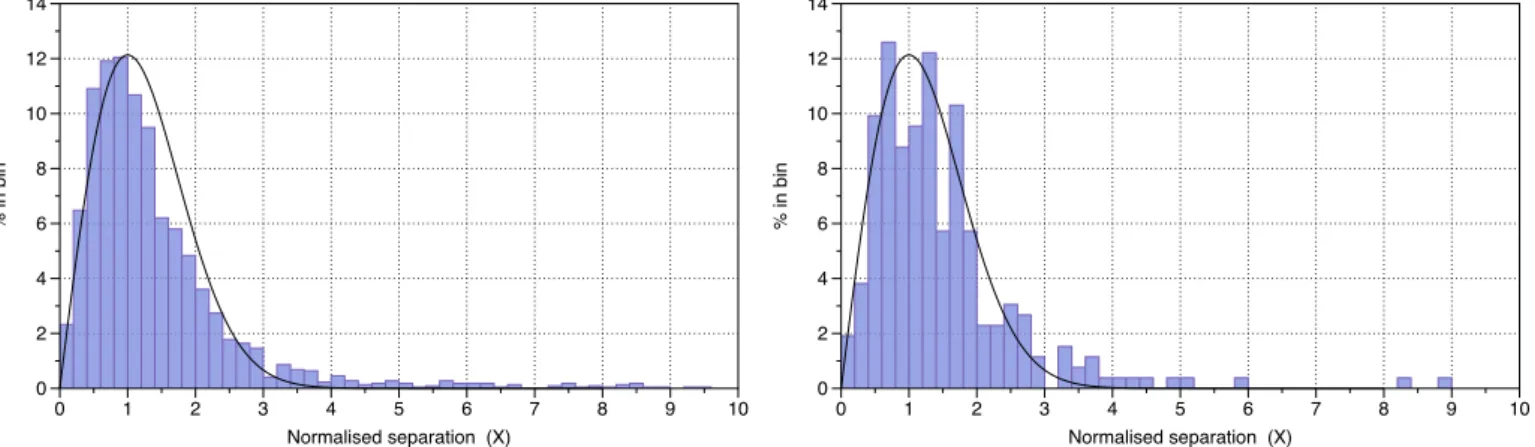
is the correlation coefficient of the combined errors. For Gaussian errors we expectX2to follow the chi-squared distribu-tion with two degrees of freedom (see AppendixBfor the mathe-matical details). Equivalently, the normalised separationXhas a Rayleigh distribution, that is Pr(X>x)=exp(−x2/2). Figure12 shows the distributions ofXfor all the ICRF sources and for the defining sources. The median value ofX is 1.11±0.02 for the whole sample of 2191 sources, and 1.28±0.05 for the defining subset. Compared with the theoretical value (ln 4)1/2'1.18, the dispersion is slightly too large for the defining sources and too small for the whole sample. The decreasing trend is consistent when going from defining to non-VCS and VCS-only sources, with median values 1.28, 1.26, and 1.03, respectively. Since this
trend is opposite to the variation of the formal uncertainties in ICRF2, it could be explained by a constant contribution from ac-tual optical-radio offsets, or by the formal uncertainties in ICRF2 being overestimated for the VCS-only sources and possibly un-derestimated for the other sources. That the root cause of this trend is in theGaiadata seems less likely, as the three categories of ICRF sources have similar properties in the Gaia observa-tions. The larger-than-expected median values for the defining and non-VCS sources could still be explained by an underesti-mation of theGaiauncertainties, in which case the ICRF2 un-certainties of the VCS-only sources would have to be even more overestimated.
Concerning the tail of large normalised separations we note that, for the theoretical distribution, the expected number of points withX>4.1 in a sample of size 2191 is less than 0.5. In reality we find 107 sources above this limit, including 11 defin-ing sources. These can reasonably be considered as outliers re-quiring a more detailed analysis.
4.3. Deviating cases
We now consider the sources whose optical positions in the
Gaia data deviate markedly from the radio positions of the matched ICRF sources, either in angular separation (ρ) or in nor-malised separation (X). Figure 13is a plot of ρversus X for all 2191 sources. In Sect.4.2.2we concluded that sources with
X >4.1 have a larger separation than expected from the com-bined formal uncertainties, and can therefore be considered as deviating cases on purely statistical grounds. This subset con-tains 107 sources, which is 5% of the whole sample.
The sources with atypically large angular separations are also interesting, however, for reasons more related to the physical properties of the sources, their environment on the sky, and the resolution of theGaiainstrument. Here it is much harder to mo-tivate a priori any specific limit in angular separation beyond which a source merits special attention. Somewhat arbitrarily, we chose to look at the sources withρ >10 mas, a value signif-icantly larger than the typical combined uncertainty. There are 137 sources that are singled out by this criterion, a number small enough to think of a case-by-case investigation.
The limits in X and ρdivide the 2191 ICRF sources into four categories, corresponding to the regions labelled A, B, C, and D in Fig.13, and which are treated separately below. It was not possible to investigate every deviating source; only a few
% in bin 0 2 4 6 8 10 12 14 Normalised separation (X) 0 1 2 3 4 5 6 7 8 9 10 % in bin 0 2 4 6 8 10 12 14 Normalised separation (X) 0 1 2 3 4 5 6 7 8 9 10
Fig. 12.Distribution of the normalised separationsX(Eq. (4)) between theGaiaDR1 positions of ICRF sources and their radio positions.Left:all 2191 sources (36 haveX>10).Right:the 262 defining sources (three haveX>10). The black curve is the expected Rayleigh distribution.
Fig. 13. Angular separation ρ versus normalised separation X for 2191 ICRF sources. Defining sources are shown as blue squares, non-VCS sources as red crosses, and non-VCS-only sources as pale grey plus signs. The four regions labelled A, B, C, and D are separated by
ρ=10 mas andX=4.1.
representative or extreme cases are discussed in some detail. Individual cases were examined using online resources avail-able through the Strasbourg astronomical Data Center (CDS), including the Sloan Digital Sky Survey (SDSS;York et al. 2000; Eisenstein et al. 2011) and the Two Micron All Sky Survey (2MASS;Skrutskie et al. 2006).
A. This is the unproblematic category where bothρandX are unremarkable. It contains 1982 sources (247 defining, 562 non-VCS, and 1173 VCS-only sources), which will not be discussed further.
B. In this category the angular separation exceeds 10 mas, but
X is still below the limit which means that the large sepa-ration may not be statistically significant. This category con-tains 102 sources (4 defining, 24 non-VCS, and 74 VCS-only
sources). The four defining sources were examined individu-ally and are listed in order of decreasing angular separation:
– ICRF J121546.7-173145 (ρ = 58.9 mas) is within 4000 of the 2nd magnitude starγCorvi. This produces a large glare around the image, increasing the background noise and generating many false detections. It is possible that
Gaiawill never deliver a good solution for this source.
– ICRF J173302.7-130449 (ρ=27.3 mas) is at 3000from a star of magnitude 7.5. It is not obvious how much trou-ble this produced in the Gaiadetection, but the obser-vation record shows that the detections were not always matched to the same Gaia source, which supports the conjecture that false detections have contaminated the solution.
– ICRF J144553.3-162901 (ρ = 12.8 mas) is a rather poorly observed source with only eight matched detec-tions and a positional uncertainty around 15 mas in the
Gaiadata. The optical source is isolated in the SDSS and 2MASS surveys.
– ICRF J023945.4-023440 (ρ=10.1 mas) is also a poorly observed source with seven matched detections andGaia
uncertainties around 8 mas. Again, the optical source is isolated in the SDSS and 2MASS surveys.
The most deviating non-VCS source in this category is ICRF J054138.0−054149 (ρ = 117.9 mas, X = 1.3). The auxil-iary quasar solution has large uncertainties for this source, although there is a good number of matched detections. No nearby bright star or host galaxy is visible in the 2MASS or SDSS survey, but the source is very faint for Gaia at
G=20.7.
The Gaia uncertainties for these five sources are charac-terised by very elongated error ellipses (axis ratios in the range 9 to 185) caused by poor coverage in terms of the scan-ning directions. This will definitely improve when more ob-servations are used in the solution and at least the last two defining sources should then get good positions fromGaia. C. This category contains sources with angular separations
ex-ceeding 10 mas that are statistically significant in relation to the formal uncertainties. This is where we are most likely to find a clear reason for the offset of the optical centre from the radio centre, caused for example by the host galaxy or a nearby faint star. The category includes 35 sources (17 non-VCS and 18 non-VCS-only sources), with one defining source just below the separation limit (see category D). The four
non-VCS sources with the highest significance are listed in order of decreasingX:
– ICRF J013741.2+330935 (X = 70, ρ = 54 mas) is 3C 48 embedded in the extended galaxy SDSS9 J013741.30+330935.0;
– ICRF J133037.6+250910 (X = 55, ρ = 128 mas) is 3C 287. On SDSS there are two optical objects of compa-rable magnitude (around 18) at 300from each other, with the ICRF position roughly coinciding with the brighter object. From the SDSS images it is difficult to determine if this object is extended. The optical position fromGaia
is offset from the radio position by 128 mas towards the north-east and away from the other object, but it is diffi -cult to see how such a faint object at 300could perturb the
Gaiameasurements;
– ICRF J120321.9+041419 (X = 53, ρ = 45 mas) is at the centre of a weak extended galaxy image, SDSS9 J120321.93+041419.0, larger than 100on SDSS images;
– ICRF J114722.1+350107 (X = 32,ρ = 19 mas) is at the centre of an extended galaxy image which is 1000 in diameter but with a luminous core. The image has a high background forGaiawith a bright point-like core, soGaiaperforms nominally well, but the optical centre could be displaced by the surrounding bright distribution of light.
TheGaiasolutions for these sources are formally good, with uncertainties below 1 mas and moderate axis ratios (in the range 1.4 to 4).
D. This category contains sources with moderate offsets (1−10 mas) that are nevertheless significant thanks to the small formal uncertainties in both the optical and radio data. It contains 72 sources (11 defining, 37 non-VCS, and 24 VCS-only sources). The most discrepant defining source is ICRF J155850.2-643229 (X=32,ρ=9.97 mas). The rel-atively bright source seen byGaia(G = 16.3) could be the central part of the galaxy 2MASX J15585027-6432298 with a total magnitude around 14 in theGaiaband. The 10 mas offset corresponds to a shift of the optical centre by only 15 pc at the distance of the galaxy, which is not unreason-able if the optical emission associated with the radio source is not strong.
Several of the sources in categories C and D clearly merit further investigation using high-resolution imaging.
4.4. Large-scale systematic differences
In this section we compare the two sets of positions in search of general large-scale patterns, like a global rotation or a glide, which could explain a fraction of the position differences. The positional reference frame ofGaiaDR1, based on the auxiliary quasar solution, has been aligned with ICRF2 as explained in the
GaiaDR1 astrometry paper (Lindegren et al. 2016). We there-fore do not expect to see any systematic difference that could be represented by a solid rotation. However, the presence of a small difference in declination, noted in Sect.4.1.1, does suggest other kinds of systematics that should be examined.
Our analysis is based on the expansion of the vector field of the differences (two components in the tangent plane of the ce-lestial sphere at the location of each source) on a set of vector spherical harmonics (VSH) as explained inMignard & Klioner (2012)orVityazev & Tsvetkov (2014). Instead of fitting the ferences on a model including the rotation, the positional dif-ferences are expanded on a set of orthogonal functions up to a
����� � � � � � � � � � �� -���� -���� -���� ���� ���� ������� ��� ����� �� ��� �������� ���������� �� ��� ����� [ ��� ]
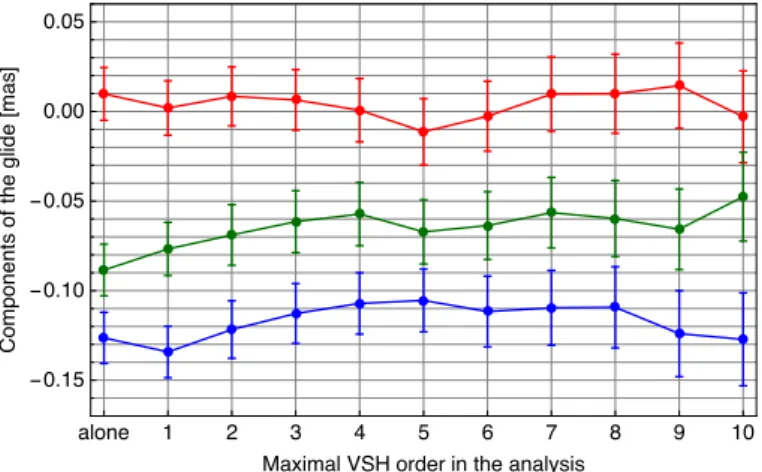
Fig. 14.Components of the glide and their errors (x, y, andz com-ponents are shown in red, green, and blue, respectively) for different largest VSH orders used in the fit (“alone” means that the three glide parameters are fitted without the three rotation parameters). The values correspond to the weighted solutions with all sources in region A as in Table2.
certain degreelmax. The global rotation and the glide (the vector field locally perpendicular to the rotation field; see Sects. 4.2, 4.3 inMignard & Klioner 2012) are extracted from the harmonics of degreel=1. This procedure is more general than the alignment since it includes higher order terms that could otherwise project on the rotation when this simplified model is used in isolation. This test is therefore an independent check of the initial align-ment as well as a search for potential large-scale systematics.
The results shown in Table 2 are very satisfactory for the present state of theGaiadata. In particular they confirm the ab-sence of global rotation at least on the level of 0.05 mas. How-ever, they do indicate a glide of about 0.13 mas, consistent with the declination difference mentioned above. The values of the glide parameters are rather stable with respect to the parameters of the fit as illustrated by Fig. 14. While it is not possible to tell from this comparison alone whether the glide results from a distortion of the GaiaDR1 reference frame or of the ICRF, we note that the validation of theGaiaDR1 astrometry has re-vealed many sorts of systematics at the level of 0.1−0.3 mas (Arenou et al. 2016;Lindegren et al. 2016). It is therefore quite possible that the reference frame ofGaiaDR1 is distorted by a similar amount. Apart from the glide, the VSH expansion shows few terms of higher order (e.g.l=3) with significant, albeit very small, amplitudes.
Part of the observed glide component may be caused by the apparent proper motion of quasars induced by the galacto-centric acceleration of the solar system barycentre (Fanselow 1983; Bastian 1995; Sovers et al. 1998; Kovalevsky 2003; Titov & Lambert 2013). This effect should produce a gradu-ally increasing distortion of the ICRF2 positions in the form of a glide vector directed towards the Galactic Centre and with an amplitude proportional to the time elapsed since the mean epoch of the VLBI observations. Using galactic parameters from Reid et al. (2009), and taking the mean epoch of ICRF2 to be 13.7 years earlier than Gaia DR1, the expected amplitude of the distortion is 0.074 mas. The observed glide is almost twice as large and directed∼30◦ away from the Galactic Centre. It is therefore probably a combination of the galactic effect with some other systematics. The unexplained (non-galactic) component is mainly directed along thez-axis.
Conceptually, the two reference frames (Gaiain the visible and ICRF2 in the radio domain) are materialisations of the same
Table 2.Global differences between theGaiaDR1 positions of ICRF sources and their positions in ICRF2, expressed by the orientation and glide parameters.
Rotation Glide
Source selection Weighting N x y z x y z
All withρ <5 mas no 1884 0.00±0.04 0.03±0.04 0.01±0.04 0.00±0.04 −0.11±0.04 −0.05±0.04 all withρ <10 mas no 2054 −0.03±0.06 0.02±0.06 0.00±0.05 −0.02±0.06 −0.08±0.06 −0.10±0.05 All yes 2191 0.02±0.05 0.06±0.04 0.04±0.05 0.01±0.05 −0.08±0.05 −0.13±0.05 All in region A yes 1982 0.03±0.02 0.03±0.02 0.01±0.02 0.01±0.02 −0.07±0.02 −0.11±0.02 Defining yes 262 0.00±0.08 0.04±0.07 0.01±0.08 −0.04±0.07 −0.14±0.07 −0.07±0.07 Defining in region A yes 247 0.01±0.04 0.01±0.03 0.03±0.04 −0.01±0.04 −0.12±0.04 −0.12±0.04
Notes.All numbers are in mas and the VSH analysis was done withlmax =5.ρis the angular separation between the optical and radio positions.
Region A is defined in Sect.4.3(see Fig.13). The weighted solutions use a non-diagonal weight matrix resulting from the combination ofGaia and ICRF2 covariances. In this way a quadratic combination ofGaiaand ICRF2 uncertainties is considered, and also the effective correlation given by Eq. (5). If the correlation is neglected, the estimates are typically shifted by a half of the corresponding uncertainty.Nis the number of sources used in the solution. The columns headedx,y,zgive the components of the rotation and glide along the principal axes of the ICRS.
reference system. Our test shows that this holds globally at a level of 0.2 mas, again a very satisfactory situation for this first
Gaiasolution.
5. Discussion of the optical-radio offsets
The non-coincidence of the optical and radio centres of ICRF sources has long been a concern for the achievement of an ac-curate optical reference frame (e.g. da Silva Neto et al. 2002; andMakarov et al. 2012). Although there are good theoretical reasons to expect that the offsets are generally small (<1 mas; e.g.Kovalev et al. 2008; andPopovi´c et al. 2012), observational studies tend to find much larger effects (e.g. Taris et al. 2011; Orosz & Frey 2013, and the surveys discussed below).
Based on deep CCD imaging of the optical counterparts of ICRF sources, linked to the H
ipparcos
/Tycho-2 reference frame,Zacharias & Zacharias (2014)hypothesised the existence of a detrimental, astrophysical, random noise (DARN) optical-radio offset on a level of'10 mas. ComparingGaiaDR1 optical-radio coordinate differences with those in Tables 4 and 5 in the USNO survey we find little or no correlation for the∼320 sources in common. While the RSE of the coordinate differences for the common sources is less than 1 mas in GaiaDR1, it is 20−30 mas in the USNO survey. A similar comparison with the Rio survey (Assafin et al. 2013) gives the same result. On the other hand, there is a clear (if rather weak) positive correlation between the differences in the USNO and Rio surveys, although different instruments were used.Clearly most of the offsets found in the Rio and USNO sur-veys must have other causes than a real non-coincidence of the optical and radio centres. A reasonable hypothesis is that the off -sets are to a large extent caused by the spatially correlated (i.e. systematic, mainly zonal) errors in the Tycho-2 proper motions revealed byGaia(see Appendix C.1 inLindegren et al. 2016). The errors, on a level of 2−6 mas yr−1, are much larger than assumed byZacharias & Zacharias (2014), and could contribute offsets up to∼50 mas over the∼10 year epoch difference be-tween the surveys and H
ipparcos
/Tycho-2. Although a DARN effect will surely exist at some level, it must in general be well below 1 mas.6. Conclusions
As part of Gaia DR1 we present the optical positions of 2191 Gaia sources matched to ICRF2 sources, including 262 of the defining sources in ICRF2. These positions, which come
from the special auxiliary quasar solution, are shown to be more accurate than the positions from the secondary solution given elsewhere inGaiaDR1. Magnitudes inGaia’sGband are given for 2152 of the sources (260 defining). The properties of the op-tical data are discussed and detailed comparisons made between the optical and radio positions of the ICRF sources. The main conclusions are the following:
– TheGmagnitudes span a range from 12.4 to 21.0 mag with the bulk of sources between 17 and 20 mag.
– The formal accuracy of the optical positions has a floor at
∼0.25 mas forG < 17 mag, gradually increasing to a few mas atG = 20. There is no systematic difference between defining and non-defining ICRF sources in terms of their op-tical accuracies versus magnitude.
– The overall agreement between the optical and radio posi-tions is excellent: the angular separation is<1 mas for 44% of the sources and <10 mas for 94% of the sources. For the defining sources the corresponding numbers are 71% and 98%.
– Analysis of the large-scale systematic differences between the optical and radio positions in terms of VSH reveals no significant components except for a glide of amplitude
∼0.15 mas.
– The angular separations are in general consistent with the combined formal uncertainties in ICRF2 and theGaiadata, supporting the claimed accuracies. The uncertainties of the radio positions of VCS-only sources in ICRF2 may be overestimated.
– For most of the 6% sources with angular separations above 10 mas the optical-radio offsets are consistent with the stated formal uncertainties of the data, but for a quarter of them the offsets are statistically significant. Individual examination of a number of these cases shows that a likely explanation for the offset can often be found, for example in the form of a bright host galaxy or nearby star.
– Among the sources with good optical and radio astrometry we found no indication of physical optical-radio offsets ex-ceeding a few tens of mas. For most sources the true offsets are likely to be less than 1 mas.
The last result is very encouraging for the future alignment of the very accurate optical reference frame to be built fromGaia
observations and the corresponding radio frame, using common sources in two very different wavelength domains.
Acknowledgements. This work has made use of data from the ESA space mis-sionGaia, processed by theGaiaData Processing and Analysis Consortium
(DPAC). This research has made use of Aladin sky atlas and the Simbad database developed at CDS, Strasbourg Observatory, France. We are grate-ful to the developers of TOPCAT (Taylor 2005) for their software. Funding for the DPAC has been provided by national institutions, in particular the in-stitutions participating in the Gaia Multilateral Agreement. The Gaia
mis-sion website ishttp://www.cosmos.esa.int/gaia. The authors are
mem-bers of theGaiaDPAC. This work has been supported by the European Space Agency in the framework of theGaiaproject; the Centre National d’Études Spa-tiales (CNES); the German Aerospace Agency DLR under grants 50QG0501, 50QG1401 50QG0601, 50QG0901, and 50QG1402; and the Swedish National Space Board. The authors are very grateful to Chris Jacobs for his constructive review and thoughtful remarks, which helped to improve the paper.
References
Andrei, H., Antón, S., Taris, F., et al. 2014, in Journées 2013 Systèmes de référence spatio-temporels, ed. N. Capitaine, 84
Arenou, F., Luri, X., Babusiaux, C., et al. 2016, A&A, submitted (GaiaSI) Assafin, M., Vieira-Martins, R., Andrei, A. H., Camargo, J. I. B., & da Silva
Neto, D. N. 2013,MNRAS, 430, 2797
Bailer-Jones, C. A. L., Andrae, R., Arcay, B., et al. 2013,A&A, 559, A74 Bastian, U. 1995, in Future Possibilities for astrometry in Space, eds. M. A. C.
Perryman, & F. van Leeuwen,ESA SP, 379, 99
Beasley, A. J., Gordon, D., Peck, A. B., et al. 2002,ApJS, 141, 13
da Silva Neto, D. N., Andrei, A. H., Vieira Martins, R., & Assafin, M. 2002,AJ, 124, 612
Eisenstein, D. J., Weinberg, D. H., Agol, E., et al. 2011,AJ, 142, 72 Fabricius, C., Bastian, U., Portell, J., et al. 2016,A&A, 595, A3(GaiaSI) Fanselow, J. L. 1983, Observation Model and parameter partial for the JPL VLBI
parameter Estimation Software MASTERFIT-V1.0, Tech. Rep.
Fey, A. L., Gordon, D., Jacobs, C. S., et al. 2015,AJ, 150, 58 Gaia Collaboration (Prusti, T., et al.) 2016,A&A, 595, A1(GaiaSI) Gordon, D., Jacobs, C., Beasley, A., et al. 2016,AJ, 151, 154
Kovalev, Y. Y., Petrov, L., Fomalont, E. B., & Gordon, D. 2007,AJ, 133, 1236 Kovalev, Y. Y., Lobanov, A. P., Pushkarev, A. B., & Zensus, J. A. 2008,A&A,
483, 759
Kovalevsky, J. 2003,A&A, 404, 743
Lindegren, L., Lammers, U., Hobbs, D., et al. 2012,A&A, 538, A78 Lindegren, L., Lammers, U., Bastian, U., et al. 2016,A&A, 595, A4(GaiaSI) Ma, C., Arias, E. F., Eubanks, T. M., et al. 1998,AJ, 116, 516
Ma, C., Arias, E. F., Bianco, G., et al. 2009, IERS Technical Note, 35
Makarov, V., Berghea, C., Boboltz, D., et al. 2012,Mem. Soc. Astron. Italiana, 83, 952
Michalik, D., & Lindegren, L. 2016,A&A, 586, A26 Mignard, F., & Klioner, S. 2012,A&A, 547, A59 Orosz, G., & Frey, S. 2013,A&A, 553, A13
Petrov, L., Kovalev, Y. Y., Fomalont, E. B., & Gordon, D. 2008,AJ, 136, 580 Popovi´c, L. ˇC., Jovanovi´c, P., Stalevski, M., et al. 2012,A&A, 538, A107 Reid, M. J., Menten, K. M., Zheng, X. W., et al. 2009,ApJ, 700, 137 Skrutskie, M. F., Cutri, R. M., Stiening, R., et al. 2006,AJ, 131, 1163 Smart, R. L., & Nicastro, L. 2013, VizieR Online Data Catalog, I/324 Sovers, O. J., Fanselow, J. L., & Jacobs, C. S. 1998,Rev. Mod. Phys., 70, 1393 Taris, F., Souchay, J., Andrei, A. H., et al. 2011,A&A, 526, A25
Taylor, M. B. 2005, in Astronomical Data Analysis Software and Systems XIV, eds. P. Shopbell, M. Britton, & R. Ebert,ASP Conf. Ser., 347, 29
Titov, O., & Lambert, S. 2013,A&A, 559, A95
Vityazev, V. V., & Tsvetkov, A. S. 2014,MNRAS, 442, 1249
York, D. G., Adelman, J., Anderson, Jr., J. E., et al. 2000,AJ, 120, 1579 Zacharias, N., & Zacharias, M. I. 2014,AJ, 147, 95
Appendix A: Identification of ICRF sources in the secondary solution ofGaiaDR1
Apart from the auxiliary quasar table, all positional data inGaia
DR1 for faint sources come from the secondary solution. For most of the sources in the auxiliary quasar table slightly different positions from the secondary solution can be found. In this ap-pendix we briefly consider the optical positions of ICRF sources in the secondary solution, even though they are not used in the rest of the paper.
Searching the secondary solution of Gaia DR1 for posi-tional matches to the 3414 radio positions in ICRF2 results in 2299 matches within 150 mas (the same limit as was used in Sect.2.4). All of the matches are unique in the sense that there is at most one optical source within 150 mas of the radio source. Among the ICRF sources there are 260 defining, 657 non-VCS, and 1382 VCS-only sources.
Comparing the optical positions from the two tables (auxil-iary and secondary) with the matched ICRF2 positions clearly demonstrates the superiority of the auxiliary quasar solution. For example, the median separation (Eq. (2)) isρ = 1.2 mas for the auxiliary quasar table and 1.8 mas for the secondary table. The difference is even more pronounced for the defining sources, where the median separations are 0.6 mas (auxiliary) and 1.1 mas (secondary). These results do not change signifi-cantly if we only consider the subset of 2135 ICRF2 sources (of which 256 are defining) that appear in both tables.
Not only are the positions from the auxiliary quasar solu-tion more accurate than in the secondary solusolu-tion, but the associ-ated standard uncertainties also appear to be more reliable in the auxiliary solution. This can be seen from the robust dispersion (RSE) of the normalised coordinate differencesXα,Xδ(Eq. (3)).
For the auxiliary quasar solution the dispersion is close to one, as expected, even for the defining sources (see Figs.9and11). For the secondary solution the dispersion is about 10% higher for the whole sample and 30% higher for the defining sources. This is a strong indication that the positional uncertainties are severely underestimated in the secondary solution, which is not the case for the auxiliary table. There are thus good reasons to restrict the detailed analysis of the optical-radio differences to the auxiliary quasar table.
As already mentioned, the two tables have 2135 ICRF2 sources in common, which means that the secondary table con-tains 2299−2135 = 164 ICRF2 sources that are not listed in the auxiliary table. Conversely, the auxiliary table contains 2191−2135 = 56 ICRF2 sources not listed in the secondary table. The relation between the two tables is even more compli-cated: among the 2135 ICRF2 sources that appear in both ta-bles, 56 have differentGaiasource identifiers in the two tables. This means that the auxiliary and secondary positions for these 56 ICRF2 sources were computed from disjoint subsets of the
Gaiadetections (cf. Sect.2.2). Complications of this sort hap-pened inGaiaDR1 because of the imperfect state of the initial source list and the relatively large attitude and calibration errors in the initial processing steps, but in later releases they will even-tually be eliminated.
Appendix B: Derivation of Eq. (4)
B.1. Covariance for the differences of two random vectors
Consider two independentk-dimensional random vectorsx1and
x2 with mutlivariate normal distribution with meansµ1,µ2and
covariance matrices respectively Σ1 and Σ2. Each distribution is then Nk(µ,Σ). Without changing the subsequent argument,
µ1 = µ2 = 0 can always be assumed. As a consequence of the independence of the two random vectors, the joint distribution of the vector of 2k-dimensionx=[x1,x2]Talso has a multivariate normal distribution with zero mean and covariance matrix, Σ∗= " Σ1 0 0 Σ2 # , (B.1)
whereΣ∗ is a 2k × 2kpositive definite symmetric matrix. We now introduce thek-dimensional random vector
y=x2−x1. (B.2)
This transformation can also be written as linear mapping from
R2ktoRkas
y=Bx, (B.3)
where Bis a k×2k matrix, built with the k-dimensional unit matrixIk,
B=hIk −Ik
i
. (B.4)
Therefore, the probability distribution ofyisNk(0,Σ), where the covariance matrix is given by
Σ=BΣ∗BT (B.5)
or more trivially
Σ=Σ1+Σ2, (B.6)
a generalisation of the addition of the variances for two scalar independent variables.
For a normal distribution Nk(0,Σ) of ak-dimensional
ran-dom vectorxthe quadratic form
xTΣ−1x (B.7)
follows aχ2distribution withkdegrees of freedom.
B.2. Application to k = 2
This is the case of interest in this paper with the differences between Gaia and ICRF2 respectively in right ascension and declination. Let x1 = (x1, y1) and x2 = (x2, y2), which yields successively Σ1= "σ2 x1 c1 c1 σ2y1 # (B.8) and Σ2= "σ2 x2 c2 c2 σ2y2 # (B.9) and finally, Σ= "σ2 x1+σ 2 x2 c1+c2 c1+c2 σ2y1+σ 2 y2 # , (B.10)
wherec1=cov(x1, y1) andc2=cov(x2, y2), respectively the co-variance between the errors in the ICRF2 and in theGaia solu-tion in right ascension and declinasolu-tion, and thenxα=x2−x1and
The quadratic form Qα,δ=hxα xδiΣ−1 " xα xδ # (B.11) therefore follows aχ2distribution with 2 degrees of freedom or, equivalently, p
Qα,δfollows a standard Rayleigh distribution. An
analytical inversion ofΣgives the same as Eq. (4), although it
is written with reduced variables with unit variances and the co-variance identical to the correlation coefficient. ThusCin Eq. (5) is the same as c1+c2 q σ2 x1+σ 2 x2 q σ2 y1+σ 2 y2 · (B.12)