Procedia Computer Science 96 ( 2016 ) 255 – 264
1877-0509 © 2016 The Authors. Published by Elsevier B.V. This is an open access article under the CC BY-NC-ND license (http://creativecommons.org/licenses/by-nc-nd/4.0/).
Peer-review under responsibility of KES International doi: 10.1016/j.procs.2016.08.138
ScienceDirect
20th International Conference on Knowledge Based and Intelligent Information and Engineering
Systems, KES2016, 5-7 September 2016, York, United Kingdom
Automatic Transformation of Data Warehouse Schema To NoSQL
Data Base: Comparative Study
Rania Yangui
a, Ahlem Nabli
b, Faiez Gargouri
a aMIRACL Laboratory, Institute of Computer Science and Multimedia Sfax, BP 1030, Tunisia bMIRACL Laboratory, Faculty of Computer Science and Information Technology, Al-Baha University, KSAAbstract
Driven by the ever-growing of data from social network (SN), data warehouse (DW) approaches must be adapted. Generally the star, snowflake or constellation models are used as logical ones. All these models are inadequate when dealing with social data which need scalable and flexible systems. As an alternative, NoSQL systems begin to grow.
In the absence of a clear approach which allows the implementation of data warehouse under NoSQL model, we propose in this paper, new rules for transforming a multidimensional conceptual model into two NoSQL ones: column-oriented and document-oriented models. For each model, we distinguish two types of transformation: simple and hierarchical. To validate our trans-formation rules, we implemented four data warehouses using Cassandra as a column-oriented NoSQL system and MongoDB as document-oriented NoSQL system. These systems were implemented using java routines in Talend Data Integration tool and evaluated in terms of ”Write Request Latency” and ”Read request Latency” using TPC-DS benchmark.
c
2016 The Authors. Published by Elsevier B.V. Peer-review under responsibility of KES International.
Keywords: NoSQL Data Warehouse, Social Networks, Column-oriented model, Document-oriented model;
∗Corresponding author. Tel.:+216 20004271. E-mail address:[email protected]
© 2016 The Authors. Published by Elsevier B.V. This is an open access article under the CC BY-NC-ND license (http://creativecommons.org/licenses/by-nc-nd/4.0/).
1. Introduction
Because of the huge amount of data available on the Web, integrating external data from social network with a companys internal data in a data warehouse is a promising approach. This latter broaches a paramount importance and draws the attention of many researches. However, As argued by many works1 2, current warehousing
methodolo-gies with relational databases cannot be successfully applied to handle the growing complexity and volume of data generated from SN. The rules that were designed for relational data cannot be enforced on SNs generated data. In fact, many new technologies have emerged such as NoSQL databases in order to increase the performance and the availability of services5. NoSQL is a term often used to describe a class of non-relational databases that scale
horizontally to very large data sets.
Given that a well-designed DW requires a carefully planned logical design, all updates and versions of a DW lead to a revision of the logical design6. Generally, the mapping from the conceptual to the logical model is made according to
three approaches: ROLAP (Relational-OLAP), MOLAP (Multidimensional-OLAP) and HOLAP (Hybrid-OLAP)9.
All these approaches are inadequate when dealing with SN generated data. To solve a part of this issue, some works have followed the NoSQL model.
However, the choice of NOSQL database type with the best transformation is a key problem for the implementation of a NoSQL DW. Decision support systems must have not only large storage capacity, but also must be able to respond properly and promptly to the queries of decision makers. Thus the ability to respond to relatively complex queries and response time are main criteria in the choice of the NoSQL model.
In order to benefit from the NoSQL model advantages, and in the absence of a clear approach allowing the imple-menting of the NoSQL DW, the objective of this paper is to determine the appropriate NoSQL model that will be used when creating DW from SN. For that, this paper deals with a set of transformation rules from conceptual model to NoSQL ones. These rules are implemented using java routines in Talend Data Integration tool and evaluated in terms of ”Write Request Latency” and ”Read request Latency” using TPC-DS benchmark.
This paper is organized as follows. Section 2 represents a state of art. Section 3 gives a formal representation of the multidimensional schema. Section 4 presents a formal representation of the NoSQL Columnar and Document-oriented Databases. Section 5 details the transformation rules. Section 6 represents the evaluation tasks. Section 7 concludes the paper and draws future research directions.
2. Related Work on NoSQL data warehousing
NoSQL systems have shown their advantages over relational systems in terms of flexibility and handling massive data. In the literature, a number of researchers have recognized the deficiencies of the traditional OLAP data model and have proposed approaches for the migration from relational databases to NoSQL ones (indirect approaches). How-ever, few works have focused on the transformation of the multidimensional conceptual model to NoSQL logical one (direct approaches). The first type of transformation (indirect) is provided in two stages. The first stage11 12is to use a
set of transition rules from multidimensional conceptual level to relational logical one. The second stage13,14,15finds
the correspondences between the obtained relational model and the NoSQL target system . In13the authors propose
rules allowing the storage of a time dimension in HBase table. In14, the authors propose a set of transformation rules
for translating a relational model to column-oriented model via HBase. As an attempt to migrate to a document-oriented NoSQL model, the authors have focused in15 on the system performance study when using MongoDB as
NoSQL system. However, this work has focused only on testing the performance without specifying the rules of transforming the logical model to document-oriented one.
Indirect Migration approaches have shown that it is possible to migrate from a relational database to NoSQL one. However, this first generation of solutions have certain limitations. First, these approaches are limited to converting a logical representation to another logical one and does not consider the conceptual model of data warehouses. Addi-tionally, at the beginning, all data should be stored in a relational database. This latter showed these limits during the storage of large volumes of data.
For the direct approaches, we can cite few recent works that are aimed at developing data warehouses in NoSQL systems. In16, the authors have developed a new benchmark for the columnar NoSQL DW, but without giving the
formalization for the modeling process. This work is considered as the first work which proposes implemented star DW under column oriented NoSQL DBMS directly from dimensional model. This work is extended by proposing
three approaches which allow big data warehouses to be implemented under the column oriented NoSQL model17.
Each approach differs in terms of structure and the attribute types used when mapping the conceptual model into logical model is performed. Other recent works, have tried to define logical models for NoSQL data stores (oriented columns and oriented documents)2 3 4. The authors have proposed a set of rules to map star schema into two NoSQL
models: column-oriented (using HBase) and document-oriented (using MongoDB). Table 1 highlights a summary of the literature review based on seven criteria.
Table 1. Summary of the literature review.
Work NoSQL DB Source Source Model Transformation Type Formalization Evaluation (Han et all., 2012) HBase DW Logical Indirect, Simple No No (Li et all., 2010) HBase DB Logical Indirect No No (Chevalier et all., 2015) HBase/MongoDB DW Conceptual Direct, Simple Yes Yes (Dehdouh et all., 2015) HBase DW Conceptual Direct, Simple Yes Yes
All the mentioned works present several interesting mining. They have shown that it is possible to convert a multidimensional conceptual model to a NoSQL storage. However, we note that the concepts of the conceptual mul-tidimensional model were enever considered in the context of indirect transformations. Also, direct approaches have focused only on the rules for transforming the concepts of fact and dimension in a NoSQL structure. Furthermore, it appears that the majority of researchers use HBase for implementing a NoSQL DW. This is justified by the resem-blance between the logic model HBase and that of relational databases, particularly in terms of concepts of tables and rows. Nevertheless, during the transformation of a DW to a NOSQL DB, we confront several possible transformations that we need to evaluate. Moreover, we emphasize there’s two interesting concepts that have never been used in the proposed transformation, namely embedded documents and super columns. In our work, we have used these concepts for detailing hierarchies. To achieve that, we start with formally describing the source (multidimensional model) and the target (columnar and documents- oriented models).
3. Formal Representation of the Multi-Dimensional Schema
Conceptual modeling is the necessary foundation phase. In this phase, DW are modeled in a multidimensional way. The basic concepts of multidimensional modeling are: facts, measures, dimensions and hierarchies. According to10, we formalize it as follows:
Fact and measures.A fact represents the analyzed subject. It is composed of measures reflecting the information to be analysed. The measures of a fact are generally numeric and continuously valued to summarize a large number of records. Formally, a fact is a pair (FN,FM) where:
• FNis the name of the fact;
• FMis a set of attributes forming the Fact measures:FM={M
1, . . . ,Mn}.
Each measure M is defined by: M=(MN,MFonc) where: • MNis the name of the measure;
• MFoncis an aggregate function (sum, average, etc.).
Dimension and Hierarchy.The dimensions represent the axes of the multidimensional analysis. They are usually textual and discreet. They are used to restrict the scope of queries to limit the size of the responses. Formally, a dimension is a triplet (DN,DAtt,DHier) where:
• DNis the name of the dimension; • DAtt={A
1, . . . ,Am}is the set of strong and weak attributes of a dimension;
• DHier={H
1, . . . ,Hk}is a set of hierarchies.
The attributes of the dimensions are organized into one or more hierarchies. A hierarchy is composed of several levels, representing different degrees of information accuracy. A hierarchy of a dimension H is a path defined by (HN,HP, PFAtt) where:
• HNis the name of the hierarchy; • HP=P
1, . . . ,Pois an ordered list of the strong attributes used in the hierarchy;
• PFAttis a function that associates each strong attribute its weak attributes.
Multidimensional Schema. A DW is characterized by its multidimensional schema (MS) composed of a fact schema with a single or a constellation of facts and dimensions. Formally, a multidimensional schema MS is defined by (MSN,MSFact,MSDim, Func) where:
• MSNis the name of the MS; • MSFact={F 1, . . . ,Fl}is a set of facts; • MSDim=D 1, . . . ,Dq is a set of dimensions;
• Func a function that associates to a factFithe list of its dimensions with∨i∈[1, . . . ,l], Func (Fi)={Dv, . . . ,Dx}
such that∨j∈[v, . . . ,x],∃Dj∈MSDimand∨Df ∈MSDim,∃Fi∈MSDimsuch thatDf ∈Func (Fi).
4. Formal Representation of Column-oriented and Document-oriented Databases
NoSQL databases are becoming increasingly popular and have many interesting strengths such as scalability and flexibility2. In order to define the rules that cover the mapping process from MS to the target NoSQL logical ones, we begin by formalizing the different concepts of column-oriented and document-oriented DBs.
4.1. Column-oriented Database
A column-oriented database can be seen as a complex data structure with five main components: KeySpace, Columns, Super-Columns, Column-Families, and Super-Column-Families.
Column.A column is the smallest unit in the column-oriented databases. A column is identified by a name and a value defined by the user as well as a timestamp that indicates the last date at which the data was changed. Formally, a column is a triple (CN,CVal,CT s) where:
• CNis the name of the column; • CValis the value of the column;
• CT sis the timestamp that indicates the last date on which the data has changed.
Super-Column.A super-column is a structure that has a name and that has as value an infinite number of related columns. Formally, a super-column SC is a pair (S CN,S CVal) where:
• S CNis the name of the super-column; • S CVal={C
1, . . . ,Cn}is a set of columns that constitutes the super-column/∨i∈ {1, . . . ,n},Ci∈C.
Column-Family.A column-family is the main component in the column-oriented database that can be assimilated to a table in relational database. Linked columns (those accessed simultaneously) must be grouped in the same column family. The column-families can be created dynamically and their number is not limited. Formally a column-family CF is defined by (CFN,CFVal) where:
• CFNis the name of the column-family; • CFVal = {L
1, . . . ,Ln} is a set of lines that constitute the column-family such as each lineLi is defined by
(LiKey,LVal i ) where:
– LKeyi is a key identifying the lineLi;
– LVal
i ={C1, . . . ,Cn}is a set of columns that constitute the line/∨j∈ {1, . . . ,n},C j∈C.
Super-Column-Family. A column-family is a NoSQL object that contains Lines composed of super-columns. It can be seen as a map of tables. The flexibility of this model is that we can represent relationships and hierarchies in a simple and flexible manner. Formally a super-column-family SCF is defined by (S CFN,S CFVal)
where:
• S CFVal={M
1, . . . ,Mn}is a set of lines that constitute the super-column-family such as each lineMiis defined
by (MiKey,MVal i ) where:
– MiKeyis a key identifying the lineMi;
– MVal
i ={S C1, . . . ,S Cn}is a set of super-columns that constitute the line/∨ j∈ {1, . . . ,n},S C j∈S C.
Keyspace. A keyspace is an object that holds together all the column-families (Simple and Super). It can be assimilated to the schema concept in relational databases. Generally, there is one keyspace per application. Formally a keyspace KS is defined by (KSN,KSVal) where:
• KSNis the name of the keyspace;
• KSVal={CF1, . . . ,CFn} ∪ {S CF1, . . . ,S CFm}is a set of column-families (simple and super).
4.2. Document-Oriented Database
Document-oriented databases are very flexible and may handle very large amounts of data and provide horizontal scalability. Thus, they are very suited for distributed environments. A document contains hierarchically organized data. This allows to represent one-to-one as well as one-to-many relationships in a single document. Consequently, a complex document can be retrieved or stored without joins. The formalization of document-oriented model consists on the formalization of its three components: collections, documents and attributes.
Document and Attribute. The document is the main storage unit of a document-oriented model. The document structure is defined by means of attributes. We distinguish simple attributes whose values are atomic (integer, string, etc.) and composed attributes whose values are themselves documents, called imbricated (embedded) documents. Formally a document DC is a couple (DCN,DCAtt) where:
• DCNis the name of the Document;
• DCAttis set of simple and embedded attributes.
Formally, a simple attribute SA of a documentDCiis a couple (S AN,S AVal) where: • S ANis the name of the simple attribute;
• S AVal=Vis the atomic value of the simple attribute.
Opposed to the simple attributes whose values are atomic, the composed attributes have as values other embedded documents. Formally, a composed attribute CA of a documentDCiis a couple (CAN,CAVal) where:
• CANis the name of the composed attribute; • CAVal={S A
1, . . . ,S Am} ∪ {CA1, . . . ,CAn}is a set of simple and composed attributes/∨j∈ {1, . . . ,m},S A j∈
S Aand/∨i∈ {1, . . . ,n},CA j∈CA.
Collection of Documents.In relational databases, data are stored in tables containing rows. By analogy, document-oriented NoSQL databases store data in collections of documents. Formally, a collection of documents DCC is a pair (DCCN,DCCVal) where:
• DCCNis the name of the collection;
• DCCVal={DC
1, . . . ,DCn}is a set of documents/∨ j∈ {1, . . . ,n},DC j∈DC.
The above formal descriptions will be used to facilitate the definition and the automation of the transformation rules from conceptual model to NoSQL ones.
5. Transformation Rules
The aim of this section is to propose transformation rules to NoSQL DWs. Recall that a DW schema consists of fact with measures, as well as a set of dimensions with attributes, we map the dimensions according to its attributes and the fact according to its measures. As, several alternatives are possibles, we will detail some of these alternatives in order to choose the best. We define two types of transformations namely: simple and hierarchical transforma-tions. The first one proposes storing the fact and dimensions into column-families/collections, and uses only the simple columns/documents for representing measure and dimension attributes. The second transformation uses also
different column-families/collections for storing facts and dimensions, and uses the simple columns/documents for representing measure and the super-columns/composed attributes for representing dimension attributes while explain-ing hierarchies. For each type of transformation, we define a set of rules ensurexplain-ing the mappexplain-ing from MS concepts to column-oriented and document-oriented models.
5.1. Simple Transformation
The simple transformation is the mapping to NoSQL model while highlighting the concepts of the MS but without detailing the hierarchies. Otherwise, this transformation distinguishes between measures of fact and attributes of dimension. The dimensions and the facts are stored separately on different column-families/collections. To ensure the links between these two entities (dimension-fact), the dimension identifier is duplicated in column-family/Collection representing the fact. In the following, we present the ST-C and ST-D, rules for Simple Transformation to Column-oriented and Document-Column-oriented DWs.
Rule1: Simple Transformation to Column-oriented model (ST-C).Each multidimensional schema MS (MSN,
MSFact,MSDim,Func) is transformed to a keyspace KS (KSN,KSVal) where: • The name of the keyspace is the name of the MS/KSN←MSN;
• Each factF∈MSFactis transformed to a column-familyCF(CFN,CFVal) where :
– The name of the column-family is the name of the fact/CFN←FN;
– Each measureM∈Fis transformed to a columnC∈CFVal/CN←M;
– Each identifier of the related dimensions is transformed to a columnC∈CFVal/CN←Did; • Each dimension (DN,DAtt,DHier)/D∈MSDimis transformed to column-familyCF(CFN,CFVal) where:
– The name of the column-family/CFNis equivalent to the name of the dimensionCFN←DN;
– Each attribute A ∈ DAttis transformed to a columnC ∈ CFVal where the name of the column is the
attribute name/CN←A.
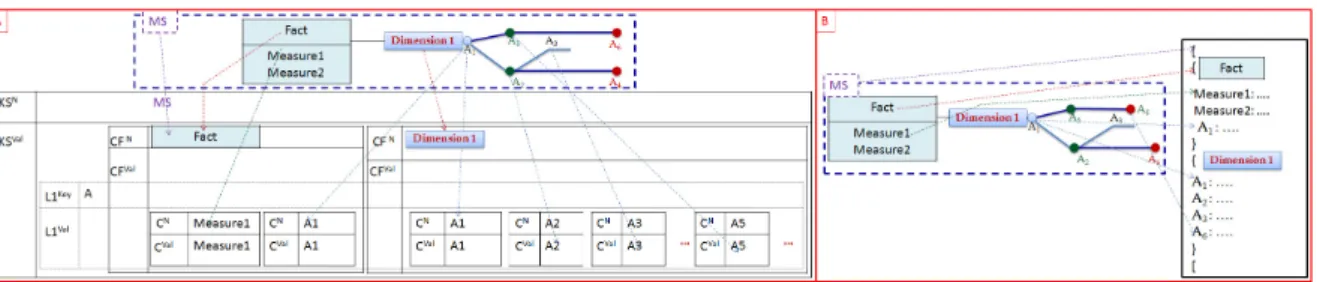
The overall simple transformation process from DW conceptual schema to column-oriented model is presented in (Fig 1.A).
Rule2: Simple Transformation to Document-oriented model (ST-D).Each multidimensional schema MS (MSN,
MSFact,MSDim,Func) is transformed to a documents collection DCC (DCCN,DCCVal) where: • The name of the collection is the name of the MS/DCCN←MSN;
• Each factF∈MSFactis transformed to a document DC (DCN,DCAtt) where :
– The name of the document is the name of the fact/DCN←FN;
– Each measure M∈F is transformed to a simple attribute SA∈DCatt/S AN←M;
– Each identifier of the related dimensions is transformed to a simple attribute SA∈DCatt/S AN←Did; • Each dimensionD(DN,DAtt,DHier)/D∈MSDimis transformed to a documentDC(DCN,DCAtt) where:
– The name of document is equivalent to the name of the dimension/DCN←DN;
– Each attribute A∈ DAttis transformed to a simple attributeS A ∈ DCattwhere the name of the simple
attribute is the attribute name/S AN←A.
The overall simple transformation process from DW conceptual schema to document-oriented model is presented in (Fig 1.B).
5.2. Hierarchical transformation
We are looking in this section to transform the multidimensional model of DW to a NoSQL model while explaining hierarchies. It consists to explore the concepts of super-column and super-column-family, respectively embedded document, to burst the dimensions of a multidimensional diagram.
Rule 3: Hierarchical Transformation to Column-oriented model (HT-C) Each multidimensional schema MS (MSN,MSFact,MSDim,Func) is transformed to a keyspaceKS(KSN,KSVal) where:
• The name of the keyspace is the name of the MS/KSN←MSN;
• Each factF∈MS Factis transformed to a column-familyCF(CFN,CFVal) where :
– The name of the column-family is the name of the Fact/CFN←FN;
– Each measureM∈Fis transformed to a columnC∈CFVal/CN←M;
– Each identifier of a related dimension is transformed to a columnC∈CFVal/CN←Did;
• Each dimension (DN,DAtt,DHier)/D ∈MSDimis transformed to super-column-familyS CF(S CFN,S CFVal)
where:
– The name of the super-column-family/S CFNis equivalent to the name of the dimensionDN←DN;
– Each hierarchy H(HN,HP, PFAtt) is transformed to a super-column SC(S CN,S CVal) in the line M i ∈
S CFValwhere:
∗ The name of the super-column is the hierarchy name/S CN←HN ∗ Each attribute (strong and week)Pjbecomes column inS CVal
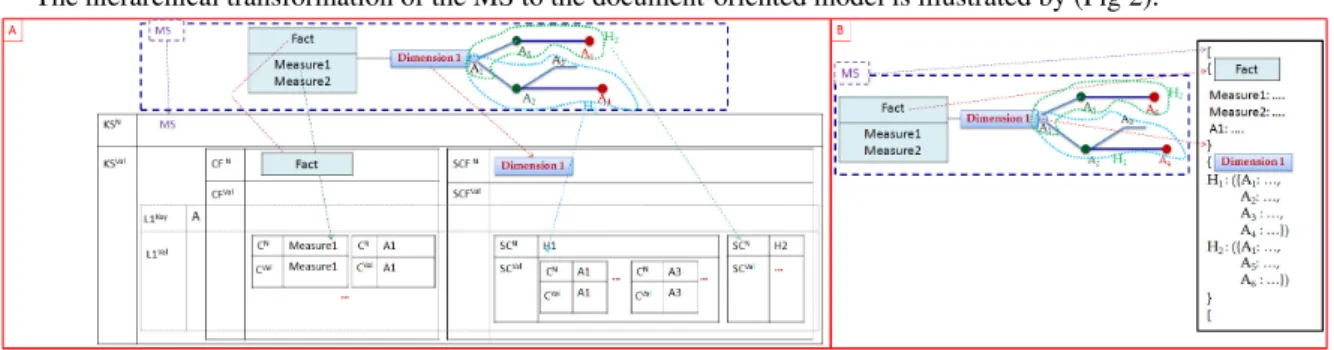
The hierarchical transformation of the multidimensional schema to the column-oriented model is illustrated by (Fig 2.A).
Rule 4: Hierarchical Transformation to Document-oriented model (HT-D).Each multidimensional schema MS (MSN,MSFact,MSDim,Func) is transformed to a documents collectionDCC(DCCN,DCCVal) where:
• The name of the collection is the name of the MS/DCCN←MSN;
• Each factF∈MSFactis transformed to a document DC (DCN,DCAtt) where :
– The name of the document is the name of the fact/DCN←FN;
– Each measureM∈Fis transformed to a simple attributeS A∈DCatt/S AN←M;
– Each identifier of a related dimensions is transformed to a simple attributeS A∈DCatt/S AN←Did; • Each dimensionD(DN,DAtt,DHier)/D∈MSDimis transformed to a documentDC(DCN,DCAtt) where:
– The name of dimension D is equivalent to the name of the document/DCN←DN;
– Each hierarchy H(HN,HP,PFAtt) is transformed to a composed attributeCA∈DCattwhere : ∗ The name of the composed attribute is the hierarchy name/CAN←HN
∗ The values of composed attributes are the simple attributes that represent the weak and the strong attributes.
The hierarchical transformation of the MS to the document-oriented model is illustrated by (Fig 2).
Fig. 2. HT examples.
These proposed transformation rules allow transforming a multidimensional model of a DW to two NoSQL models: column-oriented and document-oriented. Using these rules, we can implement and analyze several decision systems. We begin by validating these transformations by the implementation of the decision systems concerning the simple
and hierarchical transformations under Cassandra and MongoDB systems. We then compare their performance on loading and query phases using the decision benchmark TPC-DS.
6. EXPERIMENTS
Extensive experiments were conducted to validate our proposals including the implementation of the transforma-tion rules to map multidimensional model to NoSQL column-oriented and document-oriented ones.
6.1. NoSQL DW Implementation Environment
For implementing the column-oriented DW, our choice is oriented towards Cassandra. Like any other NoSQL database, Cassandra can quickly handle large volumes of data and offers the ability to create flexible schema. Our choice is justified by the fact that Cassandra is the only NoSQL database which includes the concepts of super-column and super-column-family. Otherwise, we used MongoDB to implement the document-oriented DW because it is the fastest-growing database. It provides a rich document oriented structure with dynamic queries. Also, MongoDB allows dividing data into collections.
In our context, we use TPC-DS benchmark to load the different NoSQL DWs. As TPC-DS is a logical model, we generated the conceptual schema, then we used our proposed rules to obtain the corresponding NoSQL models. An expert of the TCP-DS generated MS is depicted by Fig 3.
Fig. 3. Excerpt of the TPC-DS multidimensional schema.
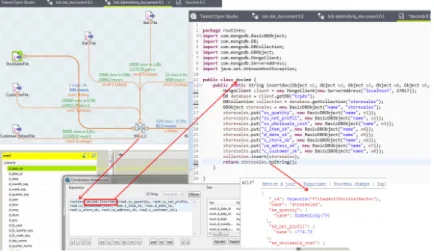
To load data in the NoSQL DWs, we chose to use the data integration tool ”Talend for Big Data”. This tool allows extracting data from large and heterogeneous data sources and integrates them into NoSQL database. In the context of our work, data integration is done according to our transformation rules. These rules are implemented using ETL routines in the same tool (Fig 4).
6.2. Discussion
In order to evaluate the implemented NoSQL DWs, we chose to use two metrics: ”Write Request Latency” and ”Read request Latency”. The first metric has the purpose to test the speed of the system during the data loading stage. As for the second metric, it evaluates the system’s ability to respond quickly to user requests. Regarding requests, we chose to use a set of six queries that we classified into two categories. The first category is simple and consists on increasing the number of dimensions and attributes to test the performance of the decision system with the presence of joins in the user’s queries. As for the second category, it is more complex (integrated with TPC-DS benchmark) and consists on using some operators. Table 2 describe the used queries.
Table 2. Requests description. Request R.
Cate-gory
Dimension(s) Attribute(s) Condition(s) Group by Order by
Q1 Simple Date d year d year=”1990” - -Q2 Simple Date, Item d year, i category d year=”2001” - -Q3 Simple Date, Item,
Cus-tomer Address
d year, i category, ca state d year=”1999” - -Q4 Simple Item i ctegory i ctegory=”Children” - -Q5 Simple Item i category, i class i category=”Men”,
i class=”pants”
-
-Q6 Simple Item i catgory, i class, i brand i catgory=”Women”, i class=”fragrances”, i brand=”exportiimporto”
-
-Q7 Complex Date, Store Sales, Item
d year, i brand, sum(ss quantity)
d moy=”12” d year, i brand d year Q8 Complex Date, Store Sales,
Item
i brand, sum(ss quantity) d moy=”11”, d year=”1999”
i brand i brand Q9 Complex Date, Store Sales,
Item
d year, i category, sum(ss quantity)
d=”12”, d year=”1998” d year, i category i category Q10 Complex Item, Store Sales,
Store
s store sk, s country d year=”1998” s store sk s state Q11 Complex Date, Store Sales,
Item
d year, i brand, sum(ss quantity)
d=”12”, d year=”2000” d year, i brand d year Q12 Complex Date, Store Sales,
Item
i brand, sum(ss quantity) d=”12”, d year=”2001” i brand i brand
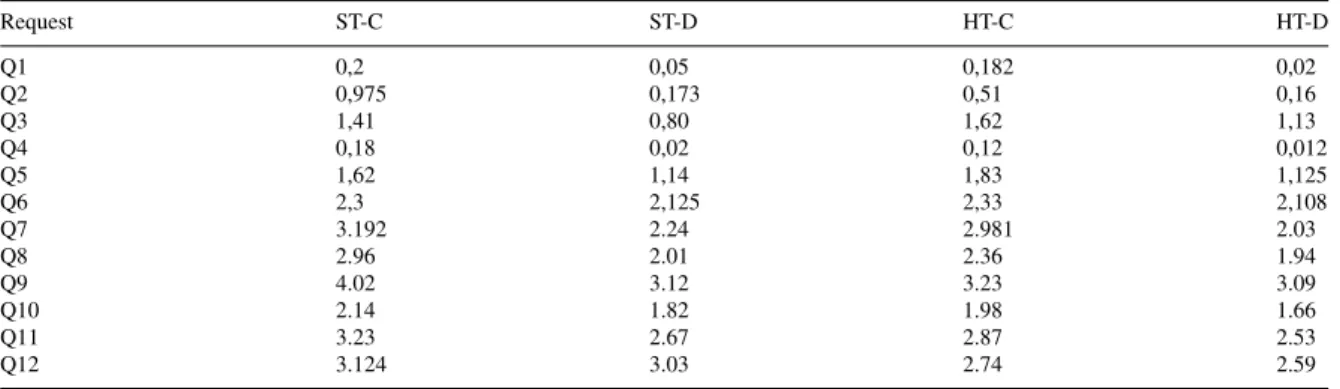
We started the evaluation of the DWs by comparing their data loading times Write Request Latency. We noted that the DW built under Cassandra is faster than the DW built under MongoDB (1000000 rows in 203.23s for Cassandra while 1000000 rows in 437.36s for MongoDB). Thereafter we tested the behavior of the systems(ST-C, ST-D, HT-C and HT-D) against the queries sets (Read Request Latency)(Table 3).
Table 3. Read Request Latency (ms).
Request ST-C ST-D HT-C HT-D Q1 0,2 0,05 0,182 0,02 Q2 0,975 0,173 0,51 0,16 Q3 1,41 0,80 1,62 1,13 Q4 0,18 0,02 0,12 0,012 Q5 1,62 1,14 1,83 1,125 Q6 2,3 2,125 2,33 2,108 Q7 3.192 2.24 2.981 2.03 Q8 2.96 2.01 2.36 1.94 Q9 4.02 3.12 3.23 3.09 Q10 2.14 1.82 1.98 1.66 Q11 3.23 2.67 2.87 2.53 Q12 3.124 3.03 2.74 2.59
Initial results show that the document-oriented NoSQL data warehouse is more efficient in terms of interrogation when dealing with two categories of queries. The best transformation is the hierarchical one. We observed also that the loading times is different for each system and gives advantage to column-oriented one. This is argued by the fact that Cassandra uses less memory space and it is known for effective data compression (due to column redundancy).a A major difference between the different NoSQL systems concerns interrogation. For queries that demand multiple attributes , the column-oriented approaches might take longer because data will not be available in one place. This remains an advantage to MongoDB compared to Cassandra. Studying differences with respect to interrogation using complex queries (drill-down, roll-up, etc.) is listed for future work.
7. Conclusion and future works
In this paper, we have proposed transformation rules that ensure the successful translation from conceptual DW schema to two logical NoSQL models (column-oriented and document-oriented). We proposed two possible trans-formations namely: simple and hierarchical transtrans-formations. The first one stores the fact and dimensions into one column-family/collection. The second transformation uses different column-families/collections for storing fact and dimensions while explaining hierarchies. Experiments are carried out using the benchmark TPC-DS. Preliminary results show that MongoDB with hierarchical transformation is more suitable when dealing with OLAP queries. The used queries are qualified as simple, so in terms of perspectives we want to study the NoSQL systems with respect to more complex querying (roll-up, drill-down). We need to study different types of queries and identifying queries that benefit mostly from NoSQL models. We can also consider other NoSQL models (graph-oriented NoSQL model). References
1. K.R. Krish, A. Khasymski, A.R. Butt, S. Tiwari, M. Bhandarkar, AptStore. Dynamic Storage Management for Hadoop, CloudCom (2013), p33. 2. M. Chevalier, M. El Malki, A. Kopliku, O.Teste, T. Tournier. Implementing Multidimensional Data Warehouses into NoSQL, International
Conference on Enterprise Information Systems, (2015), p172-183.
3. M. Chevalier, M. El Malki, A. Kopliku, O. Teste, R. Tournier. Implementation of Multidimensional Databases in Column-Oriented NoSQL Systems. ADBIS, (2015), p79-91.
4. M. Chevalier, M. El Malki, A., O. Teste, R. Tournier. Implementation of Multidimensional Databases with Document-Oriented NoSQL, DaWaK, (2015), p379-390.
5. R. Hecht, S. Jablonski. NoSQL Evaluation A Use Case Oriented Survey, International Conference on Cloud and Service Computing, (2011), p336.
6. P. Russom. Evolving Data Warehouse Architectures In the Age of Big Data, TDWI Research BEST PRACTICES REPORT, (2014). 7. B. Evelson. Its the dawning of the age Of BI DBMS, Technical report, (2011).
8. A. Cuzzocrea, I.Y. Song, K.C. Davis. Analytics over large-scale multidimensional data: the big data revolution, International workshop on data warehousing and OLAP, (2011), p101.
9. S. Chaudhuri, U. Dayal, V. Ganti. Database technology for decision support systems, IEEE Computer Society, (2002), p48-55. 10. A. Nabli, J. Feki, F. Gargouri. Automatic construction of multidimensional schema from OLAP requirements, AICCSA, (2005), p28. 11. S. Chaudhuri, U. Dayal. An overview of data warehousing and OLAP technology, ACM Sigmod record, (1997), p65-74.
12. G. Colliat. OLAP, relational, and multidimensional database systems.ACM Sigmod Record, (1996), p64-69.
13. D. Han, E. Stroulia. A three-dimensional data model in hbase for large time-series dataset analysis. In IEEE International Conference on Maintenance and Evolution of Service-Oriented and Cloud-Based Systems (MESOCA), (2012), p47-56.
14. C. Li. Transforming relational database into HBase: A case study. In IEEE International Conference on Software Engineering and Service Sciences (ICSESS), (2010), p.683-687.
15. E. Dede, M. Govindaraju, D. Gunter, R. Canon, L. Ramakrishnan. Performance evaluation of a mongodb and hadoop platform for scientific data analysis. In Proceedings of the 4th ACM workshop on Scientific cloud computing, (2013), p13-20.
16. K. Dehdouh, O. Boussaid, F. Bentayeb. Columnar NoSQL Star Schema Benchmark, Model and Data Engineering MEDI, (2014), p281-288. 17. K. Dehdouh, O. Boussaid, F. Bentayeb. Using the column oriented NoSQL model for implementing big data warehouses. In: the 21st