Learning Probabilistic Relational Dynamics for
Multiple Tasks
by
Ashwin Deshpande
Submitted to the Department of Electrical Engineering and Computer
Science
in partial fulfillment of the requirements for the degree of
Masters of Engineering in Computer Science and Engineering
at the
MASSACHUSETTS INSTITUTE OF TECHNOLOGY
@ Massachusetts
May 2007
Institute of Technology
.rA "
2007. All rights reserved.
,\ A
Author
...
Department of Electrical Engineering and Computer Science
May 25, 2007
Certified by.
. --
r
...
Leslie Pack Kaelbling
Professor of Computer Science
Thesis Supervisor
AAccepted by
MASSACHUSETTS INSTITUrT OF TECHNOLOGYOCT
03 2007
LIBRARIES
S... . :. .- ... ..- .... ...Arthur C. Smith
Chairman, Department Committee on Graduate Students
*·- *-
Learning Probabilistic Relational Dynamics for Multiple
Tasks
by
Ashwin Deshpande
Submitted to the Department of Electrical Engineering and Computer Science on June 2, 2007, in partial fulfillment of the
requirements for the degree of
Masters of Engineering in Computer Science and Engineering
Abstract
While large data sets have enabled machine learning algorithms to act intelligently in complex domains, standard machine learning algorithms perform poorly in situations in which little data exists for the desired target task. Transfer learning attempts to extract trends from the data of similar source tasks to enhance learning in the target task. We apply transfer learning to probabilistic rule learning to learn the dynamics of a target world. We utilize a hierarchical Bayesian framework and specify a generative model which dictates the probabilities of task data, task rulesets and a common global ruleset. Through a greedy coordinated-ascent algorithm, the source tasks contribute towards building the global ruleset which can then be used as a prior to supplement the data from the target ruleset. Simulated experimental results in a variety of blocks-world domains suggest that employing transfer learning can provide significant accuracy gains over traditional single task rule learning algorithms. Thesis Supervisor: Leslie Pack Kaelbling
Acknowledgments
I would like to thank my advisor Leslie Kaelbling and my collaborators Brian Milch and Luke Zettlemoyer for guiding me through the research process.
Bibliographic Notes
The bulk of this thesis is based on the following paper:
"Learning Probabilistic Relational Dynamics for Multiple Tasks" by Ashwin Desh-pande, Brian Milch, Luke Zettlemoyer, and Leslie Kaelbling. The paper will appear in the Proceedings of the 23rd Conference on Uncertainty in Artificial Intelligence
Contents
1 Introduction 2 Related Work
3 Representation and Generative Model 3.1 Representation ...
3.2 Generative Model ...
3.2.1 Generating Data Sets from Local Rulesets . . . . 3.2.2 Generating Local Rulesets from Global Rulesets . 3.2.3 Generating Global Rulesets . . . . 4 Optimization Strategy
4.1 Overview . . . . 4.2 Learning a Local Ruleset given a Global Ruleset . . . . .
4.2.1 Ruleset Modification ...
4.2.2 Outcome Set Modification . . . . 4.2.3 Learning the Outcome Distribution . . . . 4.3 Learning a Global Ruleset given a Set of Local Rulesets . 4.3.1 Global Ruleset Modification . . . . 4.3.2 Global Rule Outcome Set Modification . . . . 4.3.3 Learning the Global Rule Outcome Distribution . 5 Results
5.1 Gripper Size Domain ...
15 . . .. . . 15 . . . . 17 . . . . . . 19 . . . . . . 20 . . . . . . 24 27 . . . . 27 . . . . . . 29 . . . . 29 . . . . . . 31 . . . . . . 32 . . . . . . 34 . . . . . . 34 . . . . . . 36 . . . . . . 37
5.2 Slippery Gripper Domain ... 47 5.3 Slippery Gripper with Size Domain . ... . . . 49 5.4 Random Domain ... 51
6 Future Work and Conclusions 55
6.1 Direct Optimization Strategy ... 55 6.2 Conclusion ... . . ... . 56
List of Figures
3-1 A hierarchical Bayesian model with n source tasks and 1 target task. 18 3-2 This figure describes how a local ruleset can be applied to a world state
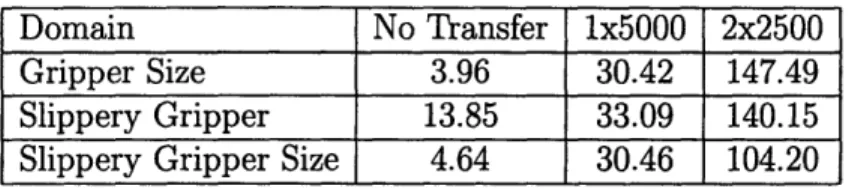
and action to produce the subsequent world state. . ... . . 20 5-1 Computation time(seconds) per search iteration with 2000 target task
examples . ... ... 45 5-2 Domain generator for the gripper size domain . ... 46 5-3 Sample learned global rule for the gripper size domain ... 46 5-4 Accuracy results for the gripper size domain comparing transfer
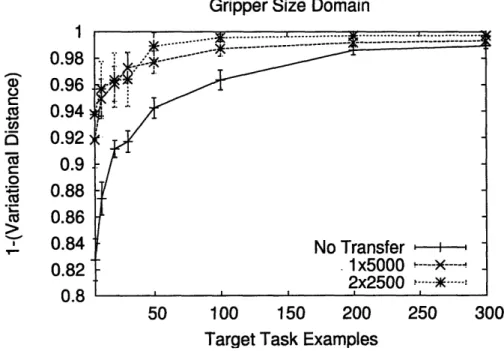
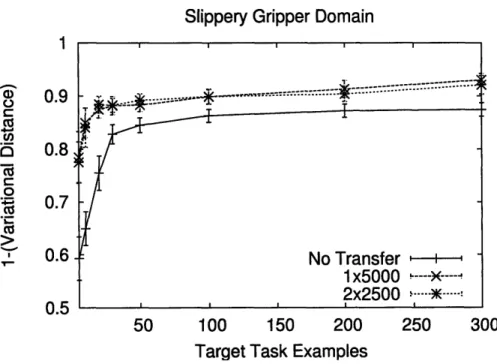
learn-ers vs a non-transfer learner ... 46 5-5 Domain generator for the slippery gripper domain . ... 47 5-6 Sample learned global rules for the slippery gripper domain ... 48 5-7 Accuracy results for the slippery gripper domain comparing transfer
learners vs a non-transfer learner. . ... . 48 5-8 Domain generator for the slippery gripper with size domain ... 50 5-9 Sample learned global rules for the slippery gripper with size domain 50 5-10 Accuracy results for the slippery gripper with size domain comparing
transfer learners vs a non-transfer learner. . ... 51 5-11 Sample learned global rule for the random domain. . ... 52 5-12 Accuracy results for the random domain comparing transfer learners
Chapter 1
Introduction
In the past twenty years, a trend towards accumulating large amounts of information has pushed artificial intelligence to rely more and more on data driven techniques. Standard machine-learning techniques using large data sets have proved very success-ful in a variety of domains from natural language processing to planning.
However, traditional machine learning techniques adapt poorly to new distorted tasks even if the model of the original tasks are well known. Transfer learning attempts to boost performance in new target tasks with little task-specific data by incorporating knowledge gained from similar source tasks.
This thesis describes the methods of applying transfer learning to probabilistic rule learning. Probabilistic rule learning is the process of learning a ruleset that describes the probabilistic effects of performing actions in a world. For example, consider a robot trying to learn the dynamics in the domain of driving a car. For a particular task, for example, a particular car, the robotic can learn that if the accelerator is pushed, the car will go faster; if the brake is pushed, the car will most likely decelerate, but due to the possibility of unforeseen circumstances like ice, with some probability, braking may not affect the speed of the car. Under single-task probabilistic rule learning, each of these actions, accelerating and braking, requires a large body of examples to learn the structure and parameters of the associated ruleset from scratch. If the task is changed, for example, a new car is introduced, the dynamics must be completely relearned.
Transfer learning reduces the need for a large training set in the target task by using structural and parametric data gathered in related source tasks as a prior for the target task's ruleset. Going back to the driving example, if the robot has previ-ously seen how several models of cars operate, if a new car with a different weight is introduced, the robot can transfer knowledge about the structure and parameters of its driving model from the previous cars to the model of the new car to quickly approximate its behavior. Similarly, even if the dynamics of the new car are struc-turally different than previously seen examples, for example, the robot is presented with a manual transmission car when it has only been previously exposed to au-tomatic transmission cars, the robot can adapt common notions of car dynamics, whether manual or automatic, to learning the dynamics of the new car with less data than it would require to learn the dynamics from scratch. Overall, transfer learning can greatly reduce the need for target specific data when general domain specific data will suffice to fill in the information gaps.
Our model uses a hierarchical Bayesian structure to transfer knowledge from the source tasks to the target task. All data is assumed to have been created from a local ruleset which in turn is created from a common global ruleset via a specified generative model. Using this framework, the data in the source tasks can help build a model of the associated local rulesets and ultimately a common global ruleset. The global ruleset is then used as a prior on the target task and combined with support from examples in the target task to create the target task ruleset.
Section 2 describes some related work in both hierarchical Bayesian models and probabilistic rule learning. Next, section 3 states the world representation and the generative model which ties together the global ruleset, local rulesets, and examples. Section 4 describes the optimization strategy used to approximate the global ruleset and local rulesets. Section 5 displays the results of the hierarchical rule learning algorithm. Finally, section 6 describes possible future work in extending the algorithm and concludes the thesis.
Chapter 2
Related Work
Transferring knowledge between different tasks has been addressed in the past by hierarchial Bayesian models [5]. In these methods, local models, describing task-specific examples, are assumed to be sampled from a global model. By learning both the local and global models simultaneously, one can boost commonalities among the local models and increase the overall accuracy of local models with little data. This approach has been successfully used in a variety of statistical domains[l, 3, 6, 9, 11]. However, there is no previous work which uses a hierarchical Bayesian model to the structure of relational rules between tasks.
The notion of probabilistic planning rules was introduced by Kushmerick[4] and successfully used in probabilistic planning using STRIPS rules by Blum and Langford[2]. Zettlemoyer et. al developed an algorithm to learn the probabilistic planning rules for a single task[8, 10]. In that framework, a heuristic function, rather than a gen-erative model, is used to score the complexity of a ruleset. Incremental changes to the ruleset are proposed and chosen if the combined complexity and error is lowered. This method was shown to be successful on a variety of both hand-crafted and simu-lated domains. This thesis borrows many concepts from these works and extends the framework of the learning algorithms to allow for knowledge transfer between tasks.
Chapter 3
Representation and Generative
Model
3.1
Representation
This section describes the representation of states, actions, and rules in the world. Many of the concepts defined below are borrowed from Pasula et. al[8].
An example in a particular task is a triplet (St+l, At, St) where S describes a world state consisting of a number of objects and their properties and A describes an action. Thus, an example shows the effects of performing action At in the world described by St and the resulting state St+,. The ultimate goal of the problem is to learn a ruleset that effectively describes the probabilistic effects of A in a given task.
We start by defining a language F of a set of functions. Each function f maps an
ordered list of fagg arguments to a discrete value in the finite set fv,,ues. We define a
literal 1 to be a triplet (f, [args], value) where f is a function, [args] is an ordered list
of objects, variables, and constants, and value is a element from f•aiue,. In addition,
we define a formula to be a set of non-duplicate and non-contradictory literals. We assume that the world is completely observable and all observations can be trusted. Given these assumptions, we define a world state S to be a complete formula that describes the world. Thus, for every function f E F and every set of objects [objs] of size farg,, there exists a single literal of the form (f, [objs], value) where
value E fvalues. In effect, the difference between any two world states is always in the
values of functions rather than in the structure of the literals themselves.
An action A effects a change in the world and thus has the potential to change the values of literals within the world state S. The action itself contains an ordered list of arguments which is filled with different objects from the world'. In the case of multiple actions, each action is learned independently of all other actions. Thus, for the scope of this thesis, we examine only one action per domain.
A local rule is defined as a triplet (A, C, O) where A is an action, C describes the context, or precondition, of the rule and 0 describes the various outcomes associated
with the rule. C is defined by a formula. 0 is a set of outcomes [ol, ...,ok] each
represented by a formula representing possible changes in the world and a parameter oi,,b which describes the probability of outcome oi being chosen. In our model, we require that no two outcomes in 0 overlap, that is, for any world state St, the resulting world states St+,,, and St+1,2 created by applying two local outcomes oi, oj E 0 must differ.2 0 also contains a special outcome onoise which indicates the probability that the resulting world state is unpredictable or too complicated for the rule to learn specific outcomes.
A ruleset consists of a set of non-overlapping local rules.3 Thus, in this model, for any world state S and action A, at most one rule from the local ruleset can apply. In addition, every ruleset contains a special rule called the default rule which applies when no other local rules apply. The default rule contains only two outcomes: the noise outcome and a no change outcome. The inclusion of the default rule greatly simplifies the complexity of rulesets which describe tasks in which actions frequently
IThe requirement for non-repeating objects in the action arguments is not strictly necessary.
However, in order to transfer knowledge between rules in various domains, maintaining a one-to-one mapping of world objects to variables allows rules to be directly compared. If one-to-one-to-one-to-one mapping was not required, then comparing two rules would an exponential time to search over all semantically equivalent variations of each literal. For example, if argl and arg2 refer to the same object, then a literal (f, [argl, arg2], val) will also need to be represented as (f, [argl, argl], val), (f, [arg2, arg2j, val), and (f, [arg2, argl], val) for comparison.
2This is a requirement of the optimization strategy used rather than of the model. This
require-ment can be removed by introducing variational inference techniques into the optimization strategy.
3This requirement, like that of non-overlapping outcomes, is a requirement of our optimization
strategy rather than the framework itself. However, due to computational requirements, we enforced a strict non-overlapping policy for local rulesets.
do not change the world state.
Finally, the last items to be described are global rules and the global ruleset. The global ruleset and global rules serve as priors for the various local rulesets and local rules. The global model concepts are very similar to those of local rules and local rulesets, but with a few important differences explained below.
Global rulesets do not require non-overlapping rules. As global rules serve as the prior for local rules, by our generative model, syntactically similar local and global rules are more likely to correspond and ultimately transfer information. While this choice led to greater optimization requirements, in the end, we felt the extra transfer gained by allowing overlapping global rules was more important. Note that identical global rules are still not permitted.
In addition, global rules do not require non-overlapping outcomes. We made the choice to allow outcomes to overlap in global rules as the global rule serves as a prior for local rules. Thus, constraining the global rule's outcomes to not overlap may produce a new global rule that is semantically equal but transfers knowledge poorly to local rules. As before, identical global outcomes are not permitted.
Global rules also have one additional outcome over local rules: the new outcome. The new outcome allows local rules to create new outcomes completely different than anything existing in the global rule. The generative model section will describe the use of the new outcome.
Finally, global outcomes do not have outcome probabilities like local outcomes.
Instead, a global outcome oi has an associated Polya hyperparameter oi,,pram. The
next sections will describe how this hyperparameter is used in the generative model.
3.2
Generative Model
This section describes the hierarchical model used to transfer information between tasks.
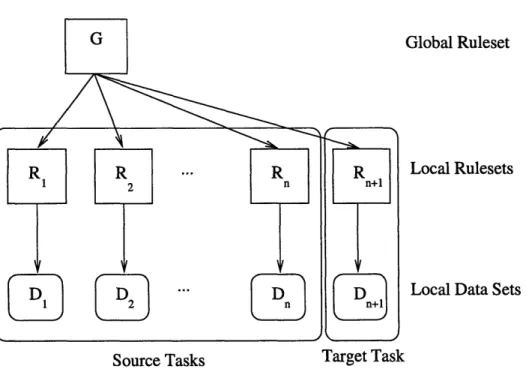
The rule learning framework is set up as a three-tier hierarchy as shown in Fig.
Global Ruleset
Local Rulesets
Local Data Sets
Source Tasks Target Task
Figure 3-1: A hierarchical Bayesian model with n source tasks and 1 target task.
Each task t% has its own data set Di. Each task data set Di is derived from a local
ruleset Ri. Finally, all local rulesets R1, ..., R,+, are derived from a global ruleset G.
We describe a generative model that can give the probability of deriving a local ruleset R, from the global ruleset G and the probability of deriving a data set Di from a local ruleset G. Although we never actually use the generative model to generate local rulesets and data sets, we use the probabilities derived from the model to shape the local and global rulesets.
In the generative model, it is assumed that all examples derived from a local ruleset are independent of all other examples given the local ruleset. Furthermore, we assume that all local rulesets are independent of each other given the global ruleset. Thus, for clarity, we only describe how a particular data set D is derived from a local ruleset R, and how R is derived from the global ruleset G. Finally, we end the section by describing the generative model for the global ruleset G.
3.2.1
Generating Data Sets from Local Rulesets
In this section, we describe how a data set D is generated from a local ruleset R. Each example E in D is generated independently given R. Thus, the probability of creating an data set D from a local ruleset R is p(D) = IEED p(EIR). Therefore, in essence, this section will describe how E is generated from R and how to compute
p(EIR).
The first step involves creating an initial world state St and an action At. Each initial world state is created independently of all other world states; therefore, the initial world states do not follow a trajectory. St is generated by populating a world with various objects. The world state is then specified as a complete formula as described previously. As the ruleset R defines a conditional probability distribution, the initial state of the world is not of critical importance. However, in order to sample over the example space thoroughly, a roughly uniform distribution on initial world states is preferred. Following the creation of St the action At is specified by picking various world objects to satisfy the action arguments. Thus, the initial world state St and action At can be specified.
The next step involves applying the ruleset R to the initial world state St and action At to generate the resulting world state St+l. Rulesets are used to generate future world states as described below. Fig. 3-2 demonstrates the steps described below for a sample world and ruleset. For each rule U E R, the applicability of the rule must be assessed. If no standard rules apply, then the default rule applies. Assume that a particular rule U is tested for applicability. First, a one-to-one mapping £ of world objects and constants in S to action arguments in the context of U is calculated. If no such £ exists, i.e. no mapping of world objects to action arguments will satisfy all literals in the context of U, then the rule U cannot be used to predict the subsequent state. If a mapping does exist, then the outcomes of U describe the predicted future
world state. Each outcome oj is chosen with probability oj,,rob. Assume outcome
o* is ultimately chosen. The inverse map of 0 is calculated and applied to formula
St : On(BlockA, BlocksB) = true, Clear(BlockA) = true,
Clear(BlocksB) = false, Size(BlockA) = Size2, Size(BlockB) = Sizel
At : Pickup(BlockA, BlockB) U : Pickup(argl, arg2)
On(argl, rg2) = true .18 : Size(argl) = Sizel
82 : Size(argl) = Size2, On(argl, arg2) = false Q : BlockA -* argl, BlocksB -- arg2
o* : Size(argl) = Size2, On(argl, arg2) = false
Q-1 : argl --+ BlockA, arg2 -- BlockB
fchanges : Size(BlockA) = Size2, On(BlockA, Blocks) = false
St+1 : On(BlockA, BlocksB) = false, Clear(BlockA) = true,
Clear(Block,) = false, Size(BlockA) = Size2, Size(BlockB) = Sizel
Figure 3-2: This figure describes how a local ruleset can be applied to a world state and action to produce the subsequent world state.
state St+l is as a copy of St U fc*hange, in which all duplicate or contradictory literals are resolved in favor of f*hanges. The triplet (St, At, St+,) forms the final example.
To compute the p(EIR), or the probability of generating a example given the local ruleset, one need only retrace the generative process. As all steps of the generative model are deterministic until an outcome o* is chosen, the probability of an example utilizing utilizing outcome o* is simply oprob*
3.2.2
Generating Local Rulesets from Global Rulesets
In this section, we describe how a local ruleset R is generated from a global ruleset G.
The first step in creating a local ruleset is to choose the number of rules to use. As the default rules are always present in both the local and global ruleset, we do not count their presence in the number of rules in a ruleset. Let mR be the size of the
local ruleset and mG be the size of the global ruleset. We bias the local ruleset to have a similar number of rules as the global ruleset. Therefore, we define p(mRImG) to be
large when mR is close to mG and small when the number of rules differs radically. To achieve a smooth distribution, we use the following probability function:
(mm) Geom[a](mR - mc) if mR > mG (3.1) ) (1 - a)Binom[mG, 3](mR) otherwise
With this distribution, if mR > mc, we use a geometric distribution parameterized by a constant a. Thus, the probability mass of p(mR > me) = a. The remaining probability mass, 1 - a, is assigned if mR 5 mG. This distribution is a binomial distribution parameterized by a different constant 0. For any 0 < a,
f
< 1, this distribution provides a bias for local rulesets to have a similar number of rules as the global ruleset.Once the number of rules is chosen, each local rule is created almost independently. The only constraint between the rules is that the final local ruleset must not have overlapping rules. This constraint is enforced by discarding any created ruleset with overlapping rules. Although this strategy places a bias towards creating local rules with complex contexts (as rules with long contexts are less likely to overlap), it does provide a near uniform bias. Finally, as the rules in the ruleset can be permuted in any order and still yield the same overall ruleset, a factor of mR! is added. Thus, letting p(UilG) be the probability of creating rule i, the final probability for generating a ruleset of size mR is:
MR
p(RIG) =
mR! *p(mRlmc) *
p(Ui
G)
(3.2)
i=l
It is helpful to now discuss how a formula is created given a formula in global ruleset as a prior, as this process is used in the creation of both the context and outcomes of a local rule. Let the formula of the local rule be fL and the formula of the global rule be fG. Creating fL requires two phases. In the first phase, all literals
from fG are copied into fL. For each literal in fL, with some probability arem~,, that literal is removed from fL. Let memove be the size of fL after this phase. The second
phase involves adding literals to fL. First, the number of literals to add mnew is chosen from a geometric distribution parameterized by a constant aadd. Given, mnew, each literal is chosen independently. For each literal 1,ne to be added, a function is uniformly chosen from the language F. Let the number of arguments accepted by 1 be larg. Next, each argument is randomly chosen without repeats from the set of action arguments and constants Targ. If the created formula contains any repeated or contradictory functions, it is resampled. While in theory, we must integrate over the possibility of removing and readding a particular literal, as this probability is negligible, we only observe the probability of the most likely generation pathway from fG to fL. This yields the overall probability of creating fL from fc as:
p(fLIfG) = Binom[mG, aremove] (mremove)* Geom[mnew, Ceadd] * mnew! *
I
larg 1 lElnew(3.3) We will now describe how a local rule U is derived from the global ruleset G. This process requires four steps: first, a corresponding global rule must be chosen; then, the local rule context must be determined; next, the local outcomes are chosen; finally, the local outcome distribution is fixed.
The first step of creating U is to choose a corresponding global rule E from G. With a constant probability qnw no existing global rule is chosen, and the global new rule set to be the parent. With the remaining probability mass, 1- qnew, a E is chosen uniformly from all rules in G. Note that the global default rule is never allowed to be the corresponding rule for any local rule except the local default rule. Once the corresponding rule is chosen, the context for U can be easily created by the formula modification procedure given above.
The next step is to choose outcomes for U. This procedure is very similar to choosing local rules given the global ruleset. First, the number of outcomes mot is chosen from a probability distribution specified in equation 3.1. Each outcome oi is mapped to a corresponding global outcome yi from E. With some constant probability q,,new, a local outcome is mapped to the global new outcome. Otherwise,
the remaining probability mass is equally distributed among the global outcomes. As before, only the local noise outcome maps to the global noise outcome. Once the outcome correspondences have been determined, the local outcomes are generated by perturbing the global outcome by the formula modification procedure. All local outcomes mapping to the global new outcome are created from an empty global formula using the same method. Thus, the overall probability of the outcomes 0 given E is:
p(OjE) = mont! *
J
p(yjiE)p(oJl y) (3.4)oiEO
The last step is to choose the outcome distribution for the local outcomes 0 given the global outcome distribution. This involves sampling from a Dirichlet distribution to determine the probability of each local outcome. However, the hyperparame-ters specified in the global outcome distribution may be unsuitable to sample from, as many local outcomes might correspond to a single global outcome and no local outcomes might correspond to some global outcomes. Thus, another set of pseudo-hyperparameters must be created with a pseudo-hyperparameter for each local out-come. Let W be the original set of global outcome hyperparameters and a be the new set of pseudo-hyperparameters.
The first case to consider is if no local outcome maps to a particular global outcome i. In this case, we define the generative model to not include the hyperparameter for i, effectively shrinking down the dimensionality of the problem. Note that the value of the removed hyperparameter is inconsequential as it is no longer a part of the probability distribution.
The second, and more interesting, case to consider is when one or more local
outcomes ol,..., o, map to a single global outcome with hyperparameter Wj. We made the decision to set the sum of the expected probabilities of o, ... , oa to the same
expected probability of a single hypothetical outcome o*.4 The expected probability
4
We also entertained the possibility of letting each outcome in ol, ..., oa receive the full prior support of Wj. However, this would imply that other outcomes would effectively lose support from their global hyperparameter priors. We decided to use our current method as it provides more probability transitions when splitting across functions (mapping multiple local outcomes to a single
for o* when all outcome probabilities are sampled from the Dirichlet distribution is: __Wi
E[o*] = 'Wi (3.5)
EwMEW Wi
Thus, to set the expected probability of each outcome ol,..., o, to be 1/a of the quantity specified above requires that:
Voi E {of, ..., oa}, a, = W a (3.6)
Once all the local hyperparameters are chosen, the local outcome probabilities are sampled from a Dirichlet with hyperparameter vector a. Let B be the vector of sampled local probabilities. Then, the probability of creating an local outcome distribution is simply:
p(BIW)
=
Dir[a](B)
(3.7)
Here Dir[a](b) is simply the probability of generating B from the Dirichlet hyper-parameters a. Note that the process of generating a from W is deterministic, and thus has probability 1.
By following the steps listed above, a local ruleset can be derived from a global ruleset. While no local rulesets are ever created using the generative model, the op-timization strategy does use the generative model's ability to provide the probability of creating a local ruleset from a global ruleset.
3.2.3
Generating Global Rulesets
The last section of the generative model is the generative model to create a global ruleset G. As the complexity of each local ruleset generated by G is most completely determined by the complexity of G, the generative model for G serves to bias the entire hierarchical model away from complexity and over-fitting.
The generative model for creating a global ruleset G is very similar to that of
creating a local ruleset. First, the number of rules mru,,, is chosen from a
geomet-ric distribution with parameter ag,ruZe. Given mrules, each rule U is independently
created. If two rules have exactly the same context, then the ruleset is resampled. Overlapping rules are permitted. Thus, the probability for creating a global ruleset G is:
p(G) = mrules! * p(U) (3.8)
UEG
To select a context for a sample global rule U, three steps are required: first the context of the rule is determined, then the outcomes are determined, and last the outcome distribution is picked.
The generative process is far simpler for creating a global rule than a local rule as the corresponding rule prior is assumed to be empty. For each rule U, the context Ucontext uses the formula modification procedure starting with an empty formula. Next, the number of outcomes mot8 is sampled using equation 3.1 using 0 outcomes as the prior. Each outcome oi in the global outcome set O is created from scratch using the formula modification procedure. If two outcomes are exactly the same, the the rule must be resampled (overlapping outcomes are permitted in global outcome sets). In our current generative model, we do not have any prior on outcome hyperparameters. Thus, the outcome hyperparameters are chosen as positive real numbers. Overall, the probability of creating a rule U is:
p(U) = p(Ucontext nil) mo,! *
[
p(o lnil) (3.9)oiEO
By using the methods above, one can find the probability of an entire hierarchial model given the global ruleset, local rulesets, and data sets. The following section will describe the optimization strategy used to maximize the overall probability of the entire model.
Chapter 4
Optimization Strategy
4.1
Overview
This section describes how the hierarchical framework and generative model are used as a basis to create local rulesets for the various local tasks and a global ruleset which ties them all together.
By the problem formulation, the input to the algorithm is a set of examples from both the sources tasks and the target task. Let tasks tl...N represent the sources tasks and task tN+1 represent the target task. Let Di represent the data from the ith task. The quantity of interest is the probability of the target data DN+I given the source data D1...N. However, by the generative model, the probability of a set of data Di can be calculated given a local ruleset RP, and the probability of a local ruleset R, can be calculated given the global ruleset G. Furthermore, by the generative model, all data sets are independent given their corresponding local rulesets, and all local rulesets are independent given the global ruleset. Thus, working in log space:
N+1
logp(DN+jljD...N) c] logp(G) + logp(DijRJi)1ogp(RjG) (4.1) GRI'"..N+ i=1
Since a single target ruleset is the output of the optimization, the most proba-ble local ruleset RN+I can be selected from the above equation leading to the new
optimization equation:
N+1
RN+1 = arg max
I
logp(G) + E logp(Di~j ) + logp(RiIG) (4.2)RN+I JG,R1...N N=1
However, the above optimization quantity is extremely complex as each local ruleset R1 to RN and the global ruleset G consist of multiple rules, each with a context, outcomes, and an outcome distribution. A great deal of this complexity can be removed if the integration over all local rulesets and global rulesets is replaced with choosing the most likely estimate of each ruleset leading to the new optimization quantity:
N+1
RN+1 = arg max max logp(G) + logp(DiIRi) + logp(RljG) (4.3)
RN+1 G,R1...N
i=1
However, this quantity is still too complex to optimize directly. To approximately optimize this, we use a coordinated ascent algorithm. Using this method, the global ruleset is held constant while each local ruleset from source tasks is optimized. Thus, for a task i, the optimization using a constant global ruleset G is:
Ri = arg max logp(DilRi) + logp(RiIG) (4.4)
The second step of the coordinated ascent algorithm estimates the global ruleset. To do this, all local rulesets R1...N from source tasks are held constant. The ruleset from the target task is not used in the optimization of the global ruleset because, as specified by the problem formulation itself, the target task has little data and cannot
contribute much to the global ruleset. Thus, for constant local source rulesets RI:...N, the optimization for the global ruleset is:
N
G = arg maxlogp(G) + logp(RlIG) (4.5)
i=1
The global ruleset is calculated by alternately performing the first optimization over the local rulesets from source tasks and the second optimization over the global ruleset. When all rulesets stabilize, the first optimization is used one last time on the
target task to create the target task ruleset.
The global ruleset is initialized to be empty except for the default rule which is initialized with small Polya hyperparameters to allow local rulesets to easily create task specific rules. Each local ruleset is initialized to be empty of all rules except the default rule.
4.2
Learning a Local Ruleset given a Global
Rule-set
This section describes how a local ruleset is created from task data and a fixed global ruleset. At the highest level, a greedy search is run which suggests the addition, deletion, or modification of rules in the local ruleset. Given each potential suggestion, the optimal outcomes and outcome distribution is acquired through another greedy search process. High level ruleset changes are proposed and applied greedily until no further modifications to the ruleset lead to a higher ruleset probability.
4.2.1
Ruleset Modification
The highest-level greedy search in optimizing a local ruleset proposes the addition, deletion, and modification of rules in the local ruleset. In the case of additions or modifications to rules, only the rule(s) context needs to be specified as the outcomes and outcome distribution are determined by a secondary greedy search. There are five search operators which propose changes:
* Add Rule - This operator proposes that a new rule be added to the local ruleset. This rule context can be derived either by copying a rule context verbatim from the global ruleset or by extracting all functions from a local example which deal with an object that is modified through the rule's action. In order to maintain overlapping rules, all rules which do not have a contradictory function in the context are removed from the ruleset.
* Remove Rule - This operator simply removes a rule from the local ruleset. All local examples explained by the removed rule must then be explained by the default rule.
* Add Function - This operator adds a function to the context of an existing rule (provided the function is not already present in the context and no existing
function in the context contradicts the new function).
* Remove Function - This operator removes a function from the context of an existing rule. If the modified rule overlaps with any other rules in the ruleset, these rules are removed.
* Split Function -This operator breaks apart a single existing rule into multiple rules. Each new rule has the same context as the old rule with the addition of an additional function that has identical arguments across all new rules but differing values. Note that the set of new rules covers the same example space as the single existing rule.
In each case, if examples become explained or unexplained through the modifi-cation of the ruleset, the default rule must be updated. As the default rule does not learn new outcomes, it learns a new outcome distribution through parameter estimation which is described later.
With each search operator, the parent rule of each affected local rule must be recalculated through the generative model. As an approximation to allowing any local rule to be derived from any global rule, we define the parent rule of each local rule to be the global rule which has the most similar context according the to global rule. In addition to this parent rule, we also calculate the probability of the local rule being generated from scratch. In order to find the probability of the outcome set and outcome distribution of each local rule, a second greedy search is needed in order to create a set of outcomes.
4.2.2
Outcome Set Modification
When a rule enters the outcome set modification greedy search, it has a single out-come: the noise outcome. Thus, all examples which are described by the rule are considered noise, leading to a terrible rule score. Thus, the rule has a great incentive to learn new outcomes and reduce the dependence on the noise outcome.
As before, there are multiple search operators that are used when building an outcome set. In this search, a set of candidate outcomes are constructed before the greedy search is started. Candidate outcomes include all outcomes from the corresponding global rule and all outcomes which can explain a local example. The operators include:
* Remove Outcome -This operator removes a outcome from the outcome distri-bution. All local examples explained by the removed outcome are then delegated to the noise outcome.
* Add Function - This operator adds a function to an existing outcome (as before, no duplicate or contradictory outcomes are allowed).
* Merge Outcomes - This operator merges the context of an existing outcome and a candidate outcome by taking the union of their outcome changes and removing duplicate functions. This operator is only valid when the existing outcome and candidate outcome do not contradict one another.
* Split Function - This operator breaks apart a single outcome into multiple outcomes as in the ruleset "Split Function" operator. In addition to the con-text of the old outcome, each newly proposed outcome contains an additional common function with different values.
* Add Outcome* - This operator proposes that a new outcome be added to the outcome set. The proposed outcome is chosen from the candidate outcomes. * Remove Function* -This operator removes a function from an existing
As before, any new unexplained examples are delegated to the noise outcome. The starred operators above can potentially create overlapping outcomes. Thus, whenever either of those operators are proposed, a secondary greedy search is run to ensure that the outcomes remain non-overlapping.
In the secondary search, all overlapping outcomes are noted in a pairwise manner. Next, for each pair of outcomes, a set of functions which contradict one of the pair is proposed to be appended to the second of the pair, which results in the pair not overlapping. Finally, the function proposal which leads to the greatest number of non-overlapping outcomes is chosen. In certain cases, the secondary search modifies two outcomes to be identical. If such a deadlock is found, one of the offending outcomes is removed. The secondary search is repeated until all outcomes do not overlap.
After the search operators listed above are proposed, the probability of the entire rule and outcome set can be calculated by the generative model. The only missing probability is the probability of the outcome distribution given the global outcome distribution which is described next.
4.2.3
Learning the Outcome Distribution
After a set of local outcomes has been chosen, the corresponding global rule acts as a prior for the outcome distribution. The process of sampling from a rule probability distribution from the Dirichlet parameters of a global rule and sampling examples from the subsequent probability distribution specified in the generative model can be modeled by the Polya distribution[7].
This framework requires that each local outcome be mapped to the most likely global outcome as an approximation to calculating all pathways of deriving the local outcome set from the global outcome set. This mapping can be calculated by finding the closest global outcome to each local outcome specified by the generative ruleset. In some cases, the "new" outcome in the global ruleset may be closer to a local outcome than an existing global outcome. By using this method, many local outcomes may map to the same global outcome, and some global outcomes may not have any mappings.
Given a one-to-one mapping of local outcomes to global outcomes, the outcome probabilities can be calculated via the Polya distribution. Let bk be the probability of the kth local outcome, K be the total number of local outcomes, nk be the number of examples supporting outcome k, and ak be the Polya hyperparameter for outcome
k. Then, the Polya distribution is:
f
r(E
K
p(n
nKIQ1-...K)
OC
Oi)
I...
bkak-1
(4.6)
Taking the expected value of the probability parameters bi yields the expected probabilities:
ni + ai (4.7)
bi = K (4.7)
When there is not a one-to-one mapping of local outcomes to global outcomes, a set of pseudo hyperparameters must be created to create a one-to-one mapping. In order for a global outcome to give an equal prior weight to all derived outcomes, the hyperparameter value for the single global outcome is divided equally among each pseudo hyperparameter of derived local outcomes. This distribution of weight evenly divides the prior among the derived local outcomes and does not affect the estimation of other local outcomes. Using this method, one can derive the the expected values of the outcome probabilities for arbitrary local and global outcomes.
A second factor which must be calculated is the probability of the data given the pseudo hyperparameters. In this case, the probabilities of local outcomes can be factored out of the overall probability yielding:
K K K
logp(c ...cKa ...aK) oc logr(- ak) - logr( nk+ak) + logr(nk+ak) -logr(ak)
k=1 k=1 k=1
(4.8) Using these methods, one can find a point estimate for an outcome probability distribution and the probability of deriving an example distribution from a global rule's Polya hyperparameters. This procedure can be used repeatedly within the
outcome set search and ultimately the ruleset search to calculate the probability of modifying the outcome set or ruleset to eventually arrive at a locally optimum ruleset.
4.3
Learning a Global Ruleset given a Set of Local
Rulesets
The counterpart of learning a local ruleset from a set of examples and constant global ruleset is learning a global ruleset from a set of constant local rulesets. The search framework is very similar to that of the local ruleset search. In the outer loop, there is a greedy global ruleset search which adds, removes, and modifies global rules. For each proposed change, all rules relearn outcome sets through another greedy search. Finally, the Polya hyperparameters are calculated within each step taken within the greedy outcome set search.
4.3.1
Global Ruleset Modification
The highest-level greedy search in optimizing the global ruleset proposes the addition, deletion, and modification of global rules as in the local ruleset modification search. As before, in the case of additions or modifications to global rules, only the global rule(s) context needs to be specified as the outcomes and outcome distribution are determined by a secondary greedy search. In the global ruleset search, there are five search operators to modify the global ruleset:
* Add Global Rule - This operator proposes that a new global rule be added to the global ruleset. The global rule's context is formed by copying the context of a local rule. As rules are allowed to overlap in the global ruleset, no rules are removed when using this operator.
* Remove Global Rule - This operator removes a global rule from the global ruleset. All local rules explained by the removed global rule are then required to find new parent rules.
* Add Function - This operator adds a function to the context of an existing global rule (barring duplicate and contradictory functions).
* Remove Function -This operator removes a function from the context of an existing global rule.
* Split Function - This operator breaks apart a single existing global rule into multiple global rules. As in the case for local rulesets, each new global rule copies the context of the original global rule and appends a common function to each new rule's context. Each new rule assumes a different value of the appended function.
As described in the previous chapter, each local rule is paired with the most probable parent global rule to approximate the generative model which states that any local rules can be derived from any global rule. In order to calculate the mappings between local and global rules, the contexts of all local and global rules are compared and the probability that a local rule is derived from a global rule is partially estimated by the generative model. Each local rule is initially assigned to the closest global rule. However, the generative model also specifies that any local rule can be created from scratch without a global rule parent. In order to accommodate this possibility, after the outcome distribution for a global rule has been calculated, any local rule mapped to that global rule has the option of declaring itself to be created from scratch. Local rules which have a higher probability of being created from scratch than of being derived from the global rule are disowned from the global rule. Following the disownment of any local rules, the global outcome set is recalculated once again and the process repeated until all owned local rules have a higher probability of being derived from the global rule than being created from scratch.
Whenever the global ruleset is modified, it is possible that local rules will switch parent global rules. As it is impossible to predict what effects a single search operator may have on the remapping of local rules to global rule parents, the outcome set and distribution of each rule must be recalculated at every step.
The only global rule which need not be recalculated at every step is the global default rule. The global default rule is automatically the parent of all local default rules. As the local rulesets are held constant, and no other local rules can be mapped to the global default rule, the outcome distribution of the global default rule need only be calculated at the beginning of the search. Note that by the generative model, like the local default rules, the global default rule cannot learn any new outcomes, so an outcome search is unnecessary.
As in the local ruleset optimization, once the context for a global rule is set, the next step involves creating a outcome set and outcome distribution. The following two sections will describe those components of the global ruleset search.
4.3.2
Global Rule Outcome Set Modification
The global rule outcome set search is very similar to the local rule outcome set search with one important difference: the outcome set for a global rule is allowed to have overlapping outcomes.
As with the local outcome set search, a list of candidate outcomes is constructed before the greedy search is started. Each outcome of each owned local rule is consid-ered as a candidate outcome. Following this initialization, as in the local outcome set optimization search, the main greedy search is driven by several search operators:
* Remove Outcome - This operator removes an outcome from the outcome distribution.
* Add Function - This operator adds a function to an existing outcome (the duplicates or contradictory outcomes rule applies here as well).
* Merge Outcomes - This operator merges the context of an existing outcome and a candidate outcome by taking the union of their outcome changes and removing duplicate functions. This operator is only valid when the existing outcome and candidate outcome do not contradict one another.
* Split Function - This operator breaks apart a single outcome into multiple outcomes as in the ruleset "Split Function" operator. In addition to the con-text of the old outcome, each newly proposed outcome contains an additional common function with different values.
* Add Outcome* - This operator proposes that a new outcome be added to the outcome set. The proposed outcome is chosen from the candidate outcomes.
* Remove Function* - This operator removes a function from an existing out-come.
After the global rule's outcome set is modified, a new mapping from the outcome sets of associated local rules must be calculated. To do this, the same mapping algorithm described in the previous section on local outcome set learning is used. Each local outcome in each associated local rule is assigned to the global outcome which is closest via the generative model. Note again, that the closest global outcome may be the "new" outcome which specifies that the local outcome is created from
scratch.
With mapping from local outcomes to global outcomes, the probability of deriv-ing each associated local rule from the global rule can be calculated except for the probability related to the outcome distributions. The following part will describe how to calculate the global rule outcome distribution and calculate the probability of all associated local rule outcome distribution probabilities.
4.3.3
Learning the Global Rule Outcome Distribution
This section describes how to calculate the global rule outcome distribution given a mapping from associated local rule outcome sets to the global rule set. Once the global rule outcome distribution has been calculated, one can use the generative model to calculate the probability of deriving the associated local ruleset outcome distributions.
Deriving the Probability of the Global Outcome Set Distribution
As discussed earlier in section 4.2.3, it is possible that several local outcomes from within a particular rule will map to a common global outcome. As the immediate objective is to find the global rule outcome distribution, the differences between
lo-cal outcomes which map to the same global outcome can be disregarded and those outcomes can be replaced by a generic local outcome with an example count equal to the sum of the example counts of the replaced local outcomes.
This procedure results in a matrix of example counts n where nik refers to the total number of example counts associated with global outcome k from local rule i. Let a refer to a vector of global outcome distribution hyperparameters, K refer to the total number of global outcomes and I refer to the total number of associated local rules. As the outcome distribution of each local rule is independent of any other local rule's outcome distribution given the global outcome set, the log probability of the count matrix is simply the sum of the log probabilities of the count vectors of each local rule. As specified by the generative model, there is a uniform prior on all hyperparameters of the global rule outcome distribution, and so the prior on these hyperparameters does not factor into the overall probability. Thus:
I
logp(nla) oc Elogp(nila) (4.9)
i=1
Plugging in the Polya probability distribution into the probability of the example count vector for each task yields:
I K K
logp(nla) cc E logr(E ak) - logr( nik + ak)+
i=1 k=1 k=1
K
Z
logF(nik+
ak)-logr(ak)
(4.10)
Sk=1
example count matrix. The generative model implies that if a global outcome is not selected, then its hyperparameters should not be factored into the probability. To accommodate this, the first two sums over outcomes must be selective in which hyperparameters are allowed to be added. Note that by the generative model, the hyperparameters new outcome and the noise outcome are not discounted, even if there are 0 example counts for either outcome. This fact can be neatly factored into the math equations by initializing the example counts for the two outcomes with a small number like .01. Discounting hyperparameters with 0 example counts yields:
I K K
logp(nj ) oc logF( E ak) - logF( E ik + ak)+
i=1 k-=l,nik>O k=l,nik>O
K
Z
logF(nik + ak) - logF(ak) (4.11)k=1
Finally, through experimentation, we discovered that using the above equation to calculate a new global rule outcome distribution led to very large hyperparameters which often dwarfed pertinent data from local tasks. In fact, if there is only a single associated rule for a global rule, the probability-maximizing hyperparameters are infinity, and thus no amount of local data can outweigh the prior. To combat that trend, we add an additional term to the probability which penalizes the global rule outcome distribution for having very large hyperparameters. We assign a weight W to dictate the strength of the this bias. Thus, the final probability distribution is:
K I K K
logp(nja) cc -W* log( ak) + logF( E ak) - log( nik
+
k)+k=1 i=1 k=l,nik>O k=l,nik>0
K
E logr(nik +
ak)-
logr(ak)
(4.12)
Setting the Global Hyperparameters
The next step involves setting the global rule outcome distribution hyperparameters in order to maximize the above probability. As the quantity is complex and highly non-linear, an intensive convex optimization search is needed. We used the the Newton iteration method to converge to the appropriate hyperparameters.
The main criterion for being able to use a convex optimization scheme is the con-vexity of the underlying distribution. To determine the concon-vexity of our probability function, we tested if the hessian of the probability function was negative semidefinite. Let f be the log probability function and H(fla) be the hessian of f. Then:
H(f la) = a2f 82 ,9alC9QK Oal 8a2 82f 82K 8 0l2800K 2 f K2 19C'K 02f W
O
C K+
E V-ak
) -
(
xP'
+XF(
ni
k
ak
aak
m=1
am i,nik>0a22 f
W
+(k
= I 1 m)2 i,nik>0,nij>0 m=1,nim>0 n=1,ni,m>0 #lim + am K nim+am)--'( E m=l,nim >0 (4.13) K ) E am) m=l,nim>O (4.14) where Ologr(x)T(x)
=
O(X)
T/'(x) = ox
(4.15) (4.16) A convex probability function should have non-positive determinants over all square sub-matrices of the hessian including the top-left element. Unfortunately, it is immediately clear that even the top left element of the hessian may be positive in some circumstances. To combat non-convexity, we used a standard technique ofsubtracting constant from the main diagonal to force the probability distribution to behave convexly[7].
To start the convex optimization, an initial point must be specified. We adapted a common initialization point for the standard Polya distribution to suit our probability distribution. We first calculate P, the proportion of each outcome occurrence for each task:
ik k (4.17)
Next, we calculate the average A and squared average S of each outcome using all non-zero proportions. Thus:
A = =ount,(pik > 0) (4.18)
= =1,Pk> k (4.19)
Si = Countk= l(Pk > 0) (4.19)
The intensity s of the initial probability distribution is calculated as follows:
s
=
media
A - Sk
(4.20)
Finally, the initial guess a is chosen as the product of the intensity and the mean of the outcomes:
ak = S * Ak (4.21)
Once an initial point is chosen, the Newton iteration method is repeated until convergence. Thus, for initial guess aold, an update consists of updating the guess to ane, by the stated formula. Note that as mentioned earlier, in order to ensure convexity and an invertible hessian, a negative constant is subtracted from the main diagonal if needed:
Using this procedure, one is able to estimate a likely value of the global hyperpa-rameters.
Using the Global Hyperparameters
The third step of global outcome distribution step is estimating the probabilities of the local outcome distributions given the global outcome distribution. Unfortunately, the probability function shown earlier cannot be used to calculate the probability of all local outcome distributions at once as steps were initially taken to merge similarly mapped local outcomes together. Thus, the probabilities of each local rule outcome distribution must be calculated given the global outcome hyperparameters by the method described in section 4.2.3. The probability of the global outcome distribution can then be reported as the sum of all local outcome distributions.
Using the methods outlined here, the global ruleset search can test ruleset changes, build outcome sets for each proposed change, and calculate outcome distribution probabilities for each step of the outcome set step. By greedily searching through many levels, the global ruleset eventually stops searching when no further ruleset
operators increase the probability of the global ruleset.
By iterating between optimizing source task rulesets and the global ruleset, the algorithm arrives at a likely global ruleset. This is then used as a prior for the target task. The following section will show the results of the optimization strategy.
Chapter 5
Results
This section will describe the results of the hierarchical rule transfer model.
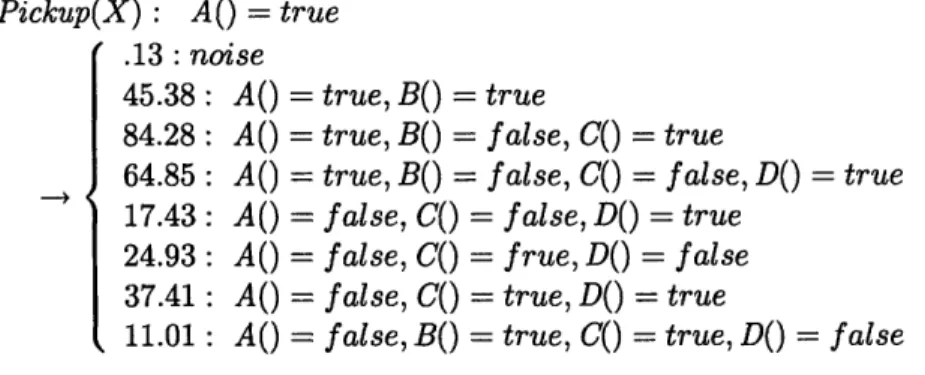
The following blocks-world domains each have a generative model different than the one specified in chapter 3. Thus, it is informative to note that our generic gener-ative model is widely applicable to a large class of domains. We call the genergener-ative models that create test tasks domain generators. In the first four domains, task rulesets are generated by copying all rules from the global ruleset. In domains with structural variation between tasks, specific functions constituting parts of the context or outcome set of rules are chosen when each task ruleset is initialized. Finally, the probability distribution assigned to each local rule is sampled from a Dirichlet with the hyperparameters of the corresponding global rule. In the fifth random domain, the generative model is explained in the section for the random domain.
Once each task ruleset has been created, a set of examples is sampled by creating random worlds and applying rules from the task rulesets. The task of the learner is to reconstruct the target task ruleset from these examples.
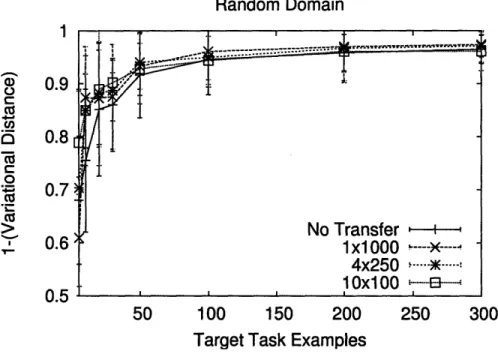
Both the learning techniques, using transfer and not using transfer, eventually converge to the optimal ruleset given enough examples. Thus, the measure of success in transfer learning is how well the transfer learners can perform with a small number of examples. To quantify accuracy, we use a measure called sampled variational
distance.