Clustering Algorithms for Dynamic Adaptation of Service
Function Chains
by
Imane EL MENSOUM
MANUSCRIPT-BASED THESIS PRESENTED TO ÉCOLE DE
TECHNOLOGIE SUPÉRIEURE IN PARTIAL FULFILLMENT FOR A
MASTER’S DEGREE WITH THESIS IN CONCENTRATION
TELECOMMUNICATION NETWORKS
M.A.Sc
MONTRÉAL, DECEMBER 5, 2019
ÉCOLE DE TECHNOLOGIE SUPÉRIEURE
UNIVERSITÉ DU QUÉBEC
This Creative Commons allows readers to download this work and share it with others as long as the author is credited. The content of this work cannot be modified in any way or used commercially.
BOARD OF EXAMINERS
THIS THESIS HAS BEEN EVALUATED BY THE FOLLOWING BOARD OF EXAMINERS
Mrs. Nadjia Kara, Thesis Supervisor
Département de génie logiciel et des TI, École de technologie supérieure M. Aris Leivadeas, President of the Board of Examiners
Département de génie logiciel et des TI, École de technologie supérieure M. Abdelouahed Gherbi, Member of the jury
Département de génie logiciel et des TI, École de technologie supérieure
THIS THESIS WAS PRESENTED AND DEFENDED
IN THE PRESENCE OF A BOARD OF EXAMINERS AND THE PUBLIC ON DECEMBER 2, 2019
Algorithmes de mise en grappes pour une adaptation dynamique des chaînes de services
Imane El MENSOUM RÉSUMÉ
La virtualisation des fonctions réseau est l’un des paradigmes les plus adoptées dans les architectures réseau d’aujourd’hui, car elle offre entre autres une meilleure gestion des ressources, ainsi qu’une maintenance flexible des services déployés sur des ressources partagées dans des environnements en nuage.
Les fonctions réseau traditionnellement hébergées sur du matériel dédié sont désormais fournies comme des composantes logicielles, pouvant s'exécuter soit sur des machines virtuelles, soit sur des conteneurs. L'avantage majeur de cette transition c’est qu'elle facilite le déploiement des nouveaux services tout en optimisant le temps de gestion et d’administration des architectures réseau. Il est beaucoup plus facile de créer une nouvelle machine virtuelle/conteneur qui hébergera une fonction de réseau /service ou une application spécifique décrite sous forme de chaîne de services que de déployer un nouvel équipement matériel et de vérifier sa compatibilité avec le reste de l’architecture mise en place.
Avec tous les avantages qu’offre ce nouveau paradigme se présente un ensemble de défis principalement liés à : 1) l’optimisation de la consommation de ressources sur l'infrastructure partagée 2) la prise des meilleures décisions d'ordonnancement et de placement des fonctions virtuelles tout en respectant les exigences des clients ainsi que les ressources disponibles sur le réseau physique exprimées par différentes métriques (ex., CPU, mémoire, latence, bande passante, etc.)
Ce concept de la virtualisation des fonctions réseau (Network Function Virtualization – NFV), et plus spécifiquement du placement des chaines de services (Service Function Chains - SFC) a été traité dans de nombreux travaux de recherche proposant des approches garantissant un placement et un routage optimaux des fonctions de réseau virtualisées (Virtual Network Function – VNF) dans des réseaux physiques partagés, mais comme l’adoption de la virtualisation prend de plus en plus d’envergure et vu les exigences de plus en plus strict des applications d’aujourd’hui (ex., applications hautement sensibles à la latence, à la disponibilité de service, etc.), il est toujours important de considérer tous les paramètres ayant un impact sur la gestion du réseau dans les environnements Infonuagique. Dans la cadre de ce projet de recherche, nous avons développé de nouvelles approches, pour le placement et le routage des fonctions réseau virtuelles dans des environnements Infonuagique. La première approche permet de former à la demande des grappes de serveurs déployés dans une l'infrastructure physique. Ces serveurs sont regroupés en fonction d'attributs similaires (ex., serveur à usage intensif en CPU, serveur efficace en énergie, etc.).
VI
Ce processus constitue une mesure proactive permettant de s'assurer que les SFCs sont hébergées dans des serveurs garantissant leurs exigences en termes de métriques spécifiques (CPU, mémoire, disque…). Il utilise une méta-heuristique appelée CRO (Chemical Reaction Optimization) pour décider du meilleur placement des VNF garantissant une consommation de ressources optimale en termes de CPU / mémoire mais assurant également les latences les plus faibles lors du routage entre les différentes VNF, ce qui est un aspect important à considérer, car la plupart des applications actuelles demandent des latences faibles et des temps d’exécution les plus courts possible. Dans la deuxième approche, les grappes sont formées à l'aide d'algorithmes basés sur des méta-heuristiques, notamment le CRO, permettant d’améliorer la qualité des grappes constituées en termes de similarité, densité et modularité.
Mots-clés : virtualisation des fonctions réseau, chaines de services, méta-heuristique, allocation des ressources.
Clustering Algorithms for Dynamic Adaptation of Service Function Chains Imane El MENSOUM
ABSTRACT
Network function virtualization is a pillar-stone of today’s network architectures as it offers better management and elasticity and allows also a flexible maintenance of services running on shared resources over cloud environments.
Network functions traditionally hosted on dedicated hardware are now provided over software based components that might run either on virtual machines or on containers. The major advantage of this transition is that it makes the deployment of new services easier while optimizing the management and administration of network architectures. It is much easier to spin up a new virtual machine/container hosting a network function or a specific application described as a service function chain, than to deploy a new hardware based equipment and checking its compatibility with the rest of the architecture.
With all the advantages that this new paradigm offers comes a set of challenges related mainly to: 1) optimizing the resource consumption on the shared infrastructure 2) making the best decision of placing the virtual functions that respects at the same time clients’ requirements and also leverages the available resources on the substrate network in terms of different metrics (e.g., CPU, memory, latency, bandwidth).
This aspect of Network Function Virtualization-NFV and Service Function Chains-SFC placement have been treated in so many research works that propose approaches ensuring optimal placement and chaining of VNFs in virtualized networks, but as the adoption of these technologies gets more important in real network setups, and given the strict restrictions of today’s’ applications (e.g. latency sensitive applications, or availability highly-sensitive service, etc.), it is always important to consider all the parameters impacting the network management in cloud environments.
In this research project, we develop new approaches for placement and chaining of virtual network functions in cloud-based environments. The first approach allows forming on-demand clusters of servers deployed in a physical infrastructure. These servers are grouped according to their similar attributes (e.g., CPU-intensive server, energy-efficient server, etc). This process is a proactive measure to ensure that SFCs are hosted in servers that meet their specific metrics requirements (CPU, memory, disk, etc.). It employs a meta-heuristic called CRO (Chemical Reaction Optimization) to decide of the best VNF placement guaranteeing optimal resource consumption in terms of CPU / memory. We employ CRO also to ensure the lowest latencies during the routing between the different VNFs. In fact, the E2E delay is an important aspect to consider, as most current applications require low latencies and shortest run times. In the second approach, the clusters are formed using algorithms based on
VIII
meta-heuristics, including the CRO, allowing to improve the quality of clusters formed in terms of similarity, density and modularity.
Keywords: Network function virtualization, Service function chains, metaheuristic, resource allocation.
TABLE OF CONTENT
Page
INTRODUCTION ………..1
CHAPTER 1 LITERATURE REVIEW ...0
CHAPTER 2 MuSC: A Multi-Stage Service Chains Embedding Approach ...5
2.1 Abstract ...5
2.2 Introduction ...6
2.2.1 Problem Statement ... 6
2.2.2 Contributions... 8
2.3 Related Work: ...9
2.3.1 VNF Placement and Chaining approaches: ... 10
2.3.2 CRO and GA Based Approaches: ... 12
2.4 Problem formulation: ...13
2.5 Algorithms: ...17
2.5.1 K-medoids Clustering process: ... 17
2.5.2 Overall Cluster-based SFC Placement and Chaining: ... 17
2.5.3 Metaheuristic Chaining approaches: ... 20
2.6 Experimental Setup and Results: ...41
2.7 Conclusion ...56
CHAPTER 3 VALKYRIE: A suite of topology-aware clustering approaches for cloud-based virtual network services ...59
3.1 Abstract ...59
3.2 Introduction ...60
3.3 Context, motivation and system architecture ...63
3.4 Related work ...64
3.5 System model and problem statement ...69
3.5.1 Definitions and notations ... 69
3.5.2 Problem statement ... 69
3.5.3 VALKYRIE clustering model ... 71
3.6 CRO-based clustering approach ...73
3.6.1 CRO approach description ... 73
3.6.2 Molecule encoding ... 75
3.6.3 Initial population ... 76
3.6.4 Elementary reactions ... 77
3.6.5 Overall CRO-based clustering algorithm ... 80
3.7 Game Theory based approach ...82
3.8 Asymptotic analysis : ...86
3.9 Evaluation: ...87
3.9.1 Setup ... 88
X
3.9.3 Scenarios ... 89
3.10 Discussion and observations: ...90
3.10.1 Modular topology with variable connectivity degree ... 90
3.10.2 Random topology with fixed connectivity degree ... 95
3.11 Conclusion and future work ...100
CHAPTER 4 DISCUSSION OF THE RESULTS ...103
CONCLUSION and RECOMMANDATIONS ...105
APPENDIX A ……. ...117
LIST OF TABLES
Page
Table 2.1 Simulation Setup for chaining ...47
Table 2.2 Simulation Setup for clustering ...50
Table 2.3 Simulation setup for placement ...51
Table 2.4 Heuristic comparison for chaining ...55
Table 2.5 SFC embedding performance comparison ...56
Table 3.1 Notation table ...71
Table 3.2 First Molecule encoding ...75
Table 3.3 Adopted molecule encoding ...76
Table 3.4 Degrees of connectivity in our scenarios ...89
LIST OF FIGURES
Page
Figure 0.1 Network Functions Virtualization Framework defined by ETSI ...3
Figure 2.1 Notations ...15
Figure 2.2 CRO Molecule Encoding ...22
Figure 2.3 Input Requests ...36
Figure 2.4 Molecule Encoding ...36
Figure 2.5 Comparison of E2E evolution for CGA, PGA and CRO ...43
Figure 2.6 Average E2E Delay for CGA, PGA and CRO ...44
Figure 2.7 Average run-time for CGA, PGA and CRO ...45
Figure 2.8 Average E2E delay for PGA and CRO ...46
Figure 2.9 Average Runtime for PGA and CRO by network size ...47
Figure 2.10 Average E2E Delay by network size for parallel CRO ...48
Figure 2.11 Rejection rate of SFC requests ...48
Figure 2.12 Node distribution according to energy levels ...50
Figure 2.13 Node distribution according to memory levels ...51
Figure 2.14 Comparison of number of used servers ...52
Figure 2.15 E2E delay comparison with and without clustering ...53
Figure 2.16 Run-time comparison of placement and chaining with and ……… without clustering ... 54
Figure 3.1 VALKYRIE for building virtual clusters for cloud and virtual network ... services ... 64
Figure 3.2 Preference cycle elimination process ...84
XIV
Figure 3.4 Similarity values for modular topology ...92
Figure 3.5 Modularity values for modular topology ...93
Figure 3.6 Density values for modular topology ...94
Figure 3.7 Clustering time for random topology with fixed connectivity degree ...95
Figure 3.8 Similarity values for random topology with fixed connectivity degree ...96
Figure 3.9 Modularity values for random topology with fixed connectivity degree ...97
LIST OF ALGORITHMS
Page
Algorithm 2.1 Placement and chaining algorithm ...29
Algorithm 2.2 Molecules Generation ...22
Algorithm 2.3 Synthesis ...23
Algorithm 2.4 Inter-Molecule Ineffective Collision ...24
Algorithm 2.5 On-Wall Ineffective Collision ...25
Algorithm 2.6 Decomposition ...26
Algorithm 2.7 Min-Delay CRO ...28
Algorithm 2.8 Genetic Algorithm-Chromosome generation ...29
Algorithm 2.9 Priority-based Genetic Algorithm Crossover ...31
Algorithm 2.10 Genetic Algorithm-Mutaion ...32
Algorithm 2.11 Genetic Algorithm Decodning ...32
Algorithm 2.12 Min-Delay Priority based GA ...34
Algorithm 2.13 CRO Placement Molecule Generation ...36
Algorithm 2.14 CRO Placement Decomposition ...37
Algorithm 2.15 CRO Placement On-Wall Ineffective Collision ...38
Algorithm 2.16 CRO Placement-Synthesis ...40
Algorithm 2.17 CRO based plcement ...41
Algorithm 3.1 Molecule generation ...77
Algorithm 3.2 On-wall ineffective collision ...78
XVI
Algorithm 3.4 Synthesis ...80
Algorithm 3.5 Over-all CRO algorithm for clustering ...82
Algorithm 3.6 Preference list computation ...83
Algorithm 3.7 Irving algorithm ...84
LIST OF ABREVIATIONS AND ACRONYMS
CPU Central processing unit
CRO Chemical Reaction optimization
DC Data Center
DS Data Set
E2E End to End delay
E-GT Enhanced Game theory
GA Genetic Algorithm
GT Game Theory
ILP Integer Linear Programming MANO Management and Orchestration NFV Network Function Virtualization SDN Software Defined Networks SFC Service Function Chain SLA Service Level Agreement SLO Service Level Objective VNF Virtual Network Function
LIST OF SYMBOLS AND UNITIES OF MEASURE
ms millisecond
us microsecond
INTRODUCTION
0.1 Context:
Today’s networks are getting more complex due to the increasing demand of connectivity and speed rates by the consumers. The diversity of offered applications and services that are bandwidth intensive and that require important computation capabilities implies important evolutions in the network’s architecture.
Networks today should be able to support multiple protocols, access technologies and different service layers. With all these complex needs and demands, it is getting harder for legacy networks to satisfy all these requirements along with ensuring an effective network management. Therefore, the adoption of virtualization techniques and software based networks becomes a must.
Network function virtualization (NFV) is an emerging concept that attracts increasing attention in the industry. NFV offers much more agility and flexibility to the network allowing easier software updates, resource adjustment and scalable changes in the configuration of the services. Network functions traditionally delivered on hardware and purpose-built platforms can now be provided through virtual resources which are called Virtual Network Functions (VNFs) and are hosted over shared physical network infrastructures.
Moreover, functions built on proprietary dedicated hardware are usually hard to upgrade, integrate and deploy over already built-up environments. This complexity is mainly due to compatibility issues coming from the use of different equipment manufacturers and vendors. Thus, using network functions as software components would help to improve the process of VNF deployment and the management cycle.
2
It would avoid having to check whether or not a function is compatible with the rest of the network’s physical parts. In fact, VNFs are hardware independent which helps to reduce the maintenance costs that can increase drastically in case of major upgrades in the network infrastructure.
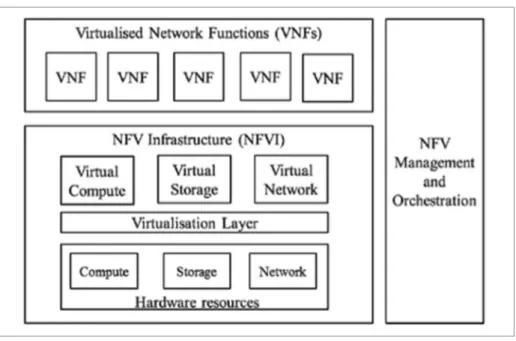
As defined by the European Telecommunications Standards Institute (ETSI) in Figure 0.1, the overall framework for NFV is composed of three main domains:
• The NFV infrastructure represents the combination of hardware and software resources which form the platform on which the VNFs would be deployed and run. The physical resources can be either storage nodes (servers) or network nodes like switches and routers providing the processing, storage and connectivity requirements to ensure the good functioning of virtual components.
• VNFs Virtual Network Functions: representing the software entities that implement the network functionalities over the NFV infrastructure. A network block might be instantiated over a single VM or multiple ones, a VNF can also have as many replicas as needed for resiliency constraints and to ensure the continuity of the service in case of hardware (servers) breakdown.
• NFV MANO Management and orchestration: This domain is responsible of the orchestration and management of the physical resources allocation as well as the virtual entities management during their lifecycles.
3
Figure 0.1 Network Functions Virtualization Framework Taken from ETSI GS NFV 002 (2012, p.10)
With all the benefits that this framework offers, shifting to virtual based networks faces an important number of challenges. The main concerns are in terms of placing those virtual components, ensuring their interoperability and maintaining the quality of service at a good level. Hereby, we refer mainly to the NFV MANO orchestration and management, which is the targeted layer in this research project.
0.2 Problem Definition:
Combining Network Function Virtualization (NFV) and Software Defined Networks (SDN) concepts can bring many benefits in terms of automation, flexibility and agility in network management which justifies the keen interest they’re getting in the IT sector. However, these new paradigms are a doubled-edged sword because they also come with serious challenges. Shifting from legacy networks where every component of the network is a hardware entity to a virtual environment where functions are bricks of software programs is challenging. This transition requires a good management over the hosting servers so as to avoid wasting computation resources, storage capacity and energy consumption. The concrete deployment
4
of these virtual instances is a delicate task that is hindered by a set of technical issues some of them are related to: 1) how to efficiently place, readjust and schedule the VNFs of a certain network and 2) how to ensure that while doing this placement we make sure of the effective use of resources in the substrate network, whether in terms of storage and processing capacity, Service Level Objective (SLO) and/or energy consumption.
So, it comes back to finding a tradeoff between ensuring that all the VNFs instances are deployed with respect to the client requests and requirements. It is also important to optimize the use and the exploitation of the physical resources, so as to guarantee this promise of NFV/SDN paradigm to reduce the costs of network deployment and management.
These issues are considered as intriguing research questions and many contributions in the literature have been made to address them, which mainly focus on: 1) the placement of VNFs where the goal is to find the optimal set of servers to host all the incoming VNFs requests along with optimizing the consumption of hardware resources; 2) the service chains routing which is more related to the chaining between the set of VNFs composing a single SFC (both joint and non-joint placement and chaining might be considered). The chaining process guarantees low latencies, reduces the execution time to find the paths and minimizes the response time to clients’ requests.
Even though many research works ((Mechtri et al.2016), (Pham et al.2018), (Khebbache et al.2018), (Draxler et al.2018), (Wang et al.2017)) have targeted this matter, there is still room for improvement and to overcome the limitations of existing solutions described in the literature.
Given the different parameters that may impact the quality of the placement and chaining decisions, it is usually hard to find a certain tradeoff between these several metrics (e.g. Energy, Memory, CPU, Delay, bandwidth, etc). The actual contributions reduce the complexity of this optimization problem by only selecting few metrics and do not take them all into account. Another aspect in the research works we have studied is that usually the
5
resource status is considered to be a static value, while in real case scenarios, the available resources in the network dynamically change, the same goes for the workload that evolves also continuously. The dynamic aspect of resource adaptation and traffic rates are important aspects that should also be considered while placing and chaining the virtual network functions.
To tackle these problematics, we defined two main sets of approaches: The 1st is related to clustering the substrate network into a set of on demand group of servers that are optimized in terms of energy, memory, or CPU. The clustering process is also dynamic and groups servers while optimizing similarity, modularity and density in these groups. This step is a pre-processing phase that helps not only to include several optimized metrics in the process of embedding SFCs, but also to reduce the search space for the 2nd set of approaches, which is related to placement and chaining. This 2nd track of our research is about the joint or non-joint placement and chaining of VNFs using evolutionary heuristics like the chemical reaction optimization and the genetic algorithms, these techniques will be further explained in the present report.
To the best of our knowledge none of the actual research works apply CRO-based joint (that optimizes both placement and chaining at the same time) or non-joint (that performs placement first then chaining after) algorithms on a set of pre-clustered substrate network to optimize resource consumption and reduce Service Level Agreement (SLA) violations as well. Moreover, no research work has been done actually to apply graph-based clustering technique in cloud-based environments and all the graph-based clustering papers we studied are more related to data analysis or community detection in social networks.
0.3 Objectives:
The main objectives of this research project are to develop two algorithms that might be integrated in the NFV management layer in order to classify the network in terms of physical
6
resources and optimally place and chain incoming SFC requests. The output of these algorithms should provide:
1. Homogenous groups of servers clustered together and have high similarities between them in terms of the selected attributes (e.g. Energy, Memory, CPU…) and with no outliers (servers that are not assigned to any cluster).
2. Dense clusters that are highly connected to ensure low latencies within the same group of servers and avoid violating the agreement in terms of delay/bandwidth.
3. Continuous adaptation of the clustering based on the variations of the resources on the servers and the workload state.
4. Optimal placement of the virtual network functions that ensure the respect of the clients’ requests in terms of physical resources as well as avoiding resource wastage and over-provisioning in the physical infrastructure.
5. Optimal chaining of VNFs in the same SFC so as to respect the agreements in terms of delays and reduce the SLO violation.
0.4 Methodology:
As explained in the previous section, this project is divided into two major research tracks: a. SFC Placement and chaining:
The first track concerns the definition of a heuristic approach for placement and chaining of virtual functions in cloud-based environments. The overall procedure for placement and chaining is is composed of three main steps. We start by classifying the network into groups of servers that are similar in terms of their attributes (which could be either energy, memory,
7
CPU, etc) using Integer Linear Programming (ILP) model adapted from the model proposed in (Abdul Wahab et al. (2019)). This proactive step ensures that the SFC requests will be placed on the servers responding to their specified conditions in terms of CPU, energy, etc. The clustering helps not only to satisfy the clients’ requests, but also to reduce the search space for both phases of placement and chaining and thus reduce the overall execution time for our algorithm. Once this pre-processing phase is performed, we execute the CRO and GA heuristics to place the VNF components in a way that guarantees the SFC request but also optimizes the physical resource consumption in the provider’s physical network. The last step is to ensure the chaining between the set of VNFs belonging to the same SFC, we used also CRO and GA heuristics for this step. The goal of the chaining is to ensure that the minimum end to end delay specified as an input by the client is respected. This is a non-joint placement and chaining approach. We also develop a CRO-based joint placement and chaining approach that is out of the scope of this thesis.
b. Clustering of the substrate network:
The second track is related to the dynamic clustering of the substrate networks. The aim of this work is to classify the servers in the substrate graph not only based on their attributes (e.g. CPU, Energy, memory...), but also based on the connectivity and the links between them. In this way, we ensure that not only servers in the same cluster are optimized in terms of the selected attributes, but their connectivity avoids violating the clients’ requirements in terms of delay once the SFCs are deployed.
We developed a CRO-based approach to solve this graph-based clustering problem. We compared it with Game theory approach as well with optimal solution that considers the similarity between servers as well as the modularity which is the measure that ensures high density and connectivity between servers in the same cluster.
8
The clustering procedure is to be applied at the initialization phase of substrate network deployment but should be invoked at regular basis as the resources on the physical servers are continuously changing.
0.5 Technical Contributions:
The main motivations behind this work are to improve the management of resources in cloud-based environments while guaranteeing SLO as well as efficient and effective consumption of physical resources.
The project was divided in two major sets like we described in the Methodology section. The main contributions of this thesis are then:
1. Development of a multi-stage technique for SFCs placement and chaining: This was the subject of our first article entitled “MuSC: A Multi-Stage Service Chains Embedding Approach” accepted for publication in Journal of Network and Computer Applications, October 2019. In this joint research work, the main contribution of Miss Imane ElMensoum is the definition of ILP model adapted from the model defined in (Abdul Wahab et al. (2019)) and the development of non-joint CRO-based and GA-based placement and chaining approaches. The detailed description of this approach is presented in Chapter 2. A joint CRO-based and GA-based placement and chaining approaches have been also developed by Miss Imane El Mensoum. This contribution was submitted to IEEE Transactions on Services Computing. This work is out of the scope of this report.
2. Our second research contribution studies the graph-based clustering of substrate networks in order to host service functions chains. This second track was the subject of our second article entitled “VALKYRIE: A suite of topology-aware clustering approaches for cloud-based virtual network services” submitted to IEEE TRANSACTIONS ON CYBERNETICS Journal in October 2019. In addition, this
9
second approach was subject to a provisional patent application filled by the Patent Unit of Ericsson Canada to the United States Patent and Trademark Office (USPTO) in October 2019. In this joint research work, the contribution of Miss Imane El Mensoum is the development of CRO-based clustering technique that was compared to Game theory-based approach and optimal solution. You will find the article describing this approach in Chapter 3.
El Mensoum, I., Abdul Wahab, O., Kara, N., & Edstrom, C. (2019). MuSC: A Multi-Stage Service Chains Embedding Approach. Accepted for publication in Journal of Network and Computer Applications.
Lahlou, L., El Mensoum, I., Kara, N., & Edstrom, C. (2019). ARTIMIS: A chemical Reaction OptiMization approach for delay sensitive virtual network services. Submitted to IEEE Transactions on Services Computing, October 2019.
El Mensoum, I., Lahlou, L., A. Khasawneh, F., Kara, N., & Edstrom, C. (2019). VALKYRIE: A suite of topology-aware clustering approaches for cloud-based virtual network services Submitted to IEEE TRANSACTIONS ON CYBERNETICS Journal, November 2019.
El Mensoum, I., Lahlou, L., A. Khasawneh, F., Kara, N., & Edstrom, C. (2019). VALKYRIE: A suite of topology-aware clustering approaches for cloud-based virtual network services, Application Patent reference number P79104, October 2019
0.6 Thesis Organization:
The present thesis is structured by article, so we start first by a general literature review and then we include two distinct chapters to describe each of the pre-mentioned contributions. In each of these chapters, we present a more detailed literature review related to the research tracks followed by the approach description, the used algorithms and the obtained results and their analysis. Chapter 4 is dedicated to an overall discussion of the results for both considered research matters, and last the conclusion and future work are discussed in the last section.
CHAPTER 1 LITERATURE REVIEW
Virtualization of network functions is a promising concept that attracts both cloud providers and also industry stakeholders, as it allows them to gain more flexibility to deploy new service function chains and also reduces the costs of instantiating and maintaining the overall quality of the offered service. With the arise of new technologies like 5G and IoT, it is of a great importance to ensure that this swap to virtualized infrastructures will be capable of respecting the requirements in terms of physical resources as well as SLO which are key performance indicators for every client’s request.
Given all these challenges, many research works have targeted this field to tackle the resource management issue in cloud-based environments, and proposed approaches to deploy these SFCs with respect to the clients’ requirements while at the same time optimizing the overall consumption of resources.
In this section, we will describe some of the previous research works that have treated the issue of service function chains embedding in cloud-based environments and analyze the proposed approaches aiming to optimize the resource consumption and improve the overall QoS of the offered service.
Most of the studies focus mainly on the optimal placement and chaining of virtual components of SFCs. The proposed works usually first apply the placement of VNFs followed by their chaining (non-joint placement and chaining).
This non-joint approach impacts the execution time of the full process, we propose in our approach to apply clustering as a pre-processing phase that helps us optimize the execution time as the substrate network is divided into a set of efficient clusters which makes the search space smaller for our metaheuristic-based algorithms designed for placement and chaining.
1
For instance, (Pham et al, 2018) proposes a non-joint placement and chaining approach to solve the problem using sampling-based Markov approximation combined with matching theory. To consider both operational and traffic costs (meaning physical resources consumption and bandwidth/delay costs). The authors propose a weighted summation as an objective function where the weight set for each cost is defined by the provider and can be adjusted to achieve the targeted tradeoff. The approach presented in this article is based on a two-stage algorithm where the first step consists of finding the optimal set of servers to host the VNFs and then the second consists of placing them in a way to minimize the total cost, which means that the placement and chaining are performed in a sequential scheme and not in parallel.
In (Khebbache et al 2018), the authors propose a metaheuristic based on genetic algorithm NSGA-II to find Pareto optimal fronts that respect the considered metrics and find near optimal tradeoffs. As objective functions, the authors consider both the mapping cost in terms of resource utilization on hosting nodes as well as link resource consumption.
In (Khebbache et al 2017), the authors formulate the same problem in two approaches. The first one considers an exact mathematical model to solve the case of hosting SFCs composed of a maximum of 3 VNFs, the model considers resource consumption in terms of link utilization only. Obviously, this model cannot scale well with larger SFCs which is why the authors propose a heuristic-based approach to solve bigger instances and improve the runtime of the placement process of SFCs.
In (J.Pei et al 2018), the authors formulate the VNF chains placement problem as a Binary Integer Programming model (BIP) where the objective is to minimize the embedding cost that the authors define as the total of resource and placement costs. The resource cost represents the remaining resources on links, nodes and VNF instances while the placement cost represents the computing power, licenses fees and network utilization. As this problem is widely known to be NP-hard, the authors propose two algorithms to optimize the VNF placement. The first one is called SFC embedding Algorithm (SFC-MAP) used to place the
2
SFC requests with a minimum cost. The 2nd proposed algorithm is the VNF-DRA (VNF Dynamic Release Algorithm). As the network load has a dynamic nature it is important to consider this aspect so as to release redundant instances and reduce both resource consumption and running time. The VNF-DRA algorithm runs periodically and calculates the rate of resource usage on each VNF if it is lower than a defined threshold, then the considered VNF is either released or redirected, the threshold is computed based on the network load. Moreover, the authors include the lifetime of instances to drive a decision, for short lifetime SFC requests they’re left to expire by their own and thus release the previously allocated resources to them. For long lifetime SFCs that are below the defined threshold, the algorithm first checks if they’re not used at all they will be released and if they are lightly used their corresponding workload will be redirected to another instance of the same VNF. Although, the problem of placement and chaining of SFCs has been widely addressed in the research area. The proposed approaches do not consider all the metrics that may impact the quality of the placement. Research works tend to reduce the complexity of the problem by defining objective functions only for specific metrics, and few of the studied works addressed the dynamic aspect of resources, while in real network scenarios the workload as well as the availability of resources are constantly changing and are also subject to peaks in some cases. That is why this aspect is to be taken considerably when developing new techniques for SFCs placement and chaining.
One way to reduce the complexity of the placement and chaining problem while at the same time considering several metrics for optimization is to include the clustering in the process. That is why we propose in our non-joint approach for placement and chaining of SFCs to use the clustering as it helps to cover a set of metrics that are treated prior to receiving new requests and reduce the runtime for the mapping of VNFs and their chaining.
Our approach is then capable of covering several metrics when performing the placement and chaining of VNFs while at the same time optimizing the run-time of this process which is an
3
important factor especially in cloud environments, where the resources are constantly changing, and decisions should be made as fast as possible.
To the best of our knowledge none of the actual proposed work has combined clustering techniques to form highly connected and similar groups of servers in terms of their attributes (energy, memory, CPU, etc,) with the placement and chaining procedures to cover more metrics in the optimization process and reduce the resource consumption on the substrate physical network. This is the reason why we were not able to compare our results to previous research works and we made the comparisons only between our adopted heuristics (Genetic Algorithm- GA, Chemical Reaction Optimization- CRO).
Moreover, most of the graph-based clustering techniques proposed in the literature are more related to data analysis or community detection in social networks. Therefore, and to the best of our knowledge, none of the actual research work define graph-based clustering technique for SFC placement and chaining in NFV environments.
The next two chapters are dedicated to each of the proposed contributions described in section 0.5. In each chapter, a more detailed literature review is described. The state-of-the-art section of Chapter 2 reviews research works related to the placement and chaining approaches while the literature review of Chapter 3 focuses on existing clustering approaches.
CHAPTER 2
MUSC: A MULTI-STAGE SERVICE CHAINS EMBEDDING APPROACH Imane El Mensouma, Omar Abdel Wahabb, Nadjia Karac, Claes Edstromd
a b c Department of Software Engineering and IT, École de Technologie Supérieure,
1100 Notre-Dame Ouest, Montréal, Québec, Canada H3C 1K3
dEricsson Canada, 8275 Route Transcanadienne, Ville Saint-Laurent, Québec, Canada H4S 0B6
Paper accepted for publication in Elsevier Journal of Network and Computer Applications, October 2019
2.1 Abstract
Network function virtualization is an emerging concept that is attracting increasing attention in the industry because it offers high levels of agility and flexibility to the network allowing easier software updates, resource adjustment and scalable changes in the configuration of the services. Network functions traditionally delivered on hardware and purpose-built platforms in legacy networks can now be provided through shared virtual resources called VNFs (Virtual network functions) hosted over shared physical network infrastructures. Using network functions as absolute software components would certainly improve the deployment process and the management of the VNF life cycle. Since VNFs are hardware-independent, there is no need to check whether or not a network function is compatible with the rest of the network’s physical parts; this also helps reduce the maintenance costs, which can increase drastically in the case of major upgrades to the network infrastructure. Along with all these benefits, shifting to virtual-based networks comes with a significant number of challenges, especially in terms of placing such virtual components, ensuring their interoperability and maintaining the quality of service at a level that is at least as good as what is offered by hardware based architectures. In this paper, we propose a cluster-based placement and chaining solution. The overall proposed approach consists of: 1) formulating an Integer Linear Programming (ILP) model aimed at finding an optimal tradeoff between multiple
6
objective functions that might be sometimes conflicting (e.g. hardware resource and energy consumption minimization, transmission delays, bandwidth usage, etc.), 2) classifying the substrate network into a set of on-demand clusters that are efficient for a predefined set of metrics, and 3) using meta-heuristic-based algorithms to find near-optimal solutions for the formulated ILP.
Keywords: Network Function Virtualization, Service function chains, Virtual functions placement and chaining, Genetic algorithm, Chemical Reaction Optimization.
2.2 Introduction
Network Function Virtualization (NFV) is based on the concept of moving network functions (e.g., routing, intrusion detection, etc.) from expensive physical hardware to software-oriented modules that are executed on top of commodity hardware in the form of Virtual Network Functions (VNFs). This approach has proven efficient in reducing both the Capital Expenditures (CapEx) and Operational Expenditures (OpEx) due to its resulting reduced equipment costs and reduced power consumption (Yi et al.(2018)). It also contributes in increasing the flexibility of scaling up, scaling down, and updating network services. However, the concrete deployment of NFV is hindered by a set of technical issues, relating mainly to the efficient placement and chaining of VNFs across physical nodes in the substrate network in order to minimize hardware resource consumption (Gil-Herrera et al.(2016)), while simultaneously respecting the dependencies among the VNFs composing a given network service. These objectives may be conflicting where, for example, the placement strategy that preserves the dependencies does not guarantee minimal hardware resource consumption or violates end-to-end delay requirements.
2.2.1 Problem Statement
There have been many efforts in the literature to address the VNF management issue, with contributions focusing mainly on two important aspects: the placement of the VNFs and their chaining. The first set of the proposed approaches (Xia et al.(2015), Mehraghdam et
7
al.(2014); Ghaznavi et al. (2015); Su et al.(2016)), seek to find the optimal set of servers on which to place each new incoming VNF, taking into consideration the optimization of several factors, such as hardware resource, and energy consumption. The second set (Alleg et al.(2017); Khebbache et al.(2018); Eramo et al. (2017)), for their part focus more on Service chains routing, and try to ensure that the chaining between the set of VNFs composing an SFC (assuming that the placement is already done) is realized in a way that guarantees low latencies, reduces run time to find the paths, and of course, minimizes the response time to clients’ requests. One of the main limitations of these approaches stems from their static deployment scheme, which does not account for variations that are likely to occur at the level of server resources availability. These changes include sudden spikes or drops in the available resources on some servers, failure of some nodes, and changes in the SFC users’ locations and needs. This leads to a degraded performance in dynamic settings wherein the status of the servers and the users’ needs are continuously changing. For example, some servers that are the closest to some events (e.g. media servers used in festivals hosted by a city) in some time periods may experience unexpectedly high loads on their resources.
Therefore, incorporating dynamism into placement strategies is of prime importance to guarantee optimal Quality of Service (QoS) and resource consumption under changing environments. Another challenge faced in the proposed solutions is dealing with the complexity of the SFC placement and chaining problem; defining an optimal trade-off between multiple objective functions is usually hard to perform. Current research works reduce then the complexity of the problem, by defining their objective functions for few metrics (Energy/CPU consumption, latency, throughput, etc.) depending on the service chain priorities and its field of application. To address these challenges, our solution adopts a proactive approach in which the network is a priori divided into a set of efficient clusters to facilitate the placement and chaining processes in real-time. The clustering step helps not only to reduce the complexity of the problem, but also to cover a set of metrics, guaranteeing that the SFCs are placed based on their priorities among the predefined metrics, which could be either energy or memory, for instance. Once the clusters are formed, we employ our
8
heuristic-based solution to place and chain the requests in a dynamic scheme, taking into account variations in the network’s available resources.
2.2.2 Contributions
We propose in this paper a cluster-based placement and chaining approach whose main premise is splitting the substrate network into a set of on-demand clusters that optimize some particular metrics (e.g., energy, memory, etc.). To perform the clustering, we employ the k- medoids clustering approach, while integrating statistical technique on top of it to improve the selection of the initial clusters. Thereafter, cluster-based placement and chaining algorithms are designed. Genetic Algorithm (GA) and Chemical Reaction Optimization (CRO) techniques are proposed to solve the placement and chaining problems, while considering several conflicting objectives, such as minimizing delays, CPU, energy, and memory consumption. This has the advantage of considerably reducing the solution space that CRO and GA meta-heuristics need to explore, thus accelerating both the placement and chaining processes.
The main contributions of this paper can be summarized in the following points:
• We formulate an Integer Linear Programming (ILP) to model the VNF placement and chaining problem, while taking into account the minimization of several metrics, such as hardware resource utilization, Service-Level Objective (SLO) violation cost and latency. • We employ a modified k-medoids clustering approach to divide the substrate network
into a set of on-demand clusters. The proposed clustering approach operates ina proactive manner to minimize the setup latency and decrease the complexity of placing/chaining VNFs.
• We develop cluster-based placement and chaining algorithms that employ meta-heuristic techniques such as GA and CRO to efficiently derive the appropriate VNF placement and chaining strategies. Two GA-based placement and chaining strategies are defined
9
and compared with CRO strategies: Classical-GA and Priority-based GA. These approaches are described in section 4.3.
• We perform experimental comparisons between the proposed algorithms to determine the advantages and limitations of each technique under different network scenarios. Proceeding as such allows us to provide network administrators with a comprehensive view on what technique to use and under which conditions.
The rest of the paper is organized as follows: In the next section, we review research contributions that tackle the same problem of VNFs placement and chaining, and also highlight the particular features that distinguish our approach from the already proposed approaches in previous research works. In Section 3, we present our ILP model where we formulate the placement and chaining problem. Section 4 is where we discuss the different used algorithms and heuristics we use for clustering, placement and chaining. In Section 5, we present the simulations’ setup, the results interpretation and discussion. Finally, in Section 6 we conclude our work and evaluate the performance of our proposed approach. The rest of the paper is organized as follows: In the next section, we review research contributions that tackle the same problem of VNFs placement and chaining, and also highlight the particular features that distinguish our approach from the already proposed approaches in previous research works. In Section 3, we present our ILP model where we formulate the placement and chaining problem. Section 4 is where we discuss the different used algorithms and heuristics we use for clustering, placement and chaining. In Section 5, we present the simulations’ setup, the results interpretation and discussion. Finally, in Section 6 we conclude our work and evaluate the performance of our proposed approach. 2.3 Related Work:
In this section, we carry out a detailed discussion of the major contributions that have been proposed concerning the VNF placement and chaining problem, and we highlight the unique
10
features of our solution in comparison with the state-of-the-art. Moreover, we provide an overview of some contributions in which CRO and GA have also been employed.
2.3.1 VNF Placement and Chaining approaches:
In (Mehraghdam et al. (2014)), the problem of optimally placing VNFs in the substrate network has been formulated as a Mixed Integer Quadratically Constrained Program (MIQCP) to derive the optimal placement and chaining of network functions, while considering the limited network resources and functional requirements. In (Cohen et al. (2015)), the authors formulate the VNF placement problem as an integer linear programming model with the aim of minimizing both the deployment and connection (between VNFs) costs and propose some approximation algorithms to solve it. In (Khebbache et al. (2018)), the authors formulate the VNF placing problem as a multi objective optimization problem aimed at minimizing two major metrics: the mapping cost and physical link utilization. A meta-heuristic based on the Non-Dominated Sorting Genetic Algorithm II (NSGA-II) is proposed by the authors to find near-optimal solutions respecting the considered metrics and ensuring acceptable performance trade-offs. In (Pham et al. (2017)), the authors propose a joint placement and chaining approach to solve the problem using sampling-based Markov approximation combined with matching theory. In order to consider both operational and traffic costs, i.e., physical resource consumption and bandwidth/delay costs, the authors propose a weighted summation as an objective function in which the weights set for each cost function are defined by the provider and can be adjusted to achieve the desired tradeoff. In (Ghaznavi et al. (2015)), the authors formulate an Elastic Virtual Network Function Placement (EVNFP) problem and derive a solution to minimize the operation cost, while considering the minimization of elasticity overhead and the trade-off between bandwidth and host resource consumption. Thereafter, a heuristic solution called Simple Lazy Facility Location (SLFL) is advanced to derive the appropriate placement of VNFs. The authors consider four challenges related to NFV, namely: (1) where to place Virtual Network Function Instances (VNFIs), (2) how many resources should be assigned to each VNFI, (3)
11
how to convey SFC requests to the adequate VNFIs in the right order, and (4) how to readjust VNFIs to cope with the sudden changes in SFC requests concentration. To tackle these challenges, they proposed a three-phase solution whose objectives are to (1) minimize the SFC bandwidth rejection, and (2) minimize the energy consumption by reducing the number of running servers. In (Alleg et al. (2017)), the authors proposed a delay-aware placement and chaining model formulated as a Mixed Integer Quadratically Constrained problem (MIQCP). The presented approach aims at ensuring a flexible allocation of resources in the substrate network. The main idea behind this work is to ensure that the proposed solutions are capable of answering the SFC requests in terms of end to end delay, without having to allocate unnecessary physical resources on the hosting nodes, causing an over-dimensioning of the virtual network and thus leading to a significant increase in operational costs for the service provider. In (Liu et al. (2017)), the authors address the challenge of jointly optimizing the placement of new incoming SFCs and readjusting in service ones. These cases are modeled as an integer linear programming model that aims to minimize both the operational overhead and readjustment cost. To solve this problem, a column generation approach is employed. In (Draxler et al. (2018)), the authors introduce new scheme to formulate the SFC request, unlike the common representation of an SFC request consisting of a directed weighted graph composed of a set of VNF linked to each other. In this work, the authors consider that each SFC is described by a template, containing information about the components and the interconnection between them only, while for resource requirements they are considered as a function of the incoming data rates on each component. This representation allows the adaptation of resources according to the flow rates variation. While this approach may be considered dynamic, it doesn’t scale well with large networks. According to the simulations, the authors argue that it can be used for geographically distributed architectures where each node represents a whole data center. In (Lange et al. (2017)), a multi objective heuristics proposed to solve the VNF chains placement problem, the adopted approach is based on the simulated annealing algorithm. This technique aims to find feasible solutions that respect the set of objectives in terms of CPU use and link resource consumption. The proposed algorithm solves the VNF placement problem in two stages: assigning the requests to adequate nodes, and then routing of the demands. Most of the
12
contributions above focus on the optimization of VNFs placement and chaining on the substrate network, while considering different objective functions. Still, most of these works either ignore the dynamic aspect of resources in cloud-based environments or do not consider large substrate networks, but use relatively small architectures for their simulations. However, in order to benefit from the advantages offered by NFV, these challenges must be considered. In fact, the resource consumption and availability of the servers in datacenters are continuously changing depending on the adopted placement strategy, the number of served users and their locations. Moreover, VNFs should be continuously adjusted to guarantee service continuity as users are constantly changing their locations over large-scale network topologies.
To deal with these problems, our approach adopts a proactive process in which the network is a priori divided into a set of on-demand clusters optimized for certain defined metrics (e.g. energy, memory, etc.,), and that aims to facilitate the placement and chaining process. Network resource status may be monitored by an SDN controller to keep track of resource variations. This information is provided to our heuristic-based solutions as an input to ensure efficient initial placement and chaining, and may also be used for readjustment purposes. 2.3.2 CRO and GA Based Approaches:
In (Xu et al. (2011)), the authors tackle the problem of task scheduling in grid computing systems. To this end, they formulate an optimization problem aimed at minimizing the Make span and Flow time of the scheduling process, while accounting for resource reliability. To solve the problem efficiently, they employ several versions of CRO to derive effective scheduling solutions. In (Lam et al. (2010)), the authors take advantage of CRO to address the problem of allocating the available channels to unlicensed users in cognitive radio scenarios. They formulated an optimization problem with three utility functions that aims to minimize hardware utilization, while guaranteeing the fairness of the allocation process among users. Genetic algorithms have been extensively used in the context of NFV. For example, in (Dezhabad et al. (2018)), the authors discuss a method to achieve dynamic
auto-13
scalability of virtual firewalls. The objective is to determine the number of active virtual firewalls needed at each time period, based on the density of the incoming load and the portion of requests that should be assigned to each single firewall. The problem is solved using a hybrid method, which combines a genetic algorithm and reinforcement learning. The authors of (Yala et al. (2018)) propose a placement strategy for Multi-access Edge Computing (MEC) in NFV environments. They formulate the problem as an optimization problem with two conflicting objectives, i.e., maximizing service availability and minimizing access latency. A genetic algorithm is then advanced to solve the optimization problem. Although CRO and GA have been widely used to model a variety of solutions, this work is, to the best of our knowledge, the first that combines them in a cluster based environment to tackle the problem of placing and chaining SFCs.
2.4 Problem formulation:
We consider an undirected graph Gs(Vh,E) to represent the substrate network, where Vh represents the set of substrate nodes, while E is the set of links connecting these nodes. The substrate nodes can be categorized in two different sets, namely, host servers and middleboxes. Host servers are high-volume servers used to host Virtual Machines (VMs) or containers that may belong to one or different users. Middleboxes are physical network components providing various network functions, like Wide Area Network (WAN) optimizers, multimedia caches or Intrusion Detection Systems (IDSs) and Intrusion Prevention Systems (IPSs). Gv(Vv;Ev) is a directed acyclic graph that represents an SFC composed of a sequence Vv of VNFs and a set Ev of virtual links connecting the VNFs. In this section, we formulate our proposed ILP to model the VNF placement and chaining problem adapted from the model proposed in (Abdul Wahab et al. (2019)). Table 2.1 summarizes the different notations used throughout the paper.
14
Table 2.1 Notations Symbol Significance Vh Set of host servers in the substrate network. Vv Set of virtual network functions in a certain SFC. E Set of physical links in the substrate network. Ev Set of virtual links in a certain SFC.
𝑅 Amount of hardware resource capacity on physical server vh∈Vh
𝑅 Amount of hardware resources consumed by VNF of type p∈P on server m
𝛼 , Decision variable whose value is equal to 1 if VNF n of type p is hosted in server m and 0 otherwise.
βi,j Decision variable whose value is 1 if the virtual link i is mapped into physical link j and 0 otherwise.
𝜉 , Monetary weight of adding a new VNF n of physical server m.
Υ ,, Monetary weight of the service delay penalty between each pair of hosted VNFs a and b hosted on physical servers xand y respectively.
d ,, 𝑡 The propagation delay between the pair (a, b) of VNFs hosted on physical servers x and y respectively.
𝑁| | Number of VNFs |Vv| hosted on physical server m.
𝑙 ,, Maximum delay cost that a flow of pair a and b of VNFs hosted on topof physical servers x and y respectively can tolerate.
Π Set of metrics to be minimized.
hθ Cluster-head h that is efficient in terms of metrics θ (where θ⊆∏ is a single
combination subset of the set ∏).
𝜙 ( ) Set of VNFs 𝑉 hosted on physical server
15
Cost Functions:
Operational Cost: The operational cost in our case represents the cost of adding new VNFs since the last service time. Specifically, the operational cost can be computed using Eq. (2.1)
𝐶 (𝑡) = , (𝑡).𝜉 , (𝑡). 𝑁| |(𝑡)− 𝑁| |(𝑡 −1) ,
| |
| |
∀𝑝 ∈ 𝑃
(2.1)
This function aims at minimizing the resource consumption at the substrate level and thus reduces the monetary costs of adding new VNFs.
Penalty Cost: The cost of traffic transmission of an accepted SFC through a physical link in the substrate network is formulated in Eq.(2.2)
𝐶 (𝑡) = , (𝑡). , (𝑡). d ,, (𝑡).Υ ,, (𝑡) ,∀𝑝 ∈ 𝑃
| |
| |
| |
| | (2.2)
This function aims at minimizing the total delay between VNFs of the same SFC to avoid exceeding the limit set by the clients request.
Objective Functions:
The cost function C(t) of the provider at a certain time moment t can then be defined as the sum of the two previous costs: the operational and penalty costs at that time period, i.e.,
16
Thus, the objective of the providers is to:
𝑚𝑖𝑛𝑖𝑚𝑖𝑧𝑒 𝐶(𝑡) (2.4)
VNF Assignment and Chaining Constraints:
Constraint (2.5) ensures that the hardware resources consumed by the VNFs cannot exceed the physical server’s hardware resources capacity.
, (𝑡). R (𝑡)≤ R (𝑡) ,
| |
| |
∀𝑝 ∈ 𝑃 (2.5)
Constraint (2.6) ensures that the total operational cost at each time moment in the time interval [t1, tn] does not go beyond an upper limit Omax defined by the provider in order to optimize its own profit.
𝐶 (𝑡)≤ 𝑂 (𝑡) (2.6)
Constraint (2.7) defines the penalty cost to guarantee that the delay of the flow of each pair of VNFs, cannot exceed the maximum limit that this flow can tolerate.
𝐶 (𝑡) ≤ 𝑙 ,, (𝑡),∀𝑎,𝑏 ∈ 𝑉𝑣𝑎𝑛𝑑𝑥,𝑦 ∈ 𝑉ℎ
(2.7)
Constraint (2.8) guarantees that each virtual link ev in Ev is mapped to only one single link on the substrate network e in E.
𝛽 , (𝑡) = 1
∈ ∈
17
Constraint (2.9) guarantees that each VNF instance n in Vv of type p is mapped to only one single server in the substrate network m in Vh.
𝛼 , ∈
(𝑡) = 1,∀𝑛 ∈ 𝑉𝑣 (2.9)
2.5 Algorithms:
2.5.1 K-medoids Clustering process:
The clustering process consists of two principal steps: The first step enables selecting cluster heads, while the second allows distributing the substrate nodes to their corresponding clusters. The proposed method to optimize the selection of the initial set of cluster heads is a statistical technique. The main idea of this technique is to exclude the outliers (e.g., in terms of energy) that are too far from the central region, which have high variance values. Once the initial cluster heads are defined, the remaining servers are then assigned to the closest cluster-head (in terms of the considered attributes). After that, for each cluster, the server which minimizes the distance from the other servers in the same cluster is selected as a replacement cluster-head. Consequently, each server is assigned again to the closest newly appointed cluster-head and the new clustering cost is computed once again. If the new clustering cost is equal to the previous one, the algorithm stops and the clustering topology remains the same. Otherwise, the procedure is repeated until reaching a stable clustering topology. The distance we are referring to in this clustering phase can be calculated in terms of different metrics depending on the SFCs’ requests and priorities. In our approach simulation, we will tackle clustering in terms of energy and memory, but these metrics can be easily adapted to include other substrate servers’ parameters. The full procedure for clustering is summarized in appendix A.
2.5.2 Overall Cluster-based SFC Placement and Chaining:
The clustering phase reduces the complexity of our objective functions defined in Equation (4). The next step is then to execute VNF placement and chaining processes, while taking
18
advantage of the clustering results. Placement and chaining processes are distributed on each of the selected cluster heads formed according to Algorithm A-1, which reduces the search space (i.e., the number of servers and links) of the problem. More specifically, instead of having a single central module responsible for placing and chaining all of the VNFs on the total set of servers and links, each cluster head would only be executing these steps for a subset of the original substrate network. The cluster-based placement and chaining process is described in Algorithm 2.1. Each incoming SFC will be assigned to its appropriate cluster, and the corresponding cluster head will solve the ILP described in Section 3 using metaheuristic approaches described in sections 4.3 and 4.4 (using Algorithm 2.17 for placement and Algorithm 2.7 for chaining) - only for its cluster members -in order to determine the VNF-to-Server mappings. Based on the results obtained by the solution of the ILP, the VNFs composing the underlying SFC are placed on the servers chosen by the feasible solution (Algorithm 2.1 - Steps 6-11) and the virtual links among the VNFs are mapped as well to the corresponding physical links as well.
19
Algorithm 2.1 Placement and chaining algorithm
Input: Set ∏= set of metrics to be minimized (e.g., {energy, memory ,CPU, delay} .
Cluster-head hθ that is efficient in terms of metrics θ(whereθ⊆∏is a
single combination subset of the set ∏) and responsible for executing the Algorithm.
Service function chain composed of a set V = v , … . , v of VNFs Set ϕ ( )of VNFs V hosted on each server Si
Set ΨEv(e)of virtual links Ev hosted on substrate link e.
Output: Updated setϕ′ ( ) of VNFs V hosted on each server Si Updated set Ψ’Ev(e) of virtual links E v mapped to link e Procedure PLACEMENT & CHAINING
1. Run Algorithm 2.17 and 2.7 to solve the ILP in Eq. (2.4) for the metrics Π= Π\Π ∩
2. for each server Si∈Vh 3. for eachVNFvv∈Vv
if𝐯𝐩𝐯,𝐒𝐢== 1 then
Assign v to server Si, i.e., ϕ ( ) =ϕ ( )∪v
end if 4. end for 5. end for
6. for each link e∈E
7. for eachvirtual link ev∈Ev
If βev,v==1then
Assign ev to link e ,i.e., (e) = (e)∪ e
end if 8. end for 9. end for 10. 𝝓′𝑽𝒗𝒌 (𝑺𝒊)= 𝝓𝑽 𝒗 𝒌 (𝑺𝒊) 11.′𝑬𝒗(𝒆) =𝑬𝒗(𝒆) 12.end procedure
20
2.5.3 Metaheuristic Chaining approaches:
2.5.3.1 Chemical Reaction Optimization approach:
CRO is a nature-inspired approach that tries to map chemical reactions to optimization problems. The base unit in CRO is the molecule. Each molecule represents a possible solution to the underlying optimization problem and enjoys several attributes such as the molecular structure w, the potential energy PE, the Kinetic energy (KE), and the number of hits (Num-Hits). Next, we explain each of these attributes in detail:
Molecular structure w: represents a solution (i.e., number, vector, or matrix) of the underlying problem.
Potential energy (PE): represents the value of the objective function of the solution represented by w, i.e., PEw =f(w), with f being the objective function.
Kinetic energy (KE): quantifies the indulgence of the system in accepting a solution that is worse than the existing one.
Number of hits (Num-Hits): is a counter of the total number of hits (also known as collisions) that a certain molecule has undergone so far.
A chemical system, composed of a set of molecules, experiences a chemical reaction if it happens to hold excessive energy. In other words, the chemical system releases the excessive energy in order to stabilize itself. This change is triggered by a collision. A collision can be of one of two types: uni-molecular and intermolecular. Uni-molecular collisions occur when a molecule hits an external material (e.g., a wall of the container). Inter-molecular collisions, on the other hand, occur when molecules collide with each other. Every collision results in a corresponding reaction change referred to as an elementary reaction. Four types of elementary reactions can be exploited to manipulate solutions (i.e., explore the solution space):
21
On-Wall Ineffective Collision: This type of reactions occurs when a certain molecule hits a wall of the container and then bounces away resulting in one single unit. In this type of collisions, the existing molecular structure w is perturbed and becomes w’.
Decomposition: This type of reactions occurs when a certain molecule hits a wall, resulting in the molecule breaking into several parts, i.e., w = w1 +w2
Inter-Molecular Ineffective Collision: This type of reactions occurs when several molecules collide with one another, and then bounce away. In such collisions, the structure of the involved molecules (say w1 and w2) is perturbed and becomes w’1 and w’2 , i.e.,
w1 +w2 = w’1+w’2
Synthesis: The effect of this type of reactions is the opposite of that of the decomposition phase. Specifically, the synthesis occurs when several molecules collide with each other and agglomerate into one molecule, i.e., w1 +w2 = w’
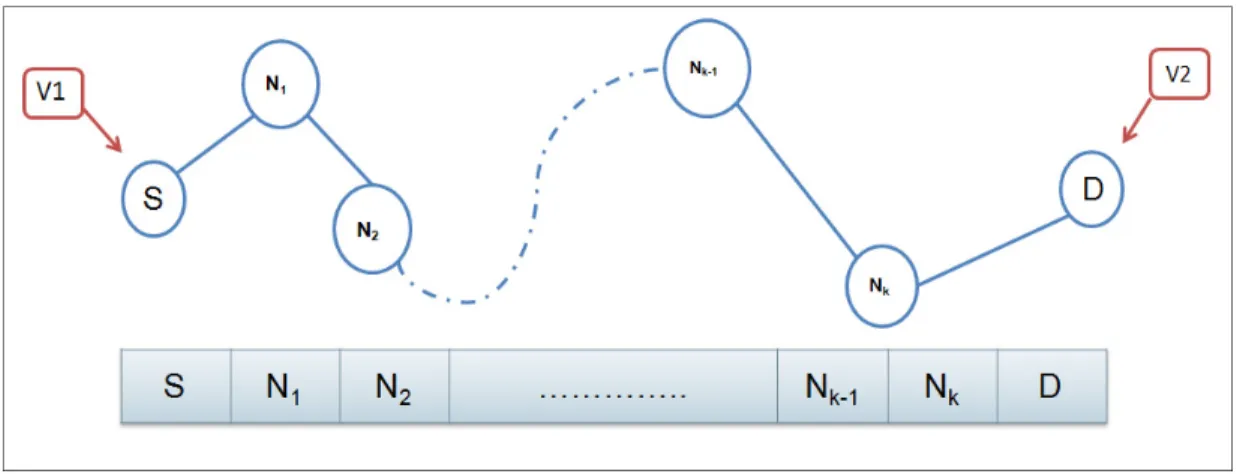
Next, we explain how we employed the CRO to solve our ILP described in Section 3. The molecule encoding, we used for our CRO-based algorithm is illustrated in Figure 2.1, with the path represented by an array containing the set of nodes representing the flow path to go from the source node S to the destination node D (where our VNFs are hosted).
The Algorithm 2.2 allows generating a set of initial solutions for the delay minimization problem. This is done by starting the construction of the path from the intended source node and then continuously picking a random node from the neighborhood, provided that this node is different from the destination node, and was not previously selected in the path. This process is repeated continuously while changing the index of the source node after each addition of a new member until reaching the destination node.