A Load-balancing Mechanism for Distributed SDN
Control Plane Using Response Time
Jie Cui, Qinghe Lu, Hong Zhong, Miaomiao Tian, and Lu Liu,
Member, IEEE
Abstract—Software-Defined Networking (SDN) has become a popular paradigm for managing large-scale networks including cloud servers and data centers because of its advantages of centralized management and programmability. The issues of scalability and reliability that a single centralized controller suffers makes distributed controller architectures emerge. One key limitation of distributed controllers is the statically configured switch-controller mapping, easily causing uneven load distri-bution among controllers. Previous works have proposed load-balancing methods with switch migration to address this issue. However, the higher-load controller is always directly considered as the overloaded controller that need to shift its load to other controllers, even if it has no response time delay. The pursuit of absolute load-balancing effect can also result in frequent network delays and service interruptions. Additionally, if there are several overloaded controllers, just one controller with the maximum load can be addressed within a single load-balancing operation, reducing load-balancing efficiency.
To address these problems, we propose SMCLBRT, a load-balancing strategy of multiple SDN controllers based on response time, considering the changing features of real-time response times versus controller loads. By selecting the appropriate re-sponse time threshold and dealing with multiple overloading controllers simultaneously, it can well solve load-balancing prob-lem in SDN control plane with multiple overloaded controllers. Simulation experiments exhibit the effectiveness of our scheme.
Index Terms—Software-defined network, load-balancing, mul-tiple controllers, response time, switch migration.
I. INTRODUCTION
W
ITH the rapid development of Internet and innovations in technology, SDN is revolutionizing the networking industry by enabling programmability, easier management, and faster innovation [1]. Many benefits are made possible by the its centralized control plane architecture, which allows the network to be programmed by the application and controlled by one central entity. However, like any other centralized system, the single centralized controller faces the issues of scalability and reliability. For large-scale networking scenarios consisting of several hundreds of thousands of servers, a single centralized controller is difficult to manage these network topologies. Hence, the next feasible step is building a logically centralized, but physically distributed control plane, which can benefit from the scalability and reliability of the distributedJ. Cui, Q. Lu, H. Zhong, and M. Tian are with the School of Com-puter Science and Technology, Anhui University, Hefei 230039, China, the Anhui Provincial Key Laboratory of Network and Information Security, Wuhu, Anhui 241002, China, and the Anhui Engineering Laboratory of IoT Security Technologies, Anhui University, Hefei 230039, China (e-mail: [email protected]).
L. Liu is with the School of Electronics, Computing and Mathematics, University of Derby, Derby DE22 1GB, UK (e-mail: [email protected]).
architecture, while preserving the logical control of the SDN [2].
Some previous works have explored the architecture of distributed SDN controllers [3]–[5]. However, the mapping between a switch and a controller is statically configured, making it difficult for the control plane to adapt to traffic load variations [1]. Therefore, the distributed architecture introduces a new challenge: load-rebalancing the controllers when uneven load distributions occur [6].
The concept of multiple-controller SDNs has also been put forward. For example, OpenFlow v.1.3, an SDN southbound interface protocol, can functionally address controller failover and load-balancing [7]. An SDN controller has three roles: master, slave, and equal. A controller may change its role at any time, but only the controller in master state has full access to the switch. It allows dynamic switch migration can be an effective and easy approach to load-balancing among distributed controllers. If seriously uneven load distributions occur among controllers, load-balancing with switch migration should be done. Additionally, if the controller pool is grown or shrunk as per traffic conditions, load-shifting across controllers should also be conducted.
With dynamic switch migration, the performance and scal-ability of distributed controllers may be effectively increased. Dixit et al. [8] first propose an efficient protocol to enable switch migration across multiple controllers, called ElastiCon. In their method, the nearest-neighbor controller was selected as the immigration controller for receiving load-shifting. In [9], a dynamic and adaptive load-balancing (DALB) algorithm was proposed. The maximum load controller was selected by com-paring its load value to an adaptive load collection threshold. Then, a heavy-load switch is chosen to migrate to a low-load controller. Many methods have been proposed to solve the election issue of outmigration and immigration controllers [2], [10]–[12]. During the process of load-balancing, we usually need to judge when the controllers’ loads are unbalanced and make an effective decision about how to shift loads. There-fore, a threshold value is necessary for selecting overloaded controllers. Moreover, switch migration might be frequently executed if we pursue absolute load-balancing across multiple controllers. Migration costs are unavoidable, and the message exchanging costs cannot be negligible during switch migration. In [13], a switch migration and decision-making (SMDM) scheme was presented to get an optimum decision for the tradeoff between migration costs and the load-balancing rate. The largest load controller over the load threshold value is always directly set as the overloaded controller in near-current load-balancing methods without determining whether
the controller load is close to its bottleneck. It invariably leads to frequent load-shifting. Migrating a switch from one controller to another can cause disruption to ongoing flows, which can severely impact the various applications in the datacenter.
To avoid frequently unnecessary operations, we take full advantage of the changing features of response time and controller load and propose a novel load-balancing scheme, the SDN multiple controller load-balancing strategy based on response time (SMCLBRT). In case the controller has a normal response time for every flow request, the process of migrating switches is unnecessary and unwanted. If its response time has increased significantly, we assess the controller load as close to its capability bottleneck. Thus, an effective load-balancing method should be triggered. Additionally, if there are several overloaded controllers, only the controller with the maximum load can be handled in a single operation, which could reduce efficiency. To address this problem, we design a method that can handle multiple overloaded controllers with just one operation.
In this paper, we focus on designing a logical load-balancing strategy via switch migration. To the best of our knowledge, it is the first work to measure controller loads and perform load-balancing operations by using response time. In summary, the main contributions of this paper are as follows.
• We validate the changing features of response time versus controller load, which can accurately judge the growth trend of controller’s response time as load increase. • We use the response time to measure the controller’s load,
and we get an appropriate response time threshold to achieve a better detection of overloading controllers so that they can be handled ahead of time.
• To improve load-balancing efficiency, we propose a novel switch migration algorithm to handle several overloaded controllers in a single load-balancing operation if there is more than one controller overload.
We have structured the paper as follows. Section II discusses related works. In Section III, we detail the design approach of SMCLBRT. Then, Section IV illustrates an implementation environment and Section V discusses performance evaluation from four aspects. Finally, we conclude with our findings and future work in Section VI.
II. RELATEDWORKS
This section reviews recent research achievements of dis-tributed controllers and load-balancing approaches that sup-port the representation of our research background and its theoretical foundation. We address three aspects, including the SDN load-balancing method, SDN-distributed controllers, and load-balancing in the SDN control plane. The first aspect explains the traditional load-balancing method and the SDN-based load-balancing method. Then we detail the distributed architecture of the SDN control plane and its challenges. The last aspect shows some research progress of load-balancing in the SDN control plane.
A. Load Balance with SDN
In traditional networks, load-balancing implies two mean-ings. First, the large number of concurrent accesses or network packets should be allocated to multiple node devices to reduce user response times. Second, a single heavy-load operation should be assigned to multiple node devices for parallel pro-cessing to significantly improve overall performance [14]. The main application scenarios of load-balancing include server and link load-balancing. Traditional network load-balancing technology includes hardware and software implementation. For example, NGINX [15] and HAProxy [16] are based on the forwarding of a four-layer interaction technology or an agent of the seven-layer protocol. However, in traditional networks, it is not easy to realize the load-balancing strategy globally, because it is difficult to obtain the whole network status. Additionally, the traditional load-balancing method is also difficult to adapt to changes and adjustments of the network state [17].
As a novel network paradigm, SDN can outsource the control permissions of programmable network switches to a software controller. The SDN controller manages all the network devices to ensure the intelligent network. It allocates network resources dynamically and flexibly, according to different users’ needs and global network topology. For the data layer, it communicates with the network infrastructure through a standard southbound protocol; For the application layer, it provides control of the network resources through an open northbound interface. The most fundamental task of an SDN controller is the correct implementation of the network policy, such as the intended load-balancing behavior. With the programmability and flexibility of SDNs, a controller is usually used as a load balancer in traditional networks for traffic-scheduling and load-management. The way of software customizing approach can reduce the requirements of hard-ware equipment. Therefore, SDN can be used to achieve link and server load-balancing in traditional networks. A fuzzy synthetic evaluation mechanism [18] is a path load-balancing solution based on SDN which effectively balances traffic and avoids unexpected breakdowns caused by link failure. It increases the utilization and reliability of network paths. [19] proposed an OpenFlow-based dynamic load-balancing strategy for datacenter networks, and it enables the efficient use of the network resources capacity. Load-balancing based on server response time [20] is also an effective server load-balancing scheme. It achieves a better load-load-balancing effect in comparison with the traditional Round Robin and Random schemes.
B. SDN Multiple Controllers
In some network cases, a centralized SDN controller (e.g., NOX [21]) can be well-used in traditional network traffic control and management. However, as the management and control center of network flows, the performance of the SDN controller is also affected by its processing load. With the deployment of SDN in application scenarios including cloud computing and big data, the massive requests of unmatched traffic to the single SDN controller can make the safety and
performance of the SDN control plane a potential bottleneck of the whole network [22], [23].
The distributed SDN controller architecture can be a good solution for limiting the control layer processing capability of centralized controllers, including HyperFlow [3] and Onix [4]. Beacon [24] improves the performance of each controller in the control plane with its multithreaded designs. Kandoo [25] implements a distributed control plane through a cluster of SDN nodes to improve the scalability and reliability of the control plane. [26] designed a hybrid hierarchical control plane for flow-based large-scale SDN networks to improve the scalability of the SDN control plane. These methods effective-ly solve the performance bottlenecks of a single centralized controller. However, multiple SDN controllers may bring some new challenges, including load imbalances between multiple controllers caused by the uneven distribution of network traffic and the problem of control information synchronization.
C. Load Balance in SDN
In the SDN distribution control plane, the mapping between OpenFlow switches and SDN controllers is static. With the dynamic change and instantaneity of network traffic, there is an uneven load distribution among controllers [8]. The static switch-controller mapping causes load imbalances and reduces the overall resource utilization, leading to sub-optimal performance [13].
In OpenFlow 1.3 protocol [7], a switch can be connected to multiple SDN controllers, allowing its load to be migrated between different controllers. Recent works focused on load-balancing methods of distributed controllers using switch migration. A switch migration protocol for SDN multiple controller load-balancing was first proposed in [8]. In this protocol, authors put forward a distributed nearest migration algorithm to save migration time by selecting the nearest con-troller to receive load-shifting, which might bring about new load imbalance. Zhouet al.[9] proposed a dynamic algorithm (i.e., DALB) totally based on a distributed architecture with an adaptive load threshold. Liang [10] proposed a dynamic load-rebalancing method based on switch migration for clustered controllers. This method also supports controller failover and avoids the single point of failure problem. However, it signifi-cantly increases the response time of the control layer. Cheng
et al. [11] designed the maximizing resource utilization mi-gration algorithm (MUMA). When the workload distribution is uneven, the overloaded controller randomly selects a switch to migrate. However, the overloaded controller still could be overloaded after migration. In [27], Yu J et al. proposed a load-balancing mechanism based on a load informing strategy. Each controller periodically reports its load information to other controllers so that an overloaded controller no longer collects all other controllers’ load information before making local decisions. The above studies do not consider the multiple overloaded controllers and have no fine-grained judgment of controller load.
In more recent works focusing on SDN multiple controller load-balancing, [13], [28] have pursued the efficiency of switch migration and decision-making. SMDM [13] proposed
a migration efficiency model to make a tradeoff between migration cost and the load balance rate. This scheme is finely designed to select a reasonable migration pairing. However, it also might cause a new load imbalance after migration because of its long load-balancing time. Additionally, it has a sub-optimal load-balancing performance. Reference [28] proposed a load-balancing scheme based on switch groups. It selects a migrating switch group depending on excess workload, effectively reducing the number of decisions. However, it increases the number of migrated switches and pursues an overall load-balancing rate, which brings extra unnecessary migration costs.
III. THEDESIGN OFSMCLBRT
Usually, in an SDN network, once a switch receives a packet matching a non-corresponding flow table entry, it needs to encapsulate the header of the packet into a PACKET IN message and send it to its master controller for routing and flow-table entry installation. The processing of PACKET IN messages is generally regarded as the most prominent part of the controller load [29], [30]. Thus, the enormous dis-tributional difference of PACKET IN messages might lead to unbalanced workloads among multiple controllers. Some controllers may reach their performance bottlenecks with the significantly increasing number of response delays, whereas other controllers are under normal loads or in an idle state.
In this section, we propose the SMCLBRT scheme for balancing in the distributed SDN control plane with multiple overloaded controllers, making a fine-grained judgment on overloaded controllers based on response time. As with other switch migration schemes, load-balancing in the SDN control plane includes three phases: the measurement of the load imbalance of controllers; the decision-making of migration plans with the selection of overloaded controllers, main load switches, and immigration controllers; and the implementation of the migration plans to shift loads of overloaded controllers.
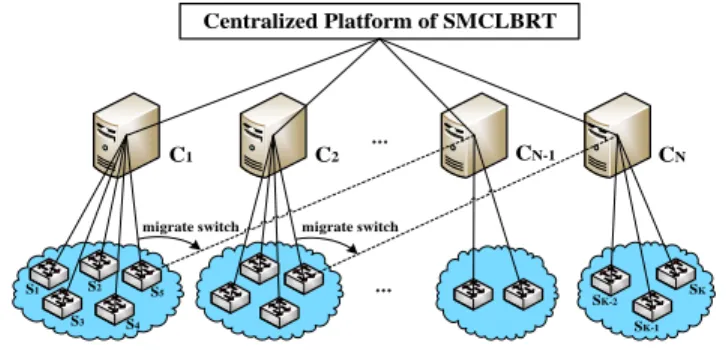
Centralized Platform of SMCLBRT CN migrate switch C2 C1 CN-1 migrate switch S1 S3 S2 S4 S5 SK SK-1 SK-2
Fig. 1. System model.
The system model is shown in Fig. 1. We consider an SDN networkGconsisting ofN controllersC={C1, C2, . . . , CN}
and K switches S = {S1, S2, . . . , SK}. These controllers
have the same performances and divide the network into N
domains. In each domain, the network traffic and controller workload are dynamically changed. Let QCi ∈S denote the
switch set managed by a master controllerCi. In the rest of
this section, we explain the detailed design of SMCLBRT from four parts.
A. Response Time Acquisition and Load Measurement
In our scheme, a new module is added for periodic statistics and the calculation of response time at a time interval,T. We letSk andTn to represent thekthswitch and thenthperiod,
respectively. Let tarrive denote the PACKET IN message
arrive time andtreplydenote the time that the controller replies
a PACKET OUT message or a FLOW MOD message to the corresponding switch. Thus, we easily get the response time to the single PACKET IN request, as shown in the Eq. (1).
tresponse=treply−tarrive (1)
Meanwhile, we record the number of request messages from Sk, in Tn (denoted as fSkTn), and use it to indicate
the workload brought by Sk in Tn (denoted as LoadSkTn).
Therefore, the sum-load of these switches in the set QCi
can be used to represent the total number of received request messages fCiTn or the workload LoadCiTn of the controller Ci in the nthperiod, as shown in the Eq. (2).
LoadCiTn=
X
Sk∈QCi
fSkTn (2)
We denote the response time to the whole PACKET IN requests sent from Sk in Tn as tSk response. Therefore, the
total response time of all the accepted messages byCi inTn
can be easily obtained. After getting these data, we can directly obtain the average response time to a single PACKET IN message with a time intervalT.
tCiTn= P Sk∈QCi tSk response LoadCiTn (3)
B. The Appropriate Threshold based on Response Time
As with the server load-balancing in traditional network, reasonable design and accurate judgement of overloaded con-trollers is inevitable and important. In previous researches on controllers’ load-balancing, most of them use some indicators directly related to controllers’ workload as threshold, such as load or average load diversity. However, the value of these indicators are generally empirical or random values, and it is difficult for them to achieve the best detection of load imbalance. If the threshold is too small, load imbalance is easy to occur due to the traffic transient, which will lead to frequent balancing operation, resulting in huge migration cost and poor network stability. However, a high threshold leads to a low balance rate. That is to say, some controllers have poor processing ability, while others are still in a relatively idle state. Therefore, selecting the appropriate threshold is partic-ularly important for accurate judgement of load imbalance, and it is very helpful for timely detection and processing of overloaded controllers.
From the user’s point of view, the response time of their request messages is the most critical factor in determining the quality of the network [31]. Additionally, the response time can also measure the load difference of controllers with the same performance. The response time of the controller to the request directly affects the waiting time of the packet for forwarding. In other words, response time can affect network
2000 500 1000 1500 2000 2500 3000 4 8 12 16 20 24 28 32
Packet arrival frequency (in pkts/sec)
A ver ag e r es po ns e t im e ( in m sec)
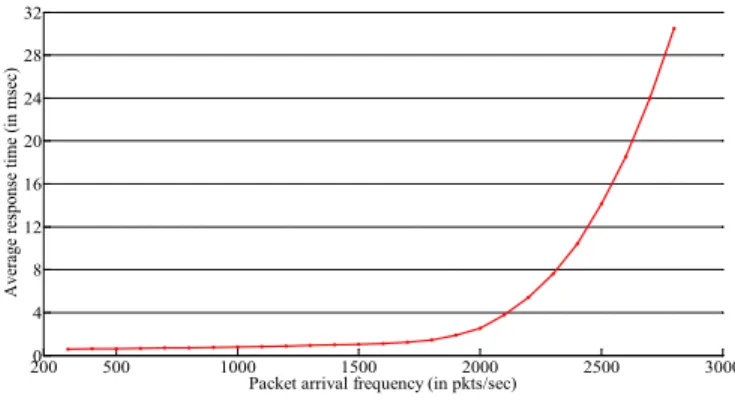
Fig. 2. Changing curve of response time to controller load.
latency and network service quality. Therefore, in the rest of this subsection, we will make full use of response time to select the appropriate threshold, which can also achieve the tradeoff between balance rate and migration cost.
Firstly, we need to test the average response time under different load. We choose an SDN controller and get its average response time to a single PACKET IN request mes-sage via the aforementioned method in Part A. In this test, the Java-based SDN controller, Floodlight [32], is selected to carry out a larger number of tests and experiments with an increasing PACKET IN arrival rate from 300 packets-per-second to 3,000 packets-per-packets-per-second with an interval of 100 for every period. Through many experiments, we select some the relatively stable data and obtain the average response times of the controller at different packet rates. By integrating the data and fitting the curve, we can draw these data into a curve diagram, as shown in Fig. 2.
Secondly, from the changing curve, we can get some change features of response time versus controller’s load. In the beginning, the controller is in low-load, and the response time increases slowly as load increases, and the changing range is less than 0.5 ms. When the controller is under normal-load state, the change in response time is accelerated. However, when the controller is in heavy-load, the response time increases obviously.
Lastly, we need to select the appropriate response time threshold according to its variation feature. With the con-troller’s load increasing from normal state to overloaded state, the response time increases faster. So we can obtain the appropriate threshold tthreshold by calculating the extremum
of response time variation. Let g(ti−1) denote the average response time in the(i−1)thperiod. Thus,g(ti)can represent
the average response time in the ith period, when the packet
arrival frequency has increased 100 packets-per-second. So we can easily calculate the first and second order by the formulation (4) and (5) below at the end ofith period.
g0(ti) = g(ti)−g(ti−1) ti−ti−1 (4) g00(ti) = g0(ti)−g0(ti−1) ti−ti−1 (5) From the formulation above, we can get the appropriate threshold tthreshold on the extremum point in the change
Algorithm 1 Load-Balancing Detection and Trigger Input: A={tC1Tn, tC2Tn,· · ·, tCNTn},tthreshold
Output: OM C,IM C
1: initialize controller set OM C={ }andIM C={ } 2: letibe the serial number of the compared controller
3: fori= 1→Ndo 4: select tCiTn fromA 5: if tCiTn > tthresholdthen 6: addCi toOM C 7: else 8: addCi toIM C 9: end if 10: end for 11: returnOM C,IM C
curve. Before this point, although the response time increases as load increases, it changes slowly and lightly. That is to say, the increasing on controller’s load has little effect on users’ message request. But after this point, the response time increases faster. If the controller’s load keeps increasing, the response time will increase significantly. Therefore, if the controller’s response time reaches this threshold, we need to quickly process this controller to prevent its response time from increasing rapidly. In this way, we can well select the appropriate response time threshold to realize the tradeoff between balance rate and balance cost.
C. Detection and Triggering of Load-Balancing
In Part B, the abrupt and continuous increase of response time can be used to choice the best time for load-balancing. Here, what we need to do is compare all controllers’ response time to the appropriate threshold to find out which controller is easy to approach its performance bottleneck and tend to a heavy-load state.
After obtaining the set A={tC1Tn, tC2Tn,· · · , tCNTn} to
represent the response time value of N controllers in a time interval, we can get the overloaded controllers. To effectively identify overloaded controllers and to reduce the complexity of choosing load-shifting pairs, we use two sets, OM C
and IM C, to denote the overloaded controllers and low-load controllers. We check controllers’ response time with the threshold and decide which controllers should be selected as the set OM C of outmigration controllers and which should be selected as the setIM Cof immigration controllers. If the response time satisfies that tCiTn > tthreshold, the controller Ci is added to OM C. Accordingly, if tCiTn ≤ tthreshold,
the controllerCi is added toIM C. In time intervalTn, we
calculate the setOM C andIM C by obtaining the average response time set Aof all controllers.
In this subsection, we decide whether we need to carry out load-balancing by generating the two controller sets. We describe the algorithmic process of load-balancing detection and triggering as Algo. 1.
D. Decision on Switch Migration
To better improve the efficiency of load-balancing, we pro-pose a switch migration method based on Algo. 1 to achieve
Algorithm 2 Switch Migration Decision
Input: OM C,IM C, load information of all the switches Output: P: switch migration actions set
1: initialize migration set P ={ }
2: while (OM C∩IM C isNotEmpty ) do 3: Cu=M AXCi∈OM C{LoadCiTn} 4: Se=M AXS k∈QCu{LoadSkTn} 5: Cv=M INCi∈IM C{LoadCiTn} 6: addhCu, Se, CvitoP 7: removeCu fromOM C 8: removeCv from IM C 9: end while 10: return P
multiple switch migration operations in a single load-balancing detection, when there are several overloaded controllers. It can well-realize the load-shifting of multiple controllers, greatly saving load-balancing time. If the load-balancing operation in Part C is activated, we can get the outmigration and immi-gration controller sets. From the sets, OM C and IM C, the steps below can elaborate the decision-making of switch migration setPwhich are formulated as a series of migration actions indicated by the triplet, hCu, Se, Cvi. For the first,
if the judgement condition, OM C∩IM C isNotEmpty, is TRUE, both the set OM C andIM C are not NULL, that is to say, there must be an overloaded controller that need to be balanced and a low-load controller that can accept load-shifting. So in this case, load-balancing with switch migration is required. Then we need to conduct the steps below to generate the migration action for each overloaded controllers.
Step 1: Choose the first controller Cu with the largest
response time set OM C, which has the biggest workload. Then, the switch with the most serious impact in the overload-ed controller will be selectoverload-ed to migrate. Of course, switchSe,
with the maximum switch load, is also selected.
Step 2: In set IM C, all controllers’ response times are basically close, and the load comparison cannot be judged according to the response time value. Thus, we directly choose the first controller Cv with the smallest workload to receive
the load migration. At this point, add the selected triplet
hCu, Se, Cvi into switch migration set P. Then, we remove
Cu fromOM C andCv fromIM C.
Step 3: Next, we can get three updated sets: outmigration controller setOM C, immigration controller setIM C, and switch migration setP. Then, we repeatStep 1andStep 2to select new triplets intoP until there is an empty set inOM C
andIM C.
The pseudo-code of switch migration decision is given as Algo. 2.
Finally, we obtain the switch migration actions and finish the load-shifting by changing management roles of migrated switches. Through the switch migration set generated by Algo. 2, we have made migration decisions for multiple overload controllers. The real implementation of load-balancing is done by the migration execution module. By completing this im-plementation process, our scheme can truly realize the multi-controller load-balancing operation.
IV. THEIMPLEMENT OFSMCLBRT
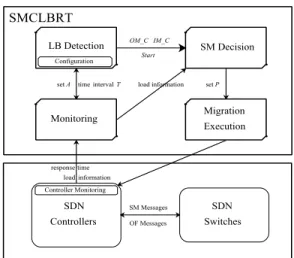
We next describe a load-balancing framework based on SMCLBRT, as illustrated in Fig. 3. We consider a framework that can dynamically balance the load distribution among multiple controllers. It can finely distinguish which controller will have a high delay close to its performance bottleneck. The following four modules are needed to support the centralized management platform: monitoring module, load balance detec-tion module, switch migradetec-tion decision module, and migradetec-tion execution module.
The monitoring module is used for periodic collection and statistics of average controller response times. Meanwhile, it also stores real-time load information of each controller and their switch sets. This module provides the response time data to the load balance detection module. If the load-balancing operation is activated, it also offers switch migration decision module load information.
The load balance detection module periodically calculates the mean of all controllers’ average response times and com-pares it with the set threshold. If there is a load imbalance, this module will trigger the switch migration module and provide the sets,OM C andIM C, to it. Our scheme is designed in a network environment with unified controller performance. However, the performance of the controller is different be-tween different network environments. So we need to retest the change curve and find the appropriate response time threshold using the same method in Part B. On the other hand, the lifetime of flow entries of different types of controllers is different, so the time interval, T, also needs to be adjusted. Therefore, we reserve a submodule to better configure the time interval and response time threshold, so that SMCLBRT can well-adapt to different network environment requirements.The switch migration decision moduleis responsible for generating switch migration decisions and does not need to perform the switch migration process. It implements Algo. 2, which can output the migration actions expressed as a set P of triplet
hCu, Se, Cviby obtaining controller sets OM C andIM C
and switches’ load information. Then, this module provides the generated migration actions to corresponding migration execution modules.
The migration execution moduleprovides the specific execu-tion of the migraexecu-tion acexecu-tions setP. For each migration action, it informs the involved controllers about mapping changes. It also requires controllers to send the corresponding migration messages to change control roles [8].
The centralized platform is designed to finely evaluate con-troller loads and perform real-time detection for load imbal-ance and multiple action decisions for overloaded controllers. Note that the centralized platform only needs to periodically acquire real-time average response times from all controllers. Consequently, it should not have any performance bottlenecks in normal circumstances. In each individual controller, the controller monitoring module is responsible for collecting PACKET IN messages and calculating response times. More-over, the migration execution also needs it to achieve changes to switch-controller mappings.
In the simulation experiment, we deploy Floodlight [32]
SMCLBRT SDN Controllers SM Decision Migration Execution Monitoring SDN Switches response time Controller Monitoring OF Messages set A time intervalT OM_C IM_C set P Start load information LB Detection Configuration load information SM Messages
Fig. 3. Basic architecture of SMCLBRT.
as the SDN controller. The time interval, T, was set at 5 s in our simulation environment. A short time interval will greatly increase monitoring and computational overhead, and may result in frequent migration. A long time interval may miss out some important network state information, because the default survival time of flow entry in Floodlight controller running is 5 s.
We simulate the real internet service topology, BT Asia-Pacific (i.e., 20 nodes) from the Internet Topology Zoo [33] to make this scheme more similar to the real network scenario. In the network environment of this paper, all switches are directly connected to each controller, but only managed by the master controller, which also conforms to the basic architecture of distributed SDN control plane. For the performance evaluation, we apply great stress on the control plane traffic load and avoid emulating the high overhead data plane or transmitting packets through data plane. Therefore, we choose a physical machine to run the lightweight network simulation tool, Mininet, and modify 20 Open vSwitches to inject PACKET IN messages to corresponding controllers. Another five physical machines are needed to set up five controller nodes: C1 to C5. We divide
the 20 nodes into five switch sets and assign them to five controllers for management.
V. PERFORMANCEEVALUATION
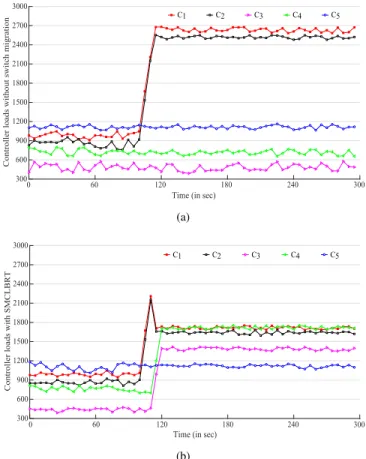
In the rest of this section, we mainly compare four schemes: Scheme I, static switch-controller mapping model; Scheme II, SMDM [13]; Scheme III, the method in [28]; and Scheme IV, SMCLBRT. We simulate the same experimental test environ-ment for these four schemes and run each simulation for 5 min. By choosing the two controllers and continuously increasing the PACKET IN request rate of their switches for 15 sec, we observe the load distribution changes under different schemes. For the first, we compare Scheme IV with Scheme I to verify the validity of our load-balancing scheme. By running the simulation experiment for 5 min, we record the load changes in two scenarios, one is under static switch-controller mapping and one uses the SMCLBRT approach. The load distribution in two scenarios are shown in Fig. 4(a) and Fig. 4(b), respectively. In Fig. 4(a), without any load-balancing, the
0 60 120 180 240 300 Time (in sec)
300 600 900 1200 1500 1800 2100 2400 2700 3000
Controller loads without switch migration
C1 C2 C3 C4 C5
(a)
0 60 120 180 240 300
Time (in sec) 300 600 900 1200 1500 1800 2100 2400 2700 3000
Controller loads with SMCLBRT
C1 C2 C3 C4 C5
(b)
Fig. 4. Five controllers’ load distribution. (a) under static switch-controller mapping; (b) under SMCLBRT.
loads of C1 and C2 keep increasing in 110 sec with about 2
ms response time and in 115 sec with about 6 ms response time. Finally, their response time arrive more than 15 ms and they keep in heavy-load state continuously. However, with our SMCLBRT method, the load-increasing switches of C1
and C2 are migrated to the low-load controllers,C3 andC4,
respectively in 115 sec. The increasing trend of C1 and C2
can be well prevented before 120 sec.
In the rest of this section, we compare with other schemes from the aspect of balance time, load distribution, migrated-switch number to verify the advantages of the overloading-controller detection by using the appropriate response time threshold and the simultaneous processing of multiple over-loading controllers in our scheme.
A. Balance Time
Fig. 5 shows the overloaded controllers’ load distribution before and after load-balancing operations under the three load-balancing schemes. The start time of load-balancing in our scheme is 105 sec, while the start time in Scheme II and III are 111 sec. Then, the end time of load-balancing in our scheme is 110 sec, while the end time in Scheme II and III are 120 sec.
From the results shown in Fig. 5, our scheme can balance the uneven load distribution in advance, and we use less time to deal with multiple overloaded controllers. From the user’s point of view, our scheme can reduce the response time of the
80 90 100 110 120 130 140 150 160 170 180 190 200 Time (in sec)
300 600 900 1200 1500 1800 2100 2400 2700 3000 Controller loads
Scheme II-C1 Scheme II-C2 Scheme III-C1 Scheme III-C1 Scheme IV-C1 Scheme IV-C2
Fig. 5. Load changes of overloaded controllers.
two overloaded controllers earlier and faster, which can also ensures a better overall response time.
Our scheme can start balance operation in advance, because we use the response time indicators to evaluate the controllers’ ability to handle switches’ request messages. So the load-balancing in our scheme starts earlier. On the other hand, in the balance processing, our scheme choose the switch that had the most serious impact on the response time of its master controller to migrate. In this way, the overloading controller can easily tend to normal-load state. Then, in the migrating processing, the two overloading controllers migrate their switches to low-load controllers simultaneous, which can achieve the parallel processing of multiple overloaded controllers in a single load-balancing detection operation.
B. Load Distribution
By continuously increasing the PACKET IN request mes-sage of switches for 15 sec, different schemes can achieve a good load-balancing effect and reach a stable-load state before 120 sec. We measure the average load value of each controller in stable-load state under different schemes. Letratiodenote the load distribution ratio, as shown in the Eq. (6). It can roughly estimate balance rate.
ratio=LoadCi
¯
Load (6)
whereLoadCi represents the workload of controller Ci, and
¯
Loadrepresents the average workload of five controllers. We compare the load distribution ratio in different scheme as shown in Fig. 6. Our scheme has a better balance rate after load-balancing operation than other schemes. Some reasons can explain this result. The selection of the response time threshold can help us to find out and deal with the overloading controllers ahead of time. In the continuous increase process of request messages of switches, our scheme timely migrate the load-increasing switches to the low-load controllers, C3 and
C4. Then, although the loads of C3 andC4 are continuously
increase for 5 sec, the response time value of them are smaller than the time threshold. In Scheme II and III, load-balancing operations start after the continuous increase for 15 sec. Then, what they need to do is to reduce the workload of the two heavy-load controllers.
Scheme II Scheme III Scheme IV 0.0 0.3 0.6 0.9 1.2 1.5 1.8 Load Ratio C1 C2 C3 C4 C5
Each controller under different schemes
Fig. 6. Balance rate of different schemes.
C. Migrated-switch Number
Switch migration is the main load-balancing means for multiple SDN controllers. However, if there are many switches that need to be migrated, normal network services may be affected with some request packet lost. We compare the number of migrated switches in the load-balancing process under each simulation. As shown in Fig. 7, under three load-balancing approaches, our scheme has the minimum number of migrated switches after load-balancing. In the migration decision processing, our scheme always select the switch that the most impact on its master controller’s response time for migration. Although this selection is unlike the migration decision in Scheme II that can generate the optimal migration triplet, we can reduce the controller’s response time at one migration operation, and do not need to do another migration in the next load-balancing processing.
In this network environment, all switches are directly con-nected to each controller, but only managed by the mas-ter controller. The switch migration process need switch-controller communication and migration time to guarantee liveness, safety and serializability [8]. The message exchange and migration time of each migration process is essentially the same. Suppose that the communication overhead and the migration time of migrating a switch from one controller to another is M com andt mig. LetN um mig to denote the number of migrated switch after the entire load-balancing is completed. So we can generally describe the communication overhead and migration time with N um mig∗M com and
N um mig∗t mig, respectively. With the minimum number of migrated switches, our scheme can reduce some commu-nication overhead and migration time in the overall balancing processing.
VI. CONCLUSION
In this paper, we investigated the problem of multiple overloaded controllers. The first, we do some research on the change features of response time versus controller’s load. Then, we selected the extremum point on the change curve as the appropriate response time threshold to get a tradeoff be-tween load balancing effect and migration cost. We presented our design of SMCLBRT, a novel load-balancing strategy via switch migration based on real-time response time. It makes
Scheme II Scheme III Scheme IV
0 1 2 3 4 5
Fig. 7. The number of migrated switches.
a fine-grained judgment on controllers’ workloads to timely find out the controller that might have a faster increase in its response time. Thus, our scheme provided a good load-balancing point for overloaded controllers to shift their load ahead of time. For quick balancing of multiple overloaded controllers, we also designed a switches selection algorithm to perform different switch migration operations simultaneously. The simulation results verify that our scheme can starts migration in advance and quickly reduce the workload for the overloading controllers. Therefore, SMCLBRT achieves load-balancing of multiple SDN controllers effectively and quickly. In this paper, we also have some problems that need to be improved and do some more research in the future. Our current simulation does not apply to most of load distribution patterns. In the next work in our simulation, we need to make more tests to well improve the adaptable of our scheme. The specific impact of migration processing on network quality need to be tested, and a real-time and adaptive selection of the appropriate response time threshold is also advanced in the future work. We also plan to study a better balancing approach of multiple overloaded controllers by considering the migration cost. In addition, we plan to consider some factors that cause the rapid and abnormal growth of controllers’ workload, such as DDoS attack on SDN controller.
ACKNOWLEDGMENT
The work was supported by the National Natural Science Foundation of China (No. 61572001, No. 61872001, No. 61702005), the Natural Science Foundation of Anhui Province (No. 1708085QF136), the Open Fund for Discipline Construc-tion Institute of Physical Science and InformaConstruc-tion Technology, Anhui University and the Excellent Talent Project of Anhui University. The authors are very grateful to the anonymous referees for their detailed comments and suggestions regarding this paper.
REFERENCES
[1] N. McKeown, T. Anderson, H. Balakrishnan, G. Parulkar, L. Peterson, J. Rexford, S. Shenker, and J. Turner, “Openflow: Enabling innovation in campus networks,”SIGCOMM Comput. Commun. Rev., vol. 38, no. 2, pp. 69–74, Mar. 2008.
[2] A. A. Dixit, F. Hao, S. Mukherjee, T. Lakshman, and R. Kompella, “Elasticon: An elastic distributed sdn controller,” in Proceedings of the Tenth ACM/IEEE Symposium on Architectures for Networking and
Communications Systems, ser. ANCS ’14. New York, NY, USA: ACM,
2014, pp. 17–28.
[3] A. Tootoonchian and Y. Ganjali, “Hyperflow: A distributed control plane for openflow,” inProceedings of the 2010 Internet Network Management
Conference on Research on Enterprise Networking, ser. INM/WREN’10.
Berkeley, CA, USA: USENIX Association, 2010, pp. 3–3.
[4] T. Koponen, M. Casado, N. Gude, J. Stribling, L. Poutievski, M. Zhu, R. Ramanathan, Y. Iwata, H. Inoue, T. Hama, and S. Shenker, “Onix: A distributed control platform for large-scale production networks,”
inProceedings of the 9th USENIX Conference on Operating Systems
Design and Implementation, ser. OSDI’10. Berkeley, CA, USA:
USENIX Association, 2010, pp. 351–364.
[5] D. Levin, A. Wundsam, B. Heller, N. Handigol, and A. Feldmann, “Logically centralized?: State distribution trade-offs in software defined networks,” in Proceedings of the First Workshop on Hot Topics in
Software Defined Networks, ser. HotSDN ’12. New York, NY, USA:
ACM, 2012, pp. 1–6.
[6] S. Sezer, S. Scott-Hayward, P. K. Chouhan, B. Fraser, D. Lake, J. Finnegan, N. Viljoen, M. Miller, and N. Rao, “Are we ready for sdn? implementation challenges for software-defined networks,”IEEE
Communications Magazine, vol. 51, no. 7, pp. 36–43, July 2013.
[7] B. Pfaff, B. Lantz, B. Heller, C. Barker, C. Beckmann, and et al., “Openflow switch specification 1.3.0,” https: //3vf60mmveq1g8vzn48q2o71a-wpengine.netdna-ssl.com/wp-content/ uploads/2014/10/openflow-spec-v1.3.0.pdf, 2012.
[8] A. Dixit, F. Hao, S. Mukherjee, T. Lakshman, and R. Kompella, “Towards an elastic distributed sdn controller,” inProceedings of the Second ACM SIGCOMM Workshop on Hot Topics in Software Defined
Networking, ser. HotSDN ’13. New York, NY, USA: ACM, 2013, pp.
7–12.
[9] Y. Zhou, M. Zhu, L. Xiao, L. Ruan, W. Duan, D. Li, R. Liu, and M. Zhu, “A load balancing strategy of sdn controller based on distributed deci-sion,” inProceedings of the 2014 IEEE 13th International Conference
on Trust, Security and Privacy in Computing and Communications, ser.
TRUSTCOM ’14. Washington, DC, USA: IEEE Computer Society, 2014, pp. 851–856.
[10] C. Liang, R. Kawashima, and H. Matsuo, “Scalable and crash-tolerant load balancing based on switch migration for multiple open flow controllers,” in2014 Second International Symposium on Computing
and Networking (CANDAR), vol. 00, Dec. 2014, pp. 171–177.
[11] G. Cheng, H. Chen, Z. Wang, and S. Chen, “Dha: Distributed decisions on the switch migration toward a scalable sdn control plane,” in2015
IFIP Networking Conference (IFIP Networking)(IFIP NETWORKING),
vol. 00, May 2015, pp. 1–9.
[12] L. Yao, P. Hong, W. Zhang, J. Li, and D. Ni, “Controller placement and flow based dynamic management problem towards sdn,” in2015
IEEE International Conference on Communication Workshop (ICCW),
June 2015, pp. 363–368.
[13] C. Wang, B. Hu, S. Chen, D. Li, and B. Liu, “A switch migration-based decision-making scheme for balancing load in sdn,”IEEE Access, vol. 5, pp. 4537–4544, 2017.
[14] M. Koerner and O. Kao, “Multiple service load-balancing with open-flow,” in2012 IEEE 13th International Conference on High Performance
Switching and Routing, June 2012, pp. 210–214.
[15] W. Reese, “Nginx: The high-performance web server and reverse proxy,”
Linux J., vol. 2008, no. 173, Sep. 2008.
[16] V. Kaushal and A. G. Bala, “Autonomic fault tolerance using haproxy in cloud environment,”International Journal of Advanced Engineering
Sciences and Technologies, vol. 7, no. 2, pp. 54–59, July 2011.
[17] T. Wood, K. K. Ramakrishnan, J. Hwang, G. Liu, and W. Zhang, “To-ward a software-based network: integrating software defined networking and network function virtualization,”IEEE Network, vol. 29, no. 3, pp. 36–41, May 2015.
[18] J. Li, X. Chang, Y. Ren, Z. Zhang, and G. Wang, “An effective path load balancing mechanism based on sdn,” in 2014 IEEE 13th International Conference on Trust, Security and Privacy in Computing
and Communications, Sept 2014, pp. 527–533.
[19] R. Trestian, K. Katrinis, and G.-M. Muntean, “Ofload: An openflow-based dynamic load balancing strategy for datacenter networks,”IEEE
Transactions on Network and Service Management, 2017.
[20] H. Zhong, Y. Fang, and J. Cui, “Lbbsrt: An efficient sdn load balancing scheme based on server response time,”Future Generation Computer
Systems, vol. 68, pp. 183 – 190, 2017.
[21] N. Gude, T. Koponen, J. Pettit, B. Pfaff, M. Casado, N. McKeown, and S. Shenker, “Nox: Towards an operating system for networks,”
SIGCOMM Comput. Commun. Rev., vol. 38, no. 3, pp. 105–110, Jul.
2008.
[22] L. Cui, F. R. Yu, and Q. Yan, “When big data meets software-defined networking: Sdn for big data and big data for sdn,” IEEE Network, vol. 30, no. 1, pp. 58–65, January 2016.
[23] L. Kuang, L. T. Yang, X. Wang, P. Wang, and Y. Zhao, “A tensor-based big data model for qos improvement in software defined networks,”
IEEE Network, vol. 30, no. 1, pp. 30–35, January 2016.
[24] D. Erickson, “The beacon openflow controller,” inProceedings of the Second ACM SIGCOMM Workshop on Hot Topics in Software Defined
Networking, ser. HotSDN ’13. New York, NY, USA: ACM, 2013, pp.
13–18.
[25] S. Hassas Yeganeh and Y. Ganjali, “Kandoo: A framework for efficient and scalable offloading of control applications,” in Proceedings of
the First Workshop on Hot Topics in Software Defined Networks, ser.
HotSDN ’12. New York, NY, USA: ACM, 2012, pp. 19–24. [26] Y. Fu, J. Bi, Z. Chen, K. Gao, B. Zhang, G. Chen, and J. Wu, “A hybrid
hierarchical control plane for flow-based large-scale software-defined networks,” IEEE Transactions on Network and Service Management, vol. 12, no. 2, pp. 117–131, 2015.
[27] J. Yu, Y. Wang, K. Pei, S. Zhang, and J. Li, “A load balancing mechanism for multiple sdn controllers based on load informing strategy,” in2016 18th Asia-Pacific Network Operations and Management Symposium
(APNOMS), Oct 2016, pp. 1–4.
[28] Y. Zhou, Y. Wang, J. Yu, J. Ba, and S. Zhang, “Load balancing for multiple controllers in sdn based on switches group,” in2017 19th
Asia-Pacific Network Operations and Management Symposium (APNOMS),
Sept 2017, pp. 227–230.
[29] A. Tootoonchian, S. Gorbunov, Y. Ganjali, M. Casado, and R. Sherwood, “On controller performance in software-defined networks,” in Proceed-ings of the 2Nd USENIX Conference on Hot Topics in Management of
Internet, Cloud, and Enterprise Networks and Services, ser. Hot-ICE’12.
Berkeley, CA, USA: USENIX Association, 2012, pp. 10–10.
[30] G. Yao, J. Bi, Y. Li, and L. Guo, “On the capacitated controller place-ment problem in software defined networks,” IEEE Communications
Letters, vol. 18, no. 8, pp. 1339–1342, Aug 2014.
[31] M. Al-Fares, A. Loukissas, and A. Vahdat, “A scalable, commodity data center network architecture,”SIGCOMM Comput. Commun. Rev., vol. 38, no. 4, pp. 63–74, Aug. 2008.
[32] FloodLight, “Open sdn controller,” http://www.projectfloodlight.org/ floodlight.
[33] S. Knight, H. X. Nguyen, N. Falkner, R. Bowden, and M. Roughan, “The internet topology zoo,”IEEE Journal on Selected Areas in
Com-munications, vol. 29, no. 9, pp. 1765–1775, October 2011.
Jie Cui was born in Henan Province, China, in 1980. He received his Ph.D. degree in University of Science and Technology of China in 2012. He is currently an associate professor in the School of Computer Science and Technology at Anhui University. His current research interests include applied cryptography, IoT security, vehicular ad hoc network, cloud computing security and software-defined networking (SDN). He has over 80 scientific publications in reputable journals (e.g. IEEE Trans-actions on Vehicular Technology, IEEE TransTrans-actions on Intelligent Transportation Systems, IEEE Transactions on Circuits and Systems, IEEE Internet of Things Journal, Information Sciences, Journal of Parallel and Distributed Computing), academic books and international conferences.
Qinghe Lu received his B.E. degree in computer science from Anhui University, Hefei, China, in 2016. He is currently pursuing his M.E. degree with the School of Computer Science and Technology, Anhui University, Hefei, China. His research focuses on software-defined networking (SDN).
Hong Zhongwas born in Anhui Province, China, in 1965. She received her PhD degree in computer science from University of Science and Technology of China in 2005. She is currently a professor and Ph.D. supervisor of School of Computer Science and Technology at Anhui University. Her research interests include applied cryptography, IoT security, vehicular ad hoc network, cloud computing security and software-defined networking (SDN). She has over 120 scientific publications in reputable journals (e.g. IEEE Transactions on Parallel and Distributed Systems, IEEE Transactions on Vehicular Technology, IEEE Transactions on Intelligent Transportation Systems, IEEE Transactions on Big Data, IEEE Internet of Things Journal, Information Sciences, Journal of Parallel and Distributed Computing), academic books and international conferences.
Miaomiao Tianwas born in Anhui Province, China, in 1987. He received his Ph.D. degree in computer science from University of Science and Technology of China in 2014. Currently, he is an associate professor in School of Computer Science and Tech-nology at Anhui University. His research interests include cryptography and information security.
Lu Liu is currently the Head of the School of Electronics, Computing and Mathematics and Pro-fessor of Distributed Computing at the University of Derby, and adjunct professor at Jiangsu Uni-versity. Professor Liu received his Ph.D. degree from University of Surrey. Professor Liu has over 170 scientific publications in reputable, academic books and international conferences, and has secured many research projects which are supported by UK research councils, BIS, Innovate UK, British Council and leading UK industries. He is the Fellow of British Computer Society.