University of Huddersfield Repository
Abuhabaya, Abdullah and Fieldhouse, John D.
Variation of Engine Performance and Emissions using Ethanol Blends.
Original Citation
Abuhabaya, Abdullah and Fieldhouse, John D. (2010) Variation of Engine Performance and
Emissions using Ethanol Blends. In: 36th International MATADOR Conference 2010, 14th - 16th
July 2010, Manchester, UK. (Submitted)
This version is available at http://eprints.hud.ac.uk/7841/
The University Repository is a digital collection of the research output of the
University, available on Open Access. Copyright and Moral Rights for the items
on this site are retained by the individual author and/or other copyright owners.
Users may access full items free of charge; copies of full text items generally
can be reproduced, displayed or performed and given to third parties in any
format or medium for personal research or study, educational or not-for-profit
purposes without prior permission or charge, provided:
•
The authors, title and full bibliographic details is credited in any copy;
•
A hyperlink and/or URL is included for the original metadata page; and
•
The content is not changed in any way.
For more information, including our policy and submission procedure, please
contact the Repository Team at: [email protected].
VARIATION OF ENGINE PERFORMANCE AND EMISSIONS USING
ETHANOL BLENDS
A. A. Abuhabaya1 and J. D. Fieldhouse2
1
Huddersfield University, Queensgate, Huddersfield HD1 3DH, United Kingdom
2
Huddersfield University, Queensgate, Huddersfield HD1 3DH, United Kingdom
Abstract. The limited fossil fuel resources along with the increased public concerns about pollution levels have increased the need for alternative fuels for use in internal combustion engines. This study is to investigate the variation of the engine performance and exhaust emissions of a spark ignition engine. A spark ignition engine running with gasoline and gasoline blended E5, E10 and E20. Effects of engine speeds between 1000 and 3500 rpm with intervals 500 rpm and throttle valve 25%, 50%, 75% and full throttle, on the engine performance and the emission concentrations are investigated. Improved engine performance and reduced emissions are observed with ethanol addition.
Keywords: Fossil fuel, Alternative fuels, Engine performance, Exhaust emissions
1.1 Introdcutaion
The Commission Green Paper ‘‘Towards a European strategy for the security of energy supply”, sets the objective of 20% substitution of conventional fuels by alternative fuels in the road transport sector by the year 2020 [1]. An extensive worldwide search is underway for alternative fuels to replace the conventional fossil fuels. The main reason is the increased prices, the very limited resources for such fossil fuels and increasing stringent environmental regulations. Growing concerns about greenhouse gas emissions will lead to an increase in biofuels and oxygenated fuels productions [2] .The application of biofuels [3, 4] and oxygenated fuels [5, 6] plays an important role in the alternative fuel for the internal combustion engines. The possible alternative fuels available in the market are diverse. Among the alternatives, ethanol usually comes from biomass that includes crops rich in sugar, starch or cellulosic material. Both spark ignition and diesel engines can use ethanol. It can be used as mixture with gasoline, both as a fuel, or after conversion into ETBE (Ethyl, Tertiary, Butyl, Ether), as an anti-knock additive.
Ethanol yields lower carbon dioxide (CO2) emissions
than gasoline and diesel. It produces low carbon monoxide (CO) and unburned hydrocarbons (HCs) emissions compared with gasoline but higher ones compared with diesel. The effects of ethanol addition to gasoline on a spark ignition engine performance and exhaust emissions were investigated experimentally and theoretically. It was found that the ethanol addition to gasoline has caused leaner operation and improved the combustion process. Engine performance parameters such as power and efficiency were increased with increasing ethanol amount in the blended fuel as a result of improved combustion. Regarding the exhaust emissions, the use of the gasoline–ethanol blends in spark ignition engine dramatically reduced the CO concentrations. However, NO concentrations were adversely affected due to the increased cylinder temperature with increasing ethanol proportion in the blend. As a result of these, many investigations of ethanol fuels have been carried out and applied to automotive engines, special interest being taking by the agricultural segments of society [7, 8].
However, it is true that ethanol fuel still has limitations in applying ethanol to engines and is widely used for automobile applications because of a cold-start problems resulting from modification of the engine design and fuel supply system in spark ignition engines. Moreover, the relatively low Reid vapour pressure compared with gasoline poses a challenge in spite of many advantages of ethanol. In addition, the high boiling point (78 oC) of ethanol causes vaporization difficulties in cold conditions, which leads to the cold-start problem. For this reason, fuels with lower ethanol content such as gasohol containing 10 vol% ethanol have been used in unmodified engines in previous research [9, 10]. There has been much research into the engine performance and emission characteristics of spark ignition engines fuelled with ethanol-gasoline blends.
The utilisation of the ethanol blends in spark ignition engines was reported by Hsieh et al. [11]. They experimentally investigated the variations of the engine
2 A. A. Abuhabaya1 and J. D. Fieldhouse2
performance and the emission levels using ethanol– gasoline blends with blending ratios of (0, 5, 10, 20, and 30%). Hsieh et al. reported that the use of ethanol– gasoline blends slightly increased the output brake torque of the engine. They presented the variation of the output torque as a function of the throttle valve opening percentage, and reported increased torque with the engine load, at fixed speed. They claimed that the increase was a result of the increased fuel quantities admitted to the cylinders. Higher engine torque of the blends compared with the gasoline, was also reported. In conclusion, they pointed out that ethanol addition has enhanced the combustion process, compared with gasoline. Hsieh et al. reported that the emission concentrations of the carbon monoxide (CO) and the unburned hydrocarbons (HC) were decrease with blending, as a result of the blending leaning effect of the fuel air mixture. However, increased concentrations of carbon dioxide (CO2) were reported
because of the enhanced combustion process with blending. The authors noted that the nitric oxide emissions (NOx) were independent on the ethanol content.
Al-Hasan [12] experimentally investigated the effects of utilising unleaded gasoline–ethanol blends on the performance and exhaust gas emissions of spark ignition engine. He tested petrol engine and evaluated the brake specific fuel consumption (BSFC), the engine volumetric efficiency, the brake thermal efficiency, the brake power and the brake torque. He also measured the concentration of the carbon monoxide (CO), carbon dioxide (CO2) and
the unburned hydrocarbons (HCs) for unleaded gasoline– ethanol blends with various blending ratio, at 75% of the engine load and at variable engine speeds of 1000, 2000, 3000 and 4000 rpm. He reported increased fuel consumption i.e. fuel mass flow rate with the increased ethanol amount in the blend. Wu et al. [9] also investigated the effect of the ethanol blends on the performance and emissions. Leaner conditions were reported with the increased ethanol in the blend. The engine torque slightly increased with blends and the emissions CO and HCs decreased, due to the oxygen enrichment. Jia et al. [13] investigated the emission characteristics of motorcycle engine utilising ethanol blend E10 (10% ethanol and 90% gasoline). They reported decreased CO and HC concentrations with the blend and slight decrease of the NOx. However, they reported increased NOx with the increased ethanol in the blend. Song et al. [14] investigated the effects of ethanol, as engine additive, on the emissions. They tested various ethanol blends and measured regulated emissions of CO, HC and NOx. They reported that ethanol addition produced lower regulated emissions compared with the other additive. The main conclusion of this study was the better effects of ethanol on the exhaust emissions. They tested various ethanol blends and measured regulated emissions of CO, HC and NOx. They reported that ethanol addition produced lower regulated emissions compared with the other additive.
1.2 Experemantal Apparatus
As shown in figure 1.1, the apparatus consists of eddy current dynamometer, exhaust gas emissions analyser, control system and data recording system.
Fig. 1.1. Photograph of the study state engine rig.
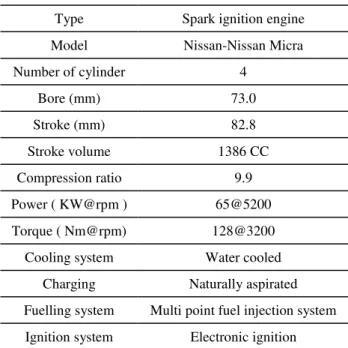
The engine used in this study has the specifications listed in table below.
Table 1.1. Test engine spicifecations.
Type Spark ignition engine
Model Nissan-Nissan Micra
Number of cylinder 4 Bore (mm) 73.0 Stroke (mm) 82.8 Stroke volume 1386 CC Compression ratio 9.9 Power ( KW@rpm ) 65@5200 Torque ( Nm@rpm) 128@3200
Cooling system Water cooled
Charging Naturally aspirated
Fuelling system Multi point fuel injection system
Ignition system Electronic ignition
1.3 Engine Performance Results and Discussion
1.3.1 Effect of engine speed on brake torque
Figure 1.2 shows that higher brake torque is obtained with the ethanol blends compared with gasoline, at all speeds. This is may be attributed to the increased
anti-knock resistance with ethanol addition, which increased the blends octane number. Generally, it was found that E20 performed the best, specifically at speeds higher than 1000 rpm, compared with the other fuels.
Fig. 1.2. Brake torque versus engine speed, at 25% full throttle
1.3.2 Effect of engine speed on (BSFC)
As shown in figure 1.3 decrease in the BSFC with speed is found and reached minimum at speed of about 2500 rpm. At higher speeds, further increase of speed increased BSFC. It is depicted from these figures that lower BSFC is found with the blended fuels over the range of test speeds. The more the added ethanol in the blend decreased more the BSFC.
Fig.1.3. BSFC versus engine speed, at 25% full throttle
1.3.3 Effect of engine speed on brake thermal efficiency
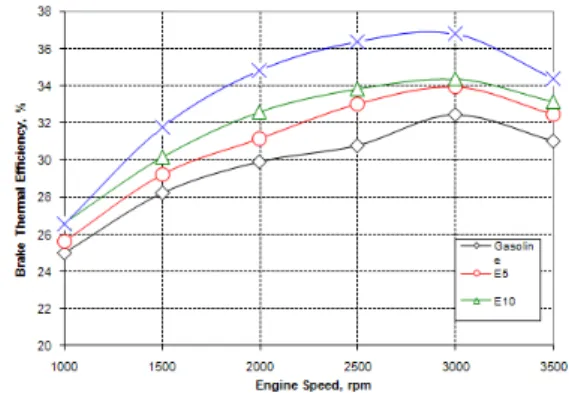
Substantial increase of the brake thermal efficiency is found with the engine speed. It reached maximum at speed of about 3000 rpm. For speeds higher than 3000 rpm, recognised decrease in efficiency is found. Also shown in figure 1.4 is that the lowest brake thermal efficiencies are found with gasoline. The efficiency
increased with the addition ethanol and reached maximum with E20 blend.
Fig. 1.4. Thermal efficiency versus engine speed, at 25% full throttle
1.4 Exhaust Emission Results and Discussion
1.4.1 Effect of throttle setting on the hydrocarbon
As shown in figure 1.5, the throttle valve increase up to 75% has nearly no effect on the HC concentration. Further throttle valve increase, up to 100% considerably increases the HC, at speed of 2000 rpm. This may be attributed to the increased turbulence generated with the throttle valve increase. The blend E5 showed the highest HC concentration compared with the other tested fuels. This behaviour of E5 is clear at the highest throttle valve of 100%. However, at the other throttle setting, the difference is not significant.
Fig.1.5. Effect of throttle on the HC at engine speed of 2000 rpm
1.4.2 Effect of throttle setting on the carbon monoxide
As shown in fighter 1.6, the increase of the throttle valve resulted in increased CO (%) emissions. This is may be
4 A. A. Abuhabaya1 and J. D. Fieldhouse2
because the increased throttle requires more charge combustion (fuel and air mixture), which may produce more CO emissions.
Fig.1.6. Effect of throttle on the CO, at engine speed of 2000 rpm
1.5 Conclusions
To analyse the effects of ethanol fuel on the combustion performance the reduction of exhaust emission were investigated in a four-cylinder spark ignition engine fuelled with an ethanol– gasoline blended fuel (E5, E10 and E20) as alternatives to petroleum gasoline fuel under
various experimental conditions. The following
conclusions were drawn from the results.
1. The brake torque and the brake specific fuel consumption were measured; the brake thermal efficiency was evaluated, as performance parameters, at 25 % of full throttle, for various engine speeds. The engine brake torque increased with engine speed. It reaches maximum at certain speed, then extremely remained decrease at maximum speed.
2. Ethanol blends produced higher torque,
compared with gasoline, at all speeds, at speeds higher than 2000 rpm, E20 performed best, compared with the other fuels as it produced 3.8% higher torque than gasoline, at 2500 rpm. At speeds of 3000 and 3500 rpm, it produced 3.9% and 8.6% higher torque than gasoline respectively.
3. Lowest brake thermal efficiencies are found for gasoline, for all test speeds. All blends showed recognised increase in the brake thermal efficiency with the speed. The maximum efficiency is found at speed of 3000 rpm. At speeds higher than 3000 rpm, the efficiency decreased considerably.
4. Blending gasoline with ethanol reduced the CO, and HC concentration.
5. Throttle valve increase, up to 100% considerably increases the HC, at speed of 2000 rpm.
6. At higher throttle valve of 100%, E20 blend showed the lowest HC.
7. The addition of ethanol decreased these
emissions and the lowest is found with blend E20.
1.6 References
[1] Directive 2003/30/EC on the promotion of the use of biofuels or other renewable fuels for transport, (2003) 8 May 2003, on the promotion of the use of biofuels or other renewable fuels for transport”, Official Journal of the European Union, L 123/43.
[2] Yoon SH, Ha SY, Roh HG, Lee CS, (2009) Effect of bioethanol as an alternative fuel on the emissions reduction characteristics and combustion stability in a spark ignition engine. Journal of Automobile Engineering 223:941-951
[3] Poulopoulos SG, Philippopoulos CJ, (2003) The effect of adding oxygenated compounds to gasoline on automotive exhaust emissions. Trans. ASME, J. Engng Gas Turbines Power 125: 344-350
[4] Marriott CD, Wiles MA, Gwidt JM, Parrish SE, (2008) Development of a naturally aspirated spark ignition direct-injection flex-fuel engine. SAE technical paper 20008-01-0319
[5] Zhang J, Qiao X, Guan B, Wang Z, Xiao G, Huang Z, (2008) Search for the optimizing control method of compound charge compression ignition (CCCI) combustion in an engine fueled with dimethyl ether. Energy Fuels 22:1581-1588
[6] Cataluna R, Silva R, Menezes EW, Ivanov RB, (2008) Specific consumption of liquid biofuels in gasoline fuelled engines. Fuel 87:3362-3368
[7] Jeuland N, Montagne X, Gautrot X, (2004) Potentiality of ethanol as a fuel for dedicated engine. Oil Gas Sci. Technol 59:559-570
[8] Topgul T, Serdar Y H, Cinar C, Koca, A, (2006) The effect of ethanol–unleaded gasoline blends and ignition timing on engine performance and exhaust emissions. Renewable Energy 31:2534-2542
[9] Wu C W, Chen RH, Pu JY, Lin TH, (2004) The influence of air–fuel ratio on engine performance and pollutant emission of an SI engine using ethanol–gasoline-blended fuels. Atmospheric Environment 38:7093-7100
[10] Yuksel F, Yuksel B, (2004) The use of ethanol– gasoline blend as a fuel in an SI engine. Renewable Energy 29:1181– 1191
[11] Hsieh WD, Chen RH, Wu TL, Lin TH, (2002) Engine performance and pollutant emission of an SI engine using ethanol–gasoline blended fuels. Atmospheric Environment 36:403–410
[12] Al-Hasan M, (2003) Effect of ethanol–unleaded gasoline blends on engine performance and exhaust emission. Energy Conversion and Management 44:547–1561
[13] Jia LW, Shen MQ, Wang J, Lin, MQ, (2005) Influence of ethanol–gasoline blended fuel on emission characteristics from a four-stroke motorcycle engine. Journal of Hazardous Materials A123:29–34
[14] Song CL, Zhang WM, Pei YQ, Fan GL, Xu GP, (2006) Comparative effects of MTBE and ethanol additions into gasoline on exhaust emissions. Atmospheric Environment 40:1957–1970