Low Complexity Multi-User MIMO Detection for
Uplink SCMA System Using Expectation
Propagation Algorithm
Alva Kosasih* , Onny Setyawati , and Rahmadwati University of Brawijaya
Jalan Veteran, Ketawanggede, Kec. Lowokwaru, Kota Malang, Jawa Timur 65145, (0341) 551611 *Corresponding author, e-mail: [email protected]
Abstract
Sparse code multiple access (SCMA), which combines the advantages of low density signature (LDS) and code-division multiple access (CDMA), is regarded as one of the promising modulation technique candidate for the next generation of wireless systems. Conventionally, the message passing algorithm (MPA) is used for data detector at the receiver side. However, the MPA-SCMA cannot be implemented in the next generation wireless systems, because of its unacceptable complexity cost. Specifically, the complexity of MPA-SCMA grows exponentially with the number of antennas. Considering the use of high dimensional systems in the next generation of wireless systems, such as massive multi-user MIMO systems, the conven-tional MPA-SCMA is prohibitive. In this paper, we propose a low complexity detector algorithm named the expectation propagation algorithm (EPA) for SCMA. Mainly, the EPA-SCMA solves the complexity problem of MPA-SCMA and enables the implementation of SCMA in massive MU-MIMO systems. For instance, the EPA-SCMA also enables the implemantation of SCMA in the next generation wireless systems. We further show that the EPA can achieve the optimal detection performance as the numbers of transmit and receive antennas grow. We also demonstrate that a rotation design in SCMA codebook is unnecessary, which is quite rather different from the general assumption.
Keyword: SCMA, expectation propagation, low complexity, detection, MU-MIMO
Copyrightc 2018 Universitas Ahmad Dahlan. All rights reserved.
1. Introduction
Next generation wireless networks are expected to satisfy tighter requirements such as massive connectivity, better quality of service, higher throughput, lower latency, and lower con-trol signaling overhead, than the fourth generation system. These requirements can be met with new waveform and access designs [1]. As one of the most promising non-orthogonal multiple access candidate, sparse code multiple access (SCMA) has been addressed to cover these re-quirements. SCMA features the advantages of code division multiplexing (CDMA) and low density signature (LDS) [2].
SCMA is a modulation technique that directly modulates each group of binary data into a complex multidimensional codeword. This codeword is taken from a codebook [1]. At the receiver side, the message passing algorithm (MPA) can be implemented to achieve near optimal detec-tion performance [3]. MPA calculates marginal distribudetec-tion for each transmitted signal, condidetec-tional on received signal. The completeness probability information in each MPA’s node results an out-standing performance of MPA. The sparsity of SCMA codeword makes a possibility to implement MPA on SCMA. However, the structure of MPA requires a recursive feedback message computa-tion on every iteracomputa-tion. Therefore, the complexity of MPA deteccomputa-tion grows exponentially with the codebook size.
To solve the complexity issue, many works have been completed either to reduce the complexity through the codebook design, using compressed sensing strategy [4, 5], or consider several extensions of the MPA, such as max-log MPA [6], SIC MPA [7], and even combined tensions of the MPA technique. However, these MPA-based detectors are suffering from an
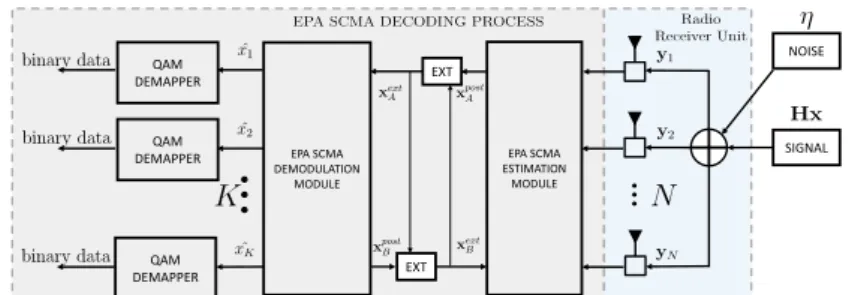
EPA SCMA ESTIMATION MODULE SIGNAL NOISE EPA SCMA DEMODULATION MODULE EXT EXT QAM DEMAPPER QAM DEMAPPER QAM DEMAPPER
Figure 1. Block diagram of uplink scheme SCMA receiver
ponentially incremental complexity because the structure of MPA is still remained. Specifically, if the codebook size or the degree of freedom significantly increased, the MPAs for SCMA quickly becomes prohibitive due to its computational complexity.
In this work, we solve the complexity problem of the MPA-SCMA. We adopt the EPA in [8] and apply the EPA to the SCMA detection. The EPA approximates the marginal distribution of the posterior probability by using an exponential family. Therefore, the complexity of EPA is much lower than MPA.
With the theoretical verification, 1) we evaluate the EPA-SCMA performance and show that the EPA for SCMA can achieve near optimal detection performance . 2) We prove that appending a rotation value [9, 10] in SCMA encoder is unnecessary. The removal of the rotation value can omit many unnecessary calculations not only in decoding but also in encoding. Our hypotheses are also verified by the experimental results.
2. Research Method
In this section, we explain our system model and the implementation of EPA in SCMA for massive MU-MIMO systems detection scheme. Our system model is configured based on the original SCMA codebook as in [1]. The implementation of EPA to SCMA will be described afterwards. Finally, the complexity comparison of our EPA-SCMA and the original MPA-SCMA will be discussed.
2.1. System Model
We consider a SCMA system withU users operating onS orthogonal subcarriers. Each user equipment featuresNt transmit antennas and the base station (BS) possessesNr receive antennas. LetK=U NtandN =SNr.
In the SCMA, each transmit symbolxk is transmitted overS subcarriers usingddegree,
and different phase rotation values are introduced at different subcarriers [1]. For example, if S= 4andd= 2, the mapping can be
φk = [φk,s] = e−j2π∆1 e−j2π∆2 0 0 ,hk = φk,1hk,1 φk,2hk,2 .. . φk,Shk,S .
where∆i ∈ [0,1), hk,s ∈ CNr denote the channel vector from the k-th transmit antenna to the BS at thes-th subcarrier. Therefore, at the BS, the N-dimensional channel output vector y is expressed asy=PK
k=1hkxk+η, whereηis the additive white Gaussian noise (AWGN) vector
with zero mean and covariance matrixσ2I. H=
h1h2 · · · hK, x=x1x2 · · · xK T
.Finally, we obtain
The input-output relationship of the SCMA can be viewed as a MIMO communication system with Kinputs andNoutputs.
2.2. EPA for SCMA
Alg. 1:EPA-SCMA Algorithm
Initialization:γ0B→A= 0,λ 0
B→A=E1sI, d(Q) =diag(Q);
fort= 1 :Tmaxdo
Estimation Module:
(1) Compute the a posteriori mean/variance ofxA:
vA,tpost=Σt=σ−2HHH+d(λtB−1→A) −1 (2a) xpostA,t =Σtσ−2HHy+γtB−1→A (2b) (2) Compute the extrinsic mean/variance ofxA:
vA,text= 1 d(Σt)−d(λ t−1 B→A) −1 (3a) xextA,t=d(v t A→B) µt d(Σt)−γ t−1 B→A (3b) Demodulation Module:
(3) Compute the a posteriori mean/variance ofxB:
xpostB,t ←E{x|xextA,t,vA,text} (4a)
vpostB,t ←Var{x|xextA,t,v ext
A,t} (4b)
(4) Compute the extrinsic mean/variance ofxB:
vextB,t=λ t B→A= 1 vB,tpost − 1 vext A,t !−1 (5a) xextB,t=γ t B→A= xpostB,t xpostB,t − xextA,t vext A,t !−1 (5b) end
The input vectorxto the equivalent MIMO channelH is a combined constellationΩ1× · · · ×ΩK, where Ωk is the set of constellation of the th transmission. Our target is to detect
transmitted signalsxover the received signalsyin a given full knowledge of channel matrixH. The complexity of the optimal detection grows exponentially with the size of the transmission and thus becomes prohibitive.
To solve this problem, we adopt the EPA in Alg.1 which is an iterative algorithm. As derived in our system model, the input-output relationship of SCMA can be configured as a MIMO communication system. Therefore, we can directly apply the EPA algorithm to the SCMA detector side. The detail of the EPA algorithm is the same as [8] and not mentioned in this paper due to limited space.
As shown in Figure 1b, the EPA-SCMA can be divided into two modules, i.e., estima-tion and demodulaestima-tion. In the estimaestima-tion module, given the channel model (1), we estimatex that minimizes the mean squared error (MMSE) given prior knowledge ofx. Let (xext
A ,vAext) and
(xpostB ,vBpost) be the input-output of demodulation module. The expectation and variance of the posterior estimator are computed as given by
xpostB ←E{x|xextA ,v
ext A },v post B ←Var{x|x ext A ,v ext A }. (6)
Specifically, considering that |Ωk| = M, the expectations in (6) are with respect toP(xk|xA,k),
which can be obtained by the Bayes rule P(xk|xA,k) = P(xA,k|xm)Px(xm) P(xA,k) , (7) where P(xA,k|xm)Px(xm) = 1 M 1 πvA,k exp −|xA,k−xm| 2 vA,k , (8) P(xA,k) = 1 M 1 πvA,k M X m=1 exp −|xA,k−xm| 2 vA,k . (9)
We then employ the performance analysis framework in [11] to develop the state evolution (SE) of the EPA-SCMA which is derived from a large scale system. For a large scale system, the extrinsic value of each EPA-SCMA module can be approximated by their average values, respectively. As given in [8], the input-output transfer function of estimation module can be derived from linear mean square error estimator, that is
vA=
K−1tr(σ−2HHH+vB−1I)−1
−1
−vB−1. (10)
where,tr{·}denotes trace operation,vAis average extrinsic value of estimation module, andvB
is average extrinsic value of demodulation module. Furthermore,vAcan also be regarded as the
SNR of the equivalent scalar additive white gaussian noise (AWGN) channel i.e. y = x+vAη.
Consistent with our assumption, wherevB andvA are the average extrinsic values of
demodu-lation and estimation EPA-SCMA modules, equivalent AWGN channel can be considered as a k-th channel underK users which has an identical channel value for everyk-th user. Similarly, we definevas the scalar version of (6). Therefore,v can be calculated byv =Var{x|xA, vA} =
E{|x−E{x|xA, vA}|2},where the expectation is with respect toP(x|xA)given by (7). Referring to
[8],vBcan be defined as
vB = v−1−vA
−1
. (11)
The iteration of the EPA is identical to the SE in (10) and (11) whose fixed points have MSE consistent with the MMSE from [12]. Moreover, the iteration of estimation and demodulation module can be traced from (10) and (11) without iterating the entire algorithm.
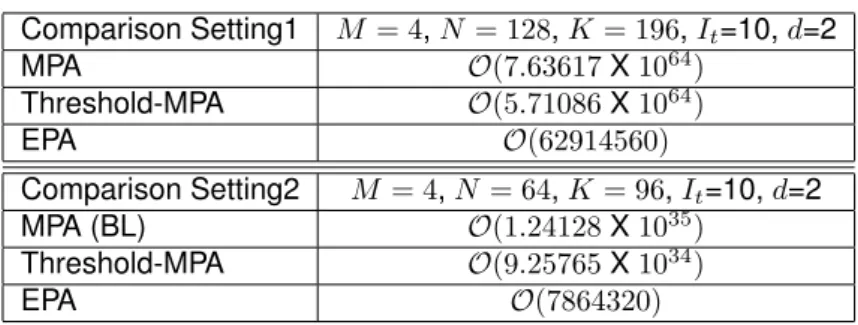
Finally, we compare the computational complexity of the three different algorithms: MPA, threshold-MPA [13], and EPA. Threshold-MPA-SCMA is recognized as a one of successful re-cently work to reduce the computational complexity of the original MPA-SCMA.
Table 1. Computational complexity comparison. Comparison Setting1 M = 4,N = 128,K= 196,It=10,d=2 MPA O(7.63617X1064) Threshold-MPA O(5.71086X1064) EPA O(62914560) Comparison Setting2 M = 4,N = 64,K= 96,It=10,d=2 MPA (BL) O(1.24128X1035) Threshold-MPA O(9.25765X1034) EPA O(7864320)
Table 1 shows the complexity orders of two settings. LetIt denotes the number of
It-eration. The implementation of MPA is prohibitive. Although threshold-MPA can decrease ap-proximately 25% of the complexity, its implementation remains prohibitive. The EPA for SCMA successfully handles these situations, and its complexity is less than10−20% of the MPA com-plexity.
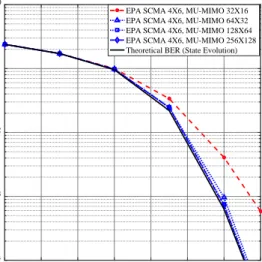
0 2 4 6 8 10 12 14 SNR(dB) 10-4 10-3 10-2 10-1 10 BER
EPA SCMA 4X6, MU-MIMO 32X16 EPA SCMA 4X6, MU-MIMO 64X32 EPA SCMA 4X6, MU-MIMO 128X64 EPA SCMA 4X6, MU-MIMO 256X128 Theoretical BER (State Evolution)
Figure 2. Performance analysis of EPA-SCMA
3. Result and Analysis
The simulation parameters are set as follows: the codebook size isM = 4point codebook proposed in [2], the number of subcarrier isS = 4, and the number of multi-antennas users is U = 6. Each user has transmit antennas Nt = 2 and the BS has receiver antennasNr = 4.
As the SE is derived from a large scale system, we increase the transmit antennas and receiver antennas in the four following settings: 1)Nt = 16,Nr = 32, 2)Nt = 32,Nr = 64, 3 )Nt = 64,
Nr = 128, 4) Nt = 128, Nr = 256. In this way, we can observe the BER performance of
EPA-SCMA from small to the large scale system. Channel used in this simulation is a normal random channel model. The rotation rule in codebook design is based on the codebook design proposed in [9].
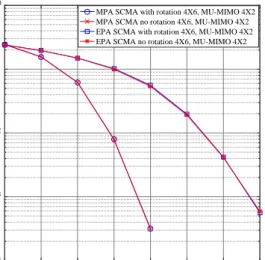
Obviously, in small scale system as presented in Figure 3, MPA-SCMA which can be viewed as an optimal detector has a better performance than EPA-SCMA. However, as the num-bers of transmit and receive antennas grow, EPA-SCMA performance improves significantly. Fur-thermore, EPA-SCMA successfully can match the theoretical BER performance as illustrated in Figure 2. As proved in [12], the theoretical performance can be viewed as near optimal perfor-mance. Therefore, the EPA-SCMA can achieve the near optimal perforperfor-mance. At the same time, under the parameter setting in Figure 2, we cannot evaluate the MPA-SCMA performance. We indicate that the complexity of MPA-SCMA increases extremely high, and becomes prohibitive to be implemented. For this reason, there is no MPA-SCMA BER performance can be presented in Figure 2 as MPA-SCMA fails to overcome its complexity problem.
Figure 3 also proves the argument on the need of putting a rotation value in the SCMA codebook as proposed in [1], [2], and [9]. Figure 3 describes that the BER performance between the EPA-SCMA and MPA-SCMA without rotation is identical to that with rotation. Consequently, the rotation value is unnecessary for the uplink scheme SCMA system. To support this argument, let the channel response on different users are vary and∆i = 0 indicating that no rotation is
included. Channel vectorhk,s for allk and sremains distinct. Therefore, no data interference
occurs.
4. Conclusion
In this paper, we propose the EPA as the SCMA data detection which is solved the com-plexity problem of original MPA-SCMA. We proof that our EPA-SCMA can match the theoretical analysis, thus our EPA-SCMA achieve the near optimal performance. We also show that the rotation design in codebook is unnecessary in the uplink SCMA.
0 2 4 6 8 10 12 14 SNR(dB) 10-4 10-3 10-2 10-1 100 BER
MPA SCMA with rotation 4X6, MU-MIMO 4X2 MPA SCMA no rotation 4X6, MU-MIMO 4X2 EPA SCMA with rotation 4X6, MU-MIMO 4X2 EPA SCMA no rotation 4X6, MU-MIMO 4X2
Figure 3. SCMA rotation and no rotation performance comparison
Acknowledgement
We thank Professor Chao-Kai Wen for His guidance and support. This work is supported by Laboratory of Wireless Communication Technology, National Sun Yat-sen University, Kaohsi-ung 804, Taiwan.
References
[1] M. Taherzadeh, H. Nikopour, A. Bayesteh, and H. Baligh, “Scma codebook design,” in2014 IEEE 80th Vehicular Technology Conference (VTC2014-Fall), Ottawa, Ontario, Canada, Sept 2014, pp. 1–5.
[2] H. Nikopour and H. Baligh, “Sparse code multiple access,” in 2013 IEEE 24th Annual In-ternational Symposium on Personal, Indoor, and Mobile Radio Communications (PIMRC), Ottawa, Ontario, Canada, Sept 2013, pp. 332–336.
[3] J. Ni and S. Tatikonda, “Analyzing product-form stochastic networks via factor graphs and the sum-product algorithm,”IEEE Transactions on Communications, vol. 55, no. 8, pp. 1588– 1597, Aug 2007.
[4] A. F. Morabito, “Power synthesis of mask-constrained shaped beams through maximally-sparse planar arrays,”Telkomnika (Telecommunication Computing Electronics and Control), vol. 14, no. 4, pp. 1217–1219, 2016.
[5] G. S. A. F. Morabito, A. R. Lagan and T. Isernia, “Mask-constrained power synthesis of max-imally sparse linear arrays through a compressive-sensing-driven strategy,”Journal of Elec-tromagnetic Waves and Applications, vol. 29, no. 10, pp. 1384–1396, 2015.
[6] S. Zhang, X. Xu, L. Lu, Y. Wu, G. He, and Y. Chen, “Sparse code multiple access: An energy efficient uplink approach for 5g wireless systems,” in 2014 IEEE Global Communications Conference, Shanghai, China, Dec 2014, pp. 4782–4787.
[7] J. Zou, H. Zhao, and W. Zhao, “Low-complexity interference cancellation receiver for sparse code multiple access,” in2015 IEEE 6th International Symposium on Microwave, Antenna, Propagation, and EMC Technologies (MAPE), San Diego, USA, Oct 2015, pp. 277–282. [8] J. Cspedes, P. M. Olmos, M. Snchez-Fernndez, and F. Perez-Cruz, “Expectation propagation
detection for high-order high-dimensional mimo systems,”IEEE Transactions on Communi-cations, vol. 62, no. 8, pp. 2840–2849, Aug 2014.
[9] D. Cai, P. Fan, X. Lei, Y. Liu, and D. Chen, “Multi-dimensional scma codebook design based on constellation rotation and interleaving,” in2016 IEEE 83rd Vehicular Technology Confer-ence (VTC Spring), Chengdu, China, May 2016, pp. 1–5.
[10] J. van de Beek and B. M. Popovic, “Multiple access with low-density signatures,” in GLOBE-COM 2009 - 2009 IEEE Global Telecommunications Conference, Kista, Sweden, nov 2009, pp. 1–6.
[11] X. Yuan, J. Ma, and L. Ping, “Energy-spreading-transform based mimo systems: Iterative equalization, evolution analysis, and precoder optimization,”IEEE Transactions on Wireless Communications, vol. 13, no. 9, pp. 5237–5250, Sept 2014.
[12] M. Bayati and A. Montanari, “The dynamics of message passing on dense graphs with ap-plications to compressed sensing,”IEEE Transactions on Information Theory, vol. 57, no. 2, pp. 764–785, Feb 2011.
[13] L. Yang, Y. Liu, and Y. Siu, “Low complexity message passing algorithm for scma system,”