Overcoming the Challenge of Security in a
Mobile Environment
Ioannis Broustis, Michalis Faloutsos and Srikanth Krishnamurthy Department of Computer Science and Engineering
University of California, Riverside, CA, 92521 {broustis, michalis, krish}@cs.ucr.edu
Abstract—The secure operation of ad hoc networks faces the novel challenge of location verification on top of the se-curity challenges that wireline networks face. The novelty lies in the fact that a node can correctly validate who it is, but lie about its location and exploit this to create problems to the network. There are three main factors that make ad hoc networks more vulnerable: (a) nodes can overhear other nodes announcements, (b) nodes can lie about their location, and (c) nodes can avoid detection and isolation by moving. As a result, malicious nodes can fake their posi-tion and this way obstruct the routing. In this work, we explain how location and topology related malice can affect the security of wireless ad hoc networks. First, we present the most important attacks that can stem from misuse of location information. Second, we provide an overview of se-curity routing approaches. Although several of the current techniques are promising, we conclude that there does not exist a bulletproof approach as of yet.
Index Terms—Wireless Ad Hoc Communications, Loca-tion VerificaLoca-tion, Network Topology, Security.
I. INTRODUCTION
Wireless ad hoc networks are more vulnerable to mali-cious attacks than wireline networks, due to several rea-sons: (a) the broadcast nature of the medium, which exposes information to a passive listener, (b) the lack of an authoritative certification source, (c) the limited battery supply, which precludes overhead and computa-tional intensive solutions, and finally, (d) the mobility, which makes tracing malicious nodes more difficult. Even though many intrusion detection techniques have been de-veloped for wireline networks, the above major differ-ences of wireless ad hoc networks demand new security approaches.
The dynamically changing topology introduces a new set of security challenges [4]. The main idea here is that a
node may verify its true identity, but it can lie about its lo-cation. Consequently, it can harm the network by modify-ing routes, monitormodify-ing all information etc. In more detail, the use of the common wireless medium makes ad hoc networks susceptible to both active and passive attacks. In passive attacks, the attacker does not actively harm the network, other than possible not forwarding packets, but it mainly acts as a spy, and determines the weaknesses of the network (e.g. bottleneck points). A passive attacker can enable an active attack, by sending this information to ac-tive attackers. In acac-tive attacks, the attacker can advertise erroneous topology information, drop or modify packets, fabricate messages or flood the network. Typically, most attacks can be categorized into either of the above cases. As a consequence, any intrusion detection mechanism re-quires extensive evidence gathering. A fundamental com-ponent of any such solution is a mechanism to verify the location of a node.
As our main contribution, we present an overview of at-tacks and solutions for network threats that stem from the abuse of location information. First, we explain how the location information and topological aspects of the net-work can be used by malicious and compromised nodes. In addition, we present the main studies on node position-ing and verification of location claims. We describe the metrics that each method uses, their assumptions, and dis-cuss their efficiency. We conclude that there is no mech-anism guaranteeing security, and hence more work needs to be done.
The remainder of this paper is organized as follows. In section 2, we present how attacks are related to the net-work topology and routing. In section 3, we describe algorithmic solutions, which employ location verification techniques, so as to secure the claimed location of a node. Finally, in section 4 we conclude the paper.
II. TOPOLOGY-RELATED ATTACKS
Our definition of attack includes any behavior that causes anomalies to the network functionality. Our focus is to relate the nature of the attacks to the topology of the network. These attacks are possible as soon as malicious nodes penetrate the network, by misleading others about their location.
Mobility provides new capabilities to attackers for var-ious reasons. First of all, mobility allows a modification of the routing table of the victim node, simply by mov-ing into the coverage range of it. The attacker may move away once it succeeds and without being traced. More-over, the mobility of legitimate nodes may help attackers disperse malicious information (epidemic spreading). For example, a malicious node may transmit encrypted mali-cious data to a legitimate node, and the latter may keep sending this data to other legitimate nodes futher away, thus spreading the malicious information. Furthermore, the set of devices within the transmission range of a node keeps changing dynamically. Hence, it becomes harder to successfully authenticate all neighbors. Last but not least, mobile nodes have power and computation limi-tations. Thus, it becomes difficult for them to access a trusted third party, like a certification authority [11].
In general for securing an ad hoc network, a lot of work has been done towards algorithms that involve pri-vate/public key management and authentication. With mobility, new routing protocols have been proposed to protect the network from attacks that modify routing in-formation. The description of these methods is beyond the scope of this paper. In this paper we focus on algorithms for secure location verification of devices within wireless ad hoc networks. We also describe in brief, some efforts on verifying claimed positions in wireless networks that involve infrastructure coordinators. This is because some of those ideas are directly applicable to the ad hoc deploy-ment.
Topology, Routing and Security: The network topol-ogy is related to the routing decisions that nodes perform; nodes exchange information to establish these routes, ac-cording to routing algorithms. Here we present attacks to routing protocols. Data exchange among nodes can be a potential target for attackers. Attackers can choose a lot of techniques: inject erroneous routing packets, replay old routing packets and distort routing packets. They can fur-ther partition the network, so as to decrease the throughput significantly.
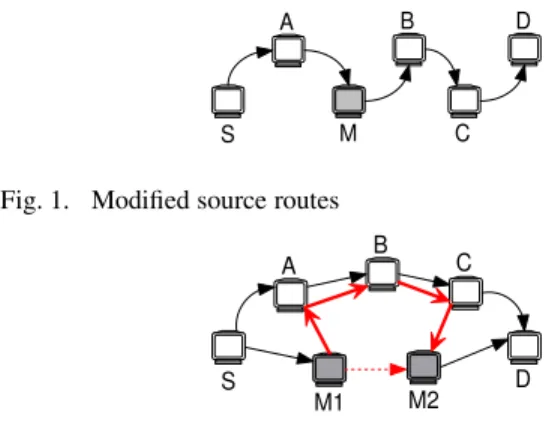
To begin with, we consider the case of redirection with
S A M B C D
Fig. 1. Modified source routes
S A M1 B C D M2
Fig. 2. Tunneling or wormhole
modified hop counts. This attack takes place when the hop count field of route discovery messages is changed. For example, AODV [12] uses the hop count field to deter-mine the shortest path. In such a case, an attacker may set the hop count field of the RREQ to infinity; this would cre-ate routes that tend to not include the malicious node. This attack is most threatening when combined with spoofing [9]. More than that, DSR [13] utilizes routes without any integrity checks. Let’s assume the scenario depicted in figure 1. A shortest path exists fromS toD,S does not have a route towardsD and nodes can hear only their 1-hop neighbors. NodeM is the attacker. NodeS sends a data packet towardsD with the source routeS -A- M -B -C -D. WhenM receives the packet, it may modify the route in the packet header, such as deletingCfrom it. As a result, when B receives the packet, it tries to send it toD directly; however this is not feasible, since D is not within the range ofB. Hence, even though nodeCis topologically near nodeB, it cannot be used as a relay for this packet.
Another commonly known attack is the tunneling or
wormhole attack. In figure 2 nodes M1 and M2 are the
attackers. The dotted line denotes the path thatM1 and
M2 claim to have between them. NodeS wants to send
a packet toD. WhenM1 receives the packet fromS, it
encapsulates the RREQ and sends it toM2, through the
existing routeM1-A-B-C-M2[9]. WhenM2gets the
packet it forwards it toD, as if it had only travelled using the routeS-M1-M2-D. After the route discovery, node
Dfinds out two routes from S; the first isS- A- B -C -D and the second isS -M1-M2 -D, which is shorter.
If the RREP is tunneled fromM2toM1, then nodeSwill
decide that the latter route is more efficient.
Besides the prior two attacks, spoofing can also be used. Assume the scenario of figure 3. NodeAcan hearB and
E A M B C D X E A M B C D X
Fig. 3. The spoofing attack
D, B can hear A and C, D can hear A and C, C can hear B, D and E, M can hear A, B, C and D, andE can hear C and the next hop towards X. Again, M is the attacker. NodeM can learn this topology by listening to the RREQ/RREP packets. As depicted in figure 3, the attacker may create a routing loop so that none of the four nodes can reach the destination. It first changes its MAC address to match A’s, moves closer toB and out ofA’s range. It sends an RREP toB that contains a hop count toX that is less than the RREP sent byC. Thus,B will change its route towardsX to go viaA. NodeM further changes its MAC address to match B’s, moves closer to Cand out of the range ofB. It sends an RREP toCwith the hop count to X lower than what was advertised by E. NodeC then routes toX through B. A routing loop has now been created and nodeX is unreachable from the four nodes. From this example it becomes obvious that if an attacker knows the topology, it can severely affect the correct functionality of the network.
We described the most common attacks to routing pro-tocols. There have been a number of efforts to address such attacks. Most of these efforts involve either a key management system, or a secure routing design, or both.
III. LOCATION-BASEDSECURITY
In this section, we describe the related studies on secur-ing the location estimation of nodes within wireless net-works. The following approaches attempt to securely ver-ify the estimated position of nodes within a network. Even though there are numerous studies on node positioning, few of them address security aspects; we identified four related studies [3], [18], [17], [2].
Tao et. al [18] present a wireless indoor LAN location sensing system for security applications. Their system re-lies on measurements of the received signal strength. Ap-propriate algorithms are imported, which allow for the de-tection of malicious nodes. The basic problem is that the system needs to be trained and it seems to be vulnerable to position spoofing attacks.
Waters and Felten [17] describe a scheme for secure distance verification, based on ultrasound and radio sig-nal propagation. They also import cryptography to secure
messages against identity fraud. Users carry an external tamper-resistant trusted hardware device, i.e.,smart card. Processing delay in the smart card is significant, but is assumed constant and publicly known to all participants. This latter assumption, together with their timing accu-racy requirements, make their technique seem unrealistic. In the remainder of this section we focus on two stud-ies for secure location verification. In the first, Sastry et al. describe a technique based on ultrasound [3]. In the sec-ond, Capkun et al. [2] propose two novel mechanisms for position verification, called VM (Verifiable Multilatera-tion)and VTDOA(Verifiable Time Difference of Arrival). They initially present their architecture for WLANs and they further extend it to support ad hoc networks. How-ever, as we discuss later, we conclude that none of the above studies can guarantee total protection. There exist some serious vulnerabilities that these studies do not ad-dress.
A. The Echo Protocol: Sastry, Shankar and Wagner [3] focus on solving the in-region verification problem: a set of verifiersV wish to verify whether a claimant P is in a region R of interest. This area could be a stadium, a building or any other physical region. Their purpose is to control the access to resources that are not protected by some physical security, such as wireless networks. Two properties are required to ensure that the protocol is ro-bust: 1. IfV acceptsP’s claim, then P, or a party col-luding withP, has a physical presence in R. 2. IfP is inRthenV will accept thatP is inR. The verifier and the claimant must both be able to communicate using Ra-dioFrequency (RF) and Ultrasound (US) techniques. In addition, the claimant must be able to bound its process-ing delay. Note that the authors assume that the verifiers are trusted nodes and that they can communicate securely amongst them. The ”Echo” protocol has few resource de-mands and it does not require a setup phase.
IfP’s claimed location l is not within R, thenV can reject the claim immediately. At the nominal start of the algorithm,V sends a nonce toP using RF andP immedi-ately echoes the packet back using US. The verifierV can then calculate how long it should take to hear the echo. This amount consists of the time it takes to reachlusing RF, plus the time for the return of the packet using US. If the elapsed time from the initial transmission to reception is more than this amount,V will reject the claim. Other-wise it will accept it. IfP is able to return the packet in sufficient time thenV is assured thatP’s distance is less or equal tol. There are two reasons thatP does not send
V
ROA (v, D) R
sD
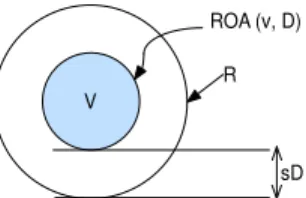
Fig. 4. Region Of Acceptance for a verifierV. R is the area of interest, D is the processing delay and s is the speed of sound. the nonce back in time. EitherV is more than l units of distance away or P has some processing delay between receiving the RF message and transmitting it back over US.
Ideally,P can receive the RF message and send it out over US instantly. However in reality this is impossible, due to the receiver’s processing delay. Let us assume that P can bound its processing delay to some value Dp and make V aware of this value. In that case, V can com-pute the maximum time that has to wait for getting the re-sponse back. An attackerAcould be a malicious claimant. A possible attack could be to submit a position claim l at the border of R. At the same time it could advertise an erroneous value for its processing delay to some very large value. However, if the actual value is very low, A could trick V into thinking that it was inside R when in fact it was not. A potential solution is for V to reduce the covered area in which is verifies claims. If P claims a processing delay of Dp > 0, thenV should reject the claim when the claimed position l is within Dps of the outside border, wheresis the speed of sound. Hence the authors define the notion of ROA(Region Of Acceptance)
to be the area whereV is sure that it can correctly verify claims. This is depicted in figure 4. ROA(V, Dp) indi-cates the area where location claims are permitted byV. NodeV should engage in the protocol only ifl is within ROA(V,Dp).
So far, during the description we assumed thatRis cir-cular. However this may not always be true. In any case however, both V and P are assumed to know R. This information helps V compute the ROA(V, 0). In order to support arbitrary shapes of R, the prior procedure is slightly modified. NodeP first broadcasts its claimed po-sitionland processing delay DptoV. If the claimed po-sition is not within ROA(V, Dp), then V will reject the claim. Otherwise,V will broadcast a nonce toP. The lat-ter will echo this packet back over US.V can again time the communication; if it equal or less than the time for the signal to travel out and back (and allowing for processing
delay),V will accept the claim.
The authors also provide a security analysis of their protocol [3]. Even though their idea is interesting, they do not explain analytically how they actually address the cases ofRhaving an arbitrary shape.
The main advantage of this approach is twofold. First, no key management or cryptography models are required. Therefore, no special software or hardware is needed for the verifier and the claimant. Second, the protocol does not require time synchronization between V and P. It only requires nodes to be able to compute the elapsed time between sending and receiving the nonce, using RF and US.
B. Secure Positioning in Wireless Multi-hop Net-works:Capkun et al. [2] present mechanisms for securing the position estimation of nodes within wireless networks. They address both cases of WLANs and Ad hoc (Multi-hop) networks. Here we focus only on the part of the work on ad hoc deployments. The proposed mechanisms aim to enable the network nodes to detect the modifications of the network topology. As mentioned earlier, the au-thor makes use of Verifiable Multilateration1(VM) and of Verifiable Time Difference of Arrival (VTDOA). Nodes are not equipped with GPS receivers; however, they have other distance-measuring capabilities.
Three major assumptions on this work can lead to pro-longed discussions. First, the authors assume that besides the communicating nodes, in the same geographical re-gion theremay exist a number of landmarks. Nodes are assumed to be able to measure the distances to their neigh-bors, as well as their distances from potential landmarks. This assumption however is later relaxed. The distance computation can take place by measuring the round trip ToF (Time of Flight) of signal. Second, the network is assumed to be operated by a central authority. This au-thority can be online or offline - services of this auau-thority may or may not be reached by via the network. In any case, the authority controls the network membership and assigns a unique identity to each node. Third, each node is capable of generating symmetric cryptographic keysto accomplish any task required to secure its communica-tions. This latter assumption implies that a node can agree on cryptographic protocols with other nodes.
a. VM and VTDOA: Verifiable Multilateration is an-other technique for determining the position of a node from a set of a reference points, whose positions are known. Each reference point measures its distance from
v4
v1
u
v2 v3
Fig. 5. Verifiable Multilateration
the node. The measured distances are then gathered by the authority. The position of the node is further calcu-lated(multilateration)by computing the intersection point of the circles centered at the reference points. The ra-dius of each circle is equal to the measured distances. The multilateration process is performed by a set of verifiers. The number of required verifiers depends on dimensional-ity: if we want the claimant’s location in two dimensions, three verifiers are needed. For3−Dcoordinates, we need four of them. Each verifier obtains an upper bound on its distance from the claimant. The verifiers further perform
multilaterationwith the obtained bounds and calculate the claimant’s location. A representative example is shown in figure 5. Verifiers v1, v2, v3 and v4 can verify the
po-sition of node u in three dimensions. Node u must be placed within the triangular pyramid formed by the ver-ifiers. Similarly, verifiers u2, u5 and u6 can verify the
position of nodezin two dimensions.
Similarly, VTDOA uses Time Difference Of Arrival to locate mobile devices. TDOA is the process of position-ing a source of signal by findposition-ing the intersection of mul-tiple hyperboloids. It is based on the time difference of arrival between the signal reception at multiple verifiers. VTDOA utilizes TDOA together with ToF distance esti-mation. The main advantage of this method is that the claimant cannot trick the verifiers easily about its location. This is because verifiers determine the location passively, by receiving a single signal sent by the claimant. This however is true when the claimant has an omni-directional antenna. Note that in the case of directional antennas, the claimant could send the signal to each of the verifiers sep-arately, with a time shift. As a result, it could fool verifiers about its actual location.
b. Using landmarks: In this approach, node posi-tions are determined by a set of landmark staposi-tions with known positions. This set is trusted by the central
author-Landmark
Height H
Power range R
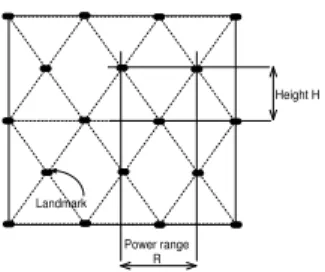
Fig. 6. Secure positioning using landmark stations
ity. Landmarks are placed in an organized manner and know their positions. Moreover, they can communicate mutually (one-hop) and they have access to the network authority. The number of landmarks needed to cover a region depends on their power range. Typically, if three landmarks are mutually reachable, they will be able to ver-ify locations within their triangle. Hence, the optimal way is to place them so that they form regular triangles with sides equal to their power ranges. It is easy to prove that the number of landmarks needed in an L∗L region is
[2L/R+ 3][L/H+ 1]/2, whereRis the power range and His the height of the triangle. This is clearly depicted in figure 6.
This scheme provides high security, if we assume land-marks to be intrusion-free. Actually, the security of this scheme is based on the security of Verifiable trilateration and VTDOA. Also, since the node positions are deter-mined independently, the scheme is resistant from mali-cious and compromised intruders.
c. Secure Distributed Positioning: In many realis-tic cases, landmark stations will probably be absent in the region of consideration. For this reason, the Basic Dis-tance Verification (BDV) mechanism is also proposed [2]. BDV is based on verifiable trilateration. The verifierV performs basic verification of the distance to the claimant P, by forming with its neighbors, all verification triangles, withinP is present.
NodeV calculates its distances to its neighbors and to P, and requests the distances measured by its neighbors. These distances are measured from each neighborV, to-wards the neighborV nodes and the claimantP.V further decides ifP is present within the triangles. If all distance verifications result in the same distance, thenV will ac-cept the location ofP. Otherwise it will assume that there is an attack.
The efficiency of BDV depends on the number of the formed triangles and on their mutual dependence. Obvi-ously, if one of the verifiers is compromised and
cooper-ates with P, then P will be able to trick other verifiers about its location. More specifically, if the claimant P is compromised, it may enlarge its distance to a claimant u. The claimant is aided by a malicious node, which en-larges one of the distances between the verifiers. As a consequence, the distances between verifiers are now con-sistent with the enlarged distance. In a second scenario, an attacker controlling two malicious nodes can perform the same attack. It is sufficient to enlarge the distance be-tween the verifier and the claimant, as well as the distance between two verifiers.
This work is very interesting, since it addresses the se-cure position verification through VM and VTDOA. The network density is an important factor for the security of positioning systems. In particular, secure positioning in ad hoc networks requires higher node density. Some assump-tions however could be relaxed. Specifically, since ad hoc network topologies are assumed, the notion of the central authority is not necessary. One can argue that the central authority will be absent in most distributed deployments. This assumption of course does not modify the impor-tance and the validity of this work; as we described above, the central authority only contacts V nodes to gather in-trusion detection and multilateration measurements. It does not perform any administrative role. Perhaps hav-ing one of the verifiers perform the central authority’s du-ties would be beneficial. In addition, the proposed mech-anism could potentially avoid including the landmarks. In most cases, landmark deployment is not feasible and prob-ably more expensive to deploy and maintain. On the other hand, their existence can further increase the resistance of secure positioning algorithms to attacks.
IV. DISCUSSION ANDCONCLUSIONS
In this paper we showed how mobility enables attackers to intrude and harm a wireless ad hoc network. Mobility creates numerous security concerns, since moving attack-ers are much more difficult to identify. We presented the most important efforts to address topology-related attacks. We conclude that currently there is no complete solution for these problems. The methodologies that were pre-sented in this paper are significant and can deal effectively with many of the currently known attacks. However, ma-licious users invent new intelligent mechanisms to attack the network. This is why making the location verification methods more secure is a hot research subject: more ef-fort is needed to design better schemes, for detecting and containing such malicious actions.
REFERENCES
[1] S. Capkun, J. P. Hubaux and M. Jakobsson, ”Secure and Privacy-Preserving Communication in Hybrid Ad Hoc Networks”, EPFL-IC Technical report no. EPFL-IC/2004/10.
[2] S. Capkun et. al, ”Location Verification And Key Management In Wireless Networks”, MSc thesis, University of Split, Croatia, EPFL 2004.
[3] N. Sastry, U. Shankar and D. Wagner, ”Secure Verification of Lo-cation Claims”, Report No. UCB//CSD-03-1245, EECS, Univer-sity of California, Berkeley.
[4] Y. Huang and W. Lee, ”A Cooperative Intrusion Detection System for Ad Hoc Networks”, Security of Ad Hoc and Sensor Networks, 2003.
[5] S. Carter and A. Yasinsac, ”Secure Position Aided Ad hoc Routing Protocol”, CCN02, November 2002.
[6] J. Y. Choi, ”Security problems for ad hoc routing protocols”, Tech-nical report on security and cryptography, Dept. of Computer Sci-ence, Indiana University at Bloomington.
[7] G. Avoine and S. Vaudenay, ”Fair Exchange with Guardian An-gels”, WISA, Lecture Notes in Computer Science, vol. 2908, pp.188-202, Springer-Verlag, August 2003.
[8] S. Yi, P. Naldurg, R.Kravets, ”A security aware ad hoc routing protocol for wireless networks”, SCI 2002.
[9] K. Sanzgiri, B. Dahill, B. N. Levine, C. Shields, E.M. Belding-Royer, ”A secure routing protocol for ad hoc networks”, ICNP 2002.
[10] P. Papadimitratos, Z. J. Haas, ”Secure Routing for Mobile Ad hoc Networks”, CNDS 2002.
[11] M. Jakobsson, S. Wetzel, B. Yener, tealth Attacks on Ad-Hoc Wireless Networks IEEE VTC 3.
[12] Charles E. Perkins and Elizabeth M. Royer, ”Ad hoc On-Demand Distance Vector Routing”, 2nd IEEE Workshop on Mobile Com-puting Systems and Applications, New Orleans, LA, February 1999, pp. 90-100.
[13] D. Johnson, D. A. Maltz, and J. Broch, ”DSR: The Dynamic Source Routing Protocol for Multi-Hop Wireless Ad Hoc Net-works”, in Ad Hoc Networking, edited by Charles E. Perkins, Chapter 5, pp. 139-172, Addison-Wesley, 2001.
[14] R. S. Fontana, ”Experimental Results from an Ultra Wideband Precision Geolocation System”, in Ultra Wideband Short-Pulse Electromagnetics, May 2000.
[15] R. S. Fontana, E. Richley and J. Barney, ”Commercialization of an Ultra Wideband Precision Asset Location System”, in IEEE Conference on Ultra Wideband Systems and Technologies, November 2003.
[16] S. Brands and D. Chaum, ”Distance-bounding protocols”, in Workshop on the theory and application of cryptographic tech-niques on Advances in cryptology, pp. 344-359, Springer-Verlag, NY. 1994.
[17] B. Waters and E. Felten, ”Proving the Location of Tamper-Resistant Devices”, Technical report, Princeton University. [18] P. Tao, A. Rudys, A.M. Ladd and D.S. Wallash, ”Wireless LAN
location-sensing for security applications”, WiSe 2003.
[19] J. Marshall, ”An Analysis of SRP for Mobile Ad Hoc Networks”, Mobile Computing and Networking, Dallas, USA 1998.