of Self-Adaptive Systems
Simos Gerasimou
PhD
University of York
Computer Science
September 2016
Software systems used in mission- and business-critical applications in do-mains including defence, healthcare and finance must comply with strict de-pendability, performance and other Quality-of-Service (QoS) requirements. Self-adaptive systems achieve this compliance under changing environmental conditions, evolving requirements and system failures by using closed-loop control to modify their behaviour and structure in response to these events. Runtime quantitative verification (RQV) is a mathematically-based ap-proach that implements the closed-loop control of self-adaptive systems. Using runtime observations of a system and its environment, RQV updates stochastic models whose formal analysis underpins the adaptation decisions made within the control loop. The approach can identify and, under cer-tain conditions, predict violation of QoS requirements, and can drive self-adaptation in ways guaranteed to restore or maintain compliance with these requirements. Despite its merits, RQV has significant computation and memory overheads, which restrict its applicability to small systems and to adaptations affecting only the configuration parameters of the system.
In this thesis, we introduce RQV variants that improve the efficiency and scalability of the approach, and extend its applicability to larger and more complex self-adaptive software systems, and to adaptations that mod-ify the structure of a system. First, we integrate RQV with established efficiency improvement techniques from other software engineering areas. We use caching of recent analysis results, limited lookahead to precompute suitable adaptations for potential future changes, and nearly-optimal re-configuration to eliminate the need for an exhaustive analysis of the entire reconfiguration space. Second, we introduce an RQV variant that incorpo-rates evolutionary algorithms into the RQV process facilitating the efficient search through large reconfiguration spaces and enabling adaptations that include structural changes. Third, we propose an RQV-driven approach that decentralises the control loops in distributed self-adaptive systems. Finally, we devise an RQV-based methodology for the engineering of trustworthy self-adaptive systems. We evaluate the proposed RQV variants using pro-totype self-adaptive systems from several application domains, including an embedded system for unmanned underwater vehicles and a foreign exchange service-based system. Our results, subject to the adaptation scenarios used in the evaluation, demonstrate the effectiveness and generality of the new RQV variants.
Abstract 3 List of Contents 5 List of Figures 9 List of Tables 13 Acknowledgements 17 Declaration 19 1 Introduction 21
1.1 Self-Adaptive Software Systems . . . 21
1.2 Runtime Quantitative Verification Overview . . . 23
1.3 Motivation and Research Hypothesis . . . 24
1.4 Research Scope and Assumptions . . . 25
1.5 Thesis Contributions . . . 26
1.6 Thesis Structure . . . 30
2 Background and Field Review 33 2.1 Quantitative Verification . . . 33
2.1.1 Markov Models . . . 35
2.1.1.1 Discrete-Time Markov Chains . . . 36
2.1.1.2 Continuous-Time Markov Chains . . . 40
2.1.2.1 Probabilistic Computation Tree Logic . . . 45
2.1.2.2 Continuous Stochastic Logic . . . 48
2.2 Runtime Quantitative Verification . . . 51
2.2.1 Self-Adaptation Through Runtime Quantitative Verification . . 51
2.2.1.1 Self-Adaptive Unmanned Underwater Vehicle System . 54 2.2.2 Early Approaches to Runtime Quantitative Verification . . . 57
2.2.3 The Quest for Efficient Runtime Quantitative Verification . . . . 58
2.2.3.1 Incremental Verification . . . 60
2.2.3.2 Compositional Verification . . . 61
2.2.3.3 Parametric Verification . . . 63
3 Efficient RQV Using Conventional Software Engineering Techniques 67 3.1 Techniques for Efficient RQV . . . 69
3.1.1 Caching . . . 69 3.1.2 Limited Lookahead . . . 71 3.1.3 Nearly-Optimal Reconfiguration . . . 73 3.2 Implementation . . . 75 3.3 Evaluation . . . 76 3.3.1 Research Questions . . . 76 3.3.2 Experimental Setup . . . 77
3.3.3 Results and Discussion . . . 79
3.3.4 Threats to Validity . . . 86
3.4 Related Work . . . 86
3.5 Summary . . . 88
4 Improving RQV Efficiency Using Evolutionary Algorithms 89 4.1 EvoChecker . . . 91 4.1.1 Modelling Language . . . 94 4.1.2 Quality-of-Service Attributes . . . 99 4.1.3 Human-in-the-Loop EvoChecker . . . 101 4.1.4 Automated EvoChecker . . . 106 4.2 Implementation . . . 112 4.3 Evaluation . . . 112
4.3.1 Human-in-the-Loop EvoChecker Evaluation . . . 113
4.3.1.1 Research Questions . . . 113
4.3.1.3 Evaluation Methodology . . . 114
4.3.1.4 Results and Discussion . . . 117
4.3.2 Automated EvoChecker Evaluation . . . 125
4.3.2.1 Research Questions . . . 125
4.3.2.2 Experimental Setup . . . 125
4.3.2.3 Evaluation Methodology . . . 126
4.3.2.4 Results and Discussion . . . 128
4.3.3 Threats to Validity . . . 134
4.4 Related Work . . . 136
4.5 Summary . . . 138
5 Extending RQV With Decentralised Control Loops 139 5.1 DECIDE . . . 141
5.1.1 Formal Description of a DECIDE System . . . 142
5.1.2 Stage 1: Local capability analysis . . . 145
5.1.3 Stage 2: Receipt of Peer Capability Summaries . . . 151
5.1.4 Stage 3: Selection of Component Contributions . . . 152
5.1.5 Stage 4: Execution of Local Control Loop . . . 156
5.1.6 Stage 5: Major Changes . . . 157
5.2 Implementation . . . 158
5.3 Evaluation . . . 159
5.3.1 Research Questions . . . 159
5.3.2 Experimental Setup . . . 160
5.3.3 Results and Discussion . . . 161
5.3.4 Threats to Validity . . . 167
5.4 Related Work . . . 168
5.5 Summary . . . 171
6 Engineering Trustworthy Self-Adaptive Systems 173 6.1 ENTRUST Methodology . . . 175
6.1.1 Stage 1: Development of Verifiable Models . . . 178
6.1.2 Stage 2: Verification of Controller Models . . . 182
6.1.3 Stage 3: Controller Enactment . . . 184
6.1.4 Stage 4: Partial Instantiation of Assurance Argument Pattern . . 187
6.1.5 Stage 5: Running the Self-Adaptive System . . . 193
6.2 Implementation . . . 195
6.3 Evaluation . . . 197
6.3.1 Research Questions . . . 197
6.3.2 Experimental Setup . . . 197
6.3.3 Results and Discussion . . . 199
6.3.4 Threats to Validity . . . 210
6.4 Related Work . . . 211
6.5 Summary . . . 212
7 Conclusion and Future Work 215 7.1 Efficient RQV Using Software Engineering Methods . . . 216
7.1.1 Research Contributions . . . 216
7.1.2 Further Research Directions . . . 217
7.2 Improving RQV Efficiency Using Evolutionary Algorithms . . . 218
7.2.1 Research Contributions . . . 218
7.2.2 Further Research Directions . . . 218
7.3 Extending RQV With Decentralised Control Loops . . . 219
7.3.1 Research Contributions . . . 219
7.3.2 Further Research Directions . . . 220
7.4 Engineering Trustworthy Self-Adaptive Software Systems . . . 220
7.4.1 Research Contributions . . . 220
7.4.2 Further Research Directions . . . 221
7.5 Prototype Self-Adaptive Software Systems . . . 222
Appendix A Sequential Strategy Module for the MarketWatch FX
Ser-vice 223
Appendix B Dynamic Power Management System 225
Glossary 229
2.1 Overview of quantitative verification process. . . 35 2.2 DTMC model of an e-commerce system. . . 39 2.3 CTMC model of thei-th UUV sensor. . . 43 2.4 High-level architecture of a self-adaptive system implementing the
MAPE-K closed control loop. . . 52 2.5 Runtime quantitative verification workflow. . . 53 2.6 Verification results for the UUV system requirements. . . 56 3.1 Search tree produced by limited lookahead for the 2-sensor UUV system. 73 3.2 MOOS architecture including our RQV-MOOS component. . . 76 3.3 Self-adaptive UUV simulator component. . . 77 3.4 Sample pattern of sensor failures and drops in measurement rates for a
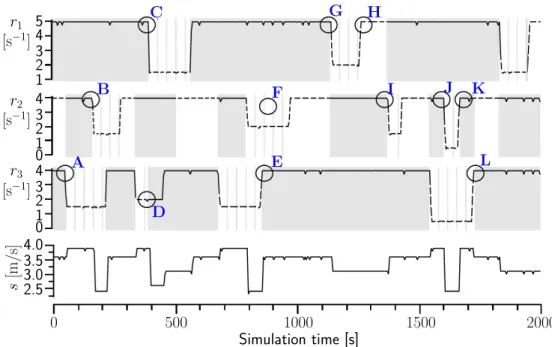
3-sensor system, and the sensor configurations and speed chosen by the self-adaptive UUV. . . 80 3.5 Effect of efficient RQV techniques on the average time required to decide
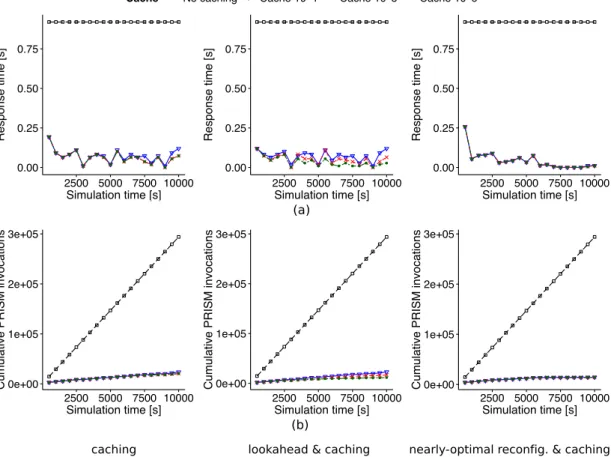
a new configuration during an RQV step and the total number of quan-titative verification operations over 2000 RQV steps, for a scenario with low sensor-rate fluctuation during normal operation. . . 81 3.6 Effect of efficient RQV techniques on the average time required to decide
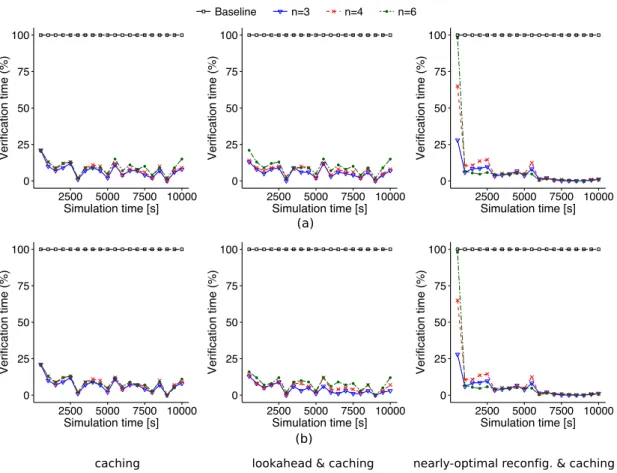
a new configuration during an RQV step and the total number of quan-titative verification operations over 2000 RQV steps, for a scenario with high sensor-rate fluctuation during normal operation. . . 82 3.7 Effect of efficient RQV verification on the response time for UUV systems
with 3, 4 and 6 sensors, low sensor-rate variation during normal operation periods, and using different cache sizes. . . 83 4.1 Workflow of the FX system. . . 92
4.2 DTMC model of the FX system. . . 96
4.3 High-level human-in-the-loop EvoChecker architecture. . . 104
4.4 High-level automated EvoChecker architecture. . . 111
4.5 Boxplots for a specific scenario of the DPM system variants from Ta-ble 4.7, evaluated using the quality indicatorsI,IHV andIIGD. . . 119
4.6 Boxplots for a specific scenario of the FX system variants from Table 4.7, evaluated using the quality indicatorsI,IHV andIIGD. . . 120
4.7 Boxplots for the FX system variants from Table 4.7 across 30 different adaptation scenarios, evaluated using the quality indicatorsI,IHV and IIGD. . . 121
4.8 Typical Pareto front approximations for the DPM system variants and optimisation objectives R3–R5 from Table B.2. . . 122
4.9 Typical Pareto front approximations for the FX system variants and op-timisation objectives R2–R4 from Table 4.4. . . 123
4.10 Variation in workflow reliability and system cost of the FX_Small variant due to the changes from Table 4.13 and system adaptation using the incremental EvoChecker with no archive use (i.e., PGA). . . 129
4.11 Boxplots for changes in environment state C4, C7, C11, C13 of the FX_Small system variant using LRGA, LDGA, PGA, CRGA, and RS. . 131
4.12 Boxplots for changes C7, C12 of the UUV_Large system variant using LRGA, LDGA, PGA, CRGA, and RS. . . 132
5.1 Decentralised self-adaptation workflow of a DECIDE component. . . 143
5.2 QoS attributes of a DECIDE component and their roles in defining system- and local-level QoS requirements. . . 143
5.3 Environment analysisEnv2i= [1.61,2.39]×[0,∞]andEnv4i= [1.55,2.45]× [3.33,4.67] for configuration subsetsCfg2i andCfg4i for a two-sensor UUV. 149 5.4 Verification ofΦi1 andΦi3 from Table 5.4 . . . 150
5.5 RQV ofΦi1 –Φi6 from Table 5.4. . . 157
5.6 MOOS architecture including our DECIDE component. . . 158
5.7 Self-adaptive multi-UUV system simulator. . . 159
5.8 Execution of DECIDE stages 1–4 for a particular scenario including ma-jor changes and local sensor changes. . . 163
5.9 DECIDE scalability analysis. . . 167
6.1 Architecture of an ENTRUST self-adaptive system. . . 175
6.3 Event-triggered MAPE model templates. . . 179
6.4 Instantiation of UUV MAPE automata based on the event-triggered EN-TRUST model templates. . . 179
6.5 Auxiliary sensor, verification engine and effector automata used for veri-fying the generic controller properties from Table 6.2 for the UUV system.183 6.6 Main GSN elements for constructing an assurance argument. . . 188
6.7 An example GSN assurance argument. . . 188
6.8 ENTRUST assurance argument pattern. . . 190
6.9 Away goal CPsIdentify which shows how application-specific require-ments are captured by one or more critical properties. . . 191
6.10 Away goal ErrorCont which indicates that (i) the design process of EN-TRUST, and the reusable components virtual machine and probabilistic verification engine do not introduce any errors; and (ii) the identified critical properties address any failures of the ENTRUST self-adaptive system. . . 191
6.11 Partially-instantiated assurance argument for the UUV system. . . 192
6.12 Verification results for UUV system requirements . . . 193
6.13 Fully-instantiated assurance argument for the UUV system. . . 196
6.14 Instantiation of FX MAPE automata based on the event-triggered EN-TRUST model templates. . . 200
6.15 Auxiliary sensor, verification engine and effector automata used for ver-ifying the generic controller properties from Table 6.2 for the FX system. 201 6.16 Partially-instantiated assurance argument for the FX system. . . 203
6.17 Verification results for the FX system requirements. . . 205
6.18 Fully-instantiated assurance argument for the FX system. . . 206
6.19 CPU time for the UPPAAL verification of the generic controller proper-ties in Table 6.2 . . . 209
6.20 CPU time for the runtime probabilistic model checking of the QoS re-quirements after changes . . . 210
A.1 Sequential strategy module for the MarketWatch service used by the FX system. . . 223
B.1 Dynamic power management system . . . 225
2.1 QoS requirements for the train booking system . . . 47
2.2 QoS requirements for the UUV system . . . 50
2.3 Overview of surveyed approaches and comparison to new approaches pro-poses in this thesis . . . 59
3.1 Analysed UUV system variants . . . 78
3.2 Summary of evaluated techniques (compared to standard RQV) . . . 85
4.1 QoS requirements for the FX system. . . 92
4.2 Types of models supported by EvoChecker . . . 95
4.3 QoS attributes for the FX system . . . 100
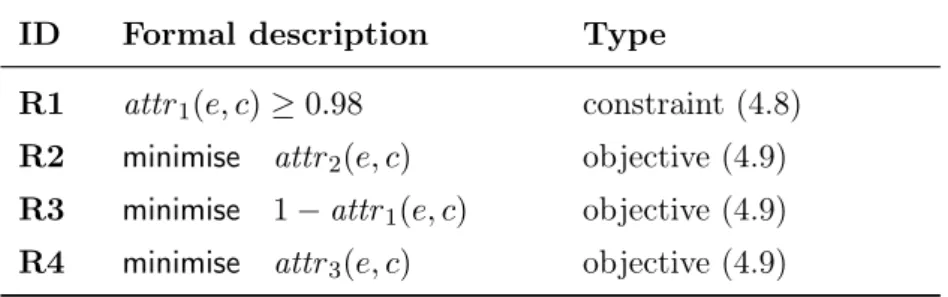
4.4 Formal specification of QoS requirements for the FX system . . . 102
4.5 EvoChecker gene encoding rules . . . 105
4.6 Formal specification of QoS requirements for the FX system . . . 107
4.7 Analysed system variants for the human-in-the-loop EvoChecker . . . . 114
4.8 System variants for which the MOGAs in rows are significantly better than the MOGAs in columns . . . 118
4.9 Mean quality indicator values for a specific scenario of the DPM system variants from Table 4.7 . . . 119
4.10 Mean quality indicator values for a specific scenario of the FX system variants from Table 4.7 . . . 120
4.11 Mean quality indicator values across 30 different adaptation scenarios for the FX system variants from Table 4.7 . . . 121
4.12 Analysed system variants for the incremental EvoChecker . . . 126
4.13 Changes in environment state of system variants used in automated EvoChecker. . . 127
4.14 Pairwise comparison of archive selection strategies for various stages of changes C4 and C11 of the FX variants showing the significantly better
strategy and effect size (in parenthesis) . . . 133
5.1 System-level QoS requirements for the multi-UUV distributed system . . 142
5.2 UUV-level QoS requirements for UUVifrom the multi-UUV distributed system . . . 142
5.3 Categories of DECIDE system-level QoS requirements from (5.2) . . . . 144
5.4 QoS attributes for UUVi, wherevalij is the value ofMi(e, c)|= Φij . . . 145
5.5 Characteristics of the three-UUV system . . . 155
5.6 Capability summaries of the three-UUV system . . . 155
5.7 Characteristics of analysed multi-UUV system variants . . . 161
5.8 Characteristics of a specific scenario of a three-UUV system . . . 162
5.9 Mean CPU and communication overheads for a three-UUV mission . . . 165
5.10 Comparison of DECIDE with the “ideal” system . . . 165
6.1 QoS requirements for the UUV self-adaptive system . . . 177
6.2 Generic properties that should be satisfied by an ENTRUST controller . 183 6.3 QoS requirements for the prototype FX self-adaptive system developed using ENTRUST . . . 198
6.4 Characteristics of analysed UUV and FX system variants . . . 199
6.5 Characteristics of the third-party service implementations of the FX system204 6.6 Changes in environment state of UUV system with 3 sensors and FX system with 3 third-party implementations per service . . . 207
B.1 Average service-provider transition times . . . 226
First, I am grateful to my supervisor Dr. Radu Calinescu. He has invested a great amount of time and effort in providing guidance throughout the duration of this research project. Without his support, this thesis would have never materialised.
Special thanks are due to my internal assessor Prof. Richard Paige for his invaluable feedback and continual encouragement, and Prof. Marin Litoiu for his suggestions to improve this thesis.
I would like to thank DSTL for supporting this project and Dr. Alec Banks, our DSTL technical partner, whose valuable insights in several aspects of our work have shaped and considerably improved this thesis.
I would also like to thank my colleagues and friends in the Enterprise Systems group, especially Dr. Babajide Ogunyomi, Dr. Yasmin Rafiq, Dr. Thomas Richardson, Gabriel Costa Silva, Dr. Colin Patterson, Dr. Konstantinos Barmpis, Dr. Antonio Garcia-Dominguez, Adolfo Sanchez-Barbudo Herrera, Dr. Ran Wei and Athanasios Zolotas for their support and for engaging in interesting discussions.
I had the opportunity to collaborate with great researchers and academics, especially Prof. Tim Kelly, Dr. Ibrahim Habli, Prof. Danny Weyns, Usman Iftikhar and Dr. Giordano Tamburrelli. Special thanks to you all.
I am very grateful to Christina for her love, encouragement and endless patience through the ups and downs of this journey. Thank you for your understanding and for being always by my side.
Finally, I would like to express my warmest gratitude to my family, Pana-gioti, Tasoula, Andri and Antoni, for their endless love and support, and for helping me to achieve my goals. Nothing would have ever been possible without you.
Except where stated, all of the work contained in this thesis represents the original contribution of the author. This work has not previously been presented for an award at this, or any other, University. All sources are acknowledged as References.
Chapter 6 is joint work with Prof. Tim Kelly and Dr. Ibrahim Habli from University of York, UK and with Prof. Danny Weyns and Usman Iftikhar from Linnaeus University, Sweden. We clarify in Section 1.5 our contribu-tions for this chapter.
Parts of the research described in this thesis have been previously published in:
• Simos Gerasimou, Radu Calinescu, Alec Banks. Efficient runtime quantitative verification using caching, lookahead, and nearly-optimal reconfiguration. In 9th International Symposium on Soft-ware Engineering for Adaptive and Self-Managing Systems (SEAMS’14). pages 115-124, 2014.
• Radu Calinescu, Simos Gerasimou, Alec Banks. Self-adaptive Soft-ware with Decentralised Control Loops. In 18th International Conference on Fundamental Approaches to Software Engineering (FASE’15). pages 235-251, 2015. (Nominated for an ETAPS’15 best paper award).
• Simos Gerasimou, Giordano Tamburrelli, Radu Calinescu. Search-Based Synthesis of Probabilistic Models for Quality-of-Service Software Engineering. In 30th International Conference on Auto-mated Software Engineering (ASE’15). pages 319-330, 2015.
Part of the research described in this thesis is currently under review in:
• Radu Calinescu, Simos Gerasimou, Ibrahim Habli, Usman Iftikhar, Tim Kelly, Danny Weyns. Engineering Trustworthy Self-Adaptive Software. Submitted to Transactions on Software Engineering (TSE).
• Radu Calinescu, Marco Autili, Javier Camara, Antinisca Di Marco, Simos Gerasimou, Paola Inverardi, Alexander Perucci, Nils Jansen, Joost-Pieter Katoen, Marta Kwiatkowska, Ole J. Mengshoel, Romina Spalazzese, Massimo Tivoli. Synthesis and Verification of Self-aware Computing Systems. Self-Aware Computing Systems. pages 337-373, 2017.
• Radu Calinescu, Simos Gerasimou, Kenneth Johnson, Colin Paterson.
Using Runtime Quantitative Verification to Provide Assur-ance Evidence for Self-Adaptive Software: AdvAssur-ances, Appli-cations and Research Challenges. Software Engineering for Self-Adaptive Systems 3. (in print)
Introduction
Realistically, such [autonomic] systems will be very difficult to build and will require significant exploration of new technologies and innovations. That’s why we view this as a Grand Challenge for the entire IT industry. Paul Horn, Senior Vice President IBM research
Autonomic Computing: IBM’s Perspective on the State of Information Technology, 2001
1.1
Self-Adaptive Software Systems
The engineering of self-adaptive software systems is an emerging research area [45, 56]. As stated in the autonomic computing manifesto [91, 126, 139], software systems characterised by well-determined functionality that is fixed at design-time are replaced by systems resilient to changes and with adaptive capabilities [127, 183]. State-of-the-art systems have gone beyond simply monitoring themselves, and are increasingly anticipating changes and discovering deviations from the desired behaviour. Through a closed control loop [139], and with limited administrator involvement, self-adaptive systems can modify their behaviour and internal structure in response to changing environmental conditions, evolving requirements and internal changes [27].
Since the advent of autonomic computing [91, 126, 139], numerous research projects have focused on devising methodologies and frameworks for engineering self-adaptive software systems. Extensive surveys of this area can be found in [127, 143, 183]. Some of these projects enhance systems with self-adaptation capabilities using intelligent agents [25, 197], biologically-inspired mechanisms like flocking and foraging [195, 216], learning [175, 198] or control theoretical techniques [78, 140]. Other approaches reason about adaptation using architectural [19, 92, 169] or behavioural [15, 96] models, i.e., ab-stract system representations that include only features of interest and omit unnecessary structural and behavioural characteristics, and implementation details. Recent research advocates the use of quantitative verification at runtime to improve the dependability of self-adaptive software systems [29, 32, 68]. This thesis investigates self-adaptive systems whose reconfiguration is driven by runtime quantitative verification.
The opportunities for research and innovation in self-adaptive systems are remark-able. The second Horizon 2020 ICT call alone will provideAC72M of funding for research on robotics and autonomous systems [70]. Horizon 2020 European research roadmaps and UK research strategy documents envisage that advances in autonomous and self-adaptive systems will have a tremendous impact on society, on business and the global economy [2, 3, 179]. The social benefits in sectors including environment, ambient-assisted living, energy and transport are expected to be significant, while the potential economic impact is estimated aroundAC1 trillion by 2025 [156]. Autonomous and self-adaptive systems will enhance almost every aspect of our lives and contribute to safer transportation, efficient manufacturing, secure systems and improved healthcare [179]. In a recent report, the UK Aerospace, Aviation & Defence Knowledge Transfer Net-work [4] highlights that “If delivered properly, telehealth systems can reduce mortality rates by up to 45% and reduce the need for admissions to hospital by 20%”.
Driven by these opportunities, the research community has explored the use of self-adaptive systems in mission- and business-critical applications in domains ranging from defence and healthcare to finance and robotics [17, 30]. Systems deployed in these domains are expected to operate predictably and to comply with strict functional and Quality-of-Service (QoS) requirements. Failing to guarantee predictable behaviour and correct operation can have catastrophic results, including financial loss, environmental damage and harm to humans. To avoid such undesired events, self-adaptive software systems must be capable of verifying their compliance with system QoS requirements before adopting a reconfiguration plan, timely and without exhausting the available resources. If this is achieved, dependable system operation will be guaranteed.
1.2
Runtime Quantitative Verification Overview
Recent research advocates the use of formal methods at runtime as a means of rigor-ously driving the reconfiguration of self-adaptive systems and supporting dependable adaptation [36, 208]. Runtime quantitative verification (RQV) is a mathematically-based approach from this area that implements the closed-loop control of self-adaptive systems. The approach uses stochastic models of a self-adaptive system and its envi-ronment, and updates these models using runtime observations (of aspects of interest). The formal analysis of these models steers adaptation inside the control loop of the sys-tem [32]. RQV was introduced in [38, 68] and developed further in [33, 39, 76, 130, 154]. Successful applications include dynamic reconfiguration of telehealth service-based sys-tems [39] and autonomous management of cloud-computing infrastructure [130].
RQV enables adaptation through continual verification of temporal logic formulae (capturing the QoS requirements of the self-adaptive system) over parametric stochastic models. These models comprise states and state transitions associated with relevant states and configurations of the system, and with possible transitions between states, respectively. The model parameters denote system and environment uncertainty (i.e., system or environment behaviour unknown at design-time or evolving at runtime), and control decisions in the form of alternative system configurations. For instance, given an unmanned underwater vehicle (UUV) equipped with on-board sensors and deployed in an environment monitoring mission [94], the approach can drive adaptation so that
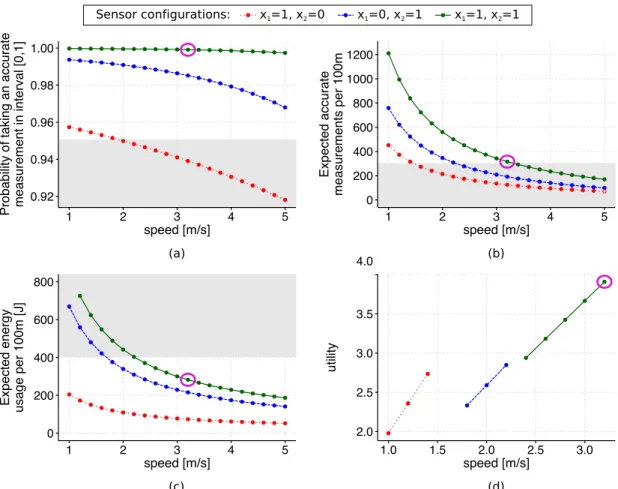
• “At least 300 measurements of sufficient accuracy are taken by the active sensors for every 100m travelled by the UUV”;
• “The energy consumption of the sensors does not exceed 400J for every 100m travelled by the UUV”.
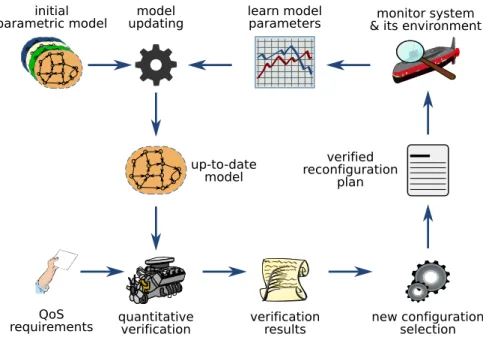
A self-adaptive software system employs RQV to reverify its compliance with QoS requirements after environmental, requirement and system changes. Through a contin-ual monitoring process, the system and its environment are observed at runtime, and the up-to-date system and environment states are determined. These states are used to instantiate a concrete model from a family (i.e., parametric) of system models associated with the different scenarios the system might operate in. The chosen model is analysed exhaustively using quantitative verification, to identify and/or predict violations of QoS requirements such as response time, availability and cost. When requirement violations occur or are predicted, the quantitative verification results enable the synthesis of a ver-ified reconfiguration plan. The execution of this plan ensures that the system continues to meet its QoS requirements despite the changes identified in the monitoring step.
1.3
Motivation and Research Hypothesis
Recent research established RQV as an approach suitable for augmenting software sys-tems with self-adaptive capabilities and for continually verifying their QoS require-ments [32, 38, 68, 146]. Notwithstanding its merits, RQV is a model checking approach, and thus is affected by thestate-explosion problem [13, 48], where the size of the model increases exponentially with the size of the system. Hence, RQV cannot operate with the low computational and memory overheads required by many realistic self-adaptive software systems. Even when RQV can analyse a single system reconfiguration effi-ciently, the need to analyse all possible alternative reconfigurations after each change renders RQV infeasible with the exception of self-adaptive systems with small configu-ration spaces. These limitations call for efficient and scalable RQV techniques [32].
Existing research to improve RQV efficiency has introduced variants of the approach that exploit various aspects of the runtime verification process. These RQV variants, which we analyse in Section 2.2.3, are (i) compositional, by using assume-guarantee model checking to verify component-based systems one component at a time [37, 130, 151]; (ii)incremental, by establishing the current verification results from those obtained in previous verification runs [82, 130, 154]; and (iii) pre-computation-based, by trans-forming temporal logic formulae into easy-to-evaluate algebraic expressions [76, 79]. These RQV variants reduce the RQV overheads but they are only applicable to discrete-time models, can support only the simplest structural changes in the verified model, and make limiting assumptions (e.g., that the model can be partitioned into strongly connected components each of which is much smaller than the original model).
This thesis presents research that complements and addresses several limitations of the solutions summarised above by improving the efficiency and scalability of RQV, aim-ing to extend its applicability to larger and more complex critical self-adaptive systems. We adapt methods from other software engineering areas, employ evolutionary algo-rithms, and propose a decentralised RQV variant suitable for distributed self-adaptive systems. Finally, we devise an RQV-based methodology for engineering trustworthy self-adaptive systems. The hypothesis underlying the research in this thesis is as follows:
Given the representation of key aspects of a self-adaptive system as Markov models and a set of QoS requirements defined in suitable probabilistic tem-poral logics, efficient runtime quantitative verification techniques can pro-vide guarantees that the system continues to satisfy its QoS requirements in the presence of changes, for much larger systems and with much lower overheads than the standard RQV approach.
1.4
Research Scope and Assumptions
Before proceeding with the presentation of our research, we should set its scope. This will clarify the RQV challenges that the research focuses on and the contributions made by this thesis. Thus, we discuss other RQV-related challenges that are outside the scope of this thesis [17, 32, 95]. We also analyse the assumptions that underpin the self-adaptive systems used for evaluating the techniques and methodologies in Chapters 3–6. First, RQV is affected by the traditional model checking challenges of deriving the stochastic models from the actual software systems and formalising QoS requirements in appropriate temporal logic formulae. Despite the importance of these challenges, they primarily concern design-time activities, and thus are outside the scope of this thesis. There is also significant research that addresses these challenges. For the former chal-lenge, ProProST [104] can transform QoS requirements expressed in natural language into probabilistic temporal logic formulae. For the latter, stochastic system models can be developed by domain experts, by analysing the system and its log files [97], or by using model-to-model transformation techniques [16, 89, 102].
Second, the effectiveness of RQV depends on the accuracy of the models analysed by the technique. Models that do not capture the actual system and environment be-haviour may lead to invalid reasoning about the compliance of a system with its QoS requirements, incorrect decisions and unnecessary or delayed adaptation. Developing initial accurate models for self-adaptive systems at design time requires significant ex-pertise. Maintaining, however, these models in sync with changes occurring in the system and its environment at runtime calls for rigorous online parameter and model learning techniques. Such techniques can be found in [34, 39, 68, 97, 141]. This is an equally important challenge for RQV, but it is also outside the scope of this thesis.
Third, RQV uses stochastic models and the corresponding temporal logic formulae for modelling and verifying QoS requirements of a self-adaptive software system, e.g., reliability, performance and cost. Thus, this research deals with self-adaptive systems whose QoS requirements can be formalised as temporal logic formulae and verified over stochastic models (that capture the behaviour of the self-adaptive systems).
Fourth, the self-adaptive systems that we consider comprise a managed software system and a monitor-analyse-plan-execute (MAPE) [139] controller. We assume that the managed system is already available and its components can execute low-level com-mands as instructed by the controller during adaptation steps. The controller monitors the managed system and its environment, analyses stochastic models to identify devia-tions from the expected behaviour, synthesises an adaptation plan to restore compliance
with QoS requirements and executes this plan to adapt the managed system.
Fifth, this thesis does not consider self-adaptive systems that operate in a “closed world”, i.e., systems in which changes can be anticipated fully beforehand. In this sce-nario, adaptation decisions for each possible system and environment state can be com-puted at design-time, and a rule-based system would be sufficient to realise adaptations at runtime. Also, self-adaptive systems with hard real-time requirements and systems in which reverification must occur several times per second are outside the scope of this thesis (since the time required by RQV to analyse alternative system configurations will unavoidably violate these timing requirements).
Finally, unless otherwise stated, we assume that all self-adaptive systems used in this thesis have afailsafe configuration. If no valid configuration can be found within the available time or without depleting the available resources, this (system-specific) failsafe configuration is automatically activated to minimise or prevent any further damage.
1.5
Thesis Contributions
The main contributions of the thesis, described in Chapters 3–6, are summarised below.
Efficient RQV Using Conventional Software Engineering Methods
We establish that caching, limited lookahead and nearly-optimal reconfiguration can improve the efficiency of RQV. With caching, recent verification results are kept for some time and are reused when the same environmental changes are encountered again. The technique is particularly effective when the changes are small and localised. Lim-ited lookahead uses idle CPU cycles to pre-verify system states deemed likely to occur in the near future. When system changes arise, if the current system state has already been verified, it is sufficient to retrieve these verification results. Finally, nearly-optimal reconfiguration terminates early a reconfiguration step, provided that a valid configu-ration has been identified and a “near-optimality” criterion is met.
We evaluate these techniques using a simulator for self-adaptive UUVs. The find-ings provide evidence that all the techniques and their combinations improve the RQV response time in many realistic scenarios. For each technique, however, there are some trade-offs. Caching and limited lookahead require additional storage for retaining the verification results. Limited lookahead also needs extra CPU for the pre-verification process. On the other hand, nearly-optimal reconfiguration operates with much lower overheads than standard RQV, at the expense of selecting a sub-optimal configuration.
Improving RQV Efficiency Using Evolutionary Algorithms
We propose EvoChecker, a search-based approach that drives reconfiguration in self-adaptive systems using evolutionary algorithms. EvoChecker encodes possible system configurations within a probabilistic model template and specifies QoS requirements as constraints and optimisation objectives. We develop a human-in-the-loop EvoChecker that produces the Pareto optimal configurations and asks system experts to validate adaptation decisions. We also implement an automated EvoChecker that uses a strat-egy to archive verification results from recent reconfigurations, such that future recon-figurations are synthesised much faster by starting from the archived historical results. We evaluate each EvoChecker variant in two case studies from different application domains and achieve significant reductions in RQV overheads. The human-in-the-loop EvoChecker generates Pareto optimal configurations and assists system experts with making informed adaptation decisions. The use of archive updating strategies in the automated EvoChecker improves the search and identifies effective configurations faster than strategies that do not make use of the archive.
Extending RQV to Decentralised Control Loops
We introduce DECIDE, the first RQV-based approach for the engineering of decen-tralised control loops in distributed self-adaptive systems. Each component of a DECIDE-based system carries out the following steps: (1) RQV-driven local capability analysis to establish a summary of possible component contributions towards realising the system-level QoS requirements; (2) receipt of peer QoS capability summaries; (3) decentralised selection of component contribution-level agreements (CLAs); and (4) RQV-based lo-cal control loop that guarantees the component’s compliance with its CLA and lolo-cal QoS requirements. Infrequently, a component is affected by major changes and executes steps (1)–(4) again; at all other times, each component runs only step (4) independently. We evaluate DECIDE using a simulated embedded system from the UUV domain, showing its efficiency and effectiveness. DECIDE drives reconfiguration with overheads that are several orders of magnitude lower compared to centralised RQV-based control loops. DECIDE can also scale with insignificant increase in overheads to systems of much larger sizes. Finally, DECIDE-based systems withstand component failures and can continue operating when peer components fail completely (provided that system-level QoS requirements can be satisfied by the other components).
Engineering Trustworthy Self-Adaptive Software Systems
verification results generated by RQV can be used as assurance evidence to confirm the correctness of adaptation decisions. To this end, we introduce ENTRUST, the first tool-supported methodology for the end-to-end engineering of trustworthy self-adaptive software systems. ENTRUST spans both design-time and runtime activities, and sup-ports the development of formally verifiable controllers whose adaptation decisions are driven by RQV, the generation of design-time and runtime assurance evidence, and the runtime instantiation of an assurance argument pattern for self-adaptive systems.
To validate ENTRUST, we apply it to the development of two self-adaptive systems from different application domains, an embedded system from the UUV domain and a service-based system from the domain of foreign exchange. Next, through an empirical evaluation of the two generated self-adaptive systems, we confirm the correct execution of the ENTRUST controller and the validity of the generated assurance arguments. Finally, we examine the overheads incurred for the generation of assurance evidence and confirm that they are acceptable for small-to-medium systems. In larger systems, ENTRUST can use the efficient RQV variants we introduce in Chapters 3–5 or the complementary techniques for improving the RQV efficiency reviewed in Section 2.2.3. ENTRUST is joint work with Prof. Tim Kelly and Dr. Ibrahim Habli from Uni-versity of York, UK and with Prof. Danny Weyns and Usman Iftikhar from Linnaeus University, Sweden. The following ENTRUST components correspond to existing re-search of our collaborators that has been integrated within ENTRUST, or to components developed collaboratively. First, the formally verifiable models used for instantiating the ENTRUST controller are developed by specialising application-independent model templates, adapted from the recent work of de La Iglesia and Weyns [99]. We extended these templates with elements specific to the ENTRUST controller (e.g. probabilistic verification engine) and the class of managed systems handled by ENTRUST (e.g., fail-safe configuration). Second, the trusted MAPE virtual machine that executes the con-troller models at runtime is developed by Prof. Danny Weyns and Usman Iftikhar [128]. Finally, the assurance argument pattern has been developed in Goal Structuring Nota-tion [105] in collaboraNota-tion with Prof. Tim Kelly and Dr. Ibrahim Habli.
The Big Picture
The contributions made in this thesis focus on the application of RQV in self-adaptive systems and address the following key RQV challenges: (1) state-space explosion; and (2) managing large configuration spaces. To this end, the thesis introduces a set of RQV techniques that improve RQV efficiency and scalability, and extend the applicability of the technique to larger and more complex critical self-adaptive systems. More
specifi-cally, we reduce RQV overheads up to one order of magnitude by extending RQV with a set of conventional software engineering methods, i.e., caching, limited lookahead and nearly-optimal reconfiguration (Chapter 3). These methods require limited effort from an engineer, caching and limited lookahead are optimal and nearly-optimal reconfigura-tion is guaranteed to complete. With EvoChecker, we reduce RQV overheads by several orders of magnitude and make RQV applicable to systems with large state and configu-ration spaces (Chapter 4). As a metaheuristics-based technique, however, EvoChecker incorporates the drawbacks of these algorithms (e.g., no optimality guarantees, stagna-tion). It also requires more engineer effort to implement. With DECIDE, we enable the application of RQV to distributed self-adaptive systems with overheads several or-ders of magnitude lower compared to centralised RQV-based control loops(Chapter 5). This technique also requires some engineering effort. Finally, we introduce ENTRUST, a methodology for engineering trustworthy self-adaptive systems using dynamic assurance cases (Chapter 6). In this methodology, RQV is used for the verification of stochastic models of a self-adaptive system and for driving adaptation decisions. The verification results are used to update the assurance case at runtime. This is an engineer-driven methodology that spans both design-time and runtime.
Our contributions in Chapters 3–5 reduce the RQV overheads and improve the scal-ability of the technique. Applying these techniques in a self-adaptive system requires domain knowledge, i.e., an engineer should examine the type and characteristics of the system (e.g., centralised or distributed, medium or large configuration space) and deter-mine the most applicable technique. Some of these techniques could be used in conjunc-tion (e.g., caching and EvoChecker). On the other hand, the ENTRUST methodology (Chapter 6) could be applied for the engineering of new self-adaptive systems and our efficient RQV techniques could undertake the relevant analysis and verification tasks of the methodology.
Prototype Self-Adaptive Software Systems
We evaluate our new RQV veriants using three self-adaptive systems from different application domains: (1) a software-controlled dynamic power management system adapted from [174, 188] and described in Appendix B; (2) an embedded system from the unmanned underwater vehicle (UUV) domain introduced in Section 2.2.1.1; and (3) a service-based system from the domain of foreign exchange (FX) presented in Section 4.1. The UUV and FX systems have been developed as part of this research. For each system, we describe its operation, define its behavioural and/or architectural aspects of interest and specify the relevant QoS requirements. We also devise Markov models that
describe the relevant behavioural aspects of each system and formalise its QoS require-ments in a suitable variant of probabilistic temporal logic. Finally, we develop prototype system implementations and use them for evaluating experimentally our contributions. Depending on the semantics of each proposed approach, we adjust the self-adaptive systems accordingly. For instance, DECIDE (Chapter 5) deals with distributed self-adaptive systems. Thus, we extend the single-UUV system to a multi-UUV system and introduce QoS requirements specific to the distributed version of the system.
We did not use recent case studies or exemplars from the domains of embedded and service-based systems, either because they were made available subsequently to our work (e.g., [65, 206]) or because they did not meet the scope of our research introduced in Section 1.4 (e.g., [201]). Finally, the choice of the UUV system is also driven by our plan to apply RQV to cyber-physical systems in the future (cf. Chapter 7).
1.6
Thesis Structure
The remainder of this thesis is structured as follows.
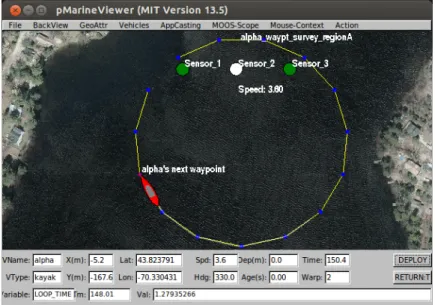
Chapter 2 presents background information, an overview of RQV, and a survey of related work. Sections 2.1.1 and 2.1.2 introduce the Markov models and temporal logic variants used throughout the thesis, respectively. Section 2.2 reviews RQV, starting with the principles underpinning its use in self-adaptive systems (Section 2.2.1) and including an extensive analysis of recent research in the area (Sections 2.2.2 and 2.2.3). Chapter 3 introduces our work on improving RQV efficiency using conventional software engineering techniques. Sections 3.1.1–3.1.3 present the integration of caching, limited lookahead and nearly-optimal reconfiguration with RQV. Section 3.2 describes the development of these RQV variants within the open-source platform MOOS-IvP for the implementation of autonomous applications on unmanned marine vehicles [20]. Section 3.3 presents our experimental evaluation and analyses our findings. Sections 3.4 and 3.5 discuss chapter-specific related work and conclude the chapter, respectively.
Chapter 4 describes EvoChecker, our search-based approach that uses evolutionary al-gorithms within the RQV process. Section 4.1 presents EvoChecker, including its mod-elling language (Section 4.1.1), and its human-in-the-loop (Section 4.1.3) and automated (Section 4.1.4) variants. Section 4.2 describes the open-source EvoChecker tool. Sec-tion 4.3 presents the evaluaSec-tion of both EvoChecker variants and summarises our results.
Sections 4.4 and 4.5 review related work and summarise the chapter, respectively. Chapter 5 introduces our DECIDE framework for the decentralisation of the control loops of distributed self-adaptive software. Section 5.1 presents DECIDE, and Sec-tions 5.1.2– 5.1.6 describe its four steps. Section 5.2 explains the DECIDE implementa-tion within the open-source platform MOOS-IvP. Secimplementa-tion 5.3 reports the experimental evaluation carried out to assess the effectiveness and scalability of DECIDE. Sections 5.4 and 5.5 discuss chapter-specific related work and conclude DECIDE, respectively.
Chapter 6 introduces our ENTRUST methodology for the engineering of trustworthy self-adaptive systems. Section 6.1 presents ENTRUST, while details of its various stages are provided in Sections 6.1.1–6.1.6. Section 6.2 outlines the tool-supported ENTRUST implementation. Section 6.3 reports the evaluation performed to examine the generality, correctness and efficiency of ENTRUST. Sections 6.4 and 6.5 overview chapter-specific related work and summarise the chapter, respectively.
Chapter 7 concludes the thesis by summarising the findings and contributions of this research, and providing directions for future work.
Background and Field Review
Designing and analysing software systems requires techniques that model and reason about their behaviour, considering specific aspects of interest while abstracting away implementation details. In this chapter, we present quantitative verification, a technique that is particularly suitable for this purpose. Section 2.1 provides basic background information, terminology and notation used throughout the thesis. In Sections 2.1.1 and 2.1.2, we present the types of probabilistic models and specification formalisms used in quantitative verification, respectively. In Section 2.2, we survey the area of runtime quantitative verification. More specifically, in Section 2.2.1 we advocate the use of runtime quantitative verification to support self-adaptation, while in Sections 2.2.2 and 2.2.3 we summarise early applications of the technique and recent advances aimed at improving its efficiency, respectively.
2.1
Quantitative Verification
Many software systems are subject to events of stochastic nature including message loss and component failure. Probabilityis an important element in defining these stochas-tic events and, therefore, in designing, analysing and verifying software systems [182]. Probability can be employed to:
• Model system uncertainty. Modern systems are typically deployed in dynamic and unpredictable environments. Moreover, self-adaptive systems are expected to operate dependably and to reconfigure themselves in response to unexpected changes. These uncertainty aspects can be described probabilistically.
• Derive efficient algorithms. Randomisation, e.g., in the form of electronic coin tosses, can break symmetry in distributed co-ordination algorithms. For instance, randomisation in self-stabilising algorithms [150] ensures that all processes will eventually reach consensus with probability 1. In the IPv4 Zeroconf Protocol [147], randomisation minimises IP address collision by requiring devices joining a network to choose randomly an address from a pool of 65024 available addresses.
• Model system failure. Hardware and software components are both error-prone and affected by multiple types of failures. Typical examples include hard disk damage, processor overheat and service degradation. Probability can be used to define this unreliable behaviour, to reason about the likelihood of an action to terminate incorrectly or to determine if system failure exceeds a certain threshold. An example statement for a fault-tolerant system is “the likelihood of a failure occurring within the first hour is at most 0.001”.
• Model system performance. Probability enables to quantify the performance of a system and to establish various Quality-of-Service (QoS) properties such as throughput, average response time, queue length, energy consumption and CPU utilisation. This performance evaluation supports the identification of flaws in system design and potential deviation from specification, and can provide insights into improving the design. A typical QoS property for a server handling requests is “the expected cost of providing an answer does not exceed 10 time units”.
Quantitative verification (QV)[32, 145] is a mathematically-based technique for analysing the reliability, performance and other QoS properties of systems exhibiting stochastic behaviour. The technique uses finite state-transition Markov models (cf. Def. 2.1) to describe the behaviour of a system. In these models, states represent different system configurations and edges correspond to available transitions between these states. Depending on the model type, an edge is annotated with the probability or rate of taking the associated transition. Also, model states and transitions can be augmented with cost/reward information, extending the range of properties that can be analysed.
The QoS properties analysed using these models are formally specified in variants of temporal logic, extended with probabilities and costs/rewards. These specifications enable reasoning about the likelihood of certain events occurring while a system oper-ates or about the cost/reward associated with these events. Typical examples of QoS properties [182] include, “the expected time until a new device entering the network gets a reply” for the IPv4 Zeroconf Protocol and “the resource usage during the first month of operation” for a fault-tolerant system.
software system QoS requirements probablistic model probabilistic temporal logic probabilistic model checking (e.g., PRISM) verification results P<0.01 [F fail] result
Figure 2.1: Overview of quantitative verification process.
Given a model and a probabilistic temporal logic formula, QV carries out exhaustive analysis to establish the value of the property. To this end, the technique can determine if the property meets a bound (or threshold), and thus answer to questions concerning the satisfaction of a QoS requirement. Alternatively, verification results in the form of exact probabilities or rewards associated with the formula can be used to gain insights into the behaviour of the system and support decision making. A pictorial overview of the technique is given in Figure 2.1. Methods such as symbolic model checking, symmetry reduction and counterexamples are used for reachability analysis [13], while numerical methods like linear algebra and linear programming are used to calculate the actual probabilities [182]. Probabilistic model checkers automate the process of quantitative verification. PRISM [149], MRMC [133] and Ymer [214] are among the most widely used probabilistic model checkers. We refer the interested reader to [1] for a comprehensive list of available model checkers.
In the remainder of this section, we introduce the Markov models used later in the thesis (Section 2.1.1) and the probabilistic temporal logics (Section 2.1.2) underpinning the approaches developed by this thesis.
2.1.1 Markov Models
Given that specific aspects of a software system’s behaviour can be described probabilis-tically, e.g., uncertainty originating from the deployed environment or users’ interaction, we can model this behaviour as a stochastic process, i.e., a collection of random variables indexed by time. Formally, a stochastic process is a function X :T ×Ω→ S, where
time evolves in discrete intervals, i.e., T =N, X is a discrete-time process; otherwise,
i.e., T = [0,∞),X is acontinuous-time process. We denote with X(t) the state of the process at timet∈T.
A special class of stochastic processes, called Markov processes, satisfies the Markov property (Def. 2.1), which specifies the conditional dependence of future on the present and its independence from the past [182]. Simply stated, evolution in a Markov process depends only on the present state and not on the history of preceding events.
Definition 2.1. A stochastic process {X(n) | n = 0,1,2, ....} satisfies the Markov property if
P[X(n) =sn|X(n−1) =sn−1, ..., X(0) =s0] = P[X(n) =sn|X(n−1) =sn−1] where s0, s1, ..., sk represent successive states of the stochastic process.
All the models described hereafter are variants of Markov processes. Depending on how time evolves and the aspects of system behaviour modelled, these variants could be discrete-time Markov chains (DTMCs) and continuous-time Markov chains (CTMCs).
2.1.1.1 Discrete-Time Markov Chains
Discrete-time Markov chains (DTMCs)are the simplest among the probabilistic models we consider. A DTMC is essentially a state-transition system augmented with probabilities in which time progresses in discrete intervals. The next state at each point in time is specified by a discrete probabilistic distribution from source to target states.
Definition 2.2. A discrete-time Markov chain (DTMC) over a set of atomic proposi-tions AP is a tuple
D= (S, s0,P, L) (2.1)
where:
• S is a finite set of states;
• s0 ∈S is the initial state;
• P:S×S → [0,1] is a transition probability matrix such that the exit probability from any states∈S isP
• L : S → 2AP is a labelling function which assigns to each state s ∈ S the set L(s)⊆AP of atomic propositions that are valid in that state.
An atomic proposition declares a relevant characteristic of the system under inves-tigation. In particular, an atomic proposition expresses simple statements associated with system states that evaluate to true, if they hold, or false, otherwise. Typical ex-amples of atomic propositions are “the server queue is not full”, “the system invoked its self-protection mechanism”, and “the energy usage exceeds 100 units”.
For any states s, s0 ∈ S, the entry P(s, s0) of the transition probability matrix P
specifies the probability of moving from s to s0 in a single step. For state s, row P(s,·) and column P(·, s) denote the transitions leaving from and entering to state
s, respectively. A state with only an outgoing transition to itself with probability 1 is called an absorbing state. An edge from s to s0 exists if and only if P(s, s0) > 0.
Figure 2.2 shows the graphical representation of a DTMC, in which vertices and edges represent system states and transitions, respectively. The transition probability matrix
Pis shown in Example 2.1.
A path signifies a single execution of a DTMC. Formally, a path is a non-empty sequence of states π =s0s1s2...wheresi ∈S and P(si, si+1) >0 for all i≥0. A path is finite if the number of states in the sequence is finite, and has a length denoted as
|π|. The i-th state of the path is denoted byπ(i). Given a starting state s, the set of all paths starting froms, is denotedP athD(s).
In order to analyse the behaviour of a DTMC, we need to evaluate the probability of taking certain paths through the model. The matrixP induces a probability space on P athD(s), using the cylinder construction [182]. An observation of a finite path determines a basic event (cylinder). Assuming a starting state s0 and a finite path
π=s0s1...sn, the probabilityPrs(π) of reaching statesn is defined as
Prs(π) =
1 if n= 0
P(s0, s1)·P(s1, s2)·...·P(sn−1, sn) otherwise
(2.2)
This equation provides the means to find a unique probability Prs on the infinite pathsP athD(s). Generally, for any pair of statess, s0∈S, the probabilityPr
s is equal to the sum of the probabilities of all the paths starting fromsand ending to s0. When the number of steps is limited tok, the probability is equal to the entryPk(s, s0). More details can be found in [13, 182].
Extending DTMCs with Rewards
DMTCs can be augmented with cost/reward structures, i.e., functions that map states and/or transitions to real-valued quantities. Although mathematically there is no dis-tinction between manipulating and computing costs and rewards, commonly adopted se-mantics declare that cost should be minimised and reward should be maximised. These structures can be used to represent additional information regarding the behaviour of a system modelled by a DTMC. They can have a wide range of interpretations, for example, elapsed time, power consumption, size of message queue, numbers of messages successfully delivered, net profit and throughput.
Definition 2.3. A cost/reward structure over a DTMC D= (S, s0,P, L) is a pair of real-valued functions (ρ, ι) where:
• ρ :S → R≥0 is a state reward function that defines the reward obtained when D is in states for one time step;
• ι:S×S → R≥0 is a transition reward function that defines the reward obtained each time a transition occurs.
Example 2.1. Figure 2.2 depicts the DTMC model of a train booking e-commerce sys-tem. A customer, after entering the system, can search for and buy train tickets, and optionally have the tickets delivered using a shipping service, or can select to print the tickets herself. The customer can then either perform another search or complete the operation. The model elements are: the set of statesS={s0, s1, ..., s7}, the initial state
s0, the set of atomic propositionsAP ={init,search,buy,shippping,succ,failed_search, failed_buy,failed_shipping}, and the labelling function L : L(s0) = {init}, L(s1) =
{search}, L(s2) ={buy}, L(s3) ={shipping}, L(s4) ={succ}, L(s5) ={failed_search},
L(s6) ={failed_buy}, L(s7) ={failed_shipping}.
The DTMC is augmented with a state cost structure, shown in the rectangular box, that associates a cost of 1 each time a search operation is made.
s0 1 {init} {failed search} s1 1 s2 {search} {buy} 1 s3 {shipping} s7 {succ} {failed buy} {failed shipping} s5 s6 1 0.01 0.01 0.88 0.29 0.70 0.20 0.10 0.02 1 0.49 s4 0.30 1
Figure 2.2: DTMC model of an e-commerce system.
The corresponding transition probability matrixPof the system is
P= 0 1 0 0 0 0 0 0 0 0.70 0.29 0 0 0.01 0 0 0 0.20 0 0.79 0 0 0.01 0 0 0.10 0 0 0.88 0 0 0.02 0 0 0 0 1 0 0 0 0 0 0 0 0 1 0 0 0 0 0 0 0 0 1 0 0 0 0 0 0 0 0 1
Suppose we want to estimate the probability to complete a purchase (i.e., reach state
s4) within k = 3 steps. The expected result is given by entry P3(s0, s4). Since only path π = s0s1s2s4 can reach the success state within at most k = 3 steps, the probability Prs is equal to the probability given by path π, i.e., Prs = Prs(π) =
2.1.1.2 Continuous-Time Markov Chains
Continuous-Time Markov Chains (CTMCs) model systems which have discrete states but where time progresses continuously. Transitions in a CTMC occur in real time, while delays before making a transition are represented with exponential prob-ability distributions [12, 148]. CTMCs are suitable for modelling and analysing the performance and reliability of real-time systems, including transient and steady-state behaviour, i.e., the state of the system at a particular time instant and in the long-run, respectively. Typical examples of such systems are queueing networks, financial systems and biological systems.
Definition 2.4. A continuous-time Markov chain (CTMC) over a set of atomic propo-sitions AP is a tuple
C= (S, s0,R, L) (2.3)
where:
• S is a finite set of states;
• s0 ∈S is the initial state;
• R:S×S →R≥0 is a transition rate matrix;
• L : S → 2AP is a labelling function which assigns to each state s ∈ S the set L(s)⊆AP of atomic propositions that are valid in that state.
For any states s, s0 ∈ S such that R(s, s0) > 0, the probability that the CTMC transitions from statesto states0withinttime units is given by the negative exponential distribution 1−e−R(s,s0)·t. When multiple outgoing transitions can be triggered in s, that is, |T(s)|>1 where T(s) ={s0 ∈S |R(s, s0) >0}, the behaviour of a CTMC is the result of a race condition. Each outgoing transition froms can be triggered after an exponentially distributed delay. The first triggered transition determines the next model state. Before a transition occurs, the system remains in statesfor time t, which is exponentially distributed with its exit rate
E(s) =X s0∈S
When leaving state s, the probability to move to states0 is given by the embedded DTMC of CTMC, specified in Def. 2.5. The probabilities in the embedded DTMC are independent of the time at which the transitions occur. Similarly to DTMCs, this information can be used to determine the probability for the model to be in a given state after takingn transitions.
Definition 2.5. The embedded DTMC of a CTMC C= (S, s0,R, L) is a tuple
emb(C) = (S, s0,Pemb(C), L) (2.5) where for any s, s0 ∈S
Pemb(C)(s, s0) = R(s, s0)/E(s) if E(s)6= 0 1 if E(s) = 0 and s=s0 0 otherwise
A path through a CTMC is a non-empty sequence s0t0s1t1s2, . . . , tk−1sk where
R(si, si+1) > 0 and ti ∈ R>0 is the time spent in state s, for all 0 ≤ i ≤ k. State
sk is absorbing. We denote withπ(i) thei-th state of pathπ. Ifi≤kand t≤Pki=1−1ti we also denote with time(π, i) the amount of time spent in state si and with π@t the state occupied at timet; otherwise time(π, i) =∞ and π@t=sk. We use the notation P athC(s) for the set of all finite paths originating from states.
Analysing the behaviour of a CTMC model requires to reason about the probability of traversing certain paths in the model. Given a set of non-empty intervalsI0, ..., In−1 ∈
R≥0, the cylinder set C(s0, I0, ..., In−1, sn) contains all paths π ∈ P athC(s) such that π(i) =si for all i≤nand time(π, i)∈Ii for alli < n. The probability of this cylinder is defined by
Prs(C(s0, I0, ..., In−1, sn)) =
Prs(C(s0, I0, ..., In−2, sn−1)) · Pemb(C)(sn−1, sn) · eE(sn−1)·inf In−1−eE(sn−1)·supIn−1
(2.6) whereinfIn−1andsupIn−1 are the infimum and supremum of the intervalIn−1, respec-tively [148].
The sum of all possible cylinder sets involving states s0, s1, ..., sn and intervals I0, ..., In−1 ∈R≥0 gives a unique probabilityPrs for reaching state sn.
Extending CTMCs with Rewards
CTMCs can be annotated with cost/reward structures of the form(ρ, ι), i.e., functions that assign real-valued quantities to states and transitions. Differently from DTMCs, state cost/rewards are calculated based on the rate at which they are obtained. Thus, if the model remains in state sfor t∈R≥0 time units, a reward oft·ρ(s) is acquired.
Definition 2.6. A cost/reward structure over a CTMC is a pair of real-valued functions (ρ, ι) where:
• ρ :S → R≥0 is a state reward function that defines the rate at which the reward is obtained while the CTMC is in states;
• ι:S×S → R≥0 is a transition reward function that defines the reward obtained each time a transition occurs.
Example 2.2.Consider thei-th sensor of a system equipped with a set of sensors that can measure an environment attribute, e.g., temperature, humidity or light intensity. When used, the sensor takes measurements with rate ri and consumes energy ei for each measurement. Once a measurement is taken, the sensor carries out the necessary operations to prepare for the next measurement with raterprepi . Each measurement is accurate with probability pi, and this probability depends on various factors including the sensor’s specification and deployed environment. To save energy, the sensor can be switched on and off through a configurable parameter xi ∈ {0,1}; if xi = 1 the sensor is active, while if xi = 0 the sensor is switched off. However, switching the sensor on and off consumes an amount of energy given byeon
i andeoffi , respectively.
Figure 2.3 depicts the CTMC model of the i-sensor, adapted from [94]. The model corresponds to a session during which the sensor is either operational (xi = 1) or switched off (xi = 0). If the sensor is switched off, the model transitions to state s4 with rate roff
i and stays there indefinitely. When the sensor is operational, the model initially moves to starting state s1 with rate rion. The sensor then starts executing and takes measurements with rateri. With probabilitypi the measurement is accurate and the model transitions to success state s2; otherwise, it transitions to fail state s3.
s0 s1 s4 s2 s3 xi×r on i (1− xi) ×roff i pi×ri (1− pi) ×r i riprep riprep eoffi eon i 1 1 ei {init} {stop} {fail} {start} {succ}
Figure 2.3: CTMC model of the i-th UUV sensor.
Once this event is completed, the model transitions back to states1 with raterprepi and continues taking measurements for the duration of the session.
The CTMC is augmented with two cost/reward structures, whose non-zero elements are shown in Figure 2.3 in rectangular and dashed rectangular boxes, respectively. The former, “energy” structure associates the energy used to switch the sensor on (i.e.,eon
i ) and off (i.e., eoff
i ) and to perform a measurement (i.e., ei) with the CTMC transitions that model these events. The other cost/reward structure, called “measurement”, asso-ciates a reward of 1 with the transition corresponding to an accurate measurement.
The model has the following elements: the set of states S ={s0, s1, s2, s3, s4}, the initial state s0, the set of atomic propositions AP ={init, start, f ail, succ, stop}, and the labelling function L : L(s0) = {init}, L(s1) = {start}, L(s2) = {succ}, L(s3) =
{f ail}, L(s4) ={stop}.
The corresponding transition rate matrix Rand the embedded DTMCPemb(C) are
R= 0 xi×roni 0 0 (1−xi)×roffi 0 0 pi×ri (1−pi)×ri 0 0 rprepi 0 0 0 0 rprepi 0 0 0 0 0 0 0 1
Pemb(C)= 0 xi×roni xi×rion+(1−xi)×roff i 0 0 (1−xi)×rioff xi×roni +(1−xi)×roff i 0 0 pi (1−pi) 0 0 1 0 0 0 0 1 0 0 0 0 0 0 0 1
Finally, suppose that the i-the sensor is active, i.e, xi = 1 and rion = 10. We want to establish the probability of reaching the start states1 within 0.2 seconds; thus,
I0 = [0,0.2]. Using (2.6), the probability is equal to
P rs(C(s0, I0, s1)) =P rs(C(s0)) · Pemb(C)(s0, s1) · e−E(s0)·inf I0 −e−E(s0)·supI0
= 1·xi·(e0−e−0.2r on i ) = 1−e−0.2ron i = 0.8646647
2.1.2 Probabilistic Temporal Logics
Having specified the behaviour of a software system in a Markov model variant (e.g., DTMC or CTMC), the interest now is on quantifying several QoS properties for this system. A property represents a quality aspect of a system, typically quantifiable using specific metrics through well-defined processes; for example, reliability, response time and cost. Probabilistic temporal logics is a set of specification languages used for specifying formally the required QoS properties of a system and for reasoning about system behaviour over time. Since transitions in Markov models are associated with a probabilistic choice, we are typically interested in computing the likelihood of an event occurring, instead of simply determining whether the event holds or not. An example QoS property for the e-commerce system from Figure 2.2 is “the probability of a failure ever occurring must be less than 10%”. This section introduces Probabilistic Computation Tree Logic (PCTL) [22, 111] and Continuous Stochastic Logic (CSL) [11, 12], the temporal logic variants used to formalise the properties of DTMCs and CTMCs, respectively.
2.1.2.1 Probabilistic Computation Tree Logic
Probabilistic Computation Tree Logic (PCTL)[22, 111] is a branching-time tem-poral logic for describing properties of DTMCs. To this end, PCTL extends the non-probabilistic Computation Tree Logic [13, 182] with a non-probabilistic operator P. In this thesis, we use the cost-reward augmented PCTL variant with the syntax from [148], as detailed below.
Definition 2.7. The syntax of Probabilistic Computation Tree Logic (PCTL) is given by the following grammar:
Φ ::=true|a| ¬Φ|Φ ∧ Φ|P./p [φ] φ::=XΦ|ΦS≤k
Φ
and the cost/reward augmented PCTL state formulae are defined by the grammar:
R./r[C≤k]|R./r[I=k]|R./r[F Φ] where:
• a∈AP is an atomic proposition with AP being a set of atomic propositions;
• ./∈ {<,≤,≥, >} is a relational operator;
• k∈N∪ {∞};
• p∈[0,1] is a probability bound (or threshold);
• r∈R≥0 is a reward bound.
In order to analyse the properties of a DTMC model, PCTL formulae specify con-ditions over the states of the model. In the definition above, state formulaeΦand path formulae φ are evaluated over model states and paths, respectively. Note that path formulae can only occur within the scope of the probabilistic operator P./p [·]. This operator defines upper or lower bounds on the probability of system evolution. For instance, a state s satisfies a formula P./p[φ] if the probability of the future system evolution meets the bound ./ p. For a path π, the “next” formula XΦ holds if Φ is satisfied in the next state. The “bounded until” formula Φ1S≤kΦ2 holds if before Φ2 becomes true at time step x, where x ≤ k, Φ1 is satisfied continuously at time steps
![Figure 2.4: High-level architecture of a self-adaptive system implementing the MAPE-K closed control loop [139].](https://thumb-us.123doks.com/thumbv2/123dok_us/11082303.2994794/52.892.330.667.205.483/figure-high-level-architecture-adaptive-implementing-closed-control.webp)
![Figure 3.2: MOOS architecture, adapted from [20], including our RQV-MOOS compo- compo-nent.](https://thumb-us.123doks.com/thumbv2/123dok_us/11082303.2994794/76.892.316.684.211.452/figure-moos-architecture-adapted-including-moos-compo-compo.webp)