Julkaisu 555 Publication 555
Anne Kleemola
Group Benchmarking as a Model for Knowledge Creation
in Supply Management Context
Tampereen teknillinen yliopisto. Julkaisu 555 Tampere University of Technology. Publication 555
Anne Kleemola
Group Benchmarking as a Model for Knowledge Creation
in Supply Management Context
Thesis for the degree of Doctor of Technology to be presented with due permission for public examination and criticism in Auditorium 240, at Tampere University of Technology - Pori, on the 18th of November 2005, at 12 noon.
Tampereen teknillinen yliopisto - Tampere University of Technology Tampere 2005
ISBN 952-15-1461-2 (printed) ISBN 952-15-1504-X (PDF) ISSN 1459-2045
i
ABSTRACT
The increasing fastness of change in business environment is forcing companies to look for more efficient methods to maintain and improve their competitive position on the market. The methods are searched among cooperation and networking operations between companies and, especially on the supply field, between supply chains. Enterprises with limited resources are facing this challenge even harder. Efficient methods to learn from other organizations and other’s experiences are essential on those efforts.
This study explores the possibilities of benchmarking as a learning method in the context of supply. Benchmarking is a well-known method, but its effective applicability to organizations with limited resources as well as company networks is not examined enough. Also the process of benchmarking as an efficient learning method is not proved according to knowledge creation theories. Therefore, the theoretical findings of this study are gathered into a new model, Group Benchmarking. The model considers the shortages of existing benchmarking types as well as the needs of means for developing supply chains toward networking. The constructive approach has been used in developing the model on the basis of supply chain management and benchmarking theories. When proving the process of learning in the construction, the knowledge management theories form a conceptual background.
The construction has been proved to be feasible in two case studies. The case studies show, firstly, that the constructed model is functional and can be accomplished successfully. Secondly, it offers well focused knowledge for participating companies to develop their own supplier networks. Thirdly, the model increases organizations’ knowledge about their weaknesses and strengths on the business environment as well as gives a path to achieve their future targets by learning from other organizations. Fourthly, it attends as a cooperative, resource-saving forum for companies with limited resources, which are not forced to “invent a wheel again”.
ii
ACKNOWLEDGEMENTS
This dissertation process revealed how important the support and encouragement of people close to the researcher are. My process took five years and it would not have been finished without the people to whom I want to give my specific thanks.
First of all, I wish to thank my supervisors Docent Kaj U.Koskinen, Professor Hannu
Jaakkola, Dr. Jari Palomäki and Dr. Rainer Breite from Tampere University of Technology for their advice and experience that I was able to utilize. The comments of Professor Hannu
Vanharanta were important in guiding me to the right direction. I am also very grateful of all the practical arrangements during the work taken care of Ms. Ulla Nevanranta.
To my reviewers, Professor Pekka Kess and Professor Antti Paasio I wish to give my thanks for their fair and valuable comments that they have given me during the evaluation process of this dissertation.
The companies that participated the empirical case studies of this dissertation deserve my warm thanks. Especially I want to mention Ms. Kati Ollila who believed in my ideas during the whole process and was continually interested in the progress of the process.
There have been some financial supporters whose contribution for this work has been critical: HAMK foundation, the Finnish Cultural Foundation, the High Technology Foundation of Satakunta and Kemira foundation.
Finally I owe the greatest gratitude to my family for their understanding and support. Especially I am grateful for my dear daughters, Heidi and Henriikka – who patiently waited for their share of my time when I was working with my thesis.
Pori, November 2005
iii
TABLE OF CONTENTS
ABSTRACT i
ACKNOWLEDGEMENTS ii
TABLE OF CONTENTS iii
LIST OF FIGURES vi
LIST OF TABLES vii
LIST OF ABBREVIATIONS AND DEFINITIONS viii
1 INTRODUCTION 1
1.1 Background 1
1.2 Research context 2
1.3 Problem formulation 3
1.4 Objectives of the Study 5
1.5 Philosophical Background and the Research Approach 6
1.6 Structure of the Thesis 10
2 SUPPLY CHAIN MANAGEMENT 12
2.1 A Historical Perspective on the Supply Chain Management 13
2.2 The Supply Chain 14
2.2.1 Defining Supply Chain and Related Concepts 15 2.2.2 The Philosophy of Supply Chain Management 18 2.2.3 Features of Buyer/supplier Relationships 20
2.3 The Network 28
2.3.1 Network Concept in General 28
2.3.2 The Supply Network Concept 29
2.4 Developing Buyer/supplier Relationships 32
2.5 Summary of the Chapter “Supply Chain Management” 42
3 CONCEPT OF KNOWLEDGE MANAGEMENT 44
3.1 Epistemological View 44
3.2 A Definition of Knowledge 47
3.3 Knowledge Types 48
3.4 Creating knowledge 52
3.4.1 Knowledge Spirals 52
iv
3.5 Knowledge Enablers 60
3.6 Summary of the Chapter “Concept of Knowledge Management” 66
4 CONVENTIONAL BENCHMARKING MODEL 67
4.1 A Definition of Benchmarking 67
4.2 History of Benchmarking 69
4.3 Benchmarking as a Tool 72
4.3.1 Different Benchmarking Types 74
4.3.2 Benchmarking Practice Models 79
5 BENCHMARKING PROCESS 82
5.1 Generic Benchmarking Process 82
5.2 Practices vs. Metrics 86
5.3 Tools and Techniques for Benchmarking 90
5.3.1 Choosing the Benchmarking Subject 90
5.3.2 Analyzing the Gap between Performances 92
5.3.3 Concluding the Tools and Techniques 94
5.4 How to Find the Best Practices? 95
5.5 Some aspects of Benchmarking Supply Chains 100 5.6 Summary of the Chapters “Conventional Benchmarking Model” and
“Benchmarking Process” 102
6 A NEW GROUP BENCHMARKING MODEL 106
6.1 ABC-classification Method 110
6.2 Supplier’s Portfolio Classification Method 110
6.3 A Form as a Boundary Object 112
6.4 Strategic Supply Chain Positioning Matrix Method 114
6.5 Group Benchmarking 118
6.5.1 Bilateral Benchmarking 119
6.5.2 Cooperative Benchmarking 120
6.5.3 Collaborative Group Partnership Benchmarking 120 6.5.4 Collaborative One-to-one Partnership Benchmarking 120 6.6 Summary of the Chapter “A New Group Benchmarking Model” 121 7 THE ROLE OF GROUP BENCHMARKING MODEL IN THE EXISTING
KNOWLEDGE MANAGEMENT THEORIES 123
7.1 The Knowledge Spiral in Group Benchmarking 123
v
7.1.2 Externalization 124
7.1.3 Combination 124
7.1.4 Internalization 125
7.1.5 The Process of Knowledge Creation and Transfer in the Group Benchmarking Model
125
7.2 Enablers in Group Benchmarking 127
7.3 Five-Phase Model of the Organizational Knowledge Creation Process in Group
Benchmarking 128 7.4 Summary of the Chapter “The Role of Group Benchmarking Model in the Existing
Knowledge Management Theories” 133
8 TESTING THE FEASIBILITY OF THE GROUP BENCHMARKING MODEL 134 8.1 CASE 1: Developing Networks Through Benchmarking in the Joinery Industry 134 8.1.1 The Case Company – Harjavalta Oy, Puustelli-keittiöt Oy 134
8.1.2 The Order-delivery –process 135
8.1.3 Analyzing the Supplier Network 136
8.1.4 The Results in the Case Study 137
8.1.5 Conclusions of the Case 1 141
8.2 CASE 2: Group Benchmarking – a Model Toward Effective Supply Networking 142
8.2.1 The Companies in the Case Study 143
8.2.2 Analyzing the Suppliers in the Companies 144 8.2.3 Positioning Suppliers in the Strategic Supply Chain Matrix 145
8.2.4 Performing Group Benchmarking 145
8.2.5 The Longitudinal Study 151
8.2.6 Conclusions of the Case 2 154
9 DISCUSSION AND CONCLUSIONS 155
9.1 Theoretical Contributions 155
9.2 Practical Contributions 156
9.3 Discussion of the Results 157
9.3.1 The Main Objectives 157
9.3.2 The Minor Objectives 158
9.4 Evaluations of the Methodology 159
9.4.1 Validity of the Research 160
9.4.2 Reliability of the Research 160
vi
REFERENCES 163
Appendix 1 The Group Benchmarking Model Appendix 2 The Supplier Positioning Matrix Form
LIST OF FIGURES
Fig. 1.1 The position of the constructive research approach as a model 8
Fig. 1.2 The structure of the thesis 11
Fig. 2.1 Type of competitive relationships 20
Fig. 2.2 Continuum of possible sourcing options 22
Fig. 2.3 The networks of the focal firm 31
Fig. 2.4 The key transition from open-market negotiations to collaboration 34
Fig. 3.1 Four modes of knowledge conversion 53
Fig. 3.2 Knowledge Spiral 55
Fig. 3.3 Learning levels influencing formation and management of cooperations 59 Fig. 4.1 Development in the art of benchmarking 71
Fig. 4.2 Classification of benchmarking 77
Fig. 4.3 Typology of externally focused benchmarking activities 78
Fig. 4.4 Nature of benchmarking activities 78
Fig. 5.1 Generic benchmarking process 84
Fig. 5.2 Benchmarking for best practices 88
Fig. 5.3 A supply chain network 102
Fig. 6.1 The new model consisting four separate methods 108 Fig. 6.2 Purchasing product portfolio and supplier portfolio 111 Fig. 6.3 The process from the positioning matrix Form to graphical format 115 Fig. 6.4 An example of illustrating the situation of present and future performance of a company as well as comparing them to the present performance of another company 116 Fig. 6.5 Examples of different comparison alternatives obtained from positioning matrix material
117
Fig. 6.6 The Group Benchmarking model 119
Fig. 6.7 Group Benchmarking as a continuous process 122 Fig. 7.1 Creating and transferring knowledge through the Group Benchmarking 126
vii Fig. 7.2 Model for developing and managing supplier networks 127 Fig. 7.3 Five-phase model of the organizational knowledge-creation process 129 Fig. 8.1 Process map of Puustelli-keittiöt Oy main processes 135 Fig. 8.2 The supplier’s portfolio classification in the case company 138 Fig. 8.5 The present network situation in all participating companies on Stages 2 and 3 148 Fig. 8.6 Examples of using positioning matrixes for collaborative one-to-one partnership
benchmarking. 150 Fig. 8.7 Examples of comparison between the first and second studies 153
LIST OF TABLES
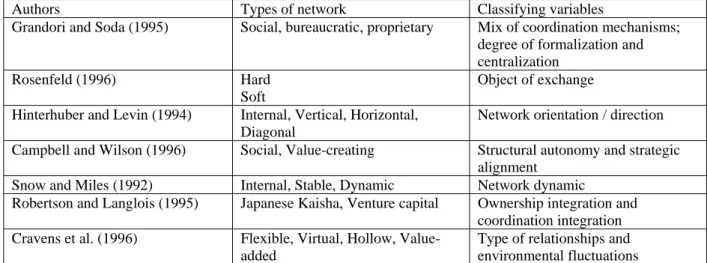
Table 2.1 Classifications of networks within the literature 29
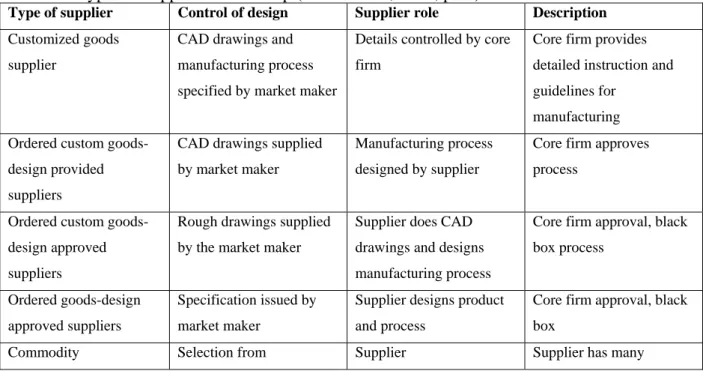
Table 2.2 Types of supplier relationship 35
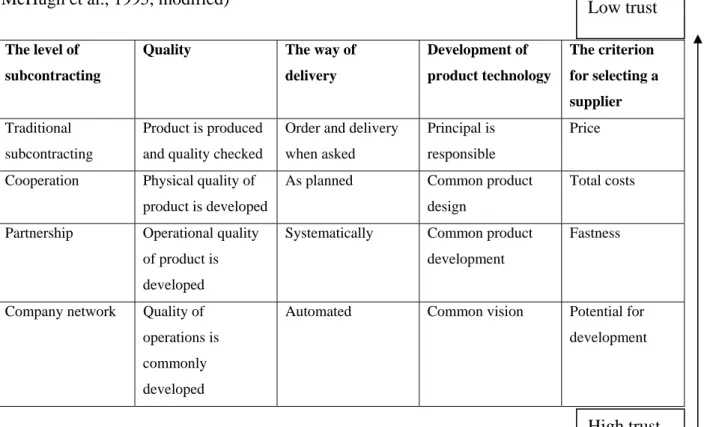
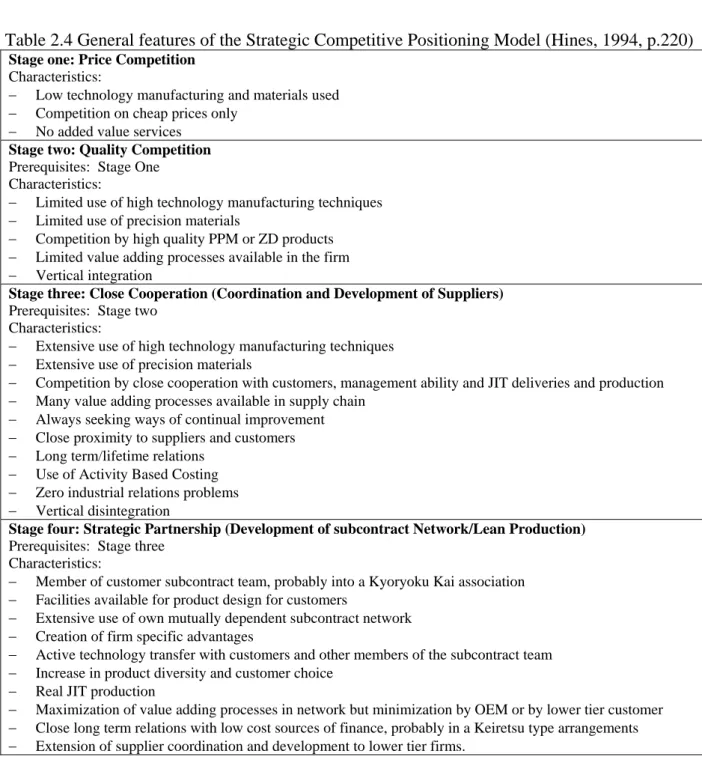
Table 2.3 The levels of subcontracting as a function of trust 36 Table 2.4 General features of the Strategic Competitive Positioning Model 38 Table 2.5 Incremental benefits achieved at each stage of the Strategic Competitive Positioning
Model 39
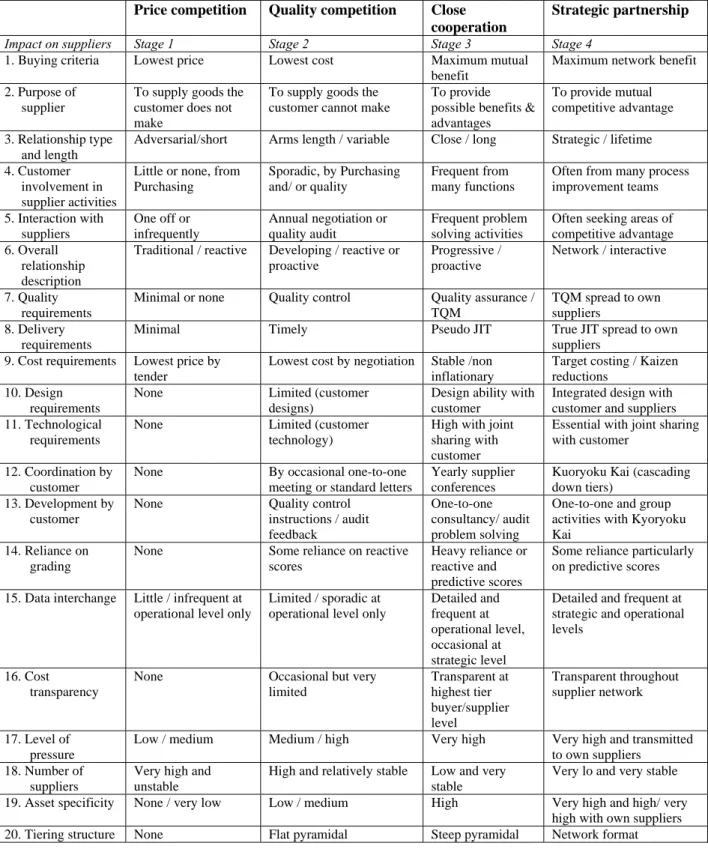
Table 2.6 The Supply Chain Positioning Matrix 40
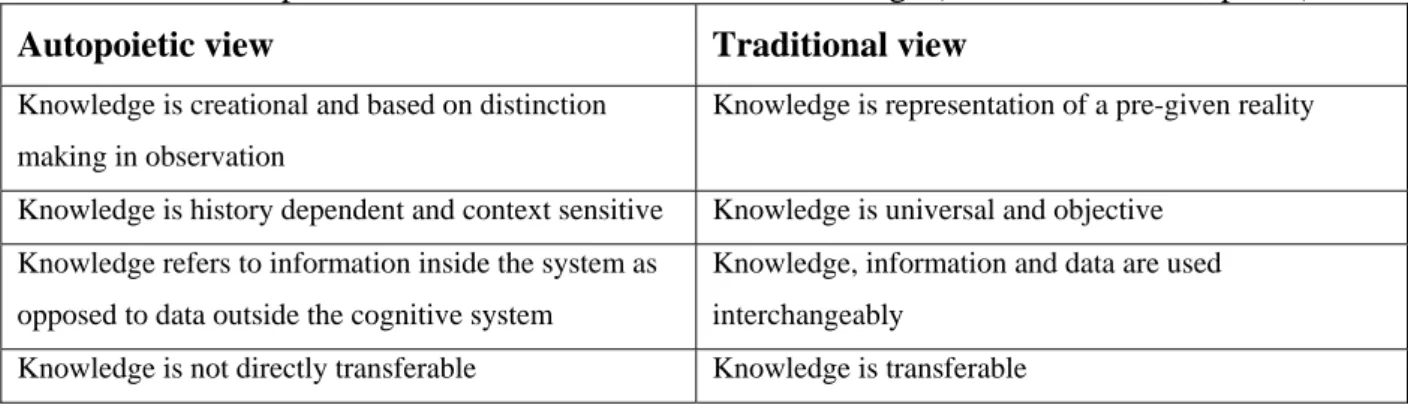
Table 3.1 The autopoietic vs. the traditional view of knowledge 46
Table 3.2 Two types of knowledge 49
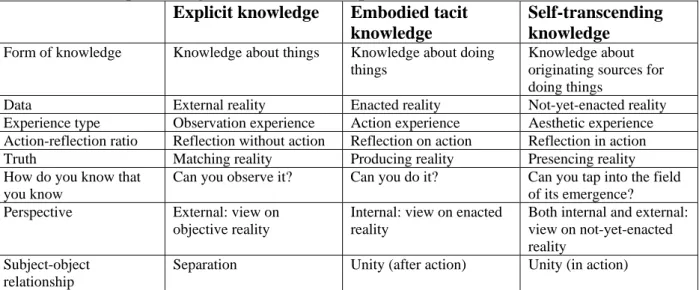
Table 3.3 Three epistemologies 50
Table 3.4 Twelve types of knowledge in organizations 51 Table 3.5 Instruments for the management of explicit knowledge 56 Table 3.6 Instruments for the management of tacit knowledge 57 Table 5.1 Tools and techniques for the analysis gap and integration of the benchmarking process
93
Table 5.2 What to benchmark? 98
Table 5.3 The typical problems, advantages and the critical success factors of general
benchmarking process 105
Table 8.1 The supplier’s portfolio classification in the companies. The Figures are numbers of
viii
LIST OF ABBREVIATIONS AND DEFINITIONS
Abbreviations
ACR = Arms-length Contractual Relationship AHP = Analytical Hierarchy Process
APICS = The Association for Operations Management CAD = Computer Aided Design
CFA = Common Factor Analysis EDI = Electronic Data Interchange
ISO = International Organization for Standardization JIT = Just in Time
MRP1 = Material Requirements Planning MRP2 = Manufacturing Resource Planning OCR = Obligational Contractual Relationship PCA = Principal Component Analysis
PDCA = Plan, Do, Check, Act
QFD = Quality Function Deployment SCM = Supply Chain Management
SCOR = The Supply Chain Operations Reference -model
SECI = Socialization, Externalization, Combination, Internalization TQM = Total Quality Management
Definitions
Method: A way of doing something, especially in accordance with a definite plan (Webster’s Encyclopedic Unabridged Dictionary of the English Language).
Methodolgy: A set or system of methods, principles, and rules for regulating a given discipline, as in the arts or sciences. The study of the principles underlying the organization of the various sciences and the conduct of scientific inquiry. A branch of pedagogies dealing with analysis and evaluation of subjects to be taught and the methods of teaching them. (Webster’s Encyclopedic Unabridged Dictionary of the English Language)
1
1 INTRODUCTION
1.1 Background
During past years several various definitions have been offered for supply chain after the concept started to gain popularity. The definition of supply chain has been widening from material flow between the raw material suppliers and end users to the concept including also the information flow, achievement of competitive advantage and added value in the whole chain. Nowadays the evolution of network-like operations within and between firms is common focusing on the partnership kind of relationship and cooperation among wide variety of activities. In the literature (e.g. Camp, 1995) there are articles and empirical descriptions about success of big and multinational companies e.g. in automotive industry, operating in networked organizations and especially about network sourcing among their suppliers and subcontractors. One reason for the tendency might be that they are supply chains and networks, not firms, competing. In addition to big organizations, also enterprises with limited resources, i.e. the enterprises with less than 750 employees, are forced to adjust their operations because they often act as roles of subcontractor for big companies so being a part of the wide supply chain or a network. However, they probably find difficulties in trying to apply the similar practices into their circumstances due to a lack of human, financial and time resources and especially because the literature of supply chain practices is more academic than practical in nature.
Benchmarking is defined to be a method to learn success (Reider, 2000, p.xii) i.e. it is a learning method, which is accomplished by transferring knowledge from one company to another. The importance of knowledge is widely acknowledged. Already in 1993 Drucker (1993) argued that in the new economy, knowledge is not just another resource alongside the traditional factors of production – labor, capital, and land – but the only meaningful resource. However, there is not much literature about examination of benchmarking as a method although its usage in development processes is wide. Also the usage of benchmarking seems not to be very efficient because of its trivial nature in practice.
This research was accomplished in order to decrease both deficiencies; a lack of methodologies for supply chain development and a need for research of benchmarking method, by constructing one new model. Additionally, this study aims at making a conceptual examination about knowledge management in benchmarking context in order to strengthen the existing theories. This research has been tested also empirically during the years 2000 and 2002
2 and is presented in two separate case studies in this dissertation in order to test and validate the created construction.
1.2 Research context
Nowadays supply chain is seen as a remarkable source of competitive advantage in the value creation process of companies. How well the supply chain as whole works to fulfill the customer demands is the decisive factor in company’s success on the market. Cooperation with the companies of the supply chain is necessary, because the strongest competitors are those who can manage the fully integrated supply chain including external customer as well as prime suppliers, their suppliers, and their supplier’s suppliers.
As the concept of supply chain management (SCM) has gained acceptance in the business community, the strategies required to be successful in this environment should be identified. As Hamel (2000) notes, business concepts or business models are becoming obsolete at an accelerating pace. Part of identifying a supply chain strategy is facing today’s issues on customer demand. Also recent trends such as outsourcing and mass customization are forcing companies to find flexible ways to meet customer demand. The focus is optimization core activities to maximize the speed of response to changes in customer expectations. (cf. Chase et al., 2000) Supplier partnerships can be the key in enhancing the performance of manufacturing companies when optimizing core activities. In this point of view also the importance of small and medium sized enterprises is growing as loops of the supply chains.
Successful supply chain management requires the effective and efficient management of a portfolio of relationships. Firstly, firms must match the optimal type of relationship to the various product, market, and supplier conditions. Secondly, they must adopt the appropriate management approach for each type of relationship. (cf. Duclos et al., 2003) There is strong recognition in the practitioner literature of the importance of supplier relationships and the need to establish “partnerships” has been widely espoused (Forsyth, 2001; Fretty, 2001; Kerns, 2000). Rackham (2001) states that successful partnerships mean radical redesigning of business relationships. He adds that partnership creates new value that could not be achieved within the existing vendor/customer roles. Surprisingly, the concept of partnership is poorly understood. Many authors (e.g. Cox, 1996; Saunders, 1997) have identified the advantages that it can bring but far less has been published on the attributes of partnership itself. What is known is that partnerships are “close” relationships and thus, the level of closeness of relationship is an appropriate viewpoint for exploring supplier partnerships. It can be assumed that developing partnerships and network kind of activities in supply chain management improves companies’
3 competitive position. Yet, it appears that it is one thing to talk about supply chain management and quite another to implement a program for developing supplier partnerships. Especially the managers of companies with limited resources could find it useful to combine their forces and utilize the resources and each other’s competences in a common supply chain but also in separate supply chains as horizontal cooperation.
It can also be assumed that the pace of change is so rapid nowadays that no single organization or a supply chain can ever control or dominate all effective operating practices and good ideas. To be a marketplace leader, one must look outward of the organization – as well as inward – for constant improvement and new ideas. Customers everywhere are sending the same message to their suppliers: “faster, cheaper, better”. Benchmarking might offer a method for a quick learning from other organizations.
Current literature does not present in any types of benchmarking an association of knowledge management with benchmarking learning process. Nor does it clearly evaluate the applicability of the benchmarking types to different organizations, industries, companies or knowledge types. However, benchmarking is considered as an effective method for improving and developing performances of companies with transferring information and knowledge between companies as well as creating new knowledge during the process. Therefore, it seems to be very natural idea to take into consideration the knowledge creation point of view when planning a new benchmarking process.
1.3 Problem formulation
The trend of competing against supply chains instead of traditional companies demands a better understanding of the supply chain management. Supply chain management is a subject, which is much written and examined causing a variety of conceptions on the field (cf. Cox et al., 1995; Lummus et al., 1997; Quinn, 1997; Womack et al., 1990; Christopher, 1998; Saunders, 1997; van Weele, 2002). The development has led to wider conceptions of supply chain, which also cause wider integrities of companies to manage and control. Companies together with their suppliers and supplier’s suppliers form a broad network of different relationships and operations. In order to react and respond quickly enough to fluctuations in demand, companies are to manage the relationships between their suppliers as well as their customers. It can be assumed that close partnerships and network sourcing are developed for that need (Hines, 1994, 1996; Cox, 1996).
The need for developing supply chains toward close relationships and network sourcing, demands a better understanding of the characteristics of different relationships between
4 companies, especially between buyers and suppliers. Suppliers can be classified and the relationships divided into classes according to different features like trust and suppliers role in design of products (cf. Ansari et al., 1997; McHugh et al., 1995; Kuitunen et al., 1999). The knowledge about the class of each supplier is a necessary beginning. It gives a clue about the importance of the relationship. Also the characters of the relationships can be determined according to each class as well as all the levels on network operations (Hines, 1994; Lamming, 1993; Ansari et al., 1997). It can be assumed that methods for classifying suppliers exist and are helpful in order to develop the relationships toward network operations. It can also be assumed that the characteristics of relationships are well described in literature. However, new evaluation and analysis methods for network operations and development are needed (Lehtinen, 2001, p.109) as well as theories, which take into account a company’s abilities to manage its supply chains (Breite, 2003, p.195). Companies are in need of ways to develop relationships in addition to the knowledge about what kind of relationships they need in order to succeed in networking operations.
The problem of not having evaluation and analysis methods for developing network operations is analyzed to be caused by three reasons. The first is that there is a lack of literature suggesting that such work should be undertaken. Second, there is a scarcity of especially western exemplars to be followed. The third reason is that, with a very few exceptions, there is an absence of knowledge about how to realize such developments and in particular the strategies and techniques to be used. (Hines, 1996)
Academics as well as practitioners are familiar with methods of learning practices. The fastness of change causes limitations for alternatives of methods. It can be assumed that benchmarking is one of the best methods because of its nature of learning something that is proved to be a best practice by another company or organization. Another reason to utilize benchmarking process is that it enables an organization to learn something that is in intangible format; knowledge and within knowledge, even in tacit form. Benchmarking is widely used by practitioners and also literature presents a variety of benchmarking types (Bendell et al., 1993; Hannus, 1994; Camp, 1989; Karlöf, 1995; Tuominen, 1997; Reider, 2000; Boxwell, 1994; Jackson et al., 2000a). It can be assumed that the process of benchmarking is well defined and there are multiple alternatives to choose the type of benchmarking. However, companies often find the process too trivial to give answers to specific problems. Also the guides for selecting the benchmarking subject and the best practice target are experienced difficult for especially small and medium sized companies. Literature is written about the world-class companies with good opportunities to choose freely the best practice target (cf. Reider, 2000). Situation is
5 probably different when a company performing the learning process is smaller and has no access to the possible best practice targets. Even more complicated is to find enough resources; human and financial to perform that kind of process. Increased usage of research partnerships is getting necessary (cf. Ralston et al., 2001). It can be assumed that networking could be the idea also in common development projects among the enterprises with limited resources. For common purposes they need the applicable methodology for cooperative learning by benchmarking and especially for supply chain field.
It can be assumed that benchmarking is a profitable learning method. It is also known that learning is, among other things, transferring knowledge from one person to another or from an organization to another (cf. Nonaka et al., 1995; Senge, 1990; Goh, 2002; Lindsay et al., 1977). There are different attitudes about the definition of knowledge, possibilities to transfer knowledge and the types of knowledge. However, creating knowledge forms the basis for a competitive advantage (cf. Nonaka et al., 1995) and the fastness of learning the best practices determines the position in the competition. How the knowledge transferring i.e. organizational learning happens in the benchmarking process is the field that is not examined. How the process of knowledge creation can be utilized in the cooperative benchmarking is also an interesting question that is discussed in this research.
As presented above, the research aim of this thesis is three-dimensional. First, the researcher constructs a model to help enterprises with limited resources to build a road map toward successful supply network operations. Second, in that effort the researcher uses benchmarking process, which needs to be developed in order to make it applicable to cooperative development project. Third, the researcher justifies the theories of knowledge management with the help of the first and second dimensions. These dimensions are fulfilled in the new construction. The problem formulation is presented in Figure 1.2 together with the structure of the thesis.
1.4 Objectives of the Study
The objectives of this study are as follows:
1. To show that a new model for developing supply network with the help of benchmarking method can be constructed and it is feasible.
2. To explore the connection between knowledge creation and benchmarking concept as a learning environment.
3. To explore network context related to supply chain management and the methods for developing buyer/supplier relationships in the context.
6 The objectives 2 and 3 are bases for the objective 1 because they determine the separate methods to be chosen in the new construction.
The purpose of the study is to construct a model which will improve the operations of organizations. This will appear in the theoretical background as pointing out the deficiencies of existing methods and developing them in the new model. In choosing the organizations for case-studies this is taken into consideration by selecting the companies which are focusing on the operations concerned i.e. supply chain development. The processing of the empirical material is executed in a way that will improve the analysis and utilization of the material and at the same time develop the methods concerned. In the evaluation of the results in this study the purpose is considered as analyzing the benefits of the new model in the improvement point of view.
1.5 Philosophical Background and the Research Approach
This study is conducted according to the steps of constructive research originally developed by Pertti Järvinen and published of Lukka (2000). The study is a typical constructive business field study; it applies both hermeneutics and positivism, uses both qualitative and quantitative methods and contains a strong conceptual analysis, which builds a basis for theoretical framework and for the new construction. It also offers an ideal result of a constructive research project which is a real-world managerial problem solved by an implementation of a new construction. In this construction the transformation of qualitative data to quantitative form in data gathering decreases the typical problem in qualitative analysis when the preunderstanding and interpretation of data are affected by the researcher. In qualitative research the personality of the researcher is a key research instrument (Gummesson, 2000) and a human being is suspected not to be rational and objective (Pihlanto, 2002).
According to Olkkonen (1994), there are two traditions of science; positivism and hermeneutics. Hermeneutics consists of research of meaning of the matters and the mind. The purpose of hermeneutics is to help in interpreting accurately the more or less unclear parts of the studied phenomena. It is often called as interpretative method. Interpretation means that the researcher examines his/her observations through the theoretical presumptions. Hermeneutics emphasizes the relation between the facts and values, on the contrary to positivism, which excludes values from the scientific thinking. The typical types of hermeneutic research are case-study and action-oriented. Positivism emphasizes that the purpose of science is to case-study the reoccurring and uniform features that happen under the laws of nature. According to the positivistic approach, the researcher proposes claims that then must be tested and proved either right or wrong. The results are reported in a mathematical form. Positivism emphasizes
7 especially the cause-and-effect relations, and describes the explanation model related to them by using the statistical methods. The approach has a connection to empirism and it has to be possible to form the data in the way that it can be measured. The method of positivistic science is explanatory; the types of research are theoretical and/or inductive-empirical.
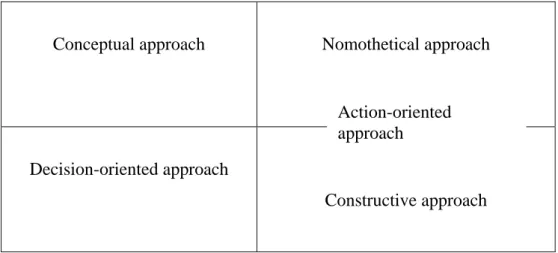
Although the constructive research approach has been explicitly developed in the field of business administration (Kasanen et al., 1991; Lukka et al., 1998), its potential application field is broad. The constructive approach can be understood as a methodological approach paralleling the four approaches defined by Neilimo et al. (1980). In this regard, the other methodological options include the conceptual, nomothetical, action-oriented and decision-oriented research approaches. The nomothetical approach is closely linked to the modernist (positivist) research tradition. The underlying explanatory model is causal and attempts are made to state the findings in the form of general laws. The decision-oriented approach focuses on analytical modelling research and is usually grounded on assumptions similar to the nomothetical one. However, there is a fundamental difference between the two in the nature of research: in contrast to what applies to nomothetical studies, the results of the decision-oriented studies are normative attempts and their results are meant, for instance, to help management in running their firms. The action-oriented approach provides a kind of alternative to the nomothetical approach as it brings the human being into the focus of analysis. The explanatory model is often teleological and the historical background of the phenomena studies is carefully examined and considered. The emphasis is usually put on gaining a thorough understanding of the studied subjects, but the purpose can include and active participate in change processes. The conceptual approach again is distinguished by its priori basic nature: it produces new knowledge primarily through the “method of reasoning”. Its aim is to create a concept system, which aids in describing different phenomena and creates instructions for present and future actions. To these four options known for a longer time, the constructive approach adds one, which is normative and empirical by its very nature. The Figure 1.1 illustrates the position of the constructive research approach in these terms.
8 Conceptual approach Nomothetical approach
Decision-oriented approach
Constructive approach
Fig. 1.1 The position of the constructive research approach as a model (Kasanen et al., 1993, p.317)
The constructive research approach has certain common aspects with the decision-oriented one. In both cases a theoretical analysis, thinking etc. plays an important role leading to the creation of a new entity. However, the decision-oriented approach typically uses the method of deduction, while heuristic innovations are characteristic of the constructive research approach. The main difference between the two lies in the fact that the constructive approach entails always an attempt to explicitly test the practical usability of the constructed solution, which is typically lacking in the decision-oriented studies. (Lukka, 2003)
Another approach of Neilimo and Näsi’s (1980) classification, which reminds the constructive approach, is the action-oriented one. In both cases the direct and pragmatic empirical connections, and the application of case study method, play a major role. However, the major difference between the action-oriented and the constructive studies in general lies in the fact that the former studies typically aim at careful description and thorough understanding of empirical phenomena without a problem-solving type of normative purposes, which is characteristic to the constructive studies. Also, the action-oriented research does not seem to aim at creating explicit managerial constructions. (Lukka, 2003)
The constructive research approach can be considered as a form of case research. Common to both approaches is the researcher’s operation directly in the field, small sample sizes, and the application of ethnographic methods (observation, interviews and analysis of archives) as the basis of data gathering in the empirical part of the study. It is also typical to rely mostly on qualitative research methods, even though the application of quantitative methods is possible, too.
The core features of the constructive approach include that it:
− focuses on real-world problems felt relevant to be solved in practice,
− produces an innovative construction meant to solve the initial managerial problem, Action-oriented
9 − includes an implementation attempt of the developed construction and thereby a test of
its practical applicability,
− implies a very close involvement and cooperation between the researcher and practitioners in a team-like manner, in which experiential learning is expected to take place,
− is explicitly linked to prior theoretical knowledge,
− pays particular attention to reflecting the empirical findings back to theory; the nature of the theoretical linkage varies, and – due to the partly heuristic nature of the constructive research process – cannot be predicted beforehand (Lukka, 2000).
As a basic meaning for the constructive approach could be considered a solution to a real-world managerial problem, implemented and having both great practical and theoretical contribution (Lukka, 2000). The process of constructive approach is described as follows:
1. To find a practical relevant problem, which also has potential for theoretical contribution.
2. To examine the potential for long-term research cooperation with the target organizations.
3. To obtain deep understanding of the topic area both practically and theoretically.
4. To innovate a solution idea and develop a problem solving construction, which also has potential for theoretical contribution.
5. To implement the solution and test how it works. 6. To ponder the scope of the applicability of the solution. 7. To reflect the findings to prior literature.
Another important research approach in this study is a conceptual approach. This approach is helpful when examining the concepts of supply chain, supply chain management, knowledge management and benchmarking. In this study a special challenge of conceptual variety is faced because of the multi scientific nature of the research field. Also some features of action-oriented approach can be found in this study. The role of researcher is actively involved during the whole process and the goals are negotiated with the companies. So, these three concepts form a basis for the new construction.
10
1.6 Structure of the Thesis
The structure of the thesis is presented in Figure 1.2. The study consists of four parts. The
first part of the thesis, Introduction, introduces the research area, describes the objectives of the study and presents the research strategy.
The second part presents the theoretical background and the framework for the new
construction. The part consists of four chapters:
Chapter 2: Supply Chain Management presents the basic definitions of the field, its history and the features essential for buyer/supplier relationships in the supply chain and especially supply network. The chapter explores methods for developing supplier networks choosing one as a basis for the new construction.
Chapter 3: Concept of Knowledge Management explores knowledge as a definition, different knowledge types and the ideas of creating and transferring knowledge between individuals and organizations.
Chapter 4: Conventional Benchmarking Modeldefines benchmarking methods, benchmarking’s history and explores different benchmarking methods and practice models.
Chapter 5: Benchmarking Process presents benchmarking process in general, compares practices and metrics in the process and highlights the tools used in benchmarking processes building a basis for the new construction presented in this study.
The third part examines the new construction: Group Benchmarking together with the
separate methods assisting the new model. The part also explores the construction by strengthening Knowledge management as a theory on background. The third part consists of two chapters:
Chapter 6: A New Group Benchmarking Model describes the construction created in this study. It explains the separate methods included in the construction and their meaning for the whole model.
Chapter 7: The Role of Group Benchmarking Model in the Existing Knowledge Management Theories presents the process of creating and transferring knowledge in the new construction.
The fourth part presents the Empirical Tests of the Model in Chapter 8, and finishes the study in Chapter 9: Discussion and Conclusions, which presents the conclusions of this study. The chapter also highlights the contributions of the study and suggests some ideas for future research.
11 Fig. 1.2 The structure of the thesis
Problem and its solution Background theories
Question: How to develop the supply
networks? Supply Chain Management Part 1: Introduction With Benchmarking Question: How to improve the applicability
of benchmarking in a network of companies?
Benchmarking
With Group Benchmarking
Question: Why does Group Benchmarking work? Knowledge Management Compatibility to Knowledge Creation Spiral Part 2: Supply Chain Management Concept of Knowledge Management Conventional Benchmarking Model Benchmarking Process Part 3: A New Group Benchmarking Model The Role of Group Benchmarking Model in the Existing Knowledge Management Theories Structure of the Thesis Part 4: Testing the Feasibility of the Group Benchmarking Model Discussion and Conclusions
Workability of the Group Benchmarking Model Question: Does it really
12
2 SUPPLY CHAIN MANAGEMENT
This chapter has been divided into five sections. In the first section, the idea of historical review is to show how the concept of supply chain has changed during the last decades and what the reasons of the changes are. This will make it easier to understand the current conception of supply chain as well as a variety of concepts related to supply chain.
In the second section the definitions of supply chain together with the related concepts; Supply Chain Management (SCM) and partnership, are explored. The definitions of separate authors will be analyzed and whether the differences between definitions are meaningful is examined. This section explores the main views of supply chain management as a review from literature. There can be found three main concepts of buyer/supplier relationships by Ellram (1991), Sako (1992) and Cox (1996). There are also some features that are essential in supply chain management giving the basis for the modern successful supply chain i.e. trust and commitment as well as Lean model. The section is important in showing the variety of views, which further explains the difficulties of companies in developing their supply chains to the best possible direction.
The third section explores the concept network in general and supply network in particular. The concept network comes up as a developed version of supply chain and as a form of sourcing (network sourcing) in literature. Because network seems to be the type of supplying that is aimed at by many companies, it needs to be examined in more details.
Finally, in the fourth section, the ways for companies to develop their supply chain toward the competitive advantage will be examined. In practice there are different situations in which buyer/supplier relationship appears. When an industrial productive company buys food supplies for its personnel canteen, it does not need to make a technical design and development together with a supplier of potatoes. Instead, it buys potatoes from a supplier, which is cost effective and delivers good quality. Whereas, when the company buys new high tech production equipment, long and reliable relationship with the supplier is beneficial for both parties. When it outsources some components needed in production for a supplier, the buyer/supplier relationship is different but again trust and long-term contract are necessary. The aim is to find understandable features of different types of buyer/supplier relationships for these and many other supplying situations. The usual problem in developing supply operations is to know the current
13 relationships in use, the best possible relationships for each situation and the way to develop the relationships. The fifth section concludes Chapter 2.
2.1 A Historical Perspective on the Supply Chain Management
The changes in production and operations management activities have strongly affected the changes in supply chain initiatives and that is why a short review about historical aspects will be made. During the period from 1960 to 1975, corporations had vertical organization structures and optimization of activities was focused on functions. Relationships with vendors were win-lose interactions, and many times adversarial. (Chandra et al., 2000) The emphasis was on materials planning, utilizing materials requirements planning techniques, inventory logistics management with one warehouse multi-retailer distribution system, and push and pull operation techniques for production systems.
In the timeframe 1975 to 1990, corporations were still vertically aligned but several were involved in process mapping and analysis to evaluate their operations. There was realization by organizations of the benefit of integration of functions such as product design and manufacturing. Various quality initiatives, such as the total quality management (TQM) philosophies of Deming, Juran, and Crosby as well as ISO standards were initiated by many organizations (Chandra et al., 2000).
Starting in 1990’s, corporations all over the world have been experiencing increasing national and international competition. Strategic alliances among organizations have been growing. Organization structures are starting to align with processes. Manufacturing systems in organizations have been enhanced with information technology tools such as enterprise resource planning, distribution requirements planning, electronic commerce, product data management, collaborative engineering etc. There has been a growing appreciation in many firms of total cost focus for a product from its source to consumption, as opposed to extracting lowest price from immediate vendor(s) (Turbide, 1997). A number of factors have contributed to this shift (Chandra et al., 2000). First, there has been a realization that better planning and management of complex interrelated systems, such as materials planning, inventory management, capacity planning, logistics, and production systems, will lead to overall improvement in enterprise productivity. Second, advances in information and communication technologies complemented by sophisticated decision support systems enable designing, implementing and controlling strategic and tactical strategies essential to delivery of integrated systems. The availability of such systems has the potential of fundamentally influencing enterprise integration issues.
14 There has also been an increased reliance on purchased materials and outside processing with a simultaneous reduction in the number of suppliers and greater sharing of information between vendors and customers. The increase of customized products instead of mass production has been a major change in the marketplace. This has resulted in the emphasis on greater organizational and process flexibility and coordination of processes across many sites. The need for rule-based, real-time decision support systems to attain organizational and process flexibility, as well as to respond to competitive pressure to introduce new products more quickly, cheaply and of improved quality have become the decisive factors in tough competition (Chandra et al., 2000).
Already in 1985 Michael Porter advocated that the coordination of complex global networks of company activities is becoming a prime source of competitive advantage (Spekman et al., 1998). According to Porter (1985), the secret is to achieve breakthrough changes and improvements so that the expertise of members of the value-added network is shared throughout the system. After that, 1990 Hahn et al. wrote as a final analysis that a firm’s ability to produce a quality product at a reasonable cost, and in a timely manner, is heavily influenced by its suppliers’ capabilities. Consequently, without a competent supplier network, a firm’s ability to compete effectively in the market can be hampered significantly. Before that time, very little publication space has been devoted to the subject (Hahn et al., 1990).
2.2 The Supply Chain
Section 2.2.1 will present definitions for supply chain and the related concepts. The presented definitions of the terms supply chain, supply chain management and partnership by different authors seem to vary in some degree. However, the section will show that there is no discrepancy between the different definitions, but the differences are mostly in the wideness of the whole supply chain concept. Section 2.2.2 will point one way of thinking supply chain management being to describe tools and techniques that provide for increased operational effectiveness and efficiency throughout the delivery channels. Additionally, Section 2.2.3 will describe the features of successful supply chain; it comply with network sourcing by adapting the features of Lean philosophy and having trust as a basis for the relationships between companies operating in the chain.
15
2.2.1 Defining Supply Chain and Related Concepts
During past years several various definitions have been offered for supply chain after the concept started to gain popularity. The APICS Dictionary describes the supply chain as (Cox et al., 1995):
1. The processes from the initial raw materials to the ultimate consumption of the finished product linking across supplier-user companies; and
2. The functions within and outside a company that enable the value chain to make products and provide services to the customer.
There is also a definition of supply chain as the network of entities through which material flows. Those entities may include suppliers, carriers, manufacturing sites, distribution centers, retailers, and customers (Lummus et al., 1997).
The Supply Chain Council (1997) uses the definition: “The supply chain – a term increasingly used by logistics professionals – encompasses every effort involved in producing and delivering a final product, from the supplier’s supplier to the customer’s customer. Four basic processes – plan, source, make, deliver – broadly define these efforts, which include managing supply and demand, sourcing raw materials and parts, manufacturing and assembly, warehousing and inventory tracking, order entry and order management, distribution across all channels, and delivery to the customer.” Later the term “return” has been added to the concept as the fifth process. Supply Chain Council has also published The Supply-Chain Operations Reference-model (SCOR) based on the terms. It will be discussed later in this study.
Quinn (1997, p.43) defines the broader supply chain as “all of those activities associated with moving goods from the raw-materials stage through to the end user. This includes sourcing and procurement, production scheduling, order processing, inventory management, transportation, warehousing, and customer service. Importantly, it also embodies the information systems so necessary to monitor all of those activities.” This definition mentions separately information systems, which are now in essential role in all business life.
In addition to defining supply chain, several authors have further defined the concept of
supply chain management. The term was used originally in the early 1980’s (Oliver et al., 1992; Houlihan, 1984) to refer to the management of materials across functional boundaries within an organization but was soon extended beyond the boundary of the firm to include “upstream” production chains and “downstream” distribution channels (Womack et al., 1990; Womack et al., 1996; Harland et al., 1990; Christopher, 1998). As defined by Ellram et al. (1993, p.1), supply chain management is “an integrating philosophy to manage the total flow of a distribution channel from suppliers to ultimate customer”. Handfield et al. (1999, p.2) stress
16 competitive advantage in their definition of supply chain management as “the integration of these activities through improved supply chain relationships, to achieve a sustainable competitive advantage”. Montczka et al. (1997, p.69) state that “integrated supply chain management is about going from external customer and then all the processes that are needed to provide the customer with value in a horizontal way”. In their definition Montczka et al. emphasize value provided to the customer, which can be concluded to be the main reason to supply anything at all. They believe that supply chains, not firms, compete and that those who will be the strongest competitors are those that can provide management and leadership to the fully integrated supply chain including external customer as well as prime suppliers, their suppliers, and their supplier’s suppliers. This idea is commonly accepted also by many other writers e.g. Handfield et al. (1999), Hughes et al. (1998) and Cox (1999). In other words, a firm’s success is tied, in part, to the strength of its weakest supply chain partner (Spekman et al., 1998).
Lummus et al. (1999) state a summary definition of the supply chain as: all the activities involved in delivering a product from raw material through to the customer including sourcing materials and parts, manufacturing and assembly, warehousing and inventory tracking, order entry and order management, distribution across all channels, delivery to the customer, and the information systems necessary to monitor all of these activities. Whereas supply chain management coordinates and integrates all of these activities into a seamless process. (Lummus et al., 1999) A key point in supply chain management is that the entire process must be viewed as one system. Any inefficiency incurred across the supply chain must be assessed to determine the true capabilities of the process.
There have been some historical changes in the idea of the concepts, which can be noticed in the article of Spekman et al. (1998). The traditional view of supply chain management is to leverage the supply chain to achieve the lowest initial purchase prices while assuring supply. Typical characteristics include: multiple partners; partner evaluations based on purchase price; cost-based information bases; arms-length negotiations; formal short-term contracts; and centralized purchasing. This kind operation encourages fierce competition among suppliers and uses rewards or punishment based on performance. The fundamental assumption in this environment is that trading partners are interchangeable and that they will take advantage if they become too important. Also there is a belief that maximum competition, under the discipline of a free market, promotes a healthy and vigorous supply base, which is predicted on the “survival of the fittest”. (Spekman et al., 1998)
17 Under the new paradigm, supply chain management is redefined as a process for designing, developing, optimizing and managing the internal and external components of the supply system, including material supply, transforming materials and distributing finished products or services to customers. Analytically, a supply chain is simply a network of material processing cells with the following characteristics: supply, transformation and demand (Davis, 1993). The essence of supply chain management is as a strategic weapon to develop a sustainable competitive advantage by reducing investment without sacrificing customer satisfaction (Lee et al., 1992).
Although these two comprehensions of supply chain management are separated here as belonging to the different historical time, they can both still be valid and found in industry even in one company at the same time concerning separate suppliers. Actually, they can be seen as different strategies for separate parts of the supply chain of a company as will be shown later in this study.
The term partnership sourcing comes up in the context of supply chain and should therefore be defined as well. Partnership Sourcing Ltd defines it as follows: “Partnership sourcing is a commitment by both customers and suppliers, regardless of size, to a long-term relationship based on clear, mutually-agreed objectives to strive for world-class capability and competitiveness”. (Saunders, 1997, p.259)
Gentry (1996) states that partnerships are the foundation on which an effective supply chain can be built. Also Cox (1996, p.65) sees the partnership sourcing concept generic and refers to a complex range of dissimilar collaborative relationships. Supplier relationships and partnerships have been widely researched during the last years and as a consequence, there are several definitions differing each other’s in the attributes they include. For example, Brennan (1997) sees partnership quite incomplete in term of dependency between the two parties. Whereas Ellram et al. (1995) define partnership wider as a relationship between two firms, which involves a commitment over an extended period of time, the sharing of information, as well as the risks and rewards of the relationships.
Definition of partnership in the literature often exhibits the following characteristics and the problems formed (Lemke et al., 2003):
− They are vague and rarely include measures (of the degree of partnership), which could help in operationalizing the concept (e.g. Landeros et al., 1995).
− Where measures are included in definitions, these are based on the authors’ perceptions, and are not empirically tested (e.g. Ellram, 1995).
18 − Different definitions from different research show inconsistency, which suggests that
different attributes are measured.
− Where definitions identify partnership attributes, these are usually based on very limited empirical evidence.
On the whole, partnerships can be characterized by a high level commitment, mutual dependency, trust, and a long-term orientation where the sharing of information as well as risks and rewards are typical (Lemke et al., 2003). However, a consistent definition of partnership based on empirical evidence cannot be found in the literature and no commonly accepted theoretically derived definition yet exists.
In this study partnership is an important characterization of relationship that companies are aiming to in developing their supply chains. In addition, partnership could be seen as a target for the relationship that companies participating the Group Benchmarking development process are forming in cooperative research project.
The presented definitions of the terms supply chain, supply chain management and partnership by different authors seem to vary in some degree. However, there is no discrepancy between the different definitions, but the differences are mostly in the wideness of the whole supply chain concept. For example supply chain widens from material flow between the raw material supplier and end users to the concept including also the information flow, achievement of competitive advantage and added value in the whole chain. In this study the widest versions of the definitions can be considered valid. Partnership is seen as a characteristic of buyer/supplier relationship. Section 2.2.2 will describe the current philosophy of supply chain management together with the features of relationships in the chain.
2.2.2 The Philosophy of Supply Chain Management
To balance customer’s demands with the need for profitable growth, many firms have moved aggressively to improve supply chain management (Advanced Manufacturing Research, 1995; Copacino, 1997; Poirier et al., 1996). Their channel integration efforts have focused on many issues like supply chain coordination, organizational structures and associated relationships, inter- and intra-enterprise communication, sourcing, manufacturing orientation, and inventory and cost management (Chandra et al., 2000). In this context organizational relationships are especially interesting. Strategic alliances and partnerships are crucial to the success of a supply chain. Firms are encouraged to focus their attention on the entire supply chain and reduce the number of suppliers that they have to deal with. Many firms have developed preferred supplier programs as well as core transport carriers to ensure that a quality
19 product is received where and when it is needed. The literature (e.g. Chandra et al., 2000) expresses the idea that a successful strategic alliance or a partnership relationship must be based on extreme trust, loyalty, positive sum game (a win-win relationship), cross-functional teams, sharing common goals and cooperation that includes willingness to assist, and positive negotiations based on fairness. The ability to have a closer customer/supplier relationship is very important because these suppliers are easier to work with. Although companies are aware of the characteristics of successful supply chain, they ask how to achieve these kinds of relationships. Companies require detailed features for the relationships and the concrete methods to achieve them.
With the evolution toward especially long-term and close supplier relationships, companies need full disclosure of information such as financial performance, gain-sharing strategies, and plans for jointly designed work. They may establish a comparable culture and also implement compatible forecasting and information technology systems. This is because their suppliers must be able to link electronically into a customer’s system to obtain shipping details, production schedules and any other needed information. (Copacino, 1996; Coyle et al., 1996; Keller, 1995) Also in less ambitious relationships open information is essential in order to find the mutual benefit in the cooperation. The strategies that give support for the success of both companies are necessary in guide lining the common supply chain.
One way of thinking supply chain management is to describe tools and techniques that provide for increased operational effectiveness and efficiency throughout the delivery channels. The channels, that are seen internally in addition to external channels between companies (Cox, 1999), must be created to support and supply existing corporate product and service offerings to customers. This way of thinking originates from the success in Japanese automotive industry in the 1970’s and 1980’s (Womack et al., 1990). It is even argued that a great deal of supply chain management practice today is replicating the external resource management originally pioneered by Toyota (Cox, 1999). The approach is often referred to “Lean thinking” which is presented by Womack in the early 1990’s. This way of thinking is based on operations of big companies like Toyota. How well those tools and techniques are applicable in small and medium sized companies is often asked by those companies.
Before researching the mentioned tools and techniques, Section 2.2.3 will explore the main features of buyer/supplier relationships as well as trust and the Lean model as the basis of modern supply chain management.
20
2.2.3 Features of Buyer/supplier Relationships
There is a continuum of possible buyer/supplier relationship styles from pure arm’s length to extremely close business-to-business relationships. The three main concepts of continuum are presented by Ellram (1991): Supply Chain model, Sako (1992): ACR-OCR – framework, and a continuum of buyer-supplier relationships by Cox (1996).
According to Ellram (1991) supply chain management can take a variety of forms, including contracts of varying length, joint ventures and equity ownership. A continuum of alternative legal forms for organizing the relationships competitively is shown in Figure 2.1.
Fig. 2.1 Type of competitive relationships (Ellram, 1991, p.14, modified)
According to Ellram (1991), vertical integration can be viewed as an alternative to supply chain management in that it attempts to manage and control supply chain operations effectively through ownership. Vertical integration can be defined as the combination within a company of functions that can be carried out by separate companies. The reasons to vertical integration may be grouped into three broad categories: control, communications and costs (Ellram, 1991). It allows a company to improve control over the way it brings its products to market. Vertically integrated companies need to have better communication network and usually common ownership improves the cost structure by creating economies and reducing transaction costs.
Obligational contracting can be viewed as one form of supply chain management in that it attempts to manage a part of supply chain through formal contracts and agreements.
Acquisition Equity interest Joint venture Long term contract Short term contract Transaction Obligational contract or relational exchange Supply Chain Management
21 Obligational contract is an ongoing, collaborative relationship with another company, which is bound by legal agreement. According to Ellram (1991), the advantages of contractual relationship are cost reduction or risk reduction.
Supply chain as a competitive form brings together many advantages of obligational contracting and vertical integration. Supply chain management allows each company in the value chain do what they do best, while spreading the risks of assets ownership and reducing market risks through improved cooperation and communication. (Ellram, 1991)
Sako (1992) made an investigation into inter-firm relationships in Britain and Japan and suggested that the relationships can be represented as a continuum between two ideal types: arms-length contractual relationship (ACR) and obligational contractual relationship (OCR). The ACR is typified by specific discrete transactions where there is no commitment between the parties and an absence of goodwill trust. Such relationships are short-term, leveraged arrangements defined by an explicit contract. In the event of default the parties are searching for redress of action, usually through remedies of damages, and legal action ensues. The opposite, OCR, is typified by high degree of interdependence, goodwill trust and reciprocity, and as the relations develop over the long-term a high degree of collaboration is induced to the point where no contract is considered necessary.
Sako’s ACR-OCR framework describes two extremes, between which she recognized there is a continuum of contractual relations. However, she does not describe any interim relations, only a contrast between the extremes. She, also, does not offer any guidance on how relations within the continuum can be generated or maintained. The work of Sako’s is, however, considered significant for its analysis of the concept of trust in context of buyer/seller relationship (Saunders, 1997).
Cox (1996) has also suggested a continuum of buyer/seller relationships which goes further to define the boundary of the firm and a range of outsourced/quasi-vertically integrated relationships (Figure 2.2). On the extreme right of the continuum is competitive market procurement using spot prices. On the left-hand extreme, there is vertically integrated company in which all sourcing between departments occurs according to managerial direction.
22 Fig. 2.2 Continuum of possible sourcing options (Cox, 1996, p.63, modified)
The boundaries of the company are thought to be flexible so that firms are not given entities existing as objects within a static market structure, but rather a firm is a fluid constructs whose internal structures and external boundaries may change as circumstances dictate and opportunities require. Firms are looking for successful strategies by examining certain type of internal and external relationships, but there is not one specific solution. The solution will vary under specific business circumstances and contexts. Determining asset specificity of the company can solve the problem. The high asset specificity – skills and services that are well established within the standard operating procedures and human assets of the organization – will be undertaken internally. On the other hand, the transactions that are not so well established in the human assets of the firm can be sourced externally due to low asset specificity. Middle asset specificity transactions, which have a relatively high level of uncertainty about the availability, will lead to forms of sharing, cooperation and bilateral relationships with external suppliers. Successful companies adapt and shift their internal and external structures and relationships in order to compete for the future. (Cox, 1996)
Later, at 2001, Cox presented his Power Matrix to better understand the attributes of power that provide opportunities for buyers and sellers to have effective leverage over others in business relationships while concentrating on core competencies and developing supply chain management. Cox (2001) has experienced a problem among practitioners to understand where they locate in power matrix, and how to make appropriate relationship-management choices.
Vertically integrated production Purchasing from subsidiaries Joint ventures Strategic alliances Lean Supply Network sourcing Single sourcing Preferred supplier Adversarial leverage Competition/ spot price High asset specificity Core competencies Medium asset specificity Complementary competencies Low asset specificity Residual competencies Fixed boundary of the firm Variable boundary of the firm Partnership relationships
23 The problems that the practitioners faced were mostly associated with an inability to avoid the problems of adverse selection and moral hazard. The power matrix was meant to be a solution for practitioners to enable them to understand their objective circumstances.
The term of network sourcing is picked up from the possible sourcing options in Figure 2.2. Network sourcing, which is originally developed by Hines (1994, 1996), is the idea that it is possible to create a virtual company at all levels of the supply chain by engineering multiple-tiered partnership relationships at each stage, but without moving to vertical integration. This way the first tier suppliers who control an extremely important medium asset specific expertise for the prime contractor has a partnership with the prime contractor in the value chain and develop partnership with those second-tier suppliers who find themselves in the same position. This chain reaction can be passed down the supply chain. (Cox, 1996) The term network sourcing originates from Japanese industry.
Hines (1996) lists an overview of network sourcing:
− a tiered supply structure with a heavy reliance on small firms,
− a small number of direct suppliers with individual part numbers sourced from one supplier but within a competitive dual sourcing environment,
− high degrees of asset specificity among suppliers and risk sharing between customer and supplier alike,
− a maximum buy strategy by each company within the semipermanent supplier network, but a maximum make strategy within these trusted networks,
− a high degree of supplier innovation in both new products and processes,
− close, long-term relations between network members, involving a high level of trust, openness and profit sharing,
− the use of rigorous supplier grading systems increasingly giving way to supplier self-certification,
− a high level of supplier coordination by the customer company at each level of the tiered supply structure, and
− a significant effort made by customers at each of these levels to develop their suppliers. In addition to these three basic types of describing buyer/supplier relationships, there are some more definitions for them. For example, Saunders (1997) determines two relationship types; the adversarial model and the partnership model which are often the extremes in the development of buyer/supplier relationship. They are also called win-lose and win-win relationships. He also determines different elements of exchange in interaction of parties in the