• No results found

A-Optimal Subsampling For Big Data General Estimating Equations

N/A
N/A
Protected

Academic year: 2021

Share "A-Optimal Subsampling For Big Data General Estimating Equations"

Copied!
101
0
0

Loading.... (view fulltext now)

Full text

(1)

ESTIMATING EQUATIONS

A Dissertation

Submitted to the Faculty

of

Purdue University

by

Chung Ching Cheung

In Partial Fulfillment of the

Requirements for the Degree

of

Doctor of Philosophy

August 2019

Purdue University

West Lafayette, Indiana

(2)
(3)

THE PURDUE UNIVERSITY GRADUATE SCHOOL

STATEMENT OF DISSERTATION APPROVAL

Dr. Hanxiang Peng, co-Chair

Department of Mathematical Sciences, IUPUI

Dr. Leonid Rubchinsky, co-Chair

Department of Mathematical Sciences, IUPUI

Dr. Benzion Boukai

Department of Mathematical Sciences, IUPUI

Dr. Guang Lin

Department of Mathematics, Purdue University

Dr. Mohammad AL Hasan

Department of Computer and Information Science, IUPUI

Approved by:

Dr. Eugene Mukhin

Head of the Graduate Program

(4)
(5)

ACKNOWLEDGMENTS

I want to express my deepest gratitude to Prof. Hanxiang Peng and Prof. Leonid

Rubchinsky for their contribution of time, energy and patience which make my

jour-ney for PhD pursuit fruitful and enjoyable. During my first two years of PhD study

in IUPUI, Prof. Rubchinsky has broadened my horizon on neuroscience, he spent

lots of time teaching me about neuroscience. I also feel grateful to know Leonid’s

post-doctoral researcher Dr. Shiva Ratnadurai who, together with Leonid, guide me

on the research patiently and wholeheartedly. It is my honor to produce some good

results with them. In my last three years of PhD study, Prof. Peng has brought me to

the world of statistics. I have learned a lot from Prof. Peng, in particular on optimal

subsampling methods of big data which is a very hot topic in statistics nowadays. His

endless encouragement and guidance has motivated me to produce some interesting

results in my research.

Besides, I would like to thank Prof. Benzion Boukai for his help on my internship,

Prof. Jyoti Sarkar for introducing me the interesting project that we work together,

and Prof. Honglang Wang for his time and effort spent on discussing with me about

high dimensional statistics. My sincere thanks also go to Prof. Guang Lin and Prof.

Hasan Mohammad AL who generously become my thesis committee.

Last but not the least, I would like to appreciate those who have supported my

study and research in IUPUI. I would also want to thank my wife Haley Yu for her

encouragement and support throughout these years of my PhD study.

(6)

TABLE OF CONTENTS

Page

LIST OF TABLES

. . . .

viii

LIST OF FIGURES

. . . .

ix

ABSTRACT

. . . .

xi

1 INTRODUCTION

. . . .

1

1.1

Big Data Analysis

. . . .

1

1.2

Challenges of Big Data Analysis

. . . .

3

1.2.1

Heterogeneity of data

. . . .

3

1.2.2

Noise accumulation

. . . .

3

1.2.3

Spurious correlation

. . . .

4

1.2.4

Incidental endogeneity

. . . .

4

1.3

Count Data regression

. . . .

5

2 LEAST-SQUARES AND LINEAR MODELS

. . . .

7

2.1

Subsmapling Methods

. . . .

8

2.2

Asymptotic Theory for Weighted Subsampling Estimators

. . . .

11

3 GENERALIZED ESTIMATING EQUATIONS

. . . .

13

3.1

Linear regression with Normal distribution

. . . .

13

3.2

Poisson regression

. . . .

14

3.3

Negative Binomial regression

. . . .

15

3.4

Generalized Linear Models (GLMs)

. . . .

16

4 A-OPTIMAL SUBSAMPLING AND ASYMPTOTIC THEORY

. . . .

18

4.1

Notation and some elementary results

. . . .

20

4.2

Asymptotic behaviors of the subsampling M-estimators for fixed/growing

dimension

. . . .

22

4.3

Examples of biases of some subsampling estimators

. . . .

32

4.4

Asymptotic behaviors of the M-estimators for fixed/growing dimension

36

4.5

Asymptotic bias of the full sample estimator

. . . .

38

4.6

Examples of biases of some full sample estimators

. . . .

47

4.7

The A-optimal sampling distribution

. . . .

51

4.8

The A-optimal sampling distribution by conditioning

. . . .

52

4.9

Asymptotic behaviors under A-optimal sampling for fixed

p . . . .

54

5 SIMULATION STUDY

. . . .

57

(7)

Page

5.2

Numerical error in simulations

. . . .

74

6 REAL DATA EXAMPLE

. . . .

79

6.1

Gas sensors data

. . . .

79

REFERENCES

. . . .

84

(8)

LIST OF TABLES

Table

Page

5.1

The average CPU times in seconds for computing ˆ

β

r

for different full data

sizes

n

, and fixed

p

= 200 and

r

= 10

4

. The covariate

X

is GA and

y

is

(9)

LIST OF FIGURES

Figure

Page

5.1

MSEs of subsampling estimator for four different distributions of covariate

X

, with Poisson data and Poisson model. The full data size is

n

= 10

6

and the subsample size

r

varies.

. . . .

59

5.2

MSEs of subsampling estimator for four different distributions of covariate

X

, with negative binomial data and negative binomial model. The full

data size is

n

= 10

6

and the subsample size

r

varies.

. . . .

61

5.3

MSEs of subsampling estimator for four different distributions of covariate

X

, with negative binomial data and Poisson model. The full data size is

n

= 10

6

and the subsample size

r

varies.

. . . .

62

5.4

MSEs of subsampling estimator for four different distributions of covariate

X

, with Poisson data and negative binomial model. The full data size is

n

= 10

6

and the subsample size

r

varies.

. . . .

63

5.5

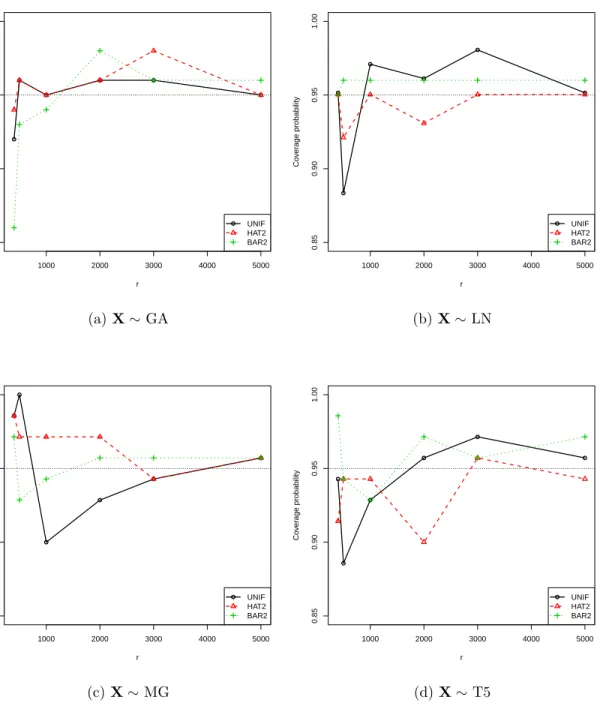
95% Coverage probabilities of the first component of subsampling

estima-tor for four different distributions of covariate

X

, with Poisson data and

Poisson model. The full data size is

n

= 10

6

and the subsample size

r

varies.64

5.6

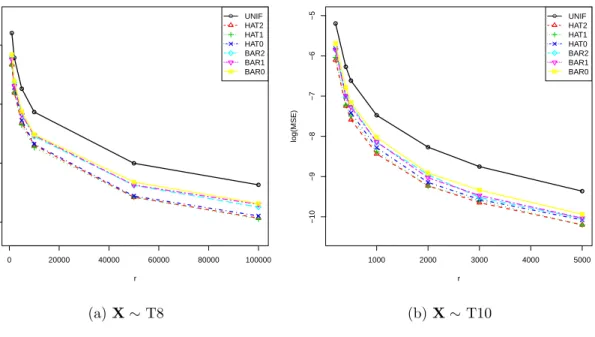
MSEs of subsampling estimator for covariate

X

being T8 and T10

dis-tributions, with Poisson data and Poisson model. The full data size is

n

= 10

6

and the subsample size

r

varies.

. . . .

66

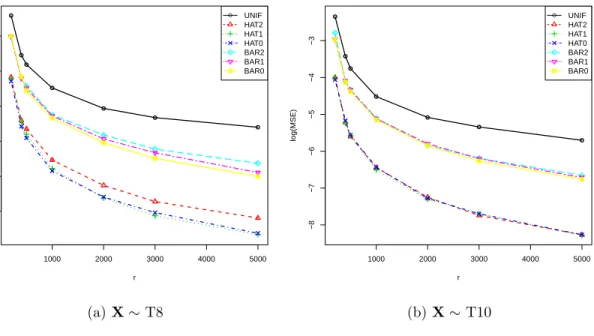
5.7

MSEs of subsampling estimator for covariate

X

being T8 and T10

distri-butions, with negative binomial data and Poisson model. The full data

size is

n

= 10

6

and the subsample size

r

varies.

. . . .

67

5.8

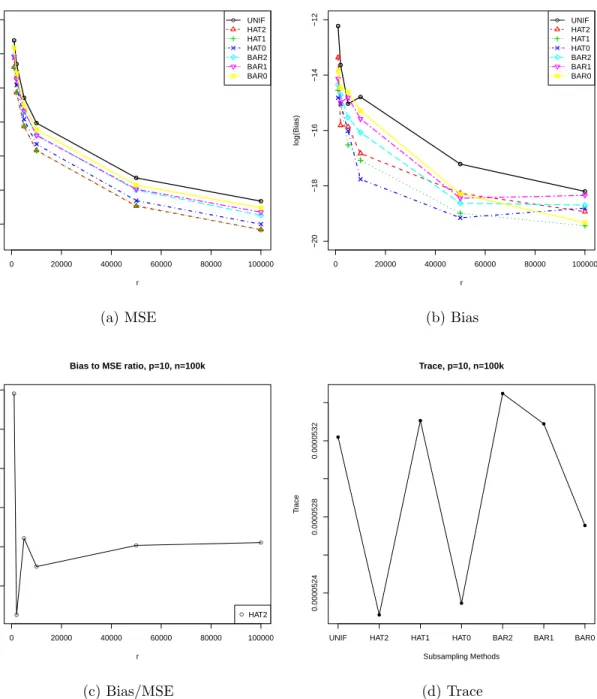
MSE, Bias, Bias to MSE ratio and trace of subsampling estimator on

X

T5, with Poisson data and Poisson model. The full data size is

n

= 100k

and the dimension is

p

= 10.

. . . .

69

5.9

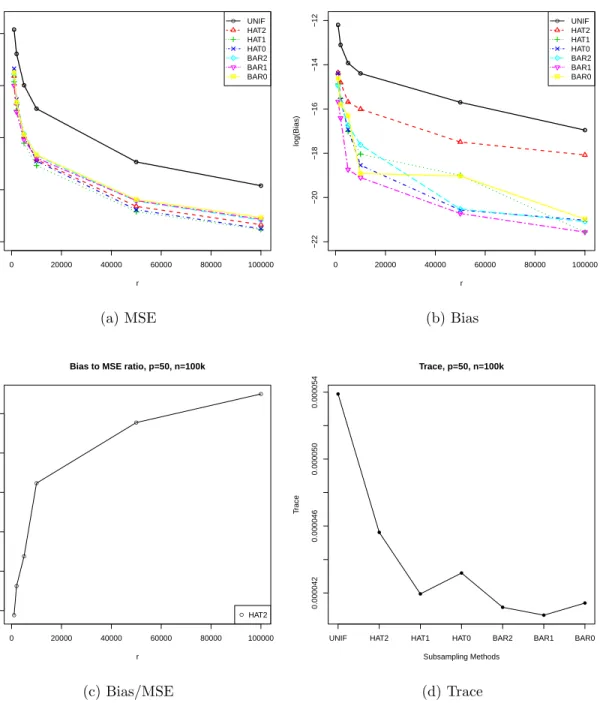
MSE, Bias, Bias to MSE ratio and trace of subsampling estimator on

X

T5, with Poisson data and Poisson model. The full data size is

n

= 100k

and the dimension is

p

= 50.

. . . .

70

5.10 MSE, Bias, Bias to MSE ratio and trace of subsampling estimator on

X

T5, with Poisson data and Poisson model. The full data size is

n

= 1M

(10)

Figure

Page

5.11 MSE, Bias, Bias to MSE ratio and trace of subsampling estimator on

X

T5, with Poisson data and Poisson model. The full data size is

n

= 1M

and the dimension is

p

= 50.

. . . .

73

5.12 MSE of subsampling estimator on

X

T5, Poisson data and Poisson

model.

np

is fixed at 1.6M with

n

and

p

assume different values.

. . . .

76

5.13 MSE of subsampling estimator on

X

T5, Poisson data and Poisson

model.

np

is fixed at 5M with

n

and

p

assume different values.

. . . .

77

5.14 MSE of subsampling estimator on

X

T5, Poisson data and Poisson

model.

np

is fixed at 10M with

n

and

p

assume different values.

. . . .

78

6.1

Scatter plots of a random sample of 10000 sensor data. The response

y

is

the reading of the last sensor and the predictors

Xi

’s are the readings of

the remaining fifteen sensors except the second sensor.

. . . .

80

6.2

log(MSE) for estimating regression parameters for gas sensors data with

100 bootstrap samples.

. . . .

82

6.3

log(Bias) for estimating regression parameters for gas sensors data with

100 bootstrap samples.

. . . .

82

6.4

Bias/MSE ratios for estimating regression parameters for gas sensors data

(11)

ABSTRACT

Cheung, Chung Ching Ph.D., Purdue University, August 2019. A-Optimal

Subsam-pling for Big Data General Estimating Equations. Major Professor: Hanxiang Peng.

A significant hurdle for analyzing big data is the lack of effective technology and

statistical inference methods. A popular approach for analyzing data with large

sam-ple is subsampling. Many subsampling probabilities have been introduced in

litera-ture (Ma,

et al.

, 2015) for linear model. In this dissertation, we focus on generalized

estimating equations (GEE) with big data and derive the asymptotic normality for

the estimator without resampling and estimator with resampling. We also give the

asymptotic representation of the bias of estimator without resampling and estimator

with resampling. we show that bias becomes significant when the data is of

high-dimensional. We also present a novel subsampling method called A-optimal which is

derived by minimizing the trace of some dispersion matrices (Peng and Tan, 2018).

We derive the asymptotic normality of the estimator based on A-optimal subsampling

methods. We conduct extensive simulations on large sample data with high

dimen-sion to evaluate the performance of our proposed methods using MSE as a criterion.

High dimensional data are further investigated and we show through simulations that

minimizing the asymptotic variance does not imply minimizing the MSE as bias not

negligible. We apply our proposed subsampling method to analyze a real data set,

gas sensor data which has more than four millions data points. In both simulations

and real data analysis, our A-optimal method outperform the traditional uniform

subsampling method.

(12)

1. INTRODUCTION

This dissertation introduces the A-optimal subsampling method for estimators

ob-tained by solving general estimating equations (GEE). We focus on the cases where

the sample size

n

is large and the dimension

p

is high. Asymptotic distribution of

the A-optimal subsampling is dervied and the magnitude of the corresponding bias

is computed. The simulation results indicated that the A-optimal sampling

outper-formed the uniform sampling by the criterion of mean square errors.

1.1

Big Data Analysis

Thanks to the advancement in computing technology, big data has become a

hot topic in statistics nowadays. Big data are data that is massive on scale where

traditional computers cannot handle. A significant hurdle for analyzing big data is

the lack of effective statistical computing and inference. Divide-and-Conquer is one

common approach to tackle the big data problems. An important example is the

MapReduce paradigm (Dean and Ghemawat, 2004) which processes large data sets

in parallel fashion. On the other hand, subsampling method is popular in statistics

to handle big data. In this method, one takes a small data set from the original

large sample and uses it as a surrogate to perform statistical analysis. For example,

uniform sampling is often used in subsampling for computational intensive problem.

However, uniform sampling is not effective in extracting relevant information and

the performance of the statistical inference can be very poor. See the simulations of

uniform sampling by Peng and Tan (2018). Motivated by this, we seek non-uniform

data-dependent sampling methods for big data in the framework of general estimating

equations (GEE) by the criterion of A-optimality, that is, minimizing the traces of

certain variance-covariance matrices.

(13)

A lot of work on non-uniform data-dependent sampling algorithms for data

anal-ysis problems can be found in literature. For instance, Ma and Sun (2014) and Ma,

et al.

(2015) has studied the leverage scores and used it as a non-uniform sampling

distribution for linear regression. Ma,

et al.

(2015) proposed the shrinkage leveraging

estimator (SLEV) and unweighted leveraging estimator (LEVUNW). They derived

the bias and variance formulas for the weighted subsampling estimators. Drineas,

et

al.

(2008) and Mahoney and Drineas (2009) has studied the matrix-based problems

that are related to least squares approximation, where normalized statistical leverage

scores are used as the non-uniform sampling distribution. Zhu,

et al.

(2015) obtained

the optimal subsampling distribution for large sample linear regression, and proposed

the predictor-length subsampling method. Wang,

et al.

(2018) constructed

opti-mal subsampling for large sample in logistic regression model. Wang,

et al.

(2019)

developed the information-based optimal subdata selection for big data linear

re-gression where the subsampling method is based on D-optimality criterion. On the

other hand, fast computational methods on subsampling algorithms have been

well-studied by statisticians and computer scientists. Drineas,

et al.

(2006) constructed

fast Monte-Carlo algorithms for approximating matrix multiplications. Drineas,

et al.

(2010) has studied randomized algorithms for least squares approximation, where the

leverage scores are computed approximately. The monograph of Mahoney (2011) has

a detailed discussion on this method. In this dissertation, we present non-uniform

subsampling methods in GEE using A-optimality criterion. Peng and Tan (2018)

proposed the A-optimal probability distribution for linear regression model. They

derived the asymptotic expansions for the subsmapling estimator and the asymptotic

normality under certain conditions. Also, they have proposed data truncation for fast

computation.

(14)

1.2

Challenges of Big Data Analysis

Fan,

et al.

(2014) discussed that big data has the following salient features: (1)

massive sample size and high dimension whereas traditional data set has sample size

larger than the dimension, (2) heterogeneity of data, (3) noise accumulation, (4)

spurious correlation and (5) incidental endogeneity. We will elaborate each of them

in details and discuss the impacts of big data on statistical thinking.

1.2.1

Heterogeneity of data

Big data is always created by aggregating data from different data sources

corre-sponding to different subpopulations. Each subpopulations may be characterized by

its unique features which are distinct from others. Data from small subpopulations

are considered as outliers. One way to deal with outliers is to remove them before

performing statistical analysis. However, under big data era, even the smallest

sub-population will have significant size since the full sample size is massive. This helps

us to better understand the heterogeneity of subpopulations. For example, the large

amount of genome sequencing data enables us to discover the relationship between

certain genes (covariates) and rare diseases (outcomes) (Worthey,

et al.

, 2010). This

discovery is infeasible if the sample size is not large enough. Besides the benefits

brought from big data, the heterogeneity of big data also comes with statistical and

computational challenges. For instances, we have to impose some regularizations to

avoid overfitting in finite mixture of regression models (Khalili and Chen, 2007).

1.2.2

Noise accumulation

Big data analysis often requires us to simultaneously estimate many parameters

(high dimension). The noise from the data will be accumulated when estimating a

large number of parameters. One way to tackle this problem is to assume sparsity on

the model (Hastie,

et al.

, 2009).

L

1

- regularization method (Lasso) is used to select a

(15)

subset of the variables which best describe the model. In fact, with more parameters

included in the model, it will not only increase the noise which may even dominate

the true signal, but also make the interpretation of the model more difficult as more

parameters are considered. In our simulation studies, we will demonstrate how the

noise accumulation in high dimensional data poses a challenge to statistical inference

under our A-optimal subsampling.

1.2.3

Spurious correlation

Spurious correlation refers to the situation that many uncorrelated random

vari-ables may have correlation in high dimensions. For example, Fan,

et al.

(2008)

demonstrated that when the dimensionality of the data is very high, variable selection

becomes challenging since there could be high correlation between those significant

variables and spurious variables. This may lead to unreliable statistical conclusion.

In particular, Fan,

et al.

(2008) considered the case when the dimension

p

(800,

6400) is larger than the sample size

n

(60). They assume

x

1

, . . . , x

n

be

n

indepen-dent observations of a

p

-dimensional Gaussian vector

X

N

p

(0

, I

p

). The

maxi-mum absolute sample correlations between the first variable and the other variables,

r

= max

i

≥2

|

corr

(

X

1

, X

i

)

|

with 1000 repetitions are then computed. The simulation

results show that the maximum absolute correlation increases when the dimension

increases.

1.2.4

Incidental endogeneity

Endogeneity refers to the fact that correlation exists between the variables

X

and

the residual noise

ε

in a regression. This contradicts with the exogenous assumption

that the predictors should be uncorrelated with the noise in regression model. Big

data is more prone to have endogeneity problem because big data is usually an

aggre-gation of data from multiple sources, this implies more measurement errors and thus

the endogeneity problem. Also, Big data usually comes with high dimensionality,

(16)

that is, more predictors are included in the model. This increases the possibility that

some predictors are correlated with the residual noise. The existence of incidental

endogeneity will make traditional statistical methods invalid, and the impact of it on

high dimensional statistics is still not well understood.

1.3

Count Data regression

Zhao (2018) studied A-optimal subsampling theory with emphasis on count data

regression model, for instance, Poisson regression model, zero-inflated Poisson

regres-sion model and negative binomial regresregres-sion model. However, the sample size of the

data is of ten of thousands which is not the usual size for Big Data. In this

disserta-tion, we study Big Data with sample size

n

equals millions and dimension

p

equals

50. We develop A-optimal subsampling theory for general estimating equation (GEE)

with arbitrary data structure, that is, data can be random or deterministic,

depen-dent or independepen-dent. These results are parallel to those obtained in linear regression

model in Peng and Tan (2018). We will also derive the Taylor expansions of the bias

of regression parameter estimators with resampling and without resampling. Both

Taylor expansions show that the magnitude of the remainder terms of the biases are

significant when the data is of high-dimensional. We will show in the simulations

that under big data with massive

n

and large

p

, the remainder term of the bias is

not negligible. Also, we will demonstrate through simulations that the bias is not

negligible when the random variable of the dataset does not have finite high-order

moments.

This dissertation is organized as follows. We briefly review the nonuniform

sub-sampling methods for linear regression model in Chapter 2. In Chapter 3, we give

some classical examples of generalized estimating equations (GEE). In Chapter 4,

we prove the asymptotic normality of the bias of estimators with resampling and

without resampling. We also derive the general expression of the biases with specific

order for the remainder terms. We discuss the theoretical results related to A-optimal

(17)

distributions under GEE framework. We shall focus on asymptotic normality,

asymp-totic behaviors under A-optimal sampling for fixed dimension and growing dimension.

Simulation studies of big data is presented in Chapter 5. A real data example will be

given in Chapter 6 to demonstrate our methods.

(18)

2. LEAST-SQUARES AND LINEAR MODELS

In this chapter, we provide an overview of subsampling methods for the linear

regres-sion problems.

Consider a linear regression model

yi

=

x

T

i

β

+

εi

,

i

= 1

, . . . , n,

(2.0.1)

where

y

i

R

is a response variable,

x

i

R

p

is a

p

-dimensional design vector,

β

R

p

is a

p

-dimensional regression parameter and

ε

1

, . . . , ε

n

are independent and identical

distributed (i.i.d.) random errors with zero mean

E

(

ε

) = 0 and finite variance

σ

2

=

V ar

(

ε

)

<

. We shall assume that

x

i

’s are nonrandom although the results will hold

also for random

x

i

’s, and the true regression parameter satisfying the linear model is

β

0

.

Let

X

= (

x

1

, . . . ,

x

n

)

T

be the

n

×

p

design matrix,

y

= (

y

1

, . . . , y

n

)

T

R

n

be the

response vector and

ε

= (

ε

1

, . . . , ε

n

)

T

R

n

be the error vector. Assume throughout

that

X

has full rank. Then the linear model can be expressed as

y

=

+

ε

(2.0.2)

A common estimator of

β

is the ordinary least squares (OLS) estimator ˆ

β

ols

given by

ˆ

β

ols

= argmin

β

R

p

k

y

k

2

= (

X

T

X

)

−1

X

T

y,

(2.0.3)

where

k · k

represents the Euclidean norm on

R

n

. The predicted value is given by ˆ

y

=

Hy

where

H

=

X

(

X

T

X

)

−1

X

T

is the so-called hat matrix. The

i

th

diagonal element

of the hat matrix

hii

=

x

T

i

(

X

T

X

)

−1

xi

is called the statistical leverage score of the

i

th

observation in literature, and we shall use the leverage score also to refer to the

distri-bution. Note that

P

n

i

=1

hii

= tr(

H

) = tr(

X

(

X

T

X

)

−1

X

T

) = tr((

X

T

X

)

−1

X

T

X

) =

p

.

(19)

clear that

hii

=

d

yi

ˆ

dy

i

, when

hii

tends to one, then ˆ

yi

tends to

yi

which implies the

i

th

observation is leveraged.

2.1

Subsmapling Methods

When the sample size

n

is extremely large, it becomes infeasible to compute the

full sample OLS using conventional computer. An alternative way is to draw a

sub-sample of size

r

n

using certain sampling probability

{

π

i

}

n

i

=1

, i.e., draw

r

rows

from the original data according to

{

π

i

}

n

i

=1

, and construct a weighted estimator ˆ

β

r

on the subsample. We summarize the weighted estimation algorithm as follows (Ma,

et al.

(2015), Zhu,

et al.

(2015)).

Weighted Estimation Algorithm (subsmapling with replacement)

Step 1. Construct a sampling probability

{

π

i

}

n

i

=1

for all the data points

(

x

i

, y

i

). Use the distribution to draw a subsample of size

r

n

and

denoted it as (

X

,

y

) with the corresponding probabilities

π

.

Step 2. Construct the weighted matrix

W

= diag

1

j

r

j

=1

.

Step 3. Compute the weighted least squares estimator as follows.

ˆ

β

r

= (

X

T

W

X

)

−1

X

T

W

y

.

Note that we can also use the weight matrix

W

= diag

k

i

rπi

n

i

=1

where

k

i

is the

num-ber of times the

i

th

data point has been selected. Then the weighted least squares

estimator is computed as

ˆ

(20)

Denote

w

= (

w

1

, w

2

, . . . , w

n

)

T

as a random vector where

w

i

’s are the diagonal entries

of

W

. Then

w

follows as a scaled multinomial distribution,

P

w

1

=

k

1

1

, w

2

=

k

2

2

, . . . , w

n

=

k

n

n

=

r

!

k

1

!

k

2

!

· · ·

k

n

!

π

k

1

1

π

k

2

2

· · ·

π

k

n

n

,

(2.1.1)

The following lemma is useful in later chapters.

Lemma 2.1.1

Consider the scaled multinomial distribution

w

as described in (2.1.1).

We have the following results.

1.

E

(

wi

) = 1

,

E

(

w

i

2

) =

1

r

1

π

i

1

+ 1

,

for

i

= 1

, . . . , n,

2.

E

(

w

i

w

j

) = 1

1

r

,

for

i

6

=

j,

3.

E

[(

w

i

1)(

w

j

1)]

=

1

r

1

π

i

1

,

for

i

=

j

1

r

,

for

i

6

=

j

Rewrite the above results in matrix form, we have

V

(

w

) =

E

[(

w

1

)(

w

1

)

T

] =

diag

1

r

π

1

r

J

n

, where

π

= (

π

1

, . . . , π

n

)

T

and

J

n

is a

n

×

n

matrix of ones.

Proof of Lemma 2.1.1

. To prove 1, note that the expected value of

w

i

is

given

E

(

w

i

) =

1

r

P

k

r

!

k

1

!

k

2

!···

k

n

!

π

k

1

1

π

k

2

2

· · ·

π

n

k

n

k

i

π

i

=

1

r

P

k

r

!

k

1

!···

k

n

!

π

k

1

1

· · ·

π

k

i

−1

i

· · ·

π

n

k

n

k

i

.

On the other hand, we have

(

π

1

+

· · ·

+

π

n

)

r

=

X

k

r

!

k

1

!

· · ·

k

n

!

π

k

1

1

· · ·

π

k

n

n

.

(2.1.2)

Differentiate the left hand side of (2.1.2) with respect to

πi

, we have

r

(

π

1

+

· · ·

+

π

n

)

r

−1

=

r

, and differentiate the right hand side of (2.1.2) with respect to

π

i

gives

rE

(

wi

). Hence,

E

(

wi

) = 1. Note that

E

(

w

2

i

) =

r

1

2

P

k

r

!

k

1

!···

k

n

!

π

k

1

1

· · ·

π

k

i

−2

i

· · ·

π

k

n

n

k

i

2

.

Differentiate (2.1.2) with respect to

π

i

twice gives

r

(

r

1) =

r

2

E

(

w

i

2

)

r

π

i

E

(

w

i

),

solving it gives

E

(

w

i

2

) =

1

r

1

π

i

1

+ 1.

To prove 2, for

i

6

=

j

, we have

E

(

w

i

w

j

) =

r

1

2

P

k

r

!

k

1

!···

k

n

!

π

k

1

1

· · ·

π

k

i

−1

i

π

k

j

−1

j

· · ·

π

n

k

n

k

i

k

j

.

Differentiate (2.1.2) with respect to

πi

and

πj

gives

r

(

r

1) =

r

2

E

(

wiwj

). Thus,

(21)

To prove 3, note that when

i

=

j

,

E

[(

w

i

1)

2

] =

E

(

w

i

2

)

E

(

w

i

)

2

=

1

r

(

π

1

i

1), and

for

i

6

=

j

,

E

[(

wi

1)(

wj

1)] =

E

(

wiwj

)

1 =

1

r

.

The weighted least squares estimator is determined by the probability distribution

{

πi

}

n

i

=1

. The followings are several subsampling distribution that have been discussed

in literature (Ma,

et la.

(2014, 2015), Zhu,

et al.

(2015)).

Uniform Sampling Estimator (UNIF).

Draw the subsample according to

the uniform sampling probability,

π

i

= 1

/n

. The corresponding weighted LS

estimator is given by ˆ

β

r

= (

X

T

X

)

−1

X

T

y

.

Basic Leveraging Estimator (LEV).

Draw the subsample according to the

leverage scores,

π

i

=

h

p

ii

.

Shrinkage Leveraging Estimator (SLEV).

Consider the convex

combi-nation of the leverage scores distribution and the uniform distribution,

π

i

=

α

h

ii

p

+ (1

α

)

1

n

, where

α

(0

,

1). This subsampling method was originally

proposed by Ma,

et al.

(2014, 2015).

Unweighted Leveraging Estimator (LEVUNW).

The subsampling

prob-ability is the leverage scores with the computation of the unweighted LS

esti-mator:

ˆ

β

u

r

= argmin

β

R

p

k

y

X

β

k

2

.

This subsampling algorithm is originially proposed by Ma

et al.

(2015).

Optimal Subsampling Estimator (OPT).

Let

πi

=

1−

h

ii

k

xi

k

P

n

i

=1

1−

h

ii

k

xi

k

. This

is the subsampling probability which minimizes the expectation of the trace of

Vc

, where

Vc

=

1

r

P

n

i

=1

e

2

i

π

i

xix

T

i

with

ei

=

yi

x

T

i

β

ˆ

ols

. This subsampling method

is proposed by Zhu,

et al.

(2015). The computational cost of OPT is

O

(

np

2

).

Predictor-length Subsampling Estimator (PL).

Let

π

i

=

k

xi

k

P

n

i

=1

k

xi

k

. This

subsampling distribution is proposed by Zhu

et al.

(2015) as an improvement

(22)

UNIF is simple to implement but the performance is usually poor. LEV is the first

nonuniform data dependent subsampling method based on leverage scores. However,

LEV can cause inflation of MSE due to the leverage scores being too small (Ma

et

al

(2015)). SLEV take advantages of both leverage scores and uniform, it makes

sure that the sampling probabilities is not too small (hence, avoid inflated variance)

and sample respect to probabilities near the leverage scores so the influential data

points can be selected. LEVUNW is different than LEV since they have different

distributions of sampling and reweighting. Ma,

et al

(2015) showed that both SLEV

and LEVUNW have better empirical performance than UNIF and LEV in terms

of mean square errors. Zhu

et al.

(2015) showed empirically that both OPT and

PL have better performance than LEV and UNIF, while OPT and PL have similar

performance.

2.2

Asymptotic Theory for Weighted Subsampling Estimators

We now give some theoretical results of bias and variance of weighted LS

estima-tors. These results are based on a series expansion of ˆ

β

r

around the expected value

ˆ

β

ols

(Peng and Tan (2018), Ma

et al.

(2014, 2015), Zhu

et al.

(2015)).

Lemma 2.2.1

Let

β

ˆ

r

be the weighted least squares estimator obtained from the weighted

estimation algorithm. Then we have the following expansion of

β

ˆ

r

around

β

ˆ

ols

ˆ

β

r

= ˆ

β

ols

+ (

X

T

X

)

−1

X

T

diag

{

ˆ

e

}

(

w

1

) +

R

W

(2.2.1)

where

ˆ

e

=

y

X

β

ˆ

ols

is the residual, and

RW

is the remainder.

Note that the randomness of the estimators is of two-fold, the randomness originated

from the model as well as the randomness inherent from the subsampling distribution.

Given Lemma 2.2.1, we can derive the conditional (concern with the randomness of

the subsampling, and conditioned on the data

y

) and unconditional (concern with the

(23)

estimators. The following result is from Ma

et al.

(2015). Better results can also be

found in Peng and Tan (2018).

Theorem 2.2.1

Let

β

ˆ

r

be the weighted least squares estimator obtained from the

weighted estimation algorithm. The conditional expectation and variance are given by

E

( ˆ

β

r

) = ˆ

β

ols

+

E

(

RW

)

,

V

( ˆ

β

r

) = (

X

T

X

)

−1

X

T

diag

{

e

ˆ

}

diag

1

r

π

diag

{

ˆ

e

}

X

(

X

T

X

)

−1

+

V

(

R

W

)

.

(2.2.2)

The unconditional expectation and variance are given by

E

( ˆ

β

r

) =

β

0

,

V

( ˆ

β

r

) =

σ

2

(

X

T

X

)

−1

+

σ

2

r

(

X

T

X

)

−1

X

T

diag

(1

h

ii

)

2

π

i

X

(

X

T

X

)

−1

+

V

(

RW

)

.

(2.2.3)

Remark 2.2.1

The conditional expectation means that when we compute the weighted

subsampling estimators from a data set

N

times, the average of the

N

estimators will

be centered roughly at the LS estimator given the remainder term is negligible. While

the unconditional expectation means that from the true model, we first generate lots

of data sets from it. Then we compute the weighted subsampling estimator from each

of the data set, and the average of these estimators is centered at the true parameter.

Remark 2.2.2

The conditional and unconditional variances of ˆ

β

r

is inversely

pro-portional to the subsample size

r

. Under LEV procedure, the second term of the

variance could be inflated by very small leverage scores as

π

i

=

h

ii

/p

. Under UNIF

procedure, the second term of the variance depends on

n/r

which is larger than

p/r

(24)

3. GENERALIZED ESTIMATING EQUATIONS

One way to obtain estimators for regression parameters in statistics is by solving

the some estimating equations. In this chapter, we give some examples of

likelihood-based models and derive the estimation equations. We will also review the estimating

equations for generalized linear model (GLM).

3.1

Linear regression with Normal distribution

Let

Y

has a normal (Gaussian) distribution

N

(

µ, σ

2

) where the mean is

E

(

y

) =

µ

and

V

(

y

) =

σ

2

. The probability density of

Y

is given by

f

(

y

|

µ, σ

) =

1

2

πσ

2

exp

(

y

µ

)

2

2

σ

2

.

(3.1.1)

The likelihood of

n

independent random variables

y

i

N

(

µ

i

, σ

) for

i

= 1

, . . . , n

is

given by

L

(

µ

, σ

2

|

y

1

, . . . , y

n

) =

n

Y

i

=1

exp

1

2

ln(2

πσ

2

)

(

y

i

µ

i

)

2

2

σ

2

(3.1.2)

= exp

(

n

X

i

=1

1

2

ln(2

πσ

2

)

(

y

i

µ

i

)

2

2

σ

2

)

(3.1.3)

where

µ

= (

µ

1

, . . . , µ

n

)

T

. Consider the linear model where

g

(

µ

i

) =

µ

i

=

E

(

y

i

) =

x

T

i

β

,

where

x

i

R

p

is the covariates vector for the

i

th

observation, and

β

R

p

is the

regression parameters, and

g

is the link function is identity. The log-likelihood model

for the linear regression is

L

(

β, σ

2

|

X, y

1

, . . . , y

n

) =

n

X

i

=1

1

2

ln(2

πσ

2

)

(

y

i

x

T

i

β

)

2

2

σ

2

(3.1.4)

If the response variable

Y

is always positive, we could use the log-link

g

(

µi

) = ln(

µi

) =

x

T

(25)

parame-ters, we use the maximum likelihood estimator which is obtained by solving the first

derivative of the log-likelihood,

∂L

∂β

,

∂L

∂β

=

n

X

i

=1

xi

(

yi

x

T

i

β

) =

0

(3.1.5)

This is the estimating equation for linear model. Solving it gives the ordinary least

squares estimator ˆ

β

ols

.

3.2

Poisson regression

Poisson distribution is a natural choice when the response variable is non-negative

counts. Let

Y

has a Poisson distribution

P oi

(

µ

) where

E

(

y

) =

V

(

y

) =

µ >

0. The

probability density of Poisson is given by

f

(

y

|

µ

) =

e

µ

µ

y

y

!

,

y

= 0

,

1

,

2

, . . . ,

(3.2.1)

The likelihood of

n

independent random variables

yi

P oi

(

µi

) for

i

= 1

, . . . , n

is

given by

L

(

µ|

y

1

, . . . , y

n

) =

n

Y

i

=1

e

µ

i

µ

y

i

i

y

i

!

(3.2.2)

=

n

Y

i

=1

exp

{−

µ

i

+

y

i

ln (

µ

i

)

ln (

y

i

!)

}

(3.2.3)

where

µ

= (

µ

1

, . . . , µ

n

)

T

. Consider the linear model with log link, ln(

µ

i

) =

x

T

i

β

. The

log-likelihood model is

L

(

β,

µ|

X, y

1

, . . . , y

n

) =

n

X

i

=1

{

exp(

x

T

i

β

) +

y

i

x

T

i

β

ln(

y

i

!)

}

(3.2.4)

Differentiate the log-likelihood with respect to

β

gives the estimating equation,

∂L

∂β

=

n

X

i

=1

(

y

i

exp(

x

T

i

β

))

x

i

=

0

(3.2.5)

The estimating equation can be solved by Newton-Raphson and iteratively reweighted

least squares (IRLS) algorithms.

(26)

Note that in real data, the condition

E

(

y

) =

V

(

y

) usually fails to hold. This is

known as overdispersion problem. Negative binomial regression is commonly used to

handle this problem.

3.3

Negative Binomial regression

Let

Y

follows a negative binomial distribution

N B

(

r, p

) with the probability

dis-tribution given by

f

(

y

|

r, p

) =

Γ(

y

+

r

)

y

!Γ(

r

)

p

y

(1

p

)

r

,

y

= 0

,

1

,

2

, . . .

(3.3.1)

where the mean

E

(

y

) =

1−

pr

p

, and variance

V

(

y

) =

(1−

pr

p

)

2

. By making a transformation

of the parameter

µ

:=

E

(

y

) =

pr

1

p

p

=

µ

µ

+

r

(3.3.2)

and set

α

:=

1

r

, we have the density as

f

(

y

|

µ, α

) =

Γ(

y

+ 1

)

y

!Γ(1

)

µ

µ

+ 1

y

1

1 +

αµ

1

,

y

= 0

,

1

,

2

, . . .

(3.3.3)

Then,

V

(

y

) =

µ

+

αµ

2

>

E

(

y

), and

E

(

y

) =

V

(

y

) if and only if

α

= 0. The term

α

is known as dispersion parameter or shape parameter. The negative binomial model

can be used to handle the overdispersed Poisson. Consider a log-linear model with

link function:

µ

i

=

E

(

y

i

) = exp(

x

T

i

β

), where

y

i

N B

(

µ

i

, α

)

, i

= 1

. . . , n

. Then the

log likelihood model is

L

(

µ

, α

|

X, y

1

, . . . , y

n

) =

n

X

i

=1

y

i

ln

µ

i

µ

i

+ 1

+

1

α

ln

1

1 +

αµ

i

+

C

(3.3.4)

=

n

X

i

=1

y

i

[

x

T

i

β

ln(exp(

x

T

i

β

) + 1

)]

(3.3.5)

n

X

i

=1

1

ln(1 +

α

exp(

x

T

i

β

)) +

C

(3.3.6)

(27)

The estimating equation is given by

∂L

∂β

=

n

X

i

=1

yixi

(

y

i

+ 1

) exp(

x

T

i

β

)

x

i

exp(

x

T

i

β

) + 1

(3.3.7)

=

n

X

i

=1

(

y

i

exp(

x

T

i

β

))

x

i

1 +

α

exp(

x

T

i

β

)

=

0

(3.3.8)

Note that we get back the estimating equation of Poisson when

α

= 0. In fact,

P oi

(

µ

) = lim

r

→∞

N B

(

r,

µ

+

µ

r

) provided that

1−

rp

p

µ

as

r

→ ∞

.

3.4

Generalized Linear Models (GLMs)

The theory of generalized linear models (GLMs) was introduced by Nelder and

Wedderburn (1972). In GLM, the response variableis a member of the exponential

family. Examples of exponential family member include Gaussian, Poisson, Bernoulli,

binomial, negative binomial, etc. The exponential family with a canonical location

parameter

θ

, nuisance parameter

φ

, and known function

a, b, c

has the following

den-sity

f

(

y

|

θ, φ

) = exp

b

(

θ

)

a

(

φ

)

+

c

(

y, φ

)

(3.4.1)

where

a

(

φ

) is a scale parameter and

c

(

y, φ

) is a normalizing term which ensures

integration of the density is one. The expected value and variance are

E

(

y

) =

b

0

(

θ

) =

µ

(3.4.2)

V

(

y

) =

V

(

µ

) =

a

(

φ

)

∂µ

∂θ

=

a

(

φ

)

b

00

(

θ

)

(3.4.3)

where the variance is a function of the mean

µ

. The likelihood of

n

independent

random variables

y

1

, . . . , yn

of exponential family is given by

L

(

θ

, φ

|

y

1

, . . . , y

n

) =

n

Y

i

=1

exp

y

i

θ

i

b

(

θ

i

)

a

(

φ

)

+

c

(

y

i

, φ

)

(3.4.4)

where

θ

= (

θ

1

, . . . , θ

n

). The log-likelihood is

L

(

θ

, φ

|

y

1

, . . . , yn

) =

n

X

i

=1

y

i

θ

i

b

(

θ

i

)

a

(

φ

)

+

c

(

yi, φ

)

(3.4.5)

(28)

We consider the linear model

g

(

µ

i

) =

g

(

µ

(

θ

i

)) =

x

T

i

β

, which implies

b

0

(

θ

i

) =

µ

i

=

h

(

x

T

i

β

) where

h

=

g

−1

. Note that

∂θ

∂µ

=

∂µ

∂θ

−1

=

1

b

00

(

θ

)

(3.4.6)

Hence the estimating equations of GLMs with this linear model is

∂L

∂β

=

∂L

∂θ

∂θ

∂µ

∂µ

∂β

(3.4.7)

=

n

X

i

=1

yi

b

0

(

θi

)

a

(

φ

)

1

b

00

(

θ

i

)

h

0

(

x

T

i

β

)

xi

(3.4.8)

=

n

X

i

=1

y

i

h

(

x

T

i

β

)

V

(

y

i

)

h

0

(

x

T

i

β

)

xi

=

0

(3.4.9)

For canonical link

g

(

µ

(

θ

)) =

θ

, we have

1 =

g

0

(

µ

(

θ

))

µ

0

(

θ

) =

g

0

(

µ

(

θ

))

b

00

(

θ

)

(3.4.10)

and

h

(

g

(

µ

(

θ

)) =

µ

(

θ

) implies

h

0

(

x

T

β

) =

g

0

(

µ

1

(

θ

))

. Thus, we can further simplify the

estimating equations of GLMs as

n

X

i

=1

(

yi

h

(

x

T

i

β

))

xi

=

0

(3.4.11)

The estimating equations of GLM are highly non-linear. But it can be solved by

IWLS through application of Newton’s method.

(29)

4. A-OPTIMAL SUBSAMPLING AND ASYMPTOTIC

THEORY

In this chapter, we give the asymptotic normality of the subampling generalized

bootstrap estimate under fixed and growing dimension. We will derive the order of the

remainder term of the bias of this subsampling estimate. The A-optimal subsampling

distribution will be dervied and the A-optimal scoring algorithm will be discussed.

We follow the framework of Chatterjee and Bose (2005): Let

{

Z

ni

: 1

i

n, n

1

}

be a sequence of random variables defined on some probability space (Ω

,

P

) and

β

∈ B ⊂

R

p

be a parameter vector. Consider a triangular array of smooth functions

{

ψ

ni

(

Z

ni

;

β

): 1

i

n

,

n

1

}

taking values in

R

p

and mapping to

R

p

, with each

E

(

ψ

ni

(

Z

ni

;

β

0

)) = 0 for some unique

β

0

∈ B

. The parameter

β

0

is unknown and we

estimate

β

0

by ˆ

β

n

which solves the estimating equations,

Ψ

n

(

β

) =

n

X

i

=1

ψ

ni

(

Z

ni

;

β

) = 0

.

(4.0.1)

We consider the case when the sample size

n

is

extremely large

and the

dimen-sion

p

is also large, in which case conventional methods suffer from large sample size

challenge and also high-dimension challenge. To deal with large

p

, which is a typical

case for big data, it is common to assume the sparsity principle, that is the response

variable only depends on a subset of predictors. See Tibshirani (1996) and B¨

uhlmann

and van de Geer. S. (2011) for the variables selection methods in high-dimensional

statistics. When

n

is large, due to the limit of computing technologies,

computa-tion of the full sample estimate ˆ

β

n

is infeasible or time-consuming to obtain. One

pupular method for handling large sample is subsampling. In this dissertation, we

seek the A-optimal sampling distribution on the data points, and use it to take a

small proportion of the data as a surrogate of the whole sample for model fitting and

(30)

size

n

. Asymptotic properties of the subsampling estimate when

p

n

is growing with

n

is investigated.

Let

π

n

= (

π

ni

, i

= 1

, . . . , n

) be a sampling distribution on the

n

data points

Zni

. Assume

πn

is known for now. A subsample

Z

=

{

Z

j

:

j

= 1

, . . . , r

}

with

the subsample size

r << n

is selected based on this sampling distribution.

Let

π

= (

π

j

:

j

= 1

, . . . , r

) be the corresponding sampling probabilities. The full sample

estimator ˆ

β

is then approximated by the subsampling generalized bootstrap estimate

ˆ

β

r

which solves the estimating equations

Ψ

r

(

β

) =:

r

X

j

=1

ψ

nj

(

Z

nj

;

β

)

π

j

= 0

.

(4.0.2)

An important feature of (4.0.2) is that it uses the sampling probability as the weights

of the estimating equations. This is analogous to the Hansen-Hurwitz estimate in

classical sampling (Hansen and Hurwitz (1943)). In fact, the conditional expectation

of

r

−1

Ψ

r

(

β

) is

E

(

r

−1

Ψ

r

(

β

)) =

1

r

r

X

j

=1

E

(

ψnj

(

Z

nj

;

β

)

π

j

)

=

n

X

i

=1

π

i

ψ

ni

(

Z

ni

;

β

)

π

i

=

n

X

i

=1

ψ

ni

(

Z

ni

;

β

)

which is original estimating equations Ψ

n

(

β

).

The theory of weighted (generalized) bootstrap has been extensively studied in the

literature, see e.g. Efron (1979), Mammen (1993) and Bose and Chatterjee (2002).

However, in order to makes the proposed bootstrap computational friendly, most of

the existing weights are exchangeable non-negative random variable and independent

of data. Only some of these weights can improve Efron’s bootstrap by using

Edge-worth expansions. See Chapter II of the monograph by Barbe and Bertail (1995)

and the references therein. Unlike existing weights, we pursue weights which are data

dependent and not exchangeable. In fact, our weights are derived by minimizing the

Figure

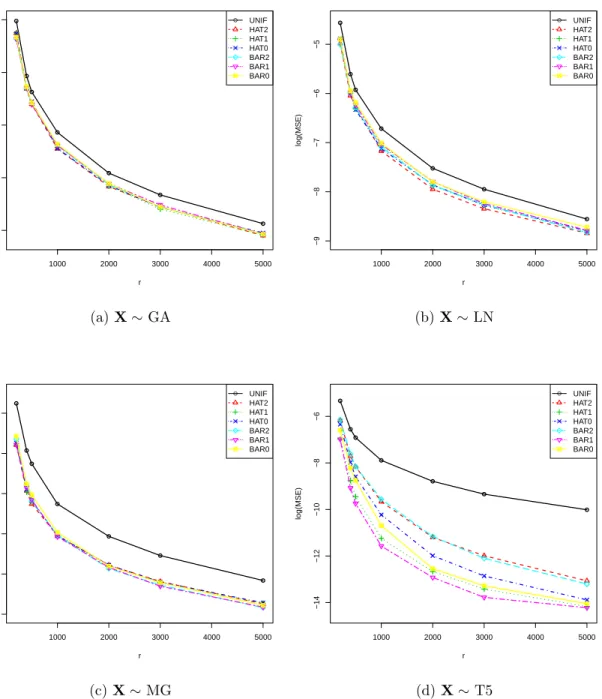
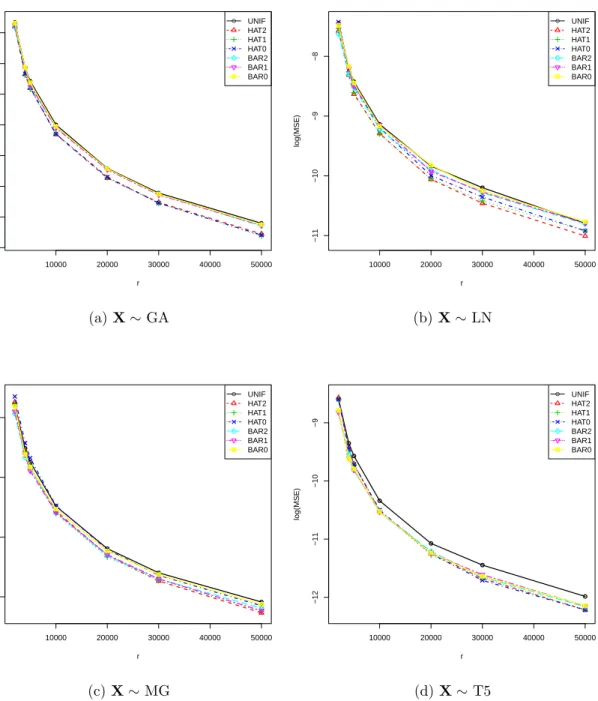
Figure 5.1 presents plots of log 10 of the MSEs of ˆ β ∗ r using ˆ π (2) (HAT2), ˆ π (1) (HAT1), ˆ π (0) (HAT0), ¯ π (2) (BAR2), ¯ π (1) (BAR1), ¯ π (0) (BAR0) and uniform  sub-sampling (UNIF) probabilities against different subsample sizes r = 0.02%n, 0.0
Figure 5.1. MSEs of subsampling estimator for four different distributions of covariate X, with Poisson data and Poisson model
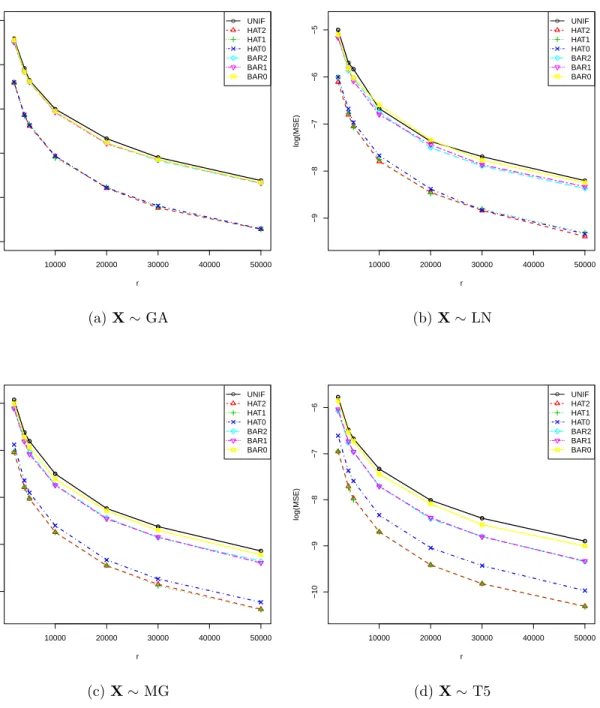
Figure 5.2. MSEs of subsampling estimator for four different distributions of covariate X, with negative binomial data and negative binomial model.
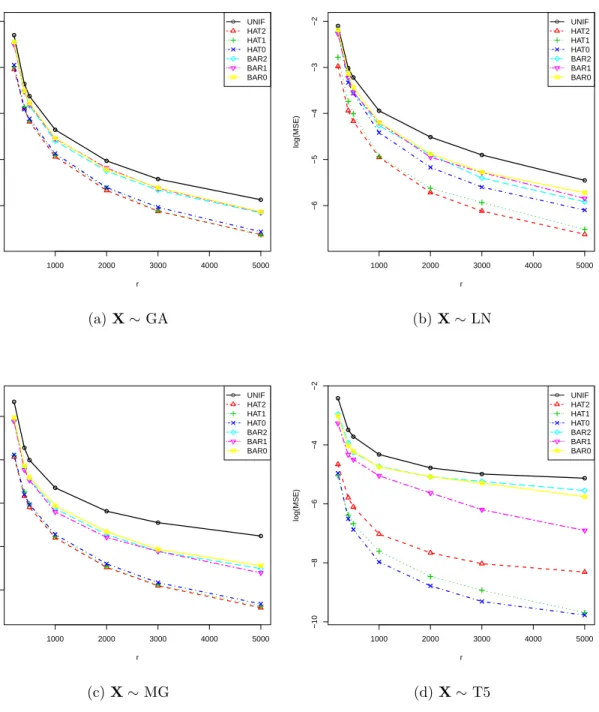
Figure 5.3. MSEs of subsampling estimator for four different distributions of covariate X, with negative binomial data and Poisson model
+7

References

Related documents

Net positive suction head (NPSH) for positive displacement reciprocating pumps is normally expressed in pressure units (psi, kPa, Bar) since a significant portion of pump NPSHR is

The final regulations provide that appraisal fees incurred by an estate or a trust to determine the fair market value of assets as of the decedent's date of death (or the

___ I understand that volunteer hours submitted for Dental Assistant Training do not qualify for the Volunteer Incentive Program for Red Cross volunteers as it is a

Chapters: Engage with individual leads locally to sell chapter membership; Ensure local programs are aligned with the national message... Membership Marketing

If your bait that you're getting people to send an email to you to become a lead in your autoresponder, is the three biggest mistakes that you're probably making right now in

• Groups who have immigrated to rural or urban New York State or have moved within the state in search of more stable economic, political, and/or social conditions. • Groups

Workplace Safety &amp; Loss Prevention Program List of Private Sector Insurance Company Certified Consultants as of October 1, 2009 3..

Based on the continuing risk of flooding, Aurora has identified the need to mitigate future flood events associated with Westerly Creek in the vicinity of Montview Park from East 23