BOTANICA LITHUANICA
2007, 13(3): 139–157
A SURVEY OF THE BOTANICAL PLACE NAMES OF THE IGLESIENTE AREA (SOUTH WEST SARDINIA)
Gianluigi BACCHETTA1, Riccardo GUARINO2, Cristiano PONTECORVO1, Pinuccio SODDU3
1Biodiversity Conservation Centre (CCB), Botanical Science Department of the University of Cagliari,
Viale S. Ignazio da Laconi 13, 09123 Cagliari, Italy; e-mail: [email protected]; [email protected]
2Botanical Department of the University of Catania, Via Antonino Longo 19, 95124 Catania, Italy; e-mail
3 “San G. Bosco” Comprehensive School of Gonnosfanadiga. Piazza Giovanni XXIII, Gonnosfanadiga,
Italy
Abstract
Bacchetta G., Guarino R., Pontecorvo C., Soddu P., 2007: A survey of the botanical place names of the Iglesiente area (South West Sardinia) [Iglesiento srities (Pietvakariø Sardinija) su augalais susijæ vietovardþiai]. – Botanica Lithuanica, 13(3): 139–157.
A preliminary contribution regarding the phytotoponymy of the Iglesiente area (southwestern Sardinia) is presented. 526 plant place names have been recorded, referring to 107 taxa. Most of these are written in Campidanese dialect and refer to plants frequently found in the territory. The most recurrent plants in the surveyed place names are trees (51 %) and shrubs (11 %), spontaneous and cultivated, most of which calcifugous. Only in the westernmost districts is it possible to find some place names referring to calcicolous taxa, linked to carbonatic sedimentary substrata. With reference to the IGM (Military Geographic Institute) 1 : 25000 topographic maps, the largest amount of phy-totoponyms are found around the settlements of Gonnosfanadiga (102), Iglesias (73) and Guspini (67), having a long rural tradition. Almost all the surveyed names are given by the combination of plant names with morphological elements of the landscape, particularly rivers (16 %), mountains and peaks (32 %).
Keywords: Sardinia, Iglesiente, flora, phytotoponymy.
INTRODUCTION
The Mediterranean place-names have not generated any major debate within anthropologists and ethnogra-phers, despite the fact that local names do often exhibit a great cultural richness, especially in the most remote areas with long rural, agro-pastoral traditions. In some areas, place names clearly retain archaic language forms, with possible implications for estate-tenure and land-use histories. The proportion of names which have been partly or wholly maimed by geographers and
cartogra-phers is quite high, as also is the proportion of names mistranslated from the original dialectal form into an official language. With reference to the Italian territory, the Island of Sardinia represents quite an exception, be-cause most of the dialectal place-names have been main-tained more or less unaltered in the cartographic work. Moreover, the density of place-names in the official car-tography is on average higher than in any other Italian district. The first exception is probably related to the dignity of language traditionally attributed to the Sar-dinian dialects and, perhaps, by the fact that the
Sardinian language was poorly understood by the car-tographers, most of which were coming from the Pied-mont region (North-west Italy). On the other hand, the high density of place-names reflects the importance of pastoralism on the Island: normally shepherds own no land, but they can rent pastures from the council of the villages. For this reason, it is very important for the communities to establish a shared and unequivocal de-signation of landscape elements which are useful for defining an administrative framework to the seasonal movements of flocks.
Botanical place-names (or phytotoponyms), i.e. those deriving from plants, are worth to be analyzed for many reasons: from the ethnographical viewpoint, they provide useful indications on what and how many plants were belonging to the bulk of knowledge of the local people; from the geobotanical viewpoint they represent an important element for reconstructing the landscape history and the former distribution of plants and vege-tation types (MAXWELL, 1958; PEARSALL, 1961; FAULL,
1979).
In spite of the great bulk of published material on common names and traditional plant uses in Sardinia, the study of the Sardinian phytotoponyms is very recent and, with the exception of a paper on Sulcis area (BAC -CHETTA et al., 2000), it has been limited to the analysis
of small areas or specific elements of the landscape. The only other published studies are, in fact, those on Monte Albo (CAMARDA, 1984), the island’s nuraghi (CAMARDA,
1989), and the Giara di Gesturi (MOSSA et al., 1989).
In the frame of a general review of the Sardinian place-names, this paper aims to analyze the Iglesiente area, defined as the portion of territory situated west of the Campidano plain and north of the Cixerri tectonic trench (Fig. 1).
MATERIALS AND METHODS
The census of the phytotoponyms was essentially based on the topographic maps of the IGM (Military Geographic Institute) in 1 : 25000 scale (Series XXV). More particularly, the following sheets were analyzed: Capo della Frasca (sh. 538, sect. IV), Porto Palma (sh. 538, sect. III), San Nicolò d’Arcidano (sh. 538, sect. II), Gutturu ‘e Flumini (sh. 546, sect. IV), Guspini (sh. 546, sect. I), San Gavino Monreale (sh. 547, sect. IV), Capo Pecora (sh. 546, sect. III), Gonnosfanadiga (sh. 546, sect. II), Villacidro (sh. 547, sect. III), Buggerru (sh. 555, sect. IV), Iglesias (sh. 555, sect. I), Vallermosa (sh. 556, sect. IV), Portoscuso (sh. 555, sect. III), Villa-massargia (sh. 555, sect. II), Siliqua (sh. 556, sect. III), and Calasetta (sh. 564, sect. IV).
In addition to the analysis of the topographic maps, the phytotoponyms commonly used by the inhabitants of the studied territory were also considered. For this purpose, interviews were conducted in both the rural areas and in the main towns of the Iglesiente area.
For the interpretation of the found toponyms, refe-rence was made to the volume “Toponomastica Sarda”
Fig. 1. The Sardo-Corsican biogeographic province, with Iglesiente pointed out. 1 a – the biogeographic sector of
Sulcis-Iglesiente, formed by the subsector Iglesiente (to the north) and Sulcis (to the south); 1 b – the “zones” traditionally recognized within the subsector Iglesiente (Arburese, Costa Verde, Linas, Fluminese, Marganai, Cixerri)
(DEDOLA, 2004), to several dictionaries (CARA, 1889;
WAGNER, 1960; CONGIA, 1998; PUDDU, 2000) and to
many books on the traditional plant uses and vernacular names in Sardinia (COSSU, 1968; VANNELLI, 1971; CA -MARDA & VALSECCHI, 1983, 1990; CHIAPPINI, 1985; CA -MARDA, 1986; NIEDDU et al., 1989), as well as to the work
on the toponymy of the Fluminese area prepared by the
Secondary School of Fluminimaggiore (RIOLA, 1997).
The Italian and scientific names of the plant species were
drawn from “Flora d’Italia” (PIGNATTI, 1982) and “An
Annotated Checklist of the Italian Vascular Flora” (CON -TI et al., 2005).
The toponyms in Appendix I and II are quoted exact-ly the way they are reported in the consulted topogra-phical maps. The abbreviations of Sardinian and Italian terms adopted by the Italian Military Geographic Insti-tute are the following: C. – casa (house); Can.le – canale
(stream); Cuc.ru – cuccuru (mountain top); G.na – genna
(pass); M. – monte (mount); Min.a – miniera (mine); P. and P.ta – punta (mountain peak); R. – rio, riu (torrent); Sa P.ta – (the mountain peak); Sez. – section (referring to the IGM maps).
RESULTS
A total of 2.964 toponyms were recorded in the sur-vey and analyzed, 526 of them turned out to be
phyto-toponyms, referring to at least 107 taxa,representing
about 6.9 % of the flora currently known for the Ig-lesiente area (PONTECORVO, 2006).
The complete list of phytotoponyms with their corres-ponding common name, scientific name, and IGM map
reference is presented in Appendix I. For the phytoto-ponyms of doubtful specific attribution, the abbreviation “sp. plur.” has been used when it was impossible to trace back to the specific level, since the phytotoponym may refer to more than one plant species, belonging to diffe-rent genera or even families. A question mark and the possible etymology have been used when there is no certainty that the phytotoponym derives from the verna-cular name of a plant species.
The place-names deriving from the surnames of land owners with a botanical etymology have been consi-dered too (see Appendix II), as well as the single case of “Su Nenneri”, in which the phytotoponym results from the name of an agricultural cooperative.
The toponymy of the whole area is mainly made up of phytotoponyms in Campidanese dialect, largely refer-ring to tree and shrub species present and often very frequent in the examined territory.
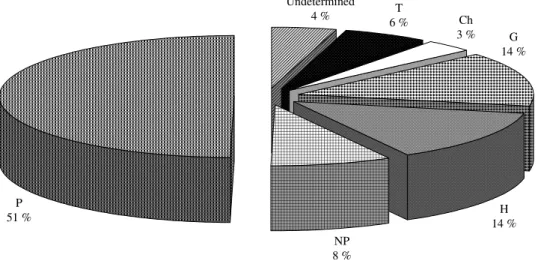
The biological spectrum of the surveyed toponyms (Fig. 2) shows a clear dominance of phanerophytes (51 %) over the other biological forms. This appears to be in relation with the fact that trees are certainly better known, more evident, and often used by man. It should also be pointed out that throughout the entire Iglesiente area the most widespread crops are arboreal, with a prevalence of olive, almond, citrus and other fruit gro-ves. The herbaceous crops are secondary, generally not irrigated and limited to flat and piedmont areas.
The most recurrent species in the local phytotopo-nymy are shown in Fig. 3. Among these, the most menti-oned are: Pyrus spinosa Forssk. and Pyrus communis L. (26), followed by Myrtus communis L. (23), Ficus cari-ca L. var. caprificus Risso (22), Phragmites australis
Fig 2. Biological forms associated with the phytotoponyms of the Iglesiente area
NP 8 % H 14 % G 14 % Ch 3 % T 6 % Undetermined 4 % P 51 %
(Cav.) Trin. (20), Olea europaea L. var. sylvestris Brot.
(19), and calcifugous sclerophylls such as Arbutus
unedo L. and Quercus suber L. (15).
The data confirm the vegetational potentials of the area, determined by the nature of the substrata and the bioclimatic conditions. In fact, non-carbonatic lithologi-cal substrata, such as Hercynic granites and Paleozoic acid-subacid metamorphytes, are dominating the
Igle-siente (CARMIGNANI et al., 1996, 2001). From the
bio-climatic standpoint, the whole area is in a Mediterranean macrobioclimatic context, with a pluviseasonal-oceanic bioclimate. The thermotypes vary from upper thermo-mediterranean to lower suprathermo-mediterranean, and the ombrotypes from the upper dry to the lower humid (BAC -CHETTA, 2000). Only in the most southern and western
parts of the territory numerous phytotoponyms for calci-colous taxa such as Rosmarinus officinalis L. (7) were found, confirming the carbonatic Paleozoic sedimentary substrata dominating in this part of the Iglesiente area. Several toponyms refer to species largely cultivated depending on the bioclimatic and vegetational potentials of the area; in particular, we might mention the species of the genera Pyrus sp. plur. (22) and Vitis vinifera L. (9). As for the species of ethnobotanical interest, the pre-sence of numerous toponyms referring to Arundo donax L.,
Phragmites australis Adanson, Myrtus communis L., and Quercus suber L. shows how, in the past, it was im-portant to locate the areas where those raw materials indispensable for constructing the artifacts and struc-tures of the Sardinian peasant civilization, or necessary for food uses, could be found.
The numerous toponyms referring to Lavatera sp. plur. are due both to the use of the leaves of these Malvaceae
plants as forage for animals (in particular in rabbit breeding), and to the difficulty in reconstructing the ety-mology of the corresponding toponyms. Indeed, names such as Narboni and Narboneddu may derive either from “narboina”, which is the vernacular Sardinian name for various species of the genus Lavatera, or from “narbone”, which means “burnbeating”, i.e. burnbeaten ground. It is therefore very probable that many of these toponyms have the latter meaning; their abundance seems to in-dicate how important was this practice in the Iglesiente mountain areas, for the subsistence farming traditionally practiced in the marginal areas of Sardinia.
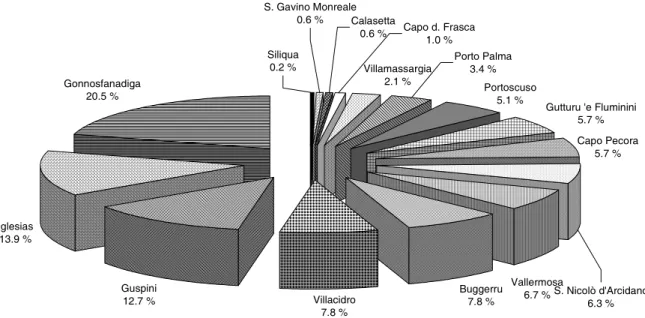
Analysis of cartographic references, revealed that the IGM sheet richest in phytotoponyms is Gonnosfana-diga (108), followed by Iglesias (73) and Guspini (67) (Fig. 4).
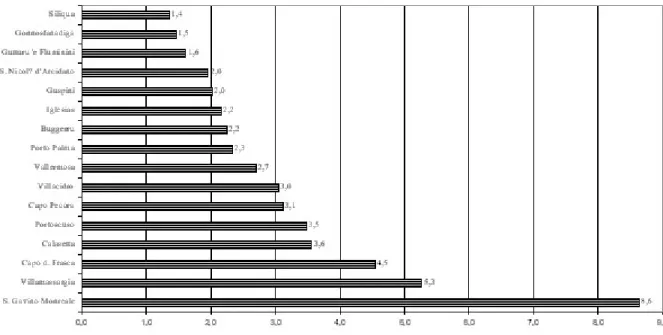
The ratios between toponyms and phytotoponyms on each IGM sheet (Fig. 5) and between the area con-sidered on the sheets and the phytotoponyms (Fig. 6) revealed that the sheets with the highest percentages of phytotoponyms are those of Siliqua (considered area is not complete), Gonnosfanadiga, and Gutturu ‘e Flumini. On the basis of the data shown in the two diagrams, it can be seen that the ratios vary considerably and tend to be lower in the mountain areas and higher in the ter-ritories more heavily affected by human activity, in particular in the Cixerri plain and at the boundary with the Campidano plain. This was to be expected; in fact, it is evident that in territories where private properties
8 8 8 9 9 9 9 9 10 10 10 12 15 15 16 19 20 22 23 26 0 5 10 15 20 25 30 Quercus ilex L. Salix sp. pl. Cyperus longus L. Vitis vinifera L. Cytisus villosus Pourret Trigonella sp. pl. Pteridium aquilinum (L.) Kuhn, Osmunda regalis L., Pteridophyta sp. pl. Calicotomevillosa (Poiret) Link in Schrader Phillyrea latifolia L., Phillyrea angustifolia L. Foeniculum vulgare L. ssp. piperitum (Ucria) Coutinho
Rosmarinus officinalis L. Prunusspinosa L.
Quercussuber L. Arbutusunedo L. Lavatera sp. pl., Althaeaofficinalis L. Oleaeuropaea L. var. sylvestris Brot. Cfr. Phragmitesaustralis (Cav.) Trin. (Arundodonax L.) Ficus carica L. var. caprificus Risso Myrtus communis L. Pyrus communis L., Pyrus amygdaliformis Vill.
are lacking and where the natural habitats are better preserved, the elements of the local flora and vegeation, combined with geomorphological elements of the landscape, are more appropriate for identifying a loca-lity.
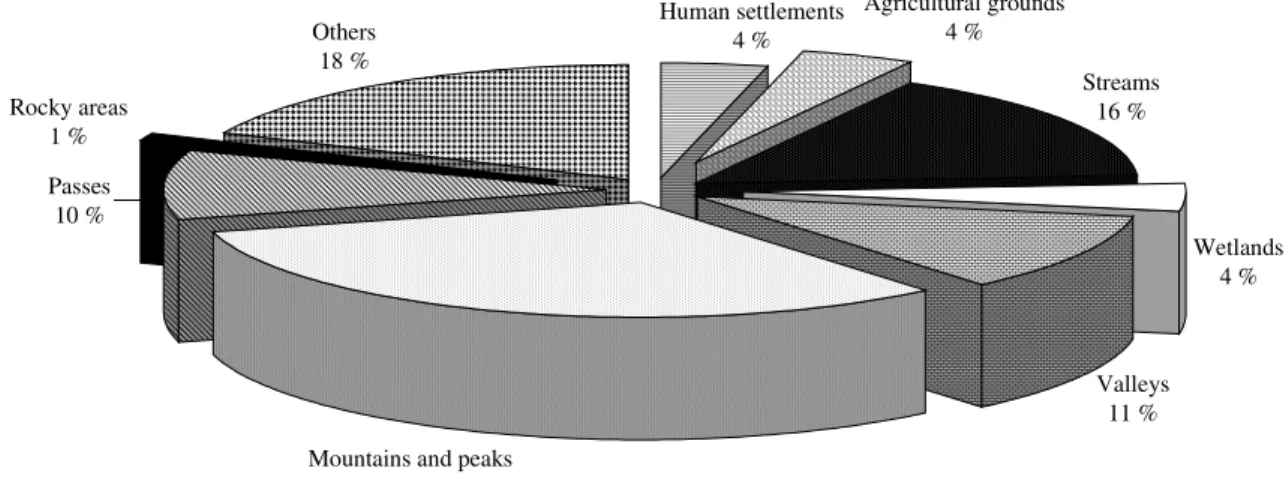
Lastly, it is shown (Table 1; Fig. 7) that the majority of the phytotoponyms pertain to and are connected with the morphological elements characterizing the land-scape, and in particular mountains and peaks (169),
Fig. 4. Percentage frequency of the phytotoponyms on the single IGM 1 : 25000 topographic map
Fig 5. Ratio between toponyms and phytotoponyms (%)
16,3 13,8 8,4 7,9 6,5 6,4 6,2 6,2 5,7 5,5 5,4 5,3 5,2 4,0 3,6 3,0 0,0 2,0 4,0 6,0 8,0 10,0 12,0 14,0 16,0 18,0 S. Gavino Monreale Villamassargia Capo d. Frasca Portoscuso Capo Pecora Vallermosa Guspini Buggerru Calasetta Iglesias Porto Palma S. Nicol? d'Arcidano Villacidro Gutturu 'e Fluminini Gonnosfanadiga Siliqua
streams (83), valleys (58) and passes (50); while only for 96 out of 526 phytotoponyms (18 %) it was not possible to establish a landscape element of reference. The toponyms connected with human settlements, even if they refer to vernacular names of plant taxa, frequently originate from the surname of the family who lives/lived there. For this reason, we have preferred to insert these toponyms separately in Appendix II. Even if they do not refer directly to plants present on the Gonnosfanadiga 20.5 % Gutturu 'e Fluminini 5.7 % Buggerru 7.8 % Villacidro 7.8 % Guspini 12.7 % Iglesias 13.9 % Villamassargia 2.1 % Portoscuso 5.1 % Porto Palma 3.4 % Capo Pecora 5.7 % Vallermosa 6.7 % S. Nicolò d'Arcidano 6.3 % Calasetta 0.6 % Siliqua 0.2 % Capo d. Frasca 1.0 % S. Gavino Monreale 0.6 %
Fig 6. Ratio between area (in km2) and number phytotoponyms
Landscape elements N° Word associated to the phytotoponyms
Mountains and peaks 169
Monte, pitzu, schina, cuccuru, punta, serra, cima, bruncu, fronte, murru, cabu, sa punta
Streams 83 Riu, s'acqua, roia, coia
Valleys 58 Conca, canali, gutturu, vallata, fosso, su strintu, bega, s'ega, sega, canabe, gora
Passes 50 Passu, arcu, sedda, genna, s'enna
Human settlements 21 Porto, case, medau, villa, ponte, miniera, guardia
Agricultural grounds 21 Pranu, piano, ortu, bingias, campu, oliveto, terre, tanca, mori, cussorgia, corti, argiola, st.le
Wetlands 21 Mitza, sorgente, funtana, pauli
Rocky areas 7 Sa pala, paba, corongiu, scoglio
Others 96 Truncu, tuppa, quassoli, nuraxi, tuvu
territory, these names bear witness to the Sardinian po-pulation’s strong tie to them, a characteristic which led these people to frequently adopt plant species names as personal names.
CONCLUSIONS
The census and the study of the toponyms of this territory, extending over an area of 1.225 km2, led to the
identification of 526 phytotoponyms, the analysis of which made it possible to identify the taxa from which Table 1.
Phytotoponyms grouped on the basis of landscape elements
they are derived, their biological spectrum, and the dis-tribution over the territory on the basis of the IGM maps and the morphological characteristics.
This analysis confirms that plants are a very useful instrument for recognizing places, especially in sparsely populated areas, if combined with a morphotoponym. In addition, it has been ascertained that inhabitants often, in assigning a toponym, refer to the most evident bota-nical and geomorphologic element of the site. With the combination of a plant and an element of the landscape or manmade structures, a definite specificity and possi-bility for precise recognition are obtained.
Fig. 7. Percentage of phytotoponyms grouped on the basis of geomorphological elements of the landscape The study has also made it possible to understand
the characteristics of the local vernacular and that the inhabitants of the place tend to classify the species mainly on the basis of their common use and/or their more evident characteristics. This often entails the attri-bution of a vernacular name to species belonging to one or more genera or even more than one family. A greater taxonomic precision can be found in the identification of tree species and plants used for food or medicines. REFERENCES
BACCHETTA G., 2000: Flora, vegetazione e paesaggio
dei Monti del Sulcis (Sardegna sud-occidentale). Tesi di Dottorato di Ricerca A. A: 1999–2000. Dipartimento di Biotecnologie Agrarie ed Ambien-tali, Università degli Studi di Ancona. – Ancona. BACCHETTA G., PONTECORVO C., MOSSA L., 2000:
Contri-buto alla conoscenza dei fitotoponimi del Sulcis (Sardegna sud-occidentale). – Rend. Sem. Fac. Sci. Univ. Cagliari., Suppl. 70: 199–213.
CAMARDA I., 1984: Ambiente e flora del Monte Albo.
Sardegna centro-orientale. – Casale Monferrato. CAMARDA I., 1986: Introduzione all’ambiente di Monte
Gonare. 2D. – Sassari.
CAMARDA I., 1989: La phytotoponymie des Nuraghes
en Sardaigne. – Braun-Blanquetia, 3(2): 337–340. CAMARDA I., VALSECCHI F., 1983: Alberi e arbusti
spon-tanei della Sardegna. – Sassari.
CAMARDA I., VALSECCHI F., 1990: Piccoli arbusti, liane e
suffruttici spontanei della Sardegna. – Sassari. CARA A., 1889: Vocabolarietto botanico sardo-italiano. –
Cagliari.
CARMIGNANI L., BARCA S., OGGIANO G., PERTUSATI P. C.,
SALVADORI I., CONTI P., ELTRUDIS A., FUNEDDA A.,
PASCI S., 1996: Carta geologica della Sardegna. –
Firenze.
CARMIGNANI L., OGGIANO G., BARCA S., CONTI P., EL -TRUDIS A., FUNEDDA A., PASCI S., 2001: Geologia
della Sardegna, Note illustrative della Carta Geolo-gica della Sardegna in scala 1: 200.000. Memorie descrittive della Carta Geologica d’Italia. – Roma. CHIAPPINI M., 1985: Guida alla flora pratica della
Sar-degna. – Sassari.
CONGIA P., 1998: Dizionario botanico sardo. – Cagliari.
CONTI F., ABBATE G., ALESSANDRINI A., BLASI C., 2005: An
Annotated Checklist of the Italian Vascular Flora. – Roma.
COSSU A., 1968: Flora pratica sarda illustrata. – Sassari.
DEDOLA S., 2004: Toponomastica sarda. – Dolianova.
FAULL M. L., 1979: Place-Names and Past Landscape. –
Journ. English Place-Name Soc., 11: 24–46.
MAXWELL I. S., 1958: The former distribution of
vege-tation in Roseland (Cornwall) as deduced from pla-ce-names. – Trans. Papers Inst. Brit. Geographers,
13: 143–152.
MOSSA L., SCRUGLI A., MULAS B., FOGU M. C., COGONI A.,
1989: La componente geobotanica del parco della Giara di Gesturi. – Assessorato alla Tutela dell’Am-biente, Provincia di Cagliari.
NIEDDU G., SCUDU C., FILIA G., NIEDDU M. A., BRUNDU M.,
1989: Le piante nostre amiche. – Nuoro.
PEARSALL W. H., 1961: Place-names as clues in pursuit
of ecological history. – Namn. Och. Bygd. 49(1–4): 72–89.
PIGNATTI S., 1982: Flora d’Italia, 1-3. – Bologna. Mountains and peaks
32 % Valleys 11 % Wetlands 4 % Streams 16 % Agricultural grounds 4 % Human settlements 4 % Others 18 % Rocky areas 1 % Passes 10 %
PONTECORVO C., 2006: Flora dell’Iglesiente (Sardegna
SW). – Tesi di Dottorato di Ricerca, A. A: 2005– 2006. Dipartimento di Scienze Botaniche, Università degli Studi di Cagliari. – Cagliari.
PUDDU M., 2000: Ditzionàriu de sa limba e de sa cultura
sarda. – Cagliari.
RIOLA R., 1997: Dizionario Toponomastico Fluminese. –
Scuola media di Fluminimaggiore. – Fluminimaggiore. VANNELLI S., 1971: La flora arborea ed arbustiva nel
dialetto gallurese. – Ispettorato Distrettuale delle Fo-reste. – Tempio.
WAGNER M. L., 1960: Dizionario etimologico sardo. –
Heidelberg.
IGLESIENTO SRITIES (PIETVAKARIØ SARDINIJA) SU AUGALAIS SUSIJÆ VIETOVARDÞIAI
Gianluigi BACCHETTA, Riccardo GUARINO, Cristiano PONTECORVO, Pinuccio SODDU
Straipsnyje pateikiama Iglesiento srities (pietvakariø Sardinija) su augalais susijusiø vietovardþiø analizë. Ið-nagrinëjus kartografinæ medþiagà, aptikti 526 su 107 taksonø augalø pavadinimais susijæ vietovardþiai. Dau-guma vietovardþiø uþraðyti kampidanenso tarme ir sie-jami su ðiame regione daþnai aptinkamais augalais. Daugiausia vietovardþiø susijæ su laukiniais ar augina-mais medþiais (51 %) ir krûaugina-mais (11 %). Reikia pridurti, kad dauguma su vietovardþiais susijusiø augalø yra ven-giantys kalkingø dirvoþemiø. Tik labiausiai vakaruose
esanèiose vietovëse yra geografiniø pavadinimø, susiju-siø su kalkiamëgiais augalais, nes tik tose vietovëse yra karbonatingø substratø. Daugiausia su augalø pavadi-nimais susijusiø vietovardþiø nustatyta aplink Gonnos-fanadigos (102), Iglesijo (73) and Guspinio (67) vieto-ves, kuriose iðlikusios senos kaimo bendruomeniø gyve-nimo tradicijos. Beveik visi iki ðiol iðlikæ su augalø pa-vadinimais susijæ vietovardþiai yra sudaryti ið augalo vardo ir kraðtovaizdþio elementø, ypaè upiø (16 %), kalnø ir virðukalniø (32 %) pavadinimø.
Appendix I
List of the phytotoponyms of the Iglesiente area. The symbol “*” has been used to mark those phytotoponyms not shown on the IGM maps (Series XXV), but which are in current use among the local inhabitants; (?) has been used to mark phytotoponyms perhaps originated from a distortion of the original name. The place-name no. 374 was found on IGM sheet 225 III NE of the Series XXIV
Phytotoponyms Scientific names Igm map N°
Acqua sa Canna Phragmites australis (Cav.) Trin., Arundo donax L. N° 555 Sez. III 1 Acqua sa Canna Phragmites australis (Cav.) Trin., Arundo donax L. N° 555 Sez. III 2 Arcu Bega sa Canna Phragmites australis (Cav.) Trin., Arundo donax L. N° 546 Sez. III 3
Arcu de Gureu Cynara cardunculus L. N° 555 Sez. IV 4
Arcu de is Moddizzis Pistacia lentiscus L. N° 555 Sez. I 5
Arcu de is Moddizzis Pistacia lentiscus L. N° 555 Sez. IV 6
Arcu de is Prunixeddas Prunus domestica L., Prunus spinosa L. N° 555 Sez. I 7
Arcu de Prunixedda Prunus domestica L., Prunus spinosa L. N° 556 Sez. IV 8
Arcu su Linnamini Undetermined N° 555 Sez. I 9
Aremitza Lavandula stoechas L. N° 555 Sez. I 10
Aremitza Lavandula stoechas L. N° 555 Sez. I 11
Argiola Frissa Dittrichia viscosa (L.) Greuter N° 546 Sez. I 12
Bega sa Canna Phragmites australis (Cav.) Trin. N° 555 Sez. IV 13
Bega sa Menta Mentha sp. plur. N° 555 Sez. I 14
Bega Saxinedda Vitis vinifera L. N° 555 Sez. I 15
Bingias Beccias Vitis vinifera L. N° 546 Sez. II 16
Bingias Novas Vitis vinifera L. N° 546 Sez. I 17
Bruncu acqua Salixi Salix sp. plur. N° 546 Sez. IV 18
Bruncu Linnaris Undetermined N° 546 Sez. IV 19
Bruncu su Sensu Artemisia arborescens L. N° 546 Sez. III 20
Bruncu su Zippiri Rosmarinus officinalis L. N° 546 Sez. IV 21
Bruncu Zippiri Rosmarinus officinalis L. N° 546 Sez. III 22
C. Genna sa Murta Myrtus communis L. N° 546 Sez. I 23
C. Narboni Lavatera arborea L., Lavatera olbia L. N° 555 Sez. IV 24
C. s’Olioni Mannu Arbutus unedo L. N° 538 Sez. III 25
Cabu de Figus Ficus carica L. var. caprificus Risso N° 546 Sez. III 26
Cadumbu* Verbascum sp. plur. N° 546 Sez. II 27
Campu ‘e Prama Phoenix dactylifera L. N° 546 Sez. III 28
Campu Ollastu Olea europaea L. var. sylvestris Brot. N° 546 Sez. I 29
Campu Pirastu Pyrus spinosa Forssk. N° 555 Sez. III 30
Campu Scruiddu Urginea maritima L. Baker N° 538 Sez. II 31
Campuspina Undetermined N° 546 Sez. I 32
Can.le Filixisterriu Pteridophyta sp. plur. N° 546 Sez. II 33
Can.le Isteri Plumbago europaea L. N° 546 Sez. II 34
Can.le Landriu Quercus sp. plur. N° 546 Sez. II 35
Can.le Murera Sinapis alba L. N° 546 Sez. II 36
Can.le s’Arrusu Rubus ulmifolius Schott N° 546 Sez. II 37
Can.le sa Meliana Viburnum tinus L. N° 546 Sez. II 38
Can.le Srementus Vitis vinifera L. N° 546 Sez. II 39
Can.le su Pressiu Prunus persica L. Batsch N° 546 Sez. II 40
Can.le Triargiu Calicotome villosa (Poiret) Link N° 555 Sez. IV 41
Can.le Tuppa de Senzu Artemisia arborescens L. N° 556 Sez. IV 42
Can.li de Prunas Arestis Prunus spinosa L. N° 538 Sez. II 43
Canabe Narba Malva sylvestris L., Lavatera sp. plur. N° 538 Sez. II 44
Canale Candelazzu Hedera helix L. N° 547 Sez. III 45
Canale de is Prunixeddas Prunus domestica L., Prunus spinosa L. N° 555 Sez. I 46
Canale di Paringianu Solanum melongena L. N° 564 Sez. IV 47
Canale is Truiscus Daphne gnidium L. N° 556 Sez. IV 48
Canale Tuvu de Scieurras Ferula communis L. N° 547 Sez. III 50
Canali Arrusu Rubus ulmifolius Schott N° 538 Sez. II 51
Canali Canna Phragmites australis (Cav.) Trin. N° 546 Sez. I 52
Canali Fenu Trainu Phleum arenarium L. N° 538 Sez. II 53
Canali Fenugu Foeniculum vulgare L. ssp. piperitum (Ucria) Coutinho N° 546 Sez. I 54
Canali Frassu* Fraxinus oxycarpa Willd (Bieb.) N° 546 Sez. II 55
Canali Opus Hyoscyamus niger L., H. albus L. N° 546 Sez. II 56
Canali s’Olioni Arbutus unedo L. N° 538 Sez. III 57
Cannamenda Phragmites australis (Cav.) Trin. N° 546 Sez. I 58
Cannamenda Phragmites australis (Cav.) Trin. N° 547 Sez. III 59
Canne Menda Phragmites australis (Cav.) Trin. N° 555 Sez. III 60
Cannisonis Phragmites australis (Cav.) Trin. N° 546 Sez. III 61
Castangias Castanea sativa Miller N° 547 Sez. III 62
Ciorixi Rubia peregrina L., Genista corsica (Loisel) DC. N° 546 Sez. II 63
Coia Sa Mela Malus domestica Borkh. N° 546 Sez. IV 64
Conca Fenugu Foeniculum vulgare L. ssp. piperitum (Ucria) Coutinho N° 546 Sez. I 65
Conca Ilixi Quercus ilex L. N° 546 Sez. I 66
Conca Moddizzi Pistacia lentiscus L. N° 546 Sez. III 67
Conca sa Figu Ficus carica L. var. caprificus Risso N° 546 Sez. III 68
Conca su Sparau Asparagus acutifolius L., A. stipularis Forssk., A. albus L. N° 546 Sez. II 69 Concas de Maguseddu Cytisus villosus Pourr., Teline monspessulana (L.) Koch N° 546 Sez. II 70
Corongiu de Tinni Juncus acutus L. N° 546 Sez. II 71
Corti sa Figu Ficus carica L. var. caprificus Risso N° 546 Sez. I 72
Craccuris Ampelodesmos mauritanicus (Poiret) Dur. et Sch. N° 547 Sez. III 73
Crocorigas Cucurbita maxima Duchesne, Bryonia marmorata Petit, N° 546 Sez. I 74
Aristolochia sp. plur.
Cuc.ru Figu Ficus carica L. var. caprificus Risso N° 555 Sez. IV 75
Cuc.ru Frissa Manna Dittrichia viscosa (L.) Greuter N° 538 Sez. II 76
Cuc.ru Genna s’Olioni Arbutus unedo L. N° 546 Sez. II 77
Cuc.ru is Abiois Lavandula stoechas L. N° 546 Sez. II 78
Cuc.ru Magusu Cytisus villosus Pourr., Teline monspessulana (L.) Koch N° 546 Sez. II 79
Cuc.ru Moddizzi Pistacia lentiscus L. N° 555 Sez. IV 80
Cuc.ru Piras Pyrus communis L., Pyrus spinosa Forssk. N° 546 Sez. II 81
Cucc.ru Suergiu Quercus suber L. N° 555 Sez. IV 82
Cuccuru ‘e Fenu Trigonella sp. plur. N° 538 Sez. II 83
Cuccuru Bingias Vitis vinifera L. N° 555 Sez. I 84
Cuccuru Cauli Brassica oleracea L. N° 546 Sez. I 85
Cuccuru de is Piras Pyrus communis L., Pyrus spinosa Forssk. N° 555 Sez. I 86
Cuccuru Faa Vicia faba L. N° 555 Sez. I 87
Cuccuru Fenugu Foeniculum vulgare L. ssp. piperitum (Ucria) Coutinho N° 547 Sez. III 88
Cuccuru Frissa (punto) Dittrichia viscosa (L.) Greuter N° 547 Sez. III 89
Cuccuru Frissa (area) Dittrichia viscosa (L.) Greuter N° 547 Sez. III 90
Cuccuru Gureu Cynara cardunculus L. N° 546 Sez. I 91
Cuccuru Gutturu Ortigu Quercus suber L. N° 538 Sez. II 92
Cuccuru is Abiois Lavandula stoechas L. N° 547 Sez. III 93
Cuccuru is Feurras Ferula communis L. N° 555 Sez. II 94
Cuccuru Murdegu Cistus creticus L. ssp. eriocephalus (Viv.) Greuter et N° 547 Sez. III 95 Burdet, C. monspeliensis L., C. salviifolius L.
Cuccuru Murtas Myrtus communis L. N° 555 Sez. I 96
Cuccuru Olionis Arbutus unedo L. N° 556 Sez. IV 97
Cuccuru Pirastu Pyrus spinosa Forssk. N° 546 Sez. I 98
Cuccuru sa Rideli Phillyrea latifolia L., Phillyrea angustifolia L. N° 556 Sez. IV 99 Cuccuru su Sparau Asparagus acutifolius L., A. stipularis Forssk., A. albus L. N° 556 Sez. IV 100
Cuccuru su Suergiu Quercus suber L. N° 556 Sez. IV 101
Cuccuru Suergiu Quercus suber L. N° 555 Sez. I 102
Cuccuru Suergiu Quercus suber L. N° 555 Sez. III 103
Cuccuru Tiriargiu Calicotome villosa (Poiret) Link N° 538 Sez. II 105 Enas Longas Avena fatua L., A. barbata Potter ex Link, A. sterilis L. N° 538 Sez. IV 106
Fenugus Foeniculum vulgare L. ssp. piperitum (Ucria) Coutinho N° 555 Sez. I 107
Fighezia Ficus carica L. var. caprificus Risso N° 546 Sez. III 108
Figu Bona Ficus carica L. var. caprificus Risso N° 546 Sez. II 109
Figu Pranu Ficus carica L. var. caprificus Risso N° 546 Sez. IV 110
Figus Ficus carica L. var. caprificus Risso N° 546 Sez. II 111
Fosso Zinibiri Juniperus oxycedrus L. ssp. oxycedrus N° 546 Sez. I 112
Fronte e s’Ilixi Quercus ilex L. N° 546 Sez. II 113
Funtana sa Ruda Ruta chalepensis L. N° 538 Sez. III 114
Funtana Sainas Avena fatua L., A. barbata Potter ex Link, N° 546 Sez. II 115
A. sterilis L., Sorghum bicolor (L.) Moench
G.na Gureu Cynara cardunculus L. N° 546 Sez. I 116
G.na Moddizzi Pistacia lentiscus L. N° 546 Sez. IV 117
G.na s’Olioni Arbutus unedo L. N° 546 Sez. I 118
G.na sa Folla Undetermined N° 546 Sez. IV 119
G.na sa Murta Myrtus communis L. N° 546 Sez. I 120
G.na Sitzia Bellis sp. plur., Anthemis sp. plur. N° 546 Sez. I 121
Genn’e Cannas Arundo donax L., Phragmites australis (Cav.) Trin. N° 547 Sez. III 122
Genna ‘e Podenti Undetermined N° 547 Sez. III 123
Genna Ciurexiu Quercus suber L. N° 547 Sez. III 124
Genna de is Prunas Prunus domestica L., Prunus spinosa L. N° 547 Sez. III 125
Genna de su Pirastu Pyrus spinosa Forssk. N° 546 Sez. II 126
Genna Flore Undetermined N° 546 Sez. I 127
Genna Gureu Cynara cardunculus L. N° 546 Sez. II 128
Genna Gureu Cynara cardunculus L. N° 538 Sez. II 129
Genna Ilixi Quercus ilex L. N° 555 Sez. IV 130
Genna Maguseddu Cytisus villosus Pourr., Teline monspessulana (L.) Koch N° 546 Sez. II 131 Genna Magusu Cytisus villosus Pourr., Teline monspessulana (L.) Koch N° 546 Sez. II 132 Genna Magusu Cytisus villosus Pourr., Teline monspessulana (L.) Koch N° 546 Sez. II 133
Genna Mirratta Santolina insularis (Genn. exFiori) Arrigoni N° 546 Sez. II 134
Genna Murtas Myrtus communis L. N° 555 Sez. IV 135
Genna Pira Matta Pyrus communis L., Pyrus spinosa Forssk. N° 538 Sez. II 136
Genna Pirastu Pyrus spinosa Forssk. N° 547 Sez. III 137
Genna Pruna Prunus domestica L., Prunus spinosa L. N° 546 Sez. I 138
Genna Pruna Prunus domestica L., Prunus spinosa L. N° 538 Sez. II 139
Genna Riu Nuxis Juglans regia L. N° 546 Sez. II 140
Genna s’Arrideli Phillyrea latifolia L., Phillyrea angustifolia L. N° 538 Sez. II 141
Genna s’Ilixi Quercus ilex L. N° 547 Sez. III 142
Genna s’Olioni Arbutus unedo L. N° 546 Sez. II 143
Genna s’Uvara Erica arborea L., E. scoparia L. N° 547 Sez. III 144
Genna s’Uvara Erica arborea L., E. scoparia L. N° 538 Sez. II 145
Genna sa Murta Myrtus communis L. N° 546 Sez. I 146
Genna sa Murta Myrtus communis L. N° 546 Sez. I 147
Genna Sambucu Sambucus nigra L. N° 546 Sez. II 148
Genna su Fenu Trigonella sp. plur. N° 546 Sez. II 149
Genna su Padenti Undetermined N° 546 Sez. II 150
Genna Suergiu Quercus suber L. N° 555 Sez. IV 151
Genna Truiscu Daphne gnidium L. N° 556 Sez. IV 152
Gora Genna Pruna Prunus domestica L., Prunus spinosa L. N° 546 Sez. I 153
Guardia is Arbuzzus Asphodelus ramosus ssp. ramosus L. N° 555 Sez. I 154
Guardia is Ollastus Olea europaea L. var. sylvestris Brot. N° 555 Sez. II 155
Guardia s’Arrideli Phillyrea latifolia L., Phillyrea angustifolia L. N° 556 Sez. IV 156 Guardia su Lillu Pancratium illyricum L. (Orobanche sp. plur., Iris sp. plur., N° 556 Sez. IV 157
Lilium sp. plur.)
Guardia su Lillu Pancratium illyricum L. (Orobanche sp. plur., Iris sp. plur., N° 556 Sez. IV 158
Lilium sp. plur.)
Gutturu Arrusarbus Rubus ulmifolius Schott N° 546 Sez. II 160
Gutturu Cea Spreni (?) Agave americana L. N° 555 Sez. I 161
Gutturu de is Sollias Olea europaea L. N° 555 Sez. I 162
Gutturu Fenugu Foeniculum vulgare L. ssp. piperitum (Ucria) Coutinho N° 546 Sez. II 163
Gutturu Filixi Pteridium aquilinum (L.) Kuhn N° 546 Sez. I 164
Gutturu Linnamini Undetermined N° 556 Sez. IV 165
Gutturu Magusu Cytisus villosus Pourr., Teline monspessulana (L.) Koch N° 546 Sez. II 166
Gutturu Siliqua Anagyris foetida L. N° 547 Sez. III 167
Ilixi Mannu Quercus ilex L. N° 538 Sez. IV 168
Is Abiois Lavandula stoechas L. N° 546 Sez. III 169
Is arenas s’acqua e s’ollastu Olea europaea L. var. sylvestris Brot. N° 538 Sez. III 170
Is Compinxius Pinus pinea L. N° 546 Sez. III 171
Is Filixi Pteridium aquilinum (L.) Kuhn N° 547 Sez. III 172
Is Lisandrus Smyrnium olusatrum L. N° 546 Sez. III 173
Is Padenteddus Undetermined N° 546 Sez. I 174
Is Tintionis Smilax aspera L. N° 538 Sez. II 175
Isca sa Stoia Typha angustifolia L., T. latifolia L. N° 555 Sez. II 176
Linas Undetermined N° 546 Sez. II 177
Linna Arbeddus Populus alba L. N° 546 Sez. II 178
Lisandru Smyrnium olusatrum L. N° 546 Sez. II 179
M. Campu Pirastu Pyrus spinosa Forssk. N° 555 Sez. III 180
M. Candelatzu Hedera helix L. N° 556 Sez. IV 181
M. Candelazzu Hedera helix L. N° 546 Sez. I 182
M. Fenugu Foeniculum vulgare L. ssp. piperitum (Ucria) Coutinho N° 555 Sez. IV 183
M. Feurra Ferula communis L. N° 547 Sez. III 184
M. Filixi Pteridium aquilinum (L.) Kuhn N° 547 Sez. III 185
M. Genna Luas Euphorbia characias L.(Euphorbia dendroides L.) N° 555 Sez. II 186
M. Genna Suergiu Quercus suber L. N° 555 Sez. I 187
M. Mordegu Cistus creticus L. ssp. eriocephalus (Viv.) Greuter et N° 555 Sez. IV 188
Burdet, Cistus monspeliensis L., Cistus salviifolius L.
M. Narba Malva sylvestris L., Lavatera sp. plur. N° 555 Sez. IV 189
M. Olioni Arbutus unedo L. N° 547 Sez. III 190
M. Ollastu Olea europaea L. var. sylvestris Brot. N° 546 Sez. II 191
M. Palma Chamaerops humilis L. N° 555 Sez. IV 192
M. Pisu Pisum sativum L. N° 555 Sez. IV 193
M. Pitzu de Rosa Rosa sp. plur. N° 555 Sez. IV 194
M. s’Olioni Mannu Arbutus unedo L. N° 538 Sez. III 195
M. Sabiu Alnus glutinosa (L.) Gaertner N° 546 Sez. II 196
M. Sparau Asparagus acutifolius L., A. stipularis Forssk., A. albus L. N° 546 Sez. I 197 M. Sparixeddu Asparagus acutifolius L., A. stipularis Forssk., A. albus L. N° 538 Sez. II 198
M. Zippiri Rosmarinus officinalis L. N° 547 Sez. III 199
M.za de su Linu (?) Linum sp. plur. N° 546 Sez. II 200
M.za s’Ulmu Ulmus minor Miller N° 538 Sez. II 201
M.za Scava Figu Ficus carica L. var. caprificus Risso N° 546 Sez. II 202
M.za su Padentili Undetermined N° 538 Sez. II 203
M.za su Suergiu Quercus suber L. N° 556 Sez. IV 204
M.za Tintionis Smilax aspera L. N° 546 Sez. II 205
Magusu Mannu Cytisus villosus Pourr., Teline monspessulana (L.) Koch N° 546 Sez. II 206
Medau Cuc.ru Suergiu Quercus suber L. N° 555 Sez. III 207
Medau Isca sa Stoia Typha latifolia L., T. angustifolia L. N° 555 Sez. II 208
Min.a di Nuraxi Figus Ficus carica L. var. caprificus Risso N° 555 Sez. III 209
Min.a Seddas Moddizzis Pistacia lentiscus L. N° 555 Sez. III 210
Miniera di Candiazzus Hedera helix L. N° 555 Sez. IV 211
Miniera Gennaluas Euphorbia characias L.(Euphorbia dendroides L.) N° 555 Sez. II 212
Mitza Filixisterriu Pteridophyta sp. plur. N° 546 Sez. II 213
Mitza Ilixi Quercus ilex L. N° 546 Sez. I 214
Mitza rio Ollastu Olea europaea L. var. sylvestris Brot. N° 546 Sez. I 215
Mitza s’acqua e s’ollastu Olea europaea L. var. sylvestris Brot. N° 538 Sez. III 217 Mitza su Filixi Pteridium aquilinum (L.) Kuhn, Osmunda regalis L. N° 547 Sez. III 218
Mitza su Filixi Pteridium aquilinum (L.) Kuhn, Osmunda regalis L. N° 538 Sez. II 219
Monte Figu Ficus carica L. var. caprificus Risso N° 555 Sez. I 220
Monte Figu Ficus carica L. var. caprificus Risso N° 555 Sez. I 221
Monte Gravellu Dianthus sp. plur. N° 555 Sez. I 222
Monte Linas Undetermined N° 546 Sez. II 223
Monte Narba Malva sylvestris L., Lavatera sp. plur. N° 555 Sez. I 224
Monte Nieddu de Fenugus Foeniculum vulgare L. ssp. piperitum (Ucria) Coutinho N° 555 Sez. I 225
Monte Rosmarino Rosmarinus officinalis L. N° 555 Sez. IV 226
Mori su Tasaru Rhamnus alaternus L. N° 556 Sez. IV 227
Mudaregu Cistus creticus L. ssp. eriocephalus (Viv.) Greuter et N° 546 Sez. I 228
Burdet, Cistus monspeliensis L., Cistus salviifolius L.
Murru is Ortigus Quercus suber L. N° 546 Sez. II 229
Murtemari Myrtus communis L. N° 546 Sez. I 230
Murtera Myrtus communis L. N° 547 Sez. III 231
Narboneddu Lavatera arborea L., Lavatera olbia L. N° 555 Sez. III 232
Narboni is Piras Pyrus communis L., Pyrus spinosa Forssk. N° 555 Sez. I 233
Narboni Malus Lavatera arborea L., Lavatera olbia L. N° 546 Sez. I 234
Narboni mannu Lavatera arborea L., Lavatera olbia L. N° 538 Sez. II 235
Narboni mannu Lavatera arborea L., Lavatera olbia L. N° 538 Sez. II 236
Narboni Mannu Lavatera arborea L., Lavatera olbia L. N° 555 Sez. III 237
Narboni mannu Lavatera arborea L., Lavatera olbia L. N° 556 Sez. IV 238
Nuraxi Figus Ficus carica L. var. caprificus Risso N° 555 Sez. III 239
Oliveto Olea europaea L. N° 555 Sez. IV 240
Ortu sa Murta Myrtus communis L. N° 546 Sez. II 241
P. Fenu Struvu Trigonella sp. plur. N° 546 Sez. IV 242
P. s’Acque s’Obia Olea europaea L. N° 538 Sez. IV 243
P. su Zinnibiri Juniperus oxycedrus L. ssp. oxycedrus N° 538 Sez. IV 244
P.ta Acqua Zinnigas Juncus sp. plur., Cyperaceae sp. plur. N° 546 Sez. II 245
P.ta Arrus Crabius Smilax aspera L. N° 546 Sez. II 246
P.ta Candiazzus Hedera helix L. N° 546 Sez. III 247
P.ta Cannisoni Phragmites australis (Cav.) Trin. N° 546 Sez. II 248
P.ta Corona Pirastubirdi Pyrus spinosa Forssk. N° 546 Sez. I 249
P.ta de sa Intilla Lens culinaris Medicus N° 555 Sez. III 250
P.ta de Tinni Juncus acutus L., Scirpus sp. plur., Lygeum spartium L. N° 555 Sez. I 251
P.ta Fenìu Trigonella sp. plur. N° 546 Sez. I 252
P.ta Fenu Trigonella sp. plur. N° 556 Sez. IV 253
P.ta Genna Pruna Prunus domestica L., Prunus spinosa L. N° 546 Sez. II 254
P.ta Guardia de Padenti Undetermined N° 546 Sez. I 255
P.ta is Abiois Lavandula stoechas L. N° 546 Sez. II 256
P.ta is Ollastus Olea europaea L. var. sylvestris Brot. N° 555 Sez. III 257
P.ta is Sermentus Vitis vinifera L. N° 546 Sez. II 258
P.ta is Uvaras Erica arborea L. N° 546 Sez. II 259
P.ta Isteri Plumbago europaea L. N° 555 Sez. I 260
P.ta Magusu Cytisus villosus Pourr., Teline monspessulana (L.) Koch N° 546 Sez. II 261
P.ta Manna is Olionis Arbutus unedo L. N° 546 Sez. II 262
P.ta Narbolia Lavatera arborea L., L. olbia L. N° 546 Sez. III 263
P.ta Nebidedda Calamintha nepeta (L.) Savi ssp. glandulosa (Req.) P. Ball, N° 546 Sez. II 264
Thymus catharinae Camarda
P.ta Pala is Suergius Quercus suber L. N° 546 Sez. II 265
P.ta Pira Inferida Pyrus communis L., P. spinosa Forssk. N° 546 Sez. II 266
P.ta Pira Roma Pyrus communis L., P. spinosa Forssk. N° 556 Sez. IV 267
P.ta Pirastu Pyrus spinosa Forssk. N° 546 Sez. III 268
P.ta Piricoccu Prunus armeniaca L.. N° 546 Sez. IV 269
P.ta Pranu Ilixis Quercus ilex L. N° 556 Sez. IV 270
P.ta Riu Sessini Cyperus longus L. N° 546 Sez. IV 271
P.ta s’Arrideli Phillyrea latifolia L., P. angustifolia L. N° 556 Sez. IV 273
P.ta s’Ega de s’Ollastu Olea europaea L. var. sylvestris Brot. N° 546 Sez. II 274
P.ta sa Frissa Dittrichia viscosa (L.) Greuter N° 546 Sez. IV 275
P.ta Salixi Salix sp. plur. N° 546 Sez. I 276
P.ta Scoveri Erica arborea L. N° 555 Sez. IV 277
P.ta Scruidda Urginea maritima (L.) Baker N° 546 Sez. III 278
P.ta Serra Tinnì Juncus acutus L. N° 555 Sez. I 279
P.ta Sitzia Bellis sp. plur., Anthemis sp. plur. N° 546 Sez. I 280
P.ta Sorixedda Rubia peregrina L. N° 555 Sez. IV 281
P.ta su Filixi Pteridium aquilinum (L.) Kuhn N° 546 Sez. II 282
P.ta Tintillonis Smilax aspera L. N° 546 Sez. I 283
P.ta Tintionis Smilax aspera L. N° 546 Sez. II 284
P.ta Tiria Calicotome villosa (Poiret) Link N° 555 Sez. II 285
P.ta Tiriargius Calicotome villosa (Poiret) Link N° 555 Sez. IV 286
P.ta Triargiu Calicotome villosa (Poiret) Link N° 555 Sez. IV 287
P.ta Zinnibireddu Juniperus oxycedrus L. ssp. oxycedrus N° 546 Sez. II 288
P.ta Zinnibiri Mannu Juniperus oxycedrus L. ssp. oxycedrus N° 546 Sez. II 289
Pala de s’Arrideli Phillyrea latifolia L., P. angustifolia L. N° 546 Sez. II 290
Pala is Ollastus Olea europaea L. var. sylvestris Brot. N° 538 Sez. II 291
Pala Ollionis di Edda Arbutus unedo L. N° 546 Sez. II 292
Pala sa Linna Sega Undetermined N° 546 Sez. II 293
Panteddu Undetermined N° 546 Sez. IV 294
Pauli Giuncus Juncus sp. plur. N° 546 Sez. I 295
Piano Pirasteddus Pyrus spinosa Forssk. N° 556 Sez. IV 296
Pireddu Pyrus spinosa Forssk. N° 546 Sez. IV 297
Pisueddu Lathyrus cicera L., L. sativus L., Pisum sativum L. N° 555 Sez. I 298
Pitzu Luas Euphorbia characias L. (E. dendroides L.) N° 555 Sez. IV 299
Ponte Murtas Myrtus communis L. N° 555 Sez. I 300
Porto Bega sa Canna Phragmites australis (Cav.) Trin. N° 555 Sez. IV 301
Porto de sa Linna Undetermined N° 564 Sez. IV 302
Porto Paglia Undetermined N° 555 Sez. III 303
Porto Palma Chamaerops humilis L. N° 538 Sez. III 304
Porto Palma Chamaerops humilis L. N° 538 Sez. III 305
Porto sa Murta Myrtus communis L. N° 538 Sez. III 306
Portu Sessini Cyperus longus L. N° 546 Sez. IV 307
Pranu Pirastu Pyrus spinosa Forssk. N° 555 Sez. I 308
Pranus Olioni Arbutus unedo L. N° 555 Sez. I 309
Punta Cadumbu Verbascum sp. plur. N° 547 Sez. III 310
Punta Camisonis Sonchus oleraceus L. N° 555 Sez. I 311
Punta Campu Spina Undetermined N° 555 Sez. I 312
Punta Cea Spreni (?) Agave americana L. N° 555 Sez. I 313
Punta de is Prunas Prunus domestica L., Prunus spinosa L. N° 555 Sez. I 314
Punta de is Tirias Calicotome villosa (Poiret) Link N° 555 Sez. I 315
Punta de sa Rosa Rosa sp. plur. N° 538 Sez. III 316
Punta Fenu Trainu Phleum arenarium L. N° 555 Sez. I 317
Punta Figu d’India Opuntia maxima Mill. N° 555 Sez. I 318
Punta Genna Ollioni Arbutus unedo L. N° 555 Sez. I 319
Punta Genna Piras Pyrus communis L., Pyrus spinosa Forssk. N° 555 Sez. I 320
Punta Genna Ruxitta Acer monspessulanum L. N° 555 Sez. I 321
Punta is Abiois Lavandula stoechas L. N° 546 Sez. II 322
Punta Nebidedda Calamintha nepeta (L.) Savi ssp. glandulosa (Req.) P. Ball N° 555 Sez. I 323
Punta Padenteddu Undetermined N° 546 Sez. IV 324
Punta Piloni de sa Figu Ficus carica L. var. caprificus Risso N° 555 Sez. I 325
Punta Pitzienti Urtica sp. plur. N° 555 Sez. I 326
Punta Roia Narbolis Lavatera sp. plur., Althaea officinalis L. N° 538 Sez. III 327
Punta Rosmarino Rosmarinus officinalis L. N° 555 Sez. I 328
Punta s’Ixi Quercus ilex L. N° 555 Sez. I 329
Punta Serra Pirastu Pyrus spinosa Forssk. N° 555 Sez. I 331
Punta Siliqua Anagyris foetida L. N° 547 Sez. III 332
Punta su Fenu Trigonella sp. plur. N° 555 Sez. I 333
Punta su Salixi Salix sp. plur. N° 546 Sez. IV 334
Punta su Trisioi Undetermined N° 538 Sez. III 335
Punta Tintillonis Smilax aspera L. N° 555 Sez. I 336
Punta Zinibiri Juniperus oxycedrus L. ssp. oxycedrus N° 538 Sez. III 337
Punta Zinnigas Juncus sp. plur., Scirpus sp. plur. N° 538 Sez. III 338
Quassoli de sa Palma Chamaerops humilis L. N° 546 Sez. III 339
R. Acqua sa Murta Myrtus communis L. N° 555 Sez. IV 340
R. Biaxi Mela Malus domestica Borkh. N° 546 Sez. I 341
R. Candelatzu Hedera helix L. N° 556 Sez. IV 342
R. Cannamenda (?) Phragmites australis (Cav.) Trin. N° 546 Sez. I 343
R. Cannamenda (?) Phragmites australis (Cav.) Trin. N° 555 Sez. III 344
R. Cannisoni Phragmites australis (Cav.) Trin. N° 546 Sez. II 345
R. Croccorighedda Cucurbita maxima Duchesne, Bryonia marmorata Petit, N° 555 Sez. II 346
Aristolochia sp. plur.
R. de is Sermentus Vitis vinifera L. N° 546 Sez. II 347
R. de su Launaxi Nerium oleander L. N° 538 Sez. II 348
R. di Sibiri Rosmarinus officinalis L. N° 546 Sez. II 349
R. Fenugu Sibiri Foeniculum vulgare L. ssp. piperitum (Ucria) Coutinho N° 546 Sez. II 350
R. Fronti Luas Euphorbia characias L. (Euphorbia dendroides L.) N° 546 Sez. II 351
R. Genna Gureu Cynara cardunculus L. N° 546 Sez. I 352
R. Genna sa Murta Myrtus communis L. N° 546 Sez. I 353
R. Gutturu Ortigu Quercus suber L. N° 538 Sez. II 354
R. is Arrus Rubus ulmifolius Schott N° 546 Sez. II 355
R. is Ollastus Olea europaea L. var. sylvestris Brot. N° 546 Sez. I 356
R. Leonaxis Nerium oleander L. N° 547 Sez. III 357
R. Matta de Ciurexiu Quercus suber L. N° 546 Sez. IV 358
R. Mudaregu Cistus creticus L. ssp. eriocephalus (Viv.) Greuter et N° 546 Sez. I 359
Burdet, Cistus monspeliensis L., Cistus salviifolius L.
R. Murtas Myrtus communis L. N° 547 Sez. III 360
R. Nuxis Juglans regia L. N° 556 Sez. IV 361
R. Pirastu Pyrus spinosa Forssk. N° 555 Sez. II 362
R. Pisu Pisum sativum L., Vicia sp. pl., Lathyrus sp. plur. N° 546 Sez. IV 363
R. s’Acqua is Prunas Prunus domestica L., Prunus spinosa L. N° 546 Sez. II 364
R. sa Mela Malus domestica Borkh. N° 546 Sez. I 365
R. Scruidda Urginea maritima (L.) Baker N° 546 Sez. III 366
R. se Fenìu Trigonella sp. plur. N° 546 Sez. I 367
R. Spadula Typha angustifolia L., T. latifolia L. N° 546 Sez. II 368
R. Spandua Typha angustifolia L., T. latifolia L. N° 546 Sez. I 369
R. su Salixi Salix sp. plur. N° 546 Sez. I 370
R. su Sciòrixi Rubia peregrina L. N° 546 Sez. I 371
R. su Sessini Cyperus longus L. N° 538 Sez. II 372
R. Suergiu Quercus suber L. N° 555 Sez. III 373
Rio Aratzu Vitis vinifera L. ssp. sylvestris (Gmelin) Hegi N° 225 III NE 374
vecchia serie
Rio di Monte Narba Malva sylvestris L., Lavatera sp. plur. N° 555 Sez. I 375
Rio di Tiny Juncus acutus L. (Cyperaceae sp. plur.) N° 555 Sez. I 376
Rio Fenugus Foeniculum vulgare L. ssp. piperitum (Ucria) Coutinho N° 555 Sez. I 377
Rio Murtas Myrtus communis L. N° 555 Sez. I 378
Rio Murtas Myrtus communis L. N° 555 Sez. I 379
Rio Pisueddu Lathyrus cicera L., Lathyrus sativus L., Pisum sativum L. N° 555 Sez. I 380
Rio sa Canna Phragmites australis (Cav.) Trin. N° 555 Sez. III 381
Rio Salixi Nieddu Salix sp. plur. N° 555 Sez. I 382
Rio Zinnigas Juncus sp. plur., Scirpus sp. plur. N° 555 Sez. I 383
Riu Cannau Cannabis sativa L. N° 546 Sez. IV 384
Riu Cannisonis Phragmites australis (Cav.) Trin. N° 546 Sez. III 386
Riu de sa Ruta Ruta chalepensis L. N° 556 Sez. IV 387
Riu de Tinni Juncus acutus L., Scirpus sp. plur. N° 555 Sez. I 388
Riu Figu Ficus carica L. var. caprificus Risso N° 556 Sez. IV 389
Riu is Arrus Rubus ulmifolius Schott N° 546 Sez. II 390
Riu is Cruccuris Ampelodesmos mauritanicus (Poiret) Dur. et Sch. N° 538 Sez. II 391
Riu is Olioneddus Arbutus unedo L. N° 538 Sez. II 392
Riu Linas Undetermined N° 546 Sez. II 393
Riu Nuxis Juglans regia L. N° 555 Sez. I 394
Riu Ollastu Olea europaea L. var. sylvestris Brot. N° 547 Sez. IV 395
Riu Piras Pyrus communis L., P. spinosa Forssk. N° 546 Sez. II 396
Riu s’Armentus (?) Vitis vinifera L. N° 555 Sez. I 397
Riu s’Ulmu Ulmus minor Miller N° 538 Sez. II 398
Riu sa Frissa Dittrichia viscosa (L.) Greuter N° 546 Sez. IV 399
Riu sa Murta Myrtus communis L. N° 538 Sez. III 400
Riu sa Murta Myrtus communis L. N° 546 Sez. II 401
Riu sa Palma Chamaerops humilis L. N° 546 Sez. III 402
Riu sa Podenta Undetermined N° 538 Sez. II 403
Riu Sessini Cyperus longus L. N° 546 Sez. IV 404
Riu Sitzeddas Bellis sp. plur., Anthemis sp. plur. N° 546 Sez. II 405
Riu Su Giuncu Juncus sp. plur. N° 546 Sez. IV 406
Riu Tiriargiu Calicotome villosa (Poiret) Link N° 546 Sez. IV 407
Roia Croccoriga Cucurbita maxima Duchesne, Bryonia marmorata Petit, N° 546 Sez. IV 408
Aristolochia sp. plur.
Roia de sa Figu Ficus carica L. var. caprificus Risso N° 546 Sez. I 409
Roia is Tintionis Smilax aspera L. N° 546 Sez. III 410
Roia Pirastus Pyrus spinosa Forssk. N° 546 Sez. I 411
Roia sa Figu Ficus carica L. var. caprificus Risso N° 546 Sez. I 412
Roia Spaduedda Typha angustifolia L., T. latifolia L. N° 546 Sez. I 413
Roia Zinnibireddu Juniperus oxycedrus L. ssp. oxycedrus N° 546 Sez. II 414
Roia Zinnibiri Mannu Juniperus oxycedrus L. ssp. oxycedrus N° 546 Sez. II 415
Roia Zinnigas Juncus sp. plur., Cyperaceae sp. plur. N° 538 Sez. III 416
‘S Compinxeddus Pinus pinea L., P. pinaster Aiton N° 546 Sez. III 417
S.ra is Olioni di Edda Arbutus unedo L. N° 546 Sez. II 418
S’acqua sa Stoia Typha angustifolia L., T. latifolia L. N° 555 Sez. III 419
S’Arcu e s’Axina Vitis vinifera L. N° 546 Sez. II 420
S’Armentus de su Fenugu Foeniculum vulgare L. ssp. piperitum (Ucria) Coutinho N° 555 Sez. I 421
S’arrideli Phillyrea latifolia L., P. angustifolia L. N° 546 Sez. III 422
S’Arrideli Phillyrea latifolia L., P. angustifolia L. N° 546 Sez. III 423
S’Arrideli Phillyrea latifolia L., P. angustifolia L. N° 546 Sez. I 424
S’ega is Luas Euphorbia characias L.(E. dendroides L.) N° 556 Sez. IV 425
S’ega sa Murta Myrtus communis L. N° 556 Sez. IV 426
S’ega sa Murta Myrtus communis L. N° 555 Sez. III 427
S’ega Sorgiu Hordeum sp. plur. N° 555 Sez. IV 428
S’enna de sa Fighixedda Ficus carica L. var. caprificus Risso N° 556 Sez. IV 429
S’enna su Murdegu Cistus creticus L. ssp. eriocephalus (Viv.) Greuter et N° 538 Sez. II 430 Burdet, C. monspeliensis L., C. salviifolius L.
Sa conca e s’Ollastu Olea europaea L. var. sylvestris Brot. N° 546 Sez. I 431
Sa Corramusa Cytisus villosus Pourr. N° 546 Sez. II 432
Sa Cussorgia de is Fenus Trigonella sp. plur. N° 555 Sez. III 433
Sa Figu de Ia Ficus carica L. var. caprificus Risso N° 547 Sez. III 434
Sa Matta de s’Ollastu Olea europaea L. var. sylvestris Brot. N° 547 Sez. III 435
Sa Matta de s’Ollastu Olea europaea L. var. sylvestris Brot. N° 555 Sez. III 436
Sa Mitza de sa Figu Ficus carica L. var. caprificus Risso N° 555 Sez. I 437
Sa Mura Morus alba L., M. nigra L. N° 555 Sez. I 438
Sa Murta Myrtus communis L. N° 546 Sez. I 439
Sa Musciuridda Atractylis gummifera L. N° 556 Sez. IV 440
Sa Pruixina Prunus spinosa L. N° 555 Sez. IV 442
Sa P.ta ‘e Candiazzus Hedera helix L. N° 555 Sez. IV 443
Sa Punta de s’Erbaceu Undetermined N° 546 Sez. II 444
Sa Punta s’Olioni Arbutus unedo L. N° 555 Sez. IV 445
Sa Roia de su Juncu Juncus sp. plur. N° 546 Sez. II 446
Sa Roia ‘e Suvara Erica arborea L., E. terminalis Salisb. N° 546 Sez. II 447
Sa Roia Narboni Lavatera arborea L., L. olbia L. N° 538 Sez. II 448
Sa Serra ‘e Tuvara Erica arborea L., E. terminalis Salisb. N° 555 Sez. IV 449
Sa Serra de sa Mela Malus domestica Borkh. N° 546 Sez. IV 450
Sa Siliqua Anagyris foetida L. N° 555 Sez. III 451
Sa Struvina Undetermined N° 555 Sez. IV 452
Sa Tanga Menta Menthapulegium L., M. insularis Req. ex Gren. et Godr. N° 555 Sez. II 453
Sas Murtas Myrtus communis L. N° 556 Sez. IV 454
Saxei de sa Menta Mentha sp. plur. N° 546 Sez. III 455
Sceraxius Prunus avium L., Celtis australis L. N° 555 Sez. II 456
Schina ‘e Serra Mucu Centaurea aspera L. N° 555 Sez. IV 457
Schina is Arridelis Phillyrea latifolia L., P. angustifolia L. N° 546 Sez. II 458
Schina Nerboni Lavatera arborea L., L. olbia L. N° 546 Sez. I 459
Schina sa Sruidda Urginea maritima (L.) Baker N° 546 Sez. III 460
Schina Serra e Sessiri Cyperus longus L. N° 546 Sez. II 461
Schina su Tà su Ru Rhamnus alaternus L. N° 546 Sez. IV 462
Scoglio is Canneddas Phragmites australis (Cav.) Trin. N° 564 Sez. IV 463
Scoveri Erica arborea L. N° 546 Sez. II 464
Scruidda Urginea maritima L. Baker N° 546 Sez. III 465
Se Fenìu Trigonella sp. plur. N° 546 Sez. I 466
Sedda ‘e Luas Euphorbia characias L. (E. dendroides L.) N° 555 Sez. IV 467
Sedda Faa Vicia faba L. N° 555 Sez. I 468
Sedda Pranu Cardu Asteraceae sp. plur. N° 555 Sez. I 469
Sedda Suergiu Quercus suber L. N° 556 Sez. IV 470
Sega sa Strappa Salix sp. plur. N° 555 Sez. I 471
Serra Cixiri Cicer arietinum L. N° 538 Sez. III 472
Serra is Pirastus Pyrus spinosa Forssk. N° 555 Sez. I 473
Serra Murdegu Cistus creticus L. ssp. eriocephalus (Viv.) Greuter et N° 546 Sez. I 474 Burdet, C. monspeliensis L., C. salviifolius L.
Serra Murdegus Cistus creticus L. ssp. eriocephalus (Viv.) Greuter et N° 546 Sez. IV 475 Burdet, C. monspeliensis L., C. salviifolius L.
Serra Nuxis Juglans regia L. N° 556 Sez. IV 476
Serra Ollastu Olea europaea L. var. sylvestris Brot. N° 547 Sez. III 477
Serra Ollastu Olea europaea L. var. sylvestris Brot. N° 547 Sez. III 478
Serra Pirastu Pyrus spinosa Forssk. N° 555 Sez. III 479
Serra Scruidda Urginea maritima (L.) Baker N° 556 Sez. III 480
Serra Sessini Cyperus longus L. N° 547 Sez. III 481
Serra Siliqua Anagyris foetida L. N° 555 Sez. IV 482
Serra su Pranu Pirastu Pyrus spinosa Forssk. N° 555 Sez. I 483
Sessini Cyperus longus L. N° 546 Sez. IV 484
Sibiri Rosmarinus officinalis L. N° 546 Sez. II 485
Sitzeddas Bellis sp. plur., Anthemis sp. plur. N° 546 Sez. II 486
Sitzia Bellis sp. plur., Anthemis sp. plur. N° 546 Sez. I 487
Sorg.te Ruvua Rubus ulmifolius Schott N° 555 Sez. I 488
Sorg.te is Cruccuris Carex sp. plur. N° 546 Sez. II 489
Sorg.te sa Mitza de is Arruus Rubus ulmifolius Schott N° 555 Sez. IV 490
Sorg.te sa Scovera Erica arborea L. N° 546 Sez. II 491
Sorixedda Rubia peregrina L. N° 555 Sez. IV 492
St.le Funtana Figu (Rud.o) Ficus carica L. var. caprificus Risso N° 555 Sez. III 493
Su Cannisoni Phragmites australis (Cav.) Trin. N° 547 Sez. III 494
Su Caraviu Crataegus monogyna Jacq. ssp. monogyna N° 546 Sez. II 495
Su Craccuri Ampelodesmos mauritanicus (Poiret) Dur. etSch. N° 547 Sez. III 496
Su Filixi Pteridium aquilinum (L.) Kuhn (Pteridophyta sp. plur.) N° 547 Sez. IV 498
Su Launaxi Nerium oleander L. N° 538 Sez. II 499
Su Lillu Pancratium illyricum L. (Orobanche sp. plur., Iris sp. plur., N° 547 Sez. III 500
Lilium sp. plur.)
Su Murru is Scovas Erica arborea L. N° 555 Sez. I 501
Su Narboni Lavatera arborea L., Lavatera olbia L. N° 555 Sez. IV 502
Su Ollargiu Lolium sp. plur. N° 555 Sez. III 503
Su Passu Suergiu Quercus suber L. N° 555 Sez. III 504
Su Pirastu Pyrus spinosa Forssk. N° 546 Sez. II 505
Su Pranu Pirastu Pyrus spinosa Forssk. N° 556 Sez. IV 506
Su Pressiu Prunus persica L. Batsch N° 546 Sez. II 507
Su Salixi Salix sp. plur. N° 538 Sez. II 508
Su Sparau Asparagus acutifolius L., A. stipularis Forssk., A. albus L. N° 546 Sez. II 509 Su Sparau Asparagus acutifolius L., A. stipularis Forssk., A. albus L. N° 547 Sez. IV 510
Su strintu de is Figus* Ficus carica L. var. caprificus Risso N° 546 Sez. II 511
Su Suergiu Quercus suber L. N° 547 Sez. III 512
Su Tassuru Rhamnus alaternus L. N° 547 Sez. III 513
Su Trabi Crataegus monogyna Jacq. ssp. monogyna N° 546 Sez. III 514
Su Tramatzu Tamarix sp. plur. N° 546 Sez. III 515
Su Tuvu de is Sceurras* Ferula communis L. N° 546 Sez. II 516
Su Zippiri Rosmarinus officinalis L. N° 555 Sez. IV 517
Terre Spadula Typha angustifolia L., T. latifolia L. N° 546 Sez. I 518
Truncu Luas Euphorbia characias L. (E. dendroides L.) N° 556 Sez. IV 519
Tuppa Arraiga Rhapanus sativus L. N° 555 Sez. IV 520
Tuppa sa Prama Phoenix dactylifera L. N° 538 Sez. IV 521
Vallata de su Salixi Salix sp. plur. N° 546 Sez. IV 522
Valle de sa Murta Myrtus communis L. N° 546 Sez. I 523
Villa Ginestra Genista sp. plur. N° 546 Sez. I 524
Zanoi* Arum pictum L. N° 546 Sez. II 525
APPENDIX II
Toponyms of the Iglesiente area deriving from a surname with botanical etymology
Toponyms Scientific names Igm map N°
Argiolas de is Pisus Pisum sativum L., Vicia sp. pl, Lathyrus sp. plur. N° 546 Sez. IV 1
C. Cabitza Graminaceaepartis N° 555 Sez. II 2
C. Cadoni Chenopodium sp. plur. N° 547 Sez. III 3
C. Cannas Phragmites australis (Cav.) Trin. N° 555 Sez. I 4
C. Chessa Pistacia lentiscus L. N° 555 Sez. III 5
C. Crocorigas Cucurbita maxima Duchesne, Bryonia marmorata Petit, N° 546 Sez. I 6
Aristolochia sp. plur.
C. Fenu Trigonella sp. plur. N° 555 Sez. III 7
C. Fenu Trigonella sp. plur. N° 555 Sez. II 8
C. Floris Undetermined N° 546 Sez. I 9
C. Floris Undetermined N° 546 Sez. I 10
C. Murtas Myrtus communis L. N° 538 Sez. III 11
C. Murtas Myrtus communis L. N° 538 Sez. III 12
C. Murtas Myrtus communis L. N° 546 Sez. I 13
C. Orrù Rubus ulmifolius Schott N° 546 Sez. III 14
C. Piras Pyrus communis L., Pyrus spinosa Forssk. N° 546 Sez. III 15
C. Piras Pyrus communis L., Pyrus spinosa Forssk. N° 546 Sez. I 16
C. Pruna Prunus domestica L. N° 546 Sez. II 17
C. Prunas Prunus domestica L. N° 546 Sez. I 18
C. Serra de is Chenopodium sp. plur. N° 556 Sez. IV 19
Cadonis
C. Steri Plumbago europaea L. N° 546 Sez. IV 20
C. Steri Plumbago europaea L. N° 546 Sez. IV 21
C. Zanda Papaver sp. plur. N° 538 Sez. II 22
C. Zanda Papaver sp. plur. N° 546 Sez. III 23
Case Murtas Myrtus communis L. N° 546 Sez. I 24
Coop.va agricola suTriticum aestivum L. N° 555 Sez. II 25
Nenneri
M. S. Margherita Bellis silvestris Cyr., B. annua L., B. perennis L., Chrysanthemum N° 546 Sez. I 26
coronarium L., C. segetum L.
Medau Fenu Trigonella sp. plur. N° 555 Sez. III 27
Medau Figus Ficus carica L. var. caprificus Risso N° 555 Sez. II 28
Medau Floris Undetermined N° 555 Sez. III 29
Medau Murtas Myrtus communis L. N° 546 Sez. II 30
P.ta Madau Meloni Cucumis melo L. N° 556 Sez. IV 31