Banco de M´
exico
Documentos de Investigaci´
on
Banco de M´
exico
Working Papers
N
◦2004-06
Globalization, Regional Wage Differentials
and the Stolper-Samuelson Theorem:
Evidence from Mexico
Daniel Chiquiar
Banco de M´exico
October 2004
La serie de Documentos de Investigaci´on del Banco de M´exico divulga resultados preliminares de
trabajos de investigaci´on econ´omica realizados en el Banco de M´exico con la finalidad de propiciar
el intercambio y debate de ideas. El contenido de los Documentos de Investigaci´on, as´ı como las
conclusiones que de ellos se derivan, son responsabilidad exclusiva de los autores y no reflejan
necesariamente las del Banco de M´exico.
The Working Papers series of Banco de M´exico disseminates preliminary results of economic
research conducted at Banco de M´exico in order to promote the exchange and debate of ideas. The
views and conclusions presented in the Working Papers are exclusively the responsibility of the
Documento de Investigaci´on Working Paper
2004-06 2004-06
Globalization, Regional Wage Differentials and the
Stolper-Samuelson Theorem: Evidence from Mexico
1Daniel Chiquiar2
Banco de M´exico
Abstract
Using individual-level data on personal characteristics and wages and state-level data on trade, foreign direct investment, international migration and other site-specific features, I study what factors determined the changes in Mexico’s regional wage differentials between 1990 and 2000. I exploit the regional variation in the exposure to globalization to identify the effects of NAFTA on wages and on returns to schooling. The results support the presence of Stolper-Samuelson type of responses during Mexico’s globalization process: regions more exposed to international markets appear to have exhibited an increase in wage levels, but a decrease in returns to schooling, relative to other regions of the country. The results suggest that globalization has an important spatial dimension that is usually neglected in traditional trade models.
Keywords: Trade Liberalization, Stolper-Samuelson Theorem, Wage Differentials, NAF-TA, Economic Geography.
JEL Classification: F11, F14, F16 Resumen
En este trabajo se analizan los factores que influyeron en los cambios de los diferenciales salariales regionales en M´exico durante la d´ecada de los 90’s. Se explota la variaci´on regio-nal en el grado de integraci´on con los mercados internacionales para identificar los efectos del TLCAN sobre los salarios y los rendimientos a la educaci´on. Los resultados apoyan la hip´otesis de que existieron respuestas tipo Stolper-Samuelson en los precios de los factores ante la apertura comercial. En particular, las regiones m´as expuestas a los mercados inter-nacionales tendieron a exhibir un aumento en los niveles salariales, pero una disminuci´on en los rendimientos a la educaci´on, en comparaci´on con el resto del pa´ıs.
Palabras Clave: Liberalizaci´on Comercial, Teorema Stolper-Samuelson, Diferenciales Salaria-les, TLCAN, Geograf´ıa Econ´omica.
1I thank Kate Antonovics, Julian Betts, Richard Carson, Susana Ferreira, Rodrigo Garc´ıa-Verd´u,
Theodore Groves, Gordon Hanson, Mark Machina, James Rauch, and Chris Woodruff for very helpful com-ments and the Consejo Nacional de Ciencia y Tecnolog´ıa (CONACYT) for financial support.
1. Introduction
The debate concerning the sources of the increase in wage inequality within developed countries from the eighties on remains to be resolved. Some observers have attributed the rise in skill premiums to the current globalization process, in which many less developed, unskilled labor abundant countries have become integrated to international goods and capital flows (Leamer, 1993 and 1994; Wood, 1994 and 1995; Sachs and Shatz, 1996). Others have argued that technological progress, and not trade, is the main culprit of increasing inequality within developed countries (Lawrence and Slaughter, 1993; Berman, Bound and Griliches, 1994; Baldwin and Cain, 1997).1
Some existing evidence suggests that wage inequality has also increased within less developed countries that liberalized to trade in this period (Cragg and Epelbaum, 1996; Davis, 1996; Feenstra and Hanson, 1997; Revenga and Montenegro, 1998). This only compounds the difficulty in resolving the debate: if trade is the main culprit of the increase in inequality within the developed world, then under a Heckscher-Ohlin framework we should have expected a simultaneous decrease in developing countries’ skill premiums. The fact that this apparently didn’t happen may appear to be evidence against the view that trade is the main cause of rising inequality. However, some authors have modified the basic Heckscher-Ohlin framework to account for some recent trends in the globalization process (the regional disintegration of production, the increased role of multinationals, etc.) and have concluded that trade may indeed be behind the rise in skill premiums in both developed and less developed countries (Feenstra and Hanson, 1996; Markusen and Zahnizer, 1997; Feenstra, 1998). The evidence from less developed countries, therefore, has not been able to solve the debate in any direction.
Mexico’s experience is an excellent case to study the links between globalization and wages. Mexico opened-up to trade unilaterally and signed on to the General Agreement on
Tariffs and Trade (GATT) in 1986. A second stage in its liberalization process can be identified with the enactment of the North American Free Trade Agreement (NAFTA), which started operating in 1994. The second stage of Mexico’s globalization locked-in the unilateral opening-up conducted during the first stage and deepened Mexico’s integration with the U.S. in terms of trade in goods and capital flows. An analysis of the effects of NAFTA on Mexico’s input prices could yield relevant insights concerning the links between globalization and wage inequality and provide useful evidence to test the predictive power of the Stolper-Samuelson Theorem in a context of increasing economic integration between skill abundant and skill scarce economies.
In this context, the existing evidence has been unable to find strong support for the presence of Stolper-Samuelson type of responses in Mexico’s input prices after its globalization. Indeed, a strong increase in the skill premium was observed after the first stage of Mexico’s trade liberalization. As a consequence, the debate concerning the role of trade in the increase in wage inequality has been recreated within the group of analysts that study Mexico’s globalization experience: some argue that the evolution of relative wages in Mexico has not been a result of trade, while others have developed alternative trade models implying that globalization may indeed be behind the rise in Mexico’s skill premium.
There are some shortcomings in the existing literature that may explain why a Stolper-Samuelson response has not been identified for Mexico’s input prices. First, most of the literature is based only on the first stage of Mexico’s liberalization. It is during the second stage of Mexico’s globalization when this country strengthened its links specifically with skill-abundant countries and the Stolper-Samuelson Theorem would unambiguously predict a decrease in the skill premium. Second, not all regions within Mexico are equally linked to the international economy. In this context, the response of input prices to trade liberalization may
have been regionally heterogeneous, making it difficult to identify Stolper-Samuelson kind of responses using economy-wide data. There has been no attempts, however, to exploit regional variations in the degree of exposure to international markets to identify these effects.
In this paper, I address these issues by assessing empirically what were the forces that contributed to the changes in wage differentials across Mexico’s regions during the nineties and by using the regional variation in the degree of exposure to international markets to identify the effects of the second stage of Mexico’s opening up on wages and on returns to schooling. This allows assessing to what extent Mexico’s globalization experience yielded results consistent with the predictions of the Heckscher-Ohlin model.
The fundamental conclusion that emerges from this paper is that Mexico’s experience with globalization, at least during the second stage of its reforms, appears to be consistent with the Stolper-Samuelson Theorem. Overall wages in general, and unskilled wages in particular, increased in regions that exhibit stronger links with the U.S. market, as compared to regions that do not exhibit such an integration with the U.S. This is, the broader integration of these specific regions with a more skill-abundant country apparently led to an increase in their overall wages, but a decline in their skill premium, as compared to the rest of the country. In this context, the nation-wide rise in the skill premium observed after Mexico’s globalization may have been a response to factors unrelated to trade.
While wages in regions more exposed to international markets behaved as traditional trade models would predict, the results of this paper suggest the existence of a distinct, spatial dimension in the effects of globalization on wages that is usually neglected in traditional models. Wage differentials between regions close to the U.S. border and the rest of the country, for similar individuals, tended to increase during the nineties. As a consequence, workers with similar characteristics fared differently in response to Mexico’s trade liberalization depending review is found in Krugman (1995).
on their geographical location. In this context, the results of this paper are consistent with the new economic-geography type of arguments that have been set forth to account for Mexico’s experience with trade liberalization. I therefore conclude that globalization of a skill-scarce country may lead to increases in wage inequality, once its spatial dimension is taken into account.
The rest of the paper is divided as follows. In Section 2 I briefly review the current literature concerning the effect of Mexico’s globalization on regional wages and the skill premium, and expose some of the shortcomings of this literature. Section 3 describes the basic regional differences across Mexico in terms of labor force characteristics and the influence of globalization. Section 4 presents a theoretical model that suggests that spatial considerations may be important when addressing the effects of globalization on domestic input prices. Section 5 estimates individual-level wage equations and analyzes the regional implications of the results. It also describes an econometric exercise in which the regional differences in exposure to international markets are used to identify the effects of globalization on the wage-schooling profile. Finally, Section 6 summarizes the main results.
2. Regional Wage Differentials and the Skill Premium During Mexico’s Globalization Coinciding with Mexico’s globalization, a process of divergence in regional wages has been observed. Since the mid-eighties, wage differentials across Mexico’s regions tended to widen: wage levels in sites closer to the U.S. border increased substantially as compared to the rest of the country, in general, and to Mexico City, in particular.2 Using economic-geography type of models, the literature has suggested that the regional employment, wage and per capita
2 A similar behavior was observed in terms of per capita output levels. The convergent pattern in regional per
capita GDP levels observed before 1985 apparently broke down after the trade reforms, as a consequence of the fact that the initially richer regions (Mexico City and the border and northern states) exhibited higher growth rates than other regions of the country (Juan-Ramón and Rivera-Bátiz, 1996; Messmacher, 2000; García-Verdú, 2002; Esquivel and Messmacher, 2002; Rodríguez-Pose and Sánchez-Reaza, 2002; and Chiquiar, 2003).
GDP patterns observed during this period were a consequence of Mexico’s globalization. According to this literature, the trade reforms altered the optimal location choice of manufacturing firms, promoting the break-up of Mexico City’s manufacturing belt and a movement of economic activity towards the border with the U.S. (Krugman and Livas Elizondo, 1996; Hanson, 1996, 1997, 1998a and 1998b; Katz, 1998; Dávila, Kessel and Levy, 2002; Meardon, 2003).3 According to these authors, the relative increase in the market
potential of firms located near the U.S. led to an increase in border wages, as compared to the wages observed in the rest of the country and, in particular, in Mexico City.
Consistently with the literature cited above, after the trade reforms Mexico City’s share of manufacturing employment declined substantially, while the share corresponding to the states that have a border with the U.S. rose steadily (see Figure 1). Large foreign-owned, export-oriented plants and, in particular, maquiladoras, account for most of the manufacturing employment growth observed after NAFTA was enacted (López-Córdova, 2001). These plants are heavily concentrated in the border region.4 This suggests that the increase in manufacturing exports may have had a disproportionately large effect on employment, wages and growth in that region, and only small effects in the center and south of the country.
Although there seems to be consensus regarding the factors behind the regional behavior of employment, output and wages after Mexico opened up to trade, the existing evidence has been unable to find strong support for the presence of Stolper-Samuelson type of
3 Another mechanism through which the trade reforms had a heterogeneous impact across Mexico’s regions is
related to the fact that agricultural producers in the north use modern technologies and irrigated land to produce fruits and vegetables for which Mexico holds a comparative advantage, while southern peasants are concentrated in subsistence agriculture based on traditional techniques and rain-fed land. The reciprocal dismantling of protection devices implied by NAFTA boosted exports of northern agricultural products to the U.S., at the same time that southern producers were hit by the elimination of protection on the products they produce (see Brown, Deardorff and Stern, 1992; Levy and Van Wijnbergen, 1995; Lustig, 2001; and Veeman, Veeman and Hoskins, 2002).
4 Mexico allowed the creation of foreign owned maquiladora assembly plants with a duty-free treatment since the
mid-sixties. These plants import virtually all raw materials from the U.S., use Mexican labor force to conduct assembly activities, and export the processed product back to the U.S. The program was originally instrumented to avoid unemployment problems in the border derived from the return of Mexican workers in the U.S. after the
mechanisms in Mexico’s response to globalization. Indeed, a strong increase in the relative wage of skilled workers was observed after the first stage of Mexico’s globalization. This event broke down the gradual decline in the skilled-unskilled wage gap that was observed up to 1985. If we assume that Mexico has a relative abundance of unskilled labor, this behavior seems to be inconsistent with the Stolper-Samuelson Theorem.
This puzzle has led some authors to argue that the evolution of relative wages has not been a result of trade, but of skill-biased technological change or of an increase in the relative demand for skilled workers derived from domestic reforms (Cragg and Epelbaum, 1996; Robertson, 2000b; Alvarez and Robertson, 2001; Airola, 2001; and Melendez, 2001). Others have extended traditional trade models to take into account that the main outcome of Mexico’s liberalization was to induce its firms to specialize in assembly activities and become part of global production networks. For example, Feenstra and Hanson (1996 and 1997) develop a model that suggests that, as U.S. firms increase purchases of inputs from Mexican firms or set up assembly firms within Mexican territory, the skill premium increases in both countries. They provide evidence showing that foreign direct investment growth in the form of
maquiladora plants may account for more than half of the increase in the skilled labor share in wages observed in the border region during the late eighties. Markusen and Zahnizer (1997) present a model based on the behavior of multinationals that has similar implications.
There are two issues concerning the existing literature that deserve further discussion. First, most of the existing literature is based only on the first stage of Mexico’s liberalization. As Robertson (2000a and 2001) points out, while Mexico has a comparative advantage in unskilled labor-intensive goods with respect to the U.S., at the same time it may be more skill-abundant than other less developed countries. Thus, during the first stage of its liberalization process, Mexico may have faced enhanced competition from more unskilled-labor abundant
countries.5 It is during the second stage of Mexico’s globalization when this country strengthened its links with clearly more skill-abundant countries and the Stolper-Samuelson Theorem would unambiguously predict a decrease in the skill premium. With the benefit of using more recent data, Robertson (2000a and 2001) provides evidence that, precisely after NAFTA started operating, the increasing trend in the skill premium stopped and, in fact, this premium started falling again (see Figure 2). Thus, the overall evolution of the skill premium in Mexico may in fact be consistent with the predictions of the Stolper-Samuelson Theorem.
Second, not all regions within Mexico are equally linked to the international economy. If inputs are not perfectly mobile across regions, then the response of input prices to trade liberalization may have been regionally heterogeneous, making it difficult to identify Stolper-Samuelson kind of responses using economy-wide data. Most of the existing literature, however, has relied on the economy-wide variation in protection levels across industries to assess the effect of Mexico’s globalization on wages. There has been no attempt so far to exploit regional variations in the degree of exposure to international markets in order to identify these effects.6
In the remainder of this paper, I address these issues explicitly. I focus on the second stage of Mexico’s globalization process and I exploit the regional variation in the degree of exposure to international markets to identify the effect of globalization on wages. In this context, it is important to note that Mexico’s regions exhibit large differences in natural resource endowments, infrastructure, past regional policies and historically-determined
5 This may give a rationale for the existing evidence suggesting that, just before the reforms, Mexico was
protecting more heavily its most unskilled-labor intensive sectors (Hanson and Harrison, 1999). After the first stage of Mexico’s opening up, it was these sectors which exhibited largest decreases in protection levels. Moreover, the rents derived from protection were apparently shared with workers. Thus, as protection was dismantled, the earnings of unskilled workers may have fallen not only as the result of the reduction in these sectors’ labor demand, but also as a consequence of the reduction in available rents (see Revenga, 1997; and Revenga and Montenegro, 1998).
6 An exception is Airola (2001), who uses regional differences in maquiladora presence to identify the effects of
globalization on the skill premium. He shows that, once post-NAFTA data are included in the analysis, the conclusions concerning the positive effect of foreign direct investment on the skill premium obtained by previous
agglomerations of population. The existence of site-specific features that, while unrelated to Mexico’s trade reforms, may have also influenced Mexico’s regional wage patterns in the last decades, render it difficult to identify the specific role that globalization had in the determination of regional wage differentials within Mexico. In order to identify and test the presence of Stolper-Samuelson type of effects, I make an explicit attempt to disentangle what was the relative influence of geographic location and of other globalization-related effects on the changes of regional wage differentials observed after Mexico’s opening up.
3. Data and Summary Statistics
In this section, I summarize the main differences across Mexico’s regions in terms of the characteristics of their populations and their links with the international economy. In order to conduct the analysis, I divide Mexico into 5 regions: i) states that have a border with the U.S.; ii) the northern region, just below the border states; iii) the center region; iv) the capital (Mexico City and its surroundings); and, v) the southern region (see Figure 3).
The data used correspond to 1% samples of male individuals taken from Mexico’s 1990 and 2000 population censuses.7 I complement this sample with state-level data on several site-specific features and globalization-related measures, such as the presence of large firms, tourism activity, migration rates, maquiladora employment, foreign direct investment flows, and the distance from the largest city in each state to the closest major U.S. border crossing.
3.1. Individual Characteristics
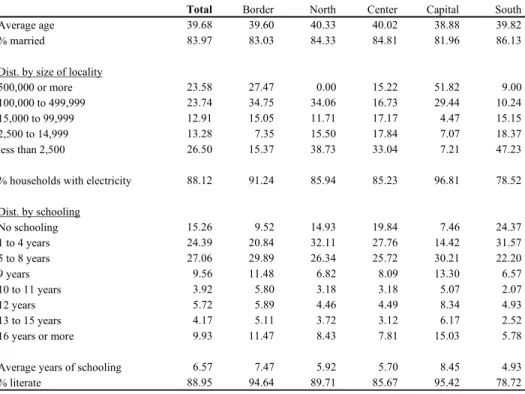
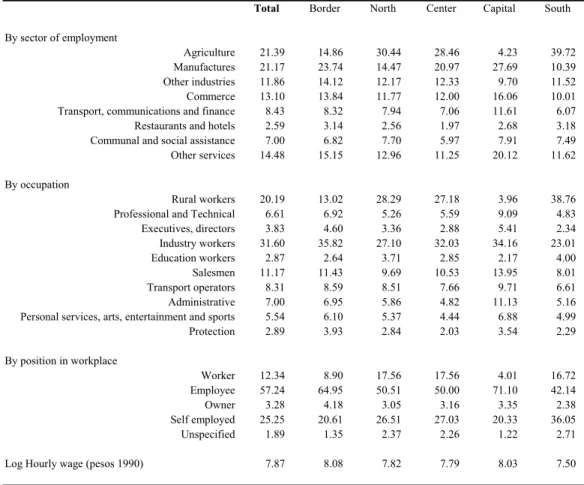
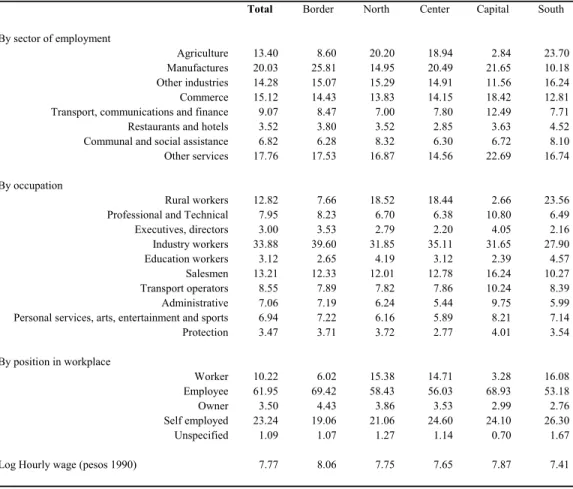
Tables 1a and 1b summarize the demographic characteristics of 25-65 year old males in 1990 and in 2000, while Tables 2 and 3 summarize the distribution of each region’s 25-65 year authors are overturned. While his findings are similar to those I report here, I use a broader set of globalization-related indicators.
old working male population by sector of employment, occupation and position in the job. Large differences in the composition of the labor force and in the orientation of economic activity across Mexico’s regions are observed. The labor force in Mexico City and the border appears to be more educated and mostly urban and industry-oriented in nature, while working individuals in the south represent a much less educated, more agriculture-oriented and spatially dispersed labor force.
Comparing the data for 1990 and 2000 we can observe that, while the share of manufacturing employment remained roughly constant in the country as a whole, it increased substantially in the border region, while it fell sharply in the capital. Thus, we observe that, during the nineties, a larger share of individuals in the border region became employed in manufacturing activities, while individuals in the capital tended to move out of manufacturing jobs and got employed in services.
It is important to observe that, within each time period, hourly wages tend to decrease as we move south from the border region, although there is a large wage premium in the capital that breaks down this pattern. It must also be noted that in 2000 the real wage in the border region was roughly the same as in 1990, while in this same period it decreased in real terms in all other regions of the country. The overall behavior of wages appears to be related to the macroeconomic instability Mexico suffered during 1995. Abstracting from this economy-wide shock, according to these figures the border wage premium increased substantially during the nineties, while the capital wage premium decreased relatively to the rest of the country.8
7 Including female data would possibly affect the results due to sample-selection biases derived from large
differences in female participation rates across regions, education and age groups and time.
8 These comparisons do not control for differences in personal characteristics across the populations of each
region. However, as will be shown below, this pattern persists even after controlling for observable characteristics of the individuals.
3.2. Globalization-Related Variables
Mexico’s regions exhibit large differences in the degree to which they are exposed to international markets, as a result of differences in the proximity to the U.S., the presence of historical links with the U.S. labor market and the capability of each region, given its site-specific features, to host export-oriented or multinational firms. In this context, Mexico’s trade liberalization may have had heterogeneous effects on wages and output across its regions.
Tables 4a and 4b summarize the importance of some globalization-related indicators in Mexico’s regions. First, consider foreign direct investment. The capital and, to a lesser extent, the border, are the main destinations for foreign direct investment. In contrast, the southern region is the least influenced by foreign direct investment flows. Foreign direct investment inflows became increasingly important in the border during the nineties. The central and northern parts of the country received increasing foreign direct investment flows during this period too. In contrast, foreign direct investments towards Mexico City diminished sharply between 1994 and 2000.9
Concerning maquiladoras, we observe that this type of plant has gained importance within manufacturing employment in all the country between 1990 and 1999. The increase in
maquiladora employment, as a proportion of manufacturing employment, is clearly visible in all regions except the capital. The gradual movement of maquiladora employment towards non-border regions may reflect the incentive to set up new plants in sites where wages are relatively lower than in the border. However, as of 1999, maquiladoras were still mainly a local feature of the border. This, along with the increasing importance of foreign direct investment within its economy, suggests that this region is the most closely integrated with the U.S. and that this integration has become increasingly important in recent years.
Finally, the tables include historical migration rates from each region to the U.S.10 The figures show the high out-migration rates exhibited in the past by the north and, to a smaller extent, the border and the center regions. In contrast, the southern and capital regions did not show relatively large migration flows towards the U.S. The fact that the north, border and center regions exhibited large migration flows in the past suggests that the current population of these regions is more closely linked to migration networks. By providing relevant information concerning the migration venture and job opportunities in the U.S., individuals linked to these networks may face lower overall costs of migrating abroad.11
Holding other factors constant, a larger presence of migration networks may exert upward pressure on local wages for several reasons. First, given the large wage differentials between Mexico and the U.S., reservation wages of workers located in regions more linked to migration networks may be higher. Second, past migration flows may have as a consequence currently higher remittance flows to relatives still located in these regions. This, in turn, may exert an upward influence on local wages by reducing labor supply through a pure income effect or by relaxing the households’ budget constraints and leading to higher investment in family microenterprises (Durand et al.,1996; Taylor, 1992; Taylor et al., 1996; and Woodruff and Zenteno, 2002) or in schooling (Hanson and Woodruff, 2002). Finally, as shown in Chiquiar and Hanson (2002), it appears that international migrants constitute a self-selected group from the middle-upper segment of the wage distribution. This may lead to a relative
10 The migration rates exhibited in the table are based on the share of each state’s 1960 population that migrated to
the U.S. during 1955-1959. I use information from this period to ensure that I capture the presence of well established migration networks developed since the Bracero program was operating, and not more recent surges in migration that may still not have strong network effects.
11 The choice of migrating to the U.S. depends significantly on the presence of links to migration networks
(Massey and Espinoza, 1997). These networks vary by region in Mexico, as a result of historical migration rates. This makes region of birth an important factor determining who moves from Mexico to the United States (Woodruff and Zenteno, 2002).
scarcity of workers with intermediate schooling levels in the regions where migration to the U.S. is more common and, as a result, it may have a positive impact on local mean wages.12
Migration to the U.S. is a phenomenon that predates the globalization policies undertaken after the mid-eighties and, thus, is not necessarily linked directly to the reforms.13
However, its importance in regional wage determination may have increased during the nineties, reflecting the fact that Mexico suffered a large-scale recession in 1995 while U.S. exhibited a long, upward swing in its business cycle. This may have implied that labor demand in the U.S. for Mexican workers increased relative to labor demand within Mexico, amplifying the effect of migration rates on wages in regions where migration networks are more common.
3.3. Domestic Migration Patterns
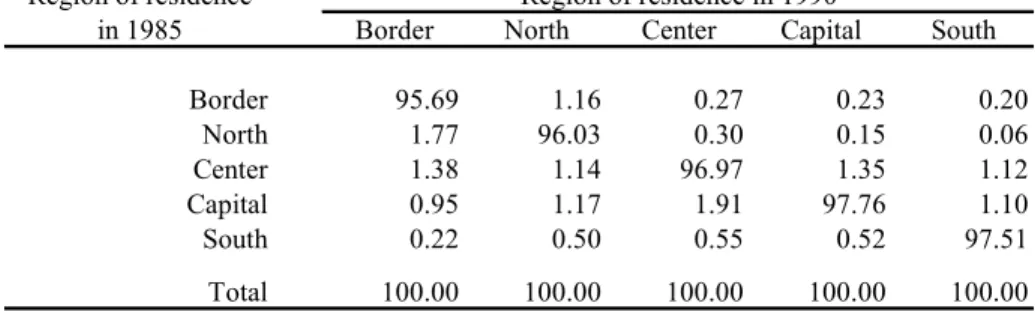
The existing evidence suggests that the response of domestic labor migration flows to regional per capita income differentials is small (Esquivel, 1999). Concerning this issue, Table 5 summarizes the broad domestic migration patterns for 25-65 year old males.14 The table decomposes each region’s population for 1990, 1995 and 2000 in terms of the region where individuals resided 5 years before.
The migration patterns that arise from the data suggest that, after Mexico’s liberalization, labor responded to regional wage differentials as expected. In particular, the overall pattern seems to be consistent with a northward movement of labor after 1985: immigration rates are consistently higher in regions closer to the U.S. border. However, most individuals that moved to the border region were originally located in the north or center, and
12 Mishra (2003) finds a positive effect of emigration from Mexico on wages, for cohorts subject to the largest
labor outflows.
13 In fact, it could be argued that, if anything, migration and trade in goods should be seen as substitutes. However,
in the short run migration and trade may be in fact complements (see Martin, 1993, and Cornelius, 2002). Markusen and Zahniser (1997) provide several arguments on why NAFTA would not necessarily diminish Mexico-U.S. migration flows.
not in Mexico City. Individuals in this city who may have lost their manufacturing jobs either moved to the nearby center region, or remained in the city, usually taking jobs in the service sector. Thus, the individuals who took jobs in the border manufacturing sector were generally not the same as the ones who lost this type of jobs in Mexico City, so that a large scale movement of individuals from the city to the border was not observed. This suggests that domestic migration responses may have not been sufficient to wipe out regional wage differentials in a short period of time.15
The arguments made above suggest that the size of the regionally-heterogeneous shock suffered by Mexico during the nineties was large, as compared to the speed of adjustment of labor to this shock. This is what gives the rationale for the presence of large and persistent changes in regional wage differentials as a consequence of the shock and justifies analyzing the relationship between the changes in regional wage differentials observed during the nineties and the trade reforms conducted during this period.
4. Theory
If the Mexican labor force was homogeneous and perfectly mobile between regions, wages should be equalized across the country, except for the effect of equalizing differences derived from region-specific amenities or differences in the prices of non-traded goods. In this context, even if Mexico’s opening up to trade can be represented as a regionally heterogeneous permanent shock, the adjustment to this shock should be reflected in labor force reallocations across regions, and not through a persistent change in regional wage differentials.
14 The same patterns are observed if the sample is restricted to individuals with 25-45 years of age. For these
tables, I complemented the data from the 1990 and 2000 samples with data drawn from a nationally representative survey on 0.4% of Mexican households, conducted during the 1995 national population count.
15 Two patterns observed in the data give additional support to this idea. First, the south does not seem to be
responsive to regional wage differentials. Individuals in this region appear to be stuck to their initial location, even when this part of the country exhibits the lowest relative wages. Second, comparing migration patterns for 1985-1990, 1990-1995 and 1995-2000 suggests that NAFTA did not induce a significantly faster migration flow towards the border.
Nonetheless, according to the evidence discussed in the previous section, the Mexican labor force appears to be neither homogeneous nor perfectly mobile across regions. In this section I argue that heterogeneity in factor endowments and differences in the geographic position of each region with respect to large markets become important determinants of local input prices when we allow for imperfect mobility of factors across the regions of a country. I will therefore show that the observed differences in factor endowments across Mexican regions, as well as the geographical advantage of the border region with respect to the U.S. market, may explain the regionally heterogeneous response of wages after Mexico liberalized to trade.
Venables and Limão (2002) formalize theoretically the presence of a link between regional patterns of specialization and geographic location. They introduce a spatial dimension into the Heckscher-Ohlin model, by combining it with Von Thünen’s spatial economic analysis. Assuming the presence of one central location and of a continuum of increasingly distant locations, they show that the sites that are closest to the center tend to specialize in exporting goods that are more sensitive to transport costs. If these goods are relatively intensive, say, in labor, then real wages will tend to be decreasing as we move away from the center. Thus, the pattern of specialization across regions and regional differences in input prices are determined endogenously, as a result of differences in transport and factor intensities across goods and of differences in factor endowments and geographic location among regions. Importantly, the authors show that the main Heckscher-Ohlin propositions hold only in a subset of locations.
The model I describe below is based on the same kind of insights. It shows that introducing a spatial dimension into an otherwise typical Heckscher-Ohlin framework, and allowing for sufficient factor immobility across regions, may lead to input price movements that in some regions seem to contradict the predictions of the typical Heckscher-Ohlin model.
However, within each region, the predictions of the Stolper-Samuelson Theorem applies. I analyze both the effects of regional heterogeneity in factor endowments and the specific role of geographic location in the determination of local input prices.16
I first present a simple model intended to demonstrate that, in a two region country, opening up to trade may lead to opposing movements in input prices in each region and to rising inequality for similar workers located in different regions. Then, I extend the model so that it matches more closely some of the regional features observed in Mexico and some of the consequences that trade liberalization apparently had. Finally, I return to the two-region model to address the role of transportation costs.
4.1. A Two Region Country
Consider a small country composed of two regions: “Border” (region B) and “Rest of the country” (region R). Assume three goods: good i “High-tech industrial goods”, good a
“Assembly” and good t “Traditional Agriculture”.17 There are two inputs: H “skilled labor”, with price q, and L “unskilled labor”, with price w. Good i is the most skill-intensive good, followed by a, while t is the least skill-intensive good. We assume that the three goods are costlessly traded within the country. However, only goods i and a are internationally traded.
The crucial assumption in this model is that inputs are immobile across regions. Moreover, region-specific factor endowments are sufficiently different to avoid factor-price equalization across regions. In particular, assume B is relatively skill-abundant and that factor endowments are sufficiently different to make each region be located in a different cone of diversification. The closed-economy equilibrium can be summarized with the Lerner-Pierce
16 Davis (1996) presents a similar model in which countries have sufficiently dissimilar factor endowments so as
to avoid factor price equalization. He shows that this causes trade liberalization to have effects on input prices that, in some countries, may contradict the predictions of the Heckscher-Ohlin Model.
17 The names provided to each good are not exhaustive. For instance, good i could as well represent R&D
activities, while good t could represent unskilled-intensive non-traded services. The main distinction between goods is in terms of their tradability and their skill intensity.
diagram depicted in Figure 4. There are two cones of diversification. The border region produces goods i and a, while the rest of the country produces a and t. Note that, in this initial equilibrium, unskilled labor wages are relatively higher in the border than in the rest of the country (equivalently, the skill premium in the rest of the country is higher than in the border).
Now assume this economy opens up to trade with a more skill-abundant country. Focusing on the prices of traded goods and taking i as numeraire, opening up increases the relative price of the assembly good, leading to an inward shift in its unit-value isoquant. The shift to this new equilibrium is depicted in Figure 5. The effect of this shift on input prices differs in each region: unskilled wages rise in the border, while the skill premium increases in the rest of the country. Thus, opening up to trade leads to opposing movements in relative input prices in each of the regions. Moreover, the factor price movements implied by trade lead to an increase in regional inequality: unskilled workers in the border obtain a further relative wage increase after trade reform, so that their wage premium with respect to similar workers located elsewhere increases further.
The basic idea that lies behind these results is that, given the pattern of specialization implied by the initial equilibrium, from the border’s perspective the price of the unskilled-intensive good rose, while from the rest of the country’s point of view, the price that rose was that of the skilled-intensive good. Thus, within each region, factor prices move in accordance with the Stolper-Samuelson Theorem.
4.2. A Three Region Country
I Now extend the model to three regions and four goods. Assume the country is divided into “Mexico City” (region M), the border (region B) and the south (region S). Let Mexico City have the relatively largest endowment of skilled workers, followed by the border. There are four goods. In decreasing order in terms of their skill intensity, these are “Banking” (good b),
“High-tech industrial goods” (good i), “Assembly” (good a) and “Traditional Agriculture” (good t). Assume banking and traditional agriculture are non-traded internationally, while i and
a are internationally tradable. All goods are costlessly traded within the country.18
Again, assume that inputs are immobile across regions and that region-specific factor endowments are sufficiently different to avoid factor-price equalization. The autarky equilibrium is depicted in Figure 6. There are three cones of diversification. Mexico City produces goods b and i, while the border specializes in i and a. The south produces goods a
and t. In this equilibrium, the skill premium is highest in the south, followed by the border. Unskilled wages are highest in Mexico City and lowest in the south.
Now consider the changes in region-specific input prices as the economy opens up to trade with a more skill-abundant country. Opening up to trade increases the relative price of the assembly good and decreases that of good i. This shifts the i unit value isoquant outwards and the a unit value isoquant inwards. Assume the shifts in unit-value isoquants are not large enough to alter the pre-trade pattern of specialization.
The shift to the new equilibrium is depicted in Figure 7. Unskilled labor wages decrease in Mexico City and in the south, while they increase in the border. In other words, the skill premium increases in Mexico City and the south, and decreases in the border. Moreover, in the new equilibrium Mexico City tends to specialize further in banking services, while the border tends to increasingly concentrate in assembly activities. Resources in the south also tend to move away from traditional agriculture and towards assembly. These patterns roughly match the observed behavior in Mexico after its trade liberalization. It is important to note that, in a sense, we may consider the border region as being more closely integrated with the
18 The assumptions in the model are based on the observed schooling levels of workers across sectors in Mexico.
Manufacturing employees exhibit higher average schooling levels than workers in agriculture, construction and some services (repair, maintenance, restaurants and hotels). However, other services employing around 40% of the total working population (commerce, transports, communications, financial, government and communal services), exhibit significantly higher schooling levels than manufacturing. Thus, it appears that, in Mexico, there
international economy: it only produces traded goods, while the other two regions produce one traded good and one non-traded good each. In this context, input price movements are consistent with the Heckscher-Ohlin model in the region that is most integrated with the world economy. In contrast, more inward-oriented regions exhibit input price changes that move in the opposite direction.
4.3. The Role of Transport Costs
The presence of positive transport costs and of location advantages for some regions may have an additional effect that causes the shift in unit-value isoquants to be heterogeneous across regions and may lead to region-specific patterns of specialization, even in the case when regions have identical factor endowments. In this context, once we take into account the fact that the border region has a geographic advantage with respect to the U.S. market, we may then expect this region to become more specialized in the exported, unskilled labor intensive good
a, while the rest of the country tends to adopt an “import substitution” pattern, specializing in good i. I show here that this is an additional mechanism that may lead to relatively higher unskilled wage rates in the border.
To this end, we return to the two region model described above. However, we now assume that, apart from the fact that the border is closer to the U.S. market, these two regions are otherwise identical. Given this assumption, in the autarky equilibrium both regions produce the same output mix and exhibit the same input prices. We also now assume that good t is not domestically traded, so that in any equilibrium it will be produced by the two regions and, in the free trade equilibrium, it will possibly exhibit a different price in each.
As before, when the economy opens up to trade with a more skill-abundant country, the price of good i tends to fall and the price of good a tends to rise. The important point, however, is both relatively skill intensive and relatively unskilled intensive service sectors, while tradable sectors exhibit
is that the relative price of the exportable good a, in terms of the importable, more skill intensive good i, tends to decrease as we move away from the border. This reflects the fact that, given fixed international prices for these goods and transport costs that increase with distance to the main market, the net price received by producers of good a tends to decrease as we move away from the border, while the price of i, inclusive of transport costs, increases as we move in that direction. The regional differences in relative output prices, in turn, lead to regional differences in patterns of specialization and input prices. In particular, the border tends to specialize in the exportable good and exhibits relatively higher unskilled labor wages, while the rest of the country tends to specialize in producing the importable good and exhibits a larger skill premium.
This situation is depicted in Figure 8. The unit-value isoquant for good i in the rest of the country shifts inwards with respect to the one applicable for border producers, reflecting the effect of transport costs on its price. Similarly, producers for good a in the rest of the country face a higher unit value isoquant than those in the border, as a reflection of the decrease in the net price they receive for this good. In the equilibrium depicted in the figure, the border produces the three goods, while the rest of the country produces only good i and good t.19 As can be observed, the unit cost line in the border is steeper than the one applicable to the rest of the country. This reflects the fact that, given transport costs, the border region faced a relatively larger increase in the relative price of the unskilled intensive tradable good. This, in turn, leads to higher unskilled wages in the border, relatively to the rest of the country. It is important to mention that the movement to free trade tends to increase the real factor incomes in the border, relative to the rest of the country. To understand this, just note that the terms of trade tend to deteriorate as we move farther away from the border. As depicted, the intermediate skill intensities.
19 Another feasible equilibrium, if the reduction in the border price for good i is large enough, would involve the
higher incomes in the border region tend to put upward pressure in the price of the non-traded good t in that site.20
In summary, I have shown that assuming factor immobility across regions and allowing for sufficient heterogeneity in factor endowments or in geographic advantages for some regions may lead to input price movements whose directions differ across regions as an economy opens up to trade. The different response of input prices across regions may lead to increases in wage differentials for similar workers. In this context, the relative increase in unskilled border wages during the nineties that I document below may have been a result not only of the fact that its production structure is more outward-oriented than the rest of the country, but also as a consequence of the transport cost advantage this region exhibits with respect to the U.S. market.21
5. Wage Regression Results
The objective of this section is to identify the factors that explain the changes in wage differentials across Mexico’s regions during 1990-2000. I assess the role of the distribution of personal characteristics, the orientation of economic activity, site-specific features, and the degree of integration with the international economy.
I first estimate a set of wage regressions using individual-level data. I sequentially include controls related to personal characteristics, site-specific features and globalization, in order to assess to what extent these controls are able to account for the changes in regional
20 If I had instead assumed that good t may be traded within the country, then a possible equilibrium would
involve the border specializing in goods i and a, and the rest of the country specializing in goods i and t. In this case, depending on the relative shifts of the different unit-value isoquants, the border unit cost line could also become steeper than that for the rest of the country.
21 The relative increase in foreign direct investment towards the border is a third possible mechanism that may
have contributed to this outcome. Consider the three region model depicted in Figure 6 and assume that there is implicitly a third complementary factor, physical capital. Assume that as the economy liberalizes investment, the capital stock increases only in the border. Moreover, let the increase in capital be directed to the exportable a
sector. This will shift the border a isoquant inwards. This also tends to cause an increase in border unskilled wages, relative to the other regions.
wage differentials during the nineties. Then, I estimate state-specific wage-schooling profiles and analyze the factors that explain the differences in intercept terms and in returns to schooling across states.
As a preview of the results, globalization seems to be the main driving force behind the changes in regional wage differentials observed during the nineties. In particular, region-specific changes in wage differentials become statistically insignificant only after I control for globalization-related measures.22 Moreover, the degree of regional exposure to globalization
appears to be an important determinant of the differences in the evolution of state-specific wage profiles during the nineties. Consistently with the model described in the previous section, states with closer links to the international economy exhibited larger increases in wage levels and a decrease in returns to schooling, as compared with the rest of the country. This result gives broad support to the hypothesis that Stolper-Samuelson type of effects were present during Mexico’s trade liberalization, but that these effects were felt more strongly in regions that are more integrated with the global economy.
5.1. Individual Wage Regressions
In this subsection, I use the 1990 and 2000 samples of 25-65 year old working males to estimate OLS wage equations based on individual-level data. I estimate wage equations in which the log of hourly wages, in 1990 pesos, depends on individual characteristics (age, age squared, schooling and marital status), on several site specific features and on variables intended to measure the regional exposure to globalization.23 In all regressions I also include dummy variables for 4 of the 5 Mexican regions, taking the center region as the base category.
22 Hanson (2003) reports similar findings.
23 Individual hourly wages are calculated as monthly labor income/(4.5*hours worked last week). Wages for 2000
were deflated by the Consumer Price Index to be expressed in 1990 pesos. In order to avoid extreme measurement errors, I dropped observations where the hourly wage was less than 0.05 dollars or more than 20 dollars, when evaluated at 1990 prices (only 4.5% and 2.6% of the 1990 and 2000 samples earned wages higher than 20 dollars, respectively).
These dummies are also interacted with schooling, to allow for region-specific returns to schooling. By including these dummies and testing their statistical significance, I may assess to what extent the included controls account for the regional wage differentials observed in Mexico.24,25
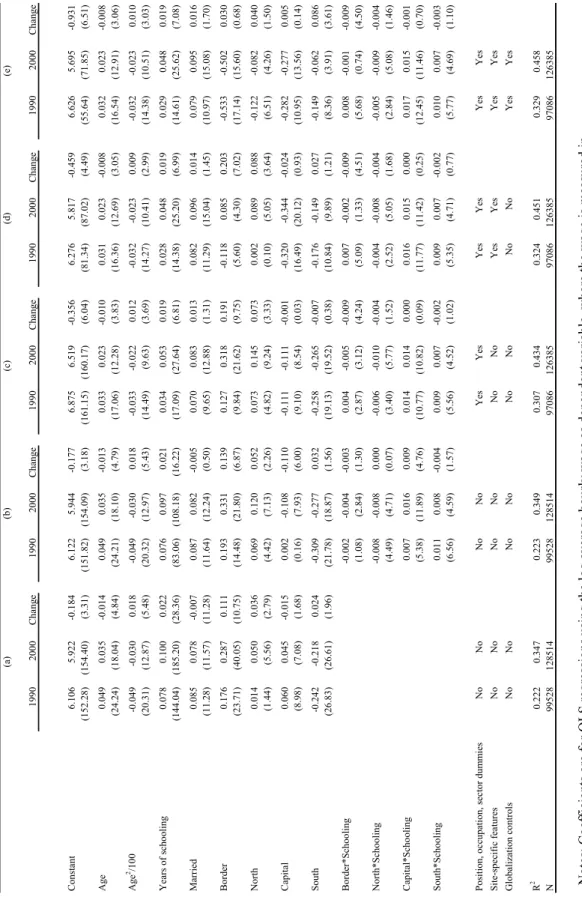
Table 6 summarizes the regional implications of this analysis. The regressions in panel (a) describe the regional wage differentials that I seek to explain. In this specification, I include as explanatory variables only the age and age squared of the individual, the number of schooling years attained, a dummy for marital status and the regional dummies, without their interactions with schooling. The estimates suggest that nation-wide returns to schooling increased between 1990 and 2000. Also, the wage-age profile appears to have become flatter during this period. More importantly, the results suggest that both wage levels and wage increases between 1990 and 2000 tended to be higher in regions closer to the U.S. border.
This evolution appears to reflect the heterogeneous impact that NAFTA may have had on the market potential of firms in each region. After NAFTA started operating, the U.S. market may have turned into a more important component of Mexican firms’ sales. If transport costs to this market are increasing with distance, the increase in market potential was greater for firms closer to the U.S. In turn, this could have led to an increase in relative wages as we move closer to the U.S. border, as firms with larger increases in market potential were able to pay higher nominal wages and more firms were induced to move northward as a consequence of the reforms.
24 A simple procedure allows testing for the statistical significance of the differences in the coefficients of the
regressions for 1990 and for 2000. I merge the data from the 1990 and the 2000 censuses and re-estimate the equations, including a dummy variable equaling 1 for the 2000 data and the interaction of this dummy with all the included explanatory variables in the regression. This allows simultaneously obtaining the coefficient estimates for each particular year and assessing what coefficient changes are statistically significant.
25 The regressions were estimated by OLS. An issue that may arise is the existence of self-selection into the
samples as a result of participation decisions. However, male participation rates are high and appear to be fairly homogeneous across age and education groups, regions and time. The coefficient estimates and, in particular, the regional implications derived from the regressions, were not found to change in a significant way if an attempt to correct for selectivity bias is performed. A second issue may be related to the presence of unobserved individual
The only region that appears to differ from this pattern is the capital, where wages are relatively higher than in the surrounding regions, even after controlling for schooling. As we will see shortly, this appears to be the result of the types of occupations and economic activities more concentrated in that site, as well as backward and forward linkages and other site-specific externalities that firms located there may still enjoy.
Specification (b) adds to the previous regression the interactions of the regional dummies with schooling. Some interesting patterns appear once we introduce region-specific returns to schooling. In particular, in terms of region-specific wage-schooling profiles, the border and northern regions tend to exhibit larger intercepts, but smaller returns to schooling, than Mexico City and the south. These differences tended to become more pronounced during the nineties.
I try to control for the heterogeneous presence of different activities across regions by adding in column (c) dummy variables for the individual’s position in his job (worker, employee, owner, or self-employed), for 17 occupation categories and for 13 sectors. The occupation and sector dummies are also interacted with schooling, to account for variations in schooling premiums across sectors and activities.26 Controlling for the individual characteristics included in this specification does not appear to account for the wage differentials observed across the country nor for their changes during the nineties. However, comparing the results with those obtained in the previous specification, it is important to note that, once including occupation and sector dummies, the 1990-2000 changes in the capital and south-specific intercepts and returns to schooling become insignificant. This suggests that the heterogeneity. While this may affect the estimated returns to schooling, it is difficult to think this heterogeneity is correlated with the regional dummies, after having controlled for sector, position and occupation of the individual.
26 Including the self-employed in the sample is justified by the importance this group has within Mexico’s labor
force. Self employment has become an important alternative for individuals who lost their jobs in manufactures in Mexico City as a consequence of the movement of these activities towards the border. Eliminating these individuals from the sample would throw away relevant information that can account for the changes in overall wages in that site. In any case, in unreported results, I found that all the results described in this paper are
relative changes in these inward-oriented regions’ wages during the nineties were not a consequence of region-specific changes in input prices, but a result of shifts in the distribution of workers across occupations and sectors. In contrast, significant region-specific input-price changes are observed in the border and the north. In those sites, relative wages increased overall, but the increase was relatively larger for unskilled workers. This suggests that globalization may have affected input prices disproportionately in regions more exposed to the skill-abundant U.S. market and that, in this context, the changes in input prices appear to be consistent with the predictions of the Stolper-Samuelson Theorem.
A relevant question that arises is to what extent this pattern is really explained by globalization and not by other unrelated site-specific features. To address this issue, I estimate specifications (d) and (e). In specification (d) I add several variables related with site-specific features that may have spillover effects on individual wages.27 In specification (e) I additionally include a set of variables related with the regional exposure to globalization. I include: i) the log of distance from the state’s largest city to the closest major U.S. border crossing; ii) the share of maquiladoras in overall state employment; iii) the share of foreign direct investment in the state’s GDP; and iv) state-level historical migration rates. I also include the share of large manufacturing establishments in the total number of manufacturing establishments in the state. While this variable may not be totally related to globalization, Mexican manufacturing exports are originated mostly in large plants.28
qualitatively unchanged if I restrict the sample to individuals who are not self-employed and work at least 20 hours a week.
27 In particular, In specification (d) I include: i) 4 dummies for the size of the locality where the individual lives;
ii) average schooling levels of 25-65 year old individuals in the county of residence; iii) the agricultural and industry shares in employment at the state level; iv) the percentage of irrigated land in the state and its interaction with the agricultural employment share; v) a measure of historical monetary yields per unit of agriculture-oriented land, to proxy for agricultural productivity, and its interaction with the agricultural employment share; vi) the fraction of large and medium-sized manufacturing, commercial and service plants and establishments, as a percentage of the total number of establishments in the state; vii) the number of tourism-related hotel rooms in the state; and, viii) the maximum temperature in the state.
28 The maquiladora employment variable corresponds to data for 1990 and 1999. Foreign direct investment is
measured in 1994 and in 2000, while migration rates correspond to historical rates measured for 1955-1959. The data concerning large manufacturing plants (with 251 of more employees) correspond to 1988 and 1993. An
Once including the site-specific controls in regressions (d), the coefficients on the border, north and, especially, the capital dummies decrease in size. In contrast, the negative southern dummy coefficient becomes smaller in absolute value. This suggests that an important part of the wage premium observed in the capital may be explained by spillovers related to city size, human capital agglomeration and industrial orientation. The southern wage lag appears to be also partially explained by a lack of this type of effects. It is important to note, however, that the relative increases in wage levels and decreases in returns to schooling for the border and northern regions observed during the nineties are not accounted for by the controls included in specification (d).
In contrast, once including the globalization controls in regressions (e), the border and northern dummies become negative and large in absolute value. Also, the negative capital and southern dummies become smaller in absolute value. This suggests that the positive premiums observed in the border and northern regions of the country seem to be largely explained by their links with the U.S. economy. More importantly, once controlling for globalization-related measures, all changes in region-specific intercepts between 1990 and 2000, with the exception of the one corresponding to the south, become statistically insignificant. This suggests that the significant increases in the border and northern relative wage levels observed during the nineties are accounted for only after controlling for the regionally-heterogeneous exposure to globalization. It is important to note, however, that even after controlling for globalization, the relative decrease in the border’s returns to schooling is not accounted for. I will turn to this issue and provide an alternative identification scheme below.
important issue arises concerning the inclusion of foreign direct investment. Data for state-specific foreign direct investment inflows are unavailable for years before 1994. Thus, for the 1990 regression, I used the share of
5.2. Identification of the Effects of Globalization on Wages
In this subsection, I exploit the state-level variation in the degree of exposure to international trade, foreign investment flows and migration to the U.S. to identify the effects of globalization on wages and returns to schooling. As opposed to the previous procedure, I allow each state in Mexico to exhibit different wage determination patterns.
This identification scheme contrasts with previous studies, in which authors tried to identify Stolper-Samuelson kind of responses in Mexican wages through variations in the degree of protection levels across industries. In a sense, the approach taken here uses variations in natural barriers to trade, such as the effect of distance to the main international market on trade and foreign investment volumes, instead of changes in explicit tariffs and protection levels, to identify Stolper-Samuelson effects derived from Mexico’s globalization.
The procedure entails two steps. First, I estimate state-specific changes in zero-schooling wages and returns to zero-schooling from 1990 to 2000. These are allowed to vary between urban and rural environments within each state. In a second step, I regress these changes against site-specific characteristics and indicators related to the degree of exposure of each state to globalization. This allows estimating the effect that these variables had on state-specific changes in wage levels and in returns to schooling during the nineties. Then, I test if region-specific wage differentials are fully accounted for by the variation in state-specific features and globalization-related variables included in the regressions.
Formally, assume that each state of the country exhibits a potentially different wage-schooling profile, characterized by a specific intercept term (zero-wage-schooling log wage) and a slope (returns to schooling). Moreover, the wage profile may differ between urban and rural environments within each state. Thus, in the first step I estimate state and environment-specific zero-schooling log wages and returns to schooling for 1990 and for 2000. This allows foreign direct investment in 1994. This may bias the estimated coefficient through a typical errors-in-variables
computing the increases in each state’s zero-schooling wage and returns to schooling during this period, for both urban and for rural environments.
To obtain these estimates, I separated the data for males with 25-65 years of age in each census year by urban and rural locations, assuming that an individual is in an urban environment if the locality where he lives is populated by 15,000 persons or more. Then, I estimated separate wage equations for each year and for each type of environment. The regressions controlled for age, age squared, marital status, position in the job, occupation and sector of employment and for human capital spillovers (mean schooling at the county level). I also included interactions of the occupation and sector dummies with schooling. By allowing for state-specific intercept terms and returns to schooling in each regression, I obtained a vector of 64 zero-schooling log wages (urban and rural environments for each of 32 states) and a vector of an equal number of estimates for returns to schooling.
In the second step, I regress the estimated changes in state and environment-specific zero-schooling log wages and returns to schooling against several state-specific features and variables related to the degree of exposure of each state to globalization. An important issue related to this econometric procedure is that the dependent variables of these regressions are estimated coefficients from previous regressions. To the extent that the standard errors for each of the coefficients of the first-step regressions may differ, the regressions estimated in the second step will exhibit heteroskedastic disturbances. Thus, I assumed a heteroskedasticity of unknown form and, consequently, the t statistics reported for these regressions are based on standard errors derived from a heteroskedasticity-consistent estimate for the variance-covariance matrix, adjusted for finite sample bias.29
effect. However, I was unable to identify valid instruments that did not belong to the wage equation.
29 An alternative approach would be to consider the structure of the second-step variance-covariance matrix and to
use the information contained in the estimated variance-covariance matrix from the first-step estimates to construct an estimate of it. To apply this correction, however, one needs to assume that the errors of estimation of the first-step coefficients are uncorrelated with the stochastic terms of the second-step regression. When this is not the case, this correction will yield biased estimates of the variance-covariance matrix and, in particular, may yield
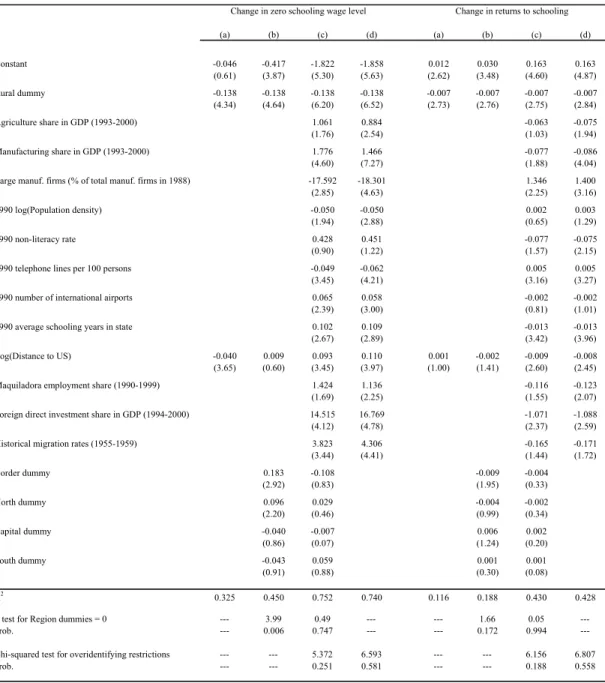
The results of this procedure are summarized in Table 7. Column (a) reports the results of regressing the state-specific changes in zero-schooling log wages and in returns to schooling on a rural dummy and the distance of each state to the U.S. border. Column (b) adds to these regressions the set of regional dummies. The results suggest that the changes in zero-schooling log wages tended to be larger for states closer to the U.S. However, it appears that the set of regional dummies captures this effect better than the measure of distance to the U.S. In particular, when these dummies are not included, distance to the U.S. border displays a negative and significant coefficient. However, once including these dummies, distance to the U.S. becomes insignificant, while the coefficients for the regional dummies suggest that zero-schooling wages increased in the border and, to a smaller extent, in the northern regions, relatively to the rest of the country. It is also important to observe that, according to the results of these regressions, returns to schooling decreased significantly in the border, relatively to the rest of the country.
Column (c) adds a set of regressors intended to measure globalization-related effects, along with a set of other site-specific features. To measure the regional exposure to globalization, I included the 1990-1999 share of maquiladora employment in each state, the 1994-2000 share of foreign direct investment in each state’s GDP, the initial (1988) presence of large manufacturing firms and the historical state-level migration rates (1955-1959). I also included the economic orientation of the states, as measured by the 1993-2000 shares of agriculture and manufacturing in each state’s GDP. Other state-level variables included in the regressions were the initial (1990) values for the population density, non-literacy rates for individuals 15 years and older, the telephone service density, the number of international
negative variances for some of the estimated coefficients (See Appendix A). In fact, this occurred when I tried to apply this correction method.
airports, and the average schooling years for individuals 15 years and older.30 To control for possible endogeneity, I used a set of instrumental variables for the manufacturing, foreign direct investment and maquiladora controls.31 As can be observed, I fail to reject the
over-identifying restrictions imposed by the choice of instrumental variables.
Interestingly, once including these regressors, the regional dummies become individually and jointly statistically insignificant in both the zero-schooling wage and the returns to schooling regressions. This suggests that the regional differences in wage profiles appear to be explained fully by the set of variables included in these regressions. Thus, in the final regressions reported in column (d) I dropped the regional dummies from the specification. The most important thing to notice is that the results suggest that the response of wages to globalization, in those regions more closely linked to the international economy, was consistent with the Stolper-Samuelson Theorem. Indeed, regions with stronger links to the international economy, as measured by maquiladora activity, migration rates and, especially, foreign direct investment inflows, experienced significantly larger increases in zero-schooling wages and relative decreases in returns to schooling during the nineties. Thus, the wage gains in these regions accrued especially to unskilled workers.32 According to the results, unskilled
30 It may seem odd to include some of these variables in a wage equation. As will be seen shortly, I estimated this
equation using a set of instrumental variables for the share of manufacturing in the state’s GDP, the foreign direct investment variable and the maquiladora employment share. I initially considered population density, non-literacy rates, the penetration of telephone service and the number of international airports as instruments for these variables, and not as regressors in the wage equation. However, in that case the over-identifying restrictions were rejected. These restrictions were not rejected only once this specific set of independent variables was included in the wage equation.
31 The list of instruments includes initial (1990) levels for several infrastructure-related measures (the ratios of
railroads and paved roads lengths to the state’s area, the percentage of households with electrical supply, tourism-oriented hotel rooms, per-capita bank branches), labor-market features (number of strike threats in 1991) and, to control for regional variation in business cycles, the state-level GDP growth rate from 1994-2000. To avoid an excessive loss of degrees of freedom, in each first-stage regression I only retained variables whose estimated coefficients had t statistics over 1.
32 Note that the regressions identify effects of the independent variables on the increases in zero-schooling wages
and in returns to schooling between 1990 and 2000, but do not reflect the effects of the independent variables on the levels of zero-schooling wages and returns to schooling. For instance, even if foreign direct investment appears to be associated with smaller increases in the returns to schooling during the nineties, this does not mean that the level of returns to schooling in regions where foreign firms are concentrated is lower.