HAL Id: hal-01160612
https://hal.inria.fr/hal-01160612
Submitted on 9 Sep 2015
HAL
is a multi-disciplinary open access
archive for the deposit and dissemination of
sci-entific research documents, whether they are
pub-lished or not. The documents may come from
teaching and research institutions in France or
abroad, or from public or private research centers.
L’archive ouverte pluridisciplinaire
HAL
, est
destinée au dépôt et à la diffusion de documents
scientifiques de niveau recherche, publiés ou non,
émanant des établissements d’enseignement et de
recherche français ou étrangers, des laboratoires
publics ou privés.
High-level Language Support for the Control of
Reconfigurations in Component-based Architectures
Frederico Alvares de Oliveira Jr., Eric Rutten, Lionel Seinturier
To cite this version:
Frederico Alvares de Oliveira Jr., Eric Rutten, Lionel Seinturier. High-level Language Support for the
Control of Reconfigurations in Component-based Architectures. 9th European Conference on
Soft-ware Architecture (ECSA), Danny weyns; Raffaela Mirandola; Ivica Crnkovic, Sep 2015, Dubrovnick,
Croatia. pp.285-293. �hal-01160612�
Control in Component-based Architectures
Frederico Alvares1, Eric Rutten1, and Lionel Seinturier2 1INRIA Grenoble, France–{frederico.alvares,eric.rutten}@inria.fr
2 University of Lille 1 & INRIA Lille, France–
Abstract. Architecting in the context of variability has become a real need in todays software development. Modern software systems and their architecture must adapt dynamically to events coming from the environ-ment (e.g., workload requested by users, changes in functionality) and the execution platform (e.g., resource availability). Component-based archi-tectures have shown to be very suited for self-adaptation especially with their dynamical reconfiguration capabilities. However, existing solutions for reconfiguration often rely on low level, imperative, and non formal languages. This paper presents Ctrl-F, a domain-specific language whose objective is to provide high-level support for describing adaptation be-haviours and policies in component-based architectures. It relies on reac-tive programming for formal verification and control of reconfigurations. We integrate Ctrl-F with the FraSCAti Service Component Architecture middleware platform, and apply it to the Znn.com self-adaptive case study.
1
Introduction
From tiny applications embedded in house appliances or automobiles to huge Cloud services, nowadays software-intensive systems have to fulfill a number of requirements in terms safety and Quality of Service (QoS) while facing highly dynamic environments (e.g., varying workloads and changing user requirements) and platforms (e.g., resource availability). This leads to the necessity to engineer such software systems with principles of self-adaptiveness, i.e., to equip these software systems with capabilities to cope with dynamically changes.
Component-based Architecture. Software architecture and more specifically soft-ware components have played a very important role in self-adaptiveness. Besides the usual benefits of modularity and reuse, adaptability and reconfigurability are key properties which are sought with this approach: one wants to be able to adapt the component assemblies in order to cope with new requirements and new exe-cution conditions occurring at run-time. Component-based Architecture defines the high-level structure of software systems by describing how they are organized by the means of a composition of components [15], which are usually captured by an Architecture Description Languages (ADL). In spite of the diversity of ADLs, the architectural elements proposed in almost all of them follow the same
conceptual basis [13]. A component is defined as the most elementary unit of processing or data and it is usually decomposed into two parts: the implementa-tion and the interface. The implementation describes the internal behaviour of the component, whereas the interfaces define how the component should inter-act with the environment. A component can be defined asatomic orcomposite, i.e., composed of other components. A connector mediates diverse forms of in-teractions of inter-component communications, and configuration corresponds to a directed graph of components and connectors describing the application’s structure. Other elements like attributes, constraints or architectural styles also appear in ADLs [13], but for brevity we omit further details on these elements. Initial assemblies (or configurations) are usually defined with the help of ADLs, whereas adaptive behaviours are achieved by programming fine-grained actions (e.g., to add, remove, connect elements), in either general-purpose lan-guages within reflective component-based middleware plaforms [20], or with the support of reconfiguration domain-specific languages (DSLs)[8]. This low level of abstraction may turn the definition of transitions among configurations into a very costly task, which consequently may lead to error-prone adaptive be-haviours. In fact, it may be non-trivial, especially for large and complex archi-tectures, to obtain assurances and guarantees about the result of these reconfig-uration behaviours. We claim that there is a need for a language, not only for the definition of configurations in the form of component assemblies, but also for the explicit specification of the transitions among them and the policies driving when and under which conditions reconfigurations should be triggered.
This paper presents Ctrl-F, a language that extends classic ADLs with high-level constructs to express the dynamicity of component-based architectures. In addition to the usual description of assemblies (configurations), Ctrl-F also com-prises a set of constructs that are dedicated for the description of: (i) behavioural aspects, that is, the order and/or conditions under which reconfigurations take place; and (ii) policies that have to be enforced all along the execution.
Heptagon/BZR. We formally define the semantics of Ctrl-F with Heptagon/BZR [10], a Reactive Language based on Finite State Automata (FSA). It allows for the definition of generalized Moore machines, with mixed data-flow equations and automata. A distinguished characteristics is that its compilation involves formal tools for Discrete Controller Synthesis (DCS): a controller is automati-cally generated so as to enforce that a system behaves at runtime in concordance with the specification. The Heptagon/BZR definition of Ctrl-F programs allows to benefit from: (i) guarantees on the correctness of adaptive behaviours by either verification or control (i.e., by DCS); (ii) the compilation of adaptive behaviours towards executable code in general purpose languages (e.g., Java or C). Due to space limitation, the detailed definition is reported on elsewhere [1].
In the remainder of this paper, Sections 2 presents the self-adaptation case study Znn.com [7], used all along the paper. Section 3 presents the Ctrl-F lan-guage. Section 4 provides some details on its integration with a real component platform as well as the evaluation of its applicability throughZnn.com. Related work is discussed in Section 5 and Section 6 concludes this paper.
2
The Znn.com Example Application
Znn.com [7] is an experimental platform for self-adaptive applications, which mimics a news website. Znn.com follows a typical client-server n-tiers architec-ture where a load balancer redirects requests from clients to a pool of replicated servers. The number of active servers can be regulated in order to maintain a good trade-off between response time and resource utilization. Hence, the ob-jective of Znn.com is to provide news content to its clients/visitors within a reasonable response time, while keeping costs as low as possible and/or under control (i.e., constrained by a certain budget).
At times, the pool of servers is not large enough to provide the desired QoS. For instance, in order to face workload spikes, Znn.com could be forced to de-grade the content fidelity so as to require fewer resource to provide the same level of QoS. For this, Znn.com servers are able to deliver news contents with three different content fidelity: (i) high quality images, (ii) low quality images, and (iii) only text. The objectives are: (1) Keep the performance (response time) as high as possible; (2) Keep content fidelity as high as possible or above a certain threshold; (3) Keep the number of active servers as low as possible or under a certain threshold. In order to achieve them, we may tune: (1) The number of active servers; (2) The content fidelity of each server.
As a running example for our proposal, in the next section, we extend Znn.com by enabling its replication in presence of different content providers: one specialized in soccer and another one specialized in politics. These two in-stances of Znn.com will be sharing the same physical infrastructure. Depending on the contract signed between the service provider and his/her clients that establishes the terms of use of the service, Znn.com Service Provider can give more or less priority to a certain client. For instance, during the World Cup the content provider specialized in soccer will always have priority over the other one. Conversely, during the elections, the politics-specialized content provider is the one that has the priority.
3
Ctrl-F Language
3.1 Overview and Common Concepts
Ctrl-F is our proposal for a domain-specific language that extends classic ADLs with high-level constructs for describing reconfigurations’ behaviour and policies to be enforced all along the execution of the target system.
The abstract syntax of Ctrl-F can be divided into two parts: a static one, which is related to the common architectural concepts (components, connec-tions, configuraconnec-tions, etc.); and a dynamic one, which refers to reconfiguration behaviours and policies that must be enforced regardless of the configuration.
The static part of Ctrl-F shares the same concepts of many existing ADLs (e.g., Fractal [6], Acme [13]). Acomponent consists of a set ofinterfaces, a set of event ports, a set ofattributes and a set ofconfigurations.Interfaces define how a component can interact with other components. So they are used to express a
required functionality (client interface) that may be provided by another com-ponent and/or to express a provided functionally (server interface) that might be used by other components. Event Ports describe the events, of the given Event Type, a component is able to emit (port out) and/or listen to (port in). Aconfiguration is defined as a set ofinstances ofcomponents, a set ofbindings connecting server and client interfaces of those instances (i.e., an assembly), and/or a set ofattribute assignments tovalues.
The dynamic part consists of a behaviour and a set ofpolicies that can be defined for each component. Abehaviour takes the form of orders and conditions (w.r.t.events and attribute values) under which transitions between configura-tions (reconfiguraconfigura-tions) take place. The policies are high-level objectives/con-straints, which may imply in the inhibition of some of those transitions.
The Znn.com example application of Section 2 can be modeled as a hierarchi-cal composition of four components:Main,Znn,LoadBalancer, and AppServer. These components are instantiated according to execution conditions, the system current state (architectural composition), adaptation behaviours and policies de-fined within each component. Listing 1.1 shows the definition of such components with the static part of Ctrl-F.
TheMaincomponent (lines 1-14) encompasses two instances ofZnn, namely soccer and politics within a single configuration (lines 7 and 8). The server interfaces of both instances (lines 9 and 10), which provides access to news services, are bound to the server interfaces of theMain component (lines 3 and 4) in order for them to be accessed from outside. A policy to be enforced is defined (line 13) and discussed in Section 3.3.
Component Znn (lines 16-33) consists of one provided interface (line 18) through which news can be requested. The component listens to events of types oload (overload) and uload (underload) (lines 20 and 21), which are emitted by other components. In addition, the component also defines two attributes: consumption (line 23), which is used to express the level of consumption (in terms of percentage of CPU) incurred by the component execution; andfidelity (line 24), which expresses the content fidelity level of the component.
Three configurations are defined forZnncomponent:conf1,conf2 andconf3. conf1 (lines 26-33) consists of one instance of eachLoadBalancer andAppServer (lines 27 and 28); one binding to connect them (line 29), another binding to expose the server interface of theLoadBalancer component as a server interface of theZnncomponent (line 30), and the attribute assignments (lines 31 and 32). The attribute fidelity corresponds to the counterpart of instance as1, whereas for theconsumption it corresponds to the sum of the consumptions of instances as1 and lb. conf2 (lines 34-39) extends conf1 by adding one more instance of AppServer, binding it to the LoadBalancer and redefining the attribute values with respect to the just-added component instance (as2).
In that case, the attribute fidelity values the average of the counterparts of instancesas1 andas2 (line 37), whereas for the consumption the same logics is applied so the consumption of the just-added instance is incorporated to the sum expression (line 38). Due to lack of space we omit the definition of configuration
conf3. Nevertheless, it follows the same idea, that is, it extendsconf2 by adding a new instance of AppServer, binding it and redefining the attribute values.
Listing 1.1.Architectural Description of
Components Main, Znn, Load Balancer
andAppServer in Ctrl-F. 1 c o m p o n e n t M a i n { 2 3 s e r v e r i n t e r f a c e sis 4 s e r v e r i n t e r f a c e sip 5 6 c o n f i g u r a t i o n m a i n { 7 s o c c e r : Znn 8 p o l i t i c s : Znn 9 b i n d sis to s o c c e r . si 10 b i n d sip to p o l i t i c s . si 11 } 12 13 p o l i c y { . . . } 14 } 15 16 c o m p o n e n t Znn { 17 18 s e r v e r i n t e r f a c e si 19 20 p o r t in o l o a d 21 p o r t in u l o a d 22 23 a t t r i b u t e c o n s u m p t i o n 24 a t t r i b u t e f i d e l i t y 25 26 c o n f i g u r a t i o n c o n f 1 { 27 lb : L o a d B a l a n c e r 28 as1 : A p p S e r v e r 29 b i n d lb . ci1 to as1 . si 30 b i n d lb . si to si 31 set f i d e l i t y to as1 . f i d e l i t y
32 set c o n s u m p t i o n to sum( as1 . c o n s u m p t i o n , lb . c o n s u m p t i o n )
33 }
34 c o n f i g u r a t i o n c o n f 2 e x t e n d s c o n f 1 {
35 as2 : A p p S e r v e r
36 b i n d lb . ci2 to as2 . si
37 set f i d e l i t y to avg( as1 . f i d e l i t y , as2 . f i d e l i t y )
38 set c o n s u m p t i o n to sum( as1 . c o n s u m p t i o n , as2 . c o n s u m p t i o n , lb . c o n s u m p t i o n ) 39 } 40 41 c o n f i g u r a t i o n c o n f 3 e x t e n d s c o n f 2 { . . . } 42 43 b e h a v i o u r { . . . } 44 p o l i c y { . . . } 45 } 46 47 c o m p o n e n t L o a d B a l a n c e r { 48 s e r v e r i n t e r f a c e si 49 c l i e n t i n t e r f a c e ci1 , ci2 , c3 50 51 p o r t out o l o a d 52 p o r t out u l o a d 53 54 a t t r i b u t e c o n s u m p t i o n = 0 . 2 55 } 56 57 c o m p o n e n t A p p S e r v e r { 58 s e r v e r i n t e r f a c e si 59 60 p o r t in o l o a d 61 p o r t in u l o a d 62 63 a t t r i b u t e f i d e l i t y 64 a t t r i b u t e c o n s u m p t i o n 65 66 c o n f i g u r a t i o n t e x t { 67 set f i d e l i t y to 0 . 2 5 68 set c o n s u m p t i o n to 0.2 69 } 70 c o n f i g u r a t i o n img - ld { 71 set f i d e l i t y to 0.5 72 set c o n s u m p t i o n to 0.6 73 } 74 c o n f i g u r a t i o n img - hd { . . . } 75 76 b e h a v i o u r { . . . } 77 p o l i c y { . . . } 78 }
ComponentLoadBalancer (lines 47-55) consists of four interfaces: one pro-vided (line 48), through which the news are propro-vided; and the others required (line 49), through which the load balancer delegates each request for balancing purposes. We assume that this component is able to detect overload and under-load situations (in terms of number of requests per second) and in order for this information to be useful for other components we define two event ports that are used to emit events of typeoload anduload (lines 51 and 52). Like for com-ponentZnn, attribute consumption (line 54) specifies the level of consumption of the component (e.g., 0.2 to express 20% of CPU consumption). As there is no explicit definition of configurations, LoadBalancer is implicitly treated as a single-configuration component.
Lastly, the atomic componentAppServer (lines 57-78) has only one interface (line 58) and listens to events of typeoloadanduload(lines 60 and 61). It has also two attributes: fidelity and consumption (lines 63 and 64), just like component
Znn. Three configurations corresponding to each level of fidelity (lines 66-69, 70-73 and 74) are defined, and the attributes are valuated according to the configuration in question, i.e., the higher the fidelity the higher the consumption. 3.2 Behaviours
A particular characteristic of Ctrl-F is the capability to comprehensively describe behaviours in component-based applications. We mean by behaviour the process in which architectural elements are changed. More precisely, it refers to the order and conditions under which configurations within a component take place.
Behaviours in Ctrl-F are defined with the aid of a high-level imperative lan-guage. It consists of a set of behavioural statements (sub-behaviours) that can be composed together so as to provide more complex behaviours in terms of sequences of configurations. In this context, a configuration is considered as an atomic behaviour, i.e., a behaviour that cannot be decomposed into other sub-behaviours. A reconfiguration occurs when the current configuration is ter-minated and the next one is started. We assume that configurations do not have the capability to directly terminate or start themselves, meaning that they are explicitly requested or ended by behaviour statements according to the defined events and policies. Nevertheless, as components are capable to emit events, it would not be unreasonable to define components whose objective is to emit events in order to force a desired behaviour.
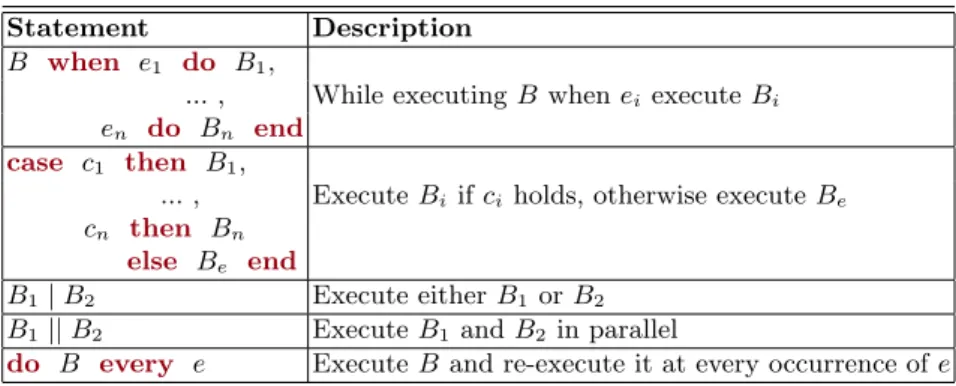
Statements Table 1 summarizes the behaviour statements of the Ctrl-F be-havioural language. During the execution of a given behaviourB, thewhen-do statement states that when a given event of event typeei occurs the
configura-tion(s) that compose(s)B should be terminated and that (those) of the corre-sponding behaviourBi are started.
Table 1.Summary of Behaviour Statements.
Statement Description
B when e1 do B1,
... , While executingB wheneiexecuteBi
en do Bn end
case c1 then B1,
... , ExecuteBiifciholds, otherwise executeBe
cn then Bn
else Be end
B1|B2 Execute eitherB1 orB2
B1||B2 ExecuteB1andB2 in parallel
do B every e ExecuteB and re-execute it at every occurrence ofe
Thecase-then statement is quite similar towhen-do. The difference resides mainly in the fact that a given behaviour Bi is executed if the corresponding
condition ci holds (e.g., conditions on attribute values), which means that it
does not wait for a given event to occur. In addition, if none of the conditions holds (c1∧...∧cn= 0), a default behaviour (Be) is executed, which forces the
compiler to choose at least one behaviour. Theparallel statement states that two behaviours are executed at the same time, i.e., at a certain point, there must be two independent branches of behaviour executing in parallel. This construct is also useful in the context of atomic components likeAppServer, where we could, for instance, define configurations composed of orthogonal attributes like fidelity and font size/color (e.g.,text || font-huge).
Thealternative statement allows to describe choice points among configura-tions or among more elaborated sequential behaviour statements. They are left free in local specifications and will be resolved in upper level assemblies, in such a way as to satisfy the stated policies, by controlling these choice points appro-priately. Finally, thedo-every statement allows for execution of a behaviour B
and re-execution of it at every occurrence of an event of typee. It is noteworthy that behaviour B is preempted every time an event of type e occurs. In other words, the configuration(s) currently activated inBis (are) terminated, and the very first one(s) inB is (are) started.
Example in Znn.com We now illustrate the use of the statements we have introduced to express adaptation behaviours for componentsAppServerandZnn the ofZnn.comcase study. The expected behaviour for componentAppServer is to pick one of its three configurations (text,img-ld orimg-hd) at every occurrence of events of type oload or uload. To that end, as it can be seen in Listing 1.2, the behaviour can be decomposed in a do-every statement, which is, in turn, composed of analternative one. It is important to mention that the decision on one or other configuration must be taken at runtime according to input variables (e.g., income events) and the stated policies, that is, there must be a control mechanism for reconfigurations that enforces those policies. We come back to this subject in Section 4.1.
Regarding componentZnn, the expected behaviour is to start with the min-imum number of AppServer instances (configuration conf1) and add one more instance, i.e., leading to configurationconf2, upon an event of type (oload). From conf2, one more instance must be added, upon an event of typeoload leading to configurationconf3. Alternatively, upon an event of typeuload, one instance of AppServer must be removed, which will lead the application back to config-uration conf1. Similarly, from configuration conf3, upon auload event, another instance must be removed, which leads the application to conf2. It is notorious that this behaviour can be easily expressed by an automaton, with three states (one per configuration) and four transitions (triggered upon the occurrence of oload anduload). However, Ctrl-F is designed to tackle the adaptation control problem in a higher level, i.e., with process-like statements over configurations. For these reasons, we describe the behaviour with two embedded do-every statements, which in turn comprise each awhen-dostatement, as shown in List-ing 1.3 (lines 6-14 and 8-12). We also define two auxiliary configurations:
emit-ter1 (line 2) and emitter2 (line 3), which extend respectively configurations conf2 and conf3, with an instance of a pre-defined component Emitter. This component does nothing but emit a given event (e.g.,e1 ande2) so as to force a loop step and thus go back to the beginning of the when-do statements. The main do-every statement (lines 6-14) performs a when-do statement (lines 7-13) at every occurrence of an event of type e1. In practice, the firing of this event allows going back to conf1 regardless of the current configuration being executed.conf1 is executed until the occurrence of an event of typeoload (line 7), then the innermost do-every statement is executed (lines 8-12), which in turn, just like the other one, executes another when-do statement (lines 9-11) and repeats it at every occurrence of an event of typee2. Again, that structure allows the application to go back to configuration conf2. Configuration conf2 is executed until an event of type eitheroload or uload occurs. For the former case (line 9), anotherwhen-do statement takes place, whereas for the latter (line 10) configurationemitter1 is the one that takes place. Essentially, at this point, an instance of componentEmitter is deployed along with conf2, sinceemitter1 extends conf2. As a consequence, this instance fires an event of type e1, which forces the application to go back to conf1. The innermost when-do statement (line 9) consists in executing conf3 until an event of type uload occurs, then configurationemitter2 takes place, which makes an event of typee2 be fired in order to force going back toconf2.
It is important to notice that this kind of construction allows to achieve the desired behaviour while sticking to the language design principles, that is, high-level process-like constructs and configurations. It also should be remarked that while in Listing 1.3 we present an imperative approach to forcibly increase the number ofAppServer instances uponuload andoload events, in Listing 1.3 we leave the choice to the compiler to choose the most suitable fidelity level accord-ing to the runtime events and conditions. Although there is no straightforward guideline, an imperative approach is clearly more suitable when the solution is more sequential and delimited, whereas as the architecture gets bigger, in terms of configurations, and less sequential, then a declarative definition becomes more interesting. Listing 1.2. AppServer’s Behaviour. 1 c o m p o n e n t 2 A p p S e r v e r { 3 ... 4 b e h a v i o u r { 5 do 6 t e x t | 7 img - ld | 8 img - hd 9 e v e r y 10 ( o l o a d 11 or u l o a d ) 12 } 13 } Listing 1.3.Znn’s Behaviour. 1 c o m p o n e n t Znn { . . . 2 c o n f i g u r a t i o n e m i t t e r 1 e x t e n d s c o n f 2 { e : E m i t t e r } 3 c o n f i g u r a t i o n e m i t t e r 2 e x t e n d s c o n f 3 { e : E m i t t e r } 4 5 b e h a v i o u r { 6 do 7 c o n f 1 w h e n o l o a d do 8 do 9 c o n f 2 w h e n o l o a d do ( c o n f 3 w h e n u l o a d do e m i t t e r 2 end) , 10 u l o a d do e m i t t e r 1 11 end 12 e v e r y e2 13 end 14 e v e r y e1 15 } 16 }
3.3 Policies
Policies are expressed with high-level constructs for constraints on configura-tions, either temporal or on attribute values. In general, they define a subset of all possible global configurations, where the system should remain invariant: this will be achieved by using the choice points in order to control the recon-figurations. An intuitive example is that two component instances in parallel branches might have each several possible configurations, and some of them to be kept exclusive. This exclusion can be enforced by choosing the appropriate configurations when starting the components.
Constraints/Optimization on Attributes This kind of constraints are pred-icates and/or primitives of optimization objectives (i.e., maximize or minimize) on component attributes. Listing 1.4 illustrates some constraints and optimiza-tion on component attributes. The first two policies state that the overall fidelity for component instancesoccer should be greater or equal to 0.75, whereas that of instancepolitics should be maximized. Putting it differently, instance soccer must never have its content fidelity degraded, which means that it will have al-ways priority overpolitics. The third policy states that the overall consumption should not exceed 5, which could be interpreted as a constraint on the physical resource capacity, e.g., the number of available machines or processing units.
Listing 1.4. Example of Constraint and Optimization on Attributes. 1 c o m p o n e n t M a i n { ... 2 p o l i c y { s o c c e r . f i d e l i t y >= 0 . 7 5 } 3 p o l i c y { m a x i m i z e p o l i t i c s . f i d e l i t y } 4 p o l i c y { ( s o c c e r . c o n s u m p t i o n + 5 p o l i t i c s . c o n s u m p t i o n ) <= 5 } 6 }
Listing 1.5. Example of Temporal Constraint.
1 c o m p o n e n t A p p S e r v e r { ...
2 p o l i c y { img - ld s u c c e e d s t e x t }
3 p o l i c y { img - ld s u c c e e d s img - hd }
4 }
Temporal Constraints Temporal constraints are high-level constructs that take the form of predicates on the order of configurations. These constructs might be very helpful when there are many possible reconfiguration paths (by eitherparalleloralternativecomposition, for instance), in which case the manual specification of such constrained behaviour may become a very difficult task.
To specify these constraints, Ctrl-F provides four constructs, as follows: – conf1 precedes conf2:conf1 must take place right before conf2. It does
not mean that it is the only one, but it should be among the configurations taking place right beforeconf2.
– conf1 succeeds conf2:conf1must take place right afterconf2. Like in the
precedes constraint, it does not mean that it is the only one to take place right afterconf2.
– conf1 during conf2:conf1 must take place along withconf2.
– conf1 between (conf2, conf3): once conf2 is started, conf1 cannot be
Listing 1.5 shows an example of how to apply temporal constraints, in which it is stated that configurationimg-ld comes right after the termination of either configuration text or configuration img-ld. In this example, this policy avoids abrupt changes on the content fidelity, such as going directly from text to image high definition or the other way around. Again, it does not mean that no other configuration could take place along withimg-ld, but thealternative statement in the behaviour described in Listing 1.2 leads us to conclude that onlyimg-ld must take place right after either text orimg-hd has been terminated.
4
Heptagon/BZR Model and Implementation
4.1 Modeling Ctrl-F in Heptagon/BZR
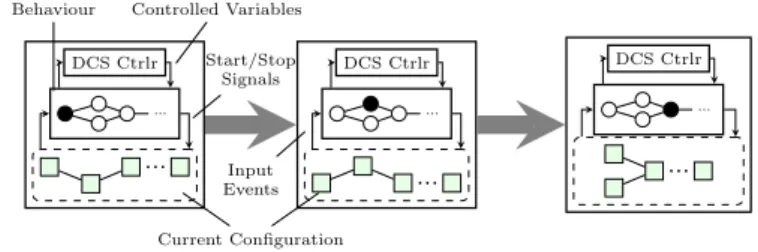
As architectures get larger and more complex, conceiving behaviours that re-spect the stated policies becomes a hard and error-prone task. This is the main reason why we model Ctrl-F behaviours and policies with Heptagon/BZR. In-deed, the FSA-based model of Heptagon/BZR allows programs to be formally exploited and verified by model checking tools [10]. The general model of Ctrl-F behaviours is as surveyed in Ctrl-Figure 1. Basically, each component accommo-dates an automaton corresponding to its adaptive behaviour, in which states correspond to configurations and transitions to reconfigurations. So, based on a vector of input events (e.g., oload and uload, in the Znn.com example) and runtime conditions (e.g., on the attribute values), transitions may be triggered while emitting signals for stopping the current configuration and starting the new one. In the case the behaviour contains choice points, that is,alternative state-ments, we model the transition conditions to each one of the choice branches as free-variables. The resulting controller from the DCS, which takes the form of a deterministic automata, is in charge of the control on those variables such that, regardless of the input events, the stated policies are enforced. It is notewor-thy that although the DCS algorithms has exponential complexity as any other model checking approach, the controller is synthesized in an off-line manner and thus with no impact on the running controlled system. The same structural translation is performed hierarchically for every sub-component, i.e., in every component instantiated within another component. Due to space limitation, we have to omit the details on the translation schemes, but the full translation of Ctrl-F behaviour statements and policies to Heptagon/BZR is available in [1].
4.2 Compilation Tool-chain
As can be seen in Figure 2, the compilation process can be split into two parts: (i) the reconfiguration logics and (ii) the behaviour/policy control and verification. The reconfiguration logics is implemented by the ctrlf2fscript compiler, which takes as input a Ctrl-F definition and generates as output a script containing a set procedures allowing going from one configuration to another. To this end, we rely on existing differencing/match algorithms for object-oriented models [23].
... DCS Ctrlr ... ... DCS Ctrlr ... ... DCS Ctrlr ... Current Configuration Behaviour Start/Stop Signals Input Events Controlled Variables
Fig. 1.Role of the Behaviour Automaton over the Transitions.
The behaviour control and verification is performed by thectrlf2eptcompiler, which takes as input a Ctrl-F definition and provides as output a synchronous reactive program in Heptagon/BZR. The result of the compilation of an Hep-tagon/BZR code is a sequential code in a general-purpose programming language (in our case Java) comprising two methods: reset and step. The former ini-tializes the internal state of the program, whereas the latter is executed at each logical step to compute the output values based on a given vector of input values and the current state.
These methods are typically used by first executingreset and then by en-closingstepin an infinite loop, in which each iteration corresponds to a reaction to an event (e.g.,oload or uload), as sketched in Listing 1.6. The step method returns a set of signals corresponding to the start or stop of configurations (line 4). From these signals, we can find the appropriate script that embodies the reconfiguration actions to be executed (lines 5 and 6).
We wrap the control loop logics into three components, which are enclosed by a composite named Manager. Component EventHandler exposes a service allowing itself to be sent events (e.g.,oload anduload). The method implement-ing this service is defined as non-blockimplement-ing so the incomimplement-ing events are stored in a First-In-First-Out queue. Upon the arrival of an event coming from theManaged System (e.g., Znn.com), componentEventHandler invokes the step method, im-plemented by componentArchitecture Analyzer. The step method output is sent to component Reconfigurator, that encompasses a method to find the proper reconfiguration script to be executed.
Ctrl-F ctrlf2ept *.ept Heptagon/BZR
Executable Code Behaviour/Policy Verification and Control
ctrlf2fscript *.fscript
Reconfiguration Logics
Listing 1.6.Control Loop Sketch. 1 r e s e t () ; 2 ... 3 on e v e n t o l o a d or u l o a d 4 <... , s t o p _ c o n f 1 , s t a r t _ c o n f 2 ,... >= s t e p ( oload , u l o a d ) ; 5 r e c o n f i g _ s c r i p t = f i n d _ s c r i p t (... , s t o p _ c o n f 1 , s t a r t _ c o n f 2 , . . . ) ; 6 e x e c u t e ( r e c o n f i g _ s c r i p t ) ;
In this work, we rely on the Java-based Service Component Architecture (SCA) middleware FraSCAti [20], since it provides mechanisms for runtime re-configuration. The FraSCAti Runtime is itself conceived relying on the SCA model, that is, it consists of a set of SCA components that can be deployeda la carte, according to the user’s needs. For instance, in our case, theManager in-stantiates thefrascati-fscriptcomponent, which provides services allowing for the execution of an SCA-variant of FPath/FScript [8], a domain-specific language for introspection and dynamic reconfiguration of Fractal components. The frascati-fscript component relies on other components integrating the middleware, inside the FraSCAti Composite, to perform introspection and runtime reconfiguration on the managed system’s components.
4.3 Adaptation Scenario
Workload
Politics Soccer Constraint
0 1 2 3 4 5 Resource 0 0.5 0.7 Fidelity Idle Text LD HD as1 Idle Text LD HD as2 Idle Text LD HD as3 Idle Text LD HD as1 Idle Text LD HD as2 Idle Text LD HD 0 1 2 3 4 5 6 7 8 9 10 11 12 13 14 15 16 as3 Step Workload
Politics Soccer Constraint
0 1 2 3 4 5 Resource 0 0.5 0.7 Fidelity Idle Text LD HD as1 Idle Text LD HD as2 Idle Text LD HD as3 Idle Text LD HD as1 Idle Text LD HD as2 Idle Text LD HD 0 1 2 3 4 5 6 7 8 9 10 11 12 13 14 15 16 as3 Step Workload
Politics Soccer Constraint
0 1 2 3 4 5 Resource 0 0.5 0.7 Fidelity Idle Text LD HD as1 Idle Text LD HD as2 Idle Text LD HD as3 Idle Text LD HD as1 Idle Text LD HD as2 Idle Text LD HD 0 1 2 3 4 5 6 7 8 9 10 11 12 13 14 15 16 as3 Step
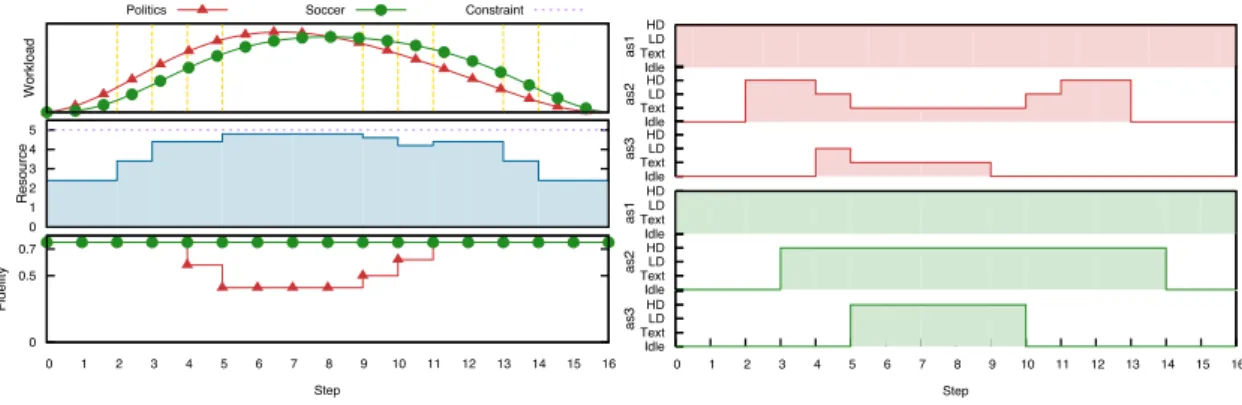
Fig. 3.Execution of the Adaptation Scenario.
We simulated the execution of the two instances of Znn.com application, namelysoccer andpolitics, under the administration of theManager presented in last section, to observe the control of reconfigurations taking into account a sequence of input events. The behaviours of componentsAppServer andZnnare stated in Listings 1.2 and 1.3, respectively, while policies are defined in Listing 1.4 and 1.5.
As it can be observed in the first chart of Figure 3, we scheduled a set of overload (oload) and underload (uload) events (vertical dashed lines), which simulate an increase followed by a decrease of the income workload for both
soccer and politics instances. The other charts correspond to the overall resource consumption, the overall fidelity, and the fidelity level (i.e., configurationstext, img-ld or img-hd) of the three instances of component AppServer contained in both instances of componentZnn.
As the workload of politics increases, an event of typeoload occurs at step 2. That triggers the reconfiguration of that instance from conf1 to conf2, that is, one more instance of AppServer is added within the Znninstance politics. We can observe also the progression in terms of resource consumption, as a consequence of this configuration. The same happens withsoccer at step 3, and is repeated with politics and soccer again at steps 4 and 5. The difference, in this case, is that at step 4, the politics instance must reconfigure (to conf3) so as to cope with the current workload while keeping the overall consumption under control. In other words, it forces the AppServer instances as2 and as3 to degrade their fidelity level from img-hd to img-ld. It should be highlighted that although at least one of the AppServer instances (as2 or as3) could be at that time at maximum fidelity level, the knowledge on the possible future configurations guarantees the maximum overall fidelity for instance soccer to the detriment of a degraded fidelity for instance politics, while respecting the temporal constraints expressed in Listing 1.5. Hence, at step 5, when the last oload event arrives, the fidelity level ofsoccer instance is preserved by gradually decreasing that ofpolitics, that is, both instancesas2 andas3 belonging to the politics instance are put in configurationtext, but without jumping directly from fromimg-hd. At step 9, the firstuload occurs as a consequence of the workload decrease. It triggers a reconfiguration in the politics instance as it goes from conf3 to conf2, that is, it releases one instance of AppServer (as3). The same happens withsoccer at step 10, which makes room on the resources and therefore allows politics to bring back the fidelity level of its as2 to img-ld, and to the maximum level again at step 11. This is repeated at steps 13 and 14 for instances politics and soccer respectively, bringing theirconsumptions at the same levels as in the beginning.
The adaptation scenario is very useful to understand the dynamics behind an Manager that is derived from a synchronous reactive programming, which is in turn, obtained from Ctrl-F. Moreover, the scenario illustrates, in a pedagogical way, how controllers obtained by DCS are capable to control reconfigurations based not only on the current events and current/past configurations (states), but also on the possible future behaviours, that is, how controllers avoid branches that may lead to configurations violating the stated policies.
5
Related Work
In the literature, there is a large and growing body of work on runtime reconfig-uration of software components. Our approach focuses on the language support for enabling self-adaptation in component-based architectures while relying on reactive systems and the underlying formal control tools for ensuring adaptation policies. This section summarizes the related work, more detailed elsewhere [1].
Classically, runtime adaption in software architectures is achieved by first relying on ADLs such as Acme [13] or Fractal [6] for an initial description of the software structure and architecture, then by specifying fine-grained reconfigura-tion acreconfigura-tions with dedicated languages like Plastik [3] or FPath/FScript [8], or simply by defining Event-Condition-Actions (ECA) rules to lead the system to the desired state. A harmful consequence is that the space of reachable configu-ration states is only known as side effect of those reconfiguconfigu-ration actions, which makes it difficult to ensure correct adaptive behaviours. Moreover, a drawback of ECA rules is that, contrary to Ctrl-F, they cannot describe sequences of con-figurations. Even though, ECA rules can be expressed in Ctrl-F with a set of when-do (for the E part) andcase(for the C and A parts) statements in parallel. Rainbow [12] is an autonomic framework that comes with Stitch, a domain-specific language allowing for the description of self-adaptation of Acme-described applications. It features system-level actions grouped intotactics, which in turn, are aggregated within a tree-like strategy path. We can draw an analogy be-tween tactics and the set of actions triggered upon a reconfiguration; as well as strategies and behaviours in the Ctrl-F language. Nonetheless, alternative and parallel, as well as event-based constructs make Ctrl-F more expressive. Further-more, Ctrl-F’s formal model enables to ensure correct adaptation behaviours.
A body of work [2][21][22][22][5][17][4] focus on how to plan a set of actions that safely lead component-based systems to a target configuration. These ap-proaches are complementary to ours in the sense that our focus is on the choice of a new configuration and its control. Once a new configuration chosen, we rely on existing mechanisms to determine the plan of action actually leading the system from the current to the next configuration.
In [18], feature models are used to express variability in software systems. At runtime, a resolution mechanism is used for determining which features should be present so as to constitute configuration. In the same direction, Pascual et al. [19] propose an approach for optimal resolution of architectural variability specified in the Common Variability Language (CVL) [14]. A drawback of those approaches is that in the adaptation logics specified with feature models or CVL, there is no way to define stateful adaptation behaviours, i.e., sequences of reconfigurations. The resolution is performed based on the current state and/or constraints on the feature model. While in our approach, in the reactive model based on FSA, decisions are taken also based on the history of configurations which allows us to define more interesting adaptation behaviours and policies.
W.r.t. formal methods, Kouchnarenko and Weber [16] propose the use of temporal logics to integrate temporal requirements to adaptation policies. While in this approach, enforcement and reflection are performed at runtime in order to ensure correct behaviour, we rely on discrete controller synthesis.
As in our approach, in [11], authors also rely on Heptagon/BZR to model adaptive behaviours of Fractal components. However, there is no high-level de-scription (e.g., ADL) like Ctrl-F, and reconfigurations are controlled at the level of fine-grained reconfiguration actions, which can be considered time-consuming and difficult to scale. Delaval et al. [9] propose to have modular controllers that
can be coordinated so as to work together in a coherent manner. The approach is complementary to ours in the sense that it does not provide high-level language support for describing those managers, although the authors provide interesting intuitions on a methodology to do so.
6
Conclusion
This paper presented Ctrl-F, a high-level domain-specific language that allows for the description of adaptation behaviours and policies of component-based architectures. A distinguished feature of Ctrl-F is its formalization with the synchronous reactive language Heptagon/BZR, which allows to benefit, among other things, from formal tools for verification, control, and automatic generation of executable code. In order to show the language expressiveness, we applied it to Znn.com, a self-adaptive case study, and we integrated it with FraSCAti, a Service Component Architecture middleware.
For future work, we intent to address issues of modularity and coordination of controllers, as well as their distribution. The reactive language and models we rely on have recent results that can be exploited, and can lead to deploy controllers taking into account the physical location of components.
References
1. Alvares, F., Rutten, E., Seinturier, L.: Behavioural Model-based Control for Au-tonomic Software Components. In: Proc. 12th Int. Conf. AuAu-tonomic Computing (ICAC’15). Grenoble, France. (extended version available as a Research Report: https://hal.inria.fr/hal-01103548) (Jul 2015)
2. Arshad, N., Heimbigner, D.: A Comparison of Planning Based Models for Compo-nent Reconfiguration. Research Report CU-CS-995-05, U. Colorado (Sep 2005) 3. Batista, T., Joolia, A., Coulson, G.: Managing dynamic reconfiguration in
component-based systems. In: Proc. 2nd European Conference on Software Ar-chitecture. pp. 1–17. EWSA’05 (2005)
4. Becker, S., Dziwok, S., Gerking, C., Heinzemann, C., Sch¨afer, W., Meyer, M.,
Pohlmann, U.: The mechatronicuml method: Model-driven software engineering of self-adaptive mechatronic systems. In: Companion Proceedings of the 36th In-ternational Conference on Software Engineering. pp. 614–615. ICSE Companion
2014, ACM, New York, NY, USA (2014),http://doi.acm.org/10.1145/2591062.
2591142
5. Boyer, F., Gruber, O., Pous, D.: Robust reconfigurations of component assemblies. In: Proc. 2013 Int. Conf. on Software Engineering. pp. 13–22. ICSE ’13 (2013)
6. Bruneton, E., Coupaye, T., Leclercq, M., Qu´ema, V., Stefani, J.B.: An open
compo-nent model and its support in java. In: Proc. International Symp. on Compocompo-nent- Component-based Software Engineering (CBSE). Edinburgh, Scotland (May 2003)
7. Cheng, S.W., Garlan, D., Schmerl, B.: Evaluating the effectiveness of the rainbow self-adaptive system. In: Software Engineering for Adaptive and Self-Managing Systems, 2009. SEAMS ’09. ICSE Workshop on. pp. 132–141 (May 2009)
8. David, P.C., Ledoux, T., L´eger, M., Coupaye, T.: FPath & FScript: Language
support for navigation and reliable reconfiguration of Fractal architectures. Annals of Telecommunications: Special Issue on Software Components (2008)
9. Delaval, G., Gueye, S.M.K., Rutten, E., De Palma, N.: Modular coordination of multiple autonomic managers. In: Proc. 17th Int. ACM Symp. on Component-based Software Engineering. pp. 3–12. CBSE ’14 (2014)
10. Delaval, G., Marchand, H., Rutten, E.: Contracts for modular discrete controller synthesis. In: ACM International Conference on Languages, Compilers, and Tools for Embedded Systems (LCTES 2010). Stockholm, Sweden (Apr 2010)
11. Delaval, G., Rutten, E.: Reactive model-based control of reconfiguration in the fractal component-based model. In: 13th International Symposium on Component Based Software Engineering (CBSE 2010). Prague, Czech Republic (Jun 2010) 12. Garlan, D., Cheng, S.W., Huang, A.C., Schmerl, B., Steenkiste, P.: Rainbow:
Architecture-based self-adaptation with reusable infrastructure. Computer 37(10), 46–54 (Oct 2004)
13. Garlan, D., Monroe, R.T., Wile, D.: Acme: Architectural description of component-based systems. In: Leavens, G.T., Sitaraman, M. (eds.) Foundations of Component-Based Systems, pp. 47–68. Cambridge University Press (2000)
14. Haugen, O., Wasowski, A., Czarnecki, K.: Cvl: Common variability language. In: Proceedings of the 17th International Software Product Line Conference. pp. 277– 277. SPLC ’13, ACM, New York, NY, USA (2013)
15. Jacobson, I., Griss, M., Jonsson, P.: Software reuse: architecture process and orga-nization for business success. ACM Press books, ACM Press (1997)
16. Kouchnarenko, O., Weber, J.F.: Adapting component-based systems at runtime via policies with temporal patterns. In: 10th Int. Symp. Formal Aspects of Component Software. LNCS, vol. 8348, pp. 234–253. Nanchang, China (2014)
17. Luckey, M., Nagel, B., Gerth, C., Engels, G.: Adapt cases: Extending use cases for adaptive systems. In: Proceedings of the 6th International Symposium on Soft-ware Engineering for Adaptive and Self-Managing Systems. pp. 30–39. SEAMS
’11, ACM, New York, NY, USA (2011),http://doi.acm.org/10.1145/1988008.
1988014
18. Morin, B., Barais, O., Nain, G., Jezequel, J.M.: Taming dynamically adaptive sys-tems using models and aspects. In: Proc. 31st Int. Conf. on Software Engineering. pp. 122–132. ICSE ’09, IEEE (2009)
19. Pascual, G.G., Pinto, M., Fuentes, L.: Run-time support to manage architectural variability specified with cvl. In: Proc. 7th European Conf. on Software Architec-ture. pp. 282–298. ECSA’13 (2013)
20. Seinturier, L., Merle, P., Rouvoy, R., Romero, D., Schiavoni, V., Stefani, J.B.: A component-based middleware platform for reconfigurable service-oriented architec-tures. Software: Practice and Experience 42(5), 559–583 (2012)
21. da Silva, C.E., de Lemos, R.: Dynamic plans for integration testing of self-adaptive software systems. In: Proc. 6th Int. Symp. on Software Engineering for Adaptive and Self-Managing Systems. pp. 148–157. SEAMS ’11 (2011)
22. Tichy, M., Kl¨opper, B.: Planning self-adaption with graph transformations. In:
Proc. 4th Int. Conf. on Applications of Graph Transformations with Industrial Relevance. pp. 137–152. AGTIVE’11 (2012)
23. Xing, Z., Stroulia, E.: Umldiff: An algorithm for object-oriented design differencing. In: Proc. 20th IEEE/ACM Int. Conf. on Automated Software Engineering. pp. 54– 65. ASE ’05 (2005)