Efficient development of data migration transformations
Paulo Carreira
Oblog Consulting and FCUL
[email protected]
Helena Galhardas
INESC-ID and IST[email protected]
ABSTRACT
In this paper we present a data transformation tool named Data Fusion. We concentrate on the following main fea-tures: A domain specific language designed to conveniently model complex data transformations, an integrated devel-opment environment to assist users on managing complex data data transformation projects, and an auditing facility that provides relevant information to project managers and external auditors.
1.
INTRODUCTION
Nowadays, the business landscape changes very fast. Or-ganizations merge and joint-ventures have become common headlines. This reality requires system reengineering, infor-mation integration and migration of legacy data. In this paper, we address the data migration issue.
Current data migration applications aim at converting legacy data stored in sources with a certain schema into target data sources whose schema is predefined. Organizations of-ten buy applicational packages (like SAP, for instance) that replace existing ones (e.g., supplier management). This sit-uation leads to data migration projects that must transform the data model underlying old applications into a new data model that supports new applications. The migration pro-cess is first exhaustively tested and then applied in a one-shot operation, usually during a weekend. The original data sources become obsolete once the migration is performed. The transformation step of the ETL (Extract-Transform-Load) process involved in large-scale data migration projects has two kinds of requirements. The first one concerns the specification of migration transformations. The second deals with the project development and management.
Several issues arise when specifying data migration transfor-mations. First, migration programs require more powerful languages than those supported by most commercial ETL tools currently available. In fact, those languages are usu-ally not powerful enough to represent the semantics of the
transformation rules involved. Typically, complex transfor-mations are handled by ad-hoc programs coded outside the tools. Second, data migration programs need more than simple programmers. People that write migration code are often business experts as well. They prefer to use high-level constructs that can be easily composed. Third, the cost in-volved in the production and maintainability of migration programs must be minimized. Migration code must be short, concise and easily modifiable.
Data migration projects deal with large amounts of data and potentially involve a considerable number of transfor-mations. Therefore, data migration programs are iteratively developed. In real world projects, easy prototyping is thus an imperative requirement. Moreover, as in any other soft-ware development effort, code and data must be logically organized into distinct packages. Managing such informa-tion is crucial for the success of the initiative.
Finally, migration processes deal with critical data. This means that project auditing is frequent and strict. Audi-tors want to be sure that the entire set of source data is migrated, i.e., that the migration transformations cover all source records. To ensure this, they need a tool that mea-sures the progress of the migration, and reports which source fields have been migrated and which target fields have been populated.
Data Fusionis a data transformation platform developed and commercialized by Oblog Consulting. It addresses the requirements of generic data transformation applications. In this paper, we describeData Fusion DMwhich is theData Fusiondata migration component that has evolved from the requirements of real data migration problems.
1.1
The
Data Fusion DMcomponent
Data Fusionoffers a domain-specific language named DTL (standing for Data Transformation Language) for writing concise and short programs. It also provides an Interactive Development Environment (IDE) for efficiently producing and maintaining code. In the rest of the paper, we will focus on the DTL primitives and IDE features supported by Data Fusion DM.
DTL provides a set of abstractions appropriate for express-ing the semantics associated to data transformations. The basic concept is amapperthat may enclose several rules. A
popu-late fields with thenullvalue (see Section 3 for an example of a mapper). The choice of providing such domain-specific language brings several advantages. First, migration solu-tions can be expressed in a language close to the problem domain. Second, programs are usually concise and easy to read and maintain. Due to these two features, DTL is ap-propriate for easy prototyping and testing, which are ma-jor requirements of data migration applications. Third, the compiler can check if the specific vocabulary is correctly used. In DTL, for example, a target attribute cannot be assigned twice. Since DTL embodies domain knowledge, a number of optimizations that could not be identified oth-erwise, can be introduced. Finally, a debugger facility can be developed for data migration programs. The debugger facility implementation ofData Fusion DMis in progress. The Data Fusion DMIDE supports the development of data migration projects. It follows the trend of modern en-vironments for software development (like e.g. Eclipse or Vi-sual Studio). It includes a text editor that supports known functionalities such as syntax highlighting and code tem-plates. Moreover, the DTL compiler is integrated within the IDE and provides helpful hints when compilation errors oc-cur. The user can parameterizeData Fusion DMthrough the IDE, in order to differentiate among production and de-velopment modes. The types of errors that are allowed when writing and testing a migration application are not the same as the ones that may occur when migrating real data. The IDE also supports project management. First, the code produced is organized into packages according to the func-tionality provided. This feature is extremely important in large-scale projects as is the case of data migration. Sec-ond, the IDE provides a project tracking facility that shows to be very useful in real data migration applications. The information to migrate is precious in the sense that every source record must be migrated and every slot of the target schema must be filled in. Auditing a data migration project is a very common activity. People owning data to be mi-grated frequently ask for periodically checking the progress of the data migration process. The IDE reports the state of all source and target fields, i.e., the association between all target and source fields, the percentage of source and target data already migrated, etc.
1.2
Related work
The commercial ETL tools currently available usually ei-ther provide an incredible number of operators (e.g., Sagent [11]) for transforming data or only a small set of opera-tors (e.g. DataJunction [3]). The first group of tools is not easy to use, given the large number of abstractions that the programmer must be able to handle. In the second group of tools, complex transformation logics must be developed as external ad-hoc functions through programming inter-faces. This solution has several drawbacks. First, program-mers must be aware of at least two programming languages: the transformation language supplied by the tool and the programming language (usually Java or C) for writing ex-ternal code. Second, migration programs that handle rich transformation semantics turn to be complex and difficult to optimize. Furthermore, debugging of migration trans-formations tha invoke external code is difficult and further delays the data migration development cycle. The Data
Fusion DMapproach defends that functions should be fined in the transformation language to allow integrated de-velopment and debugging without having to switch among development environments and tracking down bugs through archaic mechanisms.
Commercial tools provide a GUI to specify the source-target mappings, often imposing weak forms of interaction when compared with a modern programming language editor. Fi-nally, some of these tools (e.g., Compuware FileAid/Express [1]) neglect the development environment in favor of a more powerful set of data transformations. The application of Data Fusion DMto solve real world data migration prob-lems confirmed our expectations about the IDE usefulness. Several research data transformation tools have been pro-posed in the last years. Potter’s Wheel [10] is a tool for dis-crepancy detection that allows the user to successively apply simple schema and data transforms. However, the class of data transformations expressible with these transformation operators is limited and does not cover all data migration requirements. The semantics of the AJAX [5] map operator is similar to the semantics of aData Fusion DMrule, but rules can enclose more complex logics due to the expressive-ness of DTL when compared to the map let clause. Express [12] is an early prototype for data transformation. AsData Fusion DM, it offers a language for specifying transforma-tions of source files into target files. However, unlike DTL, it does not support recursion. Clio [7] is a tool for inter-active development of schema mappings. However, the set of transformations supported is a subset of SQL. As it will be shown in Section 3,Data Fusion DMDTL can express transformations that cannot be written in SQL.
DTL was designed for capturing the semantics of arbitrarily complex data migrations. It is a domain specific language because it is oriented to a particular problem domain [13]. Many domain-specific languages have been used over the years (SQL, ASN.1, Makefiles, among others [13]), and the subject has been receiving increased attention from the re-search community [6]. MedMaker MSL [9] and Squirrel ISL [14] are data integration languages whose main goal is to fusion data from several sources. DTL is intended for spec-ifying a larger class of data transformations.
Data Fusion DM assumes that the source-target schema mappings are known. The tool does not offer any facility for discovering schema mappings as it is the case of COMA [4], TranScm [8] and others.
2.
ARCHITECTURE
TheData Fusion platform follows the client-server archi-tecture depicted in Figure 1. On the client side, the
In-tegrated Development Environment (IDE) allows users to
work in multiple data migration projects. On the server side, the Run-Time Environment (RTE) is responsible for compiling and parallelizing the data migration requests sub-mitted from IDE instances. This client-server architecture attains scalability. An instance of the IDE may submit re-quests to multiple RTE instances and an instance of the RTE may run in parallel accepted submissions from multiple IDE instances.
IDE (Client)
extract load Data staging area Run-time Library Execution Service
Java Run-time Environment
Target data Source data
Remote Comm. DTL Compiler Report System User Interface RTE (Server) status information Java mappers User Extensions Compiled mappers
Figure 1: Architecture of Data Fusion
The IDE is constituted by(i)the graphical user interface, which is a development environment for DTL specifications
(ii)the remote communication subsystem in charge of sub-mitting the compiled mappers and receiving the migration progress information,(iii)the DTL compiler that generates Java code from DTL mappers, and(iv)the report system that is responsible for displaying project tracking and au-diting information.
The RTE is composed by(i)an execution service responsible for processing submission requests by compiling, launching and monitoring the execution of mappers, (ii) a run-time library that implements the semantic concepts of DTL and
(iii) the Java Run-time Environment which is responsible
for executing the Java code.
The transformations are executed by the RTE on a data staging area which can be supported by any RDBMS with a JDBC connection. Data extraction and loading are per-formed by third-party tools (e.g., Oracle SQL*Loader).
3.
THE DATA TRANSFORMATION
LANGUAGE
To motivate the unique features of the DTLlanguage, we present a simple example which is a simplified version of typical real world problems found when migrating legacy data. The example show problems that are solved in a con-cise and self-contained way usingDTL. To the best of our knowledge, complex restructuring sequences or manual cod-ing would have to be used if tackled with currently available data transformation frameworks.
The first example illustrates the ability to reason about source record ordering, in particular to variations of record ordering. The second example illustrates cardinality control.
3.1
Migration of currency rates
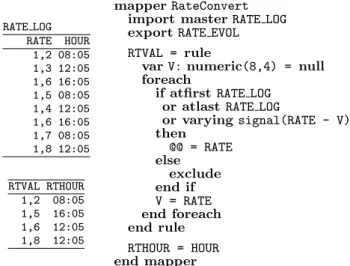
In this example, the data source viewRATE LOG(see Figure 2) stores currency rates that enter the information system at regular intervals. The columnRATE is the currency conver-sion rate andHOURcontains the hour at which the currency
RATE LOG RATE HOUR 1,2 08:05 1,3 12:05 1,6 16:05 1,5 08:05 1,4 12:05 1,6 16:05 1,7 08:05 1,8 12:05 RTVAL RTHOUR 1,2 08:05 1,5 16:05 1,6 12:05 1,8 12:05 mapperRateConvert
import masterRATE LOG
exportRATE EVOL RTVAL = rule
varV:numeric(8,4) = null foreach
if atfirstRATE LOG
or atlastRATE LOG
or varyingsignal(RATE - V) then @@ = RATE else exclude end if V = RATE end foreach end rule RTHOUR = HOUR end mapper
Figure 2: Specification of the RateConvertmapper
rate entered the system. The goal is to migrate these data into another table where only the start value, turning point values (ascending to descending and descending to ascend-ing) and final value must be kept.
Domain experts elicited the following requirements: 1. Migrate fromRATEintoRTVALthe first rate value (1,2
in the figure), the values after turning points (1,6, and 1,4 in the figure) and the last value (1,8 in the figure). 2. The columnHOURis mapped directly into columnRTHOUR. The DTL mapper that performs this conversion is shown on the right of Fig.2 using the DTL syntax. Note that each requirement is associated with a rule. In particular, the non-trivial requirement for the columnRTVALis implemented using a self-contained rule.
The rule works as follows. The variable Vis used to keep the previous value ofRATE. It is persistent across rule firings. For each source record, the foreachstatement of the rule is executed. The if statement decides whether to migrate using the value of the RATE column. The condition checks if the view cursor is located at the first record, at the last record or if there is a rate variation. Variations are detected using the built-in boolean operatorvarying. This operator evaluates an expression (signalin this case) for two consec-utive source records. If the returned value is not the same for both records, the operator returnstrue.
Achieving the same effect through a general purpose lan-guage involves instructions for moving the cursor forward and backward and an extra temporary variable for holding the value returned by thesignalfunction.
Supporting the claim of section 1, the varying operator simplifies the migration logic and greatly improves code con-ciseness and readability.
The source view LOANS, in Figure 3, stores the details of loans requested per account. The source columnACCTis the account number,LOANis the loan number for each account andAMT is the amount requested. The target system does not support loan amounts superior to 100. When a loan amount greater than 100 is found in the source, it must be split into several loan payment entries in the target. In the target viewPAYMENTS,LOANNOis the loan number andAMOUNT
is the amount to be payed. The mapping requirements are as follows:
1. The columnLOANNOis mapped by concatenatingACCT
withLOAN.
2. The columnAMOUNTis obtained by breaking down the value of AMT into multiple records with a maximum value of 100, in such a way that the sum of amounts for the sameLOANNOis equal to the source amount for the same loan.
The mapper that implements these requirements is shown on the right side of Figure 3. The first requirement is im-plemented in the rule1 that assigns the concatenation of the
source columnsACCTandLOANto the column LOANNO. To implement the second requirement, an auxiliary variable
rec amntis initialized with the value of AMTand is used to partition the total amount into parcels of 100. The dynamic creation of records is achieved by nesting aninsert state-ment into awhileloop. Each time aninsertis executed, a new value for the target column is associated with the rule. Internally, values produced by the rules are represented by nodes in a graph. After executing all the rules for a source record, the values contained in the nodes are combined by a graph traversal algorithm to produce target records. In Figure 3, for each iteration of the loop, a node AMOUNT is loaded with 100. After the loop, an additional nodeAMOUNT
is filled in with the remaining value. When both rules are executed for each source record, the values stored in node
LOANNOand in nodesAMOUNT(for eachLOANNOnode, several
AMOUNT nodes may exist) are combined to generate several records in the target viewPAYMENTS.
The distinguishing feature illustrated by this example is as follows. The mapping logics used to load the target columns whose value is fixed (LOANNO in this example) is kept out-side the loop. This is highly beneficial because in real-world examples, we often encounter target tables with tens of columns. By nesting all rules inside the loop would com-promise their readability.
4.
SCENARIO DEMONSTRATED
Data Fusion DM has been used in real data migration projects. For example, it was applied by the Spanish soft-ware house INDRA [2] to migrate financial data, and by Siemens to integrate three databases storing Portuguese pub-lic administration information.
In data migration projects, there is a common pattern. Pro-prietary applications are discontinued in favor of
applica-1Norulekeyword is required when the rule is composed of
a single statement.
LOANS
ACCT LOAN AMT
123 001 20,00 123 002 140,00 456 001 250,00 PAYMENTS LOANNO AMOUNT 123001 20,00 123002 100,00 123002 40,00 456001 100,00 456001 100,00 456001 50,00 mapperLoanConvert
import masterLOANS
exportPAYMENTS LOANNO = ACCT || LOAN AMOUNT = rule
varrec amnt: numeric
rec amnt = AMT
while rec amnt > 100do
@@ = 100
rec amnt = rec amnt - 100
insert end while @@ = rec amnt insert end rule end mapper
Figure 3: Specification of the LoanConvertmapper
tional packages which means that legacy data is migrated into a fixed target schema. The migration project that we will demonstrate intends to illustrate the generic character-istics of a data migration project driven by these require-ments.
Due to confidentiality restrictions we cannot present real data used in our projects. Therefore, the scenario demon-strated is a constructed example of a banking migration. The Banking information system is composed of four ap-plications: Clients, Accounts, Loans and Credit-cards. The data handled by these applications must be migrated into a pre-defined target schema.
With this demonstration, we want to outline the following points:
1. Complex legacy data transformations – We will illus-trate a set of data migration transformations express-ible in DTL that are either not tackled or are imprac-tical in existing tools and frameworks.
2. IDE – We will show our development environment for DTL specifications (see a snapshot in Figure 4). In particular, we will present how the IDE project man-agement handles the migration of real world financial data systems with thousands of tables.
3. Project tracking and auditing – By taking advantage of data dependency information supplied by the DTL compiler we are able: (i)to compute coverage metrics for source and target schema and(ii)to develop data dependency reports for source and target fields. We show how coverage metrics indicate the progress of rule coding. We also show how auditors take advantage of the data dependency reports to gain insight and confidence about the migration specification.
5.
REFERENCES
[1] Compuware fileaid/express.http://www.compuware.com/products/fileaid/express.htm. [2] Indra. http://www.indra.es.
[3] DataJunction. http://www.datajunction.com. [4] H.-H. Do and E. Rahm. Coma – a system for flexible
combination of schema matching approches. InProc. of the Int’l Conf. on Very Large Data Bases
(VLDB’02), Hong-Kong, August 2002.
[5] H. Galhardas, D. Florescu, D. Shasha, E. Simon, and C.-A. Saita. Declarative Data Cleaning: Language, Model, and Algorithms. InProc. of the Int’l Conf. on
Very Large Data Bases (VLDB’01), Rome, Italy,
September 2001.
[6] S. Kamin, editor.First ACM SIGPLAN Workshop on
Domain-Specific Languages (DSL’97), Jan. 1997.
[7] R. J. Miller, L. M. Haas, M. Hernand´ez, C. T. H. Ho, R. Fagin, and L. Popa. The Clio Project: Managing Heterogeneity.SIGMOD Record, 1(30), Mar. 2001.
[8] T. Milo and S. Zhoar. Using schema matching to simplify heterogeneous data translation. In Proc. of
the Int’l Conf. on Very Large Data Bases (VLDB’98),
New York, USA, August 1998.
[9] Y. Papakonstantinou, H. Garcia-Molina, and J. Ullman. MedMaker: A Mediator System Based on Declarative Specifications. InProc. Int’l. Conf. on Data Engineering, Naharia, Israel, Mar. 1996. [10] V. Raman and J. Hellerstein. Potter’s Wheel: An
Interactive Data Cleaning System. InProc. of the Int’l
Conf. on Very Large Data Bases (VLDB’01), Roma,
Italy, 2001.
[11] Sagent. http://www.sagent.com.
[12] N. C. Shu, B. C. Housel, R. W. Taylor, S. P. Ghosh, and V. Y. Lum. EXPRESS: A Data EXtraction, Processing and REStructuring System.ACM
Transactions on Database Systems, 2(2):134–174, June
1977.
[13] A. van Deursen, P. Klint, and J. Visser. Domain-Specific Languages: An Annotated
Bibliography.SIGPLAN Notices, 35(6):26–36, 2000. [14] G. Zhou, R. Hull, and R. King. Generating Data
Integration Mediators That Use Materialization.
Journal of Intelligent Information Systems, 6(2/3):199–221, 1996.