The Learning Story of an Indigenous Kindergarten Teacher
Alexandria Middlemiss, B.A., B.Ed.
Department of Graduate and Undergraduate Studies in Education
Submitted in partial fulfillment of the requirements for the degree of
Master of Education
Faculty of Education, Brock University St. Catharines, Ontario
ii
This study examined the decolonizing pedagogy and practices of a First Nations
kindergarten teacher. Indigenous communities across Canada and the world are currently affecting transformation in their schools by turning systems of colonial domination to education that is locally controlled, culturally relevant, and empowering. The study investigated the teacher’s learning story, including her personal experiences with
education throughout her life, as well as her current practice as an educator, through both an Indigenous and non-Indigenous lens. The author and the teacher acted as
co-researchers in this collaborative project. The exploration of this pedagogy and practice through these two perspectives sought to gain insight into potential solutions for
decolonizing education. This research is thus shared in the hope of bringing Indigenous-driven reconciliation into our classrooms by providing a decolonizing framework that can be imparted to fellow educators. The researchers observed that decolonizing pedagogy, in this instance, occurred through outdoor learning, culturally centred practices, as well as family and community connections. Such practices were determined to be deeply rooted in the teacher’s personal identity and experiences, stemming from an Indigenous
iii
Page
Abstract... ii
List of Figures... iv
Prologue... v
CHAPTER ONE: INTRODUCTION ... 1
Background and Rationale ... 1
Personal Rationale... 6
Land-Based Pedagogies Within Indigenous Communities... 8
Statement of the Research Problem ... 9
Theoretical Framework ... 11
Research Questions ... 12
CHAPTER TWO: REVIEW OF RELATED LITERATURE ... 13
Methodological Approach to Literature Review ... 13
Culturally Responsive Education... 14
Connection to Land... 24
Community Engagement... 28
Conclusions and Relevance to Study ... 30
CHAPTER THREE: METHODOLOGY AND RESEARCH DESIGN... 31
Selection of Site and Participants ... 33
Decolonizing Methodologies ... 39
Data Collection Tools and Analysis... 40
Ethical Considerations ... 42
Scope and Limitations of the Study ... 44
CHAPTER FOUR: PRESENTATION OF RESULTS... 44
Education Journey as a Child—Memories of Learning... 44
Education Journey as a Lifelong Learner ... 59
A Day in Kindergarten... 71
Outdoor Education—Learning From the Land... 72
Culturally Centered Practice ... 80
Family and Community Connections ... 85
CHAPTER FIVE: SUMMARY, DISCUSSION, AND CONCLUSION ... 93
Summary ... 93
Findings and Discussion ... 94
Implications for Further Research... 96
Conclusion ... 97
References ... 98
iv
Figure Page
1. Curricular framework at mainstream schools... 23
2. Curricular framework at MECCS... 23
3. Locating Indigenous methodologies in qualitative research ... 35
v
In the interest of respecting the privacy and confidentiality of research participants, all potential identifiers (names and locations alike) have been removed. Fictitious identifiers are used in their place to preserve the integrity of the research. All research was undertaken on a traditional territory and reserve located in southern Ontario. The results, as well as the ownership of this research, will be at the sole discretion of the participating community’s Chief and Council.
Three copies of this paper will be submitted to the community’s Research Ethics Committee, who will arrange for a copy to be stored at each of the following locations: the community’s public library, the local Indigenous Knowledge Centre, and the Elected Council’s administrative buildings.
The paper also contains written work from the co-researcher’s unpublished thesis; again here, the author of the thesis will not be named. These works will be cited as personal communications.
We gather our minds to greet and thank the enlightened Teachers who have come to help throughout the ages.
When we forget how to live in harmony, they remind us of the way we were instructed to live as people.
With one mind, we send greetings and thanks to these caring Teachers. Now our minds are one.
CHAPTER ONE: INTRODUCTION
For Indigenous people in Canada, education—schooling in particular—has been a site of much pain and forced assimilation (Battiste, 2013; Truth and Reconciliation
Commission of Canada [TRCC], 2015b). Such experiences encompass historical attempts at cultural genocide perpetuated through colonialism and residential schooling (Battiste, 2013) and ongoing injustices in Canadian Indigenous education through underfunding, discriminatory practices, and a Eurocentric curriculum (Chiefs Assembly on Education, 2012). Despite these unfavourable conditions, many Indigenous communities across Canada have reclaimed the education of their young people and are experiencing success. Indigenous communities across Canada and the world are currently effecting
transformation in their schools from systems of colonial domination to education that is locally controlled, culturally relevant, and empowering (Battiste, 2013; Battiste & Barman, 1995; Fulford, 2011). This study examines the learning story and teaching practice of Linda,1 an Indigenous educator who is part of this decolonizing movement in
education.
Background and Rationale
Thousands of years before European settlers arrived on Turtle Island (North America), Indigenous Nations had inhabited and lived in communities with long-standing guidelines and traditions, and educated young people in their ways of life (Battiste, 2013; Kirkness, 1999). Children learned through observation and imitation, and education was deeply embedded within the context of traditional life and spiritual–cultural identity (Battiste & Henderson, 2000). Historically and within many Indigenous cultures, children
learned through their authentic experiences, and experience was understood as being developed over time as a natural result of exploration (Bell & Brant, 2015). European settlers implemented cultural assimilation policies that aimed to eradicate traditional Indigenous ways of knowing and being. For nearly 150 years, the Indian Act has allowed the Canadian government to control Indigenous people by regulating status and dictating how Indigenous communities operate, which includes systems of education (Battiste & Henderson, 2000; Kirkness, 1999).
For more than 100 years, the Canadian government along with the church forcibly removed Indigenous children from their homes and communities to attend residential schools (Battiste & Henderson, 2000; Kirkness, 1999; TRCC, 2015b). Over 150,000 children attended these schools in which students’ language and culture were banned in an effort to “kill the Indian in the child” (TRCC, 2015b, p. 132). Duncan Campbell Scott, who mandated attendance at Residential Schools in 1920, stated the goal of this type of schooling was “to get rid of the Indian problem. ... Our objective is to continue until there is not a single Indian in Canada that has not been absorbed into the body politic and there is no Indian question, and no Indian Department, that is the whole object of this Bill” (1920, p. 55).
In addition to being removed from their home communities and placed in the totally foreign environment of a Eurocentric boarding school, residential school students were often purposefully malnourished, neglected, and abused emotionally, mentally, physically, and sexually (Kirkness, 1999; TRCC, 2015b). Over 4,000 children are estimated to have died at these schools; from those who survived, the stories are
in detail, I acknowledge that
For Indigenous people, the past is a painful chronicle of broken treaties, stolen lands, Indian residential schools, and the Indian act. ... Yet this problematic history is not in the past: it sits with us in many places – government offices, boardrooms, negotiating tables, churches, hospitals, classrooms, and community halls. (Regan, 2010, p. 20)
It is this history that has contributed to a legacy of intergenerational trauma and broken trust, particularly with the education system, for Indigenous families and communities. The Assembly of First Nations states that “61% of First Nation young adults (20-24) have not completed high school, compared with 13% of non-Aboriginal people in Canada” (Chiefs Assembly on Education, 2012, p. 2). There are a multitude of interrelated issues that exist within First Nations education in Canada to cause this disparity. Chronic underfunding, food insecurity, lack of access to high school facilities in close proximity to home communities, lack of access to mental health services, culturally irrelevant standardized testing, and intergenerational trauma caused by
residential schools are some of the most prominent barriers First Nations students face in their educational journeys (Battiste & Henderson, 2000; Chiefs Assembly on Education, 2012; Hodson & Kitchen, 2015; Kirkness, 1999). Hodson and Kitchen (2015) point to lack of access to traditional knowledge as a main cause for what they call a “mass exodus” of Aboriginal students from high school.
Of course, this problem does not begin in high school. Indigenous educators at all grade levels are crucial to healing and repairing the colonial damage of residential
describes a story-based research process “that recognizes respectful relations and more meaningful educational practices, [where] Aboriginal and non-Aboriginal educators, policymakers, and researchers can participate together” (p. 454). As illuminated by the work of Atleo, learning stories and practices of experienced Indigenous educators are invaluable, not only to their students but to their colleagues as well. This notion is also exemplified in St. Denis’s (2008) report for the Reclaiming the Learning Spirit: Learning From Our Experience roundtable in which more than 50 experts gathered to share
successful learning strategies for Aboriginal learners; story, the sharing of experience, and acknowledgement of the past and present formed the basis of developing appropriate strategies to enhance Aboriginal education.
In 2010, Linda conducted a research study in partial fulfillment of her Master of Education degree. Her observation after teaching for 12 years was that students were not successful according to the Ontario curriculum standards and on tests like EQAO. Linda interviewed five Aboriginal teachers, focusing on their learning stories both as children and adults, and how they perceived teaching and learning in their own practice as educators in order to better understand how Aboriginal students learn. In her research proposal, Linda stated that
It is necessary to look at where we came from, to know where we are going. Prior to first contact with Europeans, families and communities were responsible for educating Aboriginal children. Recent studies (Barnes & Cole, 2006; Baydala et al., 2009; Chansonneuve, 2005; Peoples, 1996) emphasize that the reason our students are not successful in school can be traced back to the impact of the residential schools, lack of community responsibility; social issues emerging
because of residential schools and the lack of culturally relevant teaching (Kea et al., 2006; Kozelski, 2000). Therefore, before we can move forward, these issues have to be explored to identify how they formed the foundation of the current education system for Aboriginal children and what changes we have to make to empower our students. (Personal communication, April 5, 2017)
Linda is highly regarded as an excellent educator in the community where she works. Her unique teaching style focuses on outdoor experiential education and traditional
Indigenous knowledge. These practices appear to set a solid foundation for her students to succeed in her kindergarten class.
In recent years, there has been a movement in mainstream education toward “forest schools,” a land-based experiential learning and outdoor education program approach (Bilton, 2010; Knight, 2013; Lowan, 2011). While I learned about the benefits of this type of pedagogy through a graduate-level course on outdoor learning in early childhood, I consistently perceived connections between Indigenous education and outdoor education. These connections began to truly come to life when I began working in Linda’s classroom and in the outdoor learning centre she has created. The purpose of this study was to make meaningful connections and enhance the researchers’
understandings of the possibilities for Indigenous education outside of the confines of Eurocentric norms of traditional schooling.
Honouring and learning from successful Indigenous educators has been
significant in my own journey to decolonize my teaching practice. As Linda stated in the research proposal quoted above, changes must be made to empower Indigenous students (Personal communication, April 5, 2017). If I am to better understand how to teach
Indigenous students, I need to collaborate with and learn from Indigenous educators. Linda agreed to partner with me in undertaking this research project so that she not only could help me and others to become better educators to the benefit of First Nations students, but also continue to refine her practice as well. It is my goal that, through this research project, others may also reflect, learn, and grow as we work together toward reconciliation.
Personal Rationale
Although my mother—as a black woman, single parent, and newcomer to Canada—raised me to be aware of social justice issues and stand against discrimination and racism, I did not recognize the stereotypes and whitewashed history presented throughout my education with regards to Indigenous people.As a child, I accepted what my school history textbooks and the media portrayed, leading me to view Indigenous people as historical entities, and not giving much thought to their ongoing presence and contributions to Canadian society. It was only in my first year of undergraduate studies that I learned of residential schools; I remember being horrified that this was not part of the mandated curriculum, and that I had lived 20 years not knowing of this significant injustice perpetrated by the Canadian government. I began to take an interest in Indigenous issues and reconciliation, taking courses on Aboriginal education, and considering the possibility of teaching on a reserve in northern Canada, where I knew there were many positions waiting to be filled.
When my husband and I completed our studies, we immediately took on first-year teaching positions in a small Anishinaabe community in northern Ontario. We were optimistic and well-meaning; however, I now recognize that some of our initial intentions
and attitudes point to a white-saviour mentality (Brown, 2013) that is not only unhelpful, but also harmful to First Nations communities. Over the next few months, these attitudes shifted as we became cognizant of their absurdity, humbled ourselves, and accepted that we were not only there to teach, but to learn. The next 2 years held some of the most enriching experiences of my life—Anishinaabe culture surrounded us, people welcomed us, and the small, 800-person community truly became our home. Increasingly, though, we became painfully aware of how ill-equipped we were to meet the learning needs of our students through a culturally sensitive and relevant pedagogy. I made a difficult decision to return to southern Ontario where we could teach on a casual supply basis at a southern Ontario reserve while continuing my education at Brock. Through the Master’s program I have learned so much, and, unlike my undergraduate education, I have been able to tailor the program to allow me to research and learn, and write about Indigenous education, decolonizing pedagogy, and reconciliation.
The TRCC (2015b) defines reconciliation as “establishing and maintaining a mutually respectful relationship between Aboriginal and non-Aboriginal peoples in this country” (p. 6). Unfortunately, non-Indigenous educators still find it easy to think we know what is best for Indigenous students, assuming we have the tools we need to solve problems and preventing us from acknowledging our responsibility to decolonize (Bell & Brant, 2015; Regan, 2010). It is with this truth in mind that I seek to decolonize my practice as an educator, and move forward with this research project “with vulnerability, humility, and a willingness to stay in the decolonizing struggle of [my] own discomfort” (Regan, 2010, p. 13).
As an educator of First Nations children, I have struggled in the development and delivery of culturally appropriate learning activities and materials for Indigenous
students. Despite literature that is available on cultural relevancy in teaching (Bell, 2013; Bell & Brant, 2015; Fulford, 2011), the Ontario curriculum and resources that have been available to me often do not align with an Indigenous view of education. In the past, I have been expected to use a great deal of biased and inappropriate teaching materials that romanticize and stereotype First Nations people through “Eurocentric assumptions,” “narratives of race and difference,” and “justification of the status quo” (Battiste, 2013, p. 107). I have, therefore, turned to Indigenous educators (either my colleagues, or resources developed by Indigenous educators) for guidance. Dominant Western ways of teaching and learning continue to be prominent in teacher education, materials, curriculum, and resources (Battiste, 2013; Bell & Brant, 2015). Although non-Indigenous teachers sometimes attempt to integrate Indigenous perspectives into the curriculum, we cannot teach what we do not know, and as Regan (2010) states, “the singular focus on the Other blinds us from seeing how settler history, myth, and identity have shaped and continue to shape our attitudes in highly problematic ways. It prevents us from acknowledging our own need to decolonize” (p. 11). Partnering with Linda in this research was a step
forward in my personal journey toward reconciliation as well as a beneficial endeavour to decolonize my teaching practice, which will benefit students in the communities in which I work.
Land-Based Pedagogies Within Indigenous Communities
Within a traditional Indigenous worldview, the land is central to education; engaging in land-based cultural activities is central to Indigenous students’ mental, physical, emotional, and spiritual development (Bell & Brant, 2015; Greenwood & de Leeuw, 2007; Rowan, 2017). Indigenous people, traditionally, see themselves as
responsible for the care and protection of the land that they themselves are a part of; the land also brings healing and wisdom (Snow, personal communication, December 4, 2017). When teachers and schools provide opportunities to secure students’ connection to the land through traditional land-based activities including storytelling, traditional
teachings, ceremonies, language, and survival skills, Indigenous students are better able to establish their identity, and value their culture (Bell, 2004; Bell & Brant, 2015). As Bell and Brant (2015) state,
The land communicates as a teacher and is a receptacle of knowledge and wisdom. When Aboriginal people seek wisdom, it is to Mother Earth that they return. With her they dream, have vision quests, and obtain the knowledge and wisdom they need. The knowledge and wisdom they glean from the land are not founded in logical thought framed within the Western rational scientific tradition. Rather, they are grounded in the land. (p. 16)
Linda understands and embodies these principles in her teaching practice. Through this project, I too have learned from the land as I spent time with Linda and her kindergarten students in nature. As a non-Indigenous person, I have much to learn about how to engage with the land alongside young learners. Non-Indigenous teachers, in order to teach through a culturally responsive pedagogy, must address the disconnect in our worldviews to those of our students, and provide opportunities for students to learn with and from the land.
Statement of the Research Problem
It is clear that Eurocentric standards of practice in education have not been effective in the education of Indigenous children, as evidenced by the disparities in
educational access and achievement between First Nations and mainstream students (Hodson & Kitchen, 2015). Some research has explored Indigenous pedagogy in practice, which I will examine in my literature review. In my own experience, however, I have observed many non-Indigenous educators—myself included—using a tokenistic approach to including Indigenous content in their practice, rather than basing their practice wholly around Indigenous ways of knowing, being, and learning. Hodson and Kitchen (2015) state that current approaches for non-Indigenous educators include: “iconography on classroom walls, the annual afternoon Pow Wow, the Mid-Winter feast, or the occasional Elder’s visit”; however, “First Nations culture cannot be rendered down to key points and imparted by non-native teachers who are then responsible for cultural continuum” (p. 14). Regan (2010) makes a distinction between this type of token inclusion of Indigenous knowledge in Canadian education and true Decolonization, which involves a cultural paradigm shift that simply cannot be achieved through a tokenistic approach. Rather, teachers must adopt a culturally responsive pedagogy that is implemented in every aspect of their programming (Bell & Brant, 2015).
Overall, culturally responsive pedagogy can be defined as “using the cultural knowledge, prior experiences, frames of reference, and performance styles of ethnically diverse students to make learning encounters more relevant to and effective for them” (Gay, 2010, p. 31). For Aboriginal students, culturally responsive pedagogies are those that are: “experiential; spiritually oriented; communal; strength-based; rooted in culture; integrate Aboriginal with Western knowledge; and account for social, economic, and political realities” (Crooks et al., 2015, p. 217).
When I taught in northern Ontario, 100% of the students were Anishinaabe, while 90% of the teaching staff were non-Indigenous. At the reserve where I am currently a
casual supply teacher, 77% of teaching staff self-identified as Aboriginal as of 2014 (Aboriginal Affairs and Northern Development Canada, as cited in Mt Pleasant, 2014). In both situations, as is the case in schools both on and off-reserve across the country, non-Indigenous people are often responsible for the in-school education of non-Indigenous students. All non-Indigenous educators have the moral and ethical responsibility to respond to the TRCC’s (2015a) calls to action, and make every effort to decolonize our practice. Personally, collaborating with and learning from successful Indigenous
educators is a crucial step to the decolonization process, and this research addresses and responds to the need for those respectful learning relationships.
Theoretical Framework
This study examines the learning story and teaching practices of an Indigenous educator whose teaching style is culturally based; therefore, the research finds its basis within the framework of decolonizing education theory. Marie Battiste’s (2013) book Decolonizing Education: Nourishing the Learning Spirit examines the legacy of
colonized education, outlines possibilities for the decolonization of education, and makes recommendations for reconciliation in education. Battiste (2013) defines decolonizing education theory in juxtaposition to colonialism:
Colonialism as a theory of relationships is embedded in power, voice, and legitimacy. … This imperialistic system of knowledge that is considered the “mainstream” functions like a “keeper” current in a rapidly flowing river or ocean. … Decolonization then is a process of unpacking the keeper current in education: its powerful Eurocentric assumptions of education, its narratives of race and difference in curriculum and pedagogy, its establishing culturalism or cultural racism as a justification for the status quo, and the advocacy for
indigenous knowledge as a legitimate education topic. It is the channel for generating a postcolonial education system in Canada and disrupting those normalized discourses and singularities and allowing diverse voices and perspectives and objectives into “mainstream” schooling. (p. 107)
Battiste (2013) calls for the decolonization of all areas of education, and the creation of a postcolonial system of education in which diverse perspectives and objectives are honoured within “mainstream” schooling. Battiste (2013) points to the successful efforts of Indigenous people in Canada to reclaim education as central to this transformative process. Linda is one such educator; thus, this project applied a critical decolonizing lens to analyze and reflect on Linda’s practice.
Research Questions
Through this project Linda and I both aimed to uncover meaning by exploring the research questions as follows:
1. How does this teacher’s life, story, and identity shape her practice as an educator? 2. What are the possibilities, benefits/successes, and challenges to implementing
land-based learning and Aboriginal pedagogy as practiced by this teacher? 3. How are culturally responsive, land-based pedagogies enacted within one
CHAPTER TWO: REVIEW OF RELATED LITERATURE For this review, I consider both quantitative and qualitative research studies, document analyses, and personal narratives from both Indigenous and non-Indigenous scholars, researchers and practitioners. Initially, I reached out to my co-researcher Linda, an accomplished educator of 20 years, to identify the research and literature that has informed her practice, as her teaching will be the focus of my research. In addition to the texts she provided, I obtained literature from peer-reviewed research journals, published theses and dissertations, books, and reports using specific, targeted search terms and criteria to form the body of literature for my review.
Methodological Approach to Literature Review
I used a variety of search portals including the Brock University library’s Super Search, Academic Search Complete, Canadian Business and Current Affairs Database. Additionally, I reviewed specific journals (Canadian Journal of Native Education, Canadian Journal of Native Studies) and conducted a reverse citation search using core texts on Indigenous education on Google Scholar. I used the key terms “aboriginal”, “Indigenous”, “native”, “First Nations”, “outdoor”, “land-based”, “education”, “kindergarten”, and “early learning” in various combinations using “and” / “or” to account for similar terms. The reference lists of pertinent journal articles lead me to discover more relevant sources. I limited my review to literature from 2000 or later, and considered only examples from North America, with a strong preference for studies conducted in Canada.
Initially my goal was to identify at least 18 empirical studies that focused on elementary land-based education in Indigenous communities in Canada. After conducting
a thorough search using the methods above, I adjusted my criteria and explored self-studies as well as formal research, including children and youth from preschool to high school, and allowed for studies that focused on either Indigenous early childhood
education or Indigenous outdoor education, with a preference for literature that discussed both. Identifying 12 core sources and several peripheral sources, I reviewed the body of research, looking for similar themes and patterns in methodology, findings, discussion, and recommendations. This literature review contains a discussion of three prevalent themes that emerged throughout my review of the literature: culturally responsive education, connection to the land, and community engagement. I explore each theme separately, maintaining the understanding that all three are interconnected (Battiste, 2008).
Culturally Responsive Education
The overarching theme in the literature I reviewed was the notion of culturally responsive pedagogy. Gay (2002) defines culturally responsive pedagogy as “using the cultural characteristics, experiences, and perspectives of ethnically diverse students as conduits for teaching them more effectively” (p. 106). Within an Indigenous context, a culturally responsive pedagogue must first address the disparity between Western and Indigenous education, to ensure the educational process is informed by Indigenous philosophy, epistemology, and ontology. Traditionally, Indigenous education centres on the land and is determined by an individual’s own unique pace of development; this kind of education is delivered holistically with the view that all aspects of a person’s life— mental, physical, emotional, and spiritual—are intrinsically connected and developing together (Bell & Brant, 2015). Traditional knowledges are transferred in many ways
through parents, grandparents, Elders, story, and children’s observation of cultural practices (Bell & Brant, 2015; Turner, Boelshcer Ignace, & Ignace, 2000)). Turner et al. (2000) note that “traditional knowledge among younger generations, in most indigenous groups, has inevitably diminished as assimilation and environmental change have escalated” (p. 1276). Western culture generally does not hold the same level of respect for the land and all life forms as Indigenous culture (Battiste, 2008; Bell & Brant, 2015; Turner et al., 2000). Thus, Western educational systems work to erode traditional knowledges by instilling an opposing worldview that does not align with Indigenous epistemology. Learning and seeking knowledge is seen as something that begins at conception and never ends for Indigenous people (Bell & Brant, 2015). A circle of Elders in Stiegelbauer’s (1992) study define the traditional Indigenous learner according to the following characteristics:
1. The foundation for the “good life” or health and capacity for learning is modeled through the structure and behaviour at home during the early years.
2. As a child develops in age they can be asked to take on practical responsibilities relevant to their age. These responsibilities go beyond tasks to values, gathering experience, understanding it and expressing it in behaviour. This changes
developmentally as a child ages. Learning is a life-long process but each stage has different qualities. Learning involves mind, body, and spirit simultaneously not separately.
3. Experience is the foundation for learning. Understanding experience is developed over time through dialogue. Experience is neither good nor bad but a natural result of exploration.
4. Children should be allowed to make choices to gather unique and individual experience within the framework of modeled values, discussion, and community good. Each individual has something unique to offer as a result of who they are and their accumulated experience.
5. Learning is a process that is accomplished through interaction with others; it is always a shared, cooperative venture.
6. The foundation for interaction with others is expressed through respect, feeling, a good heart, good intentions, kindness, sharing, and a knowledge of self.
7. Each individual is unique yet part of a whole community. The community and the individual have reciprocal responsibilities. In one sense the individual and the community and the world are the same entity, interdependent. What affects one, affects the others.
8. Learning begins with vision—of self, of goals, of the whole, of the direction a task is to go in. It is a process that goes through stages of “seeing” (vision), relating to what it is, figuring it out with heart and mind, and acting on findings in some way (behaviour).
9. The old and the young need each other: one to provide the understanding of experience from their own experiences, the other to frame that discussion in terms of current and changing needs. The child’s world may be different from that of the adult as it reflects a changing world.
10. Everyone has a responsibility to give back and to consider their actions in the light of their effect on generations to come. (p. 14)
experience, understanding life, and meaning; the beginning of knowledge is a vision for who a child can become, what they can contribute to the community (Stiegelbauer, 1992). One Elder stated: “If you don’t start with vision, it is difficult to reclaim it. The dominant society starts in the knowledge part of the circle by focusing on the institutions of
learning. Starting at vision enables you to see the whole picture” (Stiegelbauer, 1992, p. 8). Within Western educational institutions, teaching with an Indigenous cultural focus must be a purposeful act that involves unlearning and deconstructing Western knowledge systems, and starting with vision that stems from an Indigenous view of the world, of life, and of learning as outlined in the 10 points above.
Hodson and Kitchen (2015) state that the two greatest predictors of success for Indigenous students are access to traditional knowledge and teachers who employ a culturally responsive pedagogy. For Indigenous students, education must be designed from an Indigenous perspective and provide a relevant cultural context to be meaningful and effective (Battiste, 2008; Bell, 2013; Cooke-Dallin, Rosborough, & Underwood, 2000; Greenwood, de Leeuw, & Fraser, 2007). Unsuccessful attempts to provide a culturally responsive education are often delivered through an add-on approach (Hodson & Kitchen, 2015, p. 14). This approach at best would show a lack of understanding of the complexity of Indigenous knowledge; First Nations culture cannot be rendered down to key points and imparted by non-native teachers who are then responsible for cultural continuum (Hodson & Kitchen, 2015). The literature that I reviewed describes a culturally responsive education which permeates every aspect of schooling.
Cultural perspectives must be represented in the curriculum of educational programs offered to Indigenous students both on and off-reserve (Agbo, 2001; Fulford,
2011; Mashford-Pringle, 2012). Varying approaches are taken to ensuring curriculum is culturally relevant; for example, in Akwesasne, a board-developed, culturally based science curriculum is used in place of the mandated curriculum (Agbo, 2011) while in other communities, responsibility falls on the teachers to modify the curriculum to reflect Indigenous culture and perspectives (Fulford, 2011; Mashford-Pringle, 2012). In addition to culturally relevant curriculum content, practitioners must teach through a culturally responsive pedagogy that encompasses traditional ways of teaching that emphasizes learning by doing (Goulet, 2001). A culturally responsive pedagogy also includes culturally safe and appropriate assessment practices developed by and with community stakeholders as opposed to Eurocentric standardized testing with little cultural value (Fulford, 2011; Philpott, 2006).
Aligned with Indigenous beliefs, culturally responsive practitioners acknowledge each child as a valued individual with a unique talent or gift to offer; teacher–student interactions are centred on mutual respect, and teachers take a non-confrontational approach to classroom management, equalizing power relations and maintaining
relationships characterized by warmth and care (Agbo, 2011; Goulet, 2001; Oskineegish, 2015). A teacher in Oskineegish’s (2015) study described how using a different
communication style reflects care and respect to her students, for example:
When you see a kid running in the hallway, I wouldn’t say “Don’t be running in the hallways.” I won’t say that, I would say, ”When you run in the hallways, I’m afraid that you’ll get hurt, and I don’t like seeing kids get hurt.” (p. 17)
While teachers may feel uncomfortable letting go of a traditional authoritarian role, Oskineegish (2015) asserts it is “essential to carry the right kind of attitude that can help foster positive relationships and practices” (p. 18).
Ball and Pence (2006) highlight the importance of educational programs and services ensuring cultural safety by considering the particular values, goals, and practices of individual Indigenous communities and families. In much of the literature I reviewed, Indigenous epistemology and Indigenous education are discussed; the studies I reviewed considered over 60 distinct Indigenous groups across North America in total, and it is important to note that Indigenous ways of knowing and being are diverse across those groups and communities (Greenwood et al., 2007). Bomberry (2013) found that
Haudenosaunee youth often felt uncomfortable as they were expected to know everything about “Natives” in mainstream school settings, as educators tend to generalize due to their own lack of knowledge. For educators, it is important not to “pan-Indigenize” but rather to develop practice based on the culture of the local community. For example, the Anishinaabe Bimaadiziwin Cultural Healing and Learning Program is conceptually designed and delivered through a holistic Anishinaabe medicine wheel framework (Bell, 2013), while Rowan’s work (2017) is informed by the Inuit notion of nunagat—water, ice, and land. While “Indigenous education” is referred to often throughout the literature, and throughout this paper, I acknowledge the unique set of knowledges specific to each Nation, which are interweaved with broader Indigenous knowledges that transcend those boundaries.
Throughout much of the literature lies the notion that education and childcare are vital in cultural revitalization or revival (Fulford, 2011; Greenwood, 2006; Philpott, 2006; Mashford-Pringle, 2012). Cultural revitalization takes place when an emphasis is placed on Indigenous culture, knowledge, and traditions (McWilliams, Maldonado-Mancebo, Szczepaniak, & Jones, 2011). The literature reveals the myriad ways in which this
cultural revival takes place within educational settings, with those most prominent being: Indigenous language learning and immersion (Ball & Lewis, 2014; Baydala et al., 2007; Bell, 2013; Fulford, 2011; Greenwood et al., 2007; Hare, 2012; Mashford-Pringle, 2012); spiritual practices including cleansing, healing, and thanksgiving (Agbo, 2001; Baydala et al., 2007; Bell, 2013; Fulford, 2011); ceremonial and artistic activities including traditional song, dance, dress, art, and crafts (Agbo, 2001; Fulford, 2011; Hare, 2012; McWilliams et al., 2011; Rowan, 2017); traditional story-telling (Agbo, 2001; Ball & Lewis, 2014; Baydala et al., 2007; Fulford, 2011; Hare, 2012; McWilliams et al., 2011); and land-based cultural activities (Agbo, 2001; Baydala et al., 2007; Goulet, 2001; Hare, 2012; McWilliams, 2011; Rowan, 2017; Takano, 2005).
The culturally responsive educational elements listed above do not occur in isolation; rather, they are holistically applied in various settings as they would be
traditionally. An example of this from Hare’s (2012) study involved children and families going
out on the land to learn and carry out traditional activities, such as hunting, fishing, plant gathering, storytelling and communal practices associated with traditional life. ... One parent described “I make up stories, like when we’re walking in the woods”... elders regularly visit to tell children local stories and show them how to do traditional activities, such as preparing medicines, berries and fish, demonstrating how knowledge is passed on through the generations. (p. 402) Partnering with Elders, parents, and community members to provide cultural teachings is essential (Bell, 2004). Students at 10 schools in case studies reviewed by Bell (2004) took part in a wide range of cultural activities, and schools were described as having culture
and heritage as “foremost in their minds” (p. 146). Cultural camps, school-wide participation in seasonal hunting, teachers who speak Indigenous languages either exclusively or use Indigenous languages alongside English, prominent displays of cultural imagery, and student-made cultural crafts such as dreamcatchers and drums, respectful relationships between teachers and students, nurturing of traditional spiritual beliefs, opening the school for cultural events such as pow-wows, and regular presence of Elders in the school were all highlighted as positive and successful practices in the 10 schools highlighted by Bell (2004). In the Gift Lake Settlement, students are able to take part in a program focused on restoring lost traditions, which is taught by cultural experts and overseen by elders (Bell, 2004). Students learn traditional skills like “cleaning and cooking fish, preparing fish for smoke house, cutting and making dried meat, making pemmican, and tanning a moose hide” (Bell, 2004, p. 164). The program appropriately teaches these skills through an Aboriginal learning process which involves carefully observing an expert perform the skill, attempting the skill when ready, and self-evaluating for success (Bell, 2004).
Cultural content in education is an important vehicle for cultural transmission and maintaining the cultural continuum, thus, parents, Elders, and community leaders place a high priority on education when it instills cultural knowledge in younger generations (Agbo, 2001; Bell, 2013; Greenwood, 2006; McWilliams et al., 2011; Rowan, 2017; Takano, 2005). The National Educational Association found “schools that infuse Native culture into the school climate via the curricula, staff expertise, and school activities see a corresponding increase in the participation and interest level of Native families” (as cited in McWilliams et al., 2011, pp. 35-36). At Mother Earth’s Children’s Charter School
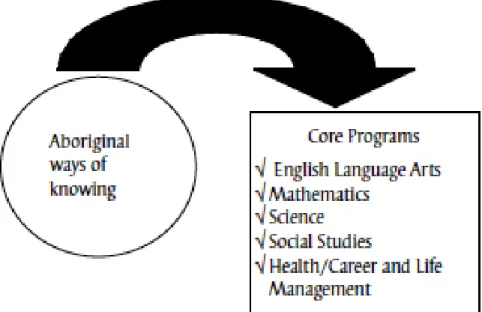
(MECCS; Baydala et al., 2007), this “infusion” of Native culture discussed by the NEA is not considered sufficient, and an entirely new curriculum was created. Baydala et al.’s (2007) research highlights the collaboration of educators, parents, Elders and community members at MECCS; the school was established by a group of Indigenous parents and educators who noted the exclusion of Indigenous language and culture in conventional Euro-centric education and felt that there could be a more effective way to educate children through Indigenous education, by moving from infusing Aboriginal perspectives into the Western curriculum, to infusing the curriculum into a holistic Aboriginal
educational program based on medicine wheel teachings.
Alberta’s Commission on Learning (2004) stated that Aboriginal perspectives should be “infused” or included within the mainstream curriculum; at MECCS, “the starting place for learning is the medicine wheel” and curriculum is seen as being “rooted in identity and experience, rather than something external to be funneled or infused into the daily life of the school” (as cited in Baydala et al, 2007, pp. 204-206). Figures 1 and 2 illustrate the way in which Western education “includes” Indigenous knowledge (in Figure 1), and the way in which a parallel curriculum at MECCS includes the Alberta curriculum into an Indigenous pedagogical approach based on the medicine wheel (Baydala et al, 2007, pp. 203-204). Through this shift, the goal is ultimately “to nurture, to support, guide and challenge each of our children to discover the gifts given to them by the Creator and [to create] a balance of their spiritual, intellectual, physical and emotional selves. Through this each child will achieve personal excellence and fulfillment”
Figure 1. Curricular framework at mainstream schools.
Connection to Land
Indigenous philosophy is grounded within the concept of interconnectedness with the earth upholds the land as “an extension of [Indigenous] thought and being because, in the words of a Pueblo Elder … ‘It is this place that holds our memories and the bones of our people. … This is the place that made us’” (Cajete, as cited in Greenwood & de Leeuw, 2007, p. 50). Underlying much of the research was a deep and meaningful connection to the land in the context of Indigenous tradition and culture. Some engaged with land-based learning as their primary focus (Lowan, 2009; Rowan, 2017; Takano, 2005), while others merely incorporated land-based learning within a broader spectrum of cultural education where cultural education was the primary focus (Baydala et al., 2007; Goulet, 2001; Fulford, 2011; Hare, 2012; McWilliams et al., 2011).
Because Indigenous knowledge is inherently entangled with land (Hare, 2012), connection to the land is valued by all stakeholders in Indigenous education. In a pilot study at MECCS, Baydala et al. (2007) noted that “All of the participants… spoke of Mother Earth and the spirit of the land and of their strong belief in the need to connect, respect and value the environment” (p. 212). Students at the school have access to over 30 acres of undeveloped land where “they spend time ‘seeing, interacting, touching and being with the energy of that land… [It is here that] they cut and dry meat, cook and pick berries. … This is the place where the grass and the wind moves the spirit of the
children’” (Bearhead, as cited in Baydala et al., 2007, p. 205).
The setting of the Anishinaabe Bimaadiziwin program is also situated rurally, with a bush around it and close access to the water, [which] was valued by the students at the school. … A natural setting allowed the students and teachers to
engage in land-based activities and learning essential to Indigenous education. These activities allowed students to develop a sense of who they were in relation to creation and to develop a sense of respect. (Bell, 2013, p. 47)
The Native Indian Centered Education program is located in an urban setting, but students still have access to an outdoor classroom and a Native healing garden, where children, parents, and caregivers all take part in planting, tending and harvesting the garden and build “strong connections to the earth” (McWilliams et al., 2011, p. 39). Students benefit from teacher flexibility to allow integration of cultural land-based activities in keeping with the seasonal cycles (e.g., berry-picking in fall, trapping and fishing in winter; Goulet, 2001; Swanson, 2003).
Children at two of the five schools in Hare’s (2012) study regularly went out on the land to take part in traditional camps, hunting, fishing, gathering plants, and taking part in other traditional activities. Goulet’s (2001) study highlights the work of a teacher named Roxanne, who took her students on cultural trips to traditional Dene hunting territory to set up camp in the bush. Roxanne describes the profound effect this had on her and her students:
It really hit me. On that trip we talked about the history, we talked about Dene, and I was really trying to instill the pride. We talked about many years ago, “This is traditional and where our ancestors used to come by” and “This is how children lived.” When it was time to leave] nobody wanted to go. ... The plane took off and they were all crying. I said, “Why are you crying?” “Because,” they said, “I can’t explain it to you. But I feel really sad. There’s something missing in our life. I mean this is the way we lived?” You know, just connecting back. So we did a lot
of journal writing when we got back in the classroom, just so they could tell me what they felt they were missing. (Goulet, 2001, p. 79)
This teacher goes on to describe the land as where the students are supposed to be, encouraging them to seek knowledge from parents and grandparents who can pass along those stories and land-based skills (Goulet, 2001).
In Baydala et al.’s (2007) research at MECCS, a primary teacher shares a similar view on children’s learning from the land; a photo is shown of students outdoors with clip charts, and the teacher states:
There’s so many picures like this out on the land because to me this is the one thing that I love that’s just so important. And I still believe ... that’s when we’re really going to see the difference in ... the kids—when we get on the land, because that’s huge... that’s central to all of it. (p. 213)
All of the teachers at MECCS involved in the pilot study referred to Mother Earth, the spirit of the land, and students’ need to connect with, respect, and value the land (Baydala et al., 2007).
Rowan’s (2017) dissertation focused on engaging with nunangat (land, water, ice, and snow) and Elders to develop culturally appropriate early childhood education
programming for Inuit communities. Rowan’s (2017) work suggests that Western ECE pedagogies are embedded with colonialism and must be challenged in their limited effectiveness with Inuit students. Ongoing engagement and relationship with the land allow children to negotiate their cultural identities, as they hear stories from Elders, learn traditional skills, and begin to see themselves as traditional people (Rowan, 2017). For example, a photo of a child participating in a nunangat-based program with willow
branched tied to her back prompted community members to share their own stories of walking many miles with giant stick mountains attached to their backs, affixed with ropes made of seal and caribou. ... It is in this story sharing that those local histories and contexts are made accessible and relationships with land can be remembered and recognized as deeply meaningful. (Rowan, 2017, p. 166) Through Elder meetings, learning stories, and excursions on Inuit land, Rowan (2017) finds a basis for nunangat pedagogy that recognizes “that Inuit knowledge and learning comes from interactions with land, water and ice, from nunangat” (p. 76). After over 25 years of living and working on Inuit nunangat, Rowan (2017) posits that Inuit voices, experiences, and knowledge systems must form the basis for land-based early childhood education programs, as opposed to ECE programs largely based on Western ways of knowing and being. Elders are essential to a land-based education program, as they “hold the knowledge needed to engage skillfully and with comprehension when harvesting plants and animals, preparing and preserving food and skins, and making materials” (Rowan, 2017, p. 169); therefore, Rowan (2017) recommends the funding of Elder educator positions in all Inuit ECE facilities. Rowan (2017) also advises educators should continue working with Inuit Elders, hunters, community members, and pedagogues to design land-based ECE curriculum from an Inuit perspective.
When schools do not provide Indigenous students with such rich opportunities for land-based education, other measures are often taken. Takano (2005) found that Elders and community members in Igloolik were concerned that young people were losing connection with their land and culture. The Elders and community members took it upon themselves to begin a program called Paariaqtuqtut (“meeting on the trail”) with the goal
of connecting young people to land-based cultural skills and teachings (Takano, 2005). Lowan’s (2009) research focused on the Giwaykiwin program, a land-based outdoor environmental education program for Aboriginal youth outside of the realm of traditional schooling. Lowan (2009) and Takano (2005) both found that young people in the
program felt as though their participation helped them to reconnect with their land and culture.
Community Engagement
For Indigenous children in schools and educational programs both on and off reserve, community connections and engagement figured prominently in the literature. Community engagement takes place within the context of the other two themes: culture and land-based learning. Oskineegish (2015) states successful teaching is only possible with “active engagement and partnership with local educators, parents, and community members; and a willingness to adapt and respond to the flow of the community” (p. 5). Learning from a community, Oskineegish (2015) states, is not a passive experience of watching from a distance but instead involves active participation in community events, which usually involve cultural and land-based components. One example of this is that community members appreciated teachers participation in events such as moose and goose-calling events which showed teachers’ willingness to be visible in the community and take part in cultural activities (Oskineegish, 2015).
Elders are integral to many successful educational settings, sharing their rich cultural knowledge, teachings, and stories with students and teachers (Bell, 2004; Cooke-Dallin et al., 2000; Fulford, 2011; Greenwood & de Leeuw, 2007; Rowan, 2017; Takano, 2005). Elders are often fluent in Indigenous languages, and their knowledge is respected
in educational settings throughout the literature I reviewed; in Bell’s (2004) study, a Department Head at Peguis Central School states “A lot of children here have lost the language, and that is why we bring elders in to explain different things such as the feather and the drum” (p. 215). Partnership with families in cultural, land-based, and academic activities connect the school and community in meaningful ways (Agbo, 2001; Baydala et al., 2007; Goulet, 2001; McWilliams et al., 2011; Rowan, 2014). In addition to the land-based and cultural activities mentioned in the previous two sections (fishing,
hunting, setting up camps, etc.), community and family relationships are fostered through home visits (Fulford, 2011; Goulet, 2001), parent volunteers who run snack,
extracurricular, and sports programs (Bell, 2004), and collaboration for community events and celebrations (Fulford, 2011; Rowan, 2014).
In Bell’s (2004) study, a recent increase in parent engagement is highlighted at Princess Alexandra School, with one parent participant stating “When you walk in, everybody makes you feel welcome, and they’re not judging you when you walk in the door” (p. 228). Bell (2014) notes that “both staff and parents celebrate the high degree of parental engagement,” with one parent stating “we bring school to our house and we bring our home to the school. Half of the circle is at our home and the other half is at the school. That is how it is working, or has to be in order to work” (p. 229). A positive home–school–community connection is illustrated here in cultural terms, using the symbol of a circle which is central to First Nations epistemology (Bell, 2004). As community cultural values and Indigenous approaches to learning are emphasized, decolonization and healing takes place; thus, education plays a key role in achieving community wellness (Greenwood, 2006).
Conclusions and Relevance to Study
The significance of culturally responsive pedagogy and cultural content in education were present in all 12 core sources I explored, and the importance of these themes cannot be overstated. Land-based learning and community connection, which occur within a cultural paradigm, are also key to a meaningful education for Indigenous students in Canada. After reviewing the literature, it is evident that a significant gap exists in research with Canadian Indigenous land-based early childhood education. As this will be the focus of my final research paper, my next step is to expand this literature review by allowing for examples outside of a North American context, where relevant connections may exist. Further, my review of the literature points to the need for
researchers and educators to base their practice around the culture of the communities in which they work. As a non-Indigenous person working in a Haudenosaunee community, the ethical space in the centre of the two-row wampum belt (Bomberry, 2013) is the area in which my teaching and research lies.
While I was not surprised by the themes found in the literature I reviewed, I was taken aback by the striking similarities in story and experience, and the strength of these correlations among successful Indigenous education programs. As my co-researcher, Linda, is considered a highly successful Indigenous educator, our collective exploration of and reflection on her teaching practice will likely reflect the themes of culture, land and community.
CHAPTER THREE: RESEARCH METHODOLOGY AND DESIGN In fall 2016, I began to work as a casual supply teacher at a First Nations reserve in southern Ontario. One of my first days on the job, I was assigned to a kindergarten classroom to supply for Linda. As I read over the day plans, it became evident that I would be spending the majority of the day outdoors with the kindergarten students. We would eat and have centre time inside, but we would read a story, do group math exercises, play, and go on a walk outside for the remainder of the day. As the students arrived, they greeted me and the Educational Assistant, and swiftly changed their shoes, checked their bags for homework, and changed their status from “in” to “out” on the attendance board without being prompted to do so. I was taken aback that they knew and followed the routines with little direction at a point so early in the year. Some students began handing me a variety of different fruits—melons, apples, oranges, grapes—out of their bag. I had read in Linda’s day plan that it was National Fruit Day and students would be making fruit salad with each child contributing a fruit if they could. As I took the fruit I said I would find a knife and cut it up for them before their lunch break. The Educational Assistant shook her head and informed me that the students themselves would cut the fruit: “We don’t do anything for them—they do everything themselves.” The students showed me for the remainder of the day how very true this statement was; I was amazed at the independence and creativity they showed while they were playing in the outdoor natural play space that Linda had developed for them. The concepts that I was engaging with in my studies at Brock really began to come to life as I continued to supply for Linda several times throughout the year.
One morning as I was walking into the school to supply for a different class, I noticed Linda backing a truck up to the outdoor play area with several stumps and
branches that she had brought from home for the students to play with. Students were outdoors, Linda explained, because that is how Indigenous children learn—from and with the land. It can be difficult to teach in her style (experiential outdoor learning) without access to any nearby forested areas. Therefore, she brought the forest to the students by bringing natural elements from home and letting students engage with them in their enclosed concrete play area outdoors. While the inside of Linda’s classroom looks like a typical ECE learning space, the outdoor space differs in that there is a large paved courtyard and a grassy area, with recycled and natural materials Linda has brought in such as logs, lumber in varying sizes, milk crates, bales of straw, a sand pit, rocks of varying sizes, copper spools, baby trees, large and small plastic containers, riding toys, wagons, wheelbarrows, et cetera.
Students were engaged, independent, happy to be at school, and connecting with their culture while learning. Over the next few months I supplied regularly in Linda’s class, and her program challenged long-held assumptions and reservations I had about early learning. Like many educators, I had previously thought of the outdoors as a place where children go to run around and release their energy for an hour or less per day out before returning to the classroom to participate in learning activities. The day plan in Linda’s classroom reflected a culturally responsive emphasis on outdoor time that allowed students to learn with and from the land. Students had freedom to choose and direct their own learning by selecting activities both indoors and outdoors of interest to them; teacher direction was minimal and students showed a great deal of autonomy to self-direct in activities that I assumed would not be allowed for them, for example, using a knife to cut fruit or hanging upside down from a tree.
Selection of Site and Participants
Initially I engaged the school community by reaching out to the Vice-Principal and Principal at the elementary school where I am a part-time casual supply teacher. I asked if they had any ideas for research that could benefit the school and community, and discussed my concerns as a non-Indigenous person hoping to conduct research within the community. I read through the Major Research Projects and Theses of some of the school staff including the Principal in order to situate my own research. After supply teaching for Linda several times, I discussed her pedagogy with the Principal of the school and with Linda herself; both were open to a collaborative research project exploring Linda’s practice as an Indigenous educator. Linda and I will work collaboratively to describe and reflect on her decolonizing outdoor experiential classroom that she has created for the kindergarten students at her school.
Decolonizing Research Methodologies
As a non-Indigenous person conducting academic research on a Traditional Territory and Reserve, I struggled to conceptualize a research methodology that would be accepted academically but also, one that would not continue a longstanding culturally insensitive and exploitative pattern of Western research in Indigenous communities (Kovach, 2009; Smith, 2012; Styres, Zinga, Bennett, & Bomberry, 2010). Margaret Kovach’s (2009) Indigenous Methodologies has been instrumental in guiding the development of the research methodology. Kovach (2009) defines Indigenous methodologies as “the theory and method of conducting research that flows form an Indigenous epistemology” (p.20). Kovach (2009) states that Indigenous knowledges have been marginalized in Western research practices, and that Canada’s colonial history must not be forgotten in this process lest Colonialism be reproduced through research.
Importantly, cultural exoticism often relegates Indigenous ways of knowing to the periphery of academia, thus, Indigenous methodologies are seen as “less than” conventional Western methodologies (Kovach, 2009).
It is with this notion in mind that Linda and I made a deliberate choice to frame this research project very loosely as a qualitative, collaborative inquiry. In Decolonizing Methodologies, Linda Tuhiwai Smith (2012) states “the intellectual project of
decolonizing has to set out ways to proceed through a colonizing world. It needs a radical compassion that reaches out, that seeks collaboration, and that is open to possibilities that can only be imagined as other things fall into place” (p. xii). In laying out a decolonizing methodology for this project, there must be an openness to allowing the research
methodology to develop as Linda and I spent more time together reflecting on her practice.
In Indigenous Methodologies, Kovach (2009) states that the use of “procedures that organize knowledge to Western terms” can limit research inquiries in an Indigenous context (p. 132). It would be both difficult and unhelpful, therefore, to frame this research within the strict paradigms of Western methodologies. Avoiding an individualistic
approach of trying to “Indigenize” Western research methods (Kovach, 2009), there is no exact methodology term that I feel completely comfortable using to describe this
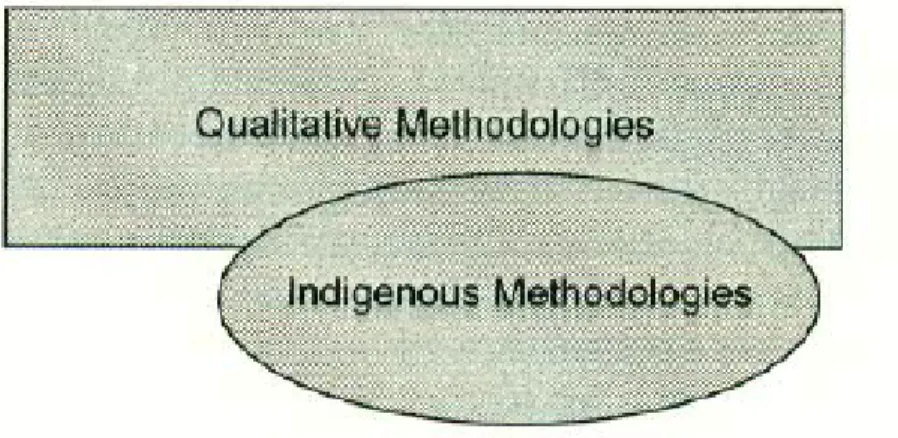
research. In this project, a “backdrop of qualitative research” became “a bridge for traversing worldviews” as many of the data collection tools embodied qualitative characteristics, yet the research as a whole could not be placed within any one specific qualitative methodology (Kovach, 2009, p. 25). Kovach (2009) illustrates the tensions that exist when locating decolonizing Indigenous methodologies within Western qualitative approaches using the diagram shown in Figure 3.
Kovach (2009) states there is a “desire to give voice to Indigenous epistemologies within qualitative research, yet those who attempt [this] are destined to feel the squirm. The tension ... will persist until Indigenous research frameworks have methodological space within research dialogue, policy, and practice” (p. 31).
Within a holistic Indigenous paradigm, Linda and I collaborated to produce what could be described as a descriptive case study based on her life and practice; for the purposes of this study we will use the term “learning story.” Our research experience reflected what Kovach (2010) defines as the Conversational method—“a means of gathering knowledge based on oral story telling tradition congruent with an Indigenous paradigm. It involves a dialogic participation that holds a deep purpose of sharing story as a means to assist others. It is relational at its core” (p. 40). Battiste (2008) also states that Indigenous epistemology, or ways of knowing, is centered on relationality.
Therefore, the research process embodied a relational tone, essentially documenting a growing mentor-type relationship between myself and Linda.
As Linda and I worked together, we applied our unique lenses to what we saw, heard, and experienced. Reflective conversation and the sharing of stories took place as this is what we both agreed would be the best way to fully understand the research questions posed. An approach that uses both Western and Indigenous lenses is referred to as two-eyed seeing (Hogue & Bartlett, 2014; Marsh, Cote-Meek, Toulouse, Najavits, & Young, 2015). Linda and I took part in a collaborative, two-eyed approach to research that privileged Indigenous ways of knowing and learning, while also reflecting upon Western approaches, which must be acknowledged in order to be decolonized.
A collaborative approach was taken for this study, with Linda and myself
writing was my responsibility, Linda’s openness to share her education journey with me was the crux of this project. As she is currently working on her own thesis for her M.Ed., I was sensitive to ensure that this project did not burden her with any work over and above our time together in the classroom. Linda and I discussed what we feel comfortable with, what our roles would be, and we were both open to flexibility within those roles. Our responsibilities for the project were divided as laid out in Figure 4.
As the research process unfolded, our experiences mirrored those of Kovach (2010), who describes the implications of research that takes place within an Indigenous paradigm:
For the conversational method, the relational factor... was significant. In each case I had known or met participants prior to the research. With this method the
researcher must have a certain amount of credibility and trustworthiness for people to participate in the research. With more trust there is the likelihood of deeper conversations, and consequently the potential for richer insights to the research question. The conversations were dialogic, relational, and reflective. As a result I found I had to be an active listener. As an active listener and participant in the research, the process felt less extractive and one-sided (even with the given that research can inevitably be an extractive process). Because I was a
co-participant, my own self-knowledge deepened with each conversation. ... The conversation itself helped to deepen relationships... participants shared stories from their lives resulting in a highly contextualized, powerful source of
knowledge. In receiving the gift of story, I was ever mindful of the responsibility inherent in research and the reciprocity it entails. (p. 46)
As co-researchers, Linda and I developed a relationship that continued to deepen through dialogue in a conversational research method. As we each shared stories within this context of mutual trust, knowledge was transmitted, assumptions were challenged, and decolonization took place, as I will describe in chapter 4.
Data Collection Tools and Analysis
I spent 4 days in the kindergarten classroom (both outdoors and indoors)
observing and the following data collection tools were used: notes that I made, notes that Linda made, and audio recordings of Linda and I during reflective conversations. At the end of each day, we discussed what we saw from each of our perspectives (the concept of two-eyed seeing is relevant here; Hatcher, Bartlett, Marshall, & Marshall, 2009).
These conversations were transcribed, and the text presented in accordance with Kovach’s model of Indigenous methodologies. Kovach (2009) states that allowing stories to emerge completely gives participants a guiding role in how the research develops that is not possible with traditional interview formats and coding which can be limiting. Kovach (2010) explains that “The conversational method ... has the means to generate highly contextualized stories. In using a conversational method that is guided by an Indigenous paradigmic approach, I struggle in decontextualizing and fragmenting the data” (p. 47). Therefore, in presenting the results, every effort was made to present the conversation in its full context leading to longer than usual excerpts from collaborative conversation within this paper. This method of presenting story in its full context as data allows the story to remain intact and speak for itself (Kovach, 2010, p. 47). These reflective conversations took place using a previous research protocol developed
exclusively developed by Linda to guide the reflection for both researchers. Because she has developed these guiding questions (see Appendix), this portion was a self-reflection
and self-study; I also reflected on my learning story noting any parallels and points of departure during these collaborative reflections.
Linda has offered to guide me through documents that she has created as well, including texts that she has authored to explain her pedagogy to administrators. We looked through these documents together and reflected on them. When the data was compiled, I aimed to present this body of data in a way that reflects the research questions posed, as well as allows myself and other educators to learn from them develop strategies that can help guide decolonization of education practices both present and future.
Ethical Considerations
As a non-Indigenous educator and researcher, the importance of ensuring
ethically sound research cannot be overstated. Historically, Indigenous people have been marginalized, taken advantage of, and harmed through Western research; recently has there been a significant shift toward “more research by and with Aboriginal peoples” and away from “research on or for Aboriginal peoples” in academia (Tecumseh Centre for Aboriginal Research and Education, 2017, p. 17). It is important to note that Aboriginal people conducted their own research within their nations prior to colonization: “These methods of investigation and problem solving involved everyone in the community and were specifically guided by Elders” (Marsh et al., 2015, p. 3). While I have ongoing difficulties with the notion of personally conducting research for fear that it will continue a pattern of marginalization and exploitation, Linda has been a great encouragement to me as she always points to the benefits of the research, which reach to the children and community that I work with. This project would also be beneficial to me in that it allows me to question and decolonize my own pedagogical practice, while learning from an experienced and successful Indigenous educator. In the two First Nations communities I