1 of 202 Document ID 33: AUTOSAR_SWS_NVRAMManager
Document Change History
Date Release Changed by Change Description 2020-11-30 R20-11 AUTOSAR
Release Management
InitBlockCallback and ROM block are mutually exclusive
Removal for DET error
NVM_E_PARAM_BLOCK_TYPE
NvM partitioning for multi-core 2019-11-28 R19-11 AUTOSAR
Release Management
Changes related to
NVM_E_WRITE_PROTECTED
Port Prototypes are generated for block only if needed
Changed Document Status from Final to published 2018-10-31 4.4.0 AUTOSAR Release Management Removed NvM_GetActiveService API
Remove EcuMfixed completely
Changed single and multi block callbacks
minor corrections / clarifications / editorial changes; For details please refer to the ChangeDocumentation 2017-12-08 4.3.1 AUTOSAR
Release Management
Correction for write protection and erase requests for
NvMWriteBlockOnce blocks
Clarification regarding implicit recovery of dataset blocks
minor corrections / clarifications / editorial changes; For details please refer to the ChangeDocumentation
Document Title
Specification of NVRAM
Manager
Document Owner AUTOSAR Document Responsibility AUTOSAR Document Identification No 33
Document Status published
Part of AUTOSAR Standard Classic Platform Part of Standard Release R20-11
2 of 202 Document ID 33: AUTOSAR_SWS_NVRAMManager
Document Change History
Date Release Changed by Change Description 2016-11-30 4.3.0 AUTOSAR
Release Management
Added NvM_FirstInitAll and NvM_GetActiveService functionalities
NvM_SetRamBlockStatus works also for explicit synchronization blocks
The interaction between NvM and BswM is clarified.
Other small clarifications and updates.
2015-07-31 4.2.2 AUTOSAR Release Management
Clarified behavior related to
restoring default data for blocks and for handling of
MEMIF_BLOCK_INVALID job result
Added additional information related to the block states in chapter
7.2.2.14 and related subchapters
Updated NvM_Init and
NvM_ValidateAll function prototypes
Debugging support marked as obsolete
2014-10-31 4.2.1 AUTOSAR Release Management
Detailed pass/fail conditions for production errors
Added the NvM_ValidateAll functionality
Updated return values for Init and SingleBlock callbacks
Other small clarifications 2014-03-31 4.1.3 AUTOSAR
Release Management
Removed job postpone in case of explicit synchronization failed after configured number of retries
Updated Service Interfaces tables
Renamed configuration parameter NvMRamBlockHeaderInclude to NvMBlockHeaderInclude
3 of 202 Document ID 33: AUTOSAR_SWS_NVRAMManager
Document Change History
Date Release Changed by Change Description 2013-10-31 4.1.2 AUTOSAR Release Management Added NvMRamBlockHeaderInclude and NvMMainFunctionPeriod configuration parameters
Corrected bugs for
NvMWriteVerificationDataSize and NvMNvramBlockIdentifier
parameters
Other small clarifications in requirement
Editorial changes
Removed chapter(s) on change documentation 2013-03-15 4.1.1 AUTOSAR Administration Added NvM_ReadPRAMBlock, NvM_WritePRAMBlock and NvM_RestorePRAMBlockDefaults APIs
Production Errors and Extended Production Errors classification
Clarifications for explicit synchronization mechanism
Modeling of Services: introduction of formal descriptions of service
interfaces
Changes regarding NvM_CancelJobs API,
NvmSetRamBlockStatus API, Init callback, handling of redundant blocks,queue sizes and usage of MemoryMapping
Reworked according to the new SWS_BSWGeneral
4 of 202 Document ID 33: AUTOSAR_SWS_NVRAMManager
Document Change History
Date Release Changed by Change Description 2011-12-22 4.0.3 AUTOSAR
Administration
Added NvM_CancelJobs behaviour
Added NvM and BswM interaction
Added NvM_SetBlockLockStatus API functional description
Corrected inconsistency between C-interface and port C-interface
Updated Include structure
Updated configuration parameters description and range
2010-09-30 3.1.5 AUTOSAR Administration
Behavior specified to prevent possible loss of data during shutdown
References to DEM for production errors, new config container NvmDemEventParameterRefs
NvMMaxNoOfWriteRetries renamed to NvMMaxNumOfWriteRetries
Note in chapter 7.1.4.5 completed
Null pointer handling changed
Chapter “Version check” updated
New DET error
NVM_E_PARAM_POINTER
Chapter 10 updated,
NvMMainFunctionCycleTime
moved, NvMSelectBlockForWriteAll added, some ranges corrected
Behavior specified when NVRAM block ID 1 shall be written
Chapter 12 updated
Handling of single-block callbacks during asynchronous multi-block specified.
Some minor changes, typos corrected
5 of 202 Document ID 33: AUTOSAR_SWS_NVRAMManager
Document Change History
Date Release Changed by Change Description 2010-02-02 3.1.4 AUTOSAR
Administration
The following features had impact on this document:
Debugging concept
Error handler concept
Memory related concepts
The following major features were necessary to implement these concepts:
Static Block Id Check
Write Verification
Read Retry
buffered read/write-operations
Legal disclaimer revised 2008-08-13 3.1.1 AUTOSAR
Administration
Technical Office SWS
Improvements are incorporated.
Requirement IDs for configuration parameters (chapter 10) added.
Management of the RAM block state specified more precisely.
The NVRAM Manager doesn't support non-sequential NVRAM block IDs any longer.
Document meta information extended
Small layout adaptations made 2007-12-21 3.0.1 AUTOSAR
Administration
Legal disclaimer revised 2007-01-24 2.1.15 AUTOSAR
Administration
AUTOSAR service description added in chapter 11
Reentrancy of callback functions specified
Details regarding memory hardware abstraction addressing scheme added
Legal disclaimer revised
“Advice for users” revised
6 of 202 Document ID 33: AUTOSAR_SWS_NVRAMManager
Document Change History
Date Release Changed by Change Description 2006-05-16 2.0 AUTOSAR
Administration
Document structure adapted to common Release 2.0 SWS Template.
Major changes in chapter 10
Structure of document changed partly
2005-05-31 1.0 AUTOSAR Administration
7 of 202 Document ID 33: AUTOSAR_SWS_NVRAMManager
Disclaimer
This work (specification and/or software implementation) and the material contained in it, as released by AUTOSAR, is for the purpose of information only. AUTOSAR and the companies that have contributed to it shall not be liable for any use of the work.
The material contained in this work is protected by copyright and other types of intellectual property rights. The commercial exploitation of the material contained in this work requires a license to such intellectual property rights.
This work may be utilized or reproduced without any modification, in any form or by any means, for informational purposes only. For any other purpose, no part of the work may be utilized or reproduced, in any form or by any means, without permission in writing from the publisher.
The work has been developed for automotive applications only. It has neither been developed, nor tested for non-automotive applications.
8 of 202 Document ID 33: AUTOSAR_SWS_NVRAMManager
Table of Contents
1 Introduction and functional overview 10
2 Acronyms and abbreviations 12
3 Related documentation 13
3.1 Input documents ... 13
3.2 Related specification ... 14
4 Constraints and assumptions 15 4.1 Limitations ... 15
4.2 Applicability to car domains ... 15
4.3 Conflicts ... 15
5 Dependencies to other modules 16 5.1 File structure ... 16
5.1.1 Header file structure ... 16
5.2 Memory abstraction modules ... 16
5.3 CRC module ... 16
5.4 Capability of the underlying drivers ... 16
6 Requirements traceability 17 7 Functional specification 25 7.1 Basic architecture guidelines ... 25
7.1.1 Layer structure ... 25
7.1.2 Addressing scheme for the memory hardware abstraction ... 25
7.1.3 Basic storage objects ... 27
7.1.4 Block management types ... 31
7.1.5 Scan order / priority scheme ... 37
7.2 General behavior ... 39 7.2.1 Functional requirements ... 39 7.2.2 Design notes ... 40 7.3 Error Classification ... 65 7.3.1 Development Errors ... 65 7.3.2 Runtime Errors ... 73 7.3.3 Transient faults ... 73 7.3.4 Production Errors ... 73
7.3.5 Extended Production Errors ... 74
8 API specification 78 8.1 API ... 78 8.1.1 Imported types... 78 8.1.2 Type definitions ... 78 8.1.3 Function definitions ... 79 8.1.4 Expected Interfaces ... 140 8.1.5 API Overview ... 147 8.2 Service Interfaces ... 148 8.2.1 Client-Server-Interfaces ... 148
8.2.2 Implementation Data Types ... 156
8.2.3 Ports ... 159 9 Sequence Diagrams 162 9.1 Synchronous calls ... 162 9.1.1 NvM_Init ... 162 9.1.2 NvM_SetDataIndex ... 162 9.1.3 NvM_GetDataIndex ... 163
9 of 202 Document ID 33: AUTOSAR_SWS_NVRAMManager
9.1.4 NvM_SetBlockProtection ... 163
9.1.5 NvM_GetErrorStatus ... 163
9.1.6 NvM_GetVersionInfo ... 164
9.2 Asynchronous calls ... 165
9.2.1 Asynchronous call with polling ... 165
9.2.2 Asynchronous call with callback ... 166
9.2.3 Cancellation of a Multi Block Request ... 167
9.2.4 BswM Interraction ... 168
10 Configuration specification 172 10.1 How to read this chapter ... 172
10.2 Containers and configuration parameters ... 172
10.2.1NvM ... 173 10.2.2NvMCommon ... 173 10.2.3NvMBlockDescriptor ... 180 10.2.4NvMInitBlockCallback ... 194 10.2.5NvMSingleBlockCallback ... 194 10.2.6NvMTargetBlockReference ... 195 10.2.7NvMEaRef ... 196 10.2.8NvMFeeRef ... 196 10.2.9NvmDemEventParameterRefs... 196 10.2.10 NvMBlockCiphering ... 199
10.3 Common configuration options ... 201
10.4 Published parameters ... 201
11 Not applicable requirements 202
Figures
Figure 1: Memory Structure of Different Block Types 10 Figure 2: Logical Structure of Different Block Types 11
Figure 4: NVRAM Manager interactions overview 25
Figure 5: NV Block layout 27
Figure 6: RAM Block layout 28
Figure 7: ROM block layout 29
Figure 8: NV block layout with Static Block ID enabled 30
Figure 9: Redundant NVRAM Block layout 33
Figure 10: Dataset NVRAM block layout 35
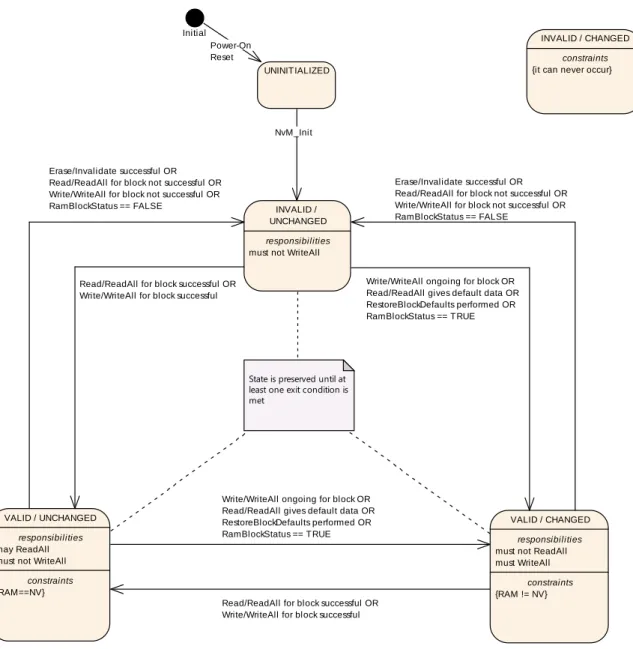
Figure 11: RAM Block States 48
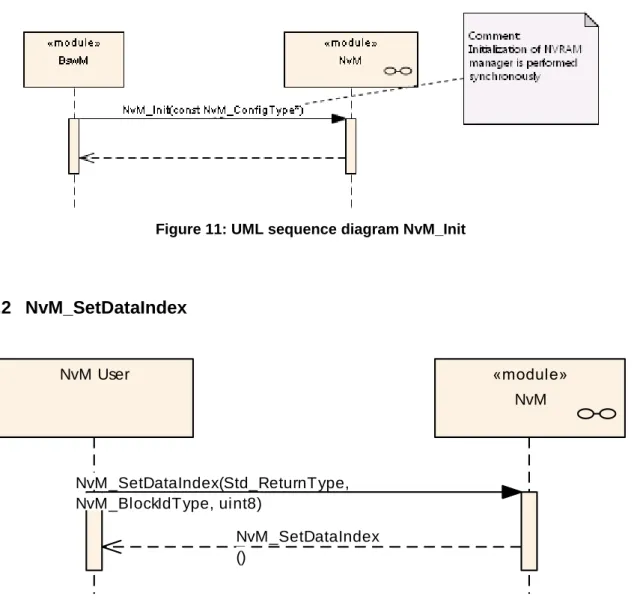
Figure 12: UML sequence diagram NvM_Init 162
Figure 13: UML sequence diagram NvM_SetDataIndex 162 Figure 14: UML sequence diagram NvM_GetDataIndex 163 Figure 15: UML sequence diagram NvM_SetBlockProtection 163 Figure 16: UML sequence diagram NvM_GetErrorStatus 163 Figure 17: UML sequence diagram NvM_GetVersionInfo 164 Figure 18: UML sequence diagram for asynchronous call with polling 165 Figure 19: UML sequence diagram for asynchronous call with callback 166 Figure 20: UML sequence diagram for cancellation of asynchronous call 167
10 of 202 Document ID 33: AUTOSAR_SWS_NVRAMManager
1
Introduction and functional overview
This specification describes the functionality, API and the configuration of the AUTOSAR Basic Software module NVRAM Manager (NvM).
The NvM module shall provide services to ensure the data storage and maintenance of NV (non volatile) data according to their individual requirements in an automotive environment. The NvM module shall be able to administrate the NV data of an EEPROM and/or a FLASH EEPROM emulation device.
The NvM module shall provide the required synchronous/asynchronous services for the management and the maintenance of NV data (init/read/write/control).
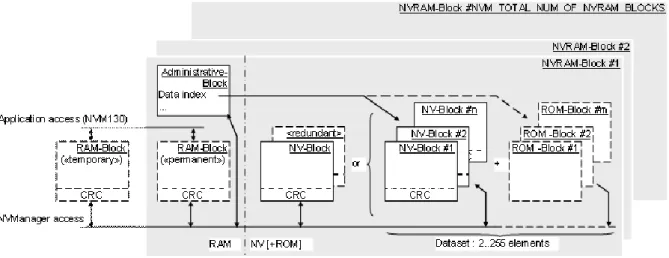
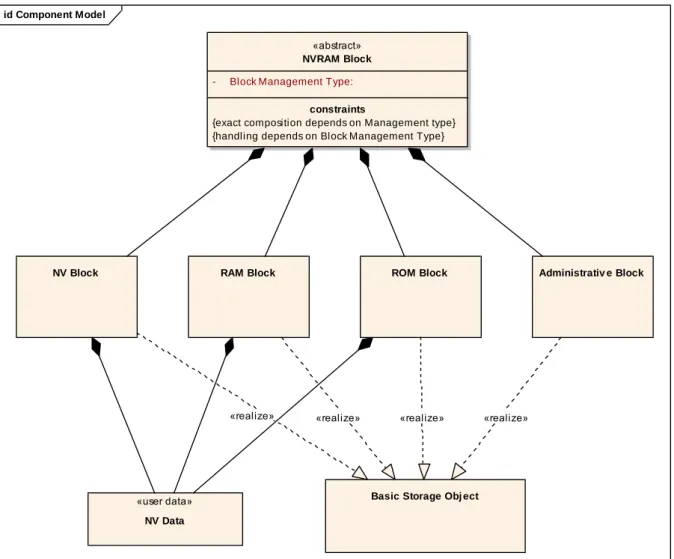
The relationship between the different blocks can be visualized in the following picture:
11 of 202 Document ID 33: AUTOSAR_SWS_NVRAMManager
id Component Model
NV Block RAM Block ROM Block Administrativ e Block
Basic Storage Obj ect «abstract»
NVRAM Block
- Block Management Type:
constraints
{exact composition depends on Management type} {handling depends on Block Management Type}
«user data» NV Data
«realize» «realize» «realize»
«realize»
12 of 202 Document ID 33: AUTOSAR_SWS_NVRAMManager
2
Acronyms and abbreviations
Acronyms and abbreviations, which have a local scope and therefore are not contained in the AUTOSAR glossary, must appear in a local glossary.
Abbreviation/ Acronym: Description:
Basic Storage Object A “Basic Storage Object” is the smallest entity of a “NVRAM block”. Several “Basic Storage Objects” can be used to build a NVRAM Block. A “Basic Storage Object“ can reside in different memory locations (RAM/ROM/NV memory).
NVRAM Block The “NVRAM Block” is the entire structure, which is needed to administrate and to store a block of NV data. NV data The data to be stored in Non-Volatile memory.
Block Management Type Type of the NVRAM Block. It depends on the
(configurable) individual composition of a NVRAM Block in chunks of different mandatory/optional Basic Storage Objects and the subsequent handling of this NVRAM block. RAM Block The „RAM Block“ is a „Basic Storage Object“. It represents
the part of a „NVRAM Block“ which resides in the RAM. See [SWS_NvM_00126]
ROM Block The „ROM Block“ is a „Basic Storage Object“. It represents the part of a „NVRAM Block“ which resides in the ROM. The „ROM Block“ is an optional part of a „NVRAM Block“.[SWS_NvM_00020]
NV Block The „NV Block“ is a „Basic Storage Object“. It represents the part of a „NVRAM Block“ which resides in the NV memory. The „NV Block“ is a mandatory part of a „NVRAM Block“. [SWS_NvM_00125]
NV Block Header Additional information included in the NV Block if the mechanism “Static Block ID” is enabled.
Administrative Block The “Administrative Block” is a “Basic Storage Object”. It resides in RAM. The “Administrative Block” is a mandatory part of a “NVRAM Block”. [SWS_NvM_00135]
DET Default Error Tracer – module to which development errors are reported.
DEM Diagnostic Event Manager – module to which production relevant errors are reported
NV Non volatile
FEE Flash EEPROM Emulation
EA EEPROM Abstraction
13 of 202 Document ID 33: AUTOSAR_SWS_NVRAMManager
3
Related documentation
3.1 Input documents
[1] List of Basic Software Modules AUTOSAR_TR_BSWModuleList.pdf [2] Layered Software Architecture
AUTOSAR_EXP_LayeredSoftwareArchitecture.pdf [3] General Requirements on Basic Software Modules
AUTOSAR_SRS_BSWGeneral.pdf [4] Requirements on Memory Services
AUTOSAR_SRS_MemoryServices.pdf [5] Specification of EEPROM Abstraction
AUTOSAR_SWS_EEPROMAbstraction [6] Specification of Flash EEPROM Emulation
AUTOSAR_SWS_FlashEEPROMEmulation [7] Specification of Memory Abstraction Interface
AUTOSAR_SWS_MemoryAbstractionInterface [8] Specification of Memory Mapping
AUTOSAR_SWS_MemoryMapping [9] Virtual Functional Bus
AUTOSAR_EXP_VFB.pdf [10] Software Component Template
AUTOSAR_TPS_SoftwareComponentTemplate [11] Specification of RTE Software
AUTOSAR_SWS_RTE.pdf
[12] Specification of ECU Configuration AUTOSAR_TPS_ECUConfiguration.pdf [13] Basic Software Module Description Template
AUTOSAR_TPS_BSWModuleDescriptionTemplate [14] Specification of CRC Routines
AUTOSAR_SWS_CRCLibrary
[15] General Specification of Basic Software Modules AUTOSAR_SWS_BSWGeneral.pdf
14 of 202 Document ID 33: AUTOSAR_SWS_NVRAMManager
3.2 Related specification
AUTOSAR provides a General Specification on Basic Software modules [15] (SWS BSW General), which is also valid for NVRAM Manager.
Thus, the specification SWS BSW General shall be considered as additional and required specification for NVRAM Manager.
15 of 202 Document ID 33: AUTOSAR_SWS_NVRAMManager
4
Constraints and assumptions
4.1 Limitations
Limitations are given mainly by the finite number of “Block Management Types” and their individual treatment of NV data. These limits can be reduced by an enhanced user defined management information, which can be stored as a structured part of the real NV data. In this case the user defined management information has to be interpreted and handled by the application at least.
4.2 Applicability to car domains
No restrictions.
4.3 Conflicts
The NvM can be configured to use functionality from other modules or integrator code. Examples include the en/decryption of block data using Csm or the
compression of block data. It is the responsibility of the integrator to ensure that:
the required functionality is available at the time NvM uses it (e.g. the called Csm is already initialized [or not yet de-initialized]; needed main functions in called modules are executed; ...)
the required time is available (e.g. cryptographic algorithms may need some time and therefore the read/write functionality of the NvM may take much longer for blocks which need an en/decryption)
16 of 202 Document ID 33: AUTOSAR_SWS_NVRAMManager
5
Dependencies to other modules
This section describes the relations to other modules within the basic software.
5.1 File structure
5.1.1 Header file structure
The include file structure shall be as follows:
[SWS_NvM_00554] ⌈NvM module shall include NvM.h, Dem.h, MemIf.h. ⌋ ( ) [SWS_NvM_00691] ⌈Only NvM.h shall be included by the upper layer. ⌋ ( )
5.2 Memory abstraction modules
The memory abstraction modules abstract the NvM module from the subordinated drivers which are hardware dependent. The memory abstraction modules provide a runtime translation of each block access initiated by the NvM module to select the corresponding driver functions which are unique for all configured EEPROM or FLASH storage devices. The memory abstraction module is chosen via the NVRAM block device ID which is configured for each NVRAM block.
5.3 CRC module
The NvM module uses CRC generation routines (8/16/32 bit) to check and to generate CRC for NVRAM blocks as a configurable option. The CRC routines have to be provided externally [ref. to ch. 8.1.4.2].
5.4 Capability of the underlying drivers
A set of underlying driver functions has to be provided for every configured NVRAM device as, for example, internal or external EEPROM or FLASH devices. The unique driver functions inside each set of driver functions are selected during runtime via a memory hardware abstraction module (see chapter 5.2). A set of driver functions has to include all the needed functions to write to, to read from or to maintain (e.g. erase) a configured NVRAM device.
17 of 202 Document ID 33: AUTOSAR_SWS_NVRAMManager
6
Requirements traceability
Requirement Description Satisfied by
SRS_BSW_00005 Modules of the µC Abstraction Layer (MCAL) may not have hard coded horizontal interfaces
SWS_NvM_00744
SRS_BSW_00006 The source code of software modules above the µC Abstraction Layer (MCAL) shall not be processor and compiler dependent.
SWS_NvM_00744
SRS_BSW_00007 All Basic SW Modules written in C language shall conform to the MISRA C 2012 Standard.
SWS_NvM_00744
SRS_BSW_00009 All Basic SW Modules shall be documented according to a common standard.
SWS_NvM_00744
SRS_BSW_00010 The memory consumption of all Basic SW Modules shall be documented for a defined configuration for all supported platforms.
SWS_NvM_00744
SRS_BSW_00101 The Basic Software Module shall be able to initialize variables and hardware in a separate
initialization function
SWS_NvM_00399, SWS_NvM_00400
SRS_BSW_00160 Configuration files of AUTOSAR Basic SW module shall be readable for human beings
SWS_NvM_00744
SRS_BSW_00161 The AUTOSAR Basic Software shall provide a microcontroller abstraction layer which provides a standardized interface to higher software layers
SWS_NvM_00744
SRS_BSW_00162 The AUTOSAR Basic Software shall provide a hardware abstraction layer
SWS_NvM_00744
SRS_BSW_00164 The Implementation of interrupt service routines shall be done by the Operating System, complex drivers or modules
SWS_NvM_00744
SRS_BSW_00168 SW components shall be tested by a function defined in a common API in the Basis-SW
SWS_NvM_00744
SRS_BSW_00170 The AUTOSAR SW Components shall provide information about their dependency from faults, signal qualities, driver demands
SWS_NvM_00744
SRS_BSW_00172 The scheduling strategy that is built inside the Basic Software Modules shall be compatible with
18 of 202 Document ID 33: AUTOSAR_SWS_NVRAMManager the strategy used in the system
SRS_BSW_00302 All AUTOSAR Basic Software Modules shall only export information needed by other modules
SWS_NvM_00744
SRS_BSW_00304 All AUTOSAR Basic Software Modules shall use the following data types instead of native C data types
SWS_NvM_00744
SRS_BSW_00306 AUTOSAR Basic Software Modules shall be compiler and platform independent
SWS_NvM_00744
SRS_BSW_00307 Global variables naming convention
SWS_NvM_00744
SRS_BSW_00308 AUTOSAR Basic Software Modules shall not define global data in their header files, but in the C file
SWS_NvM_00744
SRS_BSW_00309 All AUTOSAR Basic Software Modules shall indicate all global data with read-only purposes by explicitly assigning the const keyword
SWS_NvM_00744
SRS_BSW_00312 Shared code shall be reentrant SWS_NvM_00744 SRS_BSW_00314 All internal driver modules shall
separate the interrupt frame definition from the service routine
SWS_NvM_00744
SRS_BSW_00321 The version numbers of AUTOSAR Basic Software Modules shall be enumerated according specific rules
SWS_NvM_00744
SRS_BSW_00323 All AUTOSAR Basic Software Modules shall check passed API parameters for validity
SWS_NvM_00027
SRS_BSW_00325 The runtime of interrupt service routines and functions that are running in interrupt context shall be kept short
SWS_NvM_00744
SRS_BSW_00327 Error values naming convention SWS_NvM_00027, SWS_NvM_91004 SRS_BSW_00328 All AUTOSAR Basic Software
Modules shall avoid the duplication of code
SWS_NvM_00744
SRS_BSW_00330 It shall be allowed to use macros instead of functions where source code is used and runtime is critical
SWS_NvM_00744
SRS_BSW_00331 All Basic Software Modules shall strictly separate error and status information
SWS_NvM_00027, SWS_NvM_91004
SRS_BSW_00333 For each callback function it shall be specified if it is called from interrupt context or not
19 of 202 Document ID 33: AUTOSAR_SWS_NVRAMManager SRS_BSW_00334 All Basic Software Modules shall
provide an XML file that contains the meta data
SWS_NvM_00744
SRS_BSW_00335 Status values naming convention SWS_NvM_00744 SRS_BSW_00336 Basic SW module shall be able to
shutdown
SWS_NvM_00744
SRS_BSW_00337 Classification of development errors
SWS_NvM_91004 SRS_BSW_00341 Module documentation shall
contains all needed informations
SWS_NvM_00744
SRS_BSW_00342 It shall be possible to create an AUTOSAR ECU out of modules provided as source code and modules provided as object code, even mixed
SWS_NvM_00744
SRS_BSW_00343 The unit of time for specification and configuration of Basic SW modules shall be preferably in physical time unit
SWS_NvM_00744
SRS_BSW_00344 BSW Modules shall support link-time configuration
SWS_NvM_00744
SRS_BSW_00347 A Naming seperation of different instances of BSW drivers shall be in place
SWS_NvM_00744
SRS_BSW_00348 All AUTOSAR standard types and constants shall be placed and organized in a standard type header file
SWS_NvM_00744
SRS_BSW_00353 All integer type definitions of target and compiler specific scope shall be placed and organized in a single type header
SWS_NvM_00744
SRS_BSW_00360 AUTOSAR Basic Software Modules callback functions are allowed to have parameters
SWS_NvM_00468
SRS_BSW_00361 All mappings of not standardized keywords of compiler specific scope shall be placed and organized in a compiler specific type and keyword header
SWS_NvM_00744
SRS_BSW_00371 The passing of function pointers as API parameter is forbidden for all AUTOSAR Basic Software Modules
SWS_NvM_00744
SRS_BSW_00373 The main processing function of each AUTOSAR Basic Software Module shall be named according the defined convention
SWS_NvM_00464
SRS_BSW_00375 Basic Software Modules shall report wake-up reasons
SWS_NvM_00744 SRS_BSW_00378 AUTOSAR shall provide a SWS_NvM_00744
20 of 202 Document ID 33: AUTOSAR_SWS_NVRAMManager boolean type
SRS_BSW_00383 The Basic Software Module specifications shall specify which other configuration files from other modules they use at least in the description
SWS_NvM_00465, SWS_NvM_00466
SRS_BSW_00384 The Basic Software Module specifications shall specify at least in the description which other modules they require
SWS_NvM_00465, SWS_NvM_00466
SRS_BSW_00385 List possible error notifications SWS_NvM_00027, SWS_NvM_91004 SRS_BSW_00386 The BSW shall specify the
configuration for detecting an error
SWS_NvM_00027, SWS_NvM_91004
SRS_BSW_00398 The link-time configuration is achieved on object code basis in the stage after compiling and before linking
SWS_NvM_00744
SRS_BSW_00399 Parameter-sets shall be located in a separate segment and shall be loaded after the code
SWS_NvM_00744
SRS_BSW_00400 Parameter shall be selected from multiple sets of parameters after code has been loaded and started
SWS_NvM_00744
SRS_BSW_00404 BSW Modules shall support post-build configuration
SWS_NvM_00744
SRS_BSW_00405 BSW Modules shall support multiple configuration sets
SWS_NvM_00744 SRS_BSW_00406 A static status variable denoting if
a BSW module is initialized shall be initialized with value 0 before any APIs of the BSW module is called
SWS_NvM_00027, SWS_NvM_00399, SWS_NvM_00400, SWS_NvM_91004
SRS_BSW_00412 - SWS_NvM_00744
SRS_BSW_00414 Init functions shall have a pointer to a configuration structure as single parameter
SWS_NvM_00447
SRS_BSW_00415 Interfaces which are provided exclusively for one module shall be separated into a dedicated header file
SWS_NvM_00744
SRS_BSW_00416 The sequence of modules to be initialized shall be configurable
SWS_NvM_00744
SRS_BSW_00417 Software which is not part of the SW-C shall report error events only after the DEM is fully operational.
SWS_NvM_00744
SRS_BSW_00422 Pre-de-bouncing of error status information is done within the DEM
SWS_NvM_00744
SRS_BSW_00423 BSW modules with AUTOSAR interfaces shall be describable
21 of 202 Document ID 33: AUTOSAR_SWS_NVRAMManager with the means of the SW-C
Template
SRS_BSW_00425 The BSW module description template shall provide means to model the defined trigger
conditions of schedulable objects
SWS_NvM_00464
SRS_BSW_00426 BSW Modules shall ensure data consistency of data which is shared between BSW modules
SWS_NvM_00744
SRS_BSW_00427 ISR functions shall be defined and documented in the BSW module description template
SWS_NvM_00744
SRS_BSW_00429 Access to OS is restricted SWS_NvM_00332 SRS_BSW_00432 Modules should have separate
main processing functions for read/receive and write/transmit data path
SWS_NvM_00744
SRS_BSW_00457 Callback functions of Application software components shall be invoked by the Basis SW
SWS_NvM_00468
SRS_LIBS_08533 - SWS_NvM_00460
SRS_LIBS_08535 - SWS_NvM_00018, SWS_NvM_00253,
SWS_NvM_00461 SRS_Mem_00011 The NVRAM manager shall be
independent from its underlying memory hardware.
SWS_NvM_00157
SRS_Mem_00013 The NVRAM manager shall provide a mechanism to handle multiple, concurrent read / write requests
SWS_NvM_00162, SWS_NvM_00699
SRS_Mem_00016 The NVRAM manager shall provide functionality to read out data associated with an NVRAM block from the non-volatile memory SWS_NvM_00010, SWS_NvM_00051, SWS_NvM_00195, SWS_NvM_00196, SWS_NvM_00629, SWS_NvM_00765, SWS_NvM_00766, SWS_NvM_00825, SWS_NvM_00898, SWS_NvM_00899 SRS_Mem_00017 The NVRAM manager shall
provide functionality to store data associated with an NVRAM block in the non-volatile memory
SWS_NvM_00051, SWS_NvM_00210, SWS_NvM_00410, SWS_NvM_00622, SWS_NvM_00794, SWS_NvM_00897, SWS_NvM_00900, SWS_NvM_00901 SRS_Mem_00018 The NVRAM manager shall
provide functionality to restore an NVRAM block's associated data from ROM defaults
SWS_NvM_00012, SWS_NvM_00051, SWS_NvM_00266, SWS_NvM_00267, SWS_NvM_00435, SWS_NvM_00814, SWS_NvM_00816, SWS_NvM_00817, SWS_NvM_00893, SWS_NvM_00894, SWS_NvM_00902, SWS_NvM_00903, SWS_NvM_00951 SRS_MEM_00020 - SWS_NvM_00888, SWS_NvM_00889, SWS_NvM_00890, SWS_NvM_00891, SWS_NvM_00892, SWS_NvM_00949 SRS_Mem_00020 The NVRAM manager shall
provide functionality to read out the status of read/write operations
22 of 202 Document ID 33: AUTOSAR_SWS_NVRAMManager SRS_Mem_00027 The NVRAM manager shall
provide an implicit way of accessing blocks in the NVRAM and in the shared memory (RAM).
SWS_NvM_00442
SRS_Mem_00030 The NVRAM manager shall implement mechanisms for consistency/integrity checks of data saved in NVRAM
SWS_NvM_00164, SWS_NvM_00897
SRS_Mem_00034 Write accesses of the NVRAM manager to persistent memory shall be executed quasi-parallel to normal operation of the ECU
SWS_NvM_00162
SRS_Mem_00038 Treatable errors shall not affect other software components
SWS_NvM_00748, SWS_NvM_00825, SWS_NvM_00910, SWS_NvM_00911, SWS_NvM_00948
SRS_Mem_00041 Each application shall be enabled to declare the memory
requirements at configuration time
SWS_NvM_00051
SRS_MEM_00125 - SWS_NvM_00890, SWS_NvM_00891,
SWS_NvM_00892, SWS_NvM_00949 SRS_Mem_00125 For each block a notification shall
be configurable
SWS_NvM_00463 SRS_Mem_00127 The NVRAM manager shall allow
enabling/disabling a write
protection for each NVRAM block individually
SWS_NvM_00016, SWS_NvM_00748
SRS_Mem_00129 The NVRAM manager shall repair data in blocks of management type 'NVRAM redundant'
SWS_NvM_00165, SWS_NvM_00582
SRS_Mem_00135 The NVRAM manager shall have an unique configuration identifier
SWS_NvM_00034
SRS_MEM_00136 - SWS_NvM_00888, SWS_NvM_00889
SRS_Mem_00136 The NVRAM manager shall provide functionality for determining updates of data associated with an NVRAM Block during runtime
SWS_NvM_00849, SWS_NvM_00850, SWS_NvM_00852, SWS_NvM_00853, SWS_NvM_00854, SWS_NvM_00906, SWS_NvM_00909
SRS_Mem_00137 The NVRAM manager shall provide a service for auto-validating NVRAM blocks
SWS_NvM_00855, SWS_NvM_00856, SWS_NvM_00857, SWS_NvM_00858, SWS_NvM_00859, SWS_NvM_00860, SWS_NvM_00861, SWS_NvM_00862, SWS_NvM_00863
SRS_Mem_08000 The NVRAM manager shall be able to access multiple non-volatile memory devices
SWS_NvM_00051, SWS_NvM_00123, SWS_NvM_00442
SRS_Mem_08009 The NVRAM Manager shall allow a static configuration of a default write protection (on/off) for each NVRAM block
SWS_NvM_00325, SWS_NvM_00326, SWS_NvM_00577
SRS_Mem_08010 The NVRAM manager shall copy the ROM default data to the data area of the corresponding RAM
23 of 202 Document ID 33: AUTOSAR_SWS_NVRAMManager block if it can not read data from
NV into RAM
SRS_Mem_08011 The NVRAM manager shall provide a service to invalidate a block of data in the non-volatile memory
SWS_NvM_00421
SRS_Mem_08014 The NVRAM manager shall allow a non-continuous RAM block allocation in the global RAM area
SWS_NvM_00051, SWS_NvM_00442
SRS_Mem_08015 Some of the NV Blocks in the NVRAM shall never be erased nor be replaced with the default ROM data after first initialization
SWS_NvM_00397
SRS_MEM_08533 - SWS_NvM_00888, SWS_NvM_00889
SRS_Mem_08534 The NVRAM manager shall support two classes of RAM data blocks
SWS_NvM_00904
SRS_MEM_08535 - SWS_NvM_00888, SWS_NvM_00889
SRS_Mem_08540 The NVRAM manager shall provide a function for aborting the shutdown process
SWS_NvM_00019, SWS_NvM_00458
SRS_Mem_08541 The NVRAM manager shall guarantee that an accepted write request will be processed
SWS_NvM_00208, SWS_NvM_00472, SWS_NvM_00622, SWS_NvM_00748, SWS_NvM_00798
SRS_Mem_08542 The NVRAM manager shall provide a prioritization for job processing order
SWS_NvM_00032, SWS_NvM_00378, SWS_NvM_00564
SRS_Mem_08544 The NVRAM manager shall provide a service to erase the NV block(s) associated with an NVRAM block
SWS_NvM_00415
SRS_Mem_08545 The NVRAM Manager shall provide a service for marking the permanent RAM data block of an NVRAM block valid
SWS_NvM_00241, SWS_NvM_00405, SWS_NvM_00906, SWS_NvM_00909
SRS_Mem_08546 It shall be possible to protect permanent RAM data blocks against data loss due to reset
SWS_NvM_00240
SRS_Mem_08547 The NVRAM Manager shall be able to distinguish between explicitly invalidated and inconsistent data
SWS_NvM_00132, SWS_NvM_00164, SWS_NvM_00165, SWS_NvM_00571
SRS_Mem_08548 The NVRAM Manager shall request default data from the application
SWS_NvM_00629, SWS_NvM_00700, SWS_NvM_00893, SWS_NvM_00894
SRS_Mem_08549 The NVRAM manager shall provide functionality to
automatically initialize RAM data blocks after a software update
SWS_NvM_00171
SRS_Mem_08550 The NVRAM Manager shall provide a service for marking
SWS_NvM_00345, SWS_NvM_00696, SWS_NvM_00906, SWS_NvM_00909
24 of 202 Document ID 33: AUTOSAR_SWS_NVRAMManager permanent RAM data blocks as
modified/unmodified
SRS_Mem_08554 The NVRAM manager shall retry read and write operations on NVRAM blocks if they have not succeeded up to a configurable number of times SWS_NvM_00213, SWS_NvM_00526, SWS_NvM_00527, SWS_NvM_00529, SWS_NvM_00581, SWS_NvM_00804, SWS_NvM_00897, SWS_NvM_00907, SWS_NvM_00908
SRS_Mem_08555 The NVRAM manager shall provide mechanisms for static verification of the block identifier when reading an NVRAM block
SWS_NvM_00523, SWS_NvM_00524, SWS_NvM_00593
SRS_Mem_08556 The NVRAM manager shall provide a mechanism for verification of the written block data by again reading and comparing it
SWS_NvM_00527, SWS_NvM_00528, SWS_NvM_00529, SWS_NvM_00897
SRS_Mem_08558 The NVRAM manager shall provide a mechanism to remove all unprocessed requests associated with a NVRAM block
SWS_NvM_00458
SRS_Mem_08560 Each NVRAM block shall be configurable for shared access
SWS_NvM_00536
SWS_BSW_00047 Implement index based API services
SWS_NvM_00447
25 of 202 Document ID 33: AUTOSAR_SWS_NVRAMManager
7
Functional specification
7.1 Basic architecture guidelines
7.1.1 Layer structure
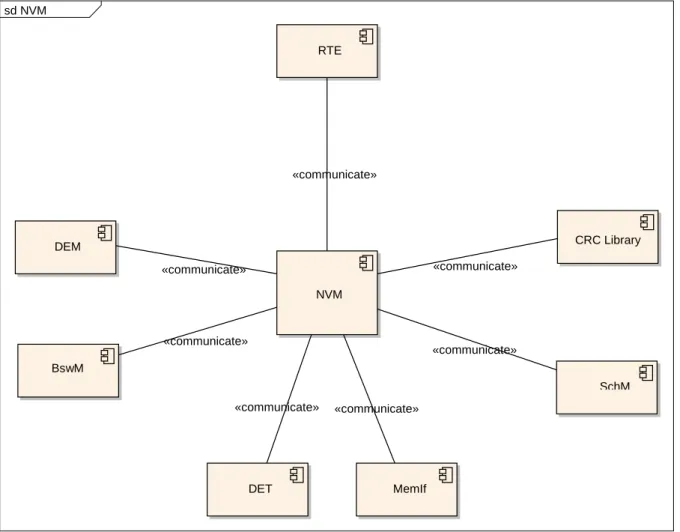
The figure below shows the communication interaction of module NvM.
Figure 3: NVRAM Manager interactions overview
7.1.2 Addressing scheme for the memory hardware abstraction
[SWS_NvM_00051] ⌈The Memory Abstraction Interface, the underlying Flash
EEPROM Emulation and EEPROM Abstraction Layer provide the NvM module with a virtual linear 32bit address space which is composed of a 16bit block number and a 16bit block address offset.⌋ (SRS_Mem_00041, SRS_Mem_08000,
SRS_Mem_08014, SRS_Mem_00016, SRS_Mem_00017, SRS_Mem_00018) Hint: According to [SWS_NvM_00051], the NvM module allows for a (theoretical) maximum of 65536 logical blocks, each logical block having a (theoretical) maximum size of 64 Kbytes. sd NVM Overview NVM DEM CRC Library MemIf SchM BswM RTE DET «communicate» «communicate» «communicate» «communicate» «communicate» «communicate» «communicate»
26 of 202 Document ID 33: AUTOSAR_SWS_NVRAMManager
[SWS_NvM_00122] ⌈The NvM module shall further subdivide the 16bit Fee/Ea block number into the following parts:
NV block base number (NVM_NV_BLOCK_BASE_NUMBER) with a bit width of (16 -NVM_DATASET_SELECTION_BITS)
Data index with a bit width of (NVM_DATASET_SELECTION_BITS)
⌋ (SRS_Mem_00041, SRS_Mem_08014, SRS_Mem_00016, SRS_Mem_00017, SRS_Mem_00018)
[SWS_NvM_00343] ⌈Handling/addressing of redundant NVRAM blocks shall be done towards the memory hardware abstraction in the same way like for dataset NVRAM blocks, i.e. the redundant NV blocks shall be managed by usage of the configuration parameter NvMDatasetSelectionBits. ⌋ ( )
[SWS_NvM_00123] ⌈The NV block base number
(NVM_NV_BLOCK_BASE_NUMBER) shall be located in the most significant bits of the Fee/Ea block number. ⌋ (SRS_Mem_08000)
[SWS_NvM_00442] ⌈The configuration tool shall configure the block identifiers. ⌋ (SRS_Mem_08000, SRS_Mem_00027, SRS_Mem_08014)
[SWS_NvM_00443] ⌈The NvM module shall not modify the configured block identifiers. ⌋ ( )
7.1.2.1 Examples
To clarify the previously described addressing scheme which is used for NVRAM manager memory hardware abstraction interaction, the following examples shall help to understand the correlations between the configuration parameters
NvMNvBlockBaseNumber, NvMDatasetSelectionBits on NVRAM manager side and EA_BLOCK_NUMBER / FEE_BLOCK_NUMBER on memory hardware abstraction side [ECUC_NvM_00061].
For the given examples A and B a simple formula is used:
FEE/EA_BLOCK_NUMBER = (NvMNvBlockBaseNumber << NvMDatasetSelectionBits)
+ DataIndex.
Example A:
The configuration parameter NvMDatasetSelectionBits is configured to be 2. This leads to the result that 14 bits are available as range for the configuration parameter NvMNvBlockBaseNumber.
Range of NvMNvBlockBaseNumber: 0x1..0x3FFE
Range of data index: 0x0..0x3(=2^NvMDatasetSelectionBits-1)
Range of FEE_BLOCK_NUMBER/EA_BLOCK_NUMBER: 0x4..0xFFFB With this configuration the FEE/EA_BLOCK_NUMBER computes using the formula mentioned before should look like in the examples below:
For a native NVRAM block with NvMNvBlockBaseNumber = 2:
27 of 202 Document ID 33: AUTOSAR_SWS_NVRAMManager
For a redundant NVRAM block with NvMNvBlockBaseNumber = 3:
1st NV block with data index 0 is accessed with FEE/EA_BLOCK_NUMBER = 12
2nd NV block with data index 1 is accessed with FEE/EA_BLOCK_NUMBER = 13
For a dataset NVRAM block with NvMNvBlockBaseNumber = 4, NvMNvBlockNum = 3:
NV block #0 with data index 0 is accessed with FEE/EA_BLOCK_NUMBER = 16
NV block #1 with data index 1 is accessed with FEE/EA_BLOCK_NUMBER = 17
NV block #2 with data index 2 is accessed with FEE/EA_BLOCK_NUMBER = 18
Example B:
The configuration parameter NvMDatasetSelectionBits is configured to be 4. This leads to the result that 12 bits are available as range for the configuration parameter NvMNvBlockBaseNumber.
Range of NvMNvBlockBaseNumber: 0x1..0xFFE
Range of data index: 0x0..0xF(=2^NvMDatasetSelectionBits-1)
Range of FEE/EA Block Number: 0x10..0xFFEF
7.1.3 Basic storage objects 7.1.3.1 NV block
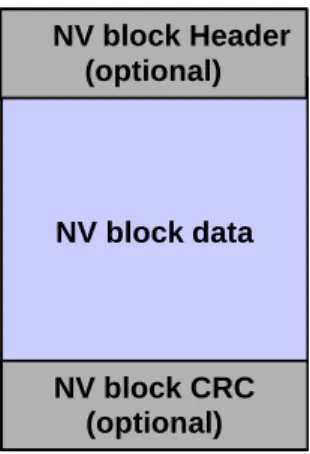
[SWS_NvM_00125] ⌈The NV block is a basic storage object and represents a memory area consisting of NV user data and (optionally) a CRC value and (optionally) a NV block header.
NV block data NV block CRC (optional) NV Block NV block data NV block CRC (optional) NV block CRC (optional) NV block CRC (optional) NV block Header (optional) NV block data NV block CRC (optional) NV block CRC (optional) NV Block NV block data NV block CRC (optional) NV block CRC (optional) NV block CRC (optional) NV block CRC (optional) NV block CRC (optional) NV block Header (optional) NV block CRC (optional) NV block Header (optional)
Figure 4: NV Block layout
Note: This figure does not show the physical memory layout of an NV block. Only the logical clustering is shown. ⌋ ( )
28 of 202 Document ID 33: AUTOSAR_SWS_NVRAMManager
7.1.3.2 RAM block
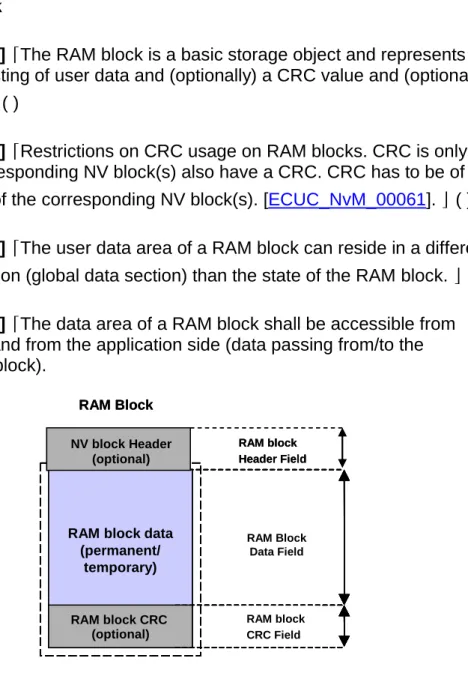
[SWS_NvM_00126] ⌈The RAM block is a basic storage object and represents an area in RAM consisting of user data and (optionally) a CRC value and (optionally) a NV block header. ⌋ ( )
[SWS_NvM_00127] ⌈Restrictions on CRC usage on RAM blocks. CRC is only available if the corresponding NV block(s) also have a CRC. CRC has to be of the same type as that of the corresponding NV block(s). [ECUC_NvM_00061]. ⌋ ( ) [SWS_NvM_00129] ⌈The user data area of a RAM block can reside in a different RAM address location (global data section) than the state of the RAM block. ⌋ ( ) [SWS_NvM_00130] ⌈The data area of a RAM block shall be accessible from NVRAM Manager and from the application side (data passing from/to the corresponding NV block).
RAM block data (permanent/ temporary) RAM block CRC (optional) RAM Block Data Field RAM block CRC Field RAM Block
RAM block data (permanent/ temporary) RAM block CRC (optional) RAM Block Data Field RAM block CRC Field NV block Header (optional) RAM block Header Field
RAM block data (permanent/ temporary) RAM block CRC (optional) RAM Block Data Field RAM block CRC Field RAM Block
RAM block data (permanent/ temporary) RAM block CRC (optional) RAM Block Data Field RAM block CRC Field NV block Header (optional) RAM block Header Field
Figure 5: RAM Block layout
Note: This figure does not show the physical memory layout of a RAM block. Only the logical clustering is shown.
As the NvM module doesn’t support alignment, this could be managed by configuration, i.e. the block length could be enlarged by adding padding to meet alignment requirements. ⌋ ( )
[SWS_NvM_00373] ⌈The RAM block data shall contain the permanently or temporarily assigned user data. ⌋ ( )
[SWS_NvM_00370] ⌈In case of permanently assigned user data, the address of the RAM block data is known during configuration time. ⌋ ( )
29 of 202 Document ID 33: AUTOSAR_SWS_NVRAMManager
[SWS_NvM_00372] ⌈In case of temporarily assigned user data, the address of the RAM block data is not known during configuration time and will be passed to the NvM module during runtime. ⌋ ( )
[SWS_NvM_00088] ⌈It shall be possible to allocate each RAM block without address constraints in the global RAM area. The whole number of configured RAM blocks needs not be located in a continuous address space. ⌋ ( )
7.1.3.3 ROM block
[SWS_NvM_00020] ⌈The ROM block is a basic storage object, resides in the ROM (FLASH) and is used to provide default data in case of an empty or damaged NV block.
ROM Block
ROM block data (default data)
ROM Block
ROM block data (default data)
Figure 6: ROM block layout
⌋ ( )
7.1.3.4 Administrative block
[SWS_NvM_00134] ⌈The Administrative block shall be located in RAM and shall contain a block index which is used in association with Dataset NV blocks.
Additionally, attribute/error/status information of the corresponding NVRAM block shall be contained. ⌋ ( )
[SWS_NvM_00128] ⌈ The NvM module shall use state information of the permanent RAM block or of the RAM mirror in the NvM module in case of explicit syncronization (invalid/valid) to determine the validity of the permanent RAM block user data.⌋ ( ) [SWS_NvM_00132] ⌈The RAM block state ”invalid“ indicates that the data area of the respective RAM block is invalid. The RAM block state “valid“ indicates that the data area of the respective RAM block is valid. ⌋ (SRS_Mem_08547)
[SWS_NvM_00133] ⌈The value of “invalid” shall be represented by all other values except “valid”. ⌋ ( )
30 of 202 Document ID 33: AUTOSAR_SWS_NVRAMManager
[SWS_NvM_00135] ⌈The Administrative block shall be invisible for the application and is used exclusively by the NvM module for security and administrative purposes of the RAM block and the NVRAM block itself. ⌋ ( )
[SWS_NvM_00054] ⌈The NvM module shall use an attribute field to manage the NV block write protection in order to protect/unprotect a NV block data field. ⌋ ( )
[SWS_NvM_00136] ⌈The NvM module shall use an error/status field to manage the error/status value of the last request [SWS_NvM_00083]. ⌋ ( )
7.1.3.5 NV Block Header
[SWS_NvM_00522] ⌈The NV Block header shall be included first in the NV Block, if the mechanism Static Block ID is enabled.
NV block data NV Block NV block header NV block CRC (optional) NV block data NV Block NV block header NV block CRC (optional)
Figure 7: NV block layout with Static Block ID enabled
31 of 202 Document ID 33: AUTOSAR_SWS_NVRAMManager
7.1.4 Block management types
7.1.4.1 Block management types overview
[SWS_NvM_00137] ⌈The following types of NVRAM storage shall be supported by the NvM module implementation:
NVM_BLOCK_NATIVE
NVM_BLOCK_REDUNDANT
NVM_BLOCK_DATASET⌋ ( )
[SWS_NvM_00557] ⌈NVM_BLOCK_NATIVE type of NVRAM storage shall consist of the following basic storage objects:
NV Blocks: 1
RAM Blocks: 1
ROM Blocks: 0..1
Administrative Blocks:1⌋ ( )
[SWS_NvM_00558] ⌈NVM_BLOCK_REDUNDANT type of NVRAM storage shall consist of the following basic storage objects:
NV Blocks: 2
RAM Blocks: 1
ROM Blocks: 0..1
Administrative Blocks:1⌋ ( )
[SWS_NvM_00559] ⌈NVM_BLOCK_DATASET type of NVRAM storage shall consist of the following basic storage objects:
NV Blocks: 1..(m<256)*
RAM Blocks: 1
ROM Blocks: 0..n
Administrative Blocks:1
* The number of possible datasets depends on the configuration parameter NvMDatasetSelectionBits. ⌋ ( )
7.1.4.2 NVRAM block structure
[SWS_NvM_00138] ⌈The NVRAM block shall consist of the mandatory basic storage objects NV block, RAM block and Administrative block. ⌋ ( )
[SWS_NvM_00139] ⌈The basic storage object ROM block is optional. ⌋ ( ) [SWS_NvM_00140] ⌈The composition of any NVRAM block is fixed during configuration by the corresponding NVRAM block descriptor. ⌋ ( )
32 of 202 Document ID 33: AUTOSAR_SWS_NVRAMManager
[SWS_NvM_00141] ⌈All address offsets are given relatively to the start addresses of RAM or ROM in the NVRAM block descriptor. The start address is assumed to be zero.
Hint: A device specific base address or offset will be added by the respective device driver if needed. ⌋ ( )
For details of the NVRAM block descriptor see chapter 7.1.4.3.
7.1.4.3 NVRAM block descriptor table
[SWS_NvM_00069] ⌈A single NVRAM block to deal with will be selected via the NvM module API by providing a subsequently assigned Block ID. ⌋ ( )
[SWS_NvM_00143] ⌈All structures related to the NVRAM block descriptor table and their addresses in ROM (FLASH) have to be generated during configuration of the NvM module. ⌋ ( )
7.1.4.4 Native NVRAM block
The Native NVRAM block is the simplest block management type. It allows storage to/retrieval from NV memory with a minimum of overhead.
[SWS_NvM_00000] ⌈The Native NVRAM block consists of a single NV block, RAM block and Administrative block. ⌋ ( )
7.1.4.5 Redundant NVRAM block
In addition to the Native NVRAM block, the Redundant NVRAM block provides enhanced fault tolerance, reliability and availability. It increases resistance against data corruption.
[SWS_NvM_00001] ⌈The Redundant NVRAM block consists of two NV blocks, a RAM block and an Administrative block.
33 of 202 Document ID 33: AUTOSAR_SWS_NVRAMManager NV block data NV Block NV block header (optional) NV block CRC (optional) NV block data NV Block NV block header (optional) NV block CRC (optional) NV block data NV Block NV block header (optional) NV block CRC (optional) NV block data NV Block NV block header (optional) NV block CRC (optional)
Figure 8: Redundant NVRAM Block layout
Note: This figure does not show the physical NV memory layout of a redundant NVRAM block. Only the logical clustering is shown. ⌋ ( )
[SWS_NvM_00531] ⌈In case one NV Block associated with a Redundant NVRAM block is deemed invalid (e.g. during read), an attempt shall be made to recover the NV Block using data from the incorrupt NV Block.⌋()
[SWS_NvM_00546] ⌈In case the recovery fails then this shall be reported to the DEM using the code NVM_E_LOSS_OF_REDUNDANCY.
Note: “Recovery” denotes the re-establishment of redundancy. This usually means writing the recovered data back to the NV Block.⌋()
7.1.4.6 Dataset NVRAM block
The Dataset NVRAM block is an array of equally sized data blocks (NV/ROM). The application can at one time access exactly one of these elements.
34 of 202 Document ID 33: AUTOSAR_SWS_NVRAMManager
[SWS_NvM_00006] ⌈The Dataset NVRAM block consists of multiple NV user data, (optionally) CRC areas, (optional) NV block headers, a RAM block and an
Administrative block. ⌋ ( )
[SWS_NvM_00144] ⌈The index position of the dataset is noticed via a separated field in the corresponding Administrative block. ⌋ ( )
[SWS_NvM_00374] ⌈The NvM module shall be able to read all assigned NV blocks.
⌋ ( )
[SWS_NvM_00375] ⌈The NvM module shall only be able to write to all assigned NV blocks if (and only if) write protection is disabled. ⌋ ( )
[SWS_NvM_00146] ⌈If the basic storage object ROM block is selected as optional part, the index range which normally selects a dataset is extended to the ROM to make it possible to select a ROM block instead of a NV block. The index covers all NV/ROM blocks which may build up the NVRAM Dataset block. ⌋ ( )
[SWS_NvM_00376] ⌈The NvM module shall be able to only read optional ROM blocks (default datasets). ⌋ ( )
[SWS_NvM_00377] ⌈The NvM module shall treat a write to a ROM block like a write to a protected NV block. ⌋ ( )
[SWS_NvM_00444] ⌈The total number of configured datasets (NV+ROM blocks) must be in the range of 1..255. ⌋ ( )
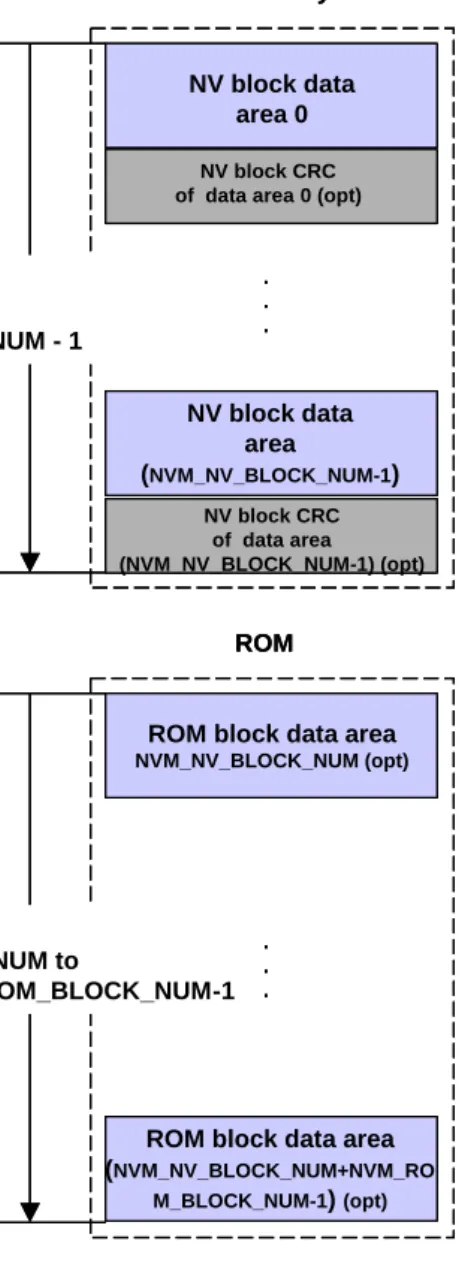
[SWS_NvM_00445] ⌈In case of optional ROM blocks, data areas with an index from 0 up to NvMNvBlockNum - 1 represent the NV blocks with their CRC in the NV memory. Data areas with an index from NvMNvBlockNum up to NvMNvBlockNum + NvMRomBlockNum - 1 represent the ROM blocks.
35 of 202 Document ID 33: AUTOSAR_SWS_NVRAMManager
Figure 9: Dataset NVRAM block layout
Note: This figure does not show the physical NV memory layout of a Dataset NVRAM block. Only the logical clustering is shown. ⌋ ( )
7.1.4.7 NVRAM Manager API configuration classes
[SWS_NvM_00149] ⌈To have the possibility to adapt the NvM module to limited hardware resources, three different API configuration classes shall be defined:
API configuration class 3: All specified API calls are available. A maximum of functionality is supported.
API configuration class 2: An intermediate set of API calls is available.
API configuration class 1: Especially for matching systems with very limited hardware resources this API configuration class offers only a minimum set of API calls which are required in any case. ⌋ ( )
NV memory
NV block data area 0
NV block CRC of data area 0 (opt)
. . . index 0 to NVM_NV_BLOCK_NUM - 1 NV block data area (NVM_NV_BLOCK_NUM-1) NV block CRC of data area (NVM_NV_BLOCK_NUM-1) (opt)
ROM block data area
NVM_NV_BLOCK_NUM (opt) . . . index NVM_NV_BLOCK_NUM to NVM_NV_BLOCK_NUM+NVM_ROM_BLOCK_NUM-1
ROM block data area (NVM_NV_BLOCK_NUM+NVM_RO M_BLOCK_NUM-1) (opt) ROM NV memory NV block data area 0 NV block CRC of data area 0 (opt)
. . . index 0 to NVM_NV_BLOCK_NUM - 1 NV block data area (NVM_NV_BLOCK_NUM-1) NV block CRC of data area (NVM_NV_BLOCK_NUM-1) (opt)
ROM block data area
NVM_NV_BLOCK_NUM (opt) . . . index NVM_NV_BLOCK_NUM to NVM_NV_BLOCK_NUM+NVM_ROM_BLOCK_NUM-1
ROM block data area (NVM_NV_BLOCK_NUM+NVM_RO
M_BLOCK_NUM-1) (opt)
36 of 202 Document ID 33: AUTOSAR_SWS_NVRAMManager
[SWS_NvM_00560] ⌈API configuration class 3 shall consist of the following API: Type 1: NvM_SetDataIndex(...) NvM_GetDataIndex(...) NvM_SetBlockProtection(...) NvM_GetErrorStatus(...) NvM_SetRamBlockStatus(...) NvM_SetBlockLockStatus() Type 2: NvM_ReadBlock(...) NvM_WriteBlock(...) NvM_RestoreBlockDefaults(...) NvM_EraseNvBlock(...) NvM_InvalidateNvBlock(...) NvM_CancelJobs(…) NvM_ReadPRAMBlock(...) NvM_WritePRAMBlock(...) NvM_RestorePRAMBlockDefaults(...) Type 3: NvM_ReadAll(...) NvM_WriteAll(...) NvM_CancelWriteAll(...) NvM_ValidateAll(...) NvM_FirstInitAll(…) Type 4: NvM_Init(...)⌋ ( )
[SWS_NvM_00561] ⌈API configuration class 2 shall consist of the following API: Type 1: NvM_SetDataIndex(...) NvM_GetDataIndex(...) NvM_GetErrorStatus(...) NvM_SetRamBlockStatus(...) NvM_SetBlockLockStatus(...) Type 2: NvM_ReadBlock(...) NvM_WriteBlock(...) NvM_RestoreBlockDefaults(...) NvM_CancelJobs(…) NvM_ReadPRAMBlock(...) NvM_WritePRAMBlock(...) NvM_RestorePRAMBlockDefaults(...) Type 3: NvM_ReadAll(...) NvM_WriteAll(...) NvM_CancelWriteAll(...)
37 of 202 Document ID 33: AUTOSAR_SWS_NVRAMManager
NvM_ValidatedAll(...) Type 4:
NvM_Init(...)⌋ ( )
[SWS_NvM_00562] ⌈API configuration class 1 shall consist of the following API: Type 1: NvM_GetErrorStatus(...) NvM_SetRamBlockStatus(...) NvM_SetBlockLockStatus(...) Type 2: -- Type 3: NvM_ReadAll(...) NvM_WriteAll(...) NvM_CancelWriteAll(...) Type 4: NvM_Init(...)
Note: For API configuration class 1 no queues are needed, no immediate data can be written. Furthermore the API call NvM_SetRamBlockStatus is only available if configured by NvMSetRamBlockStatusApi. ⌋ ( )
[SWS_NvM_00365] ⌈Within API configuration class 1, the block management type
NVM_BLOCK_DATASET is not supported. ⌋ ( )
For information regarding the definition of Type 1…4 refer to chapter 8.1.5.
[SWS_NvM_00150] ⌈The NvM module shall only contain that code that is needed to handle the configured block types. ⌋ ( )
7.1.5 Scan order / priority scheme
[SWS_NvM_00032] ⌈The NvM module shall support a priority based job processing.
⌋ (SRS_Mem_08542)
[SWS_NvM_00564] ⌈By configuration parameter NvMJobPrioritization
[SWS_NvM_00028] priority based job processing shall be enabled/disabled. ⌋ (SRS_Mem_08542)
[SWS_NvM_00378] ⌈In case of priority based job processing order, the NvM module shall use two queues, one for immediate write jobs (crash data) another for all other jobs (including immediate read/erase jobs). ⌋ (SRS_Mem_08542)
38 of 202 Document ID 33: AUTOSAR_SWS_NVRAMManager
[SWS_NvM_00379] ⌈If priority based job processing is disabled via configuration, the NvM module shall not support immediate write jobs. In this case, the NvM module processes all jobs in FCFS order. ⌋ ( )
[SWS_NvM_00380] ⌈The job queue length for multi block requests originating from any of the NvM_ReadAll, NvM_ValidateAll, NvM_FirstInitAll and NvM_WriteAll APIs shall be one (only one multi block job is queued).⌋ ( )
[SWS_NvM_00381] ⌈The NvM module shall not interrupt jobs originating from the NvM_ReadAll request by other requests. ⌋ ( )
Note: The only exception to the rule given in [SWS_NvM_00381, SWS_NvM_00567] is a write job with immediate priority which shall preempt the running read / write job [ SWS_NvM_00182 ]. The preempted job shall subsequently be resumed / restarted by the NvM module.
[SWS_NvM_00567] ⌈The NvM module shall not interrupt jobs originating from the NvM_WriteAll request by other requests. ⌋ ( )
[SWS_NvM_00568] ⌈The NvM module shall rather queue read jobs that are requested during an ongoing NvM_ReadAll request and executed them subsequently. ⌋ ( )
[SWS_NvM_00569] ⌈The NvM module shall rather queue write jobs that are requested during an ongoing NvM_WriteAll request and executed them subsequently. ⌋ ( )
[SWS_NvM_00725] ⌈The NvM module shall rather queue write jobs that are requested during an ongoing NvM_ReadAll request and executed them subsequently. ⌋ ( )
[SWS_NvM_00726] ⌈The NvM module shall rather queue read jobs that are requested during an ongoing NvM_WriteAll request and executed them subsequently. ⌋ ( )
Note: The NvM_WriteAll request can be aborted by calling NvM_CancelWriteAll. In this case, the current block is processed completely but no further blocks are written [SWS_NvM_00238].
Hint: It shall be allowed to dequeue requests, if they became obsolete by completion of the regarding NVRAM block.
[SWS_NvM_00570] ⌈The preempted job shall subsequently be resumed / restarted by the NvM module. This behavior shall apply for single block requests as well as for multi block requests. ⌋ ( )
39 of 202 Document ID 33: AUTOSAR_SWS_NVRAMManager
7.2 General behavior
7.2.1 Functional requirements
[SWS_NvM_00383] ⌈For each asynchronous request, a notification of the caller after completion of the job shall be a configurable option. ⌋ ( )
[SWS_NvM_00384] ⌈The NvM module shall provide a callback interface SWS_NvM_00113.
Hint: The NvM module’s environment shall access the non-volatile memory via the NvM module only. It shall not be allowed for any module (except for the NvM module) to access the non-volatile memory directly. ⌋ (SRS_Mem_08541)
[SWS_NvM_00038] ⌈The NvM module only provides an implicit way of accessing blocks in the NVRAM and in the shared memory (RAM). This means, the NvM module copies one or more blocks from NVRAM to the RAM and the other way round. ⌋ ( )
[SWS_NvM_00692] ⌈The application accesses the RAM data directly, with respect to given restrictions (e.g. synchronization). ⌋ ( )
[SWS_NvM_00385] ⌈The NvM module shall queue all asynchronous “single block” read/write/control requests if the block with its specific ID is not already queued or currently in progress (multitasking restrictions). ⌋ ( )
[SWS_NvM_00386] ⌈The NvM module shall accept multiple asynchronous “single block” requests as long as no queue overflow occurs. ⌋ ( )
[SWS_NvM_00155] ⌈The highest priority request shall be fetched from the queues by the NvM module and processed in a serialized order. ⌋ ( )
[SWS_NvM_00040] ⌈The NvM module shall implement implicit mechanisms for consistency / integrity checks of data saved in NV memory [SWS_NvM_00165]. ⌋ ( ) Depending on implementation of the memory stack, callback routines provided and/or invoked by the NvM module may be called in interrupt context.
Hint: The NvM module providing routines called in interrupt context has therefore to make sure that their runtime is reasonably short.
[SWS_NvM_00085] ⌈If there is no default ROM data available at configuration time or no callback defined by NvMInitBlockCallback then the application shall be
40 of 202 Document ID 33: AUTOSAR_SWS_NVRAMManager
In this case, the application has to use NvM_GetErrorStatus() to be able to distinguish [ECUC_NvM_00061] between first initialization and corrupted data [SWS_NvM_00083]. ⌋ ( )
[SWS_NvM_00387] ⌈During processing of NvM_ReadAll, the NvM module shall be able to detect corrupted RAM data by performing a checksum calculation.
[ECUC_NvM_00476]. ⌋ ( )
[SWS_NvM_00226] ⌈During processing of NvM_ReadAll, the NvM module shall be able to detect invalid RAM data by testing the validity of a data within the
administrative block [ECUC_NvM_00476]. ⌋ ( )
[SWS_NvM_00388] ⌈During startup phase and normal operation of NvM_ReadAll and if the NvM module has detected an unrecoverable error within the NV block, the NvM module shall copy default data (if configured) to the corresponding RAM block.
⌋ ( )
[SWS_NvM_00332] ⌈To make use of the OS services, the NvM module shall only use the BSW scheduler instead of directly making use of OS objects and/or related OS services. ⌋ (SRS_BSW_00429)
7.2.2 Design notes
7.2.2.1 NVRAM manager startup
[SWS_NvM_00693] ⌈NvM_Init shall be invoked by the BSW Mode Manager exclusively. ⌋ ( )
[SWS_NvM_00091] ⌈Due to strong constraints concerning the ECU startup time, the NvM_Init request shall not contain the initialization of the configured NVRAM blocks.
⌋ ( )
[SWS_NvM_00157] ⌈The NvM_Init request shall not be responsible to trigger the initialization of underlying drivers and memory hardware abstraction. This shall also be handled by the BSW Mode Manager. ⌋ (SRS_Mem_00011)
[SWS_NvM_00158] ⌈The initialization of the RAM data blocks shall be done by another request, namely NvM_ReadAll. ⌋ ( )
NvM_ReadAll shall be called exclusively by BSW Mode Manager.
[SWS_NvM_00694] ⌈Software components which use the NvM module shall be responsible for checking global error/status information resulting from the NvM
41 of 202 Document ID 33: AUTOSAR_SWS_NVRAMManager
module startup. The BSW Mode Manager shall use polling by using
NvM_GetErrorStatus [SWS_NvM_00015] (reserved block ID 0) or callback notification (configurable option NvM_MultiBlockCallback [SWS_NvM_00028]) to derive global error/status information resulting from startup. If polling is used, the end of the NVRAM startup procedure shall be detected by the global error/status
NVM_REQ_OK or NVM_REQ_NOT_OK (during startup NVM_REQ_PENDING) [SWS_NvM_00083]. If callbacks are chosen for notification, software components shall be notified automatically if an assigned NVRAM block has been processed [SWS_NvM_00281].
Note 1: If callbacks are configured for each NVRAM block which is processed within NvM_ReadAll, they can be used by the RTE to start e.g. SW-Cs at an early point of time.
Note 2: To ensure that the DEM is fully operational at an early point of time, i.e. its NV data is restored to RAM, DEM related NVRAM blocks should be configured to have a low ID to be processed first within NvM_ReadAll. ⌋ ( )
[SWS_NvM_00160] ⌈The NvM module shall not store the currently used Dataset index automatically in a persistent way.
Software components shall check the specific error/status of all blocks they are responsible for by using NvM_GetErrorStatus [SWS_NvM_00015] with specific block IDs to determine the validity of the corresponding RAM blocks. ⌋ ( )
[SWS_NvM_00695] ⌈For all blocks of the block management type “NVRAM Dataset” [SWS_NvM_00006] the software component shall be responsible to set the proper index position by NvM_SetDataIndex [SWS_NvM_00014]. E.g. the current index position can be stored/maintained by the software component in a unique NVRAM block. To get the current index position of a “Dataset Block”, the software component shall use the NvM_GetDataIndex [SWS_NvM_00021] API call. ⌋ ( )
7.2.2.2 NVRAM manager shutdown
[SWS_NvM_00092] ⌈The basic shutdown procedure shall be done by the request NvM_WriteAll [SWS_NvM_00018].
Hint: NvM_WriteAll shall be invoked by the BSW Mode Manager. ⌋ ( )
7.2.2.3 (Quasi) parallel write access to the NvM module
[SWS_NvM_00162] ⌈The NvM module shall receive the requests via an
asynchronous interface using a queuing mechanism. The NvM module shall process all requests serially depending on their priority. ⌋ (SRS_Mem_00013,
42 of 202 Document ID 33: AUTOSAR_SWS_NVRAMManager
7.2.2.4 NVRAM block consistency check
[SWS_NvM_00164] ⌈The NvM module shall provide implicit techniques to check the data consistency of NVRAM blocks [ECUC_NvM_00476], [SWS_NvM_00040]. ⌋ (SRS_Mem_08547, SRS_Mem_00030)
[SWS_NvM_00571] ⌈The data consistency check of a NVRAM block shall be done by CRC recalculations of its corresponding NV block(s). ⌋ (SRS_Mem_08547) [SWS_NvM_00165] ⌈The implicit way of a data consistency check shall be provided by configurable options of the internal functions. The implicit consistency check shall be configurable for each NVRAM block and depends on the configurable parameters
NvMBlockUseCrc and NvMCalcRamBlockCrc [ECUC_NvM_00061]. ⌋ (SRS_Mem_08547, SRS_Mem_00129)
[SWS_NvM_00724] ⌈NvMBlockUseCrc should be enabled for NVRAM blocks where NvMWriteBlockOnce = TRUE. NvMBlockWriteProt should be disabled for NVRAM blocks where NvMWriteBlockOnce = TRUE, to enable the user to write data to the NVRAM block in case of CRC check is failed. ⌋ ( )
[SWS_NvM_00544] ⌈Depending on the configurable parameters NvMBlockUseCrc
and NvMCalcRamBlockCrc, NvM module shall allocate memory for the largest CRC used.
Hint: NvM users must not know anything about CRC memory (e.g. size, location) for their data in a RAM block. ⌋ ( )
7.2.2.5 Error recovery
[SWS_NvM_00047] ⌈The NvM module shall provide techniques for error recovery. The error recovery depends on the NVRAM block management type
[SWS_NvM_00001]. ⌋ ( )
[SWS_NvM_00389] ⌈The NvM module shall provide error recovery on read for every kind of NVRAM block management type by loading of default values. ⌋ ( )
[SWS_NvM_00390] ⌈The NvM module shall provide error recovery on read for NVRAM blocks of block management type NVM_BLOCK_REDUNDANT by loading the RAM block with default values.⌋()
[SWS_NvM_00168] ⌈The NvM module shall provide error recovery on write by performing write retries regardless of the NVRAM block management type. ⌋()