Measuring Integrity on Mobile Phone Systems
Divya Muthukumaran
Systems and Internet Infrastructure Security
Laboratory
Pennsylvania State University University Park, PA 16802
[email protected]
Anuj Sawani
Systems and Internet Infrastructure SecurityLaboratory
Pennsylvania State University University Park, PA 16802
[email protected]
Joshua Schiffman
Systems and Internet Infrastructure SecurityLaboratory
Pennsylvania State University University Park, PA 16802
[email protected]
Brian M. Jung
Secure Systems Group Samsung Electronics Co., Ltd.
Suwon-City, Gyeonggi-Do, Korea, 443-742
[email protected]
Trent Jaeger
Systems and Internet Infrastructure SecurityLaboratory
Pennsylvania State University University Park, PA 16802
[email protected]
ABSTRACT
Mobile phone security is a relatively new field that is gather-ing momentum in the wake of rapid advancements in phone system technology. Mobile phones are now becoming so-phisticated smart phones that provide services beyond ba-sic telephony, such as supporting third-party applications. Such third-party applications may be security-critical, such as mobile banking, or may be untrusted applications, such as downloaded games. Our goal is to protect the integrity of such critical applications from potentially untrusted func-tionality, but we find that existing mandatory access con-trol approaches are too complex and do not provide formal integrity guarantees. In this work, we leverage the sim-plicity inherent to phone system environments to develop a compact SELinux policy that can be used to justify the integrity of a phone system using the Policy Reduced In-tegrity Measurement Architecture (PRIMA) approach. We show that the resultant policy enables systems to be proven secure to remote parties, enables the desired functionality for installing and running trusted programs, and the resul-tant SELinux policy is over 90% smaller in size. We envision that this approach can provide an outline for how to build high integrity phone systems.
Categories and Subject Descriptors
D.4.6 [Operating Systems]: Security and Protection — Access Control
Permission to make digital or hard copies of all or part of this work for personal or classroom use is granted without fee provided that copies are not made or distributed for profit or commercial advantage and that copies bear this notice and the full citation on the first page. To copy otherwise, to republish, to post on servers or to redistribute to lists, requires prior specific permission and/or a fee.
SACMAT’08,June 11–13, 2008, Estes Park, Colorado, USA. Copyright 2008 ACM 978-1-60558-129-3/08/06 ...$5.00.
General Terms
SecurityKeywords
Integrity Measurement, Mobile Phones, SELinux
1.
INTRODUCTION
Cellular communication is changing. Mobile phones have become smaller, lighter, and more powerful, and support a wide variety of applications, including text messaging, e-mail, web surfing and even multimedia transmissions. Smart phones that are a hybrid of cell phones and PDAs that can handle voice and data communications, in essence function-ing as a ”tiny computer.” This transformation motivated the transition from small, custom operating environments to more powerful, general purpose environments that are based on personal computer environments, such as Windows Mobile [33] and Linux phone OS projects [19, 23].
Third-party developers now provide many multimedia ap-plications that users can easily download onto these powerful new phones. The flexibility of supporting third-party appli-cations presents security concerns for other appliappli-cations that handle critical user data. For example, mobile banking ap-plications have been created for such phones [2], providing attackers with a valuable target. Worm attacks [16, 4] have been launched against the market-leading Symbian mobile platform [27], a variety of vulnerabilities on this platform have been identified [7, 29], and a large number of users (over 5 million in March 2006 [11]) download freeware games (i.e., potential malware) to their mobile devices. As a result, it seems likely that mobile phones, including Linux and Win-dows phones, will become targets for a variety of malware.
Security architectures for phone systems are emerging, but they make no concrete effort to justify critical application integrity. The Symbian security architecture distinguishes between its installer, critical applications, and untrusted ap-plications. The Symbian approach has been effective at pro-tecting its kernel, but some critical resources, such as phone
contacts and Bluetooth pairing information, can be compro-mised by untrusted applications [24]. A mandatory access control framework has been developed for Linux, the Linux Security Modules (LSM) framework [34], but LSM-based ap-proaches (e.g., SELinux [22] and AppArmor [21]) do not en-sure integrity. The SELinux LSM focuses on enforcingleast privilege, and its policies on personal computer systems are too complex to understand integrity completely. The Ap-pArmor LSM focuses on confining network-facing daemons, which may prevent integrity problems from untrusted net-work requests, but not from untrusted programs running on the system.
Our goal is to protect the integrity of critical phone ap-plications from the untrusted code and data of downloaded third-party applications. The mobile banking application above is one critical phone application. The aim is to install and execute such trusted applications under the control of a phone policy for which precise integrity guarantees can be made. We believe that mandatory access control policies are the foundation for providing such guarantees, but the policies developed thusfar are inadequate because they are too complex or are focused on the wrong goal.
In this paper, we define a MAC policy for a Linux phone system and enable a remote party to verify the integrity of our phone systems using integrity measurements. We use the SELinux LSM as the starting point, but we reduce the policy to focus on integrity goals. In designing our phone policy, we use the CW-Lite integrity model [25], a weakened, but more practical, version of the Clark-Wilson integrity model [6] to define our precise integrity goals. Focusing on integrity, we find that the SELinux LSM policy can be re-duced dramatically, by over 90% in size thusfar, although we believe that much greater reductions are possible. We also show that the resultant policy is suitable for justifying the integrity of such critical applications to remote parties using the PRIMA integrity measurement architecture [13]. PRIMA measures the trusted code and the information flows generated by the MAC policy to ensure that the integrity of the trusted code is protected from low integrity inputs according to the CW-Lite integrity policy. We envision that this approach can provide an outline for how to build high integrity phone systems in the future.
The structure of the paper is as follows. In Section 2, we review the background of phone systems, SELinux, formal integrity models, and integrity measurement that form the basis for this work. In Section 3, we define the phone sys-tem architecture, outline our policy design goals, and show that these goals satisfy integrity requirements while permit-ting the necessary function. In Section 4, we describe the implementation of our system on an evaluation board us-ing to prototype phone software. We show how our policies are implemented, and how integrity measurements are gen-erated for this system. We also provide results showing the performance of the system, when performing integrity mea-surement. In Section 5, we specify other related work, and we conclude with Section 6.
2.
BACKGROUND
In this section, we provide background for phone systems security, SELinux, integrity models, and integrity measure-ment approaches that motivate our work.
2.1
Mobile Phone Security
Historically, mobile phone systems have been standalone devices with custom operating systems. These consumer electronics devices were installed with software in the factory and no user interfaces were provided for typical users to update the software.
As more functional, “Smart” phones began to appear, the operating system functionality requirements increased. A consortium of phone manufacturers created the Symbian op-erating system [27], a general-purpose, embedded opop-erating system targeted specifically at the phone market.
The Symbian operating system is most noteworthy for not having a known kernel compromise in its history, but it also implements an interesting security model. The Sym-bian system defines three distinct subjects: the installer, Symbian-signed subjects, and untrusted subjects [28]. Each process is assigned to one of these three subjects depending upon which of the three categories the originating program file belongs. The three subjects essentially form a Biba hier-archy with installer being the highest integrity level. How-ever, the choice of how files are assigned to integrity-levels is somewhat ambiguous. For example, some system files, such as the Bluetooth pairing database can be modified by untrusted code, permitting untrusted devices to upload files unbeknownst to the user [24]. Although we like the small number of subjects, the integrity protections provided are insufficient.
Recently, Windows and Linux-based phone systems have begun to emerge, eating into the Symbian market share, al-though it is still the operating system in over 50% of the phone devices sold. Windows and Linux systems bring both applications and security issues to the phone market. Secu-rity in the initial versions of these phones was nearly non-existent. For early Linux phones, if an attacker could get a user to download her malware to the phone, it would be trivially compromised. But, most modern phones provide users with easy mechanisms to upload new programs. As a result, many phone system vendors are seeing that they need to add security enforcement. Motorola Linux phones, such as the A1200, include a mandatory access control mod-ule called MotoAC [19] and Samsung Research has explored SELinux on phones [35].
The challenge for phone security is becoming similar to the personal computer. Do the phone system vendors provide so much flexibility that the phones become impossible to manage? Or can a model of security that permits the secure use of untrusted code be created? We explore the answers to these questions in this paper.
2.2
SELinux
SELinux is a reference monitor for the Linux operating system [22]. SELinux enforces a mandatory access control policy based on an extended Type Enforcement model [3]. The traditional TE model has subject types (e.g., processes) and object types (e.g., sockets), and access control is repre-sented by the permissions of the subject types to the object types. All objects are labeled with a type. All objects are an instance of a particular class (i.e., data type) which has its own set of operations. A permission associates a type, a class, and an operation set (a subset of the class’s opera-tions). Permissions are assigned to subject types using an
allowstatement.
SELinux also permits domain transitions that allow a cess to change its label (e.g., when it executes a new
pro-gram). Domain transitions are important because an un-privileged program could not invoke a un-privileged program without such transitions. For example, passwd would not be able to change a user’s password in the/etc/shadowfile when called from a user’s shell unless a transition permitted
passwdto invoke its own rights. Domain transitions are also relevant to security because a privileged program that does not protect itself from invocations by untrusted subjects will be a security liability to the system. In SELinux, a subject type must have atransition permission to the resultant subject type in order to effect a domain transition.
SELinux provides a fine-grained model in which virtually any policy could be defined. As a result, we believe that the SELinux model can be used to implement a policy that we can use to verify the integrity of critical phone applications. However, the development of SELinux policies to date have focused on defining least privilege permissions to contain services. Also, SELinux policies have grown to be very com-plex. A typical SELinux policy is approximately 3MB in size containing over 2000 types and between 50,000 to 100,000 permission assignments. While there have been efforts to shrink the SELinux policy, we believe that a different view of policy and function is necessary for the phone system. If we can get a simple SELinux policy that provides effective functionionality, then we might get a handle on security be-fore the phone systems get out of control. We believe that to do this we need to focus on the integrity protection of critical applications.
2.3
Integrity Models
Protecting the integrity of critical system applications has always been a goal of security practitioners. However, the in-tegrity models that have been proposed over the years seem not to match the practical environment. Our challenge in the development of phone system policies is to find a prac-tical integrity model.
The Biba integrity model [15] assigns integrity labels to processes and relates these labels in an integrity lattice. Biba integrity requires that normal processes not read data at labels of lower integrity in the lattice. Also, Biba integrity does not permit normal processes to write data at labels of higher integrity in the lattice. As such, no lower integrity data could reach our critical, high integrity application in a Biba system. Unfortunately, many critical applications, including software installers, read some low integrity data.
Efforts to allow processes to read lower integrity data without compromising their integrity have not found accep-tance either. LOMAC [8] requires that a process drop its in-tegrity level to that of the lowest inin-tegrity data it reads, but some critical phone processes, such as the telephony servers, must be permitted to accept commands from low integrity subjects, but execute at high integrity. In general, we find LOMAC too restrictive, although we implement a variant of it for software installers (see Section 4.2). Clark-Wilson integrity [6] provides a more flexible alternative, by permit-ting subjects to read low integrity data if the immediately discard or upgrade the data, but Clark-Wilson requires full formal assurance of such processes.
We have previously proposed a compromise approach to integrity, called the CW-Lite integrity model. CW-Lite is weaker than Clark-Wilson in that it doesn’t require full for-mal assurance, but CW-Lite requires processes to have fil-tering interfaces that immediately upgrade or discard low
integrity data as Clark-Wilson prescribes. The focus then moves to identifying where low integrity data may be read and ensuring that programs use filtering interfaces to read such data. We aim to apply this view of integrity to phone systems.
2.4
Integrity Measurement
Given the inherently untrustworthy nature of remote par-ties, it is desirable to be able to validate that a system is of high integrity. More specifically, there should be some guar-antee that the remote machine is only running programs that are trusted to behave properly and that the security policy is correct. A proposed method of establishing these guaran-tees uses integrity measurement [26, 17, 10, 5, 12]. Integrity measurements consist of cryptographic hashes that uniquely identify the components that define system integrity (i.e., code and data). Remote parties verify the integrity of a sys-tem by verifying that the integrity measurements taken are consistent with the remote party’s view of integrity. Such measurements are conveyed in a messages signed by an au-thority trusted to collect the measurement, and a signed integrity measurement is called anattestation.
The secure storage and reporting of these measurements are typically reliant upon a root of trust in hardware like the Trusted Computing Group’s Trusted Platform Module (TPM) [32]. This commodity cryptographic co-processor has facilities storing hash chains in a tamper-evident fash-ion. It can also securely generate public key pairs that are used to sign attestations and identify itself to remote par-ties. Samsung demonstrated a phone with a hardware TPM, called the Mobile Trusted Module [31], at the CES confer-ence in Las Vegas in January 2008 [1].
Several architectures exist to gather integrity measure-ments such as the Linux Integrity Architecture (IMA) [10]. It obtains run-time integrity measurements of all code that is memory-mapped as executable. This facilitates the detec-tion of any malware present on a system.
However, the IMA approach is too simplistic for phone systems for two reasons. First, if any untrusted code is run on the phone system, such as a third-party game, then an IMA verification will result in the entire phone being un-trusted. Second, if an attack can modify a data file used by a trusted process, then the remote party may be tricked into thinking that a compromised phone is high integrity because IMA only measures the code and static data files. We aim to enable a phone system to run some untrusted code as long as the MAC policy enables verification that the trusted code is protected from inputs from such untrusted code.
2.5
PRIMA
The Policy-Reduced Integrity Measurement Architecture (PRIMA) [13] addresses the problem of run-time integrity measurements by additionally measuring the implied infor-mation flows between processes from the system’s security policy. This way, a verifier can prove that trusted com-ponents in the system are isolated from untrusted and po-tentially harmful inputs. Moreover, PRIMA’s CW-Lite in-tegrity enforcement model only requires the trusted portions of a system to be measured and thus reduces the number of measurements required to verify a system.
In addition to the basic integrity measurements of code and static data, we identify the following set of measure-ments necessary for a remote party to verify CW-Lite
in-Trusted Program
Untrusted Program
Installer
Operating System Kernel MAC Enforcement PRIMA CRTM Root of Trust Measurement Operating System System Services Applications
Figure 1: Software architecture for a phone system tegrity:
1. MAC Policy: The mandatory access control (MAC) policy determines the system information flows. 2. Trusted Subjects: The set oftrustedsubjects (TCB)
that interact with the target application is measured. The remote party must agree that this set contains only subjects that it trusts as well.
3. Code-Subject Mapping: For all code measured, record the runtime mapping between the code and the subject type under which it is loaded. For example,ls
may be run by normal users or trusted administrators; we might want to trust only the output of trusted pro-grams run by trusted users. If the same code is run under two subject types, then we take two measure-ments, but subsequent loads under a previously-used subject type are not re-measured.
At system startup, the MAC policy and the set of trusted subjects is measured. From these, the remote party con-structs an information flow graph. The remote party can verify that all edges into the target and trusted applications are either from trusted subjects (that are verified at runtime only to run trusted code) or from untrusted subjects via fil-tering interfaces (recall that we extended the MAC system to include interface-level permissions).
Next, we measure the runtime information. Due to the in-formation flow graph, we only need to measure the code that we depend on (i.e., trusted subjects’ code). All others are assumed untrusted anyway. Also, we measure the mapping between the code loaded and the trusted subject in which the code is loaded, so the remote party can verify that the expected code is executed for the subject. This is analo-gous to measuring the UID a program runs as in traditional UNIX.
By measuring how the code maps to system subjects, PRIMA enables a remote party to verify that the system runs high integrity code, perhaps with acceptable filtering interfaces, in its trusted subjects, and that these subjects are protected from information flows from untrusted subjects by the MAC policy.
3.
APPROACH
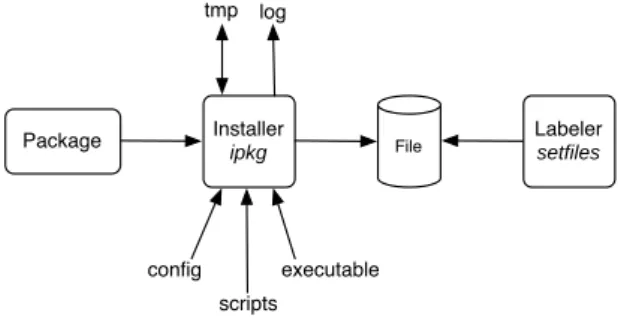
Package Installeripkg File Labelersetfiles
config executable scripts
tmp log
Figure 2: The software installation process
3.1
System Architecture
Figure 1 shows the software architecture for a phone sys-tem. First, the phone system contains some root of trust which is the basis for integrity in a phone system. An ex-ample is the Mobile Trusted Module [31] proposed by the Trusted Computing Group. We are not aware of phone sys-tem with a TPM, but we believe that some satisfactory root of trust for phone systems will emerge.
Second, the phone system has an operating system ker-nel that supports mandatory access control (MAC) and in-tegrity measurement using the PRIMA approach. The MAC policy of the kernel will be used to define the system’s in-formation flows. The MAC policy is enforced by a reference monitor in the kernel that mediates all the security-sensitive operations of all the user-level programs. SELinux is an example of a kernel with such MAC enforcement (see Sec-tion 2.2). The PRIMA module measures the informaSec-tion flows in this MAC policy as well as the code that is loaded in the system, as described in Section 2.5, to enable verifica-tion that the trusted subjects are protected from untrusted subjects.
Third, the phone system has a software installer for in-stalling both trusted and untrusted software packages. Most phone systems permit the phone users to install new software packages. In many cases, such installations require confir-mation from the device user, but that is not always the case. Also, some software packages may include signed hash files that enable verification of the originator of package and the integrity of its contents.
Fourth, the packages loaded on a phone system may in-clude trusted packages, such as a banking client, and un-trusted packages, such as a game program. While some phone systems only permit the installation of signed ages from trusted authorities (e.g., Symbian-signed pack-ages [28]), we envision that ultimately phone systems will also have to support the use of arbitrary packages. However, the trusted components of the system, such as the banking client and the installer itself, must be provably protected from such software.
3.2
Software Installation and Execution
Figure 2 shows the process of software installation. A software installer is a program that takes a software pack-age consisting of several files and installs these files into the appropriate location in the phone’s file system. Since the software installer may update virtually any program on the phone system, it is entrusted with write access over all soft-ware in the system. As a result, the integrity of the systemis dependent on the integrity of the software installer. The software installation process also determines the la-bels of the installed files. Typically, this is not done by the software installer, however, but a MAC labeling service, out-side the kernel, that labels the files based on a specification in the MAC policy. In SELinux, a program calledsetfiles
interprets the MAC policy specification for file labeling to set the correct labeling for the newly-installed package files. The MAC labeling service must also be trusted, but unlike the software installer, it need not interact with any untrusted package files directly.
When the software installer executes, its executable uses information in a variety of other files to implement installa-tion. Such files may include installer configurations, scripts, logs, and temporary files. Installation configurations, scripts, and the installer executable itself are rarely modified (e.g., only on installer upgrades), so these can be assumed not to be written on the loading of untrusted software. Other files, such as logs and temporary files may be updated on each installation. That is certainly the intent of the log file, which is designed to collect information from each installa-tion. Temporary files may or may not be used depending on the installation process. In designing an access control policy, in the next section, we must consider the use of these files in designing policies that protect system integrity prop-erly.
After the software packages are installed, the programs included in these packages may now be executed (i.e., as processes). In order to protect the integrity of the system, trusted processes, such as the banking client, must be pro-tected from untrusted processes, such as the game program. As we identified in the PRIMA background in Section 2.5, a process’s integrity depends on its code and the data that it depends on. The banking client should be isolated from untrusted programs, so it should not depend on data that can be modified by untrusted processes. However, the in-staller clearly receives input from untrusted processes (e.g., the untrusted programs themselves) which is necessary for correct functioning. Thus, integrity must be justified while allowing some access to untrusted data, but we also want to minimize the amount of untrusted data that installers must access.
3.3
System MAC Policy Design
The system MAC policy must enable practical justifica-tion of integrity for the software installer and the trusted packages that it installs. Here, we sketch the requirements for the MAC policies for trusted programs and the installer. The actual policies are defined in Section 4.
For trusted packages, such as the banking client, we be-lieve that a conservative model of integrity is practical. Biba integrity [15] (see Section 2.3) can be enforced for the bank-ing client because its files can be isolated from all untrusted programs. Since there is only one user on the phone sys-tem, there is no need to have separate principals for differ-ent banking clidiffer-ent data files. We envision that many trusted programs, such as those used to maintain phone books, ser-vice configurations, etc., will be isolated from untrusted pro-grams, and generally one another.
For the installer, isolation from untrusted programs is not possible. As a result, only the more liberal justification of CW-Lite integrity [25] (see Section 2.3) is possible1. In ad-1
We find that other system services on the phone, such as
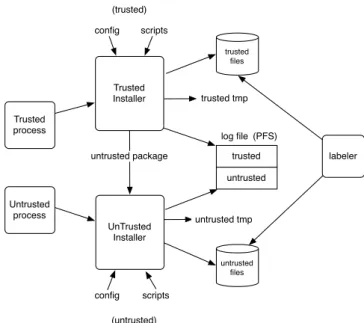
Untrusted process Trusted Installer Trusted process UnTrusted Installer untrusted package trusted files untrusted files labeler config scripts config scripts (untrusted) (trusted) trusted tmp untrusted tmp trusted untrusted log file (PFS)
Figure 3: The modified installer process showing filtering interface to handle untrusted input
dition, in the design of MAC policy for the installer, we also wish to minimize exposure to theconfused deputy prob-lem[9] as well. As a result, our software installer runs with permissions that permit any program to invoke it and per-missions that permit it to access a package file anywhere in the phone’s file system, but the installer’s permissions are dropped based on the label of the package that it will install. Figure 3 shows the modified installer process and outlines the installer’s MAC policy. The installer must provide a fil-tering interface that protects it from compromise on invoca-tion. Thus, the installer’s integrity will not be compromised by either a malicious invocation by an untrusted process or an invocation that includes a malformed package. The installer immediately determines whether it is installing a trusted or untrusted package, and drops privileges to that label. This prevents the confused deputy problem by not allowing the installer to use its trusted privileges when in-stalling untrusted software.
3.4
System Security
In this section, we show informally that the MAC policy described above will enable verification of the integrity of the trusted programs and the installer and these policies will provide the necessary permissions for trusted programs and the installer to function properly.
Biba Integrity.
For trusted programs, the MAC policy aims to ensure isolation from untrusted programs. Isolation from other trusted programs may be desirable for least privilege per-missions, but is not required to prove system integrity. All trusted programs must be trusted by the remote party in a the baseband processor daemon that enables phone calls, SMS, etc., can also be invoked by untrusted programs, so these will also achieve CW-Lite integrity at best. A sim-ilar approach would be used for securing them, but their examination is outside the scope of this paper.
successful verification, so we assign all the same MAC policy label,trusted. In addition to the initial verification of the filesystem integrity on boot (see Section 2.5), PRIMA mea-sures the code for each trusted program that is executed, and the information flows in the MAC policy. All trusted programs are isolated from untrusted programs in the MAC policy, so if the trusted program’s code is acceptable to the remote party, the integrity of the trusted programs is justi-fied to the remote party.
CW-Lite Integrity.
For the installer, the MAC policy defines two principals that the installer may run under:trusted, anduntrusted. The installer starts in the trusted principal and protects itself from its invocation inputs using a filtering interface. If the installer detects that it is installing untrusted software (e.g., by lack of a signature), it then switches tountrusted
and loads the untrusted package. In this case, the installer cannot modify any files of thetrusted packages with un-trusted data.
Supports Necessary Function.
Clearly, the trusted programs will run correctly, as their configuration permits isolated execution from untrusted pro-cesses, but we must be careful to enable the installer to run correctly when it runs as anuntrusted process. There are two issues: one for files that are only read by the installer and one for files that are read and written by the installer. First, since theuntrustedinstaller does not modify config-urations and scripts, it can access these as normal. We have found that the installer scripts do not require exceptional privilege, so they can be run asuntrusted.
Second, the installer may modify log files and temporary files. Since the temporary files apply to the untrusted pack-age being loaded and/or the untrusted files that are being replaced, these can be treated astrustedoruntrusted ac-cording to the case. At present, the SELinux MAC policy assigns the same label to all of the temporary files created by an installer, so this will need to be changed. The log files are more difficult. In this case, we want a single log file name, but the untrusted installer should not be allowed to modify trusted logs. Our design choice is to create separate log files for trusted and untrusted installers, and we use a file system implementation to enable these files to share the same name (see Section 4.2).
4.
IMPLEMENTATION
4.1
Experimental System
The initial design and development of mobile phones are typically carried out on evaluation boards that have hard-ware very similar to mobile phone hardhard-ware. Our imple-mentation was performed on a Spectrum Digital Evaluation board (OMAP 5912 OSK) with the following features:
• ARM CPU (ARM926EJ-S) operating at 192 Mhz • 32 MB DDR RAM
• 32 MB Flash ROM
We run the Linux kernel 2.6.18.1 on the evaluation board with the SELinux security module enabled and the PRIMA patches applied (see Section 4.4). The kernel is booted with
the u-boot 1.3.1 bootloader which is commonly-used on embedded devices. We cross-compiled the kernel and boot-loader for the ARM platform using a toolchain generated usingbuildroot, a script for generating toolchains and root filesystems.
The root filesystem software originates from the Qtopia Linux distribution [30]. We use theipkginstaller from the Linux OpenMoko distribution [23] as our installer. It is the only software we use from outside the Qtopia distribution.
Once the kernel is uploaded to the flash memory on the board, almost all further compilation is performed directly on the board. An exception is the compilation of the SELinux policy which fails on the board due to memory constraints. It was compiled on an x86 machine and copied to the board’s root filesystem.
We use Journalling Flash File System 2 (JFFS2) with ex-tended attributes support as the file system format on the evaluation board. JFFS2 is becoming increasingly popu-lar as the filesystem format for mobile devices due to the numerous advantages for flash memory. Due to storage space limitations of the evaluation board, we divided our root filesystem into two parts. The majority of the filesys-tem was flashed onto the memory on the board while the remaining(/usrand/tmp) was mounted via NFS from a re-mote machine. We note that SELinux does not trust NFS by default and gives the NFS-mounted files the same label,
nfs_t. On the phone, this would not be a problem as the root filesystem would not be mounted remotely.
4.2
Simplifying the Installer Policy
The basic idea behind the reduction in policy complexity is to move from a fine-grained, least privilege policy to a coarse-grained, integrity policy. We make a distinction be-tween the purpose SELinux policies serve in personal com-puters and what we want it to do in phone systems. Tradi-tionally, SELinux is used to enforce a least privilege MAC which results in a very fine-grained policy. For example, a large number of SELinux types are defined for which there must be many more rules between types. As an example, consider how the policy for installers are defined in a tradi-tional SELinux policy2. Installers needs access to different kinds of files, namely, the executable, configuration files, log files, scripts, temporary files, and libraries. Because the aim is to have a least privilege policy, each of these files is given its own SELinux type to make a distinction among them. This results in many types defined just for theipkginstaller as shown below.
type ipkg_t; /* ipkg process */
type ipkg_exec_t; /* ipkg executable */
type ipkg_file_t; /* ipkg configuration */
type ipkg_log_t; /* ipkg log */
type ipkg_script_exec_t; /* ipkg scripts */
type ipkg_script_t; /* ipkg script process */
type ipkg_script_tmp_t; /* ipkg script temp files */
type ipkg_script_tmpfs_t; /* ipkg script tmpfs use */
type ipkg_tmp_t; /* ipkg’s temp files */
type ipkg_tmpfs_t; /* ipkg’s use of tmpfs */
type ipkg_var_lib_t; /* ipkg files in /var/lib */
Our purpose for the SELinux policy in the phone systems is to preserve integrity and hence we do not need to make
2The SELinux reference policy defines policy for the rpm
installer which we adapt for the ipkginstaller used in this experiment. The architecture and function of these installers is very similar.
a distinction between all these types and to control inter-actions between them. All we need to know is whether the installer reads or writes trusted or untrusted data. In our goal of achieving integrity protection on the phone systems we move from a fine-grained policy to a coarse-grained by viewing the system as consisting of only three types of in-tegrity entities namelytrusted,untrustedandkernel.
There are SELinux rules that assign the installer pro-cess acpro-cess to its files (SELinuxallowrules) and other pro-cess’s ability to run the installer with its privileges (SELinux
type_transitionrules). In the SELinux reference policy, there are over 2000 rules of these types, most describing how other processes can invoke the installer (specifically, RPM installer). However, the installer is also given access to the entire file system because we do not know where the new files may be installed.
As an initial approach to providing system integrity, we use the three types in a Biba integrity policy [15] with ker-nel as the highest integrity and untrusted as the lowest integrity. In order to obtain all its privileges, the installer runs as trusted, and all installer files with the SELinux types shown above are relabeled totrustedas well. How-ever, requiring that the installer’s policy satisfies Biba in-tegrity is too restrictive for the software installer. There are two cases that would violate Biba integrity:
• When a process labeleduntrustedcalls the installer • When the package being installed is labeleduntrusted
In the first case, the invoking process can set the envi-ronment and arguments to the software installer, so it can write data to the software installer. This violates the Biba integrity because a low integrity process (theuntrusted re-quester) cannot write to a higher integrity process (the in-staller with type trusted). In the second case, the data being written to the installer is low integrity. This violates Biba because a high integrity process (the installer) cannot read lower integrity data (the untrusted package).
We can modify the policy to solve the first problem. If we do not provide a transition rule foruntrustedprocesses, then the installer will run asuntrustedas well. The installer no longer violates Biba integrity because it is allowed to read the high integrity installer files. The second case cannot be solved using policy modifications – we need a different approach to solve this problem.
4.3
Filtering Interface
In the second case, Biba integrity cannot work. Instead, we use the Lite integrity model semantics [25]. CW-Lite requires that any process that receives lower integrity data must supply filtering interfaces that either immediately upgrade or discard this data. For the installer, we use a variant of discarding the data, where the installer includes an interface to safely receive the input, determine its integrity, then the installer can downgrade its own label dynamically if the input is untrusted. The CW-Lite semantics should be modified slightly to include this case.
While this approach is basically implementing LOMAC integrity [8], by automatically downgrading the integrity of the software installer when it is used to install low integrity software packages, we find that CW-Lite is more general. Other critical applications, such as the telephony server, may have to process inputs from untrusted and they must
enforce access using the traditional CW-Lite semantics. We believe that both approaches should be supported.
This works as follows. Since the installer is being started by a trusted process it will run with the trustedtype ini-tially. However, when the input is examined and is de-termined to be untrusted, the installer will transition to
untrusted. Since this is a dynamic transition decision, it cannot be defined in the policy. In order to enable this tran-sition, we need to make a small addition to the installer code at the point where the input is examined.
if(!checkcontext(package_context,trusted_context) {
strcpy(str,"system_u:object_r:untrusted_t"); i = setcon((security_context_t) str); }
Thesetcon function is used to dynamically change the context of a process from within the program. Thus, on examining the input and seeing that an untrusted package is being installed the installer will self-transition tountrusted. We would ideally prefer to reduce the SELinux policy com-plexity to the bare minimum, and have only three types. However, while configuring the policy for this experiment, we found that there were many dependencies between SELinux types in the policy, which required us to include many addi-tional SELinux types. Some of the dependencies occured at compile time; it was possible to create a policy of approxi-mately 100 types compile. However, other SELinux types, particularly types for devices, appear to be necessary for the system to function properly. We are still experiment-ing with the policy to see how many of these types can be eliminated, but currently, our policy has approximately 700 SELinux types, including our three types. This is still a significant improvement over the 2000 types that are in the SELinux reference policy. In particular, the SELinux policy binary is reduced from 3MB to less than 300KB, resulting in greater than a 90% reduction in policy size.
Recall from Section 3.4 that the only installer files that are written are log files (ipkg_log_t) and temporary files (ipkg_tmp_tandipkg_tpmfs_tand the analogues foripkg
scripts) that are both now labeledtrusted. Since the tem-porary files are specific to an installer run, we can useuntrusted
temporary files for an installation by anuntrustedinstaller. For the log files, we generate separate logs for the trusted and untrusted versions of the installer. While this only per-mits an untrusted subject or a trusted subject with a fil-tering interface to read all the logs3, it does protect system integrity. The problem is that both versions of the installer would use the same log file, and we cannot give a single file two types, even if it made sense. To permit two processes to write to two versions of a file with the same name, we pro-pose using a polyinstantiated [14] file system, which Linux already has for enabling processes of different secrecy levels to write files of the same name without leaking data. In a polyinstantiated file system, multiple files correspond to the same name, but the system chooses which file to access based on the security label of the process. For example, when a high integrity process writes a file, it would write the highest integrity file it can access (i.e., at its own level). When it reads a file, the process reads data from all the files
3Separate secrecy requirements may be installed to prevent
whose integrity dominates the process (i.e., Biba read-up). This is future work.
4.4
PRIMA Implementation
To create our PRIMA system, we created a custom 2.6.18-1 Linux kernel by altering the SELinux LSM hooks with modified IMA functions. We also changed the evaluation board’sinitprogram to properly load the PRIMA’s trusted subjects policy and process the information flows.
4.4.1
Kernel Modifications
The Linux community has rejected the use of the LSM in-terface for integrity measurement, so to implement PRIMA, we converted IMA to function like a Linux kernel library that can be called from SELinux. Originally, IMA uses 5 LSM hooks as seen in Table 1, to gather integrity measurements and manage internal data. The first step in integrating in-tegrity measurement functionality with SELinux, was to add the IMA callback functions to each of the SELinux’s equiv-alent hooks. We added each callback after authorization, so they are only triggered if the SELinux hook would have authorized the policy decision.
First, we modified thefile_mmaphook to gather the SELinux subject of the current context. When calls are made to code memory mapped as executable, PRIMA is invoked to parse the PRIMA list of trusted subjects for the current context. If a match is found, then the calling process is indeed trusted and the code is measured as was done in IMA. PRIMA then performs a subsequent measurement that binds the code hash to the SELinux subject type by concatenating the two and measuring the result. However, if the file being loaded by a trusted subject is a library, the function does not take the second subject measurement since it is unimportant which trusted processes is using it.
The LSM hooksinode_permissionandsb_umountdetect when a measured file that is still open is opened for writing or unmounted. If this happens, the measurement list is in-validated as it is no longer clear if the measurement actually represents the loaded code. Since this behavior is the same in IMA as in PRIMA, we simply inserted the function call into the hook.
A trusted subject list specifies the set of SELinux subject types that must run trusted software. This list is created as part of the system’s policy so its contents are independent of PRIMA mechanism. Before the subject list is loaded, PRIMA assumes all subjects are trusted as the early boot phase is critical and must all be trusted.
To load the set of trusted subjects for the system and to view this set, we created asysfsfile/selinux/ts_load. IMA also by default exposes asysfsfile/selinux/measurereq
which accepts a file pointer and performs a PRIMA integrity measurement on arbitrary files. We use this file to measure the SELinux system policy used in this run of the system.
PRIMA also takes integrity measurements in two addi-tional cases. The first is when the aggregate of all pre-kernel integrity measurements is generated during PRIMA’s initialization. Here, no subject binding measurement is per-formed as there is no PRIMA policy available before the OS has loaded. The second case is whenever a kernel module is loaded into the kernel. In this case, the subject binding mea-surement is performed as for other trusted code as described forfile_mmapabove.
4.4.2
Building the Information Flow Graph
SELinux hook IMA task
file mmap Code measurement sb umount Detecting concurrent write inode permission Detecting concurrent write inode free security Free PRIMA data structures
file free security Free PRIMA data structures Table 1: The SELinux LSM hooks and their equiv-alent IMA purpose.
We have a program to extract the information flows from the SELinux binary policy file. The security policy defines all the types and permission assignments between types. We are interested in the interactions between types, specifically, we are interested in what information flows are allowed to or from a trusted type. We, therefore, parse the policy and extract only the data relevant to building the information flow graph.
The program first extracts the types and their string rep-resentations and builds a Type number:Type name map. Then, the policy entries are read and a hashtable ofaccess vectors(AV) is built. AVs represent the SELinuxallowrules that define the access rights in the system.
In the second stage, we go through the hashtable and in-terpret the permissions between the source and target type. Interpreting the permissions amounts to identifying if the operation corresponds to a read or a write or both. This identifies the information flow between the subject type and the object type implied by the AV. The resulting informa-tion flow is collected into our informainforma-tion flow graph after mapping the type numbers to the type names (using the type number:type name map). An entry in the information flow graph looks like this
fsadm_t proc_t both
where fsadm t is the source type, proc t is the target type and both indicates a bi-directional flow.
4.4.3
initModification
PRIMA requires a list of trusted subjects to operate prop-erly. So we modified the phone’sinitprogram to load this before loading the SELinux policy. This is done by first writ-ing the contents of the subject list stored in
/etc/selinux/subjectstomeasurereqfor measurement and then to /selinux/ts_loadto load it into kernel memory. The information flow graph is also generated through a call frominitand its resulting graph is also passed to the
measurereqinterface for measuring.
4.4.4
Measurements
PRIMA stores each measurement in the order they were performed. This forms a list that is stored in kernel memory and can be inspected through thesysfsfile
ascii_runtime_measurements.
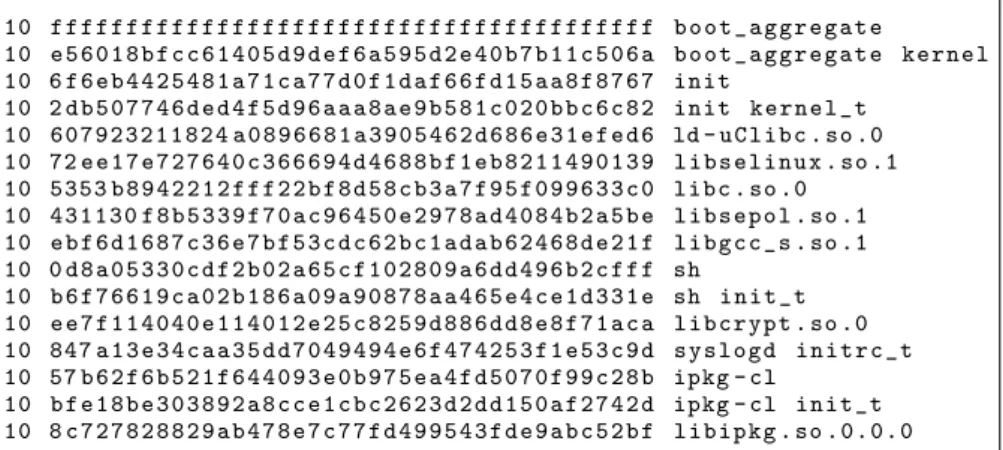
Figure 4 is a small sample of what the measurement list looks like. The fields are the PCR which is extended with the hash (if a TPM is present), the hash of the file, the filename and the SELinux subject type. All code measurements lack a subject type since they are just the measurements of the code. One measurement is made per file (if invoked by a trusted subject) unless the file is changed (i.e., the hash of
10 f f f f f f f f f f f f f f f f f f f f f f f f f f f f f f f f f f f f f f f f b o o t _ a g g r e g a t e 10 e 5 6 0 1 8 b f c c 6 1 4 0 5 d 9 d e f 6 a 5 9 5 d 2 e 4 0 b 7 b 1 1 c 5 0 6 a b o o t _ a g g r e g a t e k e r n e l 10 6 f 6 e b 4 4 2 5 4 8 1 a 7 1 c a 7 7 d 0 f 1 d a f 6 6 f d 1 5 a a 8 f 8 7 6 7 i n i t 10 2 d b 5 0 7 7 4 6 d e d 4 f 5 d 9 6 a a a 8 a e 9 b 5 8 1 c 0 2 0 b b c 6 c 8 2 i n i t k e r n e l _ t 10 6 0 7 9 2 3 2 1 1 8 2 4 a 0 8 9 6 6 8 1 a 3 9 0 5 4 6 2 d 6 8 6 e 3 1 e f e d 6 ld - u C l i b c . so .0 10 72 e e 1 7 e 7 2 7 6 4 0 c 3 6 6 6 9 4 d 4 6 8 8 b f 1 e b 8 2 1 1 4 9 0 1 3 9 l i b s e l i n u x . so .1 10 5 3 5 3 b 8 9 4 2 2 1 2 f f f 2 2 b f 8 d 5 8 c b 3 a 7 f 9 5 f 0 9 9 6 3 3 c 0 l i b c . so .0 10 4 3 1 1 3 0 f 8 b 5 3 3 9 f 7 0 a c 9 6 4 5 0 e 2 9 7 8 a d 4 0 8 4 b 2 a 5 b e l i b s e p o l . so .1 10 e b f 6 d 1 6 8 7 c 3 6 e 7 b f 5 3 c d c 6 2 b c 1 a d a b 6 2 4 6 8 d e 2 1 f l i b g c c _ s . so .1 10 0 d 8 a 0 5 3 3 0 c d f 2 b 0 2 a 6 5 c f 1 0 2 8 0 9 a 6 d d 4 9 6 b 2 c f f f sh 10 b 6 f 7 6 6 1 9 c a 0 2 b 1 8 6 a 0 9 a 9 0 8 7 8 a a 4 6 5 e 4 c e 1 d 3 3 1 e sh i n i t _ t 10 e e 7 f 1 1 4 0 4 0 e 1 1 4 0 1 2 e 2 5 c 8 2 5 9 d 8 8 6 d d 8 e 8 f 7 1 a c a l i b c r y p t . so .0 10 847 a 1 3 e 3 4 c a a 3 5 d d 7 0 4 9 4 9 4 e 6 f 4 7 4 2 5 3 f 1 e 5 3 c 9 d s y s l o g d i n i t r c _ t 10 57 b 6 2 f 6 b 5 2 1 f 6 4 4 0 9 3 e 0 b 9 7 5 e a 4 f d 5 0 7 0 f 9 9 c 2 8 b ipkg - cl 10 b f e 1 8 b e 3 0 3 8 9 2 a 8 c c e 1 c b c 2 6 2 3 d 2 d d 1 5 0 a f 2 7 4 2 d ipkg - cl i n i t _ t 10 8 c 7 2 7 8 2 8 8 2 9 a b 4 7 8 e 7 c 7 7 f d 4 9 9 5 4 3 f d e 9 a b c 5 2 b f l i b i p k g . so . 0 . 0 . 0
Figure 4: Example of a PRIMA measurement list. Each line consists of a (a) PCR Location, (b) SHA-1 Hash, (c) filename and (d) subject type.
Measurement of Policy binary 0.33 Generate Information flows 13.47 Measure trusted subjects list 0.06 Measure a generic program (busybox) 0.10 Measure generic file (Size:2.5MB) 2.76 Measure generic file (Size:30MB) 27.4 Table 2: Time taken to perform certain tasks on the evaluation board (in seconds)
the binary has changed) in which case a new measurement is taken.
The measurements with subjects show the mapping be-tween the software and its subject type. Their hashes are different from the code measurements, as they measure the concatenation of the subject and software. Only one mea-surement is needed per file, so all subsequent loads of the code by different subjects will result in just a measurement of the mapping.
We tested the performance of our system’s integrity mea-surement mechanism in processing requests. Since the eval-uation board lacks a TPM and uses NFS for a part of its root filesystem, performance is not what would be expected in an actual mobile phone, but shows the scalability of the mechanism. Table 2 shows time taken to measure typical files. The time grows roughly linearly with the size of the file. Table 3 compares the boot time and the time taken by the ikpg installer in a Vanilla, IMA and PRIMA kernel.
5.
RELATED WORK
There have been some efforts to have a policy based access control on mobile phones. A recent paper [20] summarizes the status of MontaVista Software’s efforts to implement security solutions based on ARM cores that provide sepa-rated computing environment, as well as SELinux to pro-vide MAC for embedded devices. The paper cites memory footprint and performance trade-off as the two most critical constraints for developing security solution for embedded de-vices. The emphasis is on virtualization in embedded devices with concepts like containment, root of trust and SELinux. Although there are no design details about SELinux policy for phones systems, the paper does address the need for a careful analysis of the policy to ensure that it is not
unnec-essarily comprehensive.
There has also been a recent effort by the MontaVista Corporation that incorporates SELinux into Mobile phones. A press release of Mobilinux 5.0 says it is the first operating system to include MontaVista MicroSELinux [18], a minia-turized version of SELinux. It claims to be the first Linux release for mobile phones that incorporates SELinux. While our work also emphasizes a small policy, we have shown how such a policy can be designed by using coarse grained speci-fication of integrity and tied it to an integrity measurement architecture.
Zhang et al proposed an isolation technique for resource constrained mobile platforms [35]. They realize this goal by employing the TCG’s Trusted Mobile Phone specification by leveraging SELinux. They also integrate IMA for integrity measurement by defining SELinux policy language exten-sions that adds another attribute to the context. We have implemented SELinux with integrity measurement without modifications to SELinux policy structure.
Motorola also made an attempt to provide a SELinux-like system on the Motorola A1200 mobile phone. The oper-ating system is based on a v2.4 linux kernel and includes a proprietary access control system known as MotoAC. On analysis of this system, MotoAC appears to be disabled by default and does not provide any advantage over their pre-vious phone models.
6.
CONCLUSION
In this paper we have shown that it is possible to construct an SELinux policy capable of justifying a phone system’s integrity. We have demonstrated that the policy can pro-tect critical applications from untrusted code allowing cell phone users to install and run trusted applications in a safe fashion. Further, we have achieved this with a minimal pol-icy which is 90% smaller than the SELinux reference polpol-icy (less than 300KB from a 3MB policy originally). By porting PRIMA onto the phone system we have enabled verifiable integrity on the phones. In future work, we plan to analyze the policy to further reduce its complexity. We also plan on experimenting on a variety of applications to assess our design’s robustness.
Vanilla kernel IMA Kernel PRIMA Kernel
Boot time 11.81 14.54 14.33
Execution time of a program (ipkg) 0.24 0.39 0.39
Table 3: Comparison of performance of Vanilla, IMA and PRIMA kernel on the evaluation board (in seconds)
[1] Trusted Platform.http:
//www.sisa.samsung.com/innovation/tp/index.htm. [2] Bank of America. Mobile banking.http:
//www.bankofamerica.com/onlinebanking/index. cfm?template=mobile_banking&statecheck=PA. [3] W. E. Boebert and R. Y. Kain. A practical alternative
to heirarchical integrity policies. InProceedings of the 8th National Computer Security Conference, 1985. [4] F-Secure Computer Virus Information Pages: Cabir.
http://www.f-secure.com/v-descs/cabir.shtml, 2006.
[5] L. S. Clair, J. Schiffman, T. Jaeger, and P. McDaniel. Establishing and sustaining system integrity via root of trust installation. InProceedings of the 2007 Annual Computer Security Applications Conference, Dec. 2007.
[6] D. D. Clark and D. Wilson. A comparison of military and commercial security policies. In1987 IEEE Symposium on Security and Privacy, May 1987. [7] J. de Haas. Symbian Phone Security.
http://www.blackhat.com/presentations/ bh-europe-05/BH_EU_05-deHaas.pdf. [8] T. Fraser. LOMAC: Low water-mark integrity
protection for COTS environments. In2000 IEEE Symposium on Security and Privacy, May 2000. [9] N. Hardy. The Confused Deputy: (or why capabilities
might have been invented).ACM SIGOPS Operating Systems Review, 22(4), 1988.
[10] IBM. Integrity Measurement Architecture for Linux.
http://www.sourceforge.net/projects/linux-ima. [11] 236 mln wireless subscribers in the us in 2006.
http://www.itfacts.biz/index.php?id=P8421, 2007. [12] O. W. R. M. J. Marchesini, S.W. Smith.
Experimenting with tcpa/tcg hardware, or: How i learned to stop worrying and love the bear. Technical Report TR2003-476, Computer Science Technical Report, Dartmouth College, Dec. 2003.
[13] T. Jaeger, R. Sailer, and U. Shankar. PRIMA: Policy-reduced integrity measurement architecture. In Proceedings of the 11th ACM Symposium on Access Control Models and Technologies, pages 19–28, June 2006.
[14] C. S. Janak Desai, George Wilson. Extending selinux to meet lspp data import/export requirements, Feb 2006.http://selinux-symposium.org/2006/papers/ 04-lspp.pdf.
[15] K.J.Biba. Integrity considerations for secure computer systems. Technical Report MTR-3153, Mitre
Corporation, June 1975.
[16] F-Secure Computer Virus Information Pages: Mabir.A.
http://www.f-secure.com/v-descs/mabir.shtml, 2005.
[17] H. Maruyama, F. Seliger, N. Nagaratnam, T. Ebringer, S. Munetoh, S. Yoshihama, and
T. Nakamura. Trusted platform on demand. Technical Report RT0564, IBM, Feb. 2004.
[18] Montavista. Montavista Mobilinux.
http://www.mvista.com/product_detail_mob.php. [19] Motorola. Opensource Motorola.
https://opensource.motorola.com.
[20] H. Nahari. Trusted secure embedded Linux. In Proceedings of the Linux Symposium Proceedings of the Linux Symposium Proceedings of the Linux Symposium, 2007.
[21] Novell. AppArmor Linux Application Security.
http://www.novell.com/linux/security/apparmor/. [22] Security-Enhanced Linux.
http://www.nsa.gov/selinux.
[23] openmoko.com.http://www.openmoko.com/, 2008. [24] V. Rao. Security in mobile phones - handset and
networks perspective. Master’s thesis, The Pennsylvania State University, 2007.
[25] U. Shankar, T. Jaeger, and R. Sailer. Toward automated information-flow integrity verification for security-critical applications. InProceedings of the 2006 ISOC Networked and Distributed Systems Security Symposium (NDSS’06), Feb. 2006. [26] E. Shi, A. Perrig, and L. V. Doorn. BIND: A
time-of-use attestation service for secure distributed systems. InProceedings of IEEE Symposium on Security and Privacy, May 2005.
[27] Symbian OS: the open mobile operating system.
http://www.symbian.com/, 2008. [28] Symbian Limited. Symbian signed.
http://www.symbiansigned.com. [29] Trifinite.org – home of the trifinite.group.
http://trifinite.org/trifinite_stuff.html, 2008. [30] Trolltech. Qtopia Open Source.http:
//trolltech.com/products/qtopia/opensource. [31] Trusted Computing Group. Trusted computing group:
Mobile.https:
//www.trustedcomputinggroup.org/groups/mobile. [32] Trusted Computing Group. TCG TPM specification
version 1.2 revision 85, Feb 2005.https:
//www.trustedcomputinggroup.org/groups/tpm/. [33] Windows mobile: Smartphone and pda software.
http://www.microsoft.com/windowsmobile/, 2008. [34] C. Wright, C. Cowan, S. Smalley, J. Morris, and
G. Kroah-Hartman. Linux security modules: General security support for the Linux kernel. InProceedings of the 11th USENIX Security Symposium, pages 17–31, August 2002.
[35] X. Zhang, O. Aciicmez, and J.-P. Seifert. A trusted mobile phone reference architecture via secure kernel. InProceedings of the 2007 ACM Workshop on Scalable Trusted Computing, 2007.