Making Standard ML
a Practical Database Programming Language
∗
Atsushi Ohori
Katsuhiro Ueno
Research Institute of Electrical Communication Tohoku University
{ohori, katsu}@riec.tohoku.ac.jp
Abstract
Integrating a database query language into a programming lan-guage is becoming increasingly important in recently emerging high-level cloud computing and other applications, where efficient and sophisticated data manipulation is required during computa-tion. This paper reports on seamless integration of SQL into SML# – an extension of Standard ML. In the integrated language, the type system always infers a principal type for any type consistent SQL expression. This makes SQL queries first-class citizens, which can be freely combined with any other language constructs definable in Standard ML. For a program involving SQL queries, the compiler separates SQL queries and delegates their evaluation to a database server, e.g. PostgreSQL or MySQL in the currently implemented version.
The type system of our language is largely based on Machi-avelli, which demonstrates that ML with record polymorphism can represent type structure of SQL. In order to develop a practical lan-guage, however, a number of technical challenges have to be over-come, including static enforcement of server connection consis-tency, proper treatment of overloaded SQL primitives, query com-pilation, and runtime connection management. This paper describes the necessary extensions to the type system and compilation, and reports on the details of its implementation.
Categories and Subject Descriptors H.2.3 [Database Manage-ment]: Languages—Database (persistent) programming languages General Terms Design, Languages
Keywords SQL, Polymorphism, Type System, Interoperability, SML#
1.
Introduction
Smooth integration of a database query language into a program-ming language is essential for any high-level applications that re-quire efficient processing of large amount of data. The need of this
c
° ACM, 2011. This is the author’s version of the work. It is posted here by permission of ACM for your personal use. Not for redistribution. The definitive version was pub-lished in ICFP’11: Proceedings of the International Conference on Functional Programming, September 19-21, 2011, Tokyo, Japan. http://doi.acm.org/10.1145/2034773.2034815
∗The authors were partially supported by the Japan Society for the
Promo-tion of Science Grant-in-Aid for Basic Research (C) grant no. 22500023.
integration will become particularly important in recently emerg-ing high-level cloud computemerg-ing, where sophisticated data manipu-lation beyond simple data aggregation will be required. Query lan-guage integration will also make currently wide-spread Web pro-gramming through various meta-level “framework” such as Ruby on Rails much more reliable.
The need of proper integration of a database query language and a programming language has been recognized and investigated in database programming community for more than two decades. See [4] for an early survey in this area. Since then a number of query language bindings and embeddings in general purpose pro-gramming languages have been proposed and implemented. Ex-amples include SQLJ [13] and more recent LINQ [23] and Ferry [16] middle-ware. Compared with SQL command string interface to database servers, these database binding frameworks certainly increase flexibility and ease of use in accessing databases from pro-gramming languages. However, they still do not achieve seamless integration of a database query language into a host language type system. Existing database bindings either restrict full functionality and generality provided by their target database servers, or they do not treat database queries as first-class citizens in the type systems of the host programming languages.
There have also been a number of proposals for high-level database programming languages that integrate declarative queries in their type systems. Some notable examples include GemStone (OPAL) [11], Machiavelli [30], O2 [19], and Fibonacci [2] to
name a few. While these approaches provide uniform integration of database queries in a programming language, it remains to be seen whether or not some of these approaches would become a practi-cal alternative to SQL. Based on long and intensive research and development of the relational data model [8], relational database systems have realized highly optimized data manipulation for large amount of data with various practical supports such as transaction management and network access. All of these features are made available through SQL, which is the well established and stan-dardized query language for relational database systems. Perhaps due to this reason, most of applications that require both efficient database manipulation and programming still use general purpose programming languages such as C or Java with SQL command string interface to a relational database server.
This situation indicates that an “impedance mismatch” [22] between a database system and a programming language still exists
in practice.
To eliminate this mismatch, we must develop a high-level pro-gramming language that seamlessly integrates SQL in such a way that SQL queries are first-class citizens in the language type sys-tem and that they are evaluated by a practical database server. This paper reports on one such integration, where SQL is seamlessly in-tegrated in SML# [32], an extension of Standard ML [24]. In our
development, we adopt polymorphic typing of Machiavelli [30], where the authors suggested that the programming language ML can be extended with an SQL-style declarative query language. The language proposed in [30] is, however, conceptual one focus-ing only on typfocus-ing issues; no implementation strategy is considered or developed. As outlined in the next section, a number of techni-cal challenges have to be overcome before a practitechni-cal language can become a reality. In the present paper, we have solved those prob-lems and have developed a compiler for SML# extended with SQL. In this extended language, SQL queries are first-class expressions directly definable in the language type system, and are evaluated by an external database server. Thanks to this feature, Standard ML programmers can readily enjoy efficient and practical database pro-gramming in their Standard ML code.
In addition to solving technical problems in language design and typing, we have also developed an implementation technique for connecting static semantics of SQL in the host language type system, and its dynamic semantics realized by an external database server. This should be useful for extending a typed higher-order language with various domain specific languages, not restricted to SQL.
All the results reported in this paper has been implemented in our SML# compiler. Most of them have already been made available in SML# version 0.60 or later releases [32].
1.1 Related works
Before presenting our technical development, we compare our ap-proach with some more related works.
The conventional and still widely used approach to database programming is to construct SQL command strings directly and send them to a database server using low-level database server interfaces such as SQL/CLI and JDBC. Embedded SQL such as ECPG of PostgreSQL and SQLJ [13] supports a form of macro SQL statements that are expanded by a preprocessor to those low-level database library calls. Both of them are unsatisfactory in many ways; type-checking is far from adequate, and the interac-tion with the host language construct is rather limited. In order to improve type safety and host language interface of preprocessor-based approach, several domain specific embedded languages [18] have been proposed and implemented. HaskellDB [20] implements a set of monadic term constructors corresponding to relational op-erators. ARARAT[14] provides C++ template for composing SQL queries. Ur/Web [7] provides a meta-programming framework for the programmer to generate type-consistent SQL queries through type computation. LINQ [23] and Ferry [16] attempt to provide a language independent layer for querying various data structures including relational database. DHS [15] implements a combina-tor library for generic manipulation of collection types that are to be compiled to Ferry. While these approaches provide high-level database access, they do not fully achieve seamless integration of SQL into a general purpose programming language to the extent we wish to achieve.
We note that SQL is an algebraic language based on the rela-tional algebra. In this language, relation-valued expressions includ-ingSELECTexpressions can be used to construct another query ex-pression. This properly makes SQL an elegant and powerful data al-gebra for relations. Seamlessly integrating SQL in a programming language must at least mean that relations are first-class citizens and their operations are freely combined with other language con-structs in the host programming language. This is a common-sense knowledge in functional programming. For example, consider the case of integrating an algebra oflistsin ML. Everyone unanimously expects that lists are first-class citizens and associated operators to construct and manipulate lists can be freely combined with any other language constructs. SQL should be given the same status,
without scarifying its features specified in the standardized lan-guage definition and its efficiency realized by a matured external database server. Unfortunately, however, there does not seem to ex-ist any implemented general purpose programming language that achieves this status for SQL. This is the property we attempt to achieve in SML#.
Since relations are well-defined mathematical objects, it should be possible to extend a type theory of programming languages with data algebra on relations. Based on this general observation, several database programming languages have been proposed, including GemStone [11], Machiavelli [30], Napier88 [26], Iris [3], Fibonacci [2], and Kleisli [34]. All of those languages, by their construc-tion, seamlessly integrate advanced database queries in their type systems and evaluation models. See [33] for various typing issues in database queries, and [21] for a survey on various approaches to database and language integration. However, it is non-trivial to make those languages practical database programming languages that can handle hundreds of millions of tuples efficiently. Com-pared with the high maturity of optimization and implementation techniques of relational database systems, optimization and imple-mentation techniques for advanced data models realized in those new database programming languages do not seem to have been well developed.
The goal of the present paper is to make the SQL itself seam-lessly available in a practical general purpose programming lan-guage. For this purpose, we must first extend the type system of the host programming language so that SQL statements can be repre-sentable as typed expressions. An extension of ML type inference for generalized relational algebra presented in [29] is perhaps the first such example. This type system and its refinement [28] were the basis of the type system of Machiavelli [6, 30]. We design our type system largely based on this approach. However, in this pa-per, instead of uniformly integrating generalized relational algebra in its type system and evaluation model, we develop a type system that precisely represents polymorphic typing of the SQL language itself as defined in its language standard, and develop a compilation method to delegate their evaluation to an external database server. This requires careful design and development beyond the language design reported in [6, 30].
Another approach to integrate database queries and program-ming constructs is to compile high-level expressions into SQL [9]. Links [10] takes this approach in designing a Web programming system. The type system sketched in [10] appears to be based on the observation similar to [6, 30] – it uses sorted row variables [31] in-stead of kinded typing [28, 29], but these two formalisms on record polymorphism are equivalent for typing query expressions. Links compiles relation-valued expressions, possibly involving function applications and other language constructs, into SQL. The resulting system achieves integration of database queries and programming language constructs, but this is only to the extent that the language constructs can be compiled to SQL commands. While this compile-to-SQL approach would be useful for some target areas such as Web programming, it is not obvious that this approach scales up to large and complex application development that requires a general purpose programming language and the full functionality of SQL.
We note that any practical general purpose programming lan-guage involves a number of advanced features to form a complex system whose semantics can (at least under the current state-of-the-art) only be realized by a sophisticated compiler. This is true for Standard ML. SML# compiler, for example, contains more than 0.3 million lines of code. The SQL language itself also contains various features such as grouping and duplicate controls inSELECT lists, and transaction management in data manipulation. All these features are indispensable for serious application development. Our major technical contribution is to design a type system that can
precisely represent the SQL language in Standard ML, to develop a compilation method that seamlessly combines the dynamic se-mantics of Standard ML expressions realized by a Standard ML compiler and the semantics of SQL queries realized by an exter-nal database server, and to implement it in the SML# compiler that compiles the full set of Standard ML.
1.2 Paper organization
The rest of this paper is organized as follows. Section 2 discusses the problems to be overcome and outlines our strategy. Section 3 describes the language and its type system. Section 4 describes the details of its implementation. Section 5 concludes the paper with suggestions for further investigations.
2.
Problems and our strategy
We have chosen Standard ML as the base language for our database extension. This is not accidental. In this section, we review the re-quirements and problems in achieving our goal of seamless inte-gration, and outline our development.
2.1 Expressions and typing of SQL
We begin by reviewing the basic properties of SQL in the perspec-tive of programming languages.
SQL can be characterized as a impure functional language. Its main components, i.,e.SELECTstatements, are relation-valued expressions that can be freely composed as far as each sub-phrase is type consistent. For example, a query such as
SELECT name, age FROM people WHERE age >= 25
(Q) is an expression denoting a set of tuples ofnameandageand can be used as a source relation in any other queries. SQL program-ming consists of composing those relation-valued expressions. In addition to those functional expressions, SQL also contains im-perative features such as those for updating the database state and transaction management, which assumes sequential evaluation. To represent those expressions, eager functional programming is the most appropriate framework. Moreover, since SQL programming involves manipulation of record structures across multiple tables, it is essential to enforce type discipline that statically checks com-plex queries before sending them to a remote database server. As observed in [30], SQL expressions are inherently polymorphic in the structures they manipulates. For example, the above very sim-ple query is polymorphic in several ways: this query can be issued against any database that contains at least apeopletable having at leastnamefield of any type andagefield of numerical type. This indicate that a language containing SQL should have a polymorphic type system preferably with type inference.
Base on these observations, a basic strategy of extending ML to represent SQL-style database queries was proposed in [29, 30]. In their approach, a query expression is considered as apolymorphic functionacting on an appropriate structure composed of labeled record and set data types. For example, the queryQabove would be given a polymorphic type of the following form (in the notations we use in this paper):
Q : [’a,’b#{name:’a, age:int},’c#{people:’b}. ’c db -> ’b relation]
This is the type’c db -> ’b relationin prenex form where the set of bound type variables are explicitly listed in its pre-fix ’a,’b#{name:’a, age:int},’c#{people:’b}. Notation ’b#{name:’a, age:int} represents a type variable’b with a
kind constraint #{name:’a, age:int} indicating the fact that
any instance of’bmust be a labeled record (tuple) type that con-tains at leastname:’aand age:intfields. By this polymorphic typing with record kind constraints, their approach represents the precise polymorphic nature ofQ, i.e. it is a query that can be evalu-ated against any database that contains at least apeopletable each of whose tuples contains at least integer-valuedage column and namecolumn of any type.
We roughly follow this approach. Among the ML family of languages, we consider Standard ML the most appropriate one for the following reasons.
• Its eager functional semantics with imperative features make an ideal framework for integrating relation-valued query expres-sions with imperative features such as transactions.
• Its type system and operational semantics has been rigorously specified and their details are well documented [24].
• The type theory and implementation method for extending Standard ML with record polymorphism has been well estab-lished [28, 31].
We base our development on SML#, which is an extension of Standard ML with record polymorphism [28] and interoperability with C language. These two features provide sufficient basis for seamless extension of Standard ML with SQL.
2.2 The remaining problems
The solutions so far proposed in the literature are, however, only partial for extending Standard ML with SQL. There are a number of problems that have to be worked out before realizing a practical language that achieves truly seamless integration of SQL. Among them, the following are major technical challenges.
1.Extensions of the type system.Record polymorphism is useful in achieving the integration but adding this alone to Standard ML type system does not yield a type system for SQL. We need to construct typing mechanisms for the following.
(a)Server typing and type checking. We need to develop a typ-ing mechanism to declare a database schema on a database server, and to type check its correctness against actual con-tents of the server.
(b)Server connection typing and its consistency enforcement.
Since an SQL command needs to be sent to a database server, all the query components consisting of the command must only reference to a unique server connection. With higher-order functions, enforcing this requirement turns out to be a subtle typing problem.
(c)A proper treatment of null values. Since a column may contain null values, we cannot simply infer a typing of the form’a::{age:int}for expressionage >= 25. (d)Overloaded operator and constants. Literals such as 25
above play double roles; one for a constant of the host lan-guage, and one that denotes the same constant in a remote database server. These two have different representations. Even worse,25in an SQL query represents not only an in-teger but also a floating-point number. In addition, operator such as>for comparison is overloaded with several atomic types. In Standard ML definition, overloading is resolved statically. If we simply adopt the same strategy, then the flexibility of SQL expressions would be severely limited. Again, developing a precise typing mechanism to treat these overloading requires delicate development.
2.Compilation and evaluation.Expressions in a functional lan-guage is compiled to a code and executed with a runtime sys-tem with a specialized memory management. It is relatively
straightforward to add compilation rules for their own query constructs and execute them in their own runtime system. For this purpose, it is sufficient to define a data structure for tu-ples and relations and evaluation strategy for each primitive operations in the relational algebra. Newly designed database programming languages usually adopt this strategy. Our pur-pose is different. Instead of developing a query execution en-gine inside of the language runtime system, we need to call an existing SQL database server. For this purpose, we need to develop both a compilation method and a runtime mechanism for delegating evaluation of SQL query expressions to a remote database server. Since Standard ML is a higher-order functional language, seamless integration of SQL implies that SQL queries are intermixed with function definitions and function applica-tions. This requires us to carefully design the compilation algo-rithm so that it separates SQL query expressions appearing in a given expression.
2.3 Summary of our development
We have worked out these problems, have developed compilation algorithms and have implemented a new generation of Standard ML that seamlessly integrates SQL by extending our SML# com-piler. The extension to Standard ML syntax is carefully designed so that it maintains backward compatibility with the Definition of Standard ML. In our development, we have used PostgreSQL and MySQL for our target database servers, considering their wide availability; other DBMS should equally be possible, as described later in section 4.6.
In SML# with our extension, the queryQis written as follows. val Q =
_sql db => select #person.name as name, #person.age as age from #db.people as person where SQL.>= (#person.age, 25) whereSQL.>=is the greater-or-equal comparison for SQL values. One can see that the above expression is a direct representation of (a verbose version of) the queryQ. Similar expressions may be pos-sible in some programming languages with embedded SQL com-mands, which are translated to a sequence of primitive statements. Different from those syntactic shorthands, this is an expression in the language. The extended SML# compiler type checks this and infers the following polymorphic type.
val Q = fn
: [’a#{people: ’b},
’b#{age: int, name: ’d}, ’c,
’d::{int, word, char, string, real, ’e option}, ’e::{int, word, char, bool, string, real}. (’a, ’c) SQL.db
-> {age:int, name:’d} SQL.query]
This type indicates thatQis a function that takes a database of type (’a, ’c) SQL.dbwhose contents is of type’a#{people:’b}, and returns a query of type{age:int,name:’d}. The extra pa-rameter ’cto a database type’a#{people:’b} is there to en-sure the consistent usage of connection and will be explained later. ’d::{· · ·}constrains that’dcan be instantiated only with a type shared among ML and SQL. It should be intuitively clear that the inferred type represents the precise polymorphic nature of the query
Q, and indeed it is a principal type forQ.
In an ML-style type system, the fact that a principal type is inferred for this expression immediately means that this expression can be freely combined with any other language constructs as far as its usage is type consistent. Figure 1 shows example programs
to define a database server, to connect it, to insert tuples, to execute queryQ, and to fetch the results as a list of SML# records. It shows an actual interactive session in SML#. The lines starting with prompt “#” and ending with delimiter “;” are user input, which are followed by a system response.
3.
SML# extended with SQL
This section presents the language we develop. We first introduce SML#, and develop necessary extensions in syntax, typing mech-anisms, and operational semantics. We then show a programming example demonstrating the benefit of seamless integration of SQL into SML#.
3.1 SML#: Standard ML with record polymorphism and interoperability with C
SML# embodies record polymorphism and infers a polymorphic type for record operations as seen in the following example:
# fun getName x = #Name x;
val getName = fn : [’a#{Name:’b}, ’b. ’a -> ’b] where#lselects thelfield from a record.getNametakes a record and returns itsNamefield. This record polymorphism provides a basis to extend Standard ML with SQL expressions.
In addition, SML# supports interoperability with the C language through itsnatural data representation[27]. Under this scheme, internal data representations in SML# and C have the following correspondence: atomic types includingintandrealare the same asint anddouble in C; τ array has the same representation as a pointer to an array of τ in C; and a labeled record type {l1:τ1,..., ln:τn}has the same representation as a pointer to a structure in C that contains the elements of types{τ1, . . . , τn} in the lexicographical order of their labels {l1, . . . , ln}. Based on these properties, SML# allows the programmer to declare an external library function defined in C and use it as an ordinary ML function. The following example code imports C library function sin:
# val sin =
dlsym (dlopen "/usr/lib/libm.so", "sin") : _import real -> real;
val sin = fn : real -> real; # sin 1.0;
val it = 0.841470984807 : real
wheredlopenanddlsymare built-in library functions that open and find a pointer to the named dynamically linked library func-tion. After this declaration,sinis used as an ordinary ML expres-sion of typereal -> real, but application ofsindirectly calls the C library function without any data conversion. In our develop-ment, we use this feature to bind database server library functions provided for C.
The syntax of SML# is that of Standard ML. For the explanation purpose in this paper we consider the following subset of its core language.
e ::= x|fn x => e|e e| {l1=e1,. . .,ln=en} |#l e
xranges over the set of variables.fn x => edefines a (first-class) function. {l1=e1,. . .,ln=en} constructs a labeled record. Other features are mostly orthogonal to our SQL extension and can be used without any problem. In examples, we also use the following syntax.
• val x = ebinds a variablexto an expressione.
• SQL.xis a variablex defined in the module namedSQL. In our implementation, which we shall describe in Section 4, most
# val server =
_sqlserver "host=127.0.0.1 dbname=test" : {people: {name: string, age: int}}; val server = "host=127.0.0.1 dbname=test"
: {people: {age: int, name: string}} SQL.server # val db = SQL.connect server;
val db = <conn>
: {people: {age: int, name: string}} SQL.conn # val q =
_sql db =>
insert into #db.people (name, age) values ("Alice", 24);
val q = fn
: [’a#{people: {age: int, name: string}}, ’b. (’a, ’b) SQL.db -> SQL.command] # val r = _sqlexec q db; val r = () : unit # val q = _sql db =>
insert into #db.people (name, age) values ("Bob", 25);
val q = fn
: [’a#{people: {age: int, name: string}}, ’b. (’a, ’b) SQL.db -> SQL.command] # val r = _sqlexec q db; val r = () : unit # val Q = _sql db =>
select #person.name as name, #person.age as age from #db.people as person where SQL.>= (#person.age, 25); val Q = fn
: [’a#{people:’b}, ’b#{age:int, name:’d}, ’c,
’d::{int, word, char, string, real, ’e option}, ’e::{int, word, char, bool, string, real}. (’a, ’c) SQL.db
-> {age: int, name: ’d} SQL.query] # val r = _sqleval Q db;
val r = <rel> : {age: int, name: string} SQL.rel # val x = SQL.fetchAll r;
val x = [{age = 25, name = "Bob"}] : {age: int, name: string} list
Figure 1. Example Program in SML#
resources (functions and types) for the SQL extension are orga-nized into theSQLmodule, and they are referenced through this notation.
Its type system is that of Standard ML extended with record kinds on type variables. We letCrange over type constructors such as listor array. Sometimes we useoption type constructor to represent values possibly containing null. We use the following syntax for types.
• The set of monomorphic types (ranged over byτ) is given by the following syntax
τ:=b|τ -> τ0| {l1:τ1,. . .,ln:τn} |τ C wherebranges over atomic base types such asint;τ -> τ0
is a function type;{l1:τ1,. . .,ln:τn}is a labeled record type; andτ Cis a constructor type such asint list.
• ’a,’b,. . .are type variables (ranged over byt).
• [t1#k1,...,tn#kn.τ]is a polymorphic type ofτwith bound type variablest1, . . . , tn. Eachti is constrained with a kind
ki. A kind k is either empty indicating no constraint or a record kind{l1:τ1,. . .,ln:τn}denoting all possible records that contain at least the specified fields.
3.2 Syntax extension for SQL
To represent SQL, we need to introduce the following. • A server definition on which SQL is run.
• SQL “commands”. Among them a SELECT command is an algebraic (functional) expression that returns a relation. The others are those that change the server state.
Our aim is to represent SQL queries as directly as possible, and allow them as first-class citizens in the language. The important step to achieve this goal is to identify all the syntactic elements that are implicit in aSELECTcommand and introducing them as expressions in SML#. Introduction of a server definition and other SQL commands are relatively straightforward.
To identify those implicit syntactic shorthands, let us examine the following simpleSELECTcommand.
SELECT name FROM people WHERE age >= 25 This implicitly assumes the following.
1. Field namesnameandageinSELECTandWHEREclauses denote the results of the corresponding field selections from a tuple in the table given inFROMclause.
2.SELECTphrase creates a tuple whose labels are inherited from the field names.
3. This query is executed against a given database connection. This implies that the table namepeopleinFROMclause rep-resents the selection of thepeopletable from a database con-sisting of a named collection of tables.
The first two points are made explicit by the following more ver-bose version of the same SQL command
SELECT person.name AS name, person.age AS age FROM people AS person
WHERE (person.age >= 25)
where a variablepersonis bound to a representative tuple, from which the mentioned fields are extracted. To represent the third point, we represent a query expression as a function that explicitly takes a database connection db as a parameter and selects the referenced tablepeoplefromdb. This analysis yield the example expression we gave in Section 2.
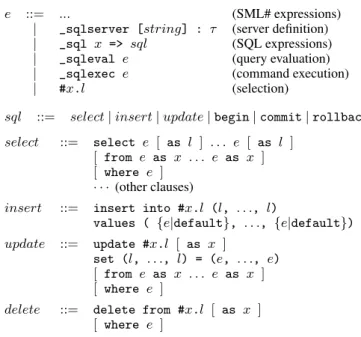
e ::= ... (SML# expressions) | _sqlserver [string] : τ (server definition) | _sql x => sql (SQL expressions)
| _sqleval e (query evaluation)
| _sqlexec e (command execution)
| #x.l (selection)
sql ::= select|insert|update|begin|commit|rollback
select ::= select e [ as l ] . . . e [ as l ] [ from e as x . . . e as x ] [ where e ]
· · ·(other clauses)
insert ::= insert into #x.l (l, . . ., l)
values ( {e|default}, . . ., {e|default}) update ::= update #x.l [ as x ]
set (l, . . ., l) = (e, . . ., e) [ from e as x . . . e as x ] [ where e ]
delete ::= delete from #x.l [ as x ] [ where e ]
Figure 2. The syntax of SQL extension in SML#
We also need to introduce syntax for executing an SQL query command against a database connection. There should be two forms, one for SELECT, which returns a relation, and the other for all the other commands which do not return any value.
Based on these analyses, we define the syntax extension to SML# as shown in Figure 2. In this definition, note thateranges over any expressions including those of SML#. Those who are fa-miliar with SQL should immediately recognize that these exten-sions are direct representation of (a subset of) SQL. SQL contains more features, which can be added without any problem, as we dis-cuss later.
3.3 Typing extension for SQL
We should emphasize that these SQL expressions are not macro but they are all legal expressions that can be freely combined with other SML# expressions. Moreover, each sub-expressioneappearing in those SQL syntax can be any expression definable in SML#. Of course not all syntactically well-formed expressions are legal; the set of expressions that have well-defined meaning are those that have atypeinferred by the type system.
Our goal is to extend the type system of SML# so that it always infers a most general type for any legal SQL expression. Since the type system guarantees that any typable expression can be freely combined as far as its type is consistent, this achieves our goal of seamless integration of SQL into Standard ML.
The type system is defined through a set of typing rules to derive typing judgments in the style of [24]. We have worked out the details of the typing rules for the above SQL extension. In this section, rather than giving a formal typing derivation system, we present the type system by explaining the meanings of new type constructors and the behavior of the associated typing rules. 3.3.1 The set of new type constructors
The set of types of SML# is extended with the following new type constructors for the SQL extension.
τ := · · · |τ server|τ conn|τ query|command|τ rel | (τ,τ0) db|(τ,τ0) table|(τ,τ0) row
| (τ,τ0) value
Intuitive meanings of these types are the following; their precise meaning will become clear when we explain typing properties of associated operations.τ server denotes a server of a database of typeτ by which SQL expressions are evaluated. In what fol-lows, we call such a server as an SQL server.τ connrepresents an established connection to an SQL server of type τ server.
τ query represents an SQLSELECT command that return a re-lation of typeτ.commandis the type of the other SQL commands such asinsertandrollback, which cause some side effects to the SQL server state.τ relrepresents a relation containing tu-ples of typeτ returned from an SQL server as a result of query evaluation. The other four types(τ1,τ2) db, (τ1,τ2) table,
(τ1,τ2) row, and(τ1,τ2) valueare used to type expressions
inside of SQL queries and commands. They respectively denote an active database connection of typeτ1, a table of typeτ1in an
ac-tive database connection, a tuple of typeτ1 in an active database
connection, and an atomic value of typeτ1 in an active database
connection.τ1of typevalueis either an atomic base typebfor
val-ues without null orb optionfor values possibly containing null. The extra second type parameterτ2in these types is introduced to
ensure the consistency of database connections in SQL queries we shall explain below.
Using these types, we represent legal SQL expressions through SQL constructs. In the following, we introduce SQL constructs and explain their typing relations.
3.3.2 SQL servers
A server expression _sqlserver [string] : τ declares that there is an SQL server of typeτat the location specified bystring. Thisstring may also contain some extra information to estab-lish a connection to the server. In our current version, the location specification string is designed so that it is expressive enough for PostgreSQL or MySQL servers.τ specifies the set of tables in the database as a form of record type. This expression is al-ways well typed with typeτ server. Note that giving a type to servers makes them first-class values. This feature gives flexibility to database programming. For example, a function can take list of servers with additional information such as their capacities and can dynamically choose appropriate one at runtime.
A runtime value of a server expression is a server object consist-ing of the server information includconsist-ing its location and a runtime representation of its typeτ. The only operation on a server object is the primitive function
SQL.connect : [’a. ’a server -> ’a conn].
This primitive attempts to connect the SML# runtime system to the SQL server using the location information stored in the server ob-ject of typeτ server. If the attempt succeeds, then it dynamically checks that the connected server has indeed the typeτ stored in the server object. This typechecking is done by retrieving database schema information from the remote SQL server. If the typecheck succeeds, then the primitive succeeds and returns a connection ob-ject of typeτ conn, which can be used to issue SQL commands. If either the connection attempt or the typecheck fails then this prim-itive raises a runtime exception.
3.3.3 Consistency of database connection
A distinguishing features of our language is that all the components of SQL are given types so that they are treated as first class val-ues. This achieves powerful SQL programming using higher-order functions. As we noted above, in our system, database servers and the corresponding database connections are all first-class values. As a consequence, one can write a program that manipulates multiple database connections to different database servers. This flexibility raises one subtle issue in ensuring well-definedness of SQL query
execution. A straightforward combination of higher-order functions and first-class database connections would inadvertently admit an SQL query that involves multiple database connections. However, an SQL query needs to be evaluated by a single SQL server through a single database connection. To see the problem, consider the fol-lowing example.
fun f db1 =
_sql db2 => select #r1.c1, #r2.c2
from #db1.t1 as r1, #db2.t2 as r2 The functionfgenerates an SQLSELECTcommand for a database connectiondb2, but it uses another database connectiondb1 re-ceived as a parameter. This function definition is valid only when db1anddb2denote the identical connection. The following exam-ple is an invalid use off.
val conn1 = SQL.connect (_selserver "DB1"); val conn2 = SQL.connect (_selserver "DB2"); _sqleval
(_sql db =>
select · · · from · · ·
where · · · (_sqleval f db conn1) · · ·) conn2
This results in sending to an SQL server"DB1"a query that in-volves a reference to another database server"DB2". A sound inte-gration of SQL into SML# type system requires that the extended type system should statically detect this form of inconsistency due to multiple database connections in one SQL query.
We solve this problem using existential types proposed in [25]. The idea is to consider a database connection of typeτ1 connas
an abstract package of type
τ1 conn=∃τ2.(τ1,τ2) db
whereτ2is an abstract witness representing a unique connection
established for a particular connection to a database. Since exis-tential types are second-order types, general introduction of this mechanism is beyond the power of ML typing on which SML# is based. So we introduce this mechanism only for the expressions _sqlevaland_sqlexecthat use a database connection. These ex-pressions temporally opens the package by generating a uniqueτ2
and converting a database connection typeτ1 conninto a database
type(τ1,τ2) db. All the database components (tables and
val-ues) that forms an argument to the same_sqlevalor_sqlexec are typed with the same unique witness typeτ2. This ensures the
consistent use of connection without introducing ad-hoc restriction on the usage of first-class SQL constructs. The second type pa-rameterτ2 in(τ1,τ2) db,(τ1,τ2) table, (τ1,τ2) row, and
(τ1,τ2) valueare introduced for this purpose. The precise
typ-ing rule is rather involved, but it is a standard application of ex-istential types. As we shall describe below, our implementation achieves an efficient and simple type inference method specialized for_sqlevaland_sqlexec.
3.3.4 Component selection expression
Theselectexpressions and other SQL commands contains com-ponent selection expressions of the form#x.l, which denotes thel
component of the value denoted byx. The value may be a database or a tuple, both of which have a labeled record structure. Correctly inferring the most general type of this construct is a key to achiev-ing seamless integration of SQL into SML#.
For this expression, the type inference system performs the following.
•Infer a type of x. The result should be either a database type (τ1,τ2) dbor a tuple type(τ1,τ2) row. In these types,τ1
is a record type representing their structure, andτ2represents a
unique database connection.
• It unifies τ1 with a fresh type variable with a record kind
’a#{l:’b}.
• If unification succeed, then the type inference system computes an instance of the component type ’b. Let the result be τ3.
The type inference system returns (’b,τ3) table if #x.l
appears in a context that requires a table, otherwise it returns (’b,τ3) value.
3.3.5 SQLSELECTcommand
With these extensions, SQLSELECT command can be typed. Its syntax in our extension has the following form.
_sql db => select e1 as l1 . . . en as ln
from e1 as x1 . . . ek as xk
where ew
For this expression, the typechecker performs the following. • Infer a typeτforewand unifyτwith(bool,τ0) value.
• For eachei, infer typesτiand unifyτiwith(τi0,τ
0) table,
and add the bindings {xi : (τi0,τ0) row} to the typing
environment.
• Under the extended typing environment, infer typesτ1, . . . , τn fore1, . . . , en.
• If all the inference steps succeed, then it returns the type {l1:τ1, . . . , ln:τn} queryas a result.
3.3.6 Sub queries
SQL allows arbitrary nesting ofSELECTcommands by treating the result of aSELECTcommand as a table. This is simply done by the introduction of the following typed primitive.
SQL.subquery : [’a, ’b.
((’a, ’b) db -> ’a query)
-> (’a, ’b) db -> (’a, ’b) table The first parameter is aselectexpression, and the second param-eter is the current database connection. This converts theselect expression to a virtual table on that connection.
3.3.7 Overloaded operators
In addition to the mechanism above, one more extension is required to infer a desired polymorphic type for SQL expressions. To explain this, we note that an SQL expression is not only polymorphic in the database structures it manipulates but it also implicitly uses overloaded operators such as comparison>. Since conventional SQL commands are executed under a fixed monomorphic database, all the overloading are resolved by the server without any problems. However, if we treat a query as a first-class value, then we need to represent the overloaded operators as first-class values as well. To see the need, consider the following query.
fun f x =
_sql db => select #person.name as name from #db.people as person where SQL.> (#person.age, x) There are multiple possible types forageand accordingly there are possible multiple instances ofSQL.>. Since SML# is a typed lan-guage, we must infer a polymorphic type of this function. Instead of introducing a general mechanism for overloading such as type classes [17], which would significantly complicate the underlying type system of Standard ML, our solution is to introduce a new kinded type variable of the form’a::{τ1,. . .,τn} representing
the fact that type variable’ais an overloaded type whose instance is restricted to one of its listτ1,. . .,τn. The type of the parameterx in the above function is type variable’awith the following kinding:
’a::{int, word, char, string, real, ’b option}, ’b::{int, word, char, bool, string, real}
The listed types are atomic types shared among ML and SQL. Since the age column in the actual database may contain null, the set of instances must contain int option as well as int etc. Thus, the set of all possible instances of’ais{int, word, char,string,real,int option,word option,char option, bool option, string option, real option} which is the standard set of types allowed for theagefield in an SQL database. The same restriction applies to the result value of a column selec-tion expression such as#person.name.
Combining all the typing mechanisms, our type system always infers a principal type for any type-correct SQL expression. For the abovef, for example, the following type is inferred.
val it = fn
: [’a::{int, word, char, string, real, ’b option}, ’b::{int, word, char, bool, string, real}, ’c.
(’a, ’c) SQL.value -> [’d#{people: ’e},
’e#{age: ’a, name: ’f},
’f::{int, word, char, string, real, ’g option},
’g::{int, word, char, bool, string, real}. (’d, ’c) SQL.db -> {name:’f} SQL.query]] Although the inferred type is notationally involved, it is not hard to see that this is exactly the constraint imposed by the above SQL query. It is this precise typing that achieves seamless integration of SQL into a typed polymorphic high-order functional language.
3.4 The operational semantics
Once we have worked out the typing structures of all the compo-nents of SQL, the next step is to develop an evaluation model for the SQL extension and to combine it in the compilation steps in SML#. An expression in a functional language is compiled to a code that generates a value denoted by the expression. In order to seamlessly integrate SQL in this general model, we adopt the fol-lowing strategy. For various SQL components that appear inside of SQL expressions, we define their values to be the syntax tree rep-resenting the component whose leaves may contain atomic SML# values, and represent the runtime value of each primitive functions operating on SQL components as a function that combines abstract syntax trees. SQL construct_sql x => sqlis compiled to a code that takes a database connection and returns an abstract syntax tree representing the corresponding SQL command to be sent to the server through the connection._sqlevaland _sqlexecare im-plemented as functions that take an abstract syntax tree, generate an SQL string from the tree, and sends it to the server. In actual im-plementation, we do not explicitly generate an abstract syntax tree but generate its string representation on the fly.
In the case of_sqleval, it must perform additional task of converting the returned result to the SML# runtime values. We solve this problem by associating_sqlevalwith a function that generates SML# values from the server’s result. The runtime representation of τ rel is a value containing such a function. SQL.fetchAll : τ rel -> τ listconverts a query result to an SML# list of records by invoking the conversion function.
3.5 Other SQL features and examples
The syntax of SQL contains additional components other than those defined in the syntax extension in section 3.2. For example, SELECTcommand has many clauses other thanFROMandWHERE such asORDER BY. Some of those additional components require extension to the syntax, and others are realized by adding primitive functions. In this section, we takeORDER BY clause ofSELECT command as an example for the former, and logical operators includingEXISTS predicate for the latter. Other components can be introduced similarly to one of these two.
TheORDER BYclause of SQL sorts tuples in the query result according to columns in the select list as well as those of the tables appearing in FROM clause. Original ORDER BY clause refers the select list in anonymous way. To realize this behavior in our syntax, we need to explicitly introduce a variable which is bound to a result tuple. We useintokeyword for this binding. The syntax ofselect command is refined as follows.
select ::= select e [ as l ] . . . e [ as l ] into x
· · ·
order by e [{asc|desc}] · · · e [{asc|desc}] The type ofxfollowingintois(τ1, τ2) rowwhereτ1is a record
type representing the type of the result tuple. Thisxcan be seen from sub-expressions in theorder byclause and is used to refer to the select list.
Some of primitive operations in SQL expressions can be repre-sented as typed primitive functions. The following typed primitives represent SQL logical operators.
SQL.andAlso :
[’a. (bool, ’a) value * (bool, ’a) value -> (bool, ’a) value]
SQL.orElse :
[’a. (bool, ’a) value * (bool, ’a) value -> (bool, ’a) value]
EXISTSsubquery expression can be introduced by the following typed primitive, similar toSQL.subquery.
SQL.exists :
[’a, ’b. ((’a, ’b) db -> ’a query)
-> (’a, ’b) db -> (bool, ’b) value] Using those features, the programmer can enjoy database pro-gramming with full spectrum of SQL directly in Standard ML. Fig-ure 3 shows an example that retrieves employee information from an employment database and constructs a nested list of employ-ees for each department.employeesis a polymorphic query that receives a condition forwhere clause and returns a list of pairs of an employee’s name and his/her salary in descending order of salary.employees’is another polymorphic query obtained from employeesby applying it to a partial condition.deptsholds the list of pairs of a department name and its ID. Themapfunction in the definition offorEachDeptperforms iteration over the depart-ment list and constructs and emits a query for each departdepart-ment.l1 andl2hold resulting employee lists under different conditions.
4.
Implementation
We have implemented the presented extension in SML# compiler. Through our effort of modular and systematic extension of a com-plex system of SML# compiler, we have developed an implemen-tation technique for connecting static semantics of SQL in the host language, SML#, and its dynamic semantics realized by an external SQL server. This technique should be useful for extending a com-piler with a domain specific language. In the next subsection, we discuss the problem in extending an existing compiler and describe
val db = _sqlserver "dbname=employment" : {employee: {name:string, age:int,
salary:int, deptId:int}, department: {id:int, name:string}} val conn = SQL.connect db
fun employees condFn =
_sql db => select #r.name, #r.salary from #db.employee as r where condFn r
order by #r.salary desc fun employees’ condFn deptId =
employees (fn r => SQL.andAlso (SQL.== (#r.deptId, deptId), condFn r)) val depts = SQL.fetchAll (_sqleval (_sql db =>
select #r.name as deptName, #r.id as deptId from #db.department as r order by #r.name) conn)
fun forEachDept queryFn =
map (fn {deptId, deptName} => {deptName = deptName,
employees =
SQL.fetchAll (queryFn deptId) conn}) depts;
val q1 = employees’ (fn r => SQL.> (#r.salary, 5000)) val l1 = forEachDept (fn i => _sqleval (q1 i)); val q2 = employees’ (fn r => SQL.> (#r.age, 50)) val l2 = forEachDept (fn i => _sqleval (q2 i));
Figure 3. example of combination of ML and SQL
the implementation technique we have developed. We then reports the details of the implementation in the subsequent subsections. 4.1 Implementation strategy
A natural way of extending a compiler with SQL would be to add its syntax and the corresponding intermediate representations, and then to add to each compilation phase the cases that process the new components in such a way that the added SQL components achieve the intended typing and runtime behavior. This approach requires detailed analysis on interaction between the existing sys-tem and new components, and is difficult for a large and complex language such as a compiler of Standard ML including SML# com-piler, which contains more than 300K line of code organized in more than 20 compilation phases. This natural strategy would also be problematic in extensibility and maintenance, since the added extensions will become tightly built-in the core of the compiler. In order to extend the SML# compiler efficiently and reliably, we should localize the extensions and minimize the modifications of the core of the compiler. Our basic strategy for achieving this goal is to use the compiler’s functions as far as possible.
Extending a typed language with some new constructs requires to implement theirstatic semantics, which infers types and prop-erly propagates them to the rest of the language, and theirdynamic semantics, which realizes the desired runtime effect. In our imple-mentation, we have successfully organized the SQL extension in such a way that both static and dynamic evaluation are realized sys-tematically using the existing functionality of the SML# compiler. This is based on our following observations.
Components of SQL expressions including “databases”, “ta-bles”, and “rows” are all labeled record structures combined with a type constructor for collections (relations). These components can be represented in the type system of SML#, which supports record polymorphism. We can then directly implement any SQL expres-sion as a source program in SML#. This would yield atoy imple-mentationof SQL in SML#. Of course, such a toy implementation is not what we really want. Our goal is to seamlessly extend SML# with SQL in such a way that the SQL part is evaluated by an ef-ficient practical database server. However, as far as typing is con-cerned, such a toy implementation is good enough; for each SQL expression, we can generate a toy program whose type is the same as that of the SQL expression. This means that we can obtain the desired static semantics of an SQL expression by constructing an appropriate toy source program that corresponds to the SQL ex-pression. Moreover, types are only used for static enforcement of legal combination of SQL expressions with other language con-structs, and are not needed at runtime. A dynamic semantics of an SQL expression is realized by generating an SQL command string and sending them to an SQL server without using type informa-tion. This process is also easily represented by an SML# program. The desired SQL extension can then be realized by connecting the static semantics realized by a toy implementation and the dynamic semantics realized by a database server.
The above observation leads us to the following implementa-tion strategy. The compiler first translates an SQL expression to a source program that computes a pair of a toy implementation and a target SQL command string. Each primitive operation of SQL is translated to a source program that simultaneously composes both the toy implementation and the target SQL command string. It is not hard to define a data type for the source program so that the type of the toy implementation becomes the type of the entire re-sult. The value of the translated program is a pair of the toy imple-mentation and the target SQL command string. So the remaining thing for the compiler to achieve the desired dynamic semantics is to compile_sqlevaland_sqlexecto a source program that takes the source program generated from an SQL expression, runs the program to obtain a pair, throws away the first component, and sends SQL command string stored in the second component to the database server.
The first major phase of the SML# compiler is elaboration, which translates a given abstract syntax to a basic source program, called acore ML program, by expanding derived forms (sugared syntax). Since most of the above process are definable in the core ML language, the major part of SQL compilation can be imple-mented by extending the elaboration phase of the SML# compiler so that it translates SQL expressions to appropriate core ML pro-grams described above.
In order to carry out the implementation based on this strategy, we have to develop the following components and integrate them in the SML# compiler.
1.Extension to the SML# type system.Although most of SQL type structures can be representable in the core ML language of SML#, a complete representation of actual SQL expressions requires some extensions to its type system. The major one is the introduction of existential types we explained in Section 3 to ensure that all the components in one SQL expression refer
to the same database connection. Introduction of this feature requires to extend the typed intermediate language of the SML# compiler and its type inference system.
2.SQL type definitions. Under our strategy, the compiler gener-ates a core ML program that achieves the static semantics of the original SQL program. Those generated programs need to ref-erence types of SQL component such as “tables” and “rows”. This means that these types should be predefined and loaded before the compilation.
3.Core ML program generation. After the preparation of the above two steps, the compiler generates a core ML program from a given SQL expression.
4.Connection management.In addition to compile SQL expres-sions, the compiler and runtime system must also manage server connection. An important additional role beside making server connection is to dynamically check type conformance of the sever database against the declared server type. Since types are static entities that only exists during compilation, a special com-piler support is necessary for this purpose.
5.SQL server binding.To communicate with an SQL server pro-cess, we need primitive functions to access an SQL server. Modern SQL servers usually provide such features as their own low-level APIs. To make our implementation independent of particular SQL server as much as possible, we introduce a
server bindingmodule to abstract the low-level communication. The following five subsections explain these major components. 4.2 Extension to the SML# type system
New typing mechanisms necessary for SQL expressions include overloading and existential types.
4.2.1 Overloading compilation for SQL primitives
As we have explained in 3.3.7, we need to represent constant literals and primitives in SQL expressions. For this purpose, we have introduced a simple first-class overloading mechanism based on polymorphic record compilation. Compared with type classes in Haskell [17], the modification to SML# type system is simple, and it can be implemented by small modification to the existing mechanism for record compilation. Here, we outline the necessary extension to SML# type system and the implementation. For the sake of explanation, we consider an overloaded primitiveOwhose instances is represented by a polymorphic type of the form
O:∀t::{b1, . . . , bn}.τ
where{b1, . . . , bn}is a set of base types. For this simplified set-ting, each of instance functions ofOis identified by a base typeb
listed in the kind, which we writeOb.
To deal with overloading specified in the definition of Standard ML, the original SML# type system already contains overloaded kind of free type variables of the formt :: {b1, . . . , bn}. where
b1, . . . , bnare distinct base types. If these type variables remain free at the top-level, they are not generalized but are instantiated with the first componentb1 of the list of types{b1, . . . , bn}. To extend the type inference system with first-class overloading, we have only to allow these type variables with overloaded kind to be generalized. The kinded type system of SML# correctly propagates and resolves overloaded instance types.
The above modified type inference system of course does not reflect the dynamic semantics of overloaded primitiveO. The com-piler needs to resolve overloading by selecting appropriate instance
Ob according to an instanceb of t. For this purpose, we apply the idea of polymorphic record compilation and compile a term with of overloaded primitive O to a higher-order function that
takes an appropriate overloaded instance as an extra parameter. For this purpose, in the target language, an overload kind is ex-tended to be a pair({O1, . . . , Om},{b1, . . . , bn}) by including the set{O1, . . . , Om} of overloaded primitives involved. When type variables with overloaded kinds are unified, the type system takes the intersection of instance sets and the union of the primi-tive sets. When polymorphic generalization is performed on those overloaded variables, extra bound variable for eachOi is intro-duced, and when polymorphic instantiation is performed, the ac-tual instance primitive is passed as an additional parameter. With this preparation, the compilation process is essentially the same as that of polymorphic record compilation. For example, a function
val f = fn x => +(x,*(x,x))
: [’a::{int, real}. ’a -> ’a] is compiled to the following term:
val f = fn I+ => fn I∗ => fn x => I+(x,I∗(x,x)) : [’a::({+,*},{int, real}).
Inst(+,’a) -> Inst(*,’a) -> ’a -> ’a] whereInst(+,’a)is the singleton type that denotes the primitive +for the type’a.
In our actual extension, we allow each overloaded instance type
bi to take another overloaded type variable as its type parameter to representnestedoverloaded instances. By allowing the nesting, we can define overloaded primitives not only over base types but also over constructed types. This is needed to represent the set of types shared among ML and SQL as described in section 3.3.7. For example, in our SQL extension, the type ofSQL.>, which is a comparison primitive for SQL queries, is declared as follows:
[’a,
’b::{int, word, char, bool, string, real}, ’c::{int, word, char, string, real, ’b option}. (’c, ’a) SQL.value * (’c, ’a) SQL.value
-> (bool option, ’a) SQL.value ]
Overloaded type variable’cin this example refers to another over-loaded type variable ’b to form a nested instance set, which repre-sents the set of types for which comparison operation is defined in SQL. The necessary extension to the SML# compiler is small and modular.
4.2.2 Existential types for database connections
In order for an SQL expression_sql db => sql to have well-defined meaning, any component insqlmust reference to the same server connection. As we have pointed out, one way to ensure this restriction is to consider the database connectiondbas an ab-stract package having an existential type∃t.σproviding the ca-pability of accessing its component tables and columns therein. The resulting type system yields sound typing for SQL expres-sions, successfully excluding anomalous terms such as the example shown in Section 3.3.3. However, introduction of existential types in their general form makes the type inference system of ML in-complete. Our solution is to restrict existential types to the com-bination of_sql db => sqland_sqleval(or_sqlexec.) Here we only explain the case for_sqleval. The case for_sqlexec is the same. The basic role of the construct_sqleval (_sql db => sql) connis to binddbto a connection denoted byconn. In addition, the type system generates a unique witness type and prop-agated through all thedbcomponent insql. To represent this effect, the type system treats this application specially. When typecheck-ing the above application, the type system generates a new type’a dbi, unifies the type ofdb, infers the application, and finally checks that the newly generated type variable’adoes not occur in both the type environment and the type judgment. This final check ensures
that all the elements insqlreference to the same server connection denoted byconn.
4.3 SQL type definitions
Our strategy is to translate SQL expressions to core ML programs of SML#. This requires that all the types of SQL component such as “database” and “tables” used in the generated programs should have been defined. For this purpose, we extend the set of built-in types of SML# with the following types.
datatype (’a, ’b) db = DB of ’a * ’b dbi datatype (’a, ’b) table =
TABLE of ’a * string * ’b dbi datatype (’a, ’b) row =
ROW of ’a * string * ’b dbi datatype (’a, ’b) value =
VALUE of ’a * string * ’b dbi
The first type argument’aofdb, table,row, andvalue is the type of the toy program. The second type parameter’b is used to propagate a unique connection type explained above. The string component in the implementations oftable,row, andvalueholds the (partially constructed) target SQL command string.
4.4 Core ML program generation
Using these types and their data constructors, the compiler gener-ates core ML programs of SML# from SQL expressions. This is done by adding a case for each of SQL expression syntax to the SML# elaboration phase, which recursively traverse a given source program. Each case is largely mechanical with a special care of ensuring that a unique connection type should be properly propa-gated. As a simple example, component selection,#x.l, in a source program is translated to the following core ML program.
case x of DB (y, {l=z,...}) => TABLE ("l", y, z) In this program,"l"is a string literal to appear in the SQL com-mand string being generated, the part{l=z,...} => zis the toy implementation that generates polymorphic typing of this selection, andy => yis for propagating a unique connection type. Each SQL operation is translated to a program that composes the toy parts, concatenates the SQL command strings, and propagates the unique connection type.
Since some of SQL components only concatenate the SQL command strings, connection types need to be propagated through SQL command string concatenation. For this purpose, we intro-duce a special string concatenation functionconcatQueryof type (string * ’a dbi) list -> string, and passes component strings together with connection witnesses to this function. This function concatenates a list of string with the typing effect of uni-fying all their connection types to the same type. This achieves the desired typing effect.
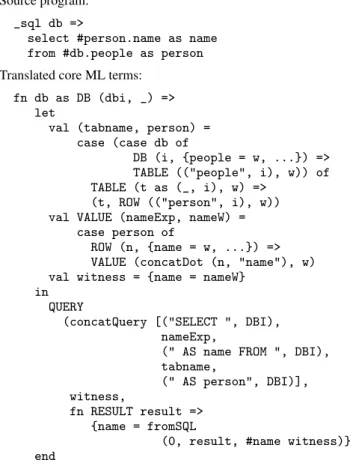
There is one more subtlety that should be take care of in achiev-ing seamless integration of SQL into SML#. We have so far iden-tified SQL rows (tuples) with Standard ML labeled records. This identification works fine for component selection and its typing. However, internal representations of SQL rows returned from an SQL server are different from those of ML record representation. This implies that a row fetched from the result of an SQL expres-sion returned from a server should be converted to the internal rep-resentation of Standard ML. Under our strategy, this requires to generate a core ML program that performs such conversion. More-over, we need to generate such a conversion function for each SQL query using its type information. This is best done at the time of translating a query expression, when all the necessary type infor-mation is available. Our source level translator generates a core ML
Source program: _sql db =>
select #person.name as name from #db.people as person Translated core ML terms:
fn db as DB (dbi, _) => let
val (tabname, person) = case (case db of
DB (i, {people = w, ...}) => TABLE (("people", i), w)) of TABLE (t as (_, i), w) =>
(t, ROW (("person", i), w)) val VALUE (nameExp, nameW) =
case person of
ROW (n, {name = w, ...}) => VALUE (concatDot (n, "name"), w) val witness = {name = nameW}
in QUERY
(concatQuery [("SELECT ", DBI), nameExp,
(" AS name FROM ", DBI), tabname,
(" AS person", DBI)], witness,
fn RESULT result => {name = fromSQL
(0, result, #name witness)}) end
Figure 4. example of query translation
program that performs this conversion just after an entire query is constructed. The result of our translation of an SQL query is then a core ML program having the following type.
datatype ’a query =
QUERY of string * ’a * (result -> ’a) The first component is an SQL command string to be sent to a server, the second component is a toy implementation, and the third component is the conversion function.
Figure 4 shows an example of translating a query expression into a core ML program.
4.5 Connection management
The remaining component of our extension is connection manage-ment. This is responsible for defining a server, establishing a con-nection, and sending a query over connection. Among them, the third one is a simple source level library function that calls one of C API provided by the database server through SML# C function interface described earlier. Server definition and connection estab-lishment need to perform runtime typechecking to ensure the type safety of SQL expressions.
We have developed a typing machinery to infer a most general type for any legal SQL query expression. This inferred type should be checked against the type of a database stored in a database server to be connected. Since a database server is external to SML# pro-grams, we model a database server as an object of typedynamic as proposed in [1]. In this formalism, an expression having a type dynamicis used with an explicit type annotation. Its runtime rep-resentation is a pair of its value and its runtime type information. This runtime type information is checked against the explicit type