Balance sheet
management
benchmark survey
Status of balance sheet management practices
among international banks – 2009
Contents
Introduction
4
Background
5
Key findings
7
General information
8
Overall governance
9
ALM unit roles and responsibilities
11
Liquidity risk
13
Interest rate risk
19
Capital management
23
Funds transfer pricing
26
Discretionary investment portfolios
28
Systems
29
This study covers the four main areas of balance sheet
management, namely interest rate risk management, liquidity
risk management, capital management and management of
discretionary investment portfolios. Many of these functions
would be covered by the asset and liability management (ALM)
function in banks, but we use the broader term ‘balance sheet
management’ because the study covers capital management as
well as the more traditional ALM focus areas.
The financial crisis has highlighted the need for organisations to take a more holistic view of their balance sheets. The financial view of the organisation has evolved over the past decade or so to one which looks at lines of business, rather than legal entities, as the primary profit centres, and both finance departments and national supervisors have been struggling with the tensions arising from this shift. At the same time the risk view of the organisation has also been equally silo-driven, with risk departments focusing on individual risk classes. Liquidity risk, in particular, has thrown up some challenges to this way of viewing finance and risk. What may look acceptable for each line of business on its own may turn out to be an unacceptable level of risk or product concentration for the organisation as a whole. Likewise certain financial products are not clearly assignable to any one risk class – Collateralized Debt Obligations (CDO) in particular have been shown to present a lethal combination of market, credit and liquidity risks. At the same time, national supervisors,
understandably keen to contain the risks to their own financial systems, have sought to impose restrictions around cross-border financing and capital flows within international banking groups.
These themes present a number of challenges to the way in which banking groups manage their balance sheets, especially in the area of governance and oversight, which is a major area of focus of this survey.
The objective of this survey is to provide the international banking industry with an overview of the state of balance sheet management in banks, to identify areas for improvement and help banks prepare for the future.
PricewaterhouseCoopers1 would like to extend our thanks to the many banks who
participated in this survey.
Background
The financial institutions who participated in this survey were as follows:
The participants in the survey will receive an individual benchmarking report comparing them with their peers
internationally. This report summarises the aggregate responses but does not attribute data to specific individual respondents.
Scope of benchmarking survey
The survey was designed to cover both the qualitative and quantitative aspects of balance sheet management approaches currently being utilised by industry participants, with a strong focus on governance and organisation. The results of the survey are intended to assist participating institutions by providing peer benchmarks of industry practices. This report has been organised around the following balance sheet management subject matter topics that were posed to each of the survey respondents:
Americas Bank of America • Citigroup • Wells Fargo • Europe ABN Amro • Banesto • Bankinter • Bank of Ireland • Barclays • BBVA • BNP Paribas • Britannia • Caixa Catalunya • Caja Madrid • Credit Suisse • Danske Bank • HSBC • ING • Intesa Sanpaolo • Landesbank Berlin • Landesbank • Hessen-Thüringen Lloyds Banking Group
• Nationwide Building • Society Nordea • Nykredit • Rabobank •
Royal Bank of Scotland
•
Santander
•
SNS REAAL
•
Standard Chartered Bank
• Svenska Handelsbanken • UBI Banca • UBS • UniCredit •
Middle East and Africa
Absa • FirstRand • Nedbank • Standard Bank • Asia CIMB • DBS Group Holdings • Kasikornbank • Oversea-Chinese • Banking Corporation Siam Commercial Bank
• Australia Commonwealth Bank • of Australia Overall governance •
ALM unit roles and
•
responsibilities Liquidity risk
•
Interest rate risk
•
Capital management
•
Funds transfer pricing
• Discretionary investment • portfolios Systems •
PricewaterhouseCoopers is pleased to present the results of our survey of the balance sheet
management practices at 43 leading financial institutions across the world. The breadth of the
survey participants gives a good picture of developments internationally.
Survey methodology
Each section of this report includes an analysis of the survey results and a discussion of the underlying issues. Tables and charts are presented to help the reader quickly ascertain the main issues associated with each topic and to assist in the benchmarking of his/her respective institution’s practices. In order to display results provided by participating institutions, PricewaterhouseCoopers designed a survey methodology that strived to achieve the appropriate balance between:
Promoting maximum participation among institutions by
•
using data templates that required firms to report their actual practices;
Ensuring soundness, integrity and comparability of the
•
survey to display results based on the actual data reported by participants;
Protecting confidentiality of participating institutions’
•
responses while providing maximum insight into the detailed parameters needed for analysing balance sheet management. The survey was carried out from April to June 2009, and the methodology used was a questionnaire supplemented where appropriate with interviews with representatives of participating institutions.
Please note that totals do not always add up to 100 because of rounding, or because respondents could choose more than one answer.
Survey confidentiality
The individual survey results and the survey questionnaire itself are confidential to the responding institutions and
PricewaterhouseCoopers. Each institution’s individual results have been kept strictly confidential and peer responses have been presented in a way that will not allow identification of any specific institution based on its submitted data. The results are based solely on survey responses as provided by each participant to PricewaterhouseCoopers. PricewaterhouseCoopers has not subjected the data contained herein to audit or review procedures or any other testing to validate the accuracy or reasonableness of the data provided by the participating companies.
A word of thanks
We acknowledge that the highly detailed nature of the survey questionnaire required a considerable amount of effort on the part of each participating institution to provide commensurately detailed and meaningful responses. We would like to extend our thanks to the responding institutions for participating in this study, and providing the breath and depth of qualitative and quantitative response within balance sheet management topics. We trust that you will find the survey results insightful and hope that they serve as a catalyst for discussion and action within your respective financial institutions.
If you have any comment or question regarding this survey, or would like to request additional copies, please contact your regional PricewaterhouseCoopers contacts listed in the appendix to this report.
Key findings
Overall governance: There is still a trend for banks to measure, manage and monitor the different risks separately, but an encouraging trend is the establishment of either capital management committees, or a broader mandate for the existing Asset-Liability Committee (ALCO) to focus on capital. The vast majority of banks operate a centralised ALM model, which enables oversight of the entire group balance sheet, usually supplemented with lower-level ALM units focusing either on business units or legal entities.
ALM unit roles and responsibilities: The responsibility for the ALM unit is almost evenly divided between the Treasury and Chief Financial Officer (CFO) functions (see Figure 3.1). Only 51% of ALM units look at capital management (see Figure 3.2), but in certain cases capital management lies with other departments, such as the Chief Risk Officer (CRO). Most banks have benchmarked their ALM framework to the Basel Committee on Banking Supervision (BCBS) guidance, ‘Principles for the Management and Supervision of Interest Rate Risk’, and half of the respondents have conducted an independent third party review of the ALM framework within the last 12 months.
Liquidity risk: Not surprisingly, many banks have undertaken an extensive review of liquidity risk management, and a very encouraging 88% now have a formal risk appetite for liquidity risk. An ongoing problem area is collateral management, as banks’ systems do not easily allow for identification of liquid assets that are encumbered (and thus not available to support liquidity needs). All respondents now conduct regular liquidity stress tests (vs. 75% in our 2006 ALM survey), and respondents report that their Boards are well informed with respect to this risk class.
Interest rate risk: Governance remains an area of potential weakness for interest rate risk management, with the ALM unit responsible for both management and measurement in around half of respondents (emerging best practice is for measurement to be done by an independent unit, such as Finance). However, we do see that a significant minority of banks now have the Risk function in a monitoring role, but there is clearly still a long way to go before this is general practice.
There has been further progress towards development of economic value measurement (as recommended by the BCBS), and 80% of respondents now assign capital to Interest Rate Risk in the Banking Book (IRRBB) under Basel II Pillar 2 (in Australia it is part of Pillar 1). However, these capital
measures are still quite crude, with many banks using either the standard 200 bp shock or Net Interest Income (NII) simulation.
Capital management: This includes capital planning, stress testing, capital allocation and economic capital calculation, and tends to sit broadly in the CFO function, although economic capital and stress testing at a number of banks resides within the CRO’s area. With capital planning sitting in Finance, having capital stress tests conducted in Risk can give rise to issues around the consistency and coordination of linkages. The common horizon for capital planning is usually three years or longer; however, capital stress testing typically contemplates a shorter time horizon. Only a small minority of respondents conduct a single stress test scenario, with the vast majority using three or more scenarios.
Funds transfer pricing (FTP): Despite the havoc which the financial crisis played with liquidity and other financing assumptions, banks seem generally quite satisfied with their FTP framework and we have not noted any significant shifts in trends since our 2006 survey.
Discretionary investment portfolios: Other than standard liquidity portfolios, there does not seem to be any industry consensus on the best way to manage discretionary investments, and one is left with the distinct impression that these investment decisions are made on a very ad hoc basis, without much in the way of formal policies and processes around them.
Systems: Banks still tend to operate with a patchwork of legacy systems set up to manage different aspects of the balance sheet (liquidity risk, interest rate risk, etc.), but significant changes are planned. With different systems, any kind of integrated balance sheet management simulation and stress testing is virtually impossible. We anticipate that, over the coming years, banks will upgrade to a more integrated approach, allowing planning and stress scenarios to be carried out across all aspects of the balance sheet. We expect that these integrated systems will cover:
IRRBB and funds transfer pricing;
•
Liquidity risk;
•
Capital planning and stress testing; and
•
Credit portfolio management.
•
The scope of balance sheet management has expanded to embrace capital management as well
as a more ‘holistic’ view of the balance sheet, although this remains a work in progress.
Figure 1.1: Breakdown of participants by asset size 18% 5% 0% % of participants 18% 37% 22% 0 – 10 $bn 10 – 50 $bn 50 – 100 $bn 100 – 200 $bn 200 – 500 $bn > 500 $bn Source: PricewaterhouseCoopers
The survey was conducted at the group head office level for all participants, who represent a good geographical cross-section of domiciles (see Figure 1.2).
Figure 1.2: Breakdown of participants by region
70% 12% 2% 7% 9% Asia
Australia/ New Zealand Europe
South Africa America % of participants
Source: PricewaterhouseCoopers
The participants primarily operate in the global market (see Figure 1.3), and are generally active in retail and commercial banking segments (see Figure 1.4).
Figure 1.3: Participants’ market presence.
43% 26% 31% Local market Regional market Global market % of participants Source: PricewaterhouseCoopers
Figure 1.4: Activities engaged in by participants 0%
Consumer banking Branch-based retail banking Wholesale banking Investment banking Private banking Wealth management Insurance Other 88 95 84 77 86 74 58 28 % of participants Source: PricewaterhouseCoopers
General information
A total of 43 banks from around the world responded to the survey; participants provided a
reasonable mix of large and medium/small banks (see Figure 1.1).
Overall governance
It is interesting to note that some banks have started to integrate overall balance sheet and risk oversight into an overarching executive risk committee. This is a trend that is expected to continue within institutions that are taking the steps to promote a holistic view of, and governance over the full spectrum of risks and capital.Figure 2.1: Body with primary oversight over balance sheet management
0% ALCO
Balance Sheet Management Committee
Executive Management Committee
Group/Executive Risk Committee Board
Board Risk Committee Board Audit Committee Other 88 7 7 16 19 12 0 16 Source: PricewaterhouseCoopers
The ALCO maintains a key focus on the traditional areas of interest rate risk and liquidity risk. In many cases the ALCO has broadened its scope across capital management and also includes the oversight of traded market risk.
Figure 2.2: Areas covered by body with primary oversight 0%
Interest rate risk Liquidity risk Structural FX risk Capital management Funds transfer pricing Discretionary investment portfolios Other 100 100 79 74 77 44 23 Source: PricewaterhouseCoopers
Centralised balance sheet management
Balance sheet management is largely centralised, with 91% of respondents managing these activities on a consolidated or group basis (see Figure 2.3). However, many banks that do run
a centralised balance sheet model also supplement the central unit with decentralised (subordinate) units, which are primarily organised along legal entity, business unit or regional basis. Most respondents noted that the subordinate units all operate under a consistently applied group framework and generally report into the central balance sheet management function.
Figure 2.3: Organisation 0%
91 9
Centralised Decentralised
Is this ALM responsible body centralised or decentralised?
Source: PricewaterhouseCoopers
Figure 2.4: Reporting lines and supplemental balance sheet management units 0% By region By legal entity By business unit 43 57 31 56 13 40 53 7 100 To regional head
To Group body with ALM responsibility Other
Source: PricewaterhouseCoopers
The amount of time devoted by the primary body with group oversight over balance sheet management matters is mainly around a one- to two-hour meeting on a monthly basis (see Figure 2.5).
Figure 2.5: Frequency/length of primary oversight body meetings 0% Daily Weekly Bi-weekly Monthly Bi-monthly Quarterly 5 5 49 26 5 < 1 hour 1 – 2 hours > 2 hours 2 2 2 2 2 Source: PricewaterhouseCoopers
We found that the ALCO remains the key executive governance body with the responsibility for
overseeing balance sheet management activities (see Figure 2.1).
The composition of the primary oversight body (see Figure 2.6) includes the most senior bank representatives, with the chair generally held by the most senior person, being either the Board Chairman or CEO. Major business unit heads are key participants and voting members. Other voting members include heads of market and credit risks, the chief economist and head of compliance.
Figure 2.6: Composition of primary oversight body 0% Board chairman Non-executive director CEO CFO CRO Treasurer BU heads ALM unit head Financial controller Other 58 21 21 16 20 64 44 56 38 62 21 68 11 10 75 15 85 15 6 47 47 6 56 38 63 38 Chair Voting member Non-voting member Source: PricewaterhouseCoopers
For the decentralised subordinate oversight bodies the meeting frequency is at least monthly (see Figure 2.7). The
sub-committees that meet on a monthly basis tend to be subsidiary, business unit or regional ALCOs, while those meeting more frequently will more actively focus on market movements and comprise participants that are more closely aligned with the specific activities related to execution of ALCO mandates or strategies.
Figure 2.7: Frequency/length of subordinate oversight body meetings 0% Daily Weekly Bi-weekly Monthly Bi-monthly Quarterly 38 5 3 10 29 10 0 0 < 1 hour 1 - 2 hours > 2 hours 2.5 2.5 Source: PricewaterhouseCoopers
However, there is also a growing percentage that have aligned the reporting to the risk management function, under the CRO or the head of market risk.
Figure 3.1: ALM unit reporting lines 0% CEO CFO CRO Treasurer Other 2 40 7 35 16 Source: PricewaterhouseCoopers
The typical areas of focus of this unit remain the core ALM activities of interest rate and liquidity risk management, including funds transfer pricing (see Figure 3.2). Several respondents noted that there is more focus on the overall balance sheet structure and optimisation of the funding and capital mix, along with oversight of impact of IAS39 and hedge effectiveness.
Figure 3.2: Areas of focus for ALM unit 0% Interest rate risk
Liquidity risk Structural FX risk Capital management Funds transfer pricing Discretionary investment portfolios Other 100 93 70 51 77 40 26 Source: PricewaterhouseCoopers
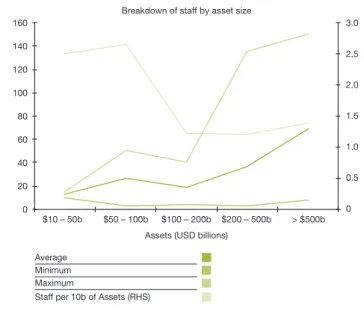
The size of the ALM department is generally related to the size of the institution, although the size of the unit can vary greatly. Regarding the size of the ALM department, economies of scale appear to realised for banks with assets between 50-100 $billion and 100-200 $billion as indicated by the downward slope and the ‘staff per 10 $billion of assets’ trend line (see Figure 3.3).
Figure 3.3: Size of ALM unit (including subordinate units below group level) 160 140 120 100 80 60 40 20 0 3.0 2.5 2.0 1.5 1.0 0.5 0 Breakdown of staff by asset size
Assets (USD billions)
$10 – 50b $50 – 100b $100 – 200b $200 – 500b > $500b
Average Minimum Maximum
Staff per 10b of Assets (RHS)
Source: PricewaterhouseCoopers
The primary objective of the ALM unit is to operate as a support unit (see Figure 3.4). However, within this category some responses would indicate that there is some overlap of cost and profit performance objectives. This is the case where the unit may undertake hedging activities or positioning strategies, but has no clear performance metric related to profit or value add. This is one area that banks need to pay attention to, with respect to segregation of duties, separating risk measurement and monitoring from the management and decision making related to transaction execution.
Figure 3.4: Primary objective of ALM unit 0% Profit centre Cost centre Support unit Other 12 5 57 26 Source: PricewaterhouseCoopers
ALM unit roles and responsibilities
All of the participating banks have a dedicated ALM support unit, which typically reports to either
the CFO or the Treasurer (see Figure 3.1).
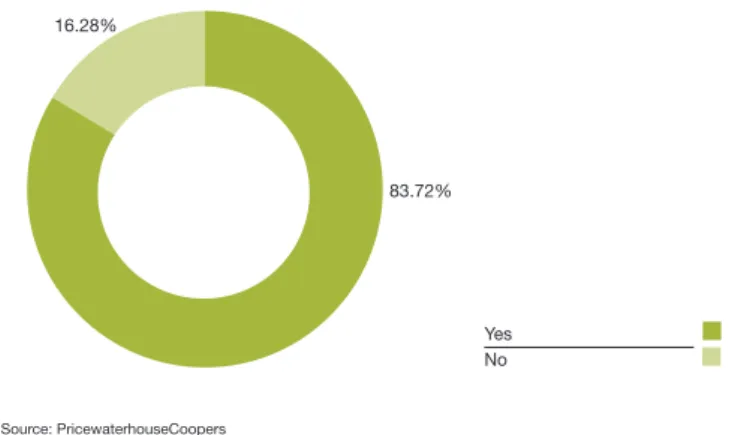
Just over 83% of participants have benchmarked their ALM unit to a specific external reference point (see Figure 3.5).
Figure 3.5: Benchmarking of ALM framework 16.28%
83.72%
Yes No
Source: PricewaterhouseCoopers
Of the organisations which have conducted external reviews, the primary reference point has been the Basel ‘Principles for the Management and Supervision of Interest Rate Risk’ (see Figure 3.6). In addition to the guidelines and standards in the public domain, many of these respondents noted that they have also used the last PwC ALM Survey published in 2006 as a reference point. Over 50% of respondents who have conducted external benchmarking have done so within the last 12 months (see Figure 3.7).
Figure 3.6: Reference point for ALM framework benchmarking 0% Basel Committee IIF CEBS Local regulator Other 71 43 40 69 33 Source: PricewaterhouseCoopers
Figure 3.7: Period since last independent review of ALM framework 0%
Within last 12 months Within last 1 – 2 years Within last 2 – 3 years Within last 3 – 5 years Not at all in last 5 years
51 30 0 5 14 Source: PricewaterhouseCoopers
Certainly the painful experiences and lessons throughout the financial crisis have highlighted the dimensions and severity of consequences from liquidity problems. The Bank for International Settlements (BIS) and Institute of International Finance (IIF) have upgraded their guidelines for the management of liquidity risk to incorporate and reiterate what constitutes sound practice.
Many banks have undertaken extensive reviews and upgrades of their liquidity risk frameworks. Now just over 88% of participants have set a formal risk appetite for liquidity risk at Board level compared with 72% in 2006.
Management, measurement and monitoring
liquidity risk
In risk management, we distinguish between those responsible for managing the risk (making day-to-day decisions and executing these (see Figure 4.1)), those responsible for measuring the risk (producing metrics and reports (see Figure 4.2)), and those monitoring the risks (ensuring adherence with policies and limits, and reviewing the overall risk profile (see Figure 4.3)). In the world of traded market risk, these would be the front office, middle office and risk management functions, respectively.
However, for liquidity risk it seems that such segregation of duties is not widely applied. The measurement and management of liquidity risk still generally resides within the same unit, as does, in some cases, the monitoring of liquidity risk. This is an area where we would expect to see growing involvement from the risk management function, particularly with respect to the measurement of liquidity risk being separated from the management of liquidity risk.
Figure 4.1: Responsibility for managing liquidity risk 0%
Within trading desk/front office – reporting to head of BU Dedicated treasury unit – reporting to CEO Dedicated treasury unit – reporting to CFO ALM unit – reporting as under 3.1 above Other 23 12 28 28 9 Source: PricewaterhouseCoopers
Figure 4.2: Responsibility for measuring liquidity risk 0%
Within trading desk/front office – reporting to head of BU Dedicated treasury unit – reporting to CEO Dedicated treasury unit – reporting to CFO ALM unit – reporting as under 3.1 above Within CFO area Within CRO area Other 2 2 14 42 9 16 14 Source: PricewaterhouseCoopers
Figure 4.3: Responsibility for monitoring liquidity risk 0%
Within trading desk/front office – reporting to head of BU Dedicated treasury unit – reporting to CEO Dedicated treasury unit – reporting to CFO ALM unit – reporting as under 3.1 above Within CFO area Within CRO area Other 0 2 14 33 12 30 9 Source: PricewaterhouseCoopers
Liquidity risk
Liquidity risk has moved up the agenda to be one of the most important areas of focus within
the ALM framework.
Governance and oversight
The committee or body with primary oversight for liquidity risk is typically the ALCO (see Figure 4.4).
Figure 4.4: Body with primary oversight over liquidity risk 0%
ALCO Balance Sheet Management Committee Executive Management Committee Group Risk Committee Board
Board Risk Committee Board Audit Committee Other 70 5 7 7 0 5 0 9 Source: PricewaterhouseCoopers
Most banks feel that their liquidity risk policies are complete, up to date and fully implemented (58%), or there are only minor gaps in policy or implementation (37%) (see Figure 4.5).
Figure 4.5: Status of liquidity risk management policy 0% Policy is complete, up to date and fully implemented Policy is broadly complete and up to date, but there are minor gaps in either the policy itself or its implementation Policy is work in progress
We do not have a group liquidity risk policy
58 37
54
0
Source: PricewaterhouseCoopers
Board awareness of liquidity risk has undoubtedly been heightened over the past three years, either by experience or observation. 90% of respondents feel that their Boards have good understanding of the concepts and technical
Figure 4.6: Board awareness of liquidity risk 0% Very high understanding with full grasp of the technical details
Broad understanding of the concepts with some understanding of the technical details Broad understanding of the concepts but little or no understanding of the technical details Limited understanding of the concepts
16 74
2 5 Source: PricewaterhouseCoopers
Over 65% of respondents indicated that there is regular reporting of liquidity risk to the full Board and/or Board Risk Committee. Around 30% do so on an ad hoc basis (see Figure 4.7).
Figure 4.7: Liquidity risk reporting to the Board 0%
At every full Board meeting At every Board Risk Committee meeting
On request/ad hoc to the full Board On request/ad hoc to the Board Risk Committee
68 65 35 30
Source: PricewaterhouseCoopers
Liquidity risk measurement
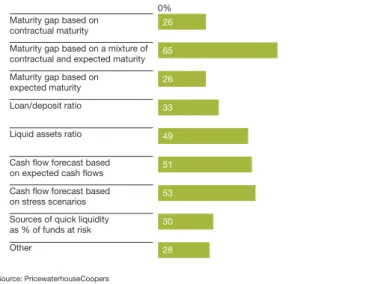
The primary measure of liquidity risk is the static maturity gap using a combination of contractual and expected term data (see Figure 4.8). However, it seems that the use of cash flow forecasts using stressed or expected cash flows is gaining greater prominence as the primary measure of liquidity risk.
Figure 4.8: Liquidity risk measures 0% Maturity gap based on
contractual maturity
Maturity gap based on a mixture of contractual and expected maturity Maturity gap based on
26 65 26
These measures are typically produced on a daily basis and it is often the case that this is a regulatory requirement.
Figure 4.9: Frequency of liquidity risk measurement 0% 40 20 36 4 32 22 46 25 43 29 4 26 6 65 3 69 6 22 3 59 16 22 3 29 21 47 3 29 18 47 6 Maturity gap based on
contractual maturity
Maturity gap based on a mixture of contractual and expected maturity Maturity gap based on expected maturity Loan/deposit ratio Liquid assets ratio Cash flow forecast based on expected cash flows Cash flow forecast based on stress scenarios Other (please specify) Daily
Weekly Monthly Other
Source: PricewaterhouseCoopers
In measuring funding risk limits and concentration, the factors typically taken into account are the types of products and the spread of maturities. Other factors such as currencies and geographies are commonly used as well (see Figure 4.10).
Figure 4.10: Factors included in liquidity risk measurement 0% Contractual maturities Effective maturities Types of products Types of customers Currencies Geographies/countries/regions Other 70 51 77 67 67 53 9 Source: PricewaterhouseCoopers
Collateral management
Collateral management is seen as material for 86% of respondents (see Figure 4.11).
Figure 4.11: Relevance of collateral management
86% 14%
Material Immaterial
Source: PricewaterhouseCoopers
It is essential to have clear, accurate and timely information regarding collateral in order to be able to deal effectively with liquidity events that may require the use of such assets. It is an area where banks need to improve and apply greater rigour in knowing precisely which assets can be quickly liquidated and at what price.
Figure 4.12: Collateral management monitoring 0%
We monitor the legal entity where collateral is held in a timely manner We monitor the physical location where collateral is held in a timely manner
60 29 52 33 2 Agree Partially agree Disagree Source: PricewaterhouseCoopers
Figure 4.13: Collateral management infrastructure 0%
MI systems that differentiate encumbered /unencumbered assets
MI systems that identify assets that can be posted at the central bank
40 45 2
45 45 2
No work needed Some improvement required Requires major upgrade
Liquidity stress tests
All responding banks perform some form of liquidity stress testing. This is an improvement from our 2006 survey which revealed that liquidity stress testing was only conducted by 75% of the banks surveyed. The most common type of scenario is a pre-defined scenario based on expert judgement (see Figure 4.14).
Figure 4.14: Liquidity stress test scenarios 0%
Pre-defined scenario based on historical experience Pre-defined scenario based on expert judgement Dynamic scenario based on expert judgement Reverse stress test (or ‘stress to fail’) Multiple scenarios 44 77 35 21 70 Source: PricewaterhouseCoopers
The one-month time horizon for such stress tests is the most common; however, there is growing use of longer time frames out to one year (see Figure 4.15).
Figure 4.15: Liquidity stress test time horizons 0% One day Two days Up to one week Up to one month Up to three months Up to six months Up to twelve months Other 21 14 40 53 42 19 40 9 Source: PricewaterhouseCoopers
For those banks using multiple scenarios (see Figure 4.16), the
Figure 4.16: Number and frequency of multiple scenarios 0% 1 2 Daily Weekly Monthly
Other (please specify)
2 0 0 0 5 10 19 0 3 0 7 10 2 4 – 5 2 2 10 0 >5 2 5 14 2 Source: PricewaterhouseCoopers
Within the scenarios 63% of banks assume that central bank funding will be available as part of their stress tests. More than 90% of banks distinguish between firm-specific (single name crisis scenarios) and market-wide stresses in their scenarios. Supervisory authorities have reviewed around three quarters of the responding banks’ liquidity stress testing scenarios with 51% being ‘fully satisfactory’ (see Figure 4.17). This is an area that is expected to continue to be of high priority with supervisors.
In performing stress tests, multiple factors are taken into account to modify contractual cash flows (see Figure 4.18). Most emphasis is placed upon making assumptions on the value of liquid assets with ‘haircuts’ and behavioural factors that may have a significant impact on the estimated cash flows, such as a rapid withdrawal of funds.
Figure 4.18: Modifications to contractual cash flows in liquidity risk modelling
0% Prepayments
Pipeline Drawdowns
Non-maturing product profiles Replicating portfolios Credit events Withdrawal of funding Contingent liabilities 70 51 74 72 19 42 74 72 84 14 Haircuts Other Source: PricewaterhouseCoopers
Oversight over modelling assumptions
93% of participants have had their modelling assumptions reviewed and approved by ALCO or the equivalent body with primary oversight of liquidity risk. This is typically done on an annual basis (see Figure 4.19).
Figure 4.19: Frequency of ALCO review of liquidity risk modelling assumptions 7% 5% 0 - 10 bn 0% 5% 19% 7% 51% Weekly Monthly Quarterly Semi-annually Annually Ad-hoc Other Source: PricewaterhouseCoopers
All of the survey participants have done a comprehensive review of all of the modelling assumptions (see Figure 4.20). Nearly all have done so within the last 12 months, further highlighting the close attention being paid to liquidity risk.
Figure 4.20: Period of last review of liquidity risk modelling assumptions
0% Within last 12 months
Within last 1 – 2 years Within last 2 – 3 years Within last 2 – 5 years Not at all in last 5 years
95 5 0 0 0 Source: PricewaterhouseCoopers
Contingency funding plan
Only 65% of participants have conducted a simulation of their contingency funding plans. Where simulations have been completed, it was typically within the last 12 months (see Figure 4.21).
Figure 4.21: Period of last simulation of contingency funding plans
5%
51% 7%
2% 2%
Within last 12 months Within last 1 – 2 years Within last 2 – 3 years Within last 2 – 5 years Not at all in last 5 years
Source: PricewaterhouseCoopers
The bodies involved in the contingency funding plan are primarily the ALCO and Treasury. It is worth noting the low responses for the board and risk functions (see Figure 4.22).
0% Board Senior management CFO ALCO Treasury Risk Control Communication department IT department Central banks
Other official sector parties Other banks Other 0 16 5 40 26 5 5 0 0 0 0 23 Source: PricewaterhouseCoopers
Disclosure
Figure 4.23: Liquidity risk disclosures 0% Liquidity reserve Liquidity gap Funding diversification Asset diversification Regulator-required ratios and measures Other quantitative measures (please specify) Organisational issues Methodologies of measures (qualitatively) 14 19 19 2 23 12 2 19 7 14 Limit framework (qualitatively) Other qualitative issues
regime set by their local supervisor, and over 90% believe their supervisor is adequately skilled to supervise liquidity risk. The challenges for the supervisors are to have policies that are up to date with industry practices and to find the right balance, the form and the substance of the bank’s liquidity management practices (see Figure 4.24).
Figure 4.24: Challenges in supervising liquidity risk
0% Policies that are out of date
compared to industry practice Focus on regulatory reporting as opposed to interpretation of ALM risk management Poor relationship with host supervisors Ivory tower approach as opposed to pragmatism 33 42 12 16 Source: PricewaterhouseCoopers
Nearly all banks have been performing some form of interest rate risk management activities and have well-established processes. However, with the heightened focus on the overall Basel II application, both regulators and banks are reviewing and updating their approach to IRRBB.
While measures such as repricing gap and net interest income (NII) analysis are widely used, more attention is now paid to measures of economic value and capital for IRRBB. Of equal focus is the governance around the IRRBB framework, including the Board-approved risk appetite, ALCO investment and oversight, policies, limits, models and organisation structure.
Governance
Nearly all banks in the survey report having a formal risk appetite for IRRBB. The primary oversight body was identified by 70% of respondents as the ALCO (see Figure 5.1).
Figure 5.1 Oversight of interest rate risk 0% ALCO
Balance Sheet Management Committee
Executive Management Committee Group Risk Committee Board
Board Risk Committee Board Audit Committee Other 70 5 2 9 0 2 0 14 Source: PricewaterhouseCoopers
The main departments that support the ALCO framework are Treasury, Finance, ALM and Risk Management. This is an approach that reflects the general concept of segregation of duties in relation to the governance of interest rate risk management.
Figure 5.2: Management of IRRBB 0% Within trading desk/front office – reporting to head of BU Dedicated treasury unit – reporting to CEO Dedicated treasury unit – reporting to CFO ALM unit – reporting as under 3.1 above Other 19 9 16 47 9 Source: PricewaterhouseCoopers
Figure 5.3: Measurement of IRRBB 0% Within trading desk/front office – reporting to head of BU Dedicated treasury unit – reporting to CEO Dedicated treasury unit – reporting to CFO ALM unit – reporting as under 3.1 above Within CFO area Within CRO area Other 0 2 5 53 2 26 12 Source: PricewaterhouseCoopers
Figure 5.4: Monitoring of IRRBB 0% Within trading desk/front office – reporting to head of BU Dedicated treasury unit – reporting to CEO Dedicated treasury unit – reporting to CFO ALM unit – reporting as under 3.1 above Within CFO area Within CRO area Other 0 0 2 35 0 44 19 Source: PricewaterhouseCoopers
Interest rate risk
Interest rate risk in the banking book (IRRBB), as it is referred to in the various documents produced
by the Basel Committee, is the area that has probably had the most attention within banks’ ALM
functions over the years.
The results show that a large percentage of respondents that have a structure that combines many of these activities within an ALM unit. There is, however, some attention as to how the traditional ALM unit may evolve, mainly in relation to separating the management of IRRBB positions from the unit that is measuring and/or monitoring the positions (see Figure 5.2-5.4). Some banks have adopted a model akin to the market risk function to handle the measurement and monitoring, while the management aspect is conducted within the Treasury or Finance division.
Nearly 80% have complete, up to date and fully implemented policies for IRRBB (see Figure 5.5).
Figure 5.5: Policy
0% Policy is complete, up to date and fully implemented Policy is broadly complete and up to date, but there are minor gaps in either the policy itself or its implementation Policy is work in progress
We do not have a group interest rate risk policy
79 19
2 0 Source: PricewaterhouseCoopers
79% of respondents say their Board’s have a broad level of knowledge of the concepts and technical details for interest rate risk management and 12% say that they have an even higher level (see Figure 5.6).
Figure 5.6: Board understanding of IRRBB 0% Very high understanding with full grasp of the technical details
Broad understanding of the concepts with some understanding of the technical details Broad understanding of the concepts but little or no understanding of the technical details Limited understanding of the concepts
12 79
2
7
Source: PricewaterhouseCoopers
Figure 5.7: Board reporting
0% At every full Board meeting
At every Board Risk Committee meeting
On request/ad hoc to the full Board On request/ad hoc to the Board Risk Committee
47 60 33 21
Source: PricewaterhouseCoopers
Investment term of equity
One of the key performance metrics for managing IRRBB is the use of a benchmark for the investment term, or duration, of equity. 58% of participants use this benchmark within their interest rate risk frameworks. The most common period targeted is the medium term of between one and five years for 42% of respondents (see Figure 5.8). This benchmark is generally reviewed and/or changed on an ad hoc basis over the course of the year, indicating that many respondents will change this target in accordance with their strategy and outlook for the interest rate market (see Figure 5.9).
Figure 5.8: Target duration of equity
0% Short term (i.e. less than 1 year) Medium term (i.e. between 1 and 5 years)
Long term (i.e. more than 5 years)
9 42
5
Source: PricewaterhouseCoopers
Figure 5.9: Frequency of review of equity duration benchmark
0% Quarterly
Annually
9 21
Measurement
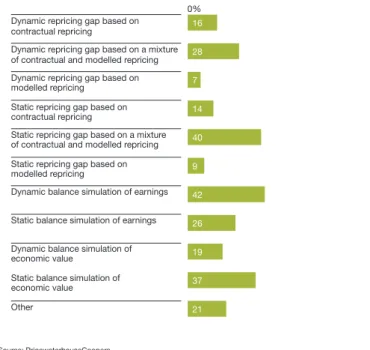
All participants use a variety of measures, generally in combination, to assess IRRBB (see Figure 5.10 and 5.11). These range from repricing gaps to earnings and economic value simulations. The challenge for the measurement and management of IRRBB has been to strike the appropriate balance between the short-term (i.e. less than one year) impact on earnings and the longer term impact on economic value. Respondents have indicated that they have been able to establish a reasonable balance between short-term and long-term measures. It is also worth noting that around 70% of the banks isolate the mismatch earnings to separate P&L units and forecast these specific amounts. This is an area where there are divergent opinions over the appropriate performance measures for the unit managing IRRBB when comparing accrual-type earnings with economic value risk measures.
Figure 5.10: Primary measurement tool for IRRBB 0%
Dynamic repricing gap based on contractual repricing
Dynamic repricing gap based on a mixture of contractual and modelled repricing Dynamic repricing gap based on modelled repricing
Static repricing gap based on contractual repricing
Static repricing gap based on a mixture of contractual and modelled repricing Static repricing gap based on modelled repricing
Dynamic balance simulation of earnings Static balance simulation of earnings Dynamic balance simulation of economic value
Static balance simulation of economic value Other 16 28 7 14 40 9 42 26 19 37 21 Source: PricewaterhouseCoopers
Figure 5.11: Secondary measurement tool for IRRBB 0%
Dynamic repricing gap based on contractual repricing
Dynamic repricing gap based on a mixture of contractual and modelled repricing Dynamic repricing gap based on modelled repricing
Static repricing gap based on contractual repricing
Static repricing gap based on a mixture of contractual and modelled repricing Static repricing gap based on modelled repricing
Dynamic balance simulation of earnings Static balance simulation of earnings Dynamic balance simulation of economic value
Static balance simulation of economic value Other 12 9 9 16 14 7 14 9 12 14 12 Source: PricewaterhouseCoopers
This can also be seen in the split between the limits applied to the respective measures. The two key identified limits are on the static economic value simulation and the dynamic earning simulation (see Figure 5.12). The slightly higher figure for a limit on the static economic value measure may be related to the fact that this is the measure that was promulgated within the Basel papers as being the approach that regulators are advised to use to determine the level of capital for IRRBB.
Over 80% of respondents measure the capital required to support IRRBB and the link to the Basel approach is supported by the use of an economic value approach.
Figure 5.12: Limits for IRRBB 0% Dynamic repricing gap based on
contractual repricing
Dynamic repricing gap based on a mixture of contractual and modelled repricing Dynamic repricing gap based on modelled repricing
Static repricing gap based on contractual repricing
Static repricing gap based on a mixture of contractual and modelled repricing Static repricing gap based on modelled repricing
Dynamic balance simulation of earnings Static balance simulation of earnings Dynamic balance simulation of economic value
Static balance simulation of economic value Other 12 16 5 9 21 5 35 21 14 40 16 Source: PricewaterhouseCoopers
Figure 5.13: Capital for IRRBB 0% Using the standard 200 bps on economic value of capital shock
Using NII simulation 28 0 0 0 14 51 0 26 0 7 0 0 19 Using economic value simulation
Other (please specify)
We do not measure capital for interest rate
Nearly all banks generate their IRRBB measures on at least a monthly basis (see Figure 5.14). Most of the banks that perform this on a daily basis are based in Europe.
Figure 5.14: Frequency of IRRBB measurement 0%
Dynamic repricing gap based on contractual repricing Dynamic repricing gap based on a mixture of contractual and modelled repricing
Dynamic repricing gap based on modelled repricing Static repricing gap based on contractual repricing Static repricing gap based on a mixture of contractual and modelled repricing
Static repricing gap based on modelled repricing Dynamic balance simulation of earnings
Static balance simulation of earnings
Dynamic balance simulation of economic value Static balance simulation of economic value Other (please specify) Daily Weekly Monthly Other 5 5 21 2 19 2 2 16 2 14 12 2 7 16 7 42 7 30 5 21 5 2 47 7 5 12 12 2 5 23 12 2 37 Source: PricewaterhouseCoopers
Just over 80% of respondents have had their IRRBB framework reviewed by their regulatory supervisors, and the results have been generally satisfactory (see Figure 5.15).
Figure 5.15: Supervisory review of IRRBB 0% Yes, and authority was fully satisfied Yes, but authority requires further minor enhancements
Yes, but authority was dissatisfied
65 16
One of the biggest challenges for banks is to establish an effective, integrated operating model to bring all of the components together and thus enable consistency and clarity within the application of the whole and related sub-components, particularly when related to the ICAAP. It has drawn greater attention within the ALM or Balance Sheet Management function under the governance of ALCOs in many cases.
Structure
As we can see from figure 6.2, most of the key capital management activities are split between the CFO and CRO functions. Traditionally, the CFO has had responsibility for regulatory risk reporting and capital planning with a general ‘top down’ approach. The calculation of economic capital has tended to evolve under the CRO on a ‘bottom’ up basis. Some of the challenges that arise with this approach are, for example:
Consistency with economic capital and capital allocation.
•
Using a ‘top down’ holistic economic capital model that can
•
integrate the ‘bottom up’ measured risks and perform robust intra-risk diversification measurement.
Using this model for stress testing and then linking to
•
capital planning.
Reconciling regulatory risk-weighted assets (RWAs) to
•
economic capital.
Effectively harnessing the capital adequacy measure for
•
stress testing and capital planning to properly capture both risk measures and accounting components, particularly with credit risk and loan loss provisioning.
Consistency of balances used for capital allocation and funds
•
transfer pricing (FTP) that drive key components that feed into economic value and risk-adjusted return on capital (RAROC) measures.
Figure 6.1: Which senior executive has responsibility for the following activities within his/her area
Capital stress testing Capital planning Return on (risk-adjusted) capital calculations Capital allocation within the organisation
Economic capital calculation Capital adequacy reporting Regulatory RWA calculation 0% CEO CFO CRO COO/head of operations Treasurer Other
Setting cost of capital
2 2 5 7 5 5 7 12 2 2 9 2 2 5 53 67 70 70 35 72 70 16 67 28 21 56 19 21 12 49 67 2 16 2 9 5 9 9 12 9 21 9 9 Source: PricewaterhouseCoopers
90% of respondents have a dedicated capital management unit, with the majority reporting to the CFO.
Figure 6.2: Capital management unit reporting line 0% CEO CFO CRO COO Treasury Other 2 60 12 0 19 2 Source: PricewaterhouseCoopers
The average headcount of these units is approximately 15, with a maximum of 60 people.
Capital management
For this survey, we have included a section on capital management for the first time. This is in
response to the increased attention being paid to capital management in a Basel II world and in
response to many questions from our clients regarding some of the issues covered.
Figure 6.3: Capital management unit headcount 55% 3% 13% 29% <=10 11 – 30 31 – 50 >50 Source: PricewaterhouseCoopers
As mentioned in the introduction, the ALCO has been the main executive body that has oversight of capital management with 49% of respondents (see Figure 6.4).
Figure 6.4: Oversight of capital management 0%
ALCO
Balance Sheet Management Committee
Finance Committee Group Risk Committee Executive Management Committee
49 12 2 12 26 Source: PricewaterhouseCoopers
Activities
The main activities performed by the capital management unit are capital planning, capital stress testing, capital allocation and setting the cost of capital (see Figure 6.5).
Other related activities are more fragmented and it would appear that for most respondents, the capital management unit is a receiver of economic capital information and that it is
Figure 6.5: Activities of the capital management unit
0% Calculation of regulatory
capital RWAs Regulatory capital adequacy reporting Economic capital calculation Capital allocation Return on (risk-adjusted) capital calculation Capital planning Capital stress testing Setting cost of capital
30 40 44 67 51 88 72 65 Source: PricewaterhouseCoopers
With regards to capital planning, the time horizon used by nearly half of the respondents is three years (see Figure 6.6).
Figure 6.6: Time horizon for capital planning 0%
One year Two years Three years More than three years Ad hoc None – we do not do capital planning 14 12 49 19 5 0 Source: PricewaterhouseCoopers
This time horizon is broadly consistent with the period looked at for capital stress testing, although there appears to be a shift in focus to shorter time frames for stress testing compared to capital planning (see Figure 6.7).
Most respondents (63%) have reported that they conduct at least three or more scenarios for their capital stress testing (see Figure 6.8).
Figure 6.8: Number of scenarios for capital stress testing 0% None 1 2 3 4 – 5 5 – 10 >10 5 12 14 26 14 23 0 Source: PricewaterhouseCoopers
Governance
All respondents have a capital management policy in place, with nearly half asserting that it is complete, up to date and fully implemented (see Figure 6.9).
Figure 6.9: Capital management policy 0% Policy is complete, up to date and fully implemented Policy is broadly complete and up to date, but there are minor gaps in either the policy itself or its implementation Policy is work in progress
We do not have a group capital management policy 47 44
5 0
Source: PricewaterhouseCoopers
Most Boards have a reasonable understanding of capital management and the associated technical concepts, with 26% reporting to have a very high level of understanding (see Figure 6.10).
Figure 6.10: Board awareness of capital management 0%
Very high understanding with full grasp of the technical details
Broad understanding of the concepts with some understanding of the technical details Broad understanding of the concepts but little or no understanding of the technical details Limited understanding of the concepts
26 63 7
0
Source: PricewaterhouseCoopers
It would be expected that there is regular reporting of capital adequacy to the Board, its Risk Committee, or both. What is surprising is that over a quarter of respondents (i.e. ‘other’ category) do not regularly report this information to the Board, but instead generally provide capital adequacy updates to some form of executive committee (see Figure 6.11).
Figure 6.11: Board reporting of capital adequacy
0% At every full Board meeting
At every Board Risk Committee meeting
On request/ad hoc to the full Board On request/ad hoc to the Board Risk Committee Other 72 42 28 16 26 Source: PricewaterhouseCoopers
However, over the past year many banks have been revisiting their practices and paying significant attention to ensuring that it is functioning properly and is supported by robust,
appropriate methodologies.
The importance of FTP has been highlighted as it underpins the interest margin and profitability results and, thus, has a significant impact on business unit performance measurement and business behaviour. It has been recognised that aspects like pricing for liquidity, optionality, customer behaviour and trading portfolios require more attention to ensure that underlying risks are properly reflected within pricing and performance measurement practices.
It is important that FTP is well understood throughout the bank and that the implications of it are understood beyond the specialised functions administering it. Methods must be sound and transparent and an appropriate level of governance undertaken to avoid potential conflict of interest.
Governance
Around half of the participating banks have their FTP policy as a part of the ALCO responsibilities (see Figure 7.1). In some banks it resides with the Finance or Treasury function (as noted within the ‘other’ category).
Figure 7.1: Responsibility for FTP policy
0% ALCO
Executive Management Committee Board
Board Risk Committee
47 14
2 2
The responsibility for managing the FTP process is primarily with the ALM unit (44%), or with the Finance or Treasury units (see Figure 7.2). A key governance point regarding the management of FTP and the setting of policy is to consider the aspect of segregation of duties. This aspect of managing FTP is of higher importance for units that are considered profit centres.
Figure 7.2: Management of FTP process
0% Finance Risk ALM Treasury Other 37 5 44 40 16 Source: PricewaterhouseCoopers
While 90% of respondents have an FTP policy in place, it is notable that around half feel that they have some gaps in the policy or its implementation (see Figure 7.3).
Figure 7.3: Status of FTP policy
0% Policy is complete, up to date and fully implemented Policy is broadly complete and up to date, but there are minor gaps in either the policy itself or its implementation Policy is work in progress
We do not have a FTP policy
44 47
5 5
Source: PricewaterhouseCoopers
Funds transfer pricing
Funds transfer pricing has been a key component of most banks’ ALM frameworks for many
years. It has often been sitting in the background and seen as a process function and not necessarily
well understood or appreciated beyond the units administering it.
The clear majority of approaches use FTP rates that are matched according to term or cash flow (see Figure 7.4).
Figure 7.4: FTP approach
0% Single FTP rate across all assets and liabilities Allocation of assets and liabilities to homogeneous pools, with one rate for each pool
Matched rate FTP for individual assets and liabilities Matched rate for each cash flow
Not applicable – we do not have an FTP process Other 12 9 56 12 0 16 Source: PricewaterhouseCoopers
Nearly all respondents (95%) use interbank money market/ swap rates to determine their FTP rates (see Figure 7.5). It is also very common to have an adjustment for funding liquidity, or a liquidity buffer (81%), and the use of an adjustment for asset liquidity is growing (44%). A third of respondents also use ‘political’ of non-risk related adjustments to influence FTP results.
Figure 7.5: Components of FTP rates 0% Bank deposit rates
Bank loan rates Government bond yield Interbank money market/ swap rates
Funding liquidity/ liquidity buffer cost Asset liquidity Option price Tax effect 33 21 28 95 81 44 33 2 12 33 Capital usage ‘Political’ adjustment Source: PricewaterhouseCoopers
When making adjustments for liquidity, two-thirds of respondents differentiate them by term and/or by product.
Figure 7.6: Treatment of liquidity risk in FTP rates
0% Single liquidity risk premium
across all assets
Single liquidity risk premium across all assets and single discount across all liabilities
Differentiated liquidity risk premia and discounts
Not applicable – we do not factor in any liquidity risk adjustments Other 5 14 67 9 5 Source: PricewaterhouseCoopers
Over half update their FTP rates on a daily basis, with a further 16% updating rates on an intra-day basis (see Figure 7.7).
Figure 7.7: Frequency of FTP rate updates
0% Intra-day
Daily Weekly Monthly
Longer term than monthly
16 51 5 26 2 Source: PricewaterhouseCoopers
While most participants are generally satisfied with their FTP frameworks, the areas that seem to require additional attention are improvements to the understanding, acceptance, and reporting of FTP (see Figure 7.8).
Figure 7.8: Satisfaction with FTP framework 0%
Methods Reporting Accuracy
Understanding and acceptance
21 51 26 9 51 37 12 49 37 9 42 42 5 Completely Very Partially Slightly Not at all Source: PricewaterhouseCoopers
Discretionary investment portfolios consist of investments that are outside the ‘normal’ business activities of banks, such as:
Trading portfolios;
•
Temporary warehousing of securitisation pipelines; or
•
Debt/equity investments resulting from problem loan work-outs.
•
As these portfolios in many cases include liquidity portfolios, it is not surprising that a high proportion (65%) of banks report managing such portfolios.
Statutory liquidity portfolios are typically managed by the CFO or Treasurer, with surplus liquidity typically passed to the trading desk to manage. However, quite a significant portion of strategic and other investment portfolios are managed by a dedicated corporate strategy/investments/development type of function.
Figure 8.1: Discretionary portfolio types 0% CEO CFO Trading Treasurer ALM unit Other 10 14 5 43 36 24 10 14 10 14 10 12 60 Statutory liquidity portfolio
Surplus liquidity portfolio Strategic investment Other
Source: PricewaterhouseCoopers
Other than the standard liquidity portfolios, we find that there is little commonality as to how the discretionary portfolios are managed and monitored.
Figure 8.2: Investment portfolio monitoring 0%
CEO 0 2 0
However, we do find that, in around two thirds of banks, there is oversight over these portfolios at a suitably senior committee level.
Figure 8.3: Investment portfolio oversight 0%
ALCO
Balance Sheet Management Committee
Executive Management Committee Group Risk Committee Board
Board Risk Committee Board Audit Committee Other 40 0 7 9 0 2 0 7 Source: PricewaterhouseCoopers
It is also notable that only a minority of banks have clear policies for managing these portfolios.
Figure 8.4: Investment portfolio policy 0% Policy is complete, up to date and fully implemented Policy is broadly complete and up to date, but there are minor gaps in either the policy itself or its implementation Policy is work in progress
We do not have a group discretionary investment policy 33 19 7 7
Source: PricewaterhouseCoopers
This, coupled with the lack of clear monitoring, would indicate that discretionary investments are very much entered into on an ‘ad hoc’ basis, leaving room for potential problems arising from these portfolios.
Some have even moved into extending modules into other risk categories, such as credit risk, to provide the foundation for the possibility of a fully integrated risk capital model that leverages the ALM platform.
At this stage, most banks seem to have a combination of various vendor systems and in-house built models supporting different parts of their ALM framework (see Figure 9.1). A handful of banks have started to make progress on achieving the use of a single, fully integrated platform.
Figure 9.1: Software used for ALM model
Third party In-house
Third party for IRRBB, FTP and liquidity In-house for IRRBB, FTP and liquidity All third party
All in-house Mix of the two Other
0% Single, fully integrated model for liquidity, IRRBB, FTP and capital management
Same for IRRBB, FTP and liquidity, but not capital management Separate models for each item Other 2 2 19 16 12 16 53 5 Source: PricewaterhouseCoopers
QRM and Sungard Bancware are the main ALM systems currently used, followed by IPS Sendero/KRM and Algorithmics. However, half of the respondents also use some form of in-house built solutions in combination with vendor models (see Figure 9.2).
Figure 9.2: Systems used for ALM model 0% In-house ALM system
Sungard Bancware QRM
Algorithmics IPS-Sendero
Kamakura Risk Manager (KRM) OFSA Risk Pro Fermat Misys Almonde Other 51 30 28 14 14 9 7 7 5 0 30 Source: PricewaterhouseCoopers
However, a significant number of banks are planning changes to their systems over the coming two years (see Figure 9.3). The key area of capability is around increasing granularity and developing transaction-based models.
Figure 9.3: Systems changes planned 0% Implementing new ALM system Implementing new liquidity system Implementing new FTP system Implementing new behavioural models
Major extension to ALM reporting in terms of granularity Major extension to liquidity reporting in terms of granularity
26 28 19 26 35 42 Source: PricewaterhouseCoopers
Systems
There has been tremendous development of balance sheet management systems capabilities
over recent years. Many ALM software vendors have developed integrated architecture and
modules to enable IRRBB, liquidity and FTP to be managed from the same platform.
The consultants who assisted with this survey were:
North America
USA Shyam Venkat
Partner
[email protected] +1 646 471 8296
Europe:
Denmark Henrik Axelsen
Partner [email protected] +45 39 45 99 80
France Rami Feghali
Partner
[email protected] +33 1 56 57 71 27
Germany Peter Goldschmidt
Senior Manager
[email protected] +49 69 9585 2682
Ireland Ronan Doyle
Partner
[email protected] +353 1 792 6559
Italy Alessandro di Lorenzo
Director
[email protected] +39 02 66720571
Netherlands Hristina Lokvenec-Guleska
Senior Adviser
[email protected] +31 (0)20 5684133
Sweden Fredrik Lindell
Senior Manager
[email protected] +46 70 92 93 678
Switzerland Arno Stöckli
Director
[email protected] +41 58 792 27 53
United Kingdom Richard Barfield
Director
[email protected] +44 (0) 20 7804 6658
Middle East and Africa
South Africa Ina de Vry
Partner
[email protected] +27 11 797 4036
Asia/Pacific
Malaysia/Thailand Cameron Evans
Director
[email protected] +66 2344 1185
Singapore Chris Matten
Partner
[email protected] +65 6236 3878
Australia Richard Groves
Director
[email protected] +61 2 8266 1499