Nurses’ experiences about palliative care
A literature review
Lian Jiaqi
Wang Mou
May 2020
School of Health and Social Studies
Degree Programme in Nursing
Description Author(s) Jaqi Lian Mou Wang Type of publication Bachelor’s thesis Date May 2020 Language of publication: English
Number of pages :22 Permission for web publication: x Title of publication
Nurses’ experiences about palliative care
A literature review Degree programme
Degree Programme in Nursing Supervisor(s)
Garbrah William & Sinivuo Riikka Abstract
There are many barriers to the development and implementation of palliative care. Chinese people's misunderstanding of palliative care due to cultural awareness and the lack of professionally trained health care workers and managers can be summarized as the main obstacles.
The aim of this study was to discuss the experiences of nurses in caring for patients
receiving palliative care based on existing literature. The purpose was to develop quality of palliative care to help patients die with dignity by providing useful information for nurses . Data of this literature review were collected from the article database: CINAHL and PUBMED. A total of 12 articles were selected for review and got the result by 4 steps. The results could be divided into three main categories: Relationships, Organization support
and Increasing nurses’ ability. And seven subcategories named: palliative care team,
patient and family, nurses and patient, establishment of local centers, providing information on facilities and services, knowledge and intervention skills & emotion management.
In conclusion, nurses need to respond promptly and quickly to improve the quality of care. Nurses support each other and work together under the encouragement of team spirit. The cultivation of team spirit and the establishment of nursing team can effectively promote the development of nursing organization, nursing profession and individual nurses. Emotional management of caregivers is also important. A variety of emotions affect the work and life of nurses to varying degrees, but also affect the patient's condition.
Keywords/tags (subjects)
Nurse, Experiences, Palliative care Miscellaneous
Contents
1 Introduction ... 1
2 Palliative care ... 2
2.1 History of palliative care ...2
2.2 Different forms of palliative care ...3
2.3 Impactions of palliative care ...5
3 Research methodology ... 6 3.1 Literature review ...6 3.2 Literature search ...7 3.3 Data analysis ...8 4 Results ... 9 4.1 Relationships ... 10 4.2 Organization support ... 11
4.3 Increasing nurses’ abilities ... 11
5 Discussion ... 12
5.1 Key results ... 12
5.2 Limitations ... 13
5.3 Ethical considerations and reliability ... 14
6 References ... 15
7 Appendices ... 18
Tables
Table 1. WHO definition of palliative care ...3Table 2. Inclusion criteria ...7
Table 3. Data search ...8
Figures
Figure 1. Data analysis process ...91
Introduction
This study is about exploring the experience of nurses with patients receiving palliative care. One of the biggest obstacles to the development and
implementation of palliative care services in mainland China may be cultural recognition and misunderstanding of palliative care. Chinese culture regards death as taboo and believes that talking about death in front of a dying patient will bring bad luck, which is not conducive to the patient's health and recovery. Palliative care is often translated as "caring for a person who is close to death." This has led to misunderstandings about palliative care not only among the
general public, but also among health care professionals. Most medical workers in China believe that only when modern medicine does little to help patients will patients be transferred to the palliative care ward or hospice, while family members believe that the palliative care ward or hospice is a place waiting for to die. The lack of professionally trained health care workers and managers is
another obstacle to the development of palliative care services in China. Palliative care is still in its infancy in China. There are many obstacles to its development and implementation (Gao, 2012.)
Palliative care is a multidisciplinary approach designed to provide medical care and care to people with life-threatening illnesses. It focuses on relieving
symptoms, pain, physical and mental stress at any stage of the illness. The aim is to improve the quality of life of individuals and families. Studies have shown the efficiency of good palliative care in improving patients’ quality of life.
(Kavalieratos et al. 2016.)
People with serious diseases are often given choices for treatment during their disease process, such as radiation, chemotherapy, breathing machines or
surgical procedures. Some patients may have many hospital admissions in a year and may not respond or fully respond to the treatment they receive. When the burdens of treating an illness outweigh the benefits, the goal of a patient's care may change from curing to comfort so he or she can enjoy the time remaining and achieve personal goals at the end of life. As the patient nears the end of life,
palliative care may extend to involve hospice care if they patient and his or her family wish (Fawole et al. 2013). To some extent, there may be no cure for a serious disease, the doctor think the patient only have a short time, often less than six months, to live or patients may choose not to receive certain treatments. Hospice care is designed for this. (NIA, 2017.)
In the face of the increasing need for palliative care, medical workers should improve their professional knowledge, learn, and discuss with each other. So that the experience of nurses is particularly important and provides reference for the development of nursing work. In order to improve nurses' awareness of palliative care, nurses' lack of experience of palliative care and their lack of cognition of palliative care were investigated. Nurses can make correct decisions in time, or have the awareness and ability to solve problems (Cleveland et al.2018.) The aim of the research is to discuss the experiences of nurses in caring for patients receiving palliative care based on existing literature. The information can be used to develop quality of palliative care to help patients die with dignity.
2
Palliative care
2.1
History of palliative care
Palliative care first appeared in the 12th century. In 1879 a sister in Berlin, Mary Eichenbach, used the hospice run by her convent as a place for terminally ill cancer patients. 1905 St. Joseph's hospice, run by a nun in London, also housed terminally ill cancer patients. Gradually the hospice was transformed from a Courier station into a care facility for the terminally ill. In 1950’s Ms. Sander of
Sicily is a nurse who advocates the establishment of a more humane hospice. In 1967, Ms. Sander of Sicily followed the wishes of patients and studied psychology and medicine. In 1967, she finally established the world's first modern St.
Christopher hospice, which combines medical technology and psychological care, in London. Ms. Sander personally led the medical team on a series of cancer pain relief studies and spiritual care (Lundy et al. 2016.)
Since the establishment of St. Christopher's hospice in 1967, the model of modern palliative medicine has been established, and since then, this model has been gradually accepted and promoted by all developed parts of the world (Lundy et al. 2016).
2.2
Different forms of palliative care
Palliative care is a method of improving the quality of life of patients and their families facing problems related to life-threatening diseases through the early identification and unimpeachable evaluation and treatment of pain and other physical, psychological, social and spiritual problems through the prevention and alleviation of pain, prerequisites for a good death are created.(WHO,2018.) The specific definition of palliative care is reflected in Table 1. (WHO 2002.)
Table 1. WHO definition of palliative care
Relief the pain Relieve the suffering of patients
Death is a normal process Not intended to hasten or delay death
Support systems Helping patients live actively
Assisting family members in coping with illness or bereavement
Team approach (bereavement counseling) Improving quality of life
Suitable for use in early stage of the disease
Combined with other therapies designed to prolong life(chemotherapy or radiotherapy, and includes investigations into clinical complications that require better
A study (Hui et al. 2010) of palliative care offered at 120 cancer centers and hospitals in the United States reported that only 23 percent had beds dedicated to palliative care. Research programs, palliative care fellowships, and mandatory rotations for oncology fellows were uncommon (Hui et al. 2010). Since the 1990’s, people have paid much more attention to the quality of life. In the United States today, 55 percent of hospitals with more than 100 beds offer palliative care programs, and nearly one fifth of community hospitals have palliative care programs. The most recent development is the palliative care group, which is a specialized medical group dedicated entirely to palliative care. (Lynn 2004.) Physicians practicing palliative care do not always receive support from the people they are treating, family members, healthcare professionals or their social peers. More than half of physicians in this survey (Goldstein 2012 ) reported that they have had at least one experience where a patient's family members, another physician or another health care professional had characterized their et al. work as being "euthanasia, murder or killing" during the last five years. A quarter of them had received similar comments from their own friends or family member, or from a patient. (Goldstein 2012.)
There are more experiences of palliative care nurses, from New Zealand, in providing mental care to patients with limited lives. The descriptions of nine palliative care nurses were classified as: cognition of mental pain, provision of mental care, and literature of mental care based on the assessment of mental needs. In addition, there were eight subcategories found: personality and respect; the connection; love and compassion; meaning, emotion and existence;
communication; provision and referral of spiritual care to god; death preparation and postmodern spiritual care are classified as the categories of spiritual care (Walker et al.2017.)
The nurse's experience in the hospital caring for patients in palliative care set in Sweden identified three themes: 1) Developing professional self-confidence 2) Developing communication skills 3) Having time for reflection. Caring for palliative care patients requires a combination of knowledge, experience,
professionals with more experience dealing with and processing suffering, death and related existential issues. Nurses need to keep their work and personal lives separate, fulfilling and relaxing leisure activities (Pennbrant et al. 2015.)
2.3
Impactions of palliative care
Palliative care improves the quality of life of patients and their families who are facing problems related to life-threatening diseases, whether physical,
psychosocial or spiritual. An estimated 40 million people require palliative care each year, and 78% of them live in low - and middle-income countries.
Worldwide, only 14% of people currently require palliative care. Excessive restrictions on morphine and other essential palliative control drugs prevent adequate access to pain relief and palliative care. Lack of training and awareness of palliative care among health professionals is a major obstacle to improving access. The global demand for palliative care will continue to grow due to the increasing burden of non-communicable diseases and an ageing population. (WHO,2018.) Early palliative care reduces unnecessary hospitalization and the use of health services. The latest official government report in Sweden (Sweden and the 2030 Agenda — Report to the UN High Level Political Forum 2017 on
Sustainable Development) proposes the implementation of good end-of-life care on equal terms for all people by introducing and developing palliative care throughout the country.
The public has high expectations of nurses, expecting them to provide quality care for patients at all times, regardless of their illness (US Agency for International Development 2009). This study was designed to explore and describe the experiences of nurses caring for patients and how these experiences impact on the lives of operational nurses on a daily basis in the context of nursing in
palliative settings. This study explored the respondents’ understanding of the
concepts ‘caring’ and ‘terminal patient’ and described the experiences of nurses
caring for terminally ill patients and how these experiences influence the nature of care rendered. Being aware that the nature of caring for terminally ill patients requires the interventions of a variety of health practitioners, the nurses
explained that their inter-dependent roles resulted in a state of affinity with other members of staff. This, in turn, developed into collegial relationships and wider social networks. In the context of providing palliative care and managing their care-giving roles efficiently, participants admitted that, apart from their intrinsic values of love and prayer, they drew upon the support of their colleagues and thus developed friendship networks (Bam et al. 2014.)
People living in rural communities in worse health than urban residents, transportation difficulties, higher unemployment and poverty more, different personal and community culture, some unique health beliefs, and obtain some basic services, including palliative care opportunities limited, these are the cause of the discrepancy. Indeed, palliative care is affected by geographical
circumstances, as there are gaps in the availability of rural palliative care, in the coordination of care, and in the availability of professional education and health care providers. Stajduhar (2010) also points out that access to end-of-life care is affected by the characteristics and cost constraints of the medical system due to the lack of staff, beds, supplies and equipment; Time pressure; In addition, the physical nature of rural communities and the additional rural aspects of each living environment present additional challenges for rural nurses providing palliative care (Stajduhar, 2010).The physical manifestations of home-provided palliative care include a number of unique factors compared to hospitals. Factors such as home design, travel time to visit home care clients, and the ability of family members or friends to provide home care are important factors to consider when examining how palliative care is delivered at home. (Kaasalainen et al. 2014.)
3
Research methodology
3.1
Literature review
Literature review is the intelligence research result that the researcher
comprehensively narrates the research status of a certain problem with his own language on the basis of reading, selecting, comparing, classifying, analyzing and
synthesizing the literature to answer the research question. The collection, arrangement and analysis of literature have laid a foundation for the writing of literature review. Literature review is a written argument. It establishes a reasonable logical argument based on the comprehensive understanding of the existing knowledge of the research topic. Through argumentation, a convincing argument can be made to answer the research question. The significance of the review is to refer to a wide range of materials and find problems in existing studies, then asking questions from the study and analyzing and solving this problem. (Lipsey & Wilson, 2001.)
3.2
Literature search
Data of this literature review were collected from the article database CINAHL and PUBMED. Table 2 shows the inclusion criteria for this literature review.
Table 2. Inclusion criteria
Different combinations of related keywords were used at the beginning of the data search. The search words used were nurse, experiences and palliative care. According to the search results, a total of 12 articles were selected for review. The
Study in English - Peer-reviewed studies
- Scientific publication, doctoral and master’s thesis included
- Published between years 2010 and 2018 - Full text for JAMK students
- Responds to the research questions /Studies the experiences of nurses working with patients in palliative care
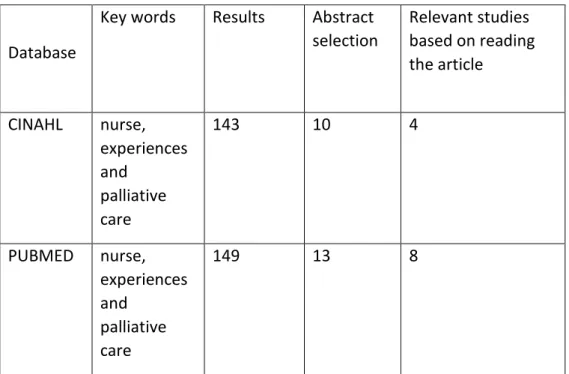
final number of articles does not include duplicate articles. Table 3 illustrates data search. The appendix 1 shows all articles reviewed.
Table 3. Data search
3.3
Data analysis
Data analysis was based on 4 steps: getting the general sense of the whole
statement; re-reading the text to find sentences for the purpose of answering our research questions ; summarizing related sentences into parts; finally, finding descriptive concept for the original sentences (Giorgi 1985).
When all the articles were carefully read and restored, the expressions summarizing the research questions were written into a list. In the clustering stage of data analysis, similarities and differences between reduced expressions were found. Subcategories were generated during this period. The cluster phase gives the names of the contents that represent them. The last stage analyzed the
Database
Key words Results Abstract
selection Relevant studies based on reading the article CINAHL nurse, experiences and palliative care 143 10 4 PUBMED nurse, experiences and palliative care 149 13 8
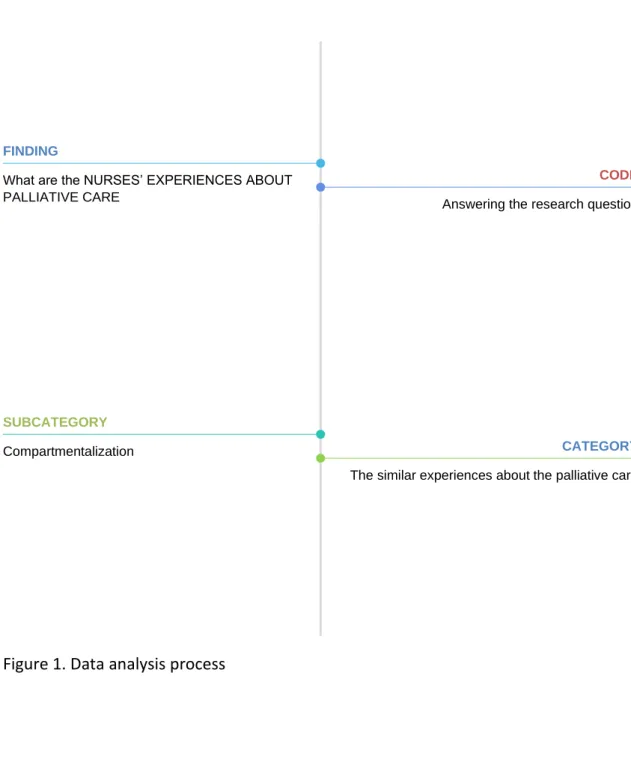
similarities and differences of each subcategory the content was linked to the main category (Peersman 2014). Figure 1 shows the data analysis process.
Figure 1. Data analysis process
4
Results
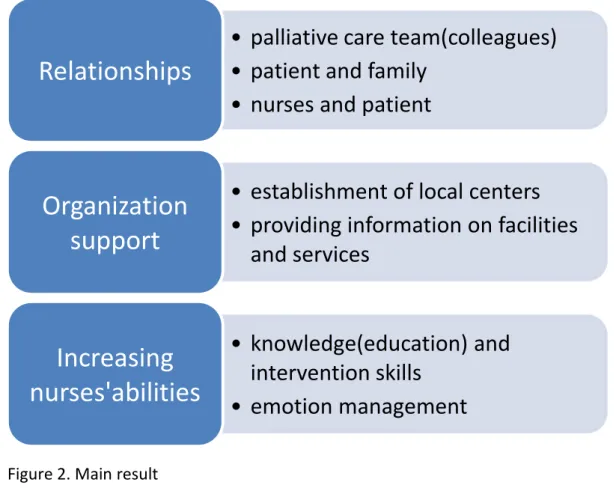
Results of the analysis are presented in Figure 2, illustrating the main categories and subcategories.
FINDING
What are the NURSES’ EXPERIENCES ABOUT PALLIATIVE CARE
SUBCATEGORY
Compartmentalization CATEGORY
The similar experiences about the palliative care
CODE
Figure 2. Main result
4.1
Relationships
Nurses work with colleagues in interdisciplinary teams to share knowledge, skills and support from palliative care teams, and good teamwork can optimize patient outcomes. Sharing day's work with colleagues can help ease nervousness. The sharing of knowledge and skills will be very diverse and will enhance each other's learning (Nokwanda et al. 2014). Experience and the development of good relations with patients and family members are said to be important factors in alleviating suffering, thereby reducing the moral burden on district nurses (Holmdahl et al.2013, Hendricks-Ferguson et al. 2015). Patients who have collected sufficient information are prepared in advance with the necessary medicines and medical supplies. Equipment for patients, such as beds, analgesic pumps, professional replacement equipment. This is considered important to maintain pain control, comfort, and quality of patient care (Hilding 2018).
•
palliative care team(colleagues)
•
patient and family
•
nurses and patient
Relationships
•
establishment of local centers
•
providing information on facilities
and services
Organization
support
•
knowledge(education) and
intervention skills
•
emotion management
Increasing
nurses'abilities
4.2
Organization support
Palliative care services and facilities can help meet the multifaceted needs of these patients and their families. Improve the availability of services and facilities, improve the capacity of spiritual service providers and volunteers, and better understand the funds available for services and facilities. The contact person can be someone (such as a regional nurse) or a regional center, and the palliative care network should be connected to the area to ensure familiarity with all local services and facilities. Services and facilities should have the opportunity to promote their availability in local multidisciplinary meetings or training courses organized by local organizations. It was found that psychological service, social service and spiritual service were not included in the classical care model of palliative care. From the Koper’s research, most of the interviewees think these services are not their job. Participation of all in services and facilities is certainly not always necessary. As expected, greater involvement and familiarity with these services will be beneficial to both patients and their families (Koper et al. 2018).
4.3
Increasing nurses
’
abilities
All the nurses in the studies agreed that in palliative care, the quality of care required for the patient was high as the patient's condition worsened. It is always necessary to carefully evaluate the patient's symptoms and make the right decision (Törnquist et al. 2013.Chong & Poon 2011). Some patients have multiple symptoms and use complex medications in the palliative ward to determine the need for nurses to participate in training for pain and symptom control
(Nokwanda et al. 2014). The bond between the nurse and the patient/family has been established for a long time and it has had a great impact on the nurses because of their emotional involvement and responsibility. On a personal level, some nurses later found it difficult to cope with their emotions, because the special relationship of sharing bad news exists between them and the patients' families. Fear and blame is a raised issue. Many nurses experienced the expected distress. Learning how to "turn off" when leaving a patient, "maintain a delicate balance," "be tough," and even maintain "emotional detachment" are factors that
most nurses consider the most important job skill. Unexpected deaths are sometimes imagined and called "failures" by nurses. Nurses complain that they often have to balance between traditional task-oriented nurses and sympathetic friends (Chong & Poon 2011, Uren et al. 2013). The younger nurse could show negative uncaring attitude and get used to death. Some of the nurse feel joy if they help patients to improve their quality of life during the period of disease control(Nokwanda et al. 2014).
5
Discussion
5.1
Key results
Nurses must serve patients day and night. Uncertain factors and emergencies often occur in nursing work, and patients' specific conditions and needs vary greatly, requiring nursing organizations to make timely and rapid response and constantly improve the quality of nursing. Providing quality and safe nursing services for patients is far from being able to meet the requirements of nursing work with the efforts of only one or several nurses. Nurses must rely on each other, support each other, work in a team, and work together under the
motivation of team spirit, in order to achieve personal and organizational success (Nokwanda et al. 2014). Meanwhile, the cultivation of team spirit and the
establishment of nursing team can effectively promote the development of nursing organization, nursing profession and individual nurses. To improve the ability and quality of nurses is a very important content in professional nursing practice. The ability of nurses is an important factor affecting the quality of
nursing. Nurses have the right to independently make clinical decisions in terms of the care and care for patients (Törnquist et al. 2013, Chong & Poon 2011).
Therefore, as a professional nurse, its function is not only to mechanically implement the doctor's orders, but also to make effective nursing decisions and solve the existing or potential problems of patients by collecting patients'
information and forming correct judgment. Nurses' self-education (Chong & Poon 2011) and mastery of theoretical knowledge are the preconditions for nurses'
clinical decision-making ability. The theory guides the practice, the nurse has the rich theory knowledge, can discover the patient's condition change in time in the clinic, can obtain the rich experience in the practice. Otherwise, if the knowledge reserve of nurses is insufficient, it is likely to accumulate practical experience in the lessons of failure, and therefore pay a certain price.
If the nurse's negative emotions are constant and present, they can have a negative effect on both the nurse and the patient. Therefore, it is also important for nurses to do well in emotion management. Everyone has emotions, but most lack the necessary understanding and attention. If the negative emotions are not timely catharsis, the light is bad, heavy will make people to collapse; positive emotions stimulate the nurse's enthusiasm and potential for work and affect the patient's body and mind. Various emotions affect the work and life of nurses to varying degrees, and also affect the patient's condition. Only by understanding emotions, can we manage and control them and give full play to their positive effects. Emotion management requires identifying, analyzing and managing
emotions. Working and being happy is the goal of emotion management (Chong & Poon 2011, Uren et al. 2013, Nokwanda et al. 2014).
Palliative care has not been widely used in the world, this article can provide theoretical basis and technical guidance for it. Research into palliative care is necessary. The implementation of palliative care is conducive to improving the quality of health care services, better reflecting patient-centered care rather than diseases. The future study of palliative care should be clinical research. Only when we actually invest in clinical research can we make continuous progress,
otherwise, we will stay in the same place.
5.2
Limitations
This literature review has some limitations. First of all, both authors are beginners to the research and may affect the quality of the research in terms of data
presentation and reliability. Secondly, because the authors are students, the knowledge obtained is limited, the article might have certain bias. Thirdly, in
terms of language, the mother tongue of the two authors is Chinese, but most of the research articles are in English, so there might be certain errors in translation and expression. Free articles for JAMK students were selected in the selection criteria, and thus some articles were not found. The databases used were also only two. Therefore, there will be some aspects not considered in the conclusion.
5.3
Ethical considerations and reliability
From the study of Wager and Wiffen (2011), we take the following ethical principles into consideration: to avoid plagiarism. Plagiarism is the use of other people's words and pictures, unconfirmed data, ideas or other original works or license them and claim them as your own work. The most extreme form of plagiarism is to take the whole work and redistribute it as your own. In this literature review, appropriate citations are required, and the description of the study is acceptable.Ensuring accuracy is another principle. First the title of the reference was read to determine whether it can be included, and then reading the whole article to find the valuable part answering research question. At the same time, it was necessary to search for problems several times and collect data for analogy. (Wager & Wiffen 2011).
The discussion and criticism of the data by the two authors help to improve the reliability of the research. The two authors were very responsible and planned to carry out data extraction and analysis to ensure the correctness of the data. It was also discussed which data can reach a consensus result. Articles written by a single author to avoid excessive subjectivity were excluded. Articles from several
different countries were selected for this review, including Germany, Singapore, the Netherlands, the United States, Norway, Canada, South Africa, Sweden, and Iran. These different settings allow the results of this study to be applied to nurses in different countries, increasing the range of articles available.
6
References
Bam NE, Naidoo JR, 2014. Nurses experiences in palliative care of terminally-ill HIV patients in a level 1 district hospital. Curationis (37), 1-9.
Bettany-Saltikov, J. 2012. How To Do A Systematic Literature Review in Nursing: A Step By Step Guide. Mcgraw-Hill Education. UK.
Center to Advance Palliative Care, www.capc.org (accessed 3.3.2020)
Chong PH, Poon WH. 2011. The lived experience of palliative homecare nurses in Singapore. Singapore Medical Journal. Mar;52(3):151-7.
Danielsen, B. V., Sand, A. M., Rosland, J. H., & Førland, O. 2018. Experiences and challenges of home care nurses and general practitioners in home-based palliative care - a qualitative study. BMC palliative care, 17(1), 95(2018).
https://doi.org/10.1186/s12904-018-0350-0
de Castro de Oliveira F, Cleveland LM, Darilek U, Borges Silva AR, Carmona EV, 2018, Brazilian Neonatal Nurses' Palliative Care Experiences. J Perinat Neonatal Nurs. 32(4):E3-E10.
Fawole OA; Dy SM; Wilson RF; Lau BD; Martinez KA; Apostol CC; Vollenweider D; Bass EB; et al. 2013. "A systematic review of communication quality improvement interventions for patients with advanced and serious illness". J Gen Intern Med. 28 (4): 570–7.
Gao W,2012, Palliative Care in China: Current Status and Future Directions. J Palliative Care Med 2:e113.
Giorgi A. 1985. Phenomenology and Psychological Research. Duquesne University Press, Pittsburg, PA, USA.
Goldstein, N. E., Cohen, L. M., Arnold, R. M., Goy, E., Arons, S., & Ganzini, L. 2012. Prevalence of formal accusations of murder and euthanasia against
physicians. Journal of palliative medicine, 15(3), 334-339.
Hendricks-Ferguson, V. L., Sawin, K. J., Montgomery, K., Dupree, C., Phillips-Salimi,
C. R., Carr, B., & Haase, J. E. 2015. Novice Nurses’ Experiences With Palliative and End-of-Life Communication. Journal of Pediatric Oncology Nursing.
Hilding, U., Allvin, R., & Blomberg, K. 2018. Striving for a balance between leading and following the patient and family - nurses' strategies to facilitate the transition from life-prolonging care to palliative care: an interview study. BMC palliative care, 17(1).
Holmdahl S, Sävenstedt S, Imoni R.2013. Parenteral nutrition in home-based palliative care: Swedish district nurses experiences. Scandinavian Journal of Caring Sciences.
Hui D; Elsayem A; De la Cruz M; Berger A; Zhukovsky DS; Palla S; Evans A; Fadul N; et al. 2010. "Availability and integration of palliative care at US cancer centers". JAMA. 303 (11): 1054–61.
Kaasalainen S, Brazil K, Williams A, Wilson D, Willison K, Marshall D, Taniguchi A, Phillips C. 2014. Nurses' experiences providing palliative care to individuals living in rural communities: aspects of the physical residential setting. Rural and Remote Health; 14: 2728. Available: www.rrh.org.au/journal/article/2728
Kavalieratos, Dio; Corbelli, Jennifer; Zhang, Di; Dionne-Odom, J. Nicholas;
Ernecoff, Natalie C.; Hanmer, Janel; Hoydich, Zachariah P.; Ikejiani, Dara Z.; Klein-Fedyshin, Michele; Zimmermann, Camilla; Morton, Sally C.; Arnold, Robert M.; Heller, Lucas; Schenker, Yael. 2016. "Association Between Palliative Care and Patient and Caregiver Outcomes". JAMA. 316 (20):2104-2114.
Koper, I., Pasman, H., & Onwuteaka-Philipsen, B. D. 2018. Experiences of Dutch general practitioners and district nurses with involving care services and facilities in palliative care: a mixed methods study. BMC health services research, 18(1), 841.
Lai X., Wong F., Ching S., 2018, The experience of caring for patients at the end-of-life stage in non-palliative care settings: a qualitative study, BMC Palliat Care 17: 116
Lipsey, M. W., & Wilson, D. 2001. Practical meta-analysis. London: Sage Publications.
Lynn, J. 2004. Sick to death and not going to take it anymore!: reforming health care for the last years of life. Berkeley: University of California Press. p. 72. Lundy, P. 2016.The Brief History of End-of-Life and Comfort Care and its Ever-Present Myths.
Mistry, B., Bainbridge, D., Bryant, D., Tan Toyofuku, S., & Seow, H. 2015. What matters most for end-of-life care? Perspectives from community-based palliative care providers and administrators. BMJ open, 5(6), e007492.
National Institute on Aging, 2017, What Are Palliative Care and Hospice Care? Peersman, G. 2014. Overview: Data Collection and Analysis Methods in Impact Evaluation, Methodological Briefs: Impact Evaluation 10, UNICEF Office of Research, Florence.
Pennbrant S., Tomaszewska M., Penttilä GL. 2015. Nurses’ experience of caring for
palliative-stagepatients in a hospital setting in Sweden, Clinical Nursing Studies Vol. 3, No. 2:97-108.
Seyedfatemi N, Borimnejad L, Mardani Hamooleh M, Tahmasebi M. 2014. Iranian
nurses’ perceptions of palliative care for patients with cancer pain. International Journal of Palliative Nursing.
Stajduhar K, Funk L, Roberts D, McLeod B, Cloutier-Fisher D, Wilkinson C, et al. 2010. Home care nurses' decisions about the need for and amount of service at the end of life. Journal of Advanced Nursing ; 67(2): 276-286.
Sweden and the 2030 Agenda — Report to the UN High Level Political Forum 2017 on Sustainable Development, 2017.
Törnquist A, Andersson M, Edberg AK. 2012. In search of legitimacy--registered nurses' experience of providing palliative care in a municipal context. Scand J Caring Sci. :651-8.
Uren, S., Graham, T. 2013. "Subjective Experiences of Coping Among Caregivers in Palliative Care" OJIN: The Online Journal of Issues in Nursing Vol. 18 No. 2.
Wager E., Wiffen PJ., 2011, Ethical issues in preparing and publishing systematic reviews, Journal of Evidence-Based Medicine ISSN 1756-5391
Walker H, Waterworth S, 2017, New Zealand palliative care nurses experiences of providing spiritual care to patients with life-limiting illness. Int J Palliat Nurs. 23(1):18-26.
7
Appendices
Appendix 1. The reviewed articles Author(s ) Publishing year and country Title Research method Main findings Koper I, Pasman HRW, Onwutea ka-Philipsen BD. 2018 The Netherlan ds. Experiences of Dutch general practitioners and district nurses with involving care s ervices and facilities in palliative care: a mixed methods study. Sequential mixed methods consisting of an online questionnaire with structured and open questions Improvements in three areas: establishment of local centers giving information on available services and facilities, presentation of services and facilities in local multidisciplinary meetings, and support organizations to proactively offer their facilities and services.
Hendrick s-Ferguson VL, Sawin KJ, Montgo mery K, Dupree C, Phillips-Salimi CR, Carr B, Haase JE. 2015 USA Novice Nurses' Experiences Wit h Palliative and End-of-Life Communication . Qualitative-descriptive study
Novice (or beginning) pediatric oncology nurses need substantial education, support, and mentorship from experienced nurse mentors to learn and acquire effective PC/EOL communication skills necessary to engage in caring and sensitive discussions with dying children and their families. Danielse n BV, Sand AM, Rosland JH, 2018 Norway Experiences and challenges of home care nurses and general practitioners in home-based palliative care - Qualitative research design with four focus groups
Optimum palliative care at home depends on close collaboration and dialogue between the patient, family, home care nurses and general practitioner.
Førland O. a qualitative study. Kaasalain en S, Brazil K, Williams A, Wilson D, Willison K, Marshall D, Taniguch i A, Phillips C. 2014 Canada Nurses' experiences providing palliative care to individuals living in rural communities: aspects of the physical residential setting. Qualitative research: individual telephone interviews The characteristics of working in a rural community and how it influences their
perception, described of their role and how the challenges of working within the physical constraints of a rural residential setting impeded their care provision Chong PH, Poon WH. 2011 Singapore The lived experience of palliative homecare nurses in Singapore. Qualitative research: hermeneutic phenomenolo gy. Introduction to palliative care; Initial experiences; Challenges; Working in a team; Working with the doctor; and Support. The nurse assumes a
prominent role as part of a team. Although it can be depressing and trying at times, she grows to see this role as both a privilege and a calling. Uren S, Graham m T. 2013 South Africa Subjective experiences of coping among caregivers in palliative care. Qualitative research: interpretative , phenomenolo gical paradigm,
finding a support person; finding the right support person; surviving the high workload; seeking alternative means of support; juggling home and work difficulties; potentially failing to cope; and
disillusionment versus acceptance.
Hilding, U., Allvin, R., Blomber g, K. 2018 Sweden Striving for a balance between leading and following the patient and family - nurses' strategies to facilitate the transition from life-prolonging care to palliative care: an interview study. Interview and content analysis.
Getting to know the patient and creating a relationship, Providing support, Adapting to individuals' needs and Enabling conversations. Mistry, B., Bainbrid ge, D., Bryant, D., Tan Toyofuku , S., Seow, H. 2015 Canada What matters most for end-of-life care? Perspectives from community-based palliative care providers and administrators. Interview and phenomenolo gical approach
Addressing the Non-physical Needs, Healthcare Teams' Nature of Palliative Care Delivery, Patient Wishes are Honoured,
Addressing the Physical Needs, Preparing for and Accepting Death,
Communication and Relationship
Development, and Involving and Supporting the Family. Solveig Holmdah l , Stefan Savenste dt and RoseMar ie Imoni 2013, Sweden. Parenteral nutrition in home-based palliative care: Swedish district nurses experiences A qualitative approach was adopted using thematic content analysis of semi-structured interviews.
Experience and the development of a good relationship with the patient and the family were said to be important factors in order to decrease agony and by that the moral burden among the district nurses. As
experience seems to be an important factor in reducing loneliness and the sense of insufficiency. Nokwan da E. Bam Joanne R. Naidoo 2014 South Africa Nurses experiences in palliative care of terminally-ill HIV patients in a level 1 district hospital Qualitative research using Husserl’s approach of phenomenolo gy and Giorgi’s steps of analysis
Palliative care made the nurses conscious of enabling them to be more sensitive, compassionate and dedicated to caring for their patients. The social networking that enabled nurses to collaborate with colleagues in the interdisciplinary teams and shared knowledge, skills and support within the palliative care team in order to optimise patient outcomes. Agneta Tornquis t Magdale na Andersso n and Anna-2013 Sweden In search of legitimacy – registered nurses’ experience of providing palliative care in a municipal context Descriptive qualitative method based on focus group interviews
Nurses lacked proper support and
prerequisites for providing high- quality palliative care to older dying patients.The results pinpoint the importance of increased acknowledgement of
Karin Edberg
nurses’ knowledge and
skills. Seyedfat emi N, Borimnej ad L, Mardani Hamoole h M, Tahmase bi M. 2014, Iran. Iranian nurses’ perceptions of palliative care for patients with cancer pain Conventional content analysis
The nurses believed palliative care for
patients with cancer pain includes both
management of physical pain and facilitation of psychological
empowerment.
Therefore, it is necessary for nurses performing palliative care for cancer patients to have
adequate information about the different kinds of pain such patients suffer .