Abstract—Post-disaster reconstruction is a highly complex
process that requires many resources, capacities, and skills. Unfortunately, the general population and humanitarian organizations in Peru lack these requirements, whether due to a lack of experience or interest. Post-disaster housing reconstruction programs play a very important role in early recovery by victims. Such housing also helps restore the dignity and the means of subsistence of communities affected by a disaster.
In March 2017, the Piura region was affected by the Coastal El Niño phenomenon. This weather event included heavy rainfall of a kind not seen in the last 18 years, causing the Piura River to overflow its banks and leaving behind over 105,369,000 damaged houses in the region. In response to this event, the Universidad de Piura (UDEP) developed a reconstruction program for 12 post-disaster housing units, known as “Vivienda Segura” (“Safe Housing”), in the towns La Campiña and Pedregal Grande, in the district of Catacaos, Piura.
In view of the work done by the professionals from the UDEP, the objective of this article is to determine quality indicators for the reconstruction of post-disaster housing based on two key standards: habitability and durability. The methodology used is that of the case study, which includes interviews with experts, professional involved in this reconstruction program, and above all, members of the affected families. These quality indicators, which are currently nonexistent in Peru, will serve as the basis for the reconstruction of different types of post-disaster housing in a range of scenarios.
Index Terms—Coastal El Niño, disasters, indicators, post-disaster housing, quality.
I. INTRODUCTION
NE of the most visible consequences following a disaster is the destruction of housing, leaving thousands of people homeless [1]. In 2004, more than 1.7 million people were left without a home after the earthquake and tsunami that struck Southeast Asia (Indonesia, Sri Lanka, Malaysia, India, and Thailand) [2]. Over 1.5 million people lost their homes as a result of the earthquake in Haiti in January 2010 [3].
This paper is result of the Project “Vivienda Segura”. This project is developed by Universidad de Piura and funded by PiuraenAcción.
Manuscript received, July 30th, 2018; revised August 10th, 2018. C. Ramirez was a student of the engineering department of the
In Peru, in March of 2017, a total of 447,018 dwellings were left collapsed, uninhabitable, or otherwise affected by the Coastal El Niño phenomenon [4]. This event battered the country’s northern and southern regions, with devastating effects for the population.
The occurrence of natural disasters around the world continues to rise. This poses a higher risk in underdeveloped countries due to the uncontrolled demographic growth that leads populations to settle in areas of greater vulnerability [5].
In order for affected communities to recover their means of subsistence, post-disaster reconstruction must begin as soon as possible. Housing plays a fundamental role in helping victims of natural disasters to recover. Losing a home is not merely a form of physical deprivation; it is a loss of dignity, identity, and privacy [6]. It is for this reason that the reconstruction of post-disaster housing must include minimum quality requirements with regard to habitability and durability.
This article proposes the minimum quality standards to be met by post-disaster housing to ensure that victims are able to live and recover in stable, dignified conditions. This investigation is based on experience in the reconstruction of post-disaster housing in towns of La Campiña and Pedregal Grande as a consequence of the Coastal El Niño phenomenon in 2017.
II. CONCEPTUALIZATION OF POST-DISASTER SHELTER AND HOUSING
To clarify the conceptualization, it is important to emphasize the Spanish term “refugio post-desastre” refers to sheltering and the term “vivienda post-desastre” refers to housing in the English-language bibliography
.
The terms post-disaster shelter and post-disaster housing have a very ambiguous meaning. Experts in the area, such as Quarantelli, define post-disaster shelters as a place to live during the period following the disaster, while suspending daily activities. Post-disaster housing, meanwhile, denotes a return to household responsibilities and daily routine [7].
This same author classifies post-disaster sheltering and housing into four stages: emergency shelter is a place where disaster victims can stay for a short period of time immediately following the emergency; temporary shelters are used for an expected short stay, and may include tents or mass shelters; temporary housing is a place where victims
Quality Indicators in Post-Disaster Housing:
Case of the 2017 Coastal El Niño, Piura
Claudia C. Ramirez, Eduardo A. Sanchez,
Member IAENG
, Susana Vegas
III. CASE OF THE 2017COASTAL EL NIÑO
A. Temporary post-disaster sheltering
Temporary housing has been criticized for being unnecessary, too expensive, too late and drawing resources away from permanent reconstruction [9].
Following a disaster, the main purpose of a shelter is to contribute to survival against the elements: rain, wind, cold, and/or sun [10]. The most important thing about temporary shelters is how fast they can be provided. The longer the response time, the higher the likelihood that disaster victims may die. Temporary shelters can be erected by the victims themselves using any materials they may have at hand, such as plastic, cardboard boxes, blankets, corrugated iron sheets, tents, etc. [11]
In March 2017, the Piura River hit a historic flow volume of nearly 3,500 m3/s [12]. The levies were unable to withstand the river’s flow volume, causing the river to overflow into the zone of Castilla, Piura, and Bajo Piura, leaving 105,369 homes destroyed or otherwise affected, in addition to causing other damage [4]. The population was forced to evacuate from the zone, leaving behind all of their belongings. Many of the victims ended up in emergency shelters, such as relatives’ homes, churches, schools, and even cemeteries.
[image:2.595.49.281.567.698.2]The Instituto Nacional de Defensa Civil (National Institute of Civil Defense, or INDECI) was responsible for distributing multifamily tents in the most severely affected areas (Fig. 1). Most of the tents were set up in the camps located at Kilometer Markers 975 and 980 of the North Carretera Panamericana Highway, to which the majority of refugees from Pedregal, La Campiña, and Cura Mori were evacuated. These tents had a capacity of 5 persons, with an umbrella-type roof, one door, and three windows. Due to the high temperatures registered in the area, however, it became unbearable to stay in the tents during the day, while water from the constant rainfall leaked in through the tent roofs at night. As a result, the tents were considered low-quality.
Fig.1. Damaged people resettled in temporary shelters days after the flood
On the other hand, a health emergency was declared in the city of Piura due to the 50,000 people affected by the disaster, with another 41 people dying from dengue fever [13]. Dengue fever is an epidemic disease that brook out due to the precarious conditions in which the population was living.
B. Permanent post-disaster housing
Unlike sheltering, post-disaster housing involves the recommencement of household responsibilities and activities [7]. In a post-disaster shelter, victims cannot return to their day-to-day, making it unsustainable for them to live there for much time [1]. Beyond basic survival, however, the role played by post-disaster housing is one of psychological, physical, and social wellbeing [10]. Indeed, post-disaster housing is a proven catalyst in enabling families to wean themselves off dependence on outside assistance, and take steps toward self-help, thus enabling and empowering communities to understand and learn about their own needs [10].
In the Piura region, INDECI provided 6,500 temporary housing units, known by the name of Unidad de Vivienda Inicial (Initial Housing Unit, or UVI) (Fig. 2). These modules measure twenty square feet, with wooden walls and floors, fiber cement lining, and five windows [14]. Of that total, 3,000 housing units were sent to the San Pablo, San Pedro, and Santa Rosa camps, while the remaining housing units were located at the most severely affected points of the city. According to Edmer Trujillo, the Minister of Housing, Construction, and Sanitation of Peru, the delivery of the UVIs was an intermediate step prior to the definitive construction of post-disaster housing [15]. This step was expected to make substantial improvements to the living conditions of the disaster victims, who had been residing in temporary shelters (tents) up to that point.
[image:2.595.305.547.568.698.2]Reference [1] argue that a considerable part of temporary post-disaster housing is unsustainable and culturally inadequate due to failed strategies, misunderstandings regarding users’ real needs, and mistaken concepts when dealing with local conditions and resources.
IV. IMPLEMENTATION OF THE PILOT POST-DISASTER HOUSING
During the emergency brought on by the coastal El Niño, professors from the Universidad de Piura paid close attention to the needs of their most vulnerable students. In response to this situation, the Universidad de Piura, with funding from Piura en Acción and the Romero Foundation, decided to undertake a reconstruction project in the zone of La Campiña and Pedregal Grande in the Lower Piura Valley. This project, which was initially called “Piso Firme” (“Firm Ground” or “Firm Steps”), involved reinforcing 264 homes in the area with cinder blocks (Fig. 3). The change from dirt to cement floors leads to significantly improved cognitive development in minors and increases the happiness, confidence, and self-esteem of adults.
Subsequently, with the goal of continuing to improve the victims’ quality of life, the Universidad de Piura proposed the reconstruction of collapsed homes, taking the UDEP student home as a pilot. And so it was that the “Vivienda Segura” project came into being.
[image:3.595.50.282.406.534.2]The project called for the reconstruction of housing based on the basic needs of residents. The quality of the home would be reflected in the quality of life of its occupants. The quality evaluation was based on the guidelines set out in the research conducted by Jo Da Silva in his article “Quality and Standards in Post-Disaster Shelter,” in which he proposes two key parameters for the reconstruction of housing: habitability and durability.
Fig. 3. Differences between dirt floor and cement floor following the Firm
Ground project.
A. Habitability and durability
From the occupant’s point of view, habitability and durability are the main concerns. Can my family live here, and for how long? Those involved in the reconstruction program must meet victims’ needs quickly, effectively, and efficiently [10].
The research conducted by Da Silva suggests twelve qualities that contribute to the habitability of post-disaster housing: weatherproofing, temperature, ventilation, light, privacy, space, kitchen, water and sanitation, vector control, physical integrity, safety, and structural soundness. And also four qualities that contribute to the durability of post-disaster
Habitability
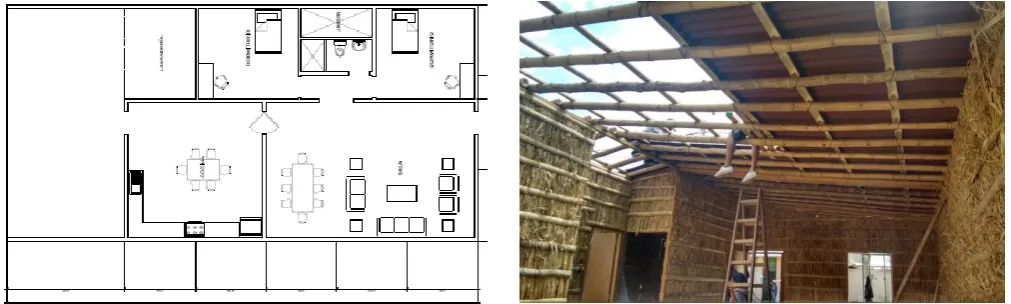
--Pitched roofs were selected for weatherproof, post-disaster housing, due to the constant rains in the area. Tornillo wood was used for the roof structure, with whole bamboo canes and Fibraforte sheeting for the covering (Fig. 4).
--Ventilation and temperature: The height of roofs and the material used in the walls (reeds) of the house helps to facilitate ventilation of the home and, most importantly, to moderate the high temperatures typical experienced in Piura (Fig. 5).
--Light: Due to their low income condition, victims are unable to pay for electricity. In response to this situation, UDEP professionals are developing a solar panel that will be installed on the roofs of houses, to take full advantage of a natural resource.
--Space and privacy: The house has an area of 200m2
divided into a living room, dining room, kitchen, bathroom, laundry room, bedrooms and a rear patio. Each of these rooms has doors and windows, afforded a level of privacy not previously experienced by residents (Fig. 6).
--Kitchen: It was decided that the ideal location for this area would be the back of the house, because residents cook using wood and/or coal, which emit gases harmful to the health of occupants.
--Water and sewage: Because the zone does not possess sewage services, a biodigestor tank was installed to facilitate organic decomposition under anaerobic conditions.
--Vector control: Thanks to the cement floor, the incidence of anemia, parasites and depression among occupants has decreased markedly.
--Safety and security: The structure of the house is made of reeds, bamboo canes and tornillo wood. Each room in the house has a door and lock, providing peace of mind for the occupants (Fig. 7).
--Structural soundness: Concrete blocks were installed to replace the bases. The wood of the structure is twice as deep, and walls were reinforced with Guayaquil cane to provide the house with greater rigidity (Fig. 8).
Durability
--Structural integrity: To reinforce the structure of the house, the external and internal walls will be covered with local material, in order not to lose the essential character of a rural home.
--Choice of materials: Materials from the area such as reed, Guayaquil cane, tornillo wood and sand were used because of their accessibility and ease of transportation (Fig. 9).
--Repair and maintenance: The house has been rebuilt by its occupants, with the help of neighbors and volunteers. The repair and maintenance of the same will be facilitated by the fact that no specialized labor will be required.
--Adaptability: Not applicable to this case study, because the reconstruction was conducted in the same place where the victims lived.
Fig. 6. Pilot House Blueprint.
[image:4.595.59.560.262.445.2]Fig. 8. Solid Structure of the house base.
Fig. 7. Materials of the house.
Fig. 4. Implementation of the post-disaster housing roof.
Fig. 5. The ventilation of the house is due to the roofs high and walls material.
[image:4.595.260.552.495.678.2]V. CONCLUSIONS
We consider that all the qualities of habitability and durability proposed serve to provide the characteristics required for post-disaster housing. We therefore authorize for use the proposal submitted by Da Silva, the quality indicators of which demonstrate its viability for use in the reconstruction of post-disaster housing in Peru.
This case study positively fulfills all the qualities of habitability and durability required. However, not all the qualities required were obtained through the design and implementation of housing; some are inherent to the project, such as the water service, which was already available in the area.
In the case of the habitability indicator, a single characteristic of the dwelling may encompass more than one quality. For example, the high ceiling and the material employed in the house both favor the fulfillment of ventilation and temperature requirements.
This study constitutes a clear example of the need for participation by non-humanitarian organizations in the reconstruction of post-disaster housing. It is very important that organizations (both humanitarian and non-humanitarian) combine their efforts and maximize their knowledge and experience, with the aim of contributing to the development of future reconstruction programs, based upon the short and long-term needs of residents: namely, habitability and durability.
REFERENCES
[1] Felix, D., Branco, J. & Feio, A. (2013). Temporary housing after disasters: A state of the art survey. Habitat International, 40, 136-141.
[2] Akkoc, R. (2014, Dic 19). The Telegraph. Available:
https://www.telegraph.co.uk/news/worldnews/asia/11303114/2004-Boxing-Day-tsunami-facts.html
[3] BBC. (2010, Jan 10). Haiti to relocate 400,000 homeless outside capital. Available: http://news.bbc.co.uk/2/hi/americas/8472958.stm [4] INDECI. (2018). Boletín estadístico virtual de la gestión reactiva.
Dirección de políticas, planes y evaluación (8). Available:
https://www.indeci.gob.pe/objetos/secciones/MTc=/MjI0/lista/MTAw Mw==/201802261608351.pdf
[5] Reyes, L. (2015). Localización de instalaciones y ruteo de personal especializado en logística humanitaria post-desastre - caso inundaciones.
[6] Barakat, S. (2003). Housing reconstruction after conflict and disaster.
(43). Overseas development institute.
[7] Quarantelli, E. (1982). Sheltering and housing after major community disasters: case studies and general conclusions.
[8] Barbosa, L. (2013). Improving temporary shelters after flood disasters with the participation of displaced people.
[9] Johnson, C. (2007). Impacts of prefabricated temporary housing after disasters: 1999 earthquakes in Turkey. Habitat International, 31, 36-52.
[10] Da Silva, J. (2007). Quality and Standars in post-disaster Shelter. The Structural engineer, 85, 25-32.
[11] INDECI. (2017). Estado Situacional de la Emergencia. Available:
http://sinpad.indeci.gob.pe/sinpad/emergencias/Evaluacion/Reporte/r pt_eme_situacion_emergencia.asp?EmergCode=00084822
[12] Bashawri, A., & Garrity, S. &. (2014). AN OVERVIEW OF THE DESIGN OF DISASTER RELIEF SHELTERS. Procedia Economics
and Finance (18), 924-931.
[13] MINSA. (2017). Numero de casos de dengue. Años 2012 - 2016 y
http://rpp.pe/peru/actualidad/video-4000-modulos-de-vivienda-fueron-instalados-para-damnificados-en-piura-noticia-1050200
[15] República, L. (2017, Apr 27). En Piura se instalarán las primeras 6500 casas prefabricadas. Available: